
K-Map Simplification COE 202 Digital Logic Design
EM
Published · 46 slides · 0 views

1 / 1



Description
K-Map Simplification COE 202 Digital Logic Design Dr. Aiman El-Maleh College of Computer Sciences and Engineering King Fahd University of Petroleum and Minerals Outline Introduction Two-Variable K-Maps Three-Variable K-Maps Four-Variable
Related Topics
Share
Embed code
Download this presentation From Below
"K-Map Simplification COE 202 Digital Logic Design" is the property of its rightful owner. Permission is granted to download and print the materials on this website for personal, non-commercial use only, and to display it on your personal computer provided you do not modify the materials and that you retain all copyright notices contained in the materials. By downloading content from our website, you accept the terms of this agreement.
Presentation Transcript
01
K-Map Simplification COE 202
Digital Logic Design
Dr. Aiman El-Maleh
College of Computer Sciences and Engineering
King Fahd University of Petroleum and Minerals<br>
Digital Logic Design
Dr. Aiman El-Maleh
College of Computer Sciences and Engineering
King Fahd University of Petroleum and Minerals<br>
02
Outline Introduction
Two-Variable K-Maps
Three-Variable K-Maps
Four-Variable K-Maps
Prime and essential prime implicants
SOP simplification
POS simplification
Simplification using don’t care conditions
Five-Variable K-Maps
Six-Variable K-Maps<br>
Two-Variable K-Maps
Three-Variable K-Maps
Four-Variable K-Maps
Prime and essential prime implicants
SOP simplification
POS simplification
Simplification using don’t care conditions
Five-Variable K-Maps
Six-Variable K-Maps<br>
03
Introduction Even though Boolean expressions can be simplified by algebraic manipulation, such an approach lacks clear regular rules for each succeeding step and it is difficult to determine whether the simplest expression has been achieved.
In contrast, Karnaugh map (K-map) method provides a straightforward procedure for simplifying Boolean functions.
K-maps of up to 4 variables are very common to use. Maps of 5 and 6 variables can be made as well, but are more cumbersome to use.<br>
In contrast, Karnaugh map (K-map) method provides a straightforward procedure for simplifying Boolean functions.
K-maps of up to 4 variables are very common to use. Maps of 5 and 6 variables can be made as well, but are more cumbersome to use.<br>
04
Introduction Simplified expressions produced by K-maps are always either in the SOP or the POS form.
The map provides the same information contained in a Truth Table but in a different format.
The objectives of this unit are to learn:
1. How to build a 2, 3, or 4 variables K-map.
2. How to obtain a minimized SOP or POS function using K-maps.<br>
The map provides the same information contained in a Truth Table but in a different format.
The objectives of this unit are to learn:
1. How to build a 2, 3, or 4 variables K-map.
2. How to obtain a minimized SOP or POS function using K-maps.<br>
05
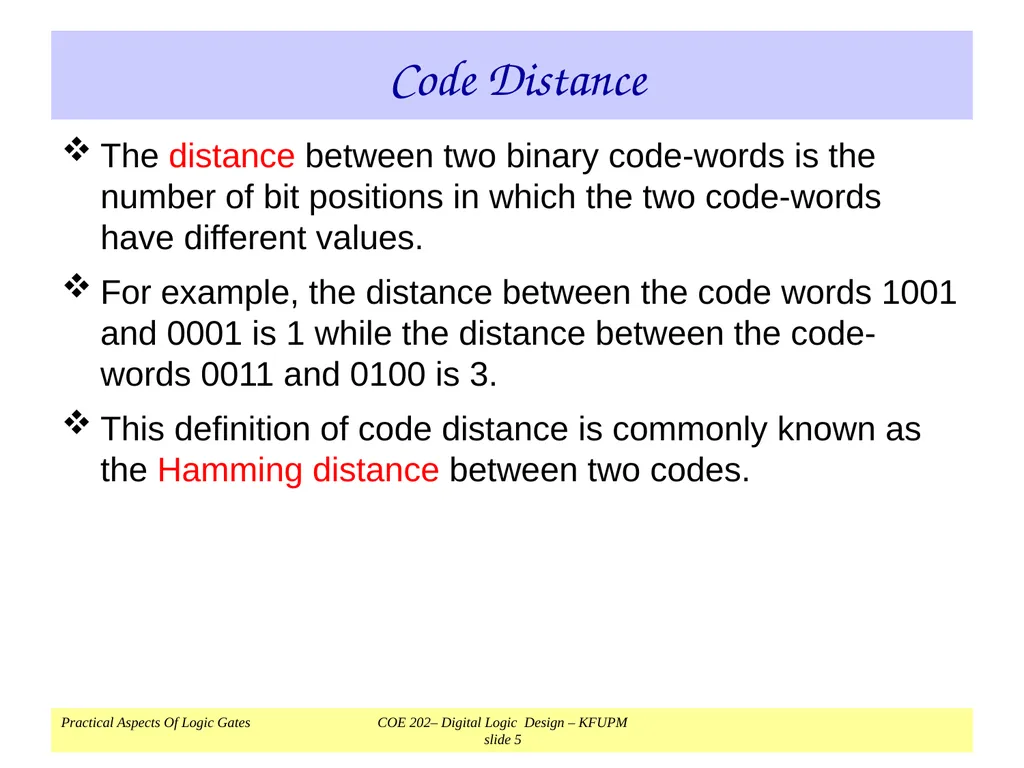
Code Distance The distance between two binary code-words is the number of bit positions in which the two code-words have different values.
For example, the distance between the code words 1001 and 0001 is 1 while the distance between the code-words 0011 and 0100 is 3.
This definition of code distance is commonly known as the Hamming distance between two codes.<br>
For example, the distance between the code words 1001 and 0001 is 1 while the distance between the code-words 0011 and 0100 is 3.
This definition of code distance is commonly known as the Hamming distance between two codes.<br>
06
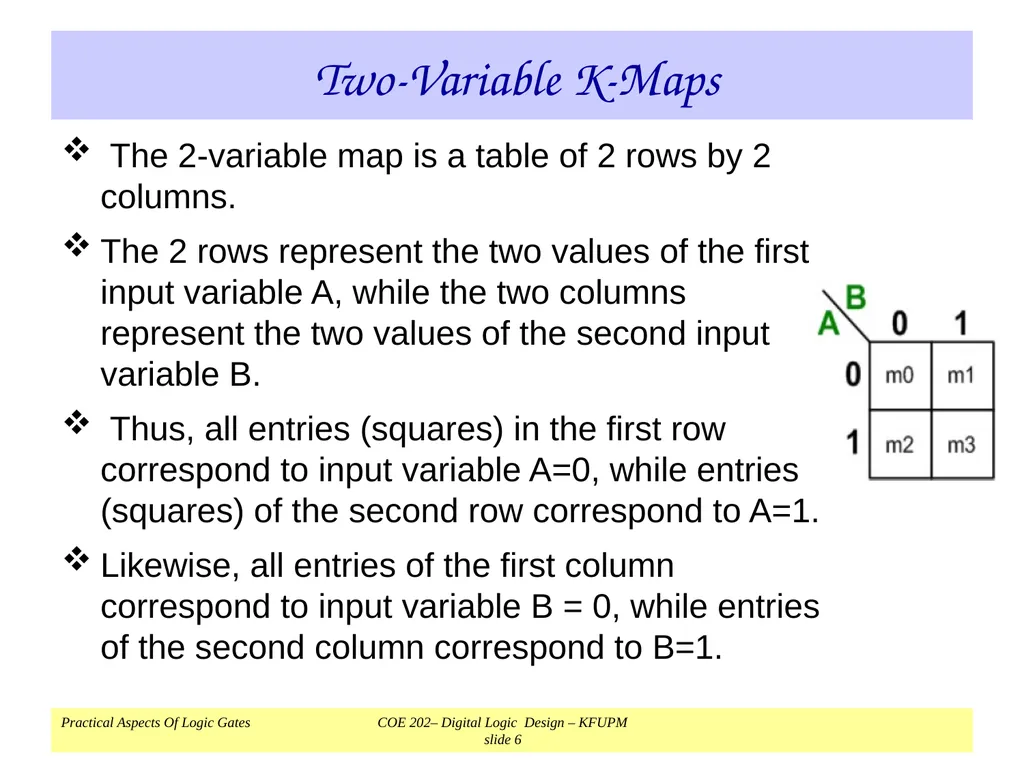
Two-Variable K-Maps The 2-variable map is a table of 2 rows by 2 columns.
The 2 rows represent the two values of the first input variable A, while the two columns represent the two values of the second input variable B.
Thus, all entries (squares) in the first row correspond to input variable A=0, while entries (squares) of the second row correspond to A=1.
Likewise, all entries of the first column correspond to input variable B = 0, while entries of the second column correspond to B=1.<br>
The 2 rows represent the two values of the first input variable A, while the two columns represent the two values of the second input variable B.
Thus, all entries (squares) in the first row correspond to input variable A=0, while entries (squares) of the second row correspond to A=1.
Likewise, all entries of the first column correspond to input variable B = 0, while entries of the second column correspond to B=1.<br>
07
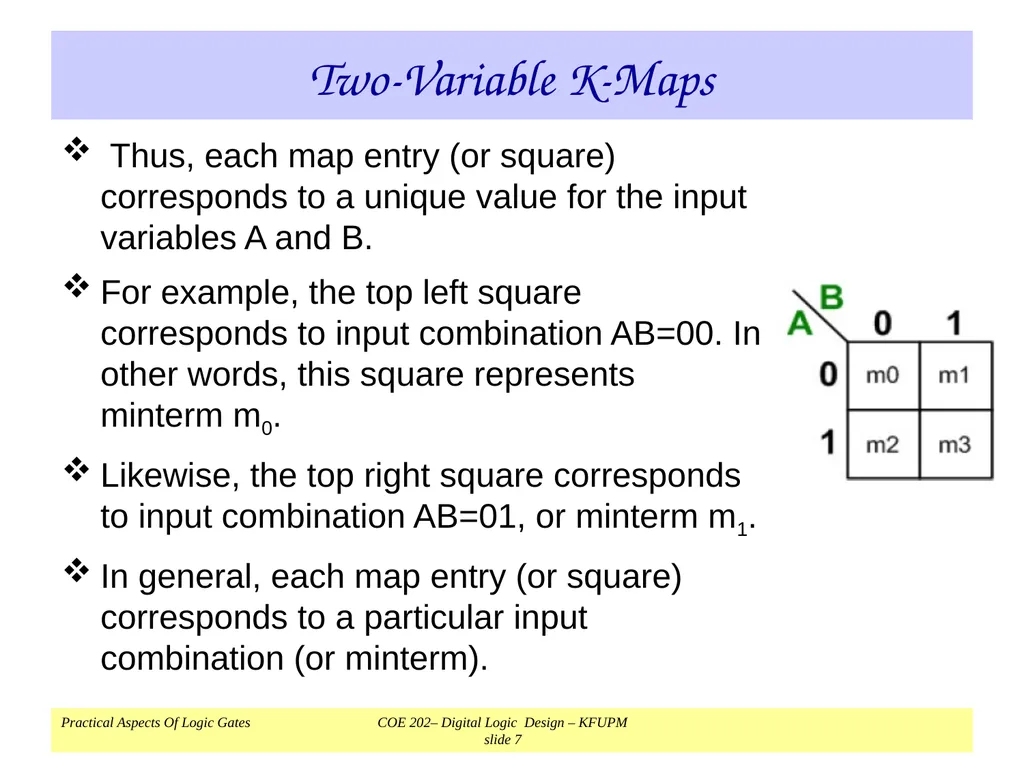
Two-Variable K-Maps Thus, each map entry (or square) corresponds to a unique value for the input variables A and B.
For example, the top left square corresponds to input combination AB=00. In other words, this square represents minterm m0.
Likewise, the top right square corresponds to input combination AB=01, or minterm m1.
In general, each map entry (or square) corresponds to a particular input combination (or minterm).<br>
For example, the top left square corresponds to input combination AB=00. In other words, this square represents minterm m0.
Likewise, the top right square corresponds to input combination AB=01, or minterm m1.
In general, each map entry (or square) corresponds to a particular input combination (or minterm).<br>
08
Two-Variable K-Maps Two K-map squares are considered adjacent if the input codes they represent have a Hamming distance of 1.
A K-map square with a function value of 1 will be referred to as a 1-Square.
A K-map square with a function value of 0 will be referred to as a 0-Square.
The simplification procedure is summarized below:
Step 1: Draw the map according to the number of input variables of the function.
Step 2: Fill “1’s” in the squares for which the function is true.<br>
A K-map square with a function value of 1 will be referred to as a 1-Square.
A K-map square with a function value of 0 will be referred to as a 0-Square.
The simplification procedure is summarized below:
Step 1: Draw the map according to the number of input variables of the function.
Step 2: Fill “1’s” in the squares for which the function is true.<br>
09
Two-Variable K-Maps Step 3: Form as big group of adjacent 1-squares as possible. There are some rules for this which you will learn with bigger maps.
Step 4: Find the common literals for each group and write the simplified expression in SOP.
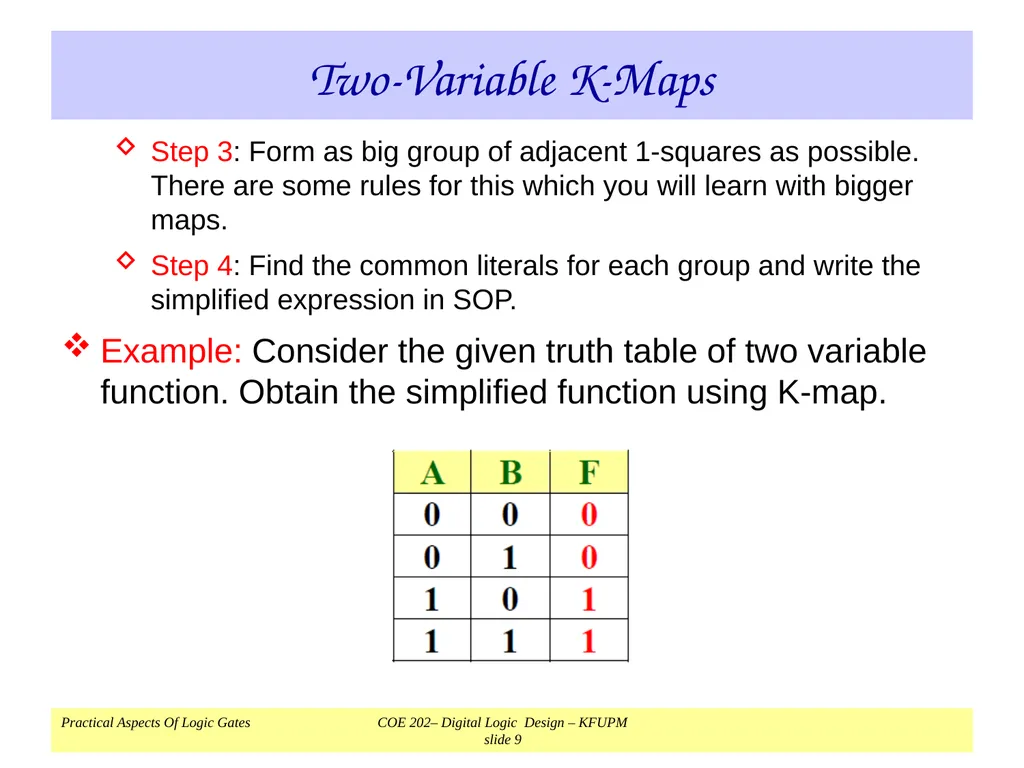
Example: Consider the given truth table of two variable function. Obtain the simplified function using K-map.<br>
Step 4: Find the common literals for each group and write the simplified expression in SOP.
Example: Consider the given truth table of two variable function. Obtain the simplified function using K-map.<br>
10
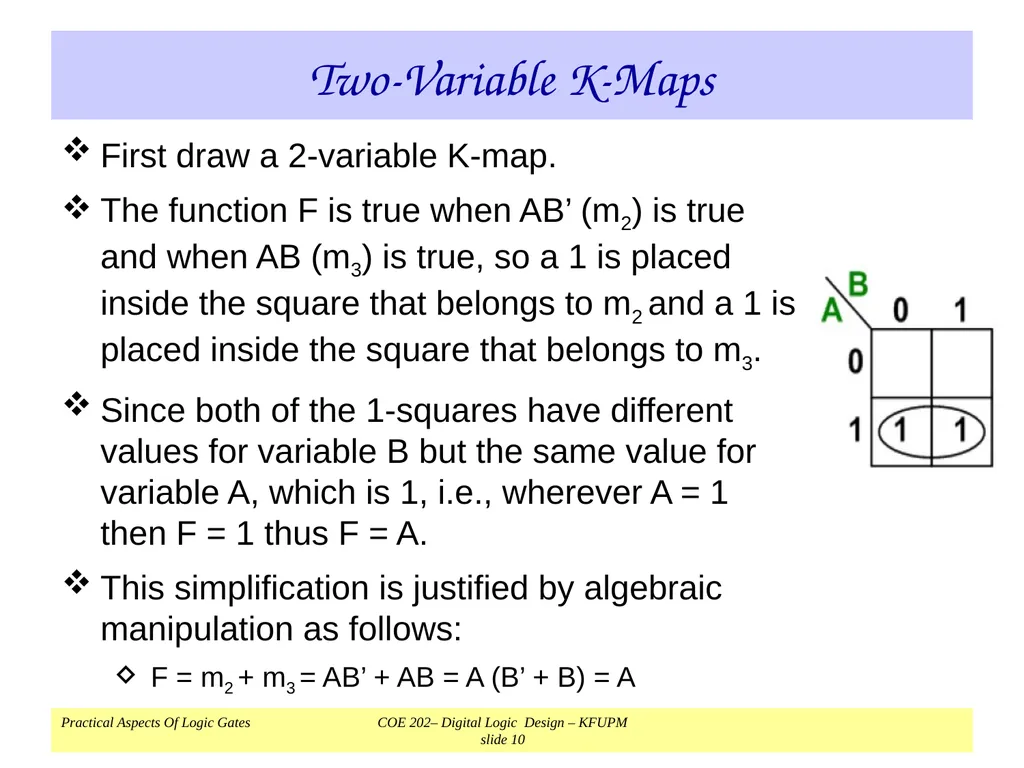
Two-Variable K-Maps First draw a 2-variable K-map.
The function F is true when AB’ (m2) is true and when AB (m3) is true, so a 1 is placed inside the square that belongs to m2 and a 1 is placed inside the square that belongs to m3.
Since both of the 1-squares have different values for variable B but the same value for variable A, which is 1, i.e., wherever A = 1 then F = 1 thus F = A.
This simplification is justified by algebraic manipulation as follows:
F = m2 + m3 = AB’ + AB = A (B’ + B) = A<br>
The function F is true when AB’ (m2) is true and when AB (m3) is true, so a 1 is placed inside the square that belongs to m2 and a 1 is placed inside the square that belongs to m3.
Since both of the 1-squares have different values for variable B but the same value for variable A, which is 1, i.e., wherever A = 1 then F = 1 thus F = A.
This simplification is justified by algebraic manipulation as follows:
F = m2 + m3 = AB’ + AB = A (B’ + B) = A<br>
11
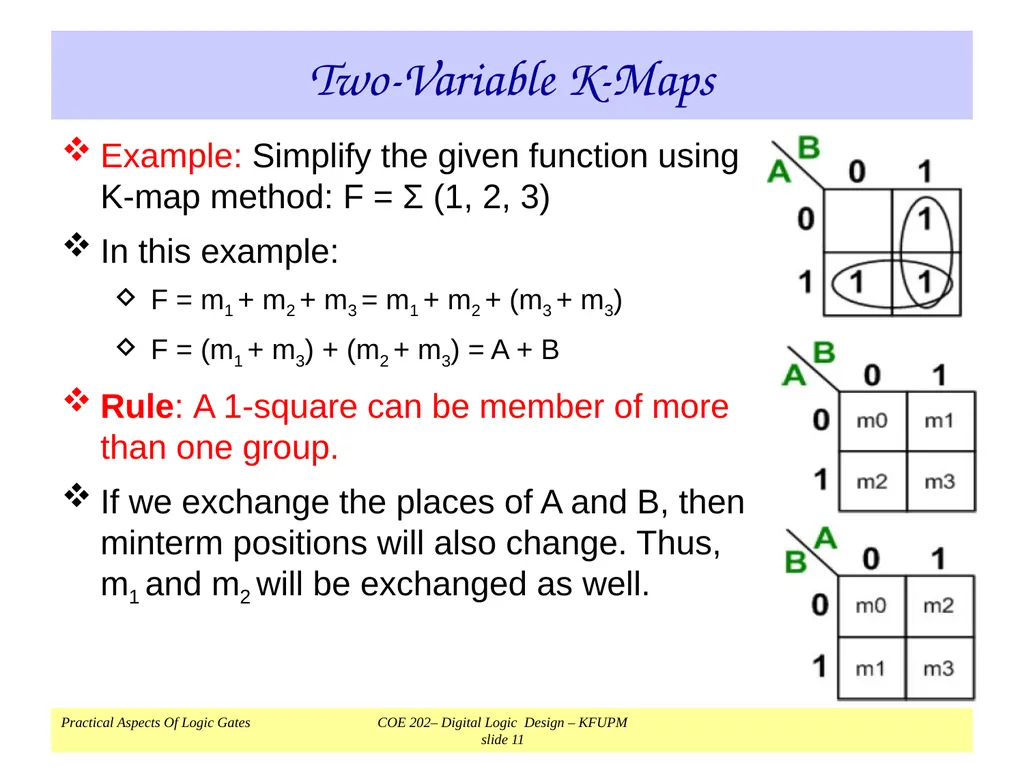
Two-Variable K-Maps Example: Simplify the given function using K-map method: F = Σ (1, 2, 3)
In this example:
F = m1 + m2 + m3 = m1 + m2 + (m3 + m3)
F = (m1 + m3) + (m2 + m3) = A + B
Rule: A 1-square can be member of more than one group.
If we exchange the places of A and B, then minterm positions will also change. Thus, m1 and m2 will be exchanged as well.<br>
In this example:
F = m1 + m2 + m3 = m1 + m2 + (m3 + m3)
F = (m1 + m3) + (m2 + m3) = A + B
Rule: A 1-square can be member of more than one group.
If we exchange the places of A and B, then minterm positions will also change. Thus, m1 and m2 will be exchanged as well.<br>
12
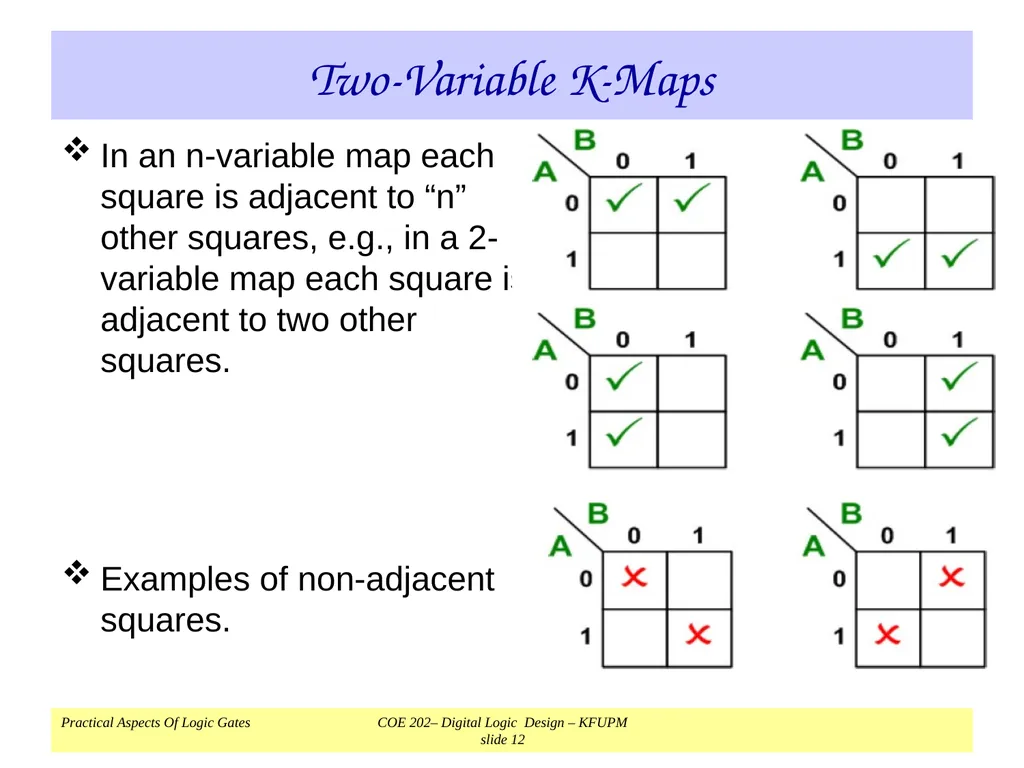
Two-Variable K-Maps In an n-variable map each square is adjacent to “n” other squares, e.g., in a 2-variable map each square is adjacent to two other squares.
Examples of non-adjacent squares.<br>
Examples of non-adjacent squares.<br>
13
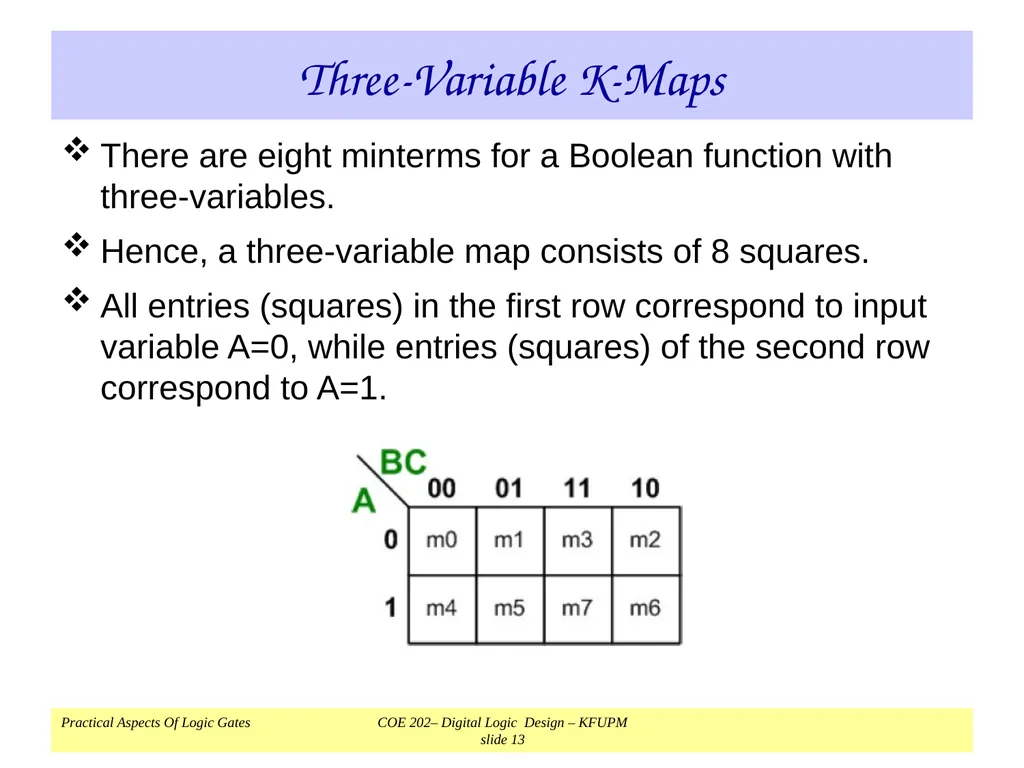
Three-Variable K-Maps There are eight minterms for a Boolean function with three-variables.
Hence, a three-variable map consists of 8 squares.
All entries (squares) in the first row correspond to input variable A=0, while entries (squares) of the second row correspond to A=1.<br>
Hence, a three-variable map consists of 8 squares.
All entries (squares) in the first row correspond to input variable A=0, while entries (squares) of the second row correspond to A=1.<br>
14
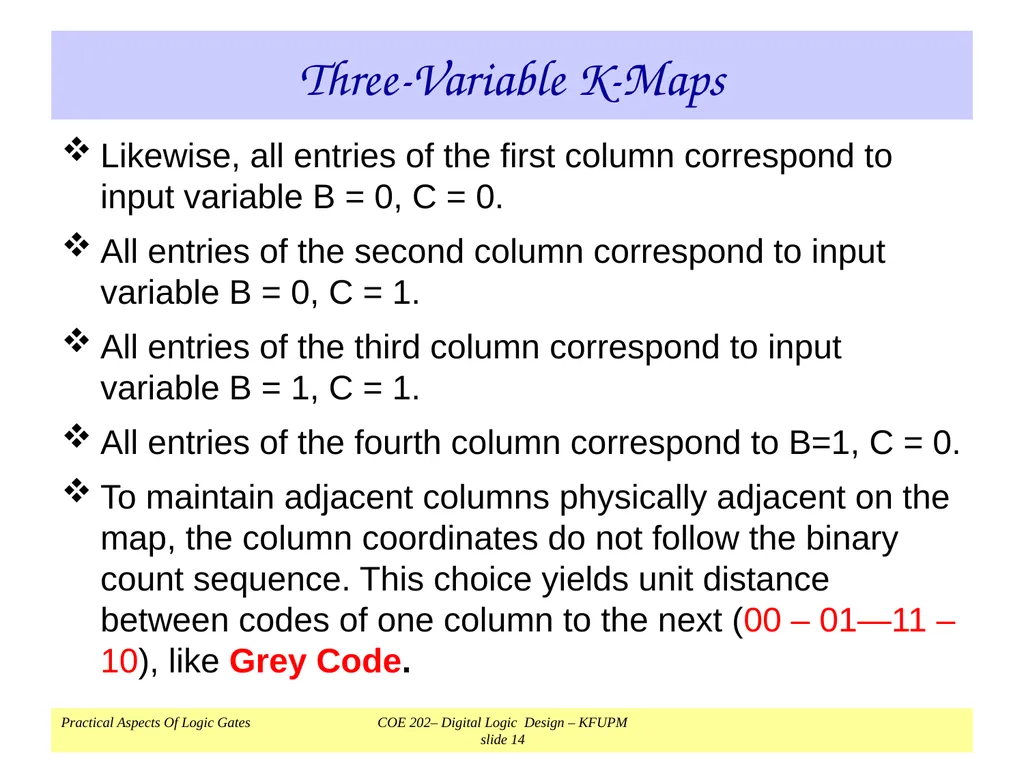
Three-Variable K-Maps Likewise, all entries of the first column correspond to input variable B = 0, C = 0.
All entries of the second column correspond to input variable B = 0, C = 1.
All entries of the third column correspond to input variable B = 1, C = 1.
All entries of the fourth column correspond to B=1, C = 0.
To maintain adjacent columns physically adjacent on the map, the column coordinates do not follow the binary count sequence. This choice yields unit distance between codes of one column to the next (00 – 01—11 – 10), like Grey Code.<br>
All entries of the second column correspond to input variable B = 0, C = 1.
All entries of the third column correspond to input variable B = 1, C = 1.
All entries of the fourth column correspond to B=1, C = 0.
To maintain adjacent columns physically adjacent on the map, the column coordinates do not follow the binary count sequence. This choice yields unit distance between codes of one column to the next (00 – 01—11 – 10), like Grey Code.<br>
15
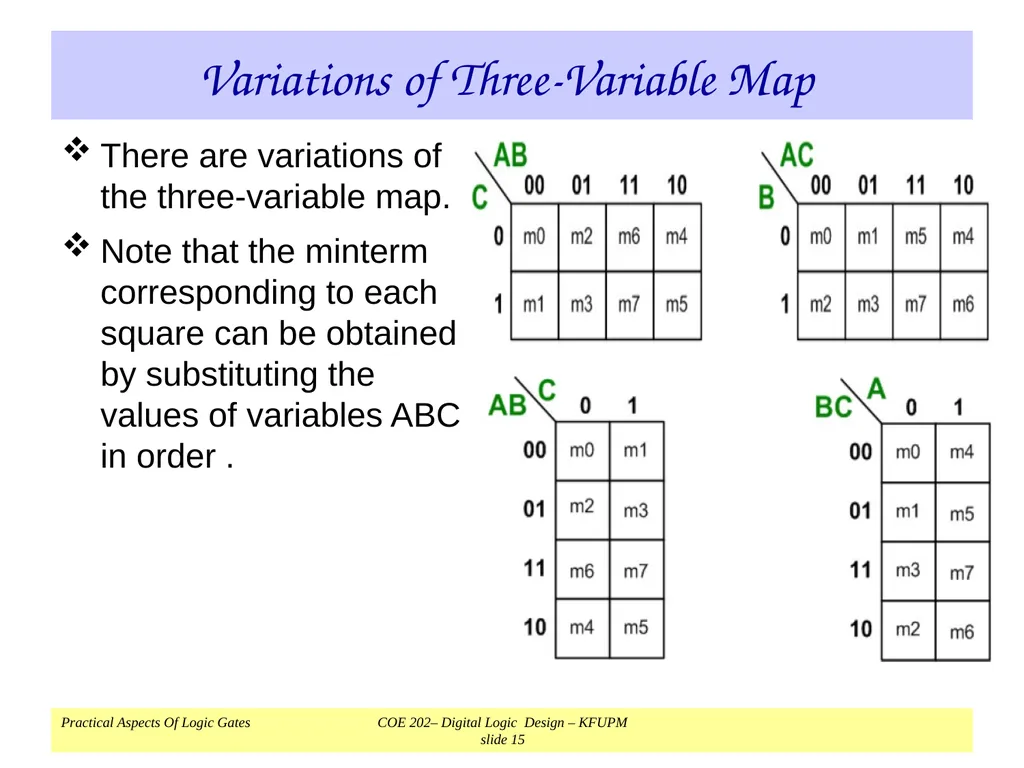
Variations of Three-Variable Map There are variations of the three-variable map.
Note that the minterm corresponding to each square can be obtained by substituting the values of variables ABC in order .<br>
Note that the minterm corresponding to each square can be obtained by substituting the values of variables ABC in order .<br>
16
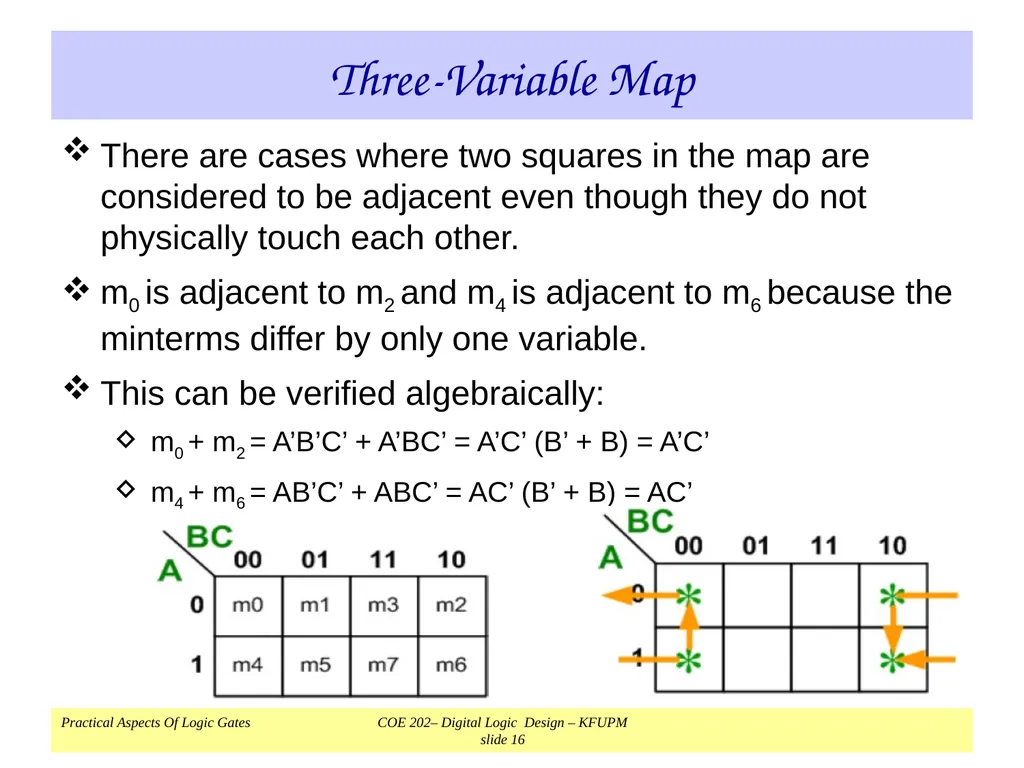
Three-Variable Map There are cases where two squares in the map are considered to be adjacent even though they do not physically touch each other.
m0 is adjacent to m2 and m4 is adjacent to m6 because the minterms differ by only one variable.
This can be verified algebraically:
m0 + m2 = A’B’C’ + A’BC’ = A’C’ (B’ + B) = A’C’
m4 + m6 = AB’C’ + ABC’ = AC’ (B’ + B) = AC’<br>
m0 is adjacent to m2 and m4 is adjacent to m6 because the minterms differ by only one variable.
This can be verified algebraically:
m0 + m2 = A’B’C’ + A’BC’ = A’C’ (B’ + B) = A’C’
m4 + m6 = AB’C’ + ABC’ = AC’ (B’ + B) = AC’<br>
17
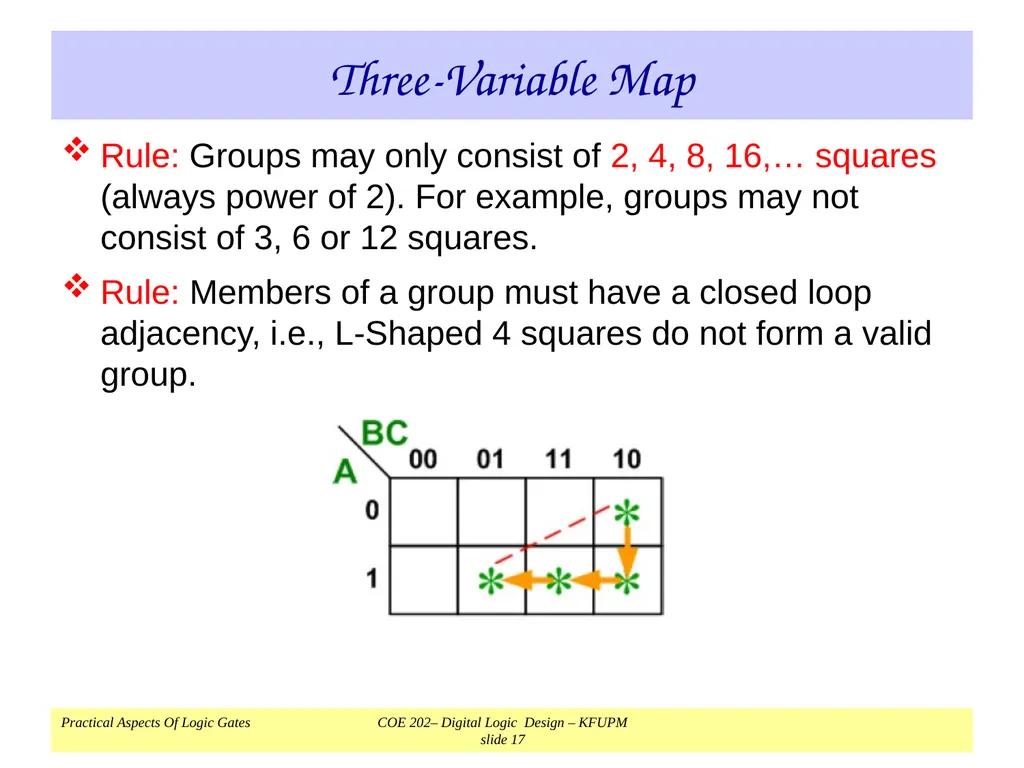
Three-Variable Map Rule: Groups may only consist of 2, 4, 8, 16,… squares (always power of 2). For example, groups may not consist of 3, 6 or 12 squares.
Rule: Members of a group must have a closed loop adjacency, i.e., L-Shaped 4 squares do not form a valid group.<br>
Rule: Members of a group must have a closed loop adjacency, i.e., L-Shaped 4 squares do not form a valid group.<br>
18
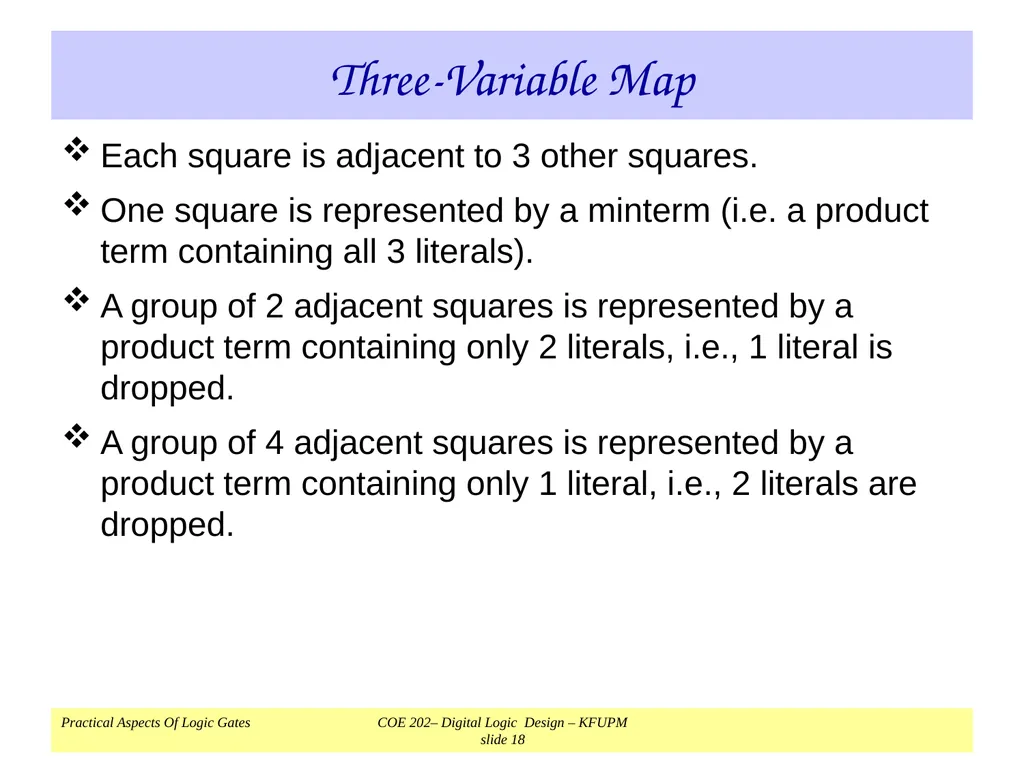
Three-Variable Map Each square is adjacent to 3 other squares.
One square is represented by a minterm (i.e. a product term containing all 3 literals).
A group of 2 adjacent squares is represented by a product term containing only 2 literals, i.e., 1 literal is dropped.
A group of 4 adjacent squares is represented by a product term containing only 1 literal, i.e., 2 literals are dropped.<br>
One square is represented by a minterm (i.e. a product term containing all 3 literals).
A group of 2 adjacent squares is represented by a product term containing only 2 literals, i.e., 1 literal is dropped.
A group of 4 adjacent squares is represented by a product term containing only 1 literal, i.e., 2 literals are dropped.<br>
19
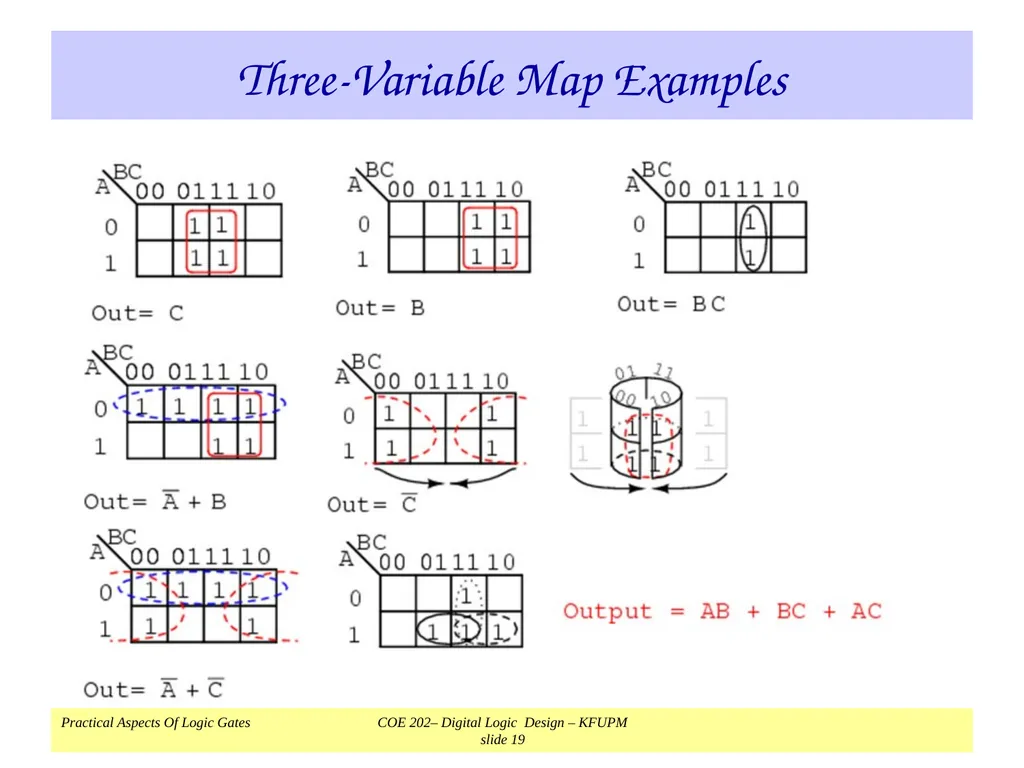
Three-Variable Map Examples<br>
20
Minimal Sum-of-Products Example<br>
21
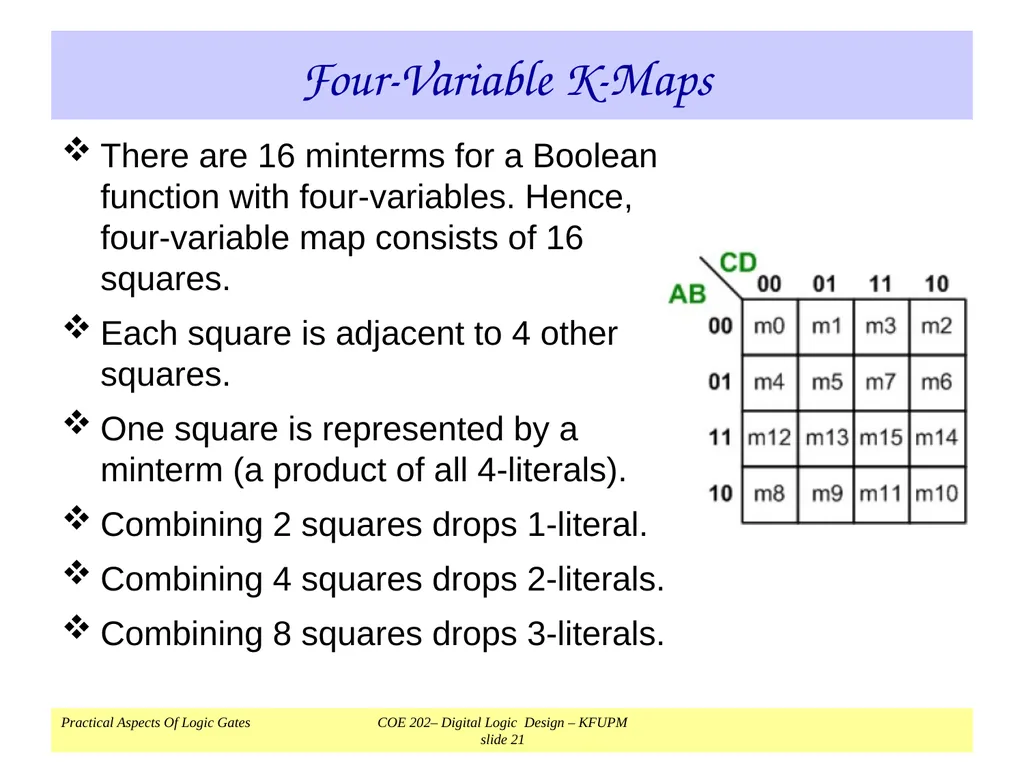
Four-Variable K-Maps There are 16 minterms for a Boolean function with four-variables. Hence, four-variable map consists of 16 squares.
Each square is adjacent to 4 other squares.
One square is represented by a minterm (a product of all 4-literals).
Combining 2 squares drops 1-literal.
Combining 4 squares drops 2-literals.
Combining 8 squares drops 3-literals.<br>
Each square is adjacent to 4 other squares.
One square is represented by a minterm (a product of all 4-literals).
Combining 2 squares drops 1-literal.
Combining 4 squares drops 2-literals.
Combining 8 squares drops 3-literals.<br>
22
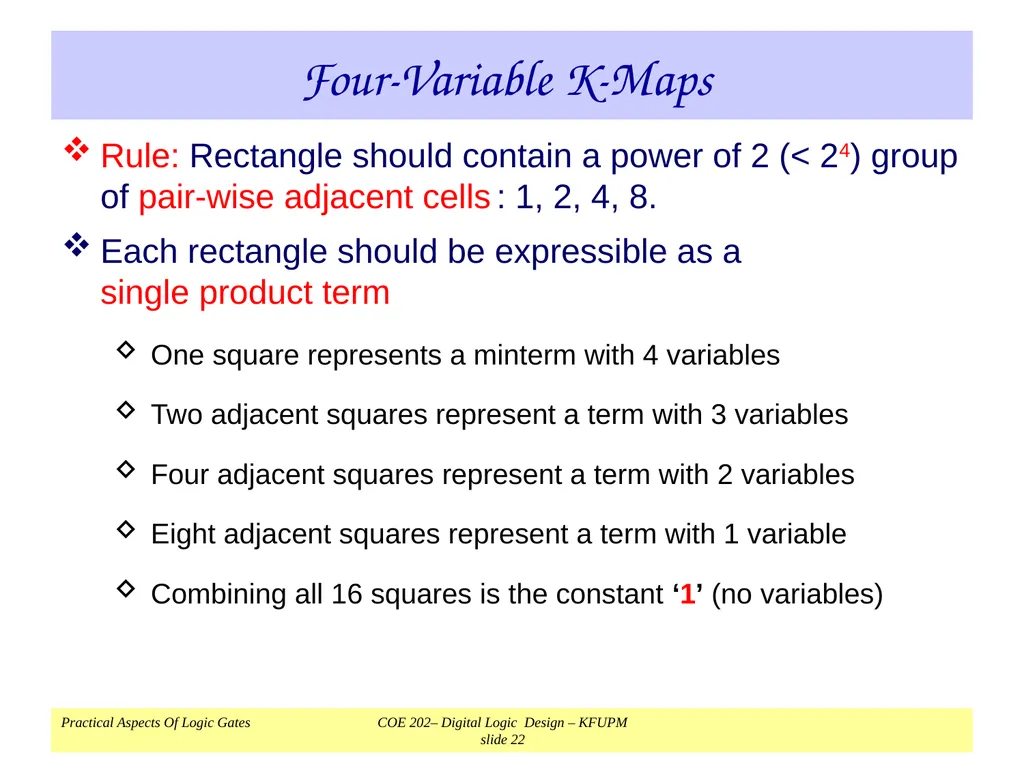
Four-Variable K-Maps Rule: Rectangle should contain a power of 2 (< 24) group of pair-wise adjacent cells : 1, 2, 4, 8.
Each rectangle should be expressible as a single product term
One square represents a minterm with 4 variables
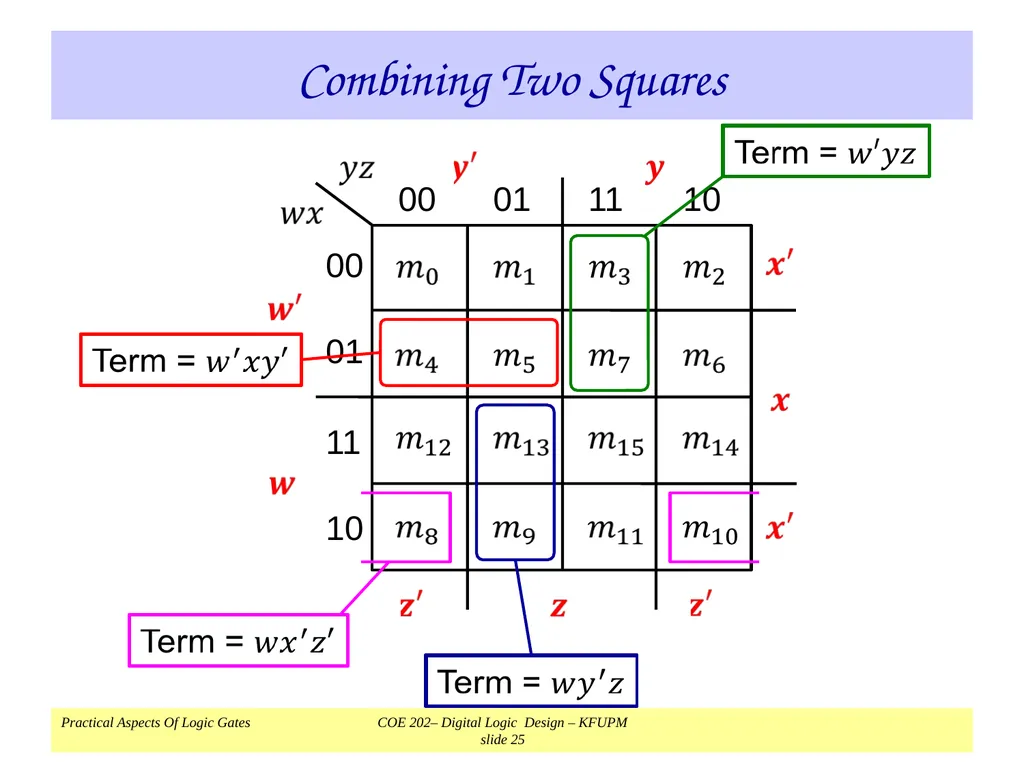
Two adjacent squares represent a term with 3 variables
Four adjacent squares represent a term with 2 variables
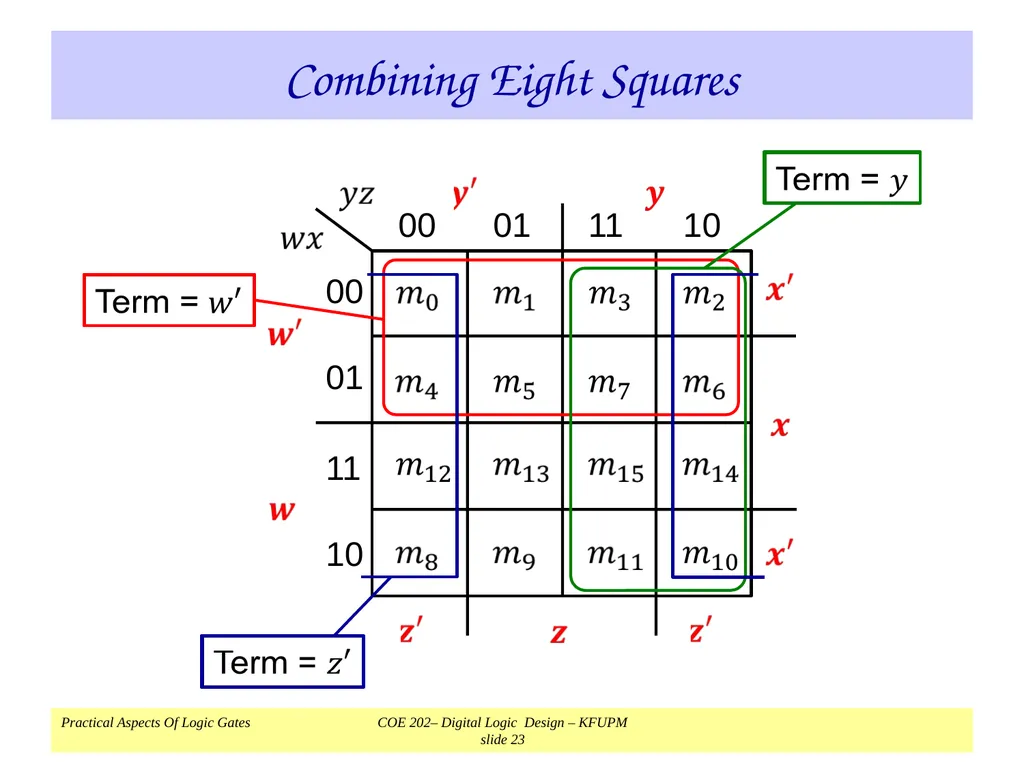
Eight adjacent squares represent a term with 1 variable
Combining all 16 squares is the constant ‘1’ (no variables)<br>
Each rectangle should be expressible as a single product term
One square represents a minterm with 4 variables
Two adjacent squares represent a term with 3 variables
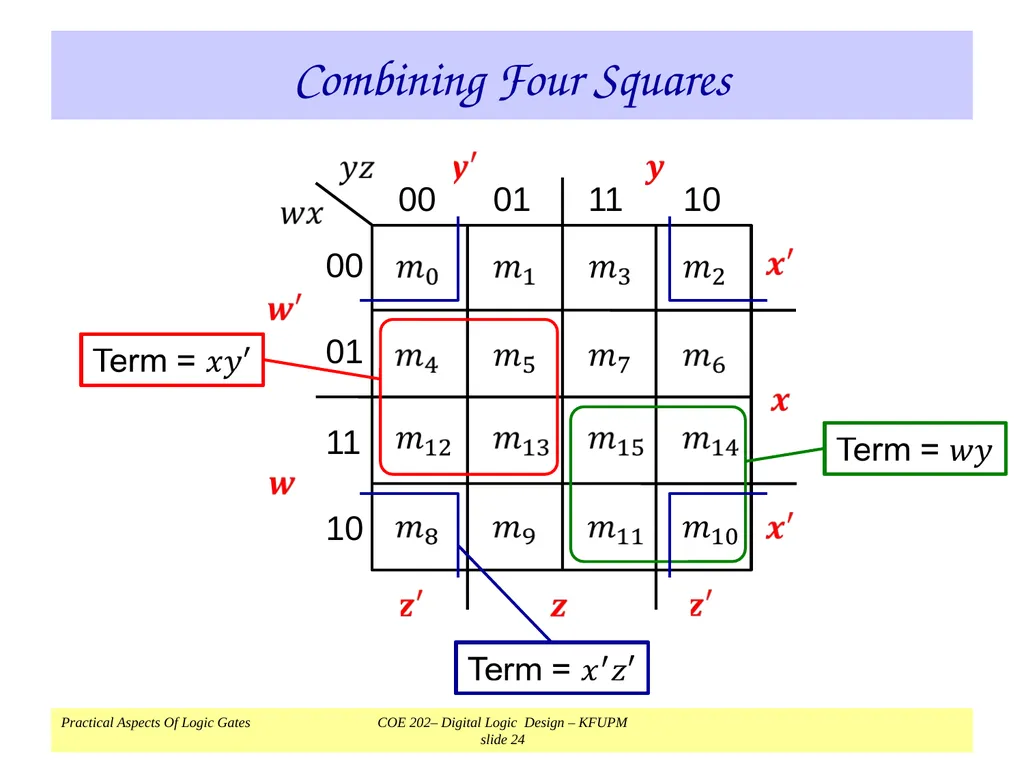
Four adjacent squares represent a term with 2 variables
Eight adjacent squares represent a term with 1 variable
Combining all 16 squares is the constant ‘1’ (no variables)<br>
23
Combining Eight Squares<br>
24
Combining Four Squares<br>
25
Combining Two Squares<br>
26
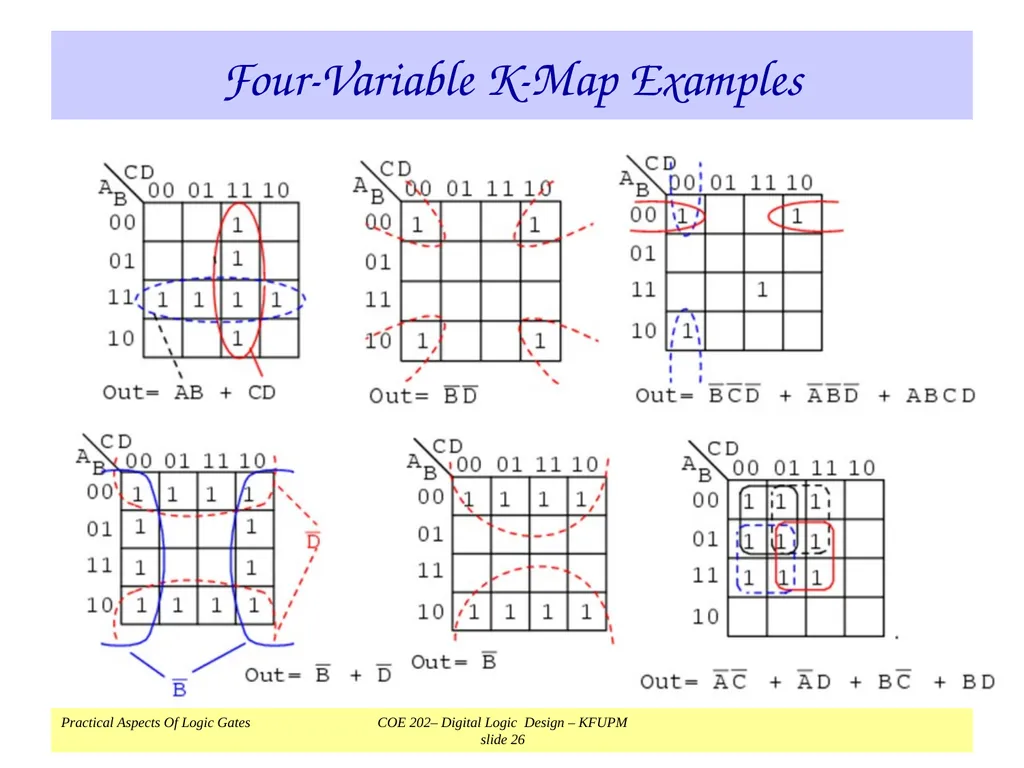
Four-Variable K-Map Examples<br>
27
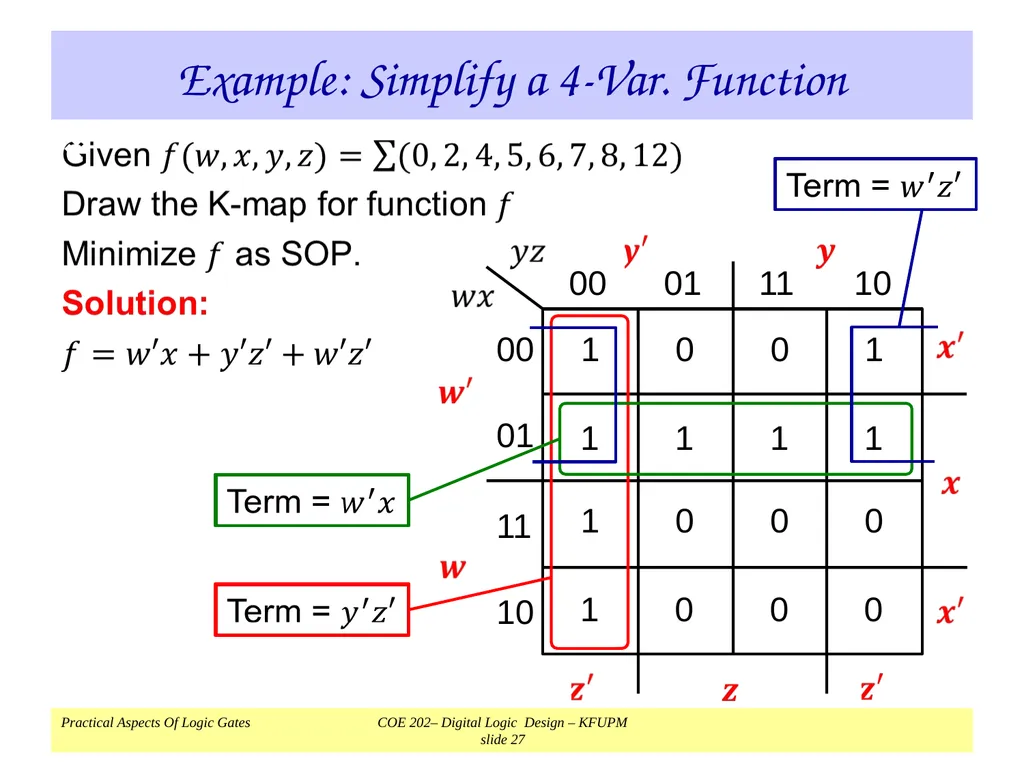
Example: Simplify a 4-Var. Function<br>
28
Definitions/Notations A product term of a function is said to be an implicant.
A Prime Implicant (PI) is a product term obtained by combining the maximum possible number of adjacent 1-squares in the map.
A Prime Implicant is a product that we cannot remove any of its literals.
If a minterm is covered only by one prime implicant then this prime implicant is said to be an Essential Prime Implicant (EPI).<br>
A Prime Implicant (PI) is a product term obtained by combining the maximum possible number of adjacent 1-squares in the map.
A Prime Implicant is a product that we cannot remove any of its literals.
If a minterm is covered only by one prime implicant then this prime implicant is said to be an Essential Prime Implicant (EPI).<br>
29
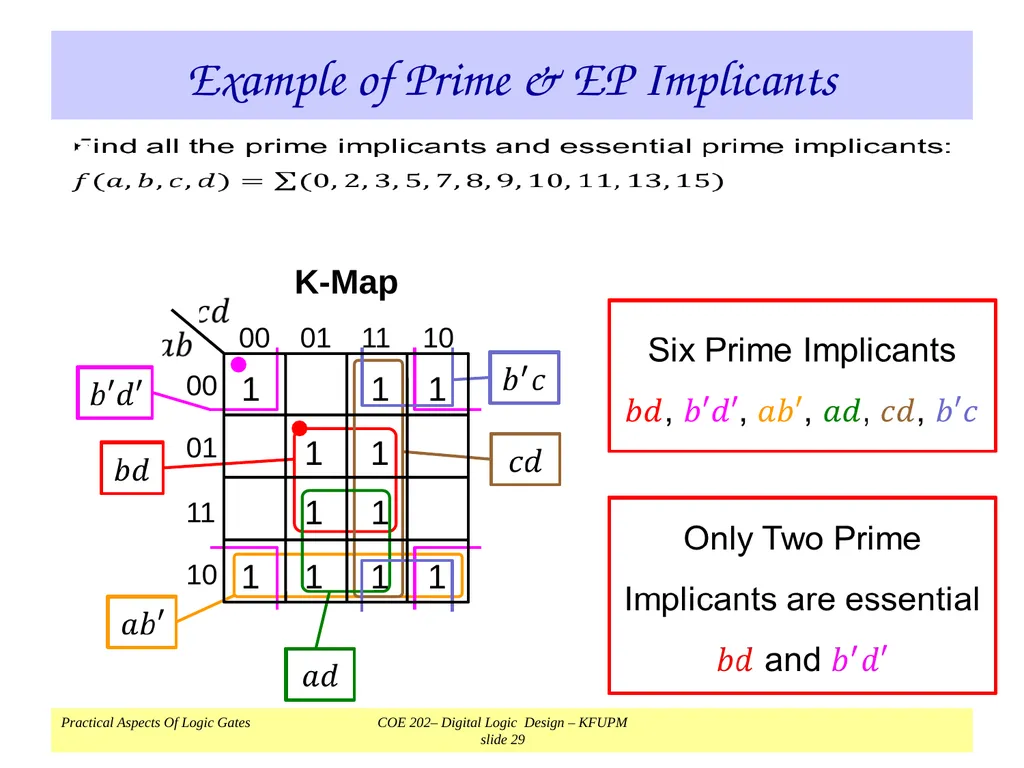
Example of Prime & EP Implicants<br>
30
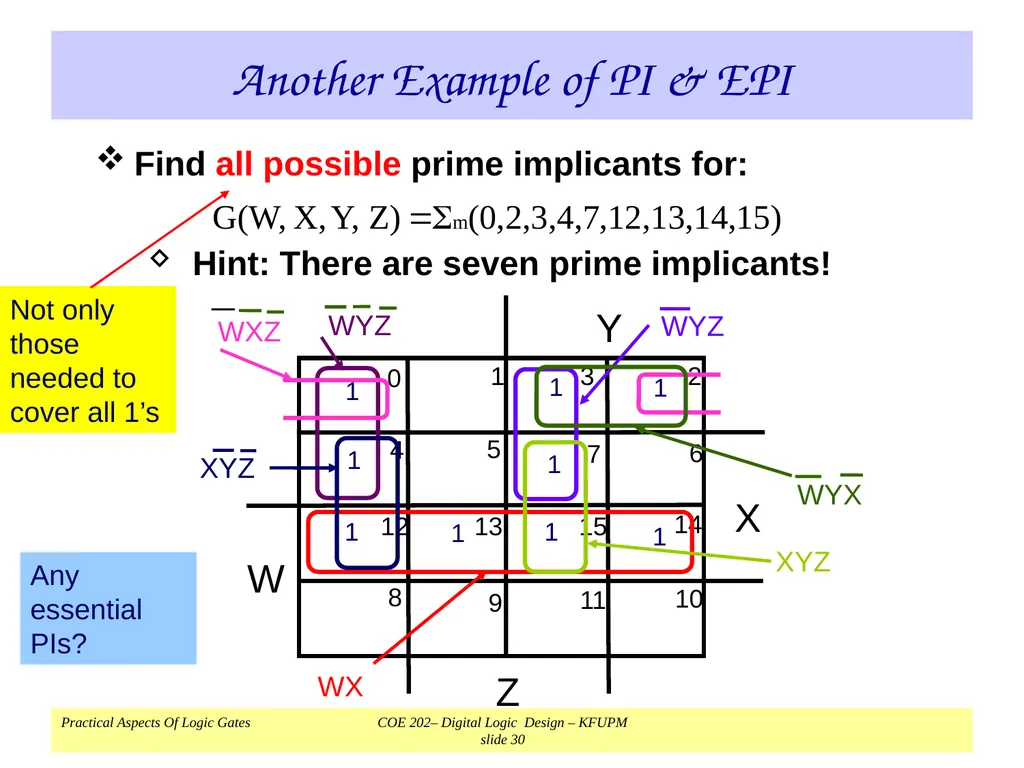
Another Example of PI & EPI Find all possible prime implicants for:
Hint: There are seven prime implicants! 8 9 10 11 12 13 14 15 0 1 3 2 5 6 4 7 X Y Z W WYZ 1 1 1 1 1 WXZ 1 1 1 1 WX WYX XYZ XYZ WYZ Not only
those needed to cover all 1’s Any essential PIs?<br>
Hint: There are seven prime implicants! 8 9 10 11 12 13 14 15 0 1 3 2 5 6 4 7 X Y Z W WYZ 1 1 1 1 1 WXZ 1 1 1 1 WX WYX XYZ XYZ WYZ Not only
those needed to cover all 1’s Any essential PIs?<br>
31
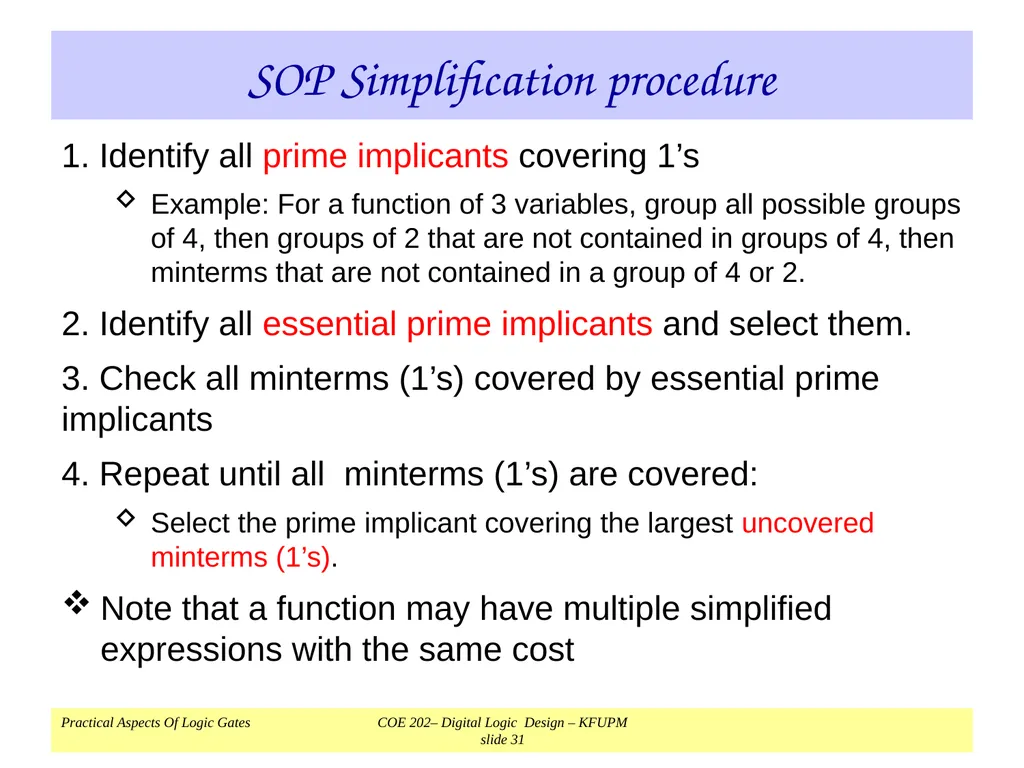
SOP Simplification procedure 1. Identify all prime implicants covering 1’s
Example: For a function of 3 variables, group all possible groups of 4, then groups of 2 that are not contained in groups of 4, then minterms that are not contained in a group of 4 or 2.
2. Identify all essential prime implicants and select them.
3. Check all minterms (1’s) covered by essential prime implicants
4. Repeat until all minterms (1’s) are covered:
Select the prime implicant covering the largest uncovered minterms (1’s).
Note that a function may have multiple simplified expressions with the same cost<br>
Example: For a function of 3 variables, group all possible groups of 4, then groups of 2 that are not contained in groups of 4, then minterms that are not contained in a group of 4 or 2.
2. Identify all essential prime implicants and select them.
3. Check all minterms (1’s) covered by essential prime implicants
4. Repeat until all minterms (1’s) are covered:
Select the prime implicant covering the largest uncovered minterms (1’s).
Note that a function may have multiple simplified expressions with the same cost<br>
32
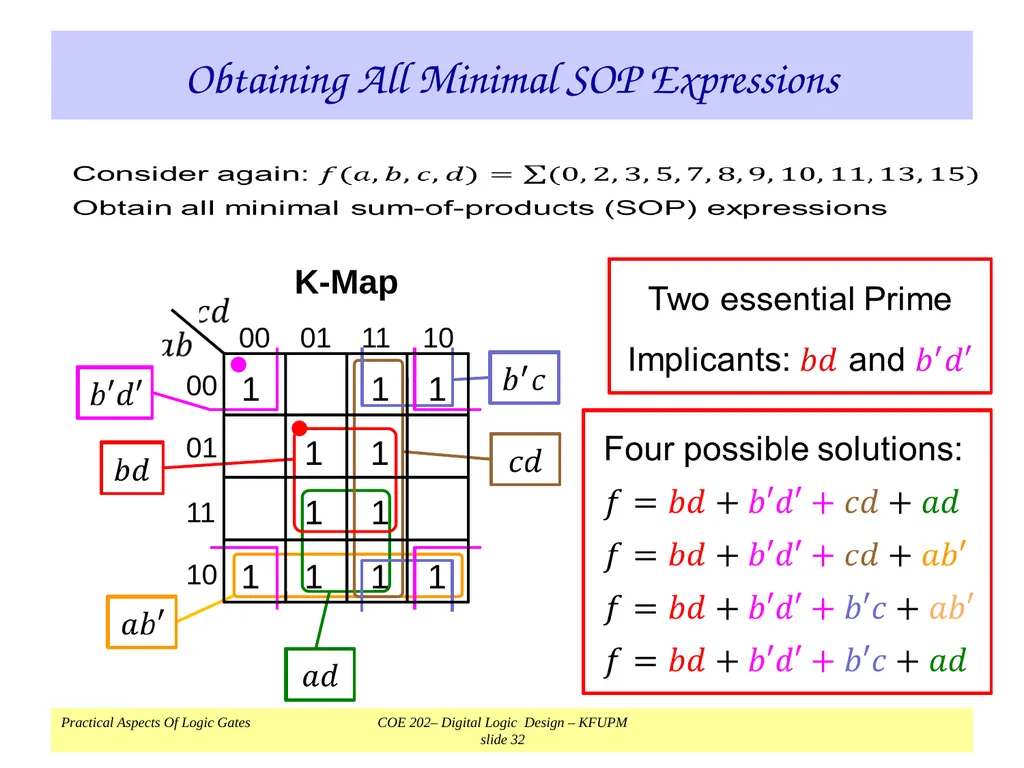
Obtaining All Minimal SOP Expressions<br>
33
Product-of-Sums (POS) Simplification All prime implicants are essential<br>
34
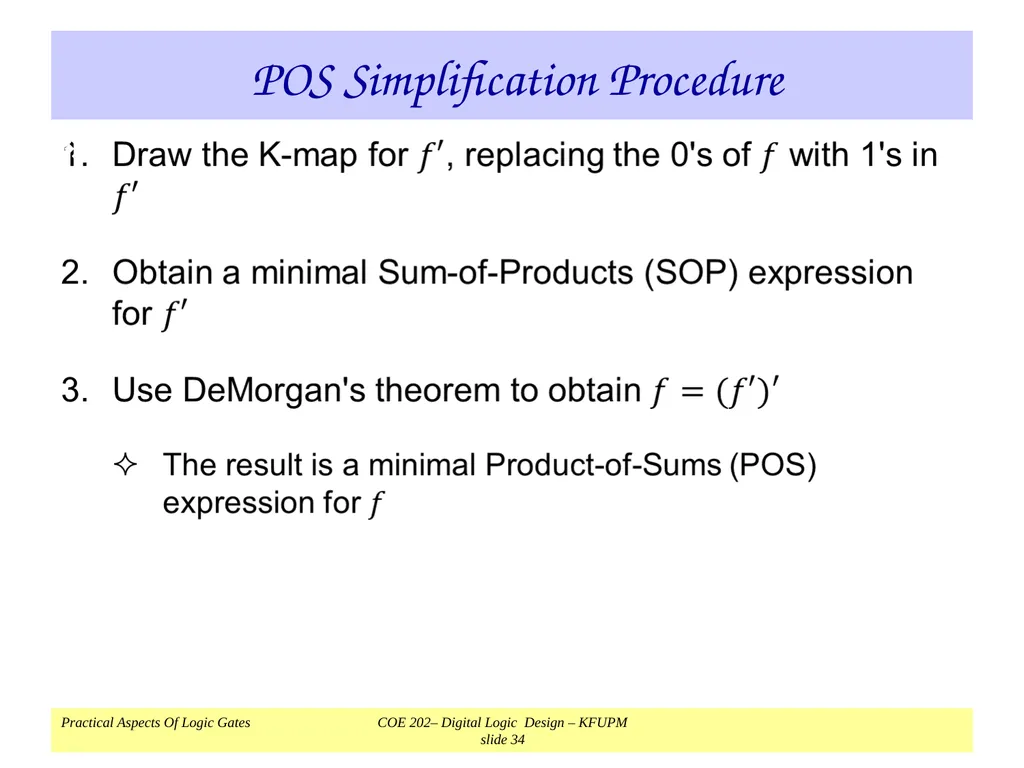
POS Simplification Procedure<br>
35
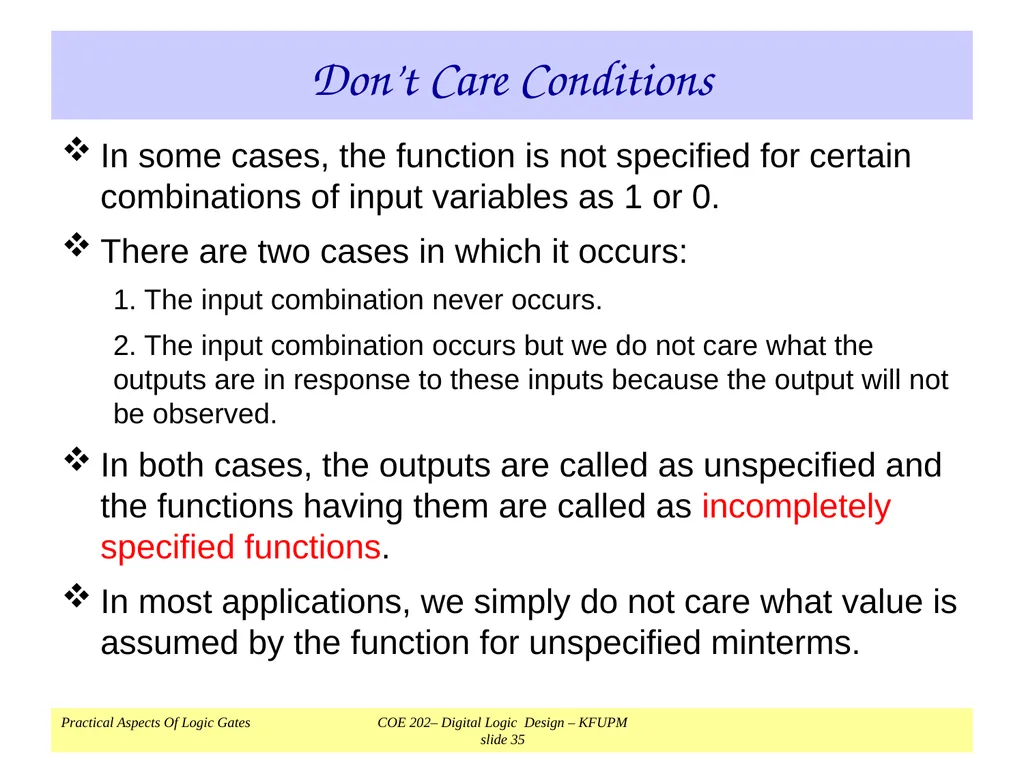
Don’t Care Conditions In some cases, the function is not specified for certain combinations of input variables as 1 or 0.
There are two cases in which it occurs:
1. The input combination never occurs.
2. The input combination occurs but we do not care what the outputs are in response to these inputs because the output will not be observed.
In both cases, the outputs are called as unspecified and the functions having them are called as incompletely specified functions.
In most applications, we simply do not care what value is assumed by the function for unspecified minterms.<br>
There are two cases in which it occurs:
1. The input combination never occurs.
2. The input combination occurs but we do not care what the outputs are in response to these inputs because the output will not be observed.
In both cases, the outputs are called as unspecified and the functions having them are called as incompletely specified functions.
In most applications, we simply do not care what value is assumed by the function for unspecified minterms.<br>
36
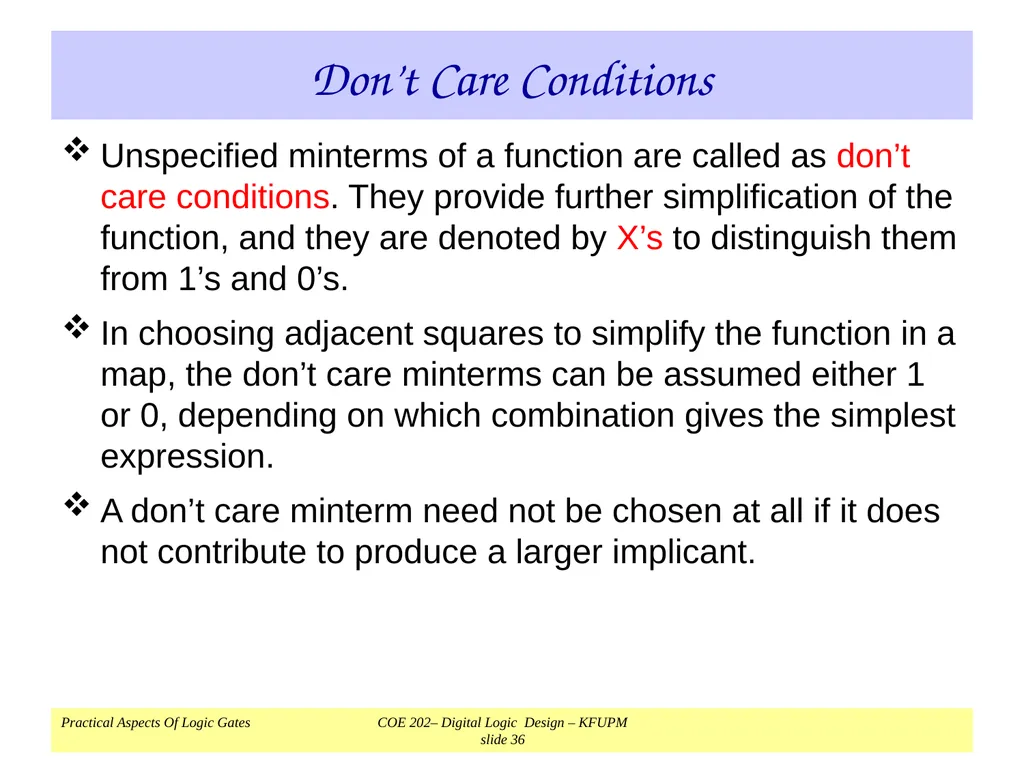
Don’t Care Conditions Unspecified minterms of a function are called as don’t care conditions. They provide further simplification of the function, and they are denoted by X’s to distinguish them from 1’s and 0’s.
In choosing adjacent squares to simplify the function in a map, the don’t care minterms can be assumed either 1 or 0, depending on which combination gives the simplest expression.
A don’t care minterm need not be chosen at all if it does not contribute to produce a larger implicant.<br>
In choosing adjacent squares to simplify the function in a map, the don’t care minterms can be assumed either 1 or 0, depending on which combination gives the simplest expression.
A don’t care minterm need not be chosen at all if it does not contribute to produce a larger implicant.<br>
37
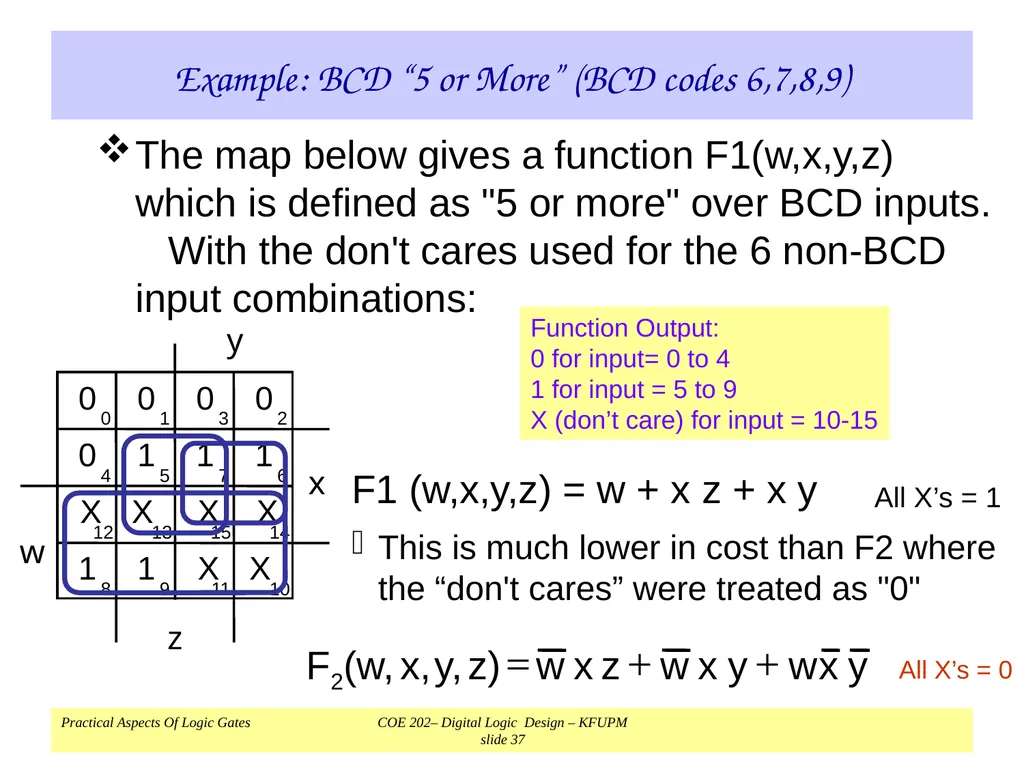
Example: BCD “5 or More” (BCD codes 6,7,8,9) The map below gives a function F1(w,x,y,z) which is defined as "5 or more" over BCD inputs. With the don't cares used for the 6 non-BCD input combinations:
F1 (w,x,y,z) = w + x z + x y
This is much lower in cost than F2 where the “don't cares” were treated as "0" z w 0 1 3 2 4 5 7 6 12 13 15 14 8 9 11 10 1 1 1 1 1 X X X X X X 0 0 0 0 0 x y Function Output:
0 for input= 0 to 4
1 for input = 5 to 9
X (don’t care) for input = 10-15 All X’s = 1 All X’s = 0<br>
F1 (w,x,y,z) = w + x z + x y
This is much lower in cost than F2 where the “don't cares” were treated as "0" z w 0 1 3 2 4 5 7 6 12 13 15 14 8 9 11 10 1 1 1 1 1 X X X X X X 0 0 0 0 0 x y Function Output:
0 for input= 0 to 4
1 for input = 5 to 9
X (don’t care) for input = 10-15 All X’s = 1 All X’s = 0<br>
38
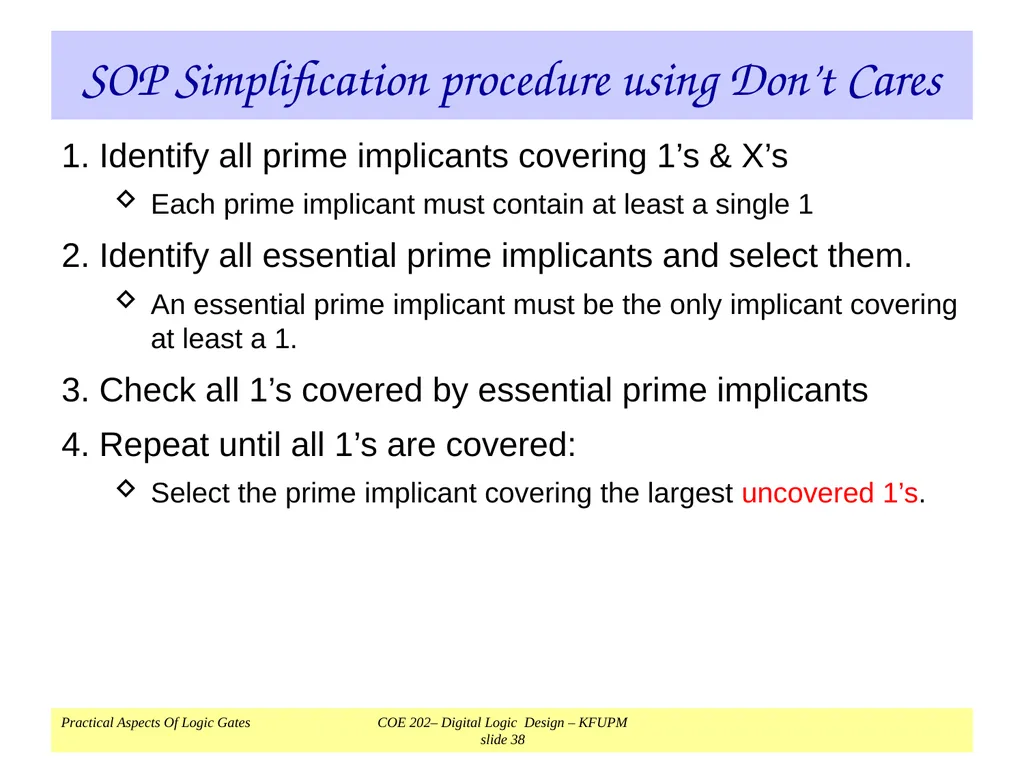
SOP Simplification procedure using Don’t Cares 1. Identify all prime implicants covering 1’s & X’s
Each prime implicant must contain at least a single 1
2. Identify all essential prime implicants and select them.
An essential prime implicant must be the only implicant covering at least a 1.
3. Check all 1’s covered by essential prime implicants
4. Repeat until all 1’s are covered:
Select the prime implicant covering the largest uncovered 1’s.<br>
Each prime implicant must contain at least a single 1
2. Identify all essential prime implicants and select them.
An essential prime implicant must be the only implicant covering at least a 1.
3. Check all 1’s covered by essential prime implicants
4. Repeat until all 1’s are covered:
Select the prime implicant covering the largest uncovered 1’s.<br>
39
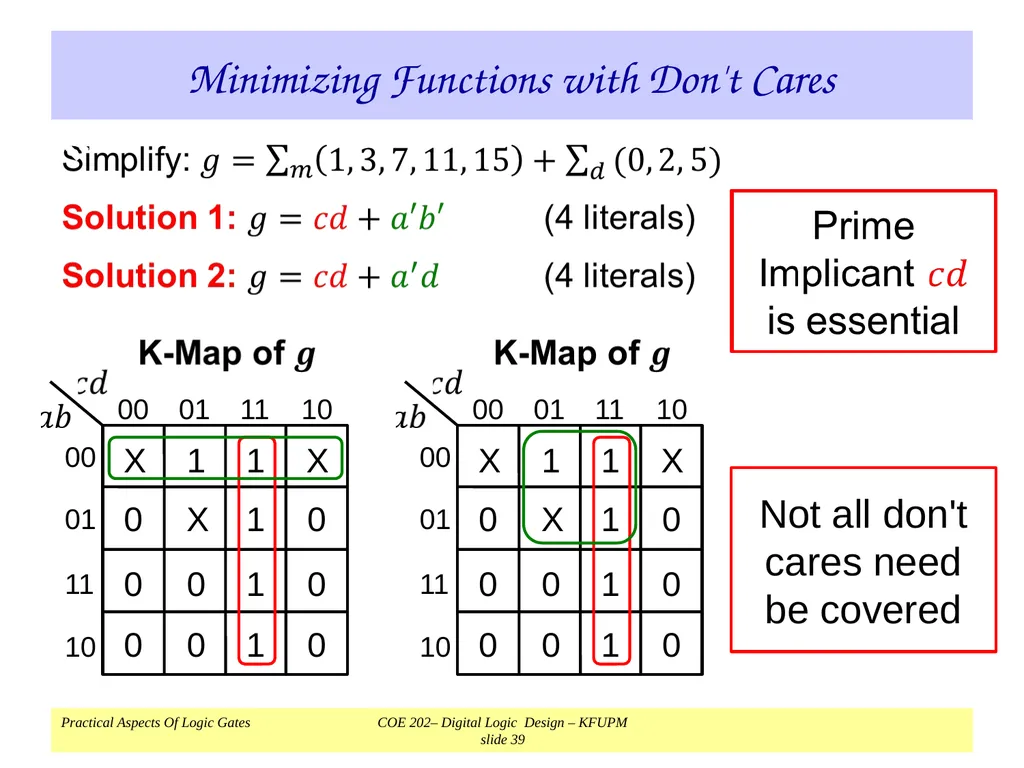
Minimizing Functions with Don't Cares Not all don't cares need be covered<br>
40
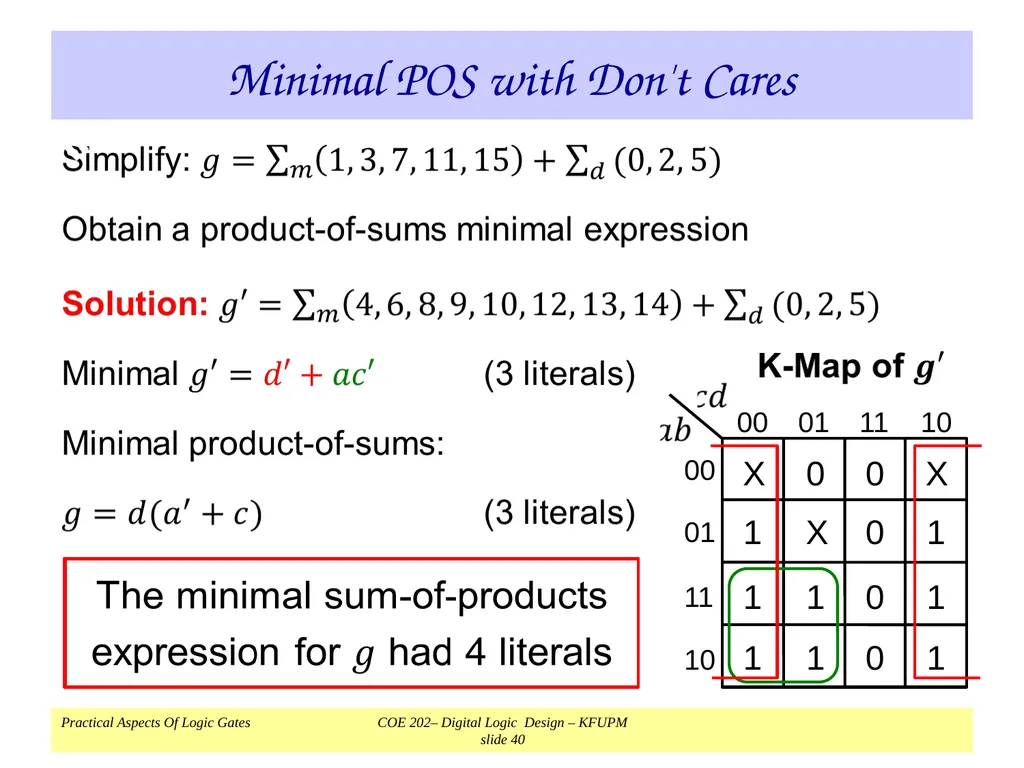
Minimal POS with Don't Cares<br>
41
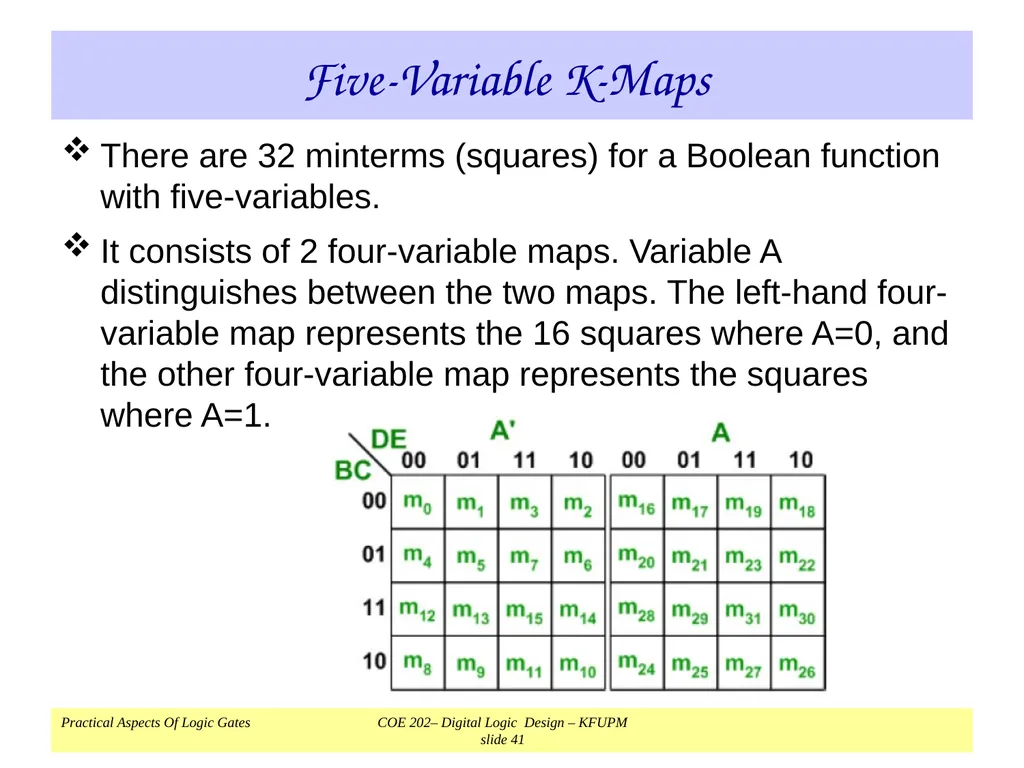
Five-Variable K-Maps There are 32 minterms (squares) for a Boolean function with five-variables.
It consists of 2 four-variable maps. Variable A distinguishes between the two maps. The left-hand four-variable map represents the 16 squares where A=0, and the other four-variable map represents the squares where A=1.<br>
It consists of 2 four-variable maps. Variable A distinguishes between the two maps. The left-hand four-variable map represents the 16 squares where A=0, and the other four-variable map represents the squares where A=1.<br>
42
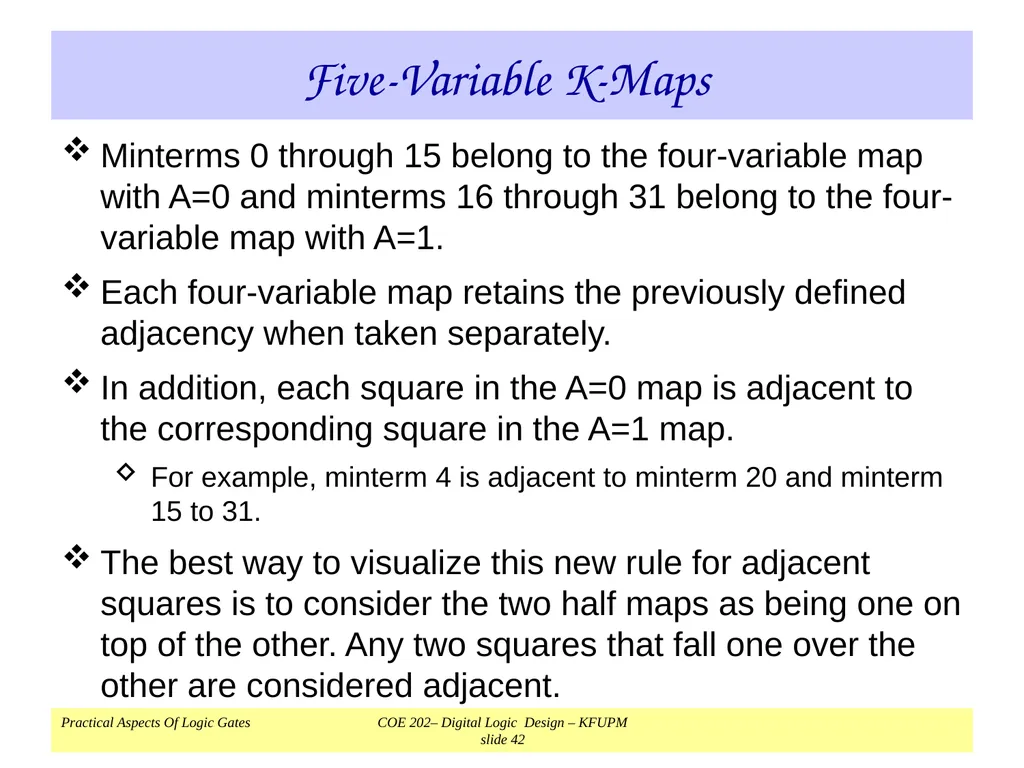
Five-Variable K-Maps Minterms 0 through 15 belong to the four-variable map with A=0 and minterms 16 through 31 belong to the four-variable map with A=1.
Each four-variable map retains the previously defined adjacency when taken separately.
In addition, each square in the A=0 map is adjacent to the corresponding square in the A=1 map.
For example, minterm 4 is adjacent to minterm 20 and minterm 15 to 31.
The best way to visualize this new rule for adjacent squares is to consider the two half maps as being one on top of the other. Any two squares that fall one over the other are considered adjacent.<br>
Each four-variable map retains the previously defined adjacency when taken separately.
In addition, each square in the A=0 map is adjacent to the corresponding square in the A=1 map.
For example, minterm 4 is adjacent to minterm 20 and minterm 15 to 31.
The best way to visualize this new rule for adjacent squares is to consider the two half maps as being one on top of the other. Any two squares that fall one over the other are considered adjacent.<br>
43
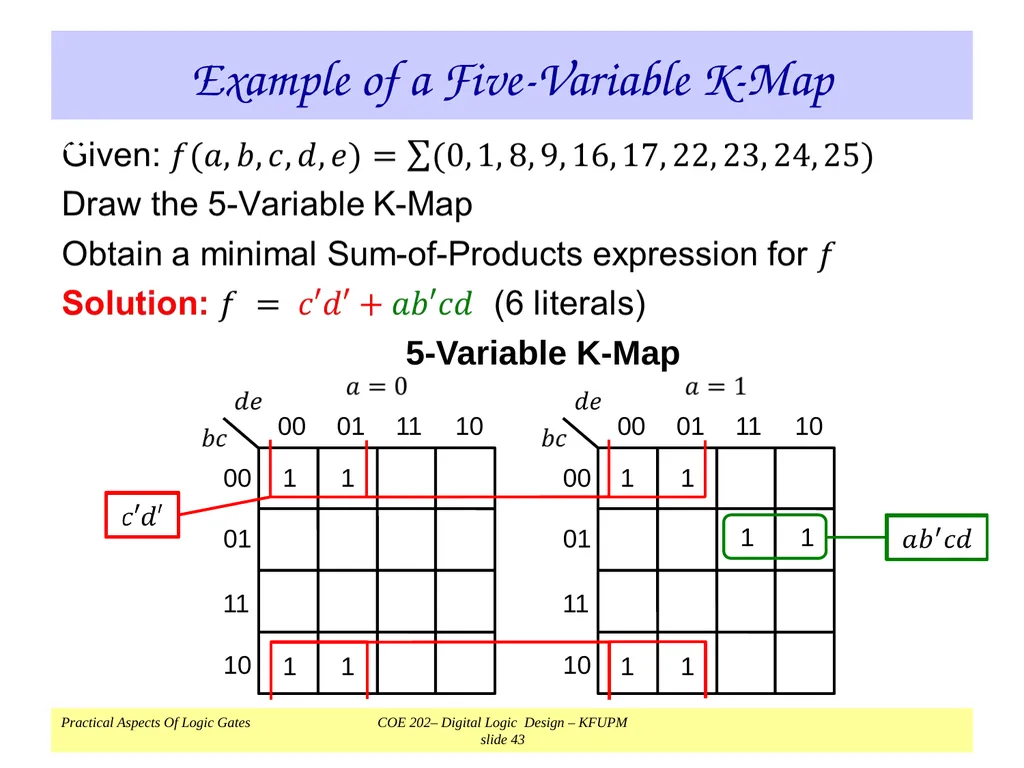
Example of a Five-Variable K-Map<br>
44
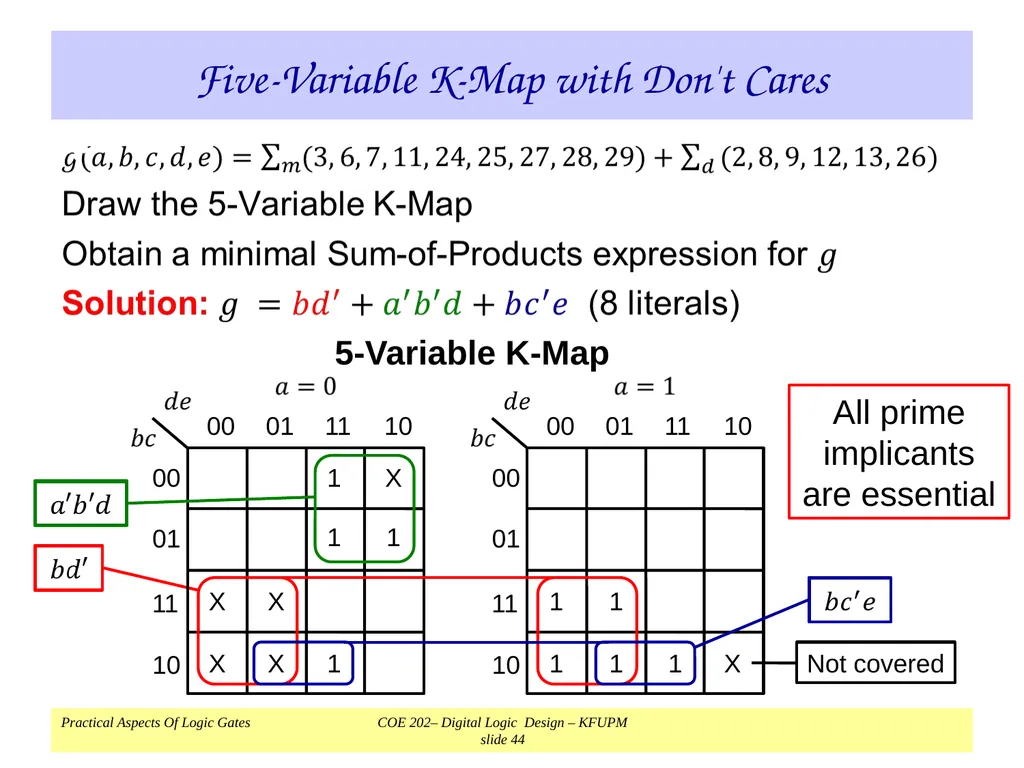
Five-Variable K-Map with Don't Cares All prime implicants are essential<br>
45
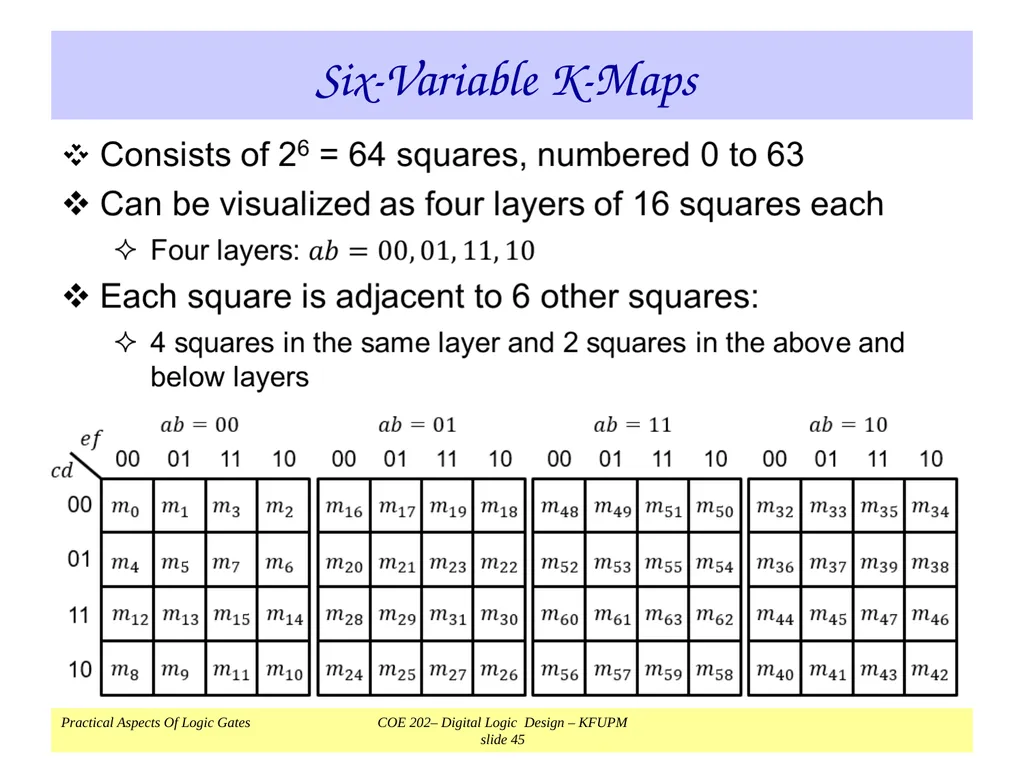
Six-Variable K-Maps<br>
46
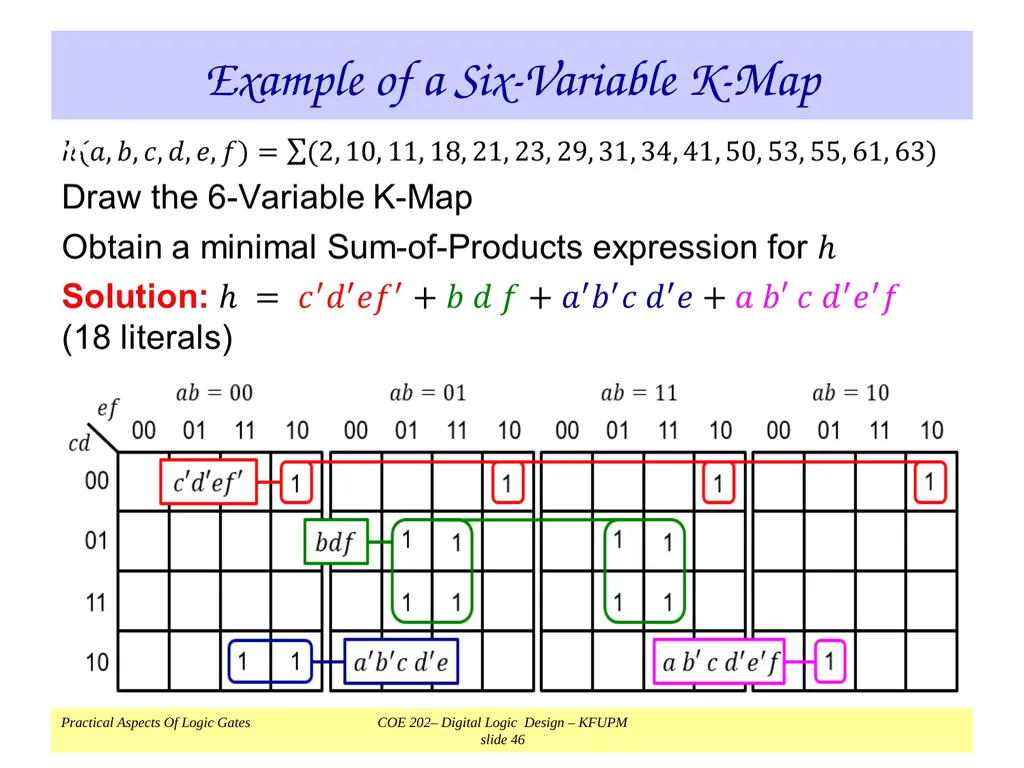
Example of a Six-Variable K-Map<br>