K-means extensions and evaluating clusters CS771: Introduction to Machine Learning Nisheeth K-means algorithm: recap 2 K-means loss function: recap 3 X Z N K K K K-means 4 Poor initialization: bad clustering Desired clustering K-means 5
"K-means extensions and evaluating clusters CS771:" is the property of its rightful owner. Permission is granted to
download and print the materials on this website for personal, non-commercial use only, and to display it
on your personal computer provided you do not modify the materials and that you retain all copyright
notices contained in the materials. By downloading content from our website, you accept the terms of this
agreement.
Presentation Transcript
01
K-means extensions and evaluating clusters CS771: Introduction to Machine Learning
Nisheeth<br>
02
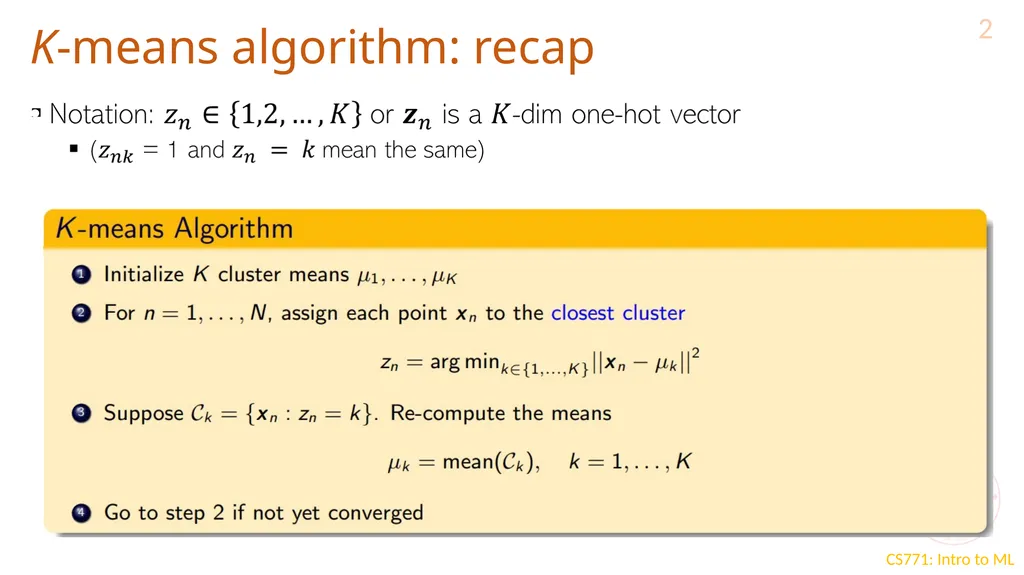
K-means algorithm: recap 2<br>
03
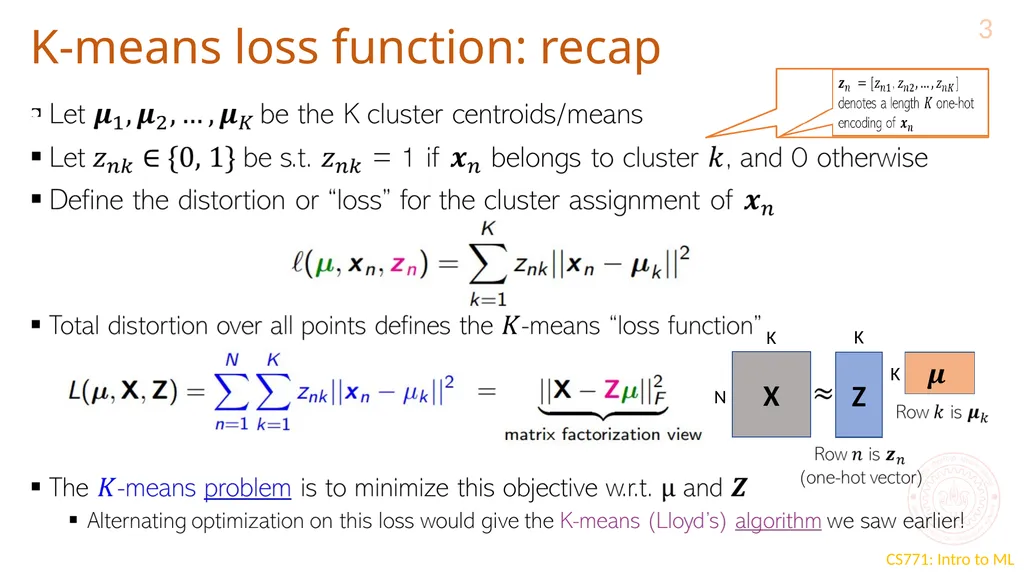
K-means loss function: recap 3 X Z N K K K<br>
04
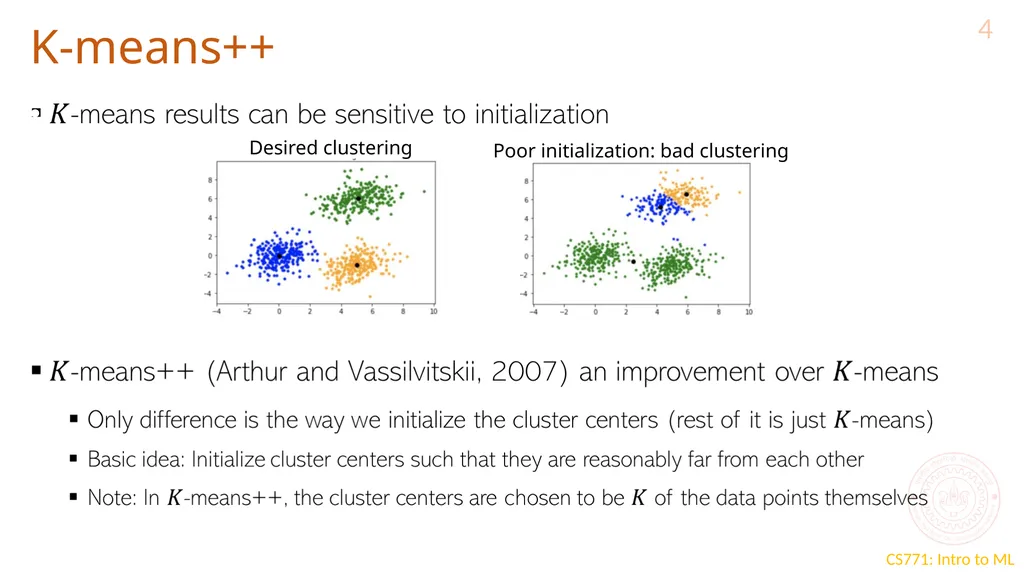
K-means++ 4 Poor initialization: bad clustering Desired clustering<br>
05
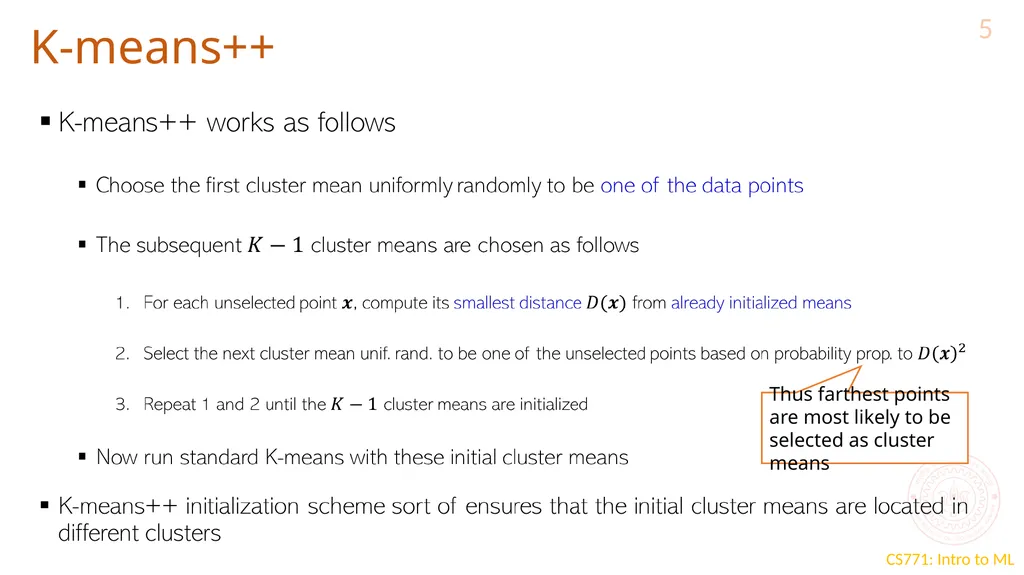
K-means++ 5 Thus farthest points are most likely to be selected as cluster means<br>
06
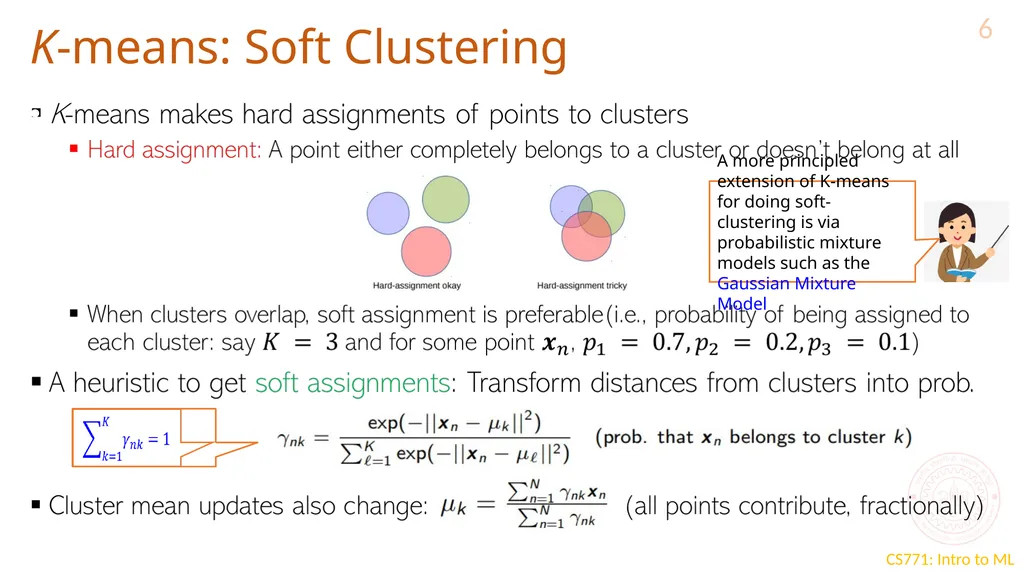
K-means: Soft Clustering 6 A more principled extension of K-means for doing soft-clustering is via probabilistic mixture models such as the Gaussian Mixture Model<br>
07
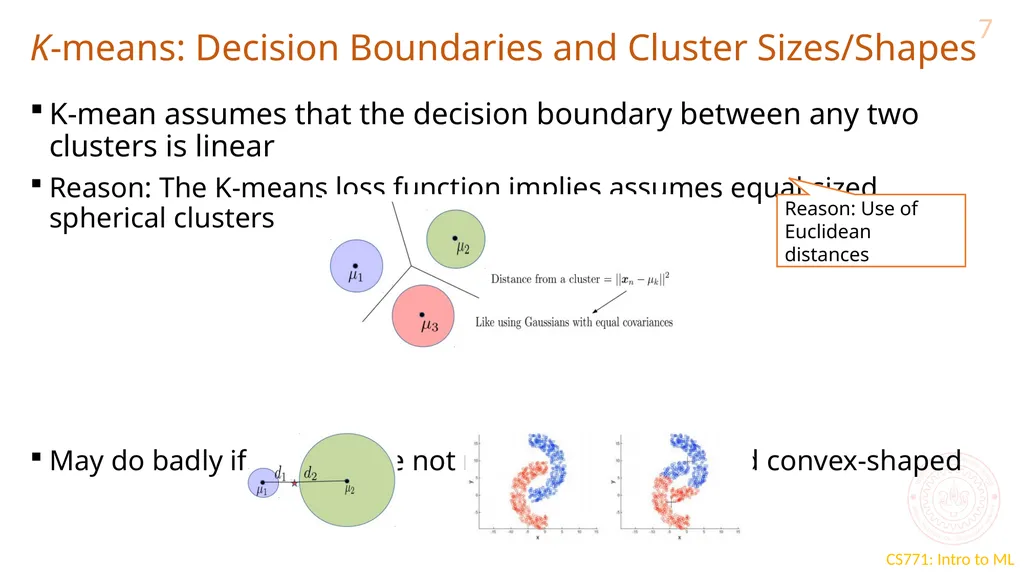
K-means: Decision Boundaries and Cluster Sizes/Shapes 7 K-mean assumes that the decision boundary between any two clusters is linear
Reason: The K-means loss function implies assumes equal-sized, spherical clusters
May do badly if clusters are not roughly equi-sized and convex-shaped Reason: Use of Euclidean distances<br>
08
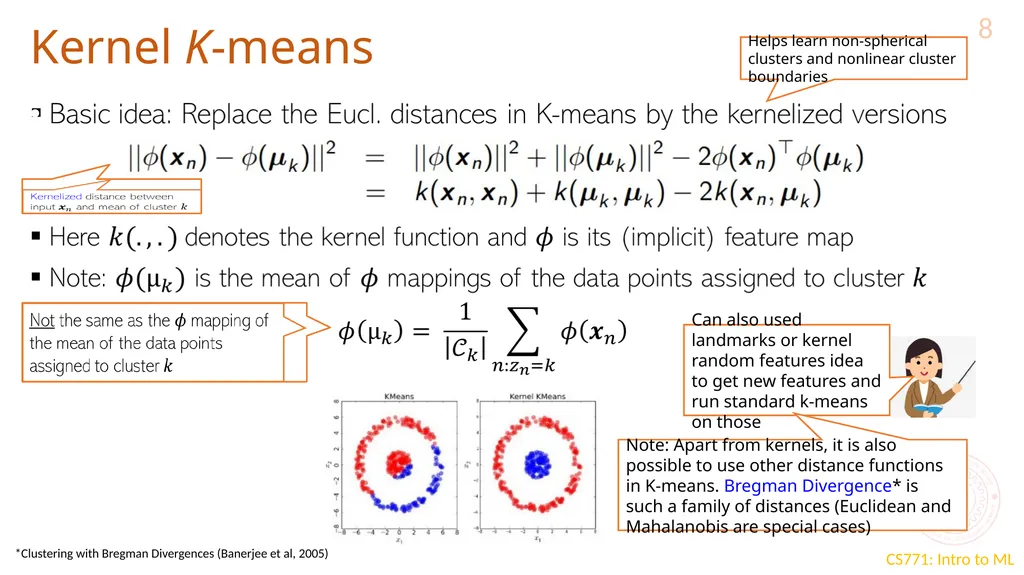
Kernel K-means 8 Helps learn non-spherical clusters and nonlinear cluster boundaries Can also used landmarks or kernel random features idea to get new features and run standard k-means on those Note: Apart from kernels, it is also possible to use other distance functions in K-means. Bregman Divergence* is such a family of distances (Euclidean and Mahalanobis are special cases) *Clustering with Bregman Divergences (Banerjee et al, 2005)<br>
09
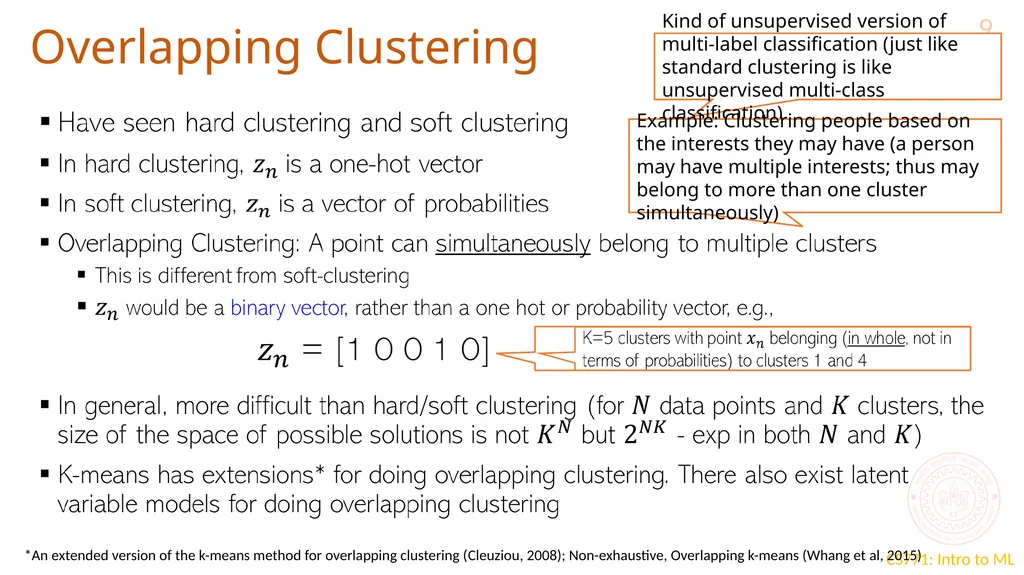
Overlapping Clustering 9 *An extended version of the k-means method for overlapping clustering (Cleuziou, 2008); Non-exhaustive, Overlapping k-means (Whang et al, 2015) Kind of unsupervised version of multi-label classification (just like standard clustering is like unsupervised multi-class classification) Example: Clustering people based on the interests they may have (a person may have multiple interests; thus may belong to more than one cluster simultaneously)<br>
10
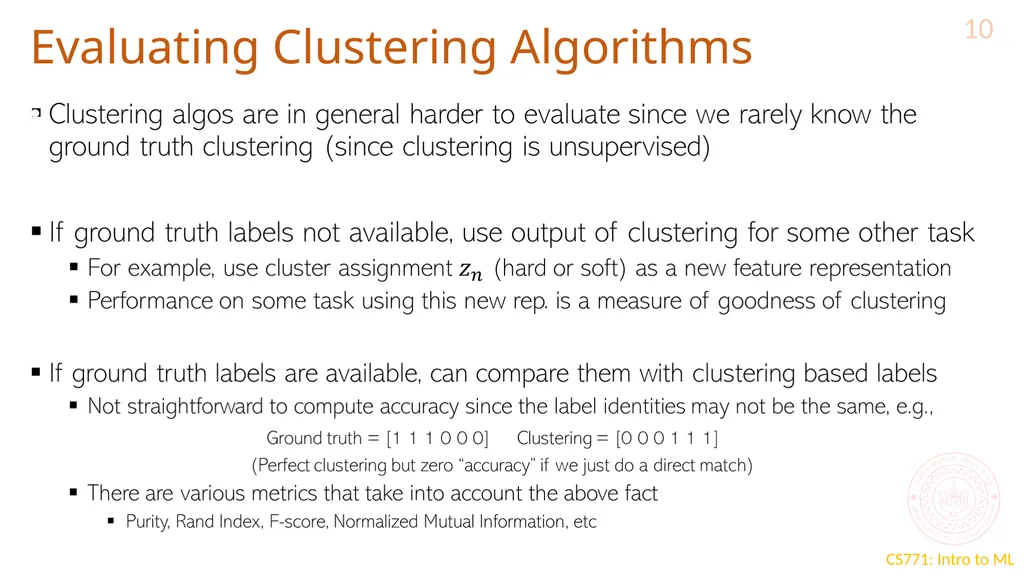
Evaluating Clustering Algorithms 10<br>
11
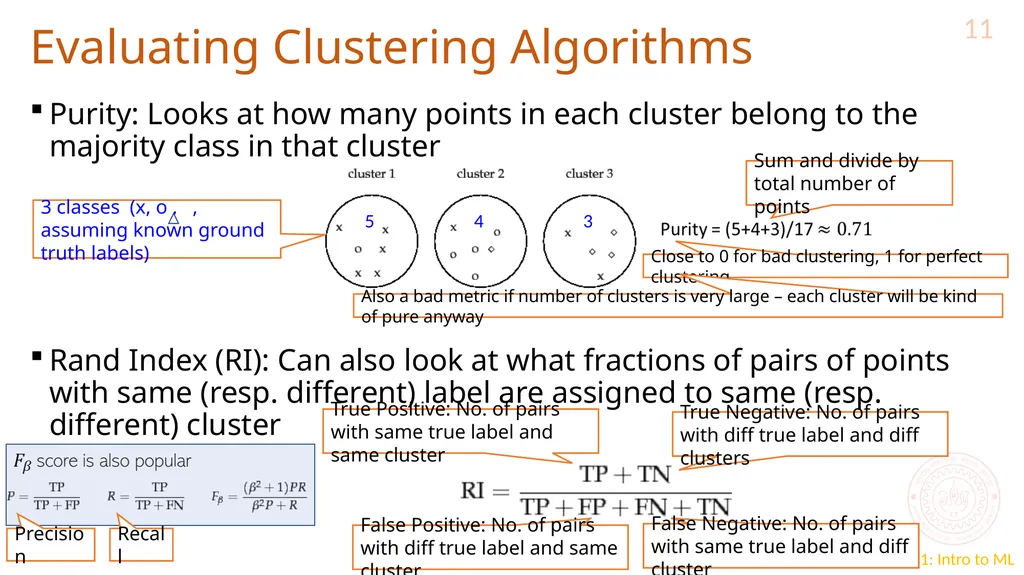
Evaluating Clustering Algorithms 11 Purity: Looks at how many points in each cluster belong to the majority class in that cluster
Rand Index (RI): Can also look at what fractions of pairs of points with same (resp. different) label are assigned to same (resp. different) cluster 5 4 3 3 classes (x, o , , assuming known ground truth labels) Sum and divide by total number of points Close to 0 for bad clustering, 1 for perfect clustering Also a bad metric if number of clusters is very large – each cluster will be kind of pure anyway True Positive: No. of pairs with same true label and same cluster True Negative: No. of pairs with diff true label and diff clusters False Positive: No. of pairs with diff true label and same cluster False Negative: No. of pairs with same true label and diff cluster Precision Recall<br>