Kallocain Karin Boye, 1940 Karin Boye, 1900-1941
Description: Kallocain Karin Boye, 1940 Karin Boye, 1900-1941 The Shield-Maiden I dreamed about swords last night I dreamed about battle last night. I dreamed I fought by your side armored and strong, last night. Lightning flashed harsh from your hand,
Related Topics
Download Presentation
"Kallocain Karin Boye, 1940 Karin Boye, 1900-1941" is the property of its rightful owner. Permission is granted to download and print the materials on this website for personal, non-commercial use only, and to display it on your personal computer provided you do not modify the materials and that you retain all copyright notices contained in the materials. By downloading content from our website, you accept the terms of this agreement.
Presentation Transcript
slide1. Kallocain Karin Boye, 1940<br>
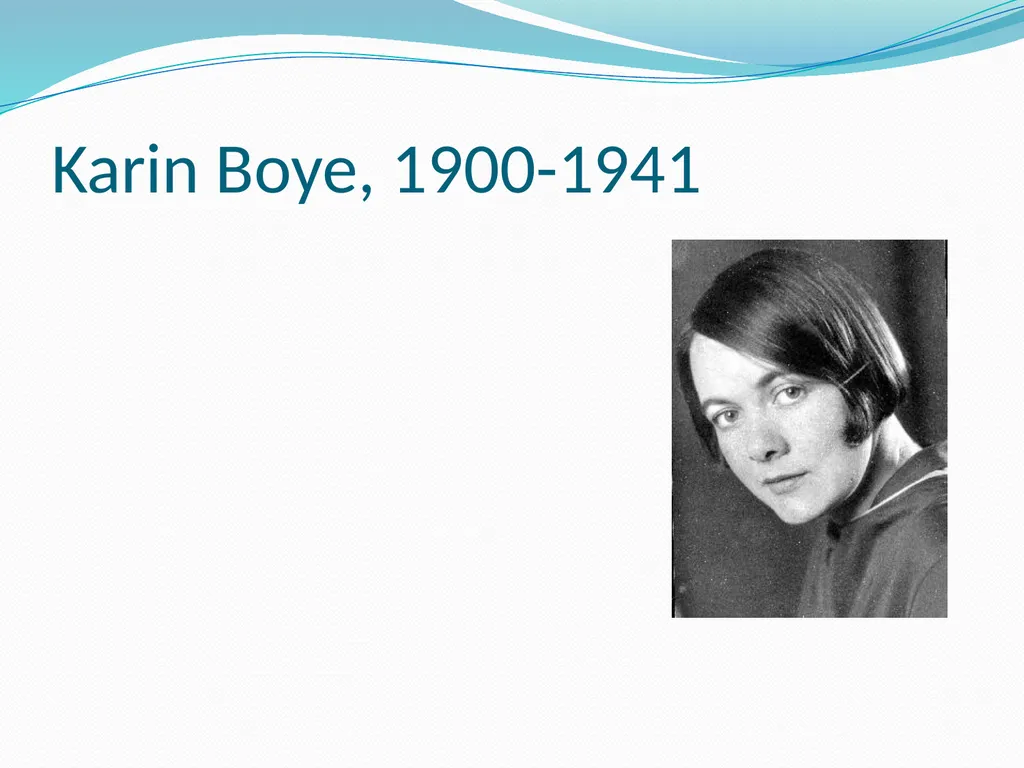
slide2. Karin Boye, 1900-1941<br>
slide3. The Shield-Maiden I dreamed about swords last nightI dreamed about battle last night.I dreamed I fought by your sidearmored and strong, last night.
Lightning flashed harsh from your hand,and the giants fell at your feet.Our ranks closed lightly and sangin silent darkness’ threat.
I dreamed about blood last night.I dreamed about death last night.I dreamed I fell by your sidewith a mortal wound, last night. You marked not at all that I fell.Earnest was your mouth.With steady hand the shield you held,and went your way straight forth.
I dreamed about fire last night.I dreamed about roses last night.I dreamed my death was fair and good.So did I dream last night.<br>
slide4. Kallocain, 1940 Dystopian novel – The All-Powerful State, the dark vision of the future with dehumanized and fearful lives
What do we gain from society, and what do we give up to be a part of it?
The ultimate collective society<br>
slide5. Folkhemmet Swedish Middle way – Capitalism / Communism
Ernst Wigforss and Per Albin Hansson (1930s)
Hansson introduced the concept in 1928
Equality and mutual understanding
Traditional class society People’s Home
Planned economy, ”Functional Socialism”
Good education – Free education
Free universal health care<br>
slide6. Sigmund Freud, Civilization and its Discontents, 1929 “Human life in common is only made possible when a majority comes together which is stronger than any separate individual and which remains united against all separate individuals. The power of this community is then set up as ‘right’ in opposition to the power of the individual, which is condemned as ‘brute force’. This replacement of the power of the individual by the power of the community constitutes the decisive step of civilization. The essence of it lies in the fact that the members of the community restrict themselves in their possibilities of satisfaction, whereas the individual knew no such restrictions.”<br>
slide7. Structure Writing Style Epistolary
Autobiography Formal and stiff,
Empty propaganda
Personal,
Emotional
More interesting<br>
slide8. Progression Loyal, undoubting fellow-soldier
Doubting,
Thinking, agonizing individual
The collective the individual<br>
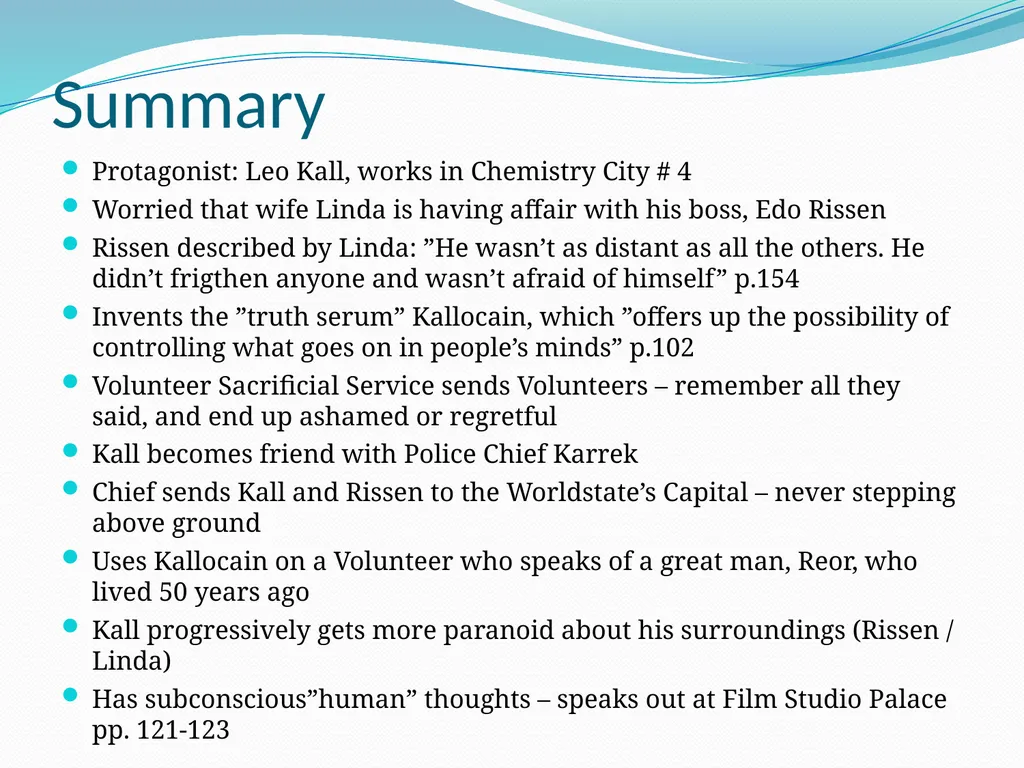
slide9. Summary Protagonist: Leo Kall, works in Chemistry City # 4
Worried that wife Linda is having affair with his boss, Edo Rissen
Rissen described by Linda: ”He wasn’t as distant as all the others. He didn’t frigthen anyone and wasn’t afraid of himself” p.154
Invents the ”truth serum” Kallocain, which ”offers up the possibility of controlling what goes on in people’s minds” p.102
Volunteer Sacrificial Service sends Volunteers – remember all they said, and end up ashamed or regretful
Kall becomes friend with Police Chief Karrek
Chief sends Kall and Rissen to the Worldstate’s Capital – never stepping above ground
Uses Kallocain on a Volunteer who speaks of a great man, Reor, who lived 50 years ago
Kall progressively gets more paranoid about his surroundings (Rissen / Linda)
Has subconscious”human” thoughts – speaks out at Film Studio Palace pp. 121-123<br>
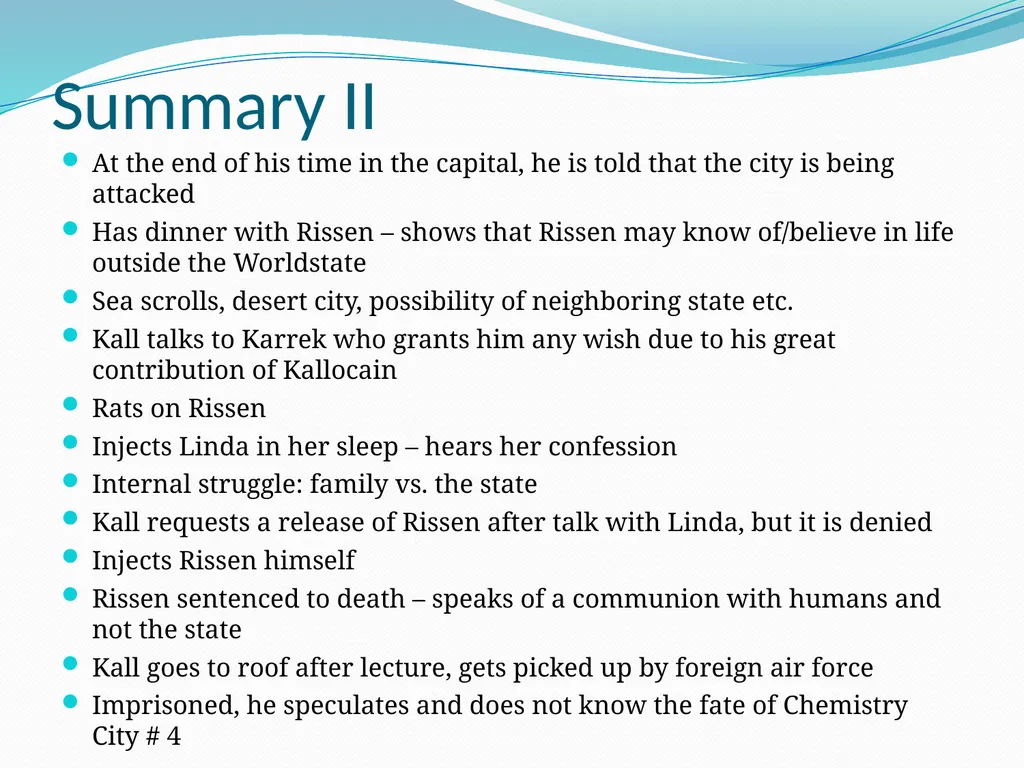
slide10. Summary II At the end of his time in the capital, he is told that the city is being attacked
Has dinner with Rissen – shows that Rissen may know of/believe in life outside the Worldstate
Sea scrolls, desert city, possibility of neighboring state etc.
Kall talks to Karrek who grants him any wish due to his great contribution of Kallocain
Rats on Rissen
Injects Linda in her sleep – hears her confession
Internal struggle: family vs. the state
Kall requests a release of Rissen after talk with Linda, but it is denied
Injects Rissen himself
Rissen sentenced to death – speaks of a communion with humans and not the state
Kall goes to roof after lecture, gets picked up by foreign air force
Imprisoned, he speculates and does not know the fate of Chemistry City # 4<br>
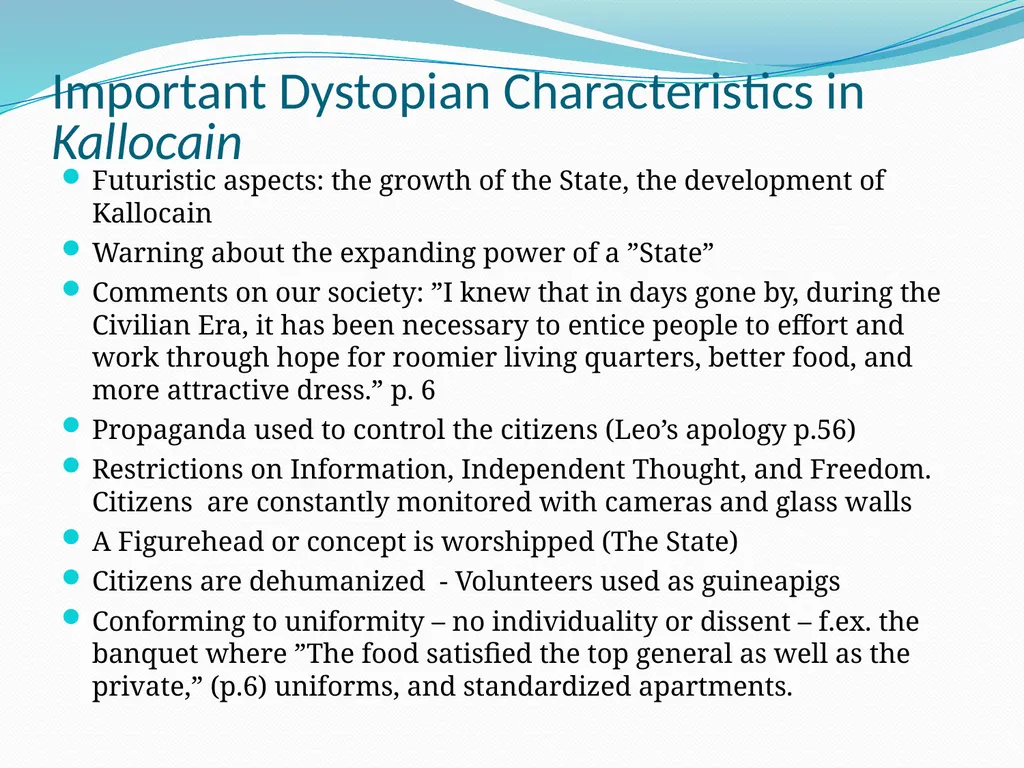
slide11. Important Dystopian Characteristics in Kallocain Futuristic aspects: the growth of the State, the development of Kallocain
Warning about the expanding power of a ”State”
Comments on our society: ”I knew that in days gone by, during the Civilian Era, it has been necessary to entice people to effort and work through hope for roomier living quarters, better food, and more attractive dress.” p. 6
Propaganda used to control the citizens (Leo’s apology p.56)
Restrictions on Information, Independent Thought, and Freedom. Citizens are constantly monitored with cameras and glass walls
A Figurehead or concept is worshipped (The State)
Citizens are dehumanized - Volunteers used as guineapigs
Conforming to uniformity – no individuality or dissent – f.ex. the banquet where ”The food satisfied the top general as well as the private,” (p.6) uniforms, and standardized apartments.<br>
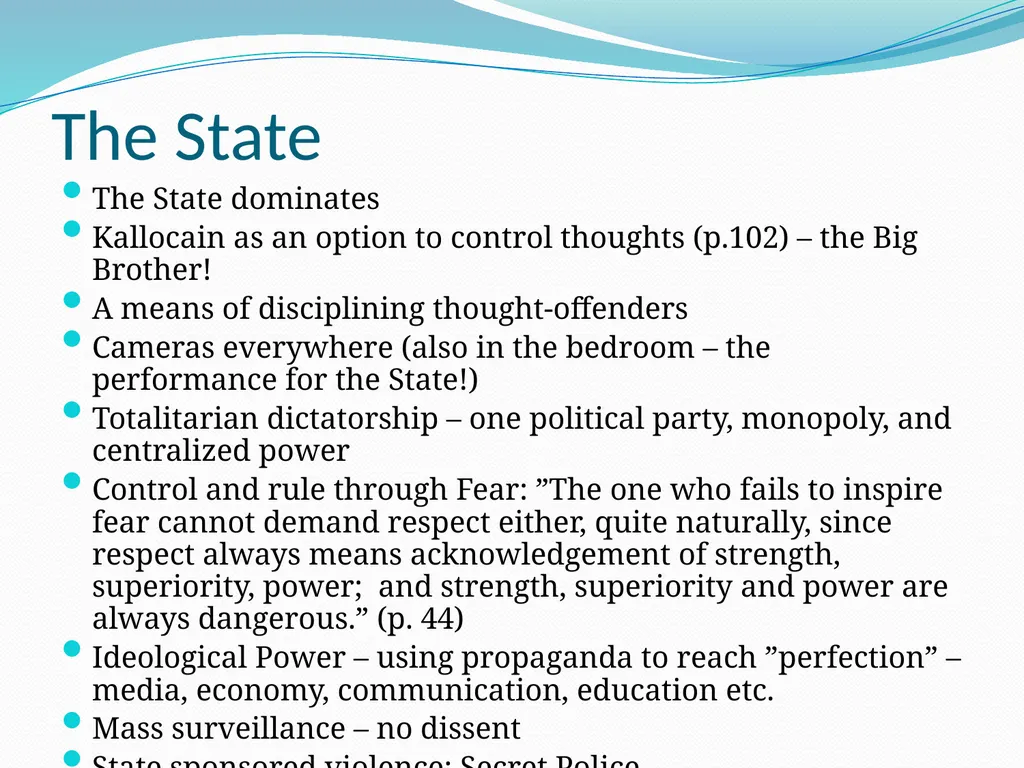
slide12. The State The State dominates
Kallocain as an option to control thoughts (p.102) – the Big Brother!
A means of disciplining thought-offenders
Cameras everywhere (also in the bedroom – the performance for the State!)
Totalitarian dictatorship – one political party, monopoly, and centralized power
Control and rule through Fear: ”The one who fails to inspire fear cannot demand respect either, quite naturally, since respect always means acknowledgement of strength, superiority, power; and strength, superiority and power are always dangerous.” (p. 44)
Ideological Power – using propaganda to reach ”perfection” – media, economy, communication, education etc.
Mass surveillance – no dissent
State sponsored violence: Secret Police<br>
slide13. The Worldstate ”The social body had developed from a planless herd to the most highly organized and differentiated of all forms: our present Worldstate. From individualism to collectivism . . The individual was only a cell with no other significance than that it served the organism [society]as a whole.” (p.51)
”The common uniform – one for work, one for leisure, and one for military and police service – was the same for all, for men and women, for high and low, except for the insignia.” (p.6-7)<br>
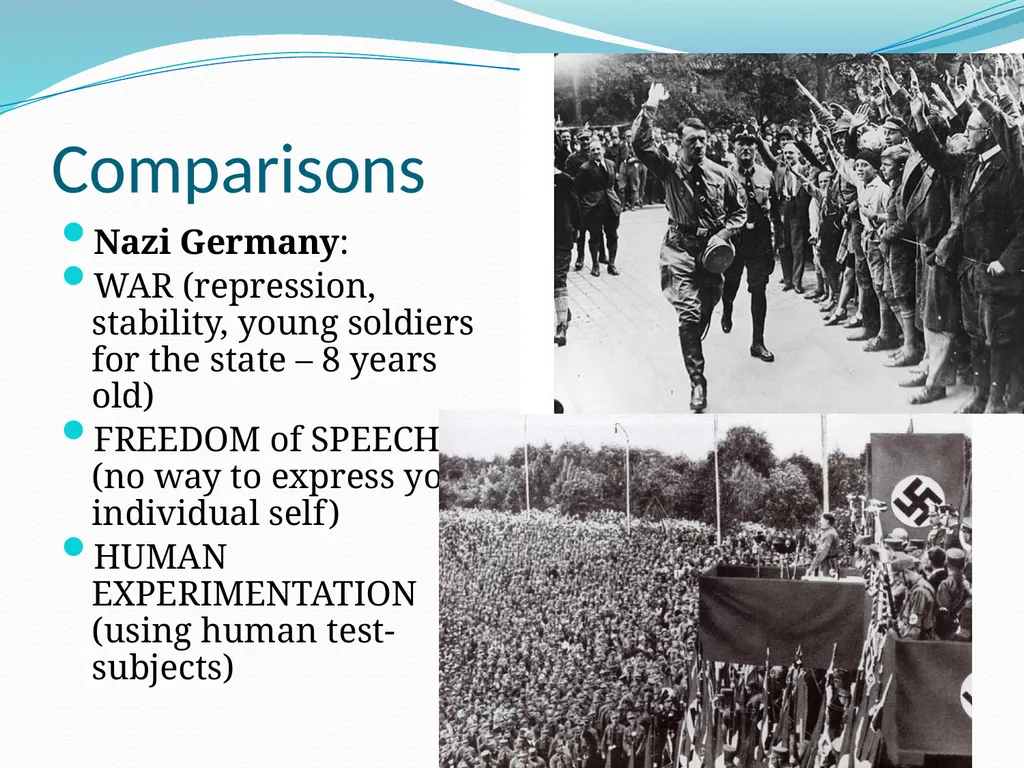
slide14. Comparisons Nazi Germany:
WAR (repression, stability, young soldiers for the state – 8 years old)
FREEDOM of SPEECH (no way to express your individual self)
HUMAN EXPERIMENTATION (using human test-subjects)<br>
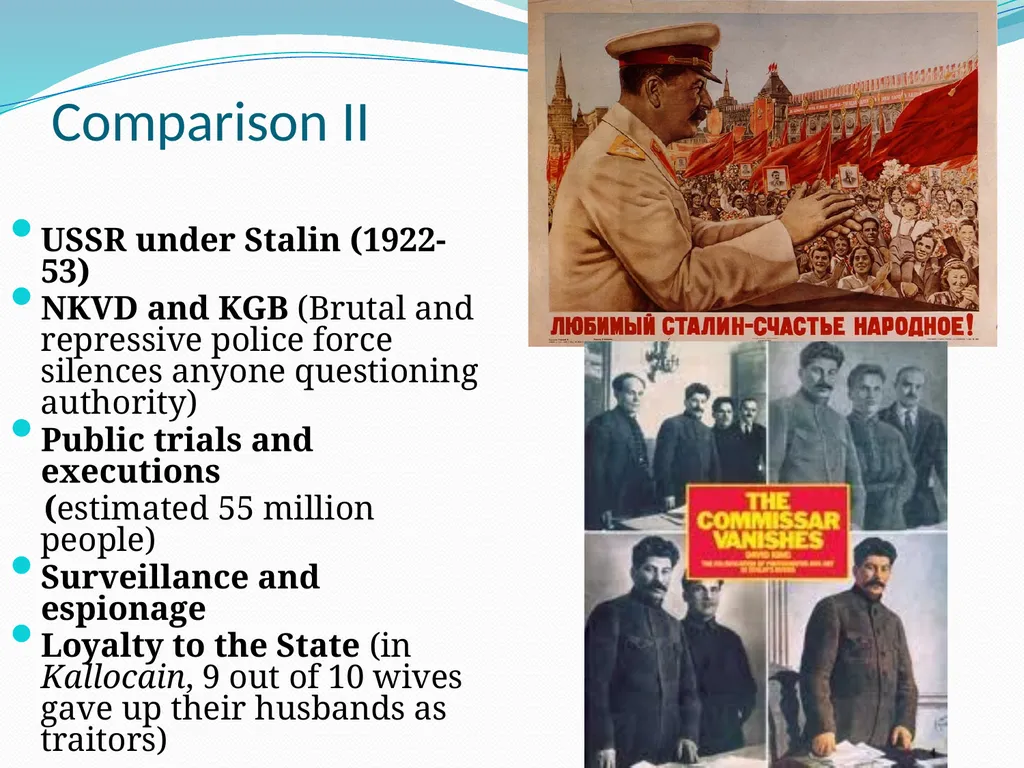
slide15. Comparison II USSR under Stalin (1922-53)
NKVD and KGB (Brutal and repressive police force silences anyone questioning authority)
Public trials and executions
(estimated 55 million people)
Surveillance and espionage
Loyalty to the State (in Kallocain, 9 out of 10 wives gave up their husbands as traitors)<br>
slide16. Theme / Message Family / relationships / emotions
War – as peace
Freedom / Tyranny
Individual perceptions of the whole
Lack of individual communication
Freedom / choice
Humans as tools
Power
Thought-Control through Kallocain
The good life?<br>
slide17. Questions 1) Leo Kall wants to move up the ladder via his invention. Is he satisfied at the end?
2) Is there any kind of mobility in a Totalitarian State?
3) What does Rissen symbolize? What does he mean when he says ”no fellow soldier over forty can have a clear conscience?”
4) What is the symbolic significance of the story of Reor? (pp.88-90)
5) What are the views on marriage / love / child- rearing in the Worldstate? And why?
6) Discuss the use of propaganda (pp.116-119) and how it relates to our society today.<br>

slide2. Karin Boye, 1900-1941<br>
slide3. The Shield-Maiden I dreamed about swords last nightI dreamed about battle last night.I dreamed I fought by your sidearmored and strong, last night.
Lightning flashed harsh from your hand,and the giants fell at your feet.Our ranks closed lightly and sangin silent darkness’ threat.
I dreamed about blood last night.I dreamed about death last night.I dreamed I fell by your sidewith a mortal wound, last night. You marked not at all that I fell.Earnest was your mouth.With steady hand the shield you held,and went your way straight forth.
I dreamed about fire last night.I dreamed about roses last night.I dreamed my death was fair and good.So did I dream last night.<br>
slide4. Kallocain, 1940 Dystopian novel – The All-Powerful State, the dark vision of the future with dehumanized and fearful lives
What do we gain from society, and what do we give up to be a part of it?
The ultimate collective society<br>
slide5. Folkhemmet Swedish Middle way – Capitalism / Communism
Ernst Wigforss and Per Albin Hansson (1930s)
Hansson introduced the concept in 1928
Equality and mutual understanding
Traditional class society People’s Home
Planned economy, ”Functional Socialism”
Good education – Free education
Free universal health care<br>
slide6. Sigmund Freud, Civilization and its Discontents, 1929 “Human life in common is only made possible when a majority comes together which is stronger than any separate individual and which remains united against all separate individuals. The power of this community is then set up as ‘right’ in opposition to the power of the individual, which is condemned as ‘brute force’. This replacement of the power of the individual by the power of the community constitutes the decisive step of civilization. The essence of it lies in the fact that the members of the community restrict themselves in their possibilities of satisfaction, whereas the individual knew no such restrictions.”<br>
slide7. Structure Writing Style Epistolary
Autobiography Formal and stiff,
Empty propaganda
Personal,
Emotional
More interesting<br>
slide8. Progression Loyal, undoubting fellow-soldier
Doubting,
Thinking, agonizing individual
The collective the individual<br>
slide9. Summary Protagonist: Leo Kall, works in Chemistry City # 4
Worried that wife Linda is having affair with his boss, Edo Rissen
Rissen described by Linda: ”He wasn’t as distant as all the others. He didn’t frigthen anyone and wasn’t afraid of himself” p.154
Invents the ”truth serum” Kallocain, which ”offers up the possibility of controlling what goes on in people’s minds” p.102
Volunteer Sacrificial Service sends Volunteers – remember all they said, and end up ashamed or regretful
Kall becomes friend with Police Chief Karrek
Chief sends Kall and Rissen to the Worldstate’s Capital – never stepping above ground
Uses Kallocain on a Volunteer who speaks of a great man, Reor, who lived 50 years ago
Kall progressively gets more paranoid about his surroundings (Rissen / Linda)
Has subconscious”human” thoughts – speaks out at Film Studio Palace pp. 121-123<br>
slide10. Summary II At the end of his time in the capital, he is told that the city is being attacked
Has dinner with Rissen – shows that Rissen may know of/believe in life outside the Worldstate
Sea scrolls, desert city, possibility of neighboring state etc.
Kall talks to Karrek who grants him any wish due to his great contribution of Kallocain
Rats on Rissen
Injects Linda in her sleep – hears her confession
Internal struggle: family vs. the state
Kall requests a release of Rissen after talk with Linda, but it is denied
Injects Rissen himself
Rissen sentenced to death – speaks of a communion with humans and not the state
Kall goes to roof after lecture, gets picked up by foreign air force
Imprisoned, he speculates and does not know the fate of Chemistry City # 4<br>
slide11. Important Dystopian Characteristics in Kallocain Futuristic aspects: the growth of the State, the development of Kallocain
Warning about the expanding power of a ”State”
Comments on our society: ”I knew that in days gone by, during the Civilian Era, it has been necessary to entice people to effort and work through hope for roomier living quarters, better food, and more attractive dress.” p. 6
Propaganda used to control the citizens (Leo’s apology p.56)
Restrictions on Information, Independent Thought, and Freedom. Citizens are constantly monitored with cameras and glass walls
A Figurehead or concept is worshipped (The State)
Citizens are dehumanized - Volunteers used as guineapigs
Conforming to uniformity – no individuality or dissent – f.ex. the banquet where ”The food satisfied the top general as well as the private,” (p.6) uniforms, and standardized apartments.<br>
slide12. The State The State dominates
Kallocain as an option to control thoughts (p.102) – the Big Brother!
A means of disciplining thought-offenders
Cameras everywhere (also in the bedroom – the performance for the State!)
Totalitarian dictatorship – one political party, monopoly, and centralized power
Control and rule through Fear: ”The one who fails to inspire fear cannot demand respect either, quite naturally, since respect always means acknowledgement of strength, superiority, power; and strength, superiority and power are always dangerous.” (p. 44)
Ideological Power – using propaganda to reach ”perfection” – media, economy, communication, education etc.
Mass surveillance – no dissent
State sponsored violence: Secret Police<br>
slide13. The Worldstate ”The social body had developed from a planless herd to the most highly organized and differentiated of all forms: our present Worldstate. From individualism to collectivism . . The individual was only a cell with no other significance than that it served the organism [society]as a whole.” (p.51)
”The common uniform – one for work, one for leisure, and one for military and police service – was the same for all, for men and women, for high and low, except for the insignia.” (p.6-7)<br>
slide14. Comparisons Nazi Germany:
WAR (repression, stability, young soldiers for the state – 8 years old)
FREEDOM of SPEECH (no way to express your individual self)
HUMAN EXPERIMENTATION (using human test-subjects)<br>
slide15. Comparison II USSR under Stalin (1922-53)
NKVD and KGB (Brutal and repressive police force silences anyone questioning authority)
Public trials and executions
(estimated 55 million people)
Surveillance and espionage
Loyalty to the State (in Kallocain, 9 out of 10 wives gave up their husbands as traitors)<br>
slide16. Theme / Message Family / relationships / emotions
War – as peace
Freedom / Tyranny
Individual perceptions of the whole
Lack of individual communication
Freedom / choice
Humans as tools
Power
Thought-Control through Kallocain
The good life?<br>
slide17. Questions 1) Leo Kall wants to move up the ladder via his invention. Is he satisfied at the end?
2) Is there any kind of mobility in a Totalitarian State?
3) What does Rissen symbolize? What does he mean when he says ”no fellow soldier over forty can have a clear conscience?”
4) What is the symbolic significance of the story of Reor? (pp.88-90)
5) What are the views on marriage / love / child- rearing in the Worldstate? And why?
6) Discuss the use of propaganda (pp.116-119) and how it relates to our society today.<br>