
Kant’s objection to ontological arguments Michael

Description: Kants objection to ontological arguments Michael Lacewing enquiriesalevelphilosophy.co.uk (c) Michael Lacewing Anselms argument God is a being greater than which cannot be conceived If you could think of something that is greater than
Related Topics
Download Presentation
"Kant’s objection to ontological arguments Michael" is the property of its rightful owner. Permission is granted to download and print the materials on this website for personal, non-commercial use only, and to display it on your personal computer provided you do not modify the materials and that you retain all copyright notices contained in the materials. By downloading content from our website, you accept the terms of this agreement.
Presentation Transcript
slide1. Kant’s objection to ontological arguments Michael Lacewing
enquiries@alevelphilosophy.co.uk (c) Michael Lacewing<br>
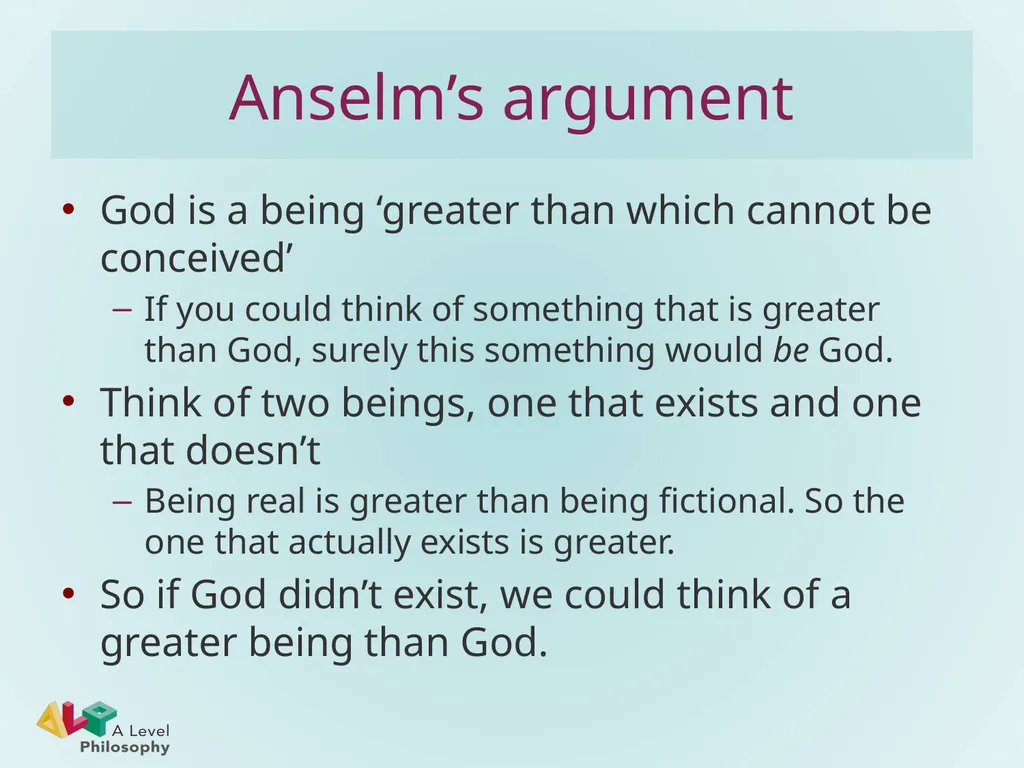
slide2. Anselm’s argument God is a being ‘greater than which cannot be conceived’
If you could think of something that is greater than God, surely this something would be God.
Think of two beings, one that exists and one that doesn’t
Being real is greater than being fictional. So the one that actually exists is greater.
So if God didn’t exist, we could think of a greater being than God.<br>
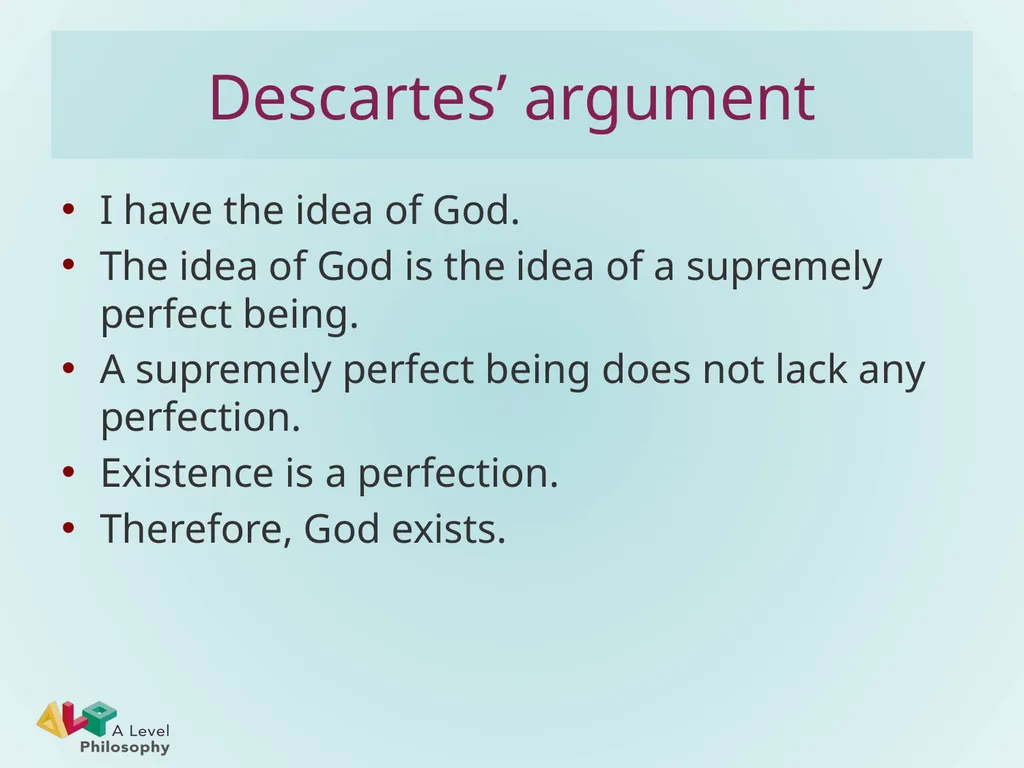
slide3. Descartes’ argument I have the idea of God.
The idea of God is the idea of a supremely perfect being.
A supremely perfect being does not lack any perfection.
Existence is a perfection.
Therefore, God exists.<br>
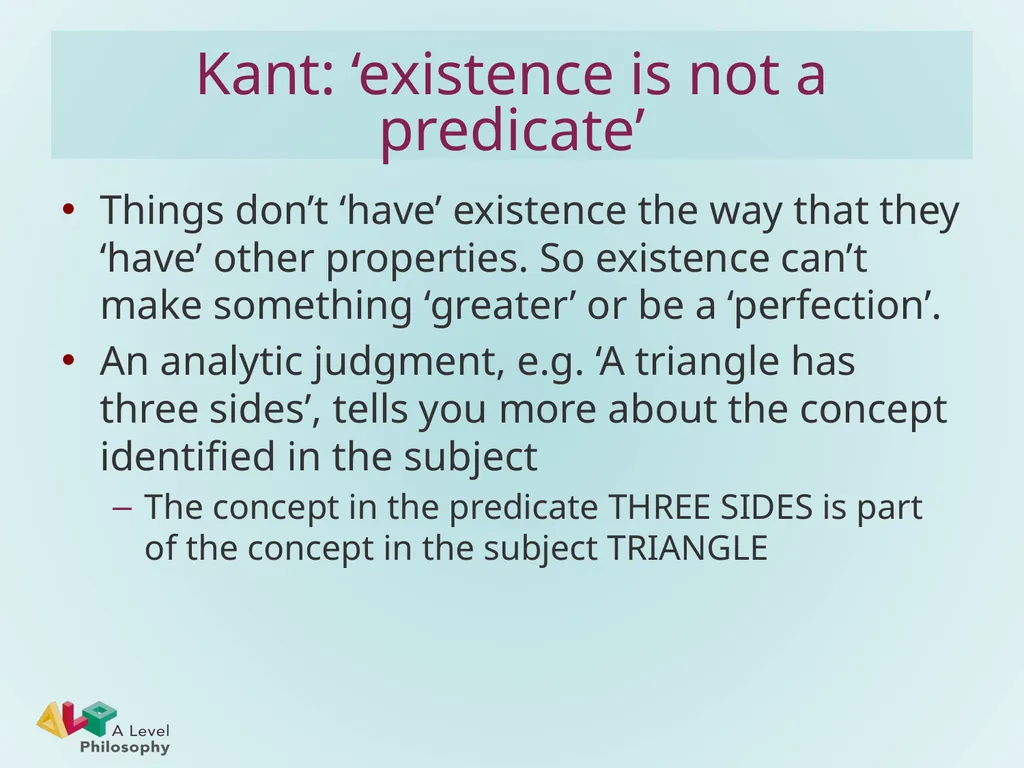
slide4. Kant: ‘existence is not a predicate’ Things don’t ‘have’ existence the way that they ‘have’ other properties. So existence can’t make something ‘greater’ or be a ‘perfection’.
An analytic judgment, e.g. ‘A triangle has three sides’, tells you more about the concept identified in the subject
The concept in the predicate THREE SIDES is part of the concept in the subject TRIANGLE<br>
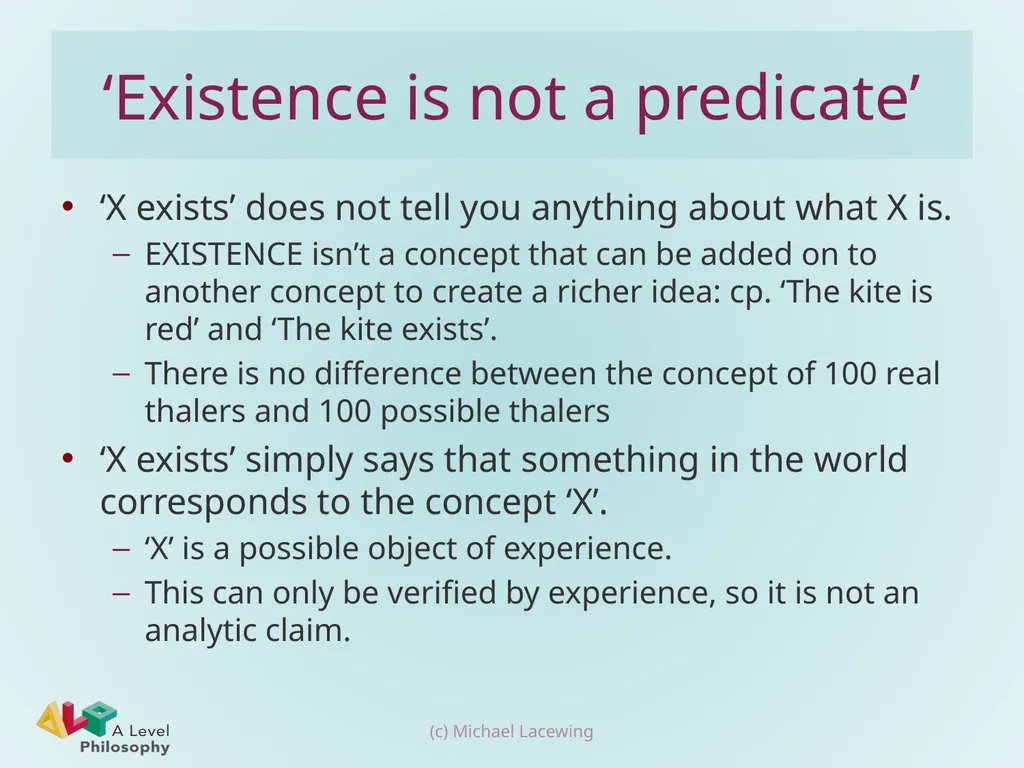
slide5. ‘Existence is not a predicate’ ‘X exists’ does not tell you anything about what X is.
EXISTENCE isn’t a concept that can be added on to another concept to create a richer idea: cp. ‘The kite is red’ and ‘The kite exists’.
There is no difference between the concept of 100 real thalers and 100 possible thalers
‘X exists’ simply says that something in the world corresponds to the concept ‘X’.
‘X’ is a possible object of experience.
This can only be verified by experience, so it is not an analytic claim. (c) Michael Lacewing<br>
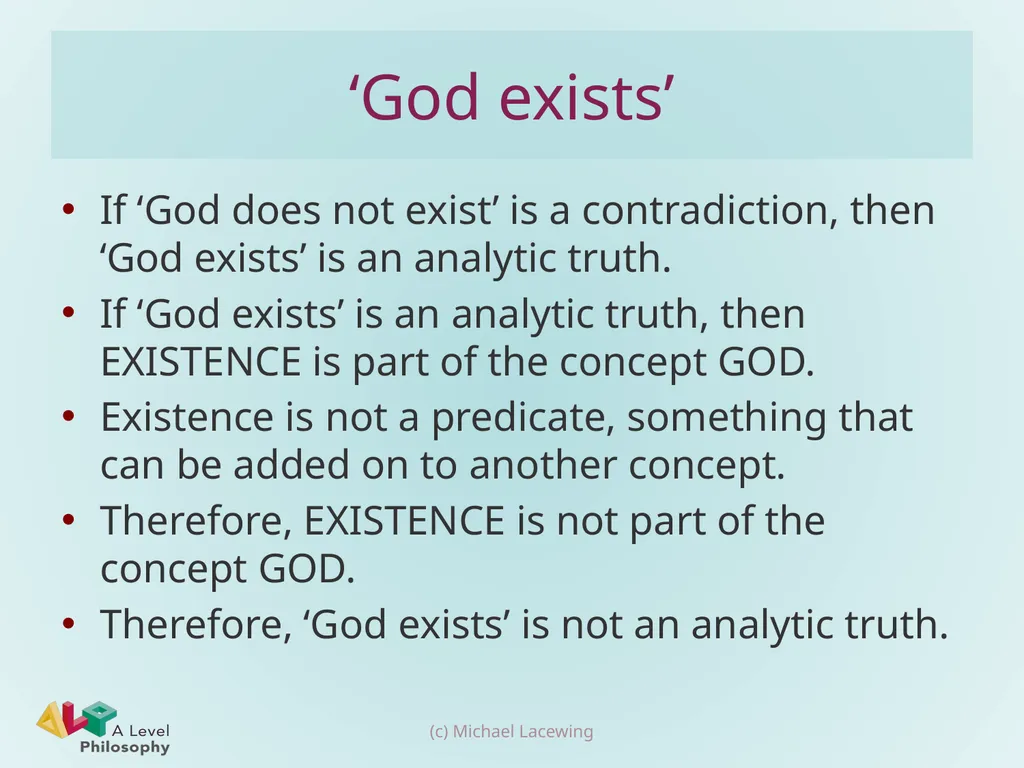
slide6. ‘God exists’ If ‘God does not exist’ is a contradiction, then ‘God exists’ is an analytic truth.
If ‘God exists’ is an analytic truth, then EXISTENCE is part of the concept GOD.
Existence is not a predicate, something that can be added on to another concept.
Therefore, EXISTENCE is not part of the concept GOD.
Therefore, ‘God exists’ is not an analytic truth. (c) Michael Lacewing<br>
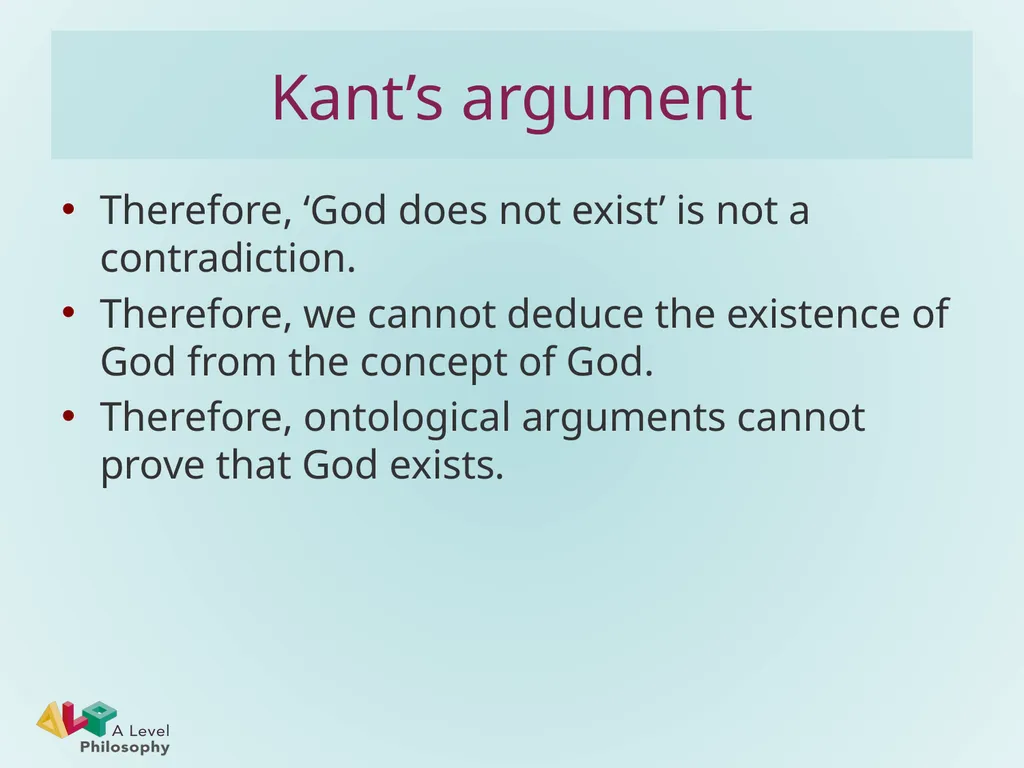
slide7. Kant’s argument Therefore, ‘God does not exist’ is not a contradiction.
Therefore, we cannot deduce the existence of God from the concept of God.
Therefore, ontological arguments cannot prove that God exists.<br>
enquiries@alevelphilosophy.co.uk (c) Michael Lacewing<br>
slide2. Anselm’s argument God is a being ‘greater than which cannot be conceived’
If you could think of something that is greater than God, surely this something would be God.
Think of two beings, one that exists and one that doesn’t
Being real is greater than being fictional. So the one that actually exists is greater.
So if God didn’t exist, we could think of a greater being than God.<br>
slide3. Descartes’ argument I have the idea of God.
The idea of God is the idea of a supremely perfect being.
A supremely perfect being does not lack any perfection.
Existence is a perfection.
Therefore, God exists.<br>
slide4. Kant: ‘existence is not a predicate’ Things don’t ‘have’ existence the way that they ‘have’ other properties. So existence can’t make something ‘greater’ or be a ‘perfection’.
An analytic judgment, e.g. ‘A triangle has three sides’, tells you more about the concept identified in the subject
The concept in the predicate THREE SIDES is part of the concept in the subject TRIANGLE<br>
slide5. ‘Existence is not a predicate’ ‘X exists’ does not tell you anything about what X is.
EXISTENCE isn’t a concept that can be added on to another concept to create a richer idea: cp. ‘The kite is red’ and ‘The kite exists’.
There is no difference between the concept of 100 real thalers and 100 possible thalers
‘X exists’ simply says that something in the world corresponds to the concept ‘X’.
‘X’ is a possible object of experience.
This can only be verified by experience, so it is not an analytic claim. (c) Michael Lacewing<br>
slide6. ‘God exists’ If ‘God does not exist’ is a contradiction, then ‘God exists’ is an analytic truth.
If ‘God exists’ is an analytic truth, then EXISTENCE is part of the concept GOD.
Existence is not a predicate, something that can be added on to another concept.
Therefore, EXISTENCE is not part of the concept GOD.
Therefore, ‘God exists’ is not an analytic truth. (c) Michael Lacewing<br>
slide7. Kant’s argument Therefore, ‘God does not exist’ is not a contradiction.
Therefore, we cannot deduce the existence of God from the concept of God.
Therefore, ontological arguments cannot prove that God exists.<br>