Kenya-United States Foreign Relations in Retrospect: Sixty Years of Relations in an Era of Emerging Global Power Competition. Winnie Rugutt, Ph.D. Department of Diplomacy and International Studies (DDIS) University of Nairobi
"Kenya-United States Foreign Relations in" is the property of its rightful owner. Permission is granted to
download and print the materials on this website for personal, non-commercial use only, and to display it
on your personal computer provided you do not modify the materials and that you retain all copyright
notices contained in the materials. By downloading content from our website, you accept the terms of this
agreement.
Presentation Transcript
01
Kenya-United States Foreign Relations in Retrospect: Sixty Years of Relations in an Era of Emerging Global Power Competition. Winnie Rugutt, Ph.D.
Department of Diplomacy and International Studies (DDIS)
University of Nairobi
wrugutt@uonbi.ac.ke
Noela Kiprotich
Department of Diplomacy and International Studies (DDIS)
University of Nairobi
nkiprotich97@students.uonbi.ac.ke<br>
02
Introduction<br>
03
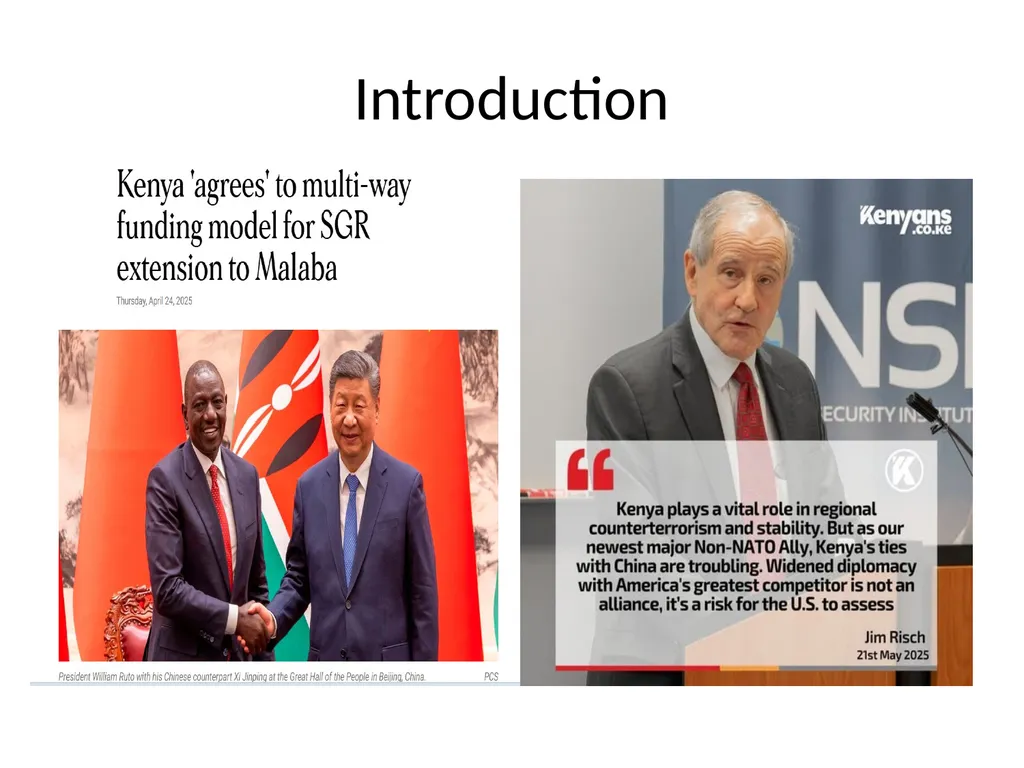
Introduction Historically, Africa has often been portrayed in international relations as passive — more acted upon than acting.
But Kenya’s relationship with the United States tells a different story. It shows us how African states exercise agency, strategically positioning themselves in global affairs
Objective: Examine the evolution, resilience, and challenges of Kenya–U.S. relations in a multipolar era.<br>
04
Core Argument Kenya–U.S. relations have passed through four broad phases:
1. Cold War alliance (strategic ally against communism).
2. 1990s – Conditional engagement with democracy and governance reforms.
3. Post-9/11 – Kenya as counterterrorism hub and security partner.
4. Contemporary multipolar era – balancing U.S. with China, India, and Gulf states.<br>
05
Core Argument Kenya is not just a recipient of policy but an active agent, leveraging its strategic geography and diversifying its partnerships.
Despite tensions, strong people-to-people ties and shared values keep this US-Kenya relationship resilient.<br>
06
Conceptual Framework: Agency in Asymmetry Agency = ability of weaker states to act strategically in asymmetric partnerships.
Kenya demonstrates agency through three lenses:
- Bargaining Power: Location in the Horn of Africa, role in regional stability, innovation hub (Silicon Savannah).
- Alternative Alliances: China (infrastructure, BRI), India (pharma, tech), Gulf states, EU.
- Domestic Imperatives: Sovereignty, nationalist narratives, public opinion (e.g., ICC backlash).<br>
07
Historical Phases Pre-independence (1959–1963): Airlift Program created early people-to-people ties.
Cold War (1963–1989): Kenya as a pro-West ally; extracted aid and military support.
1990s: Conditionality era – democratization and aid pressures; selective compliance by Moi.
Post-9/11: Reborn security partnership; Kenya vital to counterterrorism, but sovereignty concerns emerged.
2010s–Present: Kenya diversifies partners (China, India, Gulf, EU), but U.S. remains central.<br>
08
Multi-Alignment Era Kenya’s foreign policy embraces strategic multi-alignment.
China: Standard Gauge Railway, infrastructure loans with limited conditionalities.
India: Growth in pharmaceuticals, health technology, and tech transfer.
Gulf States & EU: Expanding investment and trade opportunities.
U.S.: Still critical partner; Major Non-NATO Ally (2024).
Benefits: greater bargaining power, more choices for development financing.
Risks: debt burdens, procurement issues, risk of overdependence on multiple fronts.<br>
09
Key Insights Kenya actively shapes its foreign policy rather than being a passive actor.
The U.S. advantage lies in soft power – education exchanges, diaspora, shared democratic values.
China offers speed and infrastructure, but lacks cultural and normative depth of U.S.–Kenya ties.
Kenya leverages multipolar competition to its benefit, but faces risks of debt, governance, and contradictions in policy.<br>
10
Conclusion Kenya–U.S. relations have evolved from Cold War dependency to agency-driven partnership.
Agency has been expressed differently across eras – alignment, negotiated compliance, bargaining, and multi-alignment.
Future of the partnership depends on respecting Kenya’s sovereignty and national priorities.
Opportunities for cooperation remain strong in areas such as trade, security, climate, and innovation.
The Kenya–U.S. partnership is resilient but must adapt to multipolar realities.<br>