
Kickoff Meeting Template The SEED Method for
CM
Published · 55 slides · 0 views
1 / 1




Description
Kickoff Meeting Template The SEED Method for Stakeholder Engagement in Question Development SEED DISCLOSURE What is the SEED Method? A new method to develop stakeholder-driven health research ! Todays goals Learn about health research in
Related Topics
Share
Embed code
Download this presentation From Below
"Kickoff Meeting Template The SEED Method for" is the property of its rightful owner. Permission is granted to download and print the materials on this website for personal, non-commercial use only, and to display it on your personal computer provided you do not modify the materials and that you retain all copyright notices contained in the materials. By downloading content from our website, you accept the terms of this agreement.
Presentation Transcript
01
Kickoff Meeting Template The SEED Method for Stakeholder Engagement in Question Development<br>
02
SEED DISCLOSURE<br>
03
What is the SEED Method? A new method to develop
stakeholder-driven
health research !<br>
stakeholder-driven
health research !<br>
04
Today’s goals Learn about health research in the U.S.
Learn about stakeholders
Learn about patient-centered research
Learn about the SEED Method
Review details of this project<br>
Learn about stakeholders
Learn about patient-centered research
Learn about the SEED Method
Review details of this project<br>
05
Health research in the U.S. Basic medical research
Epidemiological studies
Prevention
Disease detection, screening and diagnosis
Disease treatment and intervention
Health services and policy<br>
Epidemiological studies
Prevention
Disease detection, screening and diagnosis
Disease treatment and intervention
Health services and policy<br>
06
Examples of health research topics Specific diseases
Treatments and therapies
Genetics and biological factors
Environmental and social factors
Health services delivery & financing
Health policy
Health disparities
Maternal/child health
Aging
Mental health/behavioral health
Health promotion/education
Health information technology
Occupational health<br>
Treatments and therapies
Genetics and biological factors
Environmental and social factors
Health services delivery & financing
Health policy
Health disparities
Maternal/child health
Aging
Mental health/behavioral health
Health promotion/education
Health information technology
Occupational health<br>
07
Who funds health research?1 Private industry
Federal agencies
Private philanthropy/foundations
State and local institutions
Health associations
Universities/research institutes<br>
Federal agencies
Private philanthropy/foundations
State and local institutions
Health associations
Universities/research institutes<br>
08
How much is spent on health research in the U.S.? An estimated $130 billion was spent in the U.S. on medical and health research in 2012.1<br>
09
How do research topics get picked now? For publicly funded research, agencies solicit input from a range of stakeholders.
Advisory board, councils, and committees
Agency staff
Research scientists and professional societies;
Patient organizations and voluntary health associations;
Institute and Center Advisory Councils;
Political bodies (e.g., Congress);
Many research proposals to NIH are “investigator-initiated research” in which the researcher submits the research question and a research plan.<br>
Advisory board, councils, and committees
Agency staff
Research scientists and professional societies;
Patient organizations and voluntary health associations;
Institute and Center Advisory Councils;
Political bodies (e.g., Congress);
Many research proposals to NIH are “investigator-initiated research” in which the researcher submits the research question and a research plan.<br>
10
Stakeholder input While there may be some areas for stakeholder input for research priorities, without systematic opportunities for engagement stakeholders like patients and health care workers are unlikely to have much say in what gets funded.<br>
11
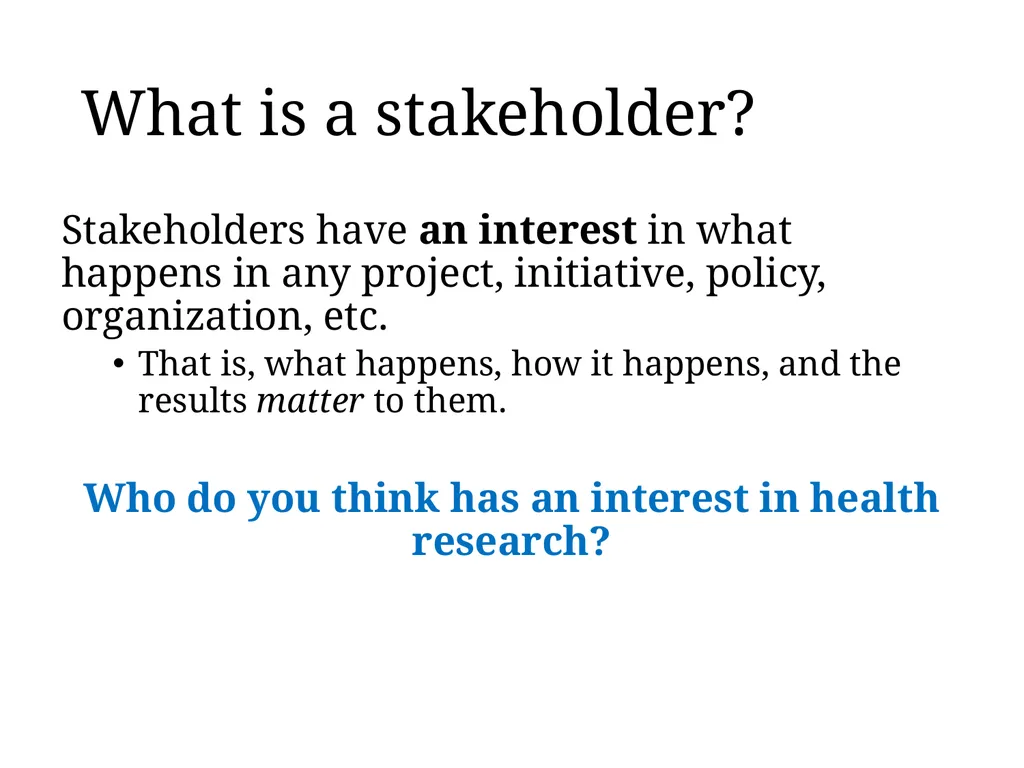
What is a stakeholder? Stakeholders have an interest in what happens in any project, initiative, policy, organization, etc.
That is, what happens, how it happens, and the results matter to them.
Who do you think has an interest in health research?<br>
That is, what happens, how it happens, and the results matter to them.
Who do you think has an interest in health research?<br>
12
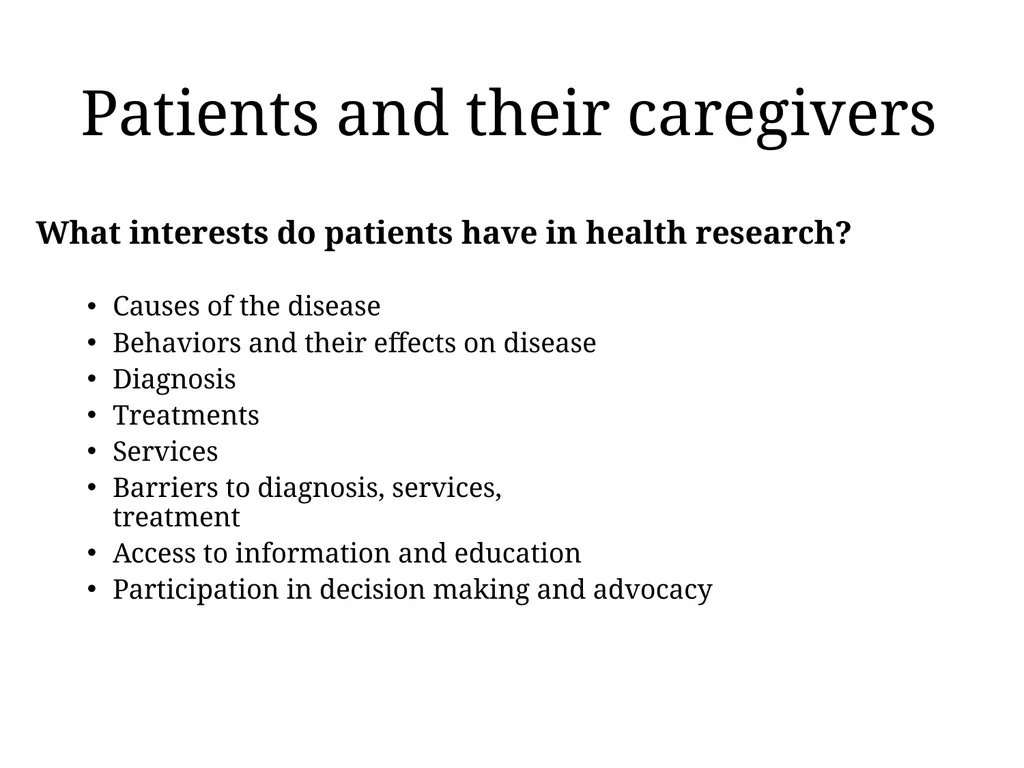
Patients and their caregivers What interests do patients have in health research?
Causes of the disease
Behaviors and their effects on disease
Diagnosis
Treatments
Services
Barriers to diagnosis, services, treatment
Access to information and education
Participation in decision making and advocacy<br>
Causes of the disease
Behaviors and their effects on disease
Diagnosis
Treatments
Services
Barriers to diagnosis, services, treatment
Access to information and education
Participation in decision making and advocacy<br>
13
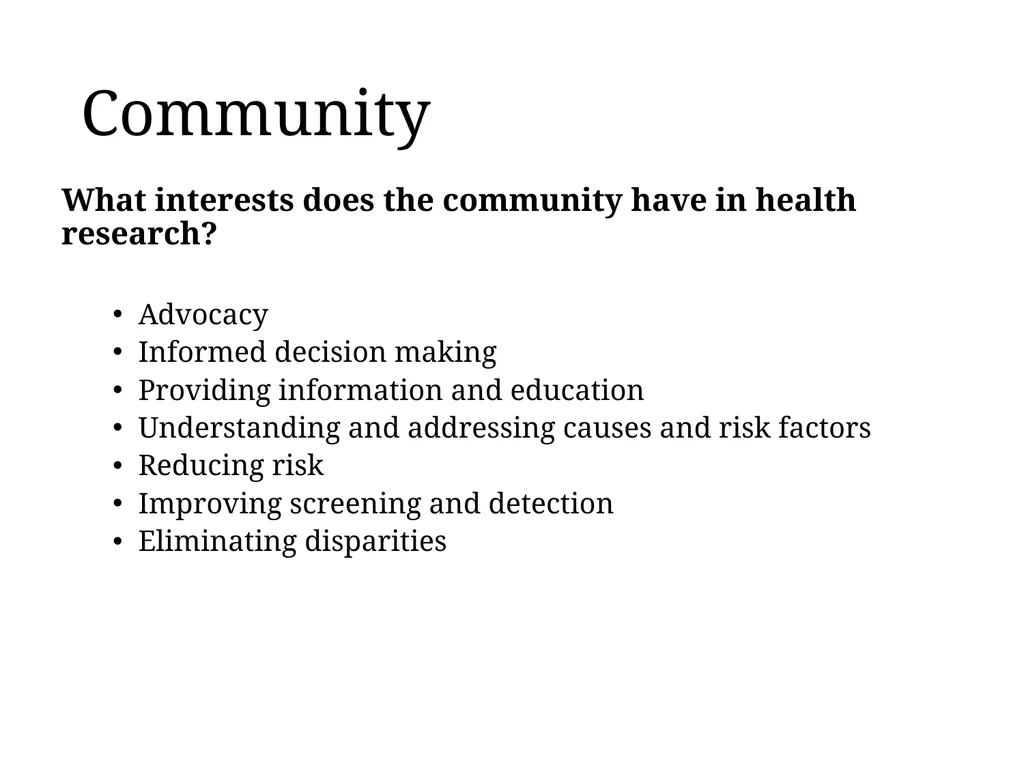
Community What interests does the community have in health research?
Advocacy
Informed decision making
Providing information and education
Understanding and addressing causes and risk factors
Reducing risk
Improving screening and detection
Eliminating disparities<br>
Advocacy
Informed decision making
Providing information and education
Understanding and addressing causes and risk factors
Reducing risk
Improving screening and detection
Eliminating disparities<br>
14
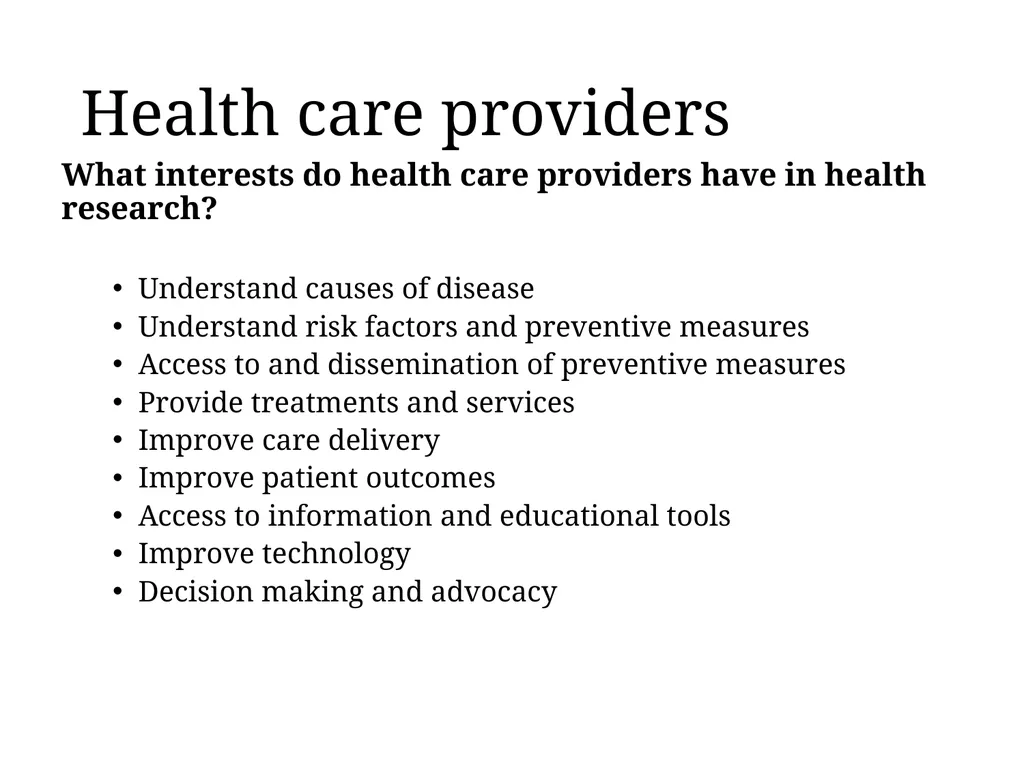
Health care providers What interests do health care providers have in health research?
Understand causes of disease
Understand risk factors and preventive measures
Access to and dissemination of preventive measures
Provide treatments and services
Improve care delivery
Improve patient outcomes
Access to information and educational tools
Improve technology
Decision making and advocacy<br>
Understand causes of disease
Understand risk factors and preventive measures
Access to and dissemination of preventive measures
Provide treatments and services
Improve care delivery
Improve patient outcomes
Access to information and educational tools
Improve technology
Decision making and advocacy<br>
15
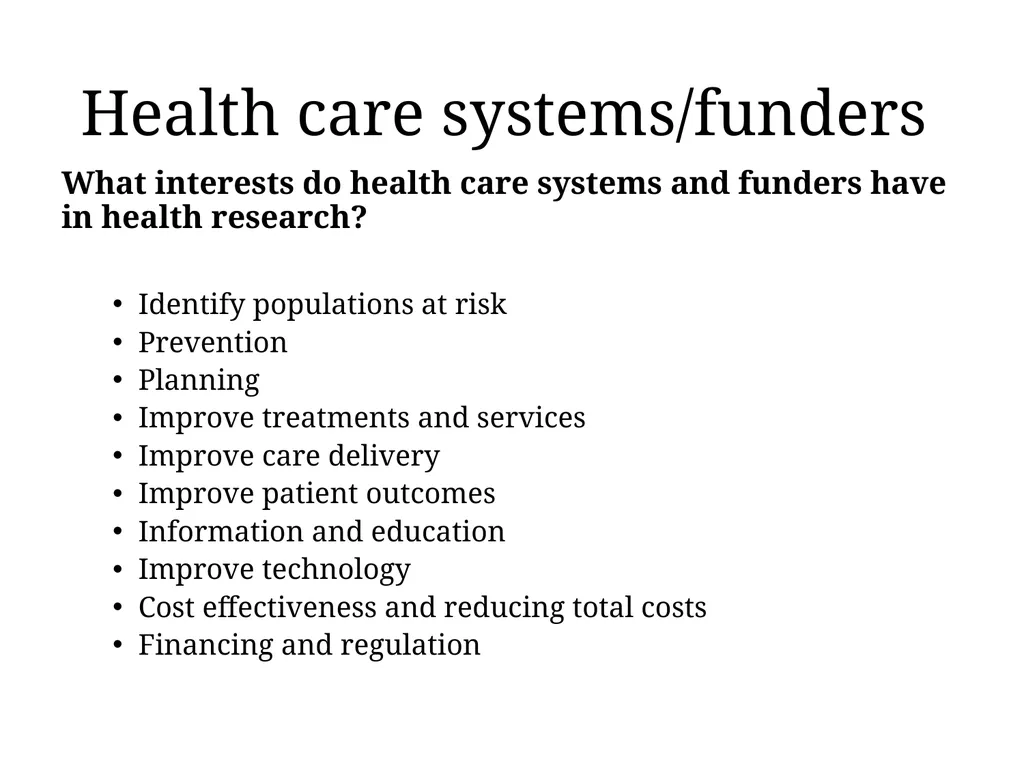
Health care systems/funders What interests do health care systems and funders have in health research?
Identify populations at risk
Prevention
Planning
Improve treatments and services
Improve care delivery
Improve patient outcomes
Information and education
Improve technology
Cost effectiveness and reducing total costs
Financing and regulation<br>
Identify populations at risk
Prevention
Planning
Improve treatments and services
Improve care delivery
Improve patient outcomes
Information and education
Improve technology
Cost effectiveness and reducing total costs
Financing and regulation<br>
16
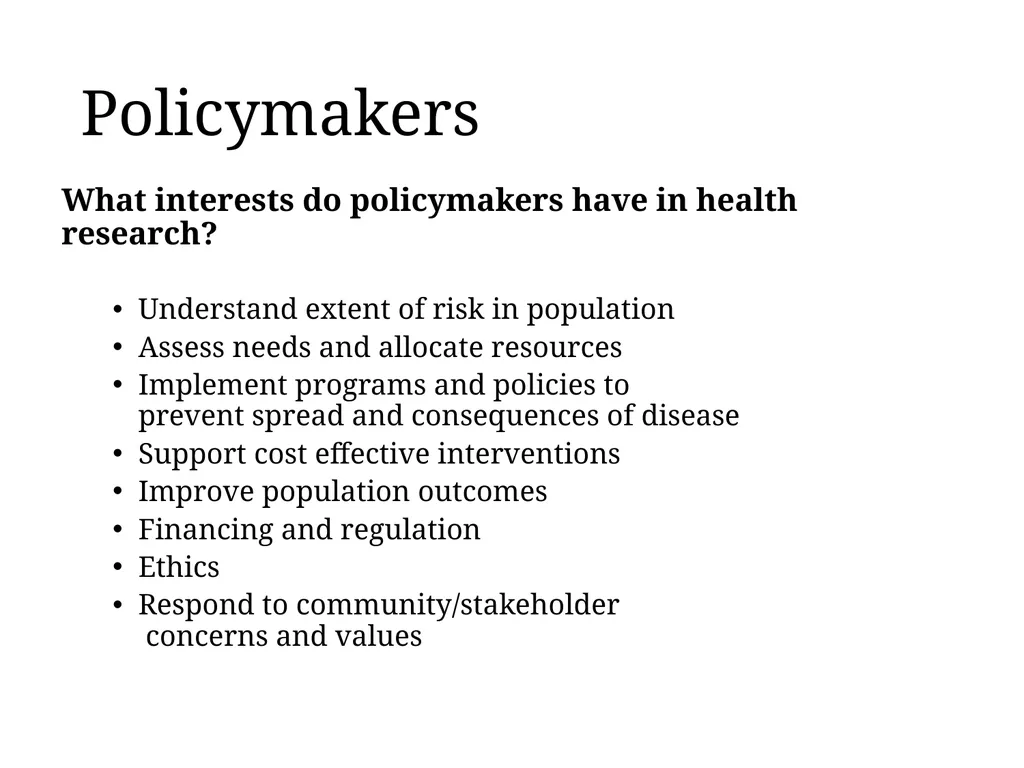
Policymakers What interests do policymakers have in health research?
Understand extent of risk in population
Assess needs and allocate resources
Implement programs and policies to prevent spread and consequences of disease
Support cost effective interventions
Improve population outcomes
Financing and regulation
Ethics
Respond to community/stakeholder concerns and values<br>
Understand extent of risk in population
Assess needs and allocate resources
Implement programs and policies to prevent spread and consequences of disease
Support cost effective interventions
Improve population outcomes
Financing and regulation
Ethics
Respond to community/stakeholder concerns and values<br>
17
Practice List 10 areas in which YOU are a stakeholder
Hints:
Are you a patient?
Do you have kids in school?
Do you own or rent a home?<br>
Hints:
Are you a patient?
Do you have kids in school?
Do you own or rent a home?<br>
18
Practice List 5 different approaches you can take as a stakeholder to represent or advance your interests.<br>
19
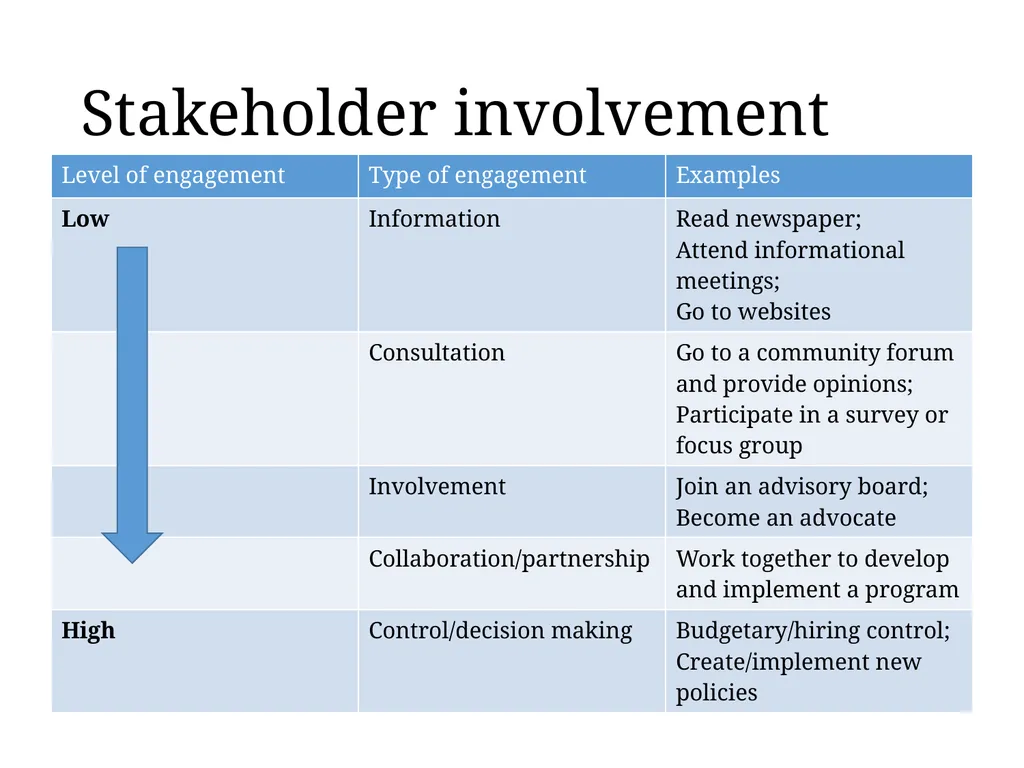
Stakeholder involvement<br>
20
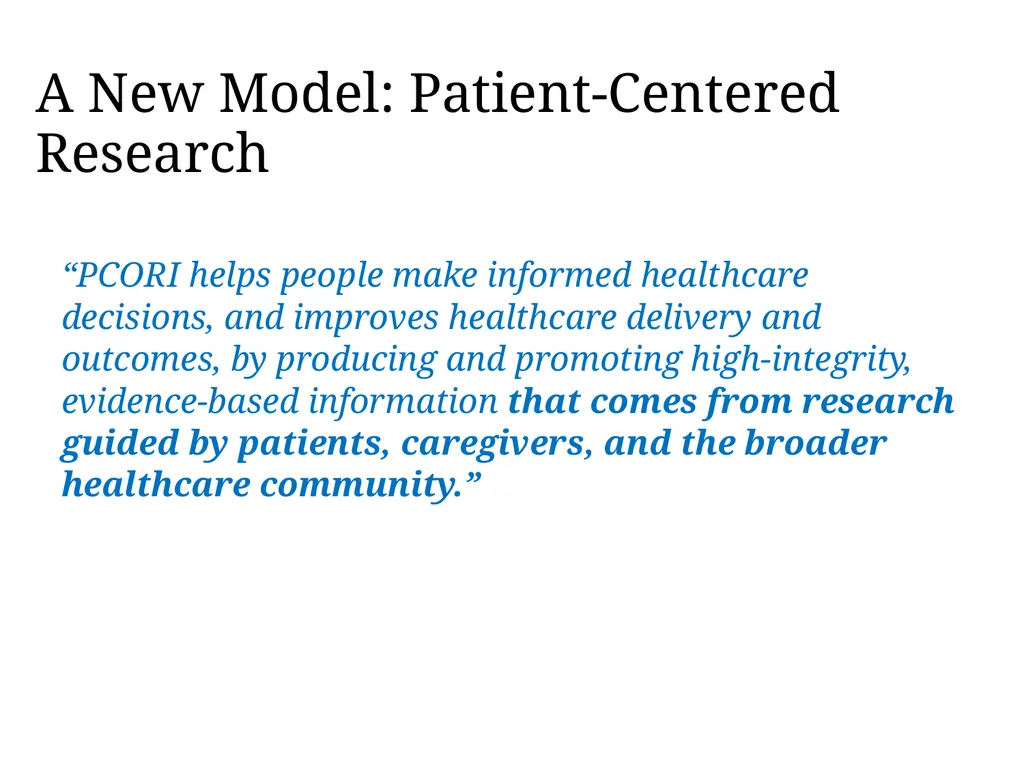
A New Model: Patient-Centered Research “PCORI helps people make informed healthcare decisions, and improves healthcare delivery and outcomes, by producing and promoting high-integrity, evidence-based information that comes from research guided by patients, caregivers, and the broader healthcare community.”<br>
21
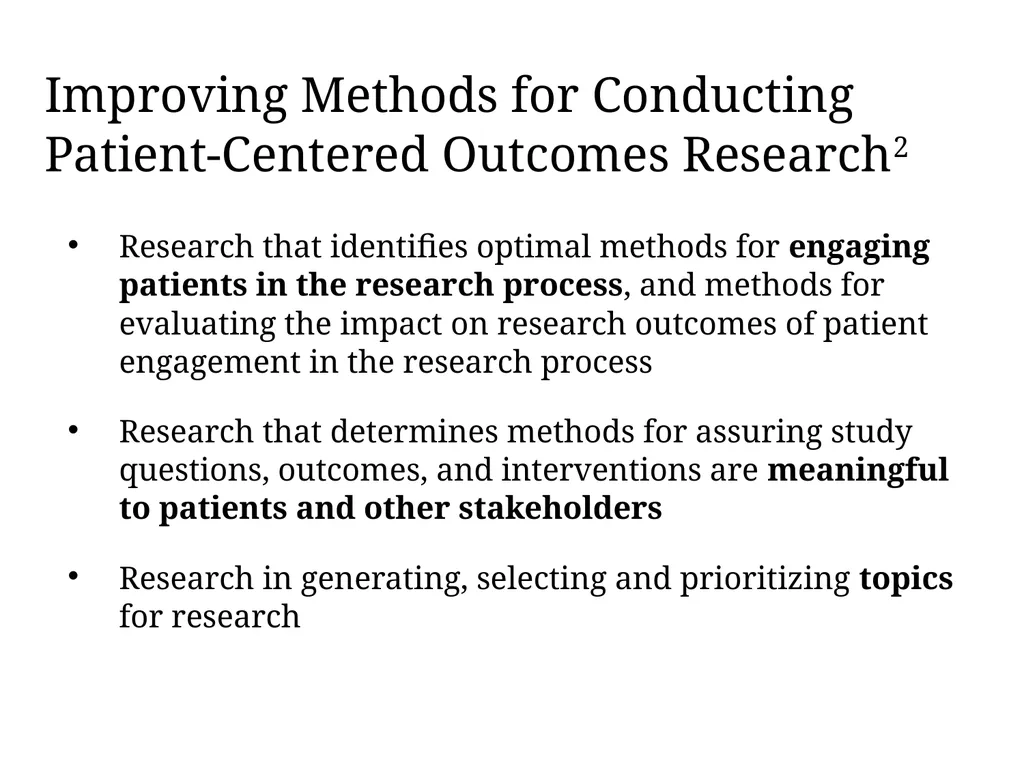
Improving Methods for Conducting Patient-Centered Outcomes Research2 Research that identifies optimal methods for engaging patients in the research process, and methods for evaluating the impact on research outcomes of patient engagement in the research process
Research that determines methods for assuring study questions, outcomes, and interventions are meaningful to patients and other stakeholders
Research in generating, selecting and prioritizing topics for research<br>
Research that determines methods for assuring study questions, outcomes, and interventions are meaningful to patients and other stakeholders
Research in generating, selecting and prioritizing topics for research<br>
22
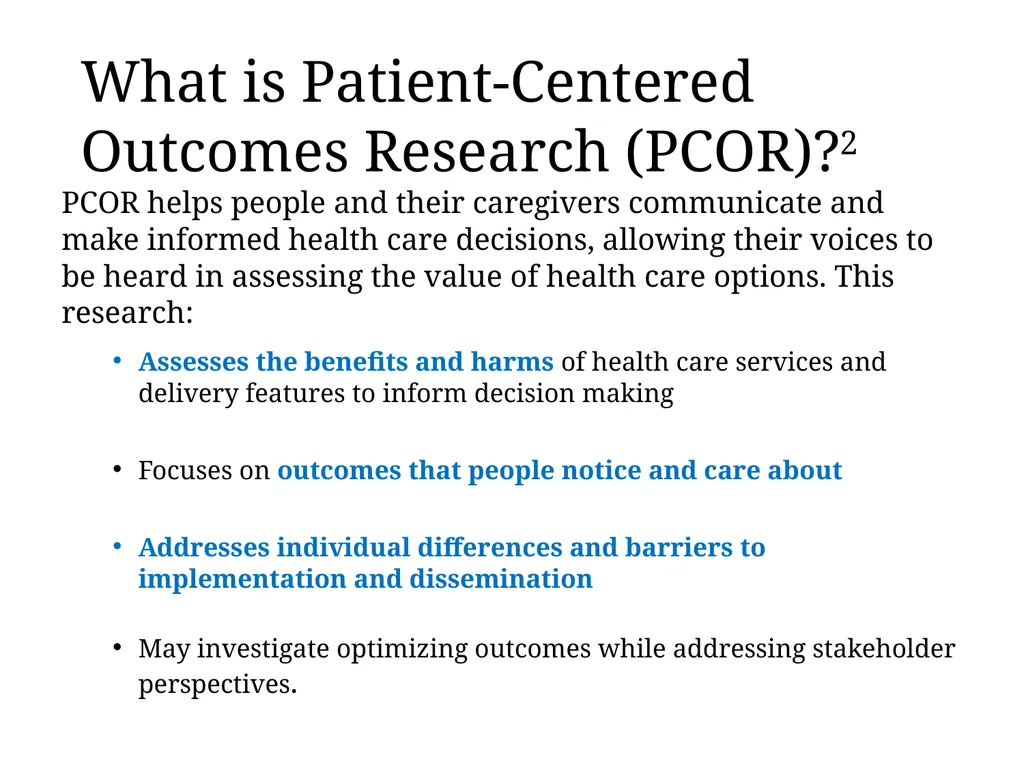
What is Patient-Centered Outcomes Research (PCOR)?2 PCOR helps people and their caregivers communicate and make informed health care decisions, allowing their voices to be heard in assessing the value of health care options. This research:
Assesses the benefits and harms of health care services and delivery features to inform decision making
Focuses on outcomes that people notice and care about
Addresses individual differences and barriers to implementation and dissemination
May investigate optimizing outcomes while addressing stakeholder perspectives.<br>
Assesses the benefits and harms of health care services and delivery features to inform decision making
Focuses on outcomes that people notice and care about
Addresses individual differences and barriers to implementation and dissemination
May investigate optimizing outcomes while addressing stakeholder perspectives.<br>
23
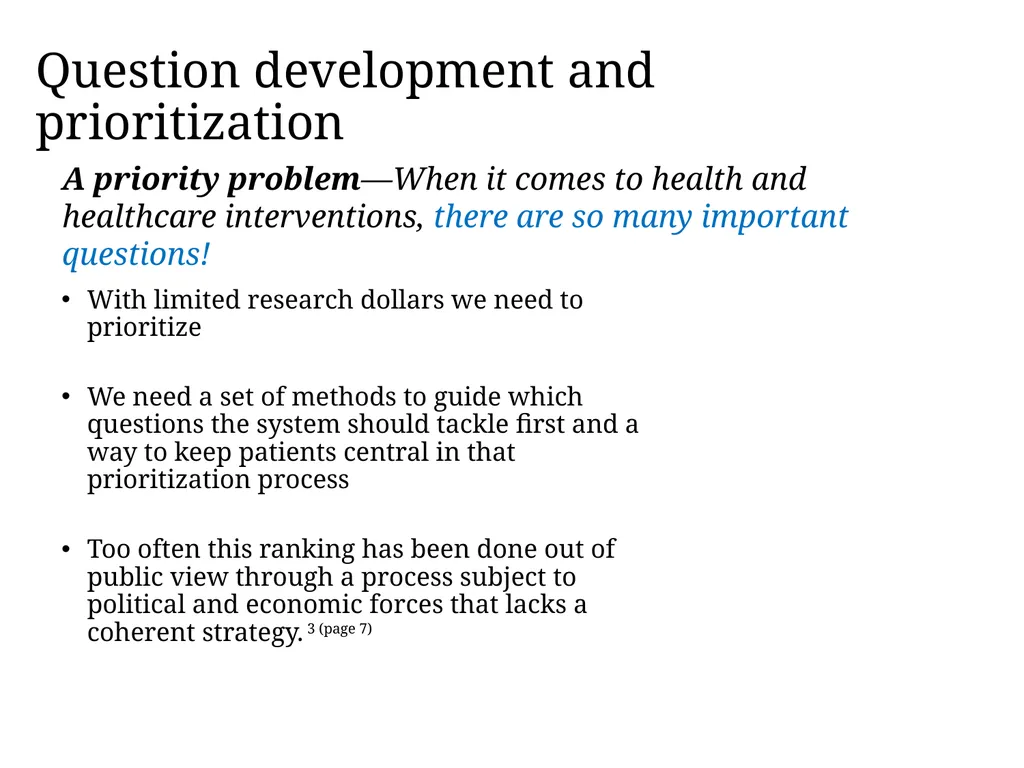
Question development and prioritization With limited research dollars we need to prioritize
We need a set of methods to guide which questions the system should tackle first and a way to keep patients central in that prioritization process
Too often this ranking has been done out of public view through a process subject to political and economic forces that lacks a coherent strategy. 3 (page 7) A priority problem—When it comes to health and healthcare interventions, there are so many important questions!<br>
We need a set of methods to guide which questions the system should tackle first and a way to keep patients central in that prioritization process
Too often this ranking has been done out of public view through a process subject to political and economic forces that lacks a coherent strategy. 3 (page 7) A priority problem—When it comes to health and healthcare interventions, there are so many important questions!<br>
24
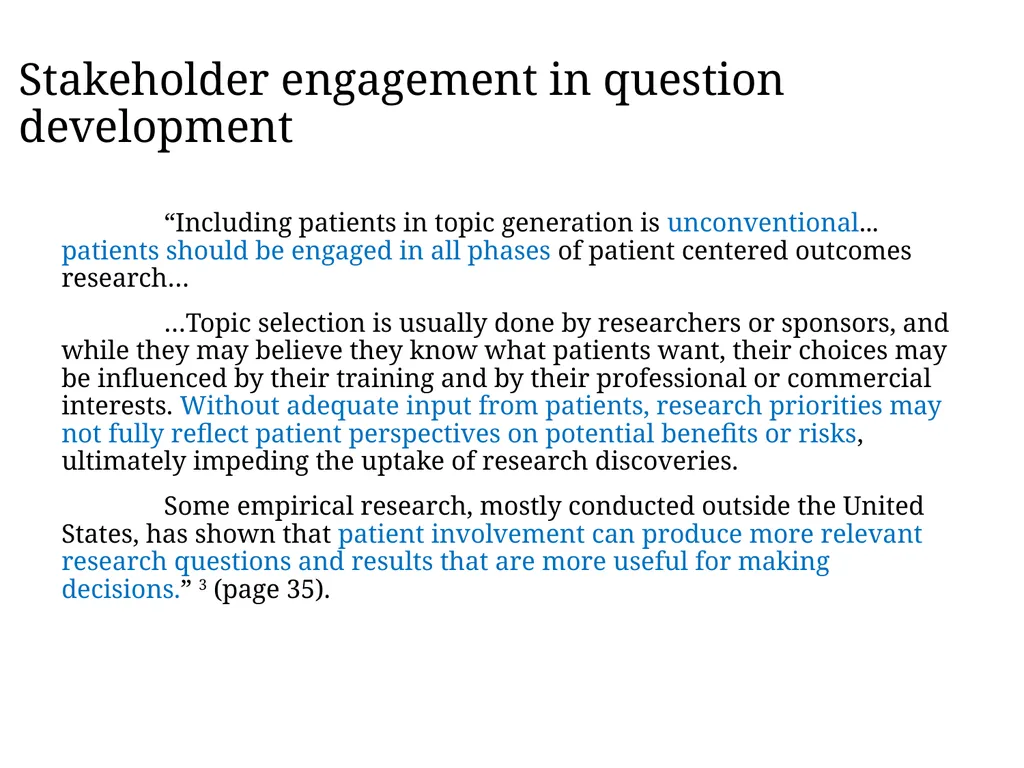
Stakeholder engagement in question development “Including patients in topic generation is unconventional... patients should be engaged in all phases of patient centered outcomes research…
…Topic selection is usually done by researchers or sponsors, and while they may believe they know what patients want, their choices may be influenced by their training and by their professional or commercial interests. Without adequate input from patients, research priorities may not fully reflect patient perspectives on potential benefits or risks, ultimately impeding the uptake of research discoveries.
Some empirical research, mostly conducted outside the United States, has shown that patient involvement can produce more relevant research questions and results that are more useful for making decisions.” 3 (page 35).<br>
…Topic selection is usually done by researchers or sponsors, and while they may believe they know what patients want, their choices may be influenced by their training and by their professional or commercial interests. Without adequate input from patients, research priorities may not fully reflect patient perspectives on potential benefits or risks, ultimately impeding the uptake of research discoveries.
Some empirical research, mostly conducted outside the United States, has shown that patient involvement can produce more relevant research questions and results that are more useful for making decisions.” 3 (page 35).<br>
25
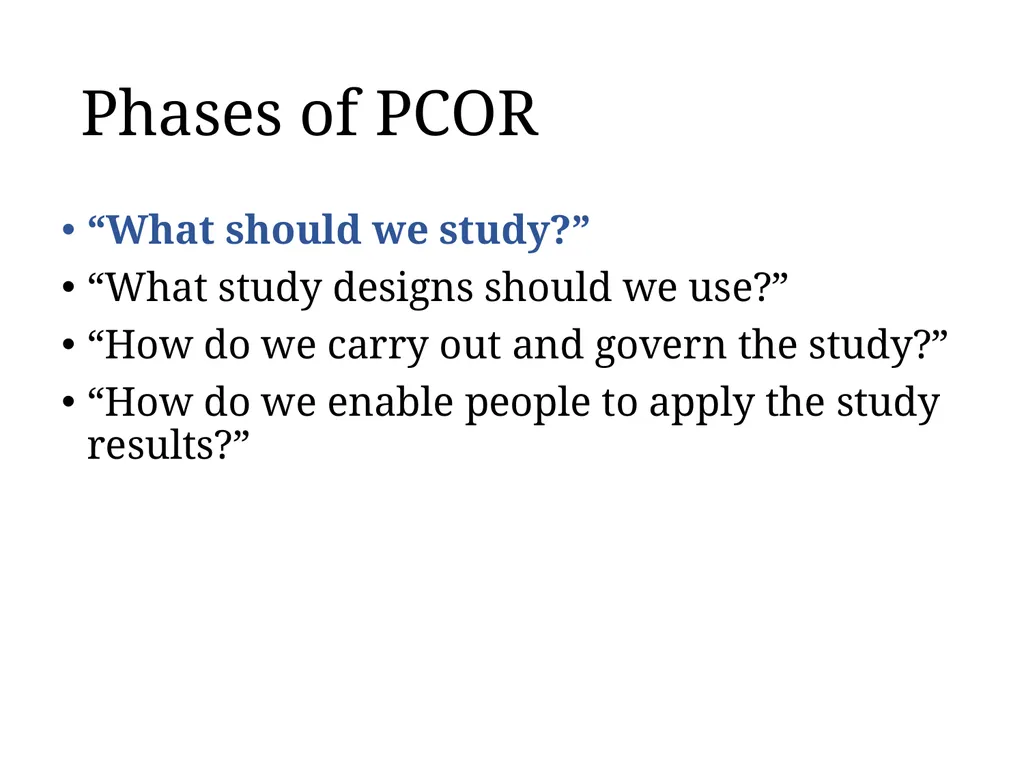
Phases of PCOR “What should we study?”
“What study designs should we use?”
“How do we carry out and govern the study?”
“How do we enable people to apply the study results?”<br>
“What study designs should we use?”
“How do we carry out and govern the study?”
“How do we enable people to apply the study results?”<br>
26
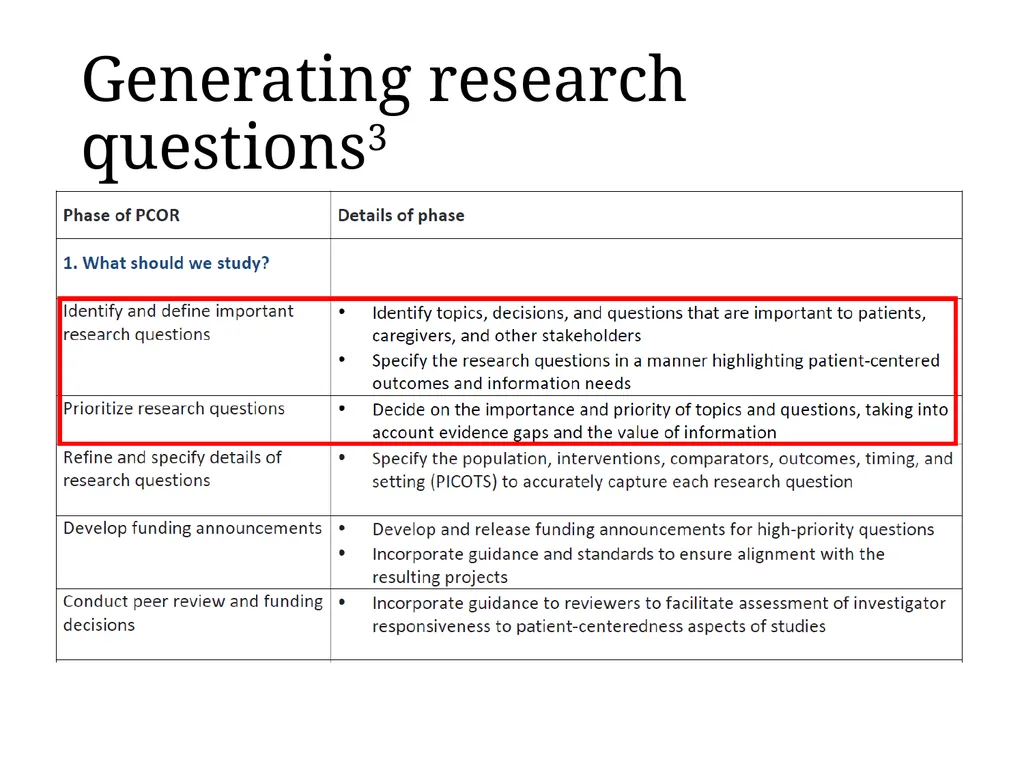
Generating research questions3<br>
27
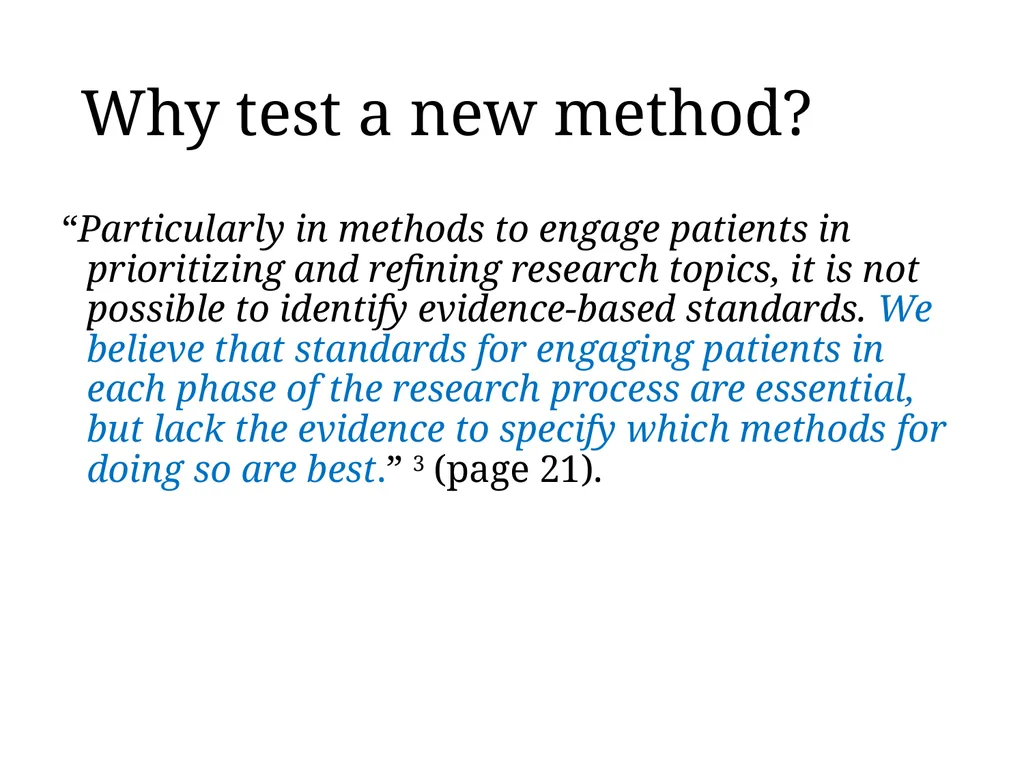
Why test a new method? “Particularly in methods to engage patients in prioritizing and refining research topics, it is not possible to identify evidence-based standards. We believe that standards for engaging patients in each phase of the research process are essential, but lack the evidence to specify which methods for doing so are best.” 3 (page 21).<br>
28
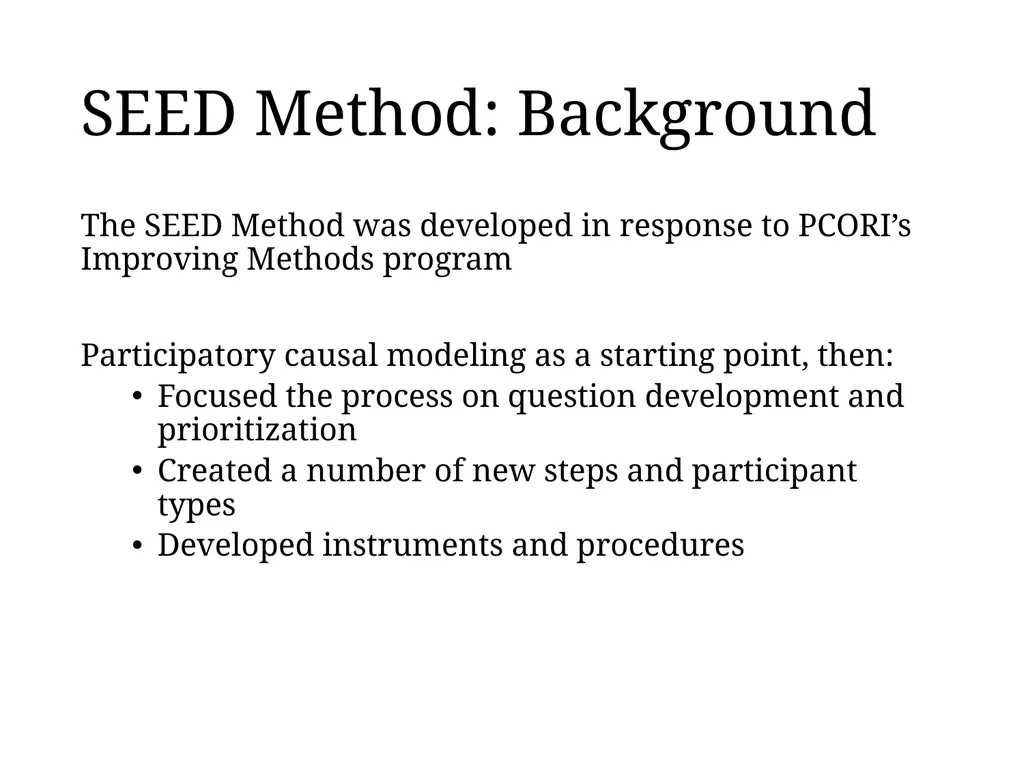
SEED Method: Background The SEED Method was developed in response to PCORI’s Improving Methods program
Participatory causal modeling as a starting point, then:
Focused the process on question development and prioritization
Created a number of new steps and participant types
Developed instruments and procedures<br>
Participatory causal modeling as a starting point, then:
Focused the process on question development and prioritization
Created a number of new steps and participant types
Developed instruments and procedures<br>
29
SEED Method [Insert health condition/topic of focus]<br>
30
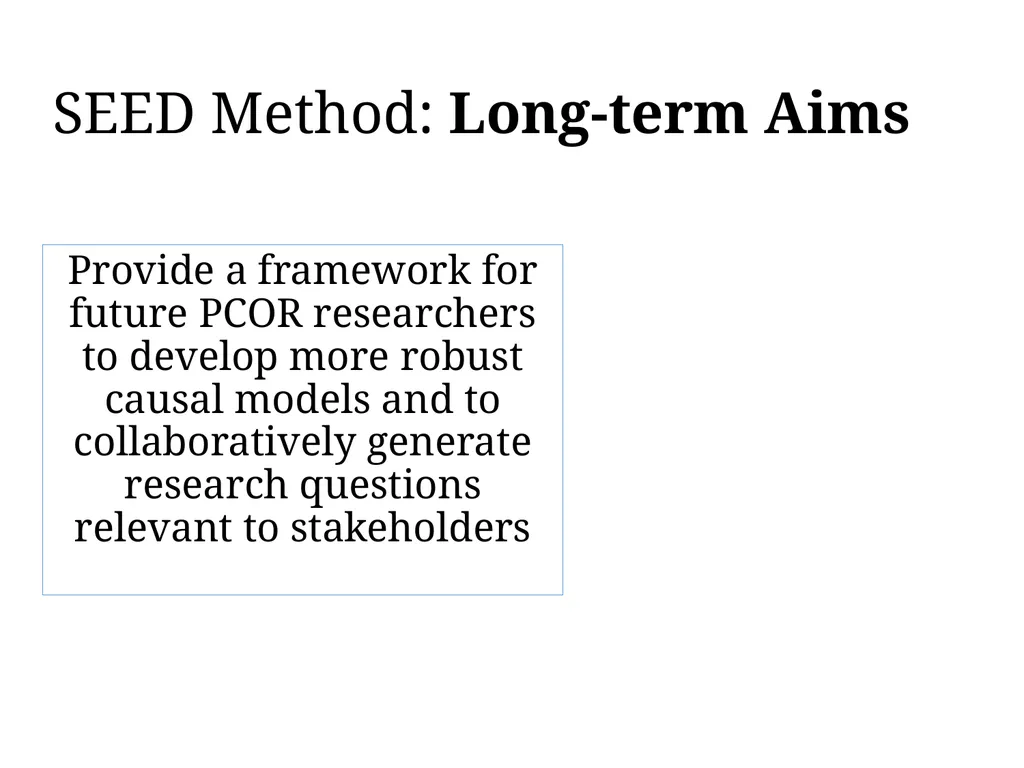
SEED Method: Long-term Aims Provide a framework for future PCOR researchers to develop more robust causal models and to collaboratively generate research questions relevant to stakeholders<br>
31
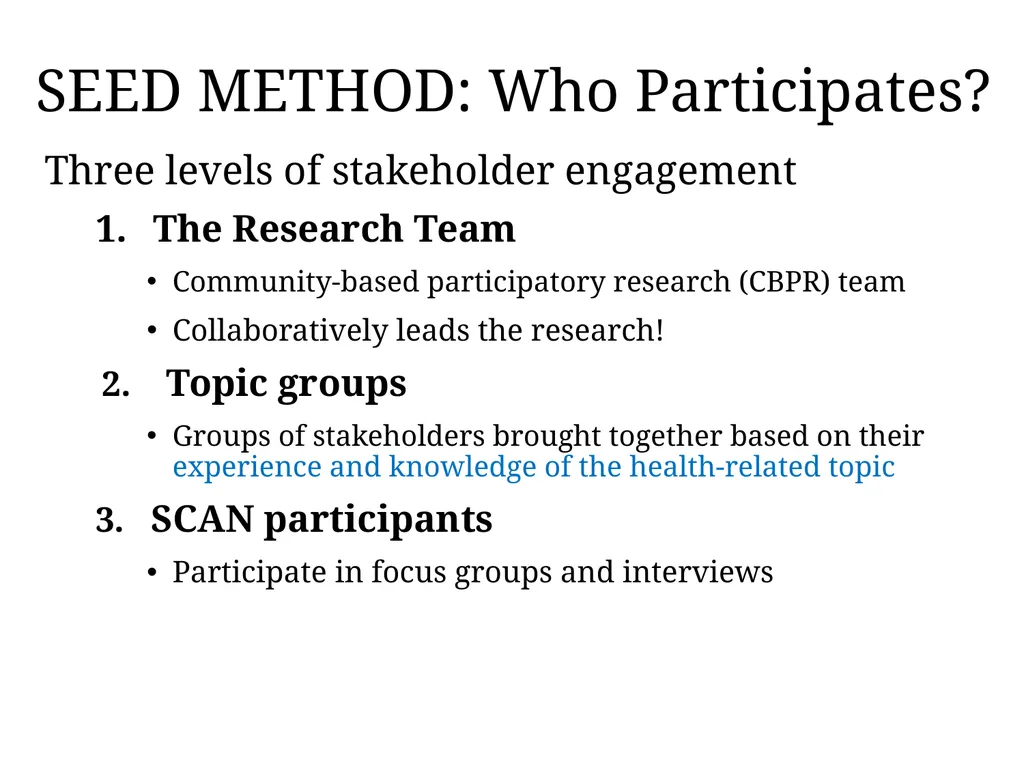
SEED METHOD: Who Participates? Three levels of stakeholder engagement
The Research Team
Community-based participatory research (CBPR) team
Collaboratively leads the research!
2. Topic groups
Groups of stakeholders brought together based on their experience and knowledge of the health-related topic
3. SCAN participants
Participate in focus groups and interviews<br>
The Research Team
Community-based participatory research (CBPR) team
Collaboratively leads the research!
2. Topic groups
Groups of stakeholders brought together based on their experience and knowledge of the health-related topic
3. SCAN participants
Participate in focus groups and interviews<br>
32
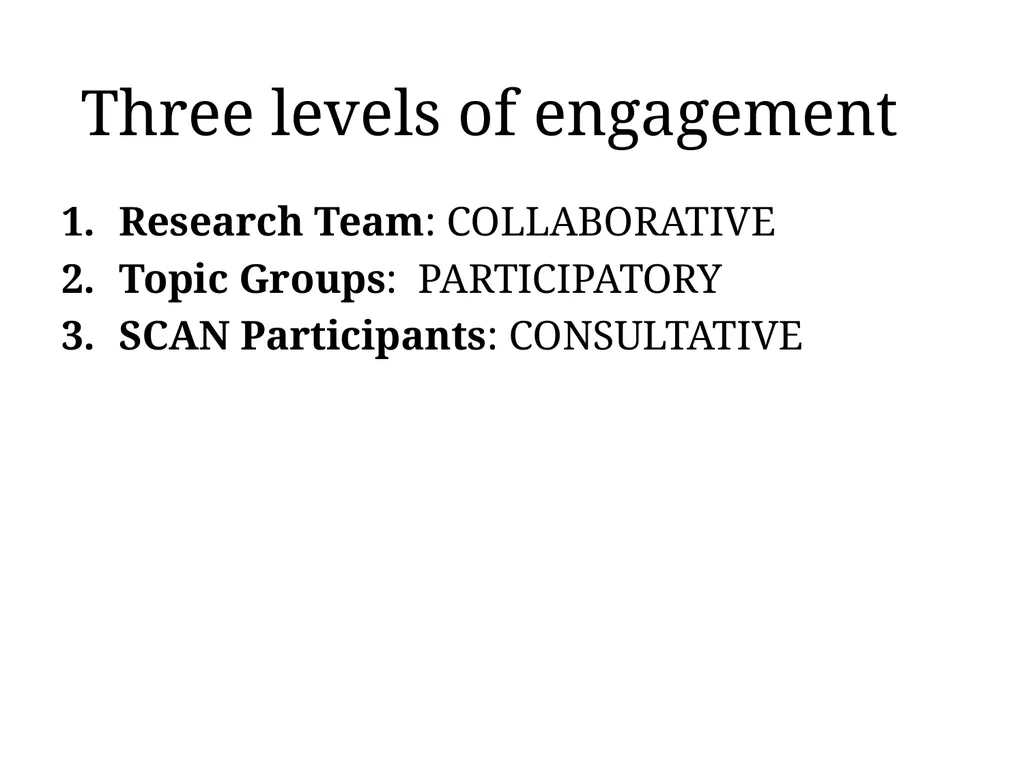
Three levels of engagement Research Team: COLLABORATIVE
Topic Groups: PARTICIPATORY
SCAN Participants: CONSULTATIVE<br>
Topic Groups: PARTICIPATORY
SCAN Participants: CONSULTATIVE<br>
33
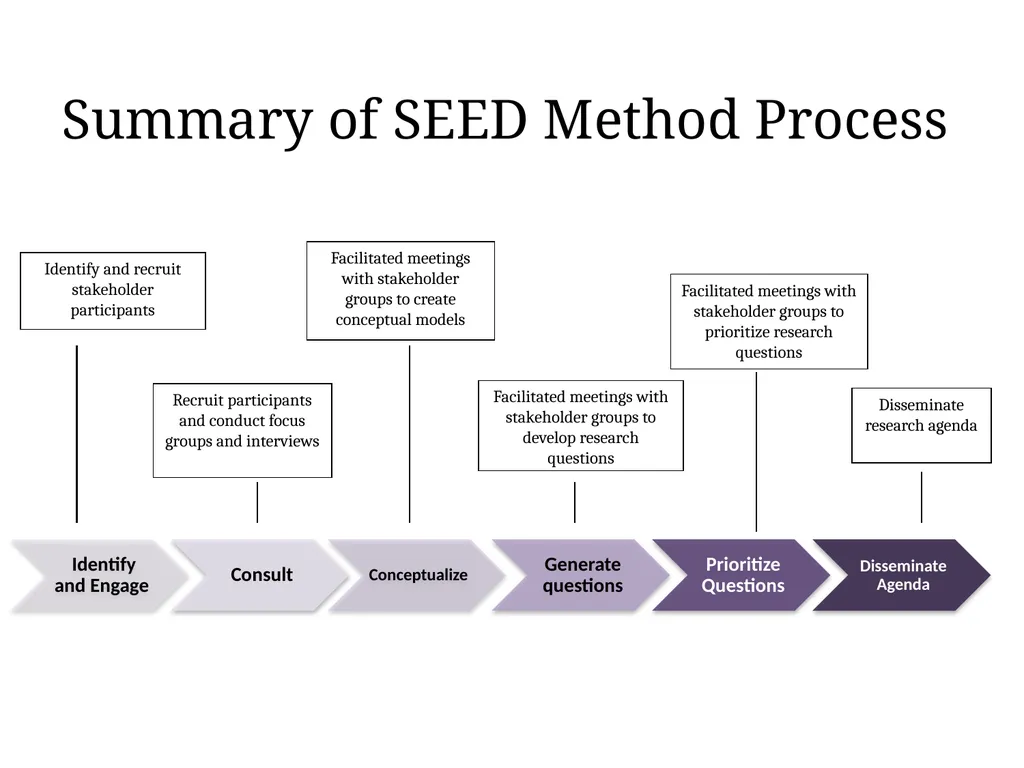
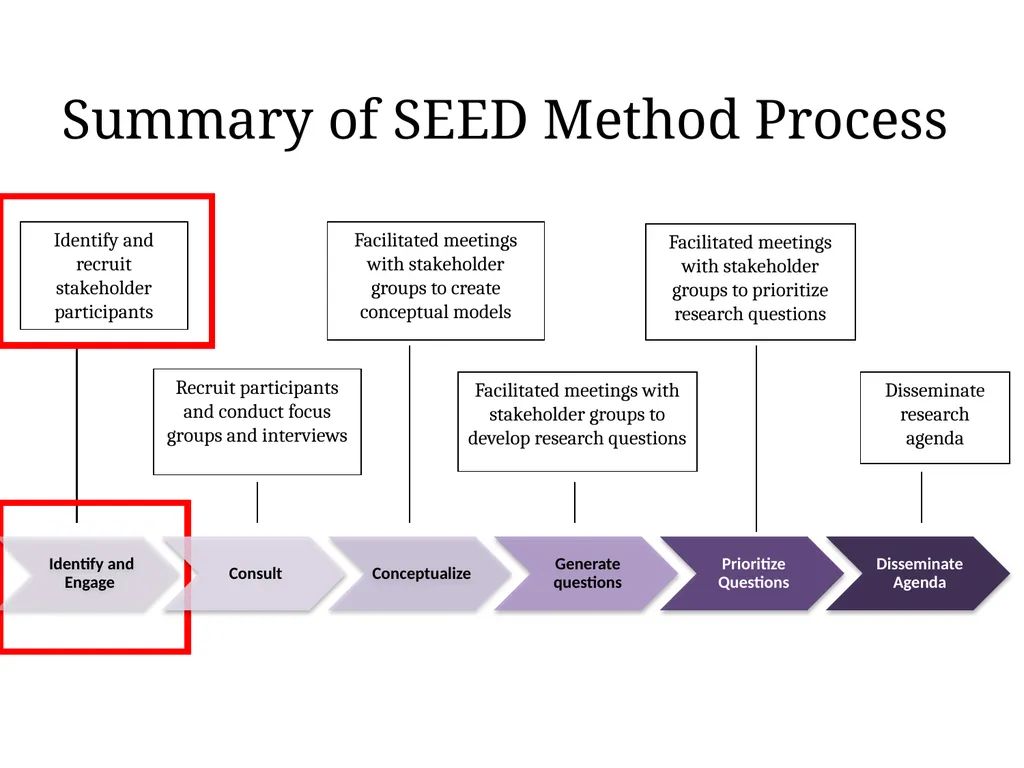
Summary of SEED Method Process Identify and recruit stakeholder participants Recruit participants and conduct focus groups and interviews Facilitated meetings with stakeholder groups to create conceptual models Facilitated meetings with stakeholder groups to develop research questions Facilitated meetings with stakeholder groups to prioritize research questions Disseminate research agenda<br>
34
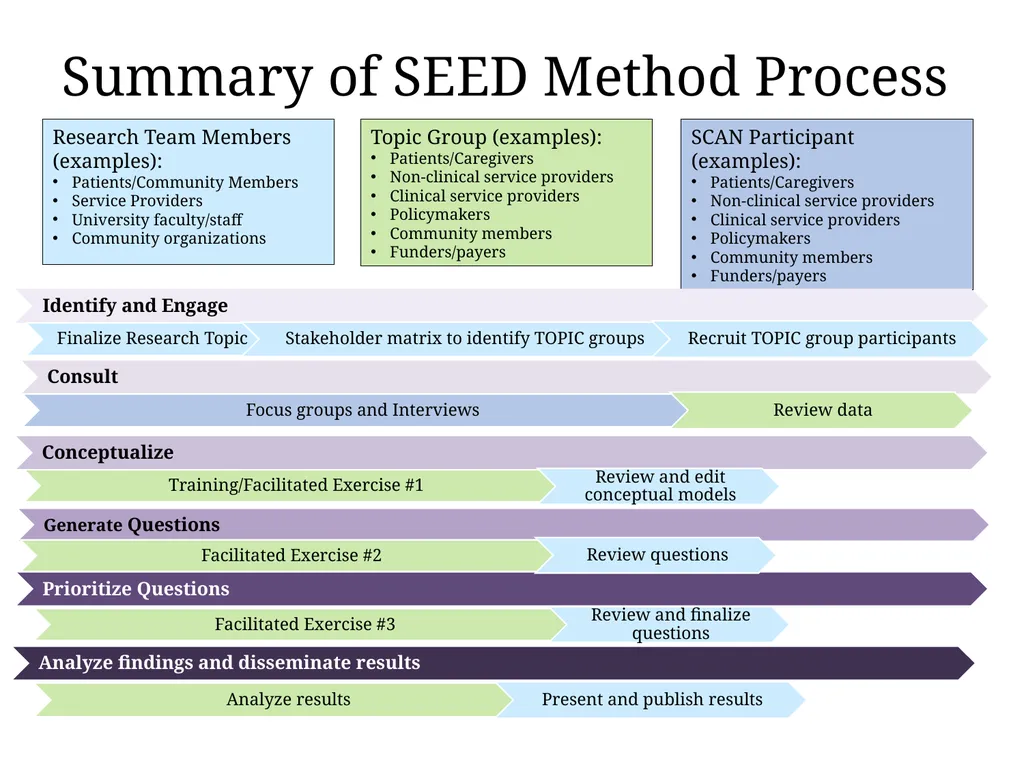
Summary of SEED Method Process Research Team Members
(examples):
Patients/Community Members
Service Providers
University faculty/staff
Community organizations Topic Group (examples):
Patients/Caregivers
Non-clinical service providers
Clinical service providers
Policymakers
Community members
Funders/payers SCAN Participant (examples):
Patients/Caregivers
Non-clinical service providers
Clinical service providers
Policymakers
Community members
Funders/payers Prioritize Questions<br>
(examples):
Patients/Community Members
Service Providers
University faculty/staff
Community organizations Topic Group (examples):
Patients/Caregivers
Non-clinical service providers
Clinical service providers
Policymakers
Community members
Funders/payers SCAN Participant (examples):
Patients/Caregivers
Non-clinical service providers
Clinical service providers
Policymakers
Community members
Funders/payers Prioritize Questions<br>
35
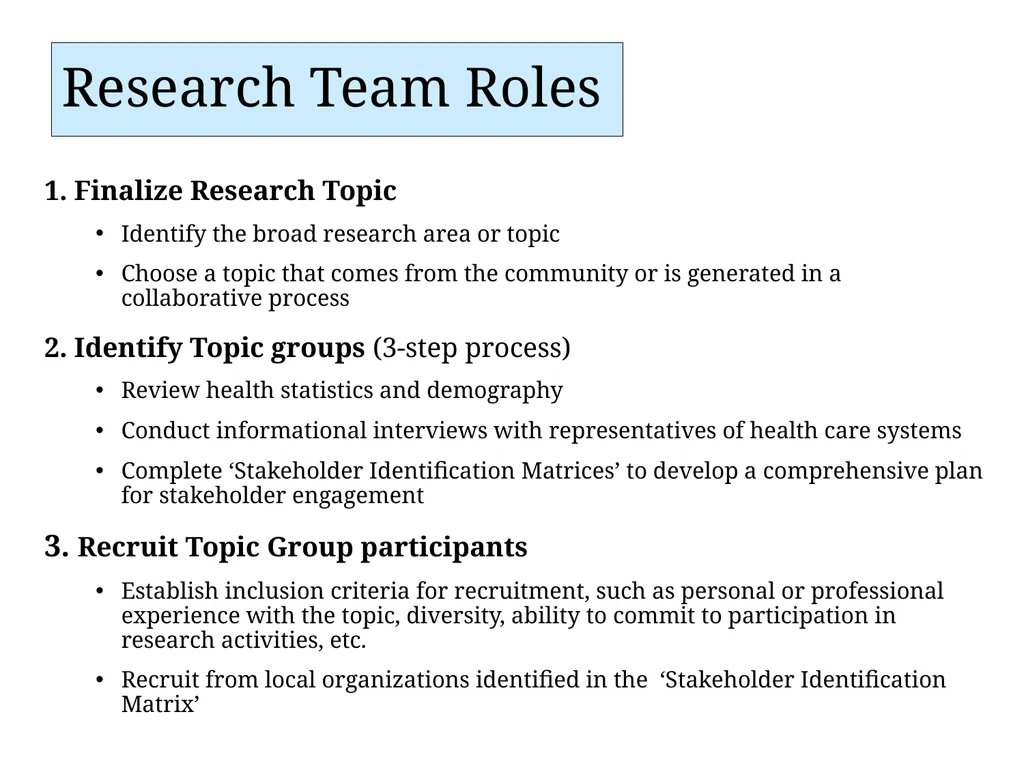
Research Team Roles 1. Finalize Research Topic
Identify the broad research area or topic
Choose a topic that comes from the community or is generated in a collaborative process
2. Identify Topic groups (3-step process)
Review health statistics and demography
Conduct informational interviews with representatives of health care systems
Complete ‘Stakeholder Identification Matrices’ to develop a comprehensive plan for stakeholder engagement
3. Recruit Topic Group participants
Establish inclusion criteria for recruitment, such as personal or professional experience with the topic, diversity, ability to commit to participation in research activities, etc.
Recruit from local organizations identified in the ‘Stakeholder Identification Matrix’<br>
Identify the broad research area or topic
Choose a topic that comes from the community or is generated in a collaborative process
2. Identify Topic groups (3-step process)
Review health statistics and demography
Conduct informational interviews with representatives of health care systems
Complete ‘Stakeholder Identification Matrices’ to develop a comprehensive plan for stakeholder engagement
3. Recruit Topic Group participants
Establish inclusion criteria for recruitment, such as personal or professional experience with the topic, diversity, ability to commit to participation in research activities, etc.
Recruit from local organizations identified in the ‘Stakeholder Identification Matrix’<br>
36
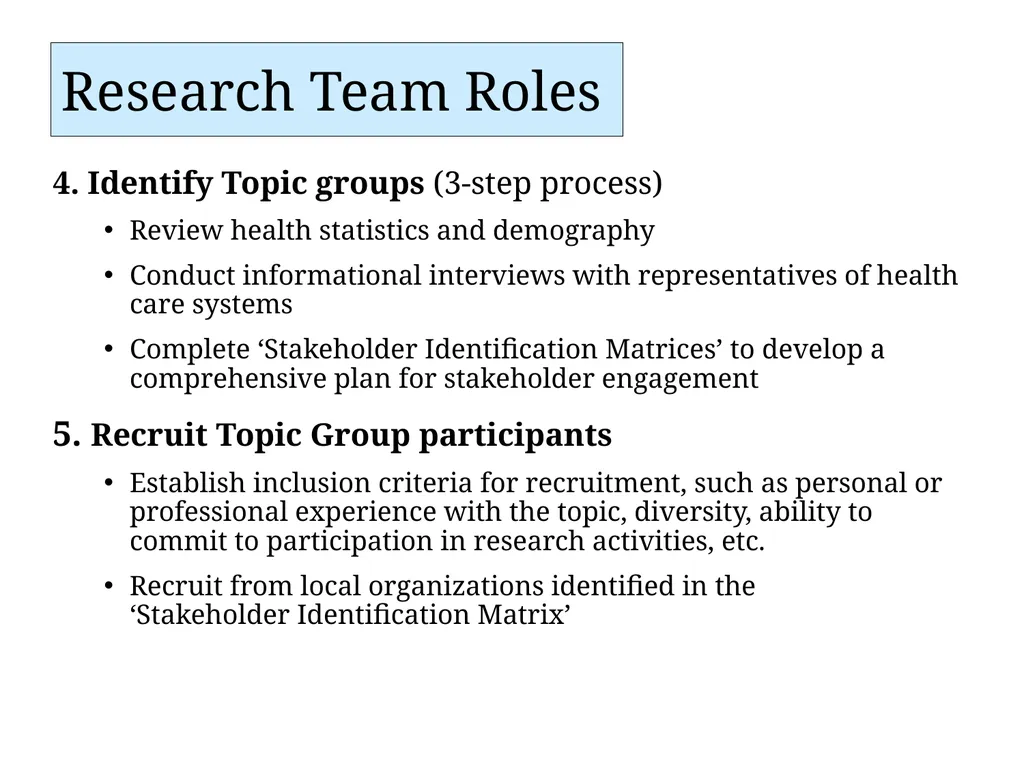
4. Identify Topic groups (3-step process)
Review health statistics and demography
Conduct informational interviews with representatives of health care systems
Complete ‘Stakeholder Identification Matrices’ to develop a comprehensive plan for stakeholder engagement
5. Recruit Topic Group participants
Establish inclusion criteria for recruitment, such as personal or professional experience with the topic, diversity, ability to commit to participation in research activities, etc.
Recruit from local organizations identified in the ‘Stakeholder Identification Matrix’ Research Team Roles<br>
Review health statistics and demography
Conduct informational interviews with representatives of health care systems
Complete ‘Stakeholder Identification Matrices’ to develop a comprehensive plan for stakeholder engagement
5. Recruit Topic Group participants
Establish inclusion criteria for recruitment, such as personal or professional experience with the topic, diversity, ability to commit to participation in research activities, etc.
Recruit from local organizations identified in the ‘Stakeholder Identification Matrix’ Research Team Roles<br>
37
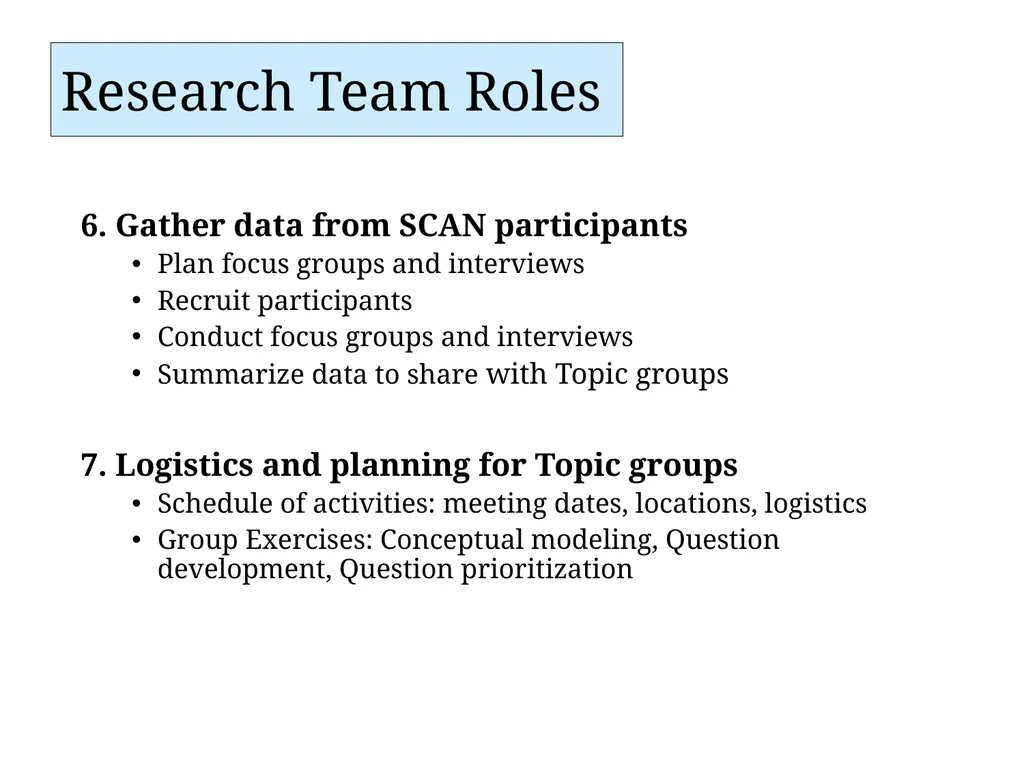
6. Gather data from SCAN participants
Plan focus groups and interviews
Recruit participants
Conduct focus groups and interviews
Summarize data to share with Topic groups
7. Logistics and planning for Topic groups
Schedule of activities: meeting dates, locations, logistics
Group Exercises: Conceptual modeling, Question development, Question prioritization Research Team Roles<br>
Plan focus groups and interviews
Recruit participants
Conduct focus groups and interviews
Summarize data to share with Topic groups
7. Logistics and planning for Topic groups
Schedule of activities: meeting dates, locations, logistics
Group Exercises: Conceptual modeling, Question development, Question prioritization Research Team Roles<br>
38
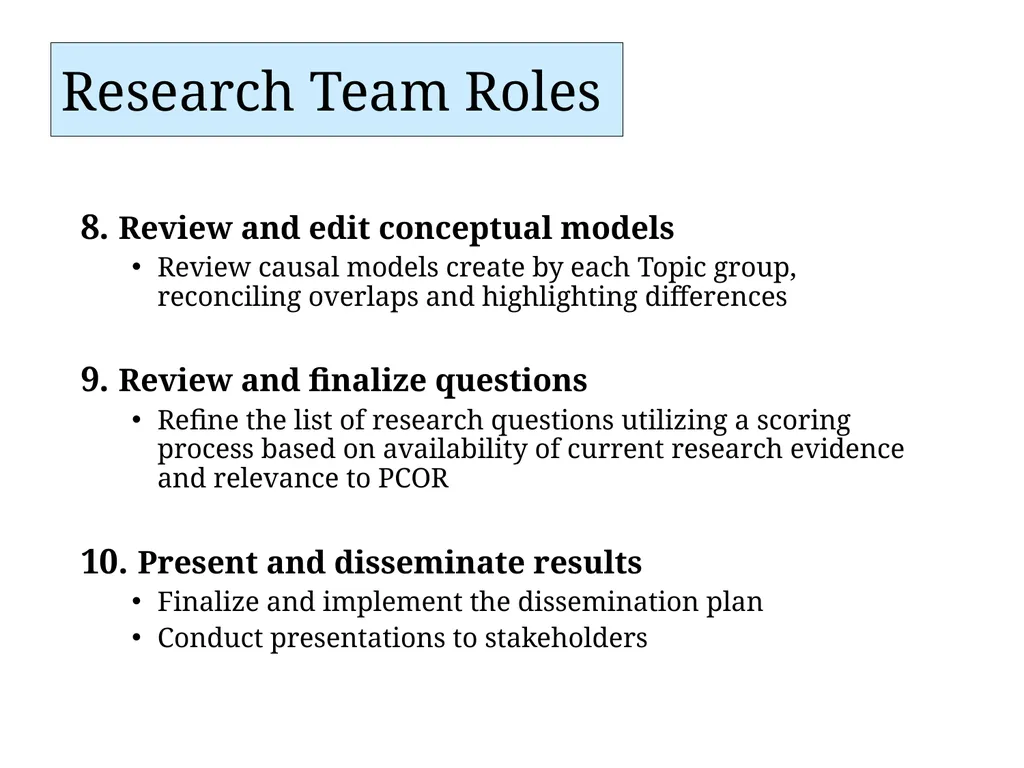
8. Review and edit conceptual models
Review causal models create by each Topic group, reconciling overlaps and highlighting differences
9. Review and finalize questions
Refine the list of research questions utilizing a scoring process based on availability of current research evidence and relevance to PCOR
10. Present and disseminate results
Finalize and implement the dissemination plan
Conduct presentations to stakeholders Research Team Roles<br>
Review causal models create by each Topic group, reconciling overlaps and highlighting differences
9. Review and finalize questions
Refine the list of research questions utilizing a scoring process based on availability of current research evidence and relevance to PCOR
10. Present and disseminate results
Finalize and implement the dissemination plan
Conduct presentations to stakeholders Research Team Roles<br>
39
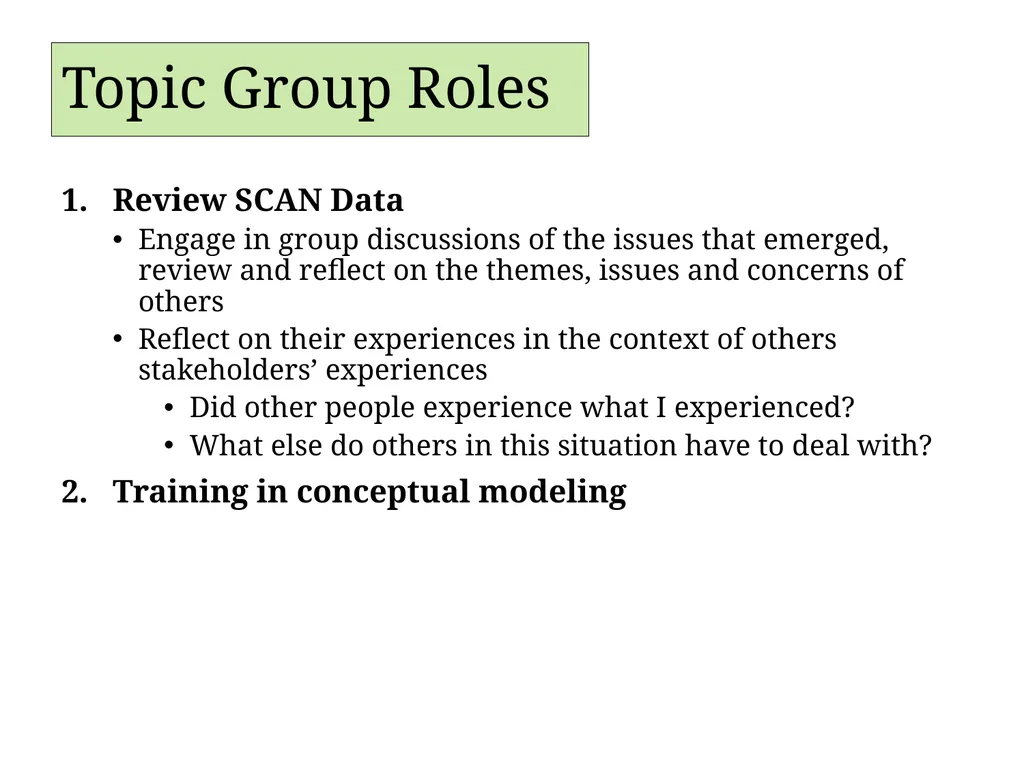
Topic Group Roles Review SCAN Data
Engage in group discussions of the issues that emerged, review and reflect on the themes, issues and concerns of others
Reflect on their experiences in the context of others stakeholders’ experiences
Did other people experience what I experienced?
What else do others in this situation have to deal with?
Training in conceptual modeling<br>
Engage in group discussions of the issues that emerged, review and reflect on the themes, issues and concerns of others
Reflect on their experiences in the context of others stakeholders’ experiences
Did other people experience what I experienced?
What else do others in this situation have to deal with?
Training in conceptual modeling<br>
40
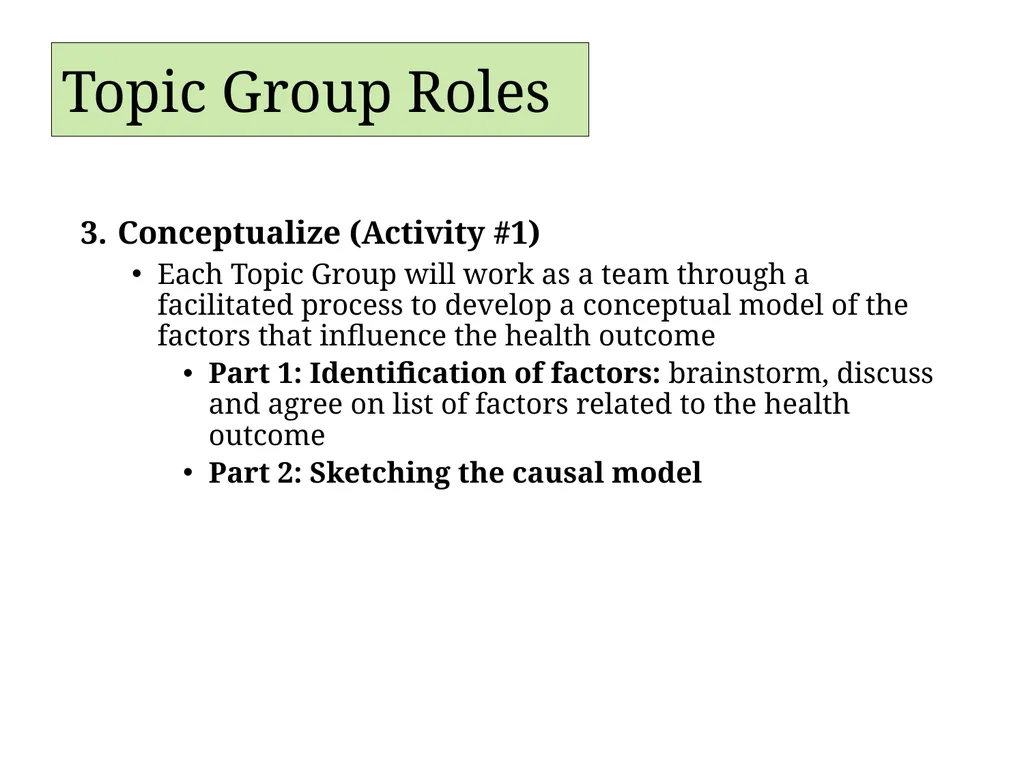
3. Conceptualize (Activity #1)
Each Topic Group will work as a team through a facilitated process to develop a conceptual model of the factors that influence the health outcome
Part 1: Identification of factors: brainstorm, discuss and agree on list of factors related to the health outcome
Part 2: Sketching the causal model Topic Group Roles<br>
Each Topic Group will work as a team through a facilitated process to develop a conceptual model of the factors that influence the health outcome
Part 1: Identification of factors: brainstorm, discuss and agree on list of factors related to the health outcome
Part 2: Sketching the causal model Topic Group Roles<br>
41
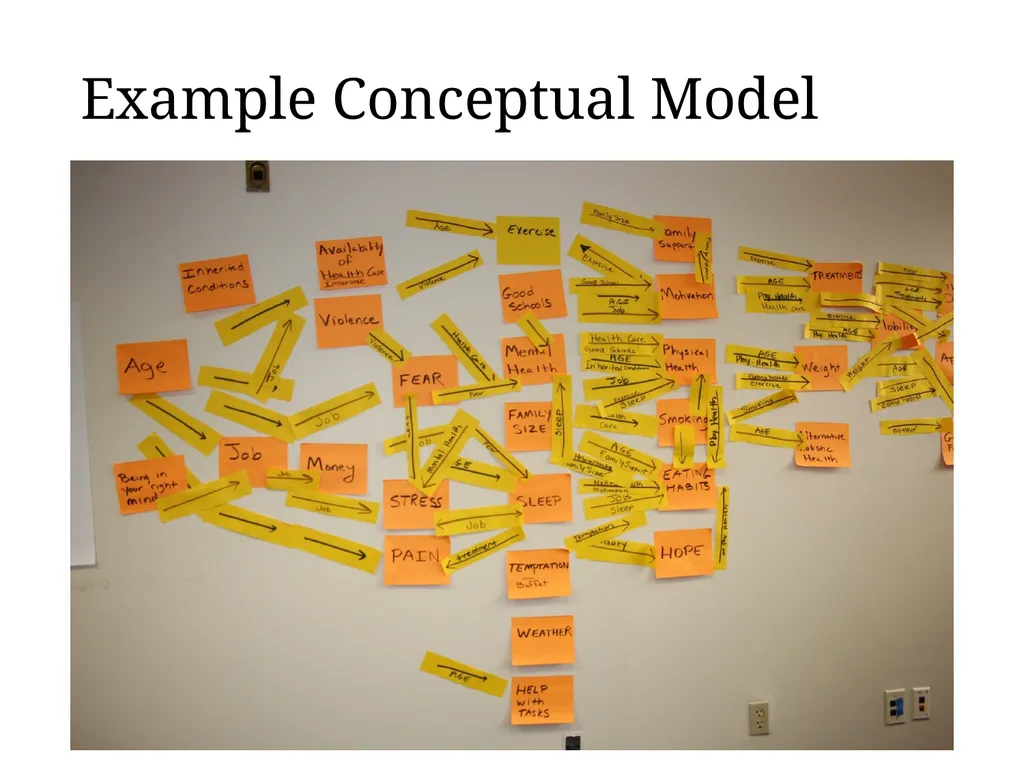
Example Conceptual Model<br>
42
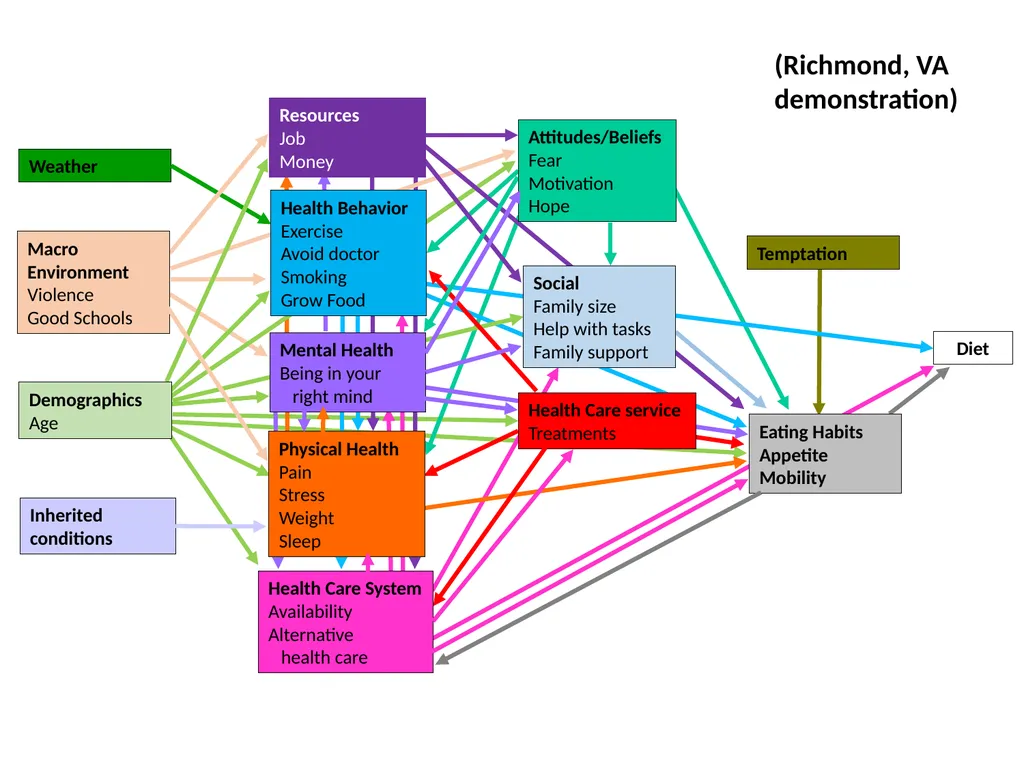
Inherited conditions Diet Weather Eating Habits
Appetite
Mobility Temptation (Richmond, VA
demonstration) Demographics
Age Social
Family size
Help with tasks
Family support Health Care service
Treatments Attitudes/Beliefs
Fear
Motivation
Hope Health Care System
Availability
Alternative
health care Health Behavior
Exercise
Avoid doctor
Smoking
Grow Food Mental Health
Being in your
right mind Resources
Job
Money Macro
Environment
Violence
Good Schools Physical Health
Pain
Stress
Weight
Sleep<br>
Appetite
Mobility Temptation (Richmond, VA
demonstration) Demographics
Age Social
Family size
Help with tasks
Family support Health Care service
Treatments Attitudes/Beliefs
Fear
Motivation
Hope Health Care System
Availability
Alternative
health care Health Behavior
Exercise
Avoid doctor
Smoking
Grow Food Mental Health
Being in your
right mind Resources
Job
Money Macro
Environment
Violence
Good Schools Physical Health
Pain
Stress
Weight
Sleep<br>
43
4. Question Development (Activity #2)
Compare the conceptual models they created with the models presented by other TOPIC Groups
Brief training in developing research questions
Facilitated process to propose research questions
5. Prioritize questions (Activity #3)
Engage in facilitated process to prioritize research questions based on the needs and interests of stakeholders Topic Group Roles<br>
Compare the conceptual models they created with the models presented by other TOPIC Groups
Brief training in developing research questions
Facilitated process to propose research questions
5. Prioritize questions (Activity #3)
Engage in facilitated process to prioritize research questions based on the needs and interests of stakeholders Topic Group Roles<br>
44
One-time participation in:
Focus Groups
Individual Interviews SCAN Participants<br>
Focus Groups
Individual Interviews SCAN Participants<br>
45
Dissemination Plan Goals of Dissemination
Disseminating final research agenda to relevant stakeholders
Utilizing appropriate dissemination channels and formats<br>
Disseminating final research agenda to relevant stakeholders
Utilizing appropriate dissemination channels and formats<br>
46
Community Partners [insert list of community partner organizations]<br>
47
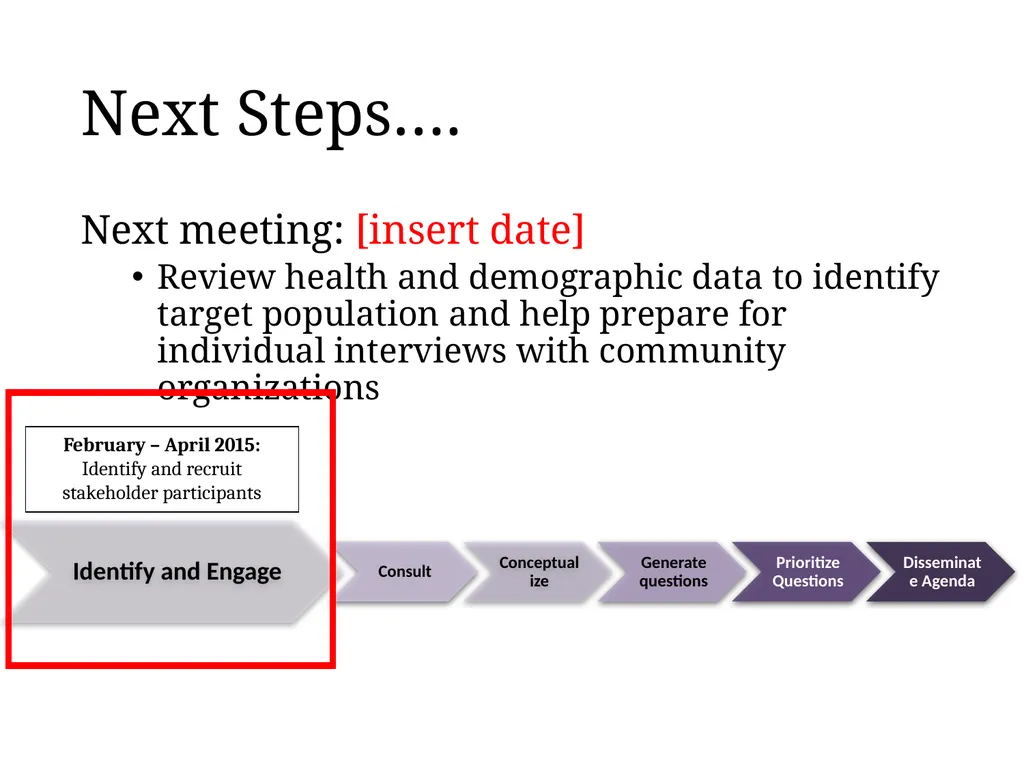
Next Steps…. Next meeting: [insert date]
Review health and demographic data to identify target population and help prepare for individual interviews with community organizations February – April 2015: Identify and recruit stakeholder participants<br>
Review health and demographic data to identify target population and help prepare for individual interviews with community organizations February – April 2015: Identify and recruit stakeholder participants<br>
48
Questions?<br>
49
References 1. Research!America. U.S. Investment in Health Research: 2012. http://www.researchamerica.org/uploads/healthdollar12.pdf
Patient-Centered Outcomes Research Institute. Funding Announcement: Improving Methods for Conducting Patient-Centered Outcomes Research. Published November 16, 2012, Updated January 15, 2013
Helfand M, Berg A, Flum D, Gabriel S, Normand S, eds. Draft Methodology Report: Our Questions, Our Decisions: Standards for Patient-Centered Outcomes Research. Patient-Centered Outcomes Research Institute. July 23, 2012.<br>
Patient-Centered Outcomes Research Institute. Funding Announcement: Improving Methods for Conducting Patient-Centered Outcomes Research. Published November 16, 2012, Updated January 15, 2013
Helfand M, Berg A, Flum D, Gabriel S, Normand S, eds. Draft Methodology Report: Our Questions, Our Decisions: Standards for Patient-Centered Outcomes Research. Patient-Centered Outcomes Research Institute. July 23, 2012.<br>
50
SEED Contact Information [insert project personnel name and contact information]<br>
51
SEED Roadmap Template<br>
52
Summary of SEED Method Process Identify and recruit stakeholder participants Recruit participants and conduct focus groups and interviews Facilitated meetings with stakeholder groups to create conceptual models Facilitated meetings with stakeholder groups to develop research questions Facilitated meetings with stakeholder groups to prioritize research questions Disseminate research agenda<br>
53
SEED Roadmap: [insert dates] Research Questions<br>
54
SEED Roadmap: NEXT STEPS Research Questions<br>
55
SEED Roadmap: TODAY [Insert agenda items for today’s meeting]<br>