Know Your Sources Popular and Scholarly Sources
Description: Know Your Sources Popular and Scholarly Sources Created by Alice Frye, Ph.D., Department of Psychology, University of Massachusetts, Lowell 1 Steps in this tutorial 1) State the goals of this tutorial 2) What a source is 3) Why sources
Related Topics
Download Presentation
"Know Your Sources Popular and Scholarly Sources" is the property of its rightful owner. Permission is granted to download and print the materials on this website for personal, non-commercial use only, and to display it on your personal computer provided you do not modify the materials and that you retain all copyright notices contained in the materials. By downloading content from our website, you accept the terms of this agreement.
Presentation Transcript
slide1. Know Your Sources Popular and Scholarly Sources Created by Alice Frye, Ph.D., Department of Psychology, University of Massachusetts, Lowell 1<br>
slide2. Steps in this tutorial 1) State the goals of this tutorial
2) What a source is
3) Why sources matter
4) The different types of sources
5) Examples of popular media sources
6) Examples of scholarly sources
7) Comparison of information from a popular and a scholarly source on the same topic Created by Alice Frye, Ph.D., Department of Psychology, University of Massachusetts, Lowell 2<br>
slide3. Goal The goal of this tutorial is to make sure you understand why sources matter in psychology
You should have a clear idea of what a “popular” source is, such as a news paper article, and what a scholarly source is
You should know how and when to use one or the other of these types of sources Created by Alice Frye, Ph.D., Department of Psychology, University of Massachusetts, Lowell 3<br>
slide4. Objectives By the end of this tutorial you should be able to
Know the general types of sources of information
Know how and why popular and scholarly sources may differ
Know why this matters in your own work Created by Alice Frye, Ph.D., Department of Psychology, University of Massachusetts, Lowell 4<br>
slide5. What is a source? Psychology as a field is often based on empirical knowledge
Data and observations
Most statements of fact require some kind of source
The source is where the data originated Created by Alice Frye, Ph.D., Department of Psychology, University of Massachusetts, Lowell 5<br>
slide6. Original Source Suppose you see an article in USA today about depression that says:
The CDC states that rates of depression have been stable for the last decade.
The original source of this information is the CDC
That is where you should look if you intend to use this information in a research paper or proposal
You should not trust that USA Today (or any popular media source) is correctly quoting the original source
You should check the original source for yourself and use that for your paper Created by Alice Frye, Ph.D., Department of Psychology, University of Massachusetts, Lowell 6<br>
slide7. Kinds of Sources There are many different types of sources
Examples include
Popular media
Popular articles
Visual media such as television
Popular magazines and newspapers
Scholarly media
Journal articles
Published studies
Books and monographs Created by Alice Frye, Ph.D., Department of Psychology, University of Massachusetts, Lowell 7<br>
slide8. Popular Media Popular media sources are usually authored by non-scholars
Reporters
Interested people
People with a goal besides presenting fact based evidence
Popular media often strive to sell advertising and generate broad interest
Popular media usually have a goal of making money or pushing an agenda
Not necessarily presenting fact based evidence Created by Alice Frye, Ph.D., Department of Psychology, University of Massachusetts, Lowell 8<br>
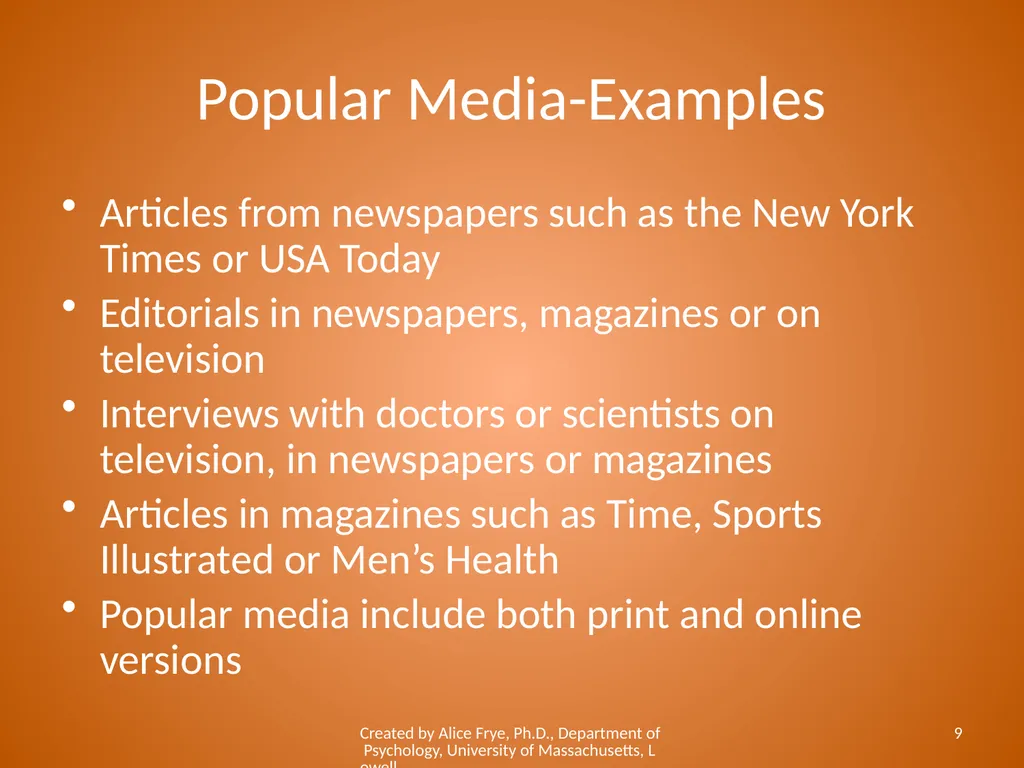
slide9. Popular Media-Examples Articles from newspapers such as the New York Times or USA Today
Editorials in newspapers, magazines or on television
Interviews with doctors or scientists on television, in newspapers or magazines
Articles in magazines such as Time, Sports Illustrated or Men’s Health
Popular media include both print and online versions Created by Alice Frye, Ph.D., Department of Psychology, University of Massachusetts, Lowell 9<br>
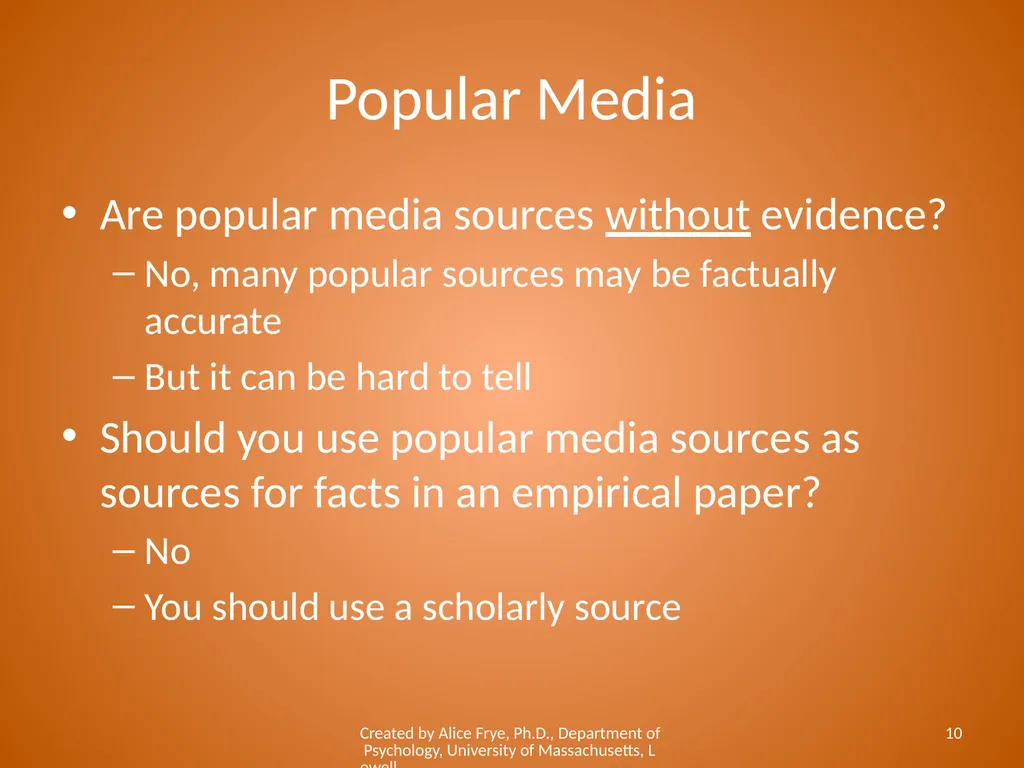
slide10. Popular Media Are popular media sources without evidence?
No, many popular sources may be factually accurate
But it can be hard to tell
Should you use popular media sources as sources for facts in an empirical paper?
No
You should use a scholarly source Created by Alice Frye, Ph.D., Department of Psychology, University of Massachusetts, Lowell 10<br>
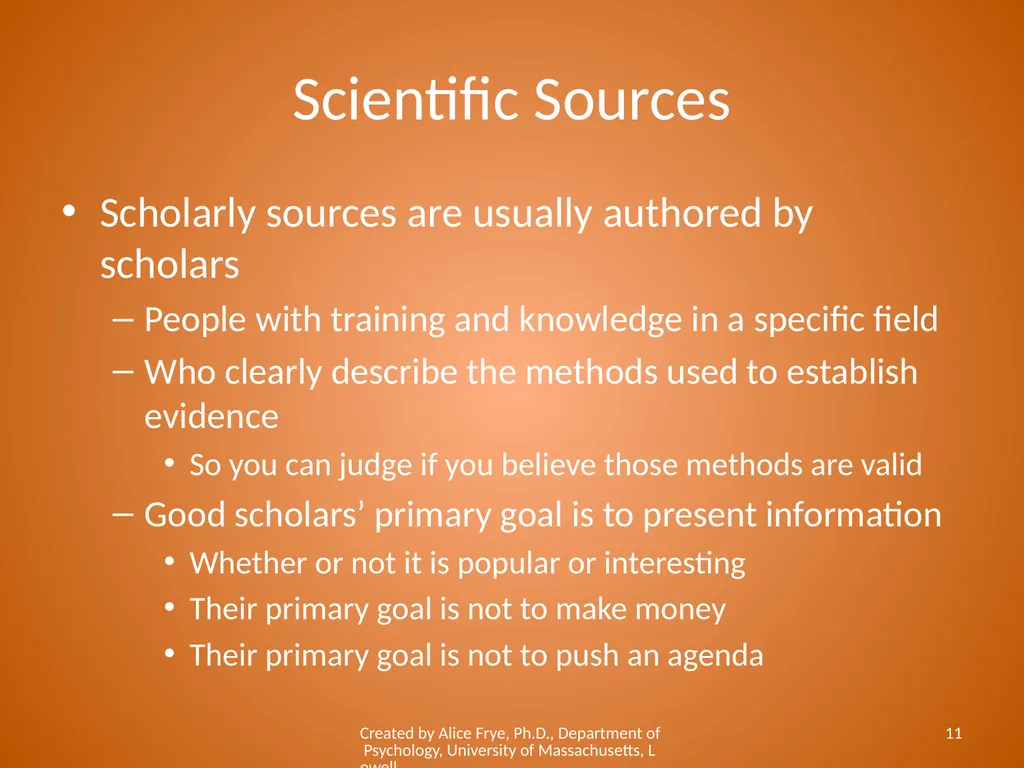
slide11. Scientific Sources Scholarly sources are usually authored by scholars
People with training and knowledge in a specific field
Who clearly describe the methods used to establish evidence
So you can judge if you believe those methods are valid
Good scholars’ primary goal is to present information
Whether or not it is popular or interesting
Their primary goal is not to make money
Their primary goal is not to push an agenda Created by Alice Frye, Ph.D., Department of Psychology, University of Massachusetts, Lowell 11<br>
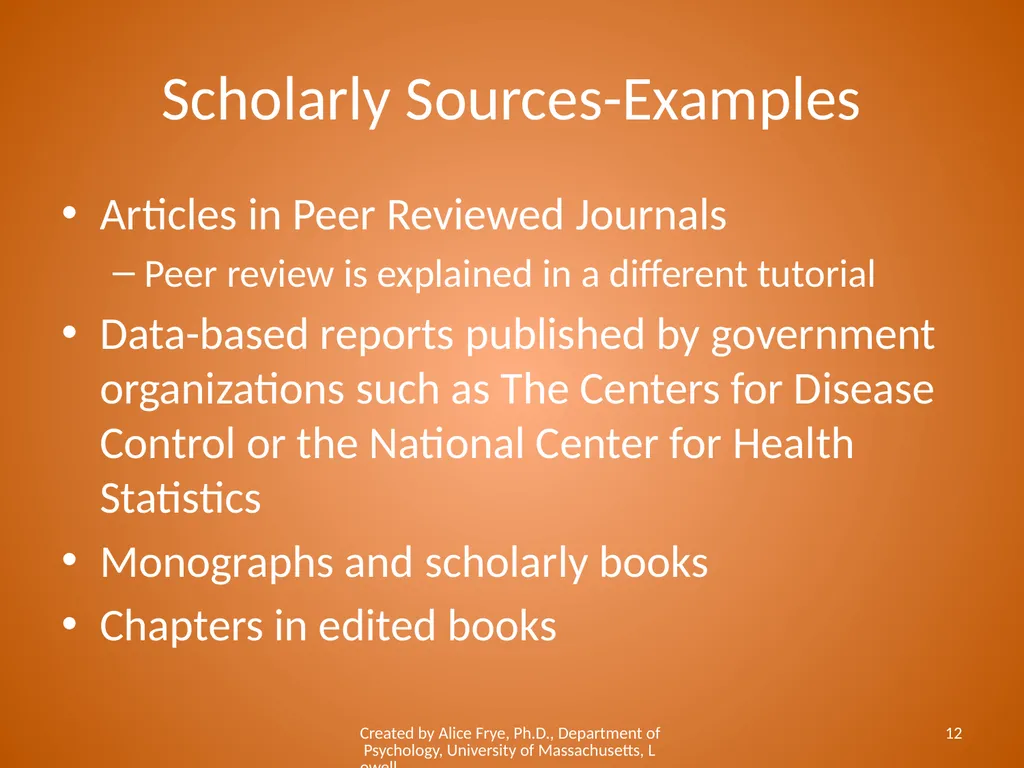
slide12. Scholarly Sources-Examples Articles in Peer Reviewed Journals
Peer review is explained in a different tutorial
Data-based reports published by government organizations such as The Centers for Disease Control or the National Center for Health Statistics
Monographs and scholarly books
Chapters in edited books Created by Alice Frye, Ph.D., Department of Psychology, University of Massachusetts, Lowell 12<br>
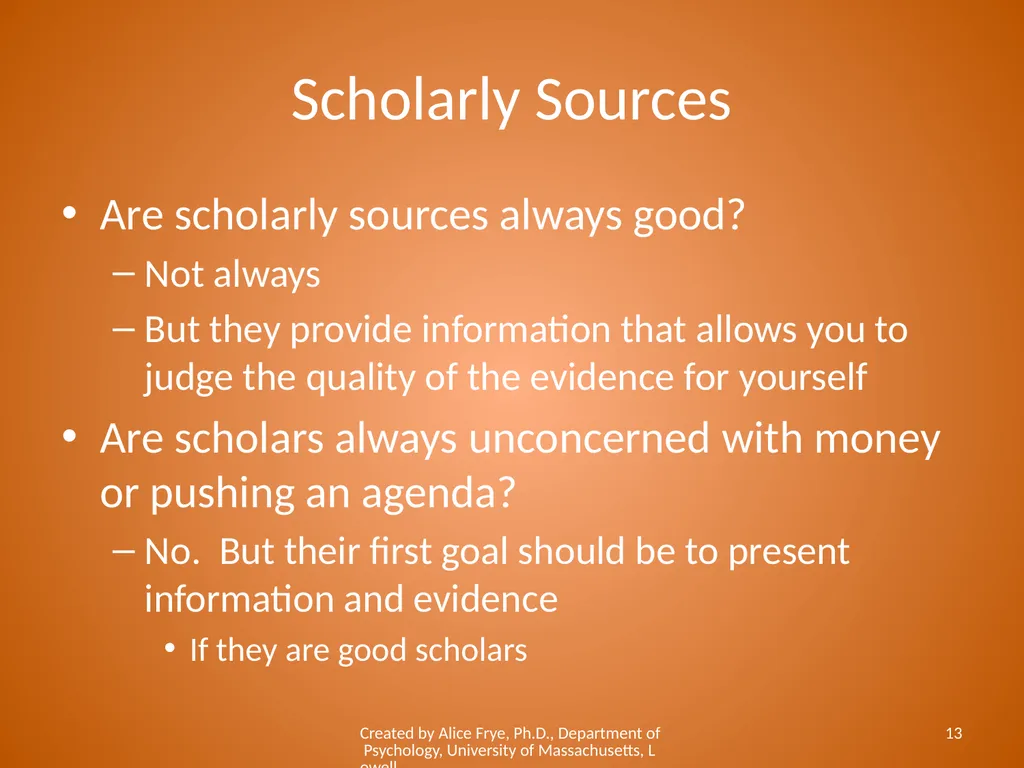
slide13. Scholarly Sources Are scholarly sources always good?
Not always
But they provide information that allows you to judge the quality of the evidence for yourself
Are scholars always unconcerned with money or pushing an agenda?
No. But their first goal should be to present information and evidence
If they are good scholars Created by Alice Frye, Ph.D., Department of Psychology, University of Massachusetts, Lowell 13<br>
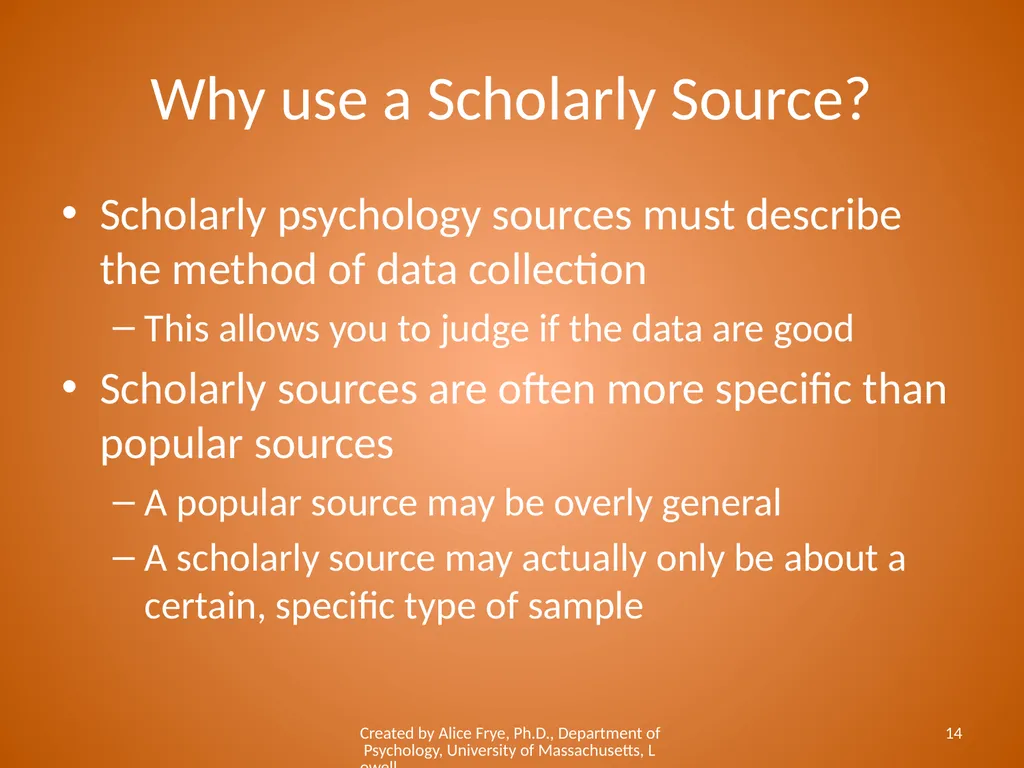
slide14. Why use a Scholarly Source? Scholarly psychology sources must describe the method of data collection
This allows you to judge if the data are good
Scholarly sources are often more specific than popular sources
A popular source may be overly general
A scholarly source may actually only be about a certain, specific type of sample Created by Alice Frye, Ph.D., Department of Psychology, University of Massachusetts, Lowell 14<br>
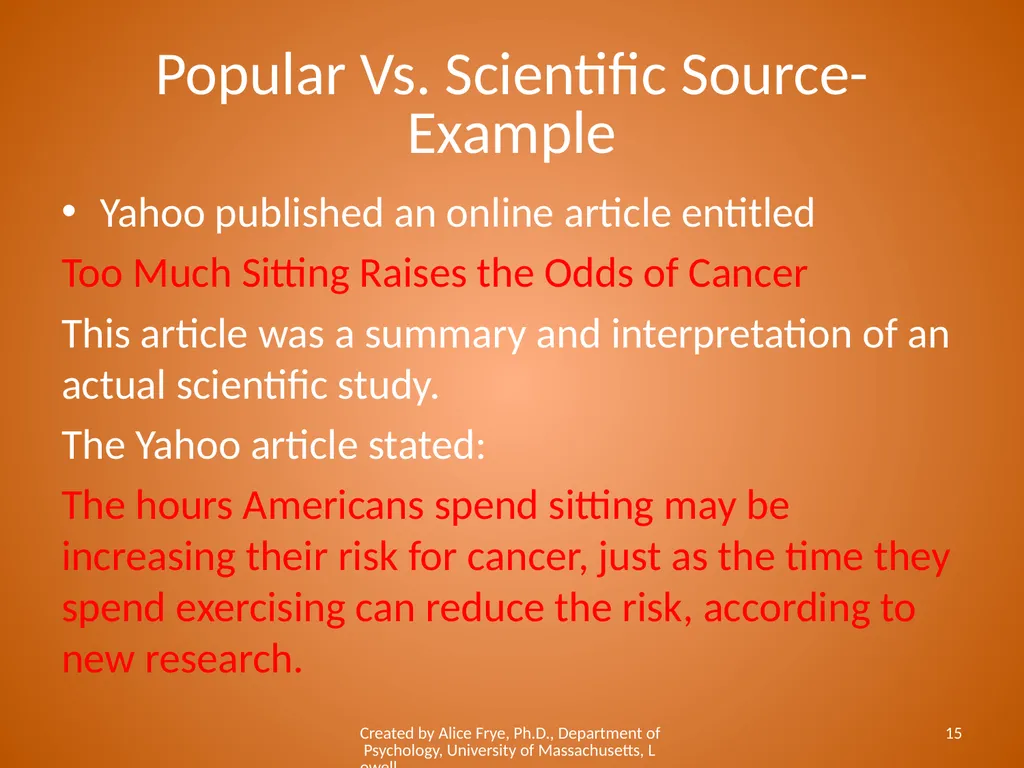
slide15. Popular Vs. Scientific Source-Example Yahoo published an online article entitled
Too Much Sitting Raises the Odds of Cancer
This article was a summary and interpretation of an actual scientific study.
The Yahoo article stated:
The hours Americans spend sitting may be increasing their risk for cancer, just as the time they spend exercising can reduce the risk, according to new research. Created by Alice Frye, Ph.D., Department of Psychology, University of Massachusetts, Lowell 15<br>
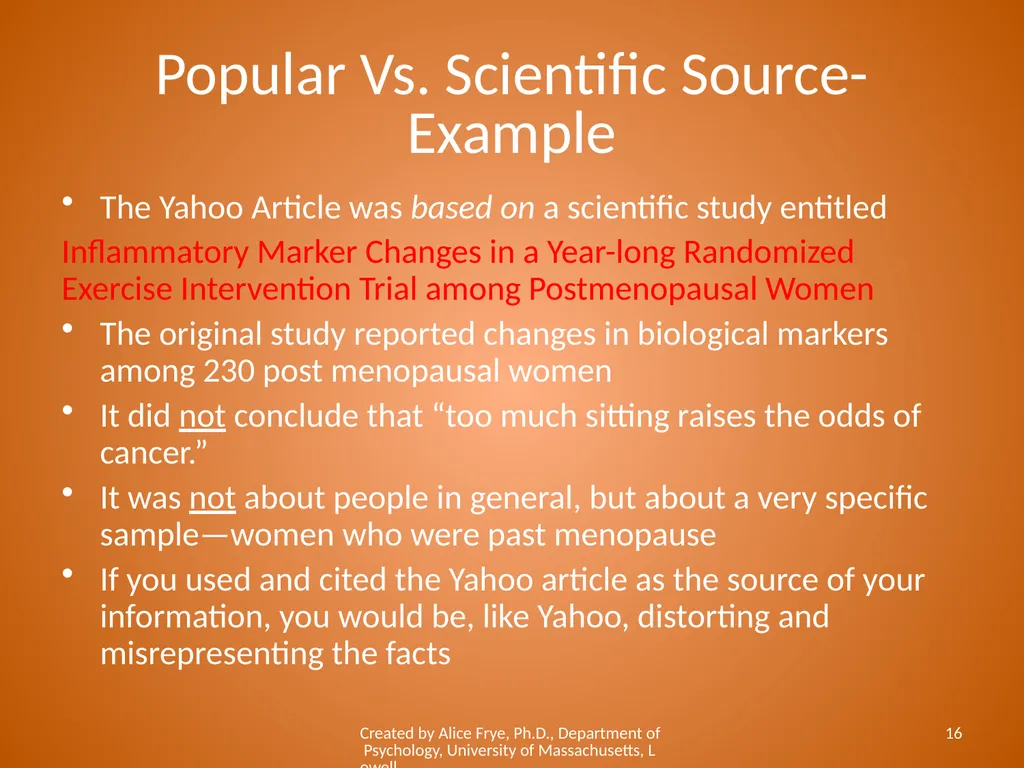
slide16. Popular Vs. Scientific Source-Example The Yahoo Article was based on a scientific study entitled
Inflammatory Marker Changes in a Year-long Randomized Exercise Intervention Trial among Postmenopausal Women
The original study reported changes in biological markers among 230 post menopausal women
It did not conclude that “too much sitting raises the odds of cancer.”
It was not about people in general, but about a very specific sample—women who were past menopause
If you used and cited the Yahoo article as the source of your information, you would be, like Yahoo, distorting and misrepresenting the facts Created by Alice Frye, Ph.D., Department of Psychology, University of Massachusetts, Lowell 16<br>
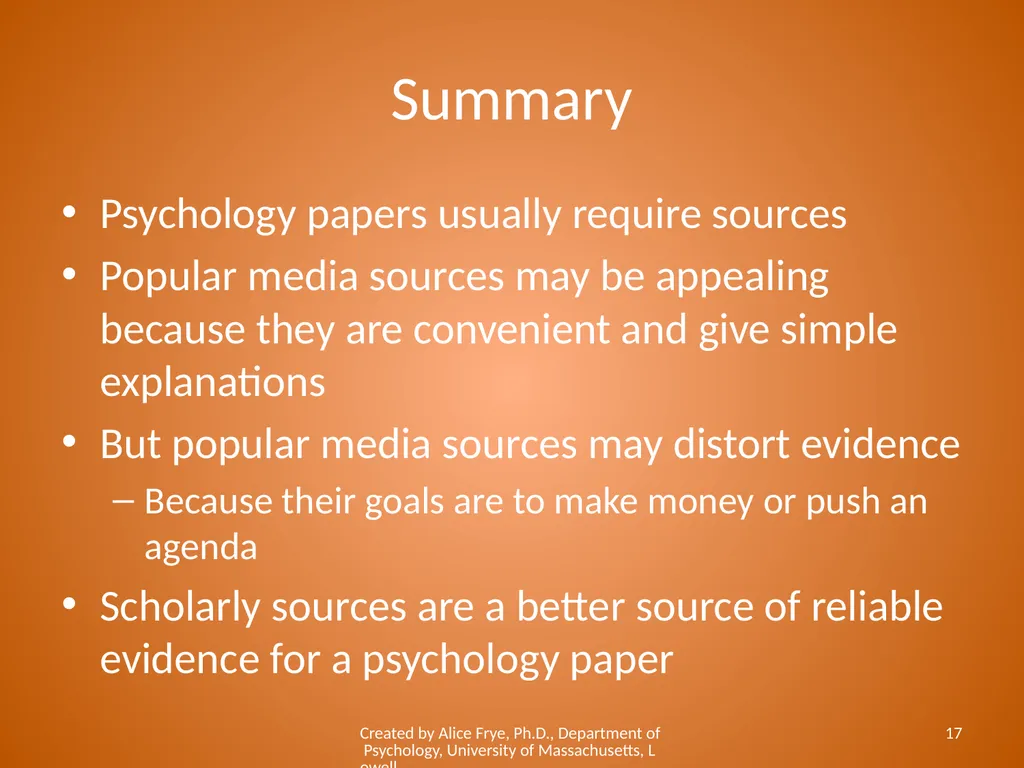
slide17. Summary Psychology papers usually require sources
Popular media sources may be appealing because they are convenient and give simple explanations
But popular media sources may distort evidence
Because their goals are to make money or push an agenda
Scholarly sources are a better source of reliable evidence for a psychology paper Created by Alice Frye, Ph.D., Department of Psychology, University of Massachusetts, Lowell 17<br>
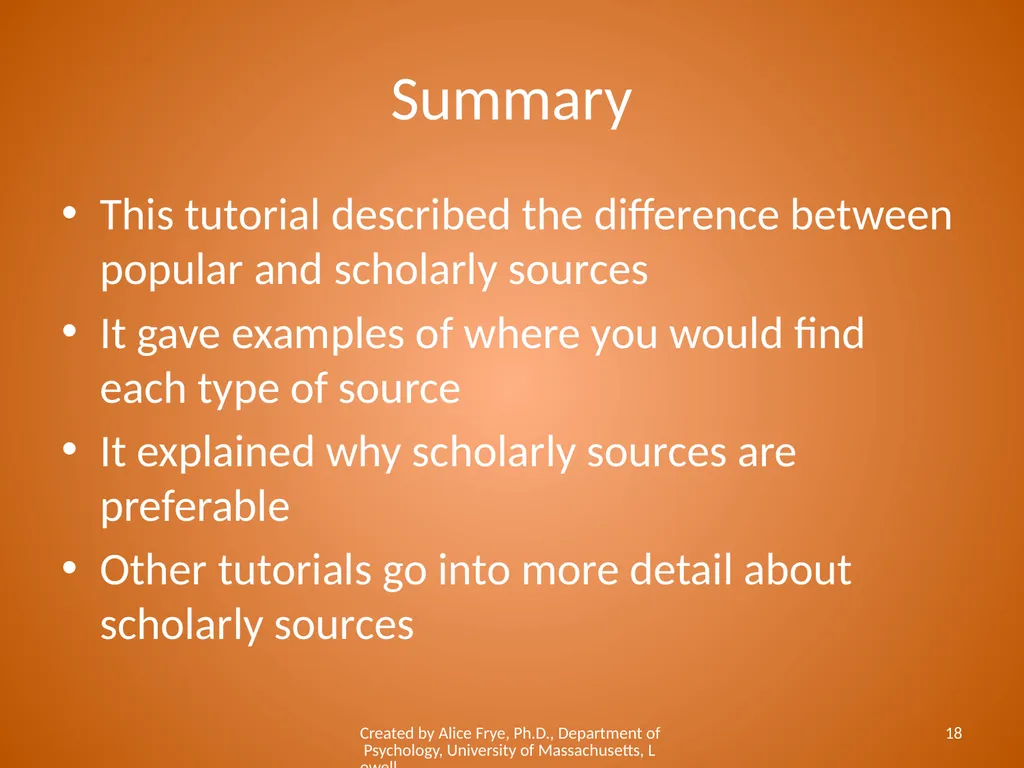
slide18. Summary This tutorial described the difference between popular and scholarly sources
It gave examples of where you would find each type of source
It explained why scholarly sources are preferable
Other tutorials go into more detail about scholarly sources Created by Alice Frye, Ph.D., Department of Psychology, University of Massachusetts, Lowell 18<br>

slide2. Steps in this tutorial 1) State the goals of this tutorial
2) What a source is
3) Why sources matter
4) The different types of sources
5) Examples of popular media sources
6) Examples of scholarly sources
7) Comparison of information from a popular and a scholarly source on the same topic Created by Alice Frye, Ph.D., Department of Psychology, University of Massachusetts, Lowell 2<br>
slide3. Goal The goal of this tutorial is to make sure you understand why sources matter in psychology
You should have a clear idea of what a “popular” source is, such as a news paper article, and what a scholarly source is
You should know how and when to use one or the other of these types of sources Created by Alice Frye, Ph.D., Department of Psychology, University of Massachusetts, Lowell 3<br>
slide4. Objectives By the end of this tutorial you should be able to
Know the general types of sources of information
Know how and why popular and scholarly sources may differ
Know why this matters in your own work Created by Alice Frye, Ph.D., Department of Psychology, University of Massachusetts, Lowell 4<br>
slide5. What is a source? Psychology as a field is often based on empirical knowledge
Data and observations
Most statements of fact require some kind of source
The source is where the data originated Created by Alice Frye, Ph.D., Department of Psychology, University of Massachusetts, Lowell 5<br>
slide6. Original Source Suppose you see an article in USA today about depression that says:
The CDC states that rates of depression have been stable for the last decade.
The original source of this information is the CDC
That is where you should look if you intend to use this information in a research paper or proposal
You should not trust that USA Today (or any popular media source) is correctly quoting the original source
You should check the original source for yourself and use that for your paper Created by Alice Frye, Ph.D., Department of Psychology, University of Massachusetts, Lowell 6<br>
slide7. Kinds of Sources There are many different types of sources
Examples include
Popular media
Popular articles
Visual media such as television
Popular magazines and newspapers
Scholarly media
Journal articles
Published studies
Books and monographs Created by Alice Frye, Ph.D., Department of Psychology, University of Massachusetts, Lowell 7<br>
slide8. Popular Media Popular media sources are usually authored by non-scholars
Reporters
Interested people
People with a goal besides presenting fact based evidence
Popular media often strive to sell advertising and generate broad interest
Popular media usually have a goal of making money or pushing an agenda
Not necessarily presenting fact based evidence Created by Alice Frye, Ph.D., Department of Psychology, University of Massachusetts, Lowell 8<br>
slide9. Popular Media-Examples Articles from newspapers such as the New York Times or USA Today
Editorials in newspapers, magazines or on television
Interviews with doctors or scientists on television, in newspapers or magazines
Articles in magazines such as Time, Sports Illustrated or Men’s Health
Popular media include both print and online versions Created by Alice Frye, Ph.D., Department of Psychology, University of Massachusetts, Lowell 9<br>
slide10. Popular Media Are popular media sources without evidence?
No, many popular sources may be factually accurate
But it can be hard to tell
Should you use popular media sources as sources for facts in an empirical paper?
No
You should use a scholarly source Created by Alice Frye, Ph.D., Department of Psychology, University of Massachusetts, Lowell 10<br>
slide11. Scientific Sources Scholarly sources are usually authored by scholars
People with training and knowledge in a specific field
Who clearly describe the methods used to establish evidence
So you can judge if you believe those methods are valid
Good scholars’ primary goal is to present information
Whether or not it is popular or interesting
Their primary goal is not to make money
Their primary goal is not to push an agenda Created by Alice Frye, Ph.D., Department of Psychology, University of Massachusetts, Lowell 11<br>
slide12. Scholarly Sources-Examples Articles in Peer Reviewed Journals
Peer review is explained in a different tutorial
Data-based reports published by government organizations such as The Centers for Disease Control or the National Center for Health Statistics
Monographs and scholarly books
Chapters in edited books Created by Alice Frye, Ph.D., Department of Psychology, University of Massachusetts, Lowell 12<br>
slide13. Scholarly Sources Are scholarly sources always good?
Not always
But they provide information that allows you to judge the quality of the evidence for yourself
Are scholars always unconcerned with money or pushing an agenda?
No. But their first goal should be to present information and evidence
If they are good scholars Created by Alice Frye, Ph.D., Department of Psychology, University of Massachusetts, Lowell 13<br>
slide14. Why use a Scholarly Source? Scholarly psychology sources must describe the method of data collection
This allows you to judge if the data are good
Scholarly sources are often more specific than popular sources
A popular source may be overly general
A scholarly source may actually only be about a certain, specific type of sample Created by Alice Frye, Ph.D., Department of Psychology, University of Massachusetts, Lowell 14<br>
slide15. Popular Vs. Scientific Source-Example Yahoo published an online article entitled
Too Much Sitting Raises the Odds of Cancer
This article was a summary and interpretation of an actual scientific study.
The Yahoo article stated:
The hours Americans spend sitting may be increasing their risk for cancer, just as the time they spend exercising can reduce the risk, according to new research. Created by Alice Frye, Ph.D., Department of Psychology, University of Massachusetts, Lowell 15<br>
slide16. Popular Vs. Scientific Source-Example The Yahoo Article was based on a scientific study entitled
Inflammatory Marker Changes in a Year-long Randomized Exercise Intervention Trial among Postmenopausal Women
The original study reported changes in biological markers among 230 post menopausal women
It did not conclude that “too much sitting raises the odds of cancer.”
It was not about people in general, but about a very specific sample—women who were past menopause
If you used and cited the Yahoo article as the source of your information, you would be, like Yahoo, distorting and misrepresenting the facts Created by Alice Frye, Ph.D., Department of Psychology, University of Massachusetts, Lowell 16<br>
slide17. Summary Psychology papers usually require sources
Popular media sources may be appealing because they are convenient and give simple explanations
But popular media sources may distort evidence
Because their goals are to make money or push an agenda
Scholarly sources are a better source of reliable evidence for a psychology paper Created by Alice Frye, Ph.D., Department of Psychology, University of Massachusetts, Lowell 17<br>
slide18. Summary This tutorial described the difference between popular and scholarly sources
It gave examples of where you would find each type of source
It explained why scholarly sources are preferable
Other tutorials go into more detail about scholarly sources Created by Alice Frye, Ph.D., Department of Psychology, University of Massachusetts, Lowell 18<br>