Knowledge Expert It is your responsibility to make sure that you are able to answer each of the questions set in the tasks below. This will be based on what you are taught in lessons and the information included the knowledge organisers.
"Knowledge Expert It is your responsibility to make" is the property of its rightful owner. Permission is granted to
download and print the materials on this website for personal, non-commercial use only, and to display it
on your personal computer provided you do not modify the materials and that you retain all copyright
notices contained in the materials. By downloading content from our website, you accept the terms of this
agreement.
Presentation Transcript
01
Knowledge Expert It is your responsibility to make sure that you are able to answer each of the questions set in the tasks below. This will be based on what you are taught in lessons and the information included the knowledge organisers. KS3 Coasts<br>
02
KS3 Coasts
knowledge checkers Core knowledge Key words Misconceptions Take it further... Multiple processes can occur at the same time on the coastline. Lesson 1
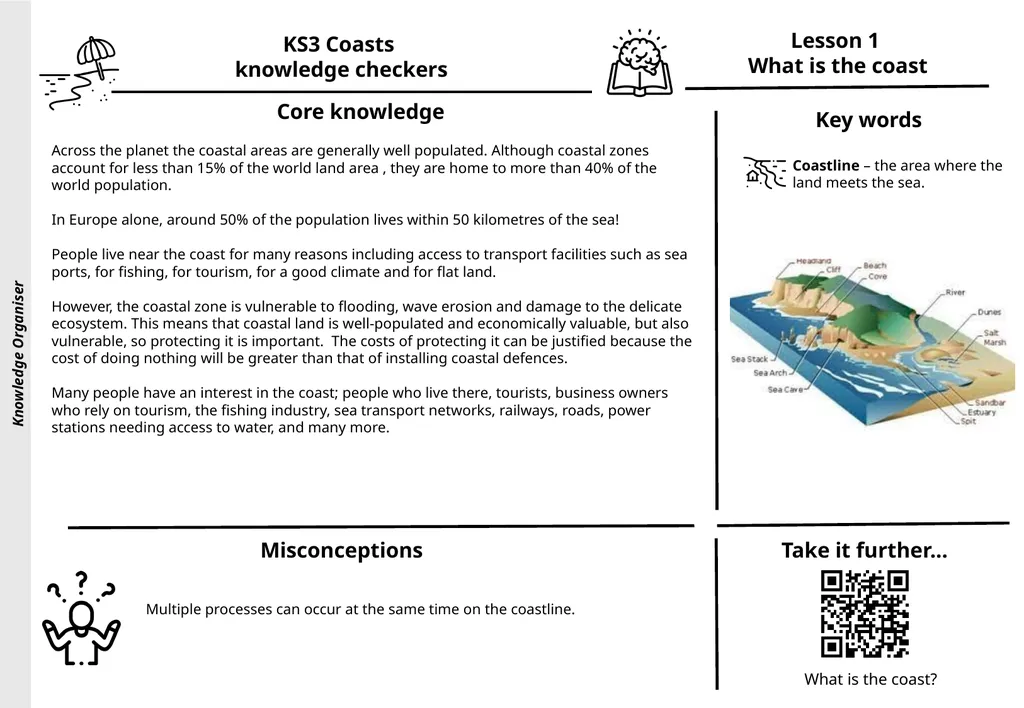
What is the coast Knowledge Organiser Across the planet the coastal areas are generally well populated. Although coastal zones account for less than 15% of the world land area , they are home to more than 40% of the world population.
In Europe alone, around 50% of the population lives within 50 kilometres of the sea!
People live near the coast for many reasons including access to transport facilities such as sea ports, for fishing, for tourism, for a good climate and for flat land.
However, the coastal zone is vulnerable to flooding, wave erosion and damage to the delicate ecosystem. This means that coastal land is well-populated and economically valuable, but also vulnerable, so protecting it is important. The costs of protecting it can be justified because the cost of doing nothing will be greater than that of installing coastal defences.
Many people have an interest in the coast; people who live there, tourists, business owners who rely on tourism, the fishing industry, sea transport networks, railways, roads, power stations needing access to water, and many more. Coastline – the area where the land meets the sea. What is the coast?<br>
03
KS3 Coasts
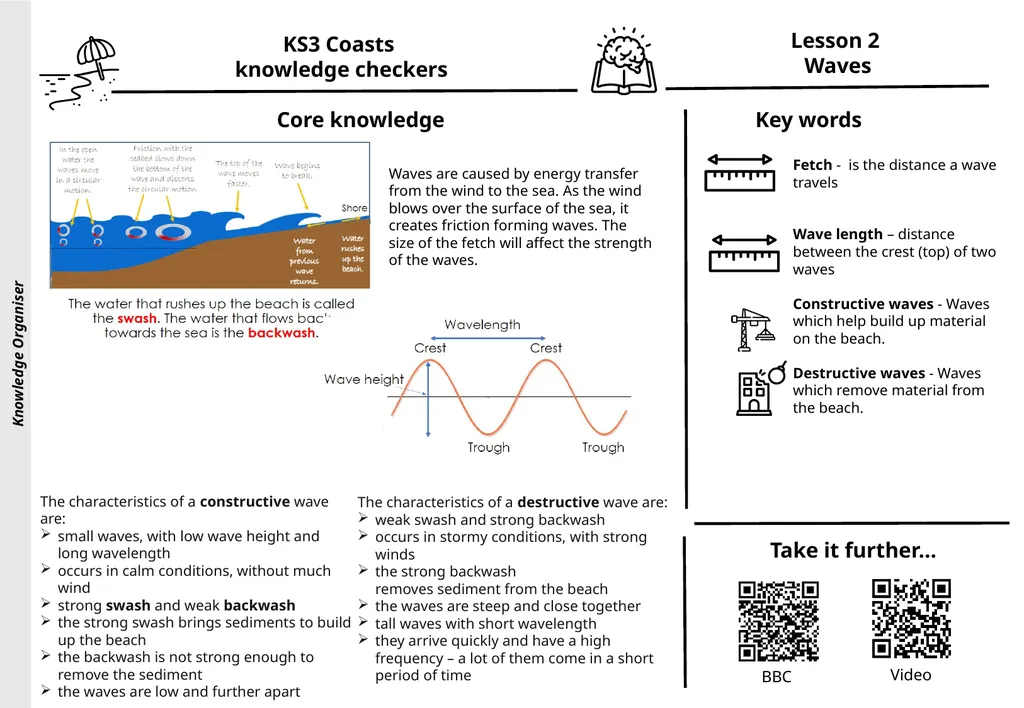
knowledge checkers Core knowledge Key words Take it further... Fetch - is the distance a wave travels
Wave length – distance between the crest (top) of two waves
Constructive waves - Waves which help build up material on the beach.
Destructive waves - Waves which remove material from the beach. Lesson 2
Waves Waves are caused by energy transfer from the wind to the sea. As the wind blows over the surface of the sea, it creates friction forming waves. The size of the fetch will affect the strength of the waves. Knowledge Organiser BBC Video The characteristics of a constructive wave are:
small waves, with low wave height and long wavelength
occurs in calm conditions, without much wind
strong swash and weak backwash
the strong swash brings sediments to build up the beach
the backwash is not strong enough to remove the sediment
the waves are low and further apart The characteristics of a destructive wave are:
weak swash and strong backwash
occurs in stormy conditions, with strong winds
the strong backwash removes sediment from the beach
the waves are steep and close together
tall waves with short wavelength
they arrive quickly and have a high frequency – a lot of them come in a short period of time<br>
04
KS3 Coasts
knowledge checkers Core knowledge Key words Take it further... Lesson 3
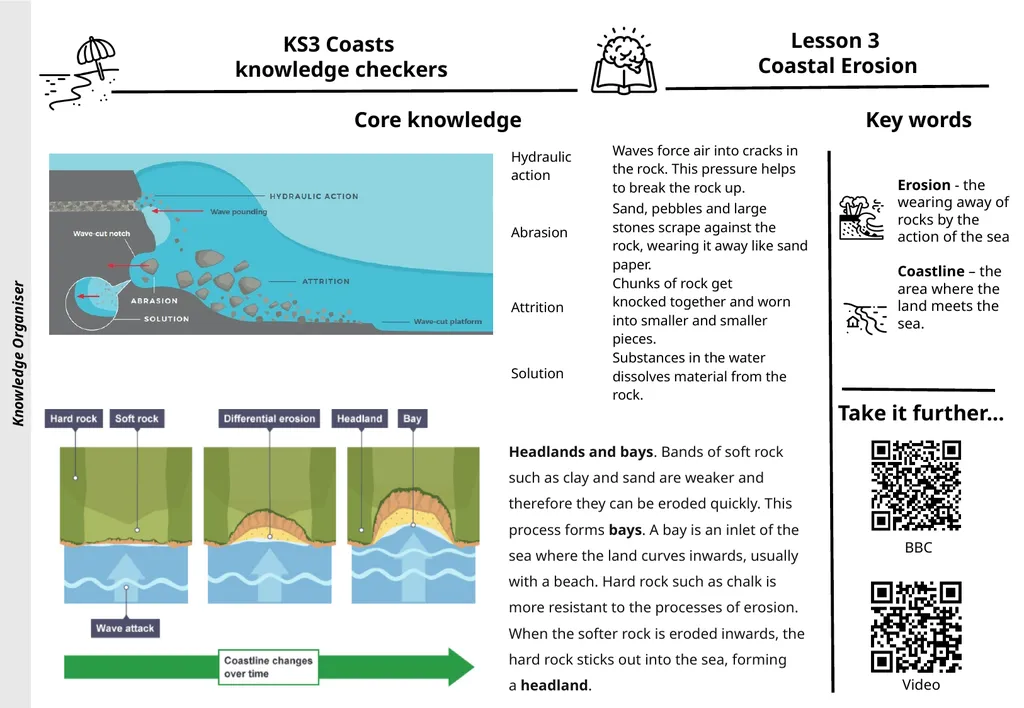
Coastal Erosion Knowledge Organiser BBC Video Headlands and bays. Bands of soft rock such as clay and sand are weaker and therefore they can be eroded quickly. This process forms bays. A bay is an inlet of the sea where the land curves inwards, usually with a beach. Hard rock such as chalk is more resistant to the processes of erosion. When the softer rock is eroded inwards, the hard rock sticks out into the sea, forming a headland. Erosion - the wearing away of rocks by the action of the sea
Coastline – the area where the land meets the sea.<br>
05
KS3 Coasts
knowledge checkers Core knowledge Key words Misconceptions Take it further... Hydraulic action - Waves force air into cracks in the rock. This pressure helps to break the rock up.
Abrasion - Sand, pebbles and large stones scrape against the rock, wearing it away like sand paper.
Headland – an area of hard rock cutting out into the sea. Many of these features of erosion can be present on any part of the headland at any time. Lesson 4
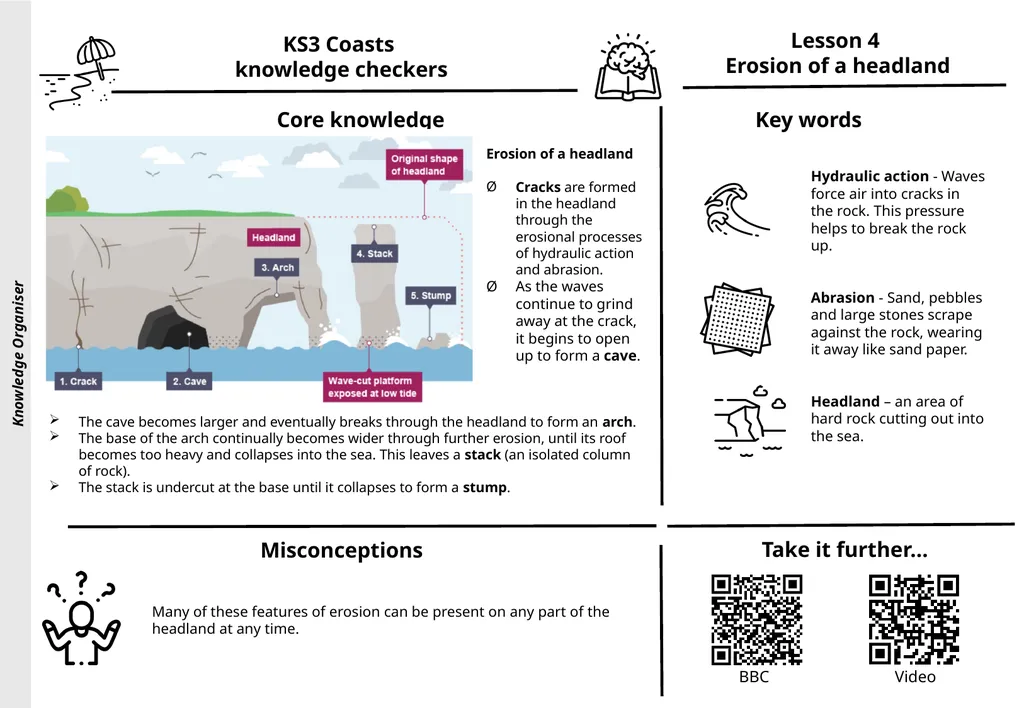
Erosion of a headland Knowledge Organiser BBC Video The cave becomes larger and eventually breaks through the headland to form an arch.
The base of the arch continually becomes wider through further erosion, until its roof becomes too heavy and collapses into the sea. This leaves a stack (an isolated column of rock).
The stack is undercut at the base until it collapses to form a stump. Erosion of a headland
Cracks are formed in the headland through the erosional processes of hydraulic action and abrasion.
As the waves continue to grind away at the crack, it begins to open up to form a cave.<br>
06
KS3 Coasts
knowledge checkers Core knowledge Key words Take it further... Coastal transportation - the movement of material in the sea and along the coast by waves.
Swash – The water flowing towards a beach when a wave breaks.
Backwash – The movement of water down the beach.
Sediment - Small fragments of rock and soil that form layers.
Prevailing wind - The most common wind direction Lesson 5
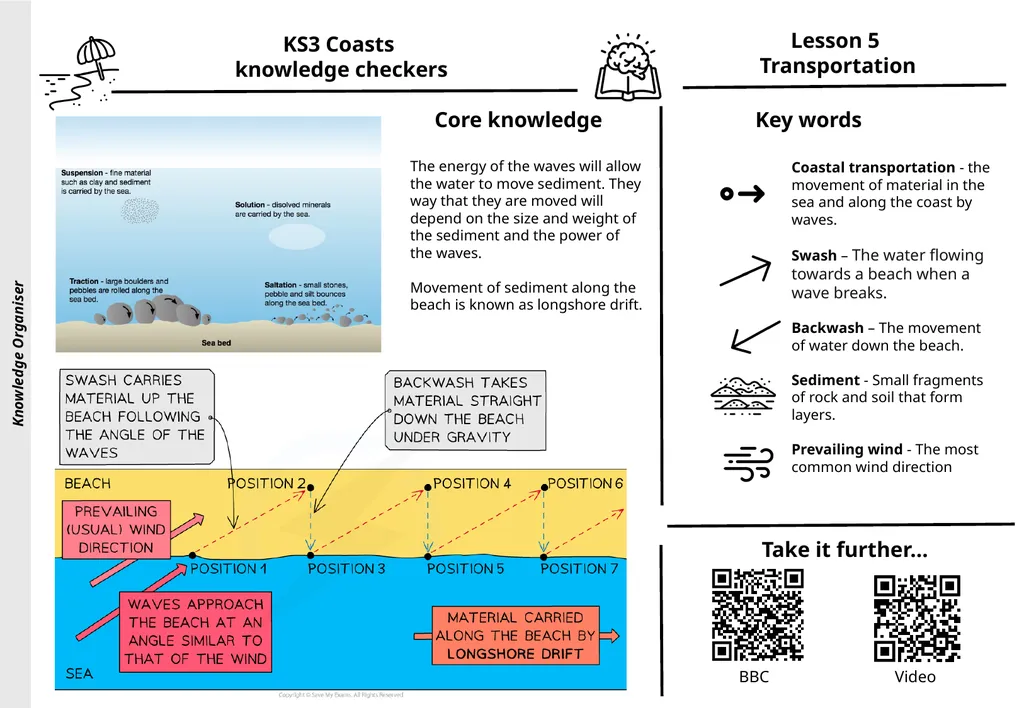
Transportation Knowledge Organiser BBC Video The energy of the waves will allow the water to move sediment. They way that they are moved will depend on the size and weight of the sediment and the power of the waves.
Movement of sediment along the beach is known as longshore drift.<br>
07
KS3 Coasts
knowledge checkers Core knowledge Key words Misconceptions Take it further... Deposition - when material is dropped by the sea
Estuary – where the mouth of the river is tidal
Tidal – affect by the tides, the sea rising and falling.
Longshore drift – the zigzag motion of material along the coastline. A lagoon is only found behind a bar NOT a spit. Lesson 6
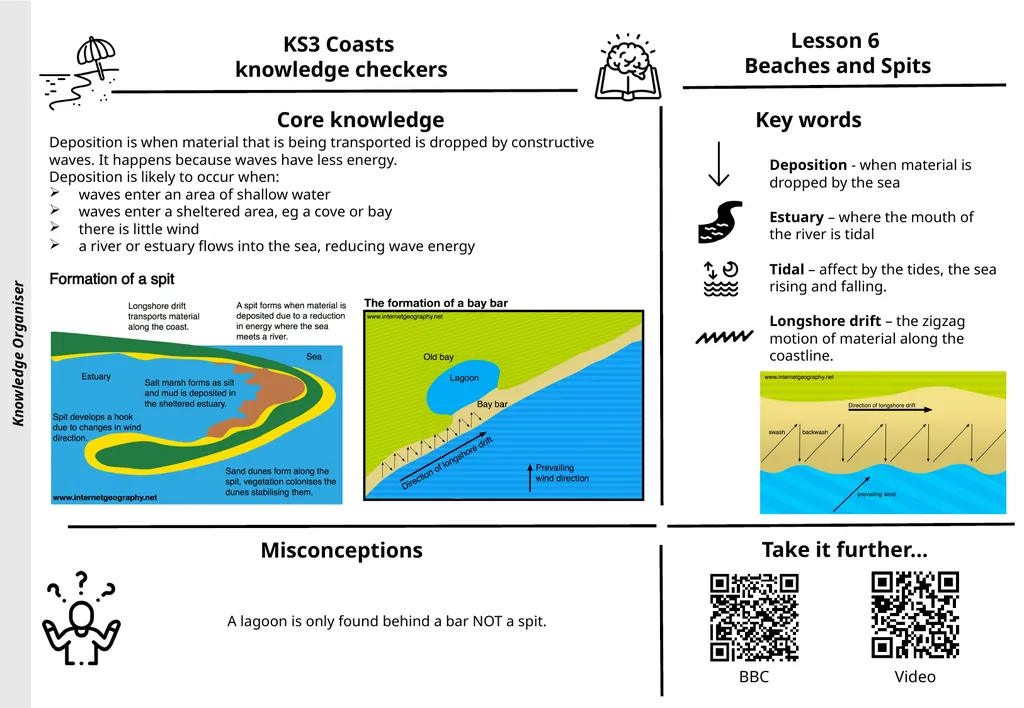
Beaches and Spits Deposition is when material that is being transported is dropped by constructive waves. It happens because waves have less energy.
Deposition is likely to occur when:
waves enter an area of shallow water
waves enter a sheltered area, eg a cove or bay
there is little wind
a river or estuary flows into the sea, reducing wave energy Knowledge Organiser BBC Video<br>
08
KS3 Coasts
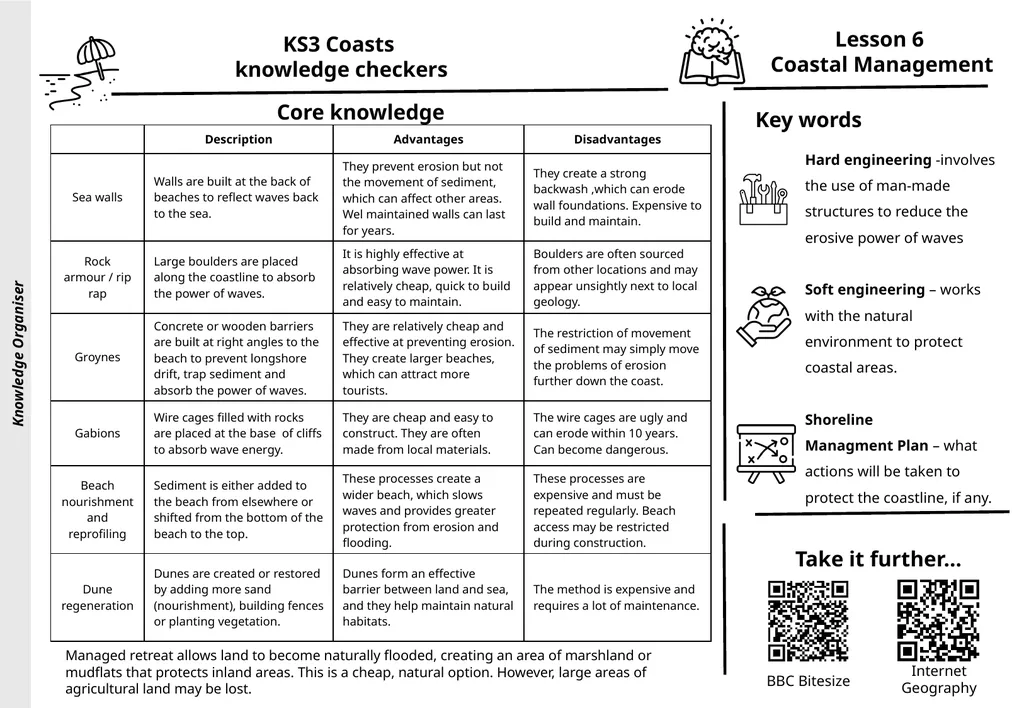
knowledge checkers Core knowledge Key words Take it further... Hard engineering -involves the use of man-made structures to reduce the erosive power of waves
Soft engineering – works with the natural environment to protect coastal areas.
Shoreline Managment Plan – what actions will be taken to protect the coastline, if any. Lesson 6
Coastal Management Knowledge Organiser BBC Bitesize Internet Geography Managed retreat allows land to become naturally flooded, creating an area of marshland or mudflats that protects inland areas. This is a cheap, natural option. However, large areas of agricultural land may be lost.<br>