Laboratory Testing for Human Parasites Cathy
Description: Laboratory Testing for Human Parasites Cathy Snider, MPH, MT(ASCP) Medical Parasitology Team Lead DSHS Laboratory Intestinal, Blood, and Tissue Parasitic Protozoa and Helminths In the late 1800s, scientists sometimes referred to

Related Topics
Download Presentation
"Laboratory Testing for Human Parasites Cathy" is the property of its rightful owner. Permission is granted to download and print the materials on this website for personal, non-commercial use only, and to display it on your personal computer provided you do not modify the materials and that you retain all copyright notices contained in the materials. By downloading content from our website, you accept the terms of this agreement.
Presentation Transcript
slide1. Laboratory Testing for Human Parasites Cathy Snider, MPH, MT(ASCP)
Medical Parasitology Team Lead
DSHS Laboratory Intestinal, Blood, and Tissue<br>
slide2. Parasitic Protozoa and Helminths “In the late 1800s, scientists sometimes referred to parasitology as medical zoology. They were referring to the way they had to understand parasites as real organisms, with natural histories of their own, before they could try to fight the diseases the parasites caused.”
Carl Zimmer, Parasite Rex<br>
slide3. Neglected Tropical Diseases Diseases caused by parasites are ancient conditions that are among the most common infections of the world’s poorest people. They make up the majority of what are called “Neglected Tropical Diseases” or NTDs.
In 2015, an estimated 214 million cases of malaria occurred worldwide and 438,000 people died. About 1,500 cases of malaria are diagnosed in the United States each year. (CDC)
In 2014, at least 1.7 billion people required mass or individual treatment and care for NTDs, in 185 countries. Of these, 1.1 billion were in lower-middle-income countries. (WHO)<br>
slide4. Parasitic Disease Exposures Fecally contaminated environment: Lack of sanitation infrastructure; zoonotic exposure
Foodborne: Unsanitary food handling; contaminated or infected food
Arthropod vector: Mosquitoes, triatomines, biting flies
Miscellaneous: Infection with free living organisms in the environment; sexual transmission; congenital transmission; transfusion/transplant acquired<br>
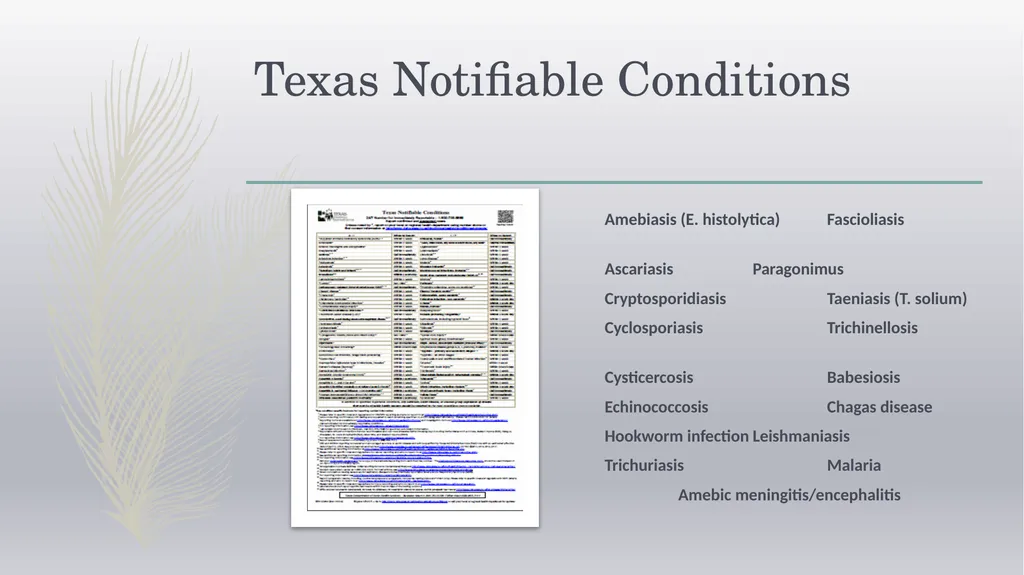
slide5. Texas Notifiable Conditions Amebiasis (E. histolytica) Fascioliasis
Ascariasis Paragonimus
Cryptosporidiasis Taeniasis (T. solium)
Cyclosporiasis Trichinellosis
Cysticercosis Babesiosis
Echinococcosis Chagas disease
Hookworm infection Leishmaniasis
Trichuriasis Malaria
Amebic meningitis/encephalitis<br>
slide6. A few more to keep on your radar … Angiostrongylus Baylisascaris
Giardia Diphyllobothrium
Toxocara Schistosoma
Toxoplasma Strongyloides
Trichomonas<br>
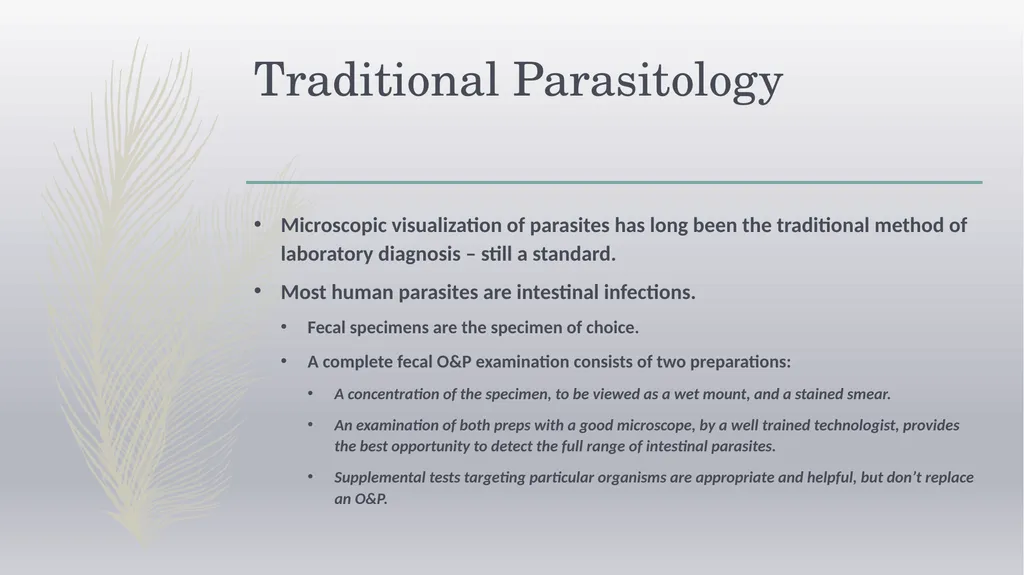
slide7. Traditional Parasitology Microscopic visualization of parasites has long been the traditional method of laboratory diagnosis – still a standard.
Most human parasites are intestinal infections.
Fecal specimens are the specimen of choice.
A complete fecal O&P examination consists of two preparations:
A concentration of the specimen, to be viewed as a wet mount, and a stained smear.
An examination of both preps with a good microscope, by a well trained technologist, provides the best opportunity to detect the full range of intestinal parasites.
Supplemental tests targeting particular organisms are appropriate and helpful, but don’t replace an O&P.<br>
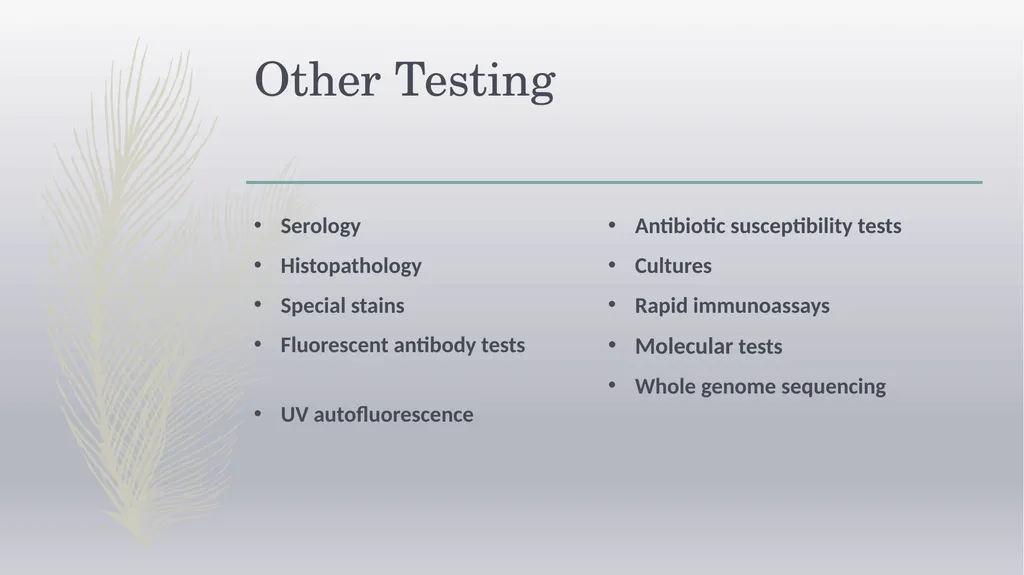
slide8. Other Testing Serology
Histopathology
Special stains
Fluorescent antibody tests
UV autofluorescence Antibiotic susceptibility tests
Cultures
Rapid immunoassays
Molecular tests
Whole genome sequencing<br>
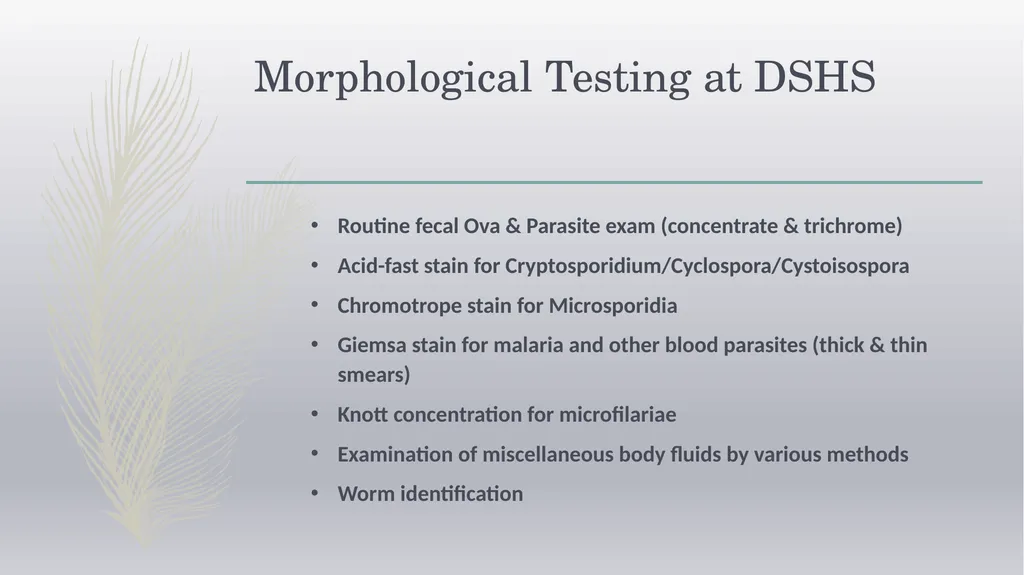
slide9. Morphological Testing at DSHS Routine fecal Ova & Parasite exam (concentrate & trichrome)
Acid-fast stain for Cryptosporidium/Cyclospora/Cystoisospora
Chromotrope stain for Microsporidia
Giemsa stain for malaria and other blood parasites (thick & thin smears)
Knott concentration for microfilariae
Examination of miscellaneous body fluids by various methods
Worm identification<br>
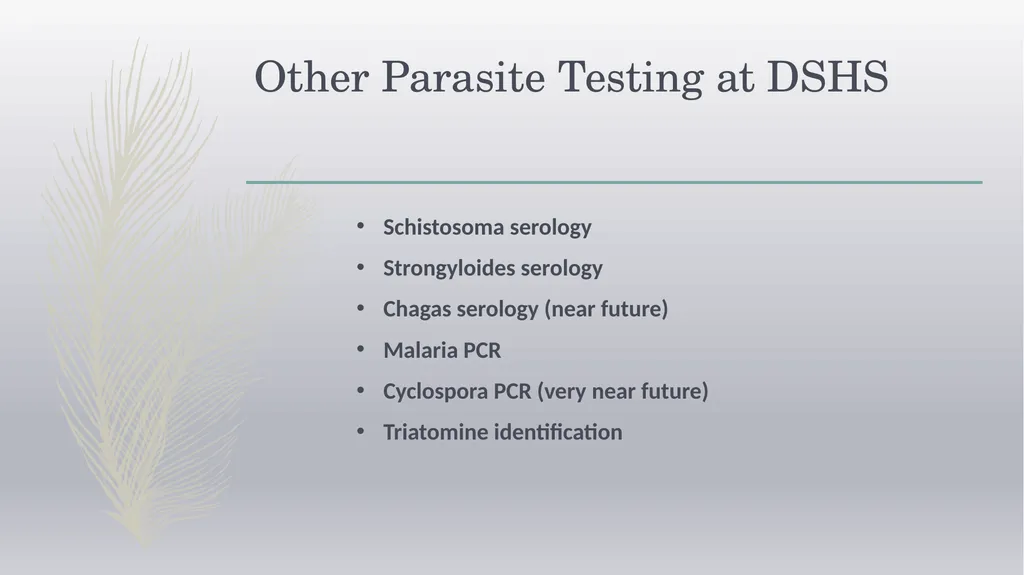
slide10. Other Parasite Testing at DSHS Schistosoma serology
Strongyloides serology
Chagas serology (near future)
Malaria PCR
Cyclospora PCR (very near future)
Triatomine identification<br>
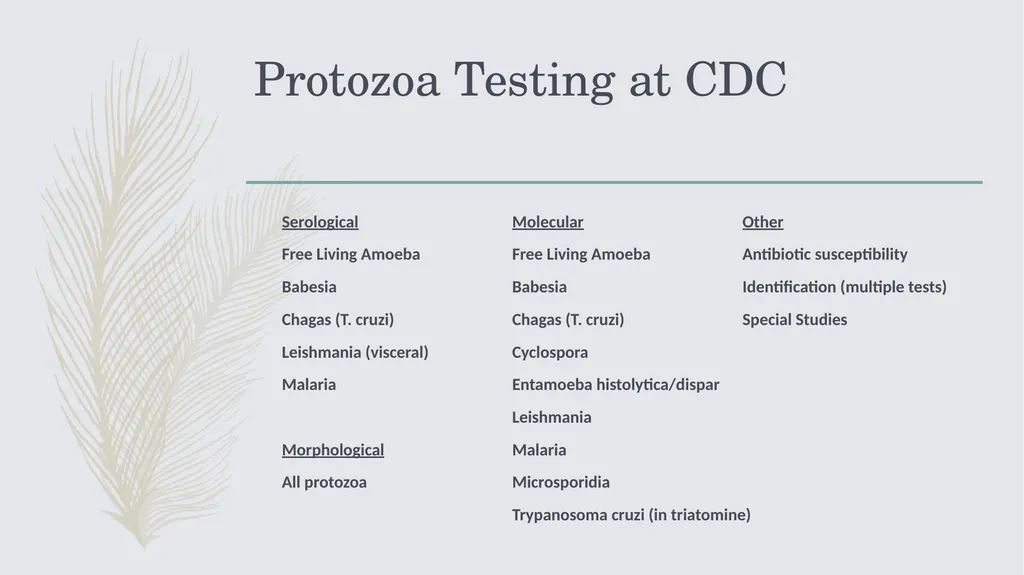
slide11. Protozoa Testing at CDC Serological Molecular Other
Free Living Amoeba Free Living Amoeba Antibiotic susceptibility
Babesia Babesia Identification (multiple tests)
Chagas (T. cruzi) Chagas (T. cruzi) Special Studies
Leishmania (visceral) Cyclospora
Malaria Entamoeba histolytica/dispar
Leishmania
Morphological Malaria
All protozoa Microsporidia
Trypanosoma cruzi (in triatomine)<br>
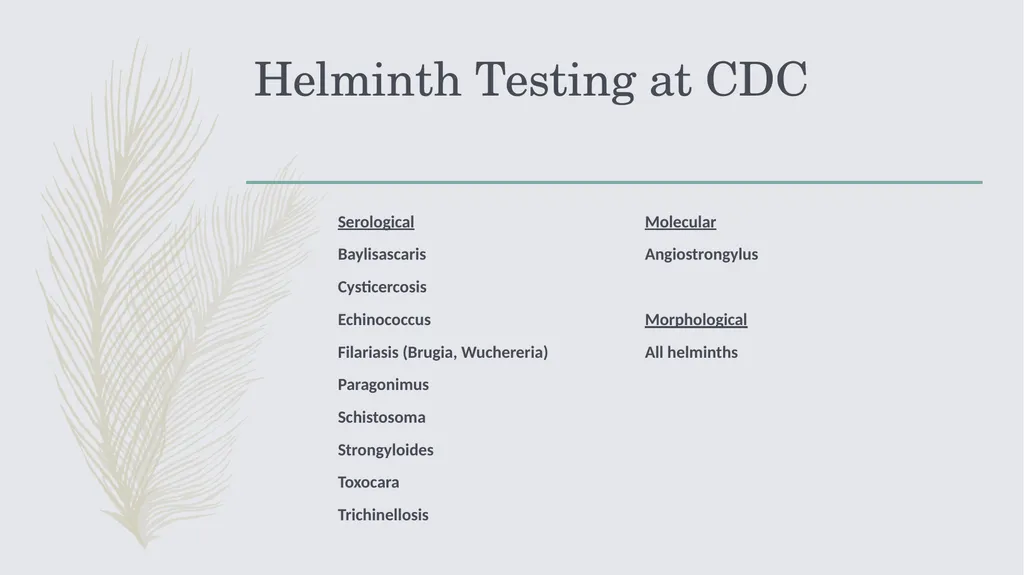
slide12. Helminth Testing at CDC Serological Molecular
Baylisascaris Angiostrongylus
Cysticercosis
Echinococcus Morphological
Filariasis (Brugia, Wuchereria) All helminths
Paragonimus
Schistosoma
Strongyloides
Toxocara
Trichinellosis<br>
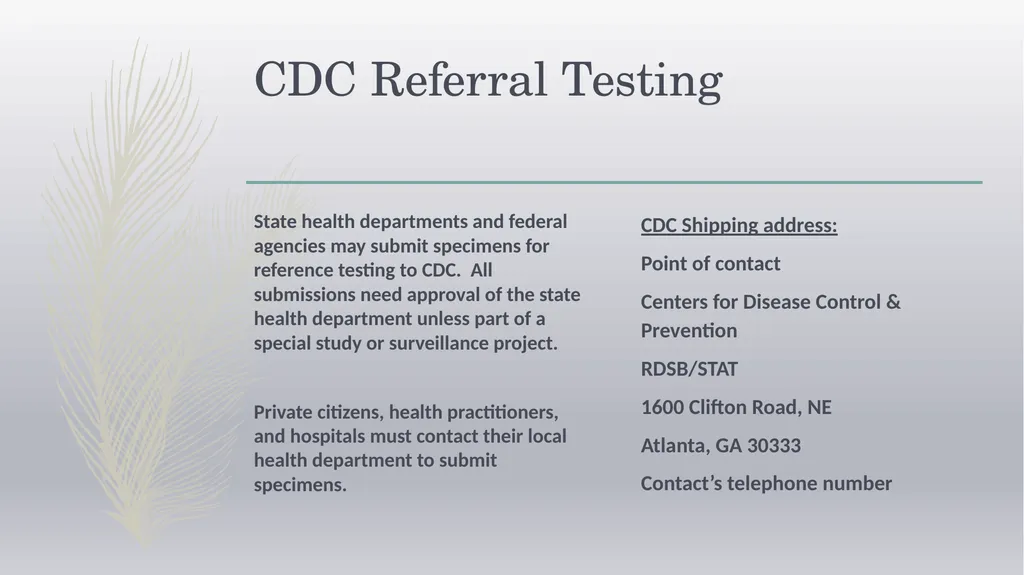
slide13. CDC Referral Testing State health departments and federal agencies may submit specimens for reference testing to CDC. All submissions need approval of the state health department unless part of a special study or surveillance project.
Private citizens, health practitioners, and hospitals must contact their local health department to submit specimens. CDC Shipping address:
Point of contact
Centers for Disease Control & Prevention
RDSB/STAT
1600 Clifton Road, NE
Atlanta, GA 30333
Contact’s telephone number<br>
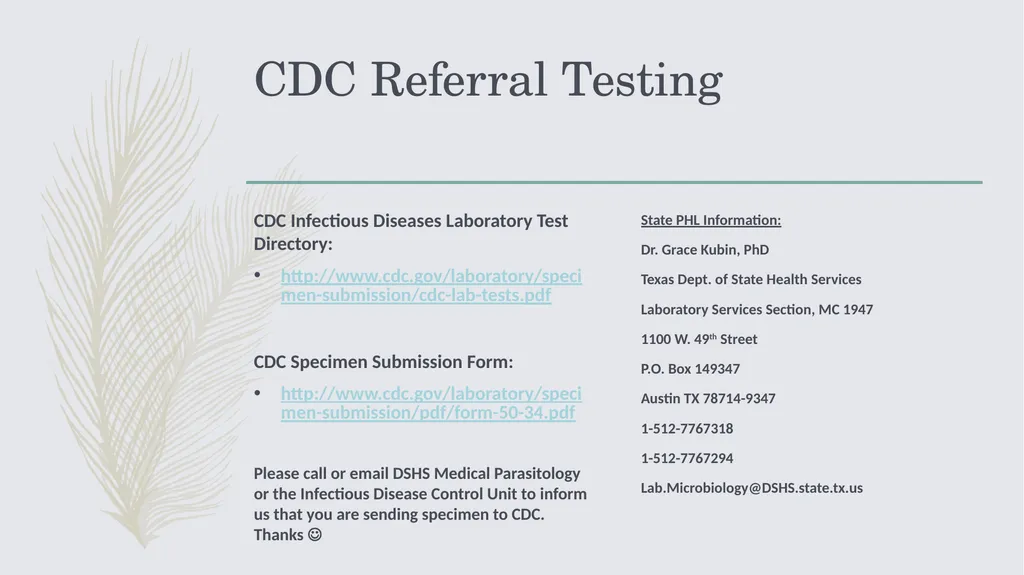
slide14. CDC Referral Testing CDC Infectious Diseases Laboratory Test Directory:
http://www.cdc.gov/laboratory/specimen-submission/cdc-lab-tests.pdf
CDC Specimen Submission Form:
http://www.cdc.gov/laboratory/specimen-submission/pdf/form-50-34.pdf
Please call or email DSHS Medical Parasitology or the Infectious Disease Control Unit to inform us that you are sending specimen to CDC. Thanks State PHL Information:
Dr. Grace Kubin, PhD
Texas Dept. of State Health Services
Laboratory Services Section, MC 1947
1100 W. 49th Street
P.O. Box 149347
Austin TX 78714-9347
1-512-7767318
1-512-7767294
Lab.Microbiology@DSHS.state.tx.us<br>
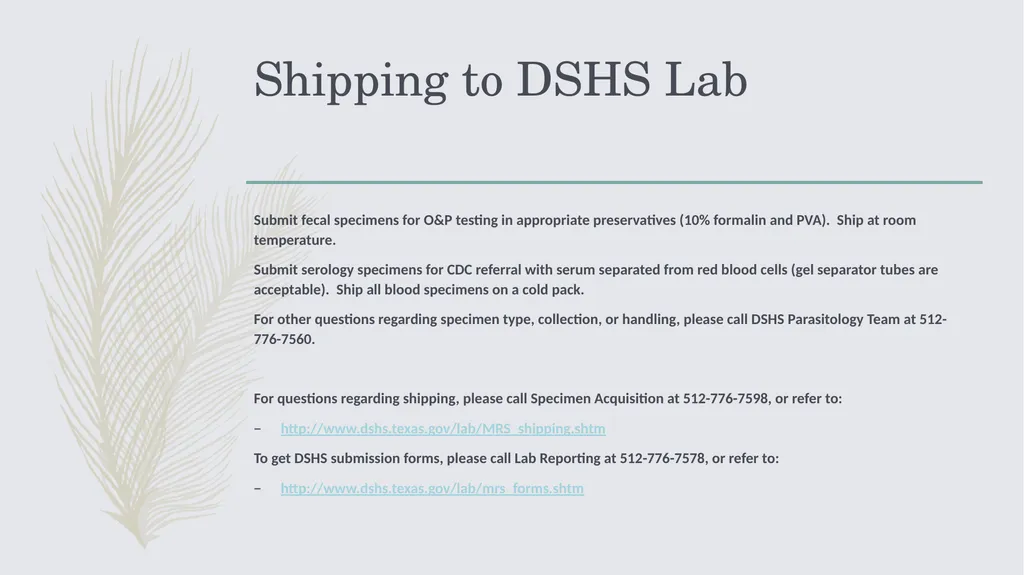
slide15. Shipping to DSHS Lab Submit fecal specimens for O&P testing in appropriate preservatives (10% formalin and PVA). Ship at room temperature.
Submit serology specimens for CDC referral with serum separated from red blood cells (gel separator tubes are acceptable). Ship all blood specimens on a cold pack.
For other questions regarding specimen type, collection, or handling, please call DSHS Parasitology Team at 512-776-7560.
For questions regarding shipping, please call Specimen Acquisition at 512-776-7598, or refer to:
http://www.dshs.texas.gov/lab/MRS_shipping.shtm
To get DSHS submission forms, please call Lab Reporting at 512-776-7578, or refer to:
http://www.dshs.texas.gov/lab/mrs_forms.shtm<br>
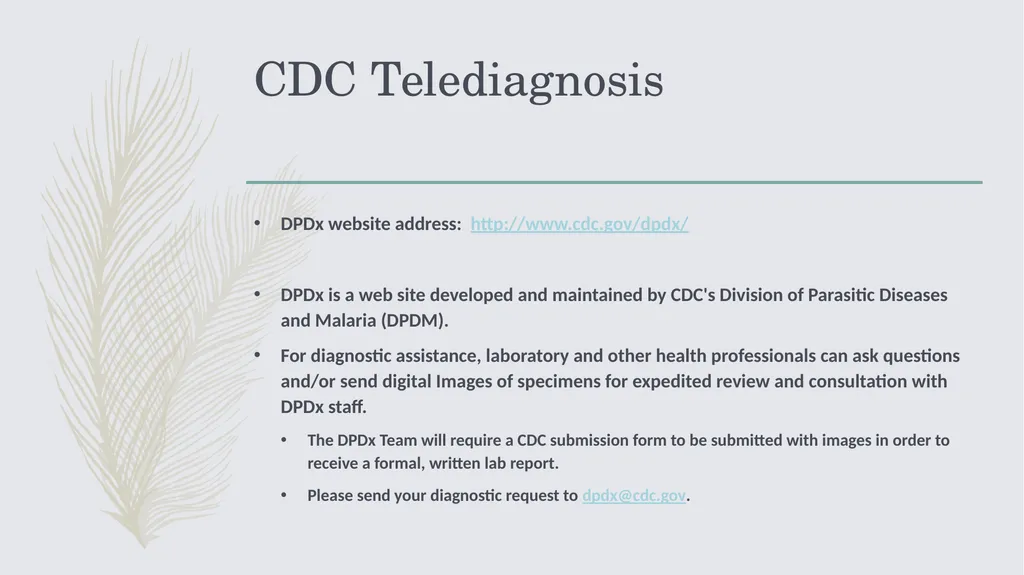
slide16. CDC Telediagnosis DPDx website address: http://www.cdc.gov/dpdx/
DPDx is a web site developed and maintained by CDC's Division of Parasitic Diseases and Malaria (DPDM).
For diagnostic assistance, laboratory and other health professionals can ask questions and/or send digital Images of specimens for expedited review and consultation with DPDx staff.
The DPDx Team will require a CDC submission form to be submitted with images in order to receive a formal, written lab report.
Please send your diagnostic request to dpdx@cdc.gov.<br>
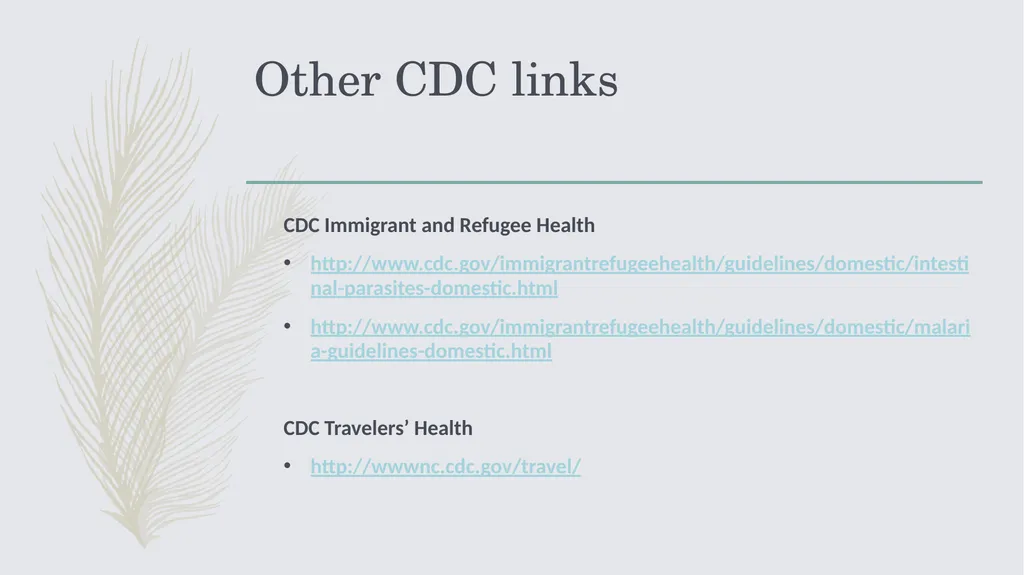
slide17. Other CDC links CDC Immigrant and Refugee Health
http://www.cdc.gov/immigrantrefugeehealth/guidelines/domestic/intestinal-parasites-domestic.html
http://www.cdc.gov/immigrantrefugeehealth/guidelines/domestic/malaria-guidelines-domestic.html
CDC Travelers’ Health
http://wwwnc.cdc.gov/travel/<br>
slide18. Contact me: Cathy Snider, MPH, MT(ASCP)
Medical Parasitology Team Lead
512-776-7560 phone
512-776-7452 fax
cathy.snider@dshs.state.tx.us<br>
Medical Parasitology Team Lead
DSHS Laboratory Intestinal, Blood, and Tissue<br>
slide2. Parasitic Protozoa and Helminths “In the late 1800s, scientists sometimes referred to parasitology as medical zoology. They were referring to the way they had to understand parasites as real organisms, with natural histories of their own, before they could try to fight the diseases the parasites caused.”
Carl Zimmer, Parasite Rex<br>
slide3. Neglected Tropical Diseases Diseases caused by parasites are ancient conditions that are among the most common infections of the world’s poorest people. They make up the majority of what are called “Neglected Tropical Diseases” or NTDs.
In 2015, an estimated 214 million cases of malaria occurred worldwide and 438,000 people died. About 1,500 cases of malaria are diagnosed in the United States each year. (CDC)
In 2014, at least 1.7 billion people required mass or individual treatment and care for NTDs, in 185 countries. Of these, 1.1 billion were in lower-middle-income countries. (WHO)<br>
slide4. Parasitic Disease Exposures Fecally contaminated environment: Lack of sanitation infrastructure; zoonotic exposure
Foodborne: Unsanitary food handling; contaminated or infected food
Arthropod vector: Mosquitoes, triatomines, biting flies
Miscellaneous: Infection with free living organisms in the environment; sexual transmission; congenital transmission; transfusion/transplant acquired<br>
slide5. Texas Notifiable Conditions Amebiasis (E. histolytica) Fascioliasis
Ascariasis Paragonimus
Cryptosporidiasis Taeniasis (T. solium)
Cyclosporiasis Trichinellosis
Cysticercosis Babesiosis
Echinococcosis Chagas disease
Hookworm infection Leishmaniasis
Trichuriasis Malaria
Amebic meningitis/encephalitis<br>
slide6. A few more to keep on your radar … Angiostrongylus Baylisascaris
Giardia Diphyllobothrium
Toxocara Schistosoma
Toxoplasma Strongyloides
Trichomonas<br>
slide7. Traditional Parasitology Microscopic visualization of parasites has long been the traditional method of laboratory diagnosis – still a standard.
Most human parasites are intestinal infections.
Fecal specimens are the specimen of choice.
A complete fecal O&P examination consists of two preparations:
A concentration of the specimen, to be viewed as a wet mount, and a stained smear.
An examination of both preps with a good microscope, by a well trained technologist, provides the best opportunity to detect the full range of intestinal parasites.
Supplemental tests targeting particular organisms are appropriate and helpful, but don’t replace an O&P.<br>
slide8. Other Testing Serology
Histopathology
Special stains
Fluorescent antibody tests
UV autofluorescence Antibiotic susceptibility tests
Cultures
Rapid immunoassays
Molecular tests
Whole genome sequencing<br>
slide9. Morphological Testing at DSHS Routine fecal Ova & Parasite exam (concentrate & trichrome)
Acid-fast stain for Cryptosporidium/Cyclospora/Cystoisospora
Chromotrope stain for Microsporidia
Giemsa stain for malaria and other blood parasites (thick & thin smears)
Knott concentration for microfilariae
Examination of miscellaneous body fluids by various methods
Worm identification<br>
slide10. Other Parasite Testing at DSHS Schistosoma serology
Strongyloides serology
Chagas serology (near future)
Malaria PCR
Cyclospora PCR (very near future)
Triatomine identification<br>
slide11. Protozoa Testing at CDC Serological Molecular Other
Free Living Amoeba Free Living Amoeba Antibiotic susceptibility
Babesia Babesia Identification (multiple tests)
Chagas (T. cruzi) Chagas (T. cruzi) Special Studies
Leishmania (visceral) Cyclospora
Malaria Entamoeba histolytica/dispar
Leishmania
Morphological Malaria
All protozoa Microsporidia
Trypanosoma cruzi (in triatomine)<br>
slide12. Helminth Testing at CDC Serological Molecular
Baylisascaris Angiostrongylus
Cysticercosis
Echinococcus Morphological
Filariasis (Brugia, Wuchereria) All helminths
Paragonimus
Schistosoma
Strongyloides
Toxocara
Trichinellosis<br>
slide13. CDC Referral Testing State health departments and federal agencies may submit specimens for reference testing to CDC. All submissions need approval of the state health department unless part of a special study or surveillance project.
Private citizens, health practitioners, and hospitals must contact their local health department to submit specimens. CDC Shipping address:
Point of contact
Centers for Disease Control & Prevention
RDSB/STAT
1600 Clifton Road, NE
Atlanta, GA 30333
Contact’s telephone number<br>
slide14. CDC Referral Testing CDC Infectious Diseases Laboratory Test Directory:
http://www.cdc.gov/laboratory/specimen-submission/cdc-lab-tests.pdf
CDC Specimen Submission Form:
http://www.cdc.gov/laboratory/specimen-submission/pdf/form-50-34.pdf
Please call or email DSHS Medical Parasitology or the Infectious Disease Control Unit to inform us that you are sending specimen to CDC. Thanks State PHL Information:
Dr. Grace Kubin, PhD
Texas Dept. of State Health Services
Laboratory Services Section, MC 1947
1100 W. 49th Street
P.O. Box 149347
Austin TX 78714-9347
1-512-7767318
1-512-7767294
Lab.Microbiology@DSHS.state.tx.us<br>
slide15. Shipping to DSHS Lab Submit fecal specimens for O&P testing in appropriate preservatives (10% formalin and PVA). Ship at room temperature.
Submit serology specimens for CDC referral with serum separated from red blood cells (gel separator tubes are acceptable). Ship all blood specimens on a cold pack.
For other questions regarding specimen type, collection, or handling, please call DSHS Parasitology Team at 512-776-7560.
For questions regarding shipping, please call Specimen Acquisition at 512-776-7598, or refer to:
http://www.dshs.texas.gov/lab/MRS_shipping.shtm
To get DSHS submission forms, please call Lab Reporting at 512-776-7578, or refer to:
http://www.dshs.texas.gov/lab/mrs_forms.shtm<br>
slide16. CDC Telediagnosis DPDx website address: http://www.cdc.gov/dpdx/
DPDx is a web site developed and maintained by CDC's Division of Parasitic Diseases and Malaria (DPDM).
For diagnostic assistance, laboratory and other health professionals can ask questions and/or send digital Images of specimens for expedited review and consultation with DPDx staff.
The DPDx Team will require a CDC submission form to be submitted with images in order to receive a formal, written lab report.
Please send your diagnostic request to dpdx@cdc.gov.<br>
slide17. Other CDC links CDC Immigrant and Refugee Health
http://www.cdc.gov/immigrantrefugeehealth/guidelines/domestic/intestinal-parasites-domestic.html
http://www.cdc.gov/immigrantrefugeehealth/guidelines/domestic/malaria-guidelines-domestic.html
CDC Travelers’ Health
http://wwwnc.cdc.gov/travel/<br>
slide18. Contact me: Cathy Snider, MPH, MT(ASCP)
Medical Parasitology Team Lead
512-776-7560 phone
512-776-7452 fax
cathy.snider@dshs.state.tx.us<br>