Labour Relations Dashboard 2019-2020 Presented at the Human Resources Labour-Management Consultative Committee (HRLMCC) October 9, 2020 DISCLAIMER NOTE The organizational data reflected in this dashboard is mainly sourced by MyGCHR and
Related Topics
Share
Embed code
Download this presentation From Below
"Labour Relations Dashboard 2019-2020 Presented at" is the property of its rightful owner. Permission is granted to
download and print the materials on this website for personal, non-commercial use only, and to display it
on your personal computer provided you do not modify the materials and that you retain all copyright
notices contained in the materials. By downloading content from our website, you accept the terms of this
agreement.
Presentation Transcript
01
Labour Relations Dashboard 2019-2020 Presented at the Human Resources Labour-Management Consultative Committee (HRLMCC)
October 9, 2020<br>
02
DISCLAIMER NOTE
The organizational data reflected in this dashboard is mainly sourced by MyGCHR and Discoverer. Please note that the Labour Relations team has undertaken a major review of its data integrity and will continue this exercise in the coming years. Hence, changes that have not been updated in MyGCHR as of March 31, 2020 are not reflected in this data source.
As part of our validation process to ensure accurate and reliable people management information in support of government reporting and decision-making, we require that any high-profile/high visibility products (e.g. presentations to the Executive Management Committee, responses to media requests, public reports, etc.) developed by you or your teams using our information, be validated with us prior to finalizing or using the products. The information/data attached, whether it is in print, electronic or any other form, should be treated as restricted and is to be used for the intended purposes.
SECURITY All use of the information/data attached must abide by the Privacy Act and information/data must be safeguarded in a manner that respects the federal Privacy Act (http://laws-lois.justice.gc.ca/eng/acts/P-21/page-1.html) and the Policy on Government Security (https://www.tbs-sct.gc.ca/pol/doc-eng.aspx?id=16578). 2<br>
03
Objectives To provide a sense of the state of workplace relations:
Grievances : grievances by branch and type, pay grievances, average response time, grievances by union affiliation and by level
Harassment complaints
Violence in the workplace complaints (Part XX of CLC)<br>
04
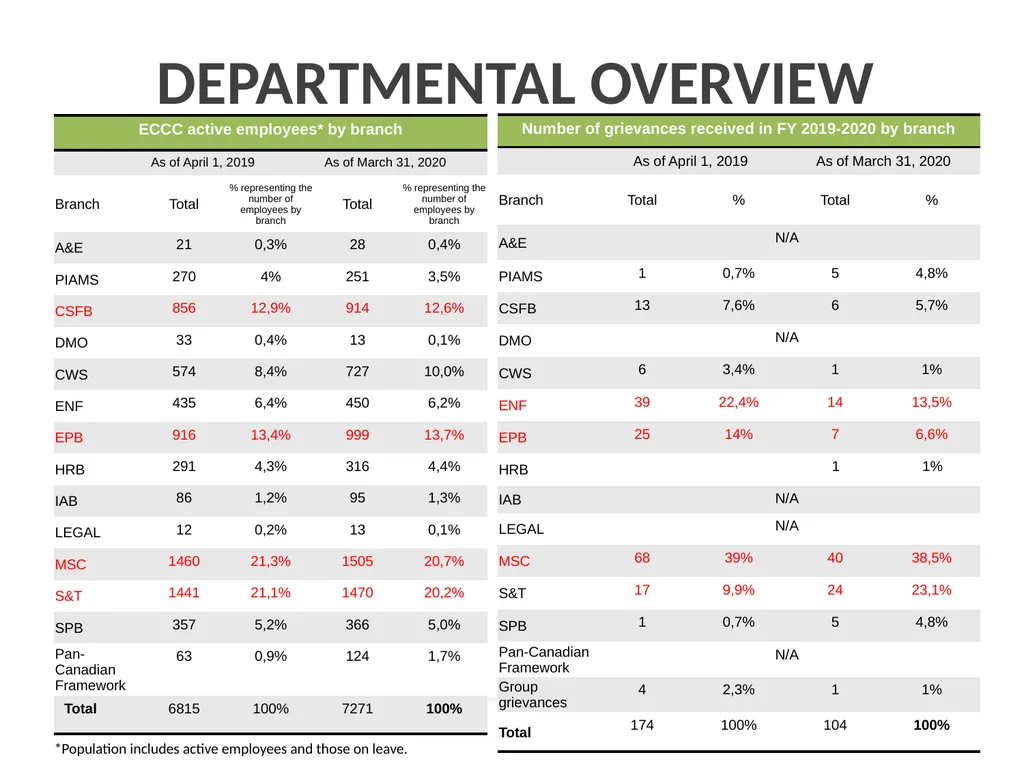
Departmental overview *Population includes active employees and those on leave. 4<br>
05
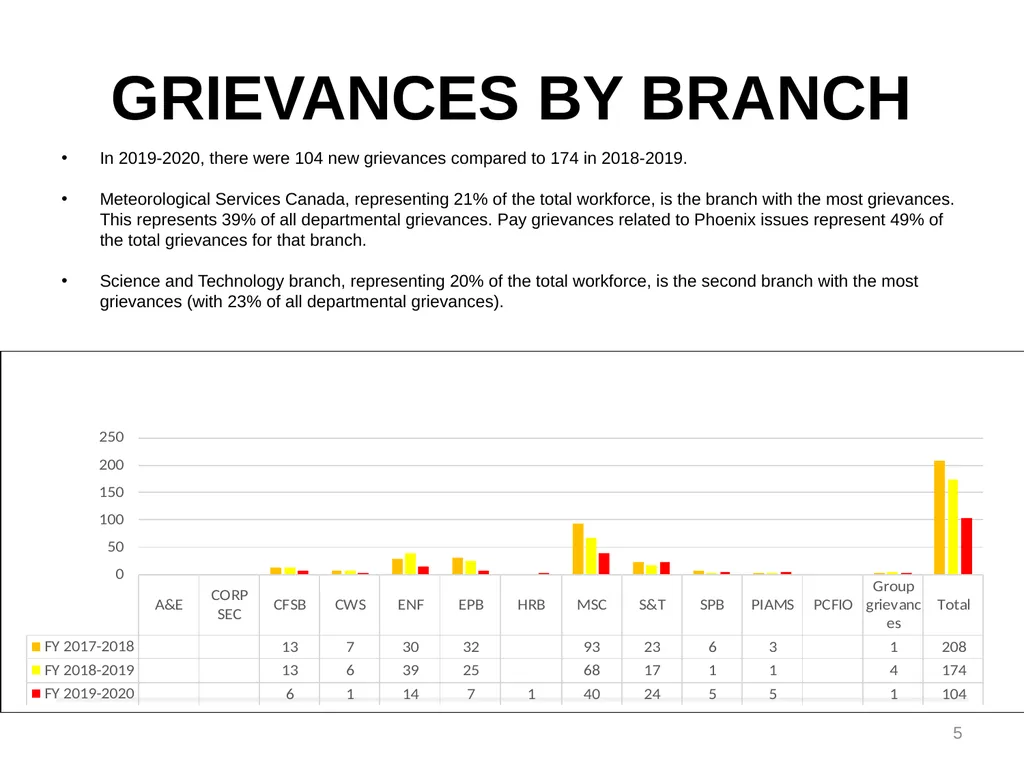
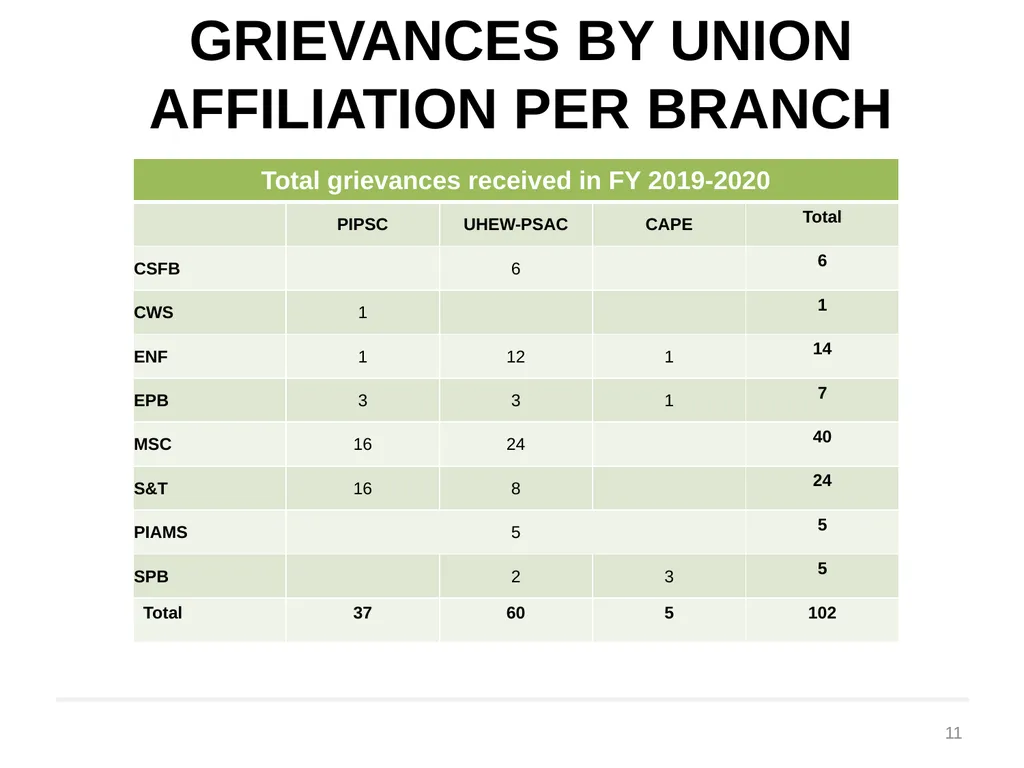
Grievances by branch In 2019-2020, there were 104 new grievances compared to 174 in 2018-2019.
Meteorological Services Canada, representing 21% of the total workforce, is the branch with the most grievances. This represents 39% of all departmental grievances. Pay grievances related to Phoenix issues represent 49% of the total grievances for that branch.
Science and Technology branch, representing 20% of the total workforce, is the second branch with the most grievances (with 23% of all departmental grievances). 5<br>
06
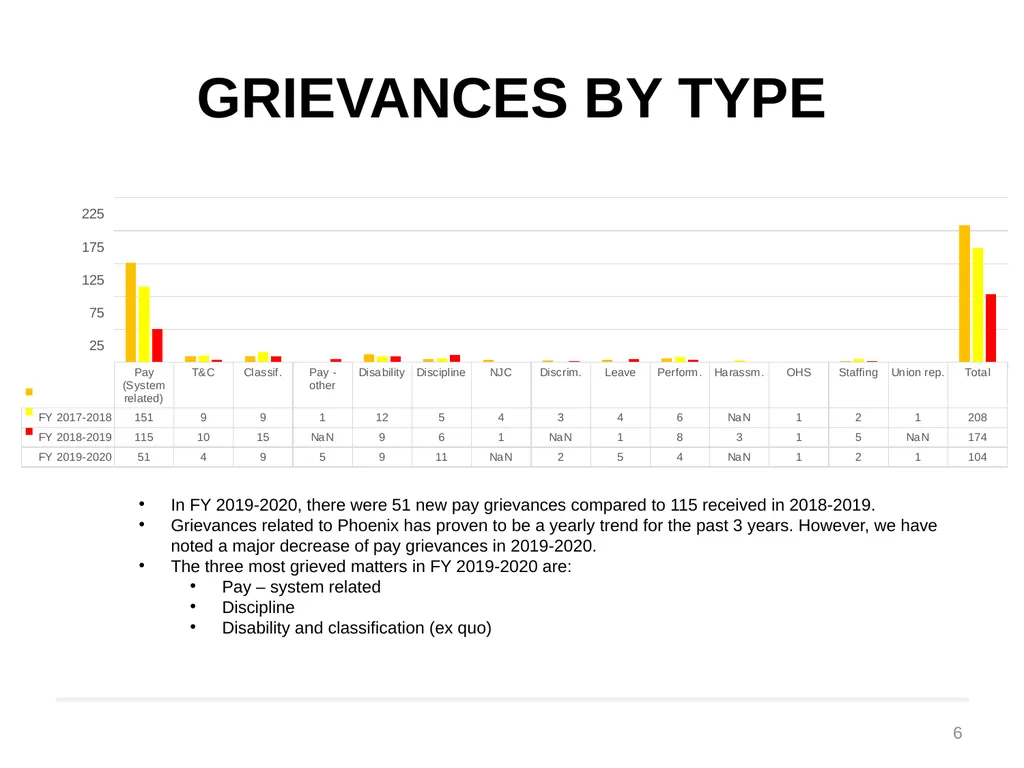
Grievances by type In FY 2019-2020, there were 51 new pay grievances compared to 115 received in 2018-2019.
Grievances related to Phoenix has proven to be a yearly trend for the past 3 years. However, we have noted a major decrease of pay grievances in 2019-2020.
The three most grieved matters in FY 2019-2020 are:
Pay – system related
Discipline
Disability and classification (ex quo) 6<br>
07
Grievances related to pay (Phoenix) MSC has the most pay grievances related to Phoenix with 89 cases that are still open (37%). * Numbers reflect the total of grievances since the implementation of the Phoenix system on February 12, 2016.
. of all pay grievances are referred to adjudication 24% 7<br>
08
Grievances related to pay (Phoenix) Cont’d * Numbers over years reflect the total of grievances since the implementation of the Phoenix system on February 12, 2016. As of March 31, 2020, there was 242 active pay grievances (system related). Status of pay grievances FY 2019-2020
51 new pay grievances (system related) were received 17 were closed 25 were placed in abeyance Over years* (As of March 31, 2020) 8<br>
09
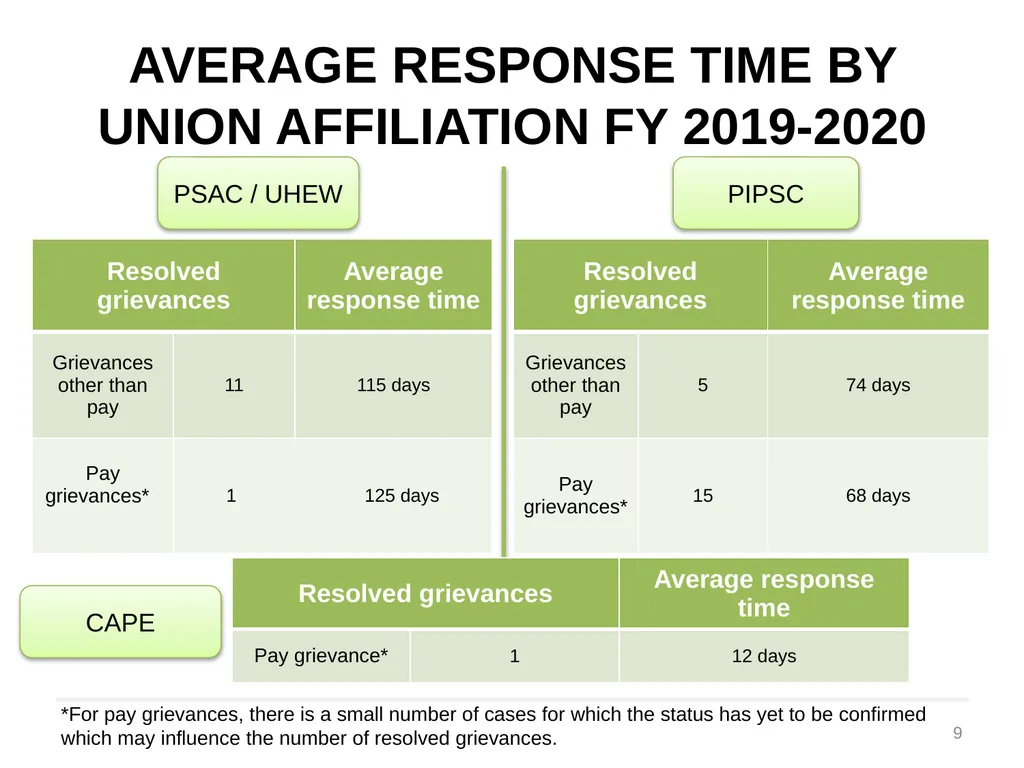
AVERAGE RESPONSE TIME by union affiliation FY 2019-2020 PIPSC PIPSC PSAC / UHEW CAPE *For pay grievances, there is a small number of cases for which the status has yet to be confirmed which may influence the number of resolved grievances. 9<br>
10
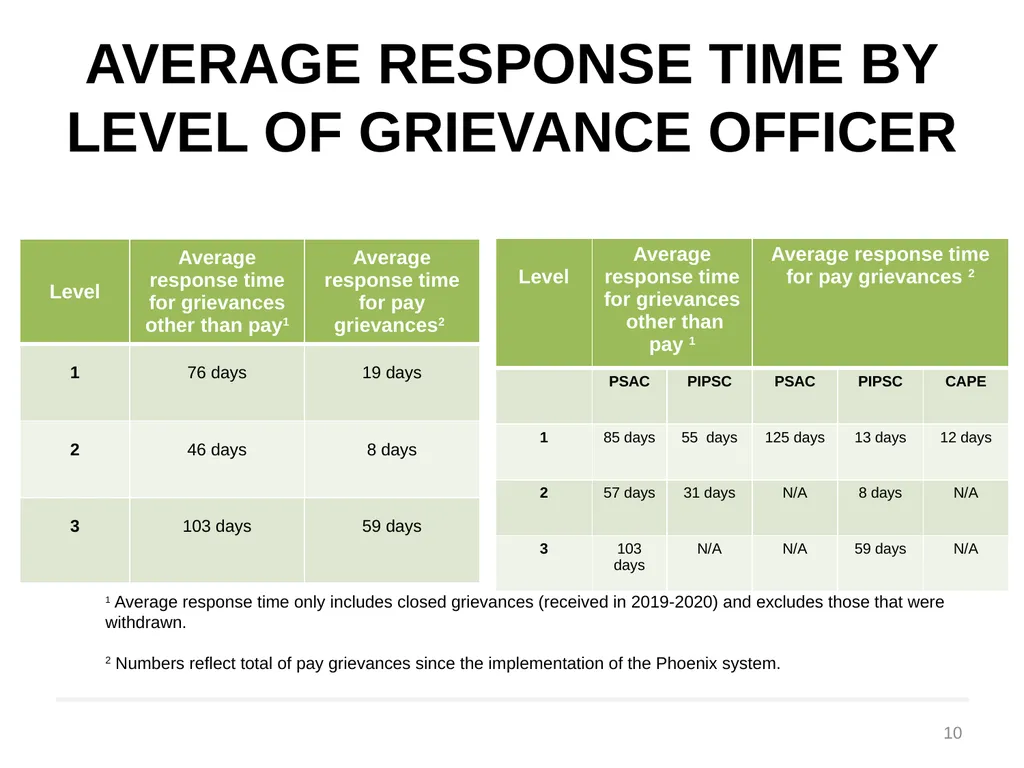
Average response time by level of grievance officer 1 Average response time only includes closed grievances (received in 2019-2020) and excludes those that were withdrawn.
2 Numbers reflect total of pay grievances since the implementation of the Phoenix system. 10<br>
11
grievances by union affiliation per branch 11<br>
12
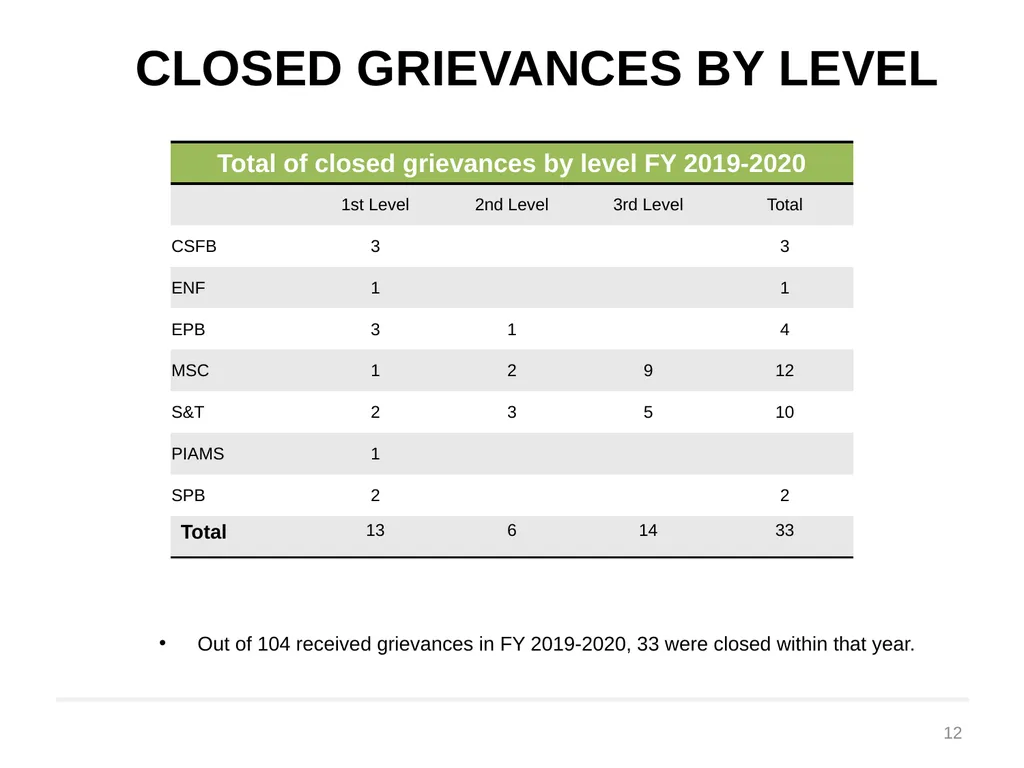
closed grievances by level Out of 104 received grievances in FY 2019-2020, 33 were closed within that year. 12<br>
13
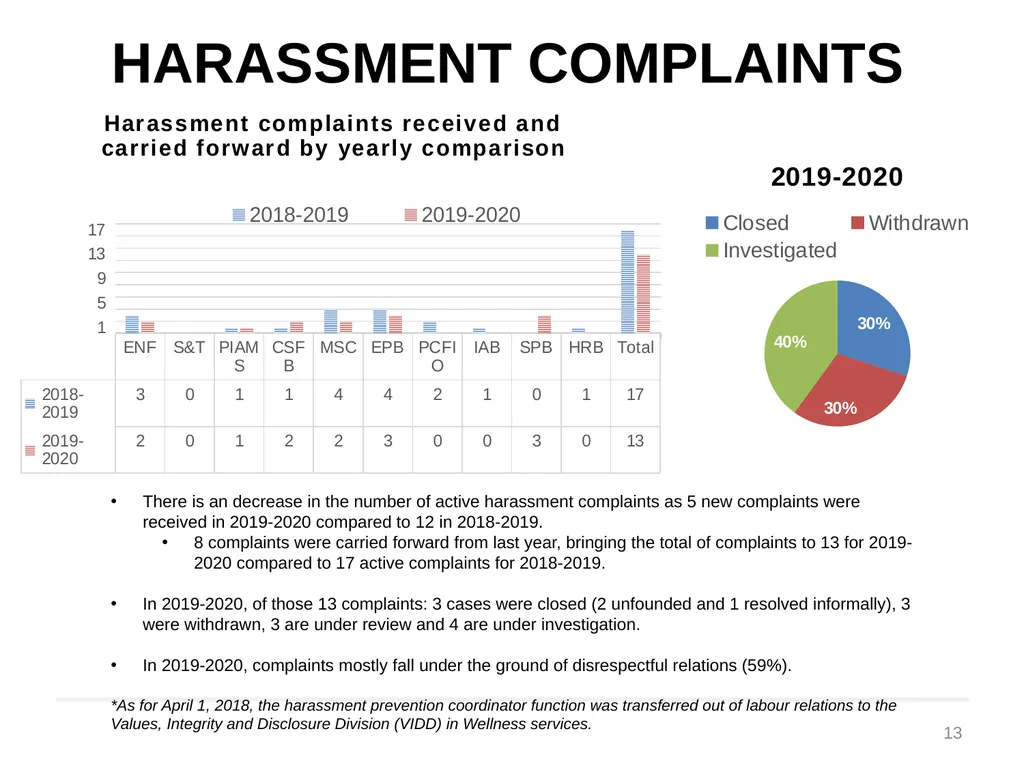
There is an decrease in the number of active harassment complaints as 5 new complaints were received in 2019-2020 compared to 12 in 2018-2019.
8 complaints were carried forward from last year, bringing the total of complaints to 13 for 2019-2020 compared to 17 active complaints for 2018-2019.
In 2019-2020, of those 13 complaints: 3 cases were closed (2 unfounded and 1 resolved informally), 3 were withdrawn, 3 are under review and 4 are under investigation.
In 2019-2020, complaints mostly fall under the ground of disrespectful relations (59%).
*As for April 1, 2018, the harassment prevention coordinator function was transferred out of labour relations to the Values, Integrity and Disclosure Division (VIDD) in Wellness services. HARASSMENT COMPLAINTS 13<br>
14
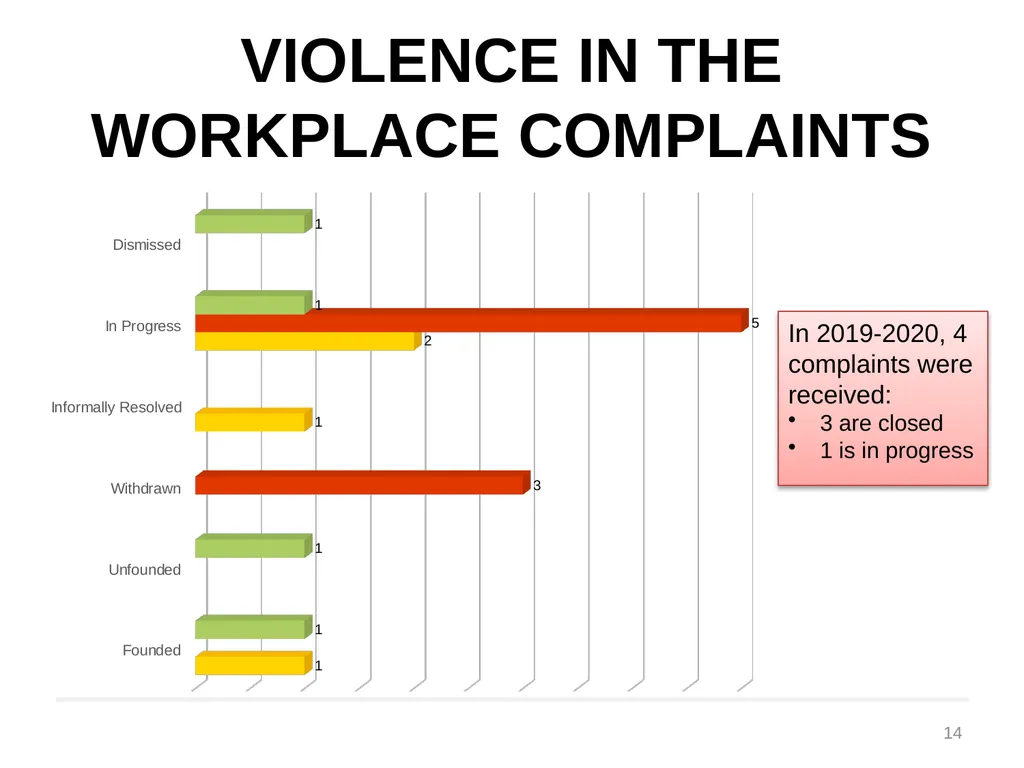
Violence in the workplace complaints In 2019-2020, 4 complaints were received:
3 are closed
1 is in progress 14<br>