LAMENESS PART -VII Fourth Professional(OLD) Unit-6 Dr. RAMESH TIWARY ASSSITANT PROFESSOR Department of Veterinary Surgery Radiology BVC, PATNA-14 Gonitis Inflammation of the stifle joint Common in bullocks than in horses. ACUTECHRONIC
"LAMENESS PART -VII Fourth Professional(OLD) Unit-6" is the property of its rightful owner. Permission is granted to
download and print the materials on this website for personal, non-commercial use only, and to display it
on your personal computer provided you do not modify the materials and that you retain all copyright
notices contained in the materials. By downloading content from our website, you accept the terms of this
agreement.
Share
Embed code
Presentation Transcript
01
LAMENESS PART -VII
Fourth Professional(OLD) Unit-6 Dr. RAMESH TIWARY
ASSSITANT PROFESSOR
Department of Veterinary Surgery & Radiology
BVC, PATNA-14<br>
02
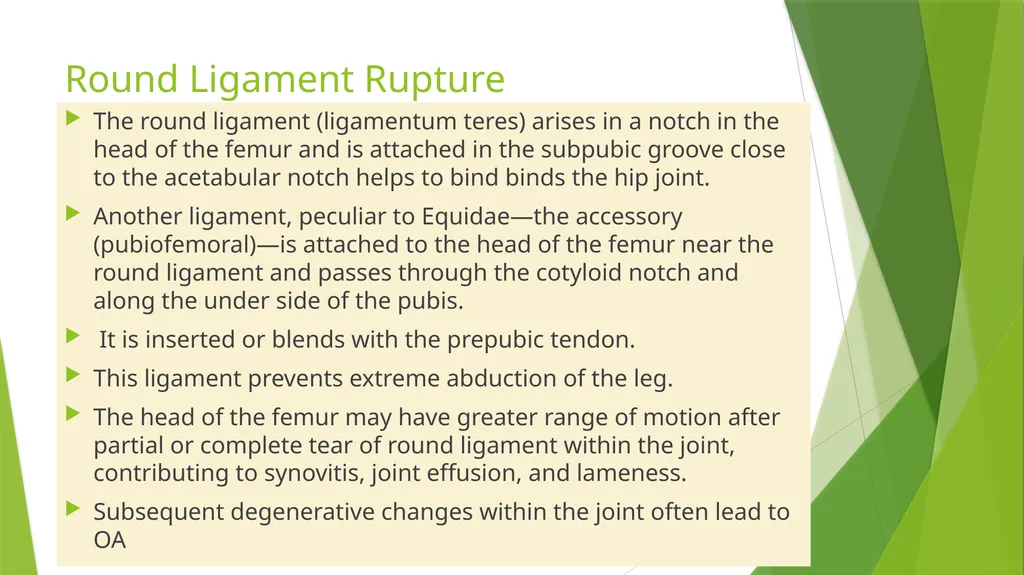
Gonitis Inflammation of the stifle joint
Common in bullocks than in horses.
ACUTE/CHRONIC
Trauma & Overextension of the stifle joint
Acute synovitis and arthritis
Swollen and painful joint
Incomplete flexion (stiffness) of the joint during progression
Shortening of the stride, and dragging of the toe.
Chronic cases incurable<br>
03
Round Ligament Rupture The round ligament (ligamentum teres) arises in a notch in the head of the femur and is attached in the subpubic groove close to the acetabular notch helps to bind binds the hip joint.
Another ligament, peculiar to Equidae—the accessory (pubiofemoral)—is attached to the head of the femur near the round ligament and passes through the cotyloid notch and along the under side of the pubis.
It is inserted or blends with the prepubic tendon.
This ligament prevents extreme abduction of the leg.
The head of the femur may have greater range of motion after partial or complete tear of round ligament within the joint, contributing to synovitis, joint effusion, and lameness.
Subsequent degenerative changes within the joint often lead to OA<br>
04
Acute onset of lameness and a history of trauma
Gluteal atrophy may be present if the condition is chronic.
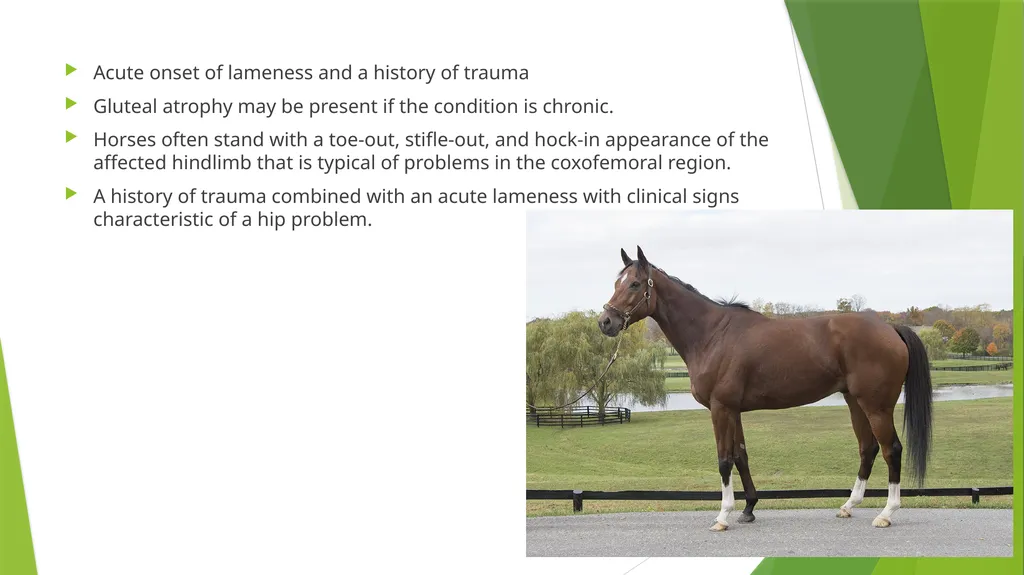
Horses often stand with a toe-out, stifle-out, and hock-in appearance of the affected hindlimb that is typical of problems in the coxofemoral region.
A history of trauma combined with an acute lameness with clinical signs characteristic of a hip problem.<br>
05
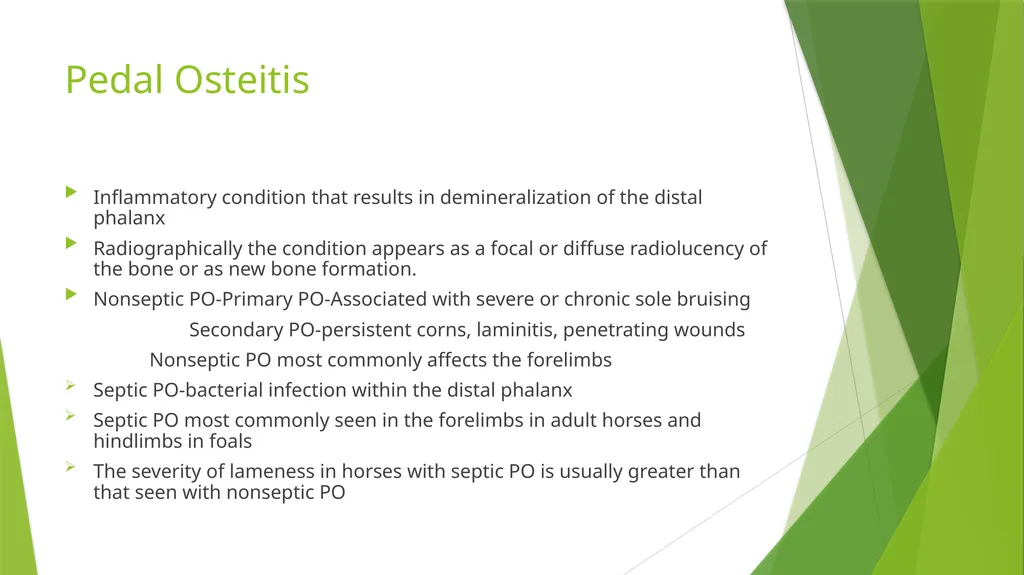
Pedal Osteitis Inflammatory condition that results in demineralization of the distal phalanx
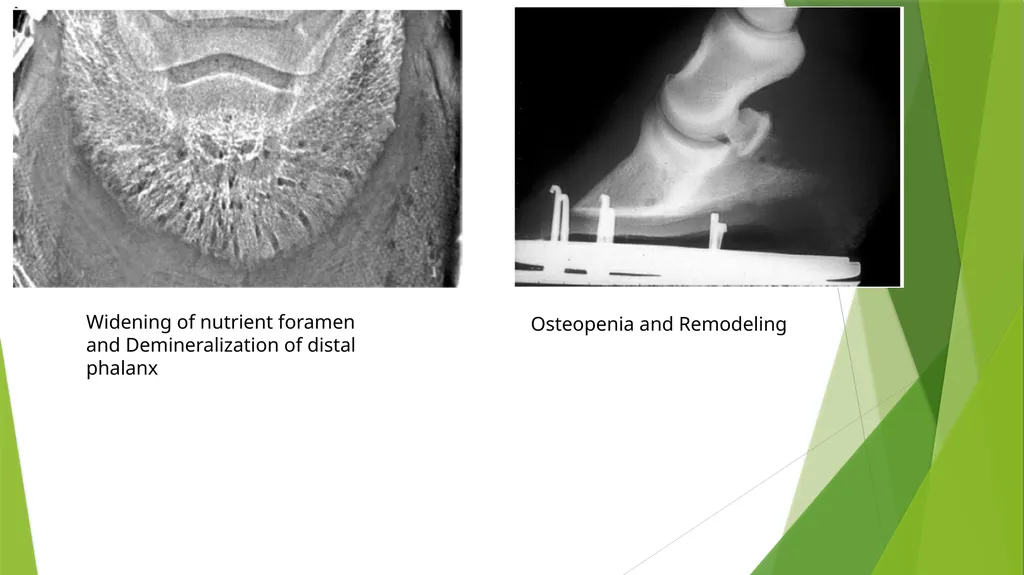
Radiographically the condition appears as a focal or diffuse radiolucency of the bone or as new bone formation.
Nonseptic PO-Primary PO-Associated with severe or chronic sole bruising
Secondary PO-persistent corns, laminitis, penetrating wounds
Nonseptic PO most commonly affects the forelimbs
Septic PO-bacterial infection within the distal phalanx
Septic PO most commonly seen in the forelimbs in adult horses and hindlimbs in foals
The severity of lameness in horses with septic PO is usually greater than that seen with nonseptic PO<br>
06
Osteopenia and Remodeling Widening of nutrient foramen and Demineralization of distal phalanx<br>