
LAND Learning Outcomes Participants will be able



Description: LAND Learning Outcomes Participants will be able to: Explain why land is an important issue in African cities Identify the different kinds of land tenure systems operational in Africa Discuss strategies for making land more accessible for
Related Topics
Download Presentation
"LAND Learning Outcomes Participants will be able" is the property of its rightful owner. Permission is granted to download and print the materials on this website for personal, non-commercial use only, and to display it on your personal computer provided you do not modify the materials and that you retain all copyright notices contained in the materials. By downloading content from our website, you accept the terms of this agreement.
Presentation Transcript
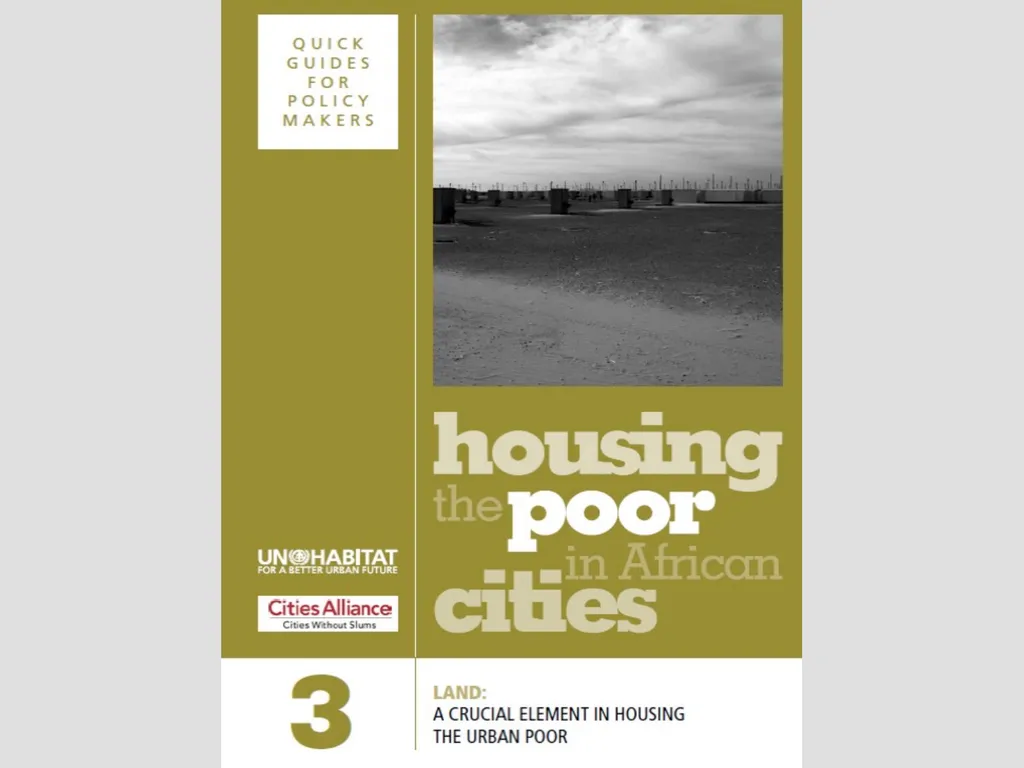
slide1. LAND<br>
slide2. Learning Outcomes Participants will be able to:
Explain why land is an important issue in African cities
Identify the different kinds of land tenure systems operational in Africa
Discuss strategies for making land more accessible for the poor 2<br>
slide3. Structure of the Module Accessing land in cities
Different types of land tenure systems in African cities
Informal land markets
Strategies for making land more accessible to the poor 3<br>
slide4. The Key Issue ‘The inaccessibility of decent, secure, affordable land is the major reason why there are so many informal settlements in African cities and is a contributing factor to urban poverty.’
>>Questions:
Do you agree with this assessment?
What are the main reasons why poor people cannot access decent and secure land? 4<br>
slide5. The Importance of Accessing Land The problem of land is a fundamental one and a major factor in the ability of poor households to survive
Yet few urban issues are more complex and conflict ridden
The demand for land is increasing
Land has become a commodity, bought and sold to the highest bidder
Land use is a political issue 5<br>
slide6. Cut and Paste Solutions ‘In many places and in many ways, the urban poor continue to be treated like blocks of colour on a development map, to be lifted up here and pasted down there – not like human beings with real needs, real families and real aspirations, living in real communities.’
>>Questions:
Is this what is happening in your own situation?
Do you agree with what is said in the Guide about the importance of community participation in finding dignified and durable solutions? 6<br>
slide7. Informal Land Markets Research in six African cities shows that 50-70% of land for housing is supplied informally
While informal land markets can be motivated by social relationships there is an increasing move towards commodification of land
>>Question:
Do these statements match your own context? 7<br>
slide8. Why the Poor Can’t Access Public Land in Cities Centralized decision making
Inefficient use of urban space
Government-driven approaches
Rigid and costly regulatory frameworks
Poor land recording systems 8<br>
slide9. Land Administration Systems in Africa ‘It is important to note that land administration systems differ considerably across Africa. In most countries, there is co-existence of formal/legal, customary and extra-legal/informal systems.’
>>Questions:
What is the situation in your own country? 9<br>
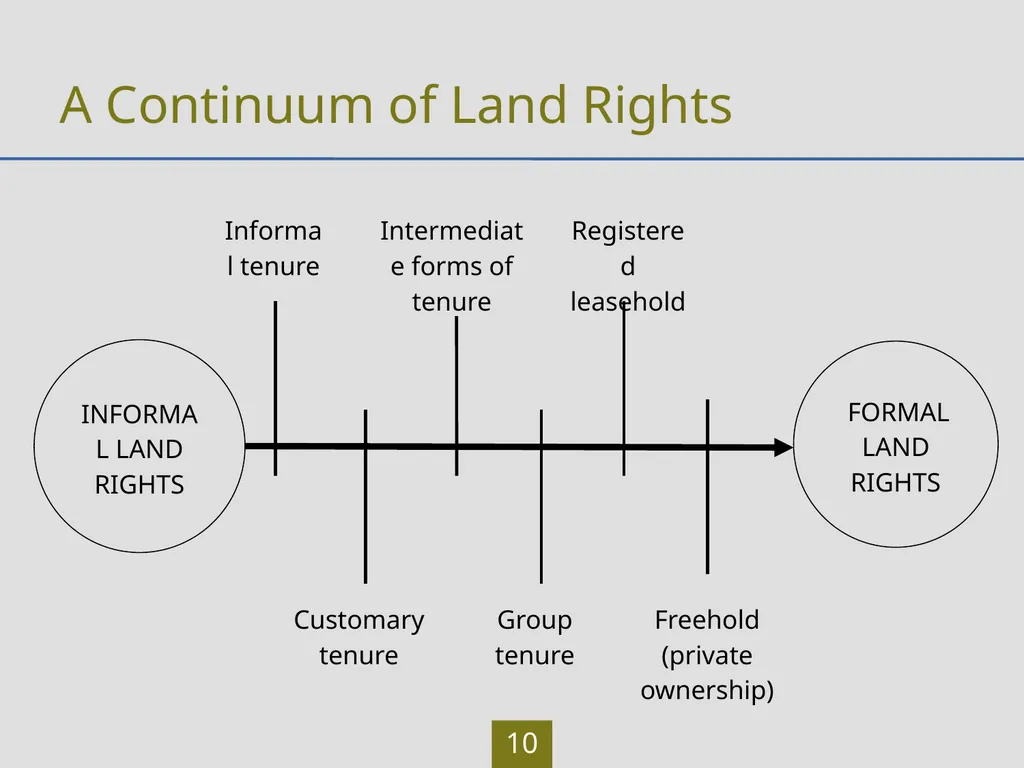
slide10. A Continuum of Land Rights 10 INFORMAL LAND RIGHTS FORMAL LAND RIGHTS Informal tenure Intermediate forms of tenure Registered leasehold Freehold
(private ownership) Group tenure Customary tenure<br>
slide11. Customary and Common Law Tenure ‘Legally, land in most African cities is made available through the dual systems of customary tenure and land titling under freehold or leasehold tenure, under customary and common law respectively.’
>>Question:
What are the advantages and disadvantages of each system? 11<br>
slide12. Women and Land Rights ‘Even in countries that have up-to-date laws forbidding discrimination, the property rights of women are often ignored in the buying, selling, inheriting, leasing or allotting of land.’
>>Questions:
Why is this the case?
What are the consequences?
What should/can be done about it? 12<br>
slide13. Demand for, and Supply of, Land ‘Market forces, demographic pressures and urban growth keep driving up the demand for land but the supply in most cities continues to fall very far short of this demand.’
>>Questions:
Is this the case for all cities in Africa?
What is the situation your country?
What are the consequences? 13<br>
slide14. Effectiveness of Informal Markets ‘Most African cities have vibrant informal land markets which are meeting the land and housing needs of poor citizens, including squatters and migrants. These informal markets are so effective that a majority of land transactions taking place in many African cities are now informal.’
>>Questions:
How valid is this argument?
Is this the case in your own situation?
What is the consequence for the future of African cities? 14<br>
slide15. How Informal Land Markets Work Land occupied without permission is sold or rented
Customary tenured land is sold or rented
Government project land is sold or sub-let
Land in zones not for residential use is sold or rented
Legally-owned land is informally sub-divided into illegally small plots and sold or rented 15<br>
slide16. Strategies for Making Land More Accessible for the Poor Planning more efficiently, with people, and adjusting land use regulations
Ensuring better land information
Establishing better land taxation systems
Promoting land sharing
Promoting land pooling
Setting up cross-subsidy schemes
Regularizing existing slums
Using public land for housing
Learning from informal land developers
Supporting community initiatives 16<br>
slide17. 1. Planning More Efficiently Planning with people in mind
Planning for pedestrians and cyclists, not cars
Planning for higher density
Creating more acceptable housing layouts 17<br>
slide18. 2. Ensuring Better Land Information Maintaining a database on land, including an inventory of all publicly owned land
Essential for natural resource management, service delivery, valuations, rating of properties, cost recovery on services, land taxation, raising finances, dispute resolution and conflict management
Using aerial photographs, land records and GIS
‘In most of the developing world, less than 30 per cent of all urban lands are recorded in the public registries.’
>>Question:
Is this the case in your own country? 18<br>
slide19. 3. Establishing Better Land Taxation Systems Three main categories:
Capital gains tax
Vacant land tax
Land use tax
‘In many countries, however, these land taxation policies have not won much support from political elites.’
>>Questions:
Why do you think this is the case?
What is the situation in your own country? 19<br>
slide20. 4. Promoting Land Sharing Method of resolving land conflicts, whereby land is shared between landowners and squatters
Benefits:
Landowners are able to clear some land for development – saving time and costs of eviction litigation
Squatters stay where they have been living and working, get secure land tenure and keep their communities intact
Governments get needed land and housing delivered to a city’s poor communities at no cost 20<br>
slide21. 5. Promoting Land Pooling Joining several adjacent pieces of land (held by different landowners) and eliminating the property boundaries to create a large site for redevelopment
Methods:
Government managed land pooling, especially through reserving plots in housing projects for low-income occupants
Re-blocking within existing settlements, through demolishing existing shelters and building a new, more efficient housing scheme
Involving several linked settlements 21<br>
slide22. 6. Setting Up Cross-subsidy Schemes Requiring private sector developers to reserve a portion of their formal, market-rate housing projects for lower-income housing (sometimes know as ‘inclusionary zoning’ or ‘inclusionary housing’)
Stipulating that a certain percentage of the total number of units a developer builds – or a proportion of the land – must be low-income housing
Specifying minimum unit sizes and maximum sale or rental rates
>>Questions:
Have such schemes been tried in your country?
How have they fared? 22<br>
slide23. 7. Regularizing Existing Slums Recognizing and granting legal tenure to informal settlement residents
Involves negotiating with landowners (if not on government land) to sell or lease land to community members, cooperatives or intermediary organizations for managing repayments
Benefits:
Most economical way to preserve investments in housing
Unleashes a wave of investments for improvements
Entitles people to access basic services
Enables government to extend basic services 23<br>
slide24. 8. Using Public Land for Housing ‘There is an unfortunate trend these days, however, to see publicly-owned land as a marketable commodity rather than as a public good and to sell it or rent it out to the highest bidder for high-income housing, shopping malls and luxury hotels, instead of using it for the public parks, schools, playgrounds, public markets and low-income housing our cities so desperately need.’
>>Question:
Do you see this trend in your country? 24<br>
slide25. 9. Learning from Informal Land Developers Officials going to the people and allocating land on the spot and providing adequate tenure security
Reducing to a minimum application, leasing and allotment steps
Insisting that people allocated land must start building immediately they take possession
Fixing only the layout of plots
Providing only the most basic of services 25<br>
slide26. 10. Supporting Community Initiatives ‘One of the best ways to enhance the supply of affordable land and housing in African cities is to find ways to support the poor themselves. While the housing they produce may not be ideal, the informal systems they have developed to produce and deliver it are still the most effective, large-scale and far-reaching housing delivery systems we have in African cities.’
>>Question:
Do you agree? 26<br>
slide27. Effective Policy Measures - 1 Utilize a holistic ‘best use’ framework for making decisions about the use of public land
Provide basic short-term security for all households in existing informal settlements
Determine whether all informal settlements in a city can stay or not
Offer priority for relocation to residents in settlements that can’t stay 27<br>
slide28. Effective Policy Measures - 2 Grant all other slums and informal settlements secure tenure
Revise rules and procedures to increase the supply of land and housing
Introduce and collect taxes on all developed and undeveloped land
Allow incremental development of buildings and services 28<br>
slide29. Supporting the Policy Measures Decentralize resources and responsibilities to lowest administrative level
Strengthen community participation
Encourage mixed land use developments
Encourage financial institutions to provide forms of housing credit other than mortgages
Strengthen the capacity of land administration and land record agencies
Improve transport links between residential, commercial and industrial areas 29<br>
slide30. Conclusions Inaccessibility of suitable land is a major reason for prevalence of informal settlements in Africa
There are both formal and informal land markets
There are many different measures policy makers can take to make land more accessible to the poor 30<br>
slide2. Learning Outcomes Participants will be able to:
Explain why land is an important issue in African cities
Identify the different kinds of land tenure systems operational in Africa
Discuss strategies for making land more accessible for the poor 2<br>
slide3. Structure of the Module Accessing land in cities
Different types of land tenure systems in African cities
Informal land markets
Strategies for making land more accessible to the poor 3<br>
slide4. The Key Issue ‘The inaccessibility of decent, secure, affordable land is the major reason why there are so many informal settlements in African cities and is a contributing factor to urban poverty.’
>>Questions:
Do you agree with this assessment?
What are the main reasons why poor people cannot access decent and secure land? 4<br>
slide5. The Importance of Accessing Land The problem of land is a fundamental one and a major factor in the ability of poor households to survive
Yet few urban issues are more complex and conflict ridden
The demand for land is increasing
Land has become a commodity, bought and sold to the highest bidder
Land use is a political issue 5<br>
slide6. Cut and Paste Solutions ‘In many places and in many ways, the urban poor continue to be treated like blocks of colour on a development map, to be lifted up here and pasted down there – not like human beings with real needs, real families and real aspirations, living in real communities.’
>>Questions:
Is this what is happening in your own situation?
Do you agree with what is said in the Guide about the importance of community participation in finding dignified and durable solutions? 6<br>
slide7. Informal Land Markets Research in six African cities shows that 50-70% of land for housing is supplied informally
While informal land markets can be motivated by social relationships there is an increasing move towards commodification of land
>>Question:
Do these statements match your own context? 7<br>
slide8. Why the Poor Can’t Access Public Land in Cities Centralized decision making
Inefficient use of urban space
Government-driven approaches
Rigid and costly regulatory frameworks
Poor land recording systems 8<br>
slide9. Land Administration Systems in Africa ‘It is important to note that land administration systems differ considerably across Africa. In most countries, there is co-existence of formal/legal, customary and extra-legal/informal systems.’
>>Questions:
What is the situation in your own country? 9<br>
slide10. A Continuum of Land Rights 10 INFORMAL LAND RIGHTS FORMAL LAND RIGHTS Informal tenure Intermediate forms of tenure Registered leasehold Freehold
(private ownership) Group tenure Customary tenure<br>
slide11. Customary and Common Law Tenure ‘Legally, land in most African cities is made available through the dual systems of customary tenure and land titling under freehold or leasehold tenure, under customary and common law respectively.’
>>Question:
What are the advantages and disadvantages of each system? 11<br>
slide12. Women and Land Rights ‘Even in countries that have up-to-date laws forbidding discrimination, the property rights of women are often ignored in the buying, selling, inheriting, leasing or allotting of land.’
>>Questions:
Why is this the case?
What are the consequences?
What should/can be done about it? 12<br>
slide13. Demand for, and Supply of, Land ‘Market forces, demographic pressures and urban growth keep driving up the demand for land but the supply in most cities continues to fall very far short of this demand.’
>>Questions:
Is this the case for all cities in Africa?
What is the situation your country?
What are the consequences? 13<br>
slide14. Effectiveness of Informal Markets ‘Most African cities have vibrant informal land markets which are meeting the land and housing needs of poor citizens, including squatters and migrants. These informal markets are so effective that a majority of land transactions taking place in many African cities are now informal.’
>>Questions:
How valid is this argument?
Is this the case in your own situation?
What is the consequence for the future of African cities? 14<br>
slide15. How Informal Land Markets Work Land occupied without permission is sold or rented
Customary tenured land is sold or rented
Government project land is sold or sub-let
Land in zones not for residential use is sold or rented
Legally-owned land is informally sub-divided into illegally small plots and sold or rented 15<br>
slide16. Strategies for Making Land More Accessible for the Poor Planning more efficiently, with people, and adjusting land use regulations
Ensuring better land information
Establishing better land taxation systems
Promoting land sharing
Promoting land pooling
Setting up cross-subsidy schemes
Regularizing existing slums
Using public land for housing
Learning from informal land developers
Supporting community initiatives 16<br>
slide17. 1. Planning More Efficiently Planning with people in mind
Planning for pedestrians and cyclists, not cars
Planning for higher density
Creating more acceptable housing layouts 17<br>
slide18. 2. Ensuring Better Land Information Maintaining a database on land, including an inventory of all publicly owned land
Essential for natural resource management, service delivery, valuations, rating of properties, cost recovery on services, land taxation, raising finances, dispute resolution and conflict management
Using aerial photographs, land records and GIS
‘In most of the developing world, less than 30 per cent of all urban lands are recorded in the public registries.’
>>Question:
Is this the case in your own country? 18<br>
slide19. 3. Establishing Better Land Taxation Systems Three main categories:
Capital gains tax
Vacant land tax
Land use tax
‘In many countries, however, these land taxation policies have not won much support from political elites.’
>>Questions:
Why do you think this is the case?
What is the situation in your own country? 19<br>
slide20. 4. Promoting Land Sharing Method of resolving land conflicts, whereby land is shared between landowners and squatters
Benefits:
Landowners are able to clear some land for development – saving time and costs of eviction litigation
Squatters stay where they have been living and working, get secure land tenure and keep their communities intact
Governments get needed land and housing delivered to a city’s poor communities at no cost 20<br>
slide21. 5. Promoting Land Pooling Joining several adjacent pieces of land (held by different landowners) and eliminating the property boundaries to create a large site for redevelopment
Methods:
Government managed land pooling, especially through reserving plots in housing projects for low-income occupants
Re-blocking within existing settlements, through demolishing existing shelters and building a new, more efficient housing scheme
Involving several linked settlements 21<br>
slide22. 6. Setting Up Cross-subsidy Schemes Requiring private sector developers to reserve a portion of their formal, market-rate housing projects for lower-income housing (sometimes know as ‘inclusionary zoning’ or ‘inclusionary housing’)
Stipulating that a certain percentage of the total number of units a developer builds – or a proportion of the land – must be low-income housing
Specifying minimum unit sizes and maximum sale or rental rates
>>Questions:
Have such schemes been tried in your country?
How have they fared? 22<br>
slide23. 7. Regularizing Existing Slums Recognizing and granting legal tenure to informal settlement residents
Involves negotiating with landowners (if not on government land) to sell or lease land to community members, cooperatives or intermediary organizations for managing repayments
Benefits:
Most economical way to preserve investments in housing
Unleashes a wave of investments for improvements
Entitles people to access basic services
Enables government to extend basic services 23<br>
slide24. 8. Using Public Land for Housing ‘There is an unfortunate trend these days, however, to see publicly-owned land as a marketable commodity rather than as a public good and to sell it or rent it out to the highest bidder for high-income housing, shopping malls and luxury hotels, instead of using it for the public parks, schools, playgrounds, public markets and low-income housing our cities so desperately need.’
>>Question:
Do you see this trend in your country? 24<br>
slide25. 9. Learning from Informal Land Developers Officials going to the people and allocating land on the spot and providing adequate tenure security
Reducing to a minimum application, leasing and allotment steps
Insisting that people allocated land must start building immediately they take possession
Fixing only the layout of plots
Providing only the most basic of services 25<br>
slide26. 10. Supporting Community Initiatives ‘One of the best ways to enhance the supply of affordable land and housing in African cities is to find ways to support the poor themselves. While the housing they produce may not be ideal, the informal systems they have developed to produce and deliver it are still the most effective, large-scale and far-reaching housing delivery systems we have in African cities.’
>>Question:
Do you agree? 26<br>
slide27. Effective Policy Measures - 1 Utilize a holistic ‘best use’ framework for making decisions about the use of public land
Provide basic short-term security for all households in existing informal settlements
Determine whether all informal settlements in a city can stay or not
Offer priority for relocation to residents in settlements that can’t stay 27<br>
slide28. Effective Policy Measures - 2 Grant all other slums and informal settlements secure tenure
Revise rules and procedures to increase the supply of land and housing
Introduce and collect taxes on all developed and undeveloped land
Allow incremental development of buildings and services 28<br>
slide29. Supporting the Policy Measures Decentralize resources and responsibilities to lowest administrative level
Strengthen community participation
Encourage mixed land use developments
Encourage financial institutions to provide forms of housing credit other than mortgages
Strengthen the capacity of land administration and land record agencies
Improve transport links between residential, commercial and industrial areas 29<br>
slide30. Conclusions Inaccessibility of suitable land is a major reason for prevalence of informal settlements in Africa
There are both formal and informal land markets
There are many different measures policy makers can take to make land more accessible to the poor 30<br>