
Language and Society: Accent and dialect Lesley
MJ
Published · 63 slides · 0 views

1 / 1










Description
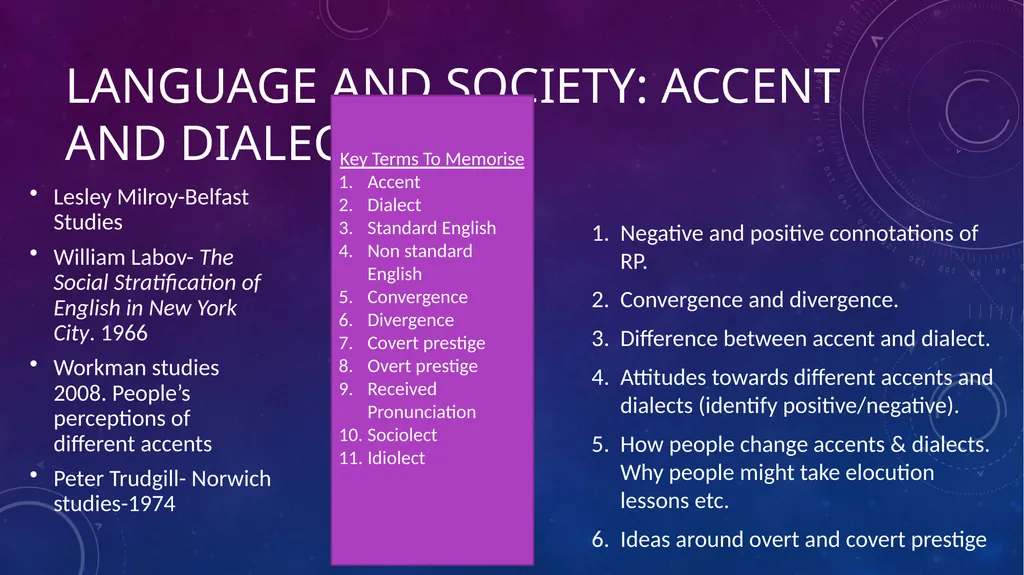
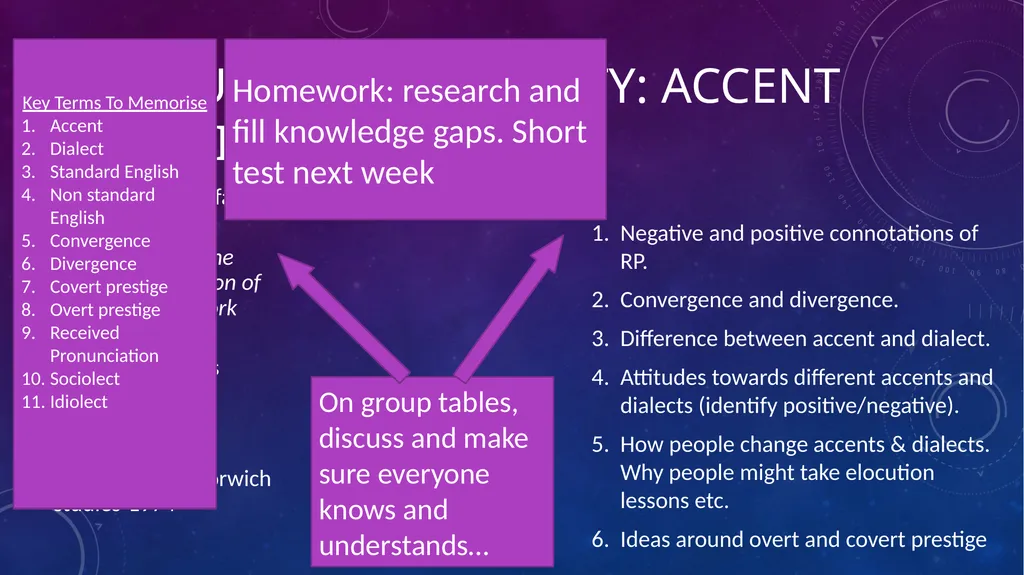
Language and Society: Accent and dialect Lesley Milroy-Belfast Studies William Labov- The Social Stratification of English in New York City. 1966 Workman studies 2008. Peoples perceptions of different accents Peter Trudgill- Norwich
Related Topics
Share
Embed code
Download this presentation From Below
"Language and Society: Accent and dialect Lesley" is the property of its rightful owner. Permission is granted to download and print the materials on this website for personal, non-commercial use only, and to display it on your personal computer provided you do not modify the materials and that you retain all copyright notices contained in the materials. By downloading content from our website, you accept the terms of this agreement.
Presentation Transcript
01
Language and Society: Accent and dialect Lesley Milroy-Belfast Studies
William Labov- The Social Stratification of English in New York City. 1966
Workman studies 2008. People’s perceptions of different accents
Peter Trudgill- Norwich studies-1974 Negative and positive connotations of RP.
Convergence and divergence.
Difference between accent and dialect.
Attitudes towards different accents and dialects (identify positive/negative).
How people change accents & dialects. Why people might take elocution lessons etc.
Ideas around overt and covert prestige Key Terms To Memorise
Accent
Dialect
Standard English
Non standard English
Convergence
Divergence
Covert prestige
Overt prestige
Received Pronunciation
Sociolect
Idiolect<br>
William Labov- The Social Stratification of English in New York City. 1966
Workman studies 2008. People’s perceptions of different accents
Peter Trudgill- Norwich studies-1974 Negative and positive connotations of RP.
Convergence and divergence.
Difference between accent and dialect.
Attitudes towards different accents and dialects (identify positive/negative).
How people change accents & dialects. Why people might take elocution lessons etc.
Ideas around overt and covert prestige Key Terms To Memorise
Accent
Dialect
Standard English
Non standard English
Convergence
Divergence
Covert prestige
Overt prestige
Received Pronunciation
Sociolect
Idiolect<br>
02
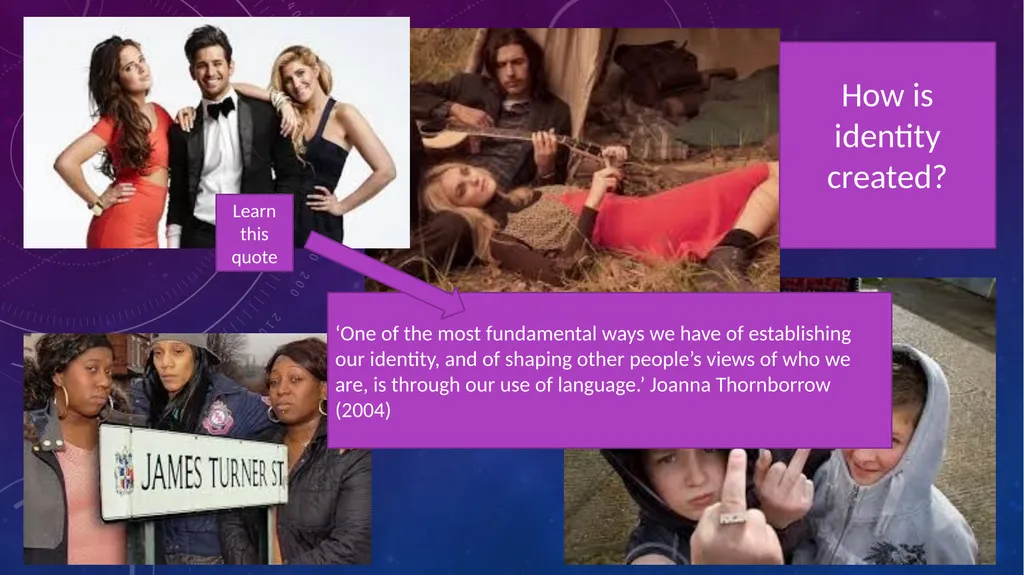
How is identity created? ‘One of the most fundamental ways we have of establishing our identity, and of shaping other people’s views of who we are, is through our use of language.’ Joanna Thornborrow (2004) Learn this quote<br>
03
Regional dialects and accents Q: What’s the difference between accent & dialect?
A: A dialect is the variation in WORDS and STRUCTURES associated with a particular geographical region.
Accent is the variation in PRONUNCIATION associated with a particular geographical region. Q: What about sociolect and idiolect?
A: Sociolect is variation in language use associated with membership of a particular social group.
Idiolect is variation in language use associated with an individual’s personalised ‘speech style’ How many different accents/dialects do you know?<br>
A: A dialect is the variation in WORDS and STRUCTURES associated with a particular geographical region.
Accent is the variation in PRONUNCIATION associated with a particular geographical region. Q: What about sociolect and idiolect?
A: Sociolect is variation in language use associated with membership of a particular social group.
Idiolect is variation in language use associated with an individual’s personalised ‘speech style’ How many different accents/dialects do you know?<br>
04
What Varies? Phonological variation https://www.youtube.com/watch?v=Yqi35Adbbks
https://www.youtube.com/watch?v=P4RkddWPVRs
https://www.youtube.com/watch?v=FyyT2jmVPAk<br>
https://www.youtube.com/watch?v=P4RkddWPVRs
https://www.youtube.com/watch?v=FyyT2jmVPAk<br>
05
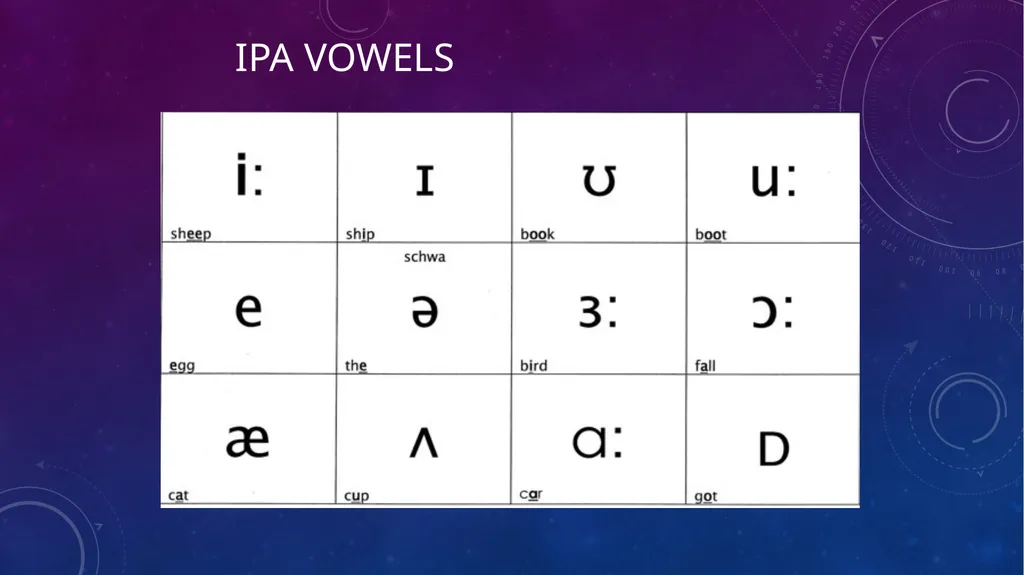
IPA vowels<br>
06
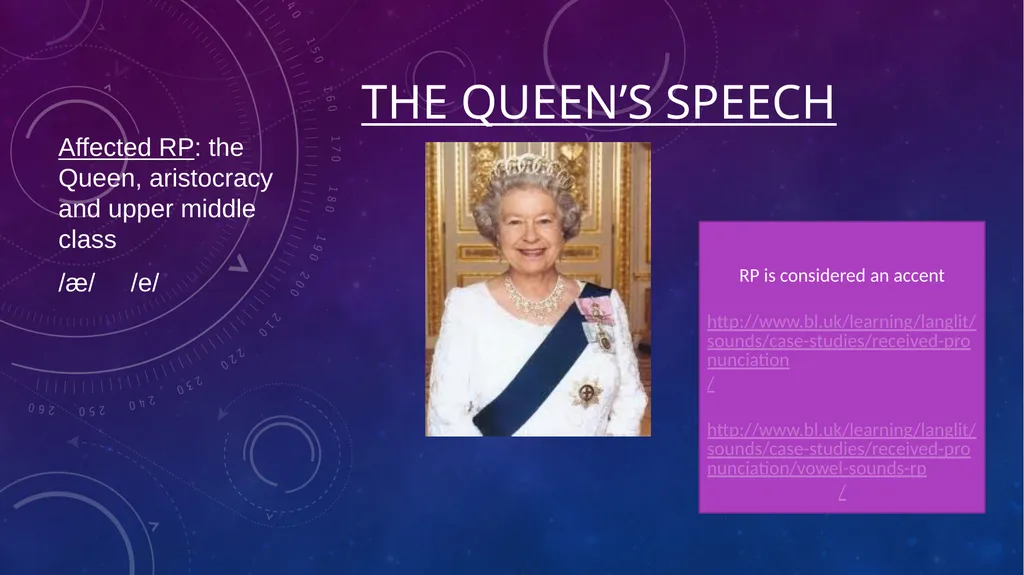
The Queen’s Speech Affected RP: the Queen, aristocracy and upper middle class
/æ/ /e/ RP is considered an accent
http://www.bl.uk/learning/langlit/sounds/case-studies/received-pronunciation/
http://www.bl.uk/learning/langlit/sounds/case-studies/received-pronunciation/vowel-sounds-rp/<br>
/æ/ /e/ RP is considered an accent
http://www.bl.uk/learning/langlit/sounds/case-studies/received-pronunciation/
http://www.bl.uk/learning/langlit/sounds/case-studies/received-pronunciation/vowel-sounds-rp/<br>
07
Speak Like a…
Regional and Social Variation I’m so happy I could marry you
/ajm so hæpi aj kʊd mæri ju/
Replace the /æ/ with /e/ in happy and marry
Replace the /æ/ with /you choose/ in happy and marry<br>
/ajm so hæpi aj kʊd mæri ju/
Replace the /æ/ with /e/ in happy and marry
Replace the /æ/ with /you choose/ in happy and marry<br>
08
Q: What are the prejudices, issues and debates around accents and dialects?<br>
09
RP: Received Pronunciation
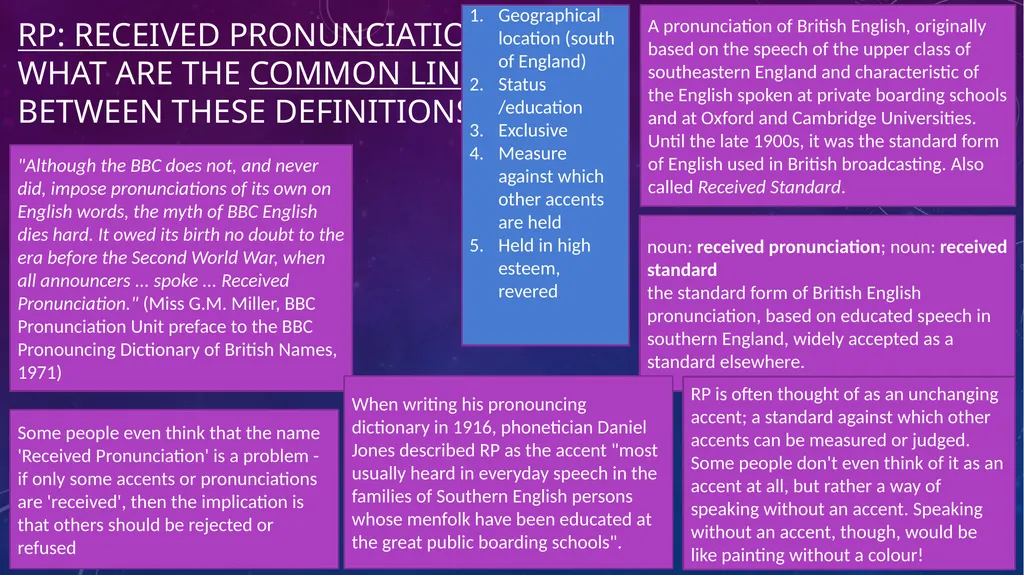
What are the common links between these definitions? A pronunciation of British English, originally based on the speech of the upper class of southeastern England and characteristic of the English spoken at private boarding schools and at Oxford and Cambridge Universities. Until the late 1900s, it was the standard form of English used in British broadcasting. Also called Received Standard. noun: received pronunciation; noun: received standard
the standard form of British English pronunciation, based on educated speech in southern England, widely accepted as a standard elsewhere. "Although the BBC does not, and never did, impose pronunciations of its own on English words, the myth of BBC English dies hard. It owed its birth no doubt to the era before the Second World War, when all announcers ... spoke ... Received Pronunciation." (Miss G.M. Miller, BBC Pronunciation Unit preface to the BBC Pronouncing Dictionary of British Names, 1971) Some people even think that the name 'Received Pronunciation' is a problem - if only some accents or pronunciations are 'received', then the implication is that others should be rejected or refused When writing his pronouncing dictionary in 1916, phonetician Daniel Jones described RP as the accent "most usually heard in everyday speech in the families of Southern English persons whose menfolk have been educated at the great public boarding schools". RP is often thought of as an unchanging accent; a standard against which other accents can be measured or judged. Some people don't even think of it as an accent at all, but rather a way of speaking without an accent. Speaking without an accent, though, would be like painting without a colour! Geographical location (south of England)
Status /education
Exclusive
Measure against which other accents are held
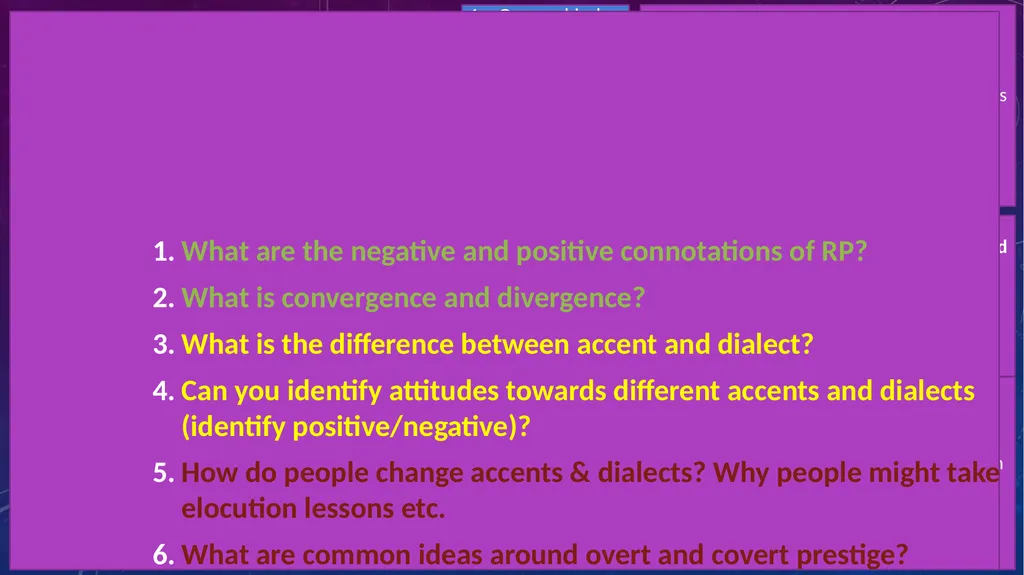
Held in high esteem, revered What are the negative and positive connotations of RP?
What is convergence and divergence?
What is the difference between accent and dialect?
Can you identify attitudes towards different accents and dialects (identify positive/negative)?
How do people change accents & dialects? Why people might take elocution lessons etc.
What are common ideas around overt and covert prestige?<br>
the standard form of British English pronunciation, based on educated speech in southern England, widely accepted as a standard elsewhere. "Although the BBC does not, and never did, impose pronunciations of its own on English words, the myth of BBC English dies hard. It owed its birth no doubt to the era before the Second World War, when all announcers ... spoke ... Received Pronunciation." (Miss G.M. Miller, BBC Pronunciation Unit preface to the BBC Pronouncing Dictionary of British Names, 1971) Some people even think that the name 'Received Pronunciation' is a problem - if only some accents or pronunciations are 'received', then the implication is that others should be rejected or refused When writing his pronouncing dictionary in 1916, phonetician Daniel Jones described RP as the accent "most usually heard in everyday speech in the families of Southern English persons whose menfolk have been educated at the great public boarding schools". RP is often thought of as an unchanging accent; a standard against which other accents can be measured or judged. Some people don't even think of it as an accent at all, but rather a way of speaking without an accent. Speaking without an accent, though, would be like painting without a colour! Geographical location (south of England)
Status /education
Exclusive
Measure against which other accents are held
Held in high esteem, revered What are the negative and positive connotations of RP?
What is convergence and divergence?
What is the difference between accent and dialect?
Can you identify attitudes towards different accents and dialects (identify positive/negative)?
How do people change accents & dialects? Why people might take elocution lessons etc.
What are common ideas around overt and covert prestige?<br>
10
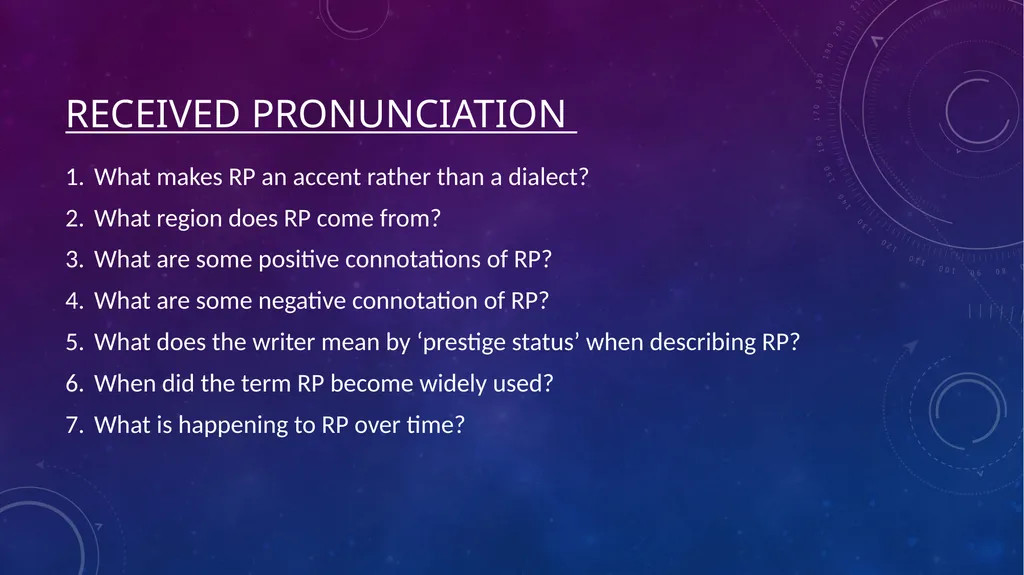
Received Pronunciation What makes RP an accent rather than a dialect?
What region does RP come from?
What are some positive connotations of RP?
What are some negative connotation of RP?
What does the writer mean by ‘prestige status’ when describing RP?
When did the term RP become widely used?
What is happening to RP over time?<br>
What region does RP come from?
What are some positive connotations of RP?
What are some negative connotation of RP?
What does the writer mean by ‘prestige status’ when describing RP?
When did the term RP become widely used?
What is happening to RP over time?<br>
11
RP: Received Pronunciation
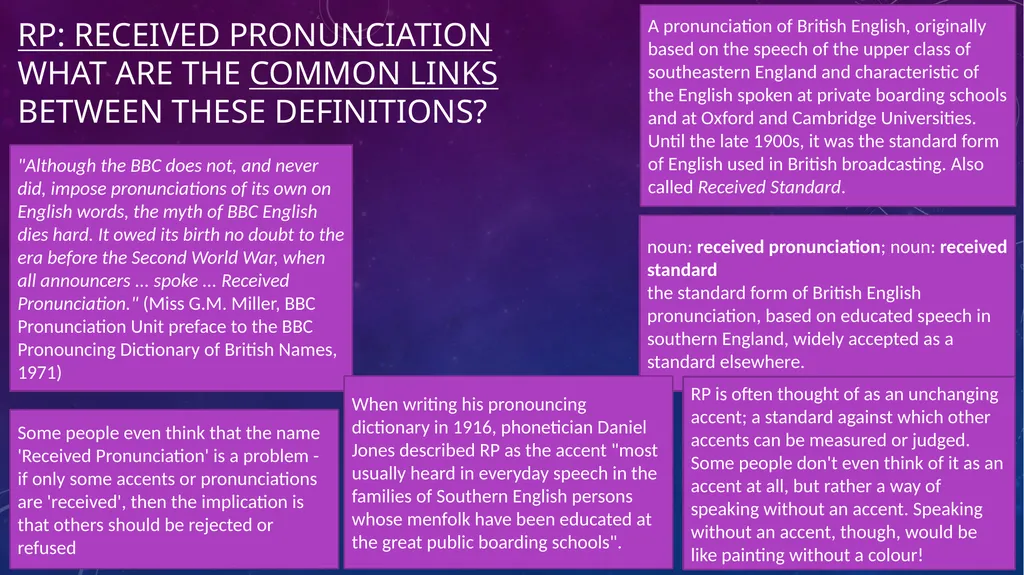
What are the common links between these definitions? A pronunciation of British English, originally based on the speech of the upper class of southeastern England and characteristic of the English spoken at private boarding schools and at Oxford and Cambridge Universities. Until the late 1900s, it was the standard form of English used in British broadcasting. Also called Received Standard. noun: received pronunciation; noun: received standard
the standard form of British English pronunciation, based on educated speech in southern England, widely accepted as a standard elsewhere. "Although the BBC does not, and never did, impose pronunciations of its own on English words, the myth of BBC English dies hard. It owed its birth no doubt to the era before the Second World War, when all announcers ... spoke ... Received Pronunciation." (Miss G.M. Miller, BBC Pronunciation Unit preface to the BBC Pronouncing Dictionary of British Names, 1971) Some people even think that the name 'Received Pronunciation' is a problem - if only some accents or pronunciations are 'received', then the implication is that others should be rejected or refused When writing his pronouncing dictionary in 1916, phonetician Daniel Jones described RP as the accent "most usually heard in everyday speech in the families of Southern English persons whose menfolk have been educated at the great public boarding schools". RP is often thought of as an unchanging accent; a standard against which other accents can be measured or judged. Some people don't even think of it as an accent at all, but rather a way of speaking without an accent. Speaking without an accent, though, would be like painting without a colour!<br>
the standard form of British English pronunciation, based on educated speech in southern England, widely accepted as a standard elsewhere. "Although the BBC does not, and never did, impose pronunciations of its own on English words, the myth of BBC English dies hard. It owed its birth no doubt to the era before the Second World War, when all announcers ... spoke ... Received Pronunciation." (Miss G.M. Miller, BBC Pronunciation Unit preface to the BBC Pronouncing Dictionary of British Names, 1971) Some people even think that the name 'Received Pronunciation' is a problem - if only some accents or pronunciations are 'received', then the implication is that others should be rejected or refused When writing his pronouncing dictionary in 1916, phonetician Daniel Jones described RP as the accent "most usually heard in everyday speech in the families of Southern English persons whose menfolk have been educated at the great public boarding schools". RP is often thought of as an unchanging accent; a standard against which other accents can be measured or judged. Some people don't even think of it as an accent at all, but rather a way of speaking without an accent. Speaking without an accent, though, would be like painting without a colour!<br>
12
RP: Received Pronunciation
What are the common links between these definitions? A pronunciation of British English, originally based on the speech of the upper class of southeastern England and characteristic of the English spoken at private boarding schools and at Oxford and Cambridge Universities. Until the late 1900s, it was the standard form of English used in British broadcasting. Also called Received Standard. noun: received pronunciation; noun: received standard
the standard form of British English pronunciation, based on educated speech in southern England, widely accepted as a standard elsewhere. "Although the BBC does not, and never did, impose pronunciations of its own on English words, the myth of BBC English dies hard. It owed its birth no doubt to the era before the Second World War, when all announcers ... spoke ... Received Pronunciation." (Miss G.M. Miller, BBC Pronunciation Unit preface to the BBC Pronouncing Dictionary of British Names, 1971) Some people even think that the name 'Received Pronunciation' is a problem - if only some accents or pronunciations are 'received', then the implication is that others should be rejected or refused When writing his pronouncing dictionary in 1916, phonetician Daniel Jones described RP as the accent "most usually heard in everyday speech in the families of Southern English persons whose menfolk have been educated at the great public boarding schools". RP is often thought of as an unchanging accent; a standard against which other accents can be measured or judged. Some people don't even think of it as an accent at all, but rather a way of speaking without an accent. Speaking without an accent, though, would be like painting without a colour! Geographical location (south of England)
Status /education
Exclusive
Measure against which other accents are held
Held in high esteem, revered<br>
the standard form of British English pronunciation, based on educated speech in southern England, widely accepted as a standard elsewhere. "Although the BBC does not, and never did, impose pronunciations of its own on English words, the myth of BBC English dies hard. It owed its birth no doubt to the era before the Second World War, when all announcers ... spoke ... Received Pronunciation." (Miss G.M. Miller, BBC Pronunciation Unit preface to the BBC Pronouncing Dictionary of British Names, 1971) Some people even think that the name 'Received Pronunciation' is a problem - if only some accents or pronunciations are 'received', then the implication is that others should be rejected or refused When writing his pronouncing dictionary in 1916, phonetician Daniel Jones described RP as the accent "most usually heard in everyday speech in the families of Southern English persons whose menfolk have been educated at the great public boarding schools". RP is often thought of as an unchanging accent; a standard against which other accents can be measured or judged. Some people don't even think of it as an accent at all, but rather a way of speaking without an accent. Speaking without an accent, though, would be like painting without a colour! Geographical location (south of England)
Status /education
Exclusive
Measure against which other accents are held
Held in high esteem, revered<br>
13
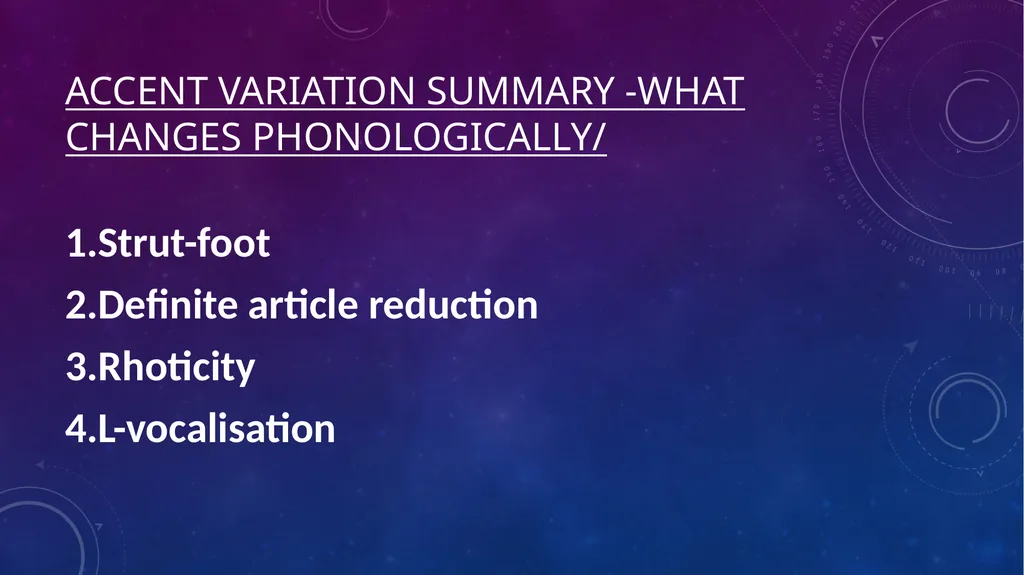
Accent Variation Summary -What changes Phonologically/ Strut-foot
Definite article reduction
Rhoticity
L-vocalisation<br>
Definite article reduction
Rhoticity
L-vocalisation<br>
14
Sound Less Northern! Discuss
Write an opinion article discussing your views. Imagine you are addressing school governors.
http://www.independent.co.uk/news/uk/home-news/teacher-told-to-sound-less-northern-after-southern-ofsted-inspection-8947332.html<br>
Write an opinion article discussing your views. Imagine you are addressing school governors.
http://www.independent.co.uk/news/uk/home-news/teacher-told-to-sound-less-northern-after-southern-ofsted-inspection-8947332.html<br>
15
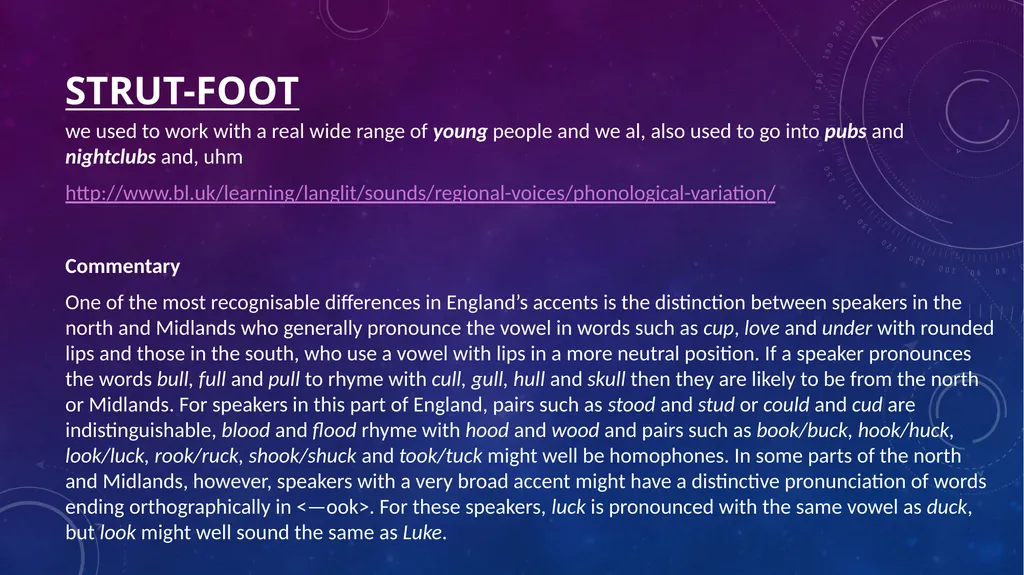
Strut-foot we used to work with a real wide range of young people and we al, also used to go into pubs and nightclubs and, uhm
http://www.bl.uk/learning/langlit/sounds/regional-voices/phonological-variation/
Commentary
One of the most recognisable differences in England’s accents is the distinction between speakers in the north and Midlands who generally pronounce the vowel in words such as cup, love and under with rounded lips and those in the south, who use a vowel with lips in a more neutral position. If a speaker pronounces the words bull, full and pull to rhyme with cull, gull, hull and skull then they are likely to be from the north or Midlands. For speakers in this part of England, pairs such as stood and stud or could and cud are indistinguishable, blood and flood rhyme with hood and wood and pairs such as book/buck, hook/huck, look/luck, rook/ruck, shook/shuck and took/tuck might well be homophones. In some parts of the north and Midlands, however, speakers with a very broad accent might have a distinctive pronunciation of words ending orthographically in <—ook>. For these speakers, luck is pronounced with the same vowel as duck, but look might well sound the same as Luke.<br>
http://www.bl.uk/learning/langlit/sounds/regional-voices/phonological-variation/
Commentary
One of the most recognisable differences in England’s accents is the distinction between speakers in the north and Midlands who generally pronounce the vowel in words such as cup, love and under with rounded lips and those in the south, who use a vowel with lips in a more neutral position. If a speaker pronounces the words bull, full and pull to rhyme with cull, gull, hull and skull then they are likely to be from the north or Midlands. For speakers in this part of England, pairs such as stood and stud or could and cud are indistinguishable, blood and flood rhyme with hood and wood and pairs such as book/buck, hook/huck, look/luck, rook/ruck, shook/shuck and took/tuck might well be homophones. In some parts of the north and Midlands, however, speakers with a very broad accent might have a distinctive pronunciation of words ending orthographically in <—ook>. For these speakers, luck is pronounced with the same vowel as duck, but look might well sound the same as Luke.<br>
16
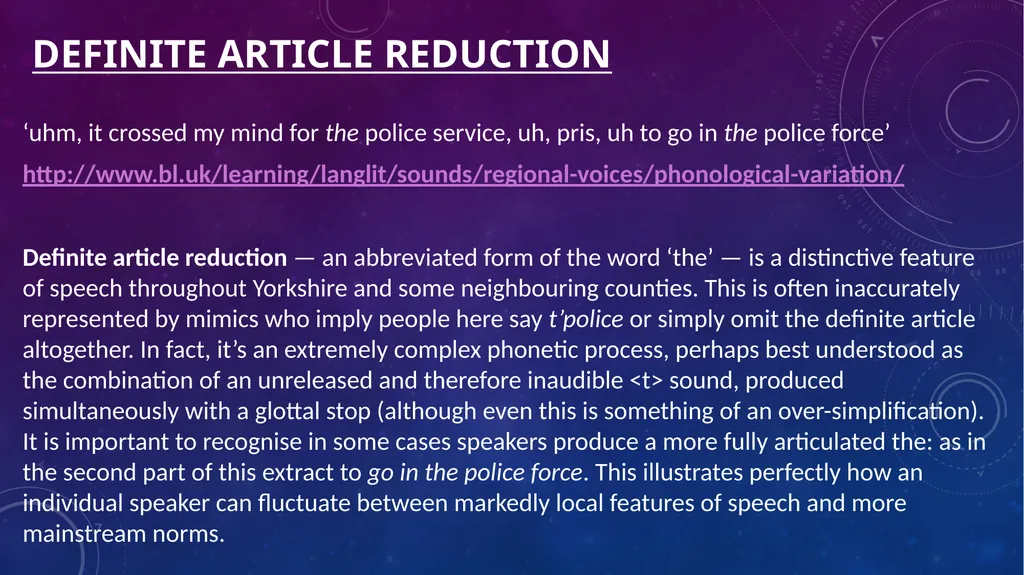
Definite article reduction ‘uhm, it crossed my mind for the police service, uh, pris, uh to go in the police force’
http://www.bl.uk/learning/langlit/sounds/regional-voices/phonological-variation/
Definite article reduction — an abbreviated form of the word ‘the’ — is a distinctive feature of speech throughout Yorkshire and some neighbouring counties. This is often inaccurately represented by mimics who imply people here say t’police or simply omit the definite article altogether. In fact, it’s an extremely complex phonetic process, perhaps best understood as the combination of an unreleased and therefore inaudible <t> sound, produced simultaneously with a glottal stop (although even this is something of an over-simplification). It is important to recognise in some cases speakers produce a more fully articulated the: as in the second part of this extract to go in the police force. This illustrates perfectly how an individual speaker can fluctuate between markedly local features of speech and more mainstream norms.<br>
http://www.bl.uk/learning/langlit/sounds/regional-voices/phonological-variation/
Definite article reduction — an abbreviated form of the word ‘the’ — is a distinctive feature of speech throughout Yorkshire and some neighbouring counties. This is often inaccurately represented by mimics who imply people here say t’police or simply omit the definite article altogether. In fact, it’s an extremely complex phonetic process, perhaps best understood as the combination of an unreleased and therefore inaudible <t> sound, produced simultaneously with a glottal stop (although even this is something of an over-simplification). It is important to recognise in some cases speakers produce a more fully articulated the: as in the second part of this extract to go in the police force. This illustrates perfectly how an individual speaker can fluctuate between markedly local features of speech and more mainstream norms.<br>
17
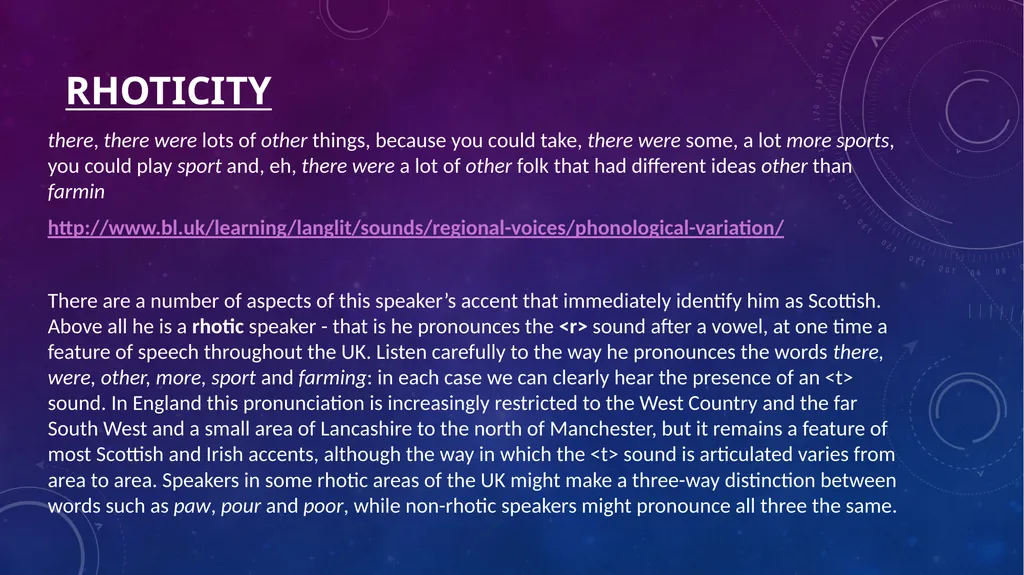
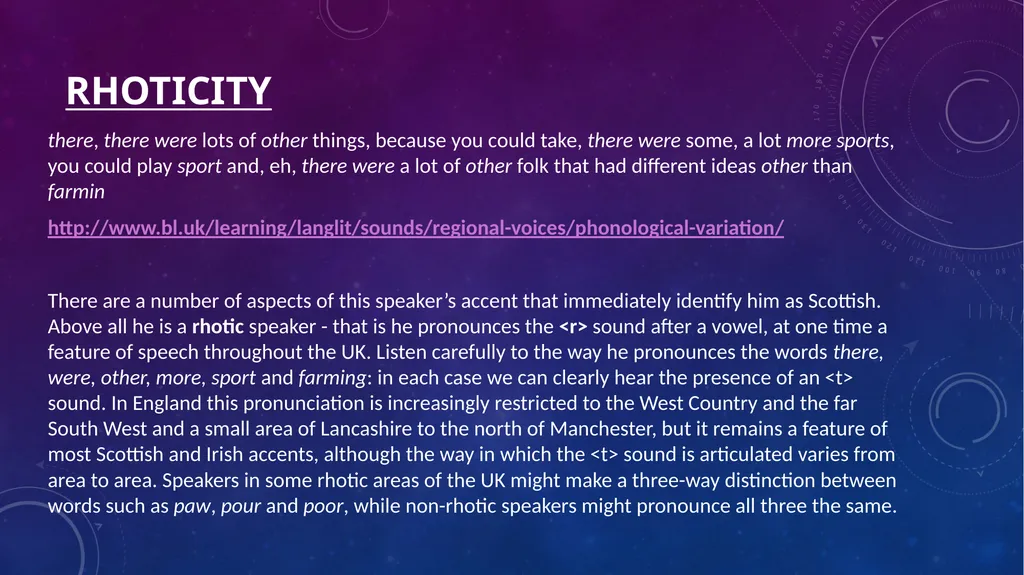
Rhoticity there, there were lots of other things, because you could take, there were some, a lot more sports, you could play sport and, eh, there were a lot of other folk that had different ideas other than farmin
http://www.bl.uk/learning/langlit/sounds/regional-voices/phonological-variation/
There are a number of aspects of this speaker’s accent that immediately identify him as Scottish. Above all he is a rhotic speaker - that is he pronounces the <r> sound after a vowel, at one time a feature of speech throughout the UK. Listen carefully to the way he pronounces the words there, were, other, more, sport and farming: in each case we can clearly hear the presence of an <t> sound. In England this pronunciation is increasingly restricted to the West Country and the far South West and a small area of Lancashire to the north of Manchester, but it remains a feature of most Scottish and Irish accents, although the way in which the <t> sound is articulated varies from area to area. Speakers in some rhotic areas of the UK might make a three-way distinction between words such as paw, pour and poor, while non-rhotic speakers might pronounce all three the same.<br>
http://www.bl.uk/learning/langlit/sounds/regional-voices/phonological-variation/
There are a number of aspects of this speaker’s accent that immediately identify him as Scottish. Above all he is a rhotic speaker - that is he pronounces the <r> sound after a vowel, at one time a feature of speech throughout the UK. Listen carefully to the way he pronounces the words there, were, other, more, sport and farming: in each case we can clearly hear the presence of an <t> sound. In England this pronunciation is increasingly restricted to the West Country and the far South West and a small area of Lancashire to the north of Manchester, but it remains a feature of most Scottish and Irish accents, although the way in which the <t> sound is articulated varies from area to area. Speakers in some rhotic areas of the UK might make a three-way distinction between words such as paw, pour and poor, while non-rhotic speakers might pronounce all three the same.<br>
18
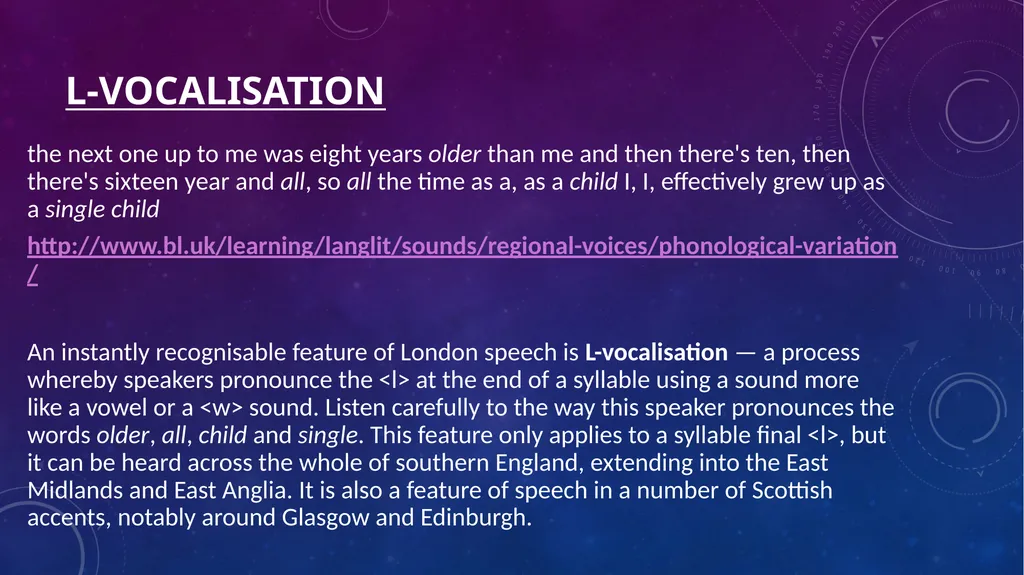
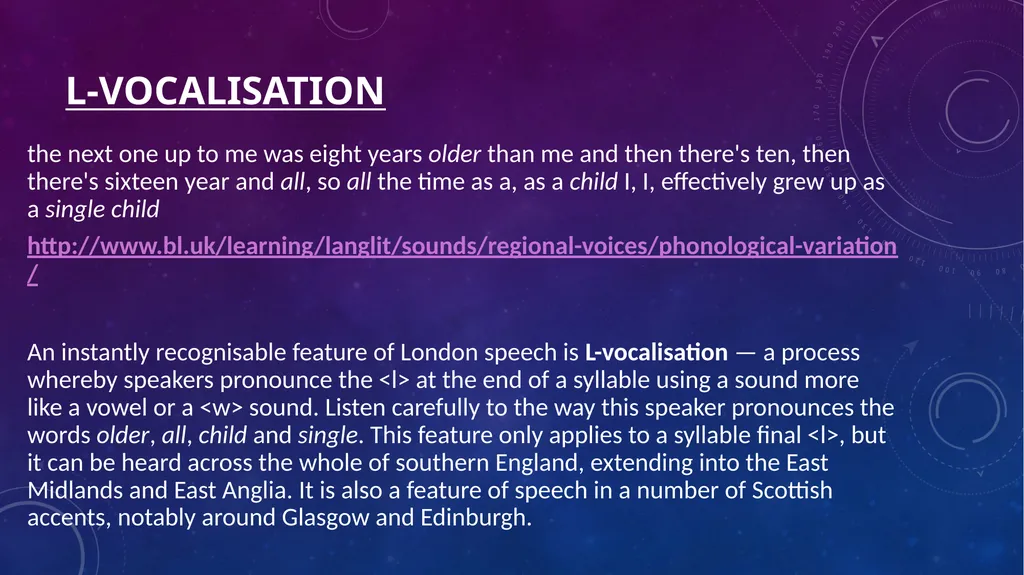
L-vocalisation the next one up to me was eight years older than me and then there's ten, then there's sixteen year and all, so all the time as a, as a child I, I, effectively grew up as a single child
http://www.bl.uk/learning/langlit/sounds/regional-voices/phonological-variation/
An instantly recognisable feature of London speech is L-vocalisation — a process whereby speakers pronounce the <l> at the end of a syllable using a sound more like a vowel or a <w> sound. Listen carefully to the way this speaker pronounces the words older, all, child and single. This feature only applies to a syllable final <l>, but it can be heard across the whole of southern England, extending into the East Midlands and East Anglia. It is also a feature of speech in a number of Scottish accents, notably around Glasgow and Edinburgh.<br>
http://www.bl.uk/learning/langlit/sounds/regional-voices/phonological-variation/
An instantly recognisable feature of London speech is L-vocalisation — a process whereby speakers pronounce the <l> at the end of a syllable using a sound more like a vowel or a <w> sound. Listen carefully to the way this speaker pronounces the words older, all, child and single. This feature only applies to a syllable final <l>, but it can be heard across the whole of southern England, extending into the East Midlands and East Anglia. It is also a feature of speech in a number of Scottish accents, notably around Glasgow and Edinburgh.<br>
19
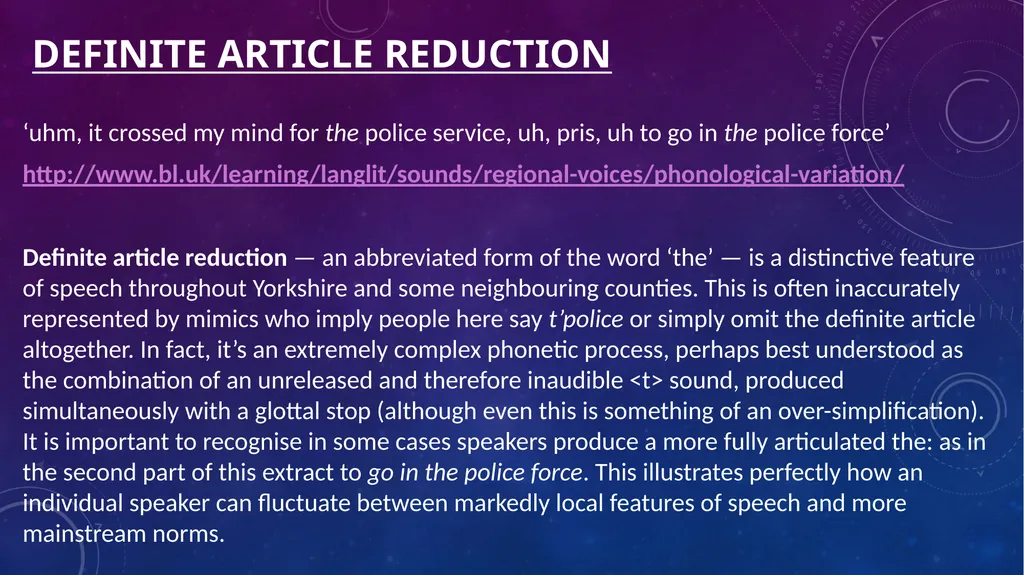
Definite article reduction ‘uhm, it crossed my mind for the police service, uh, pris, uh to go in the police force’
http://www.bl.uk/learning/langlit/sounds/regional-voices/phonological-variation/
Definite article reduction — an abbreviated form of the word ‘the’ — is a distinctive feature of speech throughout Yorkshire and some neighbouring counties. This is often inaccurately represented by mimics who imply people here say t’police or simply omit the definite article altogether. In fact, it’s an extremely complex phonetic process, perhaps best understood as the combination of an unreleased and therefore inaudible <t> sound, produced simultaneously with a glottal stop (although even this is something of an over-simplification). It is important to recognise in some cases speakers produce a more fully articulated the: as in the second part of this extract to go in the police force. This illustrates perfectly how an individual speaker can fluctuate between markedly local features of speech and more mainstream norms.<br>
http://www.bl.uk/learning/langlit/sounds/regional-voices/phonological-variation/
Definite article reduction — an abbreviated form of the word ‘the’ — is a distinctive feature of speech throughout Yorkshire and some neighbouring counties. This is often inaccurately represented by mimics who imply people here say t’police or simply omit the definite article altogether. In fact, it’s an extremely complex phonetic process, perhaps best understood as the combination of an unreleased and therefore inaudible <t> sound, produced simultaneously with a glottal stop (although even this is something of an over-simplification). It is important to recognise in some cases speakers produce a more fully articulated the: as in the second part of this extract to go in the police force. This illustrates perfectly how an individual speaker can fluctuate between markedly local features of speech and more mainstream norms.<br>
20
Rhoticity there, there were lots of other things, because you could take, there were some, a lot more sports, you could play sport and, eh, there were a lot of other folk that had different ideas other than farmin
http://www.bl.uk/learning/langlit/sounds/regional-voices/phonological-variation/
There are a number of aspects of this speaker’s accent that immediately identify him as Scottish. Above all he is a rhotic speaker - that is he pronounces the <r> sound after a vowel, at one time a feature of speech throughout the UK. Listen carefully to the way he pronounces the words there, were, other, more, sport and farming: in each case we can clearly hear the presence of an <t> sound. In England this pronunciation is increasingly restricted to the West Country and the far South West and a small area of Lancashire to the north of Manchester, but it remains a feature of most Scottish and Irish accents, although the way in which the <t> sound is articulated varies from area to area. Speakers in some rhotic areas of the UK might make a three-way distinction between words such as paw, pour and poor, while non-rhotic speakers might pronounce all three the same.<br>
http://www.bl.uk/learning/langlit/sounds/regional-voices/phonological-variation/
There are a number of aspects of this speaker’s accent that immediately identify him as Scottish. Above all he is a rhotic speaker - that is he pronounces the <r> sound after a vowel, at one time a feature of speech throughout the UK. Listen carefully to the way he pronounces the words there, were, other, more, sport and farming: in each case we can clearly hear the presence of an <t> sound. In England this pronunciation is increasingly restricted to the West Country and the far South West and a small area of Lancashire to the north of Manchester, but it remains a feature of most Scottish and Irish accents, although the way in which the <t> sound is articulated varies from area to area. Speakers in some rhotic areas of the UK might make a three-way distinction between words such as paw, pour and poor, while non-rhotic speakers might pronounce all three the same.<br>
21
L-vocalisation the next one up to me was eight years older than me and then there's ten, then there's sixteen year and all, so all the time as a, as a child I, I, effectively grew up as a single child
http://www.bl.uk/learning/langlit/sounds/regional-voices/phonological-variation/
An instantly recognisable feature of London speech is L-vocalisation — a process whereby speakers pronounce the <l> at the end of a syllable using a sound more like a vowel or a <w> sound. Listen carefully to the way this speaker pronounces the words older, all, child and single. This feature only applies to a syllable final <l>, but it can be heard across the whole of southern England, extending into the East Midlands and East Anglia. It is also a feature of speech in a number of Scottish accents, notably around Glasgow and Edinburgh.<br>
http://www.bl.uk/learning/langlit/sounds/regional-voices/phonological-variation/
An instantly recognisable feature of London speech is L-vocalisation — a process whereby speakers pronounce the <l> at the end of a syllable using a sound more like a vowel or a <w> sound. Listen carefully to the way this speaker pronounces the words older, all, child and single. This feature only applies to a syllable final <l>, but it can be heard across the whole of southern England, extending into the East Midlands and East Anglia. It is also a feature of speech in a number of Scottish accents, notably around Glasgow and Edinburgh.<br>
22
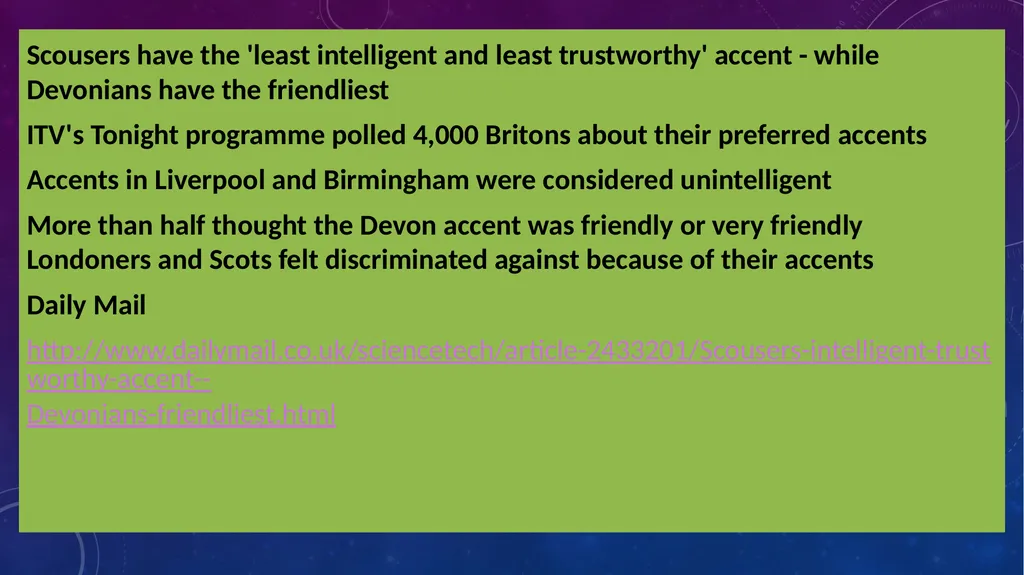
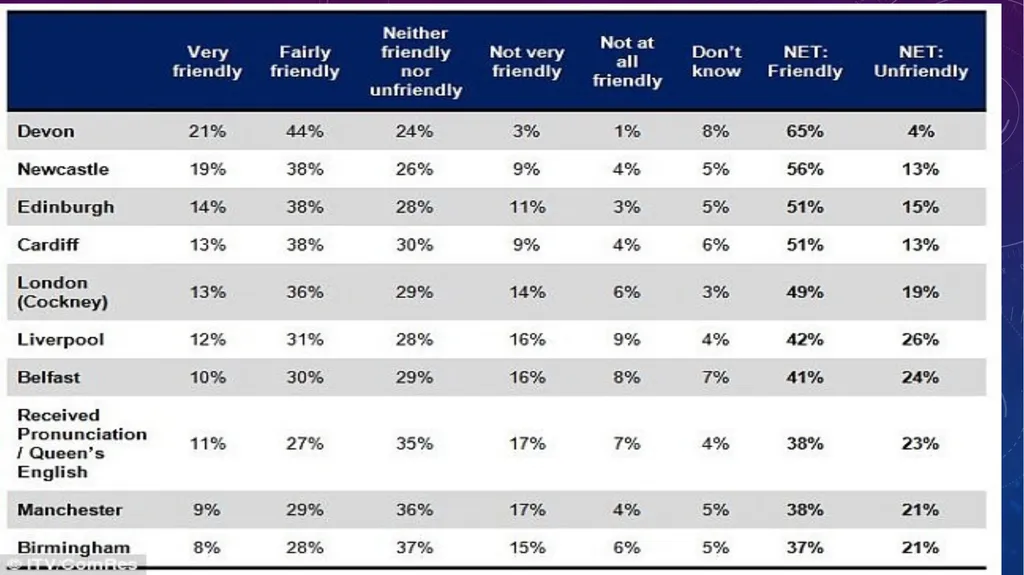
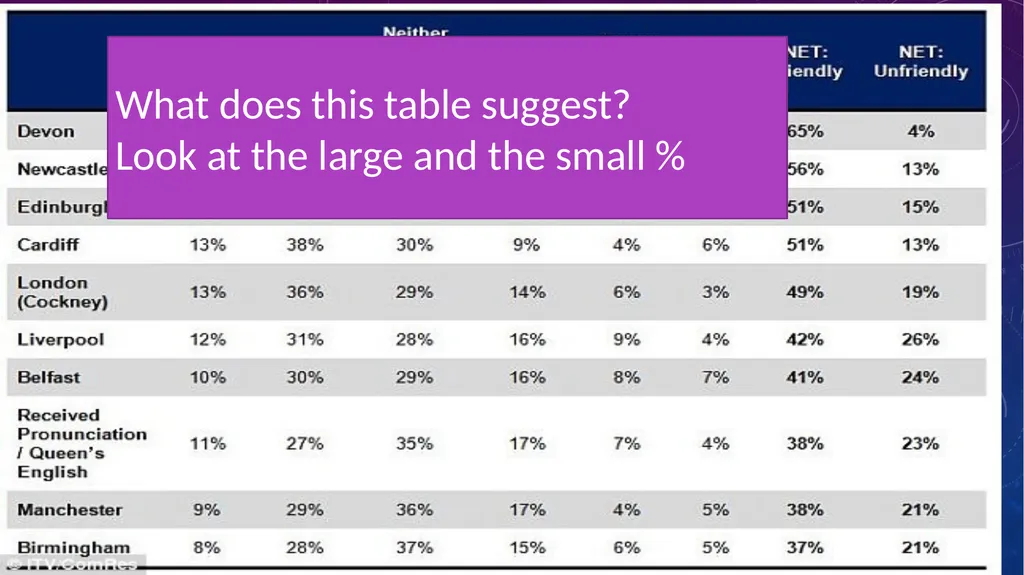
Scousers have the 'least intelligent and least trustworthy' accent - while Devonians have the friendliest
ITV's Tonight programme polled 4,000 Britons about their preferred accents
Accents in Liverpool and Birmingham were considered unintelligent
More than half thought the Devon accent was friendly or very friendly Londoners and Scots felt discriminated against because of their accents
Daily Mail
http://www.dailymail.co.uk/sciencetech/article-2433201/Scousers-intelligent-trustworthy-accent--Devonians-friendliest.html<br>
ITV's Tonight programme polled 4,000 Britons about their preferred accents
Accents in Liverpool and Birmingham were considered unintelligent
More than half thought the Devon accent was friendly or very friendly Londoners and Scots felt discriminated against because of their accents
Daily Mail
http://www.dailymail.co.uk/sciencetech/article-2433201/Scousers-intelligent-trustworthy-accent--Devonians-friendliest.html<br>
23
What does this table suggest?
Look at the large and the small %<br>
Look at the large and the small %<br>
24
Phonological Variation Read the sheet
Access the British library web age and listen to the examples
Make notes
Join with another pair and exchange information
Join with another four and exchange information<br>
Access the British library web age and listen to the examples
Make notes
Join with another pair and exchange information
Join with another four and exchange information<br>
25
Accents, Dialects & Age Q: What are the historical attitudes to language varieties?
Q: Can you tell someone’s age by the way they speak?
Q: Does your perception of who you would trust change based on their accent?
https://www.youtube.com/watch?v=FyyT2jmVPAk
https://www.youtube.com/watch?v=FyyT2jmVPAk<br>
Q: Can you tell someone’s age by the way they speak?
Q: Does your perception of who you would trust change based on their accent?
https://www.youtube.com/watch?v=FyyT2jmVPAk
https://www.youtube.com/watch?v=FyyT2jmVPAk<br>
26
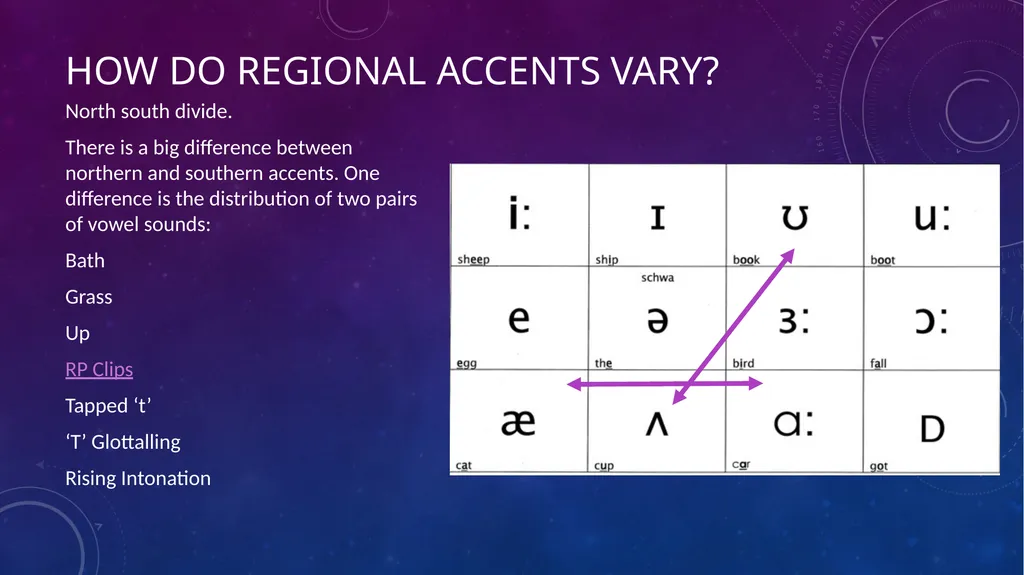
How do regional accents vary? North south divide.
There is a big difference between northern and southern accents. One difference is the distribution of two pairs of vowel sounds:
Bath
Grass
Up
RP Clips
Tapped ‘t’
‘T’ Glottalling
Rising Intonation<br>
There is a big difference between northern and southern accents. One difference is the distribution of two pairs of vowel sounds:
Bath
Grass
Up
RP Clips
Tapped ‘t’
‘T’ Glottalling
Rising Intonation<br>
27
http://englishspeechservices.com/blog/accent-of-evil/
https://www.youtube.com/watch?v=mFN6l4J351Q&feature=youtu.be Listen
Take notes Q: What are the prejudices, issues and debates around accents and dialects?<br>
https://www.youtube.com/watch?v=mFN6l4J351Q&feature=youtu.be Listen
Take notes Q: What are the prejudices, issues and debates around accents and dialects?<br>
28
When was the term RP introduced? When was the BBC established?
What did John Honey rank?<br>
What did John Honey rank?<br>
29
Language Social Class and Education The construct of elaborated and restricted language codes was introduced by Basil Bernstein in 1971, as a way of accounting for the relatively poor performance of working-class pupils on language-based subjects, when they were achieving as well as their middle-class counterparts on mathematical topics.<br>
30
Deficit model
An assumption that something is lacking or deficient
Elaborated code
An idea advanced by Bernstein (and much disputed) that middle class speakers use context free, complex forms of language.
Pragmatic rules
The unspoken rules that operate in interactions between people who share a common understanding.
Restricted code
An idea advanced by Bernstein (and much disputed) that working class speakers use context based, limited forms of language.<br>
An assumption that something is lacking or deficient
Elaborated code
An idea advanced by Bernstein (and much disputed) that middle class speakers use context free, complex forms of language.
Pragmatic rules
The unspoken rules that operate in interactions between people who share a common understanding.
Restricted code
An idea advanced by Bernstein (and much disputed) that working class speakers use context based, limited forms of language.<br>
31
What are the negative and positive connotations of RP?
What is convergence and divergence?
What is the difference between accent and dialect?
Can you identify attitudes towards different accents and dialects (identify positive/negative)?
How do people change accents & dialects? Why people might take elocution lessons etc.
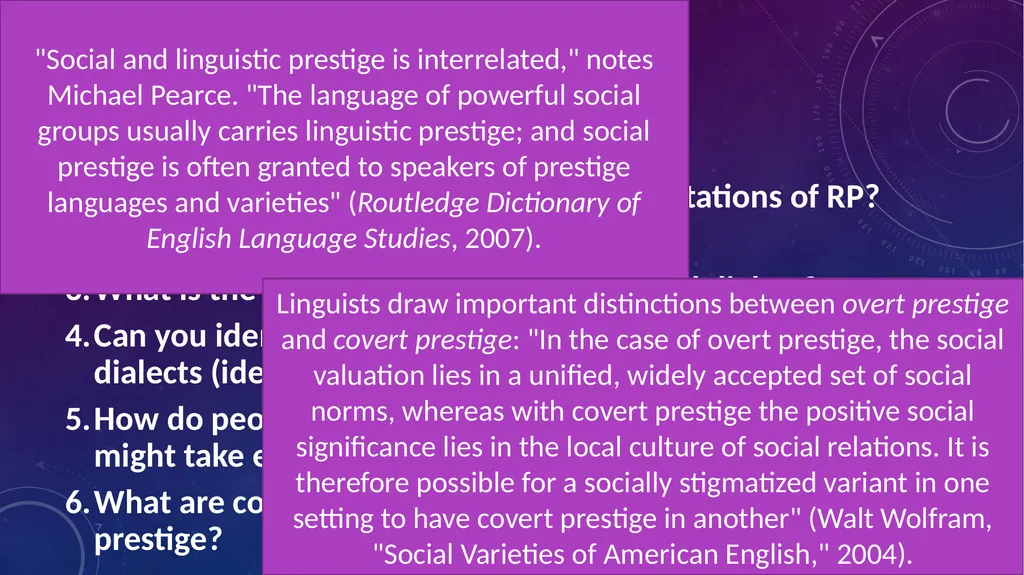
What are common ideas around overt and covert prestige? "Social and linguistic prestige is interrelated," notes Michael Pearce. "The language of powerful social groups usually carries linguistic prestige; and social prestige is often granted to speakers of prestige languages and varieties" (Routledge Dictionary of English Language Studies, 2007). Linguists draw important distinctions between overt prestige and covert prestige: "In the case of overt prestige, the social valuation lies in a unified, widely accepted set of social norms, whereas with covert prestige the positive social significance lies in the local culture of social relations. It is therefore possible for a socially stigmatized variant in one setting to have covert prestige in another" (Walt Wolfram, "Social Varieties of American English," 2004).<br>
What is convergence and divergence?
What is the difference between accent and dialect?
Can you identify attitudes towards different accents and dialects (identify positive/negative)?
How do people change accents & dialects? Why people might take elocution lessons etc.
What are common ideas around overt and covert prestige? "Social and linguistic prestige is interrelated," notes Michael Pearce. "The language of powerful social groups usually carries linguistic prestige; and social prestige is often granted to speakers of prestige languages and varieties" (Routledge Dictionary of English Language Studies, 2007). Linguists draw important distinctions between overt prestige and covert prestige: "In the case of overt prestige, the social valuation lies in a unified, widely accepted set of social norms, whereas with covert prestige the positive social significance lies in the local culture of social relations. It is therefore possible for a socially stigmatized variant in one setting to have covert prestige in another" (Walt Wolfram, "Social Varieties of American English," 2004).<br>
32
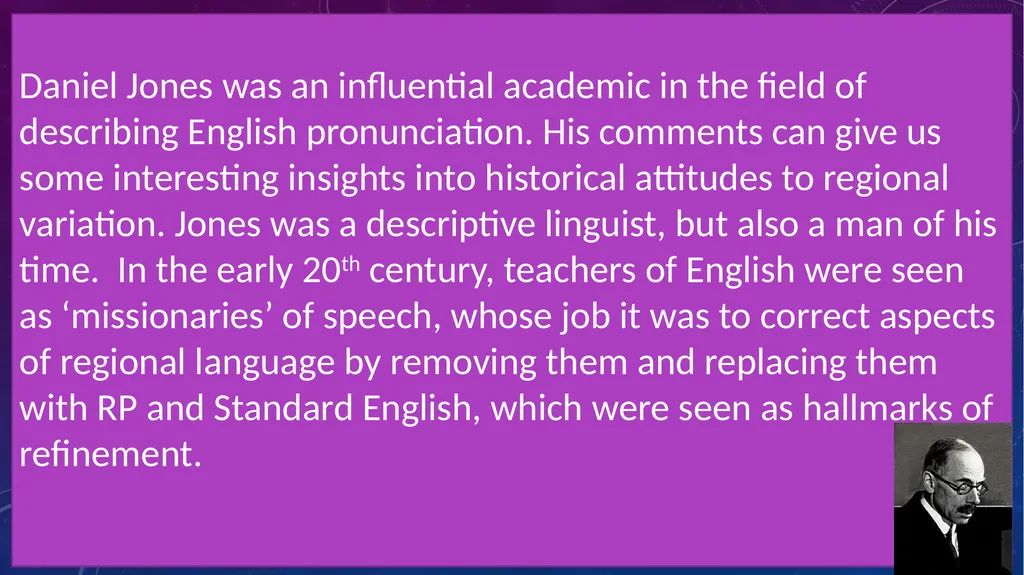
David and Ben Crystal Daniel Jones Daniel Jones was an influential academic in the field of describing English pronunciation. His comments can give us some interesting insights into historical attitudes to regional variation. Jones was a descriptive linguist, but also a man of his time. In the early 20th century, teachers of English were seen as ‘missionaries’ of speech, whose job it was to correct aspects of regional language by removing them and replacing them with RP and Standard English, which were seen as hallmarks of refinement.<br>
33
Homework: November Mind map the ideas from the Bernstein reading. Use colours.
Learn terminology associated with accent/dialect/language and people<br>
Learn terminology associated with accent/dialect/language and people<br>
34
What are we doing today? Then…
Reflecting on accents and dialects: issues and ideas, and catching up with work. Asking this question (again):
Q: Can you tell someone’s age by the Way they speak?<br>
Reflecting on accents and dialects: issues and ideas, and catching up with work. Asking this question (again):
Q: Can you tell someone’s age by the Way they speak?<br>
35
How good is your knowledge of terminology? Write the term and definition if you know it.<br>
36
Regional Dialects: Historical perspective Blind Date<br>
37
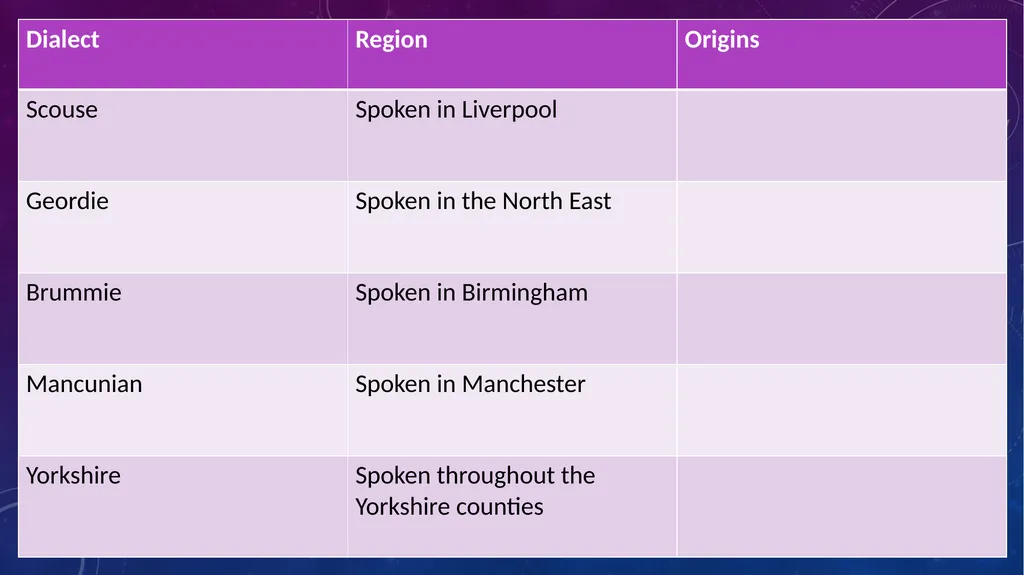
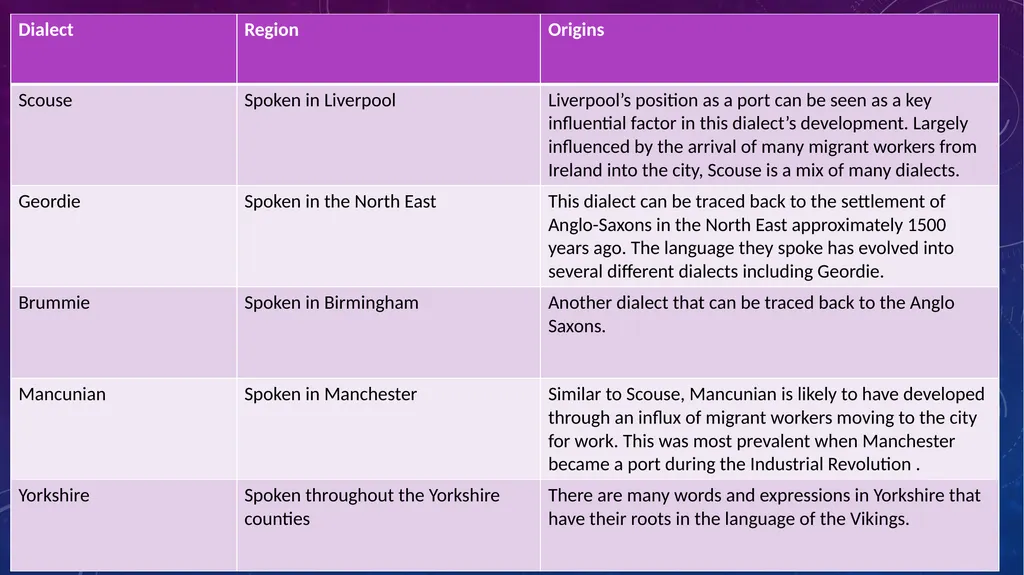
The origins Of Regional Dialects Q: What conclusions can we draw from the table?
That the different dialects of the UK are a result, to some degree, of immigration and invasion.
Q: But why do some places that are geographically very close have distinct differences in their dialect?
Newcastle and Sunderland may only be 10 miles apart but there are distinct differences in their dialect. Similarly in areas around Liverpool, residents of St Helens, Widnes, Southport and the Wirrall have their own distinctive way of speaking. Therefore, your dialect can be very specific to where you live or where you were brought up. You could argue that being so specific can be linked to identity and a sense of belonging and pride. This links to the idea of identity. People do not want to be incorrectly ‘labelled’.<br>
That the different dialects of the UK are a result, to some degree, of immigration and invasion.
Q: But why do some places that are geographically very close have distinct differences in their dialect?
Newcastle and Sunderland may only be 10 miles apart but there are distinct differences in their dialect. Similarly in areas around Liverpool, residents of St Helens, Widnes, Southport and the Wirrall have their own distinctive way of speaking. Therefore, your dialect can be very specific to where you live or where you were brought up. You could argue that being so specific can be linked to identity and a sense of belonging and pride. This links to the idea of identity. People do not want to be incorrectly ‘labelled’.<br>
38
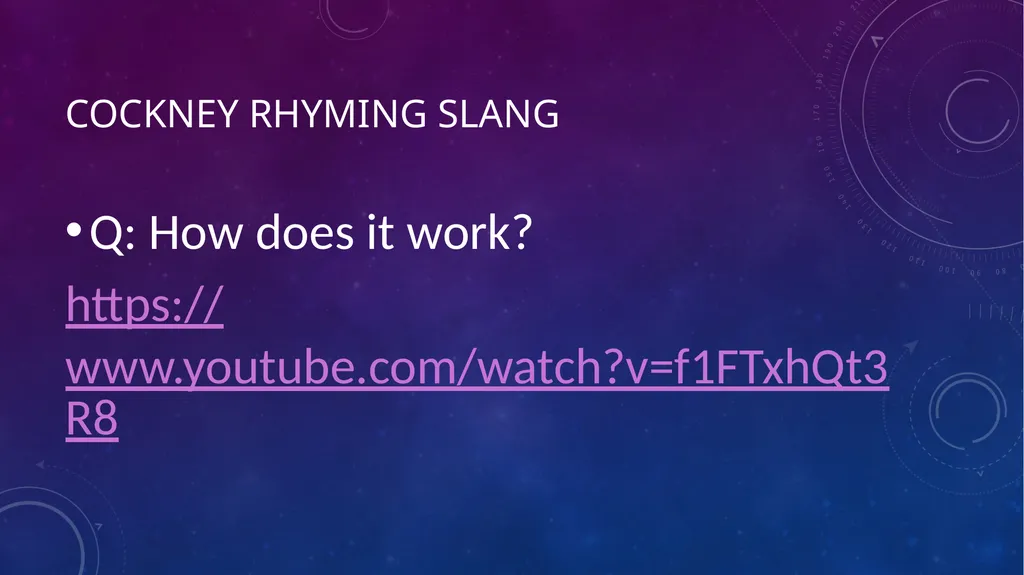
Cockney Rhyming Slang Q: How does it work?
https://www.youtube.com/watch?v=f1FTxhQt3R8<br>
https://www.youtube.com/watch?v=f1FTxhQt3R8<br>
39
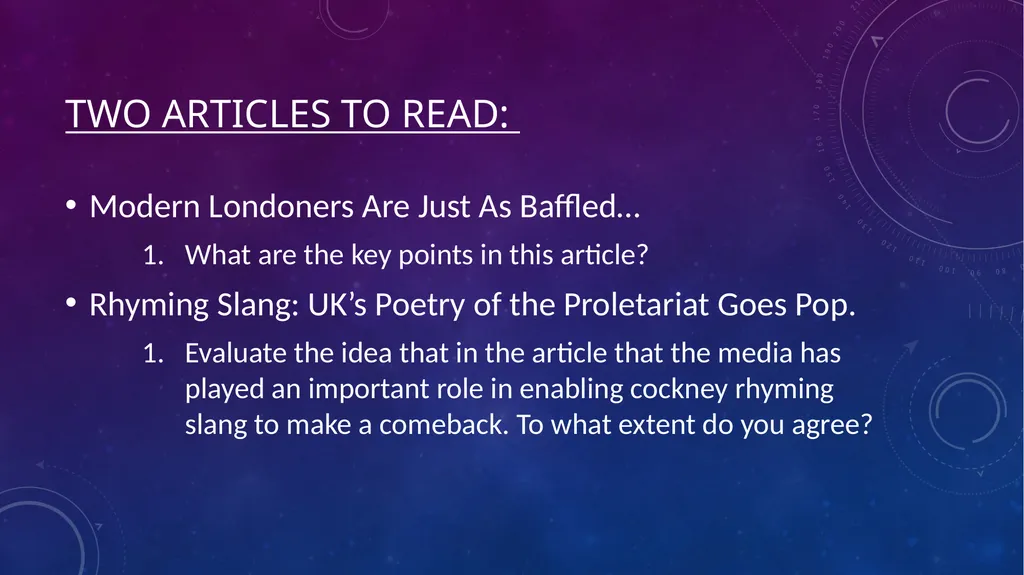
Two Articles to Read: Modern Londoners Are Just As Baffled…
What are the key points in this article?
Rhyming Slang: UK’s Poetry of the Proletariat Goes Pop.
Evaluate the idea that in the article that the media has played an important role in enabling cockney rhyming slang to make a comeback. To what extent do you agree?<br>
What are the key points in this article?
Rhyming Slang: UK’s Poetry of the Proletariat Goes Pop.
Evaluate the idea that in the article that the media has played an important role in enabling cockney rhyming slang to make a comeback. To what extent do you agree?<br>
40
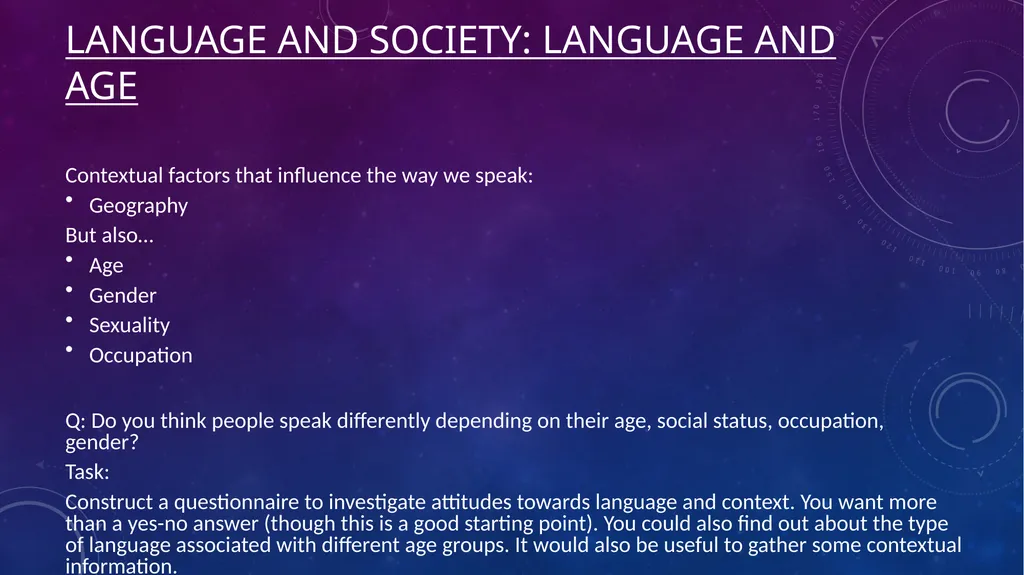
Language and Society: Language and Age Contextual factors that influence the way we speak:
Geography
But also…
Age
Gender
Sexuality
Occupation
Q: Do you think people speak differently depending on their age, social status, occupation, gender?
Task:
Construct a questionnaire to investigate attitudes towards language and context. You want more than a yes-no answer (though this is a good starting point). You could also find out about the type of language associated with different age groups. It would also be useful to gather some contextual information.
Meet back in this room in 20 minutes.<br>
Geography
But also…
Age
Gender
Sexuality
Occupation
Q: Do you think people speak differently depending on their age, social status, occupation, gender?
Task:
Construct a questionnaire to investigate attitudes towards language and context. You want more than a yes-no answer (though this is a good starting point). You could also find out about the type of language associated with different age groups. It would also be useful to gather some contextual information.
Meet back in this room in 20 minutes.<br>
41
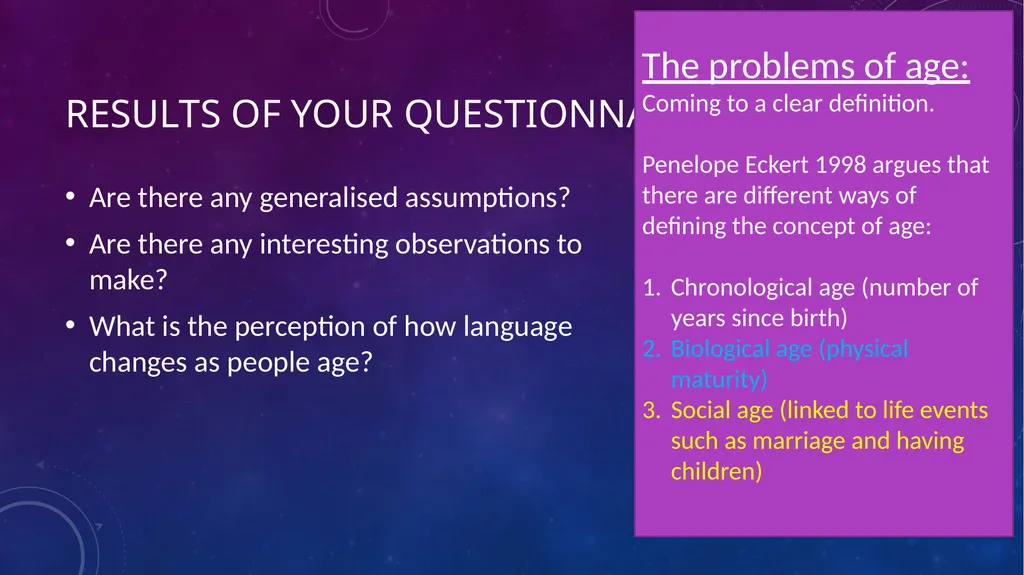
Results of your questionnaire: Are there any generalised assumptions?
Are there any interesting observations to make?
What is the perception of how language changes as people age? The problems of age:
Coming to a clear definition.
Penelope Eckert 1998 argues that there are different ways of defining the concept of age:
Chronological age (number of years since birth)
Biological age (physical maturity)
Social age (linked to life events such as marriage and having children)<br>
Are there any interesting observations to make?
What is the perception of how language changes as people age? The problems of age:
Coming to a clear definition.
Penelope Eckert 1998 argues that there are different ways of defining the concept of age:
Chronological age (number of years since birth)
Biological age (physical maturity)
Social age (linked to life events such as marriage and having children)<br>
42
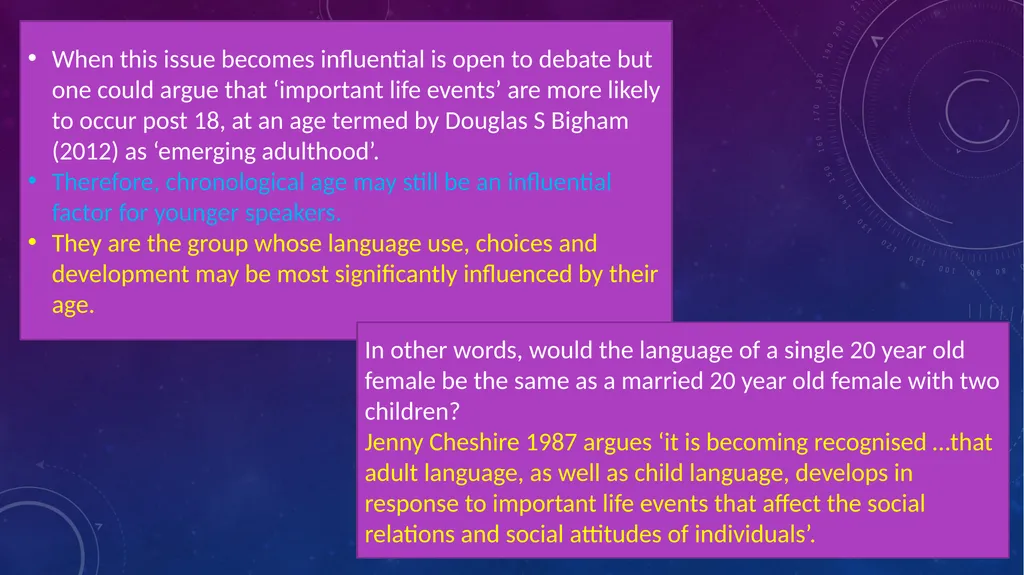
When this issue becomes influential is open to debate but one could argue that ‘important life events’ are more likely to occur post 18, at an age termed by Douglas S Bigham (2012) as ‘emerging adulthood’.
Therefore, chronological age may still be an influential factor for younger speakers.
They are the group whose language use, choices and development may be most significantly influenced by their age. In other words, would the language of a single 20 year old female be the same as a married 20 year old female with two children?
Jenny Cheshire 1987 argues ‘it is becoming recognised …that adult language, as well as child language, develops in response to important life events that affect the social relations and social attitudes of individuals’.<br>
Therefore, chronological age may still be an influential factor for younger speakers.
They are the group whose language use, choices and development may be most significantly influenced by their age. In other words, would the language of a single 20 year old female be the same as a married 20 year old female with two children?
Jenny Cheshire 1987 argues ‘it is becoming recognised …that adult language, as well as child language, develops in response to important life events that affect the social relations and social attitudes of individuals’.<br>
43
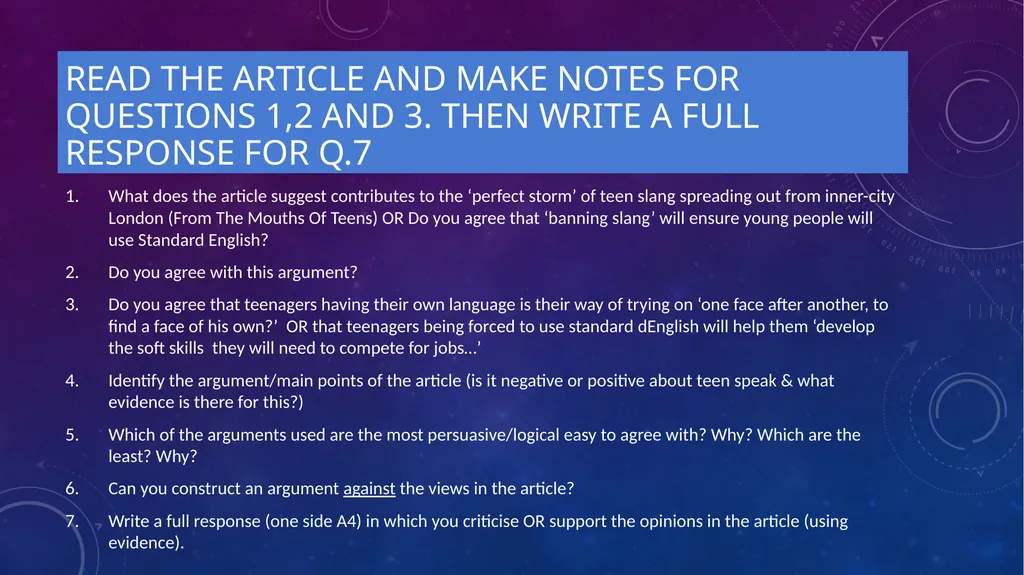
Read the article and make notes for questions 1,2 and 3. Then Write a Full response for q.7 What does the article suggest contributes to the ‘perfect storm’ of teen slang spreading out from inner-city London (From The Mouths Of Teens) OR Do you agree that ‘banning slang’ will ensure young people will use Standard English?
Do you agree with this argument?
Do you agree that teenagers having their own language is their way of trying on ‘one face after another, to find a face of his own?’ OR that teenagers being forced to use standard dEnglish will help them ‘develop the soft skills they will need to compete for jobs…’
Identify the argument/main points of the article (is it negative or positive about teen speak & what evidence is there for this?)
Which of the arguments used are the most persuasive/logical easy to agree with? Why? Which are the least? Why?
Can you construct an argument against the views in the article?
Write a full response (one side A4) in which you criticise OR support the opinions in the article (using evidence).<br>
Do you agree with this argument?
Do you agree that teenagers having their own language is their way of trying on ‘one face after another, to find a face of his own?’ OR that teenagers being forced to use standard dEnglish will help them ‘develop the soft skills they will need to compete for jobs…’
Identify the argument/main points of the article (is it negative or positive about teen speak & what evidence is there for this?)
Which of the arguments used are the most persuasive/logical easy to agree with? Why? Which are the least? Why?
Can you construct an argument against the views in the article?
Write a full response (one side A4) in which you criticise OR support the opinions in the article (using evidence).<br>
44
Current Research on Language and age in speech Cut out and glue table 15f into your notes.
Highlight linguistic terms and examples in the table.
Read the other sections of the photocopy and highlight the specific language features referred to.
Make a note of the theorists referred to and their research/claims.
Make a new table and write in features commonly found in the two types of spoken language (adult/teen). P11: Using an editorial style, write an opinion piece, suitable for a sixth form blog, investigating age and language. Suitable for publication. Flamboyant. 500-800 words. https://www.youtube.com/watch?v=ItODnX5geCM David Crystal<br>
Highlight linguistic terms and examples in the table.
Read the other sections of the photocopy and highlight the specific language features referred to.
Make a note of the theorists referred to and their research/claims.
Make a new table and write in features commonly found in the two types of spoken language (adult/teen). P11: Using an editorial style, write an opinion piece, suitable for a sixth form blog, investigating age and language. Suitable for publication. Flamboyant. 500-800 words. https://www.youtube.com/watch?v=ItODnX5geCM David Crystal<br>
45
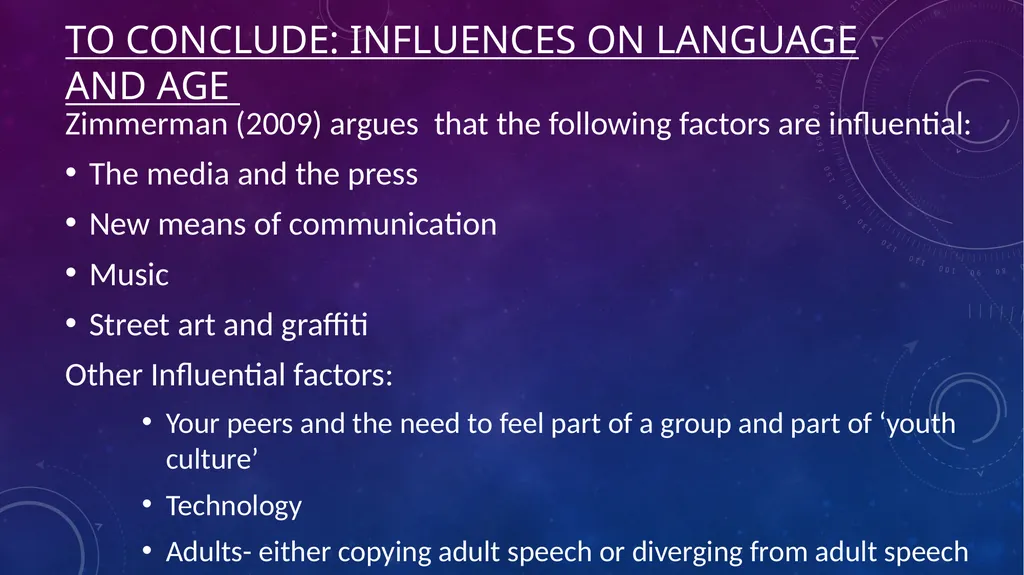
To conclude: Influences on language and age Zimmerman (2009) argues that the following factors are influential:
The media and the press
New means of communication
Music
Street art and graffiti
Other Influential factors:
Your peers and the need to feel part of a group and part of ‘youth culture’
Technology
Adults- either copying adult speech or diverging from adult speech<br>
The media and the press
New means of communication
Music
Street art and graffiti
Other Influential factors:
Your peers and the need to feel part of a group and part of ‘youth culture’
Technology
Adults- either copying adult speech or diverging from adult speech<br>
46
The Teens Who can barely talk Answer questions 1-4 ‘Reflecting on and evaluating the article’.<br>
47
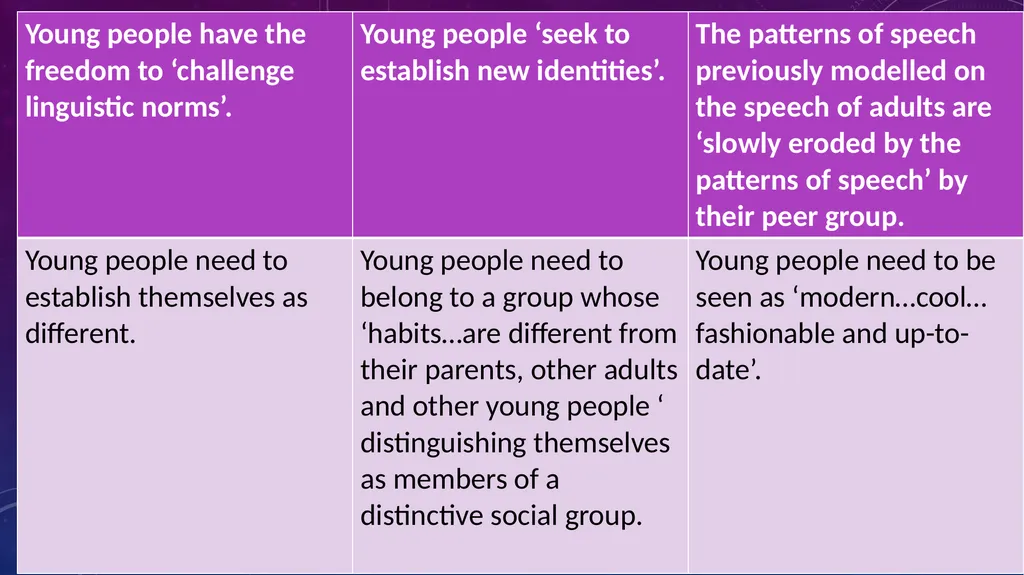
Vivian de Klerk (2005) draws several conclusions about TEEN language: Do you agree/disagree? Why?
Looking at the quote you have been given, what does it mean in your own words?
Can you think of an example to illustrate the conclusion? What influences teen language?<br>
Looking at the quote you have been given, what does it mean in your own words?
Can you think of an example to illustrate the conclusion? What influences teen language?<br>
48
How texting is changing the language https://youtu.be/P2XVdDSJHqY
https://www.youtube.com/watch?v=Boj8VYzDAy8<br>
https://www.youtube.com/watch?v=Boj8VYzDAy8<br>
49
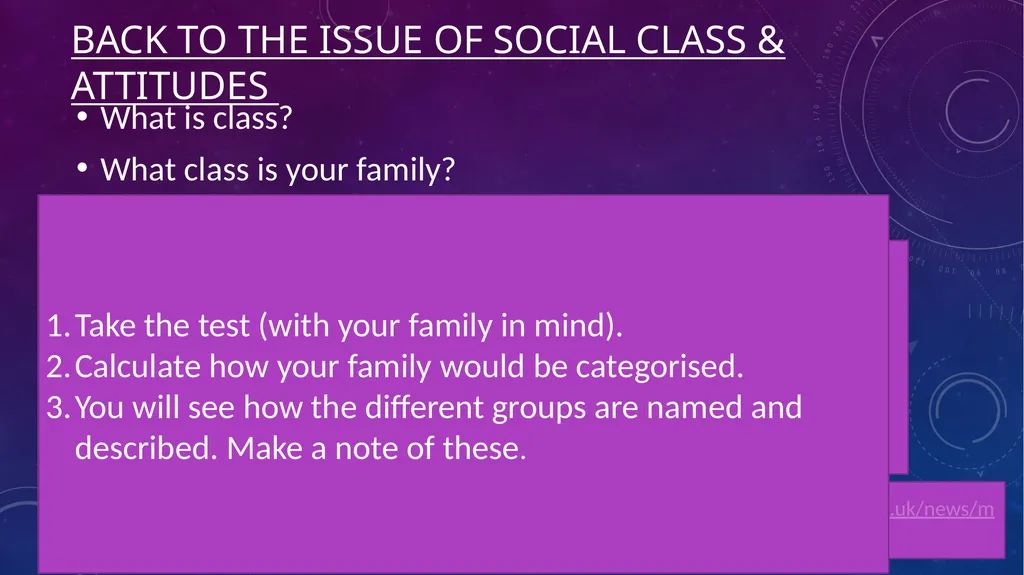
Back to the issue of social class & Attitudes What is class?
What class is your family? 2013 BBC collaboration with LSE and York and Manchester Universities to come up with a new system of categories basing their work on a survey of 161, 000 people. In this new system, the following aspects are key factors: http://www.bbc.co.uk/news/magazine-22000973 Take the test (with your family in mind).
Calculate how your family would be categorised.
You will see how the different groups are named and described. Make a note of these.<br>
What class is your family? 2013 BBC collaboration with LSE and York and Manchester Universities to come up with a new system of categories basing their work on a survey of 161, 000 people. In this new system, the following aspects are key factors: http://www.bbc.co.uk/news/magazine-22000973 Take the test (with your family in mind).
Calculate how your family would be categorised.
You will see how the different groups are named and described. Make a note of these.<br>
50
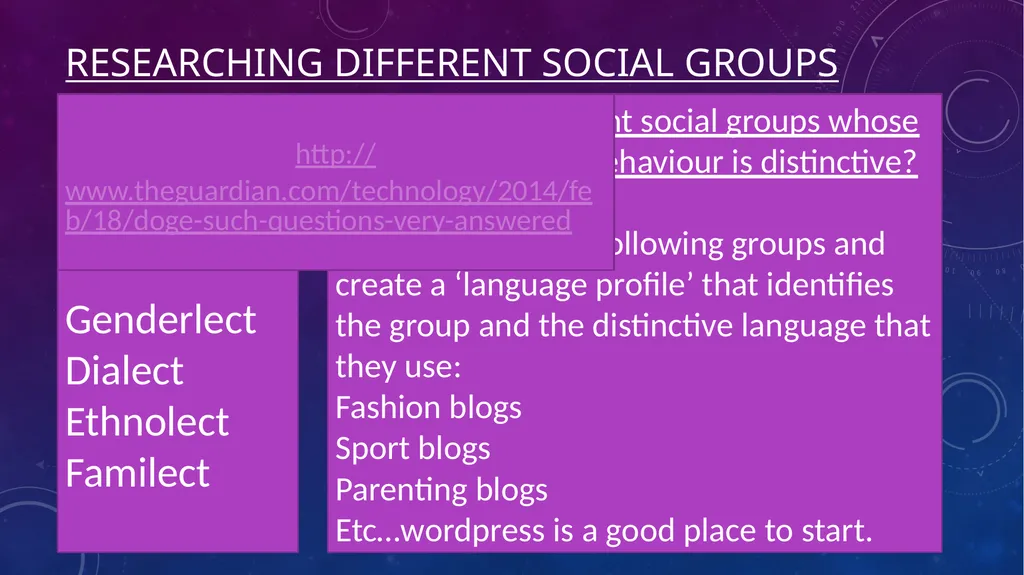
Researching different social groups ‘lect’ words:
Genderlect
Dialect
Ethnolect
Familect Q: Are there different social groups whose language use and behaviour is distinctive?
Choose one of the following groups and create a ‘language profile’ that identifies the group and the distinctive language that they use:
Fashion blogs
Sport blogs
Parenting blogs
Etc…wordpress is a good place to start. http://www.theguardian.com/technology/2014/feb/18/doge-such-questions-very-answered<br>
Genderlect
Dialect
Ethnolect
Familect Q: Are there different social groups whose language use and behaviour is distinctive?
Choose one of the following groups and create a ‘language profile’ that identifies the group and the distinctive language that they use:
Fashion blogs
Sport blogs
Parenting blogs
Etc…wordpress is a good place to start. http://www.theguardian.com/technology/2014/feb/18/doge-such-questions-very-answered<br>
51
Regional dialect- emerging variations Apparent rise in the use of Cockney rhyming slang.
Great Britain has also seen a rise in other, ‘newer’ dialects, which are also strongly associated with the ways that speakers want to project a sense of identity.
In addition to well known dialects such as Scouse and Geordie, certain areas of the country have seen completely new dialects emerge.<br>
Great Britain has also seen a rise in other, ‘newer’ dialects, which are also strongly associated with the ways that speakers want to project a sense of identity.
In addition to well known dialects such as Scouse and Geordie, certain areas of the country have seen completely new dialects emerge.<br>
52
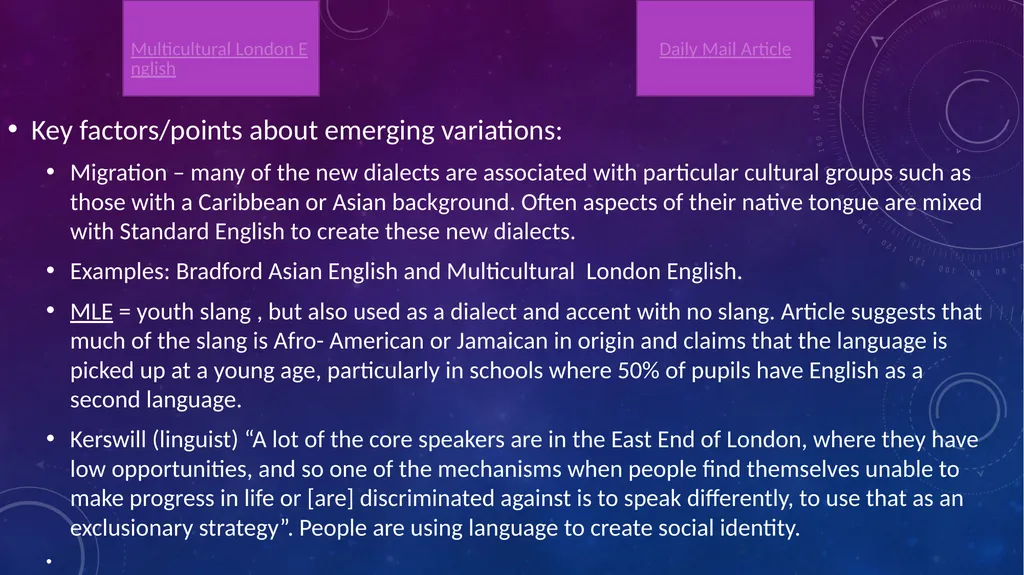
Key factors/points about emerging variations:
Migration – many of the new dialects are associated with particular cultural groups such as those with a Caribbean or Asian background. Often aspects of their native tongue are mixed with Standard English to create these new dialects.
Examples: Bradford Asian English and Multicultural London English.
MLE = youth slang , but also used as a dialect and accent with no slang. Article suggests that much of the slang is Afro- American or Jamaican in origin and claims that the language is picked up at a young age, particularly in schools where 50% of pupils have English as a second language.
Kerswill (linguist) “A lot of the core speakers are in the East End of London, where they have low opportunities, and so one of the mechanisms when people find themselves unable to make progress in life or [are] discriminated against is to speak differently, to use that as an exclusionary strategy”. People are using language to create social identity. Multicultural London English Daily Mail Article<br>
Migration – many of the new dialects are associated with particular cultural groups such as those with a Caribbean or Asian background. Often aspects of their native tongue are mixed with Standard English to create these new dialects.
Examples: Bradford Asian English and Multicultural London English.
MLE = youth slang , but also used as a dialect and accent with no slang. Article suggests that much of the slang is Afro- American or Jamaican in origin and claims that the language is picked up at a young age, particularly in schools where 50% of pupils have English as a second language.
Kerswill (linguist) “A lot of the core speakers are in the East End of London, where they have low opportunities, and so one of the mechanisms when people find themselves unable to make progress in life or [are] discriminated against is to speak differently, to use that as an exclusionary strategy”. People are using language to create social identity. Multicultural London English Daily Mail Article<br>
53
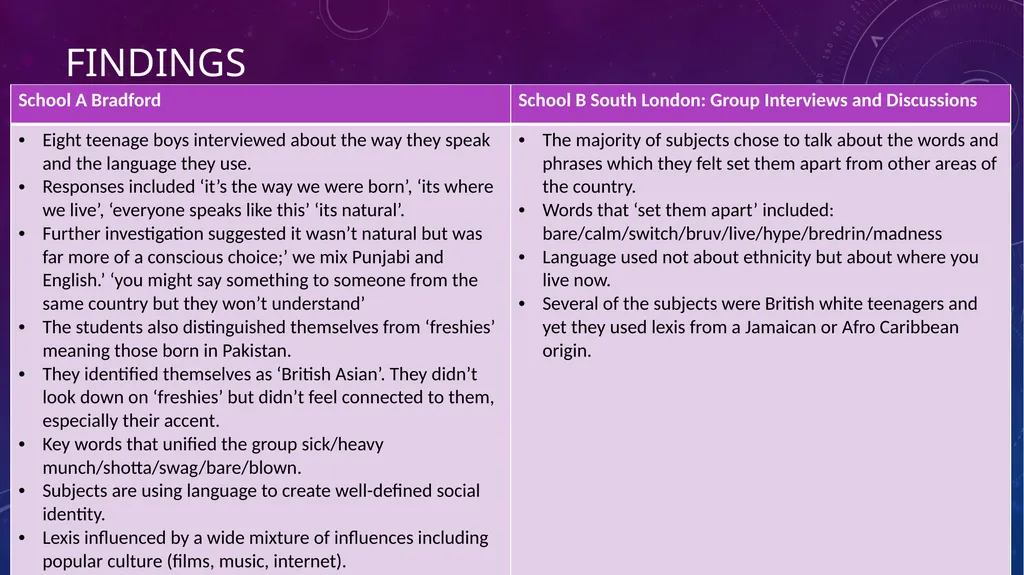
Bradford Asian English Growing use of code-switching in which speakers alternate their first and second languages: English and, most commonly, Punjabi.
Gary Ives (2014) commissioned two different case studies to be carried out in London and Bradford.<br>
Gary Ives (2014) commissioned two different case studies to be carried out in London and Bradford.<br>
54
Findings<br>
55
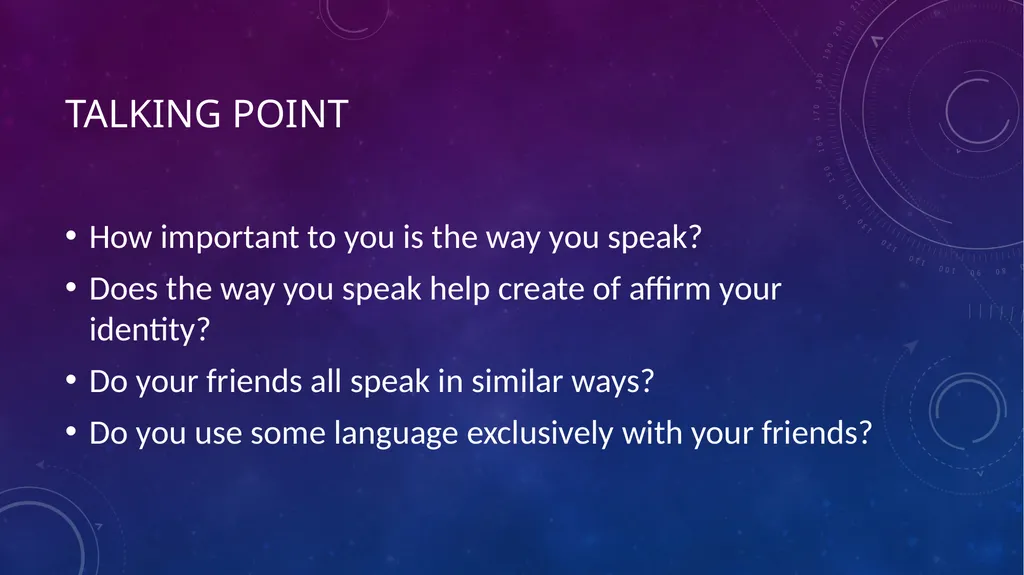
Talking Point How important to you is the way you speak?
Does the way you speak help create of affirm your identity?
Do your friends all speak in similar ways?
Do you use some language exclusively with your friends?<br>
Does the way you speak help create of affirm your identity?
Do your friends all speak in similar ways?
Do you use some language exclusively with your friends?<br>
56
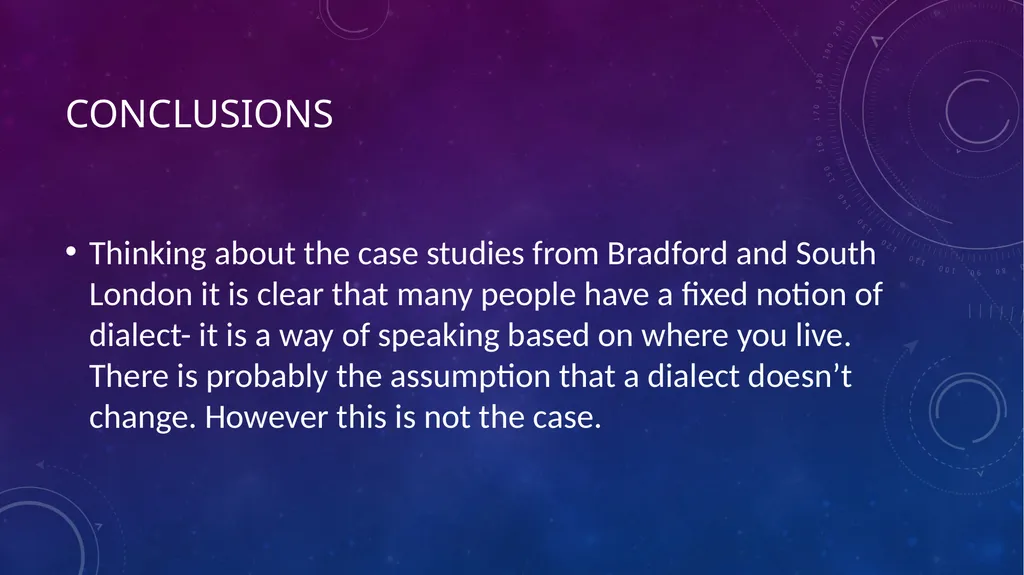
Conclusions Thinking about the case studies from Bradford and South London it is clear that many people have a fixed notion of dialect- it is a way of speaking based on where you live. There is probably the assumption that a dialect doesn’t change. However this is not the case.<br>
57
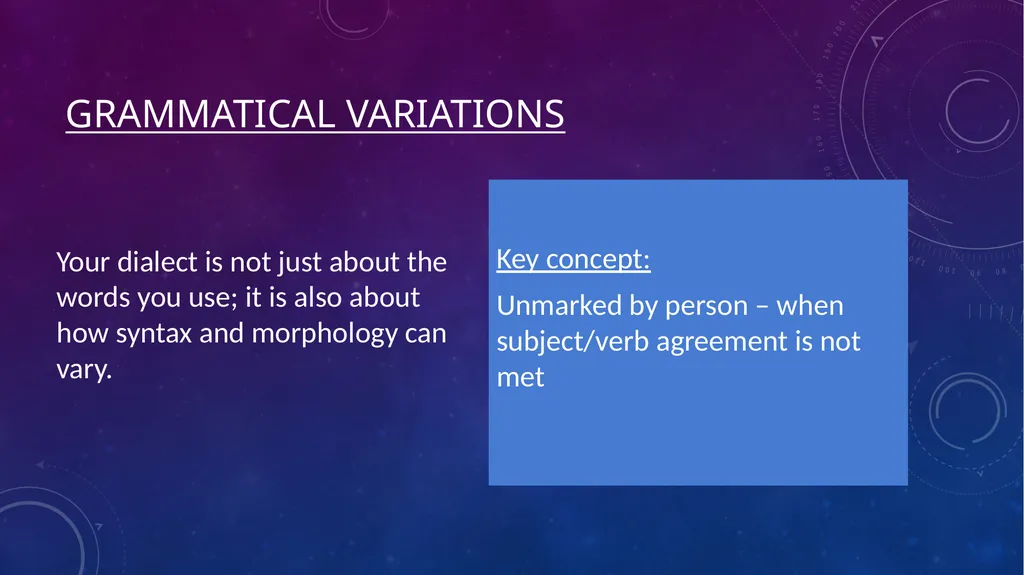
Grammatical variations Your dialect is not just about the words you use; it is also about how syntax and morphology can vary. Key concept:
Unmarked by person – when subject/verb agreement is not met<br>
Unmarked by person – when subject/verb agreement is not met<br>
58
‘sorry I were late’/its’ ok you was late yesterday too’ Non- standard utterance
Typical of some dialects in the North and Midlands
The replacement of ‘was’ by ‘were’ is commonplace.
Uses the past tense form of the verb ‘to be’ in all grammatical constructions: I were/you were/ etc. this is unmarked by person.
Similarly, some dialects in the South East of England also use the unmarked version but instead use the singular form: I was/you was/he/she/it was Read the A3 sheet with further examples of dialect/grammar variations.
Further reading:
http://www.universalteacher.org.uk/lang/britishisles.htm#othercultures<br>
Typical of some dialects in the North and Midlands
The replacement of ‘was’ by ‘were’ is commonplace.
Uses the past tense form of the verb ‘to be’ in all grammatical constructions: I were/you were/ etc. this is unmarked by person.
Similarly, some dialects in the South East of England also use the unmarked version but instead use the singular form: I was/you was/he/she/it was Read the A3 sheet with further examples of dialect/grammar variations.
Further reading:
http://www.universalteacher.org.uk/lang/britishisles.htm#othercultures<br>
59
Language and Society: Accent and dialect Lesley Milroy-Belfast Studies
William Labov- The Social Stratification of English in New York City. 1966
Workman studies 2008. People’s perceptions of different accents
Peter Trudgill- Norwich studies-1974 Negative and positive connotations of RP.
Convergence and divergence.
Difference between accent and dialect.
Attitudes towards different accents and dialects (identify positive/negative).
How people change accents & dialects. Why people might take elocution lessons etc.
Ideas around overt and covert prestige On group tables, discuss and make sure everyone knows and understands… Homework: research and fill knowledge gaps. Short test next week Key Terms To Memorise
Accent
Dialect
Standard English
Non standard English
Convergence
Divergence
Covert prestige
Overt prestige
Received Pronunciation
Sociolect
Idiolect<br>
William Labov- The Social Stratification of English in New York City. 1966
Workman studies 2008. People’s perceptions of different accents
Peter Trudgill- Norwich studies-1974 Negative and positive connotations of RP.
Convergence and divergence.
Difference between accent and dialect.
Attitudes towards different accents and dialects (identify positive/negative).
How people change accents & dialects. Why people might take elocution lessons etc.
Ideas around overt and covert prestige On group tables, discuss and make sure everyone knows and understands… Homework: research and fill knowledge gaps. Short test next week Key Terms To Memorise
Accent
Dialect
Standard English
Non standard English
Convergence
Divergence
Covert prestige
Overt prestige
Received Pronunciation
Sociolect
Idiolect<br>