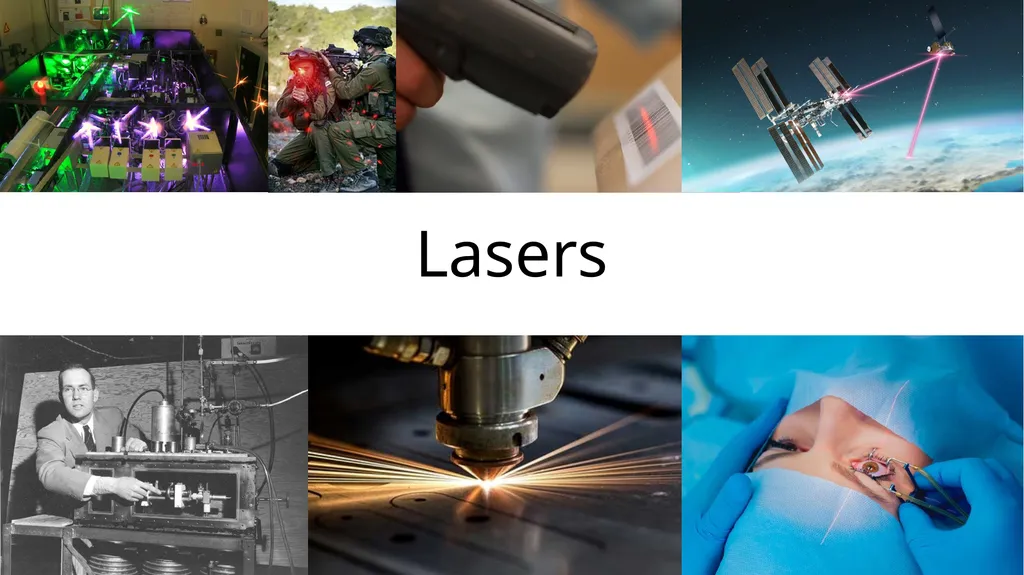
Lasers Properties of Laser Light Light Amplification by Stimulated Emission of Radiation Laser photons have the same wavelength travel in the same direction are in phase Thus, laser light can be monochromatic (one wavelength) coherent
"Lasers Properties of Laser Light Light" is the property of its rightful owner. Permission is granted to
download and print the materials on this website for personal, non-commercial use only, and to display it
on your personal computer provided you do not modify the materials and that you retain all copyright
notices contained in the materials. By downloading content from our website, you accept the terms of this
agreement.
Presentation Transcript
01
Lasers<br>
02
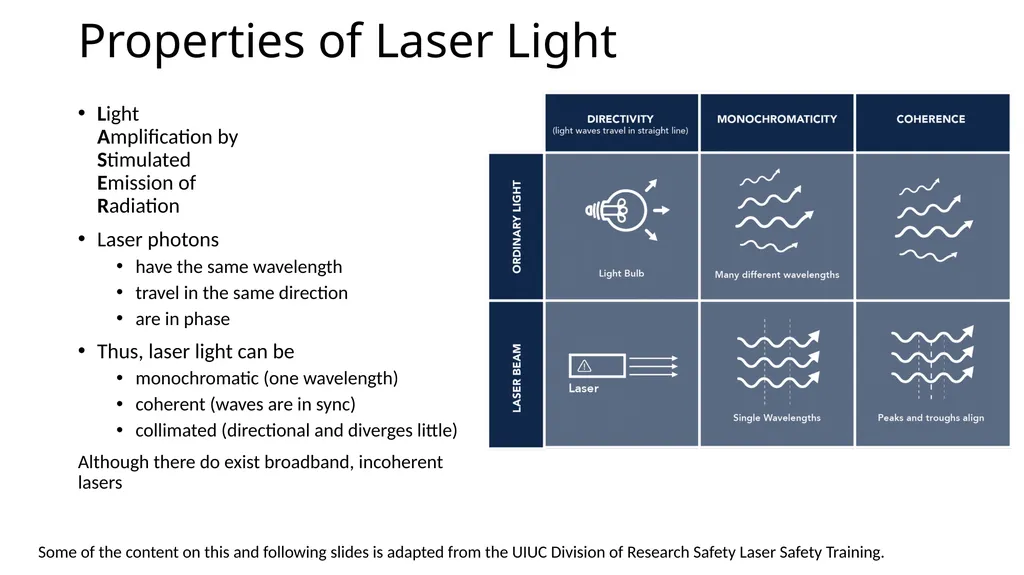
Properties of Laser Light Light Amplification by Stimulated Emission of Radiation
Laser photons
have the same wavelength
travel in the same direction
are in phase
Thus, laser light can be
monochromatic (one wavelength)
coherent (waves are in sync)
collimated (directional and diverges little)
Although there do exist broadband, incoherent lasers Some of the content on this and following slides is adapted from the UIUC Division of Research Safety Laser Safety Training.<br>
03
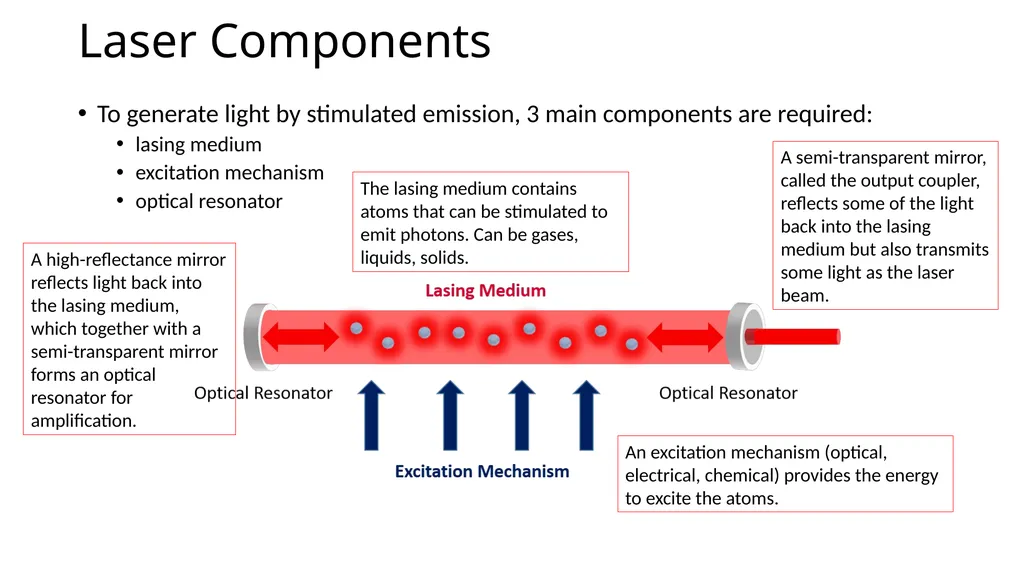
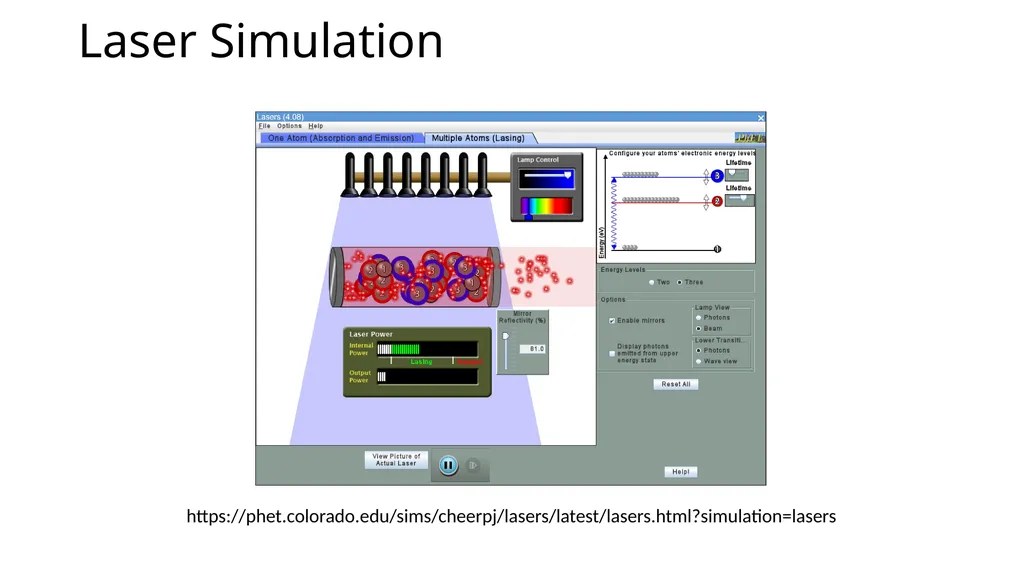
Laser Components To generate light by stimulated emission, 3 main components are required:
lasing medium
excitation mechanism
optical resonator The lasing medium contains atoms that can be stimulated to emit photons. Can be gases, liquids, solids. A high-reflectance mirror reflects light back into the lasing medium, which together with a semi-transparent mirror forms an optical resonator for amplification. An excitation mechanism (optical, electrical, chemical) provides the energy to excite the atoms. A semi-transparent mirror, called the output coupler, reflects some of the light back into the lasing medium but also transmits some light as the laser beam.<br>
04
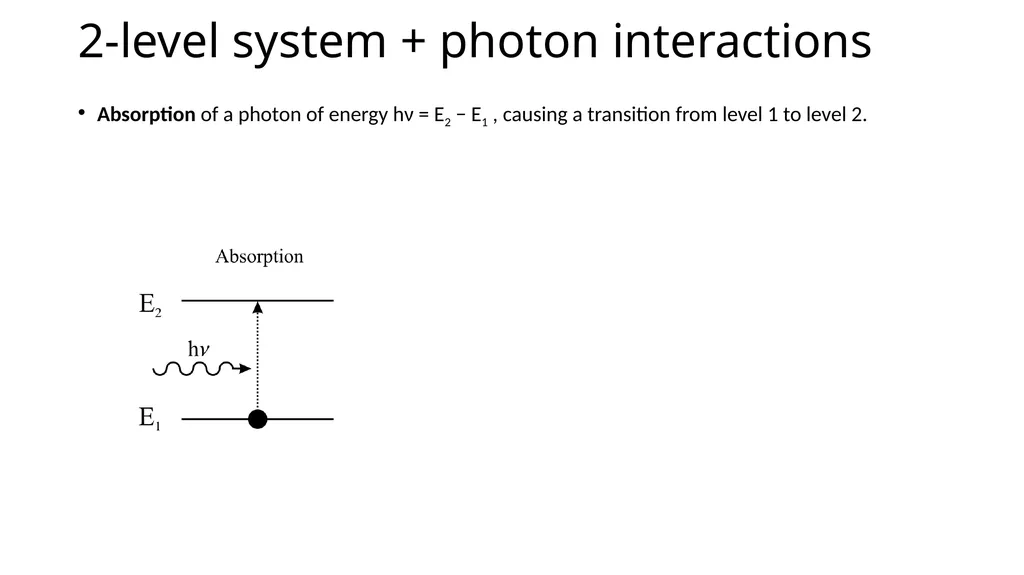
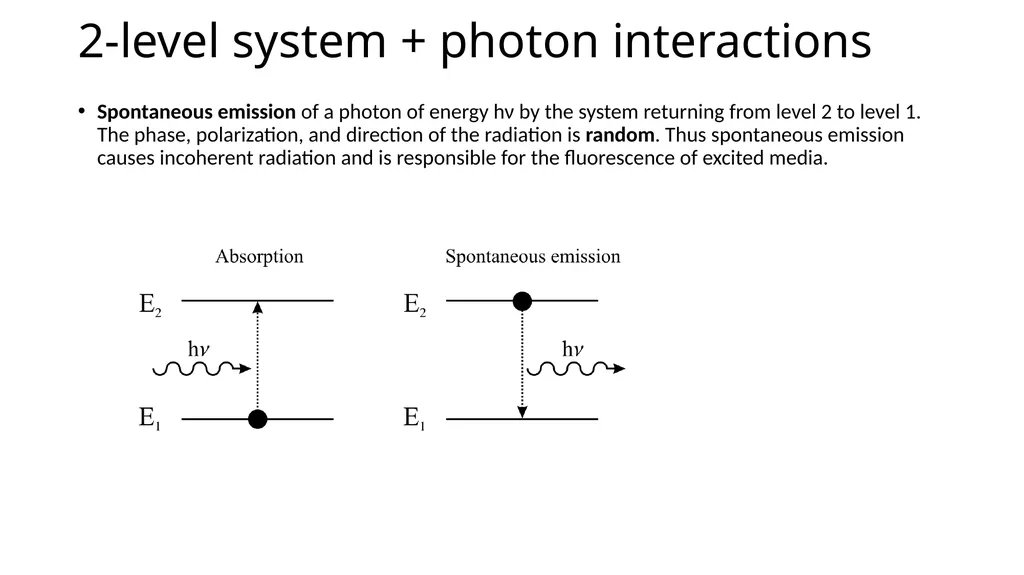
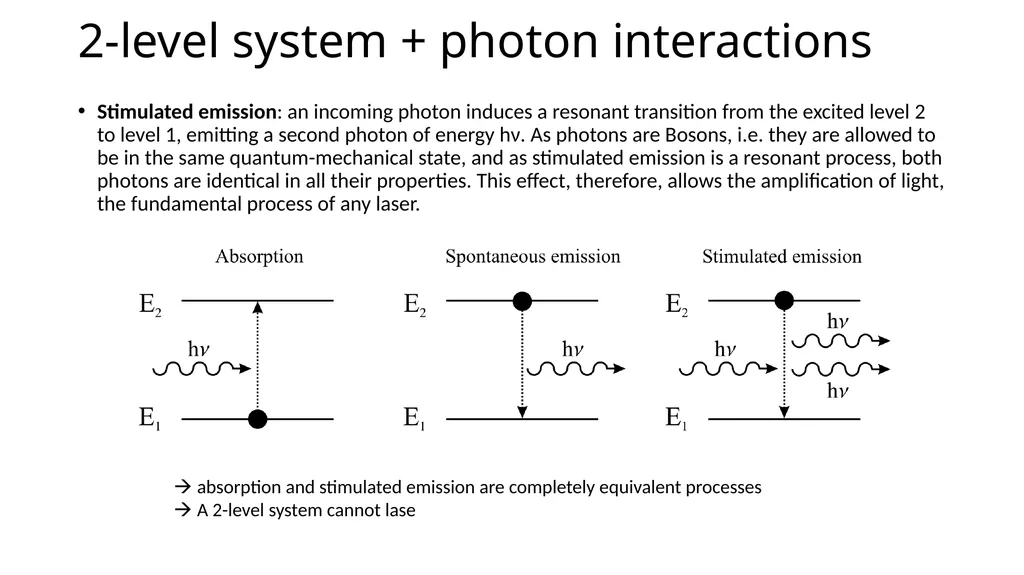
2-level system + photon interactions Absorption of a photon of energy hν = E2 − E1 , causing a transition from level 1 to level 2.<br>
05
2-level system + photon interactions Spontaneous emission of a photon of energy hν by the system returning from level 2 to level 1. The phase, polarization, and direction of the radiation is random. Thus spontaneous emission causes incoherent radiation and is responsible for the fluorescence of excited media.<br>
06
2-level system + photon interactions Stimulated emission: an incoming photon induces a resonant transition from the excited level 2 to level 1, emitting a second photon of energy hν. As photons are Bosons, i.e. they are allowed to be in the same quantum-mechanical state, and as stimulated emission is a resonant process, both photons are identical in all their properties. This effect, therefore, allows the amplification of light, the fundamental process of any laser. absorption and stimulated emission are completely equivalent processes
A 2-level system cannot lase<br>
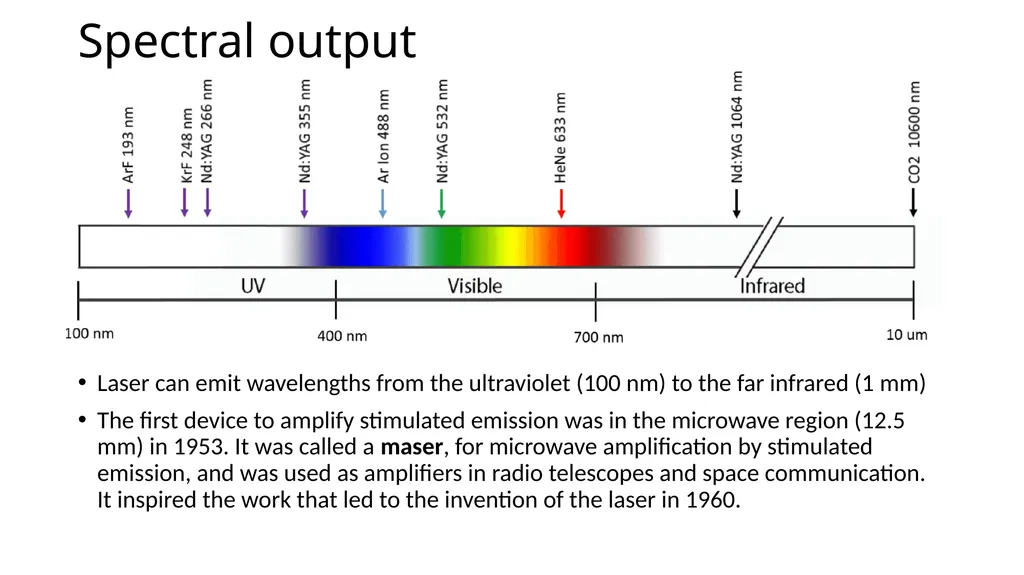
Spectral output Laser can emit wavelengths from the ultraviolet (100 nm) to the far infrared (1 mm)
The first device to amplify stimulated emission was in the microwave region (12.5 mm) in 1953. It was called a maser, for microwave amplification by stimulated emission, and was used as amplifiers in radio telescopes and space communication. It inspired the work that led to the invention of the laser in 1960.<br>
09
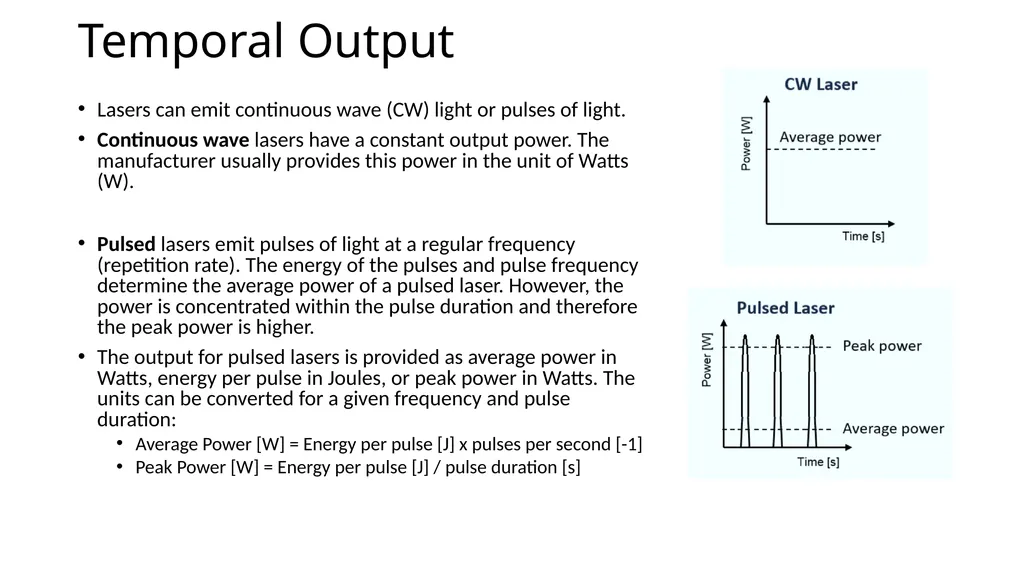
Temporal Output Lasers can emit continuous wave (CW) light or pulses of light.
Continuous wave lasers have a constant output power. The manufacturer usually provides this power in the unit of Watts (W).
Pulsed lasers emit pulses of light at a regular frequency (repetition rate). The energy of the pulses and pulse frequency determine the average power of a pulsed laser. However, the power is concentrated within the pulse duration and therefore the peak power is higher.
The output for pulsed lasers is provided as average power in Watts, energy per pulse in Joules, or peak power in Watts. The units can be converted for a given frequency and pulse duration:
Average Power [W] = Energy per pulse [J] x pulses per second [-1]
Peak Power [W] = Energy per pulse [J] / pulse duration [s]<br>
10
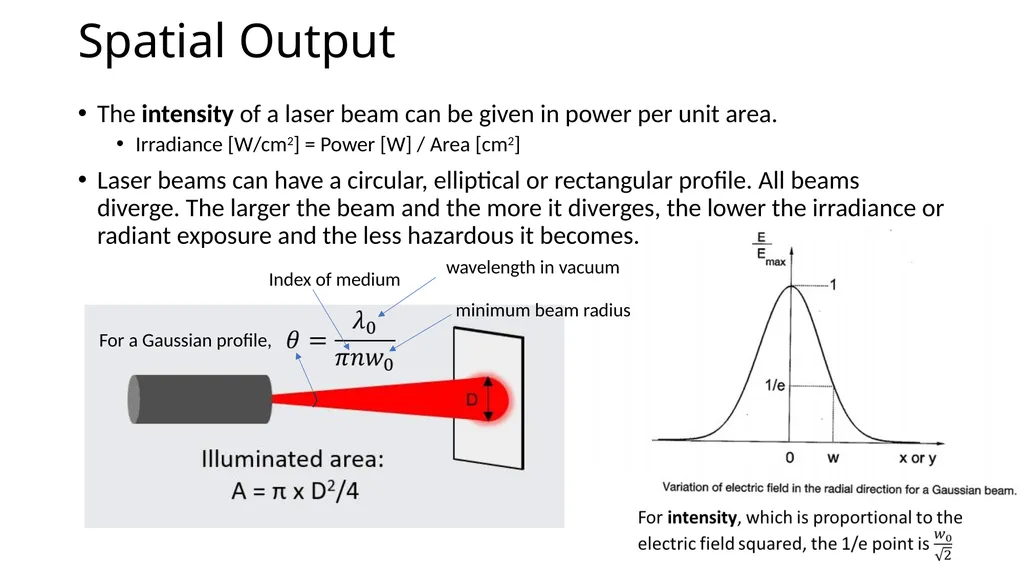
Spatial Output The intensity of a laser beam can be given in power per unit area.
Irradiance [W/cm2] = Power [W] / Area [cm2]
Laser beams can have a circular, elliptical or rectangular profile. All beams diverge. The larger the beam and the more it diverges, the lower the irradiance or radiant exposure and the less hazardous it becomes. Index of medium wavelength in vacuum minimum beam radius For a Gaussian profile,<br>
11
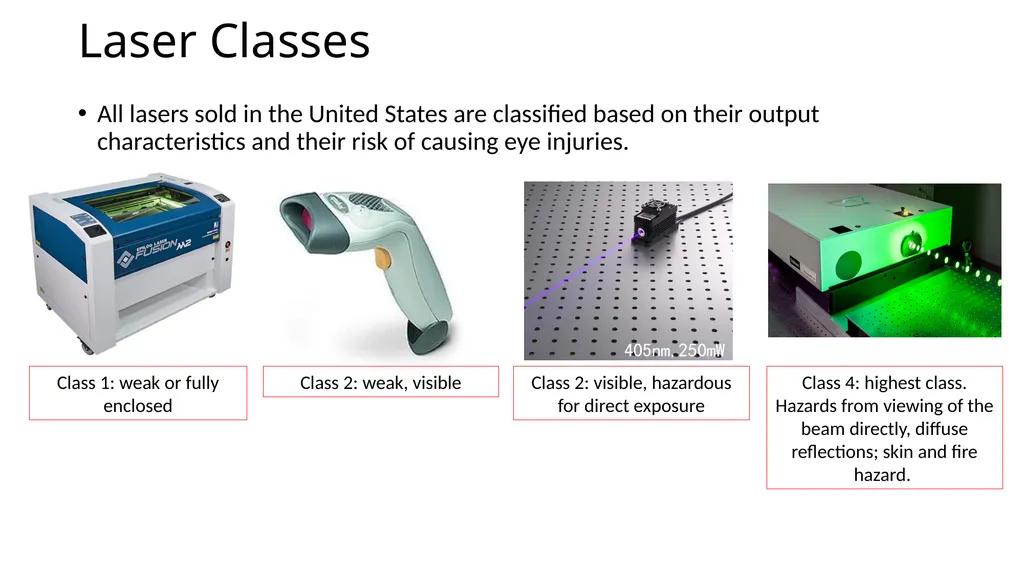
Laser Classes All lasers sold in the United States are classified based on their output characteristics and their risk of causing eye injuries. Class 1: weak or fully enclosed Class 2: weak, visible Class 2: visible, hazardous for direct exposure Class 4: highest class. Hazards from viewing of the beam directly, diffuse reflections; skin and fire hazard.<br>