
Law Enforcement Licensing AN OVERVIEW 1 SECTION I:







Description: Law Enforcement Licensing AN OVERVIEW 1 SECTION I: INTRODUCTION 2 Why Police Licensure? When does it take effect? Who Does it Effect? N.J.S.A. 52:17B-67.1 N.J.A.C. 13: 1-10.1 N.J.S.A. 52: 17B-1, et. Seq. N.J.S.A. 52:17B-66 N.J.A.C. 13:1-2.1
Related Topics
Download Presentation
"Law Enforcement Licensing AN OVERVIEW 1 SECTION I:" is the property of its rightful owner. Permission is granted to download and print the materials on this website for personal, non-commercial use only, and to display it on your personal computer provided you do not modify the materials and that you retain all copyright notices contained in the materials. By downloading content from our website, you accept the terms of this agreement.
Presentation Transcript
slide1. Law Enforcement Licensing AN OVERVIEW 1<br>
slide2. SECTION I:
INTRODUCTION 2<br>
slide3. Why Police Licensure? When does it take effect? Who Does it Effect? N.J.S.A. 52:17B-67.1 N.J.A.C. 13: 1-10.1 N.J.S.A. 52: 17B-1, et. Seq. N.J.S.A. 52:17B-66 N.J.A.C. 13:1-2.1 N.J.A.C. 13:1-21.1 The bill was signed into law on July 21, 2022, and with a few exceptions, the law and the regulations take effect on January 1, 2024.
The legislature found Licensure necessary for all sworn law enforcement officers in order to maintain professionalism and uphold public trust in law enforcement.
This means any person who is employed as a sworn member of any State, county or municipal law enforcement agency, department, division, or instrumentality of those governments who is statutorily empowered to act for the detection, investigation, arrest, conviction, detention or rehabilitation of persons violating the criminal laws of the State needs a license effective January 1, 2024. 3<br>
slide4. HOW LONG DOES A LICENSE LAST? N.J.S.A. 52: 17B-1, et. Seq. N.J.A.C. 13:1-20.1 A License is valid for 3 years from the date of issue.
All currently certified officers will receive a license on January 1, 2024.
The initial licensing period will stagger expiration dates in a manner determined by the PTC.
These licenses will be for 1, 2, or 3 years.
Initial licensing period shall not exceed 3 years.
The PTC will issue guidance for subsequent licensing intervals so that all of the approximately 38,000 law enforcement officers will not have to be renewed at the same time. 4<br>
slide5. Who Administers Licensing? N.J.S.A. 52:17B-71 N.J.A.C. 13:1-2.5 N.J.A.C. 13:1-2.6 The Police Training Commission
Originally created by the Police Training Act to facilitate education and training of LEOs
The PTC’s goal is to enhance professionalism, transparency, and accountability of law enforcement
Composed of representatives of various organizations
The AG is the Chairperson – Appoints an administrator
4 citizens of N.J. who are appointed by the Governor with the advice and consent of the state Senate. Their terms are for three years.
16 Other members include the PBA, FOP, NJSACOP, The NJSP, and the STFA.
Powers, Responsibilities, and duties now include, but are not limited to, administering law enforcement licensing and regulating all aspects of law enforcement training.<br>
slide6. N.J.S.A. 52:17B-71 N.J.A.C. 13:1-2.4 Do members of the PTC have to undergo training?
All members of the PTC must annually complete all training mandated by the Attorney General, including but not limited to, ethics and confidentiality training.
All newly appointed public members of the PTC must complete a course familiarizing them with relevant law enforcement training concepts, including but not limited to, use of force and internal affairs policy. 6<br>
slide7. N.J.S.A. 52:17B-70 N.J.S.A. 52:17B-71 N.J.A.C. 13:1-2.2 N.J.A.C. 13:1-2.6 What is the Licensing Committee?
The Licensing Committee administers licensing
Has at least seven members including AG and at least one public member;
Can review applications for licensing;
Request additional information to determine qualifications;
Make recommendations for adverse licensing action; and
May designate a hearing officer to conduct hearings<br>
slide8. SECTION II:
LICENSE REQUIREMENTS 8<br>
slide9. Who Notifies PTC of a New Appointments? N.J.S.A. 52: 17B-77.16(a) N.J.S.A. 52: 17B-71c N.J.A.C. 13: 1-11.2 N.J.A.C. 13: 1-11.3 The Appointing Authority makes the LEO appointment;
The Chief Law Enforcement Executive of an employing Law Enforcement Unit shall notify the PTC in writing of a LEO’s appointment to or employment with the LEO Unit.
NONA form will be absorbed into ACADIS
The LEO Unit is responsible for collecting, verifying, and maintaining all required licensing documentation
Completed application records must be maintained for at least 5 years
Ultimately, the Chief LEO Executive’s responsibility
Notification shall include the commencement date of such appointment or employment. 9<br>
slide10. Notification must be sent to School Director for New Hire Trainees N.J.S.A. 52: 17B-77.16a N.J.S.A. 52: 17B-71c N.J.A.C. 13:1-8.2 The amount of written notice that the Chief LEO Executive must provide the school director prior to the course beginning that LEO Unit has complied with its responsibilities pursuant to N.J.A.C. 13:1-8.1, et. seq. has increased from 10 days to 21 days.
If LEO Unit cannot comply, LEO Unit may make a written request to the Commission for an extension of time.
The extension request must state the reasons why an extension of time is needed.
Important to schedule hiring around beginning of academy class 10<br>
slide11. License Requirements: Screening Applicants N.J.S.A. 52: 17B-67.1 N.J.S.A. 52: 17B-71b N.J.S.A. 52: 17B-71c N.J.S.A. 52: 17B-71d N.J.A.C. 13: 1-10.2 N.J.A.C. 13: 1-11.2 In order to be licensed, the Applicant must satisfy the basic licensing requirements.
LEOs appointed on or after 1/1/24 must complete the initial licensing process.
LEOs appointed prior to 1/1/24 must complete the license renewal process.
If the Applicant does not satisfy the basic licensing requirements, they cannot be licensed.
BACKGROUND IS IMPORTANT 11<br>
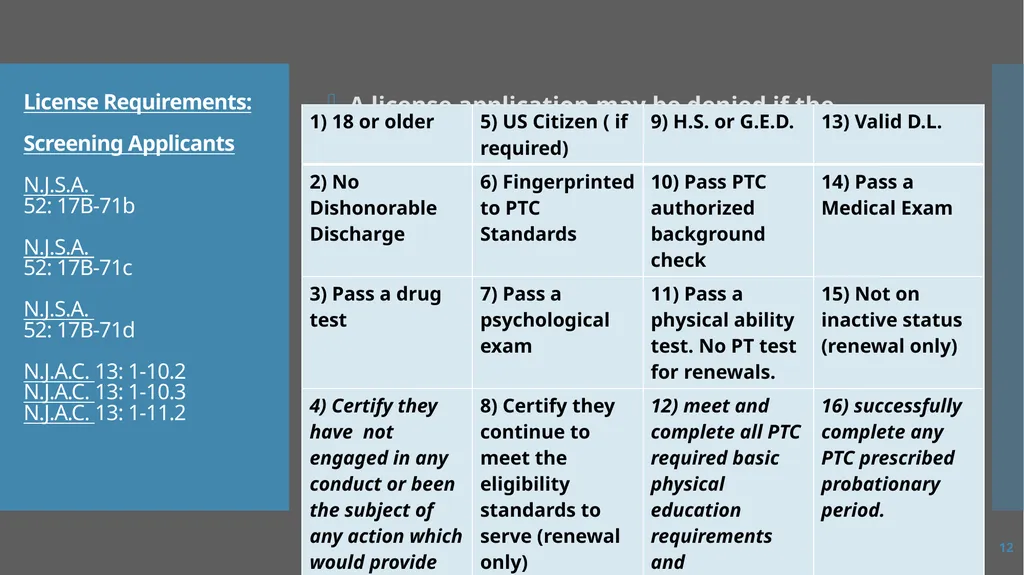
slide12. License Requirements: Screening Applicants N.J.S.A. 52: 17B-71b N.J.S.A. 52: 17B-71c N.J.S.A. 52: 17B-71d N.J.A.C. 13: 1-10.2 N.J.A.C. 13: 1-10.3 N.J.A.C. 13: 1-11.2 A license application may be denied if the applicant fails to meet any of the license requirements such as: 12<br>
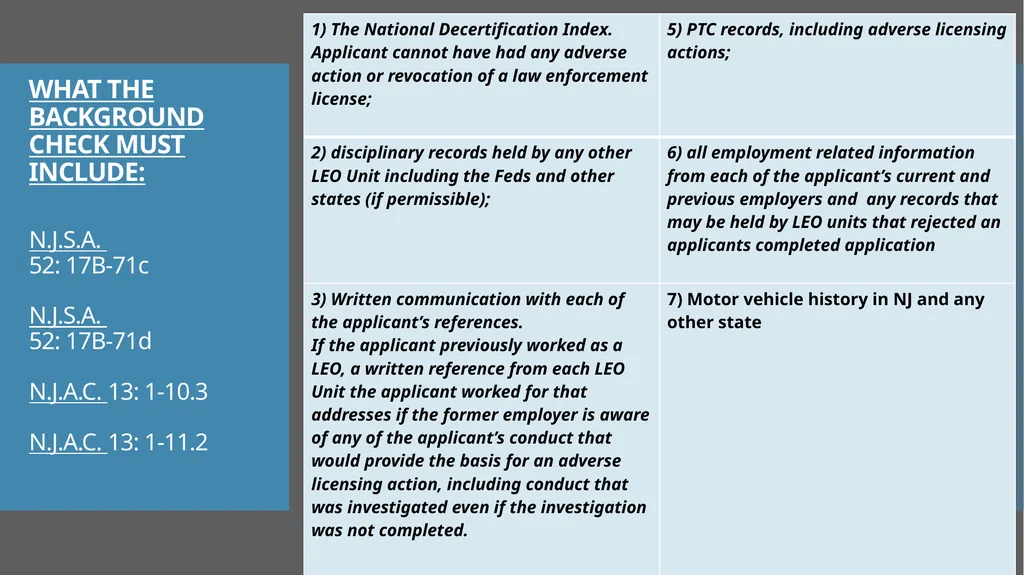
slide13. WHAT THE BACKGROUND CHECK MUST INCLUDE: N.J.S.A. 52: 17B-71c N.J.S.A. 52: 17B-71d N.J.A.C. 13: 1-10.3 N.J.A.C. 13: 1-11.2 . 13<br>
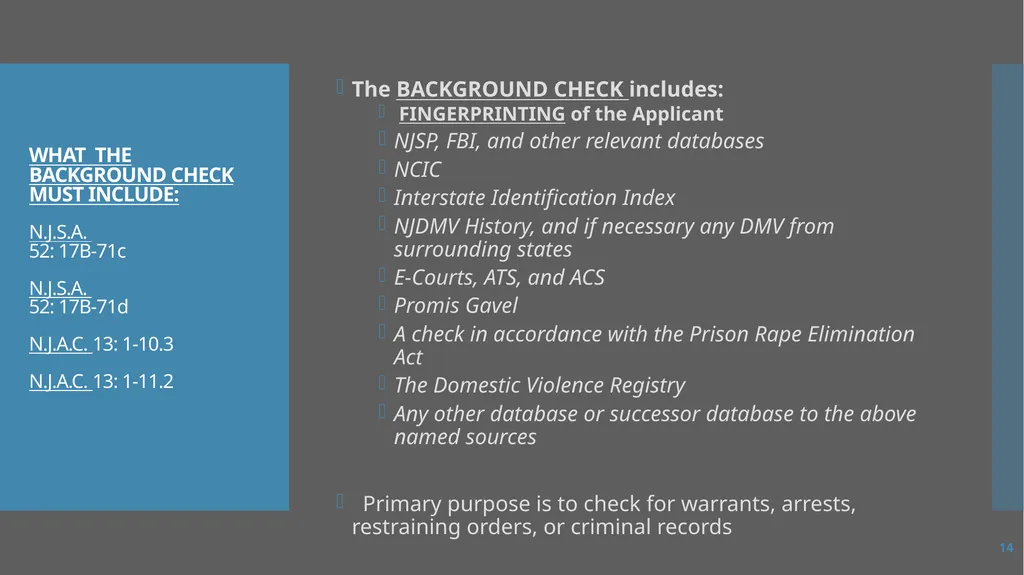
slide14. WHAT THE BACKGROUND CHECK MUST INCLUDE: N.J.S.A. 52: 17B-71c N.J.S.A. 52: 17B-71d N.J.A.C. 13: 1-10.3 N.J.A.C. 13: 1-11.2 The BACKGROUND CHECK includes:
FINGERPRINTING of the Applicant
NJSP, FBI, and other relevant databases
NCIC
Interstate Identification Index
NJDMV History, and if necessary any DMV from surrounding states
E-Courts, ATS, and ACS
Promis Gavel
A check in accordance with the Prison Rape Elimination Act
The Domestic Violence Registry
Any other database or successor database to the above named sources
Primary purpose is to check for warrants, arrests, restraining orders, or criminal records 14<br>
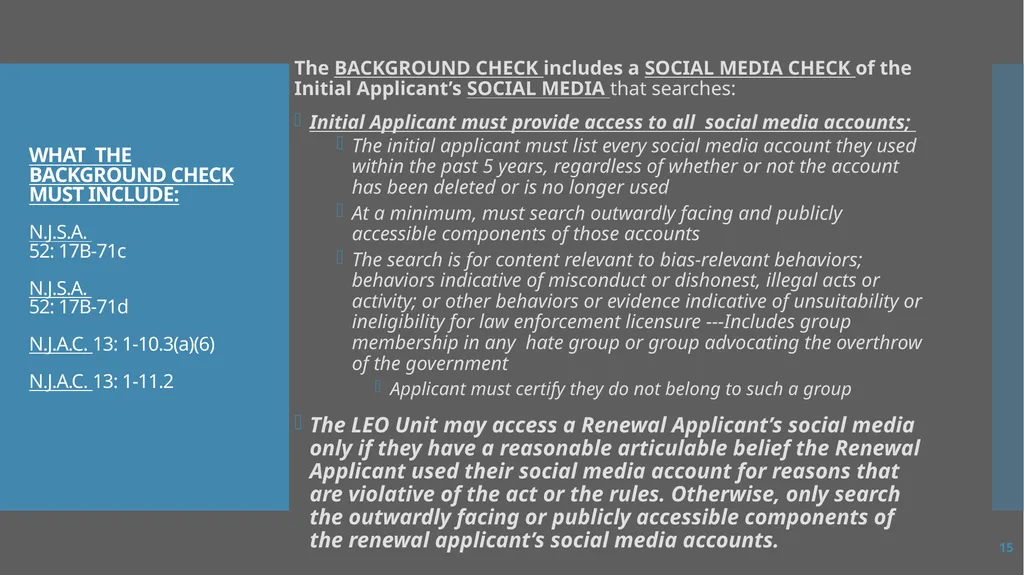
slide15. WHAT THE BACKGROUND CHECK MUST INCLUDE: N.J.S.A. 52: 17B-71c N.J.S.A. 52: 17B-71d N.J.A.C. 13: 1-10.3(a)(6) N.J.A.C. 13: 1-11.2 The BACKGROUND CHECK includes a SOCIAL MEDIA CHECK of the Initial Applicant’s SOCIAL MEDIA that searches:
Initial Applicant must provide access to all social media accounts;
The initial applicant must list every social media account they used within the past 5 years, regardless of whether or not the account has been deleted or is no longer used
At a minimum, must search outwardly facing and publicly accessible components of those accounts
The search is for content relevant to bias-relevant behaviors; behaviors indicative of misconduct or dishonest, illegal acts or activity; or other behaviors or evidence indicative of unsuitability or ineligibility for law enforcement licensure ---Includes group membership in any hate group or group advocating the overthrow of the government
Applicant must certify they do not belong to such a group
The LEO Unit may access a Renewal Applicant’s social media only if they have a reasonable articulable belief the Renewal Applicant used their social media account for reasons that are violative of the act or the rules. Otherwise, only search the outwardly facing or publicly accessible components of the renewal applicant’s social media accounts. 15<br>
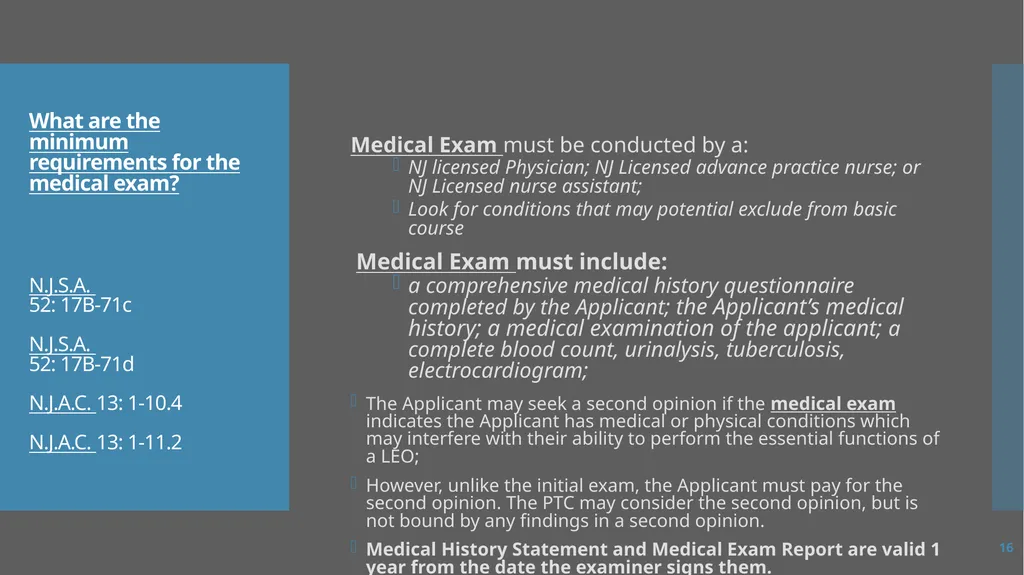
slide16. What are the minimum requirements for the medical exam? N.J.S.A. 52: 17B-71c N.J.S.A. 52: 17B-71d N.J.A.C. 13: 1-10.4 N.J.A.C. 13: 1-11.2 Medical Exam must be conducted by a:
NJ licensed Physician; NJ Licensed advance practice nurse; or NJ Licensed nurse assistant;
Look for conditions that may potential exclude from basic course
Medical Exam must include:
a comprehensive medical history questionnaire completed by the Applicant; the Applicant’s medical history; a medical examination of the applicant; a complete blood count, urinalysis, tuberculosis, electrocardiogram;
The Applicant may seek a second opinion if the medical exam indicates the Applicant has medical or physical conditions which may interfere with their ability to perform the essential functions of a LEO;
However, unlike the initial exam, the Applicant must pay for the second opinion. The PTC may consider the second opinion, but is not bound by any findings in a second opinion.
Medical History Statement and Medical Exam Report are valid 1 year from the date the examiner signs them. 16<br>
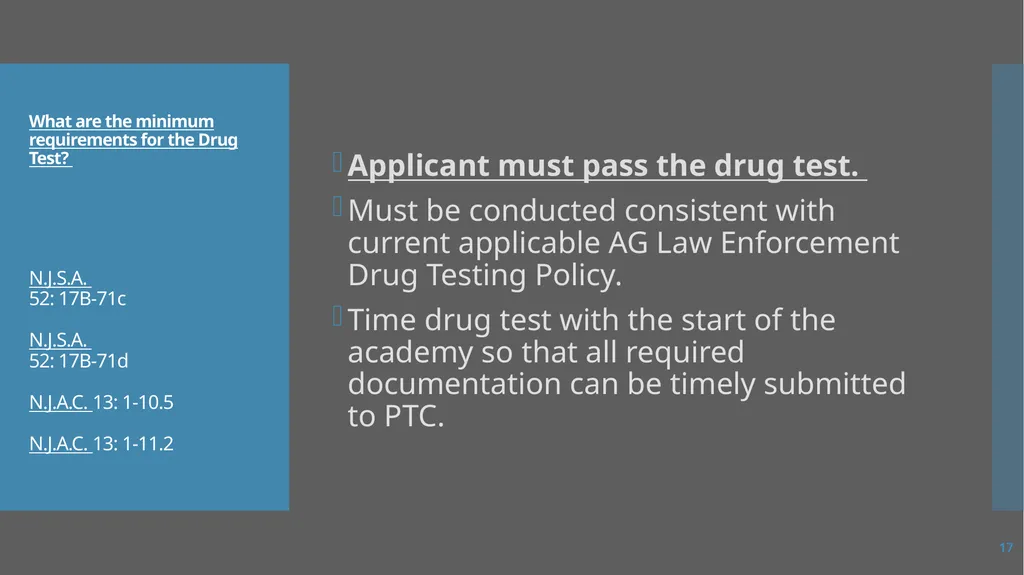
slide17. What are the minimum requirements for the Drug Test? N.J.S.A. 52: 17B-71c N.J.S.A. 52: 17B-71d N.J.A.C. 13: 1-10.5 N.J.A.C. 13: 1-11.2 Applicant must pass the drug test.
Must be conducted consistent with current applicable AG Law Enforcement Drug Testing Policy.
Time drug test with the start of the academy so that all required documentation can be timely submitted to PTC. 17<br>
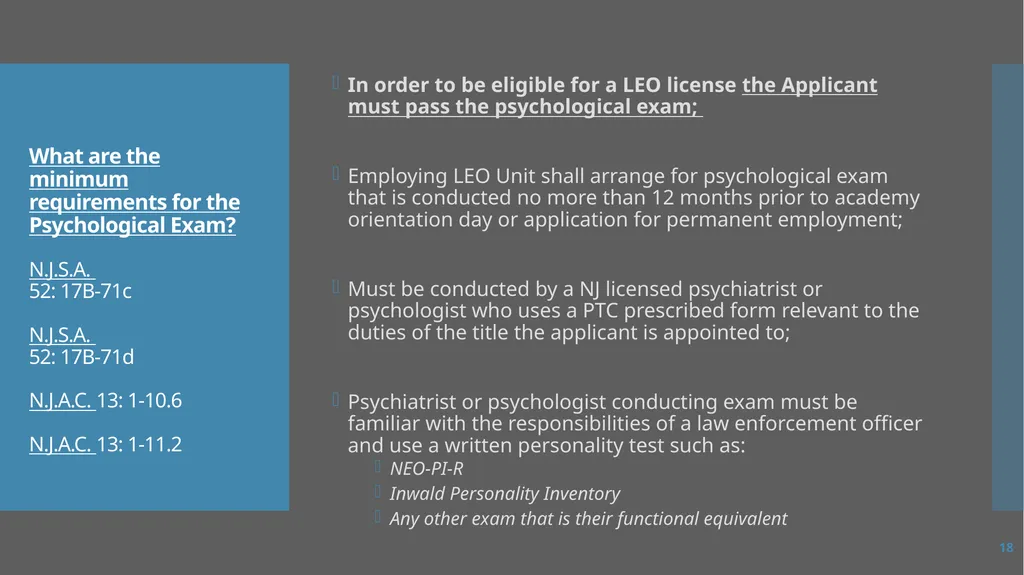
slide18. What are the minimum requirements for the Psychological Exam? N.J.S.A. 52: 17B-71c N.J.S.A. 52: 17B-71d N.J.A.C. 13: 1-10.6 N.J.A.C. 13: 1-11.2 In order to be eligible for a LEO license the Applicant must pass the psychological exam;
Employing LEO Unit shall arrange for psychological exam that is conducted no more than 12 months prior to academy orientation day or application for permanent employment;
Must be conducted by a NJ licensed psychiatrist or psychologist who uses a PTC prescribed form relevant to the duties of the title the applicant is appointed to;
Psychiatrist or psychologist conducting exam must be familiar with the responsibilities of a law enforcement officer and use a written personality test such as:
NEO-PI-R
Inwald Personality Inventory
Any other exam that is their functional equivalent 18<br>
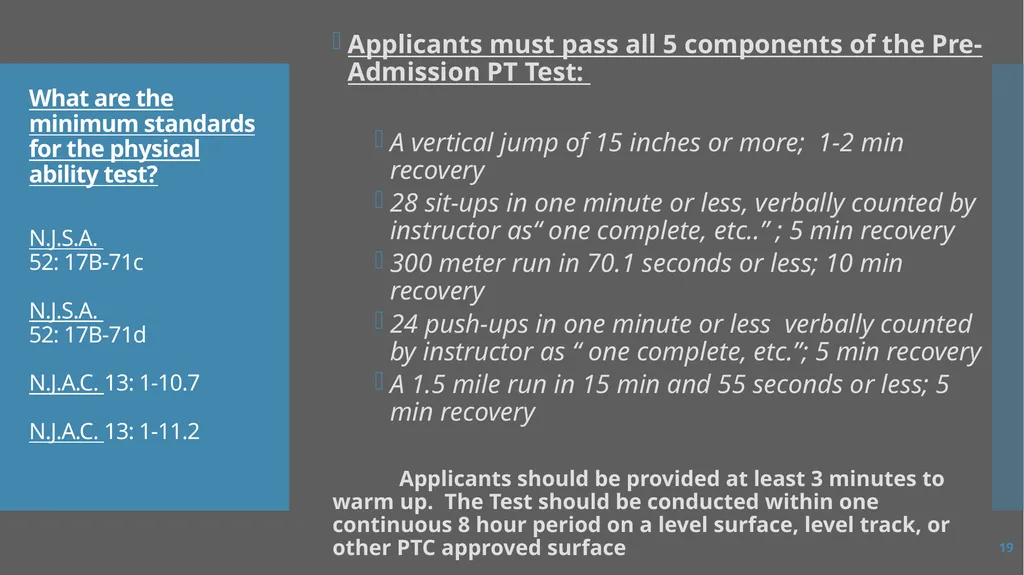
slide19. What are the minimum standards for the physical ability test? N.J.S.A. 52: 17B-71c N.J.S.A. 52: 17B-71d N.J.A.C. 13: 1-10.7 N.J.A.C. 13: 1-11.2 Applicants must pass all 5 components of the Pre- Admission PT Test:
A vertical jump of 15 inches or more; 1-2 min recovery
28 sit-ups in one minute or less, verbally counted by instructor as“ one complete, etc..” ; 5 min recovery
300 meter run in 70.1 seconds or less; 10 min recovery
24 push-ups in one minute or less verbally counted by instructor as “ one complete, etc.”; 5 min recovery
A 1.5 mile run in 15 min and 55 seconds or less; 5 min recovery
Applicants should be provided at least 3 minutes to warm up. The Test should be conducted within one continuous 8 hour period on a level surface, level track, or other PTC approved surface 19<br>
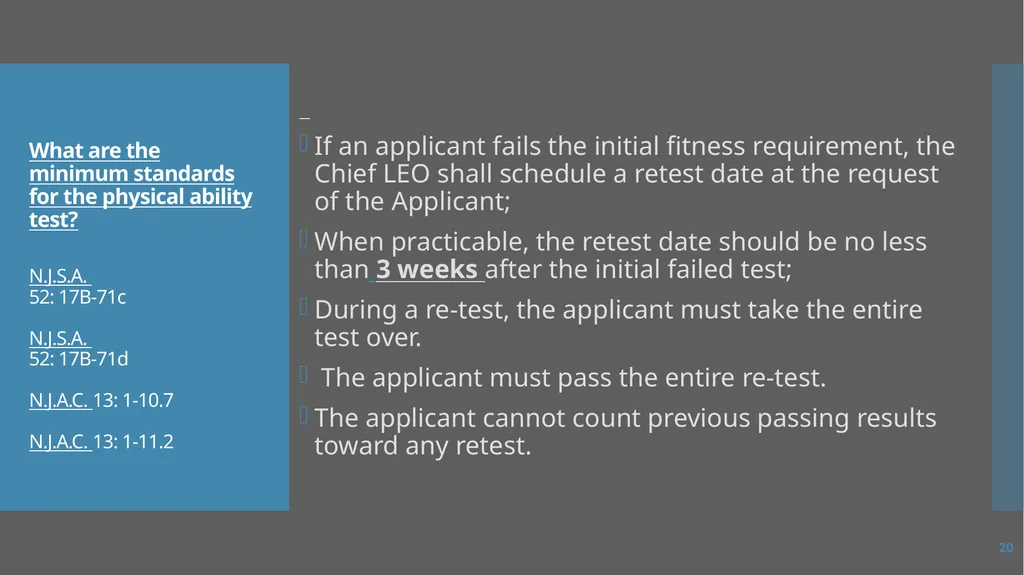
slide20. What are the minimum standards for the physical ability test? N.J.S.A. 52: 17B-71c N.J.S.A. 52: 17B-71d N.J.A.C. 13: 1-10.7 N.J.A.C. 13: 1-11.2 If an applicant fails the initial fitness requirement, the Chief LEO shall schedule a retest date at the request of the Applicant;
When practicable, the retest date should be no less than 3 weeks after the initial failed test;
During a re-test, the applicant must take the entire test over.
The applicant must pass the entire re-test.
The applicant cannot count previous passing results toward any retest. 20<br>
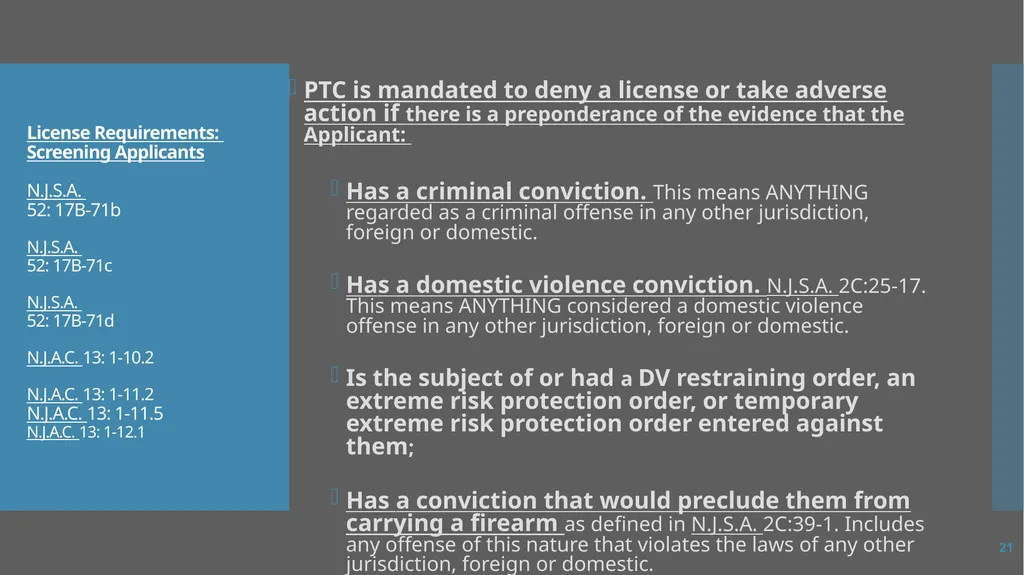
slide21. License Requirements: Screening Applicants N.J.S.A. 52: 17B-71b N.J.S.A. 52: 17B-71c N.J.S.A. 52: 17B-71d N.J.A.C. 13: 1-10.2 N.J.A.C. 13: 1-11.2 N.J.A.C. 13: 1-11.5 N.J.A.C. 13: 1-12.1 PTC is mandated to deny a license or take adverse action if there is a preponderance of the evidence that the Applicant:
Has a criminal conviction. This means ANYTHING regarded as a criminal offense in any other jurisdiction, foreign or domestic.
Has a domestic violence conviction. N.J.S.A. 2C:25-17. This means ANYTHING considered a domestic violence offense in any other jurisdiction, foreign or domestic.
Is the subject of or had a DV restraining order, an extreme risk protection order, or temporary extreme risk protection order entered against them;
Has a conviction that would preclude them from carrying a firearm as defined in N.J.S.A. 2C:39-1. Includes any offense of this nature that violates the laws of any other jurisdiction, foreign or domestic. 21<br>
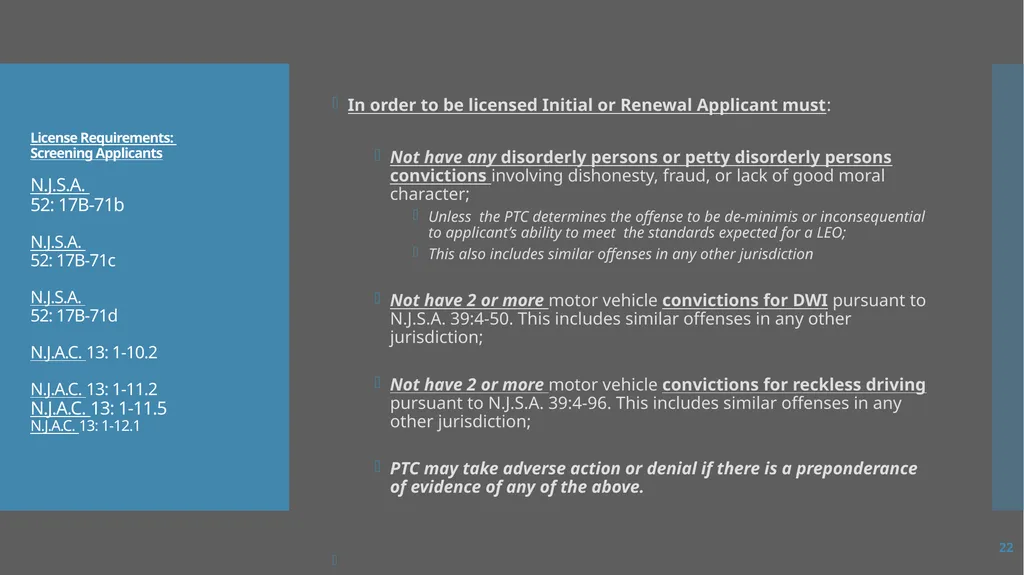
slide22. License Requirements: Screening Applicants N.J.S.A. 52: 17B-71b N.J.S.A. 52: 17B-71c N.J.S.A. 52: 17B-71d N.J.A.C. 13: 1-10.2 N.J.A.C. 13: 1-11.2 N.J.A.C. 13: 1-11.5 N.J.A.C. 13: 1-12.1 In order to be licensed Initial or Renewal Applicant must:
Not have any disorderly persons or petty disorderly persons convictions involving dishonesty, fraud, or lack of good moral character;
Unless the PTC determines the offense to be de-minimis or inconsequential to applicant’s ability to meet the standards expected for a LEO;
This also includes similar offenses in any other jurisdiction
Not have 2 or more motor vehicle convictions for DWI pursuant to N.J.S.A. 39:4-50. This includes similar offenses in any other jurisdiction;
Not have 2 or more motor vehicle convictions for reckless driving pursuant to N.J.S.A. 39:4-96. This includes similar offenses in any other jurisdiction;
PTC may take adverse action or denial if there is a preponderance of evidence of any of the above. 22<br>
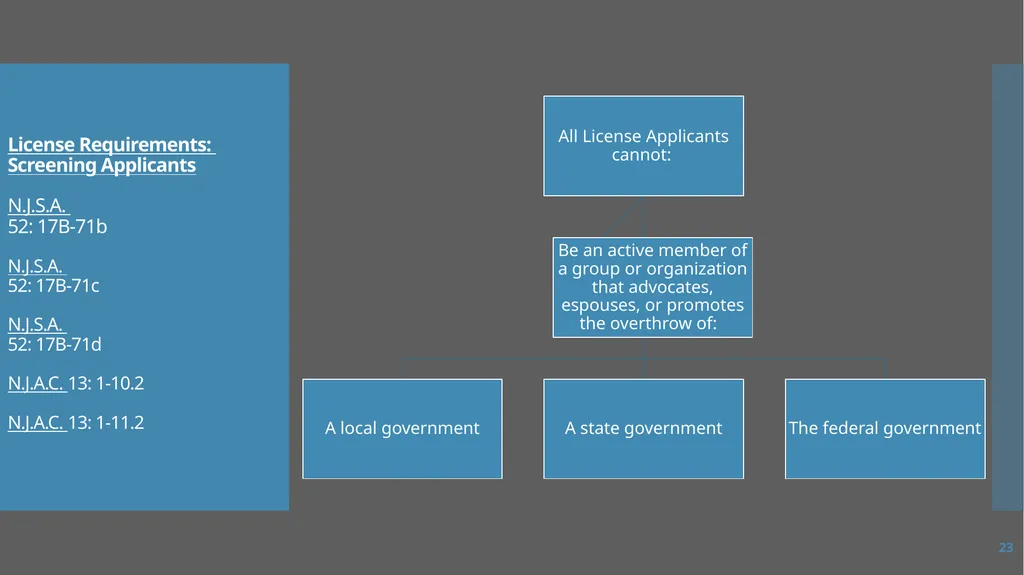
slide23. License Requirements: Screening Applicants N.J.S.A. 52: 17B-71b N.J.S.A. 52: 17B-71c N.J.S.A. 52: 17B-71d N.J.A.C. 13: 1-10.2 N.J.A.C. 13: 1-11.2 23<br>
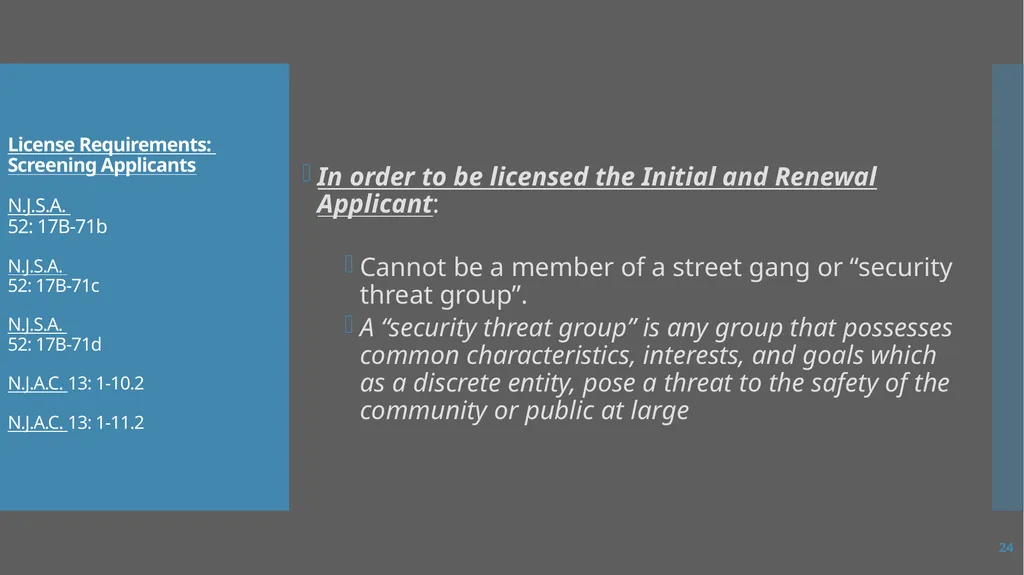
slide24. License Requirements: Screening Applicants N.J.S.A. 52: 17B-71b N.J.S.A. 52: 17B-71c N.J.S.A. 52: 17B-71d N.J.A.C. 13: 1-10.2 N.J.A.C. 13: 1-11.2 In order to be licensed the Initial and Renewal Applicant:
Cannot be a member of a street gang or “security threat group”.
A “security threat group” is any group that possesses common characteristics, interests, and goals which as a discrete entity, pose a threat to the safety of the community or public at large 24<br>
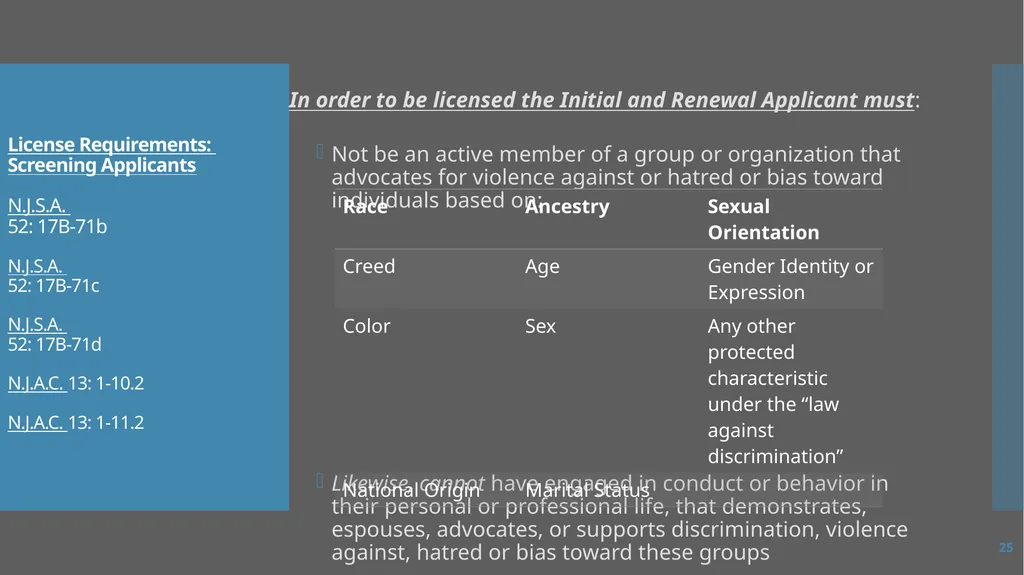
slide25. License Requirements: Screening Applicants N.J.S.A. 52: 17B-71b N.J.S.A. 52: 17B-71c N.J.S.A. 52: 17B-71d N.J.A.C. 13: 1-10.2 N.J.A.C. 13: 1-11.2 In order to be licensed the Initial and Renewal Applicant must:
Not be an active member of a group or organization that advocates for violence against or hatred or bias toward individuals based on:
Likewise, cannot have engaged in conduct or behavior in their personal or professional life, that demonstrates, espouses, advocates, or supports discrimination, violence against, hatred or bias toward these groups 25<br>
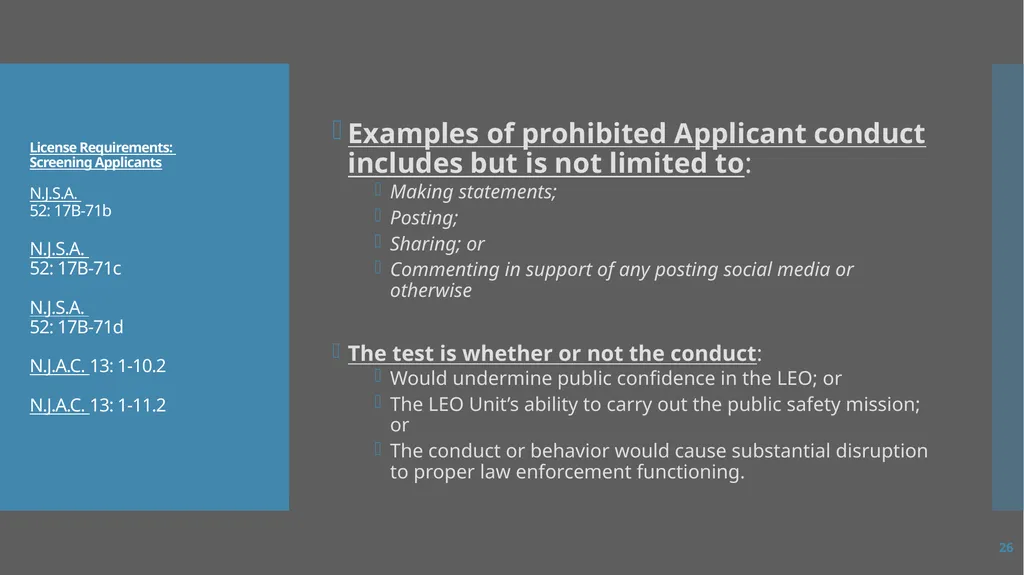
slide26. License Requirements: Screening Applicants N.J.S.A. 52: 17B-71b N.J.S.A. 52: 17B-71c N.J.S.A. 52: 17B-71d N.J.A.C. 13: 1-10.2 N.J.A.C. 13: 1-11.2 Examples of prohibited Applicant conduct includes but is not limited to:
Making statements;
Posting;
Sharing; or
Commenting in support of any posting social media or otherwise
The test is whether or not the conduct:
Would undermine public confidence in the LEO; or
The LEO Unit’s ability to carry out the public safety mission; or
The conduct or behavior would cause substantial disruption to proper law enforcement functioning. 26<br>
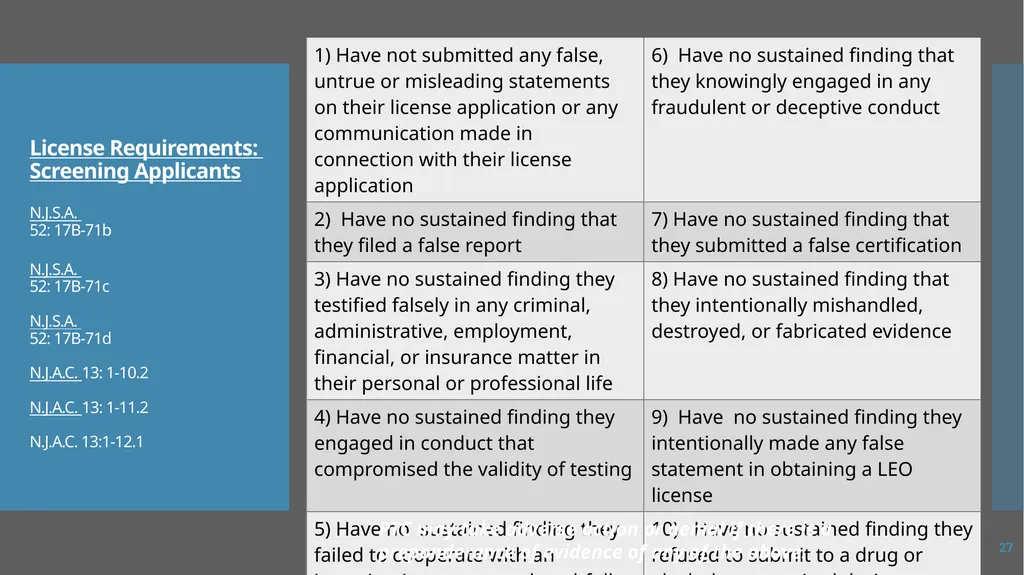
slide27. License Requirements: Screening Applicants N.J.S.A. 52: 17B-71b N.J.S.A. 52: 17B-71c N.J.S.A. 52: 17B-71d N.J.A.C. 13: 1-10.2 N.J.A.C. 13: 1-11.2 N.J.A.C. 13:1-12.1 27 PTC may take adverse action or denial if there is a preponderance of evidence of any of the above.<br>
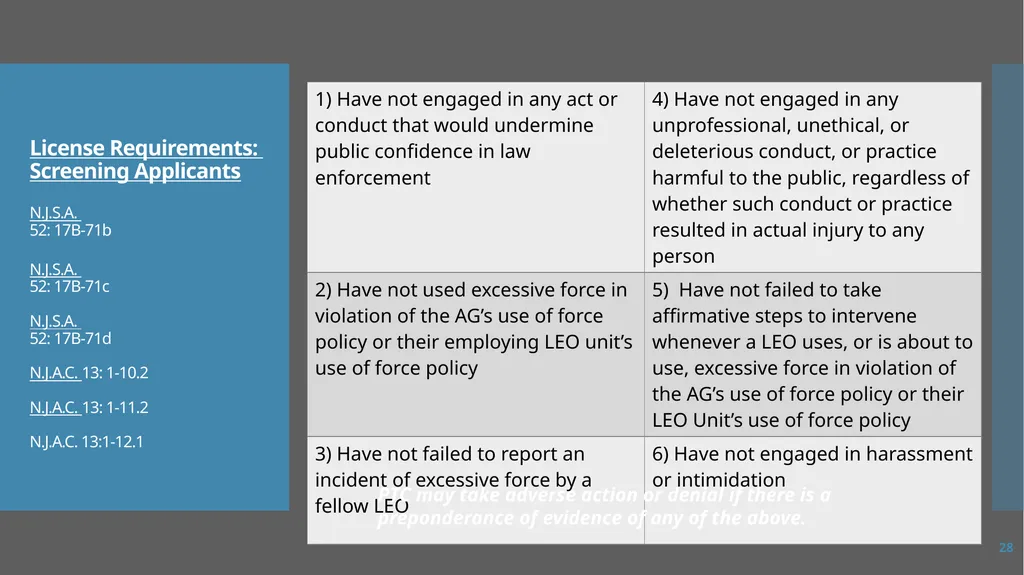
slide28. License Requirements: Screening Applicants N.J.S.A. 52: 17B-71b N.J.S.A. 52: 17B-71c N.J.S.A. 52: 17B-71d N.J.A.C. 13: 1-10.2 N.J.A.C. 13: 1-11.2 N.J.A.C. 13:1-12.1 28 PTC may take adverse action or denial if there is a preponderance of evidence of any of the above.<br>
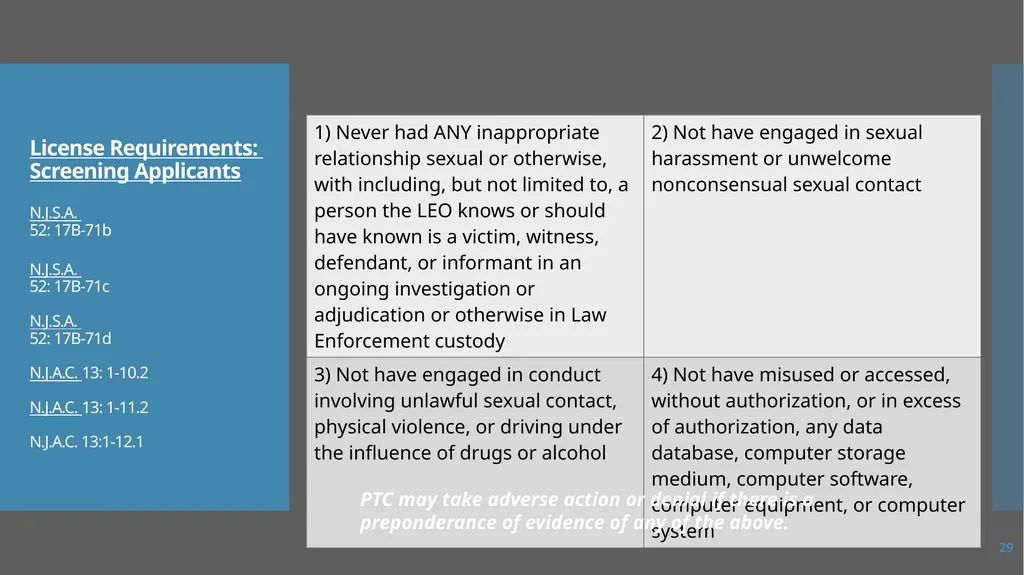
slide29. License Requirements: Screening Applicants N.J.S.A. 52: 17B-71b N.J.S.A. 52: 17B-71c N.J.S.A. 52: 17B-71d N.J.A.C. 13: 1-10.2 N.J.A.C. 13: 1-11.2 N.J.A.C. 13:1-12.1 29 PTC may take adverse action or denial if there is a preponderance of evidence of any of the above.<br>
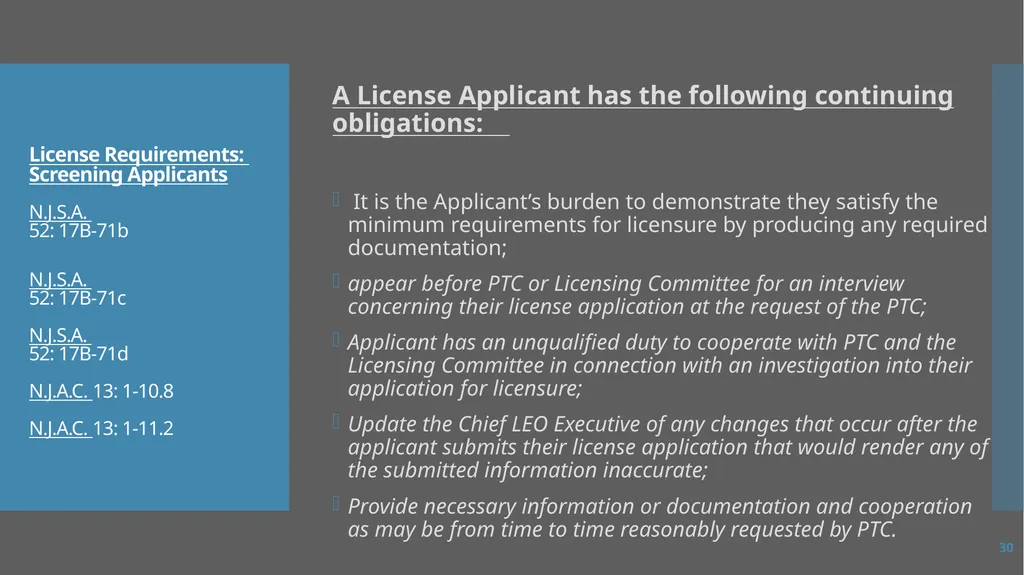
slide30. License Requirements: Screening Applicants N.J.S.A. 52: 17B-71b N.J.S.A. 52: 17B-71c N.J.S.A. 52: 17B-71d N.J.A.C. 13: 1-10.8 N.J.A.C. 13: 1-11.2 A License Applicant has the following continuing obligations:
It is the Applicant’s burden to demonstrate they satisfy the minimum requirements for licensure by producing any required documentation;
appear before PTC or Licensing Committee for an interview concerning their license application at the request of the PTC;
Applicant has an unqualified duty to cooperate with PTC and the Licensing Committee in connection with an investigation into their application for licensure;
Update the Chief LEO Executive of any changes that occur after the applicant submits their license application that would render any of the submitted information inaccurate;
Provide necessary information or documentation and cooperation as may be from time to time reasonably requested by PTC. 30<br>
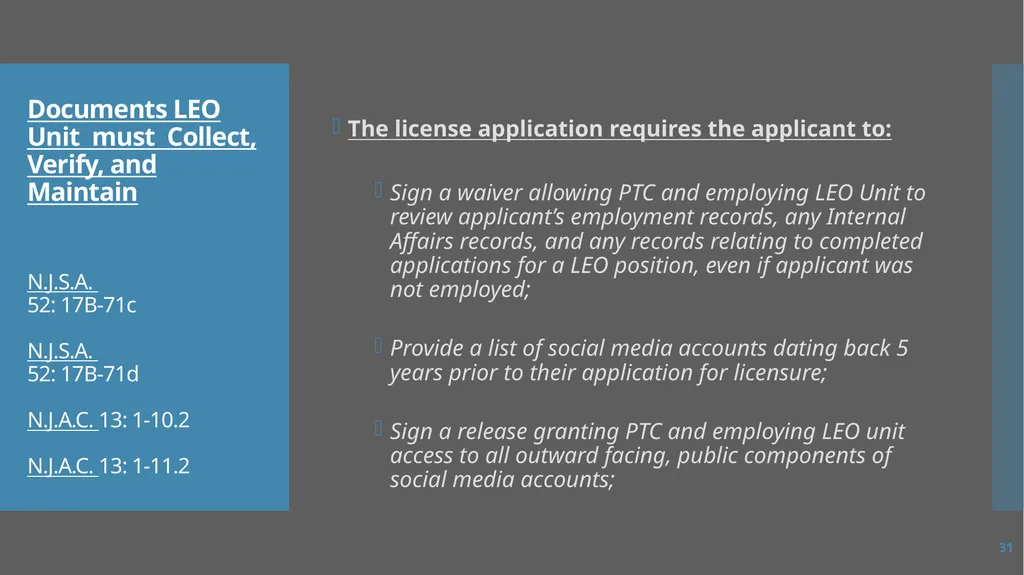
slide31. Documents LEO Unit must Collect, Verify, and Maintain N.J.S.A. 52: 17B-71c N.J.S.A. 52: 17B-71d N.J.A.C. 13: 1-10.2 N.J.A.C. 13: 1-11.2 The license application requires the applicant to:
Sign a waiver allowing PTC and employing LEO Unit to review applicant’s employment records, any Internal Affairs records, and any records relating to completed applications for a LEO position, even if applicant was not employed;
Provide a list of social media accounts dating back 5 years prior to their application for licensure;
Sign a release granting PTC and employing LEO unit access to all outward facing, public components of social media accounts; 31<br>
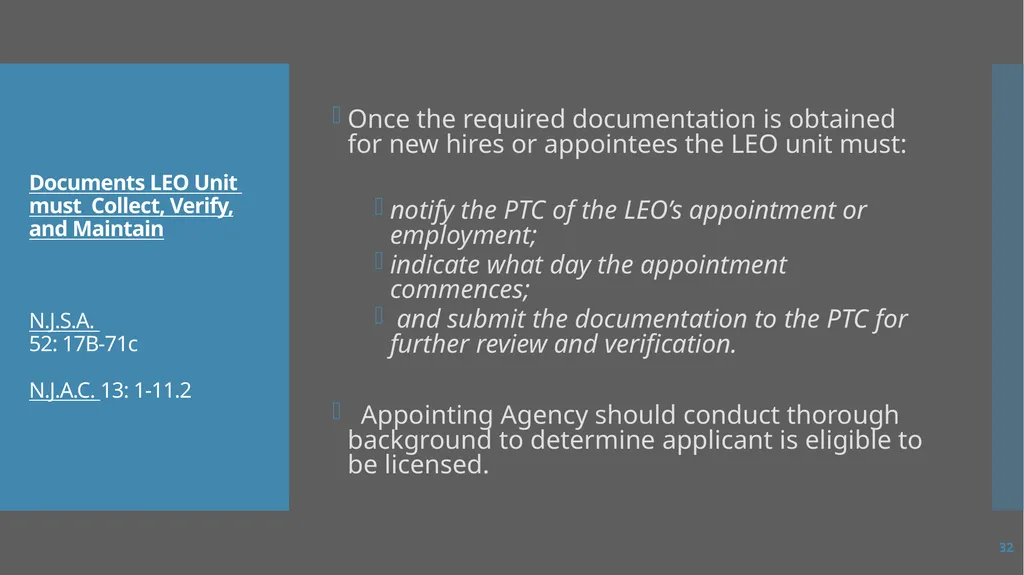
slide32. Documents LEO Unit must Collect, Verify, and Maintain N.J.S.A. 52: 17B-71c N.J.A.C. 13: 1-11.2 Once the required documentation is obtained for new hires or appointees the LEO unit must:
notify the PTC of the LEO’s appointment or employment;
indicate what day the appointment commences;
and submit the documentation to the PTC for further review and verification.
Appointing Agency should conduct thorough background to determine applicant is eligible to be licensed. 32<br>
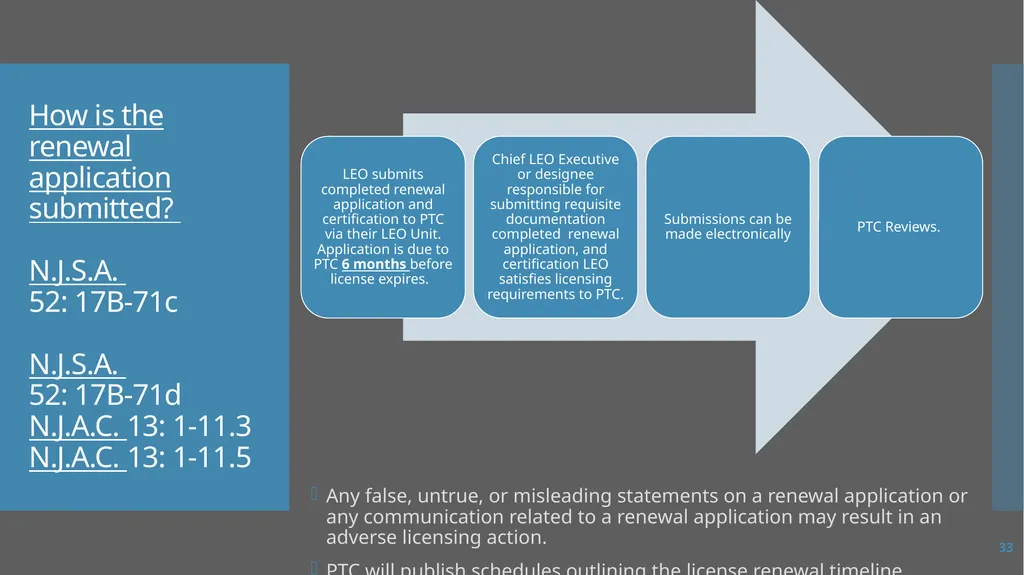
slide33. How is the renewal application submitted? N.J.S.A. 52: 17B-71c N.J.S.A. 52: 17B-71d N.J.A.C. 13: 1-11.3 N.J.A.C. 13: 1-11.5 Any false, untrue, or misleading statements on a renewal application or any communication related to a renewal application may result in an adverse licensing action.
PTC will publish schedules outlining the license renewal timeline. 33<br>
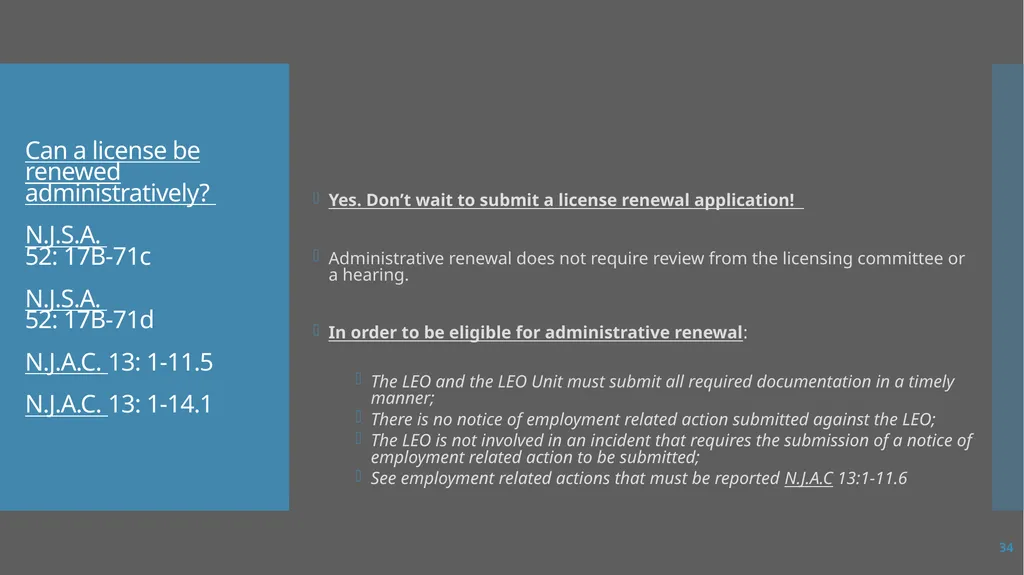
slide34. Can a license be renewed administratively? N.J.S.A. 52: 17B-71c N.J.S.A. 52: 17B-71d N.J.A.C. 13: 1-11.5 N.J.A.C. 13: 1-14.1 Yes. Don’t wait to submit a license renewal application!
Administrative renewal does not require review from the licensing committee or a hearing.
In order to be eligible for administrative renewal:
The LEO and the LEO Unit must submit all required documentation in a timely manner;
There is no notice of employment related action submitted against the LEO;
The LEO is not involved in an incident that requires the submission of a notice of employment related action to be submitted;
See employment related actions that must be reported N.J.A.C 13:1-11.6 34<br>
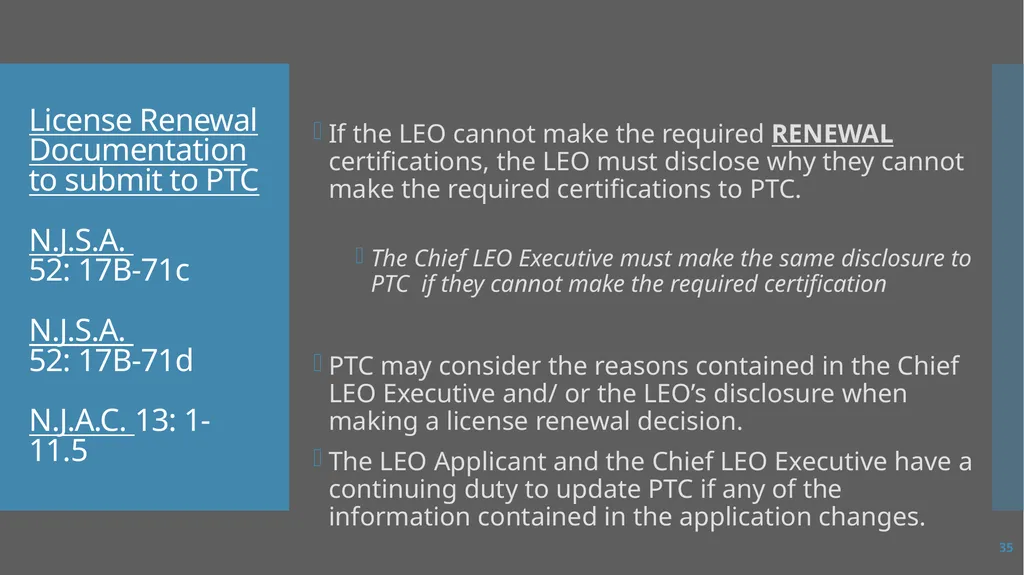
slide35. License Renewal Documentation to submit to PTC N.J.S.A. 52: 17B-71c N.J.S.A. 52: 17B-71d N.J.A.C. 13: 1-11.5 If the LEO cannot make the required RENEWAL certifications, the LEO must disclose why they cannot make the required certifications to PTC.
The Chief LEO Executive must make the same disclosure to PTC if they cannot make the required certification
PTC may consider the reasons contained in the Chief LEO Executive and/ or the LEO’s disclosure when making a license renewal decision.
The LEO Applicant and the Chief LEO Executive have a continuing duty to update PTC if any of the information contained in the application changes. 35<br>
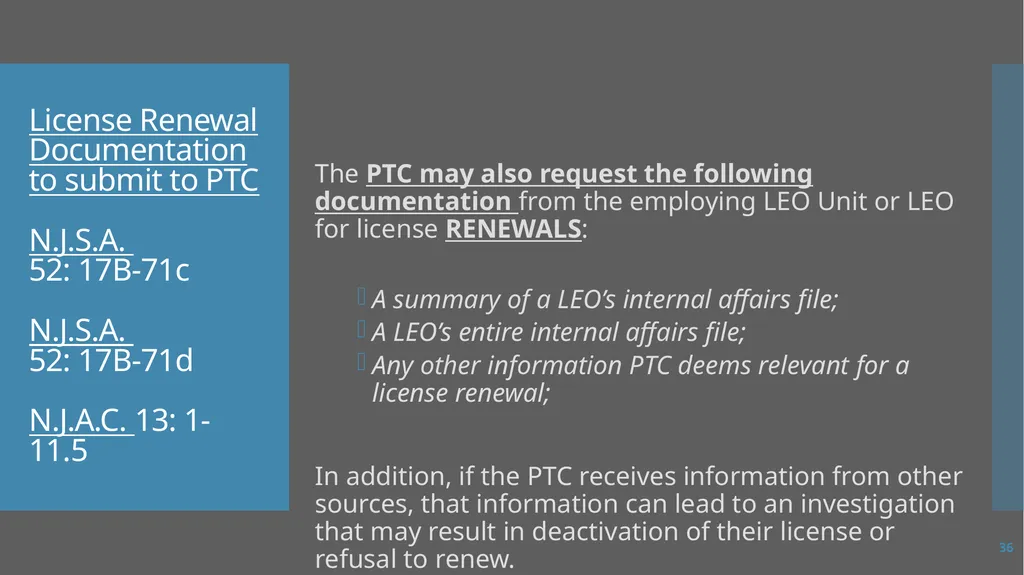
slide36. License Renewal Documentation to submit to PTC N.J.S.A. 52: 17B-71c N.J.S.A. 52: 17B-71d N.J.A.C. 13: 1-11.5 The PTC may also request the following documentation from the employing LEO Unit or LEO for license RENEWALS:
A summary of a LEO’s internal affairs file;
A LEO’s entire internal affairs file;
Any other information PTC deems relevant for a license renewal;
In addition, if the PTC receives information from other sources, that information can lead to an investigation that may result in deactivation of their license or refusal to renew. 36<br>
slide37. SECTION III:
Grounds for License Denial, Initiation of an Adverse Licensing Action, or License Revocation 37<br>
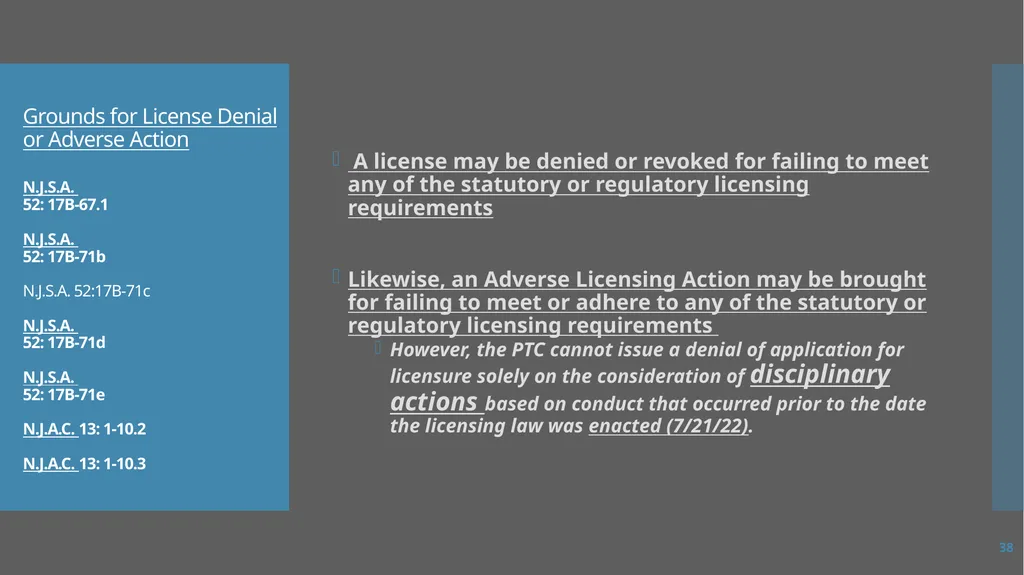
slide38. Grounds for License Denial or Adverse Action N.J.S.A. 52: 17B-67.1 N.J.S.A. 52: 17B-71b N.J.S.A. 52:17B-71c N.J.S.A. 52: 17B-71d N.J.S.A. 52: 17B-71e N.J.A.C. 13: 1-10.2 N.J.A.C. 13: 1-10.3 A license may be denied or revoked for failing to meet any of the statutory or regulatory licensing requirements
Likewise, an Adverse Licensing Action may be brought for failing to meet or adhere to any of the statutory or regulatory licensing requirements
However, the PTC cannot issue a denial of application for licensure solely on the consideration of disciplinary actions based on conduct that occurred prior to the date the licensing law was enacted (7/21/22). 38<br>
slide39. Grounds for License Denial or Adverse Action N.J.S.A. 52:17B-71e (a) The Commission has the authority to bring an adverse license action if the applicant or LEO has: 39 Unprofessional conduct includes any departure from or failure to conform to the minimum standards of acceptable and prevailing practices of a LEO as set forth by PTC<br>
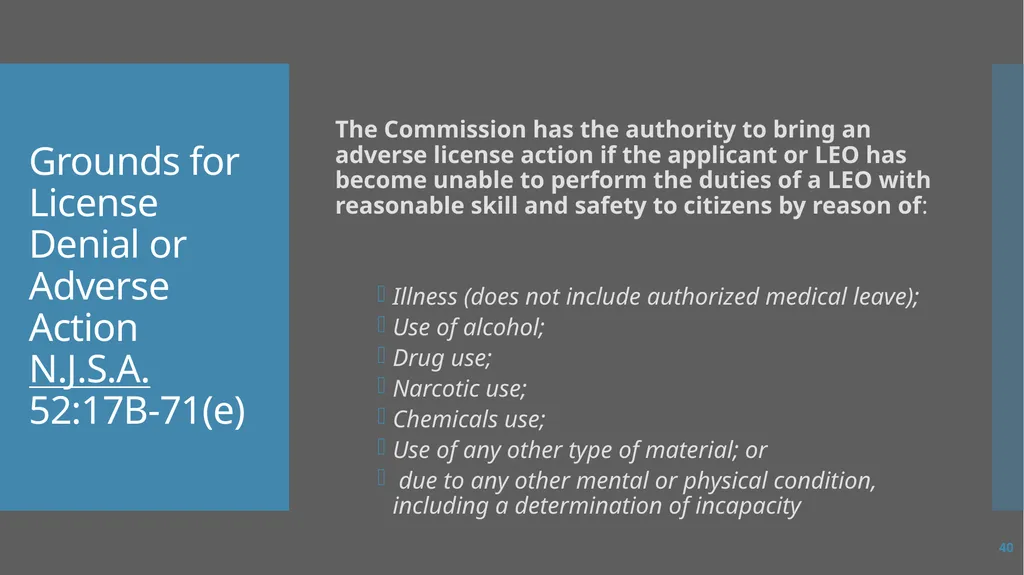
slide40. Grounds for License Denial or Adverse Action N.J.S.A. 52:17B-71(e) The Commission has the authority to bring an adverse license action if the applicant or LEO has become unable to perform the duties of a LEO with reasonable skill and safety to citizens by reason of:
Illness (does not include authorized medical leave);
Use of alcohol;
Drug use;
Narcotic use;
Chemicals use;
Use of any other type of material; or
due to any other mental or physical condition, including a determination of incapacity 40<br>
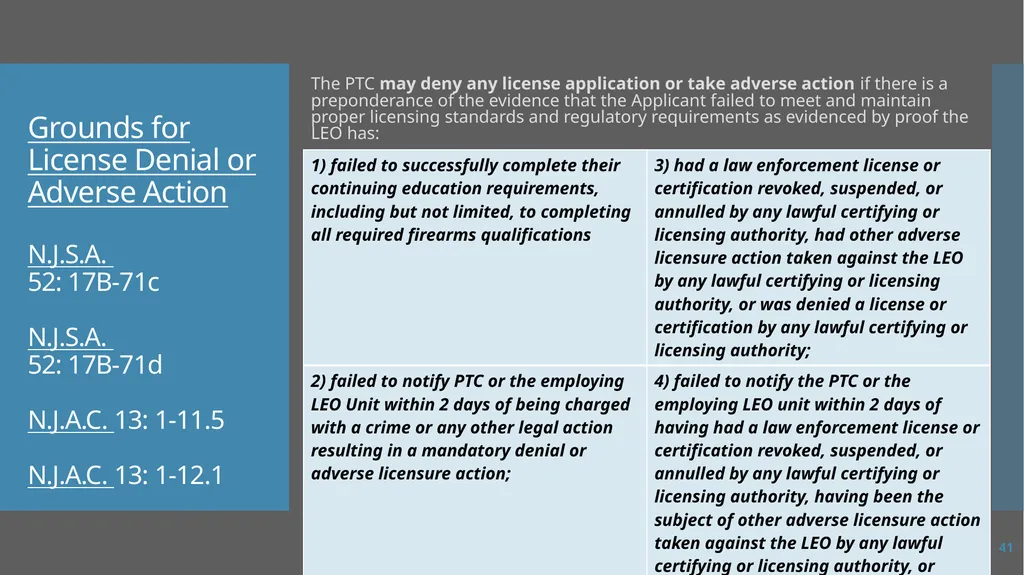
slide41. Grounds for License Denial or Adverse Action N.J.S.A. 52: 17B-71c N.J.S.A. 52: 17B-71d N.J.A.C. 13: 1-11.5 N.J.A.C. 13: 1-12.1 The PTC may deny any license application or take adverse action if there is a preponderance of the evidence that the Applicant failed to meet and maintain proper licensing standards and regulatory requirements as evidenced by proof the LEO has: 41<br>
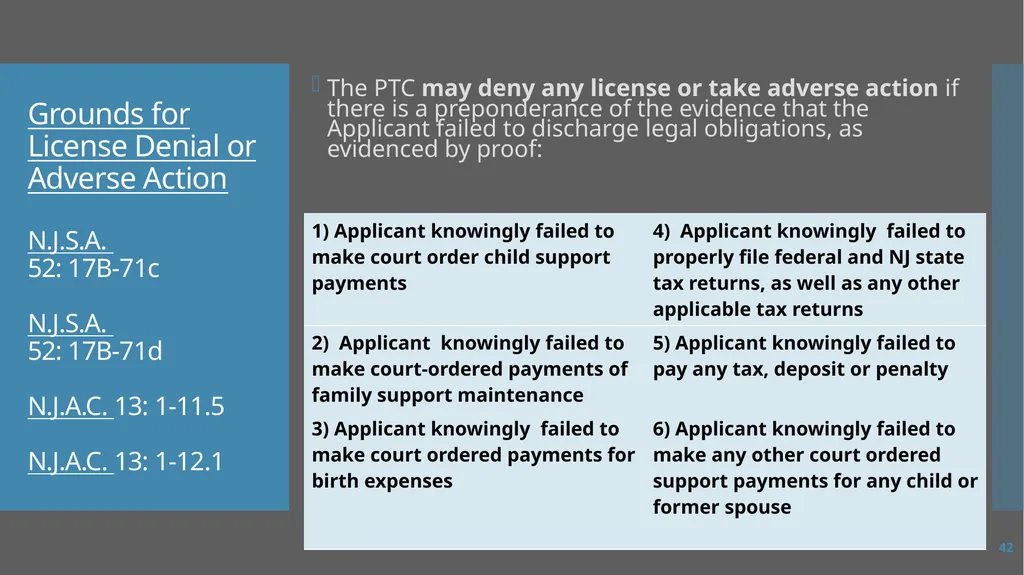
slide42. Grounds for License Denial or Adverse Action N.J.S.A. 52: 17B-71c N.J.S.A. 52: 17B-71d N.J.A.C. 13: 1-11.5 N.J.A.C. 13: 1-12.1 The PTC may deny any license or take adverse action if there is a preponderance of the evidence that the Applicant failed to discharge legal obligations, as evidenced by proof: 42<br>
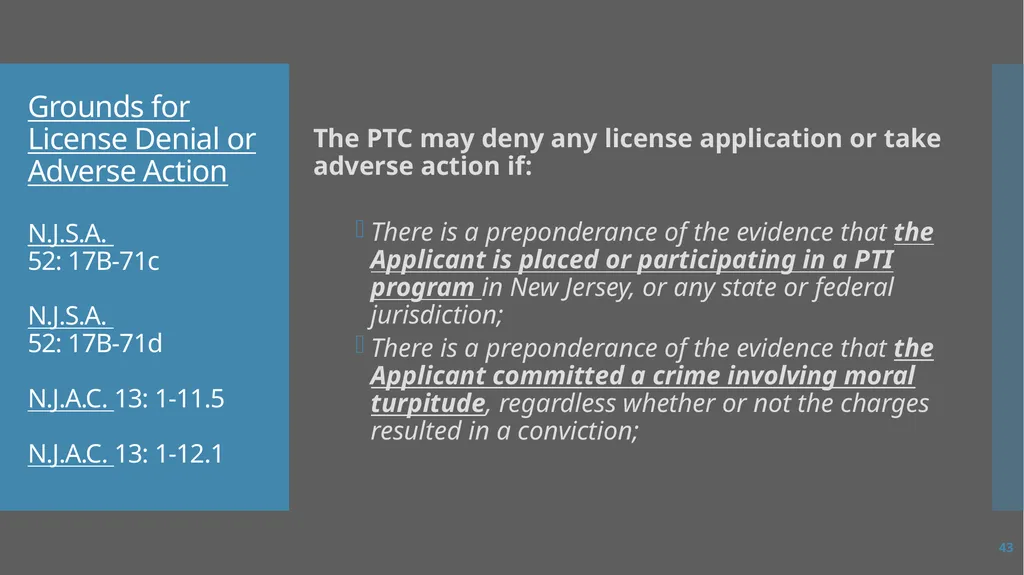
slide43. Grounds for License Denial or Adverse Action N.J.S.A. 52: 17B-71c N.J.S.A. 52: 17B-71d N.J.A.C. 13: 1-11.5 N.J.A.C. 13: 1-12.1 The PTC may deny any license application or take adverse action if:
There is a preponderance of the evidence that the Applicant is placed or participating in a PTI program in New Jersey, or any state or federal jurisdiction;
There is a preponderance of the evidence that the Applicant committed a crime involving moral turpitude, regardless whether or not the charges resulted in a conviction; 43<br>
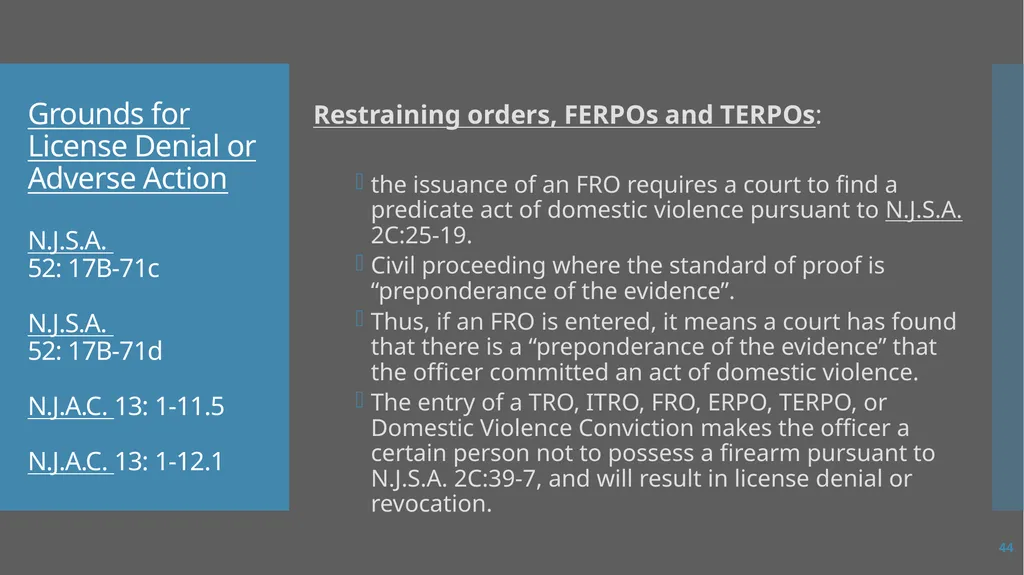
slide44. Grounds for License Denial or Adverse Action N.J.S.A. 52: 17B-71c N.J.S.A. 52: 17B-71d N.J.A.C. 13: 1-11.5 N.J.A.C. 13: 1-12.1 Restraining orders, FERPOs and TERPOs:
the issuance of an FRO requires a court to find a predicate act of domestic violence pursuant to N.J.S.A. 2C:25-19.
Civil proceeding where the standard of proof is “preponderance of the evidence”.
Thus, if an FRO is entered, it means a court has found that there is a “preponderance of the evidence” that the officer committed an act of domestic violence.
The entry of a TRO, ITRO, FRO, ERPO, TERPO, or Domestic Violence Conviction makes the officer a certain person not to possess a firearm pursuant to N.J.S.A. 2C:39-7, and will result in license denial or revocation. 44<br>
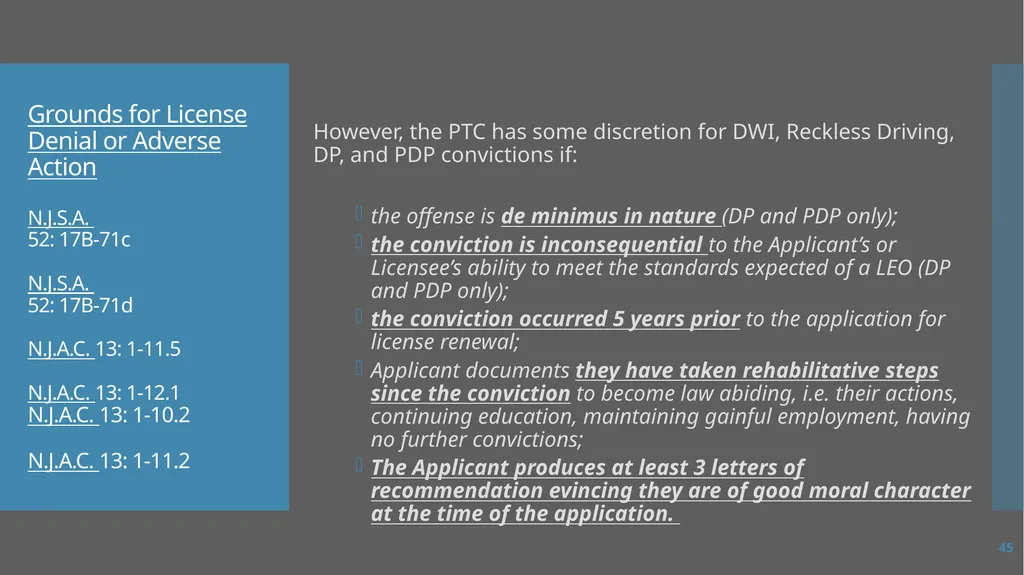
slide45. Grounds for License Denial or Adverse Action N.J.S.A. 52: 17B-71c N.J.S.A. 52: 17B-71d N.J.A.C. 13: 1-11.5 N.J.A.C. 13: 1-12.1 N.J.A.C. 13: 1-10.2 N.J.A.C. 13: 1-11.2 However, the PTC has some discretion for DWI, Reckless Driving, DP, and PDP convictions if:
the offense is de minimus in nature (DP and PDP only);
the conviction is inconsequential to the Applicant’s or Licensee’s ability to meet the standards expected of a LEO (DP and PDP only);
the conviction occurred 5 years prior to the application for license renewal;
Applicant documents they have taken rehabilitative steps since the conviction to become law abiding, i.e. their actions, continuing education, maintaining gainful employment, having no further convictions;
The Applicant produces at least 3 letters of recommendation evincing they are of good moral character at the time of the application. 45<br>
slide46. SECTION IV:
ADVERSE LICENSE ACTION PROCESS 46<br>
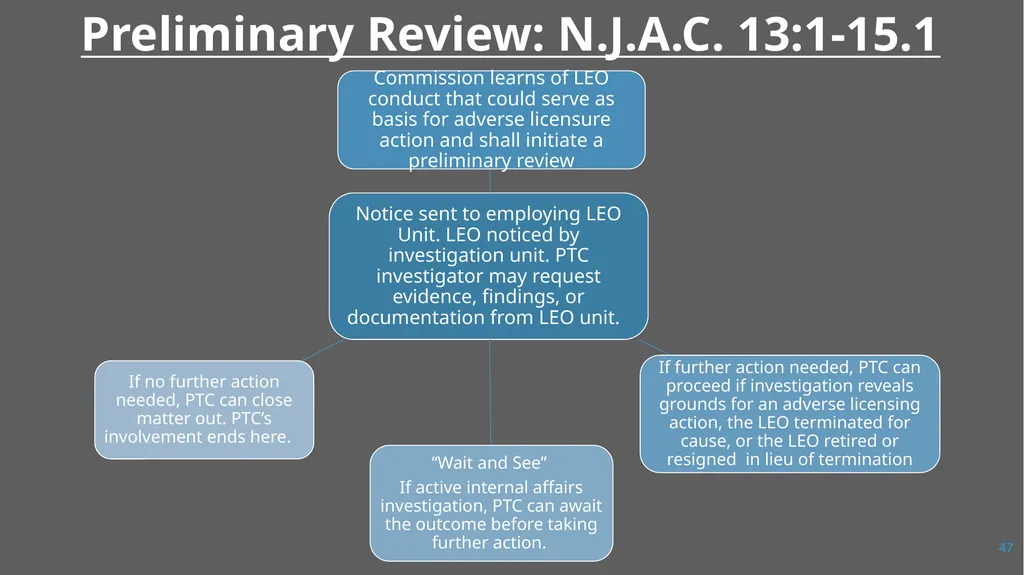
slide47. 47 Preliminary Review: N.J.A.C. 13:1-15.1<br>
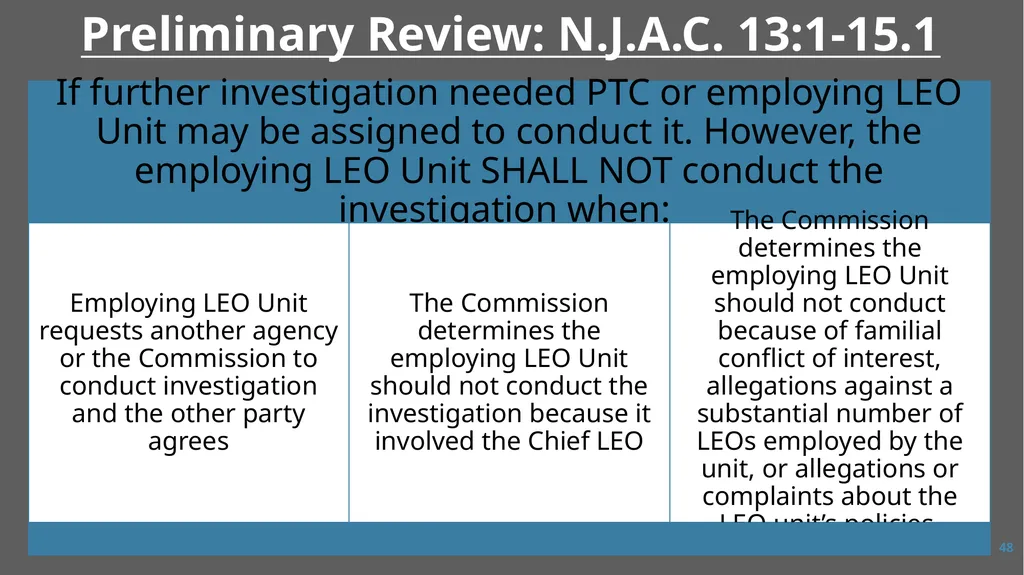
slide48. 48 Preliminary Review: N.J.A.C. 13:1-15.1<br>
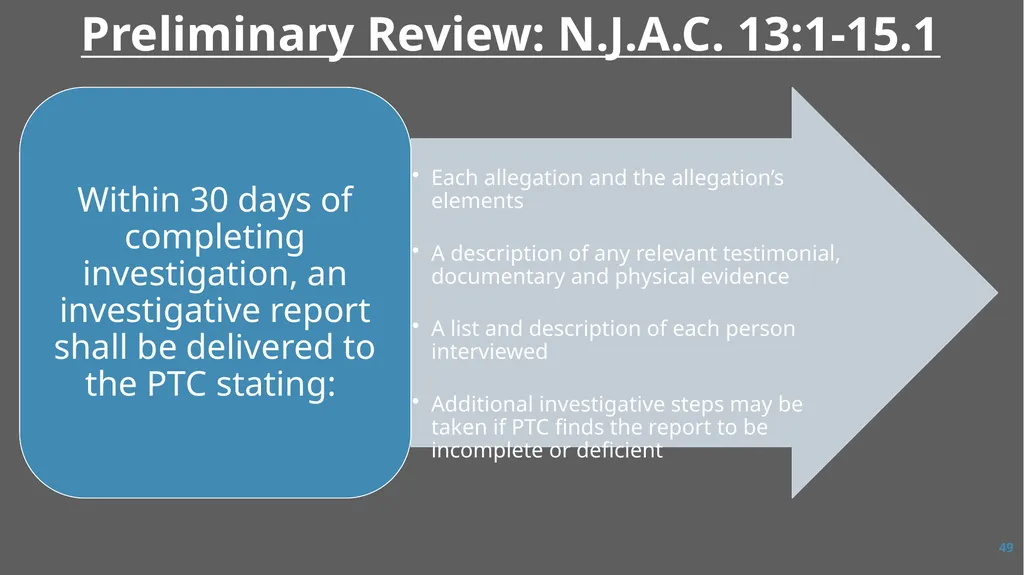
slide49. 49 Preliminary Review: N.J.A.C. 13:1-15.1<br>
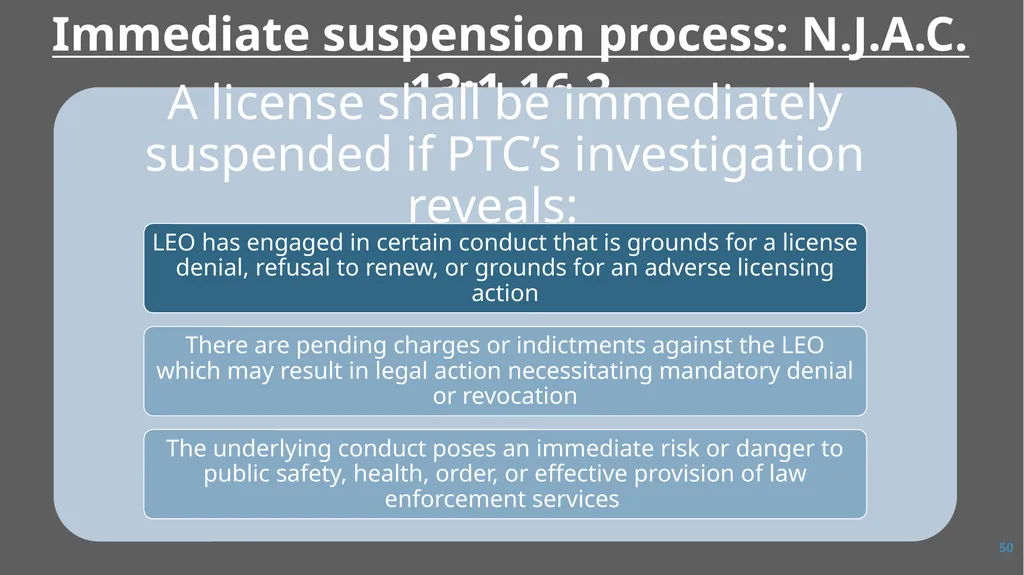
slide50. 50 Immediate suspension process: N.J.A.C. 13:1-16.2<br>
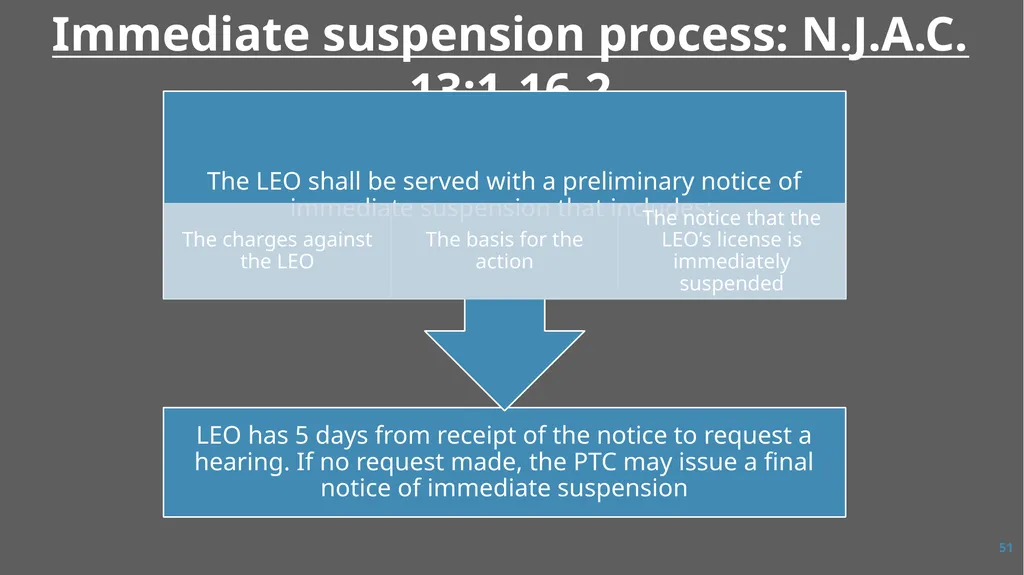
slide51. 51 Immediate suspension process: N.J.A.C. 13:1-16.2<br>
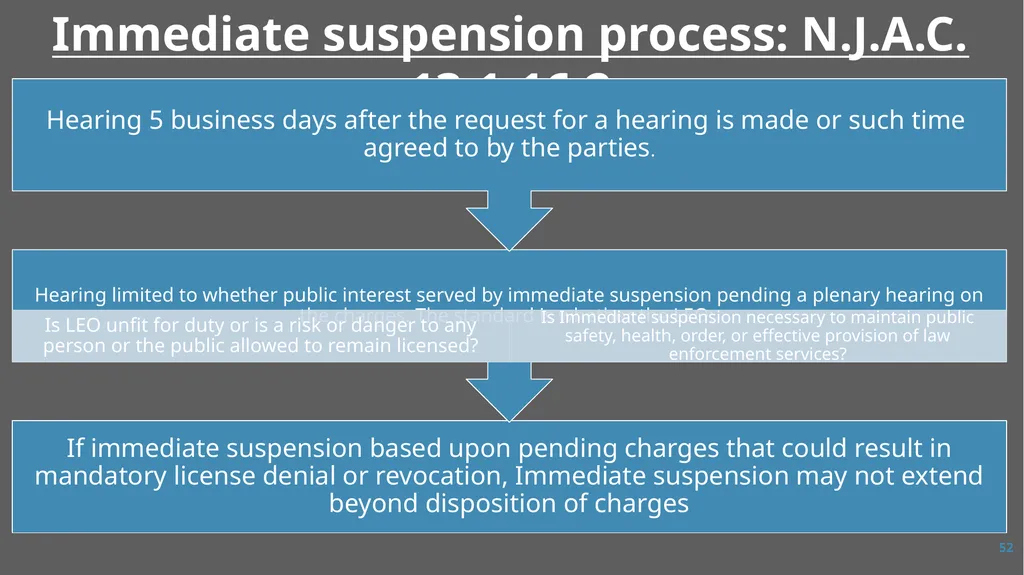
slide52. 52 Immediate suspension process: N.J.A.C. 13:1-16.2<br>
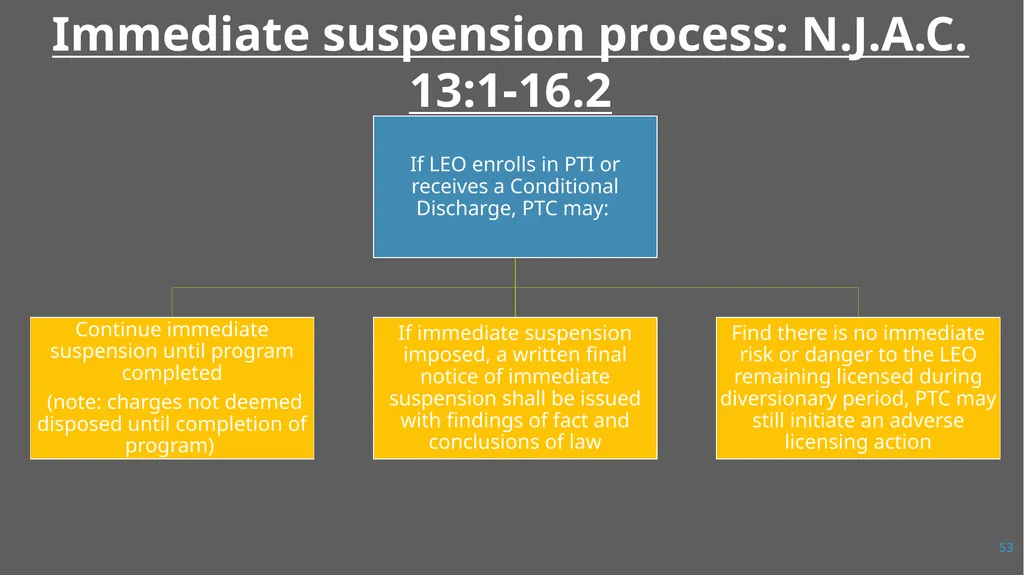
slide53. 53 Immediate suspension process: N.J.A.C. 13:1-16.2<br>
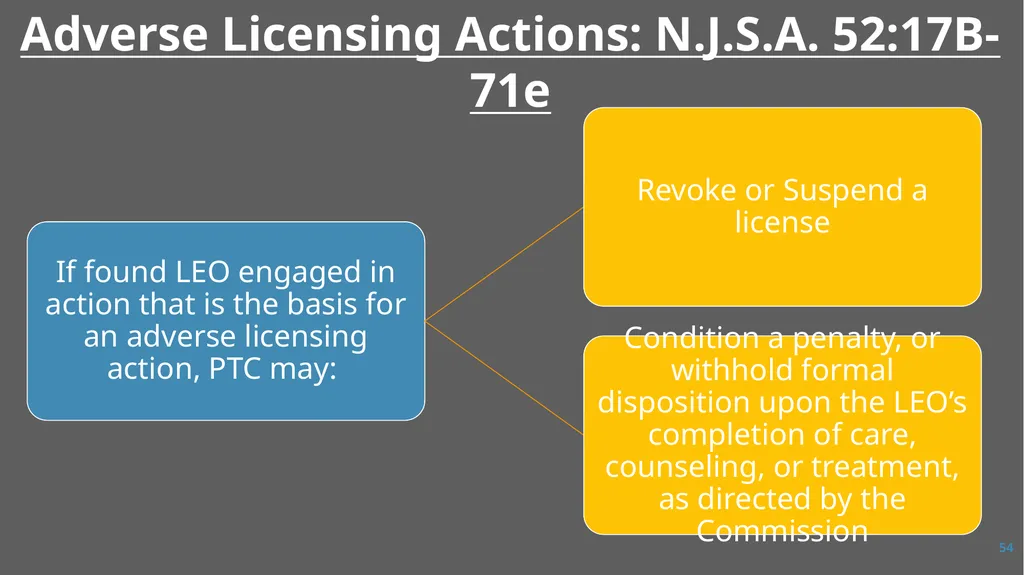
slide54. 54 Adverse Licensing Actions: N.J.S.A. 52:17B-71e<br>
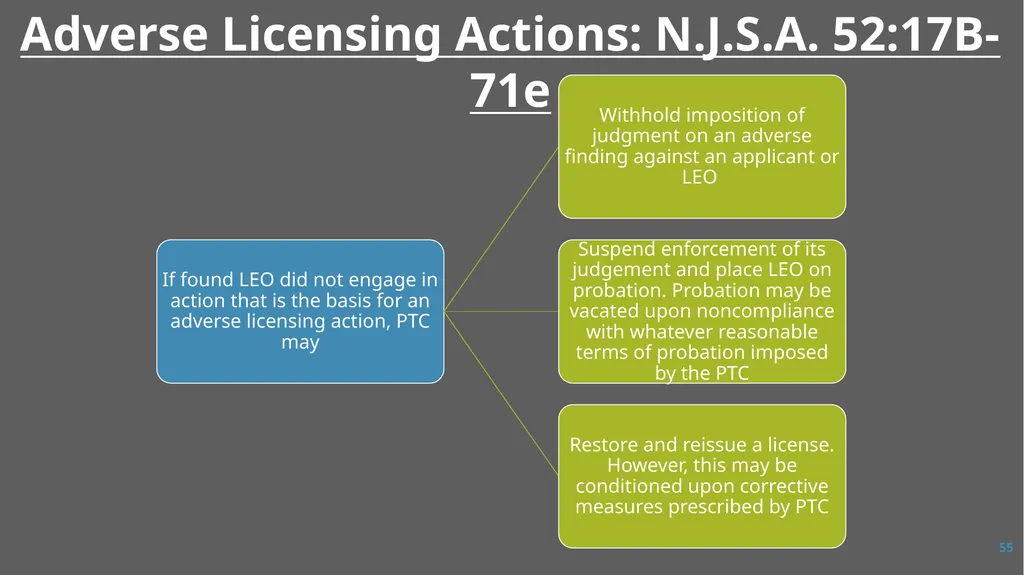
slide55. 55 Adverse Licensing Actions: N.J.S.A. 52:17B-71e<br>
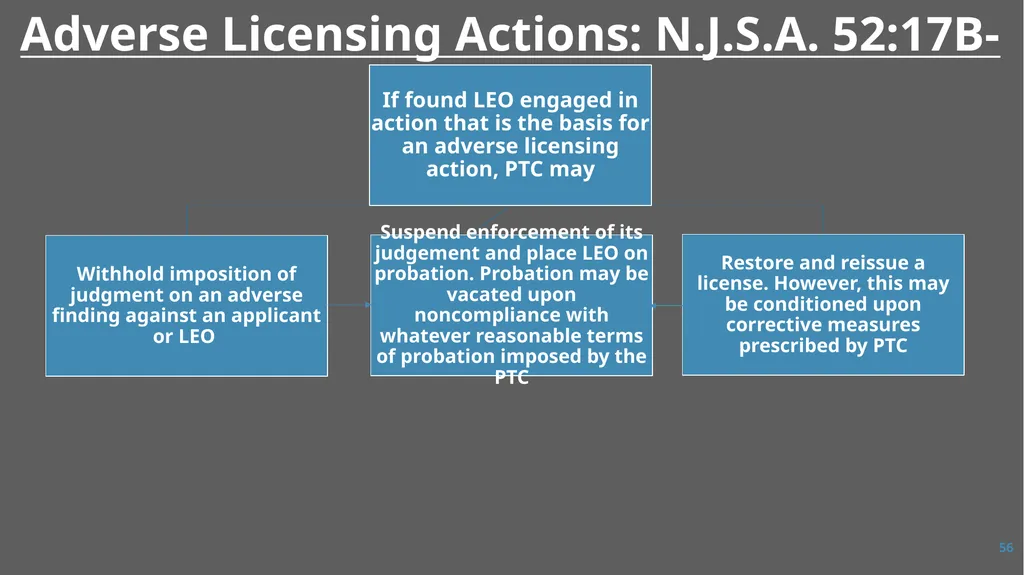
slide56. 56 Adverse Licensing Actions: N.J.S.A. 52:17B-71e<br>
slide57. SECTION V:
HEARING AND APPEAL PROCESS
*Note that all records confidential under N.J.S.A. 47:1A-1 et. seq. (OPRA) shall not be made public* 57<br>
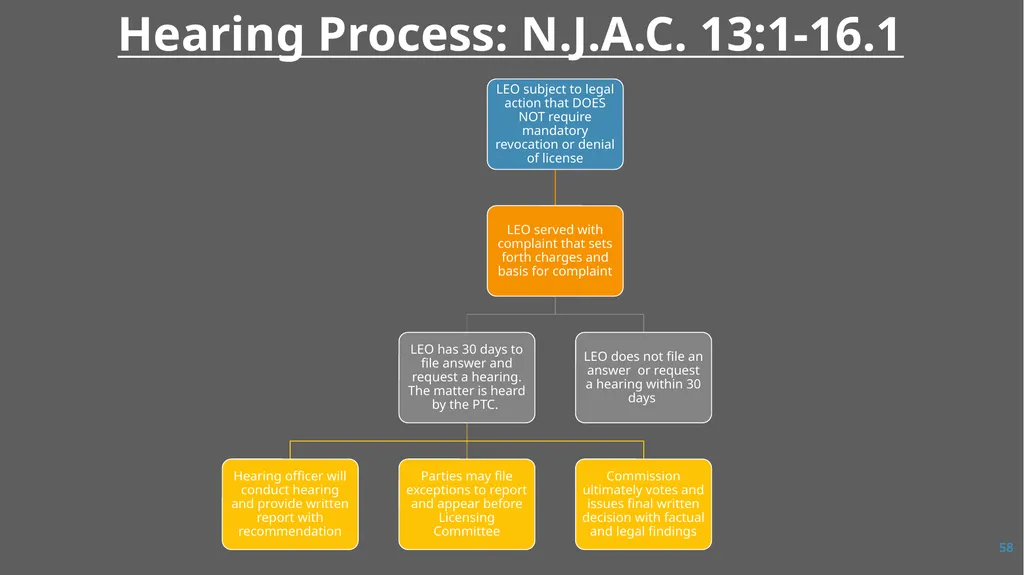
slide58. 58 Hearing Process: N.J.A.C. 13:1-16.1<br>
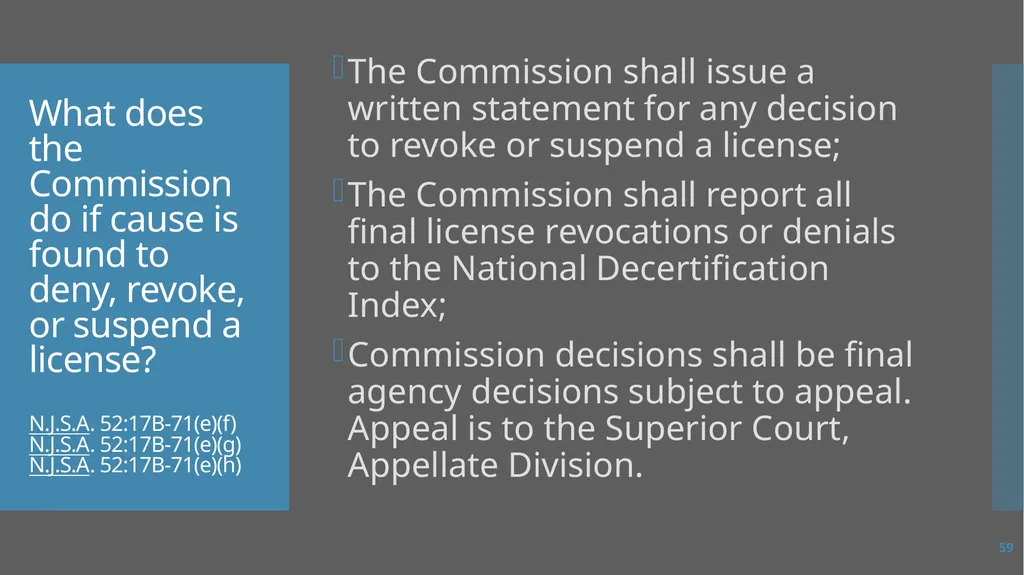
slide59. What does the Commission do if cause is found to deny, revoke, or suspend a license? N.J.S.A. 52:17B-71(e)(f) N.J.S.A. 52:17B-71(e)(g) N.J.S.A. 52:17B-71(e)(h) The Commission shall issue a written statement for any decision to revoke or suspend a license;
The Commission shall report all final license revocations or denials to the National Decertification Index;
Commission decisions shall be final agency decisions subject to appeal. Appeal is to the Superior Court, Appellate Division. 59<br>
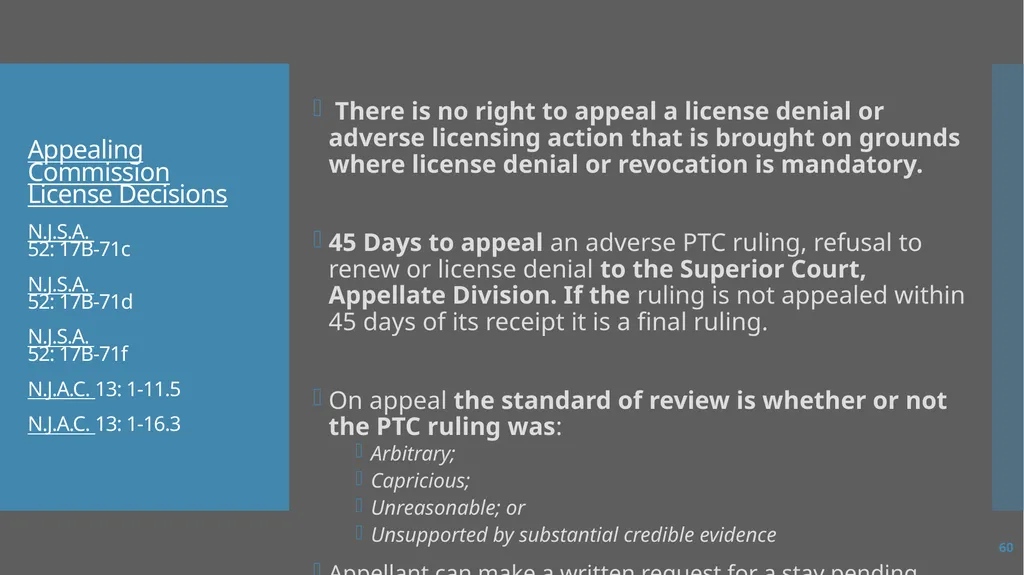
slide60. Appealing Commission License Decisions N.J.S.A. 52: 17B-71c N.J.S.A. 52: 17B-71d N.J.S.A. 52: 17B-71f N.J.A.C. 13: 1-11.5 N.J.A.C. 13: 1-16.3 There is no right to appeal a license denial or adverse licensing action that is brought on grounds where license denial or revocation is mandatory.
45 Days to appeal an adverse PTC ruling, refusal to renew or license denial to the Superior Court, Appellate Division. If the ruling is not appealed within 45 days of its receipt it is a final ruling.
On appeal the standard of review is whether or not the PTC ruling was:
Arbitrary;
Capricious;
Unreasonable; or
Unsupported by substantial credible evidence
Appellant can make a written request for a stay pending appeal. PTC has discretion to grant or deny. Denial of a stay may also be appealed to the Appellate Division. 60<br>
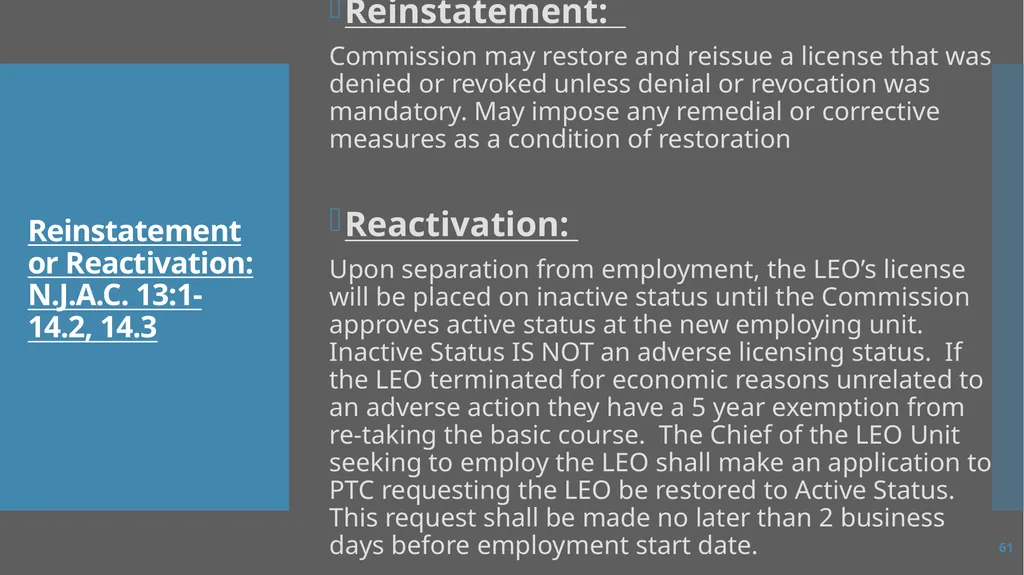
slide61. Reinstatement or Reactivation: N.J.A.C. 13:1-14.2, 14.3 61 Reinstatement:
Commission may restore and reissue a license that was denied or revoked unless denial or revocation was mandatory. May impose any remedial or corrective measures as a condition of restoration
Reactivation:
Upon separation from employment, the LEO’s license will be placed on inactive status until the Commission approves active status at the new employing unit. Inactive Status IS NOT an adverse licensing status. If the LEO terminated for economic reasons unrelated to an adverse action they have a 5 year exemption from re-taking the basic course. The Chief of the LEO Unit seeking to employ the LEO shall make an application to PTC requesting the LEO be restored to Active Status. This request shall be made no later than 2 business days before employment start date.<br>
slide62. N.J.A.C. 13:1-18.1 The PTC and Public Transparency
The Commission shall make the following information publicly available on its website, which shall be updated on a quarterly basis: 62 The following information will be made public regarding (1) pending adverse licensing actions and (2) adverse licensing actions where PTC has made a final decision:<br>
slide63. SECTION VI:
TERMINATION OR SUSPENSION 63<br>
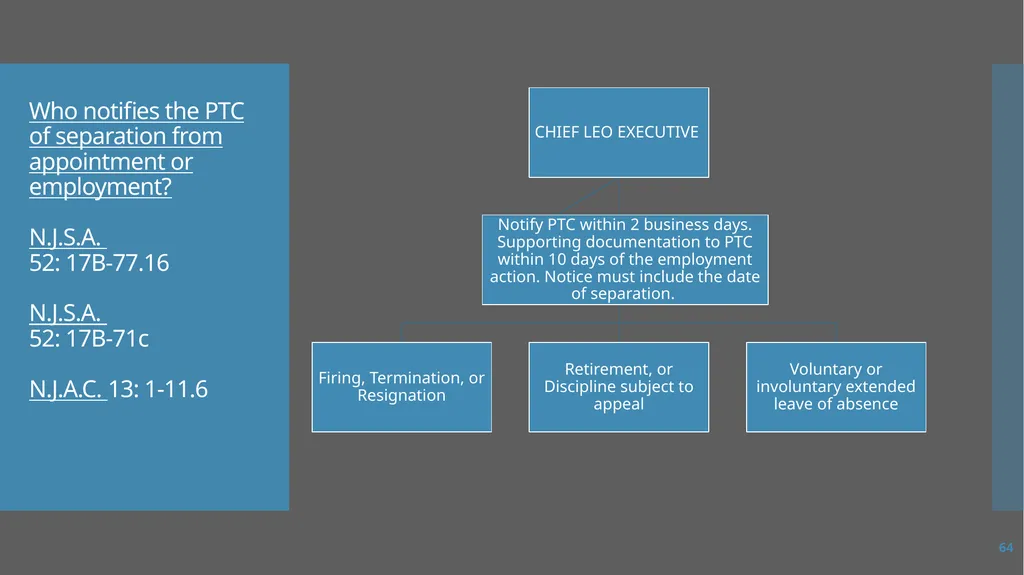
slide64. Who notifies the PTC of separation from appointment or employment? N.J.S.A. 52: 17B-77.16 N.J.S.A. 52: 17B-71c N.J.A.C. 13: 1-11.6 64<br>
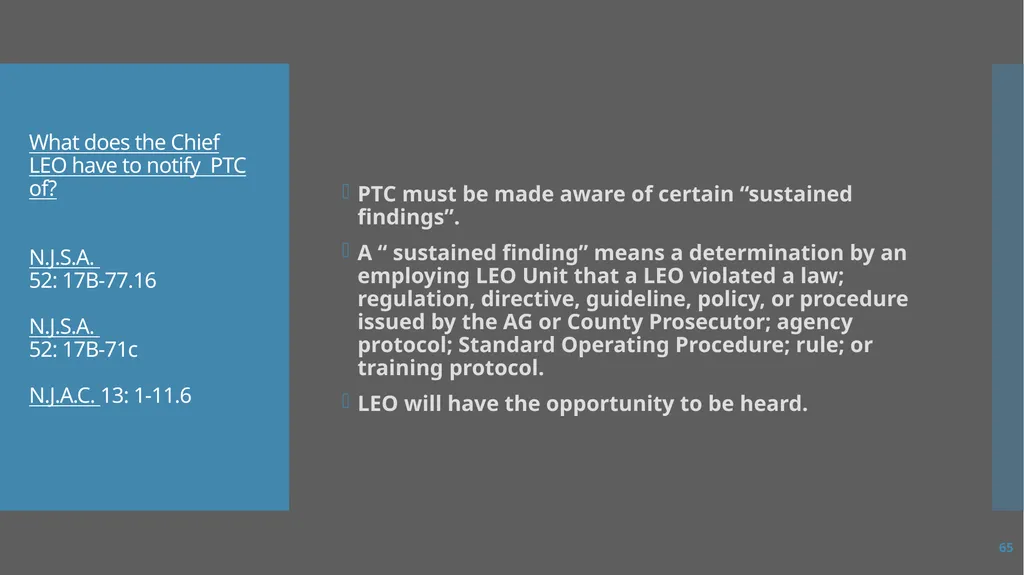
slide65. What does the Chief LEO have to notify PTC of? N.J.S.A. 52: 17B-77.16 N.J.S.A. 52: 17B-71c N.J.A.C. 13: 1-11.6 PTC must be made aware of certain “sustained findings”.
A “ sustained finding” means a determination by an employing LEO Unit that a LEO violated a law; regulation, directive, guideline, policy, or procedure issued by the AG or County Prosecutor; agency protocol; Standard Operating Procedure; rule; or training protocol.
LEO will have the opportunity to be heard. 65<br>
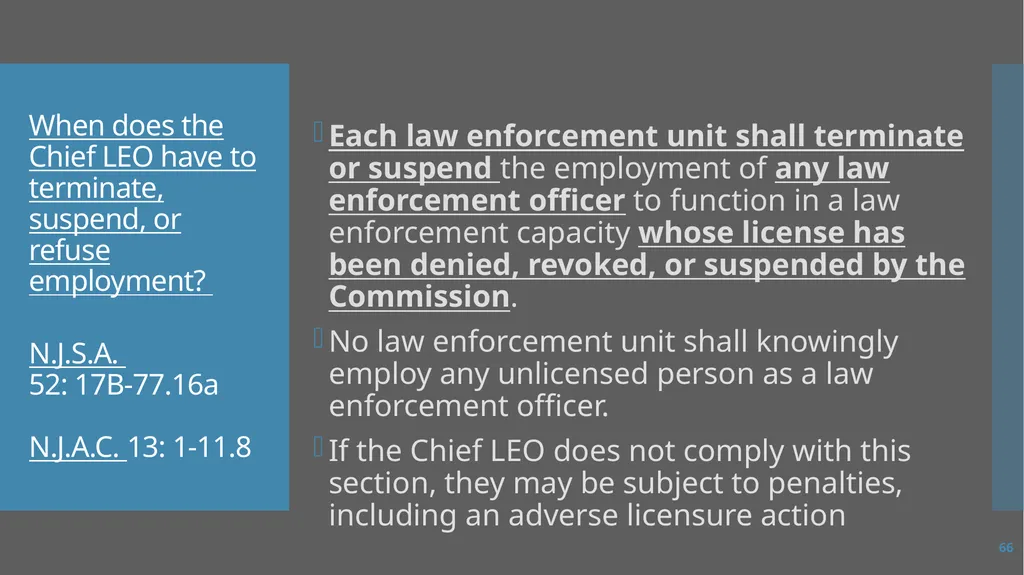
slide66. When does the Chief LEO have to terminate, suspend, or refuse employment? N.J.S.A. 52: 17B-77.16a N.J.A.C. 13: 1-11.8 Each law enforcement unit shall terminate or suspend the employment of any law enforcement officer to function in a law enforcement capacity whose license has been denied, revoked, or suspended by the Commission.
No law enforcement unit shall knowingly employ any unlicensed person as a law enforcement officer.
If the Chief LEO does not comply with this section, they may be subject to penalties, including an adverse licensure action 66<br>
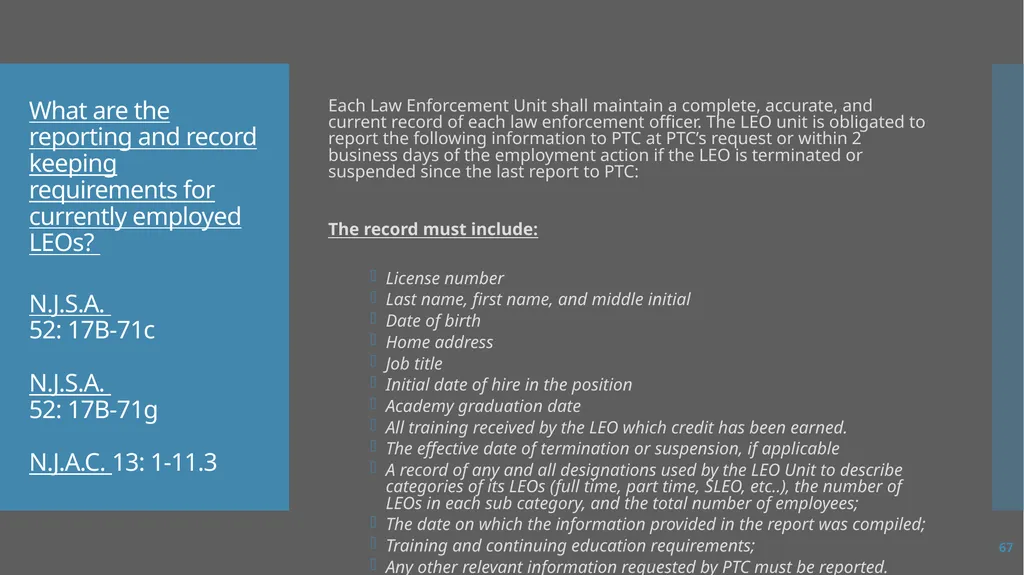
slide67. What are the reporting and record keeping requirements for currently employed LEOs? N.J.S.A. 52: 17B-71c N.J.S.A. 52: 17B-71g N.J.A.C. 13: 1-11.3 Each Law Enforcement Unit shall maintain a complete, accurate, and current record of each law enforcement officer. The LEO unit is obligated to report the following information to PTC at PTC’s request or within 2 business days of the employment action if the LEO is terminated or suspended since the last report to PTC:
The record must include:
License number
Last name, first name, and middle initial
Date of birth
Home address
Job title
Initial date of hire in the position
Academy graduation date
All training received by the LEO which credit has been earned.
The effective date of termination or suspension, if applicable
A record of any and all designations used by the LEO Unit to describe categories of its LEOs (full time, part time, SLEO, etc..), the number of LEOs in each sub category, and the total number of employees;
The date on which the information provided in the report was compiled;
Training and continuing education requirements;
Any other relevant information requested by PTC must be reported. 67<br>
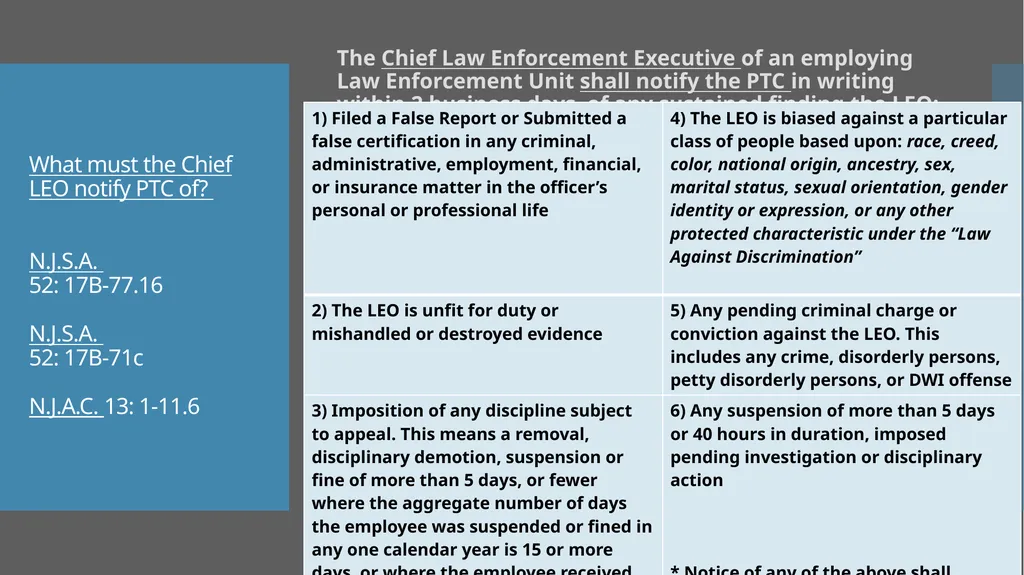
slide68. What must the Chief LEO notify PTC of? N.J.S.A. 52: 17B-77.16 N.J.S.A. 52: 17B-71c N.J.A.C. 13: 1-11.6 The Chief Law Enforcement Executive of an employing Law Enforcement Unit shall notify the PTC in writing within 2 business days of any sustained finding the LEO: 68<br>
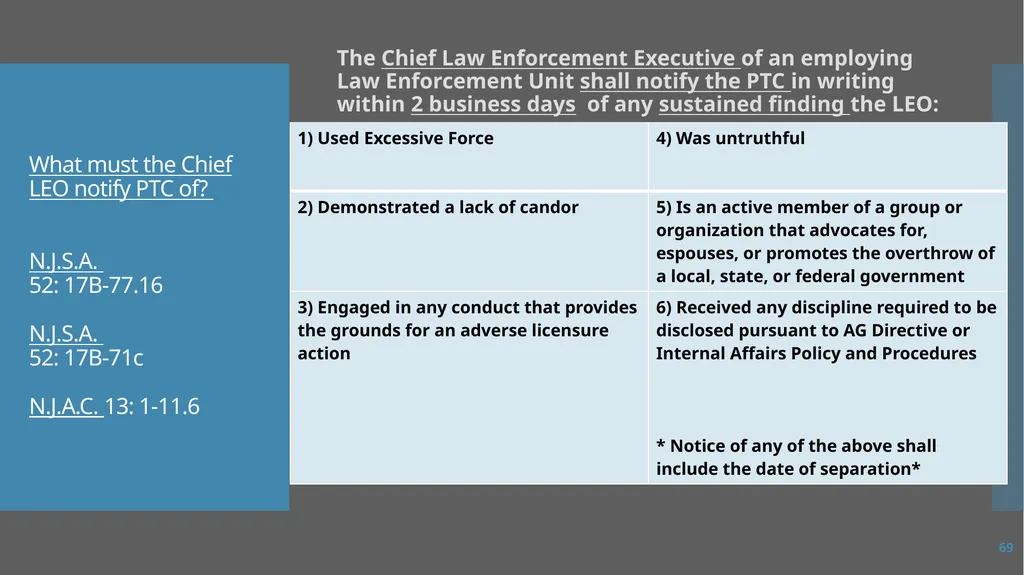
slide69. What must the Chief LEO notify PTC of? N.J.S.A. 52: 17B-77.16 N.J.S.A. 52: 17B-71c N.J.A.C. 13: 1-11.6 The Chief Law Enforcement Executive of an employing Law Enforcement Unit shall notify the PTC in writing within 2 business days of any sustained finding the LEO: 69<br>
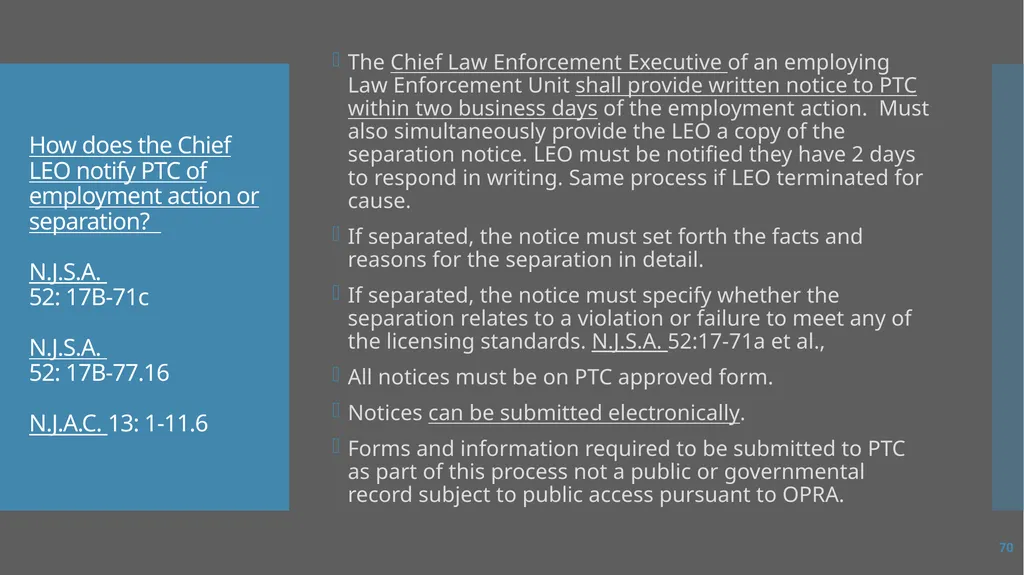
slide70. How does the Chief LEO notify PTC of employment action or separation? N.J.S.A. 52: 17B-71c N.J.S.A. 52: 17B-77.16 N.J.A.C. 13: 1-11.6 The Chief Law Enforcement Executive of an employing Law Enforcement Unit shall provide written notice to PTC within two business days of the employment action. Must also simultaneously provide the LEO a copy of the separation notice. LEO must be notified they have 2 days to respond in writing. Same process if LEO terminated for cause.
If separated, the notice must set forth the facts and reasons for the separation in detail.
If separated, the notice must specify whether the separation relates to a violation or failure to meet any of the licensing standards. N.J.S.A. 52:17-71a et al.,
All notices must be on PTC approved form.
Notices can be submitted electronically.
Forms and information required to be submitted to PTC as part of this process not a public or governmental record subject to public access pursuant to OPRA. 70<br>
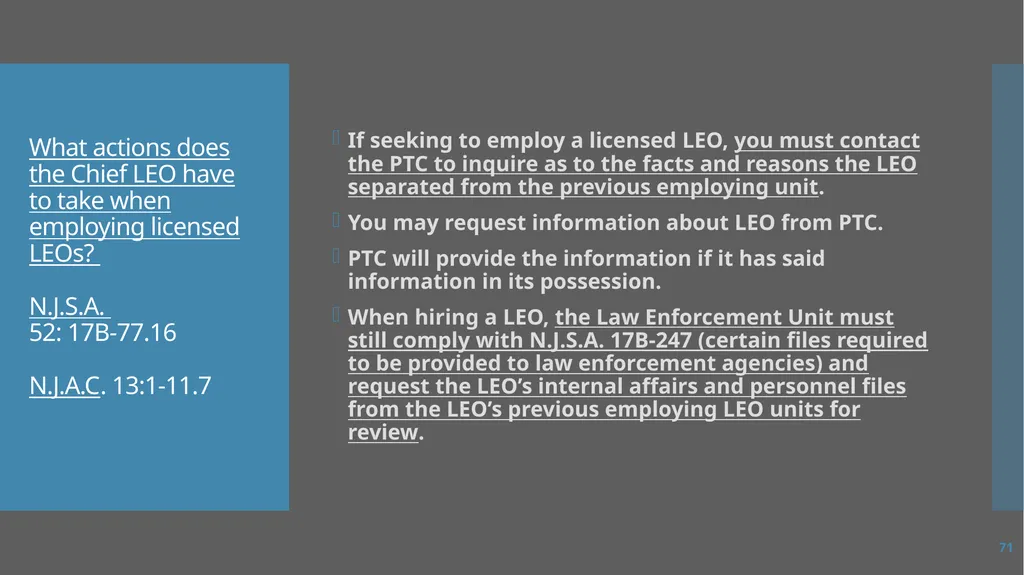
slide71. What actions does the Chief LEO have to take when employing licensed LEOs? N.J.S.A. 52: 17B-77.16 N.J.A.C. 13:1-11.7 If seeking to employ a licensed LEO, you must contact the PTC to inquire as to the facts and reasons the LEO separated from the previous employing unit.
You may request information about LEO from PTC.
PTC will provide the information if it has said information in its possession.
When hiring a LEO, the Law Enforcement Unit must still comply with N.J.S.A. 17B-247 (certain files required to be provided to law enforcement agencies) and request the LEO’s internal affairs and personnel files from the LEO’s previous employing LEO units for review. 71<br>
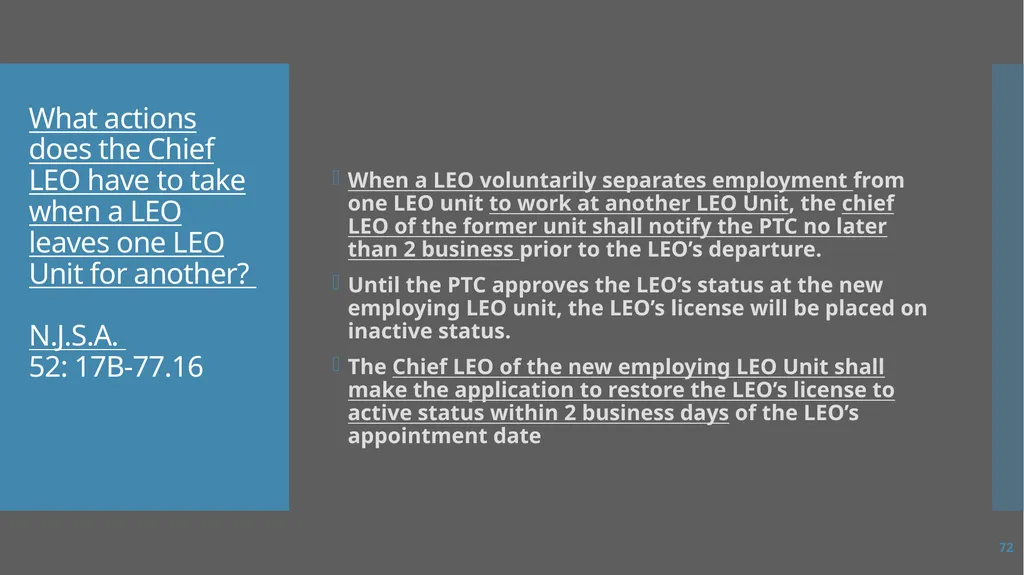
slide72. What actions does the Chief LEO have to take when a LEO leaves one LEO Unit for another? N.J.S.A. 52: 17B-77.16 When a LEO voluntarily separates employment from one LEO unit to work at another LEO Unit, the chief LEO of the former unit shall notify the PTC no later than 2 business prior to the LEO’s departure.
Until the PTC approves the LEO’s status at the new employing LEO unit, the LEO’s license will be placed on inactive status.
The Chief LEO of the new employing LEO Unit shall make the application to restore the LEO’s license to active status within 2 business days of the LEO’s appointment date 72<br>
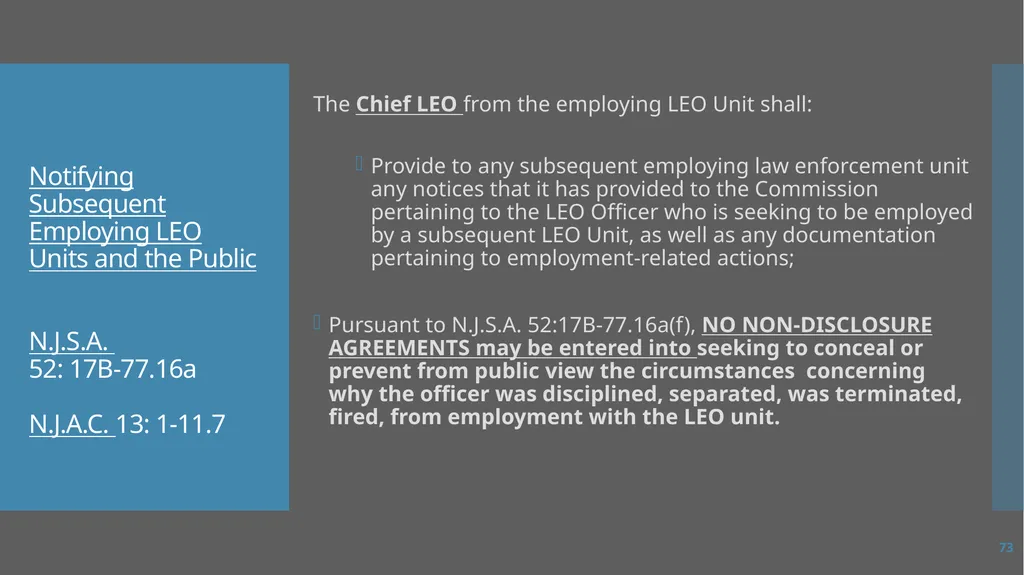
slide73. Notifying Subsequent Employing LEO Units and the Public N.J.S.A. 52: 17B-77.16a N.J.A.C. 13: 1-11.7 The Chief LEO from the employing LEO Unit shall:
Provide to any subsequent employing law enforcement unit any notices that it has provided to the Commission pertaining to the LEO Officer who is seeking to be employed by a subsequent LEO Unit, as well as any documentation pertaining to employment-related actions;
Pursuant to N.J.S.A. 52:17B-77.16a(f), NO NON-DISCLOSURE AGREEMENTS may be entered into seeking to conceal or prevent from public view the circumstances concerning why the officer was disciplined, separated, was terminated, fired, from employment with the LEO unit. 73<br>
slide74. SECTION VII:
FEES 74<br>
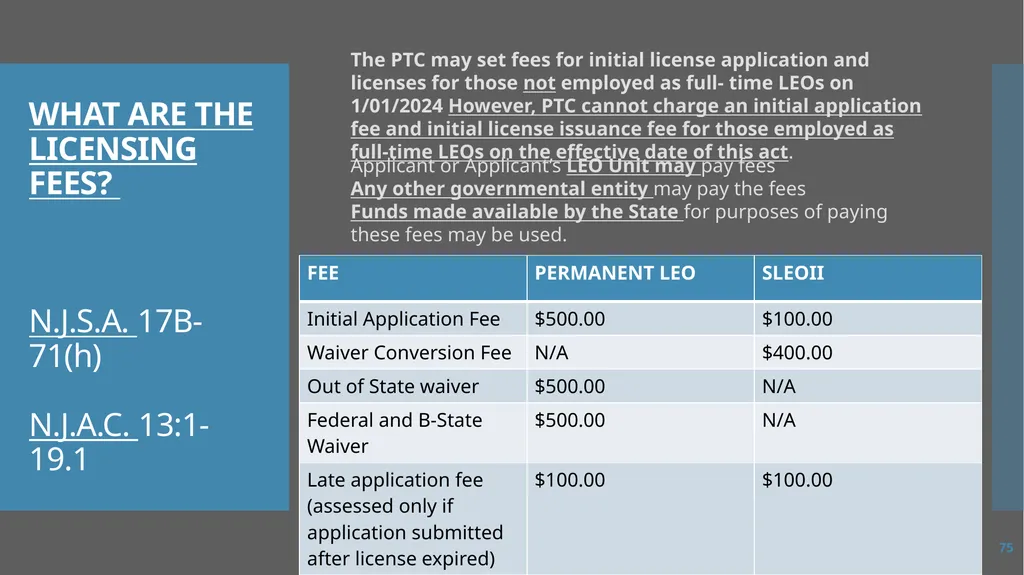
slide75. WHAT ARE THE LICENSING FEES? N.J.S.A. 17B-71(h) N.J.A.C. 13:1-19.1 75 The PTC may set fees for initial license application and licenses for those not employed as full- time LEOs on 1/01/2024 However, PTC cannot charge an initial application fee and initial license issuance fee for those employed as full-time LEOs on the effective date of this act. Applicant or Applicant’s LEO Unit may pay fees
Any other governmental entity may pay the fees
Funds made available by the State for purposes of paying these fees may be used.<br>
slide76. CONTACT John Cunningham
Administrator
NJ POLICE TRAINING COMMISSION
(E): CunninghamJ@njdcj.org
(P): 609-376-2410
Deputy Attorney General Stephen Wenger
Chief, Office of Police Policy
Office of Public Integrity and Accountability
(E):WengerS@njdcj.org
(P): 609-376-3365
Deputy Attorney General Alessandra Baldini
Office of Public Integrity and Accountability
(E): baldinia@njdcj.org
(P):609-376-2800
Deputy Attorney General Ed Simonson
Office of Public Integrity and Accountability
(E):Simonsone@njdcj.org
(P): 609-931-5165 76<br>
slide2. SECTION I:
INTRODUCTION 2<br>
slide3. Why Police Licensure? When does it take effect? Who Does it Effect? N.J.S.A. 52:17B-67.1 N.J.A.C. 13: 1-10.1 N.J.S.A. 52: 17B-1, et. Seq. N.J.S.A. 52:17B-66 N.J.A.C. 13:1-2.1 N.J.A.C. 13:1-21.1 The bill was signed into law on July 21, 2022, and with a few exceptions, the law and the regulations take effect on January 1, 2024.
The legislature found Licensure necessary for all sworn law enforcement officers in order to maintain professionalism and uphold public trust in law enforcement.
This means any person who is employed as a sworn member of any State, county or municipal law enforcement agency, department, division, or instrumentality of those governments who is statutorily empowered to act for the detection, investigation, arrest, conviction, detention or rehabilitation of persons violating the criminal laws of the State needs a license effective January 1, 2024. 3<br>
slide4. HOW LONG DOES A LICENSE LAST? N.J.S.A. 52: 17B-1, et. Seq. N.J.A.C. 13:1-20.1 A License is valid for 3 years from the date of issue.
All currently certified officers will receive a license on January 1, 2024.
The initial licensing period will stagger expiration dates in a manner determined by the PTC.
These licenses will be for 1, 2, or 3 years.
Initial licensing period shall not exceed 3 years.
The PTC will issue guidance for subsequent licensing intervals so that all of the approximately 38,000 law enforcement officers will not have to be renewed at the same time. 4<br>
slide5. Who Administers Licensing? N.J.S.A. 52:17B-71 N.J.A.C. 13:1-2.5 N.J.A.C. 13:1-2.6 The Police Training Commission
Originally created by the Police Training Act to facilitate education and training of LEOs
The PTC’s goal is to enhance professionalism, transparency, and accountability of law enforcement
Composed of representatives of various organizations
The AG is the Chairperson – Appoints an administrator
4 citizens of N.J. who are appointed by the Governor with the advice and consent of the state Senate. Their terms are for three years.
16 Other members include the PBA, FOP, NJSACOP, The NJSP, and the STFA.
Powers, Responsibilities, and duties now include, but are not limited to, administering law enforcement licensing and regulating all aspects of law enforcement training.<br>
slide6. N.J.S.A. 52:17B-71 N.J.A.C. 13:1-2.4 Do members of the PTC have to undergo training?
All members of the PTC must annually complete all training mandated by the Attorney General, including but not limited to, ethics and confidentiality training.
All newly appointed public members of the PTC must complete a course familiarizing them with relevant law enforcement training concepts, including but not limited to, use of force and internal affairs policy. 6<br>
slide7. N.J.S.A. 52:17B-70 N.J.S.A. 52:17B-71 N.J.A.C. 13:1-2.2 N.J.A.C. 13:1-2.6 What is the Licensing Committee?
The Licensing Committee administers licensing
Has at least seven members including AG and at least one public member;
Can review applications for licensing;
Request additional information to determine qualifications;
Make recommendations for adverse licensing action; and
May designate a hearing officer to conduct hearings<br>
slide8. SECTION II:
LICENSE REQUIREMENTS 8<br>
slide9. Who Notifies PTC of a New Appointments? N.J.S.A. 52: 17B-77.16(a) N.J.S.A. 52: 17B-71c N.J.A.C. 13: 1-11.2 N.J.A.C. 13: 1-11.3 The Appointing Authority makes the LEO appointment;
The Chief Law Enforcement Executive of an employing Law Enforcement Unit shall notify the PTC in writing of a LEO’s appointment to or employment with the LEO Unit.
NONA form will be absorbed into ACADIS
The LEO Unit is responsible for collecting, verifying, and maintaining all required licensing documentation
Completed application records must be maintained for at least 5 years
Ultimately, the Chief LEO Executive’s responsibility
Notification shall include the commencement date of such appointment or employment. 9<br>
slide10. Notification must be sent to School Director for New Hire Trainees N.J.S.A. 52: 17B-77.16a N.J.S.A. 52: 17B-71c N.J.A.C. 13:1-8.2 The amount of written notice that the Chief LEO Executive must provide the school director prior to the course beginning that LEO Unit has complied with its responsibilities pursuant to N.J.A.C. 13:1-8.1, et. seq. has increased from 10 days to 21 days.
If LEO Unit cannot comply, LEO Unit may make a written request to the Commission for an extension of time.
The extension request must state the reasons why an extension of time is needed.
Important to schedule hiring around beginning of academy class 10<br>
slide11. License Requirements: Screening Applicants N.J.S.A. 52: 17B-67.1 N.J.S.A. 52: 17B-71b N.J.S.A. 52: 17B-71c N.J.S.A. 52: 17B-71d N.J.A.C. 13: 1-10.2 N.J.A.C. 13: 1-11.2 In order to be licensed, the Applicant must satisfy the basic licensing requirements.
LEOs appointed on or after 1/1/24 must complete the initial licensing process.
LEOs appointed prior to 1/1/24 must complete the license renewal process.
If the Applicant does not satisfy the basic licensing requirements, they cannot be licensed.
BACKGROUND IS IMPORTANT 11<br>
slide12. License Requirements: Screening Applicants N.J.S.A. 52: 17B-71b N.J.S.A. 52: 17B-71c N.J.S.A. 52: 17B-71d N.J.A.C. 13: 1-10.2 N.J.A.C. 13: 1-10.3 N.J.A.C. 13: 1-11.2 A license application may be denied if the applicant fails to meet any of the license requirements such as: 12<br>
slide13. WHAT THE BACKGROUND CHECK MUST INCLUDE: N.J.S.A. 52: 17B-71c N.J.S.A. 52: 17B-71d N.J.A.C. 13: 1-10.3 N.J.A.C. 13: 1-11.2 . 13<br>
slide14. WHAT THE BACKGROUND CHECK MUST INCLUDE: N.J.S.A. 52: 17B-71c N.J.S.A. 52: 17B-71d N.J.A.C. 13: 1-10.3 N.J.A.C. 13: 1-11.2 The BACKGROUND CHECK includes:
FINGERPRINTING of the Applicant
NJSP, FBI, and other relevant databases
NCIC
Interstate Identification Index
NJDMV History, and if necessary any DMV from surrounding states
E-Courts, ATS, and ACS
Promis Gavel
A check in accordance with the Prison Rape Elimination Act
The Domestic Violence Registry
Any other database or successor database to the above named sources
Primary purpose is to check for warrants, arrests, restraining orders, or criminal records 14<br>
slide15. WHAT THE BACKGROUND CHECK MUST INCLUDE: N.J.S.A. 52: 17B-71c N.J.S.A. 52: 17B-71d N.J.A.C. 13: 1-10.3(a)(6) N.J.A.C. 13: 1-11.2 The BACKGROUND CHECK includes a SOCIAL MEDIA CHECK of the Initial Applicant’s SOCIAL MEDIA that searches:
Initial Applicant must provide access to all social media accounts;
The initial applicant must list every social media account they used within the past 5 years, regardless of whether or not the account has been deleted or is no longer used
At a minimum, must search outwardly facing and publicly accessible components of those accounts
The search is for content relevant to bias-relevant behaviors; behaviors indicative of misconduct or dishonest, illegal acts or activity; or other behaviors or evidence indicative of unsuitability or ineligibility for law enforcement licensure ---Includes group membership in any hate group or group advocating the overthrow of the government
Applicant must certify they do not belong to such a group
The LEO Unit may access a Renewal Applicant’s social media only if they have a reasonable articulable belief the Renewal Applicant used their social media account for reasons that are violative of the act or the rules. Otherwise, only search the outwardly facing or publicly accessible components of the renewal applicant’s social media accounts. 15<br>
slide16. What are the minimum requirements for the medical exam? N.J.S.A. 52: 17B-71c N.J.S.A. 52: 17B-71d N.J.A.C. 13: 1-10.4 N.J.A.C. 13: 1-11.2 Medical Exam must be conducted by a:
NJ licensed Physician; NJ Licensed advance practice nurse; or NJ Licensed nurse assistant;
Look for conditions that may potential exclude from basic course
Medical Exam must include:
a comprehensive medical history questionnaire completed by the Applicant; the Applicant’s medical history; a medical examination of the applicant; a complete blood count, urinalysis, tuberculosis, electrocardiogram;
The Applicant may seek a second opinion if the medical exam indicates the Applicant has medical or physical conditions which may interfere with their ability to perform the essential functions of a LEO;
However, unlike the initial exam, the Applicant must pay for the second opinion. The PTC may consider the second opinion, but is not bound by any findings in a second opinion.
Medical History Statement and Medical Exam Report are valid 1 year from the date the examiner signs them. 16<br>
slide17. What are the minimum requirements for the Drug Test? N.J.S.A. 52: 17B-71c N.J.S.A. 52: 17B-71d N.J.A.C. 13: 1-10.5 N.J.A.C. 13: 1-11.2 Applicant must pass the drug test.
Must be conducted consistent with current applicable AG Law Enforcement Drug Testing Policy.
Time drug test with the start of the academy so that all required documentation can be timely submitted to PTC. 17<br>
slide18. What are the minimum requirements for the Psychological Exam? N.J.S.A. 52: 17B-71c N.J.S.A. 52: 17B-71d N.J.A.C. 13: 1-10.6 N.J.A.C. 13: 1-11.2 In order to be eligible for a LEO license the Applicant must pass the psychological exam;
Employing LEO Unit shall arrange for psychological exam that is conducted no more than 12 months prior to academy orientation day or application for permanent employment;
Must be conducted by a NJ licensed psychiatrist or psychologist who uses a PTC prescribed form relevant to the duties of the title the applicant is appointed to;
Psychiatrist or psychologist conducting exam must be familiar with the responsibilities of a law enforcement officer and use a written personality test such as:
NEO-PI-R
Inwald Personality Inventory
Any other exam that is their functional equivalent 18<br>
slide19. What are the minimum standards for the physical ability test? N.J.S.A. 52: 17B-71c N.J.S.A. 52: 17B-71d N.J.A.C. 13: 1-10.7 N.J.A.C. 13: 1-11.2 Applicants must pass all 5 components of the Pre- Admission PT Test:
A vertical jump of 15 inches or more; 1-2 min recovery
28 sit-ups in one minute or less, verbally counted by instructor as“ one complete, etc..” ; 5 min recovery
300 meter run in 70.1 seconds or less; 10 min recovery
24 push-ups in one minute or less verbally counted by instructor as “ one complete, etc.”; 5 min recovery
A 1.5 mile run in 15 min and 55 seconds or less; 5 min recovery
Applicants should be provided at least 3 minutes to warm up. The Test should be conducted within one continuous 8 hour period on a level surface, level track, or other PTC approved surface 19<br>
slide20. What are the minimum standards for the physical ability test? N.J.S.A. 52: 17B-71c N.J.S.A. 52: 17B-71d N.J.A.C. 13: 1-10.7 N.J.A.C. 13: 1-11.2 If an applicant fails the initial fitness requirement, the Chief LEO shall schedule a retest date at the request of the Applicant;
When practicable, the retest date should be no less than 3 weeks after the initial failed test;
During a re-test, the applicant must take the entire test over.
The applicant must pass the entire re-test.
The applicant cannot count previous passing results toward any retest. 20<br>
slide21. License Requirements: Screening Applicants N.J.S.A. 52: 17B-71b N.J.S.A. 52: 17B-71c N.J.S.A. 52: 17B-71d N.J.A.C. 13: 1-10.2 N.J.A.C. 13: 1-11.2 N.J.A.C. 13: 1-11.5 N.J.A.C. 13: 1-12.1 PTC is mandated to deny a license or take adverse action if there is a preponderance of the evidence that the Applicant:
Has a criminal conviction. This means ANYTHING regarded as a criminal offense in any other jurisdiction, foreign or domestic.
Has a domestic violence conviction. N.J.S.A. 2C:25-17. This means ANYTHING considered a domestic violence offense in any other jurisdiction, foreign or domestic.
Is the subject of or had a DV restraining order, an extreme risk protection order, or temporary extreme risk protection order entered against them;
Has a conviction that would preclude them from carrying a firearm as defined in N.J.S.A. 2C:39-1. Includes any offense of this nature that violates the laws of any other jurisdiction, foreign or domestic. 21<br>
slide22. License Requirements: Screening Applicants N.J.S.A. 52: 17B-71b N.J.S.A. 52: 17B-71c N.J.S.A. 52: 17B-71d N.J.A.C. 13: 1-10.2 N.J.A.C. 13: 1-11.2 N.J.A.C. 13: 1-11.5 N.J.A.C. 13: 1-12.1 In order to be licensed Initial or Renewal Applicant must:
Not have any disorderly persons or petty disorderly persons convictions involving dishonesty, fraud, or lack of good moral character;
Unless the PTC determines the offense to be de-minimis or inconsequential to applicant’s ability to meet the standards expected for a LEO;
This also includes similar offenses in any other jurisdiction
Not have 2 or more motor vehicle convictions for DWI pursuant to N.J.S.A. 39:4-50. This includes similar offenses in any other jurisdiction;
Not have 2 or more motor vehicle convictions for reckless driving pursuant to N.J.S.A. 39:4-96. This includes similar offenses in any other jurisdiction;
PTC may take adverse action or denial if there is a preponderance of evidence of any of the above. 22<br>
slide23. License Requirements: Screening Applicants N.J.S.A. 52: 17B-71b N.J.S.A. 52: 17B-71c N.J.S.A. 52: 17B-71d N.J.A.C. 13: 1-10.2 N.J.A.C. 13: 1-11.2 23<br>
slide24. License Requirements: Screening Applicants N.J.S.A. 52: 17B-71b N.J.S.A. 52: 17B-71c N.J.S.A. 52: 17B-71d N.J.A.C. 13: 1-10.2 N.J.A.C. 13: 1-11.2 In order to be licensed the Initial and Renewal Applicant:
Cannot be a member of a street gang or “security threat group”.
A “security threat group” is any group that possesses common characteristics, interests, and goals which as a discrete entity, pose a threat to the safety of the community or public at large 24<br>
slide25. License Requirements: Screening Applicants N.J.S.A. 52: 17B-71b N.J.S.A. 52: 17B-71c N.J.S.A. 52: 17B-71d N.J.A.C. 13: 1-10.2 N.J.A.C. 13: 1-11.2 In order to be licensed the Initial and Renewal Applicant must:
Not be an active member of a group or organization that advocates for violence against or hatred or bias toward individuals based on:
Likewise, cannot have engaged in conduct or behavior in their personal or professional life, that demonstrates, espouses, advocates, or supports discrimination, violence against, hatred or bias toward these groups 25<br>
slide26. License Requirements: Screening Applicants N.J.S.A. 52: 17B-71b N.J.S.A. 52: 17B-71c N.J.S.A. 52: 17B-71d N.J.A.C. 13: 1-10.2 N.J.A.C. 13: 1-11.2 Examples of prohibited Applicant conduct includes but is not limited to:
Making statements;
Posting;
Sharing; or
Commenting in support of any posting social media or otherwise
The test is whether or not the conduct:
Would undermine public confidence in the LEO; or
The LEO Unit’s ability to carry out the public safety mission; or
The conduct or behavior would cause substantial disruption to proper law enforcement functioning. 26<br>
slide27. License Requirements: Screening Applicants N.J.S.A. 52: 17B-71b N.J.S.A. 52: 17B-71c N.J.S.A. 52: 17B-71d N.J.A.C. 13: 1-10.2 N.J.A.C. 13: 1-11.2 N.J.A.C. 13:1-12.1 27 PTC may take adverse action or denial if there is a preponderance of evidence of any of the above.<br>
slide28. License Requirements: Screening Applicants N.J.S.A. 52: 17B-71b N.J.S.A. 52: 17B-71c N.J.S.A. 52: 17B-71d N.J.A.C. 13: 1-10.2 N.J.A.C. 13: 1-11.2 N.J.A.C. 13:1-12.1 28 PTC may take adverse action or denial if there is a preponderance of evidence of any of the above.<br>
slide29. License Requirements: Screening Applicants N.J.S.A. 52: 17B-71b N.J.S.A. 52: 17B-71c N.J.S.A. 52: 17B-71d N.J.A.C. 13: 1-10.2 N.J.A.C. 13: 1-11.2 N.J.A.C. 13:1-12.1 29 PTC may take adverse action or denial if there is a preponderance of evidence of any of the above.<br>
slide30. License Requirements: Screening Applicants N.J.S.A. 52: 17B-71b N.J.S.A. 52: 17B-71c N.J.S.A. 52: 17B-71d N.J.A.C. 13: 1-10.8 N.J.A.C. 13: 1-11.2 A License Applicant has the following continuing obligations:
It is the Applicant’s burden to demonstrate they satisfy the minimum requirements for licensure by producing any required documentation;
appear before PTC or Licensing Committee for an interview concerning their license application at the request of the PTC;
Applicant has an unqualified duty to cooperate with PTC and the Licensing Committee in connection with an investigation into their application for licensure;
Update the Chief LEO Executive of any changes that occur after the applicant submits their license application that would render any of the submitted information inaccurate;
Provide necessary information or documentation and cooperation as may be from time to time reasonably requested by PTC. 30<br>
slide31. Documents LEO Unit must Collect, Verify, and Maintain N.J.S.A. 52: 17B-71c N.J.S.A. 52: 17B-71d N.J.A.C. 13: 1-10.2 N.J.A.C. 13: 1-11.2 The license application requires the applicant to:
Sign a waiver allowing PTC and employing LEO Unit to review applicant’s employment records, any Internal Affairs records, and any records relating to completed applications for a LEO position, even if applicant was not employed;
Provide a list of social media accounts dating back 5 years prior to their application for licensure;
Sign a release granting PTC and employing LEO unit access to all outward facing, public components of social media accounts; 31<br>
slide32. Documents LEO Unit must Collect, Verify, and Maintain N.J.S.A. 52: 17B-71c N.J.A.C. 13: 1-11.2 Once the required documentation is obtained for new hires or appointees the LEO unit must:
notify the PTC of the LEO’s appointment or employment;
indicate what day the appointment commences;
and submit the documentation to the PTC for further review and verification.
Appointing Agency should conduct thorough background to determine applicant is eligible to be licensed. 32<br>
slide33. How is the renewal application submitted? N.J.S.A. 52: 17B-71c N.J.S.A. 52: 17B-71d N.J.A.C. 13: 1-11.3 N.J.A.C. 13: 1-11.5 Any false, untrue, or misleading statements on a renewal application or any communication related to a renewal application may result in an adverse licensing action.
PTC will publish schedules outlining the license renewal timeline. 33<br>
slide34. Can a license be renewed administratively? N.J.S.A. 52: 17B-71c N.J.S.A. 52: 17B-71d N.J.A.C. 13: 1-11.5 N.J.A.C. 13: 1-14.1 Yes. Don’t wait to submit a license renewal application!
Administrative renewal does not require review from the licensing committee or a hearing.
In order to be eligible for administrative renewal:
The LEO and the LEO Unit must submit all required documentation in a timely manner;
There is no notice of employment related action submitted against the LEO;
The LEO is not involved in an incident that requires the submission of a notice of employment related action to be submitted;
See employment related actions that must be reported N.J.A.C 13:1-11.6 34<br>
slide35. License Renewal Documentation to submit to PTC N.J.S.A. 52: 17B-71c N.J.S.A. 52: 17B-71d N.J.A.C. 13: 1-11.5 If the LEO cannot make the required RENEWAL certifications, the LEO must disclose why they cannot make the required certifications to PTC.
The Chief LEO Executive must make the same disclosure to PTC if they cannot make the required certification
PTC may consider the reasons contained in the Chief LEO Executive and/ or the LEO’s disclosure when making a license renewal decision.
The LEO Applicant and the Chief LEO Executive have a continuing duty to update PTC if any of the information contained in the application changes. 35<br>
slide36. License Renewal Documentation to submit to PTC N.J.S.A. 52: 17B-71c N.J.S.A. 52: 17B-71d N.J.A.C. 13: 1-11.5 The PTC may also request the following documentation from the employing LEO Unit or LEO for license RENEWALS:
A summary of a LEO’s internal affairs file;
A LEO’s entire internal affairs file;
Any other information PTC deems relevant for a license renewal;
In addition, if the PTC receives information from other sources, that information can lead to an investigation that may result in deactivation of their license or refusal to renew. 36<br>
slide37. SECTION III:
Grounds for License Denial, Initiation of an Adverse Licensing Action, or License Revocation 37<br>
slide38. Grounds for License Denial or Adverse Action N.J.S.A. 52: 17B-67.1 N.J.S.A. 52: 17B-71b N.J.S.A. 52:17B-71c N.J.S.A. 52: 17B-71d N.J.S.A. 52: 17B-71e N.J.A.C. 13: 1-10.2 N.J.A.C. 13: 1-10.3 A license may be denied or revoked for failing to meet any of the statutory or regulatory licensing requirements
Likewise, an Adverse Licensing Action may be brought for failing to meet or adhere to any of the statutory or regulatory licensing requirements
However, the PTC cannot issue a denial of application for licensure solely on the consideration of disciplinary actions based on conduct that occurred prior to the date the licensing law was enacted (7/21/22). 38<br>
slide39. Grounds for License Denial or Adverse Action N.J.S.A. 52:17B-71e (a) The Commission has the authority to bring an adverse license action if the applicant or LEO has: 39 Unprofessional conduct includes any departure from or failure to conform to the minimum standards of acceptable and prevailing practices of a LEO as set forth by PTC<br>
slide40. Grounds for License Denial or Adverse Action N.J.S.A. 52:17B-71(e) The Commission has the authority to bring an adverse license action if the applicant or LEO has become unable to perform the duties of a LEO with reasonable skill and safety to citizens by reason of:
Illness (does not include authorized medical leave);
Use of alcohol;
Drug use;
Narcotic use;
Chemicals use;
Use of any other type of material; or
due to any other mental or physical condition, including a determination of incapacity 40<br>
slide41. Grounds for License Denial or Adverse Action N.J.S.A. 52: 17B-71c N.J.S.A. 52: 17B-71d N.J.A.C. 13: 1-11.5 N.J.A.C. 13: 1-12.1 The PTC may deny any license application or take adverse action if there is a preponderance of the evidence that the Applicant failed to meet and maintain proper licensing standards and regulatory requirements as evidenced by proof the LEO has: 41<br>
slide42. Grounds for License Denial or Adverse Action N.J.S.A. 52: 17B-71c N.J.S.A. 52: 17B-71d N.J.A.C. 13: 1-11.5 N.J.A.C. 13: 1-12.1 The PTC may deny any license or take adverse action if there is a preponderance of the evidence that the Applicant failed to discharge legal obligations, as evidenced by proof: 42<br>
slide43. Grounds for License Denial or Adverse Action N.J.S.A. 52: 17B-71c N.J.S.A. 52: 17B-71d N.J.A.C. 13: 1-11.5 N.J.A.C. 13: 1-12.1 The PTC may deny any license application or take adverse action if:
There is a preponderance of the evidence that the Applicant is placed or participating in a PTI program in New Jersey, or any state or federal jurisdiction;
There is a preponderance of the evidence that the Applicant committed a crime involving moral turpitude, regardless whether or not the charges resulted in a conviction; 43<br>
slide44. Grounds for License Denial or Adverse Action N.J.S.A. 52: 17B-71c N.J.S.A. 52: 17B-71d N.J.A.C. 13: 1-11.5 N.J.A.C. 13: 1-12.1 Restraining orders, FERPOs and TERPOs:
the issuance of an FRO requires a court to find a predicate act of domestic violence pursuant to N.J.S.A. 2C:25-19.
Civil proceeding where the standard of proof is “preponderance of the evidence”.
Thus, if an FRO is entered, it means a court has found that there is a “preponderance of the evidence” that the officer committed an act of domestic violence.
The entry of a TRO, ITRO, FRO, ERPO, TERPO, or Domestic Violence Conviction makes the officer a certain person not to possess a firearm pursuant to N.J.S.A. 2C:39-7, and will result in license denial or revocation. 44<br>
slide45. Grounds for License Denial or Adverse Action N.J.S.A. 52: 17B-71c N.J.S.A. 52: 17B-71d N.J.A.C. 13: 1-11.5 N.J.A.C. 13: 1-12.1 N.J.A.C. 13: 1-10.2 N.J.A.C. 13: 1-11.2 However, the PTC has some discretion for DWI, Reckless Driving, DP, and PDP convictions if:
the offense is de minimus in nature (DP and PDP only);
the conviction is inconsequential to the Applicant’s or Licensee’s ability to meet the standards expected of a LEO (DP and PDP only);
the conviction occurred 5 years prior to the application for license renewal;
Applicant documents they have taken rehabilitative steps since the conviction to become law abiding, i.e. their actions, continuing education, maintaining gainful employment, having no further convictions;
The Applicant produces at least 3 letters of recommendation evincing they are of good moral character at the time of the application. 45<br>
slide46. SECTION IV:
ADVERSE LICENSE ACTION PROCESS 46<br>
slide47. 47 Preliminary Review: N.J.A.C. 13:1-15.1<br>
slide48. 48 Preliminary Review: N.J.A.C. 13:1-15.1<br>
slide49. 49 Preliminary Review: N.J.A.C. 13:1-15.1<br>
slide50. 50 Immediate suspension process: N.J.A.C. 13:1-16.2<br>
slide51. 51 Immediate suspension process: N.J.A.C. 13:1-16.2<br>
slide52. 52 Immediate suspension process: N.J.A.C. 13:1-16.2<br>
slide53. 53 Immediate suspension process: N.J.A.C. 13:1-16.2<br>
slide54. 54 Adverse Licensing Actions: N.J.S.A. 52:17B-71e<br>
slide55. 55 Adverse Licensing Actions: N.J.S.A. 52:17B-71e<br>
slide56. 56 Adverse Licensing Actions: N.J.S.A. 52:17B-71e<br>
slide57. SECTION V:
HEARING AND APPEAL PROCESS
*Note that all records confidential under N.J.S.A. 47:1A-1 et. seq. (OPRA) shall not be made public* 57<br>
slide58. 58 Hearing Process: N.J.A.C. 13:1-16.1<br>
slide59. What does the Commission do if cause is found to deny, revoke, or suspend a license? N.J.S.A. 52:17B-71(e)(f) N.J.S.A. 52:17B-71(e)(g) N.J.S.A. 52:17B-71(e)(h) The Commission shall issue a written statement for any decision to revoke or suspend a license;
The Commission shall report all final license revocations or denials to the National Decertification Index;
Commission decisions shall be final agency decisions subject to appeal. Appeal is to the Superior Court, Appellate Division. 59<br>
slide60. Appealing Commission License Decisions N.J.S.A. 52: 17B-71c N.J.S.A. 52: 17B-71d N.J.S.A. 52: 17B-71f N.J.A.C. 13: 1-11.5 N.J.A.C. 13: 1-16.3 There is no right to appeal a license denial or adverse licensing action that is brought on grounds where license denial or revocation is mandatory.
45 Days to appeal an adverse PTC ruling, refusal to renew or license denial to the Superior Court, Appellate Division. If the ruling is not appealed within 45 days of its receipt it is a final ruling.
On appeal the standard of review is whether or not the PTC ruling was:
Arbitrary;
Capricious;
Unreasonable; or
Unsupported by substantial credible evidence
Appellant can make a written request for a stay pending appeal. PTC has discretion to grant or deny. Denial of a stay may also be appealed to the Appellate Division. 60<br>
slide61. Reinstatement or Reactivation: N.J.A.C. 13:1-14.2, 14.3 61 Reinstatement:
Commission may restore and reissue a license that was denied or revoked unless denial or revocation was mandatory. May impose any remedial or corrective measures as a condition of restoration
Reactivation:
Upon separation from employment, the LEO’s license will be placed on inactive status until the Commission approves active status at the new employing unit. Inactive Status IS NOT an adverse licensing status. If the LEO terminated for economic reasons unrelated to an adverse action they have a 5 year exemption from re-taking the basic course. The Chief of the LEO Unit seeking to employ the LEO shall make an application to PTC requesting the LEO be restored to Active Status. This request shall be made no later than 2 business days before employment start date.<br>
slide62. N.J.A.C. 13:1-18.1 The PTC and Public Transparency
The Commission shall make the following information publicly available on its website, which shall be updated on a quarterly basis: 62 The following information will be made public regarding (1) pending adverse licensing actions and (2) adverse licensing actions where PTC has made a final decision:<br>
slide63. SECTION VI:
TERMINATION OR SUSPENSION 63<br>
slide64. Who notifies the PTC of separation from appointment or employment? N.J.S.A. 52: 17B-77.16 N.J.S.A. 52: 17B-71c N.J.A.C. 13: 1-11.6 64<br>
slide65. What does the Chief LEO have to notify PTC of? N.J.S.A. 52: 17B-77.16 N.J.S.A. 52: 17B-71c N.J.A.C. 13: 1-11.6 PTC must be made aware of certain “sustained findings”.
A “ sustained finding” means a determination by an employing LEO Unit that a LEO violated a law; regulation, directive, guideline, policy, or procedure issued by the AG or County Prosecutor; agency protocol; Standard Operating Procedure; rule; or training protocol.
LEO will have the opportunity to be heard. 65<br>
slide66. When does the Chief LEO have to terminate, suspend, or refuse employment? N.J.S.A. 52: 17B-77.16a N.J.A.C. 13: 1-11.8 Each law enforcement unit shall terminate or suspend the employment of any law enforcement officer to function in a law enforcement capacity whose license has been denied, revoked, or suspended by the Commission.
No law enforcement unit shall knowingly employ any unlicensed person as a law enforcement officer.
If the Chief LEO does not comply with this section, they may be subject to penalties, including an adverse licensure action 66<br>
slide67. What are the reporting and record keeping requirements for currently employed LEOs? N.J.S.A. 52: 17B-71c N.J.S.A. 52: 17B-71g N.J.A.C. 13: 1-11.3 Each Law Enforcement Unit shall maintain a complete, accurate, and current record of each law enforcement officer. The LEO unit is obligated to report the following information to PTC at PTC’s request or within 2 business days of the employment action if the LEO is terminated or suspended since the last report to PTC:
The record must include:
License number
Last name, first name, and middle initial
Date of birth
Home address
Job title
Initial date of hire in the position
Academy graduation date
All training received by the LEO which credit has been earned.
The effective date of termination or suspension, if applicable
A record of any and all designations used by the LEO Unit to describe categories of its LEOs (full time, part time, SLEO, etc..), the number of LEOs in each sub category, and the total number of employees;
The date on which the information provided in the report was compiled;
Training and continuing education requirements;
Any other relevant information requested by PTC must be reported. 67<br>
slide68. What must the Chief LEO notify PTC of? N.J.S.A. 52: 17B-77.16 N.J.S.A. 52: 17B-71c N.J.A.C. 13: 1-11.6 The Chief Law Enforcement Executive of an employing Law Enforcement Unit shall notify the PTC in writing within 2 business days of any sustained finding the LEO: 68<br>
slide69. What must the Chief LEO notify PTC of? N.J.S.A. 52: 17B-77.16 N.J.S.A. 52: 17B-71c N.J.A.C. 13: 1-11.6 The Chief Law Enforcement Executive of an employing Law Enforcement Unit shall notify the PTC in writing within 2 business days of any sustained finding the LEO: 69<br>
slide70. How does the Chief LEO notify PTC of employment action or separation? N.J.S.A. 52: 17B-71c N.J.S.A. 52: 17B-77.16 N.J.A.C. 13: 1-11.6 The Chief Law Enforcement Executive of an employing Law Enforcement Unit shall provide written notice to PTC within two business days of the employment action. Must also simultaneously provide the LEO a copy of the separation notice. LEO must be notified they have 2 days to respond in writing. Same process if LEO terminated for cause.
If separated, the notice must set forth the facts and reasons for the separation in detail.
If separated, the notice must specify whether the separation relates to a violation or failure to meet any of the licensing standards. N.J.S.A. 52:17-71a et al.,
All notices must be on PTC approved form.
Notices can be submitted electronically.
Forms and information required to be submitted to PTC as part of this process not a public or governmental record subject to public access pursuant to OPRA. 70<br>
slide71. What actions does the Chief LEO have to take when employing licensed LEOs? N.J.S.A. 52: 17B-77.16 N.J.A.C. 13:1-11.7 If seeking to employ a licensed LEO, you must contact the PTC to inquire as to the facts and reasons the LEO separated from the previous employing unit.
You may request information about LEO from PTC.
PTC will provide the information if it has said information in its possession.
When hiring a LEO, the Law Enforcement Unit must still comply with N.J.S.A. 17B-247 (certain files required to be provided to law enforcement agencies) and request the LEO’s internal affairs and personnel files from the LEO’s previous employing LEO units for review. 71<br>
slide72. What actions does the Chief LEO have to take when a LEO leaves one LEO Unit for another? N.J.S.A. 52: 17B-77.16 When a LEO voluntarily separates employment from one LEO unit to work at another LEO Unit, the chief LEO of the former unit shall notify the PTC no later than 2 business prior to the LEO’s departure.
Until the PTC approves the LEO’s status at the new employing LEO unit, the LEO’s license will be placed on inactive status.
The Chief LEO of the new employing LEO Unit shall make the application to restore the LEO’s license to active status within 2 business days of the LEO’s appointment date 72<br>
slide73. Notifying Subsequent Employing LEO Units and the Public N.J.S.A. 52: 17B-77.16a N.J.A.C. 13: 1-11.7 The Chief LEO from the employing LEO Unit shall:
Provide to any subsequent employing law enforcement unit any notices that it has provided to the Commission pertaining to the LEO Officer who is seeking to be employed by a subsequent LEO Unit, as well as any documentation pertaining to employment-related actions;
Pursuant to N.J.S.A. 52:17B-77.16a(f), NO NON-DISCLOSURE AGREEMENTS may be entered into seeking to conceal or prevent from public view the circumstances concerning why the officer was disciplined, separated, was terminated, fired, from employment with the LEO unit. 73<br>
slide74. SECTION VII:
FEES 74<br>
slide75. WHAT ARE THE LICENSING FEES? N.J.S.A. 17B-71(h) N.J.A.C. 13:1-19.1 75 The PTC may set fees for initial license application and licenses for those not employed as full- time LEOs on 1/01/2024 However, PTC cannot charge an initial application fee and initial license issuance fee for those employed as full-time LEOs on the effective date of this act. Applicant or Applicant’s LEO Unit may pay fees
Any other governmental entity may pay the fees
Funds made available by the State for purposes of paying these fees may be used.<br>
slide76. CONTACT John Cunningham
Administrator
NJ POLICE TRAINING COMMISSION
(E): CunninghamJ@njdcj.org
(P): 609-376-2410
Deputy Attorney General Stephen Wenger
Chief, Office of Police Policy
Office of Public Integrity and Accountability
(E):WengerS@njdcj.org
(P): 609-376-3365
Deputy Attorney General Alessandra Baldini
Office of Public Integrity and Accountability
(E): baldinia@njdcj.org
(P):609-376-2800
Deputy Attorney General Ed Simonson
Office of Public Integrity and Accountability
(E):Simonsone@njdcj.org
(P): 609-931-5165 76<br>