
Leading Statewide Strategic Planning October 7,
TD
Published · 35 slides · 0 views

1 / 1
Description
Leading Statewide Strategic Planning October 7, 2014 3:00 pm 4:30 pm EST Presenters: Ann McDaniel Brad Williams Introduction and Objectives Differentiate between a SILC strategic planning process and SPIL development Describe effective
Related Topics
Share
Embed code
Download this presentation From Below
"Leading Statewide Strategic Planning October 7," is the property of its rightful owner. Permission is granted to download and print the materials on this website for personal, non-commercial use only, and to display it on your personal computer provided you do not modify the materials and that you retain all copyright notices contained in the materials. By downloading content from our website, you accept the terms of this agreement.
Presentation Transcript
01
Leading Statewide Strategic Planning
October 7, 2014
3:00 pm – 4:30 pm EST
Presenters:
Ann McDaniel
Brad Williams<br>
02
Introduction and Objectives Differentiate between a SILC strategic planning process and SPIL development
Describe effective strategic planning that supports inclusion in all processes and full accessibility of meetings and materials
Describe effective processes for collecting and synthesizing input and setting priorities
Describe strategies that will engage, support, and follow up with stakeholders to ensure successful implementation of the strategic plan<br>
Describe effective strategic planning that supports inclusion in all processes and full accessibility of meetings and materials
Describe effective processes for collecting and synthesizing input and setting priorities
Describe strategies that will engage, support, and follow up with stakeholders to ensure successful implementation of the strategic plan<br>
03
Have you ever had these situations…? Difficulty recruiting new members
Problems meeting quorum
Delays or setbacks with negotiating
budgets/contracts
Difficulty with cash flow
Lack of organizational goals outside of SPIL
Inability to respond to crisis situations
Need to layoff/downsize staff<br>
Problems meeting quorum
Delays or setbacks with negotiating
budgets/contracts
Difficulty with cash flow
Lack of organizational goals outside of SPIL
Inability to respond to crisis situations
Need to layoff/downsize staff<br>
04
YOU NEED TO BE PROACTIVE! These problems are occurring because you are reacting to situations.
While the SPIL is your primary responsibility, you ALSO have organizational needs!
SOLUTION: You need to define your organizational needs using Strategic Planning Methods.<br>
While the SPIL is your primary responsibility, you ALSO have organizational needs!
SOLUTION: You need to define your organizational needs using Strategic Planning Methods.<br>
05
SILC Strategic Planning – 2 Aspects SPIL Development
SILC Strategic Plan Development<br>
SILC Strategic Plan Development<br>
06
Isn’t the SPIL a Strategic Plan? Yes, but the SPIL is a plan for IL in your state – not for the SILC. It works toward building the IL Network.
A SILC Strategic Plan is specifically to:
Achieve the SILC mission
Support the growth & development of the SILC as an organization
Direct the work of the SILC outside the SILC’s SPIL responsibilities<br>
A SILC Strategic Plan is specifically to:
Achieve the SILC mission
Support the growth & development of the SILC as an organization
Direct the work of the SILC outside the SILC’s SPIL responsibilities<br>
07
Impact of WIOA on Planning Changes to SILC Duties
Develop SPIL with CILs (not DSU)
Coordination with SRC & others no longer a duty
Addition of Authorized Activities including:
Work with CILs to coordinate services with others
Conduct resource development to support SILC activities and/or IL services by CILs
Perform such other functions, consistent with the purpose of this chapter and comparable to other functions described in this subsection, as the Council determines to be appropriate<br>
Develop SPIL with CILs (not DSU)
Coordination with SRC & others no longer a duty
Addition of Authorized Activities including:
Work with CILs to coordinate services with others
Conduct resource development to support SILC activities and/or IL services by CILs
Perform such other functions, consistent with the purpose of this chapter and comparable to other functions described in this subsection, as the Council determines to be appropriate<br>
08
How Does WIOA Affect SILC Planning SPIL planning process
SPIL Developed by SILC & CILs
SPIL signed by SILC Chair, at least 51% of CIL directors, and the director of the designated state entity
Should include how SILC will accomplish duties & authorities
SILC Strategic Planning
Coordinate organizational strategies with duties and authorities addressed in SPIL<br>
SPIL Developed by SILC & CILs
SPIL signed by SILC Chair, at least 51% of CIL directors, and the director of the designated state entity
Should include how SILC will accomplish duties & authorities
SILC Strategic Planning
Coordinate organizational strategies with duties and authorities addressed in SPIL<br>
09
SPIL as a Strategic Plan Assesses needs of people with disabilities & gathers input (analysis)
Includes goals and objectives & how funds will be used to address needs
Includes input & feedback from others
But – the SPIL is time limited (3 years) & is a plan for the state, not the SILC<br>
Includes goals and objectives & how funds will be used to address needs
Includes input & feedback from others
But – the SPIL is time limited (3 years) & is a plan for the state, not the SILC<br>
10
Why Strategic Planning in Addition to the SPIL Process? SPIL addresses statewide IL needs, which may include SILC, but not in a comprehensive way
Even though there is a SILC resource plan in the SPIL, it usually addresses basic operation
Strategic planning will:
help to identify organizational development and longer-range needs of the SILC.
prioritize key issues not discussed during SPIL development process and allow for other logistical planning related to committees, resources, etc.<br>
Even though there is a SILC resource plan in the SPIL, it usually addresses basic operation
Strategic planning will:
help to identify organizational development and longer-range needs of the SILC.
prioritize key issues not discussed during SPIL development process and allow for other logistical planning related to committees, resources, etc.<br>
11
Make a Plan for Planning Decide who to involve in planning
Identify stakeholders to gather input from
Decide methods for gathering input
Decide on planning process
Find a time and a place for the strategic planning to occur without interruptions<br>
Identify stakeholders to gather input from
Decide methods for gathering input
Decide on planning process
Find a time and a place for the strategic planning to occur without interruptions<br>
12
What Kind of Plan is Needed? Plan may vary depending on SILC structure:
Non-profit corporation
Informal organization supported by DSU
Other?
Mission and Vision affect detail and time frame for the plan
What you want to accomplish will impact how long it will take and the detail of the planning<br>
Non-profit corporation
Informal organization supported by DSU
Other?
Mission and Vision affect detail and time frame for the plan
What you want to accomplish will impact how long it will take and the detail of the planning<br>
13
Is a Facilitator Necessary? An outside facilitator is strongly recommended:
To provide expertise in directing the strategic planning process
To allow all SILC members, staff & stakeholders to participate fully
To provide impartial direction through the process & to mediate stressful discussions<br>
To provide expertise in directing the strategic planning process
To allow all SILC members, staff & stakeholders to participate fully
To provide impartial direction through the process & to mediate stressful discussions<br>
14
Resolving Disputes Identify areas of agreement
Identify common goals
Allow for negotiation and give & take on how to accomplish goals
Have a facilitator to mediate the discussion and reach resolution<br>
Identify common goals
Allow for negotiation and give & take on how to accomplish goals
Have a facilitator to mediate the discussion and reach resolution<br>
15
Questions & Answers<br>
16
SILC Organizational Snap Shot
Assessment Tool WNYIL (Buffalo, NY-formerly RRTC in IL Management) created Organizational Snap Shot for SILCs.
Collects important organizational information about SILCs as well as compliance data.
Helps to expose areas that need addressing (strengths and weaknesses), what could be referred to a committee for work, and need for potential resources.
Identifies key information going into a strategic planning process.<br>
Collects important organizational information about SILCs as well as compliance data.
Helps to expose areas that need addressing (strengths and weaknesses), what could be referred to a committee for work, and need for potential resources.
Identifies key information going into a strategic planning process.<br>
17
SILC Organizational Snap Shot
Assessment Tool, cont’d. “Snap shot” takes picture of how SILC exists today.
This strategic planning tool is divided into 9 management categories:
Organizational Culture, Administrative Management, Physical Plant Management, Governance/Board, Financial Management, Human Resource Management, Program and Services, Community Relations, & Sample SILC Budget.
Overall, it allows you to examine how the SILC is doing in each of these areas.<br>
This strategic planning tool is divided into 9 management categories:
Organizational Culture, Administrative Management, Physical Plant Management, Governance/Board, Financial Management, Human Resource Management, Program and Services, Community Relations, & Sample SILC Budget.
Overall, it allows you to examine how the SILC is doing in each of these areas.<br>
18
SILC Organizational Snap Shot
Assessment Tool, cont’d. 2 Process:
Begin at least 2 months prior to meeting with facilitator
Share results of completed snap shot with full council in advance of meeting
Allow people to review the information to identify gaps, potential goals, etc.
Not all members equal (time/experience, etc.).
Apply a timeline (5 years) to be able to address issues, view progress, and provide for turnover of council.
Compare current snap shot to new one in 5 years.<br>
Begin at least 2 months prior to meeting with facilitator
Share results of completed snap shot with full council in advance of meeting
Allow people to review the information to identify gaps, potential goals, etc.
Not all members equal (time/experience, etc.).
Apply a timeline (5 years) to be able to address issues, view progress, and provide for turnover of council.
Compare current snap shot to new one in 5 years.<br>
19
Need for External Input External information should also be gathered about the SILC.
External perceptions and realities:
Could reflect internal perceptions & realities
More likely will give you a better understanding of the differences―how your organization is viewed by partners, the public, & other stakeholders.<br>
External perceptions and realities:
Could reflect internal perceptions & realities
More likely will give you a better understanding of the differences―how your organization is viewed by partners, the public, & other stakeholders.<br>
20
Formats for Gathering Input Public Comments
Focus Groups
Facilitated Discussions
Survey Results
Needs Assessment Results<br>
Focus Groups
Facilitated Discussions
Survey Results
Needs Assessment Results<br>
21
Questions & Answers<br>
22
New York SILC Experience Conduct SILC Snap Shot and share findings
Obtain external input
Conduct strategic planning session and share materials in advance
Peter Drucker Self Assessment Tool exercises
Albert Humphrey SWOT Analysis
Prioritizes important elements of a strategic plan<br>
Obtain external input
Conduct strategic planning session and share materials in advance
Peter Drucker Self Assessment Tool exercises
Albert Humphrey SWOT Analysis
Prioritizes important elements of a strategic plan<br>
23
Exercise #2: Humphrey SWOT Analysis SWOT stands for strengths, weaknesses, opportunities, and threats. The assessment provides a quick overview of organizational dynamics.
Helps to identify strengths and opportunities from which to build. Identifies weaknesses and potential threats, and determines if the threats are real and controllable, or uncontrollable.
Issues and goals usually come from strengths to build on, weaknesses to be strengthened, opportunities to be taken, and threats to be avoided.<br>
Helps to identify strengths and opportunities from which to build. Identifies weaknesses and potential threats, and determines if the threats are real and controllable, or uncontrollable.
Issues and goals usually come from strengths to build on, weaknesses to be strengthened, opportunities to be taken, and threats to be avoided.<br>
24
Exercise #2: Humphrey SWOT Analysis, cont’d. Looked at in relation to organization’s life cycle. As organizations change and grow from start-up phase, to growth phase, through governance phase, and onto institutional phase, they develop certain characteristics which can be both positive and negative, and require different management and leadership abilities.
Based on information identified in SILC Organizational Snap Shot, and personal experience related to the council, the group is encouraged to generate a list of up to 5-10 items per SWOT area.<br>
Based on information identified in SILC Organizational Snap Shot, and personal experience related to the council, the group is encouraged to generate a list of up to 5-10 items per SWOT area.<br>
25
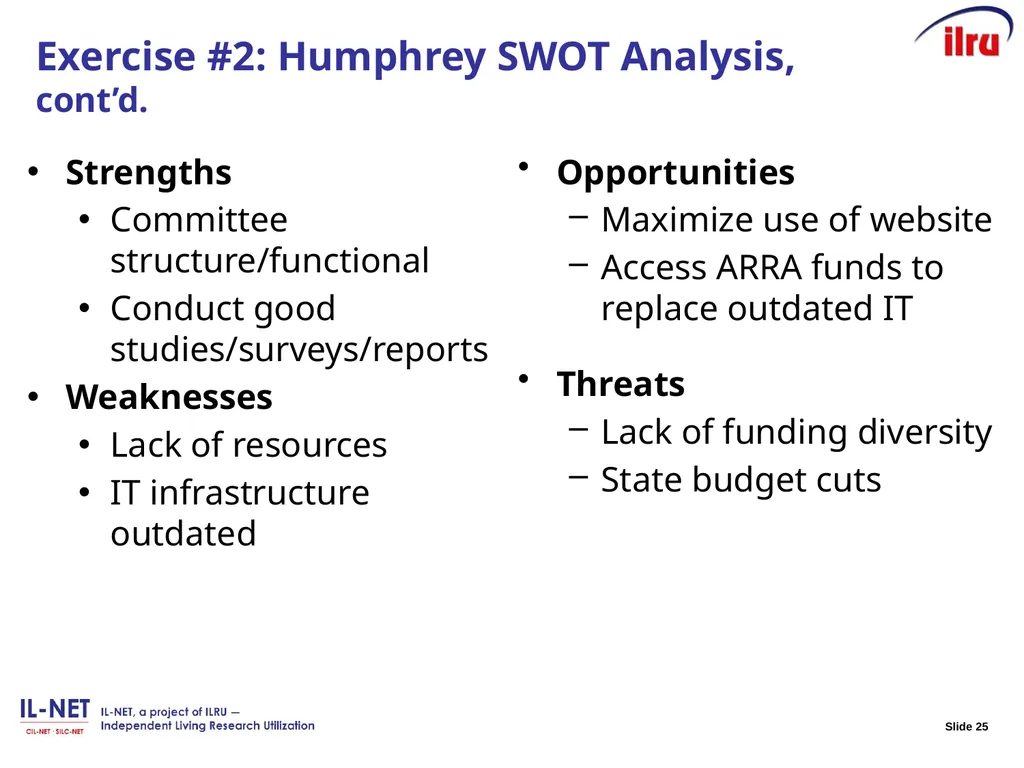
Exercise #2: Humphrey SWOT Analysis, cont’d. Strengths
Committee structure/functional
Conduct good studies/surveys/reports
Weaknesses
Lack of resources
IT infrastructure outdated Opportunities
Maximize use of website
Access ARRA funds to replace outdated IT
Threats
Lack of funding diversity
State budget cuts<br>
Committee structure/functional
Conduct good studies/surveys/reports
Weaknesses
Lack of resources
IT infrastructure outdated Opportunities
Maximize use of website
Access ARRA funds to replace outdated IT
Threats
Lack of funding diversity
State budget cuts<br>
26
Exercise # 3: Drucker Worksheet 1 What is the current mission statement?
Does the mission statement need to be replaced?
New mission statement:
Mission guidelines:
Purpose of the organization (who you are and what you do.)<br>
Does the mission statement need to be replaced?
New mission statement:
Mission guidelines:
Purpose of the organization (who you are and what you do.)<br>
27
Exercise # 4: Drucker Worksheet 1A What is the current vision statement?
Does the vision statement need to be replaced?
New vision statement:
Vision statement elements:
Compelling, global―inspires commitment and action and the impact to aspire to achieve.<br>
Does the vision statement need to be replaced?
New vision statement:
Vision statement elements:
Compelling, global―inspires commitment and action and the impact to aspire to achieve.<br>
28
Exercise #1: Drucker Worksheet 5 Identify your primary customer.
A consumer is a CIL’s primary customer, but just who IS a SILC’s primary customer?
Identify your supporting customers.
It may include volunteers, members, State Plan partners, funders, and other stakeholders.<br>
A consumer is a CIL’s primary customer, but just who IS a SILC’s primary customer?
Identify your supporting customers.
It may include volunteers, members, State Plan partners, funders, and other stakeholders.<br>
29
Exercise # 5: Drucker Worksheet 15 Top 5 Priority Goals
Identify goals based on top priorities from SILC snap shot, SWOT analysis, external input, consistent with mission and vision.
Assign responsibility of each goal to appropriate council committee.
Have the committee work on action steps to facilitate progress on the goal.
Identify potential resources (if appropriate).
Identify a timeframe (up to 5 years).<br>
Identify goals based on top priorities from SILC snap shot, SWOT analysis, external input, consistent with mission and vision.
Assign responsibility of each goal to appropriate council committee.
Have the committee work on action steps to facilitate progress on the goal.
Identify potential resources (if appropriate).
Identify a timeframe (up to 5 years).<br>
30
Outcomes of Strategic Planning Clear picture of your organization from the inside/outside
Updated Mission & Vision Statements
Identified customers and organizational needs
Clear goals to work toward with action steps to achieve progress
Be sure to include newly defined SILC areas under WIOA
A stronger, more productive SILC!<br>
Updated Mission & Vision Statements
Identified customers and organizational needs
Clear goals to work toward with action steps to achieve progress
Be sure to include newly defined SILC areas under WIOA
A stronger, more productive SILC!<br>
31
Resources Free SWOT Analysis Template http://www.businessballs.com/swotanalysisfreetemplate.htm
The Drucker Foundation Self-Assessment Tool, Copyright © 1999 The Peter F. Drucker Foundation for Nonprofit Management, 320 Park Avenue, 3rd Floor, New York, NY 10022. http://www.pfdf.org
Organizational Snap Shot for Statewide Independent Living Councils (SILCs), © 2005 Western New York Independent Living, Buffalo, NY (formerly the RRTC in IL Management). http://www.ilru.org/sites/default/files/resources/silc/SILC_SnapShot.pdf<br>
The Drucker Foundation Self-Assessment Tool, Copyright © 1999 The Peter F. Drucker Foundation for Nonprofit Management, 320 Park Avenue, 3rd Floor, New York, NY 10022. http://www.pfdf.org
Organizational Snap Shot for Statewide Independent Living Councils (SILCs), © 2005 Western New York Independent Living, Buffalo, NY (formerly the RRTC in IL Management). http://www.ilru.org/sites/default/files/resources/silc/SILC_SnapShot.pdf<br>
32
Questions & Answers<br>
33
Contact Information Ann McDaniel: ann.meadows@wvsilc.org
Phone: (304) 766-4624
Brad Williams: bradw@nysilc.org
Phone: (518) 427-1060<br>
Phone: (304) 766-4624
Brad Williams: bradw@nysilc.org
Phone: (518) 427-1060<br>
34
Wrap Up and Evaluation Click the link below now to complete an evaluation of today’s program found at:
https://vovici.com/wsb.dll/s/12291g56eb4<br>
https://vovici.com/wsb.dll/s/12291g56eb4<br>
35
SILC-NET Attribution Support for development of this training was provided by the U.S. Department of Education, Rehabilitation Services Administration under grant number H132B120001. No official endorsement of the Department of Education should be inferred. Permission is granted for duplication of any portion of this PowerPoint presentation, providing that the following credit is given to the project: Developed as part of the SILC-NET, a project of the IL-NET, an ILRU/NCIL/APRIL National Training and Technical Assistance Program.<br>