
Lecture 1: Introduction Dr. Ann T. Orlando 17
SN
Published · 39 slides · 0 views

1 / 1




Description
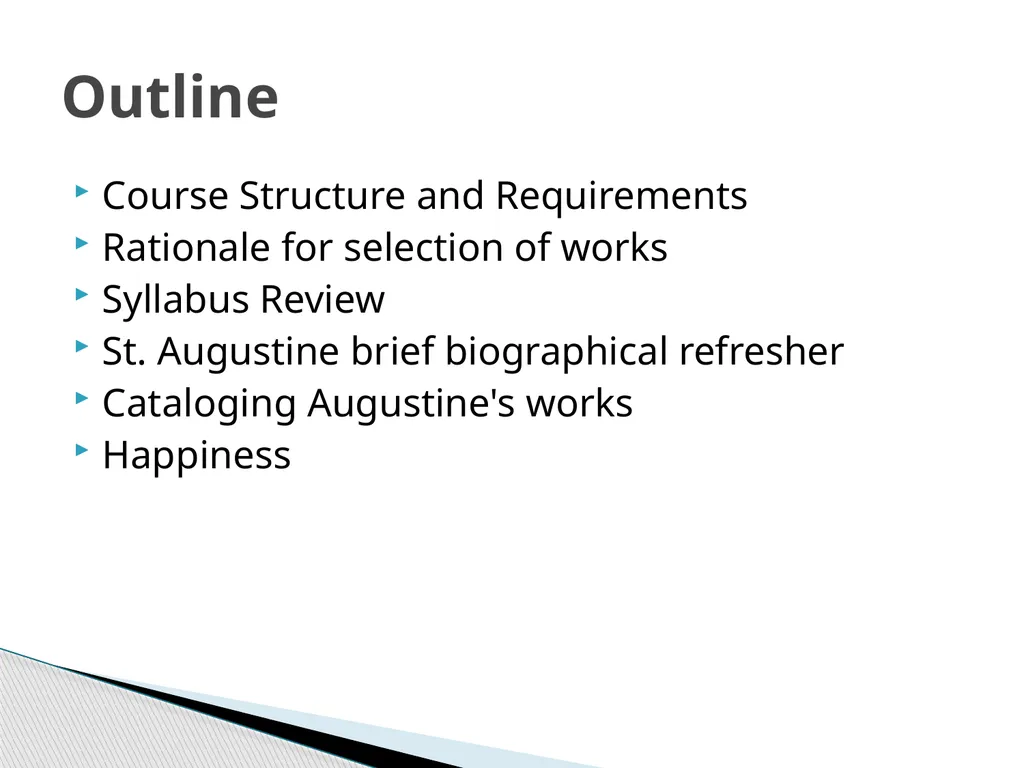
Lecture 1: Introduction Dr. Ann T. Orlando 17 January 2020 Course Structure and Requirements Rationale for selection of works Syllabus Review St. Augustine brief biographical refresher Cataloging Augustines works Happiness Outline My
Related Topics
Share
Embed code
Download this presentation From Below
"Lecture 1: Introduction Dr. Ann T. Orlando 17" is the property of its rightful owner. Permission is granted to download and print the materials on this website for personal, non-commercial use only, and to display it on your personal computer provided you do not modify the materials and that you retain all copyright notices contained in the materials. By downloading content from our website, you accept the terms of this agreement.
Presentation Transcript
01
Lecture 1: Introduction Dr. Ann T. Orlando
17 January 2020<br>
17 January 2020<br>
02
Course Structure and Requirements
Rationale for selection of works
Syllabus Review
St. Augustine brief biographical refresher
Cataloging Augustine's works
Happiness Outline<br>
Rationale for selection of works
Syllabus Review
St. Augustine brief biographical refresher
Cataloging Augustine's works
Happiness Outline<br>
03
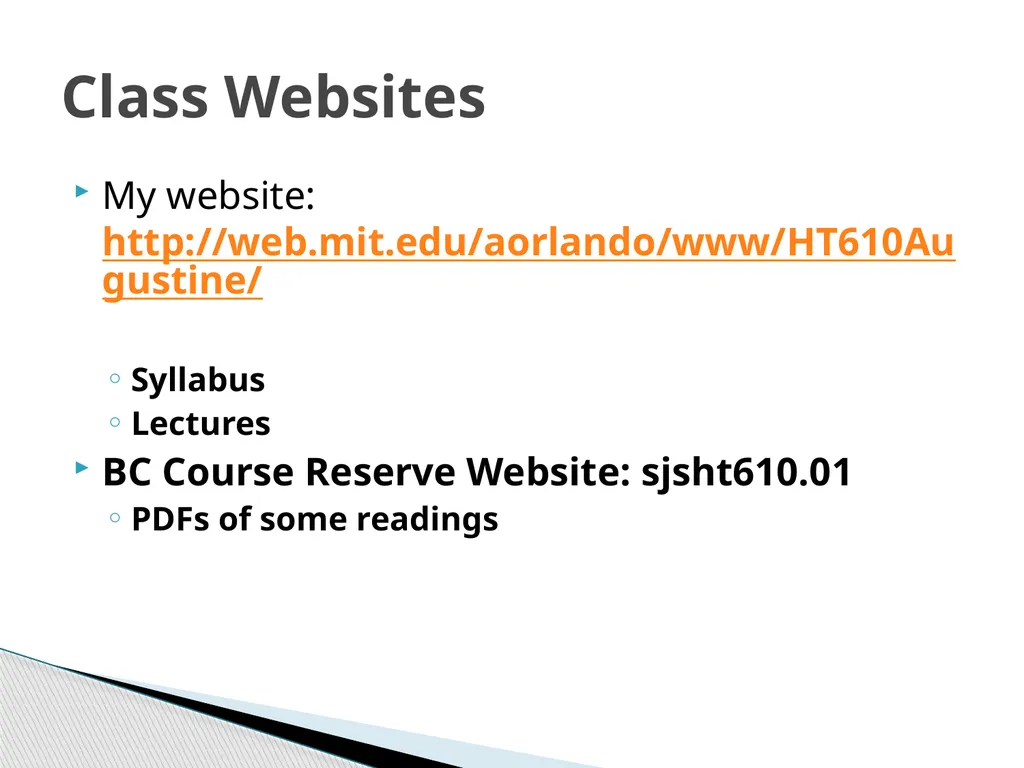
My website: http://web.mit.edu/aorlando/www/HT610Augustine/
Syllabus
Lectures
BC Course Reserve Website: sjsht610.01
PDFs of some readings Class Websites<br>
Syllabus
Lectures
BC Course Reserve Website: sjsht610.01
PDFs of some readings Class Websites<br>
04
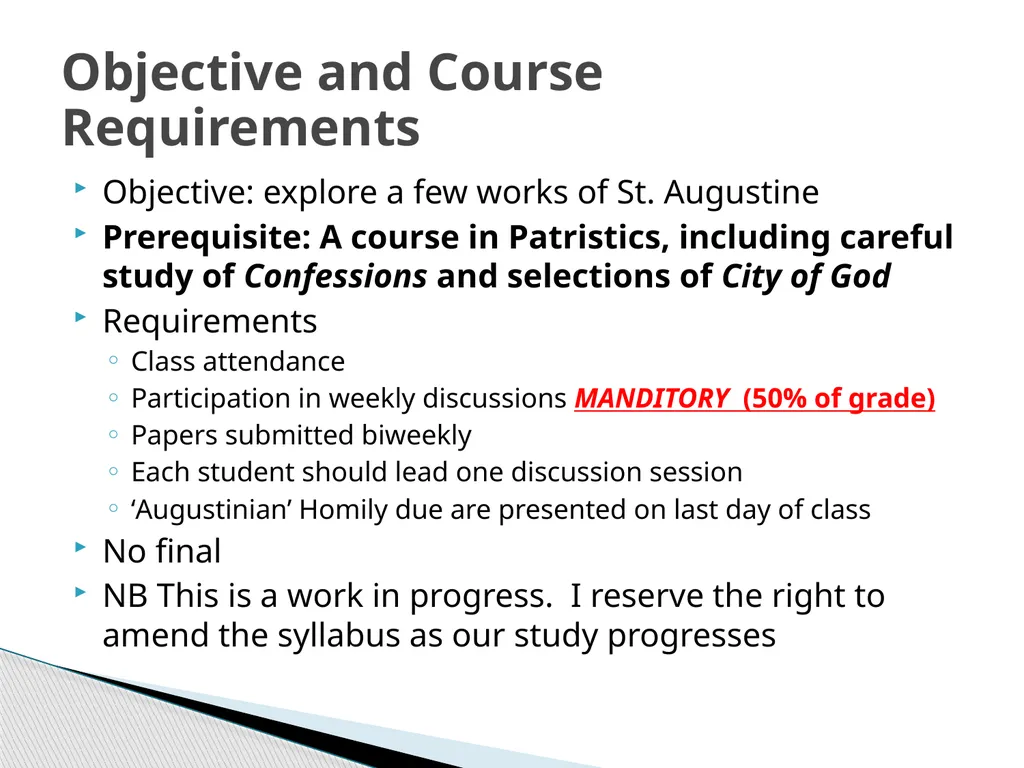
Objective: explore a few works of St. Augustine
Prerequisite: A course in Patristics, including careful study of Confessions and selections of City of God
Requirements
Class attendance
Participation in weekly discussions MANDITORY (50% of grade)
Papers submitted biweekly
Each student should lead one discussion session
‘Augustinian’ Homily due are presented on last day of class
No final
NB This is a work in progress. I reserve the right to amend the syllabus as our study progresses Objective and Course Requirements<br>
Prerequisite: A course in Patristics, including careful study of Confessions and selections of City of God
Requirements
Class attendance
Participation in weekly discussions MANDITORY (50% of grade)
Papers submitted biweekly
Each student should lead one discussion session
‘Augustinian’ Homily due are presented on last day of class
No final
NB This is a work in progress. I reserve the right to amend the syllabus as our study progresses Objective and Course Requirements<br>
05
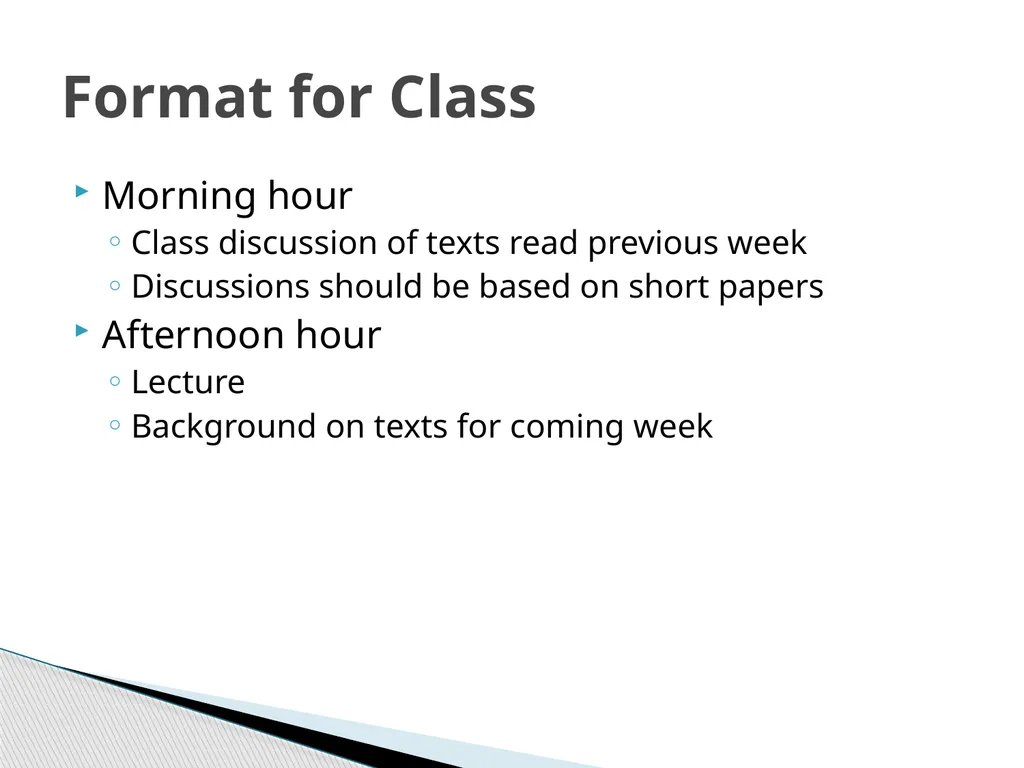
Morning hour
Class discussion of texts read previous week
Discussions should be based on short papers
Afternoon hour
Lecture
Background on texts for coming week Format for Class<br>
Class discussion of texts read previous week
Discussions should be based on short papers
Afternoon hour
Lecture
Background on texts for coming week Format for Class<br>
06
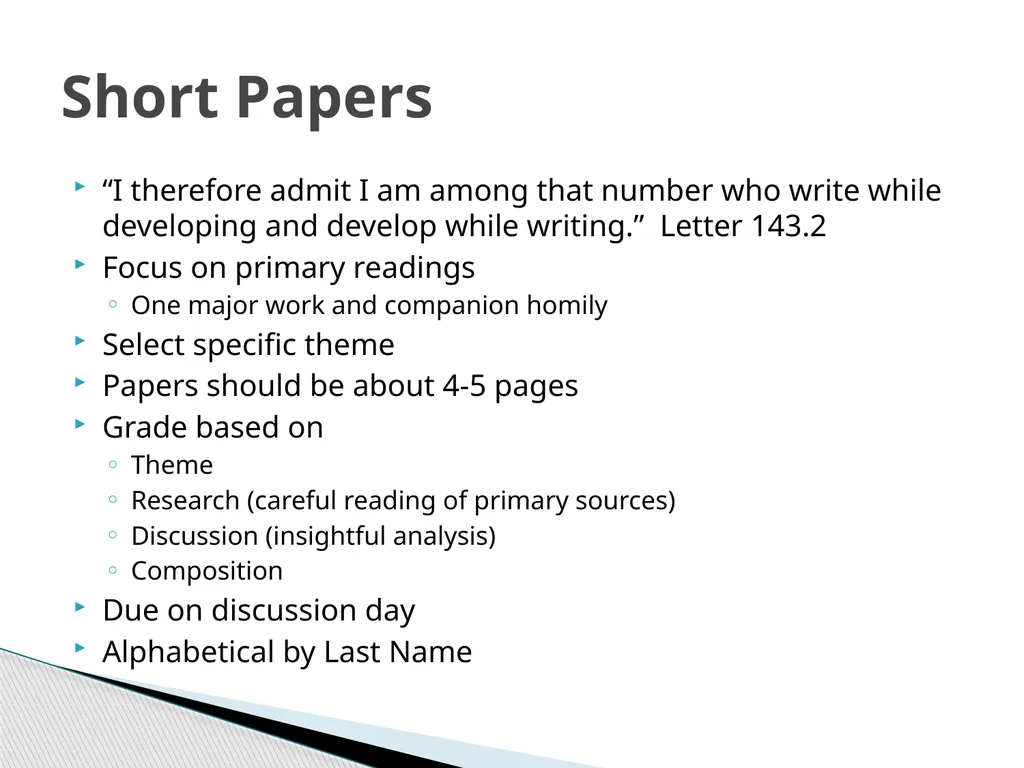
“I therefore admit I am among that number who write while developing and develop while writing.” Letter 143.2
Focus on primary readings
One major work and companion homily
Select specific theme
Papers should be about 4-5 pages
Grade based on
Theme
Research (careful reading of primary sources)
Discussion (insightful analysis)
Composition
Due on discussion day
Alphabetical by Last Name Short Papers<br>
Focus on primary readings
One major work and companion homily
Select specific theme
Papers should be about 4-5 pages
Grade based on
Theme
Research (careful reading of primary sources)
Discussion (insightful analysis)
Composition
Due on discussion day
Alphabetical by Last Name Short Papers<br>
07
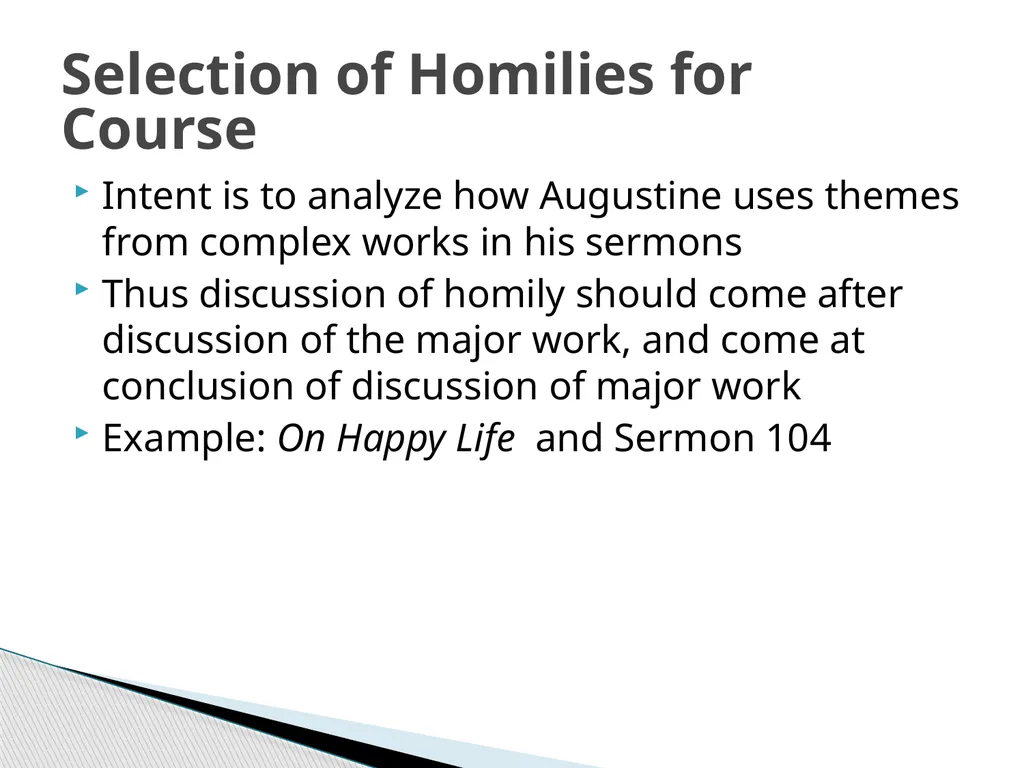
Intent is to analyze how Augustine uses themes from complex works in his sermons
Thus discussion of homily should come after discussion of the major work, and come at conclusion of discussion of major work
Example: On Happy Life and Sermon 104 Selection of Homilies for Course<br>
Thus discussion of homily should come after discussion of the major work, and come at conclusion of discussion of major work
Example: On Happy Life and Sermon 104 Selection of Homilies for Course<br>
08
5 to 10 minute homily
Specify audience
Specify occasion
Bibliography indicating what themes or works of Augustine did you use to craft the homily Short Homily at end of Semester<br>
Specify audience
Specify occasion
Bibliography indicating what themes or works of Augustine did you use to craft the homily Short Homily at end of Semester<br>
09
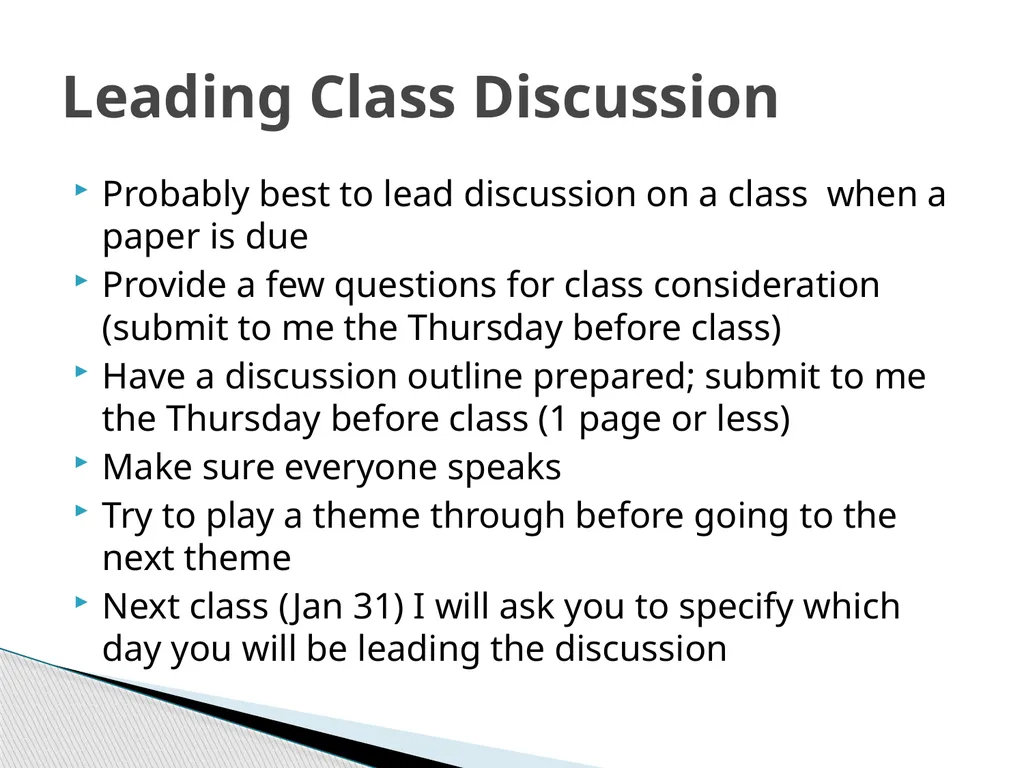
Probably best to lead discussion on a class when a paper is due
Provide a few questions for class consideration (submit to me the Thursday before class)
Have a discussion outline prepared; submit to me the Thursday before class (1 page or less)
Make sure everyone speaks
Try to play a theme through before going to the next theme
Next class (Jan 31) I will ask you to specify which day you will be leading the discussion Leading Class Discussion<br>
Provide a few questions for class consideration (submit to me the Thursday before class)
Have a discussion outline prepared; submit to me the Thursday before class (1 page or less)
Make sure everyone speaks
Try to play a theme through before going to the next theme
Next class (Jan 31) I will ask you to specify which day you will be leading the discussion Leading Class Discussion<br>
10
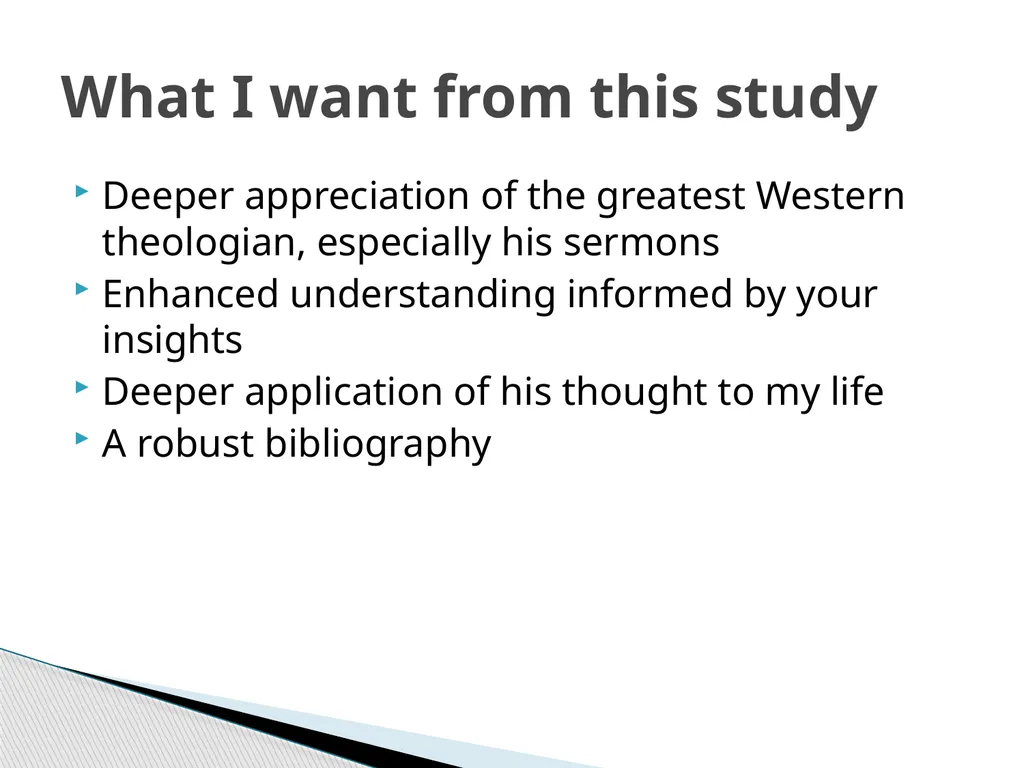
Deeper appreciation of the greatest Western theologian, especially his sermons
Enhanced understanding informed by your insights
Deeper application of his thought to my life
A robust bibliography What I want from this study<br>
Enhanced understanding informed by your insights
Deeper application of his thought to my life
A robust bibliography What I want from this study<br>
11
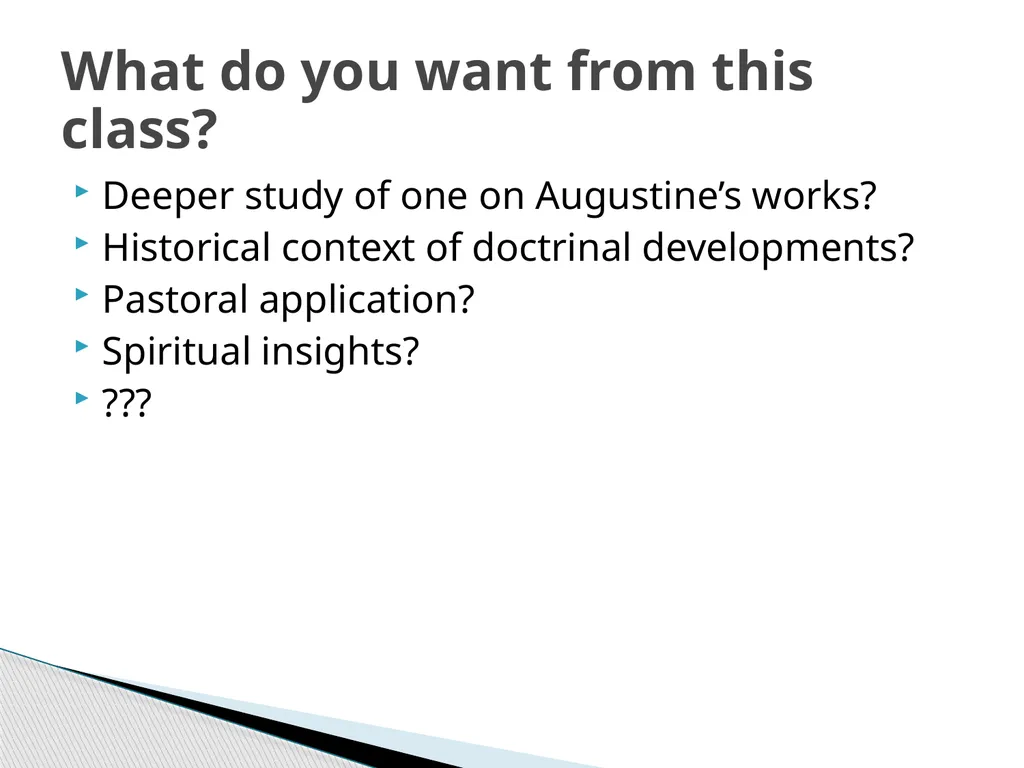
Deeper study of one on Augustine’s works?
Historical context of doctrinal developments?
Pastoral application?
Spiritual insights?
??? What do you want from this class?<br>
Historical context of doctrinal developments?
Pastoral application?
Spiritual insights?
??? What do you want from this class?<br>
12
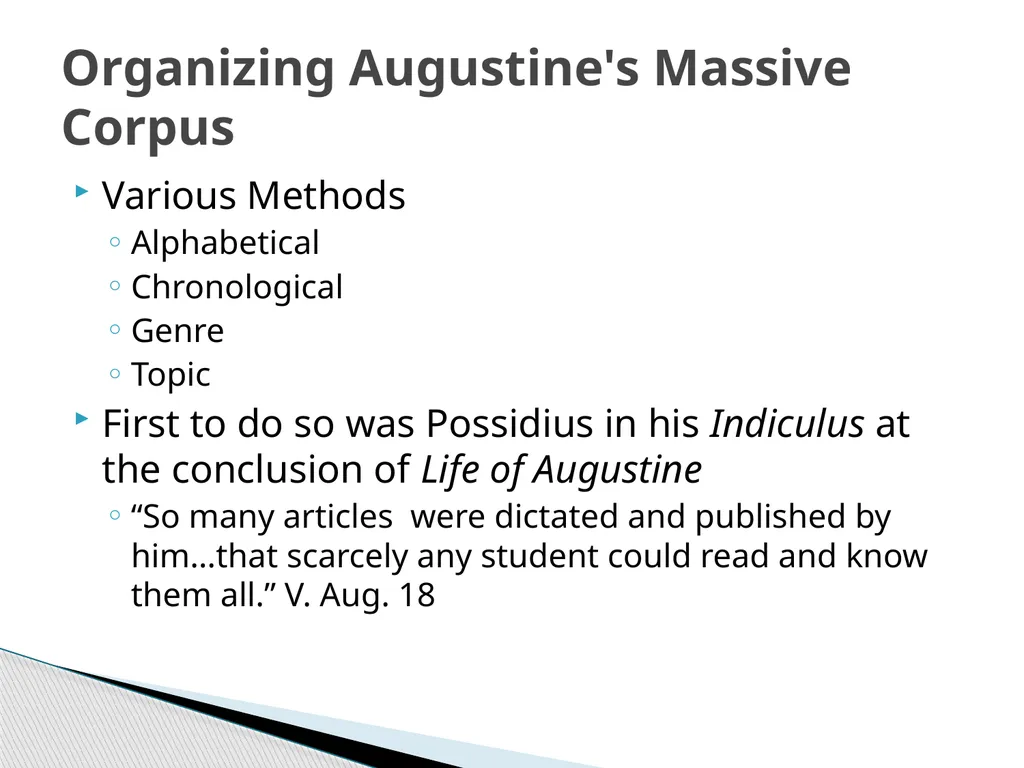
Various Methods
Alphabetical
Chronological
Genre
Topic
First to do so was Possidius in his Indiculus at the conclusion of Life of Augustine
“So many articles were dictated and published by him…that scarcely any student could read and know them all.” V. Aug. 18 Organizing Augustine's Massive Corpus<br>
Alphabetical
Chronological
Genre
Topic
First to do so was Possidius in his Indiculus at the conclusion of Life of Augustine
“So many articles were dictated and published by him…that scarcely any student could read and know them all.” V. Aug. 18 Organizing Augustine's Massive Corpus<br>
13
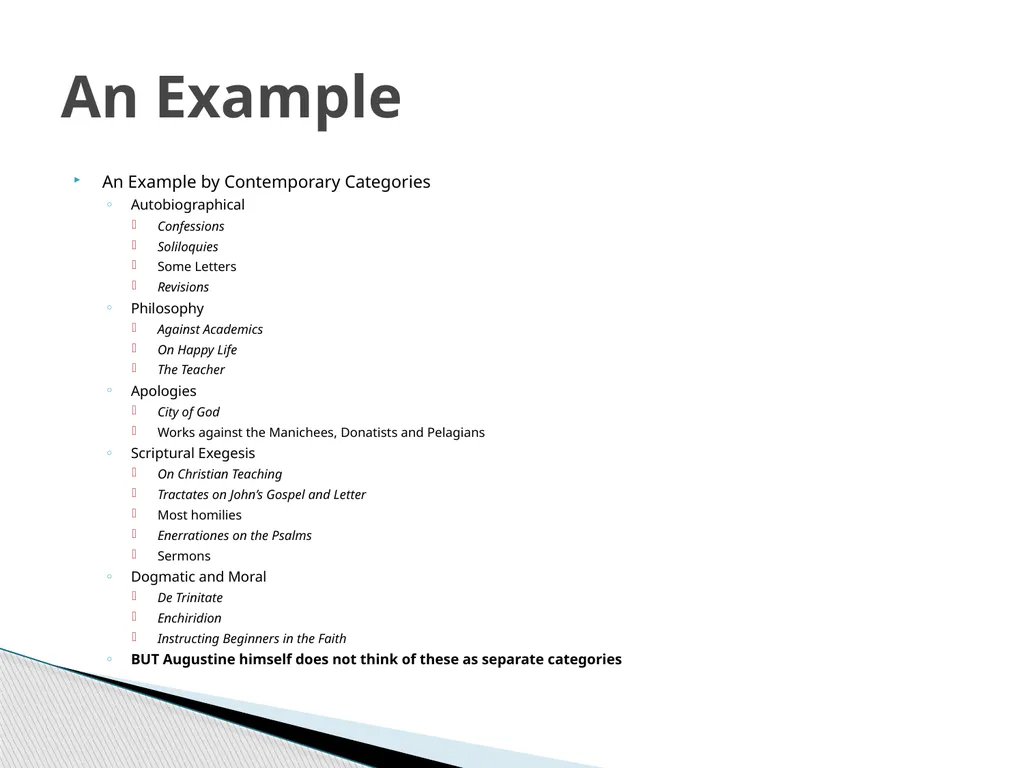
An Example by Contemporary Categories
Autobiographical
Confessions
Soliloquies
Some Letters
Revisions
Philosophy
Against Academics
On Happy Life
The Teacher
Apologies
City of God
Works against the Manichees, Donatists and Pelagians
Scriptural Exegesis
On Christian Teaching
Tractates on John’s Gospel and Letter
Most homilies
Enerrationes on the Psalms
Sermons
Dogmatic and Moral
De Trinitate
Enchiridion
Instructing Beginners in the Faith
BUT Augustine himself does not think of these as separate categories An Example<br>
Autobiographical
Confessions
Soliloquies
Some Letters
Revisions
Philosophy
Against Academics
On Happy Life
The Teacher
Apologies
City of God
Works against the Manichees, Donatists and Pelagians
Scriptural Exegesis
On Christian Teaching
Tractates on John’s Gospel and Letter
Most homilies
Enerrationes on the Psalms
Sermons
Dogmatic and Moral
De Trinitate
Enchiridion
Instructing Beginners in the Faith
BUT Augustine himself does not think of these as separate categories An Example<br>
14
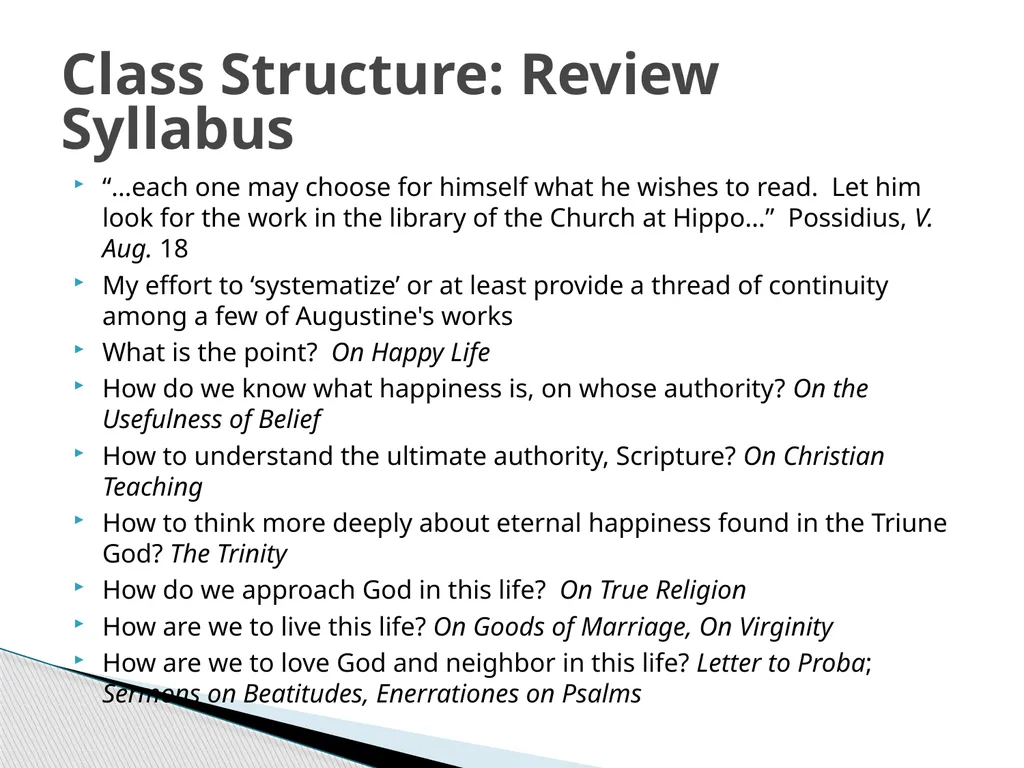
“…each one may choose for himself what he wishes to read. Let him look for the work in the library of the Church at Hippo…” Possidius, V. Aug. 18
My effort to ‘systematize’ or at least provide a thread of continuity among a few of Augustine's works
What is the point? On Happy Life
How do we know what happiness is, on whose authority? On the Usefulness of Belief
How to understand the ultimate authority, Scripture? On Christian Teaching
How to think more deeply about eternal happiness found in the Triune God? The Trinity
How do we approach God in this life? On True Religion
How are we to live this life? On Goods of Marriage, On Virginity
How are we to love God and neighbor in this life? Letter to Proba; Sermons on Beatitudes, Enerrationes on Psalms Class Structure: Review Syllabus<br>
My effort to ‘systematize’ or at least provide a thread of continuity among a few of Augustine's works
What is the point? On Happy Life
How do we know what happiness is, on whose authority? On the Usefulness of Belief
How to understand the ultimate authority, Scripture? On Christian Teaching
How to think more deeply about eternal happiness found in the Triune God? The Trinity
How do we approach God in this life? On True Religion
How are we to live this life? On Goods of Marriage, On Virginity
How are we to love God and neighbor in this life? Letter to Proba; Sermons on Beatitudes, Enerrationes on Psalms Class Structure: Review Syllabus<br>
15
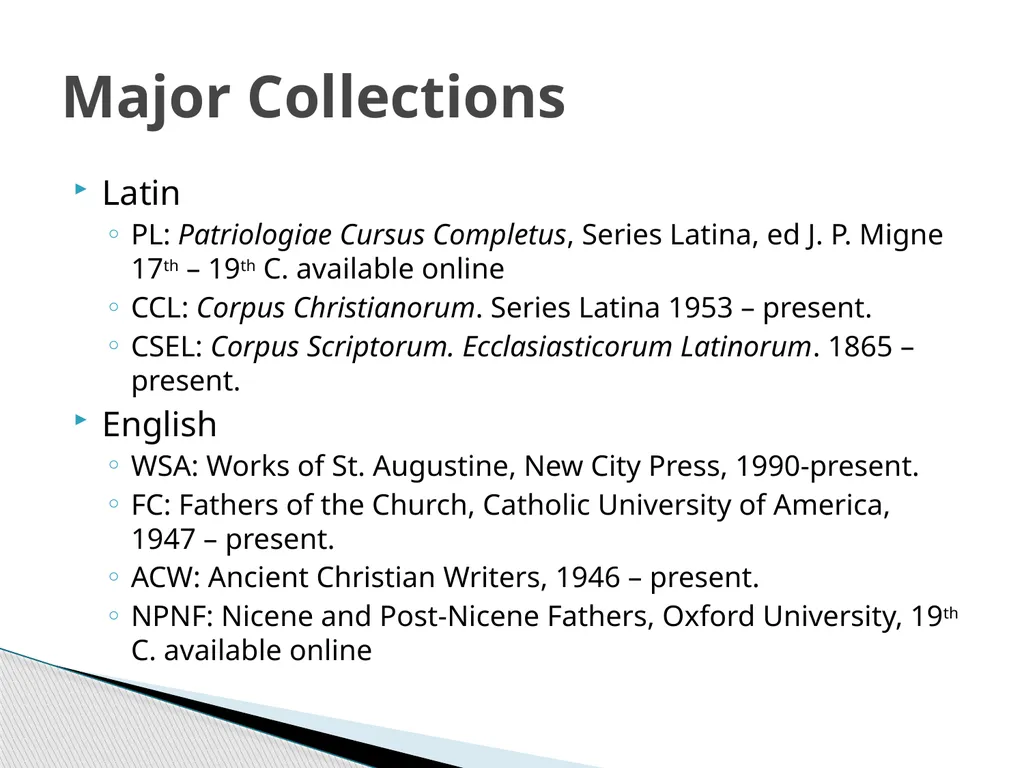
Latin
PL: Patriologiae Cursus Completus, Series Latina, ed J. P. Migne 17th – 19th C. available online
CCL: Corpus Christianorum. Series Latina 1953 – present.
CSEL: Corpus Scriptorum. Ecclasiasticorum Latinorum. 1865 – present.
English
WSA: Works of St. Augustine, New City Press, 1990-present.
FC: Fathers of the Church, Catholic University of America, 1947 – present.
ACW: Ancient Christian Writers, 1946 – present.
NPNF: Nicene and Post-Nicene Fathers, Oxford University, 19th C. available online Major Collections<br>
PL: Patriologiae Cursus Completus, Series Latina, ed J. P. Migne 17th – 19th C. available online
CCL: Corpus Christianorum. Series Latina 1953 – present.
CSEL: Corpus Scriptorum. Ecclasiasticorum Latinorum. 1865 – present.
English
WSA: Works of St. Augustine, New City Press, 1990-present.
FC: Fathers of the Church, Catholic University of America, 1947 – present.
ACW: Ancient Christian Writers, 1946 – present.
NPNF: Nicene and Post-Nicene Fathers, Oxford University, 19th C. available online Major Collections<br>
16
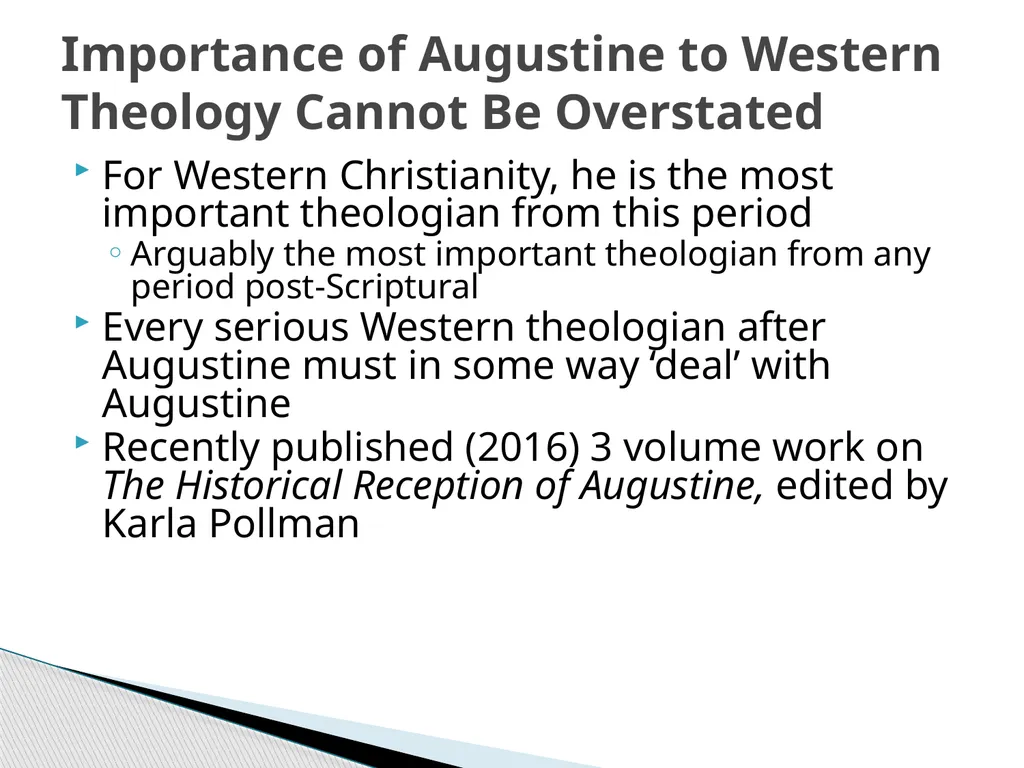
Importance of Augustine to Western Theology Cannot Be Overstated For Western Christianity, he is the most important theologian from this period
Arguably the most important theologian from any period post-Scriptural
Every serious Western theologian after Augustine must in some way ‘deal’ with Augustine
Recently published (2016) 3 volume work on The Historical Reception of Augustine, edited by Karla Pollman<br>
Arguably the most important theologian from any period post-Scriptural
Every serious Western theologian after Augustine must in some way ‘deal’ with Augustine
Recently published (2016) 3 volume work on The Historical Reception of Augustine, edited by Karla Pollman<br>
17
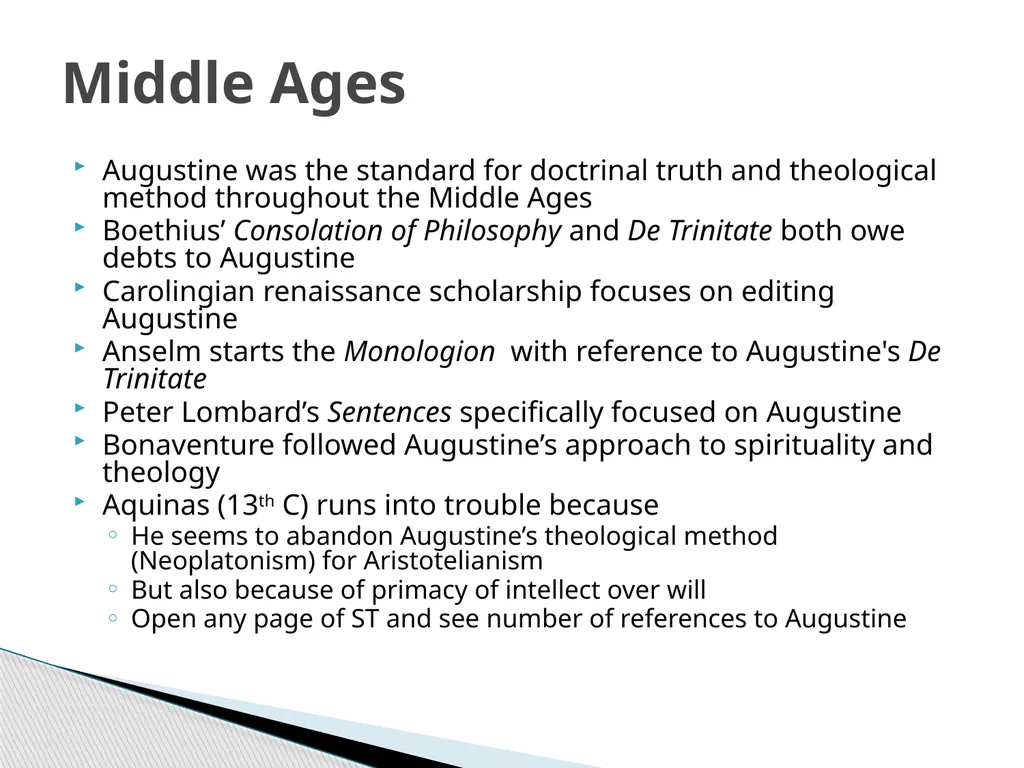
Middle Ages Augustine was the standard for doctrinal truth and theological method throughout the Middle Ages
Boethius’ Consolation of Philosophy and De Trinitate both owe debts to Augustine
Carolingian renaissance scholarship focuses on editing Augustine
Anselm starts the Monologion with reference to Augustine's De Trinitate
Peter Lombard’s Sentences specifically focused on Augustine
Bonaventure followed Augustine’s approach to spirituality and theology
Aquinas (13th C) runs into trouble because
He seems to abandon Augustine’s theological method (Neoplatonism) for Aristotelianism
But also because of primacy of intellect over will
Open any page of ST and see number of references to Augustine<br>
Boethius’ Consolation of Philosophy and De Trinitate both owe debts to Augustine
Carolingian renaissance scholarship focuses on editing Augustine
Anselm starts the Monologion with reference to Augustine's De Trinitate
Peter Lombard’s Sentences specifically focused on Augustine
Bonaventure followed Augustine’s approach to spirituality and theology
Aquinas (13th C) runs into trouble because
He seems to abandon Augustine’s theological method (Neoplatonism) for Aristotelianism
But also because of primacy of intellect over will
Open any page of ST and see number of references to Augustine<br>
18
Renaissance and Reformation Renaissance sometimes said to begin when Petrarch reads Confessions
Structures his Soliloquies as an internal discussion with Augustine
Buried in Pavia, to be near Augustine in death
Erasmus and Luther debate over Augustine and meaning of free will
Luther and Calvin claim Augustine for themselves in opposition to Scholasticism
Galileo calls upon Augustine in his defense against ecclesial criticisms
Augustine is patron saint of Jansenists, Augustinus<br>
Structures his Soliloquies as an internal discussion with Augustine
Buried in Pavia, to be near Augustine in death
Erasmus and Luther debate over Augustine and meaning of free will
Luther and Calvin claim Augustine for themselves in opposition to Scholasticism
Galileo calls upon Augustine in his defense against ecclesial criticisms
Augustine is patron saint of Jansenists, Augustinus<br>
19
Modernity Descartes rejects notion that Augustine had any influence on him
His contemporaries chastise him for this
Rousseau writes his own Confessions opposed to Christianity
Enlightenment rejection of Christianity is often phrased as a rejection of Augustine (Voltaire, Diderot, Gibbon)
Romantic reaction against Enlightenment is in part a rediscovery of Augustine (Newman)
Heidegger and Wittgenstein both start with Augustine in their philosophical treatises.
Rethinking evil in 20th C: Albert Camus The Plague and John Hick Evil and the God of Love explicitly reject Augustine’s understanding of evil
Augustine quoted in CCC more often than any other theologian
Recent new translations of and ‘popular’ interest in Augustine: New City Press; J.J. O’Donnell, Garry Wills
Pope Benedict XVI has defined himself an Augustinian theologian<br>
His contemporaries chastise him for this
Rousseau writes his own Confessions opposed to Christianity
Enlightenment rejection of Christianity is often phrased as a rejection of Augustine (Voltaire, Diderot, Gibbon)
Romantic reaction against Enlightenment is in part a rediscovery of Augustine (Newman)
Heidegger and Wittgenstein both start with Augustine in their philosophical treatises.
Rethinking evil in 20th C: Albert Camus The Plague and John Hick Evil and the God of Love explicitly reject Augustine’s understanding of evil
Augustine quoted in CCC more often than any other theologian
Recent new translations of and ‘popular’ interest in Augustine: New City Press; J.J. O’Donnell, Garry Wills
Pope Benedict XVI has defined himself an Augustinian theologian<br>
20
Brief Biographical Sketch Born near Carthage in 354 to a devoutly Catholic mother and worldly father
In youth leads a life of pleasure searching for happiness
Investigates and is attracted to Manichaeism
Becomes enamored with Platonism (Plotinus)
Conversion to Catholic Christianity
Ordained priest 391, bishop of Hippo 395
Died on 28 August 430
First biographer was Possidius
Peter Brown’s book Augustine of Hippo remains the most important biography of Augustine in English
Be sure to get the New Edition with Epilogue
Discusses discovery of 12 previously unstudied letters and sermons of Augustine (396-404)<br>
In youth leads a life of pleasure searching for happiness
Investigates and is attracted to Manichaeism
Becomes enamored with Platonism (Plotinus)
Conversion to Catholic Christianity
Ordained priest 391, bishop of Hippo 395
Died on 28 August 430
First biographer was Possidius
Peter Brown’s book Augustine of Hippo remains the most important biography of Augustine in English
Be sure to get the New Edition with Epilogue
Discusses discovery of 12 previously unstudied letters and sermons of Augustine (396-404)<br>
21
A friend and fellow bishop
Probably joined Augustine in his community at Hippo c. 390.
Became bishop of Calama in 397.
Emphasis of the work is on Augustine’s life after the period covered by Books I – IX of the Confessions
Possidius’ catalogue of Augustine’s works (Indiculum) forms basis for the Augustinian corpus. Possidius (370-440)<br>
Probably joined Augustine in his community at Hippo c. 390.
Became bishop of Calama in 397.
Emphasis of the work is on Augustine’s life after the period covered by Books I – IX of the Confessions
Possidius’ catalogue of Augustine’s works (Indiculum) forms basis for the Augustinian corpus. Possidius (370-440)<br>
22
Contemporary English and Philosophy
Greek
Philosophy
Bible
Latin What is Happiness<br>
Greek
Philosophy
Bible
Latin What is Happiness<br>
23
‘Happiness,’ as Augustine says about time, “I know what it is until someone asks me to define it.” (Confessions, Book XI)
Possible components of happiness may be
Meaningfulness (satisfaction)
Contentment (pleasure)
Stability (tranquility, peace, order)
Time scale
Moment to moment
Lifetime
Beyond time…eternity and stable happiness Contemporary Notions of Happiness<br>
Possible components of happiness may be
Meaningfulness (satisfaction)
Contentment (pleasure)
Stability (tranquility, peace, order)
Time scale
Moment to moment
Lifetime
Beyond time…eternity and stable happiness Contemporary Notions of Happiness<br>
24
Psychologists often think of happiness as rooted in the psychology of the individual,
Opposite of depression
Philosophers often think of happiness as a state of well being or flourishing
Value judgments about well-being
Social implications Happiness: A State or an Emotion<br>
Opposite of depression
Philosophers often think of happiness as a state of well being or flourishing
Value judgments about well-being
Social implications Happiness: A State or an Emotion<br>
25
Hedonism: Pleasurable experiences
Desire: Getting what we want
Objective: Engaged in ‘good’ activities; based on value judgments
‘We take what is self-sufficient to be that which on its own makes life worthy of choice and lacking in nothing. We think happiness to be such, and indeed the thing most of all worth choosing, not counted as just one thing among others’ (Aristotle, Nicomachean Ethics) Contemporary Theories of Happiness (well-being sense)<br>
Desire: Getting what we want
Objective: Engaged in ‘good’ activities; based on value judgments
‘We take what is self-sufficient to be that which on its own makes life worthy of choice and lacking in nothing. We think happiness to be such, and indeed the thing most of all worth choosing, not counted as just one thing among others’ (Aristotle, Nicomachean Ethics) Contemporary Theories of Happiness (well-being sense)<br>
26
Croesus (595-547 BC), wealthiest of Greek kings in Asia Minor
Herodotus and others tells the tale of Croesus as prelude to Greek-Persian Wars
And as a cautionary tale of human hubris
Croesus in his wealth and seeming happiness, asked the wise man Solon who was the happiest of men
Solon responds there were three genuinely happy men: Tellus who died fighting for his country; and two brothers who died peacefully in their sleep after caring for their mother
Shortly after, the Persian King Cyrus conquers Croesus, and burns him on a large pyre
Solon’s adage: call no man happy while he lives Croesus and the Cautionary Tale of Happiness<br>
Herodotus and others tells the tale of Croesus as prelude to Greek-Persian Wars
And as a cautionary tale of human hubris
Croesus in his wealth and seeming happiness, asked the wise man Solon who was the happiest of men
Solon responds there were three genuinely happy men: Tellus who died fighting for his country; and two brothers who died peacefully in their sleep after caring for their mother
Shortly after, the Persian King Cyrus conquers Croesus, and burns him on a large pyre
Solon’s adage: call no man happy while he lives Croesus and the Cautionary Tale of Happiness<br>
27
In early Platonic dialog Euthydemus, Socrates assumes everyone wants to be happy, and asks how to become happy
The desire to be happy is one of the few ‘self-evident’ truths that Socrates accepts
Questions of happiness further explored in Symposium (focused on individuals) and Republic focused on society
In Republic Socrates says Croesus might have been happy if he had looked to contemplation of wisdom rather than wealth and power for happiness Socrates, Plato and Happiness<br>
The desire to be happy is one of the few ‘self-evident’ truths that Socrates accepts
Questions of happiness further explored in Symposium (focused on individuals) and Republic focused on society
In Republic Socrates says Croesus might have been happy if he had looked to contemplation of wisdom rather than wealth and power for happiness Socrates, Plato and Happiness<br>
28
Primarily addressed in Nichomachean Ethics
Which begins by reminding readers of Croesus and Solon
Some external goods are necessary (but not sufficient) for happiness: good friends, children, money, health, physical beauty (1.73)
Without a sufficient amount of these one will be unhappy
Some of these are within one’s control through moral goodness (virtue)
But luck or fortune also has a role in providing the conditions for happiness
Given that the external conditions for happiness are met, a man can only be genuinely happy through contemplation (13.37-43) Aristotle on Happiness<br>
Which begins by reminding readers of Croesus and Solon
Some external goods are necessary (but not sufficient) for happiness: good friends, children, money, health, physical beauty (1.73)
Without a sufficient amount of these one will be unhappy
Some of these are within one’s control through moral goodness (virtue)
But luck or fortune also has a role in providing the conditions for happiness
Given that the external conditions for happiness are met, a man can only be genuinely happy through contemplation (13.37-43) Aristotle on Happiness<br>
29
Epicurean notion of happiness
Absence of pain or mental anguish
To remove fear of eternal judgment, recognize that there is no life after death
Curb physical desires to what is easily attainable
Stoic notion of happiness
Accept one’s lot in life ordained by Providence as witnessed by a life of virtue
Curb physical desires to what is provided by Providence
Example: Seneca On the Happy Life, one can be happy on the pyre, as Croesus should have been if he, virtue of fortitude, and had accepted his fate Epicurus and Zeno the Stoic on Happiness<br>
Absence of pain or mental anguish
To remove fear of eternal judgment, recognize that there is no life after death
Curb physical desires to what is easily attainable
Stoic notion of happiness
Accept one’s lot in life ordained by Providence as witnessed by a life of virtue
Curb physical desires to what is provided by Providence
Example: Seneca On the Happy Life, one can be happy on the pyre, as Croesus should have been if he, virtue of fortitude, and had accepted his fate Epicurus and Zeno the Stoic on Happiness<br>
30
Eudaimonia: Good fortune, happy
Most common term in Greek philosophy; includes a sense of good luck
In Aristotle, this may be obtained through a good moral life
In Epicurus something one achieves through ataraxia, or mental tranquility
Not used in LXX or NT
Makarios: Fortunate, happy, blessed
Often used in connection with happiness of the gods
In Aristotle the highest form of happiness
Not attainable by humans (who are only mortal) in Epicurus
Used extensively in LXX and NT Ancient Greek Understandings of Happiness<br>
Most common term in Greek philosophy; includes a sense of good luck
In Aristotle, this may be obtained through a good moral life
In Epicurus something one achieves through ataraxia, or mental tranquility
Not used in LXX or NT
Makarios: Fortunate, happy, blessed
Often used in connection with happiness of the gods
In Aristotle the highest form of happiness
Not attainable by humans (who are only mortal) in Epicurus
Used extensively in LXX and NT Ancient Greek Understandings of Happiness<br>
31
Felicitas: Happiness, good fortune, success (might be close to Greek eudaimonia)
Beatum: Happiness, blessedness (close to Greek makarios)
“The mere search for higher happiness, not merely its actual attainment, is a prize beyond all human wealth or honor or physical pleasure.” Cicero, from fragment of Hortensius
NB in English, happiness comes from Old Norse happ meaning random chance, for example, haphazard Latin Words for Happiness<br>
Beatum: Happiness, blessedness (close to Greek makarios)
“The mere search for higher happiness, not merely its actual attainment, is a prize beyond all human wealth or honor or physical pleasure.” Cicero, from fragment of Hortensius
NB in English, happiness comes from Old Norse happ meaning random chance, for example, haphazard Latin Words for Happiness<br>
32
One of (the) earliest work extant from Augustine
Written 386/387 in Cassiciacum
Dialog with those on retreat with Augustine prior to their Baptism (see Confessions Book IX)
Written while he was also writing Against the Academics (Skeptics)
The Cassiciacum dialogs:
On the Happy Life
Against the skeptics
On Order
Soliloquies Augustine, De Beata Vita<br>
Written 386/387 in Cassiciacum
Dialog with those on retreat with Augustine prior to their Baptism (see Confessions Book IX)
Written while he was also writing Against the Academics (Skeptics)
The Cassiciacum dialogs:
On the Happy Life
Against the skeptics
On Order
Soliloquies Augustine, De Beata Vita<br>
33
FC Series: Ludwig Schopp;Denis J Kavanagh;Robert P Russell;Thomas F Gilligan; 1948
Available online through BC
New City Press Series: Trilogy on faith and happiness; Boniface Ramsey; Hyde Park, N.Y. : New City Press, 2010
Available online through BC; on course website
On the Happy Life: St. Augustine's Cassiciacum Dialogues, Volume 2; Michael P. Foley; New Haven : Yale University Press, 2019
Available online through BC English Translations<br>
Available online through BC
New City Press Series: Trilogy on faith and happiness; Boniface Ramsey; Hyde Park, N.Y. : New City Press, 2010
Available online through BC; on course website
On the Happy Life: St. Augustine's Cassiciacum Dialogues, Volume 2; Michael P. Foley; New Haven : Yale University Press, 2019
Available online through BC English Translations<br>
34
One Book, 36 paragraphs divided among 4 sections
Occasion is Augustine’s birthday party
1.1-6 Is an introduction and a ‘cover letter’ to Theodore, a mutual friend of Augustine and Ambrose in Milan
2.7-16 Beginning of the dialog first examining the anthropology of body and soul, then moving to the consideration of the happiness of body and soul
3.17-22 Next day, the dialog continues; discussing the relation of God to human happiness
4.23-36 Third day begins in the baths; a discussion of need and happiness; the Trinity and happiness. Structure of On the Happy Life<br>
Occasion is Augustine’s birthday party
1.1-6 Is an introduction and a ‘cover letter’ to Theodore, a mutual friend of Augustine and Ambrose in Milan
2.7-16 Beginning of the dialog first examining the anthropology of body and soul, then moving to the consideration of the happiness of body and soul
3.17-22 Next day, the dialog continues; discussing the relation of God to human happiness
4.23-36 Third day begins in the baths; a discussion of need and happiness; the Trinity and happiness. Structure of On the Happy Life<br>
35
What are some of the themes of the cover letter?
What are some of the threats to the happy life?
What is the necessary condition for happiness?
What are some of the arguments against skepticism?
What is the relationship between happiness and friendship?
What is Monica’s role in the symposium? Questions to consider in On The Happy Life<br>
What are some of the threats to the happy life?
What is the necessary condition for happiness?
What are some of the arguments against skepticism?
What is the relationship between happiness and friendship?
What is Monica’s role in the symposium? Questions to consider in On The Happy Life<br>
36
Uncertain date and audience
Note in 104.2 the admonition to scholars
Points of comparison with themes on Happy Life
Meal setting and food for the soul
Images of ships at sea and harbors
Mind-body relationship
Truth as food for mind
A difference (perhaps): emphasis on faith rather than philosophy
Due to audience?
Or may be due to a more mature Augustine (see The Happy Life Revisions) Sermon 104<br>
Note in 104.2 the admonition to scholars
Points of comparison with themes on Happy Life
Meal setting and food for the soul
Images of ships at sea and harbors
Mind-body relationship
Truth as food for mind
A difference (perhaps): emphasis on faith rather than philosophy
Due to audience?
Or may be due to a more mature Augustine (see The Happy Life Revisions) Sermon 104<br>
37
Written rather late in Augustine’s life, c. 414.
Macedonius had written to Augustine (Letter 154) stating
That he had read the early draft of the first 3 books of the CoG, and wanted to read more
Also, he wanted to know how as a Christian he could pursue the happy life
Macedonius was a magistrate of some sort in North Africa. There is also an earlier exchange of letters between him and Augustine concerning the intervention of bishops to lessen the punishment of criminals (Letters 152 and 153)
As you read note especially what Augustine’s response likely would be to ‘modern’ issues (155.2) EXTRA: Letter 155 “To Macedonius”<br>
Macedonius had written to Augustine (Letter 154) stating
That he had read the early draft of the first 3 books of the CoG, and wanted to read more
Also, he wanted to know how as a Christian he could pursue the happy life
Macedonius was a magistrate of some sort in North Africa. There is also an earlier exchange of letters between him and Augustine concerning the intervention of bishops to lessen the punishment of criminals (Letters 152 and 153)
As you read note especially what Augustine’s response likely would be to ‘modern’ issues (155.2) EXTRA: Letter 155 “To Macedonius”<br>
38
Read
Possidius, Life of Augustine
Augustine, On the Happy Life
---- Sermon 104
____ Letter 155 “To Macedonius” (EXTRA)
Prepare paper #1 on The Happy Life and Sermon 104
Focus on The Happy Life, then how Augustine uses these themes in his homily
Read Revisions of On the Happy Life Assignment<br>
Possidius, Life of Augustine
Augustine, On the Happy Life
---- Sermon 104
____ Letter 155 “To Macedonius” (EXTRA)
Prepare paper #1 on The Happy Life and Sermon 104
Focus on The Happy Life, then how Augustine uses these themes in his homily
Read Revisions of On the Happy Life Assignment<br>
39
Avramenko, Richard. “The Wound and Salve of Time: Augustine's Politics of Human Happiness,” The Review of Metaphysics Vol. 60, No. 4 (Jun., 2007) 779-811.
Foley, Michael P. “The Other Happy Life: The Political Dimension to St. Augustine’s Cassiciacum Dialogues,” The Review of Politics Vol. 65, No. 2 (Spring 2003). Pp. 165-183.
______ On the Happy Life: St. Augustine’s Cassiciacum Dialogues, Volume 2. New Haven: Yale University Press, 2019.
Rose, Matthew. “Nietzsche on Augustine on Happiness,” Studies in Christian Ethics. 2017 Vol 30(2) 170-178.
Steinhauser, Kenneth. “Augustine Laughed: De beata vita,” in Tradition and the Rule of Faith in the Early Church. Edited Ronnie Rombs and Alexander Hwang. Washington: Catholic University Press, 2010. Chapter 11 Some Works Consulted<br>
Foley, Michael P. “The Other Happy Life: The Political Dimension to St. Augustine’s Cassiciacum Dialogues,” The Review of Politics Vol. 65, No. 2 (Spring 2003). Pp. 165-183.
______ On the Happy Life: St. Augustine’s Cassiciacum Dialogues, Volume 2. New Haven: Yale University Press, 2019.
Rose, Matthew. “Nietzsche on Augustine on Happiness,” Studies in Christian Ethics. 2017 Vol 30(2) 170-178.
Steinhauser, Kenneth. “Augustine Laughed: De beata vita,” in Tradition and the Rule of Faith in the Early Church. Edited Ronnie Rombs and Alexander Hwang. Washington: Catholic University Press, 2010. Chapter 11 Some Works Consulted<br>