
Lecture 10: BCS theory --- Thermodynamics,
Description: Lecture 10: BCS theory --- Thermodynamics, electrodynamics, and the coherence factors Lecture 9: BCS theory --- Self-consistent solution and quasiparticles Next time Today Discussion the BCS theory in four parts: Clues to the mechanism and
Related Topics
Download Presentation
"Lecture 10: BCS theory --- Thermodynamics," is the property of its rightful owner. Permission is granted to download and print the materials on this website for personal, non-commercial use only, and to display it on your personal computer provided you do not modify the materials and that you retain all copyright notices contained in the materials. By downloading content from our website, you accept the terms of this agreement.
Presentation Transcript
slide1. Lecture 10: BCS theory --- Thermodynamics, electrodynamics, and the coherence factors Lecture 9: BCS theory --- Self-consistent solution and quasiparticles Next time Today Discussion the BCS theory in four parts:
Clues to the mechanism and the Cooper instability problem
Attractive interaction and the BCS wavefunction and ground state
Self-consistent solution and quasiparticles
Thermodynamics, electrodynamics, and the coherence factors<br>
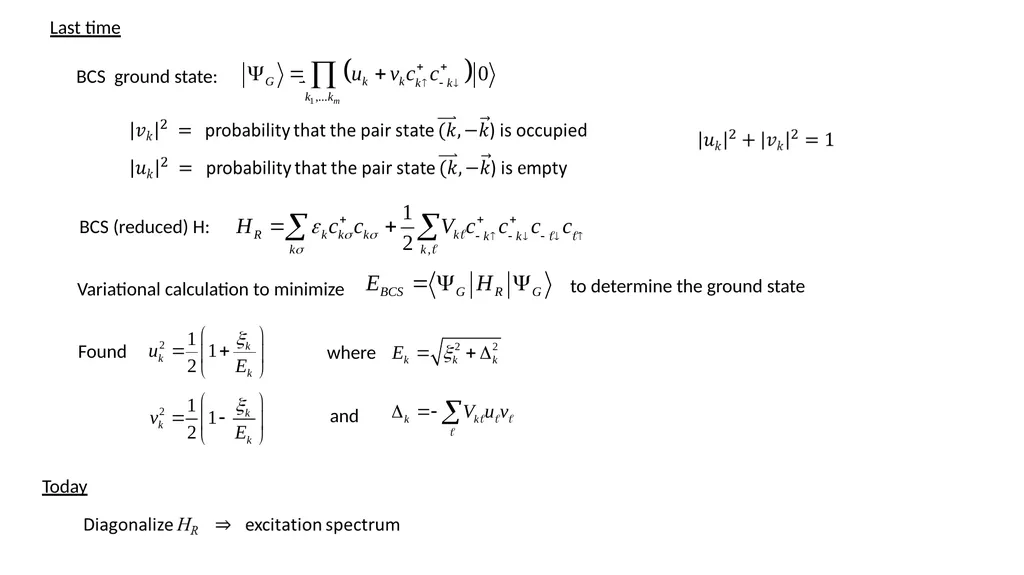
slide2. BCS ground state: BCS (reduced) H: where and Last time Variational calculation to minimize Found Today to determine the ground state<br>
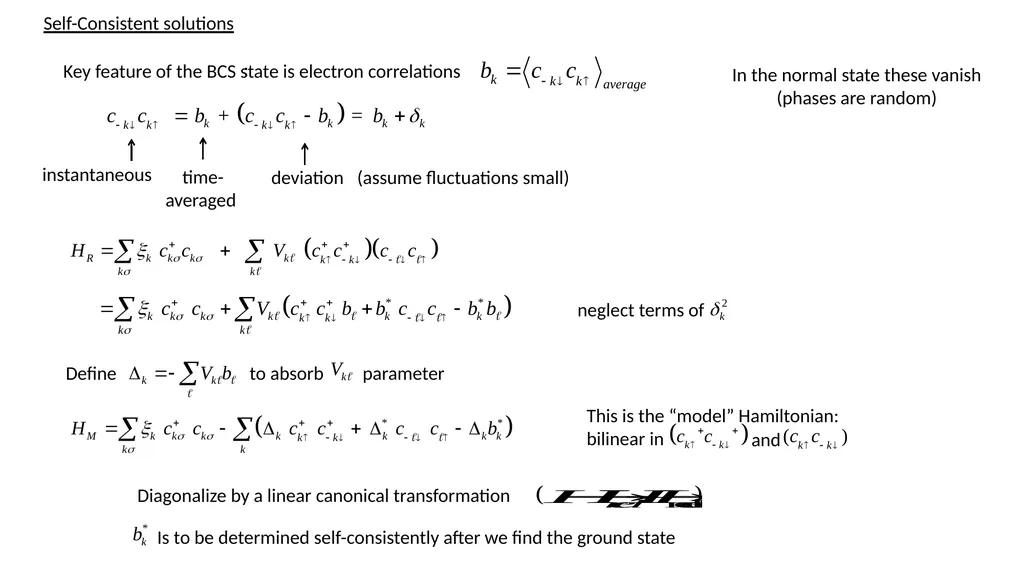
slide3. Self-Consistent solutions In the normal state these vanish (phases are random) deviation : Diagonalize by a linear canonical transformation (assume fluctuations small) Key feature of the BCS state is electron correlations instantaneous time-averaged<br>
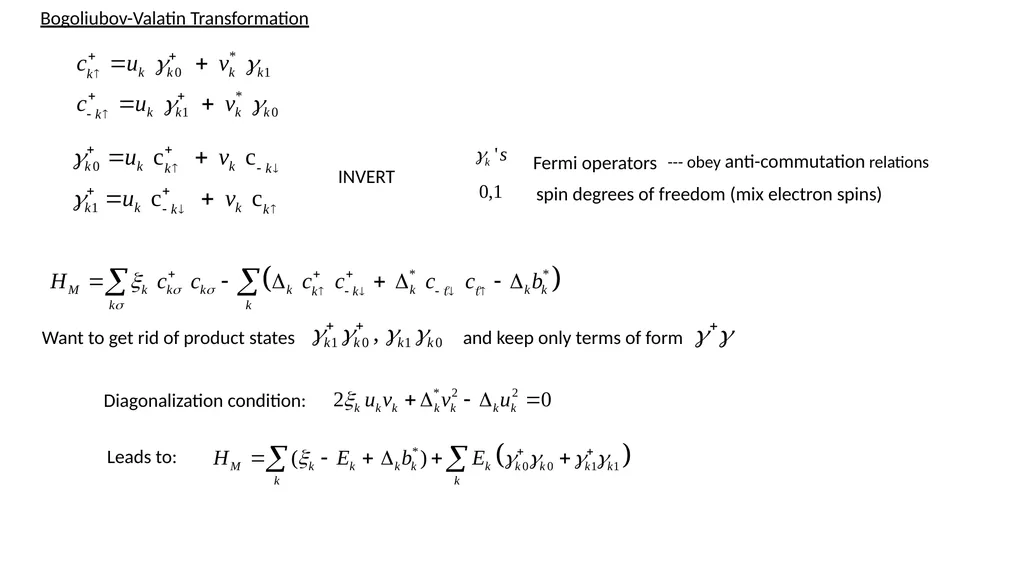
slide4. Bogoliubov-Valatin Transformation --- obey anti-commutation relations INVERT Diagonalization condition: spin degrees of freedom (mix electron spins) Fermi operators and keep only terms of form Leads to:<br>
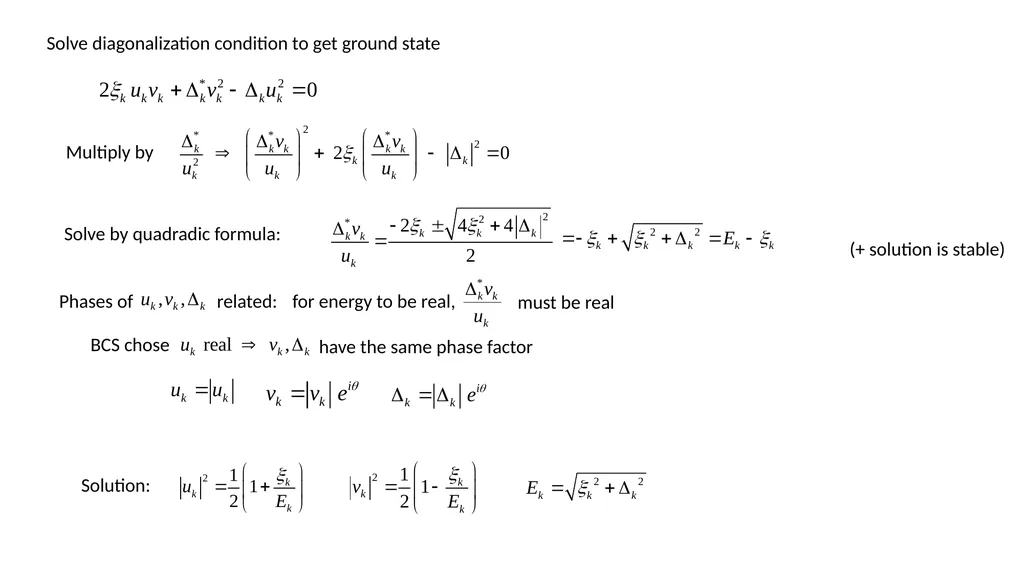
slide5. Multiply by (+ solution is stable) Phases of related: for energy to be real, Solve by quadradic formula: Solve diagonalization condition to get ground state Solution: must be real BCS chose have the same phase factor<br>
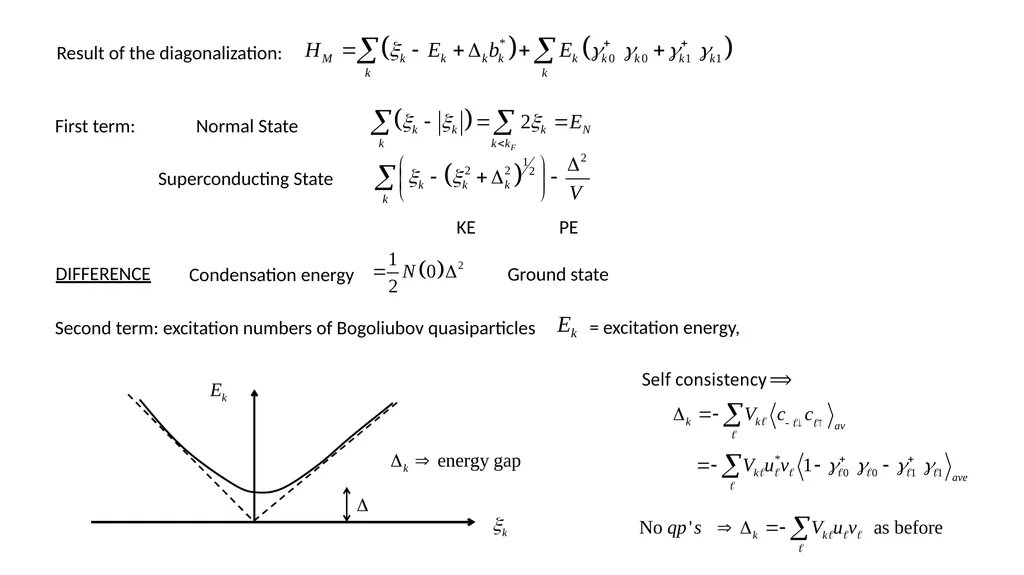
slide6. First term: Normal State KE PE Condensation energy DIFFERENCE Second term: excitation numbers of Bogoliubov quasiparticles Ground state Result of the diagonalization: Superconducting State = excitation energy,<br>
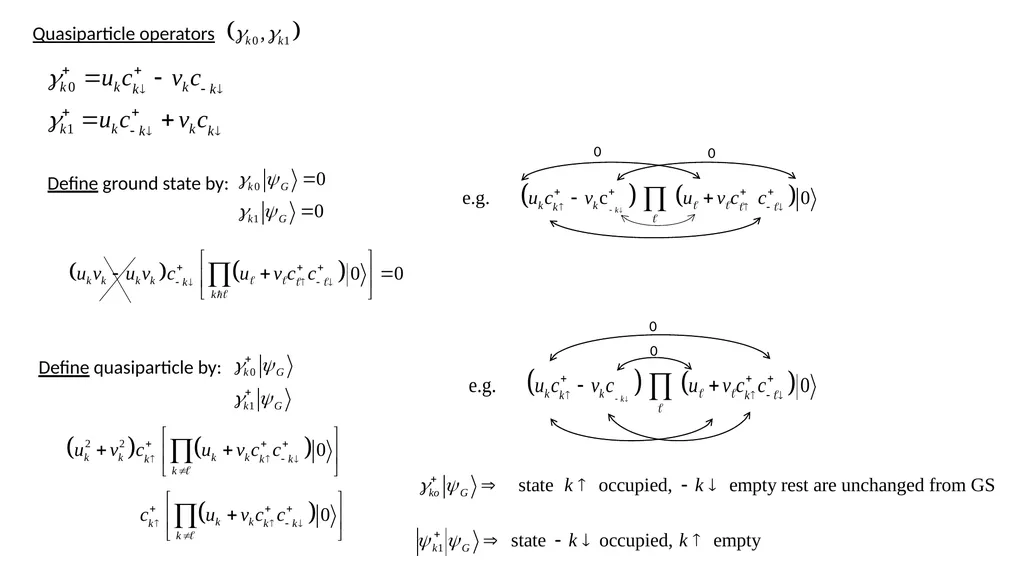
slide7. Quasiparticle operators Define ground state by: Define quasiparticle by:<br>
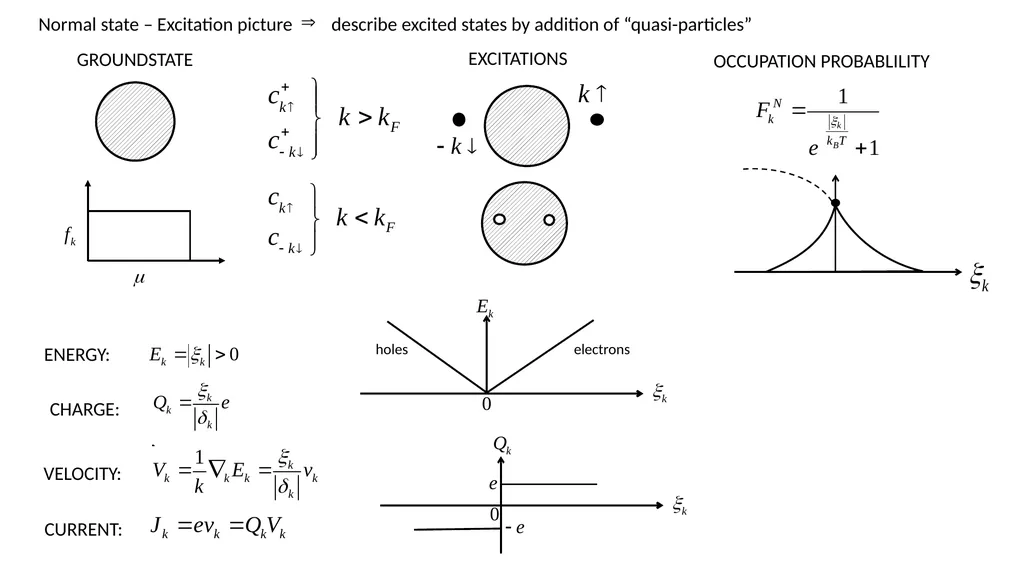
slide8. Normal state – Excitation picture describe excited states by addition of “quasi-particles” GROUNDSTATE EXCITATIONS OCCUPATION PROBABLILITY VELOCITY: ENERGY: CHARGE: CURRENT:<br>
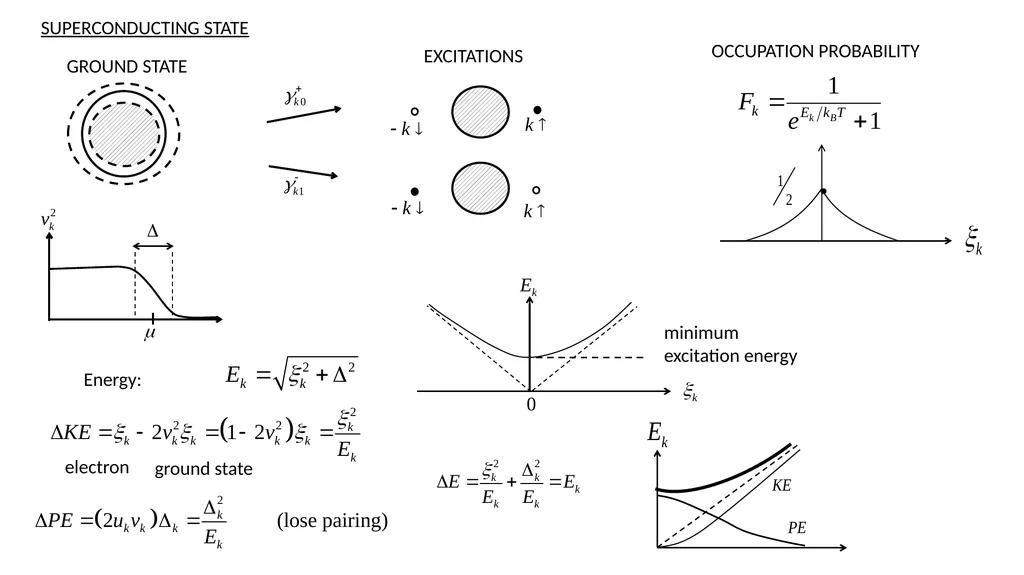
slide9. SUPERCONDUCTING STATE EXCITATIONS OCCUPATION PROBABILITY Energy: electron GROUND STATE ground state<br>
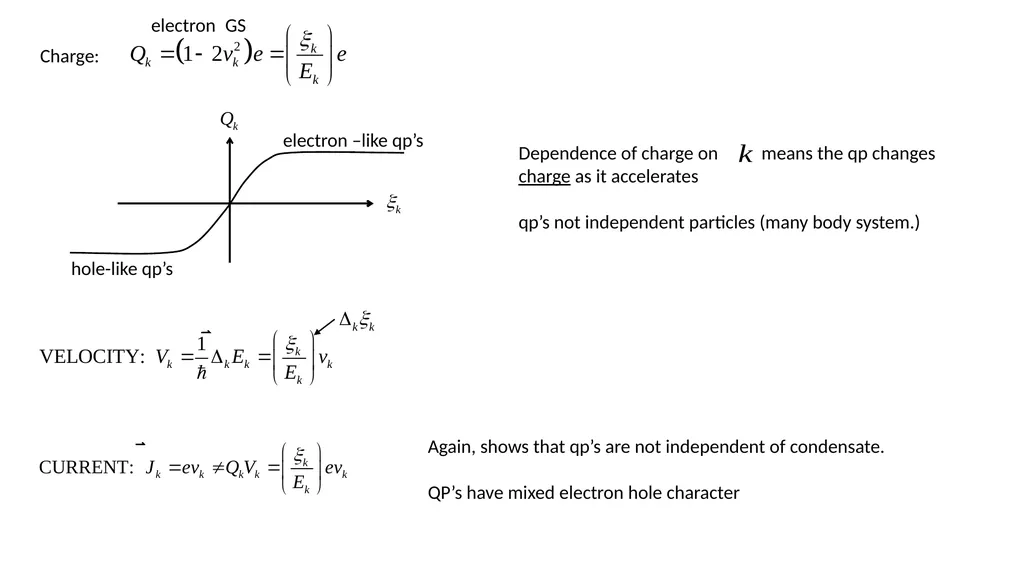
slide10. Charge: electron GS Again, shows that qp’s are not independent of condensate.
QP’s have mixed electron hole character<br>
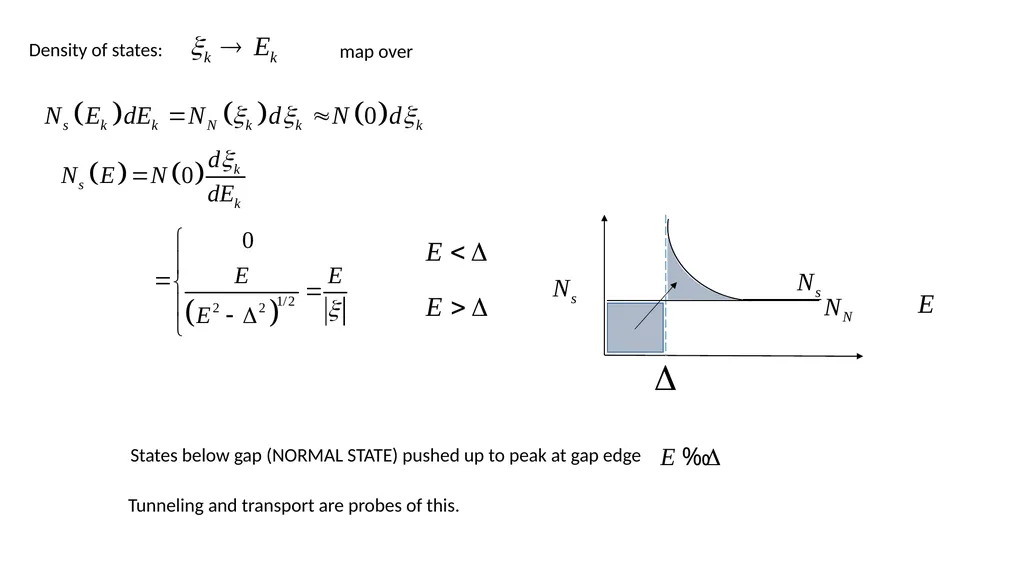
slide11. Density of states: map over States below gap (NORMAL STATE) pushed up to peak at gap edge Tunneling and transport are probes of this.<br>
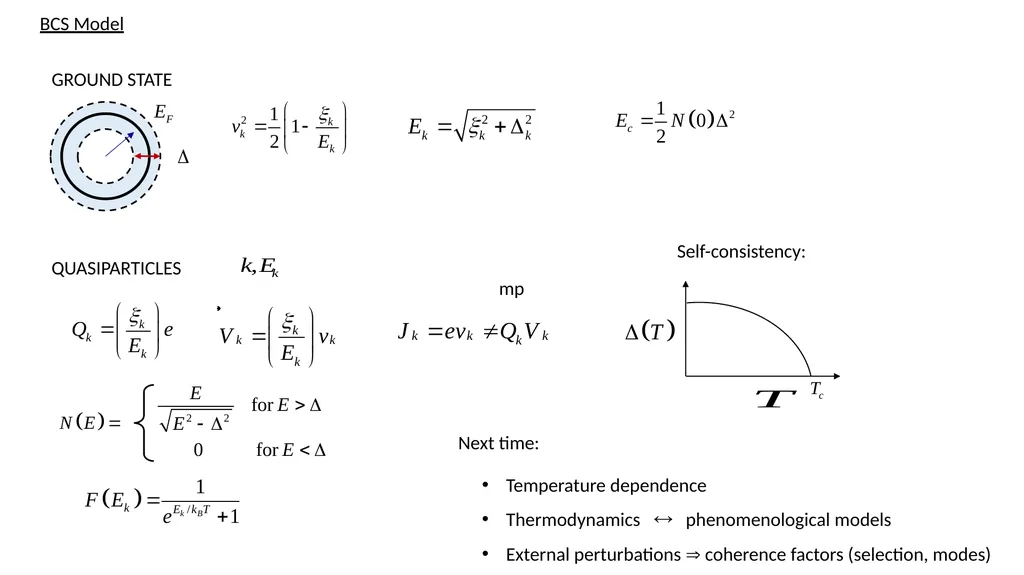
slide12. BCS Model GROUND STATE QUASIPARTICLES Self-consistency: Temperature dependence
Thermodynamics phenomenological models
External perturbations coherence factors (selection, modes) mp Next time:<br>
Clues to the mechanism and the Cooper instability problem
Attractive interaction and the BCS wavefunction and ground state
Self-consistent solution and quasiparticles
Thermodynamics, electrodynamics, and the coherence factors<br>
slide2. BCS ground state: BCS (reduced) H: where and Last time Variational calculation to minimize Found Today to determine the ground state<br>
slide3. Self-Consistent solutions In the normal state these vanish (phases are random) deviation : Diagonalize by a linear canonical transformation (assume fluctuations small) Key feature of the BCS state is electron correlations instantaneous time-averaged<br>
slide4. Bogoliubov-Valatin Transformation --- obey anti-commutation relations INVERT Diagonalization condition: spin degrees of freedom (mix electron spins) Fermi operators and keep only terms of form Leads to:<br>
slide5. Multiply by (+ solution is stable) Phases of related: for energy to be real, Solve by quadradic formula: Solve diagonalization condition to get ground state Solution: must be real BCS chose have the same phase factor<br>
slide6. First term: Normal State KE PE Condensation energy DIFFERENCE Second term: excitation numbers of Bogoliubov quasiparticles Ground state Result of the diagonalization: Superconducting State = excitation energy,<br>
slide7. Quasiparticle operators Define ground state by: Define quasiparticle by:<br>
slide8. Normal state – Excitation picture describe excited states by addition of “quasi-particles” GROUNDSTATE EXCITATIONS OCCUPATION PROBABLILITY VELOCITY: ENERGY: CHARGE: CURRENT:<br>
slide9. SUPERCONDUCTING STATE EXCITATIONS OCCUPATION PROBABILITY Energy: electron GROUND STATE ground state<br>
slide10. Charge: electron GS Again, shows that qp’s are not independent of condensate.
QP’s have mixed electron hole character<br>
slide11. Density of states: map over States below gap (NORMAL STATE) pushed up to peak at gap edge Tunneling and transport are probes of this.<br>
slide12. BCS Model GROUND STATE QUASIPARTICLES Self-consistency: Temperature dependence
Thermodynamics phenomenological models
External perturbations coherence factors (selection, modes) mp Next time:<br>