
Lecture 5: Human Nature Possessed: How to become
KL
Published · 17 slides · 0 views

1 / 1



Description
Lecture 5: Human Nature Possessed: How to become Divine and Demoniac? Spiritus: a subtle vapour produced in the blood and disseminated throughout the body by the arteries and nerves. It was considered to be the central source of activity in
Related Topics
Share
Embed code
Download this presentation From Below
"Lecture 5: Human Nature Possessed: How to become" is the property of its rightful owner. Permission is granted to download and print the materials on this website for personal, non-commercial use only, and to display it on your personal computer provided you do not modify the materials and that you retain all copyright notices contained in the materials. By downloading content from our website, you accept the terms of this agreement.
Presentation Transcript
01
Lecture 5:
Human Nature Possessed: How to become Divine and Demoniac?<br>
02
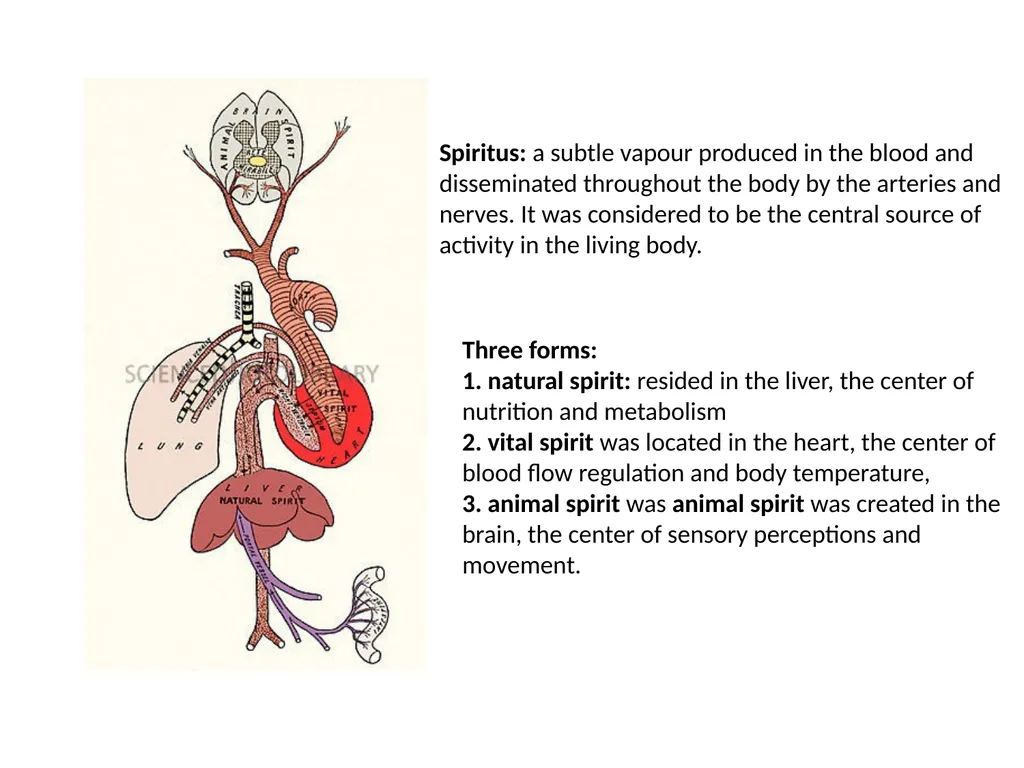
Spiritus: a subtle vapour produced in the blood and disseminated throughout the body by the arteries and nerves. It was considered to be the central source of activity in the living body. Three forms:
1. natural spirit: resided in the liver, the center of
nutrition and metabolism
2. vital spirit was located in the heart, the center of
blood flow regulation and body temperature,
3. animal spirit was animal spirit was created in the
brain, the center of sensory perceptions and
movement.<br>
1. natural spirit: resided in the liver, the center of
nutrition and metabolism
2. vital spirit was located in the heart, the center of
blood flow regulation and body temperature,
3. animal spirit was animal spirit was created in the
brain, the center of sensory perceptions and
movement.<br>
03
“The soul … being united to bodily substance … useth the spirite: which is the most universall instrumente of the soul … the soul directeth it, and guideth it vnto more particular instruments, for more speciall and priuate vses, as to the eye, to see with; to the eare to heare; to the nose to smell; to the bowells, stomack, and liuer, to nourish, to the heart, to maintaine life: and to other partes, to the end of propagation: this is all performed by the selfe same, one, and single spirite. …
I know commonly there are accompted three spirits: animall, vitall, and naturall”
Timothie Bright, A Treatise of Melancholy … with the Physicke Cure (1586), 46-7.<br>
I know commonly there are accompted three spirits: animall, vitall, and naturall”
Timothie Bright, A Treatise of Melancholy … with the Physicke Cure (1586), 46-7.<br>
04
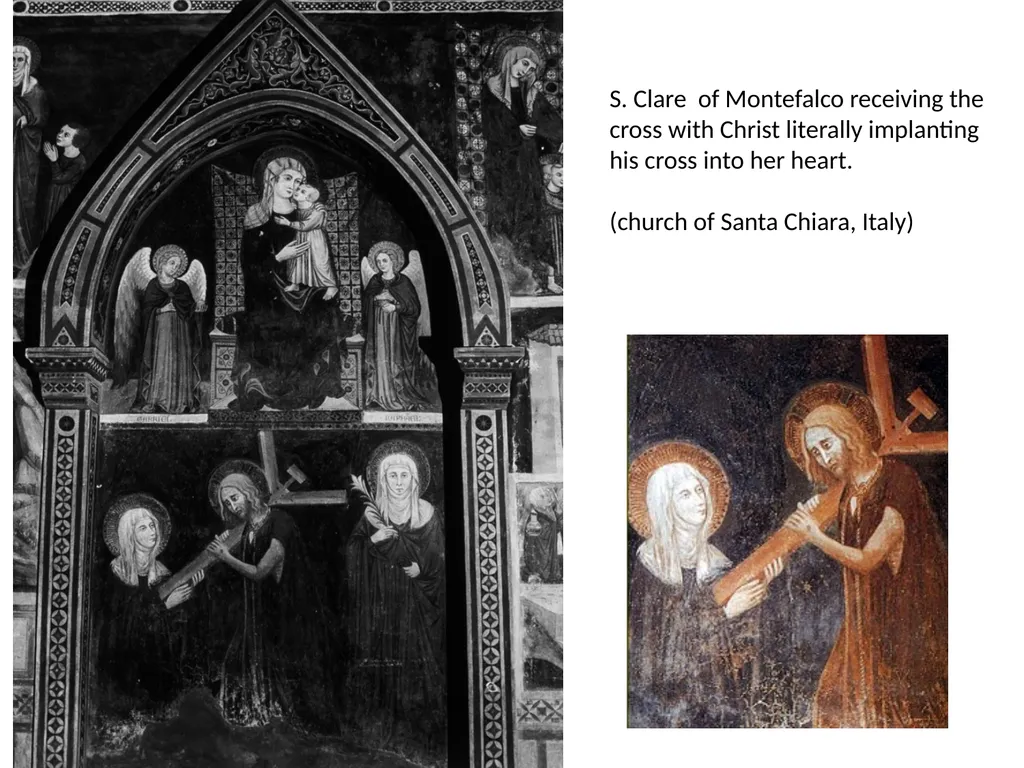
S. Clare of Montefalco receiving the cross with Christ literally implanting his cross into her heart.
(church of Santa Chiara, Italy)<br>
(church of Santa Chiara, Italy)<br>
05
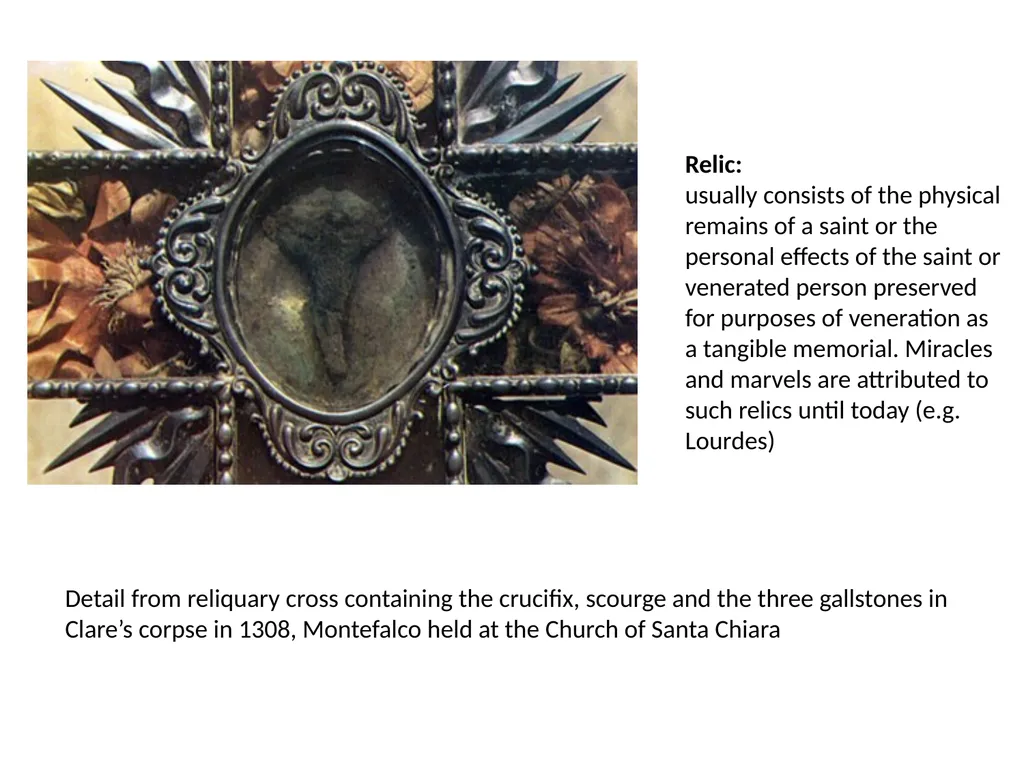
Detail from reliquary cross containing the crucifix, scourge and the three gallstones in Clare’s corpse in 1308, Montefalco held at the Church of Santa Chiara Relic:
usually consists of the physical remains of a saint or the personal effects of the saint or venerated person preserved for purposes of veneration as a tangible memorial. Miracles and marvels are attributed to such relics until today (e.g. Lourdes)<br>
usually consists of the physical remains of a saint or the personal effects of the saint or venerated person preserved for purposes of veneration as a tangible memorial. Miracles and marvels are attributed to such relics until today (e.g. Lourdes)<br>
06
Canonization: the process by which Orthodox, Roman Catholic, or Anglican Church declares that a person who has died was a saint. Upon this declaration the person is included in the canon, or list, of recognized saints.
Stages of canonization in the Catholic Church (since 1983)
Servant of God → Venerable → Blessed (beatification) → Saint (cannonisation)
To be canonized a saint, the person in question (in the state of ‘the Blessed’) must have performed at least two through the his/her intercession after his or her death (i.e., an additional miracle after that granting beatification).<br>
07
Aristotle and the Soul
Aristotelian psychology:
the study of the ‘soul’ or ‘psyche’ (in his text, De Anima); the study of the
nature of the soul (or psyche), which he considered the basis of all life. The soul, according to Aristotle, is the essence of all living things that makes them behave in the ways distinctive of living things.
note: today the term ‘psychology’ refers only to the study of the mind; Aristotle understood it in a much broader way
Central question for Aristotle was:
How does the soul relate to the physical body?
Answer: He regards the body as the matter (parts and material that make up the body) and the soul as the form of a living thing. The two are correlative to one another. What humans do involves always the soul and the body together (differs from Plato’s ideas of the soul).<br>
08
Aristotle subdivides ‘the soul’ into three kinds:
vegetative/nutritive soul: was the lowest soul which included the functions basic to all living things: nutrition,
growth and reproduction.
sensitive soul: second highest of the three souls which included all of the powers of the vegetative soul as well as the powers of movement and emotion as well as the ten internal and external senses.
Intellective/rational soul: included not only the vegetative and sensitive powers — the organic
faculties of the other two souls - but also the three rational powers of intellect, intellective memory (memory of concepts, as opposed to mere sense images) and will.<br>
09
All living beings/things were divided into genera according to the kind of soul they possessed according to Aristotle (hierarchy of souls)
Plants – only possess the ‘vegetative’ or ‘nutritive’ soul
2. ‘Imperfect’ animals (including sponges, worms and bivalves) –partial ‘sensitive’ soul
‘Perfect’ animals (including insects, birds and mammals) – a complete ‘sensitive’ soul
But they also possess the vegetative/nutritive soul
3. Humans beings – only living beings with intellective or rational soul (but humans also possess the other two souls – ‘vegetative’ and ‘sensitive’)<br>
10
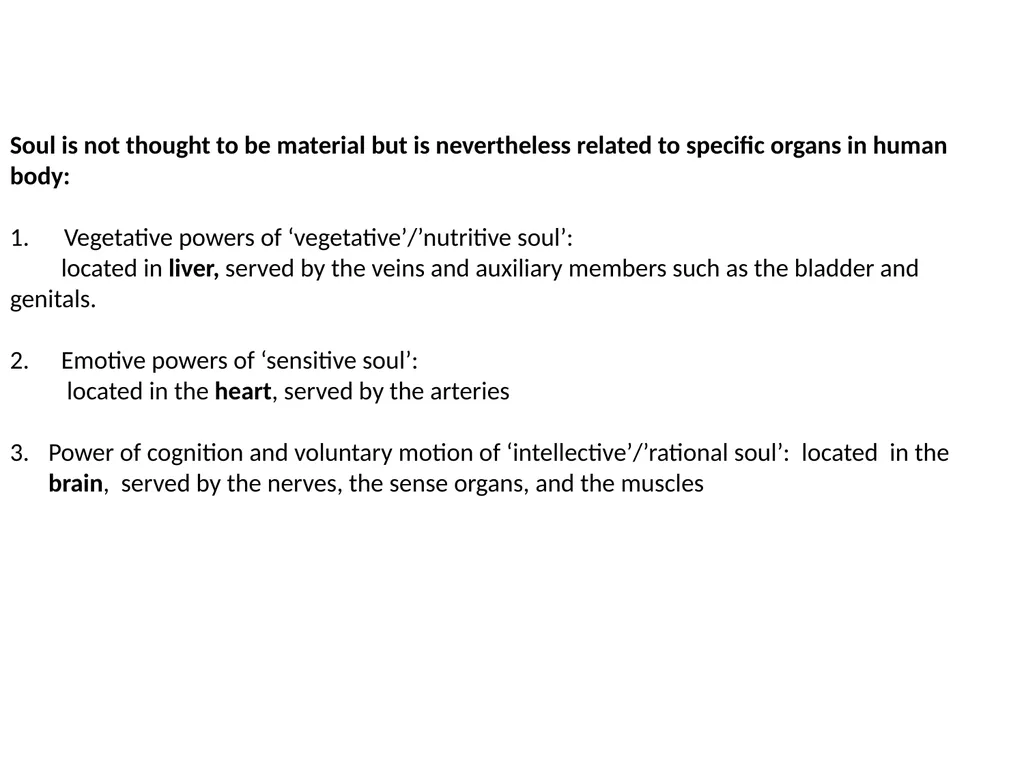
Soul is not thought to be material but is nevertheless related to specific organs in human body:
1. Vegetative powers of ‘vegetative’/’nutritive soul’:
located in liver, served by the veins and auxiliary members such as the bladder and genitals.
2. Emotive powers of ‘sensitive soul’:
located in the heart, served by the arteries
Power of cognition and voluntary motion of ‘intellective’/’rational soul’: located in the brain, served by the nerves, the sense organs, and the muscles<br>
11
spirit/pneuma: means ‘air’ or ‘breath’, and is imagined
as a sort of hot vapor fused in blood 1. natural spirit: resided in the liver, the center of
nutrition and metabolism.
2. vital spirit was located in the heart, the center of
blood flow regulation, heart beat, respiration, and body temperature.
3. animal spirit was created in the brain, the center of sensory perceptions and movement. Souls and the organs where they were believed to reside
relied for the operation on ‘spirits’ -
goes back to medical ideas of Galen Galen’s idea of body and spirits<br>
12
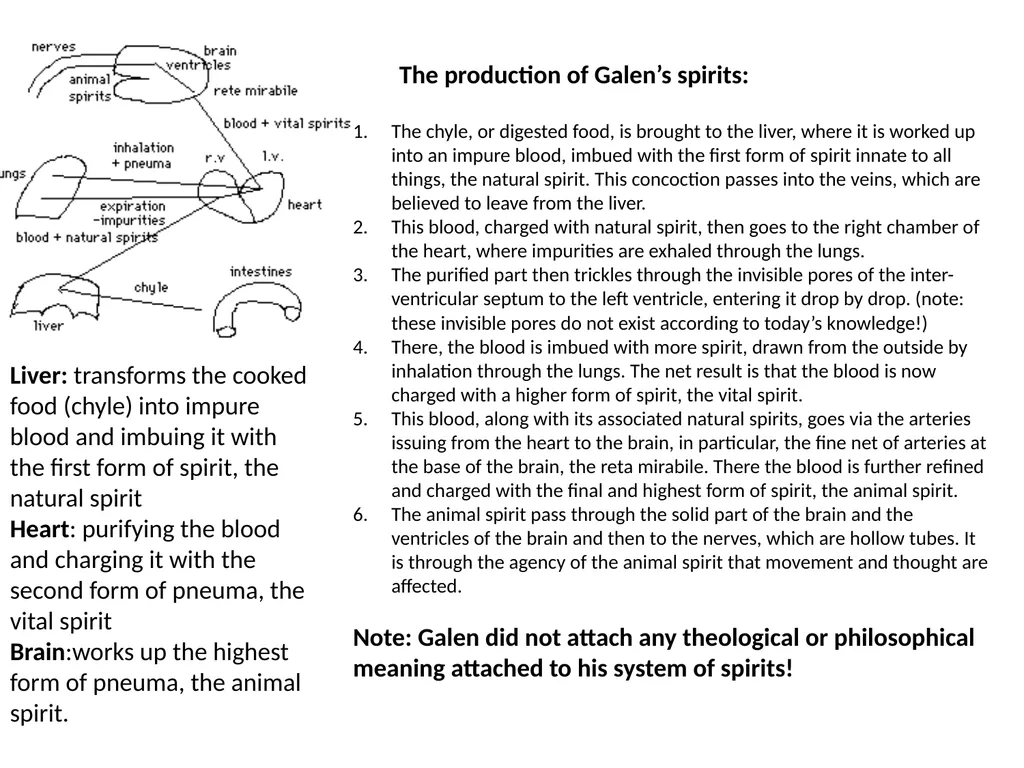
The chyle, or digested food, is brought to the liver, where it is worked up into an impure blood, imbued with the first form of spirit innate to all things, the natural spirit. This concoction passes into the veins, which are believed to leave from the liver.
This blood, charged with natural spirit, then goes to the right chamber of the heart, where impurities are exhaled through the lungs.
The purified part then trickles through the invisible pores of the inter-ventricular septum to the left ventricle, entering it drop by drop. (note: these invisible pores do not exist according to today’s knowledge!)
There, the blood is imbued with more spirit, drawn from the outside by inhalation through the lungs. The net result is that the blood is now charged with a higher form of spirit, the vital spirit.
This blood, along with its associated natural spirits, goes via the arteries issuing from the heart to the brain, in particular, the fine net of arteries at the base of the brain, the reta mirabile. There the blood is further refined and charged with the final and highest form of spirit, the animal spirit.
The animal spirit pass through the solid part of the brain and the ventricles of the brain and then to the nerves, which are hollow tubes. It is through the agency of the animal spirit that movement and thought are affected.
Note: Galen did not attach any theological or philosophical meaning attached to his system of spirits! Liver: transforms the cooked food (chyle) into impure blood and imbuing it with the first form of spirit, the natural spirit
Heart: purifying the blood and charging it with the second form of pneuma, the vital spirit
Brain:works up the highest form of pneuma, the animal spirit. The production of Galen’s spirits:<br>
13
Devil snatches the spirit leaving the body of dying man through the mouth
(Danish mural, 12th century) During 12-14th century the ‘spirit’ took on theological meanings
Appropriation of natural function and organs related to the spiritual and soul systems of Galen and Aristotle and the linking of these physiological ideas to Christian ideas, expressed in the Bible and writings of Church fathers<br>
14
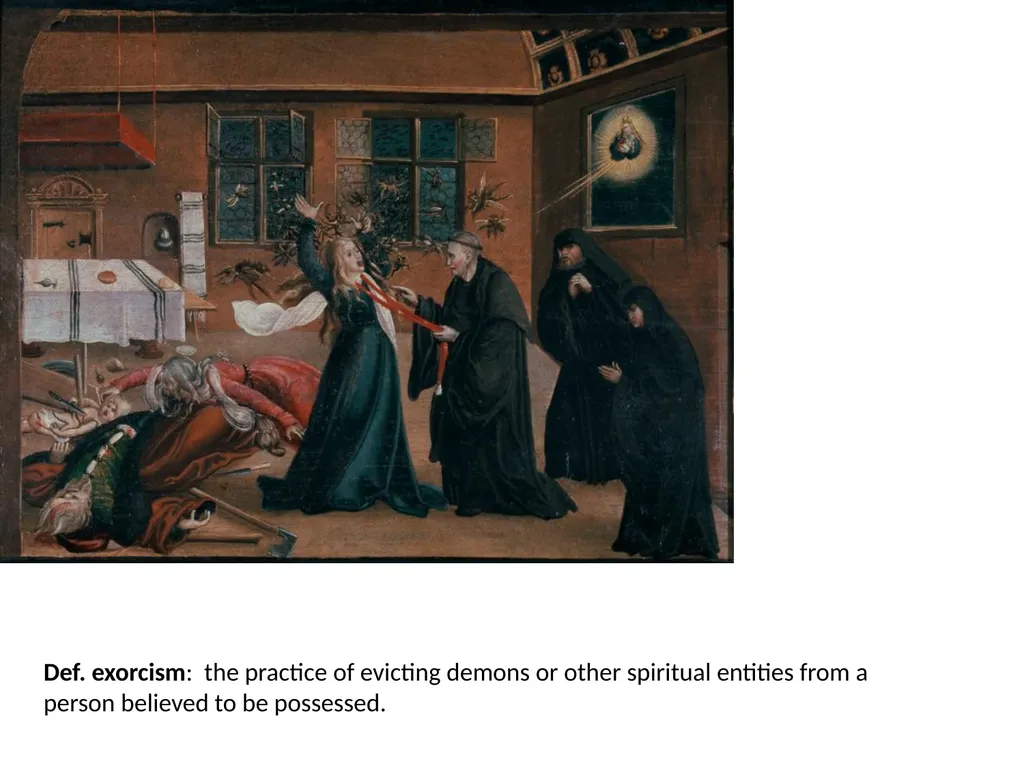
Def. exorcism: the practice of evicting demons or other spiritual entities from a
person believed to be possessed.<br>
person believed to be possessed.<br>
15
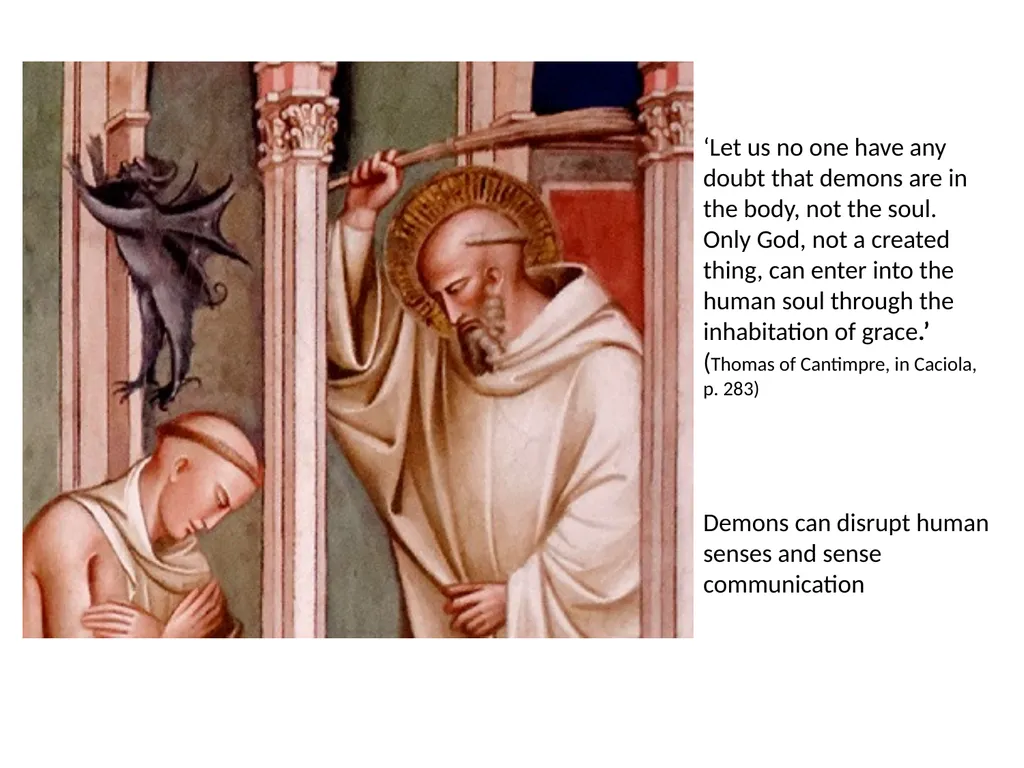
‘Let us no one have any doubt that demons are in the body, not the soul. Only God, not a created thing, can enter into the human soul through the inhabitation of grace.’
(Thomas of Cantimpre, in Caciola, p. 283) Demons can disrupt human
senses and sense communication<br>
(Thomas of Cantimpre, in Caciola, p. 283) Demons can disrupt human
senses and sense communication<br>
16
Discerning Holy and Demonic Spirits
The responses of an audience to a mystic’s public performances were intricately bound up with the question of how external behaviors were thought to mirror internal, spiritual states.
This process of discerning spirits became a major hermeneutic challenge. One would have to establish a truth about the encounter, a truth about the interior movements within the soul, and a truth about the somatic signs of the body.
Discerning a spiritual possession was also a social practice involving processes of negotiation between ordinary men and women as well as attendant clergymen and medics.<br>
17
How to approach this subject as historians?
The beliefs and case studies reviewed in this lecture would have once been used to illustrate past ignorance and superstition. Is the assumption of ignorance a helpful starting point?
It is more fruitful to try and comprehend what made certain beliefs possible, rational and truthful at particular moments in time.
The belief in demonic possession fitted into a coherent system of Aristotelian natural philosophy. Whilst God could intervene supernaturally in human affairs – that is, work above and beyond the realm of nature and touch the soul – the devil and demonic spirits worked through ‘preternatural’ forces and were conceptualised as part of early modern nature. Therefore their effects on human beings were, of necessity, a part of early modern science and medicine. (see Stuart Clarke’s Thinking with Demons).<br>