
Lecture 6 Consciousness Consciousness A hard


Description: Lecture 6 Consciousness Consciousness A hard problem? Consciousness A hard problem? con with scire to know (Latin) Philosophical positions Dualism and monism Philosophical positions Aside: materialism and physicalism Materialism vs.
Related Topics
Download Presentation
"Lecture 6 Consciousness Consciousness A hard" is the property of its rightful owner. Permission is granted to download and print the materials on this website for personal, non-commercial use only, and to display it on your personal computer provided you do not modify the materials and that you retain all copyright notices contained in the materials. By downloading content from our website, you accept the terms of this agreement.
Presentation Transcript
slide1. Lecture 6
Consciousness<br>
slide2. Consciousness
A hard problem?<br>
slide3. Consciousness
A hard problem? con with
scire to know
(Latin)<br>
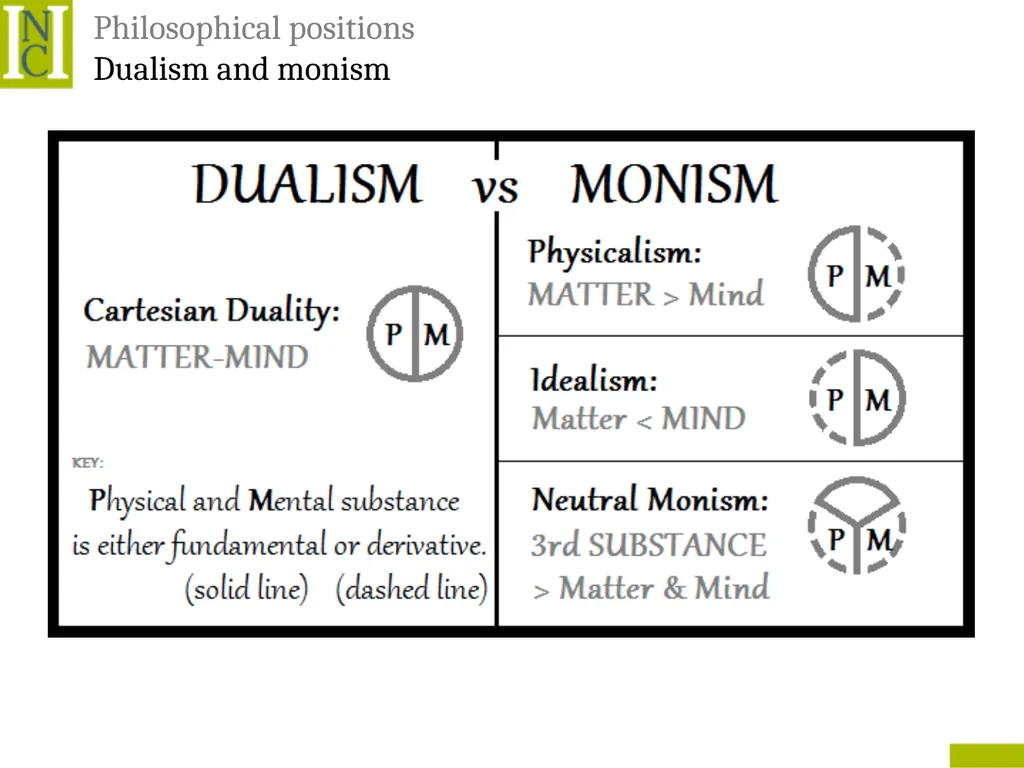
slide4. Philosophical positions
Dualism and monism<br>
slide5. Philosophical positions
Aside: materialism and physicalism Materialism vs. physicalism:
in contemporary thought, often interchangeable.
Materialism is a very old term; physicalism was introduced in the 1930s.
There is still debate about whether there is an exact correspondence.
Neurath, O, 1931, ‘Physicalism: The Philosophy of the Vienna Circle’ in R.S. Cohen, and M. Neurath (eds.), Philosophical Papers 1913–1946, Dordrecht: D. Reidel Publishing Company, 1983, pp. 48–51.<br>
slide6. Philosophical positions
Realism Realism concerns itself with the relationship between percepts and the things which cause them.
Naive realism: we percieve things directly, as they really are
Indirect realism: we perceive a transformed version of reality
The contrast between naive and indirect realism is in a way orthogonal from the dualism/monism contrast:
our decision about dualism/monism does not afect our decision about direct/indirect realism.<br>
slide7. Consciousness
Many meanings What can be conscious/unconscious?
A life-form, animal or person
A life-form, animal or person at a particular time
Consciousness is a label for creatures, and a state they can be in at a particular time.<br>
slide8. Consciousness
Conscious experience The process of awareness of things going on in the world around you
and of things happening in your own mind.<br>
slide9. Consciousness
Consciousness as a zone Things may enter our consciousness or, if unconscious, remain outside our consciousness.
Consciousness can be seen as a zone in which thoughts, or at least brain events, may take place.<br>
slide10. Consciousness
Consciousness as an inner life We usually assume that conscious beings have some kind of inner life: private thoughts or feelings which are separate from external behaviours.
The inner life is made up of qualia, which are ineffable.<br>
slide11. Consciousness
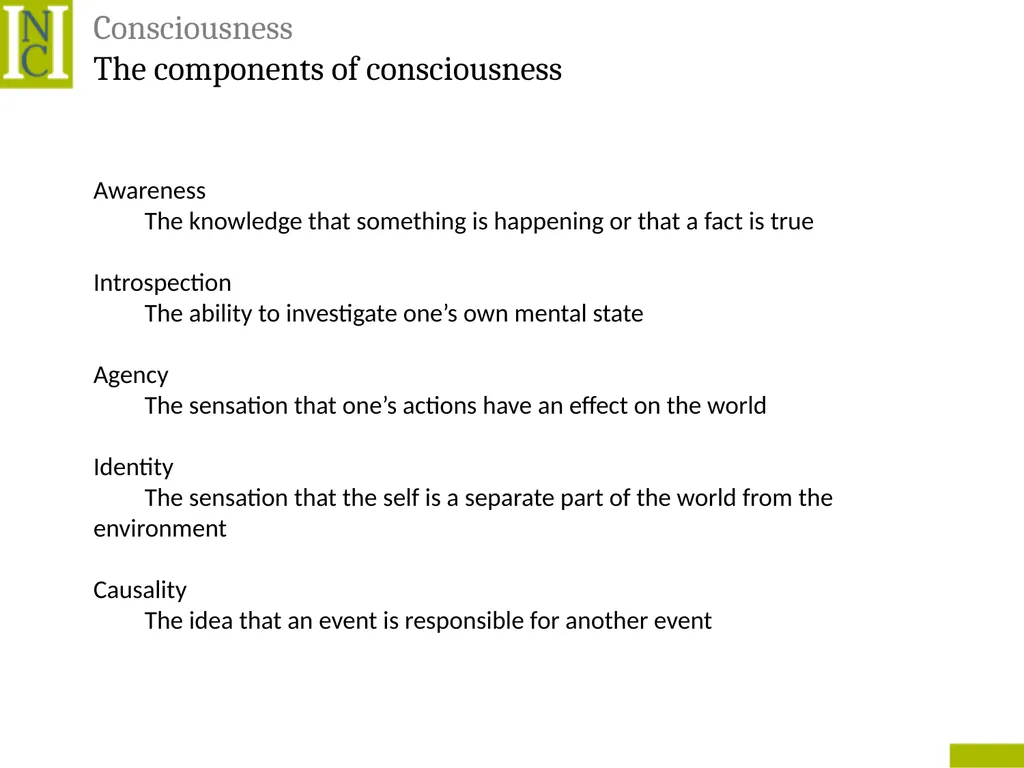
The components of consciousness Awareness
The knowledge that something is happening or that a fact is true
Introspection
The ability to investigate one’s own mental state
Agency
The sensation that one’s actions have an effect on the world
Identity
The sensation that the self is a separate part of the world from the environment
Causality
The idea that an event is responsible for another event<br>
slide12. Consciousness
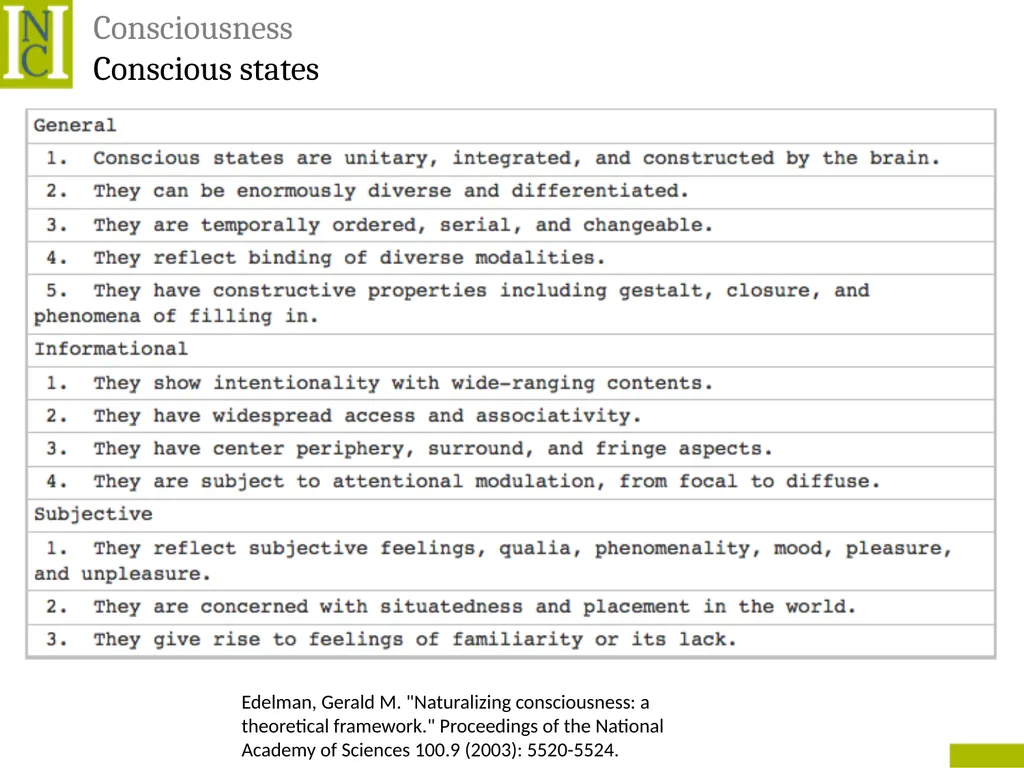
Conscious states Conscious states Edelman, Gerald M. "Naturalizing consciousness: a theoretical framework." Proceedings of the National Academy of Sciences 100.9 (2003): 5520-5524.<br>
slide13. Consciousness
Conscious states Consciousness: state or process?<br>
slide14. Consciousness
Qualia What if your experience of the colour red is different from everyone else’s?
Wherever they see red, you see blue.
Would this ever be noticeable?
No.
Thomas Nagel:
When I am in a conscious mental state, there is something it is like for me to be in that state from the subjective or first-person point of view.
Nagel, T. "What is it like to be a Bat?" In Philosophical Review 83: 435-456, 1974.<br>
slide15. Consciousness
“The hard problem” We seek to link
Qualia: internal, private, subjective experience
Measurable states: brainwaves, neural connections, firing patterns, skin conductance...
The difficulty of finding a relationship between the two,
a process which can translate one to the other,
is the so-called hard problem of consciousness.
This is called the explanatory gap.
Levine, Joseph. "Materialism and qualia: The explanatory gap." Pacific philosophical quarterly 64.4 (1983): 354-361.<br>
slide16. Consciousness
“The hard problem” “The hard problem” is orthogonal to the question of exactly how consciousness is implemented. Whether the system is dualist or realist, and however it is eventually discovered to work, qualia will still feel the same.<br>
slide17. Consciousness
What do we consider conscious? Certainly: other people
Perhaps: animals
Certainly not: simple information processing devices
inanimate objects
There are no explicit divisions: consciousness is a continuum.<br>
slide18. Consciousness
Altered states of consciousness Consciousness is not just a continuum between zero and “fully conscious.”
Illness, psychoactive chemicals, brain damage, or cognitive impairment can change the nature of one’s consciousness.<br>
slide19. The seagull argument You have grown up on an island inhabited by nothing but people and seagulls.
Eventually you ask yourself, “what is flight?”
Any definition you come up with will make reference only to seagulls.
Then, for the first time, you encounter a helicopter.
According to your definition, does it fly?
There is no way of knowing.<br>
slide20. The seagull argument The same reasoning applies for intelligence (see the domain of the Turing test) and consciousness.
We build a new, powerful computer, discover an alien race or meet a chimpanzee; is it really intelligent?
Is it really conscious?<br>
slide21. Consciousness as a social label Consciousness is a useful tag for deciding how we treat other creatures.
One has great difficulty causing harm to something one considers conscious.<br>
slide22. Consciousness
Consciousness as a metaphor We often use terms related to consciousness to describe interactions with admittedly non-conscious objects:
the computer wants you to do this
the website thinks you’re not logged in
the components don’t want to fit together properly<br>
slide23. Consciousness
Descriptions We can distinguish two main ways of describing conscious experience:
To others (verbally, linguistically, behaviourally)
To ourselves (remembering past feelings; introspecting)
By definition, the second form of description can never be communicated to another person.<br>
slide24. Models
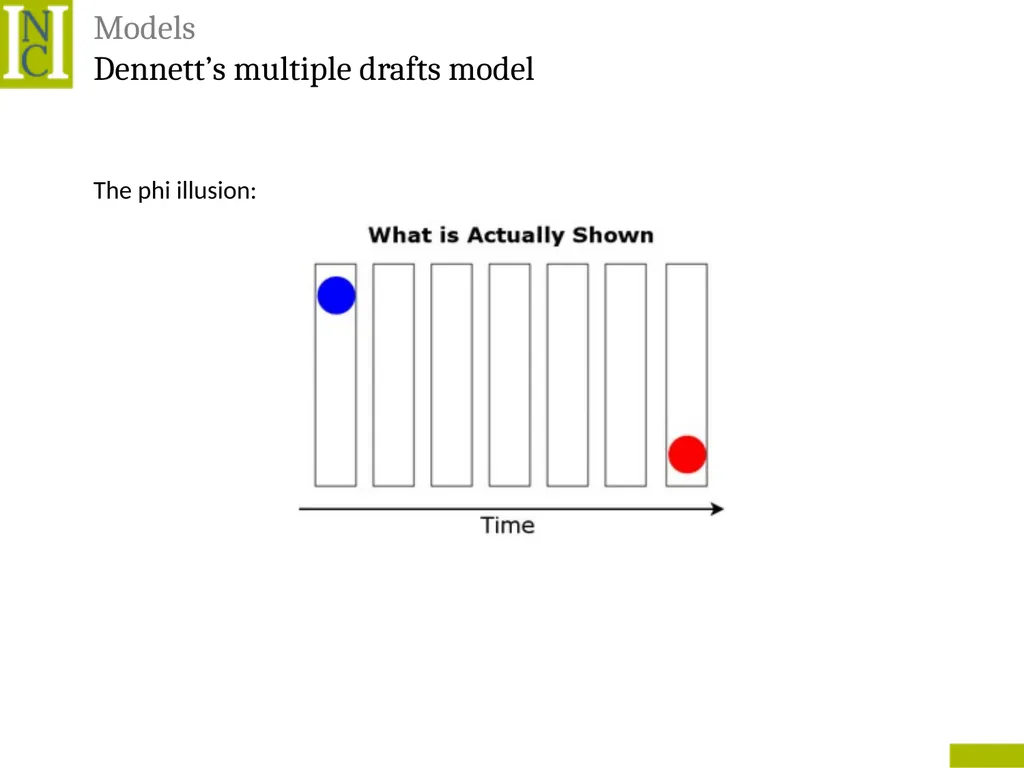
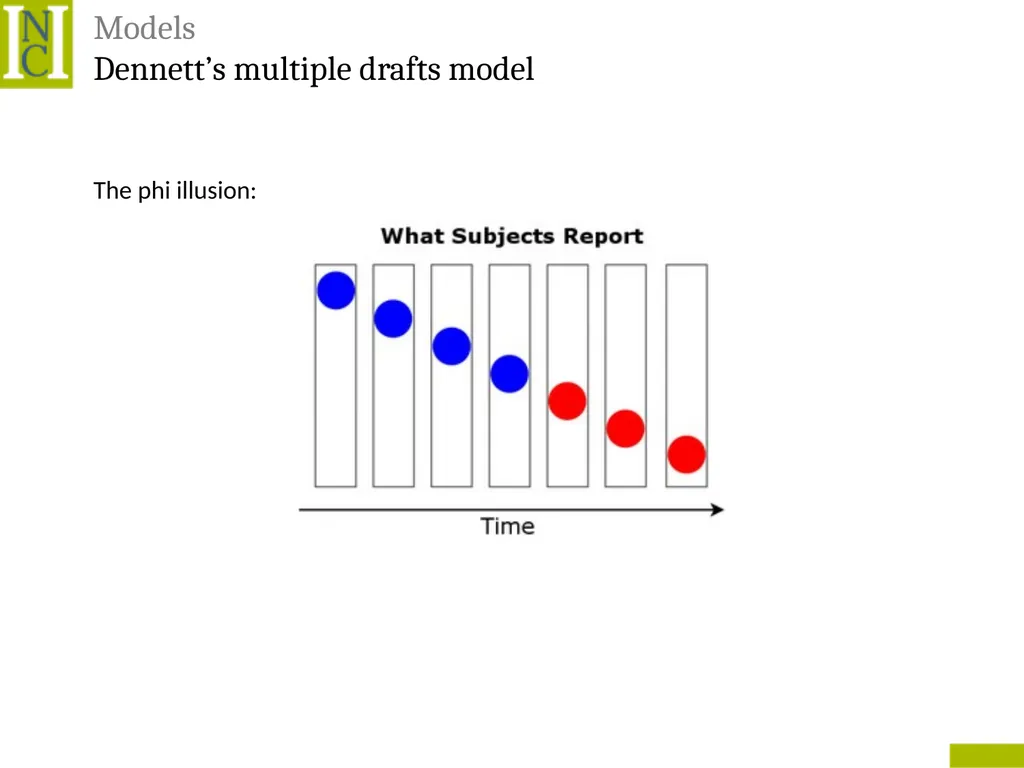
Dennett’s multiple drafts model The phi illusion:<br>
slide25. Models
Dennett’s multiple drafts model The phi illusion:<br>
slide26. Models
Dennett’s multiple drafts model Orwellian explanations:
The observer concludes one thing, then changes it later.
Stalinesque explanations:
The contradiction is resolved before entering consciousness.<br>
slide27. Models
Dennett’s multiple drafts model Cartesian materialism: the view that there is a hard boundary to the zone of consciousness, aka the Cartesian theatre.
The multiple drafts model rejects the Cartesian Theatre.
The world provides us with a variety of sensory inputs, which can be interpreted in different ways. These may happen in parallel or at different speeds.
Percepts do not instantaneously arrive in the mind in their full richness.<br>
slide28. Models
Dennett’s three stances Physical stance: mass, energy, trajectories, atoms, molecules, materials.
Design stance: purpose, function, design.
Intentional stance: belief, volition, intent, thinking, knowing.<br>
slide29. Models
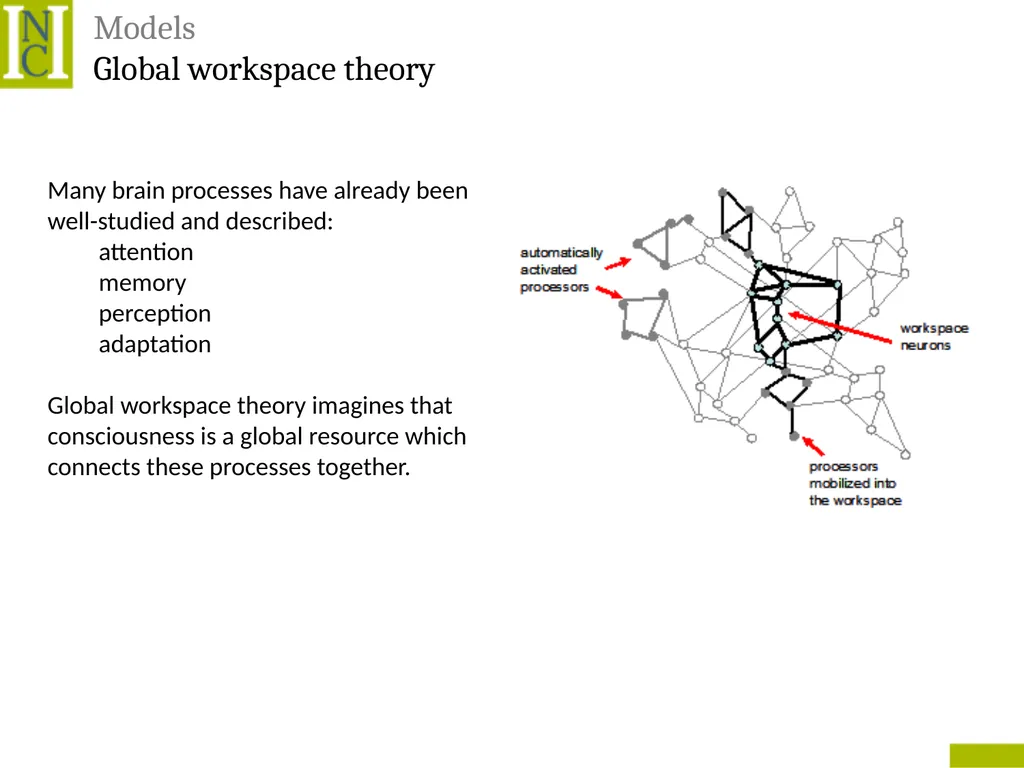
Global workspace theory Many brain processes have already been well-studied and described:
attention
memory
perception
adaptation
Global workspace theory imagines that consciousness is a global resource which connects these processes together.<br>
slide30. Models
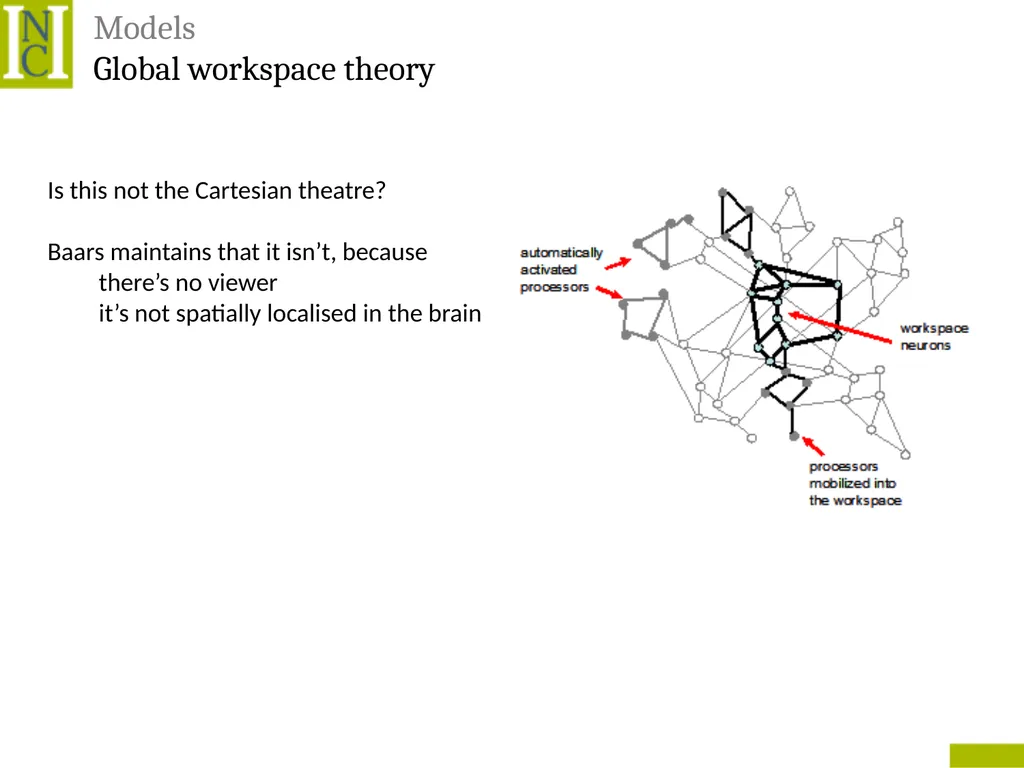
Global workspace theory Is this not the Cartesian theatre?
Baars maintains that it isn’t, because
there’s no viewer
it’s not spatially localised in the brain<br>
slide31. Neurophysiology
Consciousness as an integrator Consciousness seems to be the place where, or process by means of which, information from different senses and different brain processes is integrated and bound into a unified whole.<br>
slide32. Neurophysiology
Neural correlates of consciousness A complex-sounding term, but really just a bridge over the explanatory gap.
Crick F. and Koch C. (1990) Towards a neurobiological theory of consciousness. Seminars in Neuroscience Vol2, 263–275.<br>
slide33. Neurophysiology
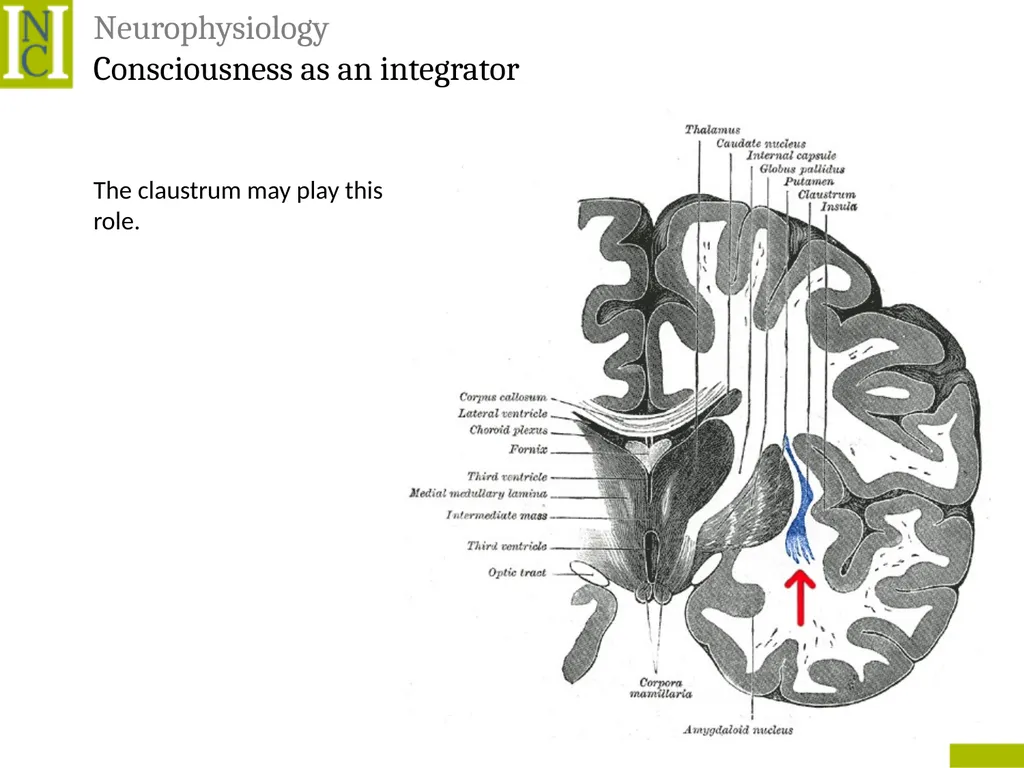
Consciousness as an integrator The claustrum may play this role.<br>
slide34. Neurophysiology
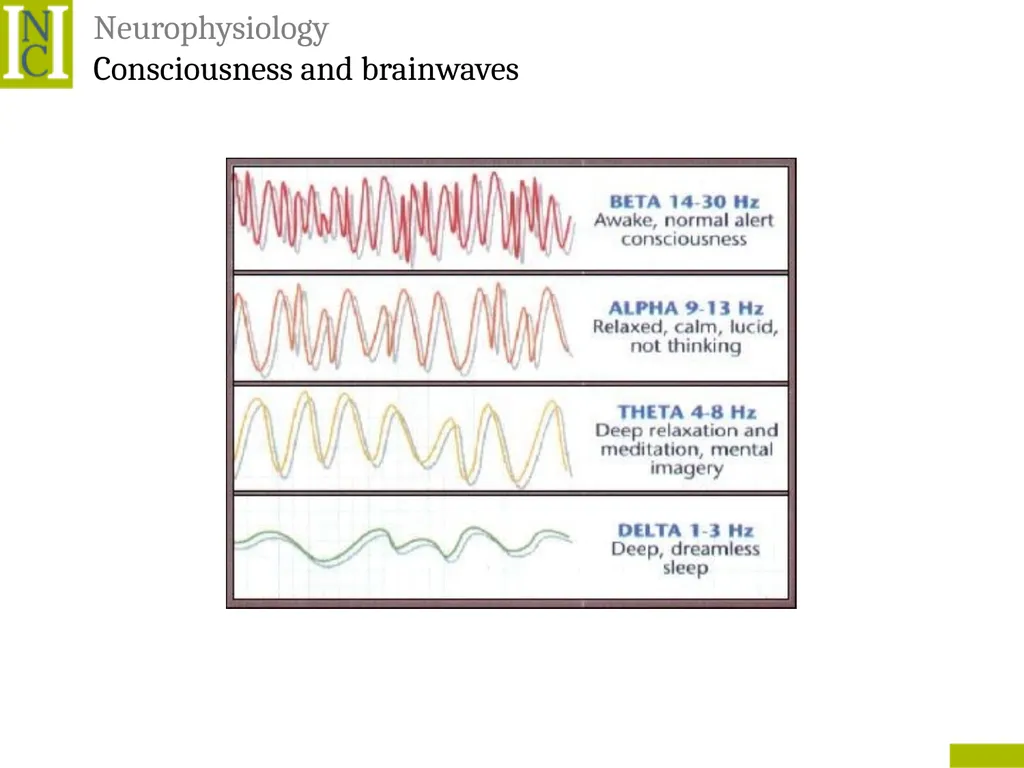
Consciousness and brainwaves<br>
slide35. Neurophysiology
REM sleep Dreaming is not full consciousness – but it is close. It is often difficult to distinguish between the two; lucid dreaming is a state with elements of both dreaming and wakefulness.
Dreaming is reliably indicated by rapid eye movement.<br>
slide36. Neurophysiology
Coma or vegetative state Brain activity, detected through MRI or EEG, may show a response to heard language despite the absence of a behavioural response.<br>
slide37. Neurophysiology
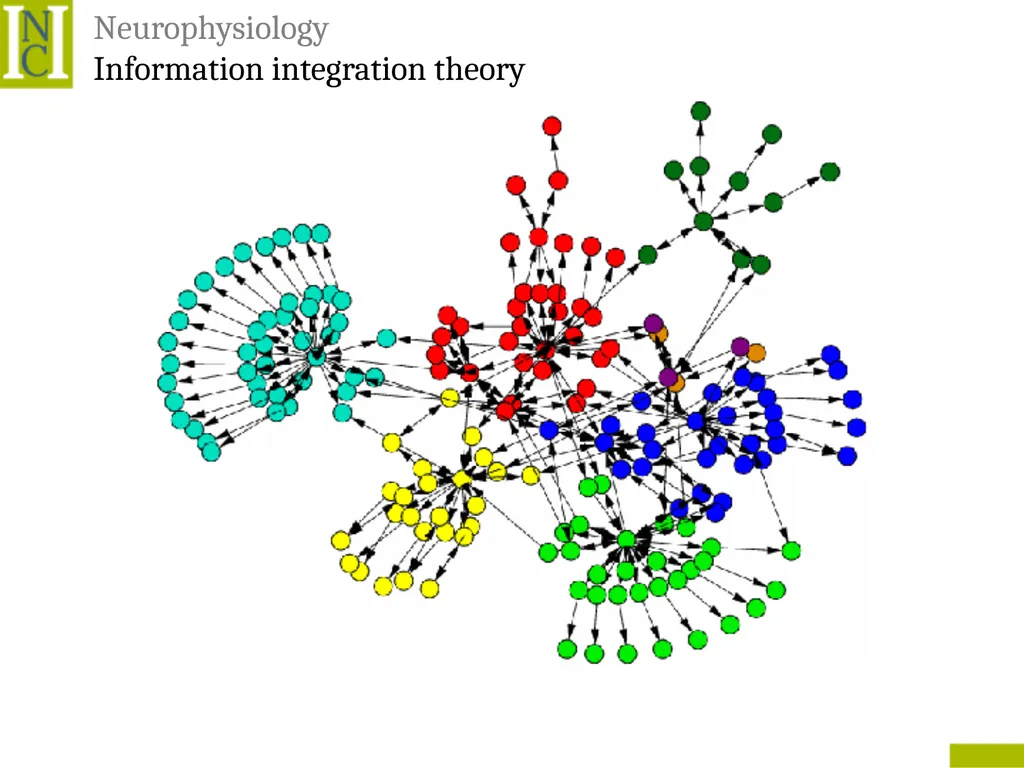
Information integration theory<br>
slide38. Neurophysiology
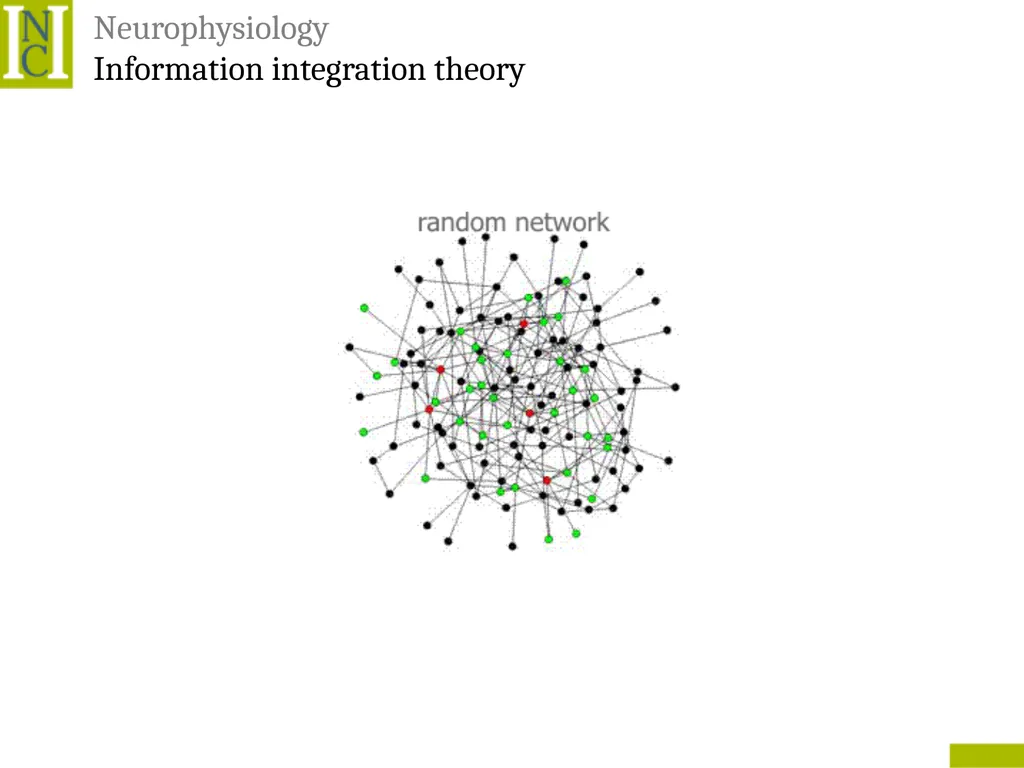
Information integration theory<br>
slide39. Neurophysiology
Information integration theory Phi (Φ) is a possible measure of the ability of a system to integrate information.
It has yet to be properly validated.
Giulio (December 2008). "Consciousness as integrated information: a provisional manifesto". The Biological Bulletin 215 (3): 216–242.<br>
slide40. Consciousness and language Sapir-Whorf hypothesis: the qualities of your language affect the qualities of your thoughts.
“The great Eskimo vocabulary hoax”
Pinker’s point of view: thoughts are not expressed just in language, but in propositions and more abstract structures.
There are linguistic details (cadence, assonance, timbre) which are language-specific; however “The fact that you can translate shows that there’s something other than words.” [Pinker]
Do we want to say that beings without language are less conscious?<br>
slide41. Artificial consciousness What needs to be done to produce human-like consciousness in an artificial system?
This depends on the size of the structures important for consciousness; how far down the levels of abstraction they go.<br>
slide42. Artificial consciousness Nation
Group
Person
Brain area
Neuron
Intracellular structure
Molecule
Atom
Quark
Gluon
Strings
?<br>
slide43. Artificial consciousness
Can we tell the difference? Well, obviously a computer does not look like a biological organism.
Suppose we set up an environment where this is not obvious.<br>
slide44. Artificial consciousness
The Imitation Game (Otherwise known as the Turing test.)
Hides the “obvious factors” behind a communication interface.
But all details cannot be hidden: imagine for example a machine that can multiply 7897958 by 676562 in under a second. All you have to do to defeat it is to ask that question.<br>
slide45. Artificial consciousness
Identity of indiscernibles Objects or entities which have all their properties in common, must be the same.
(Leibniz)<br>
slide46. Artificial consciousness
The Chinese Room A person sits in a room; he receives cards through a slot, writes new cards according to a set of rules laid out in a binder, and replies with other cards.
From the outside (if one waits a very long time), it appears that he understand Chinese. However, from his point of view, he does not.
Searle sees this as an incontrovertible demonstration that machines cannot truly understand and think.
Searle, John R. "Minds, brains, and programs." Behavioral and brain sciences 3.03 (1980): 417-424.<br>
slide47. Artificial consciousness
The Chinese Room However, there are problems:
The occupant of the room would have to modify the rules as he went along; they would have to contain instructions for this, too.
Otherwise, a simple test of memory (“what was the last question I asked you?”) would defeat the Room.
If this was done, the identity of indiscernibles (provided we speed the Room up) indicates the Room does understand Chinese.<br>
slide48. Discredited theories Roger Penrose: consciousness depends on nanotubes and quantum effects below the level of the neuron
Quantum effects have proved useful to birds for sensing magnetic fields, but have not been shown to help with information processing.
Holonomic brain theory (Karl Pribram): memories are stored in the form of a hologram (information is distributed and replicated).
Penrose, Roger. The emperor's new mind: concerning computers, minds, and the laws of physics. Oxford University Press, 1999.<br>
slide49. An eventual solution One of three things must happen.
We will never solve the problem of consciousness; our minds are not up to the task. The debate will continue.
“Consciousness” will go the way of phrenology – it will become an outdated metaphor. It may still be useful as a social tool, but science will realise it is misguided.
We will find a precise mapping between what we call consciousness, and obserable structures in the brain – perhaps yet to be discovered.<br>
slide50. Free will Another amorphous and difficult concept.
Intricately related to consciousness.
The idea that you make decisions.
You: the conscious self
Decision: a situation in which you can imagine several possible routes and may only take one of them.<br>
slide51. Free will Free will is related to simulation and agency.
Simulation: imagining different outcomes
Agency: deciding to take one path<br>
slide52. Free will Could we tell the difference between the illusion of free will, and free will itself?<br>
slide2. Consciousness
A hard problem?<br>
slide3. Consciousness
A hard problem? con with
scire to know
(Latin)<br>
slide4. Philosophical positions
Dualism and monism<br>
slide5. Philosophical positions
Aside: materialism and physicalism Materialism vs. physicalism:
in contemporary thought, often interchangeable.
Materialism is a very old term; physicalism was introduced in the 1930s.
There is still debate about whether there is an exact correspondence.
Neurath, O, 1931, ‘Physicalism: The Philosophy of the Vienna Circle’ in R.S. Cohen, and M. Neurath (eds.), Philosophical Papers 1913–1946, Dordrecht: D. Reidel Publishing Company, 1983, pp. 48–51.<br>
slide6. Philosophical positions
Realism Realism concerns itself with the relationship between percepts and the things which cause them.
Naive realism: we percieve things directly, as they really are
Indirect realism: we perceive a transformed version of reality
The contrast between naive and indirect realism is in a way orthogonal from the dualism/monism contrast:
our decision about dualism/monism does not afect our decision about direct/indirect realism.<br>
slide7. Consciousness
Many meanings What can be conscious/unconscious?
A life-form, animal or person
A life-form, animal or person at a particular time
Consciousness is a label for creatures, and a state they can be in at a particular time.<br>
slide8. Consciousness
Conscious experience The process of awareness of things going on in the world around you
and of things happening in your own mind.<br>
slide9. Consciousness
Consciousness as a zone Things may enter our consciousness or, if unconscious, remain outside our consciousness.
Consciousness can be seen as a zone in which thoughts, or at least brain events, may take place.<br>
slide10. Consciousness
Consciousness as an inner life We usually assume that conscious beings have some kind of inner life: private thoughts or feelings which are separate from external behaviours.
The inner life is made up of qualia, which are ineffable.<br>
slide11. Consciousness
The components of consciousness Awareness
The knowledge that something is happening or that a fact is true
Introspection
The ability to investigate one’s own mental state
Agency
The sensation that one’s actions have an effect on the world
Identity
The sensation that the self is a separate part of the world from the environment
Causality
The idea that an event is responsible for another event<br>
slide12. Consciousness
Conscious states Conscious states Edelman, Gerald M. "Naturalizing consciousness: a theoretical framework." Proceedings of the National Academy of Sciences 100.9 (2003): 5520-5524.<br>
slide13. Consciousness
Conscious states Consciousness: state or process?<br>
slide14. Consciousness
Qualia What if your experience of the colour red is different from everyone else’s?
Wherever they see red, you see blue.
Would this ever be noticeable?
No.
Thomas Nagel:
When I am in a conscious mental state, there is something it is like for me to be in that state from the subjective or first-person point of view.
Nagel, T. "What is it like to be a Bat?" In Philosophical Review 83: 435-456, 1974.<br>
slide15. Consciousness
“The hard problem” We seek to link
Qualia: internal, private, subjective experience
Measurable states: brainwaves, neural connections, firing patterns, skin conductance...
The difficulty of finding a relationship between the two,
a process which can translate one to the other,
is the so-called hard problem of consciousness.
This is called the explanatory gap.
Levine, Joseph. "Materialism and qualia: The explanatory gap." Pacific philosophical quarterly 64.4 (1983): 354-361.<br>
slide16. Consciousness
“The hard problem” “The hard problem” is orthogonal to the question of exactly how consciousness is implemented. Whether the system is dualist or realist, and however it is eventually discovered to work, qualia will still feel the same.<br>
slide17. Consciousness
What do we consider conscious? Certainly: other people
Perhaps: animals
Certainly not: simple information processing devices
inanimate objects
There are no explicit divisions: consciousness is a continuum.<br>
slide18. Consciousness
Altered states of consciousness Consciousness is not just a continuum between zero and “fully conscious.”
Illness, psychoactive chemicals, brain damage, or cognitive impairment can change the nature of one’s consciousness.<br>
slide19. The seagull argument You have grown up on an island inhabited by nothing but people and seagulls.
Eventually you ask yourself, “what is flight?”
Any definition you come up with will make reference only to seagulls.
Then, for the first time, you encounter a helicopter.
According to your definition, does it fly?
There is no way of knowing.<br>
slide20. The seagull argument The same reasoning applies for intelligence (see the domain of the Turing test) and consciousness.
We build a new, powerful computer, discover an alien race or meet a chimpanzee; is it really intelligent?
Is it really conscious?<br>
slide21. Consciousness as a social label Consciousness is a useful tag for deciding how we treat other creatures.
One has great difficulty causing harm to something one considers conscious.<br>
slide22. Consciousness
Consciousness as a metaphor We often use terms related to consciousness to describe interactions with admittedly non-conscious objects:
the computer wants you to do this
the website thinks you’re not logged in
the components don’t want to fit together properly<br>
slide23. Consciousness
Descriptions We can distinguish two main ways of describing conscious experience:
To others (verbally, linguistically, behaviourally)
To ourselves (remembering past feelings; introspecting)
By definition, the second form of description can never be communicated to another person.<br>
slide24. Models
Dennett’s multiple drafts model The phi illusion:<br>
slide25. Models
Dennett’s multiple drafts model The phi illusion:<br>
slide26. Models
Dennett’s multiple drafts model Orwellian explanations:
The observer concludes one thing, then changes it later.
Stalinesque explanations:
The contradiction is resolved before entering consciousness.<br>
slide27. Models
Dennett’s multiple drafts model Cartesian materialism: the view that there is a hard boundary to the zone of consciousness, aka the Cartesian theatre.
The multiple drafts model rejects the Cartesian Theatre.
The world provides us with a variety of sensory inputs, which can be interpreted in different ways. These may happen in parallel or at different speeds.
Percepts do not instantaneously arrive in the mind in their full richness.<br>
slide28. Models
Dennett’s three stances Physical stance: mass, energy, trajectories, atoms, molecules, materials.
Design stance: purpose, function, design.
Intentional stance: belief, volition, intent, thinking, knowing.<br>
slide29. Models
Global workspace theory Many brain processes have already been well-studied and described:
attention
memory
perception
adaptation
Global workspace theory imagines that consciousness is a global resource which connects these processes together.<br>
slide30. Models
Global workspace theory Is this not the Cartesian theatre?
Baars maintains that it isn’t, because
there’s no viewer
it’s not spatially localised in the brain<br>
slide31. Neurophysiology
Consciousness as an integrator Consciousness seems to be the place where, or process by means of which, information from different senses and different brain processes is integrated and bound into a unified whole.<br>
slide32. Neurophysiology
Neural correlates of consciousness A complex-sounding term, but really just a bridge over the explanatory gap.
Crick F. and Koch C. (1990) Towards a neurobiological theory of consciousness. Seminars in Neuroscience Vol2, 263–275.<br>
slide33. Neurophysiology
Consciousness as an integrator The claustrum may play this role.<br>
slide34. Neurophysiology
Consciousness and brainwaves<br>
slide35. Neurophysiology
REM sleep Dreaming is not full consciousness – but it is close. It is often difficult to distinguish between the two; lucid dreaming is a state with elements of both dreaming and wakefulness.
Dreaming is reliably indicated by rapid eye movement.<br>
slide36. Neurophysiology
Coma or vegetative state Brain activity, detected through MRI or EEG, may show a response to heard language despite the absence of a behavioural response.<br>
slide37. Neurophysiology
Information integration theory<br>
slide38. Neurophysiology
Information integration theory<br>
slide39. Neurophysiology
Information integration theory Phi (Φ) is a possible measure of the ability of a system to integrate information.
It has yet to be properly validated.
Giulio (December 2008). "Consciousness as integrated information: a provisional manifesto". The Biological Bulletin 215 (3): 216–242.<br>
slide40. Consciousness and language Sapir-Whorf hypothesis: the qualities of your language affect the qualities of your thoughts.
“The great Eskimo vocabulary hoax”
Pinker’s point of view: thoughts are not expressed just in language, but in propositions and more abstract structures.
There are linguistic details (cadence, assonance, timbre) which are language-specific; however “The fact that you can translate shows that there’s something other than words.” [Pinker]
Do we want to say that beings without language are less conscious?<br>
slide41. Artificial consciousness What needs to be done to produce human-like consciousness in an artificial system?
This depends on the size of the structures important for consciousness; how far down the levels of abstraction they go.<br>
slide42. Artificial consciousness Nation
Group
Person
Brain area
Neuron
Intracellular structure
Molecule
Atom
Quark
Gluon
Strings
?<br>
slide43. Artificial consciousness
Can we tell the difference? Well, obviously a computer does not look like a biological organism.
Suppose we set up an environment where this is not obvious.<br>
slide44. Artificial consciousness
The Imitation Game (Otherwise known as the Turing test.)
Hides the “obvious factors” behind a communication interface.
But all details cannot be hidden: imagine for example a machine that can multiply 7897958 by 676562 in under a second. All you have to do to defeat it is to ask that question.<br>
slide45. Artificial consciousness
Identity of indiscernibles Objects or entities which have all their properties in common, must be the same.
(Leibniz)<br>
slide46. Artificial consciousness
The Chinese Room A person sits in a room; he receives cards through a slot, writes new cards according to a set of rules laid out in a binder, and replies with other cards.
From the outside (if one waits a very long time), it appears that he understand Chinese. However, from his point of view, he does not.
Searle sees this as an incontrovertible demonstration that machines cannot truly understand and think.
Searle, John R. "Minds, brains, and programs." Behavioral and brain sciences 3.03 (1980): 417-424.<br>
slide47. Artificial consciousness
The Chinese Room However, there are problems:
The occupant of the room would have to modify the rules as he went along; they would have to contain instructions for this, too.
Otherwise, a simple test of memory (“what was the last question I asked you?”) would defeat the Room.
If this was done, the identity of indiscernibles (provided we speed the Room up) indicates the Room does understand Chinese.<br>
slide48. Discredited theories Roger Penrose: consciousness depends on nanotubes and quantum effects below the level of the neuron
Quantum effects have proved useful to birds for sensing magnetic fields, but have not been shown to help with information processing.
Holonomic brain theory (Karl Pribram): memories are stored in the form of a hologram (information is distributed and replicated).
Penrose, Roger. The emperor's new mind: concerning computers, minds, and the laws of physics. Oxford University Press, 1999.<br>
slide49. An eventual solution One of three things must happen.
We will never solve the problem of consciousness; our minds are not up to the task. The debate will continue.
“Consciousness” will go the way of phrenology – it will become an outdated metaphor. It may still be useful as a social tool, but science will realise it is misguided.
We will find a precise mapping between what we call consciousness, and obserable structures in the brain – perhaps yet to be discovered.<br>
slide50. Free will Another amorphous and difficult concept.
Intricately related to consciousness.
The idea that you make decisions.
You: the conscious self
Decision: a situation in which you can imagine several possible routes and may only take one of them.<br>
slide51. Free will Free will is related to simulation and agency.
Simulation: imagining different outcomes
Agency: deciding to take one path<br>
slide52. Free will Could we tell the difference between the illusion of free will, and free will itself?<br>