
Lecture 7 : Web Search & Mining (2) 楊立偉教授 台灣科大資管系
Description: Lecture 7 : Web Search Mining (2) 楊立偉教授 台灣科大資管系 wyangntu.edu.tw 本投影片修改自Introduction to Information Retrieval一書之投影片 Ch 20 21 1 More topics Ads and search engine optimization Web capture and spider Link analysis Duplicate detection 2 Ads
Related Topics
Download Presentation
"Lecture 7 : Web Search & Mining (2) 楊立偉教授 台灣科大資管系" is the property of its rightful owner. Permission is granted to download and print the materials on this website for personal, non-commercial use only, and to display it on your personal computer provided you do not modify the materials and that you retain all copyright notices contained in the materials. By downloading content from our website, you accept the terms of this agreement.
Presentation Transcript
slide1. Lecture 7 : Web Search & Mining (2) 楊立偉教授
台灣科大資管系
wyang@ntu.edu.tw
本投影片修改自Introduction to Information Retrieval一書之投影片 Ch 20 & 21 1<br>
slide2. More topics Ads and search engine optimization
Web capture and spider
Link analysis
Duplicate detection 2<br>
slide3. Ads and
search engine optimization (SEO) 3<br>
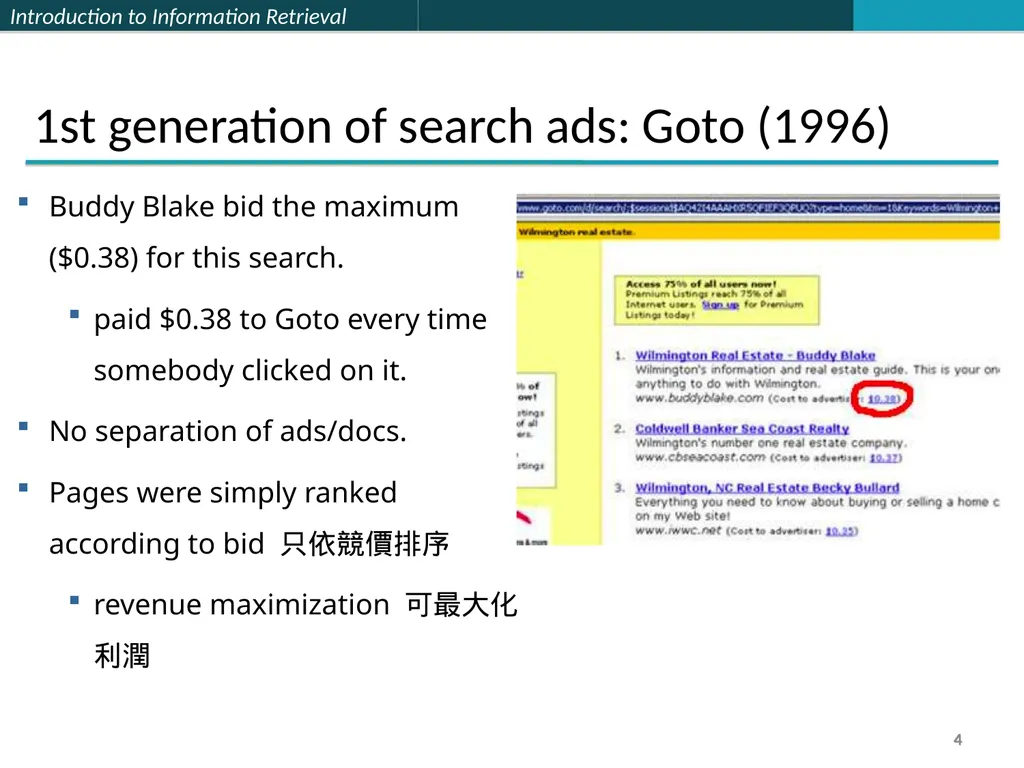
slide4. 4 1st generation of search ads: Goto (1996) 4 Buddy Blake bid the maximum ($0.38) for this search.
paid $0.38 to Goto every time somebody clicked on it.
No separation of ads/docs.
Pages were simply ranked according to bid 只依競價排序
revenue maximization 可最大化利潤<br>
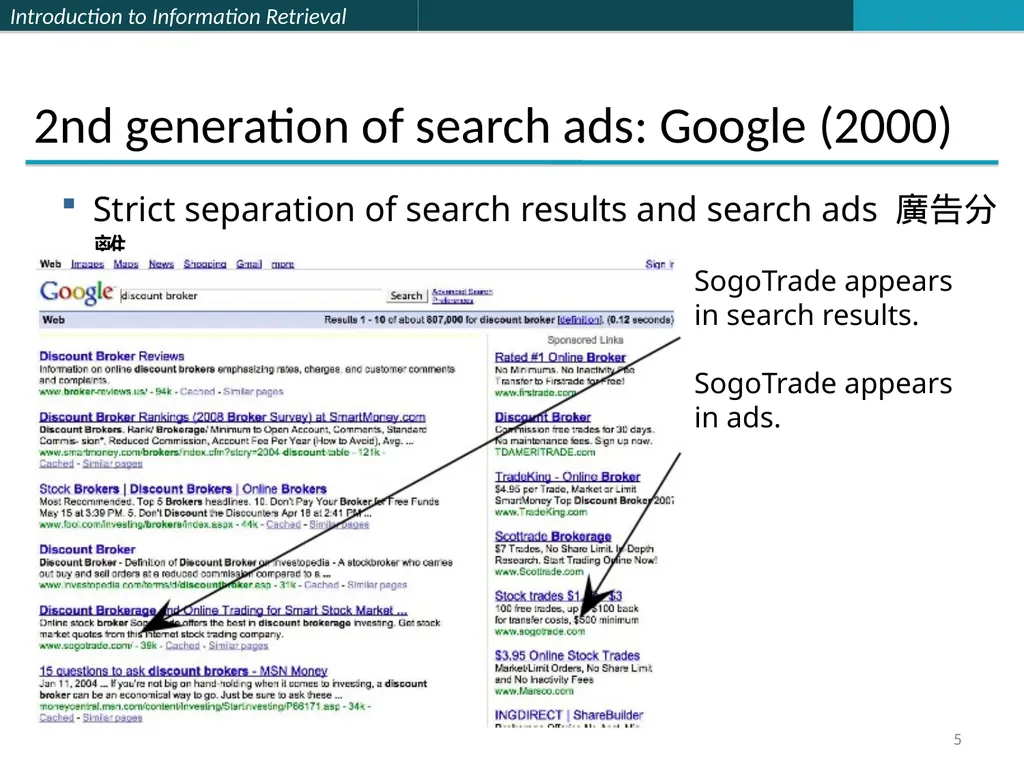
slide5. 2nd generation of search ads: Google (2000) 5 Strict separation of search results and search ads 廣告分離 SogoTrade appears
in search results.
SogoTrade appears
in ads.<br>
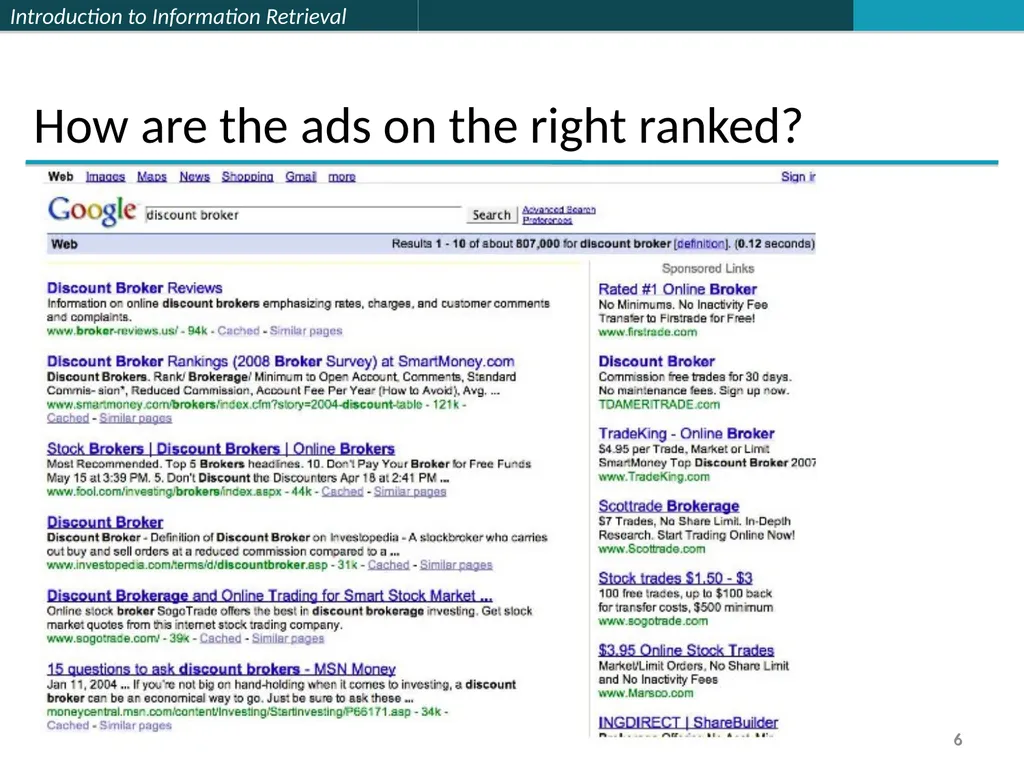
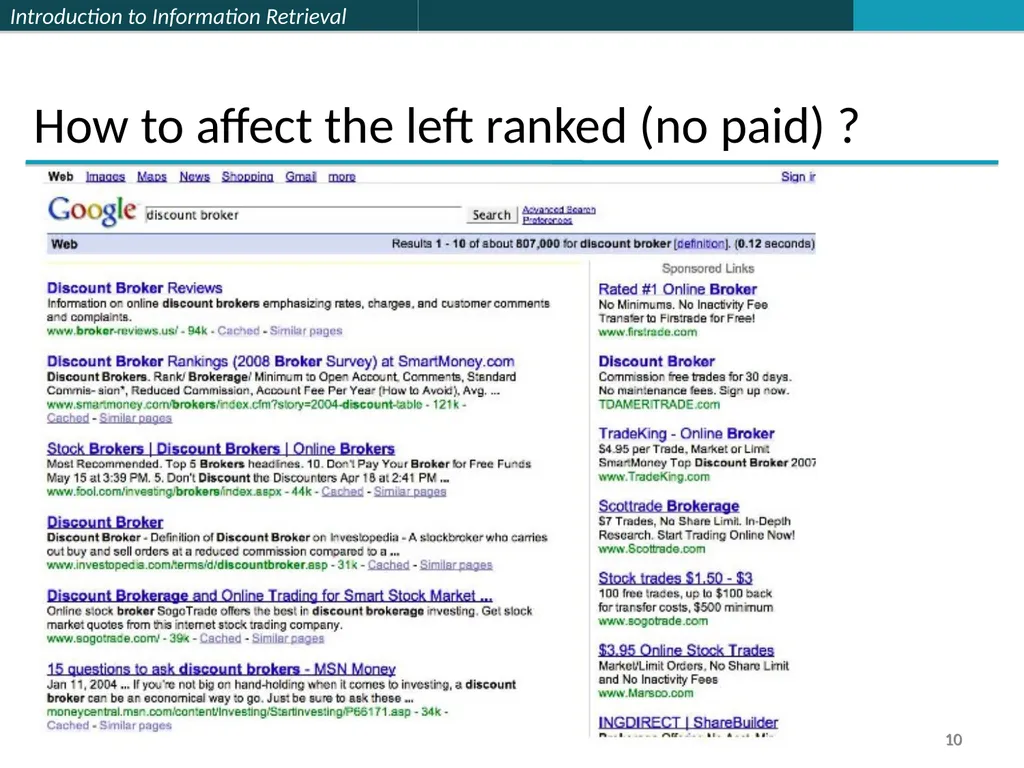
slide6. 6 How are the ads on the right ranked? 6<br>
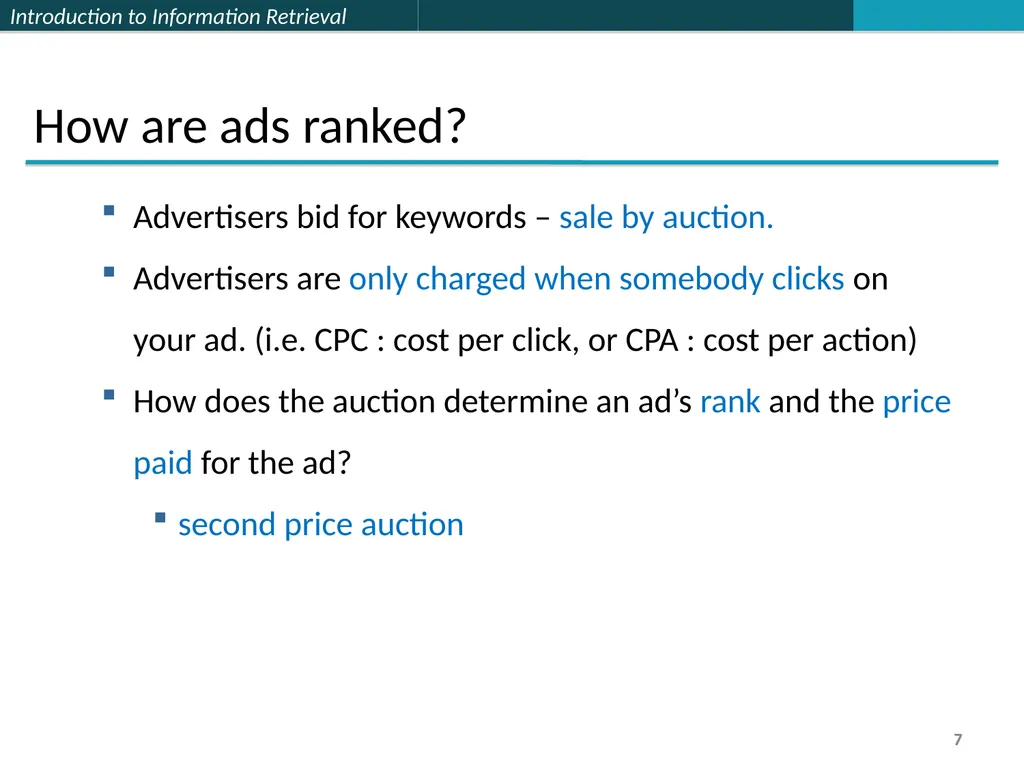
slide7. 7 How are ads ranked? Advertisers bid for keywords – sale by auction.
Advertisers are only charged when somebody clicks on your ad. (i.e. CPC : cost per click, or CPA : cost per action)
How does the auction determine an ad’s rank and the price paid for the ad?
second price auction 7<br>
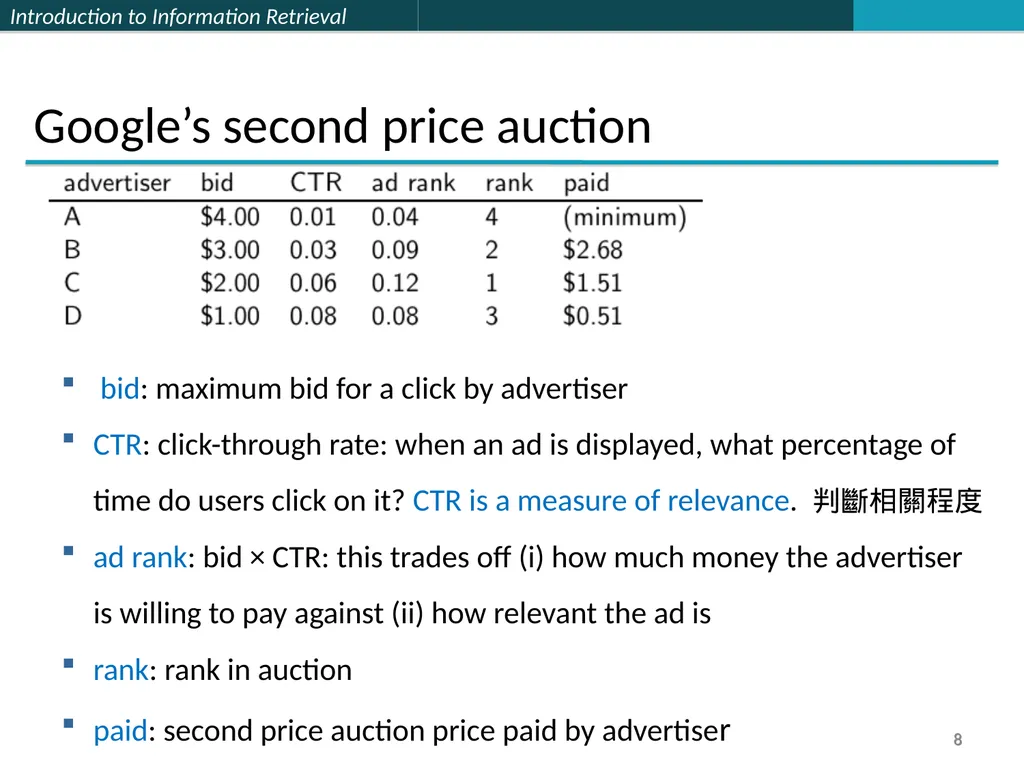
slide8. 8 Google’s second price auction bid: maximum bid for a click by advertiser
CTR: click-through rate: when an ad is displayed, what percentage of time do users click on it? CTR is a measure of relevance. 判斷相關程度
ad rank: bid × CTR: this trades off (i) how much money the advertiser is willing to pay against (ii) how relevant the ad is
rank: rank in auction
paid: second price auction price paid by advertiser 8<br>
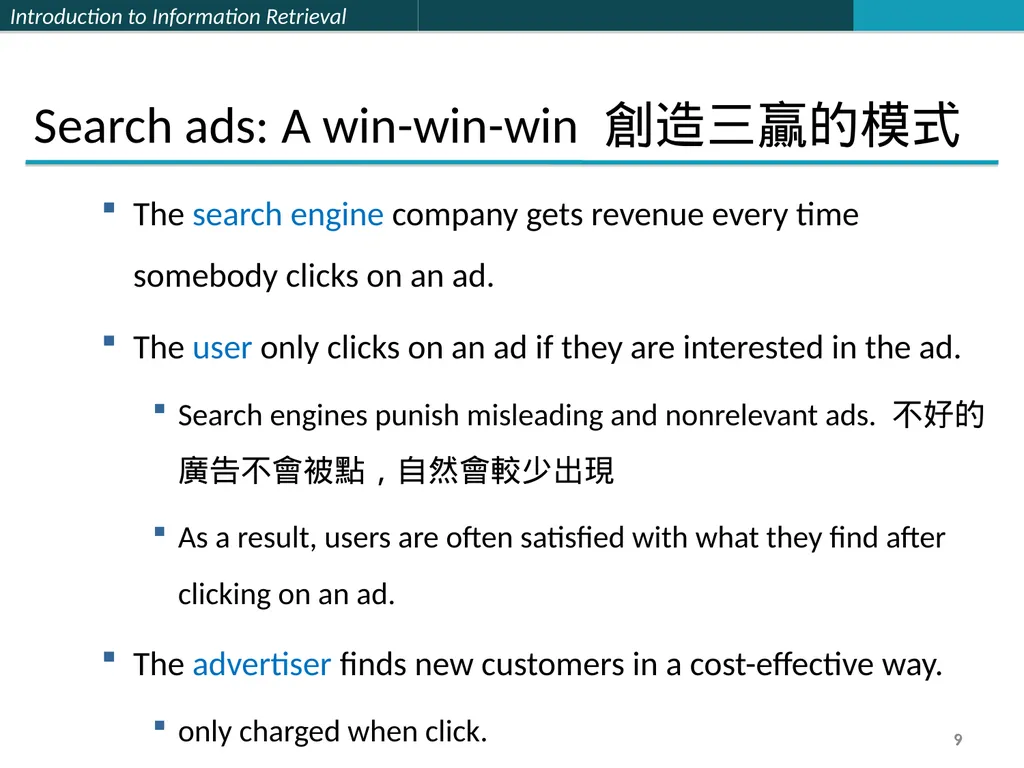
slide9. 9 Search ads: A win-win-win 創造三贏的模式 The search engine company gets revenue every time somebody clicks on an ad.
The user only clicks on an ad if they are interested in the ad.
Search engines punish misleading and nonrelevant ads. 不好的廣告不會被點,自然會較少出現
As a result, users are often satisfied with what they find after clicking on an ad.
The advertiser finds new customers in a cost-effective way.
only charged when click. 9<br>
slide10. 10 How to affect the left ranked (no paid) ? 10<br>
slide11. 11 Search Engine Optimization (SEO) The alternative to paid ads.
Search Engine Optimization:
"Tuning" your web page to rank highly in the search results for select keywords 提高搜尋排名
Alternative to paying for placement 卻不用付錢
Thus, is a marketing function
Performed by companies and consultants (“Search engine optimizers”) for their clients
Some perfectly legitimate, some very shady 黑帽 / 白帽<br>
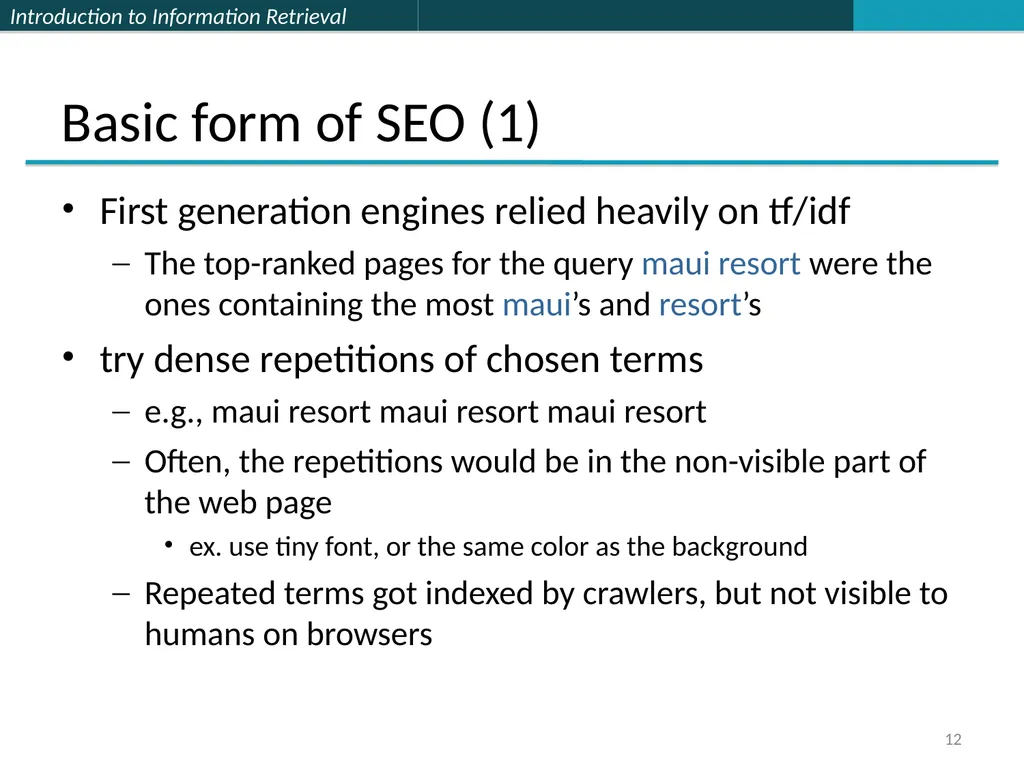
slide12. Basic form of SEO (1) First generation engines relied heavily on tf/idf
The top-ranked pages for the query maui resort were the ones containing the most maui’s and resort’s
try dense repetitions of chosen terms
e.g., maui resort maui resort maui resort
Often, the repetitions would be in the non-visible part of the web page
ex. use tiny font, or the same color as the background
Repeated terms got indexed by crawlers, but not visible to humans on browsers 12<br>
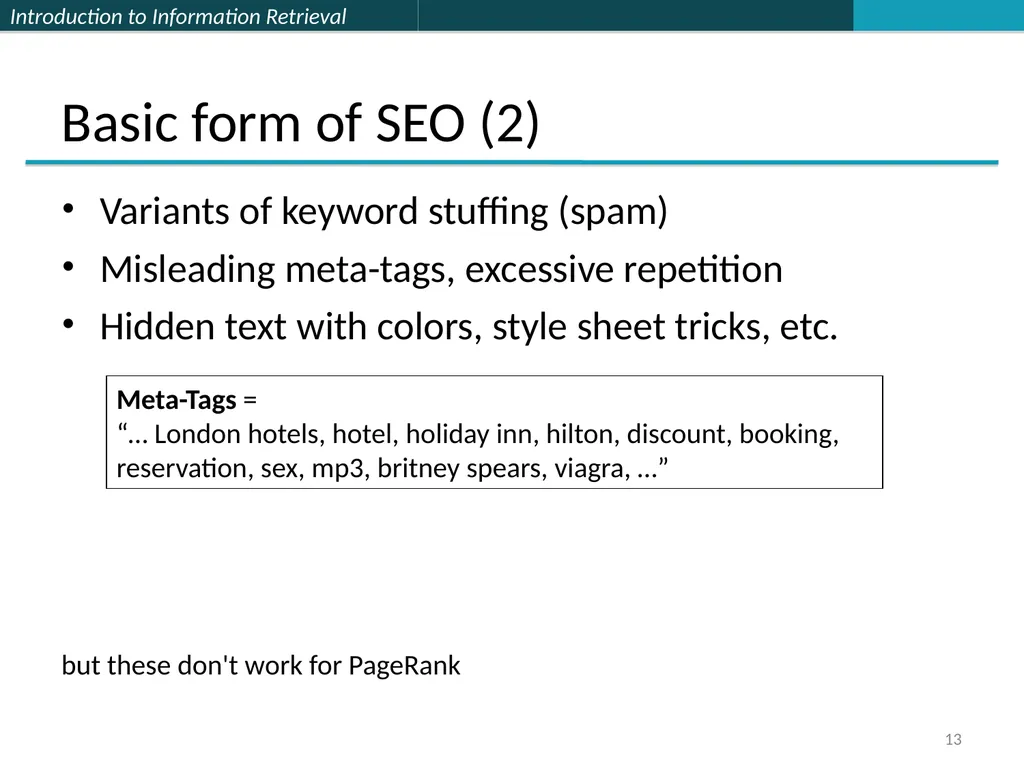
slide13. Basic form of SEO (2) Variants of keyword stuffing (spam)
Misleading meta-tags, excessive repetition
Hidden text with colors, style sheet tricks, etc.
but these don't work for PageRank 13 Meta-Tags =
“… London hotels, hotel, holiday inn, hilton, discount, booking, reservation, sex, mp3, britney spears, viagra, …”<br>
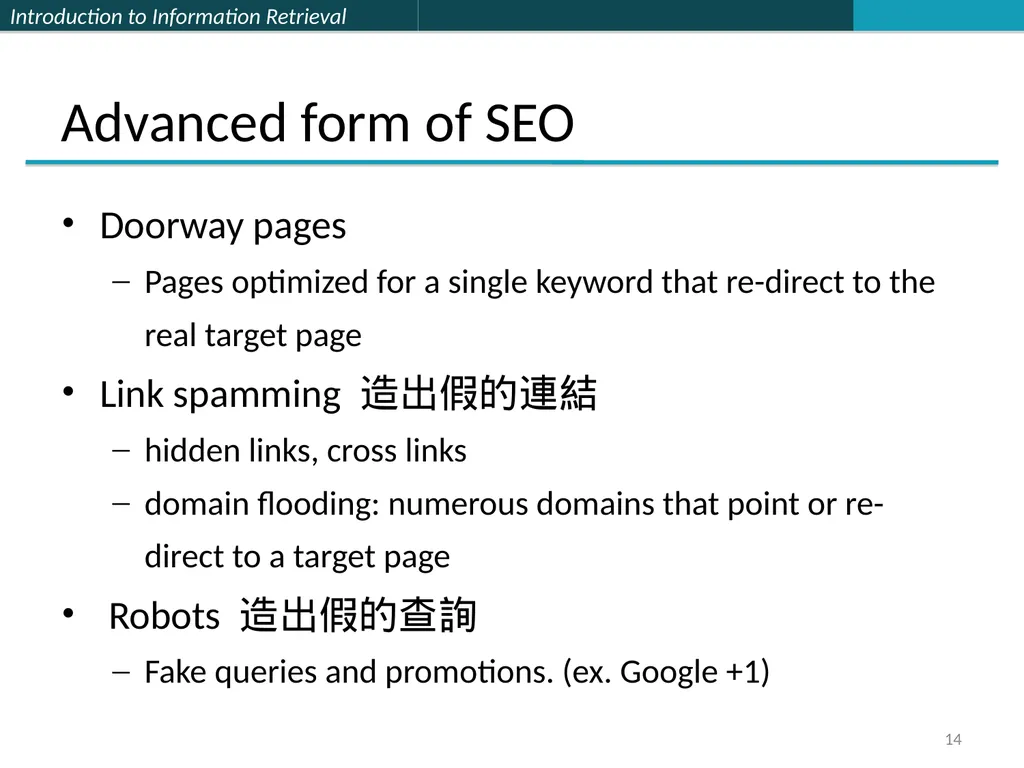
slide14. Advanced form of SEO Doorway pages
Pages optimized for a single keyword that re-direct to the real target page
Link spamming 造出假的連結
hidden links, cross links
domain flooding: numerous domains that point or re-direct to a target page
Robots 造出假的查詢
Fake queries and promotions. (ex. Google +1) 14<br>
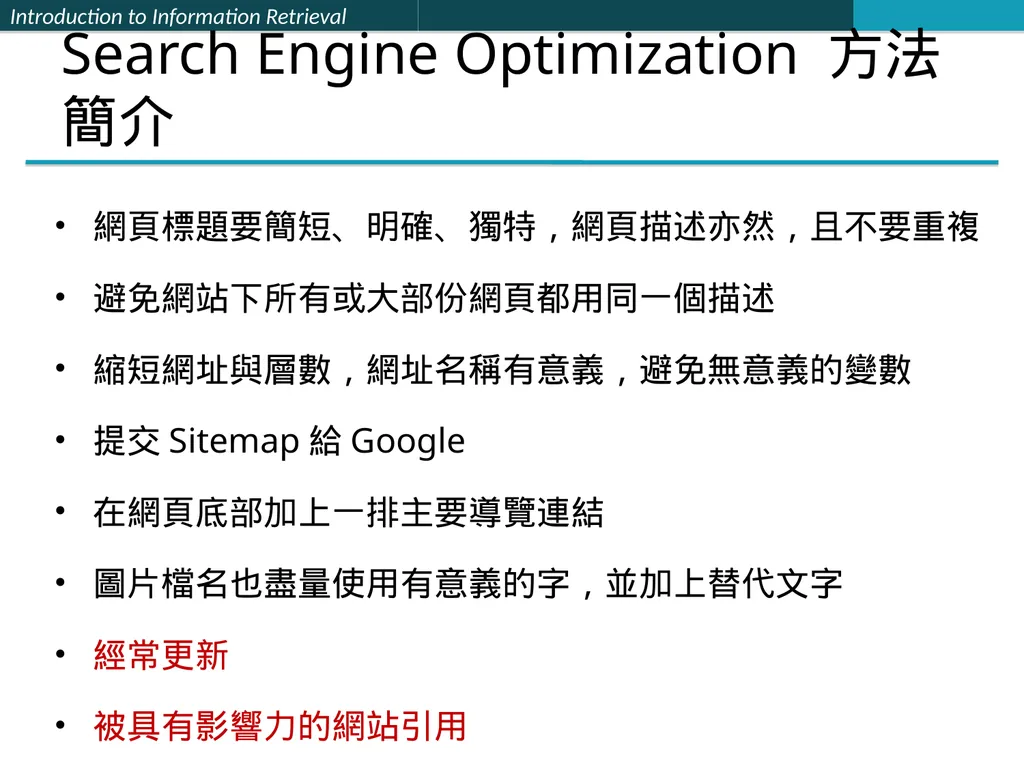
slide15. Search Engine Optimization 方法簡介 網頁標題要簡短、明確、獨特,網頁描述亦然,且不要重複
避免網站下所有或大部份網頁都用同一個描述
縮短網址與層數,網址名稱有意義,避免無意義的變數
提交Sitemap給Google
在網頁底部加上一排主要導覽連結
圖片檔名也盡量使用有意義的字,並加上替代文字
經常更新
被具有影響力的網站引用<br>
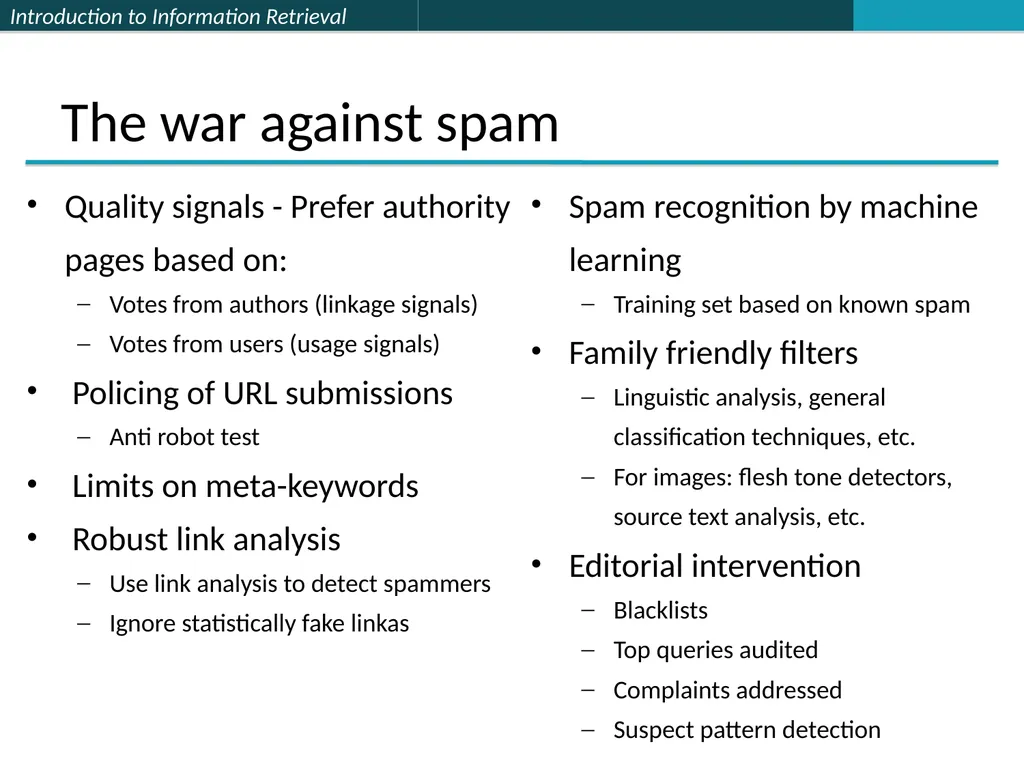
slide16. The war against spam Quality signals - Prefer authority pages based on:
Votes from authors (linkage signals)
Votes from users (usage signals)
Policing of URL submissions
Anti robot test
Limits on meta-keywords
Robust link analysis
Use link analysis to detect spammers
Ignore statistically fake linkas Spam recognition by machine learning
Training set based on known spam
Family friendly filters
Linguistic analysis, general classification techniques, etc.
For images: flesh tone detectors, source text analysis, etc.
Editorial intervention
Blacklists
Top queries audited
Complaints addressed
Suspect pattern detection<br>
slide17. Web capture and spider 17<br>
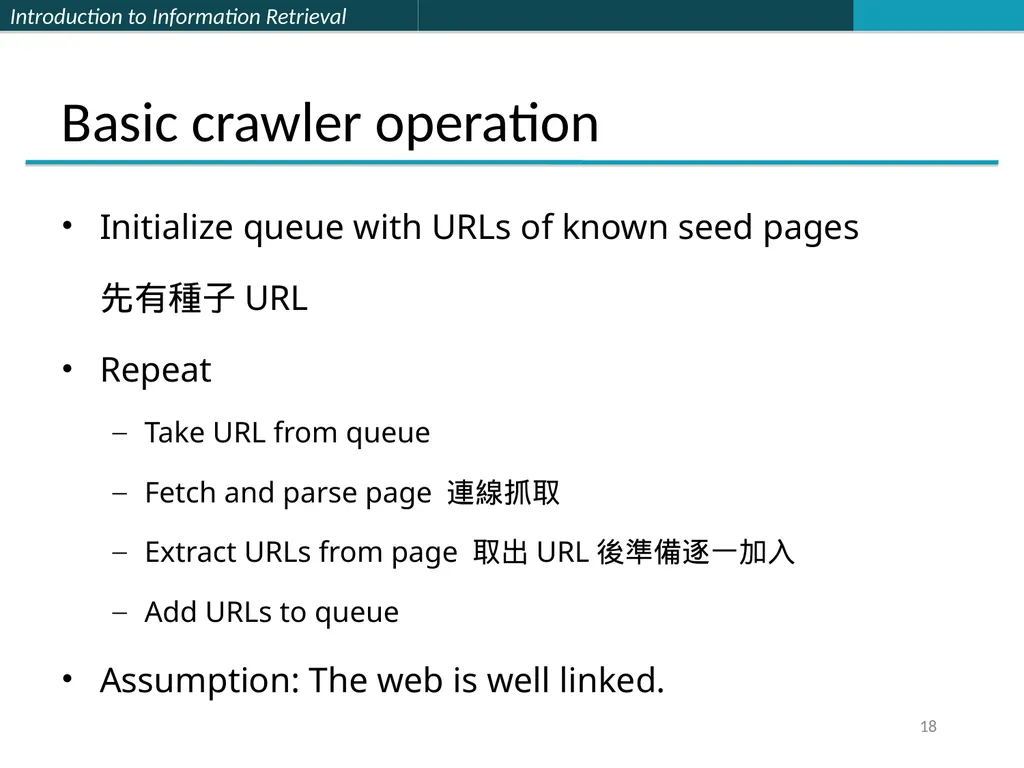
slide18. 18 Basic crawler operation Initialize queue with URLs of known seed pages
先有種子URL
Repeat
Take URL from queue
Fetch and parse page 連線抓取
Extract URLs from page 取出URL後準備逐一加入
Add URLs to queue
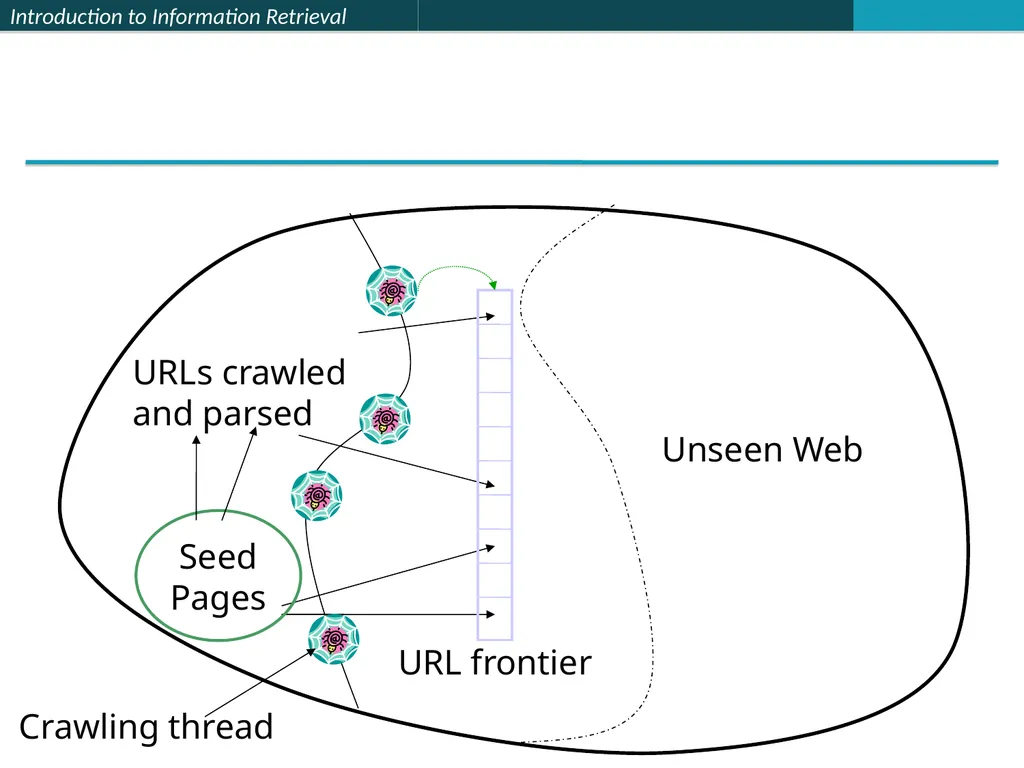
Assumption: The web is well linked.<br>
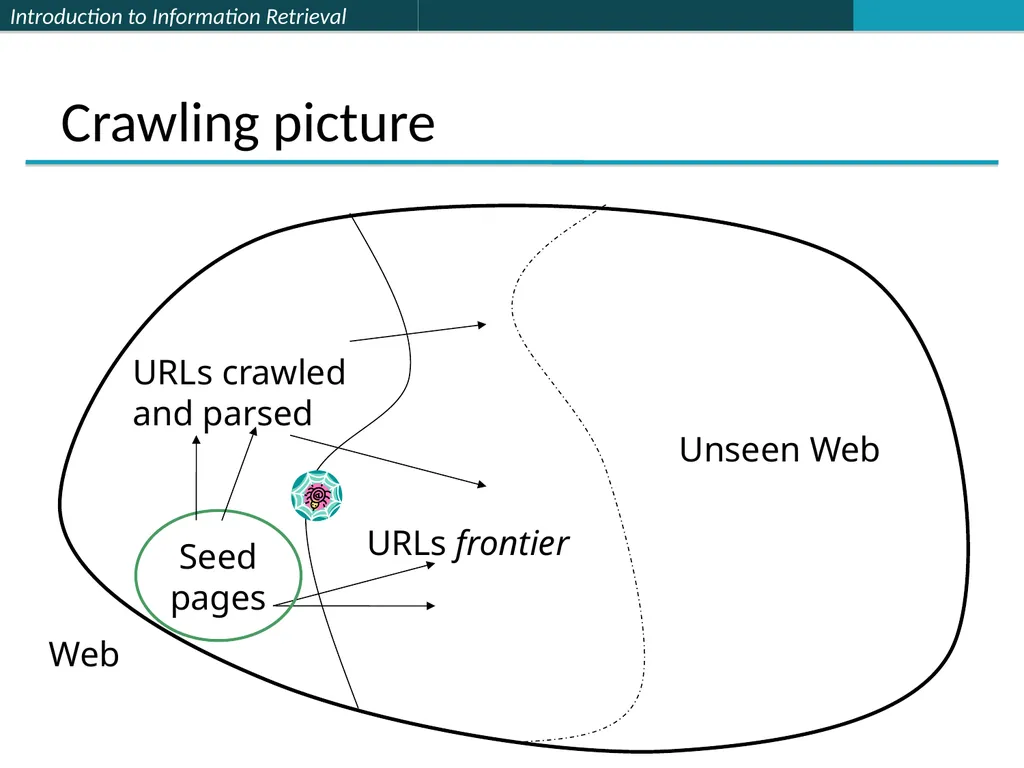
slide19. Crawling picture Unseen Web Seed
pages<br>
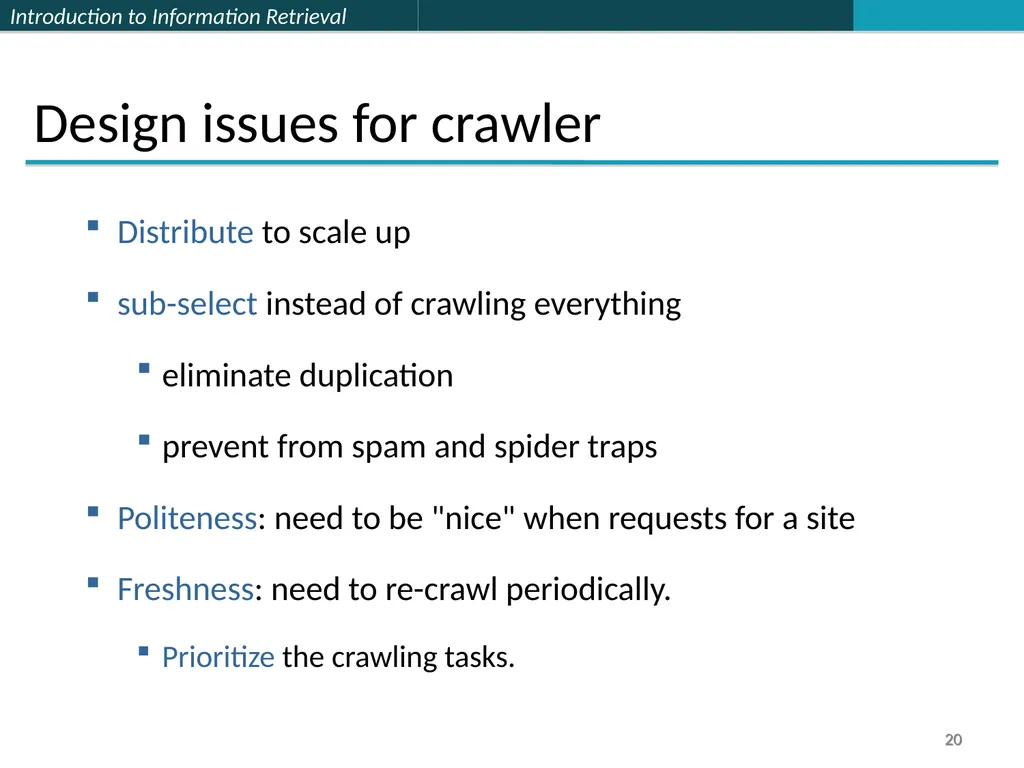
slide20. 20 Design issues for crawler Distribute to scale up
sub-select instead of crawling everything
eliminate duplication
prevent from spam and spider traps
Politeness: need to be "nice" when requests for a site
Freshness: need to re-crawl periodically.
Prioritize the crawling tasks. 20<br>
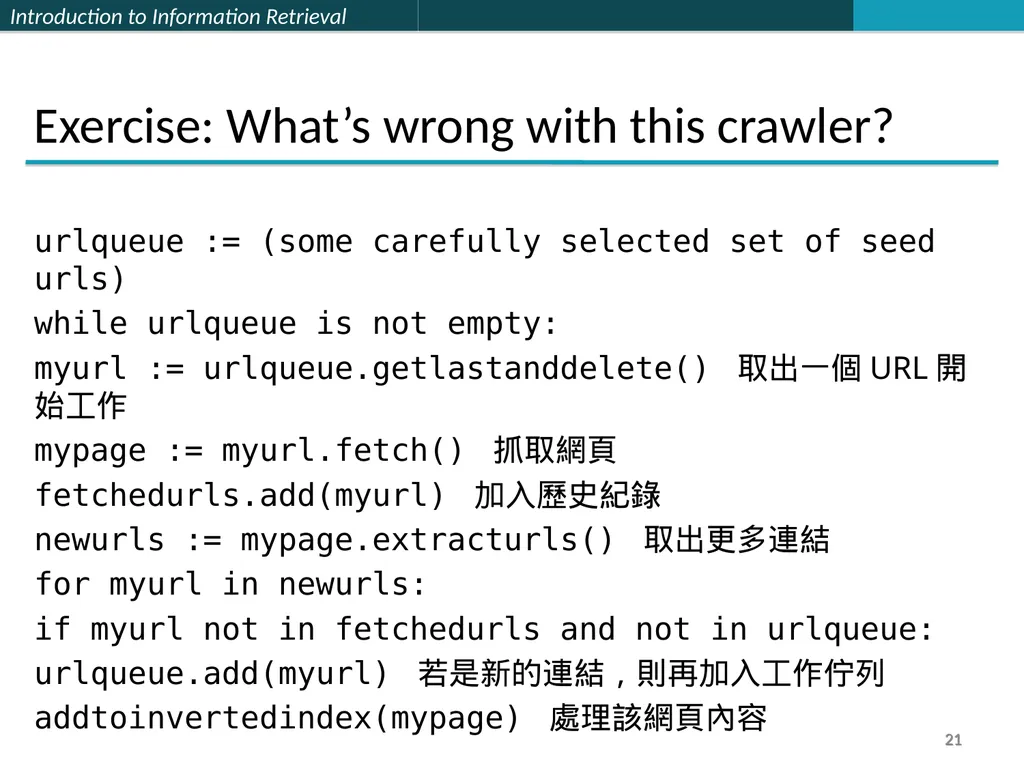
slide21. 21 Exercise: What’s wrong with this crawler? urlqueue := (some carefully selected set of seed urls)
while urlqueue is not empty:
myurl := urlqueue.getlastanddelete() 取出一個URL開始工作
mypage := myurl.fetch() 抓取網頁
fetchedurls.add(myurl) 加入歷史紀錄
newurls := mypage.extracturls() 取出更多連結
for myurl in newurls:
if myurl not in fetchedurls and not in urlqueue:
urlqueue.add(myurl) 若是新的連結,則再加入工作佇列
addtoinvertedindex(mypage) 處理該網頁內容 21<br>
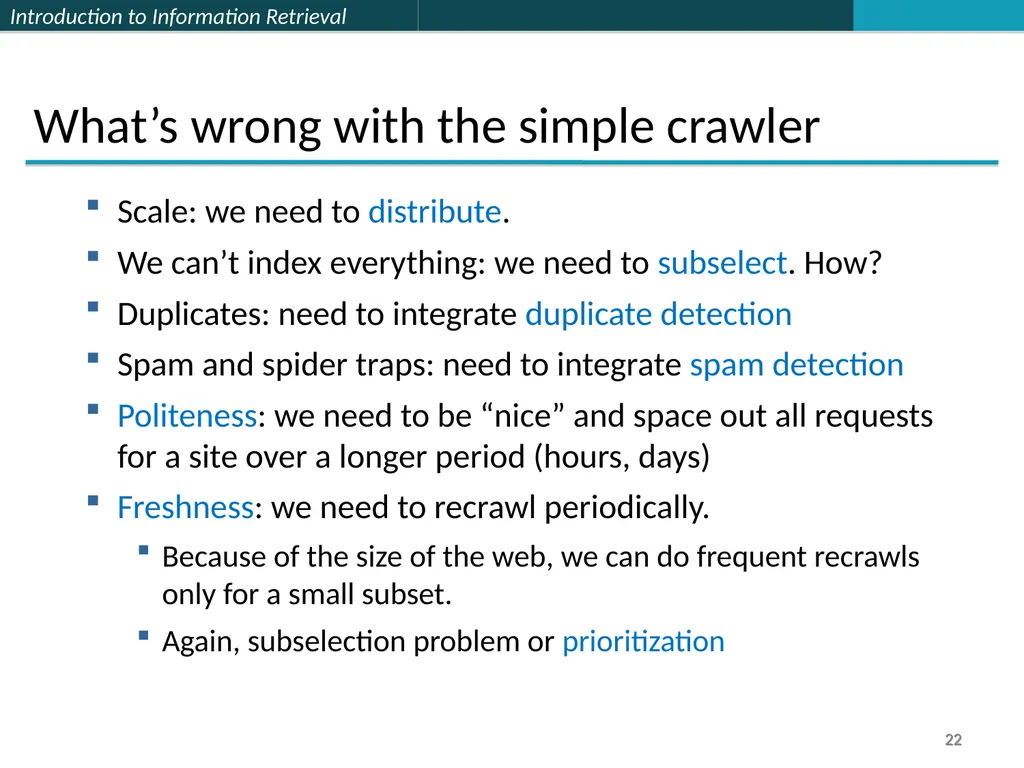
slide22. 22 What’s wrong with the simple crawler Scale: we need to distribute.
We can’t index everything: we need to subselect. How?
Duplicates: need to integrate duplicate detection
Spam and spider traps: need to integrate spam detection
Politeness: we need to be “nice” and space out all requests for a site over a longer period (hours, days)
Freshness: we need to recrawl periodically.
Because of the size of the web, we can do frequent recrawls only for a small subset.
Again, subselection problem or prioritization 22<br>
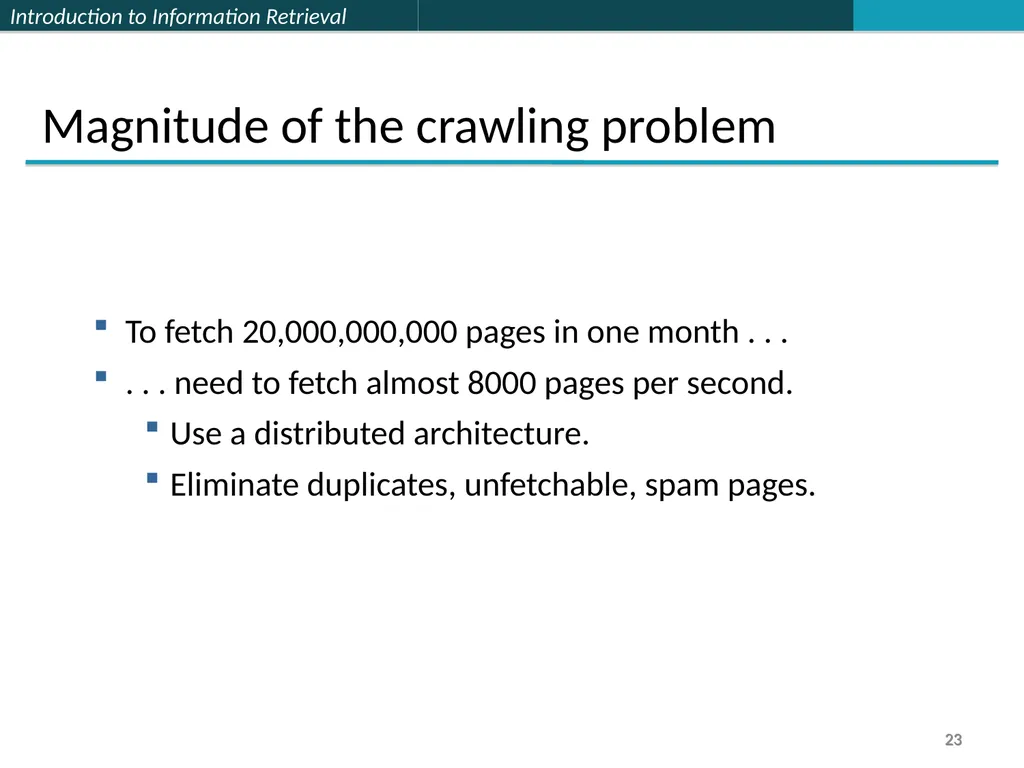
slide23. 23 Magnitude of the crawling problem To fetch 20,000,000,000 pages in one month . . .
. . . need to fetch almost 8000 pages per second.
Use a distributed architecture.
Eliminate duplicates, unfetchable, spam pages. 23<br>
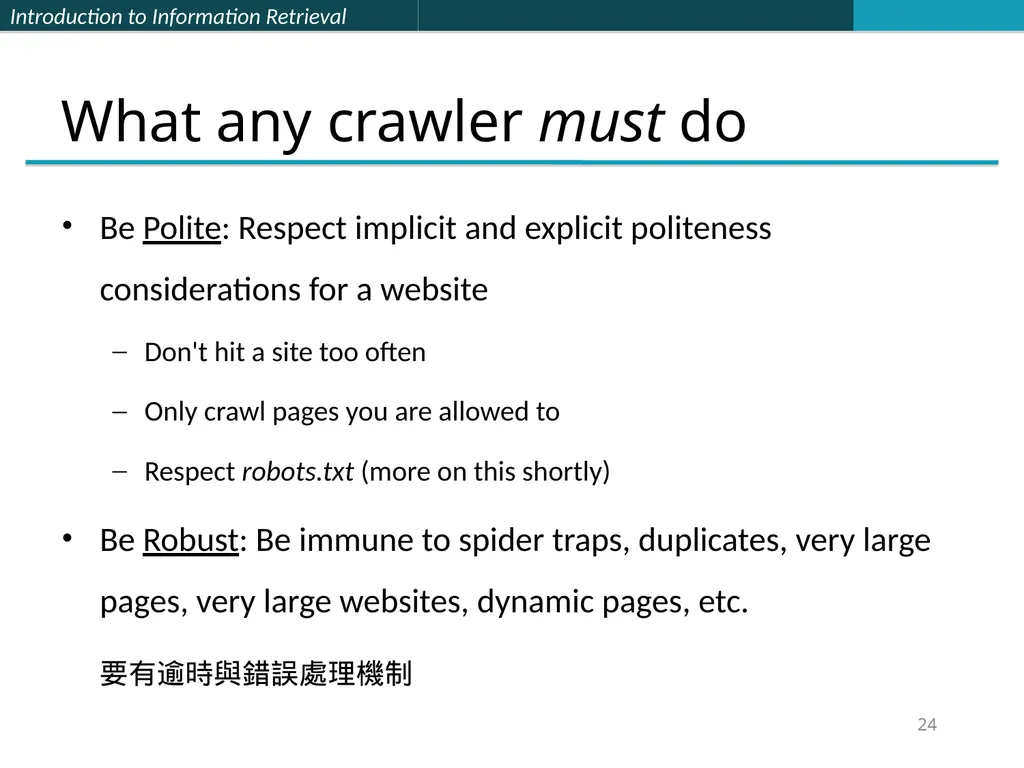
slide24. 24 What any crawler must do Be Polite: Respect implicit and explicit politeness considerations for a website
Don't hit a site too often
Only crawl pages you are allowed to
Respect robots.txt (more on this shortly)
Be Robust: Be immune to spider traps, duplicates, very large pages, very large websites, dynamic pages, etc.
要有逾時與錯誤處理機制<br>
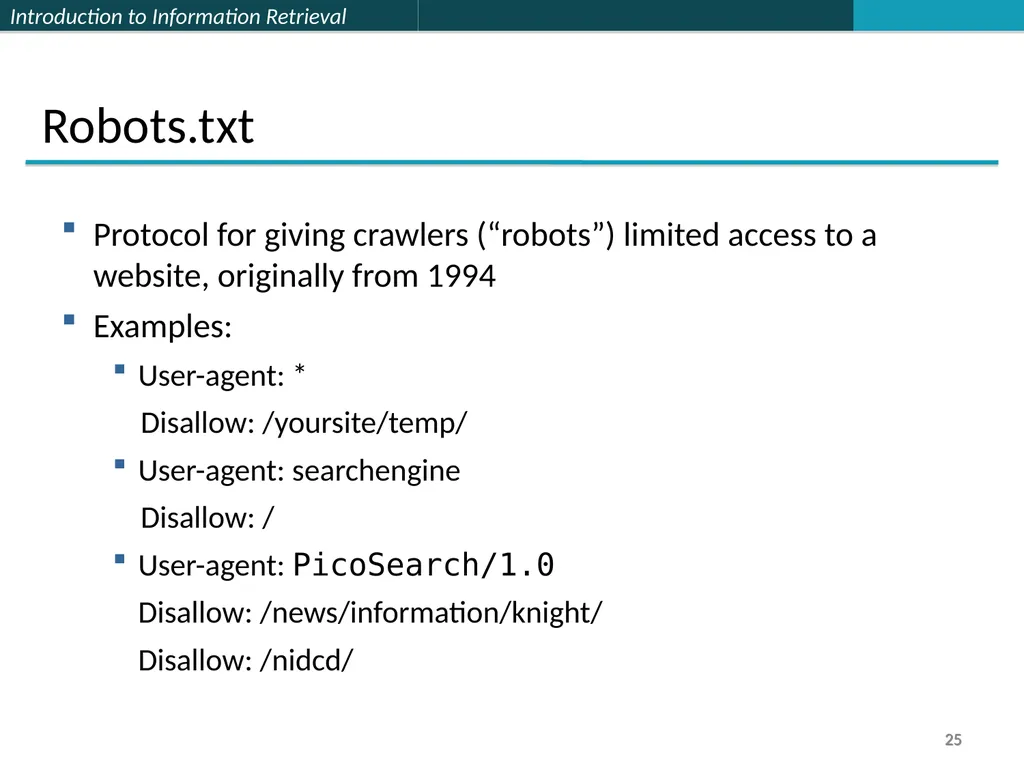
slide25. 25 Robots.txt Protocol for giving crawlers (“robots”) limited access to a website, originally from 1994
Examples:
User-agent: *
Disallow: /yoursite/temp/
User-agent: searchengine
Disallow: /
User-agent: PicoSearch/1.0
Disallow: /news/information/knight/
Disallow: /nidcd/ 25<br>
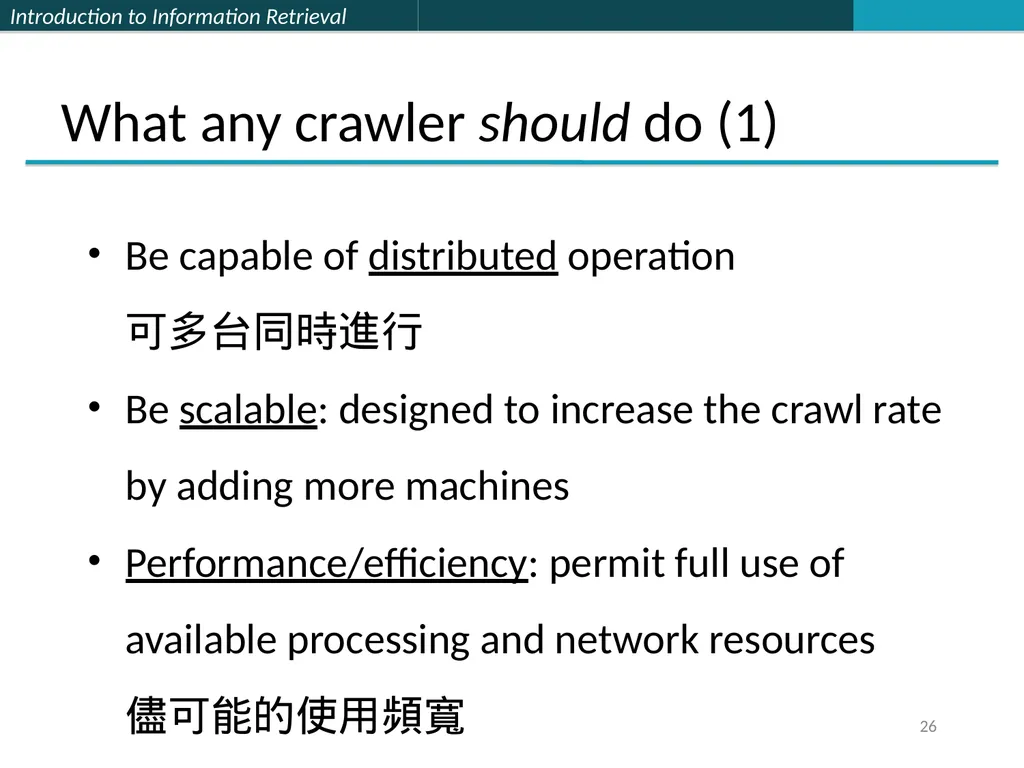
slide26. 26 What any crawler should do (1) Be capable of distributed operation
可多台同時進行
Be scalable: designed to increase the crawl rate by adding more machines
Performance/efficiency: permit full use of available processing and network resources
儘可能的使用頻寬<br>
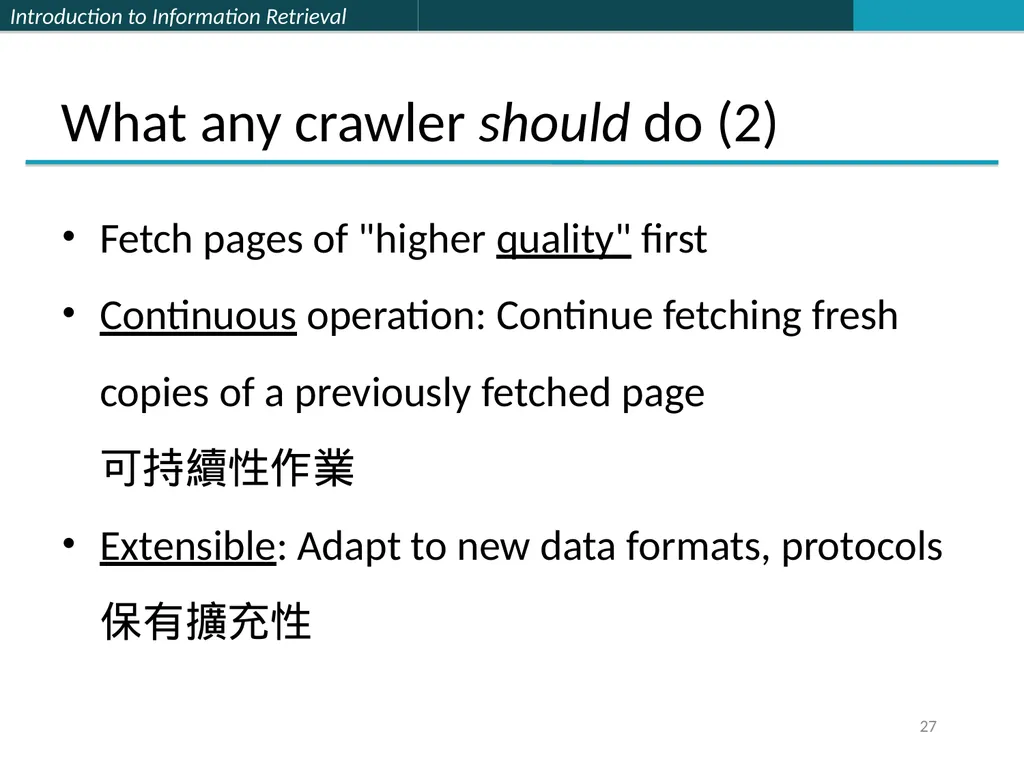
slide27. 27 What any crawler should do (2) Fetch pages of "higher quality" first
Continuous operation: Continue fetching fresh copies of a previously fetched page
可持續性作業
Extensible: Adapt to new data formats, protocols 保有擴充性<br>
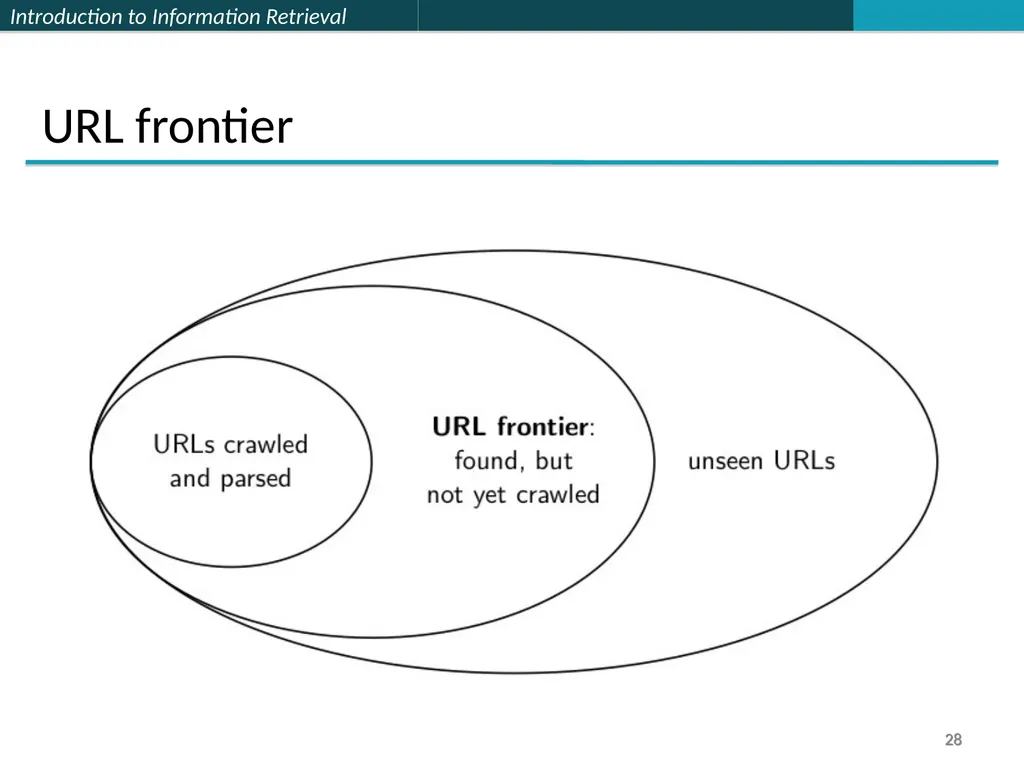
slide28. 28 URL frontier 28<br>
slide29. Unseen Web Seed
Pages URL frontier Crawling thread<br>
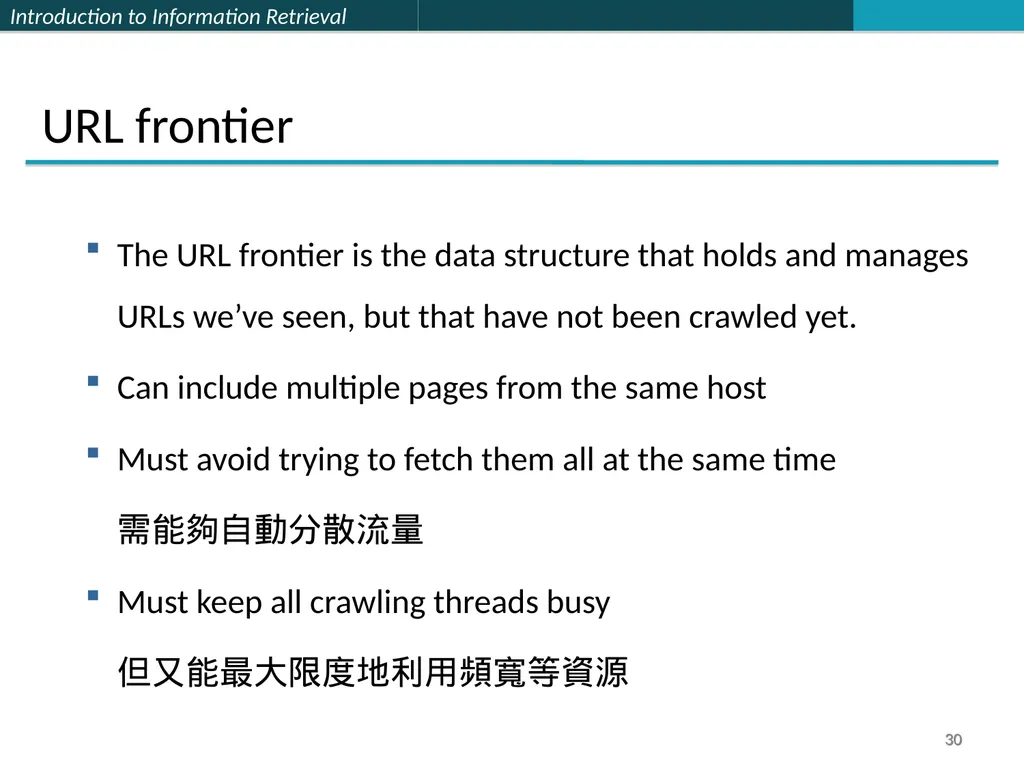
slide30. 30 URL frontier The URL frontier is the data structure that holds and manages URLs we’ve seen, but that have not been crawled yet.
Can include multiple pages from the same host
Must avoid trying to fetch them all at the same time
需能夠自動分散流量
Must keep all crawling threads busy
但又能最大限度地利用頻寬等資源 30<br>
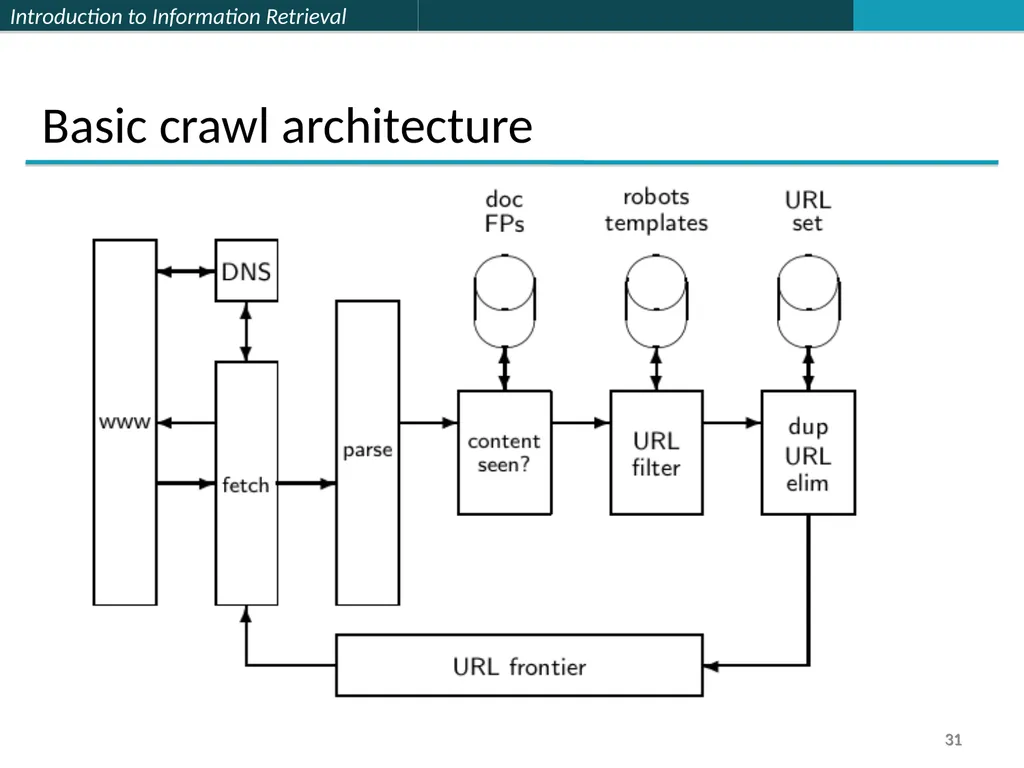
slide31. 31 Basic crawl architecture 31<br>
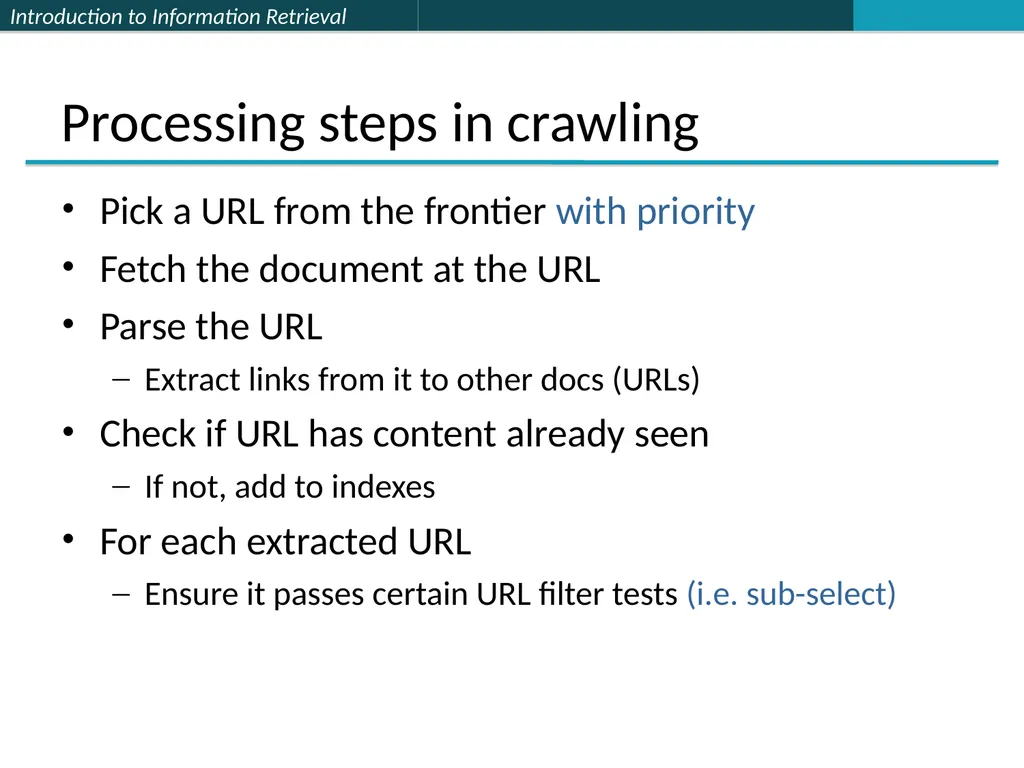
slide32. Processing steps in crawling Pick a URL from the frontier with priority
Fetch the document at the URL
Parse the URL
Extract links from it to other docs (URLs)
Check if URL has content already seen
If not, add to indexes
For each extracted URL
Ensure it passes certain URL filter tests (i.e. sub-select)<br>
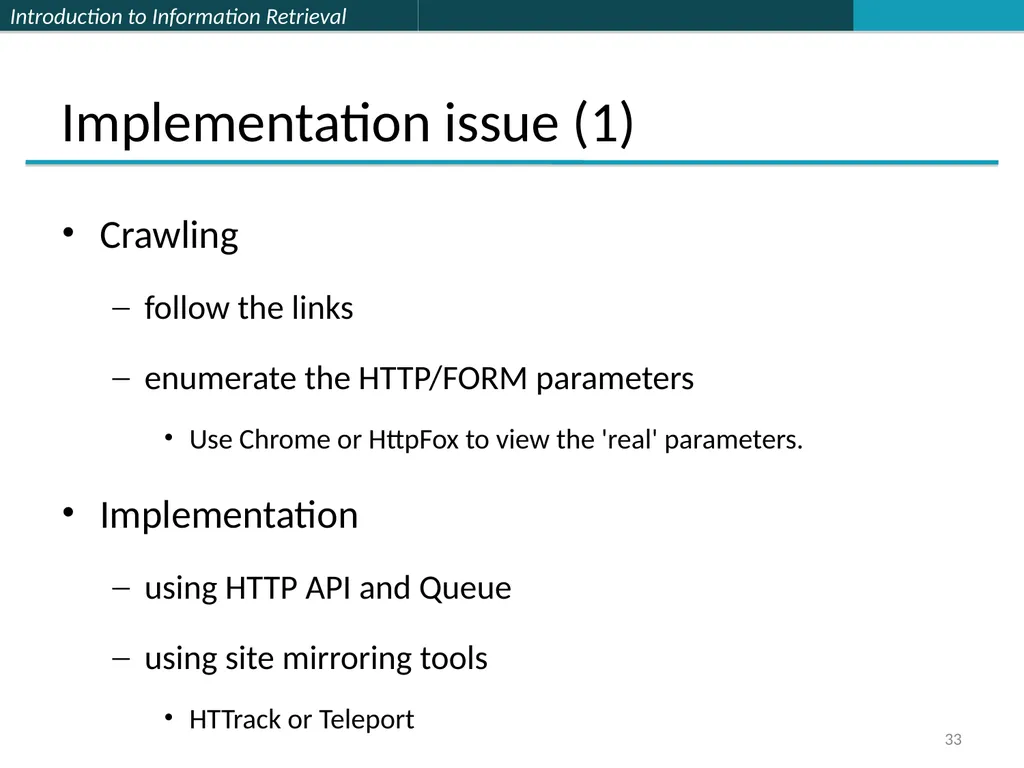
slide33. Implementation issue (1) Crawling
follow the links
enumerate the HTTP/FORM parameters
Use Chrome or HttpFox to view the 'real' parameters.
Implementation
using HTTP API and Queue
using site mirroring tools
HTTrack or Teleport 33<br>
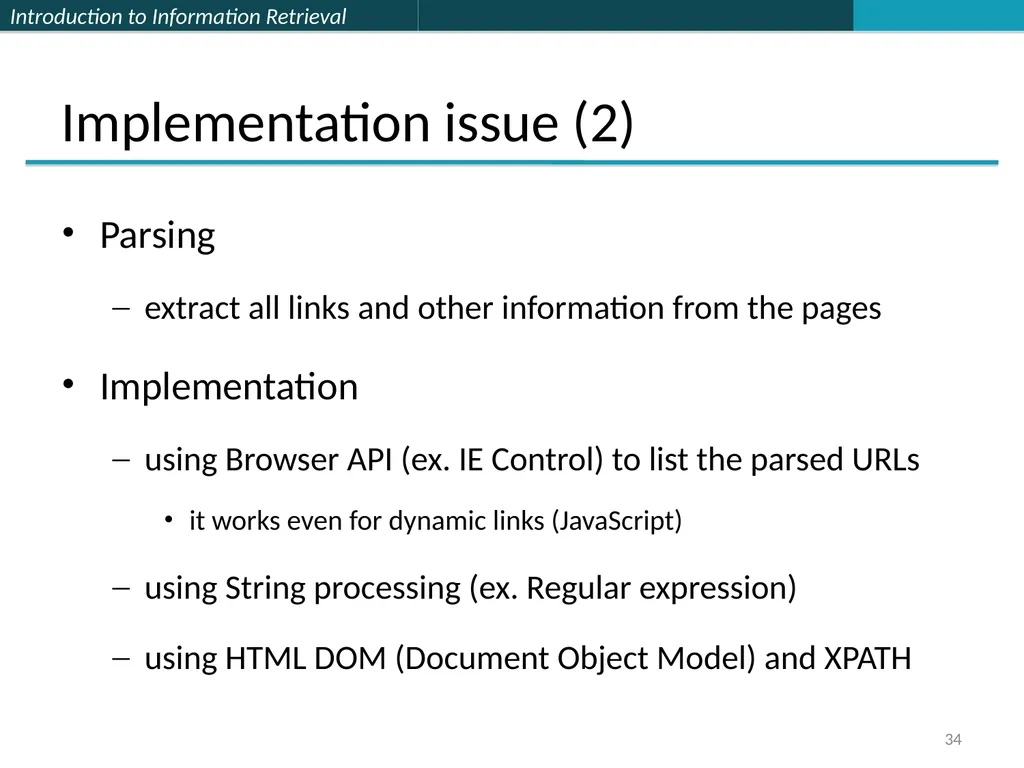
slide34. Implementation issue (2) Parsing
extract all links and other information from the pages
Implementation
using Browser API (ex. IE Control) to list the parsed URLs
it works even for dynamic links (JavaScript)
using String processing (ex. Regular expression)
using HTML DOM (Document Object Model) and XPATH 34<br>
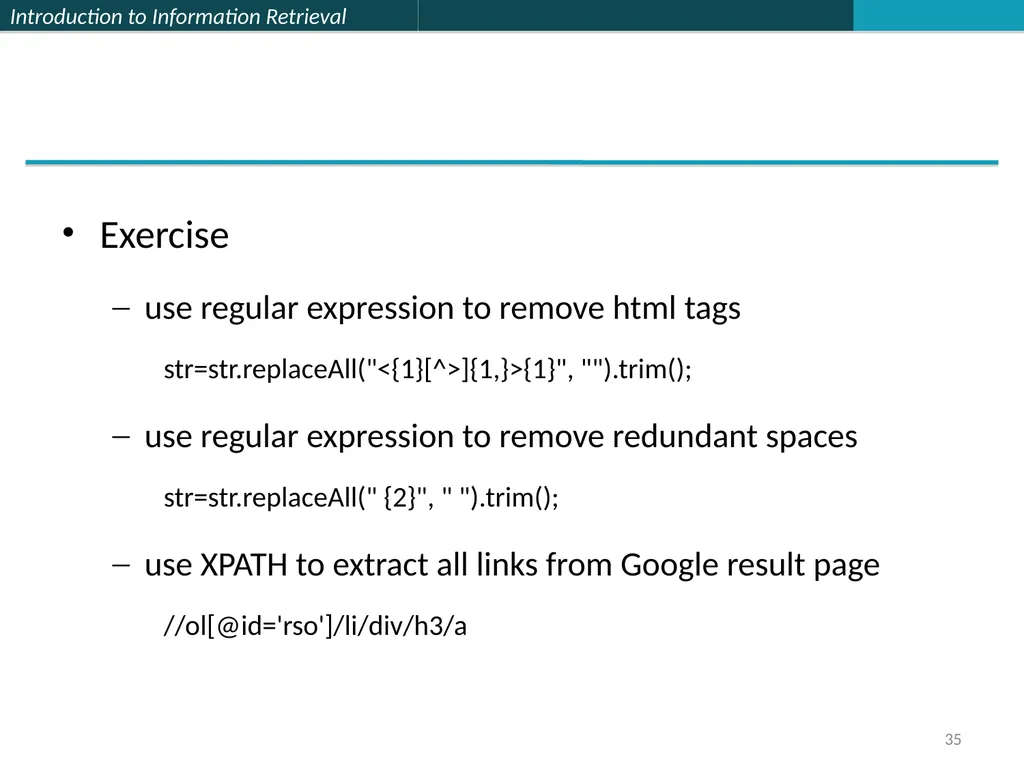
slide35. Exercise
use regular expression to remove html tags
str=str.replaceAll("<{1}[^>]{1,}>{1}", "").trim();
use regular expression to remove redundant spaces
str=str.replaceAll(" {2}", " ").trim();
use XPATH to extract all links from Google result page
//ol[@id='rso']/li/div/h3/a 35<br>
slide36. 36 URL normalization Some URLs extracted from a document are relative URLs.
E.g., at http://mit.edu, we may have aboutsite.html
This is the same as: http://mit.edu/aboutsite.html
During parsing, we must normalize (expand) all relative URLs. 36<br>
slide37. 37 Distributing the crawler Run multiple crawl threads, potentially at different nodes
Usually geographically distributed nodes
Partition hosts being crawled into nodes 37<br>
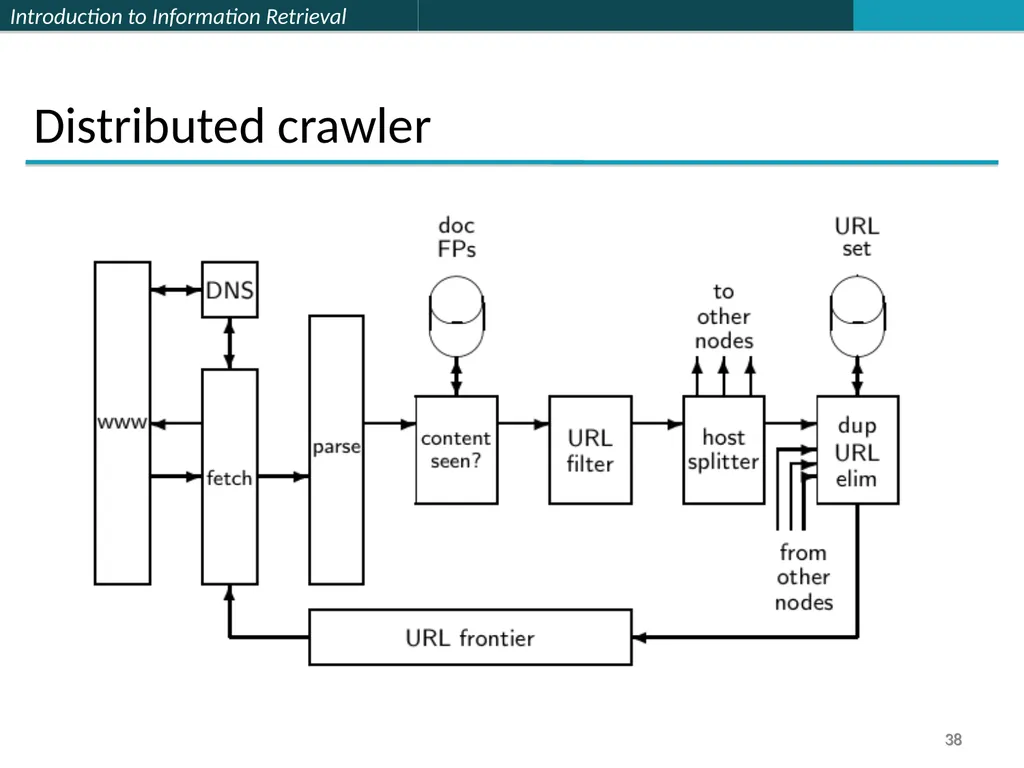
slide38. 38 Distributed crawler 38<br>
slide39. 39 URL frontier: two main considerations Politeness: do not hit a web server too frequently
Freshness: crawl some pages more often than others
pages (Ex. News sites) changes often
These goals may conflict each other.
Tips
Insert time gap between successive requests to a host
shuffle the traffic for hosts<br>
slide40. Duplicate detection 40<br>
slide41. 41 Duplicate detection The web is full of duplicated content.
Exact duplicates
Easy to eliminate (ex. use hash)
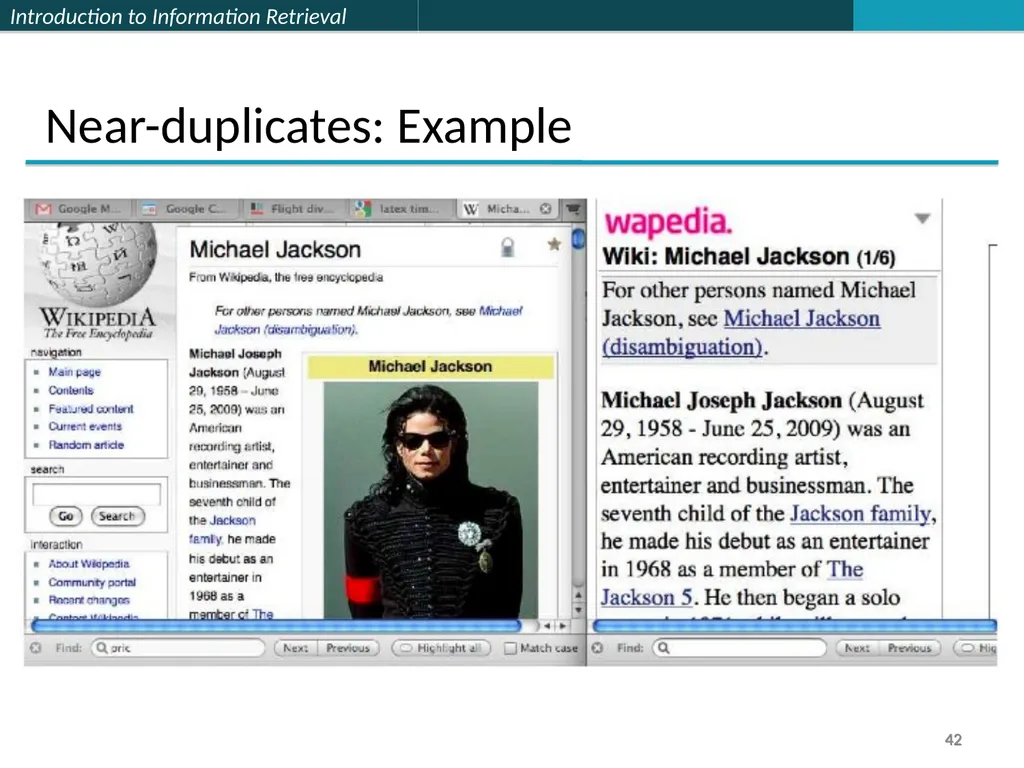
Near-duplicates
For the user, it’s annoying to get a search result with near-identical documents.
Difficult to eliminate
Marginal relevance is zero: even a highly relevant document becomes nonrelevant if it appears below a (near-)duplicate.
So need to eliminate it. 41<br>
slide42. 42 Near-duplicates: Example 42<br>
slide43. 43 Detecting near-duplicates Compute similarity with edit-distance, n-gram overlapping, or vector space model.
use “syntactic” (as opposed to semantic) similarity.
do not consider documents near-duplicates if they have the same content, but express it with different words.
Use similarity threshold θ to judge
E.g., two documents are near-duplicates if similarity > θ = 80%. 43<br>
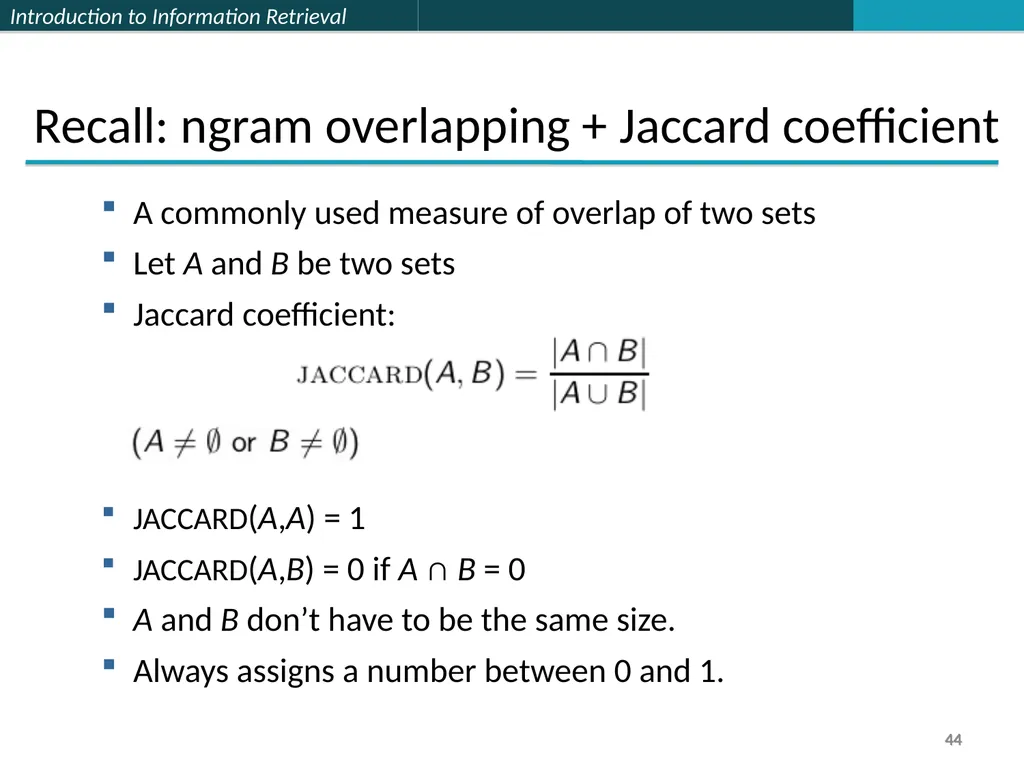
slide44. 44 Recall: ngram overlapping + Jaccard coefficient A commonly used measure of overlap of two sets
Let A and B be two sets
Jaccard coefficient:
JACCARD(A,A) = 1
JACCARD(A,B) = 0 if A ∩ B = 0
A and B don’t have to be the same size.
Always assigns a number between 0 and 1. 44<br>
slide45. Link analysis : anchor text 45<br>
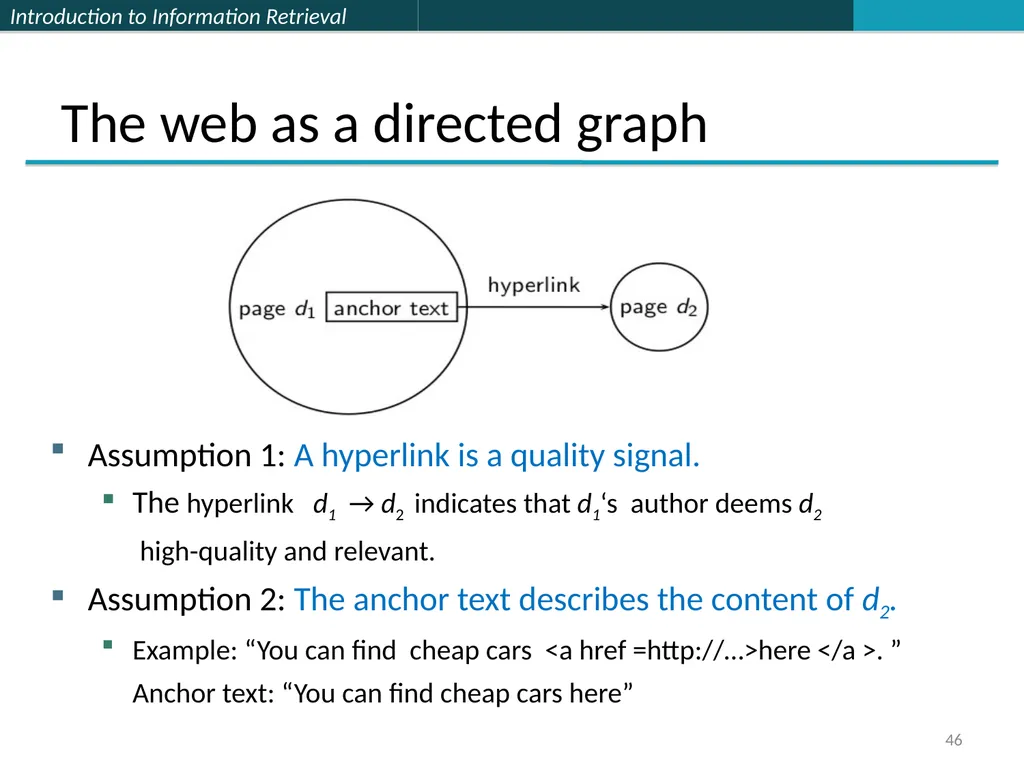
slide46. 46 The web as a directed graph Assumption 1: A hyperlink is a quality signal.
The hyperlink d1 → d2 indicates that d1‘s author deems d2
high-quality and relevant.
Assumption 2: The anchor text describes the content of d2.
Example: “You can find cheap cars ˂a href =http://…˃here ˂/a ˃. ”
Anchor text: “You can find cheap cars here”<br>
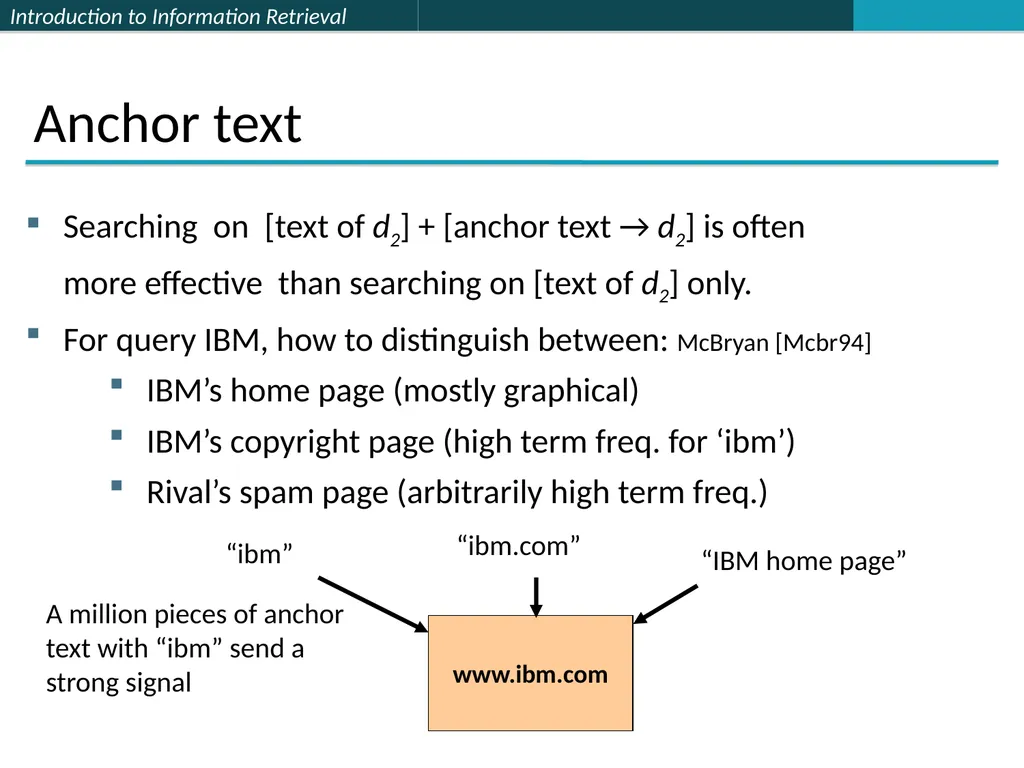
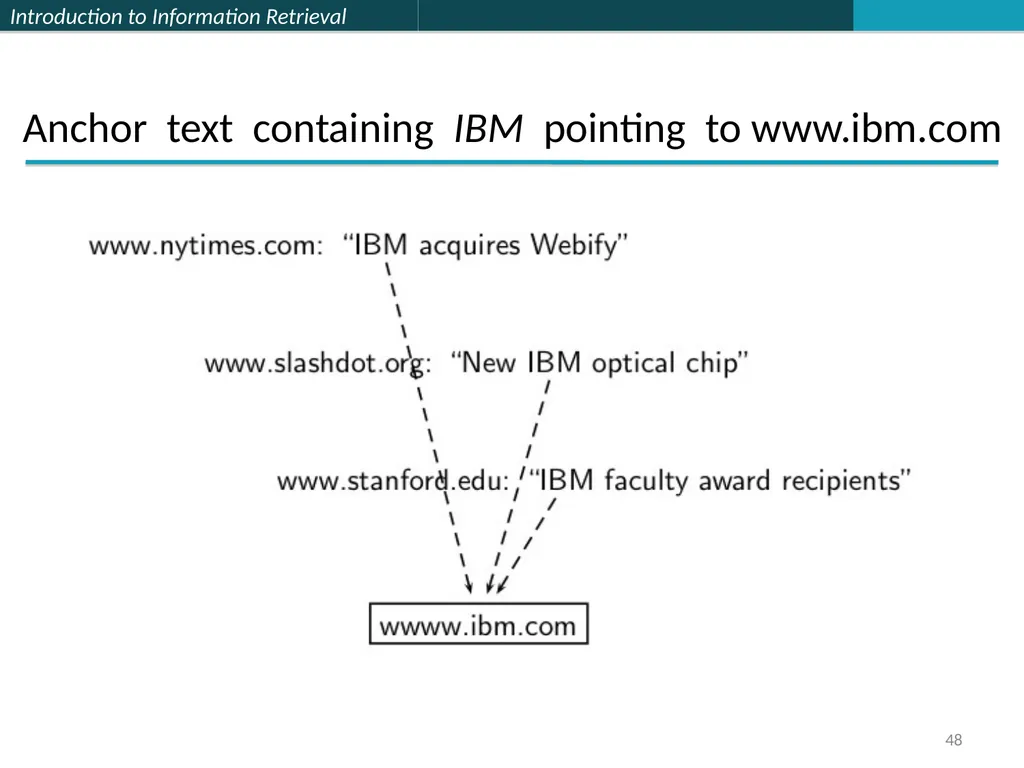
slide47. Anchor text Searching on [text of d2] + [anchor text → d2] is often
more effective than searching on [text of d2] only.
For query IBM, how to distinguish between: McBryan [Mcbr94]
IBM’s home page (mostly graphical)
IBM’s copyright page (high term freq. for ‘ibm’)
Rival’s spam page (arbitrarily high term freq.) www.ibm.com “ibm” “ibm.com” “IBM home page” A million pieces of anchor text with “ibm” send a strong signal<br>
slide48. 48 Anchor text containing IBM pointing to www.ibm.com<br>
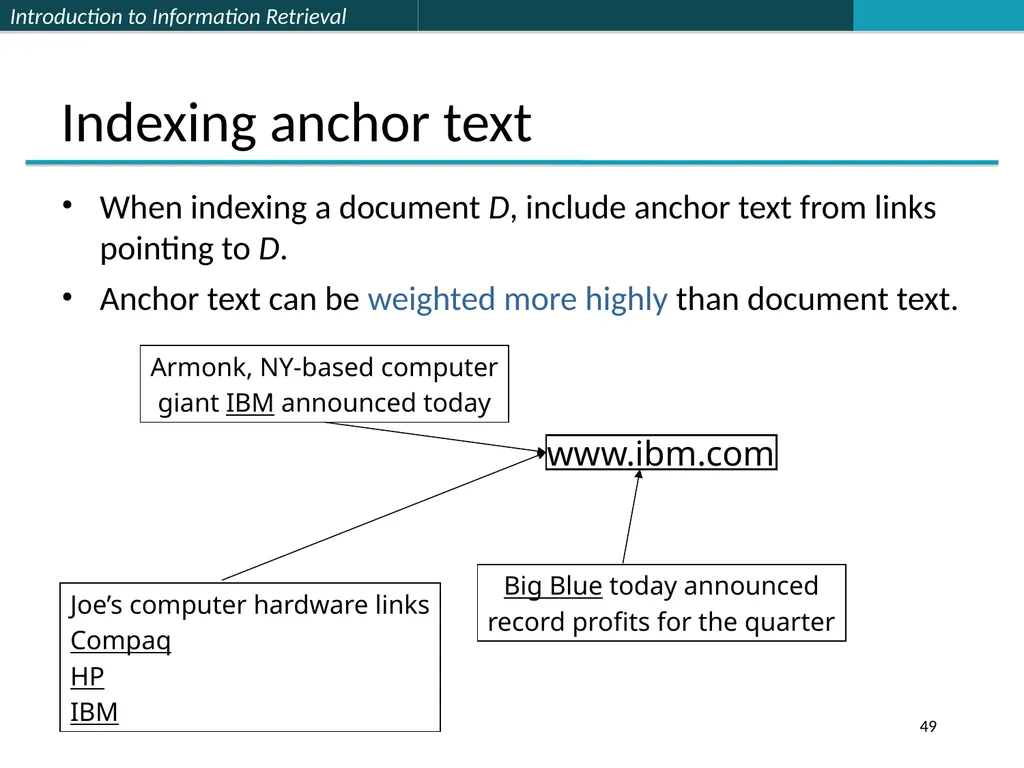
slide49. 49 Indexing anchor text When indexing a document D, include anchor text from links pointing to D.
Anchor text can be weighted more highly than document text. www.ibm.com Armonk, NY-based computer
giant IBM announced today Joe’s computer hardware links
Compaq
HP
IBM Big Blue today announced
record profits for the quarter<br>
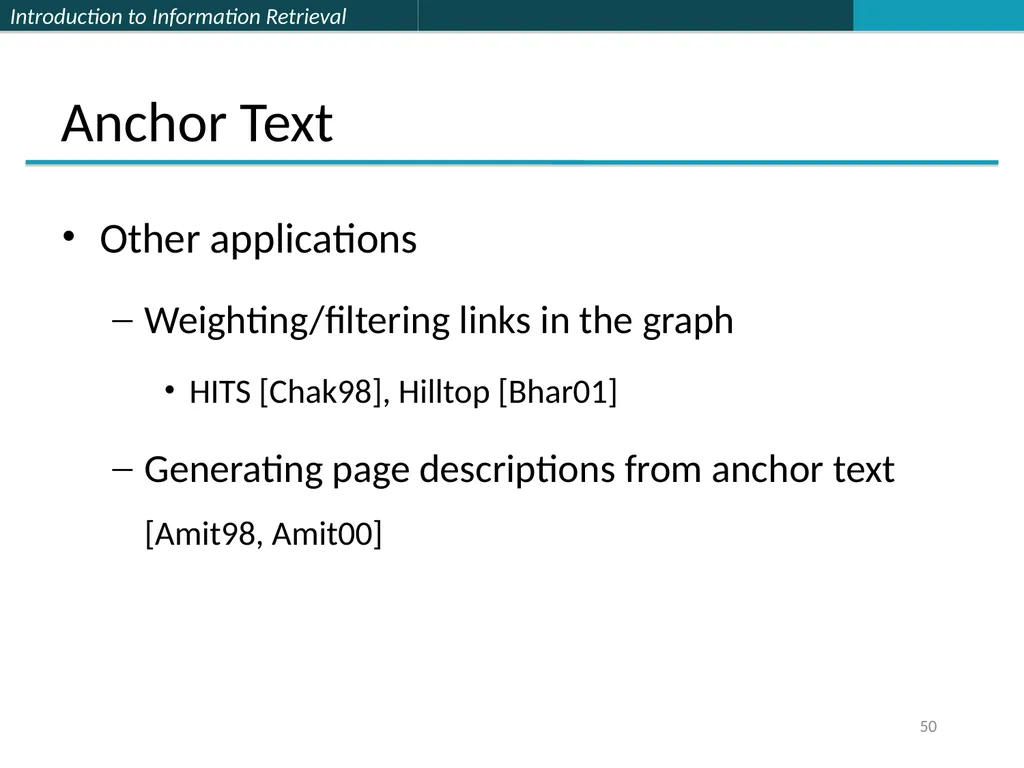
slide50. 50 Anchor Text Other applications
Weighting/filtering links in the graph
HITS [Chak98], Hilltop [Bhar01]
Generating page descriptions from anchor text [Amit98, Amit00]<br>
slide51. Link analysis 51<br>
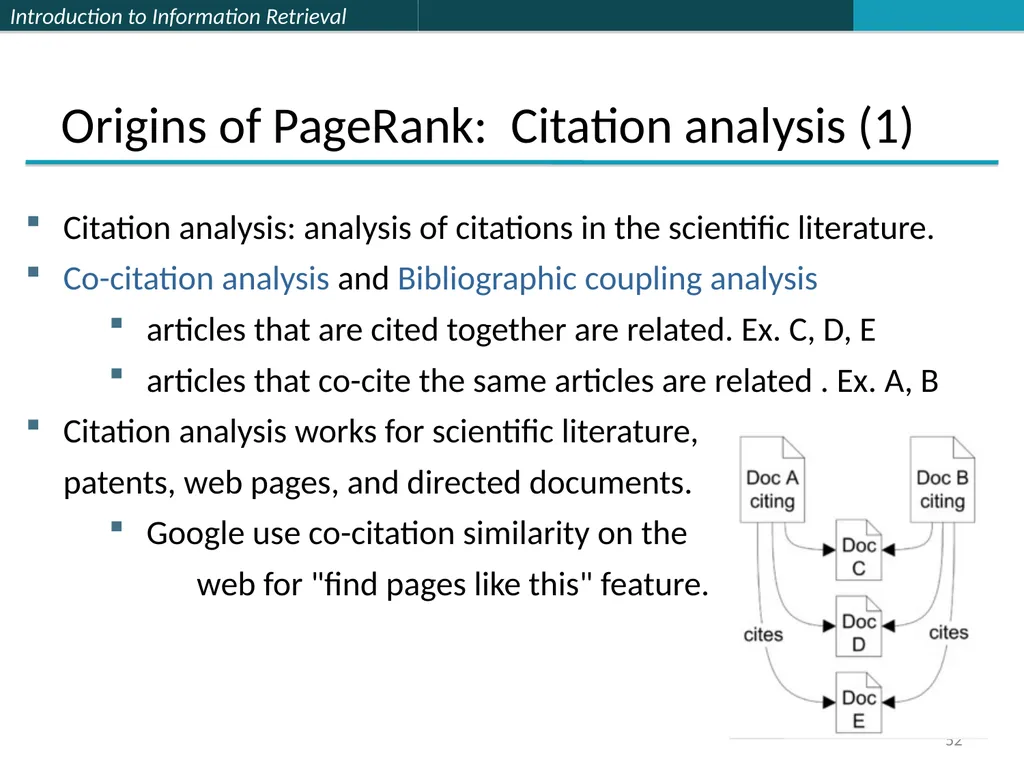
slide52. 52 Origins of PageRank: Citation analysis (1) Citation analysis: analysis of citations in the scientific literature.
Co-citation analysis and Bibliographic coupling analysis
articles that are cited together are related. Ex. C, D, E
articles that co-cite the same articles are related . Ex. A, B
Citation analysis works for scientific literature,
patents, web pages, and directed documents.
Google use co-citation similarity on the
web for "find pages like this" feature.<br>
slide53. 53 Origins of PageRank: Citation analysis (2) Citation frequency can be used to measure the impact of an article .
Ex. Google Scholar, CiteSeer
On the web: citation frequency = inlink count
Simplest measure: Each article gets one vote
A high inlink count mean high quality.
… but not very accurate because of link spam.
Better measure: weighted citation frequency or citation rank
An article’s vote is weighted according to its citation impact.
Ex. NY Times inlink is much more important than a nobody's inlink.<br>
slide54. 54 Origins of PageRank: Citation analysis (3) Weighted citation frequency or citation rank is basically PageRank
invented in the context of citation analysis by Pinsker and Narin in the 1960s.
Google uses it and other heuristics for web page ranking.
(independent from query)<br>
slide55. Link analysis : hub and authority 55<br>
slide56. 56 Hits – Hyperlink-Induced Topic Search Premise: there are two different types of relevance on the web.
Relevance type 1: Hubs. A hub page is a good list of links to pages answering the information need.
E.g, for query [chicago bulls]: Bob’s list of recommended resources on the Chicago Bulls sports team
Relevance type 2: Authorities. An authority page is a direct answer to the information need.
The home page of the Chicago Bulls sports team
By definition: Links to authority pages occur repeatedly on hub pages.
Most approaches to search (including PageRank ranking) don’t make the distinction between these two very different types of relevance.<br>
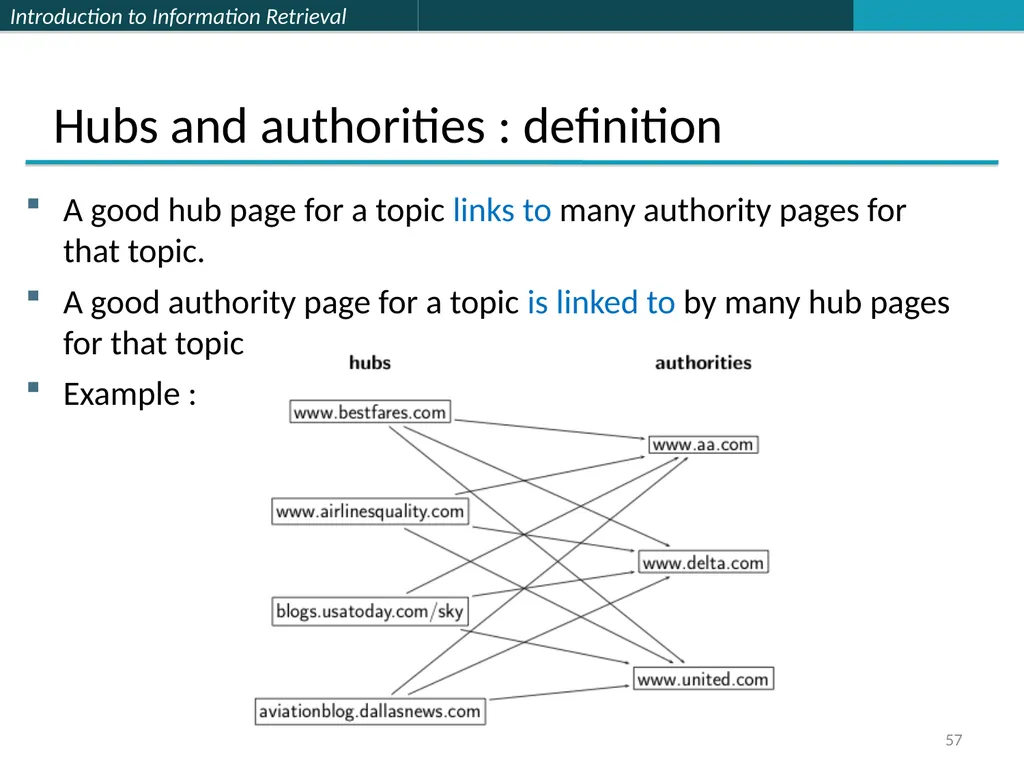
slide57. 57 Hubs and authorities : definition A good hub page for a topic links to many authority pages for that topic.
A good authority page for a topic is linked to by many hub pages for that topic.
Example :<br>
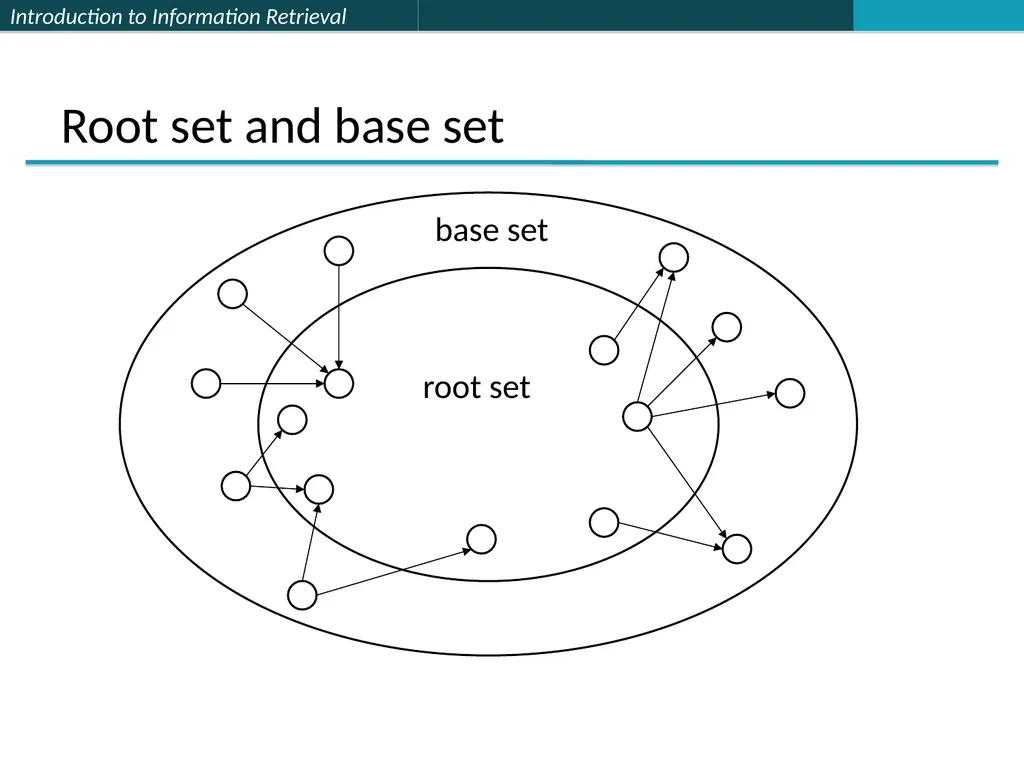
slide58. 58 How to compute hub and authority scores Do a regular web search first
Call the search result the root set
Find all pages that are linked to or link to pages in the root set
Call it as the base set
Finally, compute hubs and authorities from the base set<br>
slide59. Root set and base set root set base set<br>
slide60. 60 Hub and authority scores Root set typically has 200-1000 nodes, and base set may have up to 5000 nodes
Compute for each page d in the base set a hub score h(d) and an authority score a(d)
Initialization: for all d: h(d) = 1, a(d) = 1
Iteratively update all h(d), a(d)
After convergence:
Output pages with highest h scores as top hubs
Output pages with highest a scores as top authorities<br>
slide61. Discussions 61<br>
台灣科大資管系
wyang@ntu.edu.tw
本投影片修改自Introduction to Information Retrieval一書之投影片 Ch 20 & 21 1<br>
slide2. More topics Ads and search engine optimization
Web capture and spider
Link analysis
Duplicate detection 2<br>
slide3. Ads and
search engine optimization (SEO) 3<br>
slide4. 4 1st generation of search ads: Goto (1996) 4 Buddy Blake bid the maximum ($0.38) for this search.
paid $0.38 to Goto every time somebody clicked on it.
No separation of ads/docs.
Pages were simply ranked according to bid 只依競價排序
revenue maximization 可最大化利潤<br>
slide5. 2nd generation of search ads: Google (2000) 5 Strict separation of search results and search ads 廣告分離 SogoTrade appears
in search results.
SogoTrade appears
in ads.<br>
slide6. 6 How are the ads on the right ranked? 6<br>
slide7. 7 How are ads ranked? Advertisers bid for keywords – sale by auction.
Advertisers are only charged when somebody clicks on your ad. (i.e. CPC : cost per click, or CPA : cost per action)
How does the auction determine an ad’s rank and the price paid for the ad?
second price auction 7<br>
slide8. 8 Google’s second price auction bid: maximum bid for a click by advertiser
CTR: click-through rate: when an ad is displayed, what percentage of time do users click on it? CTR is a measure of relevance. 判斷相關程度
ad rank: bid × CTR: this trades off (i) how much money the advertiser is willing to pay against (ii) how relevant the ad is
rank: rank in auction
paid: second price auction price paid by advertiser 8<br>
slide9. 9 Search ads: A win-win-win 創造三贏的模式 The search engine company gets revenue every time somebody clicks on an ad.
The user only clicks on an ad if they are interested in the ad.
Search engines punish misleading and nonrelevant ads. 不好的廣告不會被點,自然會較少出現
As a result, users are often satisfied with what they find after clicking on an ad.
The advertiser finds new customers in a cost-effective way.
only charged when click. 9<br>
slide10. 10 How to affect the left ranked (no paid) ? 10<br>
slide11. 11 Search Engine Optimization (SEO) The alternative to paid ads.
Search Engine Optimization:
"Tuning" your web page to rank highly in the search results for select keywords 提高搜尋排名
Alternative to paying for placement 卻不用付錢
Thus, is a marketing function
Performed by companies and consultants (“Search engine optimizers”) for their clients
Some perfectly legitimate, some very shady 黑帽 / 白帽<br>
slide12. Basic form of SEO (1) First generation engines relied heavily on tf/idf
The top-ranked pages for the query maui resort were the ones containing the most maui’s and resort’s
try dense repetitions of chosen terms
e.g., maui resort maui resort maui resort
Often, the repetitions would be in the non-visible part of the web page
ex. use tiny font, or the same color as the background
Repeated terms got indexed by crawlers, but not visible to humans on browsers 12<br>
slide13. Basic form of SEO (2) Variants of keyword stuffing (spam)
Misleading meta-tags, excessive repetition
Hidden text with colors, style sheet tricks, etc.
but these don't work for PageRank 13 Meta-Tags =
“… London hotels, hotel, holiday inn, hilton, discount, booking, reservation, sex, mp3, britney spears, viagra, …”<br>
slide14. Advanced form of SEO Doorway pages
Pages optimized for a single keyword that re-direct to the real target page
Link spamming 造出假的連結
hidden links, cross links
domain flooding: numerous domains that point or re-direct to a target page
Robots 造出假的查詢
Fake queries and promotions. (ex. Google +1) 14<br>
slide15. Search Engine Optimization 方法簡介 網頁標題要簡短、明確、獨特,網頁描述亦然,且不要重複
避免網站下所有或大部份網頁都用同一個描述
縮短網址與層數,網址名稱有意義,避免無意義的變數
提交Sitemap給Google
在網頁底部加上一排主要導覽連結
圖片檔名也盡量使用有意義的字,並加上替代文字
經常更新
被具有影響力的網站引用<br>
slide16. The war against spam Quality signals - Prefer authority pages based on:
Votes from authors (linkage signals)
Votes from users (usage signals)
Policing of URL submissions
Anti robot test
Limits on meta-keywords
Robust link analysis
Use link analysis to detect spammers
Ignore statistically fake linkas Spam recognition by machine learning
Training set based on known spam
Family friendly filters
Linguistic analysis, general classification techniques, etc.
For images: flesh tone detectors, source text analysis, etc.
Editorial intervention
Blacklists
Top queries audited
Complaints addressed
Suspect pattern detection<br>
slide17. Web capture and spider 17<br>
slide18. 18 Basic crawler operation Initialize queue with URLs of known seed pages
先有種子URL
Repeat
Take URL from queue
Fetch and parse page 連線抓取
Extract URLs from page 取出URL後準備逐一加入
Add URLs to queue
Assumption: The web is well linked.<br>
slide19. Crawling picture Unseen Web Seed
pages<br>
slide20. 20 Design issues for crawler Distribute to scale up
sub-select instead of crawling everything
eliminate duplication
prevent from spam and spider traps
Politeness: need to be "nice" when requests for a site
Freshness: need to re-crawl periodically.
Prioritize the crawling tasks. 20<br>
slide21. 21 Exercise: What’s wrong with this crawler? urlqueue := (some carefully selected set of seed urls)
while urlqueue is not empty:
myurl := urlqueue.getlastanddelete() 取出一個URL開始工作
mypage := myurl.fetch() 抓取網頁
fetchedurls.add(myurl) 加入歷史紀錄
newurls := mypage.extracturls() 取出更多連結
for myurl in newurls:
if myurl not in fetchedurls and not in urlqueue:
urlqueue.add(myurl) 若是新的連結,則再加入工作佇列
addtoinvertedindex(mypage) 處理該網頁內容 21<br>
slide22. 22 What’s wrong with the simple crawler Scale: we need to distribute.
We can’t index everything: we need to subselect. How?
Duplicates: need to integrate duplicate detection
Spam and spider traps: need to integrate spam detection
Politeness: we need to be “nice” and space out all requests for a site over a longer period (hours, days)
Freshness: we need to recrawl periodically.
Because of the size of the web, we can do frequent recrawls only for a small subset.
Again, subselection problem or prioritization 22<br>
slide23. 23 Magnitude of the crawling problem To fetch 20,000,000,000 pages in one month . . .
. . . need to fetch almost 8000 pages per second.
Use a distributed architecture.
Eliminate duplicates, unfetchable, spam pages. 23<br>
slide24. 24 What any crawler must do Be Polite: Respect implicit and explicit politeness considerations for a website
Don't hit a site too often
Only crawl pages you are allowed to
Respect robots.txt (more on this shortly)
Be Robust: Be immune to spider traps, duplicates, very large pages, very large websites, dynamic pages, etc.
要有逾時與錯誤處理機制<br>
slide25. 25 Robots.txt Protocol for giving crawlers (“robots”) limited access to a website, originally from 1994
Examples:
User-agent: *
Disallow: /yoursite/temp/
User-agent: searchengine
Disallow: /
User-agent: PicoSearch/1.0
Disallow: /news/information/knight/
Disallow: /nidcd/ 25<br>
slide26. 26 What any crawler should do (1) Be capable of distributed operation
可多台同時進行
Be scalable: designed to increase the crawl rate by adding more machines
Performance/efficiency: permit full use of available processing and network resources
儘可能的使用頻寬<br>
slide27. 27 What any crawler should do (2) Fetch pages of "higher quality" first
Continuous operation: Continue fetching fresh copies of a previously fetched page
可持續性作業
Extensible: Adapt to new data formats, protocols 保有擴充性<br>
slide28. 28 URL frontier 28<br>
slide29. Unseen Web Seed
Pages URL frontier Crawling thread<br>
slide30. 30 URL frontier The URL frontier is the data structure that holds and manages URLs we’ve seen, but that have not been crawled yet.
Can include multiple pages from the same host
Must avoid trying to fetch them all at the same time
需能夠自動分散流量
Must keep all crawling threads busy
但又能最大限度地利用頻寬等資源 30<br>
slide31. 31 Basic crawl architecture 31<br>
slide32. Processing steps in crawling Pick a URL from the frontier with priority
Fetch the document at the URL
Parse the URL
Extract links from it to other docs (URLs)
Check if URL has content already seen
If not, add to indexes
For each extracted URL
Ensure it passes certain URL filter tests (i.e. sub-select)<br>
slide33. Implementation issue (1) Crawling
follow the links
enumerate the HTTP/FORM parameters
Use Chrome or HttpFox to view the 'real' parameters.
Implementation
using HTTP API and Queue
using site mirroring tools
HTTrack or Teleport 33<br>
slide34. Implementation issue (2) Parsing
extract all links and other information from the pages
Implementation
using Browser API (ex. IE Control) to list the parsed URLs
it works even for dynamic links (JavaScript)
using String processing (ex. Regular expression)
using HTML DOM (Document Object Model) and XPATH 34<br>
slide35. Exercise
use regular expression to remove html tags
str=str.replaceAll("<{1}[^>]{1,}>{1}", "").trim();
use regular expression to remove redundant spaces
str=str.replaceAll(" {2}", " ").trim();
use XPATH to extract all links from Google result page
//ol[@id='rso']/li/div/h3/a 35<br>
slide36. 36 URL normalization Some URLs extracted from a document are relative URLs.
E.g., at http://mit.edu, we may have aboutsite.html
This is the same as: http://mit.edu/aboutsite.html
During parsing, we must normalize (expand) all relative URLs. 36<br>
slide37. 37 Distributing the crawler Run multiple crawl threads, potentially at different nodes
Usually geographically distributed nodes
Partition hosts being crawled into nodes 37<br>
slide38. 38 Distributed crawler 38<br>
slide39. 39 URL frontier: two main considerations Politeness: do not hit a web server too frequently
Freshness: crawl some pages more often than others
pages (Ex. News sites) changes often
These goals may conflict each other.
Tips
Insert time gap between successive requests to a host
shuffle the traffic for hosts<br>
slide40. Duplicate detection 40<br>
slide41. 41 Duplicate detection The web is full of duplicated content.
Exact duplicates
Easy to eliminate (ex. use hash)
Near-duplicates
For the user, it’s annoying to get a search result with near-identical documents.
Difficult to eliminate
Marginal relevance is zero: even a highly relevant document becomes nonrelevant if it appears below a (near-)duplicate.
So need to eliminate it. 41<br>
slide42. 42 Near-duplicates: Example 42<br>
slide43. 43 Detecting near-duplicates Compute similarity with edit-distance, n-gram overlapping, or vector space model.
use “syntactic” (as opposed to semantic) similarity.
do not consider documents near-duplicates if they have the same content, but express it with different words.
Use similarity threshold θ to judge
E.g., two documents are near-duplicates if similarity > θ = 80%. 43<br>
slide44. 44 Recall: ngram overlapping + Jaccard coefficient A commonly used measure of overlap of two sets
Let A and B be two sets
Jaccard coefficient:
JACCARD(A,A) = 1
JACCARD(A,B) = 0 if A ∩ B = 0
A and B don’t have to be the same size.
Always assigns a number between 0 and 1. 44<br>
slide45. Link analysis : anchor text 45<br>
slide46. 46 The web as a directed graph Assumption 1: A hyperlink is a quality signal.
The hyperlink d1 → d2 indicates that d1‘s author deems d2
high-quality and relevant.
Assumption 2: The anchor text describes the content of d2.
Example: “You can find cheap cars ˂a href =http://…˃here ˂/a ˃. ”
Anchor text: “You can find cheap cars here”<br>
slide47. Anchor text Searching on [text of d2] + [anchor text → d2] is often
more effective than searching on [text of d2] only.
For query IBM, how to distinguish between: McBryan [Mcbr94]
IBM’s home page (mostly graphical)
IBM’s copyright page (high term freq. for ‘ibm’)
Rival’s spam page (arbitrarily high term freq.) www.ibm.com “ibm” “ibm.com” “IBM home page” A million pieces of anchor text with “ibm” send a strong signal<br>
slide48. 48 Anchor text containing IBM pointing to www.ibm.com<br>
slide49. 49 Indexing anchor text When indexing a document D, include anchor text from links pointing to D.
Anchor text can be weighted more highly than document text. www.ibm.com Armonk, NY-based computer
giant IBM announced today Joe’s computer hardware links
Compaq
HP
IBM Big Blue today announced
record profits for the quarter<br>
slide50. 50 Anchor Text Other applications
Weighting/filtering links in the graph
HITS [Chak98], Hilltop [Bhar01]
Generating page descriptions from anchor text [Amit98, Amit00]<br>
slide51. Link analysis 51<br>
slide52. 52 Origins of PageRank: Citation analysis (1) Citation analysis: analysis of citations in the scientific literature.
Co-citation analysis and Bibliographic coupling analysis
articles that are cited together are related. Ex. C, D, E
articles that co-cite the same articles are related . Ex. A, B
Citation analysis works for scientific literature,
patents, web pages, and directed documents.
Google use co-citation similarity on the
web for "find pages like this" feature.<br>
slide53. 53 Origins of PageRank: Citation analysis (2) Citation frequency can be used to measure the impact of an article .
Ex. Google Scholar, CiteSeer
On the web: citation frequency = inlink count
Simplest measure: Each article gets one vote
A high inlink count mean high quality.
… but not very accurate because of link spam.
Better measure: weighted citation frequency or citation rank
An article’s vote is weighted according to its citation impact.
Ex. NY Times inlink is much more important than a nobody's inlink.<br>
slide54. 54 Origins of PageRank: Citation analysis (3) Weighted citation frequency or citation rank is basically PageRank
invented in the context of citation analysis by Pinsker and Narin in the 1960s.
Google uses it and other heuristics for web page ranking.
(independent from query)<br>
slide55. Link analysis : hub and authority 55<br>
slide56. 56 Hits – Hyperlink-Induced Topic Search Premise: there are two different types of relevance on the web.
Relevance type 1: Hubs. A hub page is a good list of links to pages answering the information need.
E.g, for query [chicago bulls]: Bob’s list of recommended resources on the Chicago Bulls sports team
Relevance type 2: Authorities. An authority page is a direct answer to the information need.
The home page of the Chicago Bulls sports team
By definition: Links to authority pages occur repeatedly on hub pages.
Most approaches to search (including PageRank ranking) don’t make the distinction between these two very different types of relevance.<br>
slide57. 57 Hubs and authorities : definition A good hub page for a topic links to many authority pages for that topic.
A good authority page for a topic is linked to by many hub pages for that topic.
Example :<br>
slide58. 58 How to compute hub and authority scores Do a regular web search first
Call the search result the root set
Find all pages that are linked to or link to pages in the root set
Call it as the base set
Finally, compute hubs and authorities from the base set<br>
slide59. Root set and base set root set base set<br>
slide60. 60 Hub and authority scores Root set typically has 200-1000 nodes, and base set may have up to 5000 nodes
Compute for each page d in the base set a hub score h(d) and an authority score a(d)
Initialization: for all d: h(d) = 1, a(d) = 1
Iteratively update all h(d), a(d)
After convergence:
Output pages with highest h scores as top hubs
Output pages with highest a scores as top authorities<br>
slide61. Discussions 61<br>