Lecture 8: BCS theory --- Attractive interaction and the BCS wavefunction and ground state Lecture 7: BCS theory --- Clues to the mechanism and the Cooper instability problem Next time Today Discussion the BCS theory in four parts: Clues to
"Lecture 8: BCS theory --- Attractive interaction" is the property of its rightful owner. Permission is granted to
download and print the materials on this website for personal, non-commercial use only, and to display it
on your personal computer provided you do not modify the materials and that you retain all copyright
notices contained in the materials. By downloading content from our website, you accept the terms of this
agreement.
Presentation Transcript
01
Lecture 8: BCS theory --- Attractive interaction and the BCS wavefunction and ground state Lecture 7: BCS theory --- Clues to the mechanism and the Cooper instability problem Next time Today Discussion the BCS theory in four parts:
Clues to the mechanism and the Cooper instability problem
Attractive interaction and the BCS wavefunction and ground state
Self-consistent solution and quasiparticles
Thermodynamics, electrodynamics, and the coherence factors<br>
02
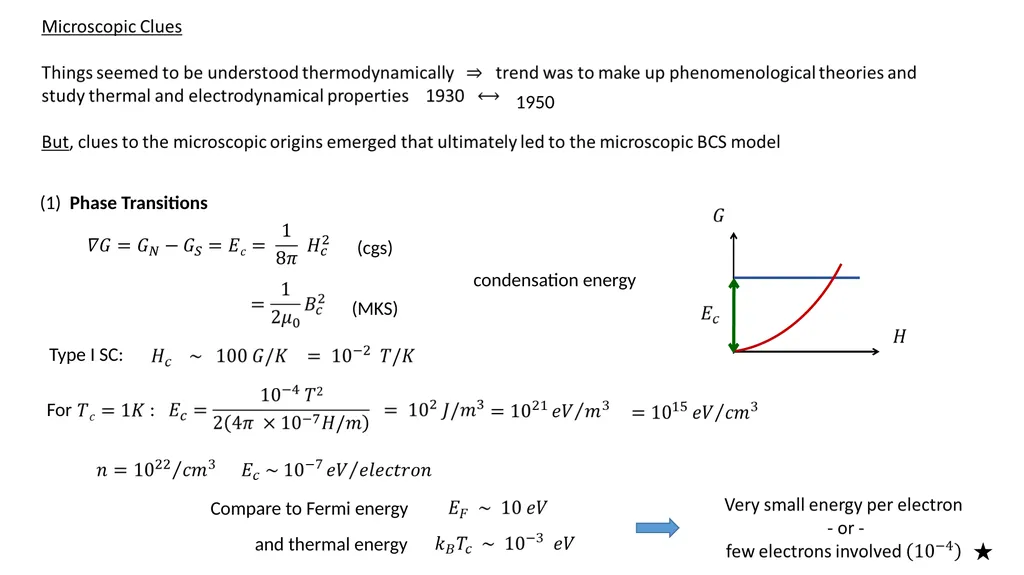
(1) Phase Transitions condensation energy (MKS) (cgs) Type I SC: Compare to Fermi energy and thermal energy 1950 For :<br>
03
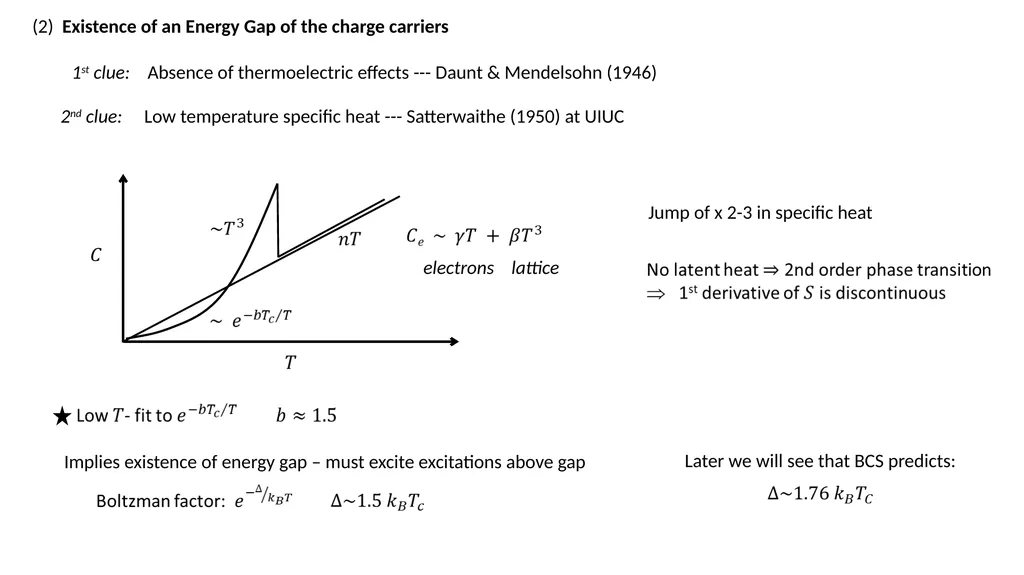
(2) Existence of an Energy Gap of the charge carriers electrons lattice Implies existence of energy gap – must excite excitations above gap Later we will see that BCS predicts: Jump of x 2-3 in specific heat 2nd clue: Low temperature specific heat --- Satterwaithe (1950) at UIUC 1st clue: Absence of thermoelectric effects --- Daunt & Mendelsohn (1946)<br>
04
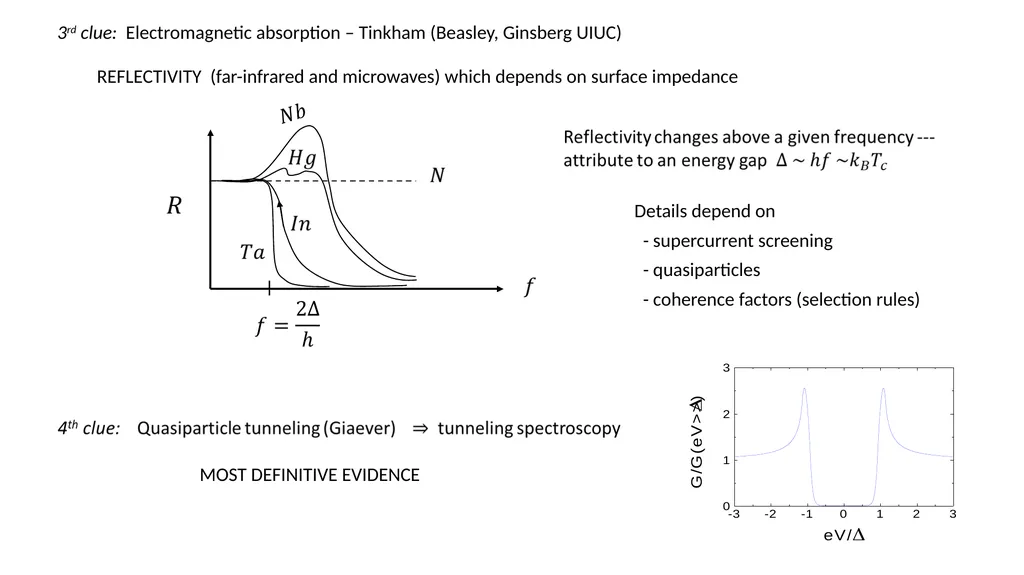
3rd clue: Electromagnetic absorption – Tinkham (Beasley, Ginsberg UIUC) REFLECTIVITY (far-infrared and microwaves) which depends on surface impedance Details depend on
- supercurrent screening
- quasiparticles
- coherence factors (selection rules) MOST DEFINITIVE EVIDENCE<br>
05
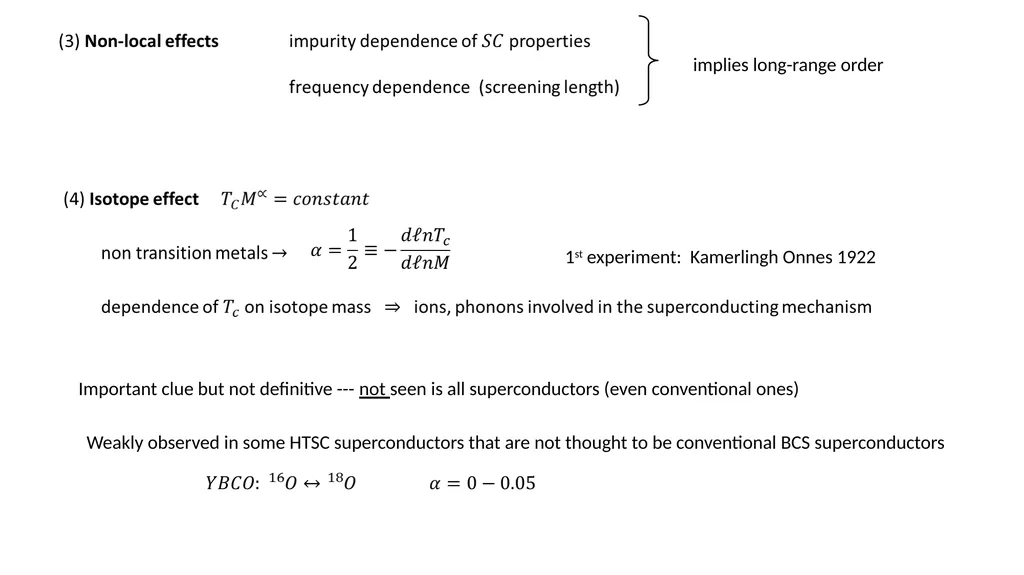
implies long-range order 1st experiment: Kamerlingh Onnes 1922 Important clue but not definitive --- not seen is all superconductors (even conventional ones) Weakly observed in some HTSC superconductors that are not thought to be conventional BCS superconductors<br>
06
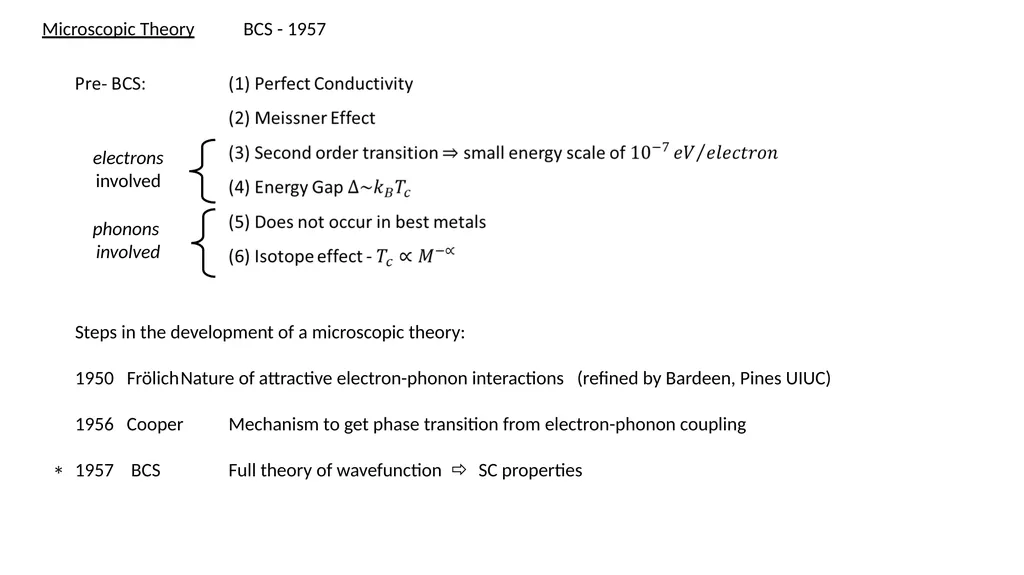
Microscopic Theory BCS - 1957 Steps in the development of a microscopic theory:
Frölich Nature of attractive electron-phonon interactions (refined by Bardeen, Pines UIUC)
1956 Cooper Mechanism to get phase transition from electron-phonon coupling
1957 BCS Full theory of wavefunction SC properties<br>
07
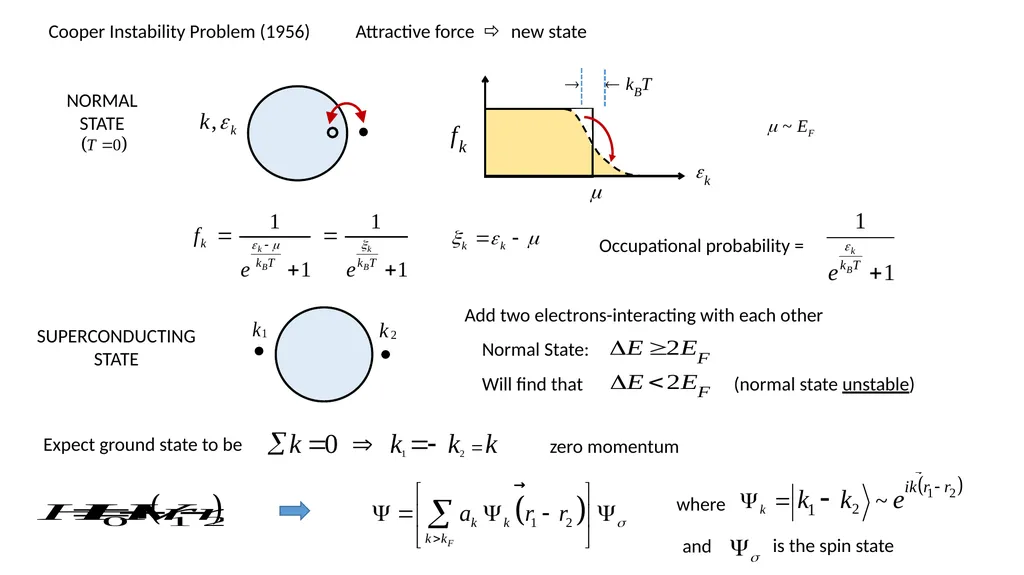
Cooper Instability Problem (1956) Attractive force new state NORMAL
STATE Occupational probability = Expect ground state to be is the spin state where SUPERCONDUCTING
STATE and zero momentum<br>
08
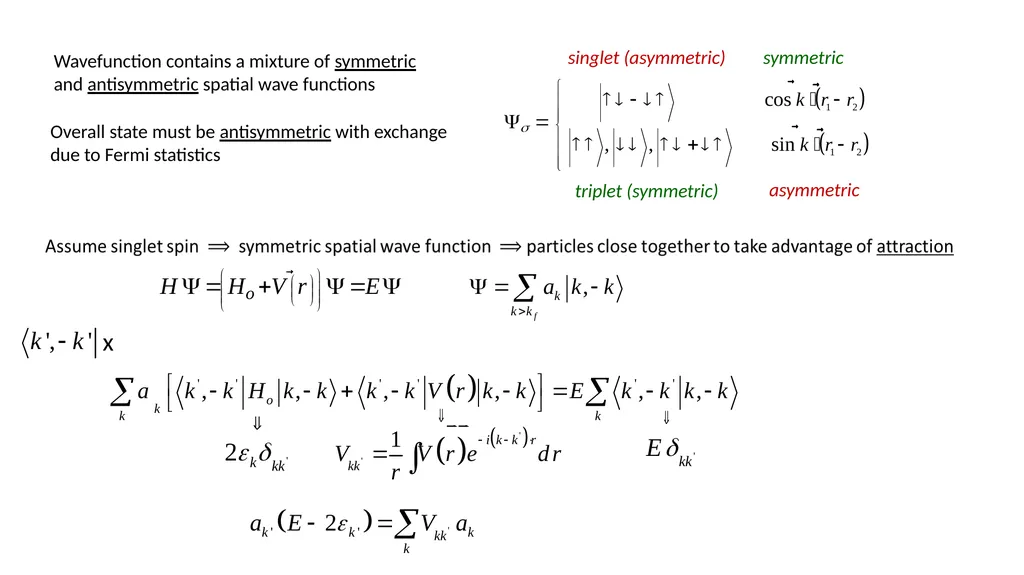
Wavefunction contains a mixture of symmetric and antisymmetric spatial wave functions singlet (asymmetric) triplet (symmetric) symmetric asymmetric x Overall state must be antisymmetric with exchange due to Fermi statistics<br>
09
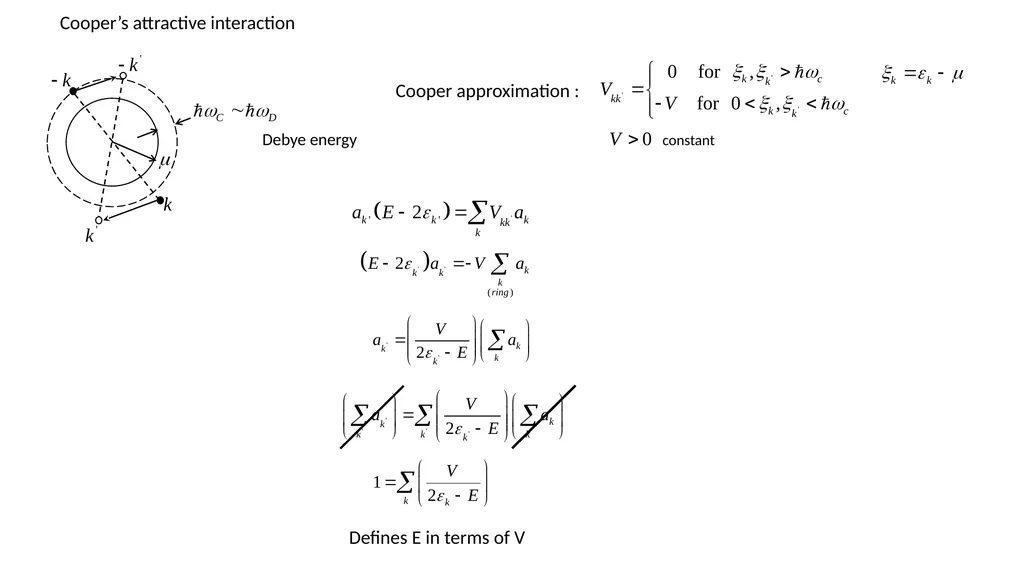
Cooper approximation : constant Defines E in terms of V Debye energy Cooper’s attractive interaction <br>
10
Evaluate by connecting sum to an integral binding energy “weak coupling” (normal state) (superconducting state)<br>
11
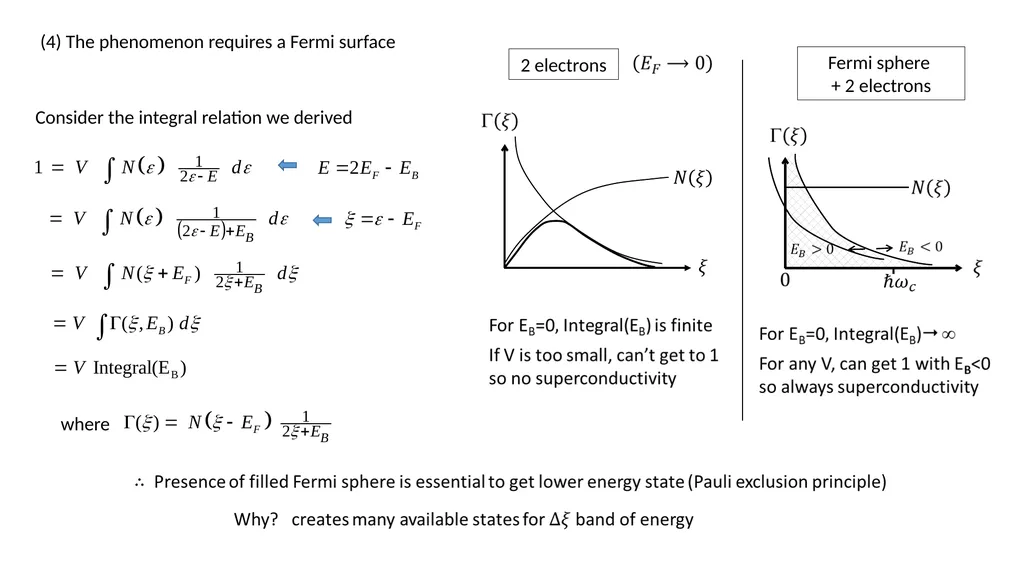
Let’s look at what this calculation means: (3) This is for one excited pair, but if it works for one pair, why not more? There is a tradeoff between number of electrons excited and number of scattering states available – reach a point of diminishing return (2) Attractive interaction lower energy state available
Repulsive interaction only gives higher energy states
Mixed interaction depends on the strength and spatial dependence of the potential Two consequences of exciting a pair: shrinks as states near EF fill up and there are less states available states to scatter into increase as states fill up – need to reach deeper into Fermi sphere<br>
12
(4) The phenomenon requires a Fermi surface Consider the integral relation we derived where<br>
13
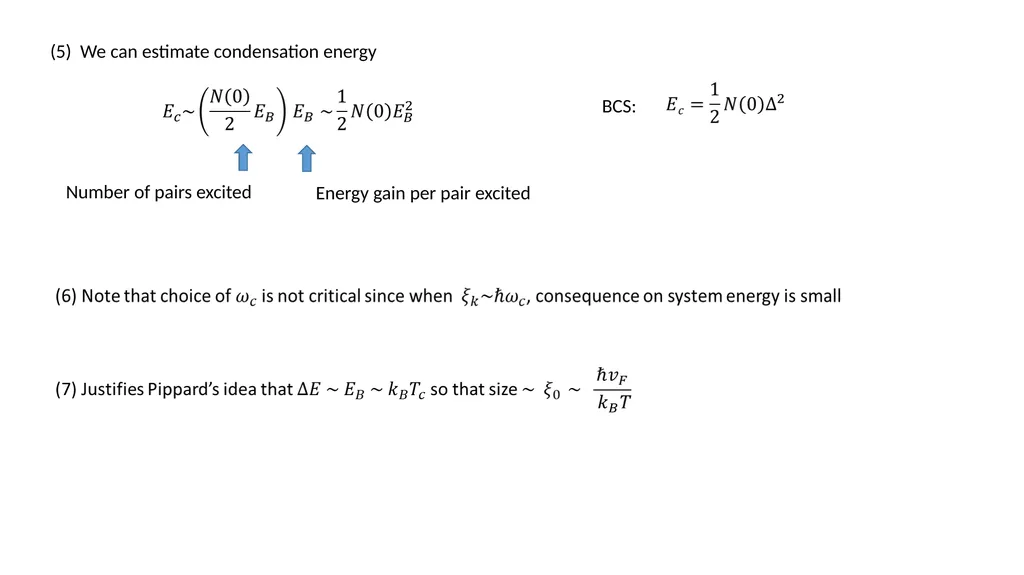
(5) We can estimate condensation energy BCS: Number of pairs excited Energy gain per pair excited<br>
14
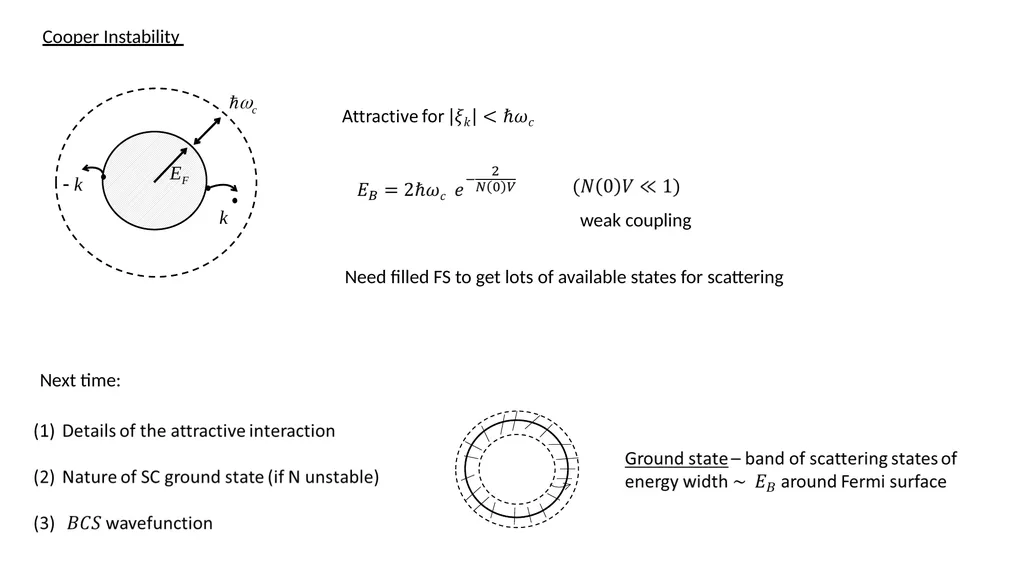
Cooper Instability weak coupling Need filled FS to get lots of available states for scattering Next time:<br>