
Lecture (ppt 4). Social structure in 21st Century
YM
Published · 46 slides · 0 views

1 / 1



Description
Lecture (ppt 4). Social structure in 21st Century Capitalism: Wealthy Elites, middle class and labor. Andrés Solimano, Universidad Mayor and CIGLOB . Prague University of Economics November, 2014 Rise of Economic Elites and the Super Rich.
Related Topics
Share
Embed code
Download this presentation From Below
"Lecture (ppt 4). Social structure in 21st Century" is the property of its rightful owner. Permission is granted to download and print the materials on this website for personal, non-commercial use only, and to display it on your personal computer provided you do not modify the materials and that you retain all copyright notices contained in the materials. By downloading content from our website, you accept the terms of this agreement.
Presentation Transcript
01
Lecture (ppt 4).
Social structure in 21st Century Capitalism: Wealthy Elites, middle class and labor. Andrés Solimano,
Universidad Mayor and CIGLOB . Prague –University of Economics
November, 2014<br>
Universidad Mayor and CIGLOB . Prague –University of Economics
November, 2014<br>
02
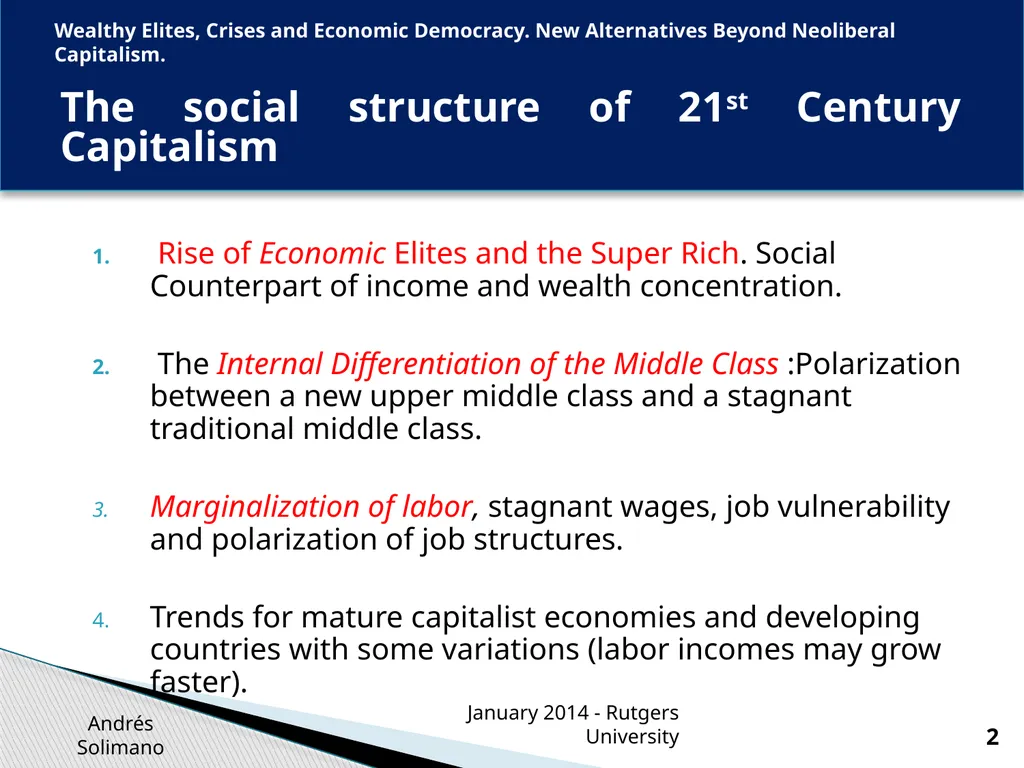
Rise of Economic Elites and the Super Rich. Social Counterpart of income and wealth concentration.
The Internal Differentiation of the Middle Class :Polarization between a new upper middle class and a stagnant traditional middle class.
Marginalization of labor, stagnant wages, job vulnerability and polarization of job structures.
Trends for mature capitalist economies and developing countries with some variations (labor incomes may grow faster). January 2014 - Rutgers University 2 The social structure of 21st Century Capitalism Wealthy Elites, Crises and Economic Democracy. New Alternatives Beyond Neoliberal Capitalism. Andrés Solimano<br>
03
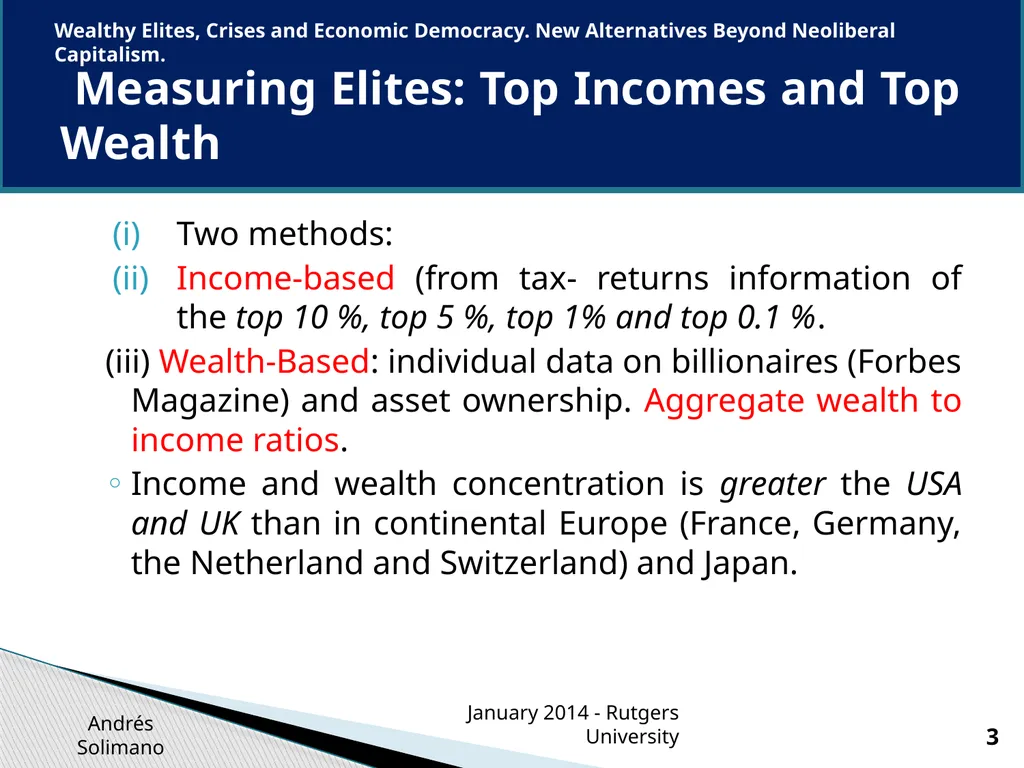
Two methods:
Income-based (from tax- returns information of the top 10 %, top 5 %, top 1% and top 0.1 %.
(iii) Wealth-Based: individual data on billionaires (Forbes Magazine) and asset ownership. Aggregate wealth to income ratios.
Income and wealth concentration is greater the USA and UK than in continental Europe (France, Germany, the Netherland and Switzerland) and Japan. January 2014 - Rutgers University 3 Wealthy Elites, Crises and Economic Democracy. New Alternatives Beyond Neoliberal Capitalism. Andrés Solimano Measuring Elites: Top Incomes and Top Wealth<br>
04
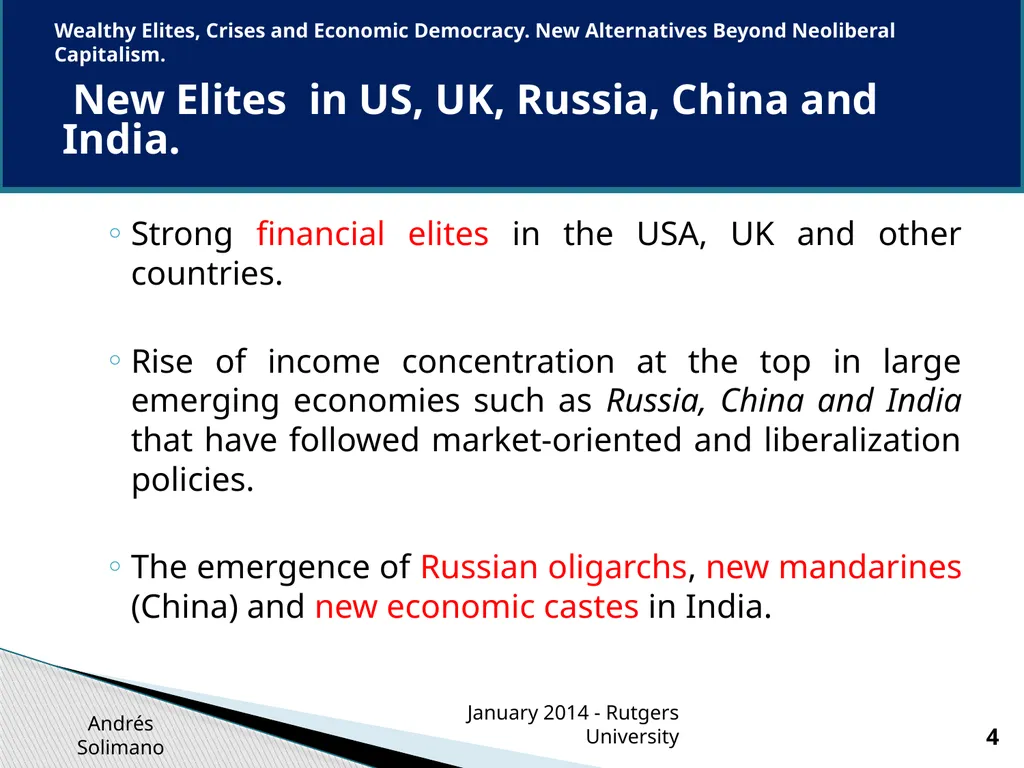
Strong financial elites in the USA, UK and other countries.
Rise of income concentration at the top in large emerging economies such as Russia, China and India that have followed market-oriented and liberalization policies.
The emergence of Russian oligarchs, new mandarines (China) and new economic castes in India. January 2014 - Rutgers University 4 New Elites in US, UK, Russia, China and India. Wealthy Elites, Crises and Economic Democracy. New Alternatives Beyond Neoliberal Capitalism. Andrés Solimano<br>
05
Top 10 %, top 5 %, top 1 %, top 0.1 % for OECD countries (USA, UK, Germany, France, Sweden, Switzerland, Jpan, Australia, Ireland, New Zealand,Canada).
For emerging economies (Argentina, China, India, Singapore, Colombia, Mauritius, South Africa). January 2014 - Routgers University 5 Empirical evidence on top incomes<br>
For emerging economies (Argentina, China, India, Singapore, Colombia, Mauritius, South Africa). January 2014 - Routgers University 5 Empirical evidence on top incomes<br>
06
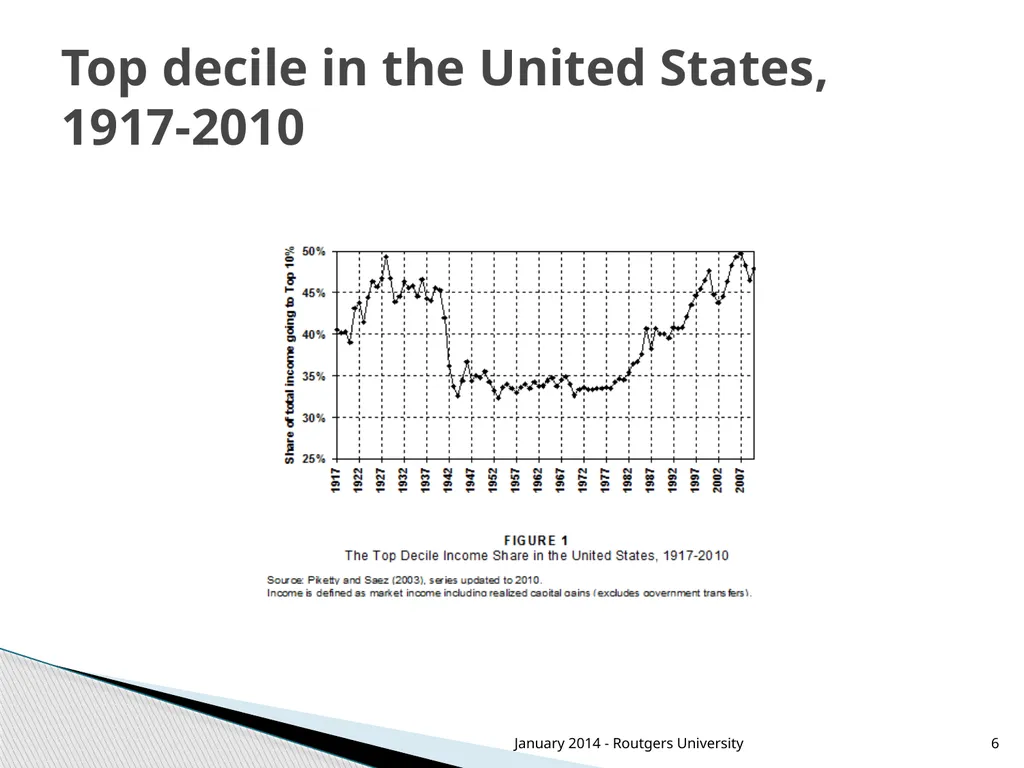
January 2014 - Routgers University 6 Top decile in the United States, 1917-2010<br>
07
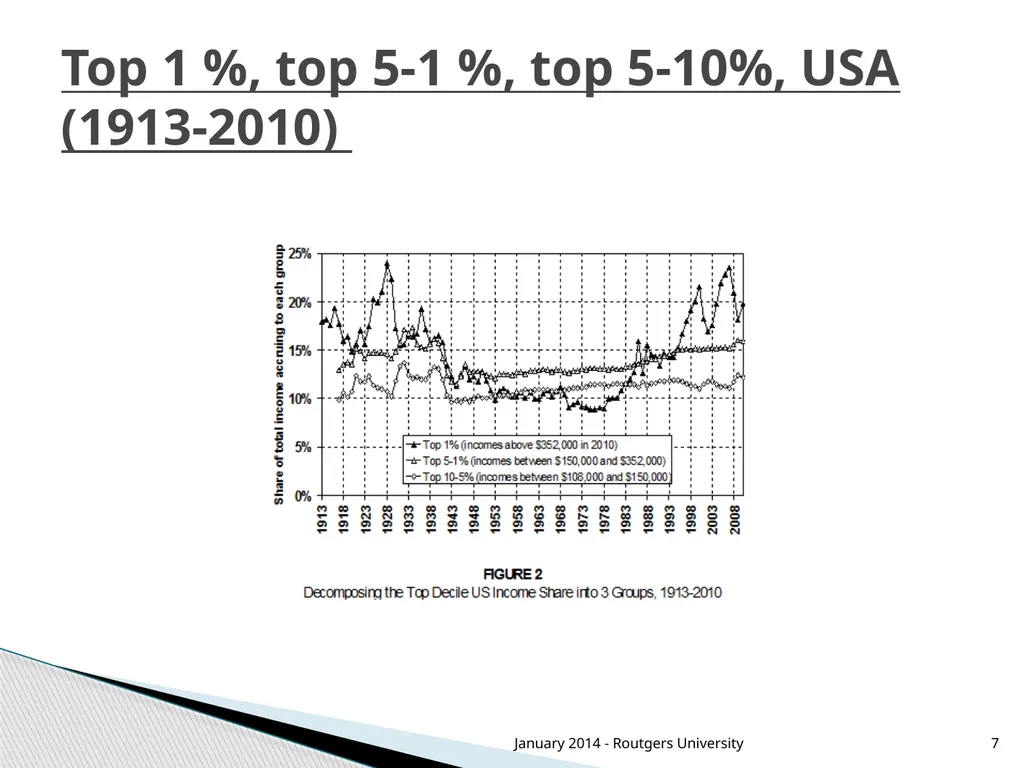
January 2014 - Routgers University 7 Top 1 %, top 5-1 %, top 5-10%, USA (1913-2010)<br>
08
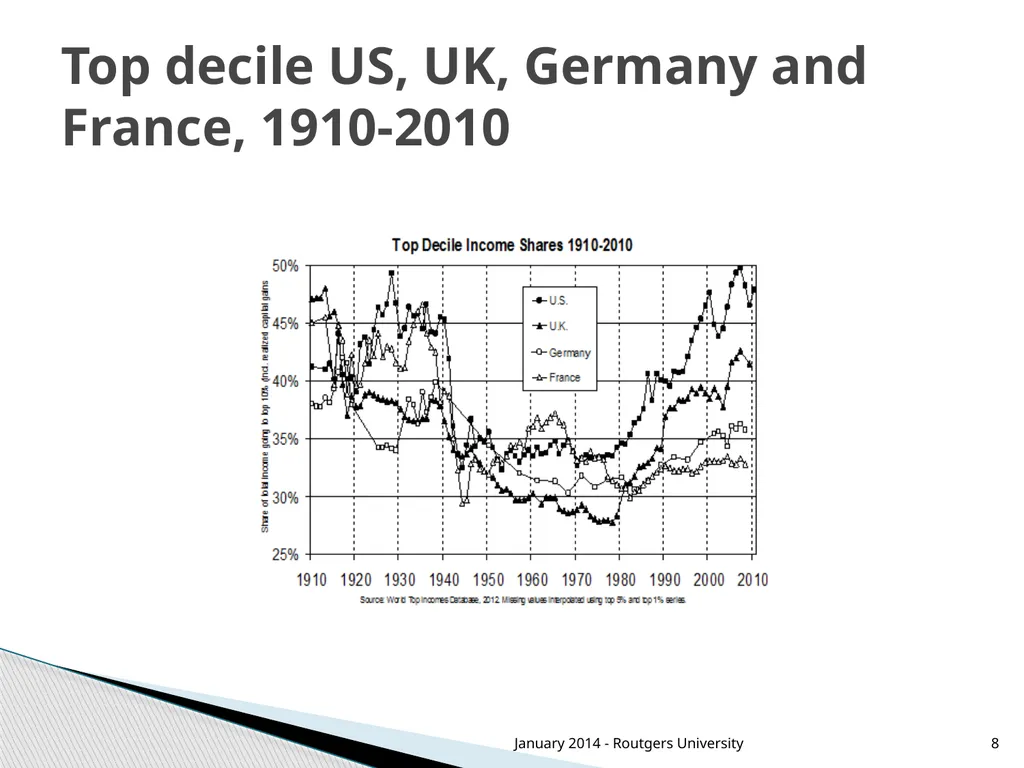
January 2014 - Routgers University 8 Top decile US, UK, Germany and France, 1910-2010<br>
09
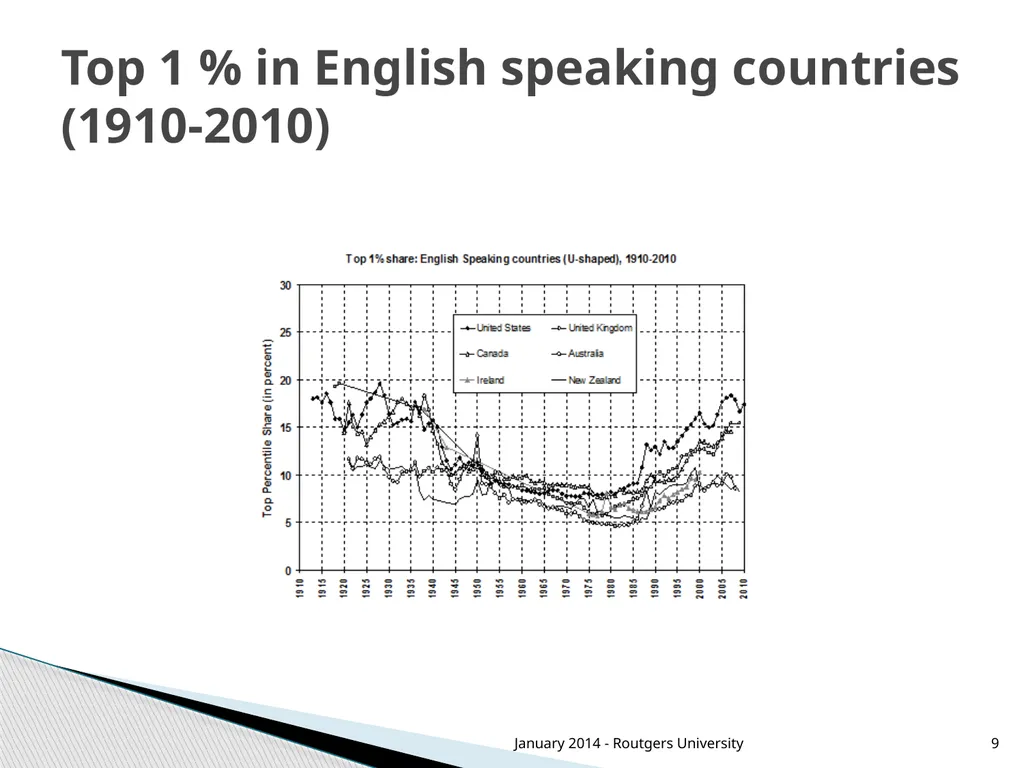
January 2014 - Routgers University 9 Top 1 % in English speaking countries
(1910-2010)<br>
10
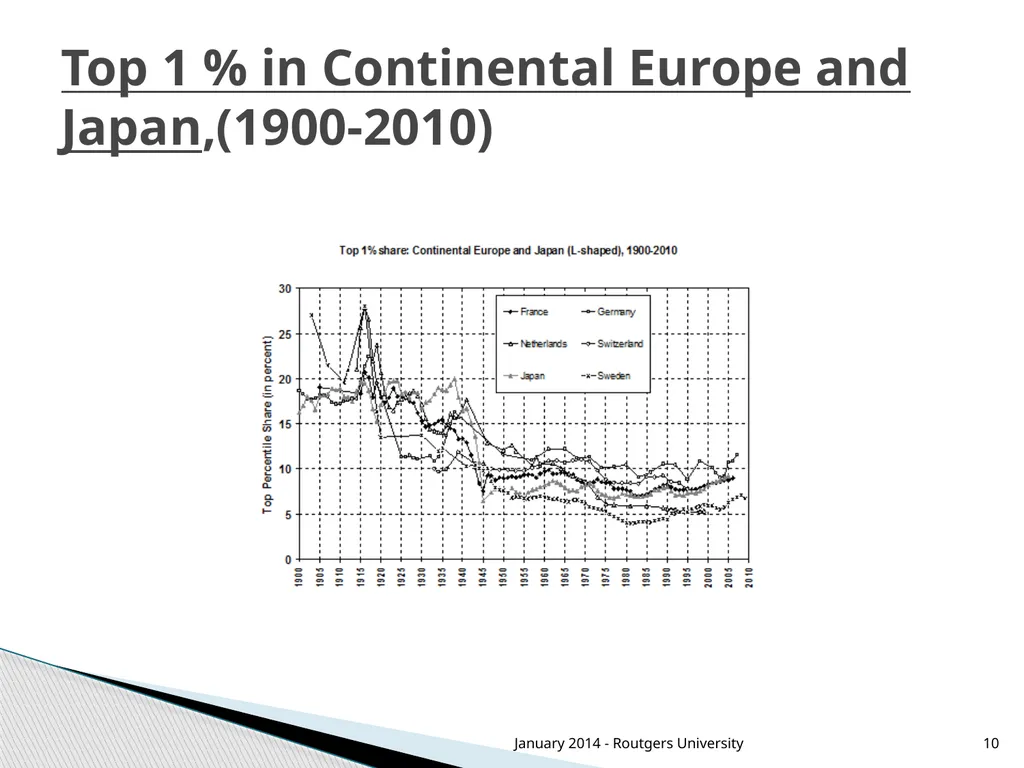
January 2014 - Routgers University 10 Top 1 % in Continental Europe and Japan,(1900-2010)<br>
11
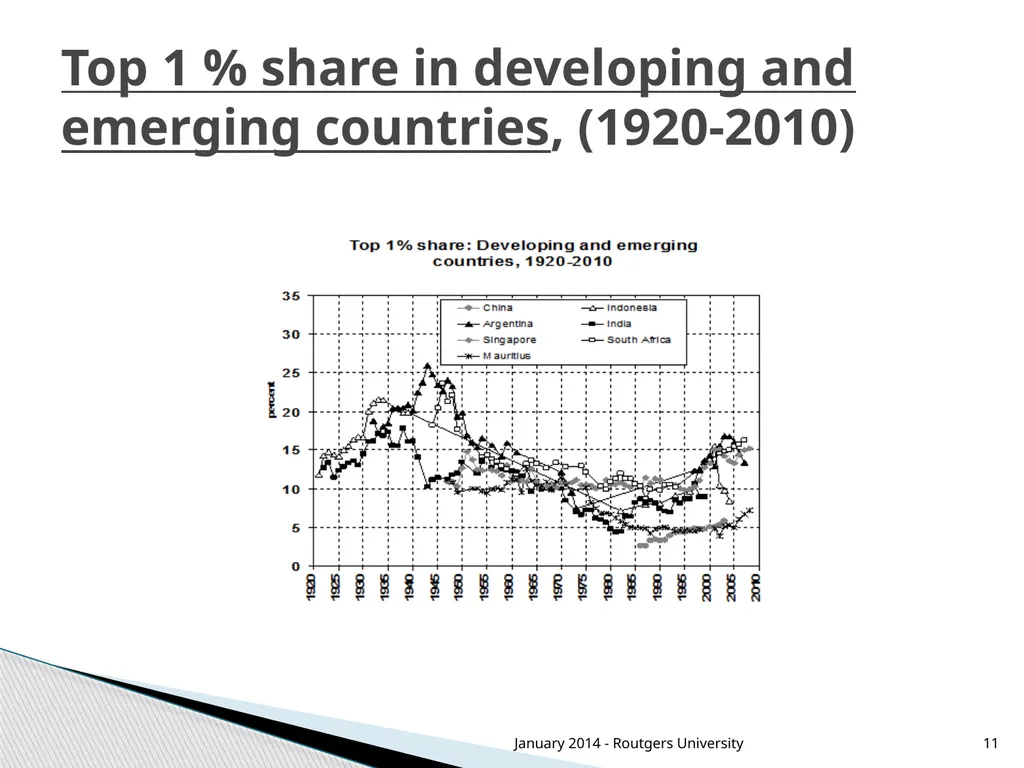
January 2014 - Routgers University 11 Top 1 % share in developing and emerging countries, (1920-2010)<br>
12
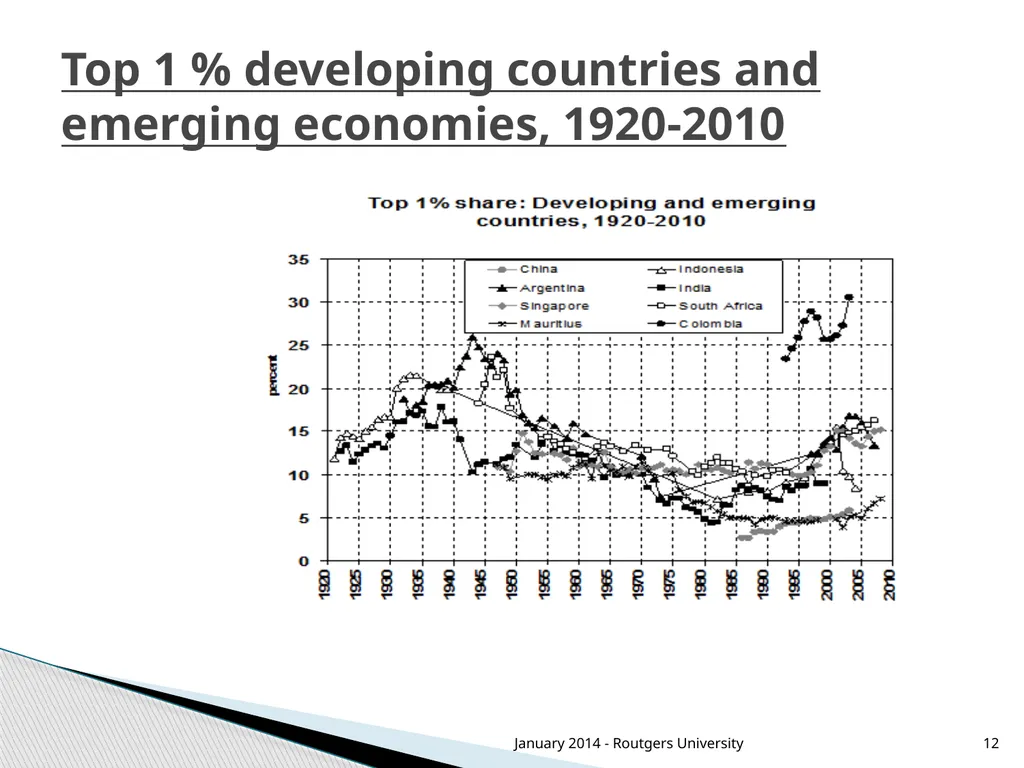
January 2014 - Routgers University 12 Top 1 % developing countries and emerging economies, 1920-2010<br>
13
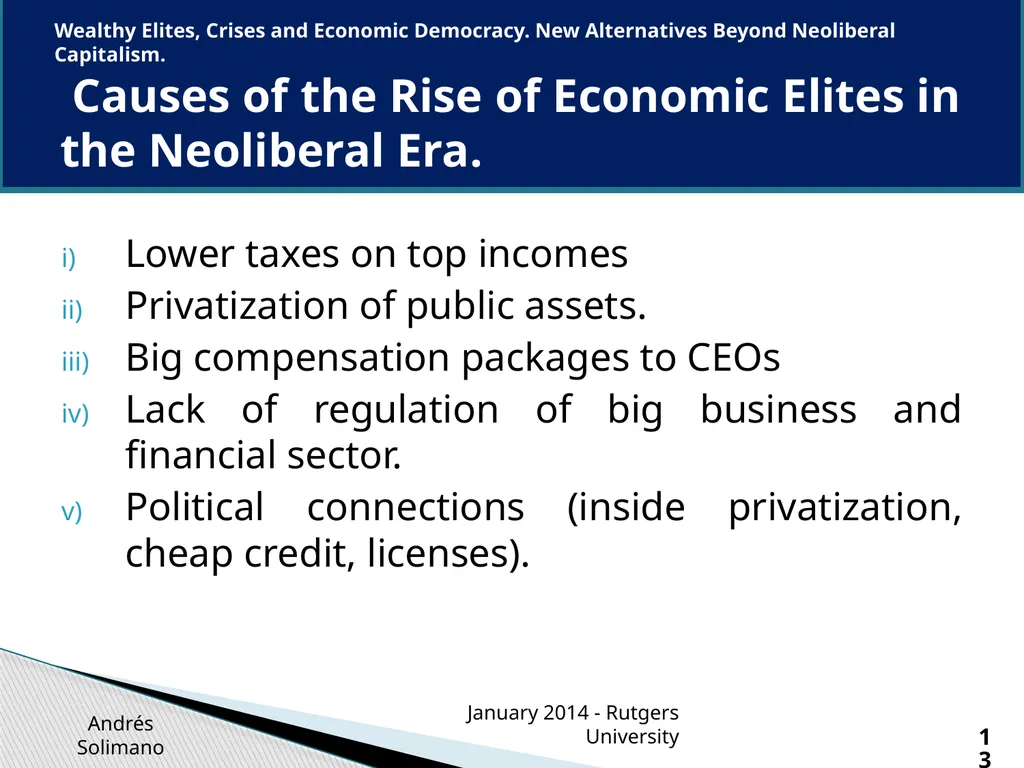
Lower taxes on top incomes
Privatization of public assets.
Big compensation packages to CEOs
Lack of regulation of big business and financial sector.
Political connections (inside privatization, cheap credit, licenses). January 2014 - Rutgers University 13 Causes of the Rise of Economic Elites in the Neoliberal Era. Wealthy Elites, Crises and Economic Democracy. New Alternatives Beyond Neoliberal Capitalism. Andrés Solimano<br>
14
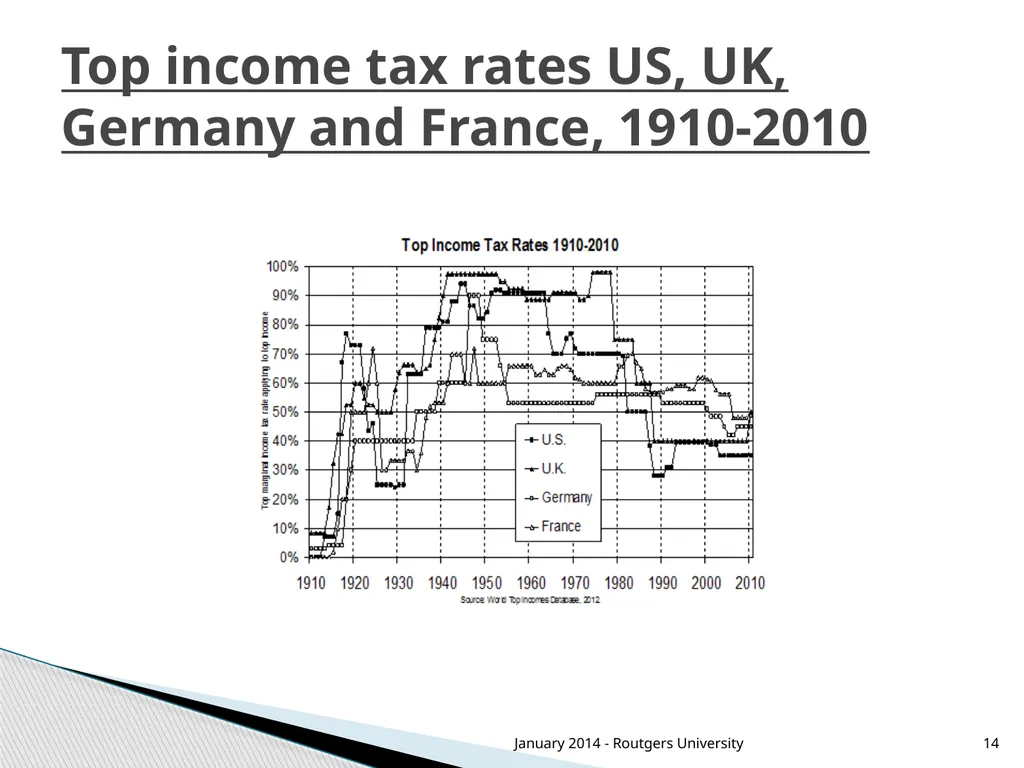
January 2014 - Routgers University 14 Top income tax rates US, UK, Germany and France, 1910-2010<br>
15
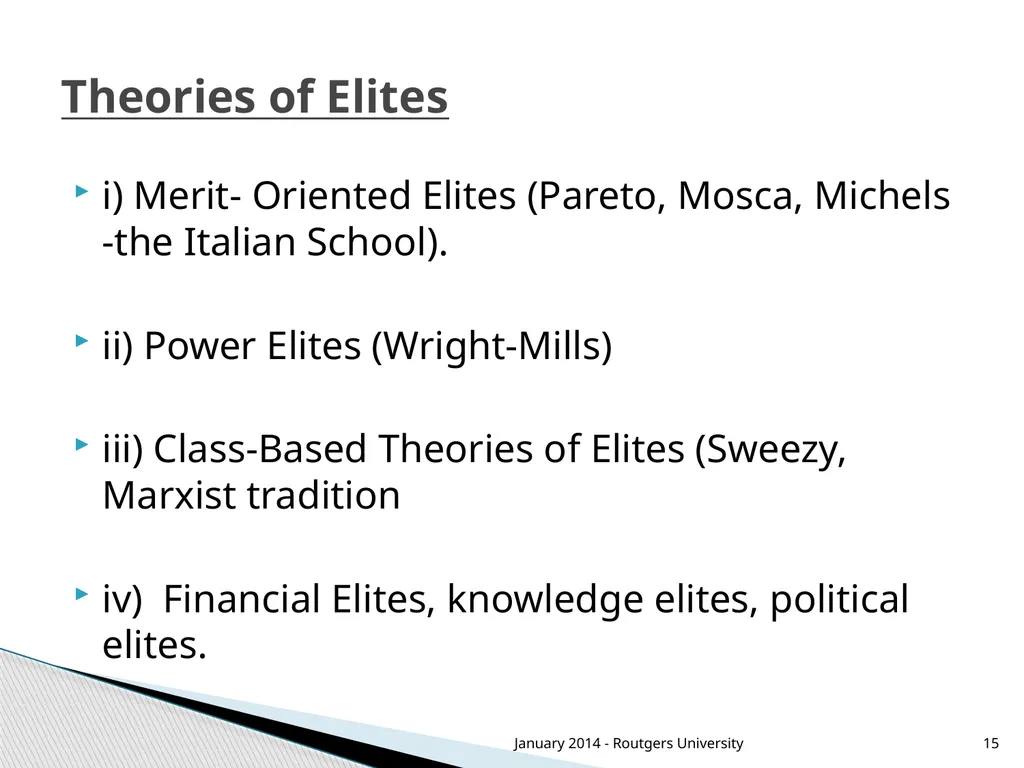
i) Merit- Oriented Elites (Pareto, Mosca, Michels -the Italian School).
ii) Power Elites (Wright-Mills)
iii) Class-Based Theories of Elites (Sweezy, Marxist tradition
iv) Financial Elites, knowledge elites, political elites. January 2014 - Routgers University 15 Theories of Elites<br>
ii) Power Elites (Wright-Mills)
iii) Class-Based Theories of Elites (Sweezy, Marxist tradition
iv) Financial Elites, knowledge elites, political elites. January 2014 - Routgers University 15 Theories of Elites<br>
16
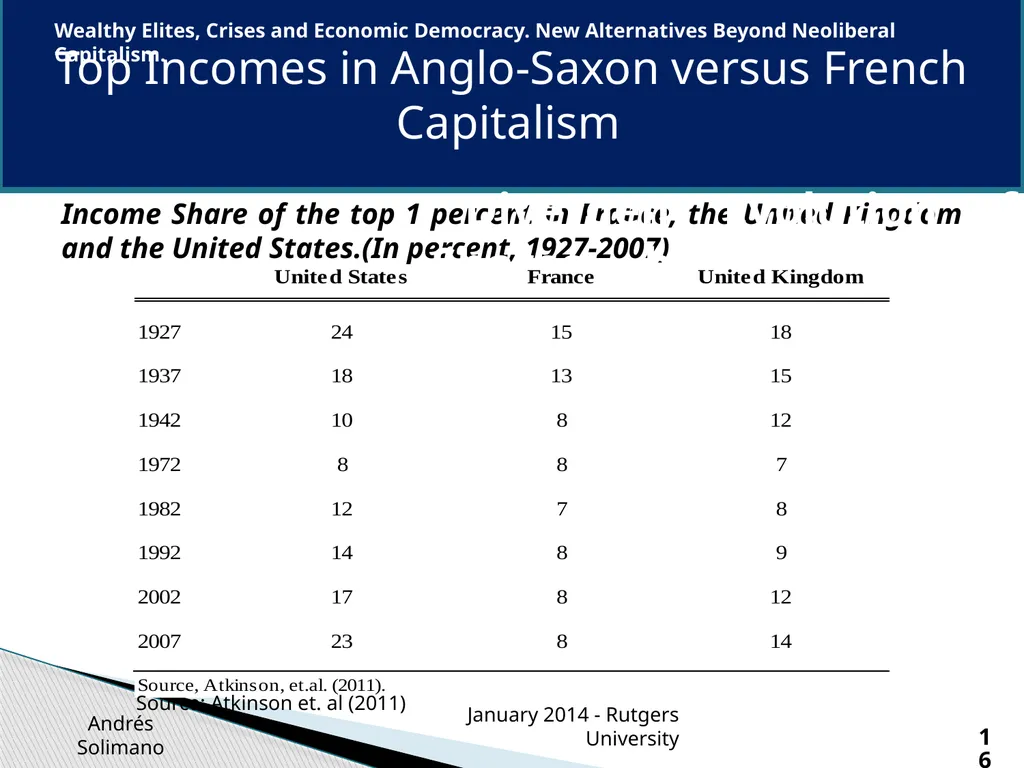
Top Incomes in Anglo-Saxon versus French Capitalism Income Share of the top 1 percent in France, the United Kingdom and the United States.(In percent, 1927-2007) January 2014 - Rutgers University 16 Divergent Evolution of Top Income Shares between Anglo-Saxon and French Capitalism Wealthy Elites, Crises and Economic Democracy. New Alternatives Beyond Neoliberal Capitalism. Andrés Solimano Source: Atkinson et. al (2011)<br>
17
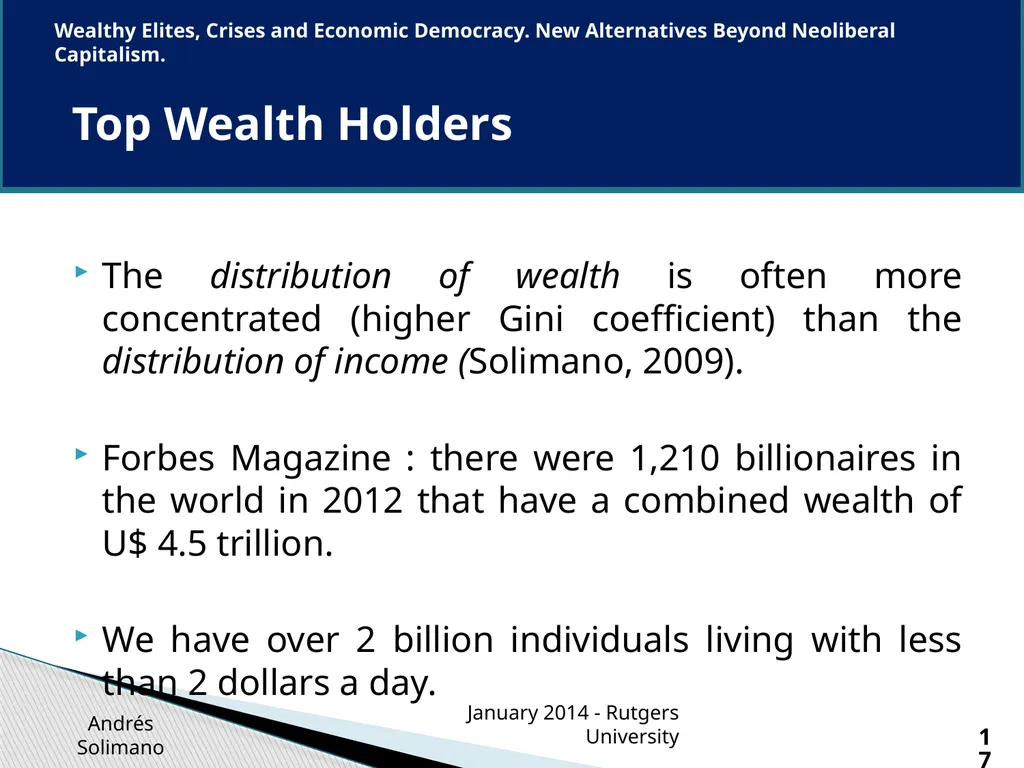
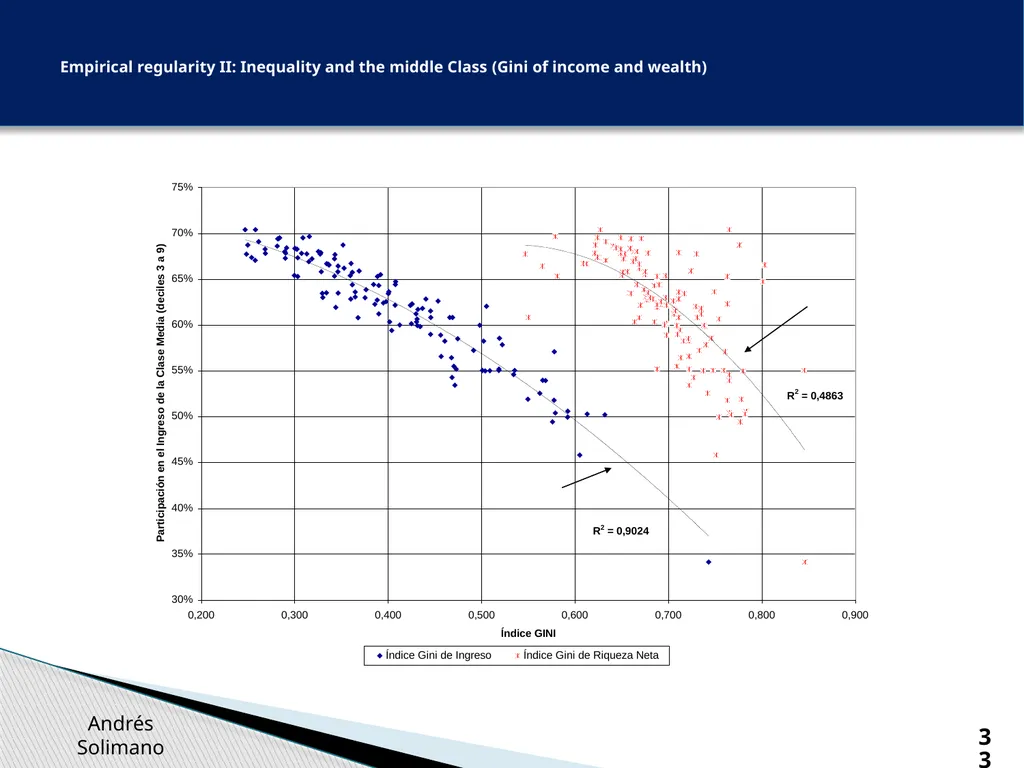
The distribution of wealth is often more concentrated (higher Gini coefficient) than the distribution of income (Solimano, 2009).
Forbes Magazine : there were 1,210 billionaires in the world in 2012 that have a combined wealth of U$ 4.5 trillion.
We have over 2 billion individuals living with less than 2 dollars a day. January 2014 - Rutgers University 17 Top Wealth Holders Wealthy Elites, Crises and Economic Democracy. New Alternatives Beyond Neoliberal Capitalism. Andrés Solimano<br>
18
Worldwide top 10 Billionaires by Country (2011) January 2014 - Rutgers University 18 Top Wealth Holders by country around the world Wealthy Elites, Crises and Economic Democracy. New Alternatives Beyond Neoliberal Capitalism. Andrés Solimano Source: Forbes.com and Wikipedia.<br>
19
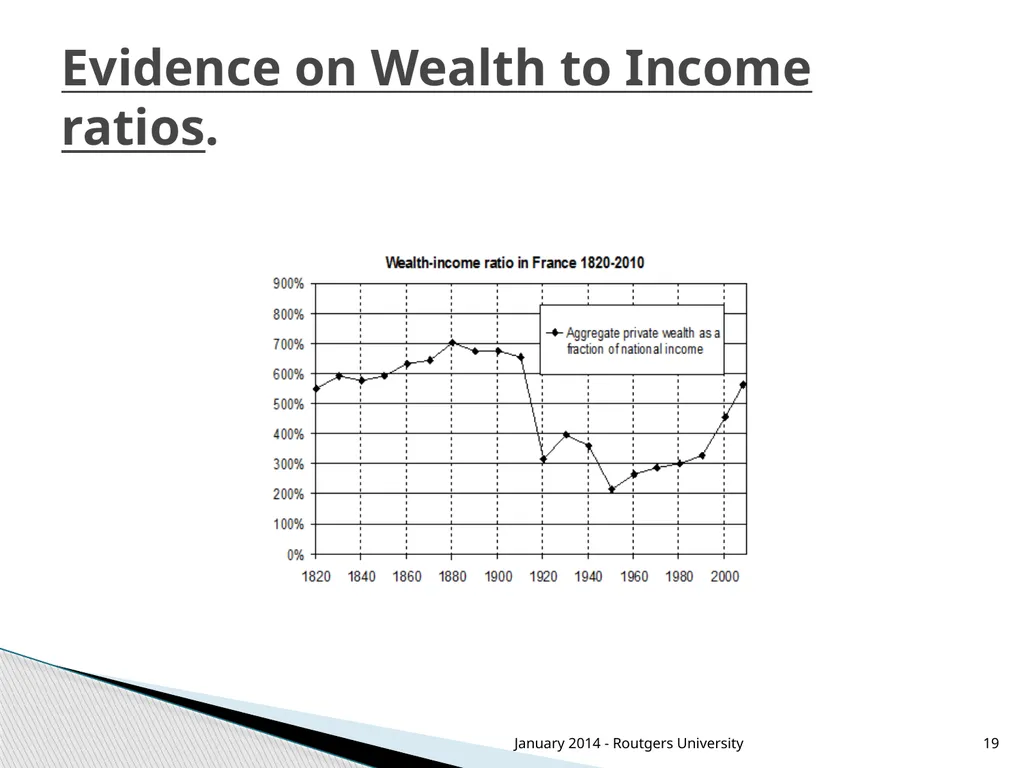
January 2014 - Routgers University 19 Evidence on Wealth to Income ratios.<br>
20
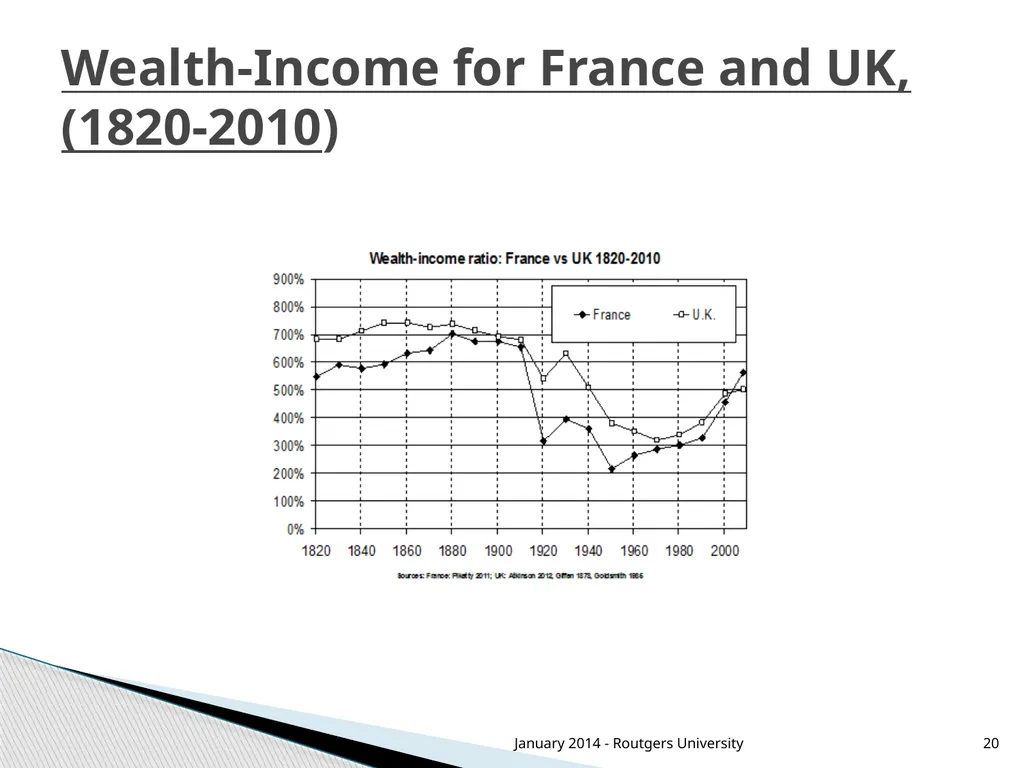
January 2014 - Routgers University 20 Wealth-Income for France and UK, (1820-2010)<br>
21
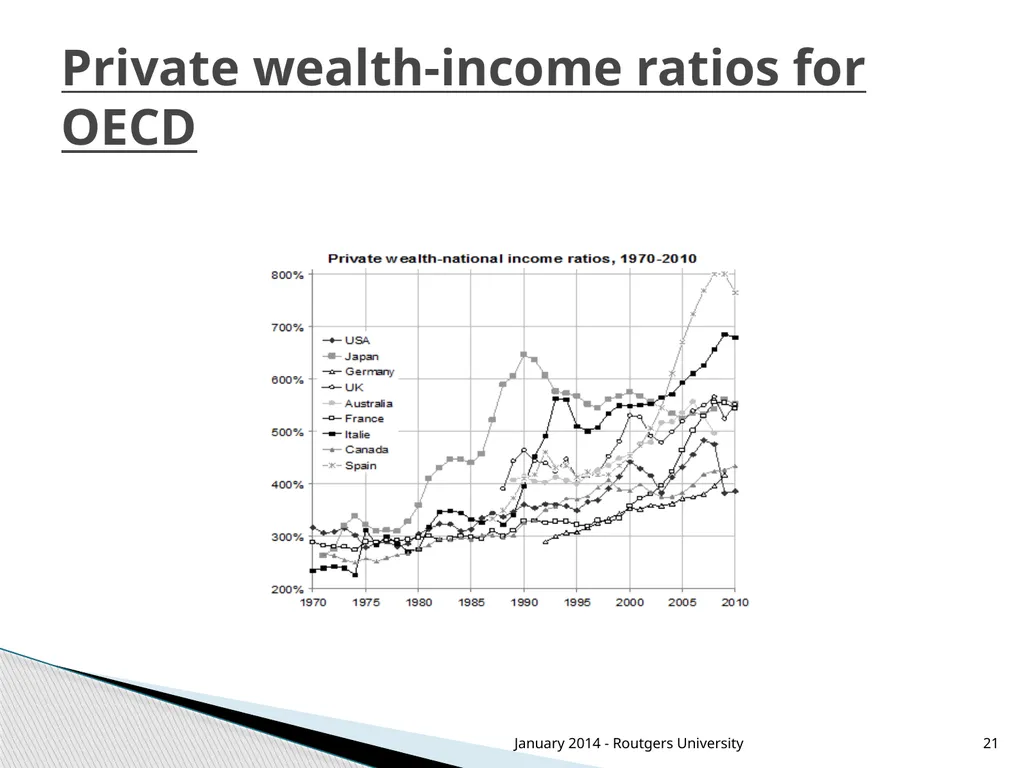
January 2014 - Routgers University 21 Private wealth-income ratios for OECD<br>
22
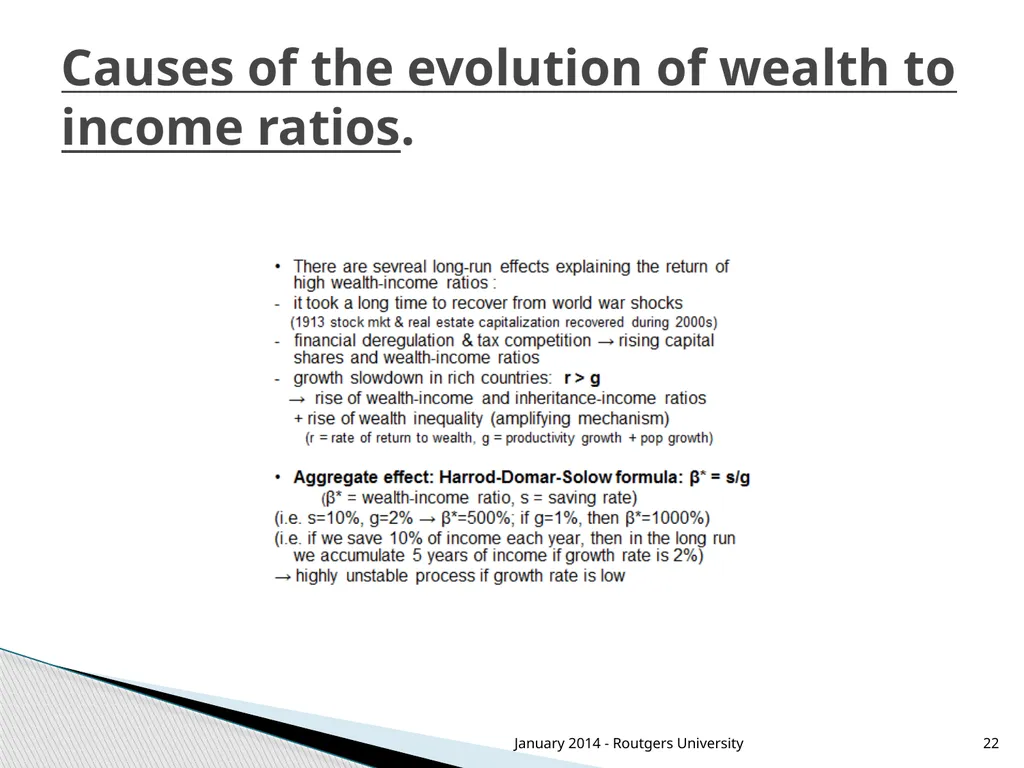
January 2014 - Routgers University 22 Causes of the evolution of wealth to income ratios.<br>
23
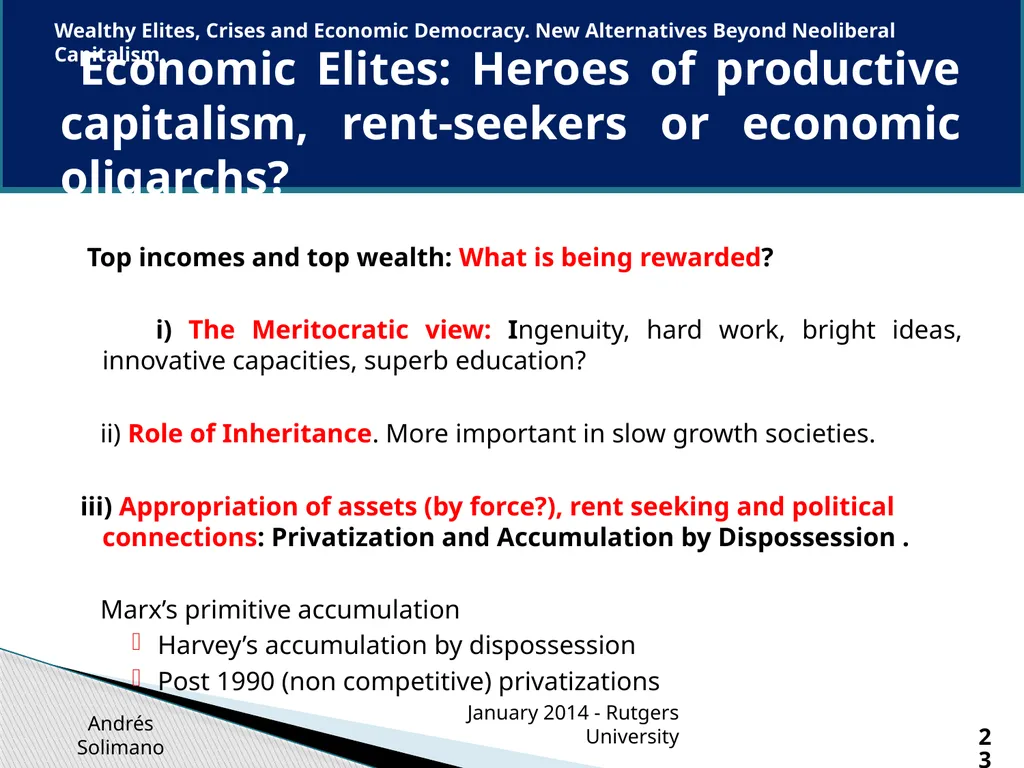
Top incomes and top wealth: What is being rewarded?
i) The Meritocratic view: Ingenuity, hard work, bright ideas, innovative capacities, superb education?
ii) Role of Inheritance. More important in slow growth societies.
iii) Appropriation of assets (by force?), rent seeking and political connections: Privatization and Accumulation by Dispossession .
Marx’s primitive accumulation
Harvey’s accumulation by dispossession
Post 1990 (non competitive) privatizations January 2014 - Rutgers University 23 Economic Elites: Heroes of productive capitalism, rent-seekers or economic oligarchs? Wealthy Elites, Crises and Economic Democracy. New Alternatives Beyond Neoliberal Capitalism. Andrés Solimano<br>
24
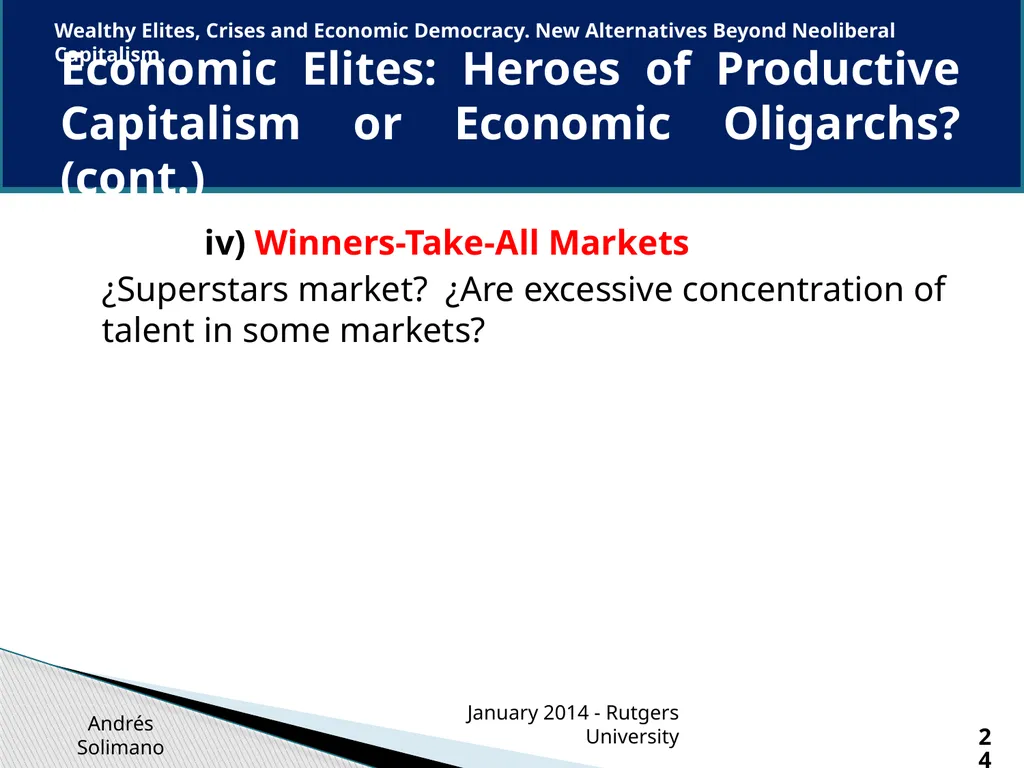
iv) Winners-Take-All Markets
¿Superstars market? ¿Are excessive concentration of talent in some markets? January 2014 - Rutgers University 24 Wealthy Elites, Crises and Economic Democracy. New Alternatives Beyond Neoliberal Capitalism. Andrés Solimano Economic Elites: Heroes of Productive Capitalism or Economic Oligarchs? (cont.)<br>
¿Superstars market? ¿Are excessive concentration of talent in some markets? January 2014 - Rutgers University 24 Wealthy Elites, Crises and Economic Democracy. New Alternatives Beyond Neoliberal Capitalism. Andrés Solimano Economic Elites: Heroes of Productive Capitalism or Economic Oligarchs? (cont.)<br>
25
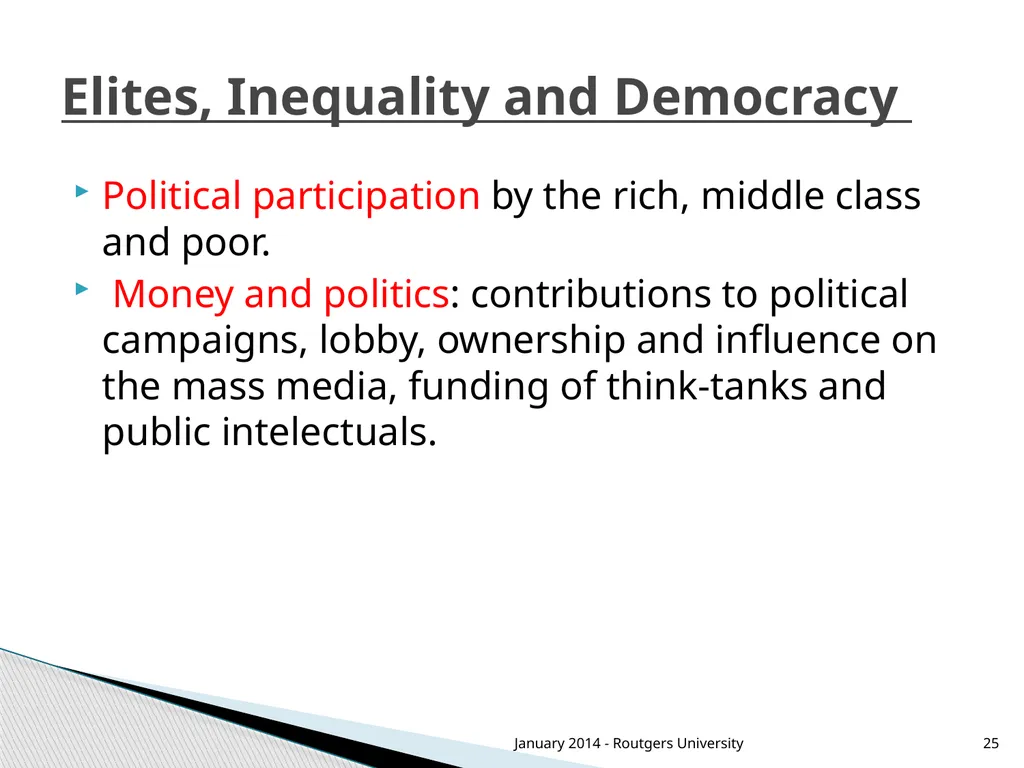
Political participation by the rich, middle class and poor.
Money and politics: contributions to political campaigns, lobby, ownership and influence on the mass media, funding of think-tanks and public intelectuals. January 2014 - Routgers University 25 Elites, Inequality and Democracy<br>
Money and politics: contributions to political campaigns, lobby, ownership and influence on the mass media, funding of think-tanks and public intelectuals. January 2014 - Routgers University 25 Elites, Inequality and Democracy<br>
26
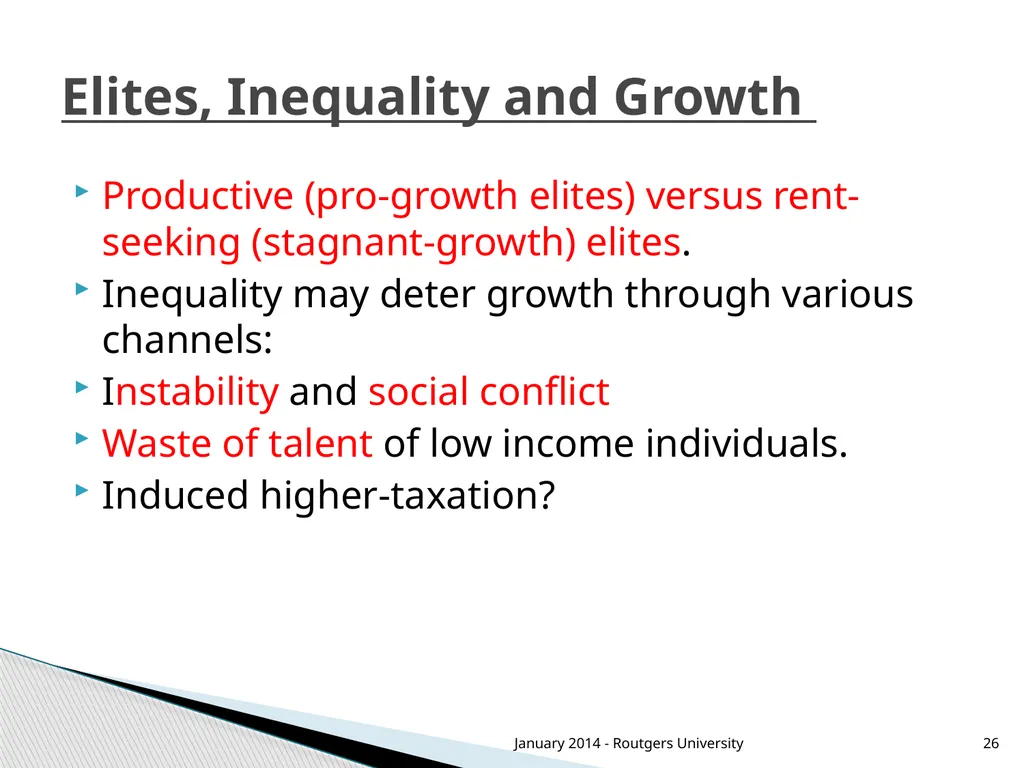
Productive (pro-growth elites) versus rent-seeking (stagnant-growth) elites.
Inequality may deter growth through various channels:
Instability and social conflict
Waste of talent of low income individuals.
Induced higher-taxation? January 2014 - Routgers University 26 Elites, Inequality and Growth<br>
Inequality may deter growth through various channels:
Instability and social conflict
Waste of talent of low income individuals.
Induced higher-taxation? January 2014 - Routgers University 26 Elites, Inequality and Growth<br>
27
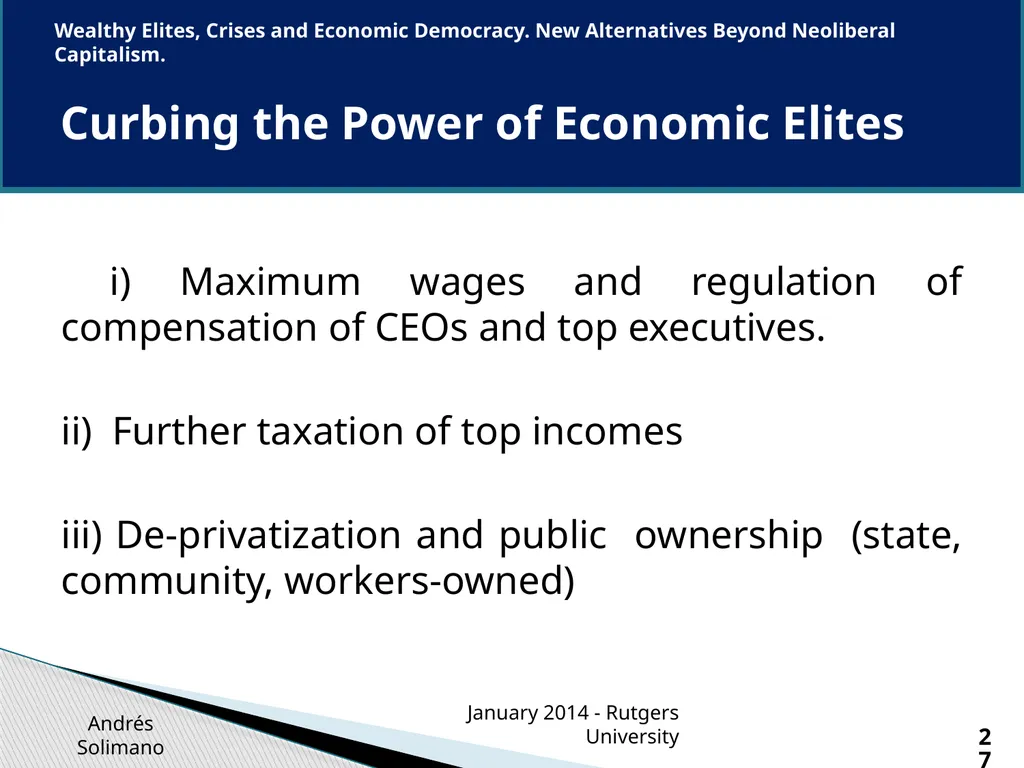
i) Maximum wages and regulation of compensation of CEOs and top executives.
ii) Further taxation of top incomes
iii) De-privatization and public ownership (state, community, workers-owned) January 2014 - Rutgers University 27 Curbing the Power of Economic Elites Wealthy Elites, Crises and Economic Democracy. New Alternatives Beyond Neoliberal Capitalism. Andrés Solimano<br>
28
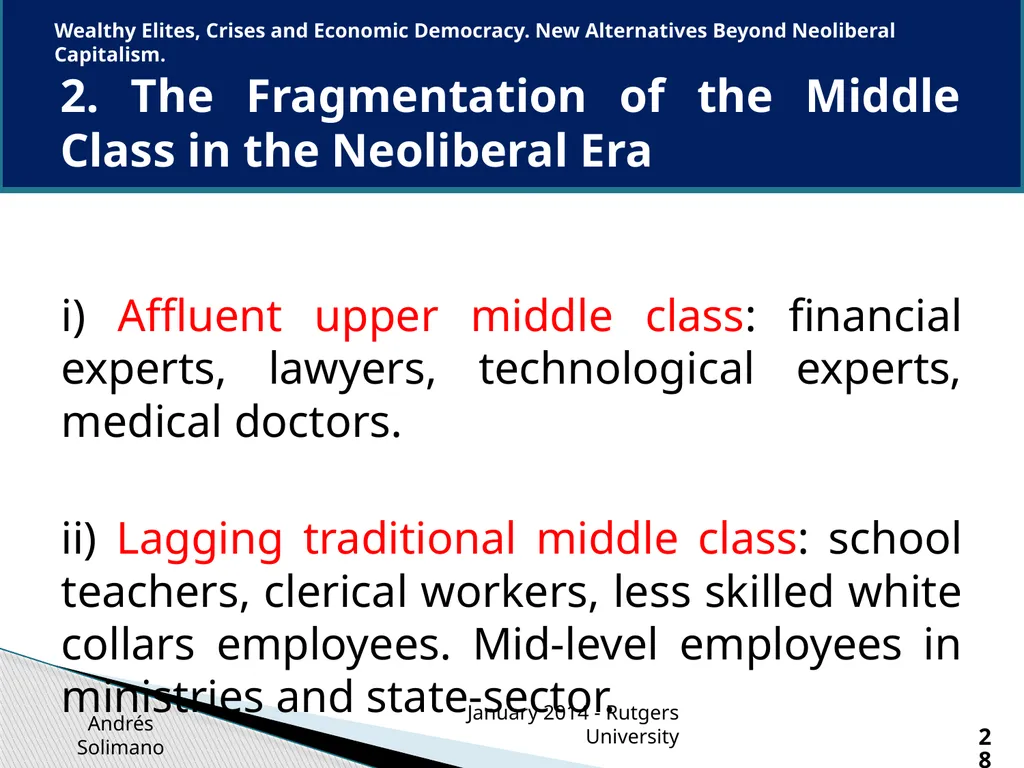
i) Affluent upper middle class: financial experts, lawyers, technological experts, medical doctors.
ii) Lagging traditional middle class: school teachers, clerical workers, less skilled white collars employees. Mid-level employees in ministries and state-sector. January 2014 - Rutgers University 28 2. The Fragmentation of the Middle Class in the Neoliberal Era Wealthy Elites, Crises and Economic Democracy. New Alternatives Beyond Neoliberal Capitalism. Andrés Solimano<br>
ii) Lagging traditional middle class: school teachers, clerical workers, less skilled white collars employees. Mid-level employees in ministries and state-sector. January 2014 - Rutgers University 28 2. The Fragmentation of the Middle Class in the Neoliberal Era Wealthy Elites, Crises and Economic Democracy. New Alternatives Beyond Neoliberal Capitalism. Andrés Solimano<br>
29
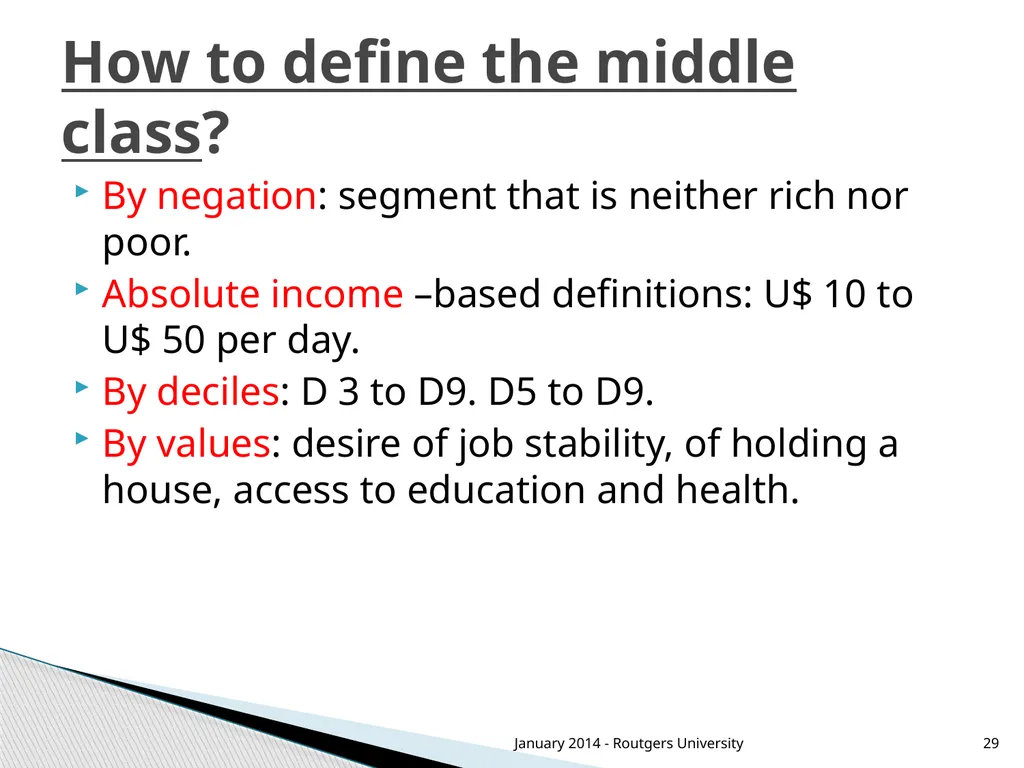
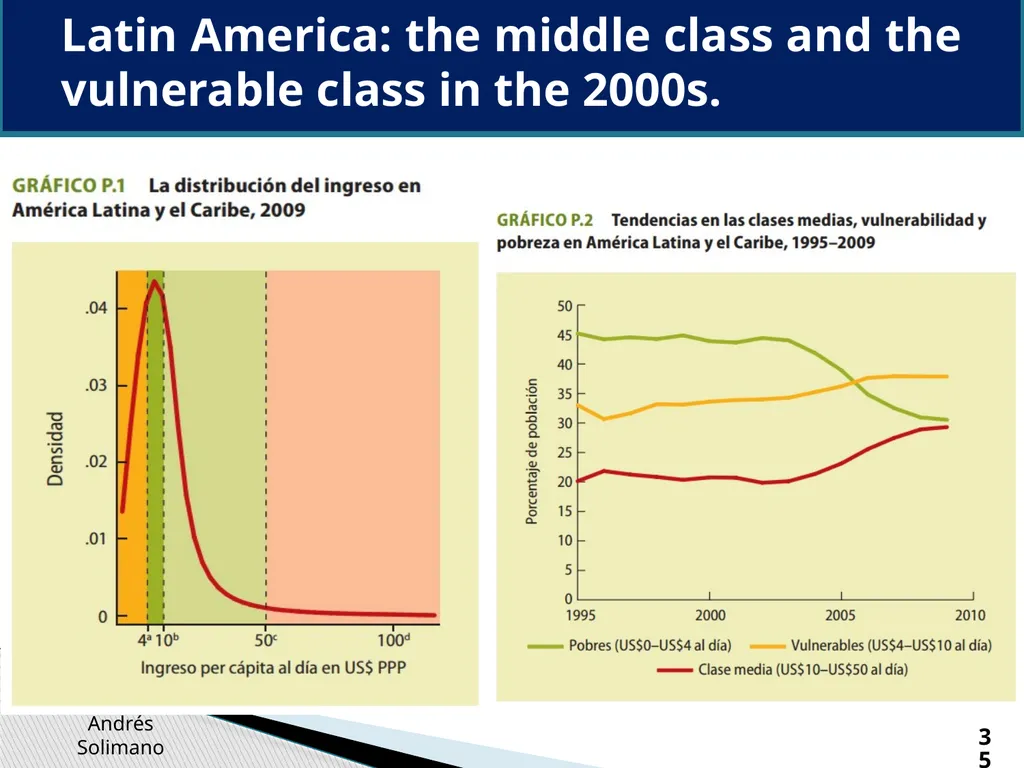
By negation: segment that is neither rich nor poor.
Absolute income –based definitions: U$ 10 to U$ 50 per day.
By deciles: D 3 to D9. D5 to D9.
By values: desire of job stability, of holding a house, access to education and health. January 2014 - Routgers University 29 How to define the middle class?<br>
Absolute income –based definitions: U$ 10 to U$ 50 per day.
By deciles: D 3 to D9. D5 to D9.
By values: desire of job stability, of holding a house, access to education and health. January 2014 - Routgers University 29 How to define the middle class?<br>
30
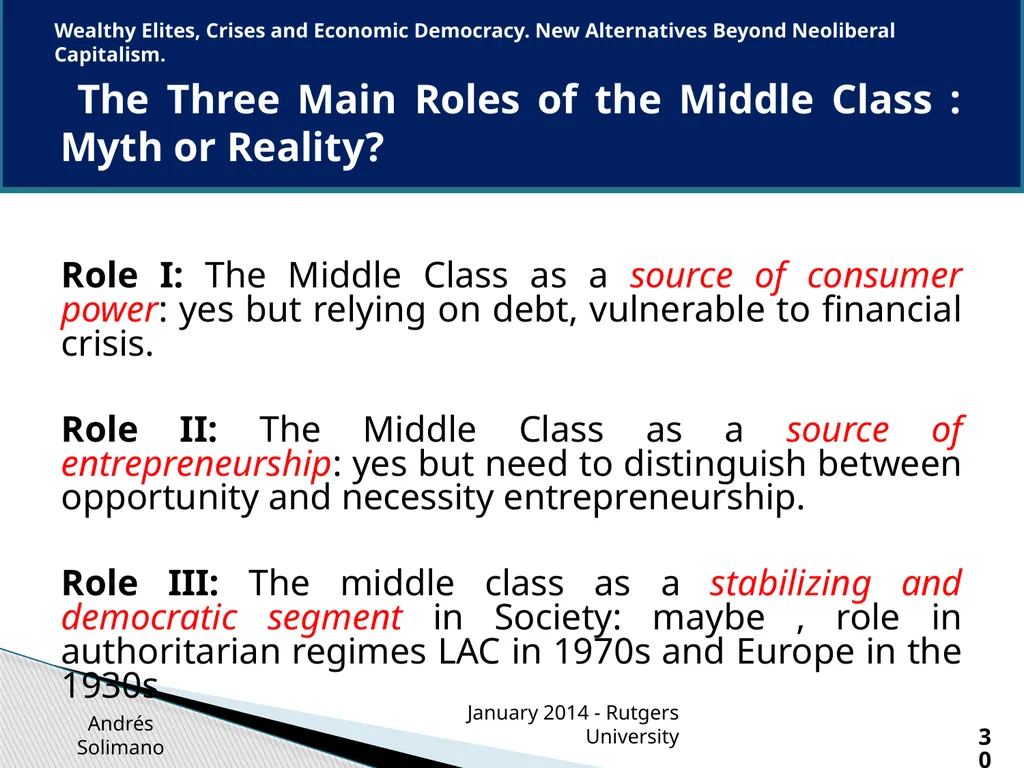
Role I: The Middle Class as a source of consumer power: yes but relying on debt, vulnerable to financial crisis.
Role II: The Middle Class as a source of entrepreneurship: yes but need to distinguish between opportunity and necessity entrepreneurship.
Role III: The middle class as a stabilizing and democratic segment in Society: maybe , role in authoritarian regimes LAC in 1970s and Europe in the 1930s. January 2014 - Rutgers University 30 The Three Main Roles of the Middle Class : Myth or Reality? Wealthy Elites, Crises and Economic Democracy. New Alternatives Beyond Neoliberal Capitalism. Andrés Solimano<br>
31
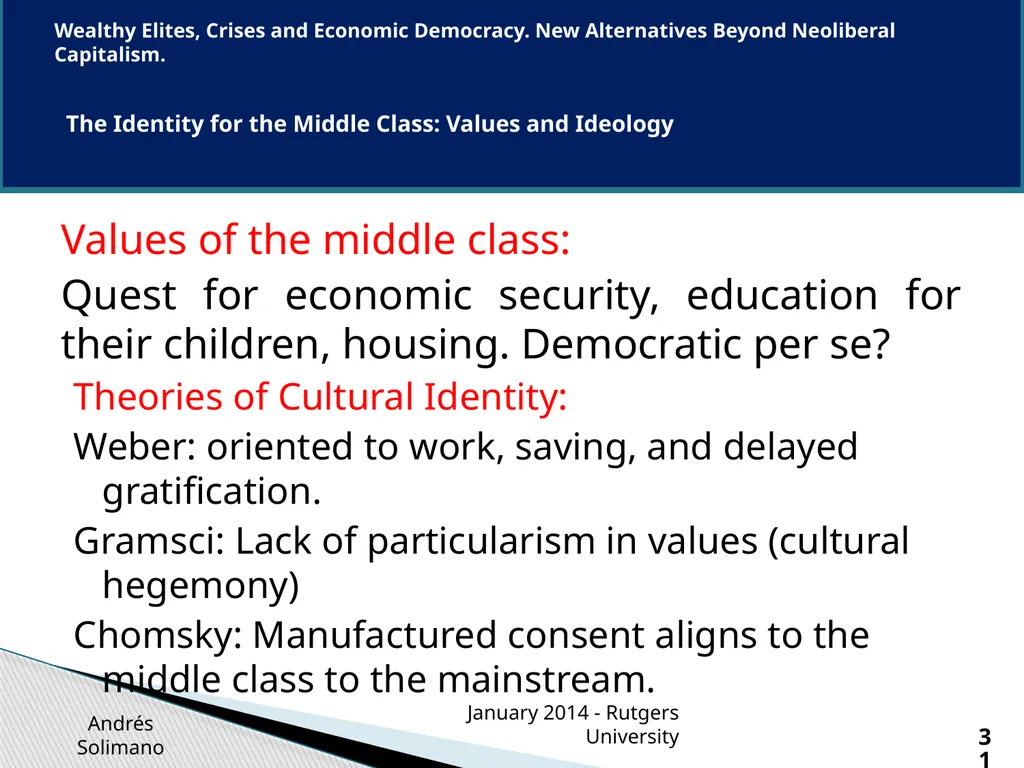
Values of the middle class:
Quest for economic security, education for their children, housing. Democratic per se?
Theories of Cultural Identity:
Weber: oriented to work, saving, and delayed gratification.
Gramsci: Lack of particularism in values (cultural hegemony)
Chomsky: Manufactured consent aligns to the middle class to the mainstream. January 2014 - Rutgers University 31 The Identity for the Middle Class: Values and Ideology Wealthy Elites, Crises and Economic Democracy. New Alternatives Beyond Neoliberal Capitalism. Andrés Solimano<br>
32
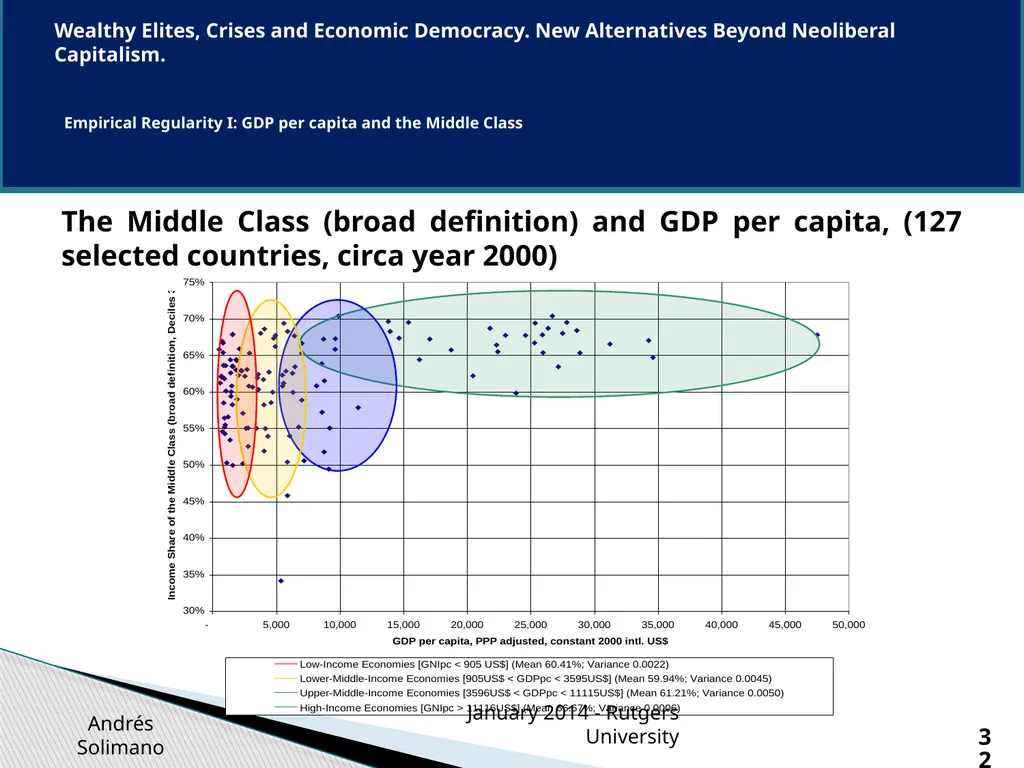
The Middle Class (broad definition) and GDP per capita, (127 selected countries, circa year 2000) January 2014 - Rutgers University 32 Empirical Regularity I: GDP per capita and the Middle Class Wealthy Elites, Crises and Economic Democracy. New Alternatives Beyond Neoliberal Capitalism. Andrés Solimano<br>
33
33 Empirical regularity II: Inequality and the middle Class (Gini of income and wealth) Andrés Solimano<br>
34
Since the late 1970s the income share of the top 10 percent (D10) starts going-up (redistribution to the rich).
This redistribution comes mainly from the bottom 40% (D1-D4) that sees its income share decline since the 1970s.
The share of the middle class (D5-D9) remains relatively flat. January 2014 - Routgers University 34 Income polarization in the US since the 1970s<br>
This redistribution comes mainly from the bottom 40% (D1-D4) that sees its income share decline since the 1970s.
The share of the middle class (D5-D9) remains relatively flat. January 2014 - Routgers University 34 Income polarization in the US since the 1970s<br>
35
35 Latin America: the middle class and the vulnerable class in the 2000s. Andrés Solimano<br>
36
In advanced capitalist countries labor is affected by:
i) Globalization of production to low-wage countries.
ii) Outsourcing of services and parts and intermediate products.
iv) Labor saving technical change
v) immigration from developing countries
vi) De-unionization January 2014 - Routgers University 36 Labor in the global Era<br>
i) Globalization of production to low-wage countries.
ii) Outsourcing of services and parts and intermediate products.
iv) Labor saving technical change
v) immigration from developing countries
vi) De-unionization January 2014 - Routgers University 36 Labor in the global Era<br>
37
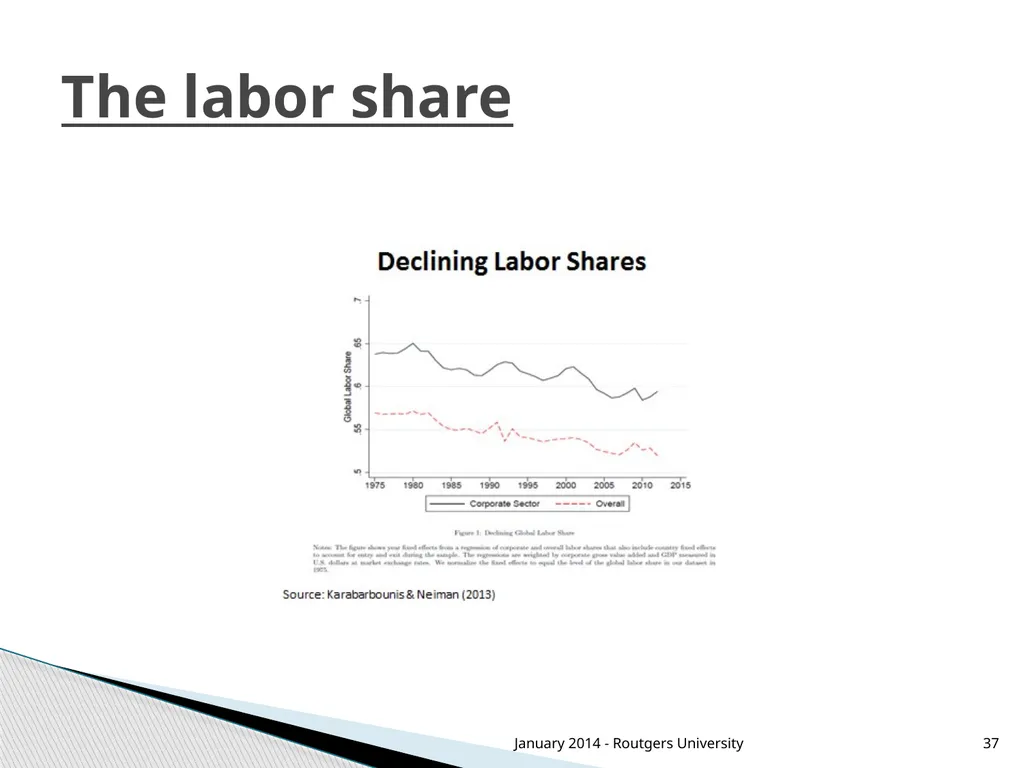
January 2014 - Routgers University 37 The labor share<br>
38
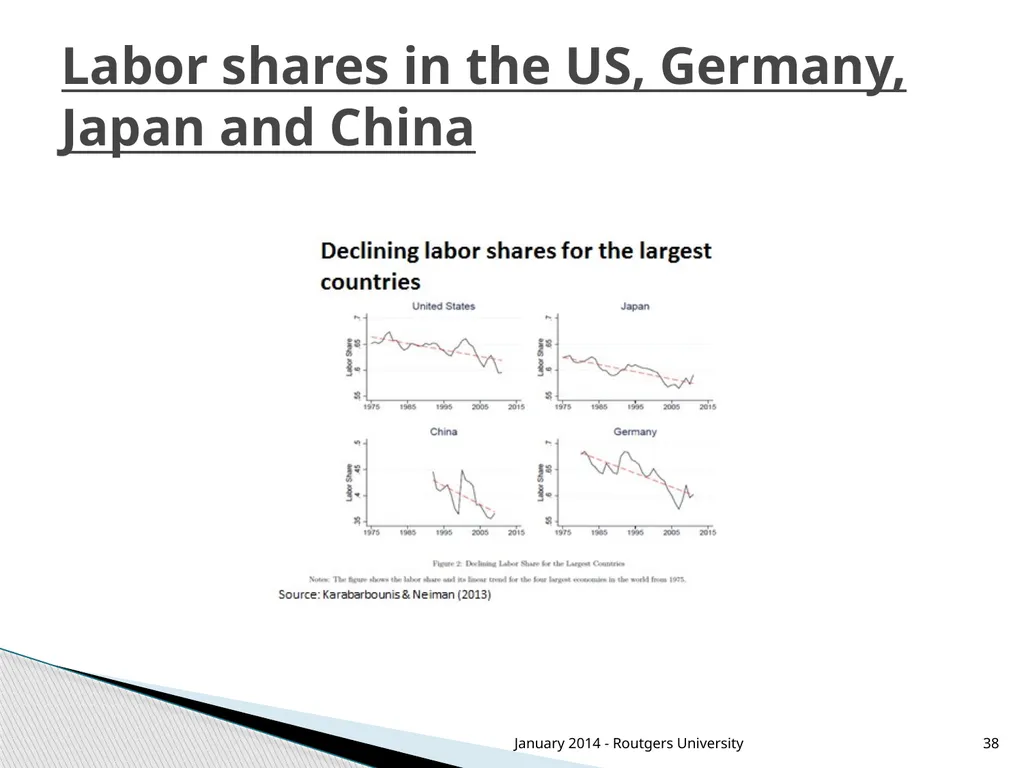
January 2014 - Routgers University 38 Labor shares in the US, Germany, Japan and China<br>
39
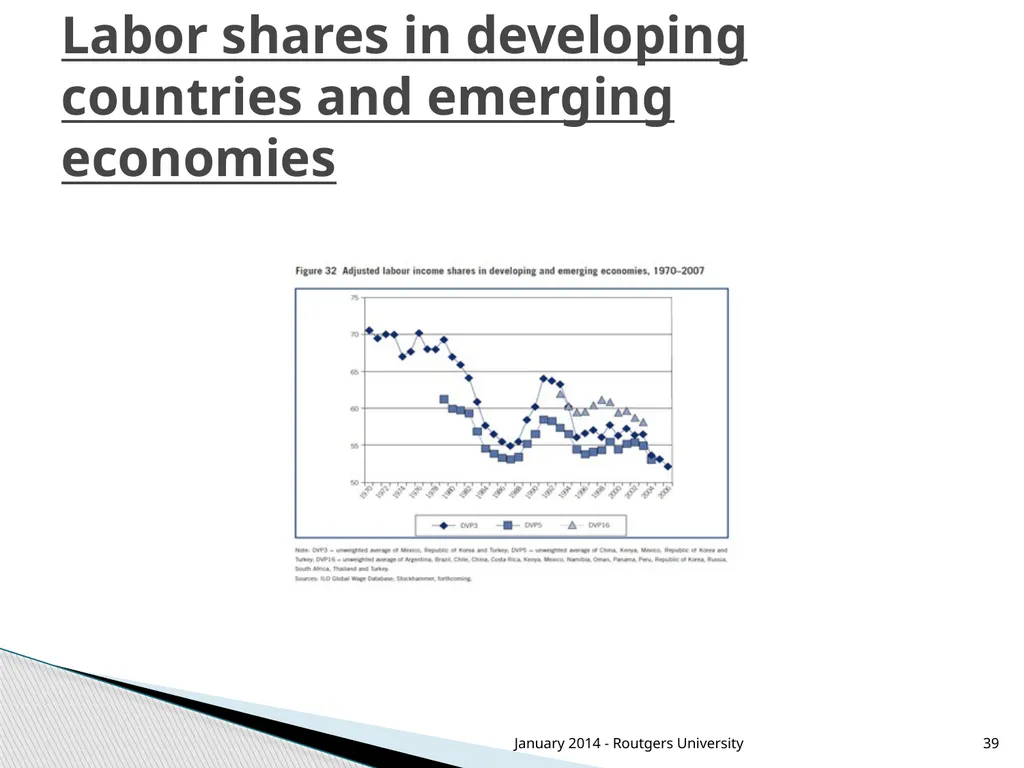
January 2014 - Routgers University 39 Labor shares in developing countries and emerging economies<br>
40
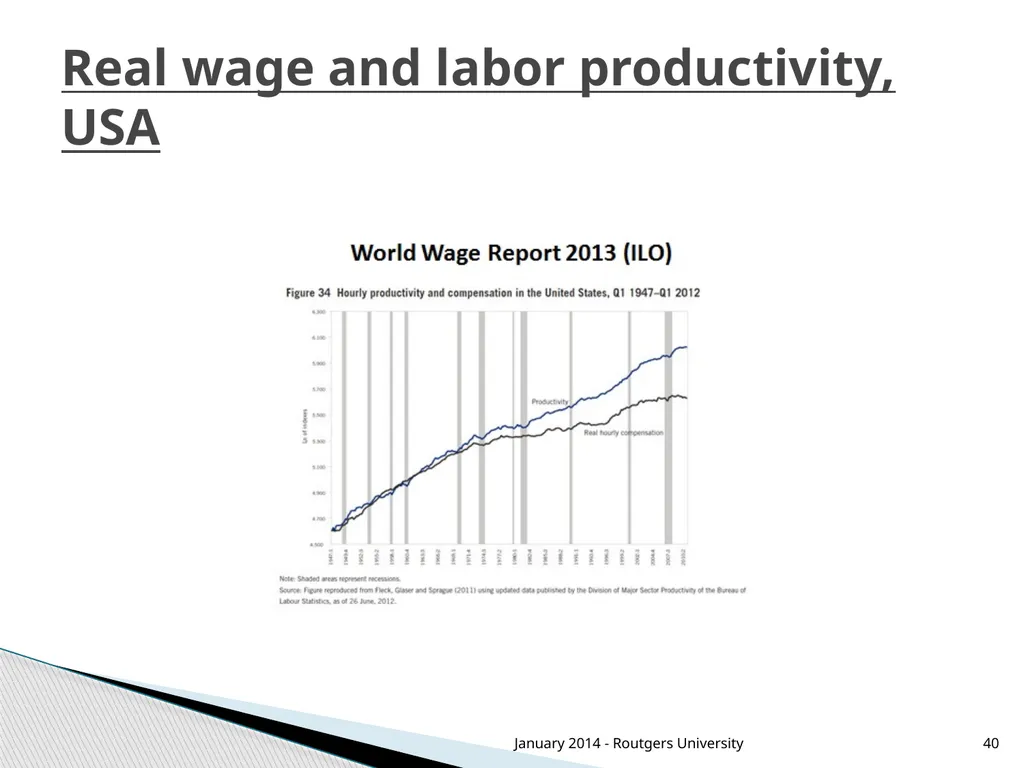
January 2014 - Routgers University 40 Real wage and labor productivity, USA<br>
41
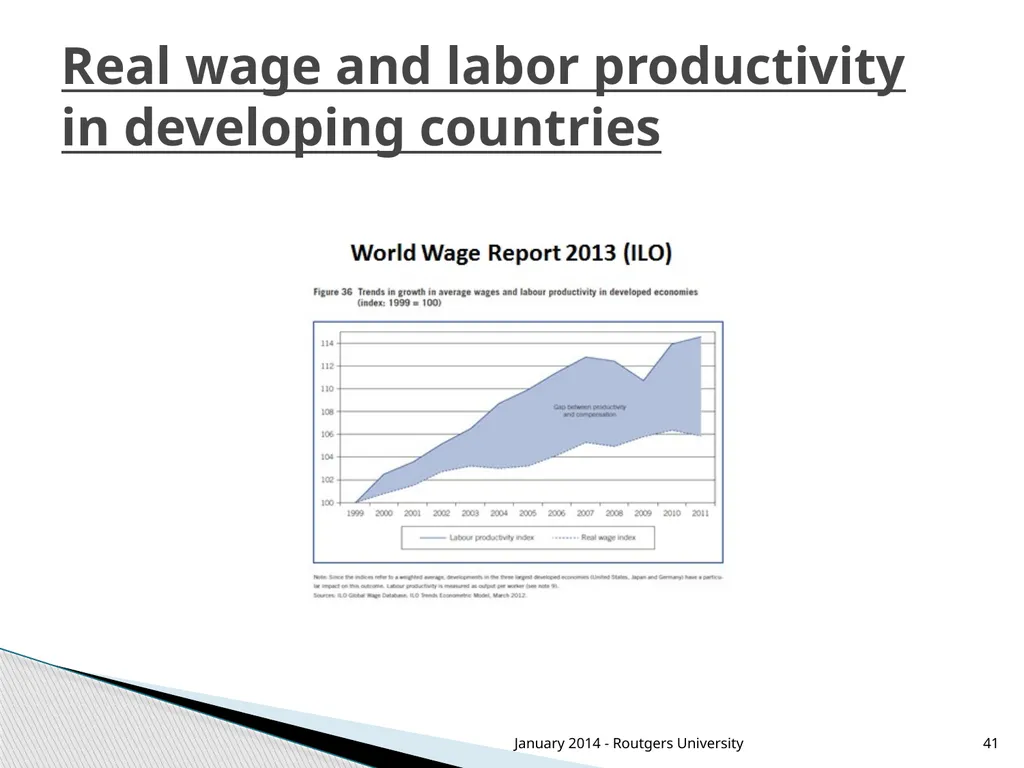
January 2014 - Routgers University 41 Real wage and labor productivity in developing countries<br>
42
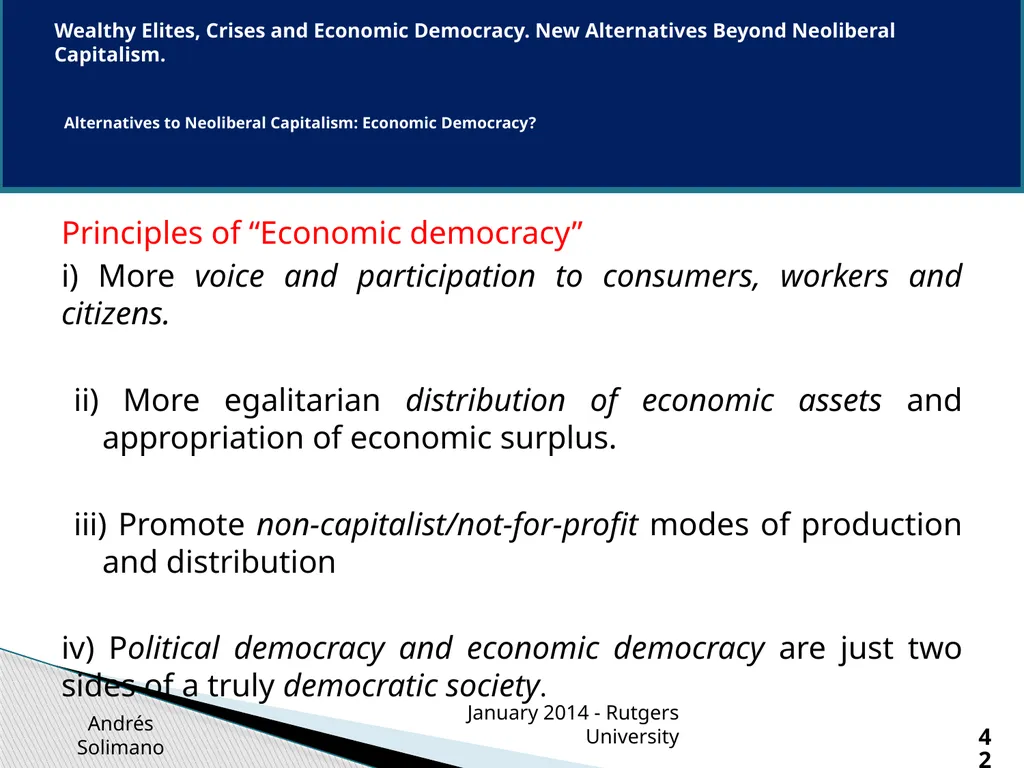
Principles of “Economic democracy”
i) More voice and participation to consumers, workers and citizens.
ii) More egalitarian distribution of economic assets and appropriation of economic surplus.
iii) Promote non-capitalist/not-for-profit modes of production and distribution
iv) Political democracy and economic democracy are just two sides of a truly democratic society. January 2014 - Rutgers University 42 Alternatives to Neoliberal Capitalism: Economic Democracy? Wealthy Elites, Crises and Economic Democracy. New Alternatives Beyond Neoliberal Capitalism. Andrés Solimano<br>
43
The Mondragon Corporation in the Basque country in Spain (85% of his workers are member of the cooperative).
Around 1 billion people worldwide are members of a cooperative.
Cooperatives provide close to 100 million jobs worldwide (20% more than multinational corporations). January 2014 - Rutgers University 43 Cases of Economic Democracy. Wealthy Elites, Crises and Economic Democracy. New Alternatives Beyond Neoliberal Capitalism. Andrés Solimano<br>
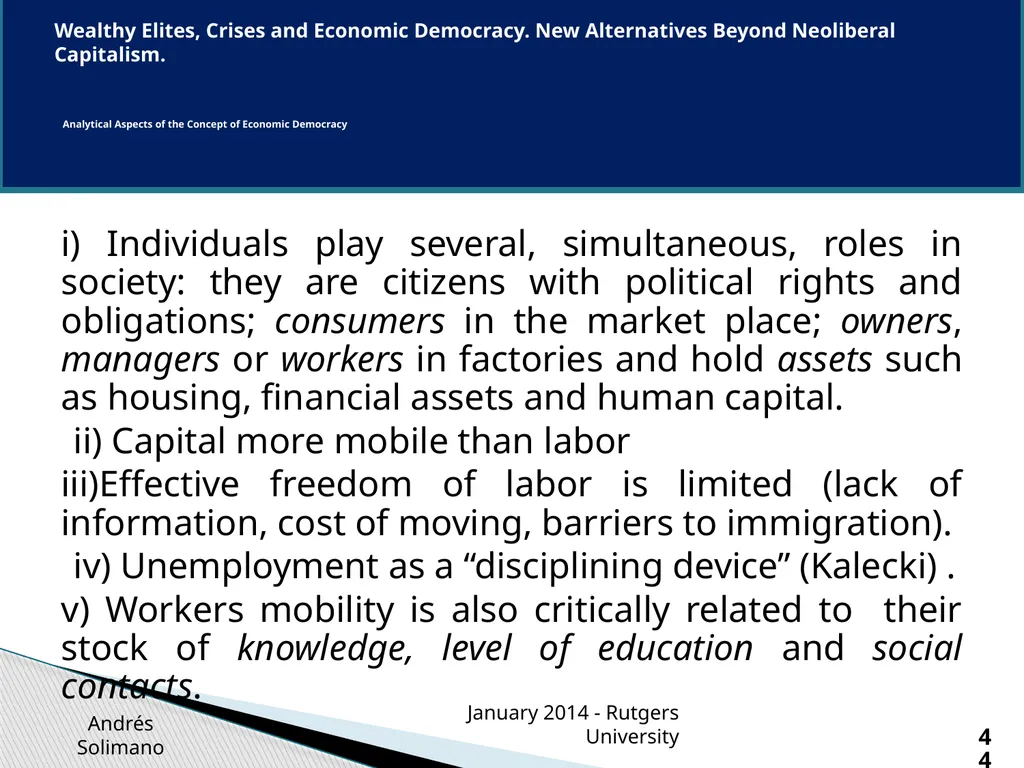
44
i) Individuals play several, simultaneous, roles in society: they are citizens with political rights and obligations; consumers in the market place; owners, managers or workers in factories and hold assets such as housing, financial assets and human capital.
ii) Capital more mobile than labor
iii)Effective freedom of labor is limited (lack of information, cost of moving, barriers to immigration).
iv) Unemployment as a “disciplining device” (Kalecki) .
v) Workers mobility is also critically related to their stock of knowledge, level of education and social contacts. January 2014 - Rutgers University 44 Analytical Aspects of the Concept of Economic Democracy Wealthy Elites, Crises and Economic Democracy. New Alternatives Beyond Neoliberal Capitalism. Andrés Solimano<br>
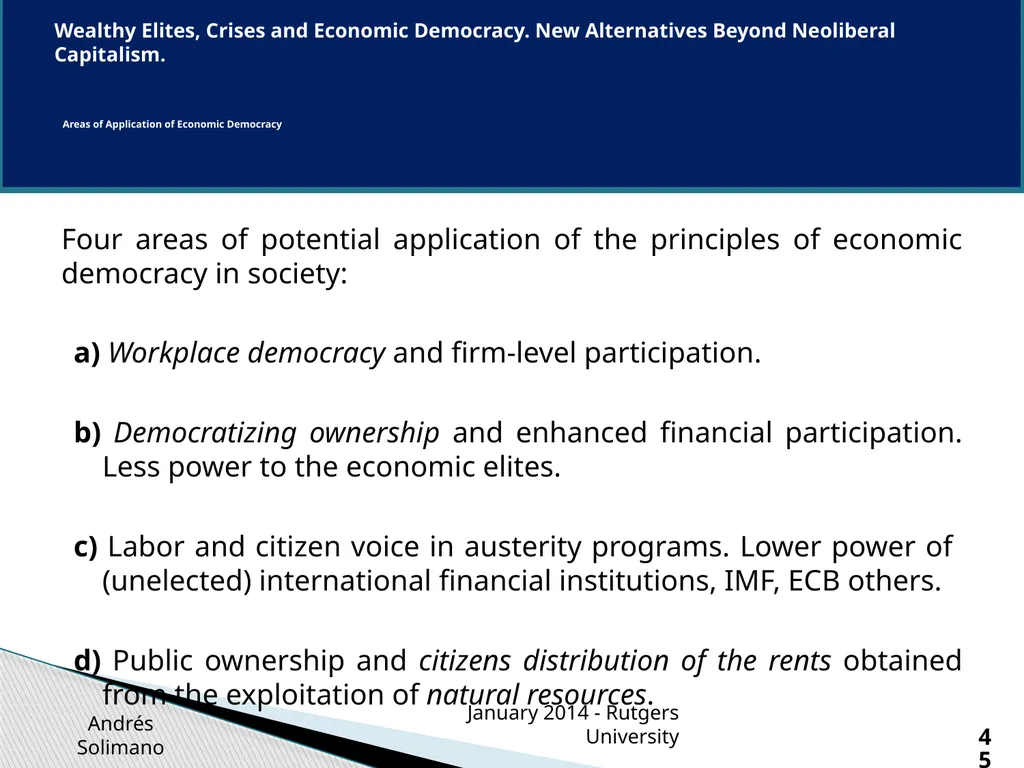
45
Four areas of potential application of the principles of economic democracy in society:
a) Workplace democracy and firm-level participation.
b) Democratizing ownership and enhanced financial participation. Less power to the economic elites.
c) Labor and citizen voice in austerity programs. Lower power of (unelected) international financial institutions, IMF, ECB others.
d) Public ownership and citizens distribution of the rents obtained from the exploitation of natural resources. January 2014 - Rutgers University 45 Areas of Application of Economic Democracy Wealthy Elites, Crises and Economic Democracy. New Alternatives Beyond Neoliberal Capitalism. Andrés Solimano<br>
46
i) 21st capitalism is prone to generate an excessive power of economic elites that concentrate income, wealth and distort democracy.
ii) Fragmentation of the middle class
iii) Marginalization of labor
iv) High frequency of financial crises
iv) Need for more economic democracy and real political reform. January 2014 - Rutgers University 46 Concluding remarks Wealthy Elites, Crises and Economic Democracy. New Alternatives Beyond Neoliberal Capitalism. Andrés Solimano<br>