
Lecturer: Simon Winberg Digital Systems EEE4084F
NS
Published · 31 slides · 0 views
1 / 1
Description
Lecturer: Simon Winberg Digital Systems EEE4084F Lecture 24: RC Platform Case Studies 12 Tools and toolchain considerations The Cell Processor Attribution-ShareAlike 4.0 International (CC BY-SA 4.0) Microprocessor-based: The Cell
Related Topics
Share
Embed code
Download this presentation From Below
"Lecturer: Simon Winberg Digital Systems EEE4084F" is the property of its rightful owner. Permission is granted to download and print the materials on this website for personal, non-commercial use only, and to display it on your personal computer provided you do not modify the materials and that you retain all copyright notices contained in the materials. By downloading content from our website, you accept the terms of this agreement.
Presentation Transcript
01
Lecturer:
Simon Winberg Digital Systems EEE4084F Lecture 24: RC Platform Case Studies 1/2
Tools and toolchain considerations & The Cell Processor Attribution-ShareAlike 4.0 International (CC BY-SA 4.0) Microprocessor-based: The Cell Broadband Engine Architecture, IBM Blade FPGA-based:
PAM, VCC, SPLASH … (next lecture)<br>
Simon Winberg Digital Systems EEE4084F Lecture 24: RC Platform Case Studies 1/2
Tools and toolchain considerations & The Cell Processor Attribution-ShareAlike 4.0 International (CC BY-SA 4.0) Microprocessor-based: The Cell Broadband Engine Architecture, IBM Blade FPGA-based:
PAM, VCC, SPLASH … (next lecture)<br>
02
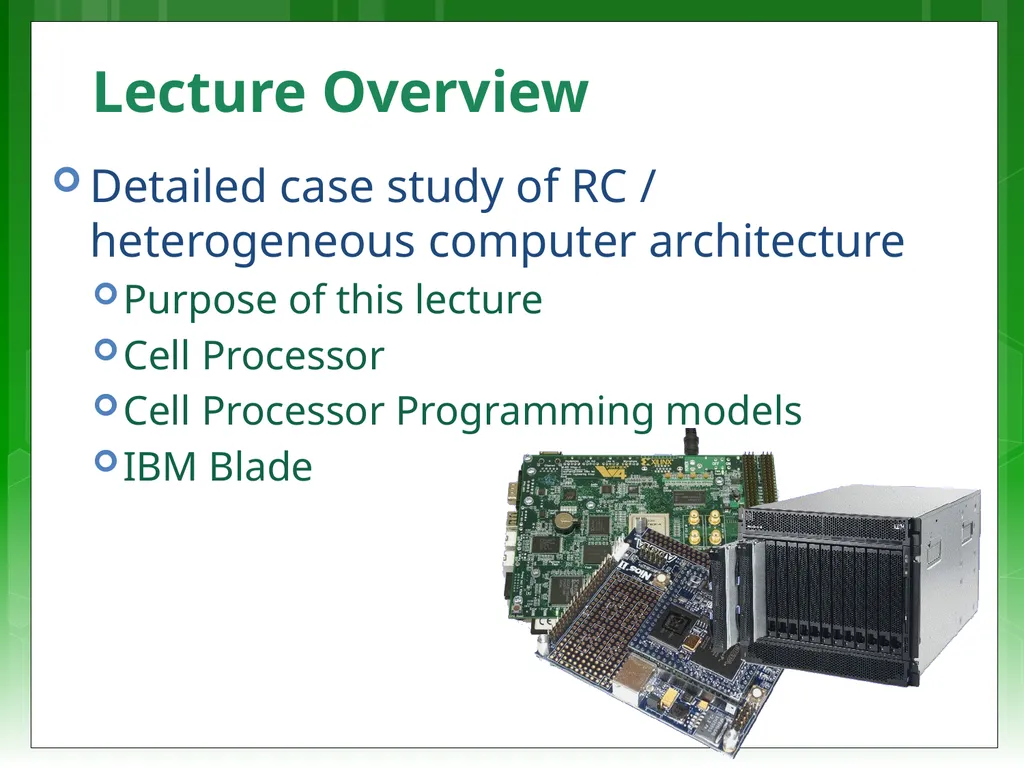
Lecture Overview Detailed case study of RC / heterogeneous computer architecture
Purpose of this lecture
Cell Processor
Cell Processor Programming models
IBM Blade<br>
Purpose of this lecture
Cell Processor
Cell Processor Programming models
IBM Blade<br>
03
Notice: Test 2 next Thrusday (17 May)
Held 2pm EM303, 50 minutes
Syllabus to be announced soon!<br>
Held 2pm EM303, 50 minutes
Syllabus to be announced soon!<br>
04
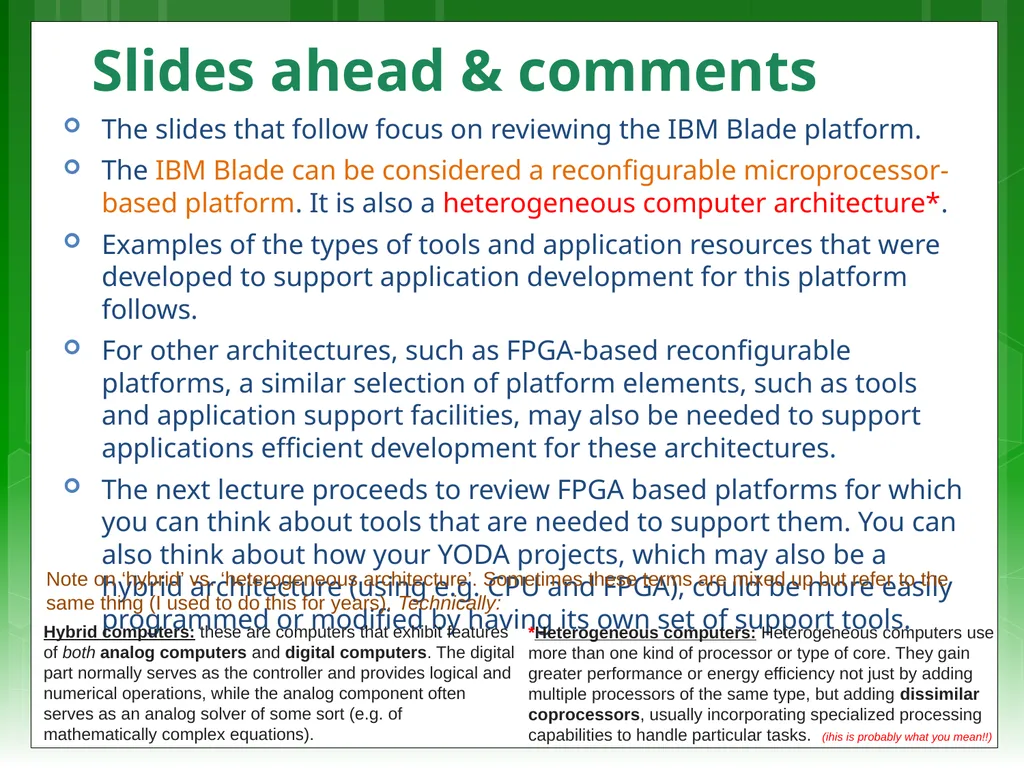
Slides ahead & comments The slides that follow focus on reviewing the IBM Blade platform.
The IBM Blade can be considered a reconfigurable microprocessor-based platform. It is also a heterogeneous computer architecture*.
Examples of the types of tools and application resources that were developed to support application development for this platform follows.
For other architectures, such as FPGA-based reconfigurable platforms, a similar selection of platform elements, such as tools and application support facilities, may also be needed to support applications efficient development for these architectures.
The next lecture proceeds to review FPGA based platforms for which you can think about tools that are needed to support them. You can also think about how your YODA projects, which may also be a hybrid architecture (using e.g. CPU and FPGA), could be more easily programmed or modified by having its own set of support tools. Note on ‘hybrid’ vs. ‘heterogeneous architecture’. Sometimes these terms are mixed up but refer to the same thing (I used to do this for years). Technically: Hybrid computers: these are computers that exhibit features of both analog computers and digital computers. The digital part normally serves as the controller and provides logical and numerical operations, while the analog component often serves as an analog solver of some sort (e.g. of mathematically complex equations). *Heterogeneous computers: Heterogeneous computers use more than one kind of processor or type of core. They gain greater performance or energy efficiency not just by adding multiple processors of the same type, but adding dissimilar coprocessors, usually incorporating specialized processing capabilities to handle particular tasks. (ihis is probably what you mean!!)<br>
The IBM Blade can be considered a reconfigurable microprocessor-based platform. It is also a heterogeneous computer architecture*.
Examples of the types of tools and application resources that were developed to support application development for this platform follows.
For other architectures, such as FPGA-based reconfigurable platforms, a similar selection of platform elements, such as tools and application support facilities, may also be needed to support applications efficient development for these architectures.
The next lecture proceeds to review FPGA based platforms for which you can think about tools that are needed to support them. You can also think about how your YODA projects, which may also be a hybrid architecture (using e.g. CPU and FPGA), could be more easily programmed or modified by having its own set of support tools. Note on ‘hybrid’ vs. ‘heterogeneous architecture’. Sometimes these terms are mixed up but refer to the same thing (I used to do this for years). Technically: Hybrid computers: these are computers that exhibit features of both analog computers and digital computers. The digital part normally serves as the controller and provides logical and numerical operations, while the analog component often serves as an analog solver of some sort (e.g. of mathematically complex equations). *Heterogeneous computers: Heterogeneous computers use more than one kind of processor or type of core. They gain greater performance or energy efficiency not just by adding multiple processors of the same type, but adding dissimilar coprocessors, usually incorporating specialized processing capabilities to handle particular tasks. (ihis is probably what you mean!!)<br>
05
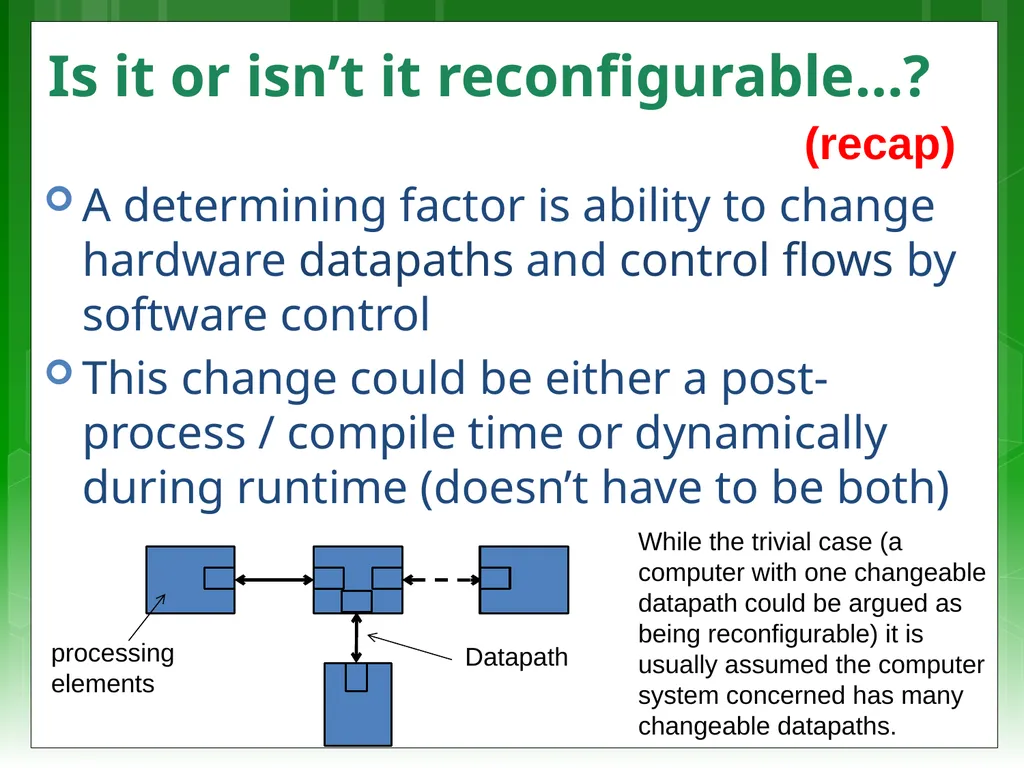
Is it or isn’t it reconfigurable…? A determining factor is ability to change hardware datapaths and control flows by software control
This change could be either a post-process / compile time or dynamically during runtime (doesn’t have to be both) processing
elements Datapath While the trivial case (a computer with one changeable datapath could be argued as being reconfigurable) it is usually assumed the computer system concerned has many changeable datapaths. (recap)<br>
This change could be either a post-process / compile time or dynamically during runtime (doesn’t have to be both) processing
elements Datapath While the trivial case (a computer with one changeable datapath could be argued as being reconfigurable) it is usually assumed the computer system concerned has many changeable datapaths. (recap)<br>
06
Purpose of this
case study Look at a complex heterogeneous processor architecture
Consider specialized programming models designed around this architecture
How to ‘package’ it as a potential computing product
Consider tools to support this unique architecture
Understanding of what is needed were you to build your own HPEC / RC platform and supporting tools.<br>
case study Look at a complex heterogeneous processor architecture
Consider specialized programming models designed around this architecture
How to ‘package’ it as a potential computing product
Consider tools to support this unique architecture
Understanding of what is needed were you to build your own HPEC / RC platform and supporting tools.<br>
07
Cell Broadband Engine Architecture Processor EEE4084F Case Study of heterogeneous architecture for a microprocessor-based RC<br>
08
The “Cell Processor” :
Cell Broadband Engine Architecture Processor Developed by STI alliance, a collaboration of Sony,
Sony Computer Entertainment, Toshiba, and IBM.
Why Cell?
Actually “Cell” is a shortening for “Cell Broadband Engine Architecture” (i.e., it isn’t an acronym)
Technically abbreviated as CBEA in full, alternatively “Cell BE”.
The design and first implementation of the Cell:
Performed at STI Design Center in Austin, Texas
Carried out over a 4-year period from March 2001
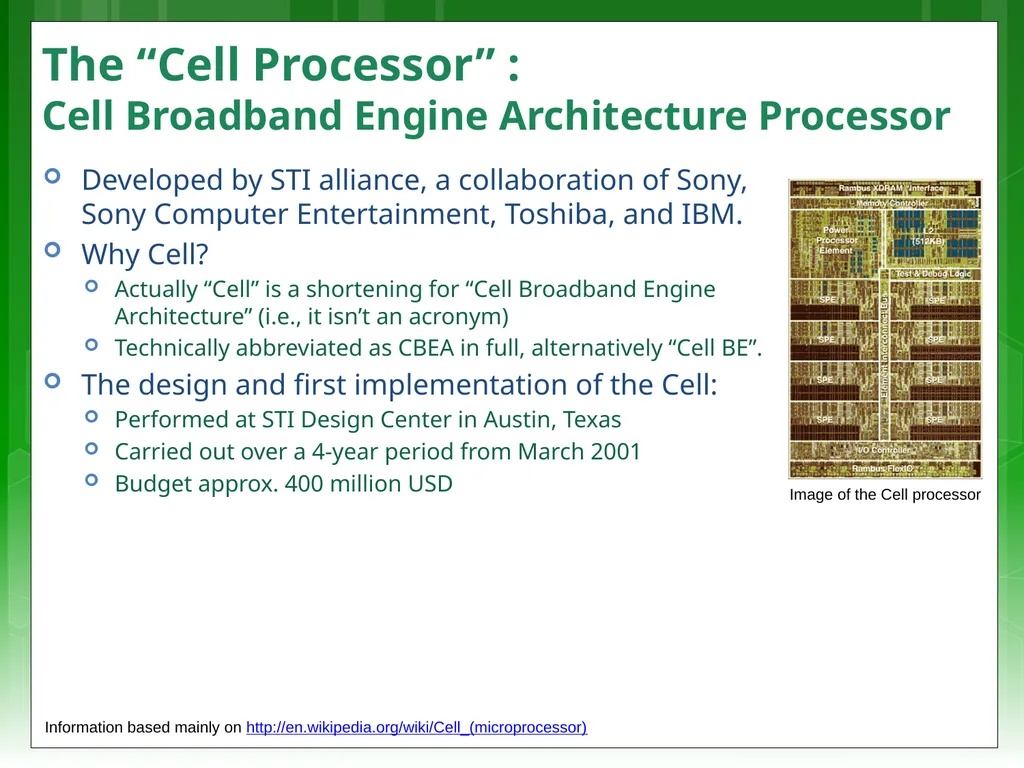
Budget approx. 400 million USD Information based mainly on http://en.wikipedia.org/wiki/Cell_(microprocessor) Image of the Cell processor<br>
Why Cell?
Actually “Cell” is a shortening for “Cell Broadband Engine Architecture” (i.e., it isn’t an acronym)
Technically abbreviated as CBEA in full, alternatively “Cell BE”.
The design and first implementation of the Cell:
Performed at STI Design Center in Austin, Texas
Carried out over a 4-year period from March 2001
Budget approx. 400 million USD Information based mainly on http://en.wikipedia.org/wiki/Cell_(microprocessor) Image of the Cell processor<br>
09
The Cell Processor Milestones 2005 Feb[1,2]
IBM’s technical disclosures of cell processors quickly led to new platforms & toolsets [2]
Oct 05: Mercury Cell Blade
Nov 05: Open Source SDK & Simulator
Feb 06: IBM Cell Blade
Resources / further reading
http://www-128.ibm.com/developerworks/power/cell/
http://www.research.ibm.com/cell/
(see copy of condensed article: Lect17 - The Cell architecture.pdf) [2] http://www.scei.co.jp/corporate/release/pdf/051110e.pdf [1] IBM press release 7-Feb-2005: http://www-03.ibm.com/press/us/en/pressrelease/7502.wss<br>
IBM’s technical disclosures of cell processors quickly led to new platforms & toolsets [2]
Oct 05: Mercury Cell Blade
Nov 05: Open Source SDK & Simulator
Feb 06: IBM Cell Blade
Resources / further reading
http://www-128.ibm.com/developerworks/power/cell/
http://www.research.ibm.com/cell/
(see copy of condensed article: Lect17 - The Cell architecture.pdf) [2] http://www.scei.co.jp/corporate/release/pdf/051110e.pdf [1] IBM press release 7-Feb-2005: http://www-03.ibm.com/press/us/en/pressrelease/7502.wss<br>
10
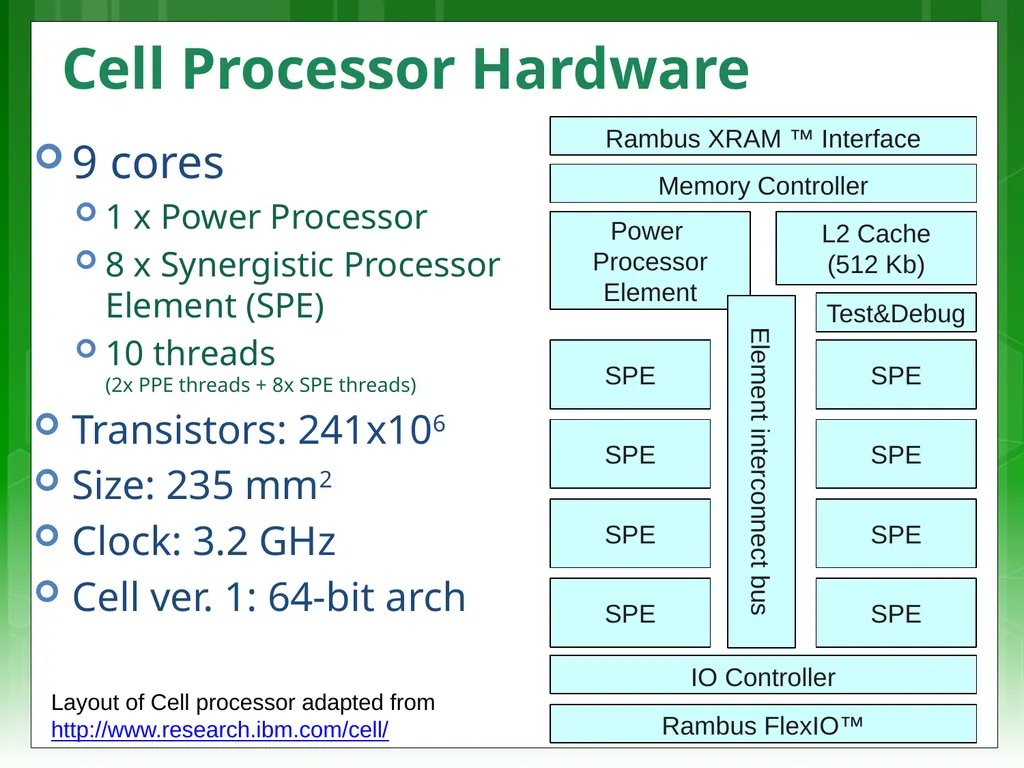
Cell Processor Hardware 9 cores
1 x Power Processor
8 x Synergistic Processor Element (SPE)
10 threads (2x PPE threads + 8x SPE threads)
Transistors: 241x106
Size: 235 mm2
Clock: 3.2 GHz
Cell ver. 1: 64-bit arch Power
Processor
Element L2 Cache
(512 Kb) Rambus XRAM ™ Interface Memory Controller SPE IO Controller Rambus FlexIO™ SPE SPE SPE SPE SPE SPE SPE Layout of Cell processor adapted from
http://www.research.ibm.com/cell/ Element interconnect bus Test&Debug<br>
1 x Power Processor
8 x Synergistic Processor Element (SPE)
10 threads (2x PPE threads + 8x SPE threads)
Transistors: 241x106
Size: 235 mm2
Clock: 3.2 GHz
Cell ver. 1: 64-bit arch Power
Processor
Element L2 Cache
(512 Kb) Rambus XRAM ™ Interface Memory Controller SPE IO Controller Rambus FlexIO™ SPE SPE SPE SPE SPE SPE SPE Layout of Cell processor adapted from
http://www.research.ibm.com/cell/ Element interconnect bus Test&Debug<br>
11
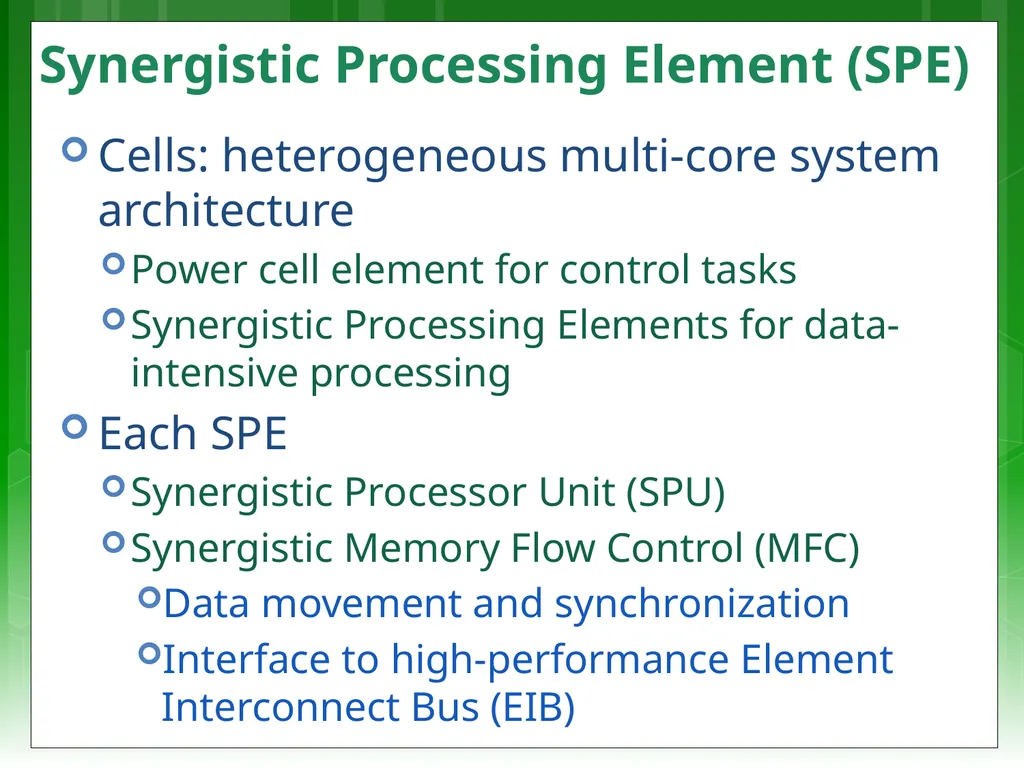
Synergistic Processing Element (SPE) Cells: heterogeneous multi-core system architecture
Power cell element for control tasks
Synergistic Processing Elements for data-intensive processing
Each SPE
Synergistic Processor Unit (SPU)
Synergistic Memory Flow Control (MFC)
Data movement and synchronization
Interface to high-performance Element Interconnect Bus (EIB)<br>
Power cell element for control tasks
Synergistic Processing Elements for data-intensive processing
Each SPE
Synergistic Processor Unit (SPU)
Synergistic Memory Flow Control (MFC)
Data movement and synchronization
Interface to high-performance Element Interconnect Bus (EIB)<br>
12
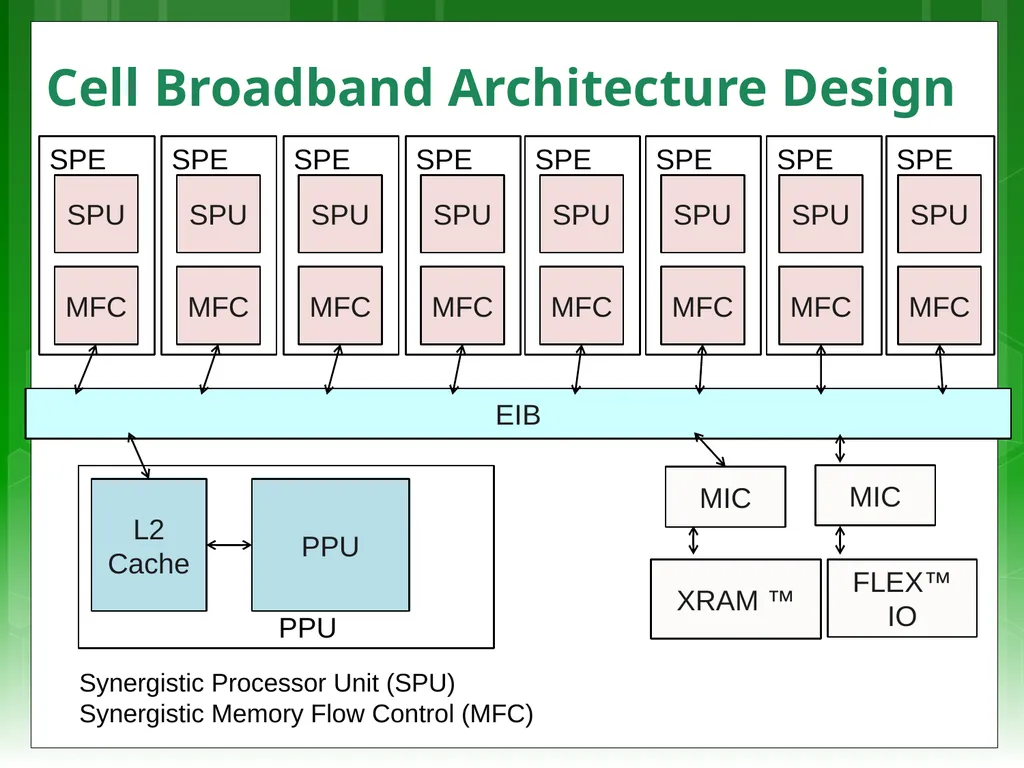
Cell Broadband Architecture Design Synergistic Processor Unit (SPU)
Synergistic Memory Flow Control (MFC) EIB L2 Cache MIC MIC XRAM ™ FLEX™ IO SPU MFC SPE SPU MFC SPE SPU MFC SPE SPU MFC SPE SPU MFC SPE SPU MFC SPE SPU MFC SPE SPU MFC SPE PPU PPU<br>
Synergistic Memory Flow Control (MFC) EIB L2 Cache MIC MIC XRAM ™ FLEX™ IO SPU MFC SPE SPU MFC SPE SPU MFC SPE SPU MFC SPE SPU MFC SPE SPU MFC SPE SPU MFC SPE SPU MFC SPE PPU PPU<br>
13
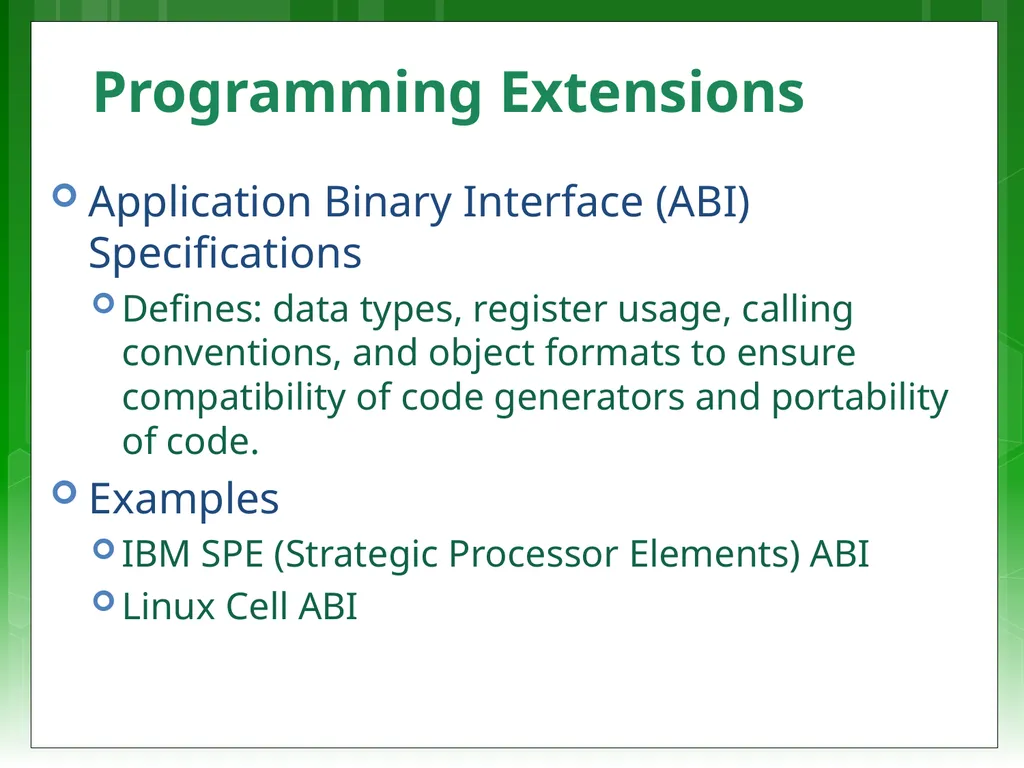
Programming Extensions Application Binary Interface (ABI) Specifications
Defines: data types, register usage, calling conventions, and object formats to ensure compatibility of code generators and portability of code.
Examples
IBM SPE (Strategic Processor Elements) ABI
Linux Cell ABI<br>
Defines: data types, register usage, calling conventions, and object formats to ensure compatibility of code generators and portability of code.
Examples
IBM SPE (Strategic Processor Elements) ABI
Linux Cell ABI<br>
14
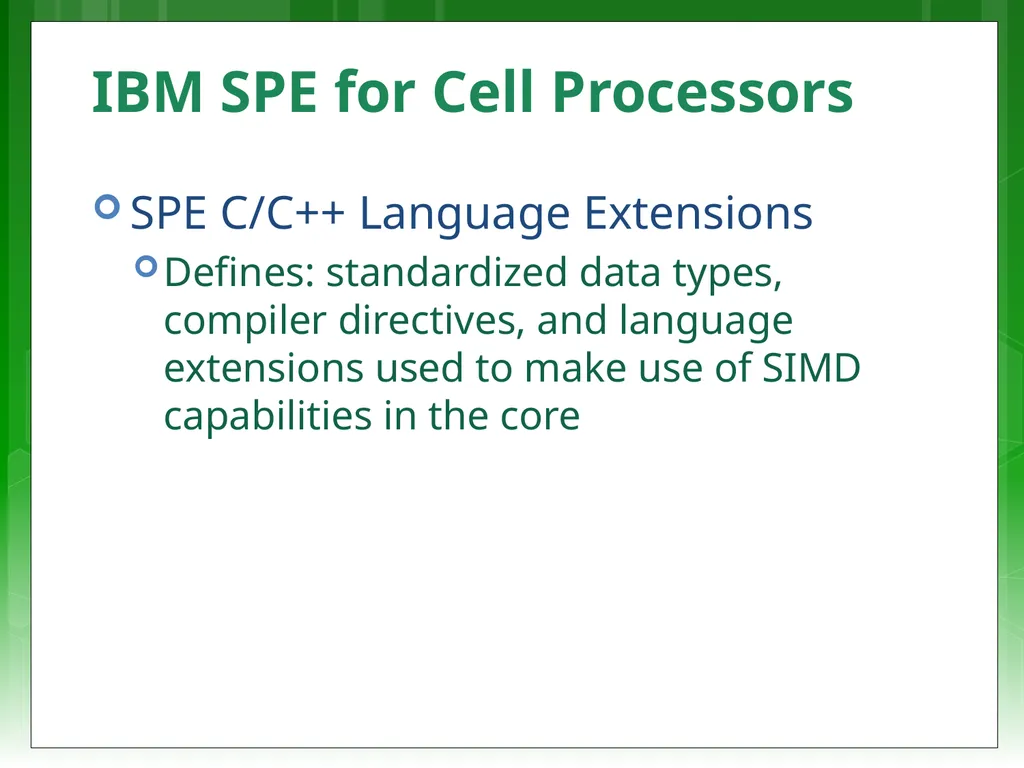
IBM SPE for Cell Processors SPE C/C++ Language Extensions
Defines: standardized data types, compiler directives, and language extensions used to make use of SIMD capabilities in the core<br>
Defines: standardized data types, compiler directives, and language extensions used to make use of SIMD capabilities in the core<br>
15
Cell Processor Programming Models Reconfigurable Computing<br>
16
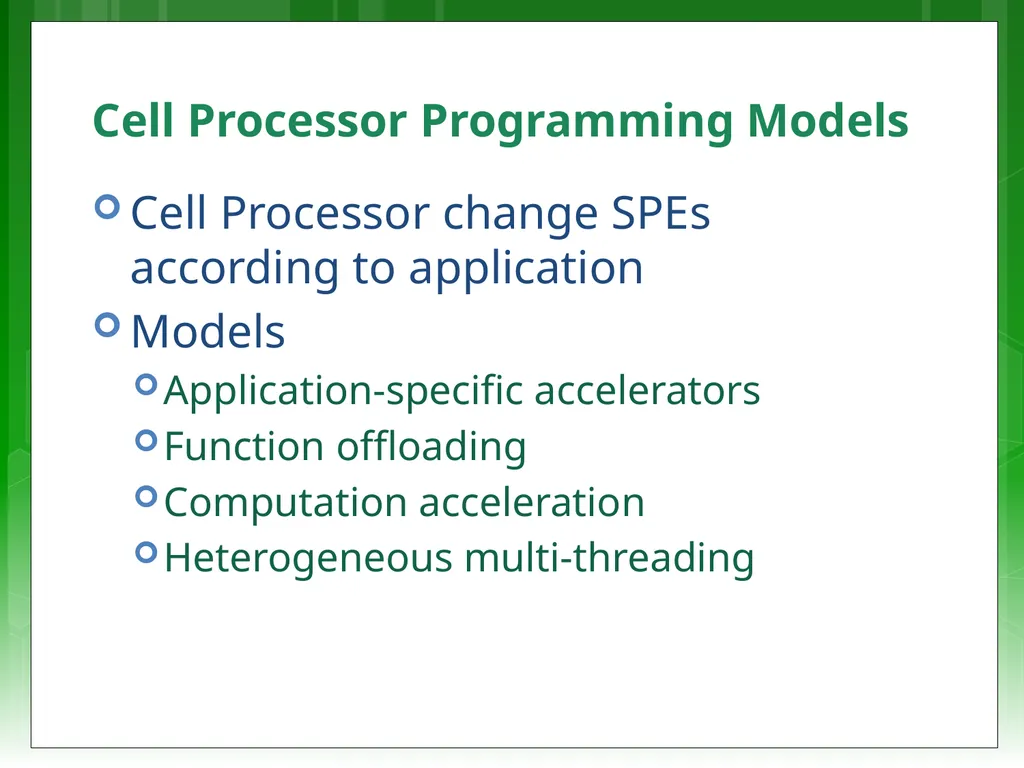
Cell Processor Programming Models Cell Processor change SPEs according to application
Models
Application-specific accelerators
Function offloading
Computation acceleration
Heterogeneous multi-threading<br>
Models
Application-specific accelerators
Function offloading
Computation acceleration
Heterogeneous multi-threading<br>
17
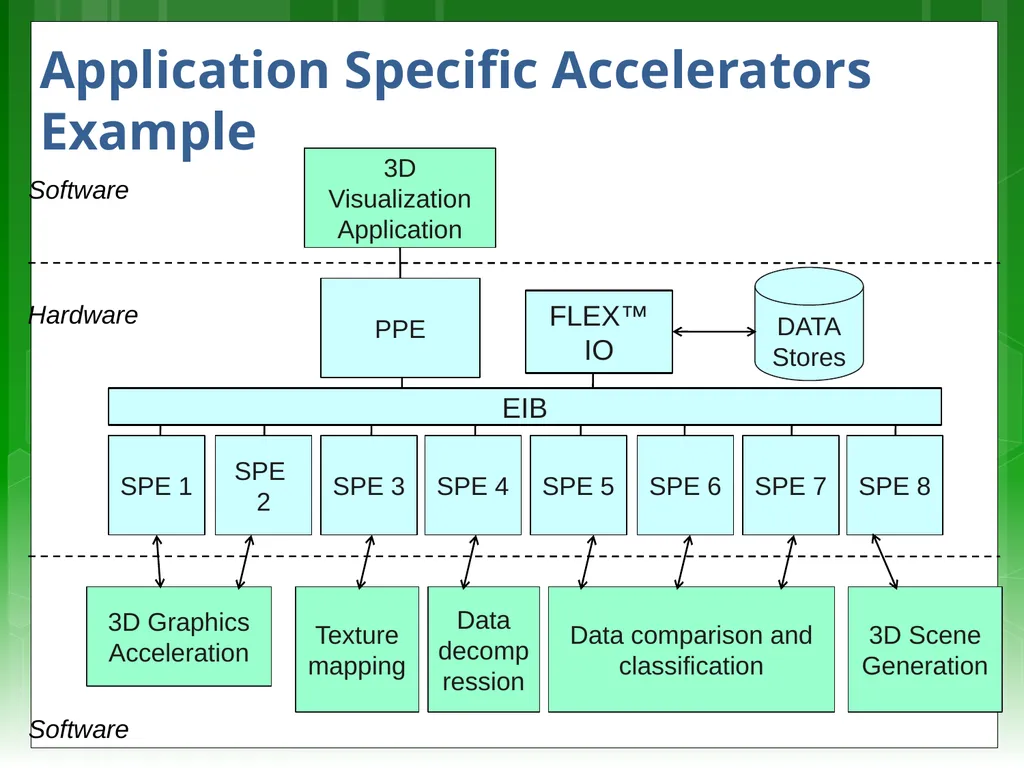
Application Specific Accelerators
Example PPE SPE 1 SPE 2 SPE 3 SPE 4 SPE 5 SPE 6 SPE 7 SPE 8 EIB Hardware Software Software 3D Visualization Application 3D Graphics Acceleration Texture
mapping Data
decompression Data comparison and classification 3D Scene Generation FLEX™ IO DATA
Stores<br>
mapping Data
decompression Data comparison and classification 3D Scene Generation FLEX™ IO DATA
Stores<br>
18
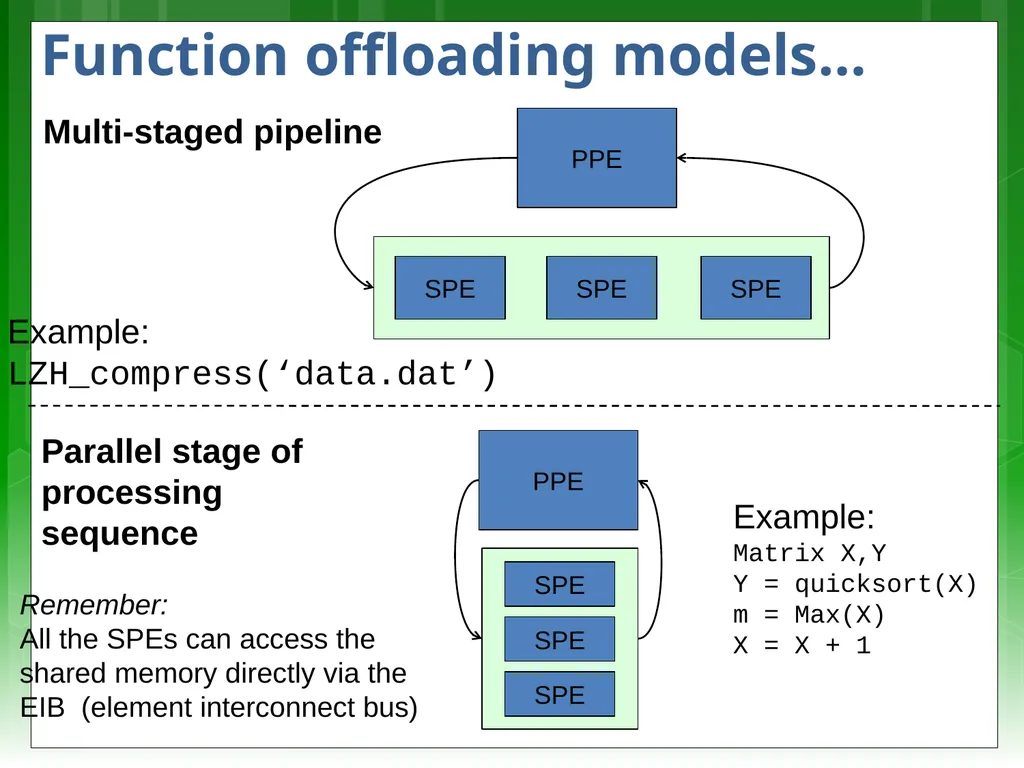
Function offloading models… PPE SPE SPE SPE Multi-staged pipeline Parallel stage of processing
sequence PPE SPE SPE SPE Remember:
All the SPEs can access the
shared memory directly via the
EIB (element interconnect bus) Example:
LZH_compress(‘data.dat’) Example:
Matrix X,Y
Y = quicksort(X)
m = Max(X)
X = X + 1<br>
sequence PPE SPE SPE SPE Remember:
All the SPEs can access the
shared memory directly via the
EIB (element interconnect bus) Example:
LZH_compress(‘data.dat’) Example:
Matrix X,Y
Y = quicksort(X)
m = Max(X)
X = X + 1<br>
19
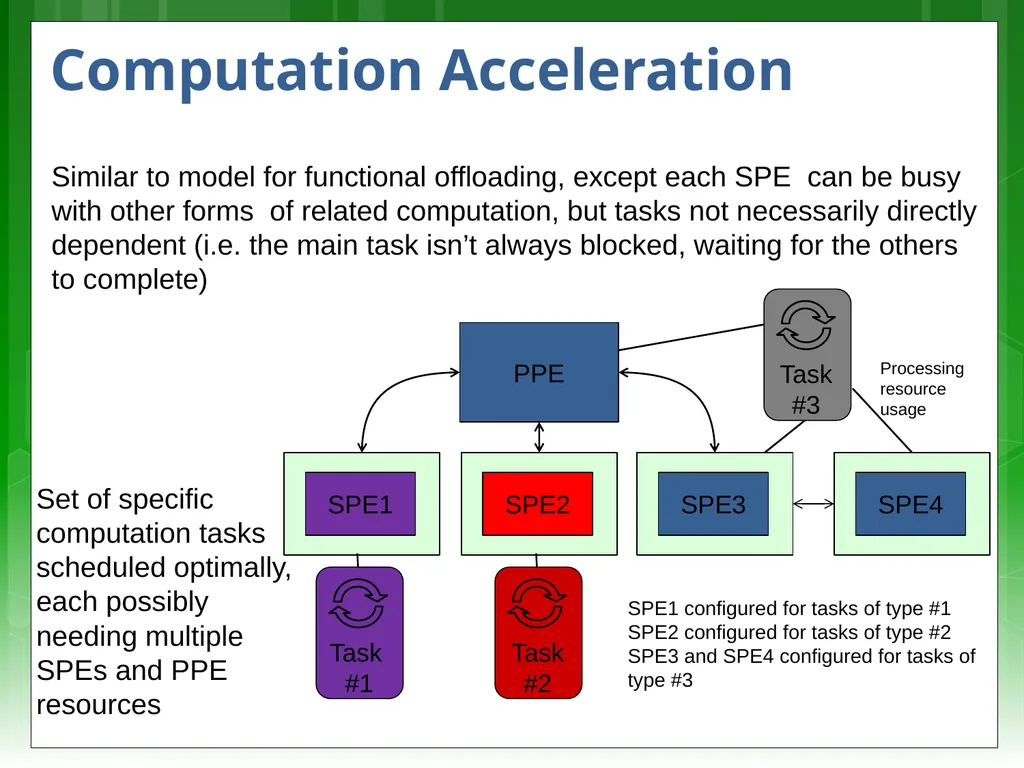
Computation Acceleration PPE SPE1 Similar to model for functional offloading, except each SPE can be busy with other forms of related computation, but tasks not necessarily directly dependent (i.e. the main task isn’t always blocked, waiting for the others to complete) SPE3 SPE2 Task
#1 Task
#2 Task
#3 Set of specific computation tasks scheduled optimally, each possibly needing multiple SPEs and PPE resources SPE4 Processing
resource
usage SPE1 configured for tasks of type #1
SPE2 configured for tasks of type #2
SPE3 and SPE4 configured for tasks of type #3<br>
#1 Task
#2 Task
#3 Set of specific computation tasks scheduled optimally, each possibly needing multiple SPEs and PPE resources SPE4 Processing
resource
usage SPE1 configured for tasks of type #1
SPE2 configured for tasks of type #2
SPE3 and SPE4 configured for tasks of type #3<br>
20
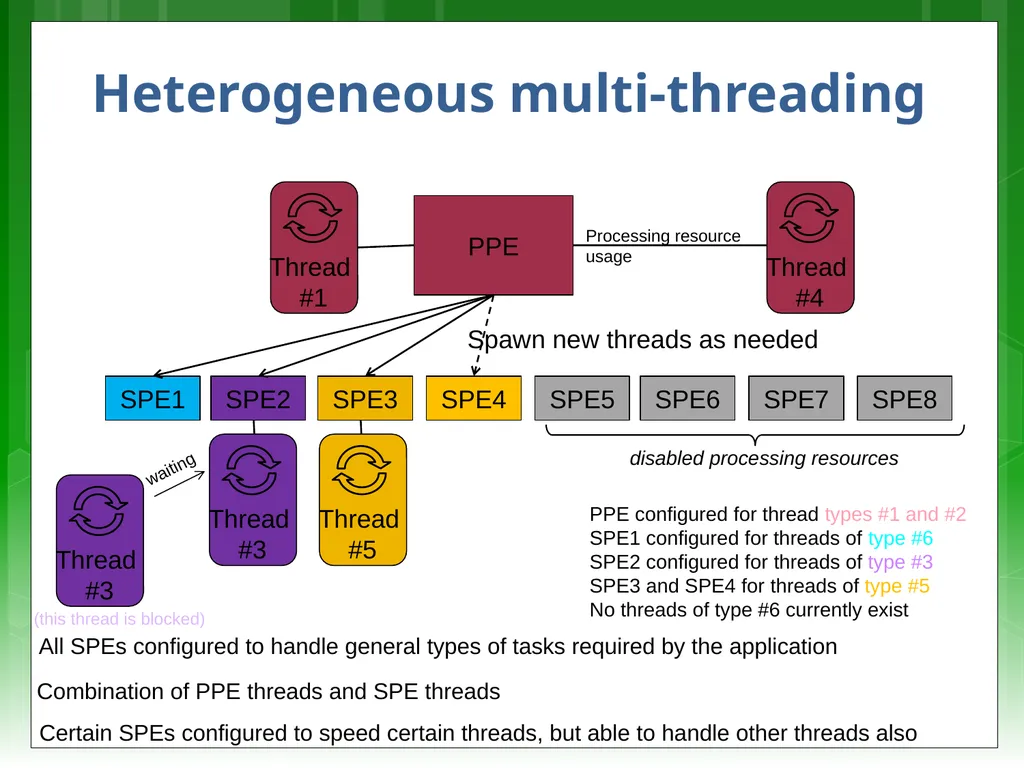
Heterogeneous multi-threading PPE SPE1 SPE2 SPE3 SPE4 SPE5 SPE6 SPE7 SPE8 Spawn new threads as needed Thread
#3 Thread
#3 Thread
#5 All SPEs configured to handle general types of tasks required by the application Combination of PPE threads and SPE threads Thread
#1 Thread
#4 Processing resource
usage disabled processing resources PPE configured for thread types #1 and #2
SPE1 configured for threads of type #6
SPE2 configured for threads of type #3
SPE3 and SPE4 for threads of type #5
No threads of type #6 currently exist Certain SPEs configured to speed certain threads, but able to handle other threads also waiting (this thread is blocked)<br>
#3 Thread
#3 Thread
#5 All SPEs configured to handle general types of tasks required by the application Combination of PPE threads and SPE threads Thread
#1 Thread
#4 Processing resource
usage disabled processing resources PPE configured for thread types #1 and #2
SPE1 configured for threads of type #6
SPE2 configured for threads of type #3
SPE3 and SPE4 for threads of type #5
No threads of type #6 currently exist Certain SPEs configured to speed certain threads, but able to handle other threads also waiting (this thread is blocked)<br>
21
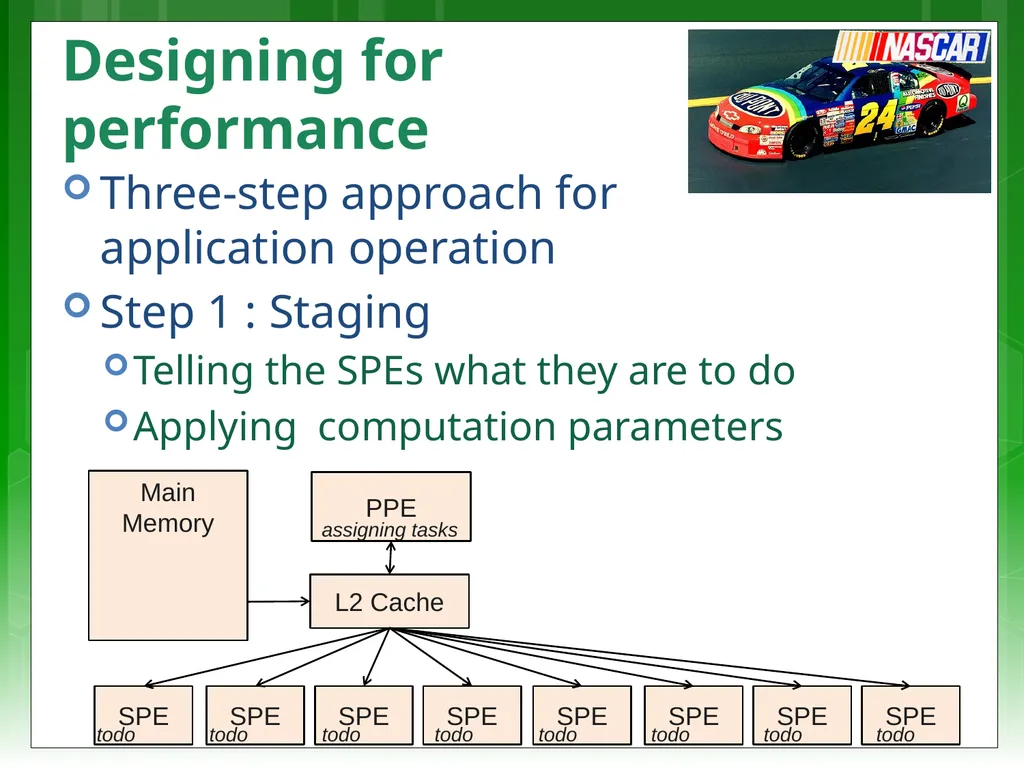
Designing for
performance Three-step approach for
application operation
Step 1 : Staging
Telling the SPEs what they are to do
Applying computation parameters PPE L2 Cache Main Memory SPE SPE SPE SPE SPE SPE SPE SPE todo todo todo todo todo todo todo todo assigning tasks<br>
Step 1 : Staging
Telling the SPEs what they are to do
Applying computation parameters PPE L2 Cache Main Memory SPE SPE SPE SPE SPE SPE SPE SPE todo todo todo todo todo todo todo todo assigning tasks<br>
22
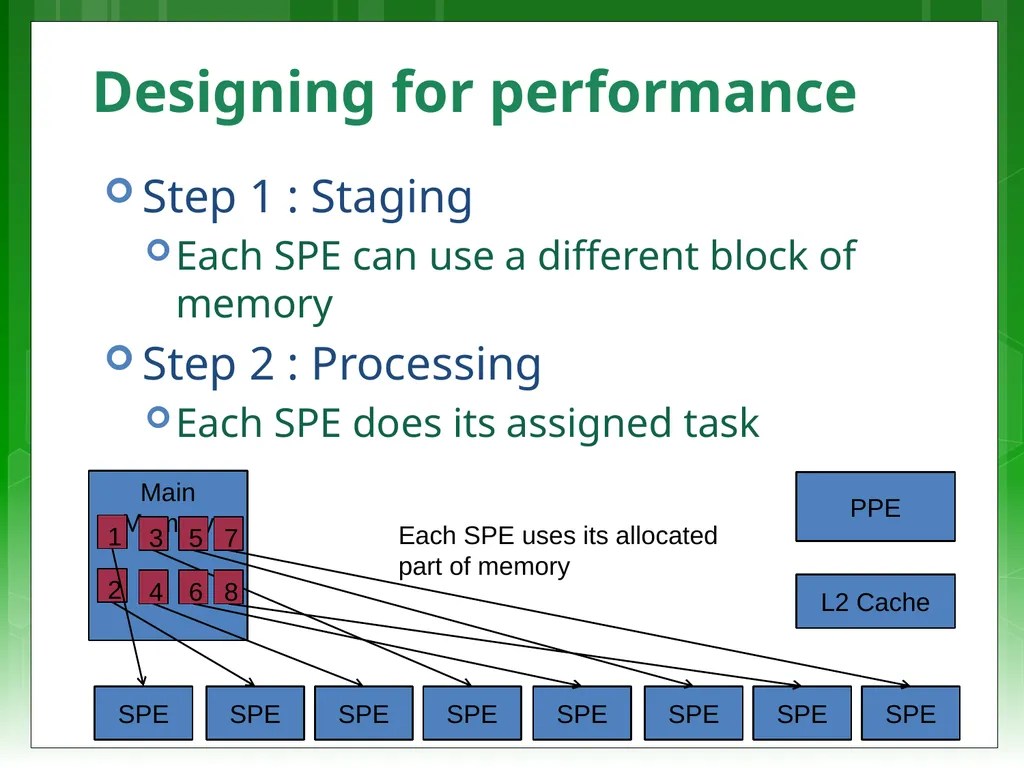
Designing for performance Step 1 : Staging
Each SPE can use a different block of memory
Step 2 : Processing
Each SPE does its assigned task PPE L2 Cache Main Memory SPE SPE SPE SPE SPE SPE SPE SPE 1 3 5 7 2 4 6 8 Each SPE uses its allocated
part of memory<br>
Each SPE can use a different block of memory
Step 2 : Processing
Each SPE does its assigned task PPE L2 Cache Main Memory SPE SPE SPE SPE SPE SPE SPE SPE 1 3 5 7 2 4 6 8 Each SPE uses its allocated
part of memory<br>
23
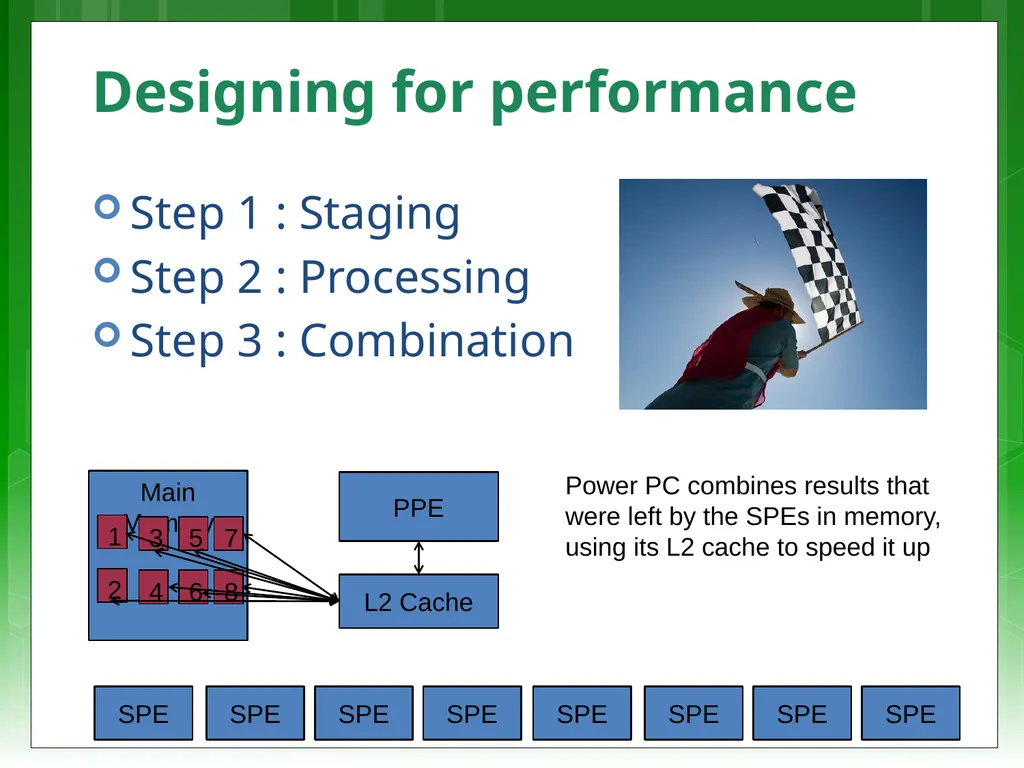
Designing for performance Step 1 : Staging
Step 2 : Processing
Step 3 : Combination PPE L2 Cache Main Memory SPE SPE SPE SPE SPE SPE SPE SPE 1 3 5 7 2 4 6 8 Power PC combines results that
were left by the SPEs in memory,
using its L2 cache to speed it up<br>
Step 2 : Processing
Step 3 : Combination PPE L2 Cache Main Memory SPE SPE SPE SPE SPE SPE SPE SPE 1 3 5 7 2 4 6 8 Power PC combines results that
were left by the SPEs in memory,
using its L2 cache to speed it up<br>
24
A Packaged Product EEE4084F Case Study of heterogeneous architecture for a microprocessor-based RC<br>
25
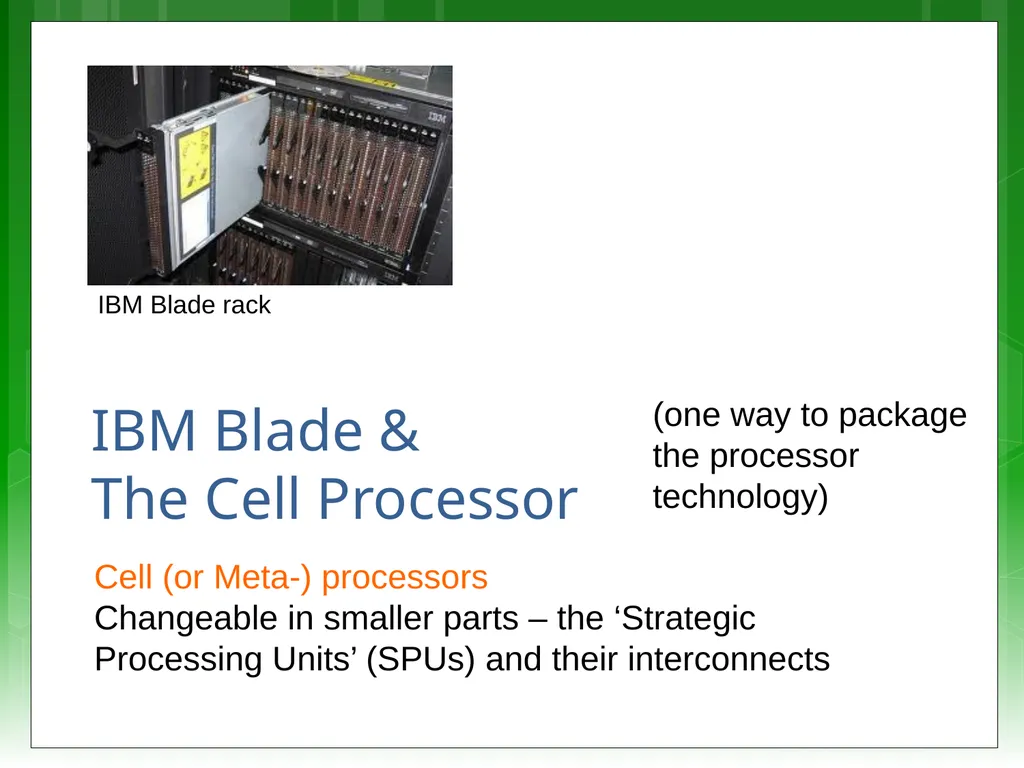
IBM Blade &
The Cell Processor CASE STUDY: Cell (or Meta-) processors
Changeable in smaller parts – the ‘Strategic Processing Units’ (SPUs) and their interconnects IBM Blade rack (one way to package the processor technology)<br>
Changeable in smaller parts – the ‘Strategic Processing Units’ (SPUs) and their interconnects IBM Blade rack (one way to package the processor technology)<br>
26
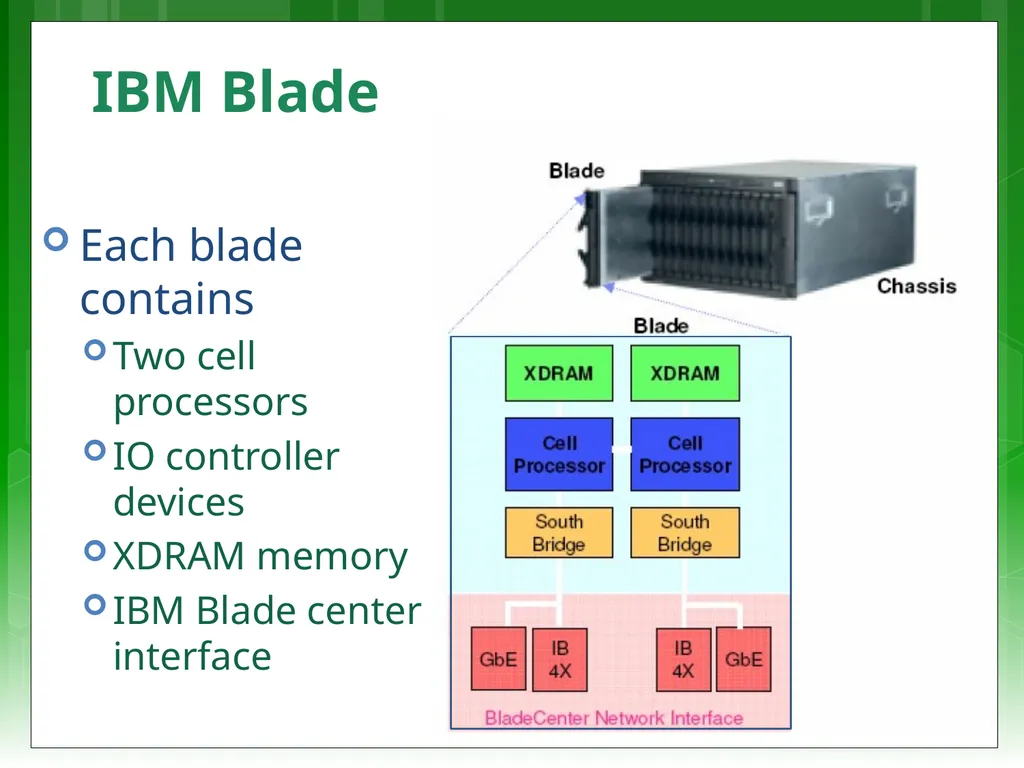
IBM Blade Each blade contains
Two cell processors
IO controller devices
XDRAM memory
IBM Blade center interface<br>
Two cell processors
IO controller devices
XDRAM memory
IBM Blade center interface<br>
27
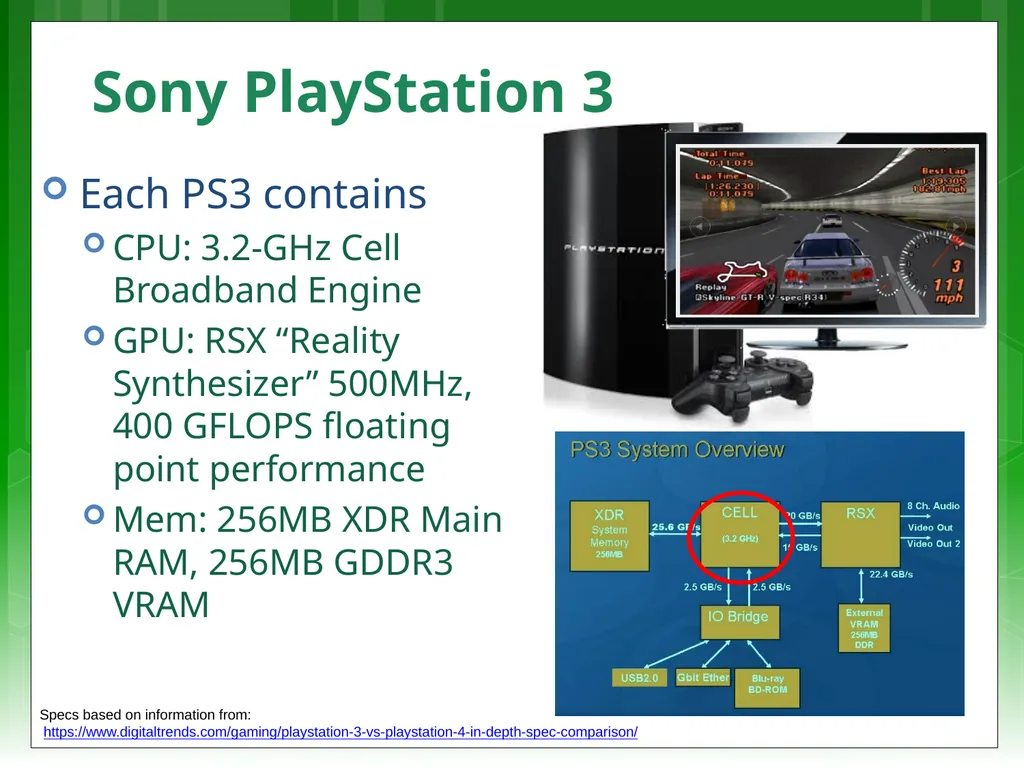
Sony PlayStation 3 Each PS3 contains
CPU: 3.2-GHz Cell Broadband Engine
GPU: RSX “Reality Synthesizer” 500MHz, 400 GFLOPS floating point performance
Mem: 256MB XDR Main RAM, 256MB GDDR3 VRAM Specs based on information from: https://www.digitaltrends.com/gaming/playstation-3-vs-playstation-4-in-depth-spec-comparison/<br>
CPU: 3.2-GHz Cell Broadband Engine
GPU: RSX “Reality Synthesizer” 500MHz, 400 GFLOPS floating point performance
Mem: 256MB XDR Main RAM, 256MB GDDR3 VRAM Specs based on information from: https://www.digitaltrends.com/gaming/playstation-3-vs-playstation-4-in-depth-spec-comparison/<br>
28
Specialized Languages and tools to support application development for specialized platforms EEE4084F<br>
29
Languages for your RC platform Language extensions
This could be functionality for example to configure where declared data is placed (e.g. the global)
Adding specialized operators or operator overloading
Configuration scripts, e.g.
Shell script calls made from the program
Could be programming particular FPGAs in the system, setting up comms speeds Could be a huge amount of work needed for this… but maybe not as much with new technologies…<br>
This could be functionality for example to configure where declared data is placed (e.g. the global)
Adding specialized operators or operator overloading
Configuration scripts, e.g.
Shell script calls made from the program
Could be programming particular FPGAs in the system, setting up comms speeds Could be a huge amount of work needed for this… but maybe not as much with new technologies…<br>
30
Technologies to support heterogeneous computing development Open Computing Language (OpenCL)
Framework for developing programs that can run across heterogeneous platforms that can comprise CPUs, GPUs, DSP processors, FPGAs and possibly other types of processing hardware for which support can be added.
Berkeley Operating system for ReProgrammable Hardware (BORPH)
An extended version of the Linux kernel that handles FPGAs as if they were CPUs with various on-FPGA peripherals attached
Introduces the concept of a 'hardware process', which is a hardware design that runs on an FPGA but behaves just like a normal user program.<br>
Framework for developing programs that can run across heterogeneous platforms that can comprise CPUs, GPUs, DSP processors, FPGAs and possibly other types of processing hardware for which support can be added.
Berkeley Operating system for ReProgrammable Hardware (BORPH)
An extended version of the Linux kernel that handles FPGAs as if they were CPUs with various on-FPGA peripherals attached
Introduces the concept of a 'hardware process', which is a hardware design that runs on an FPGA but behaves just like a normal user program.<br>
31
Image sources:
IBM Blade rack (slide 3), IBM blade, Checkered flag – Wikipedia open commons
NASCAR image – flickr CC2 share alike
Wikipedia opencommons Disclaimers and copyright/licensing details I have tried to follow the correct practices concerning copyright and licensing of material, particularly image sources that have been used in this presentation. I have put much effort into trying to make this material open access so that it can be of benefit to others in their teaching and learning practice. Any mistakes or omissions with regards to these issues I will correct when notified. To the best of my understanding the material in these slides can be shared according to the Creative Commons “Attribution-ShareAlike 4.0 International (CC BY-SA 4.0)” license, and that is why I selected that license to apply to this presentation (it’s not because I particulate want my slides referenced but more to acknowledge the sources and generosity of others who have provided free material such as the images I have used).<br>
IBM Blade rack (slide 3), IBM blade, Checkered flag – Wikipedia open commons
NASCAR image – flickr CC2 share alike
Wikipedia opencommons Disclaimers and copyright/licensing details I have tried to follow the correct practices concerning copyright and licensing of material, particularly image sources that have been used in this presentation. I have put much effort into trying to make this material open access so that it can be of benefit to others in their teaching and learning practice. Any mistakes or omissions with regards to these issues I will correct when notified. To the best of my understanding the material in these slides can be shared according to the Creative Commons “Attribution-ShareAlike 4.0 International (CC BY-SA 4.0)” license, and that is why I selected that license to apply to this presentation (it’s not because I particulate want my slides referenced but more to acknowledge the sources and generosity of others who have provided free material such as the images I have used).<br>