
LEGAL FRAMEWORK 2 3 Important legislations












Description: LEGAL FRAMEWORK 2 3 Important legislations governing securities market Key statutes applicable for foreign investors include: FEMA, 1999 SEBI Foreign Portfolio Investors Regulations, 2019 SEBI Regulations applicable to key market
Related Topics
Download Presentation
"LEGAL FRAMEWORK 2 3 Important legislations" is the property of its rightful owner. Permission is granted to download and print the materials on this website for personal, non-commercial use only, and to display it on your personal computer provided you do not modify the materials and that you retain all copyright notices contained in the materials. By downloading content from our website, you accept the terms of this agreement.
Presentation Transcript
slide2. LEGAL FRAMEWORK 2<br>
slide3. 3 Important legislations governing securities market Key statutes applicable for foreign investors include:
FEMA, 1999
SEBI Foreign Portfolio Investors Regulations, 2019
SEBI Regulations applicable to key market intermediaries such as Custodians, Stockbrokers and regulations governing investor classes – Mutual Funds /collective investment schemes, Alternative Investment Funds, Portfolio Manager etc.
Legislations governing securities market in detail is included in Annexure 1:<br>
slide4. 4 INVESTMENT ROUTES IN INDIA<br>
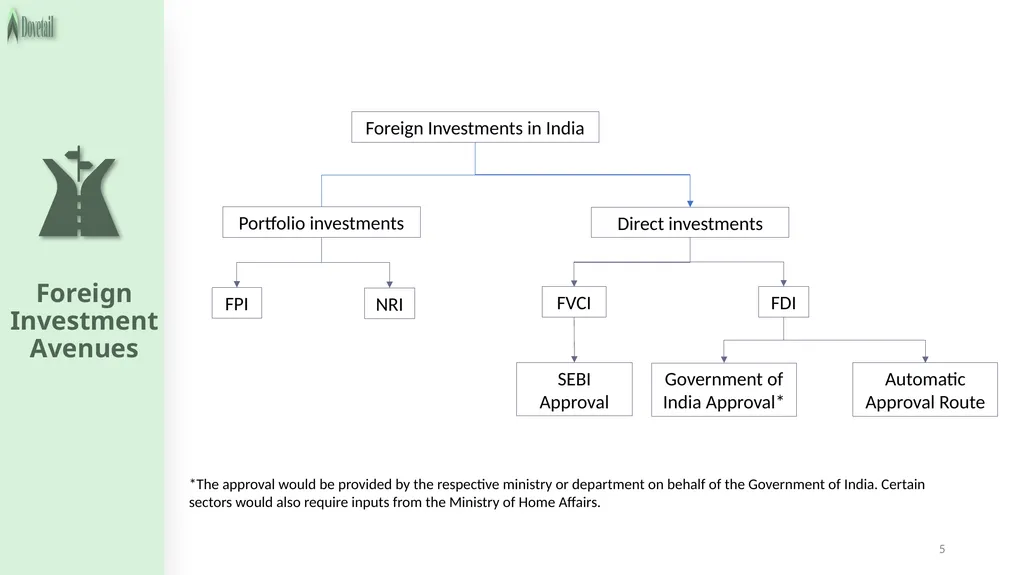
slide5. 5 Foreign Investments in India Portfolio investments Direct investments FPI NRI FVCI FDI SEBI Approval Government of India Approval* Automatic Approval Route *The approval would be provided by the respective ministry or department on behalf of the Government of India. Certain sectors would also require inputs from the Ministry of Home Affairs. Foreign Investment Avenues<br>
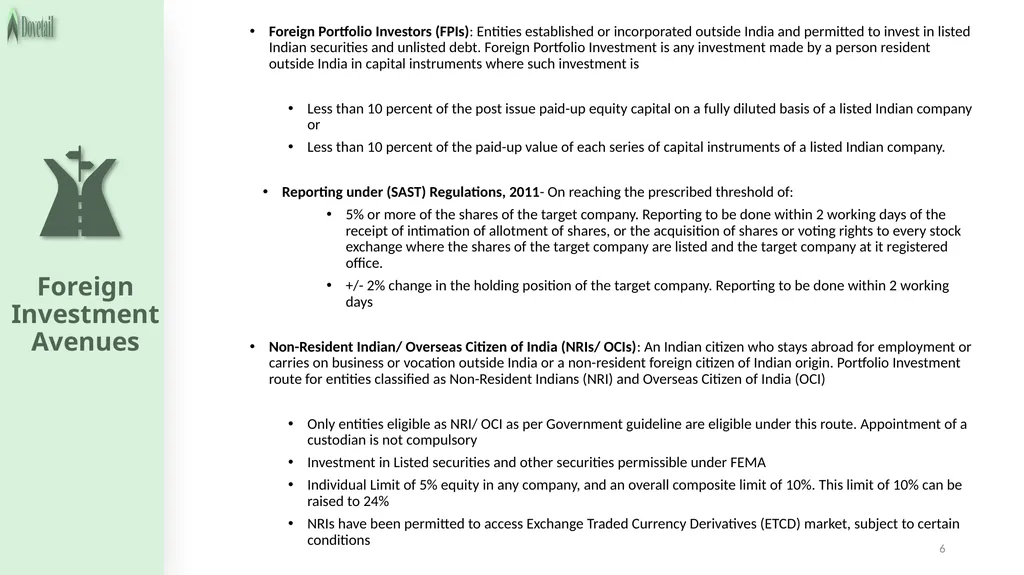
slide6. 6 Foreign Portfolio Investors (FPIs): Entities established or incorporated outside India and permitted to invest in listed Indian securities and unlisted debt. Foreign Portfolio Investment is any investment made by a person resident outside India in capital instruments where such investment is
Less than 10 percent of the post issue paid-up equity capital on a fully diluted basis of a listed Indian company or
Less than 10 percent of the paid-up value of each series of capital instruments of a listed Indian company.
Reporting under (SAST) Regulations, 2011- On reaching the prescribed threshold of:
5% or more of the shares of the target company. Reporting to be done within 2 working days of the receipt of intimation of allotment of shares, or the acquisition of shares or voting rights to every stock exchange where the shares of the target company are listed and the target company at it registered office.
+/- 2% change in the holding position of the target company. Reporting to be done within 2 working days
Non-Resident Indian/ Overseas Citizen of India (NRIs/ OCIs): An Indian citizen who stays abroad for employment or carries on business or vocation outside India or a non-resident foreign citizen of Indian origin. Portfolio Investment route for entities classified as Non-Resident Indians (NRI) and Overseas Citizen of India (OCI)
Only entities eligible as NRI/ OCI as per Government guideline are eligible under this route. Appointment of a custodian is not compulsory
Investment in Listed securities and other securities permissible under FEMA
Individual Limit of 5% equity in any company, and an overall composite limit of 10%. This limit of 10% can be raised to 24%
NRIs have been permitted to access Exchange Traded Currency Derivatives (ETCD) market, subject to certain conditions Foreign Investment Avenues<br>
slide7. 7 Foreign Direct Investments (FDIs) (Strategic investments in Indian companies):
Investments through this route are considered strategic investments. Foreign Direct Investments (FDI) in India attract provisions of the Foreign Exchange Management Act,1999 (FEMA) and are subject to the regulations and directions issued by the Government of India (GoI) and Reserve Bank of India (RBI).
Entry routes for FDI –
Automatic Route - Investment by a person resident outside India does not require the prior approval from GoI or RBI.
Government Approved Route - Investment by a person resident outside India in certain specified sectors requires prior approval from Government of India. In addition, entities or beneficial owners of the entities (direct or indirect) based in or citizen of countries which share land border with India, should seek prior approval from Government of India
Eligibility Norms - Person resident outside India can invest in Indian companies, subject to the FDI Policy except in those sectors/ activities which are part of the prohibited list. An entity of a country, which shares land border with India or the beneficial owner of an entity (directly or indirectly) seeking to invest into India is situated in or is a citizen of any such country, shall invest only with prior Government approval. Eligible investors need to adhere to uniform KYC as specified by SEBI and RBI from time to time
Further, there are 8 sectors where investments are prohibited – Lottery business including government/private lottery, online lotteries etc., gambling and betting including casinos etc., chit funds, Nidhi company, trading in transferable development rights (TDRs), real estate business or construction of farm houses, manufacturing of cigars, cheroots, cigarillos and cigarettes, of tobacco or of tobacco substitutes and activities/sectors not open to private sector investment e.g.(I) Atomic Energy and (II) Railway operations.
A non-resident entity can invest in India, subject to the FDI Policy except in those sectors/activities which are prohibited. However, an entity of a country, which shares a land border with India or where the beneficial owner of investment into India is situated in or is a citizen of any such country, can invest only under the Government route. Foreign Investment Avenues<br>
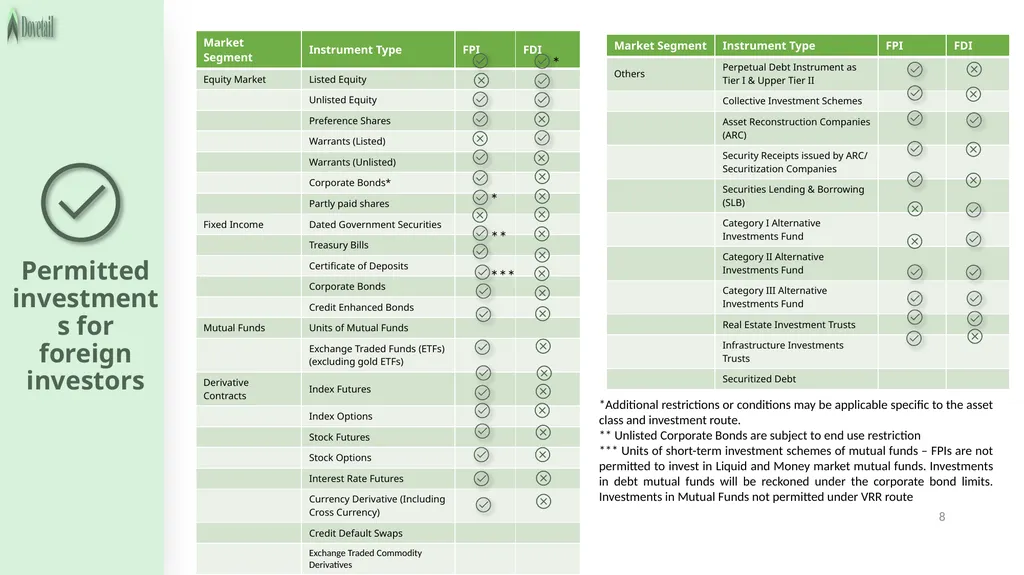
slide8. 8 *Additional restrictions or conditions may be applicable specific to the asset class and investment route.
** Unlisted Corporate Bonds are subject to end use restriction
*** Units of short-term investment schemes of mutual funds – FPIs are not permitted to invest in Liquid and Money market mutual funds. Investments in debt mutual funds will be reckoned under the corporate bond limits. Investments in Mutual Funds not permitted under VRR route Permitted investments for foreign investors 8 * * ** ***<br>
slide9. 9 FOREIGN PORTFOLIO INVESTORS FOREIGN PORTFOLIO INVESTORS<br>
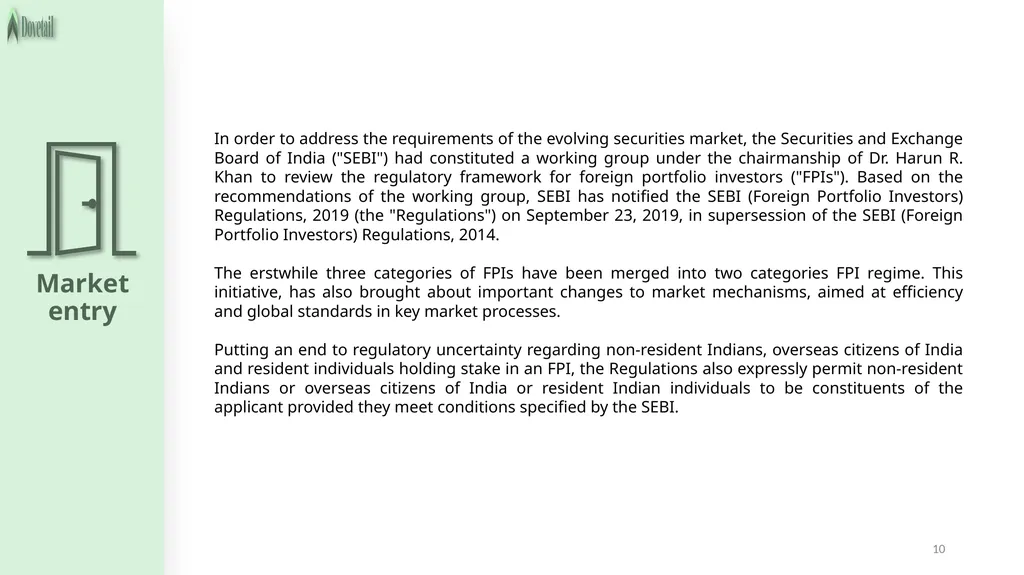
slide10. 10 In order to address the requirements of the evolving securities market, the Securities and Exchange Board of India ("SEBI") had constituted a working group under the chairmanship of Dr. Harun R. Khan to review the regulatory framework for foreign portfolio investors ("FPIs"). Based on the recommendations of the working group, SEBI has notified the SEBI (Foreign Portfolio Investors) Regulations, 2019 (the "Regulations") on September 23, 2019, in supersession of the SEBI (Foreign Portfolio Investors) Regulations, 2014.
The erstwhile three categories of FPIs have been merged into two categories FPI regime. This initiative, has also brought about important changes to market mechanisms, aimed at efficiency and global standards in key market processes.
Putting an end to regulatory uncertainty regarding non-resident Indians, overseas citizens of India and resident individuals holding stake in an FPI, the Regulations also expressly permit non-resident Indians or overseas citizens of India or resident Indian individuals to be constituents of the applicant provided they meet conditions specified by the SEBI. Market entry<br>
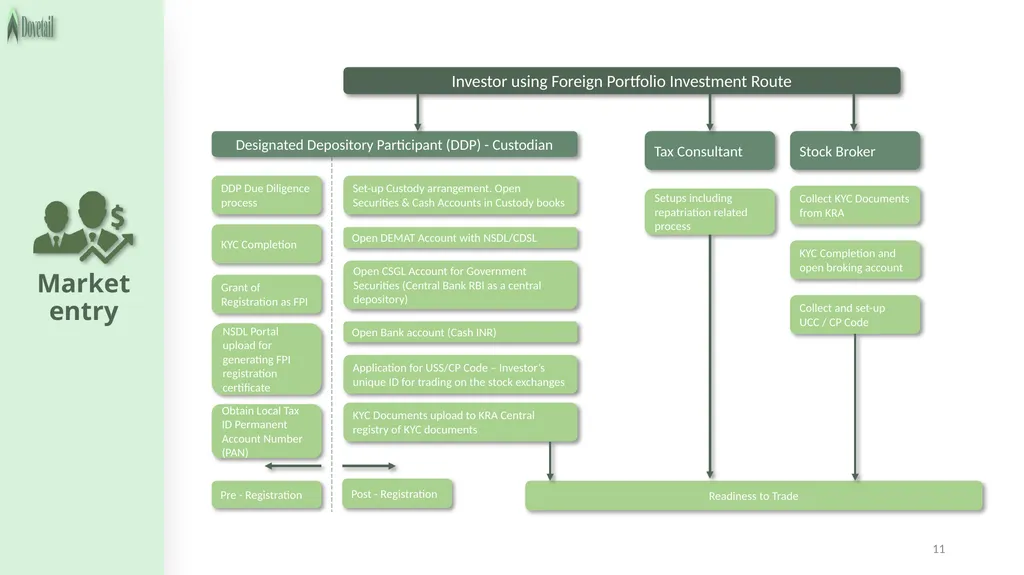
slide11. 11 Investor using Foreign Portfolio Investment Route Designated Depository Participant (DDP) - Custodian DDP Due Diligence process KYC Completion Grant of Registration as FPI NSDL Portal upload for generating FPI registration certificate Pre - Registration Post - Registration Set-up Custody arrangement. Open Securities & Cash Accounts in Custody books Open DEMAT Account with NSDL/CDSL Open CSGL Account for Government Securities (Central Bank RBI as a central depository) Open Bank account (Cash INR) Application for USS/CP Code – Investor’s unique ID for trading on the stock exchanges KYC Documents upload to KRA Central registry of KYC documents Tax Consultant Stock Broker Obtain Local Tax ID Permanent Account Number (PAN) Setups including repatriation related process Collect KYC Documents from KRA KYC Completion and open broking account Collect and set-up UCC / CP Code Readiness to Trade Market entry<br>
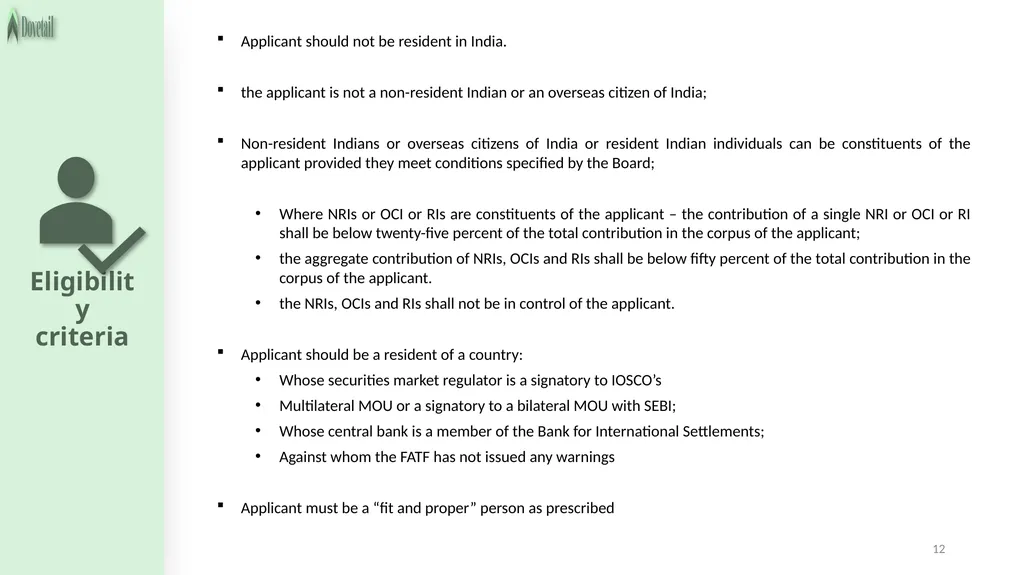
slide12. 12 Applicant should not be resident in India.
the applicant is not a non-resident Indian or an overseas citizen of India;
Non-resident Indians or overseas citizens of India or resident Indian individuals can be constituents of the applicant provided they meet conditions specified by the Board;
Where NRIs or OCI or RIs are constituents of the applicant – the contribution of a single NRI or OCI or RI shall be below twenty-five percent of the total contribution in the corpus of the applicant;
the aggregate contribution of NRIs, OCIs and RIs shall be below fifty percent of the total contribution in the corpus of the applicant.
the NRIs, OCIs and RIs shall not be in control of the applicant.
Applicant should be a resident of a country:
Whose securities market regulator is a signatory to IOSCO’s
Multilateral MOU or a signatory to a bilateral MOU with SEBI;
Whose central bank is a member of the Bank for International Settlements;
Against whom the FATF has not issued any warnings
Applicant must be a “fit and proper” person as prescribed Eligibility criteria<br>
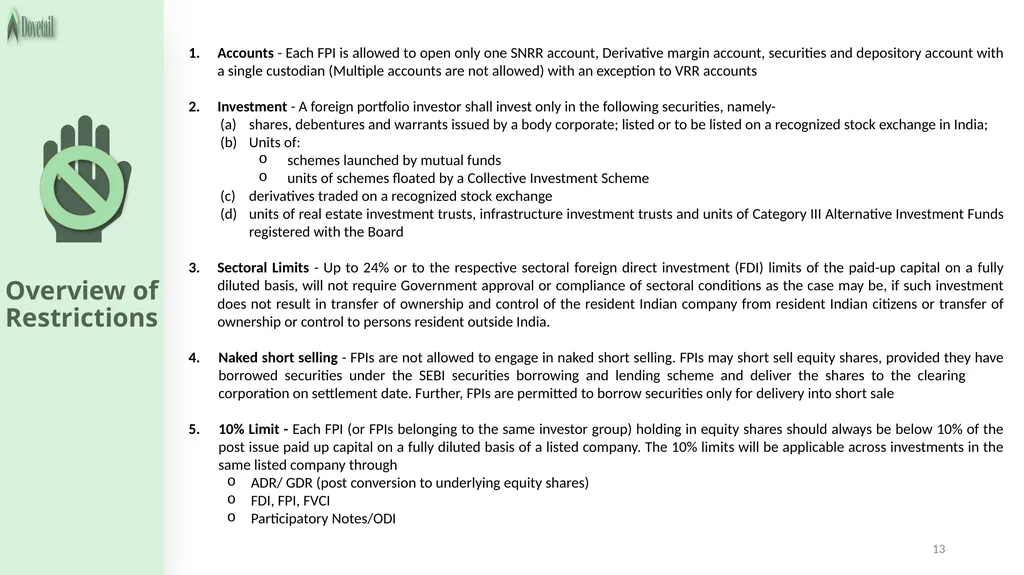
slide13. 13 Accounts - Each FPI is allowed to open only one SNRR account, Derivative margin account, securities and depository account with a single custodian (Multiple accounts are not allowed) with an exception to VRR accounts
Investment - A foreign portfolio investor shall invest only in the following securities, namely-
shares, debentures and warrants issued by a body corporate; listed or to be listed on a recognized stock exchange in India;
Units of:
schemes launched by mutual funds
units of schemes floated by a Collective Investment Scheme
derivatives traded on a recognized stock exchange
units of real estate investment trusts, infrastructure investment trusts and units of Category III Alternative Investment Funds registered with the Board
Sectoral Limits - Up to 24% or to the respective sectoral foreign direct investment (FDI) limits of the paid-up capital on a fully diluted basis, will not require Government approval or compliance of sectoral conditions as the case may be, if such investment does not result in transfer of ownership and control of the resident Indian company from resident Indian citizens or transfer of ownership or control to persons resident outside India.
4. Naked short selling - FPIs are not allowed to engage in naked short selling. FPIs may short sell equity shares, provided they have borrowed securities under the SEBI securities borrowing and lending scheme and deliver the shares to the clearing corporation on settlement date. Further, FPIs are permitted to borrow securities only for delivery into short sale
5. 10% Limit - Each FPI (or FPIs belonging to the same investor group) holding in equity shares should always be below 10% of the post issue paid up capital on a fully diluted basis of a listed company. The 10% limits will be applicable across investments in the same listed company through
ADR/ GDR (post conversion to underlying equity shares)
FDI, FPI, FVCI
Participatory Notes/ODI Overview of Restrictions<br>
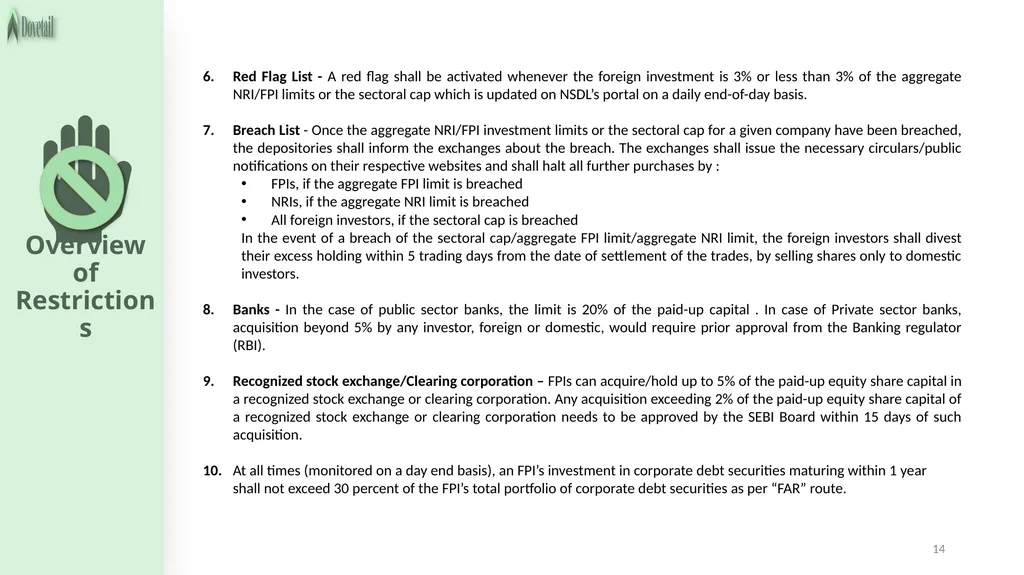
slide14. 14 Red Flag List - A red flag shall be activated whenever the foreign investment is 3% or less than 3% of the aggregate NRI/FPI limits or the sectoral cap which is updated on NSDL’s portal on a daily end-of-day basis.
Breach List - Once the aggregate NRI/FPI investment limits or the sectoral cap for a given company have been breached, the depositories shall inform the exchanges about the breach. The exchanges shall issue the necessary circulars/public notifications on their respective websites and shall halt all further purchases by :
FPIs, if the aggregate FPI limit is breached
NRIs, if the aggregate NRI limit is breached
All foreign investors, if the sectoral cap is breached
In the event of a breach of the sectoral cap/aggregate FPI limit/aggregate NRI limit, the foreign investors shall divest their excess holding within 5 trading days from the date of settlement of the trades, by selling shares only to domestic investors.
8. Banks - In the case of public sector banks, the limit is 20% of the paid-up capital . In case of Private sector banks, acquisition beyond 5% by any investor, foreign or domestic, would require prior approval from the Banking regulator (RBI).
9. Recognized stock exchange/Clearing corporation – FPIs can acquire/hold up to 5% of the paid-up equity share capital in a recognized stock exchange or clearing corporation. Any acquisition exceeding 2% of the paid-up equity share capital of a recognized stock exchange or clearing corporation needs to be approved by the SEBI Board within 15 days of such acquisition.
10. At all times (monitored on a day end basis), an FPI’s investment in corporate debt securities maturing within 1 year shall not exceed 30 percent of the FPI’s total portfolio of corporate debt securities as per “FAR” route. Overview of Restrictions<br>
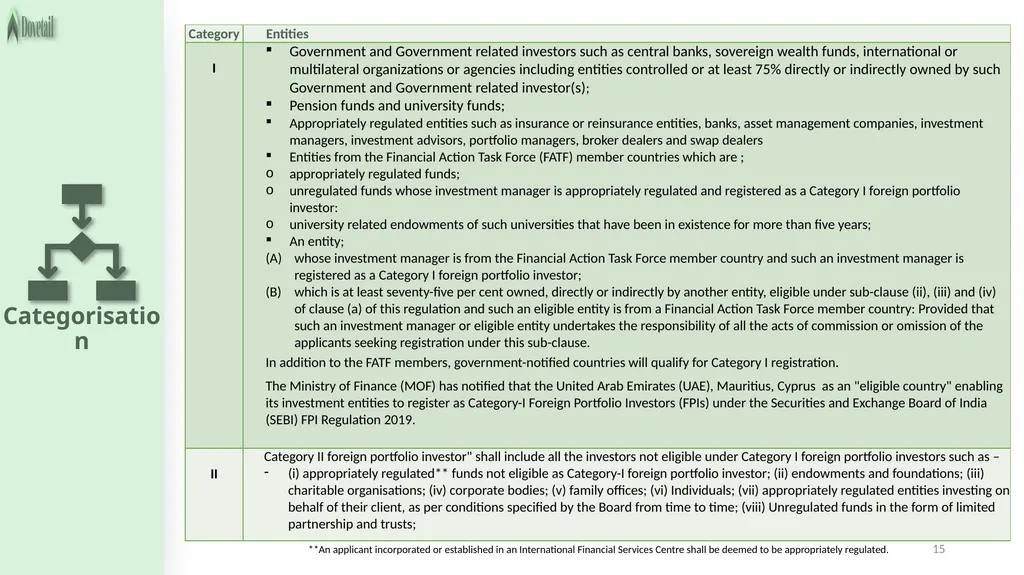
slide15. **An applicant incorporated or established in an International Financial Services Centre shall be deemed to be appropriately regulated. 15 Categorisation<br>
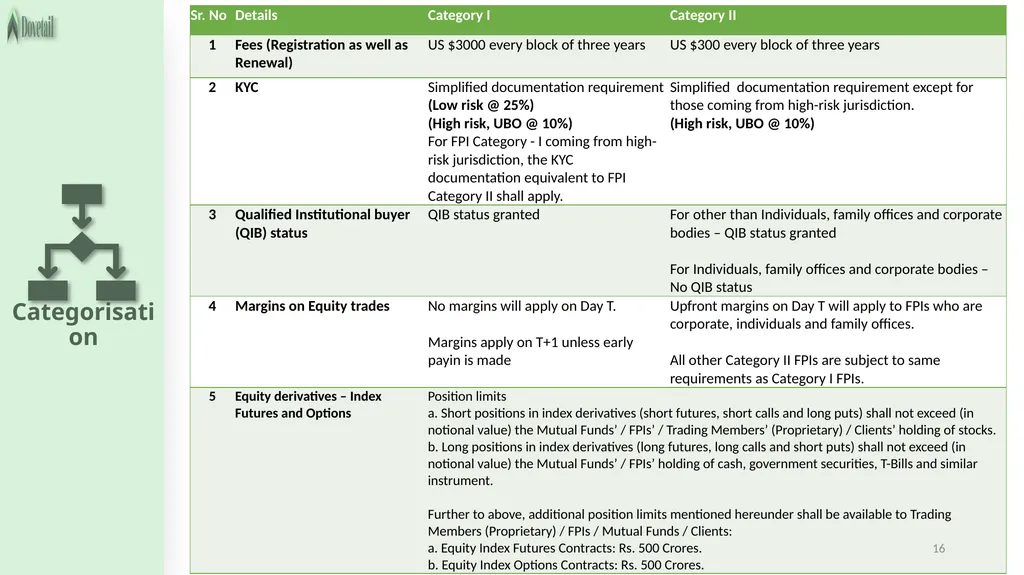
slide16. Categorisation 16<br>
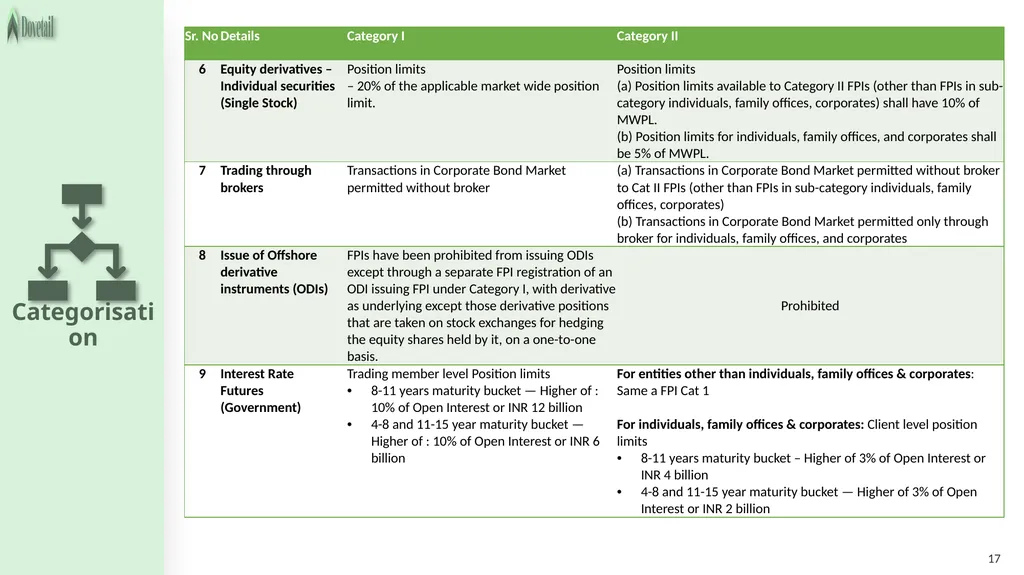
slide17. Categorisation 17<br>
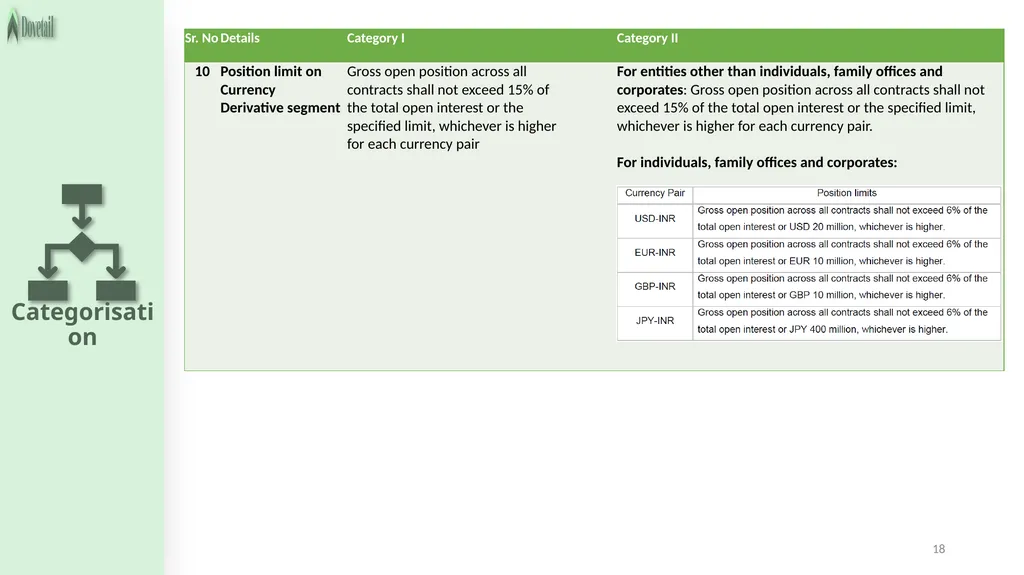
slide18. Categorisation 18<br>
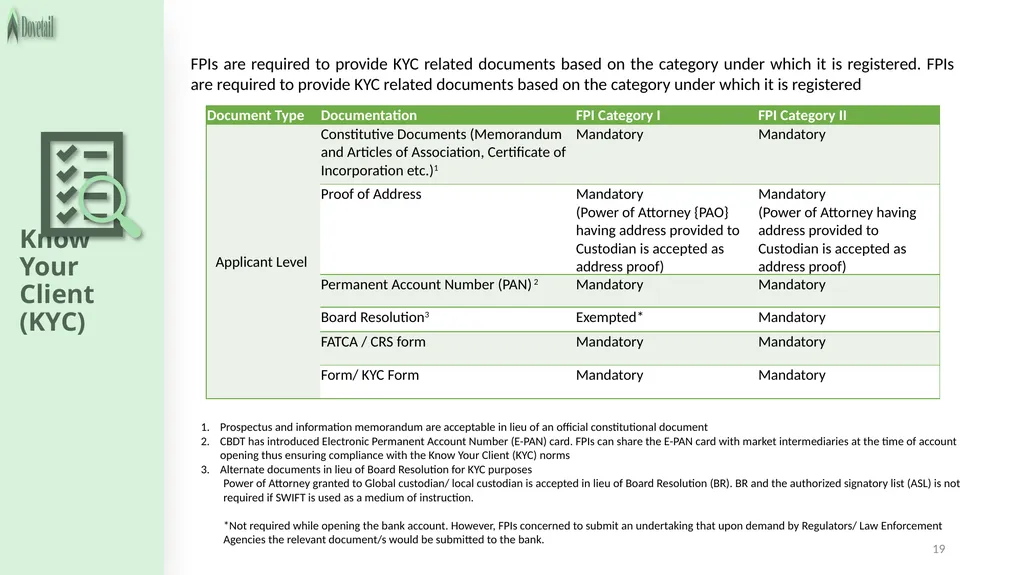
slide19. 19 FPIs are required to provide KYC related documents based on the category under which it is registered. FPIs are required to provide KYC related documents based on the category under which it is registered Prospectus and information memorandum are acceptable in lieu of an official constitutional document
CBDT has introduced Electronic Permanent Account Number (E-PAN) card. FPIs can share the E-PAN card with market intermediaries at the time of account opening thus ensuring compliance with the Know Your Client (KYC) norms
Alternate documents in lieu of Board Resolution for KYC purposes
Power of Attorney granted to Global custodian/ local custodian is accepted in lieu of Board Resolution (BR). BR and the authorized signatory list (ASL) is not required if SWIFT is used as a medium of instruction.
*Not required while opening the bank account. However, FPIs concerned to submit an undertaking that upon demand by Regulators/ Law Enforcement Agencies the relevant document/s would be submitted to the bank. Know Your Client (KYC)<br>
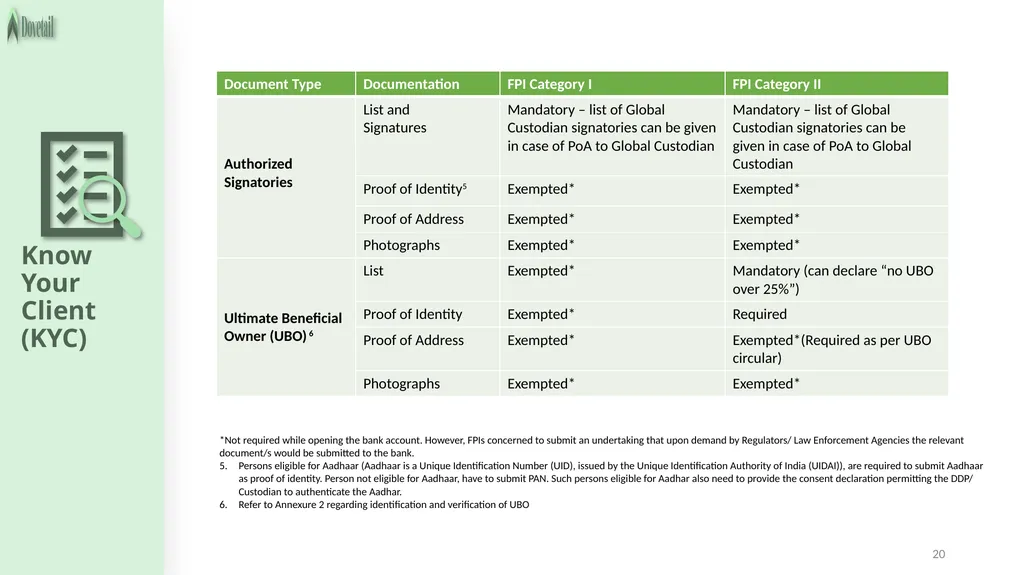
slide20. 20 *Not required while opening the bank account. However, FPIs concerned to submit an undertaking that upon demand by Regulators/ Law Enforcement Agencies the relevant document/s would be submitted to the bank.
Persons eligible for Aadhaar (Aadhaar is a Unique Identification Number (UID), issued by the Unique Identification Authority of India (UIDAI)), are required to submit Aadhaar as proof of identity. Person not eligible for Aadhaar, have to submit PAN. Such persons eligible for Aadhar also need to provide the consent declaration permitting the DDP/ Custodian to authenticate the Aadhar.
Refer to Annexure 2 regarding identification and verification of UBO Know Your Client (KYC) 20<br>
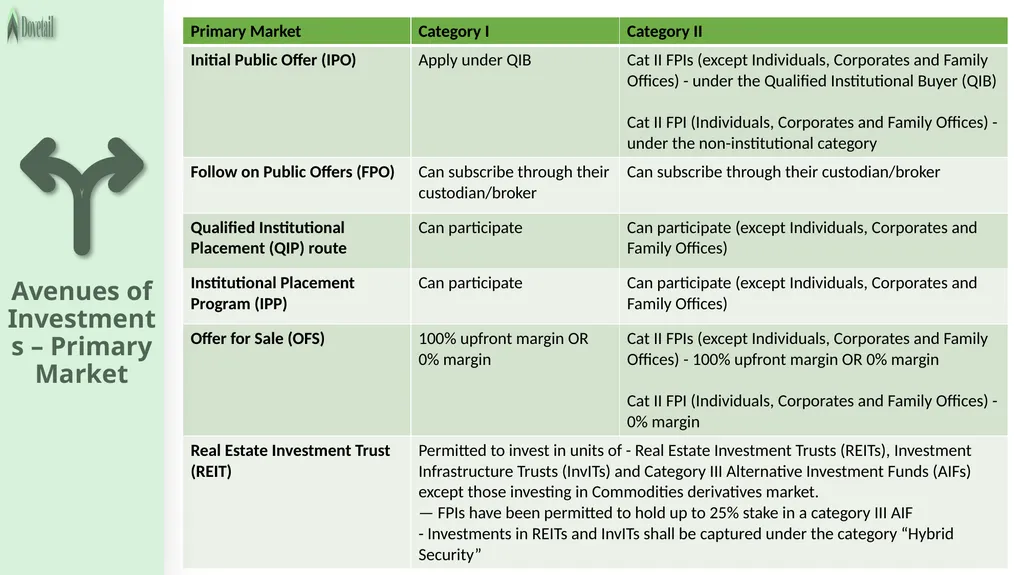
slide21. Avenues of Investments – Primary Market 21<br>
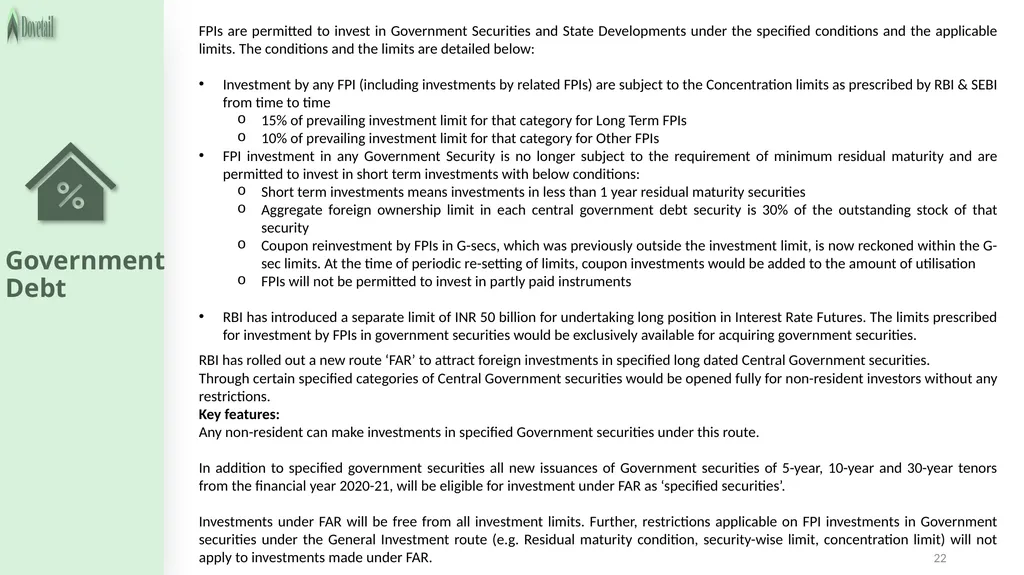
slide22. 22 FPIs are permitted to invest in Government Securities and State Developments under the specified conditions and the applicable limits. The conditions and the limits are detailed below:
Investment by any FPI (including investments by related FPIs) are subject to the Concentration limits as prescribed by RBI & SEBI from time to time
15% of prevailing investment limit for that category for Long Term FPIs
10% of prevailing investment limit for that category for Other FPIs
FPI investment in any Government Security is no longer subject to the requirement of minimum residual maturity and are permitted to invest in short term investments with below conditions:
Short term investments means investments in less than 1 year residual maturity securities
Aggregate foreign ownership limit in each central government debt security is 30% of the outstanding stock of that security
Coupon reinvestment by FPIs in G-secs, which was previously outside the investment limit, is now reckoned within the G-sec limits. At the time of periodic re-setting of limits, coupon investments would be added to the amount of utilisation
FPIs will not be permitted to invest in partly paid instruments
RBI has introduced a separate limit of INR 50 billion for undertaking long position in Interest Rate Futures. The limits prescribed for investment by FPIs in government securities would be exclusively available for acquiring government securities. Government Debt RBI has rolled out a new route ‘FAR’ to attract foreign investments in specified long dated Central Government securities.
Through certain specified categories of Central Government securities would be opened fully for non-resident investors without any restrictions.
Key features:
Any non-resident can make investments in specified Government securities under this route.
In addition to specified government securities all new issuances of Government securities of 5-year, 10-year and 30-year tenors from the financial year 2020-21, will be eligible for investment under FAR as ‘specified securities’.
Investments under FAR will be free from all investment limits. Further, restrictions applicable on FPI investments in Government securities under the General Investment route (e.g. Residual maturity condition, security-wise limit, concentration limit) will not apply to investments made under FAR.<br>
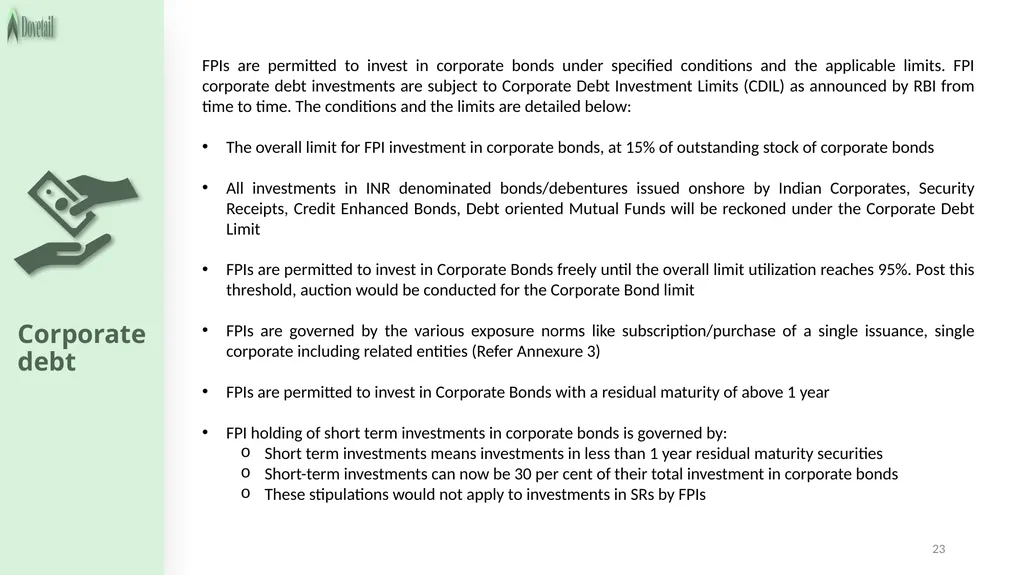
slide23. 23 FPIs are permitted to invest in corporate bonds under specified conditions and the applicable limits. FPI corporate debt investments are subject to Corporate Debt Investment Limits (CDIL) as announced by RBI from time to time. The conditions and the limits are detailed below:
The overall limit for FPI investment in corporate bonds, at 15% of outstanding stock of corporate bonds
All investments in INR denominated bonds/debentures issued onshore by Indian Corporates, Security Receipts, Credit Enhanced Bonds, Debt oriented Mutual Funds will be reckoned under the Corporate Debt Limit
FPIs are permitted to invest in Corporate Bonds freely until the overall limit utilization reaches 95%. Post this threshold, auction would be conducted for the Corporate Bond limit
FPIs are governed by the various exposure norms like subscription/purchase of a single issuance, single corporate including related entities (Refer Annexure 3)
FPIs are permitted to invest in Corporate Bonds with a residual maturity of above 1 year
FPI holding of short term investments in corporate bonds is governed by:
Short term investments means investments in less than 1 year residual maturity securities
Short-term investments can now be 30 per cent of their total investment in corporate bonds
These stipulations would not apply to investments in SRs by FPIs Corporate debt<br>
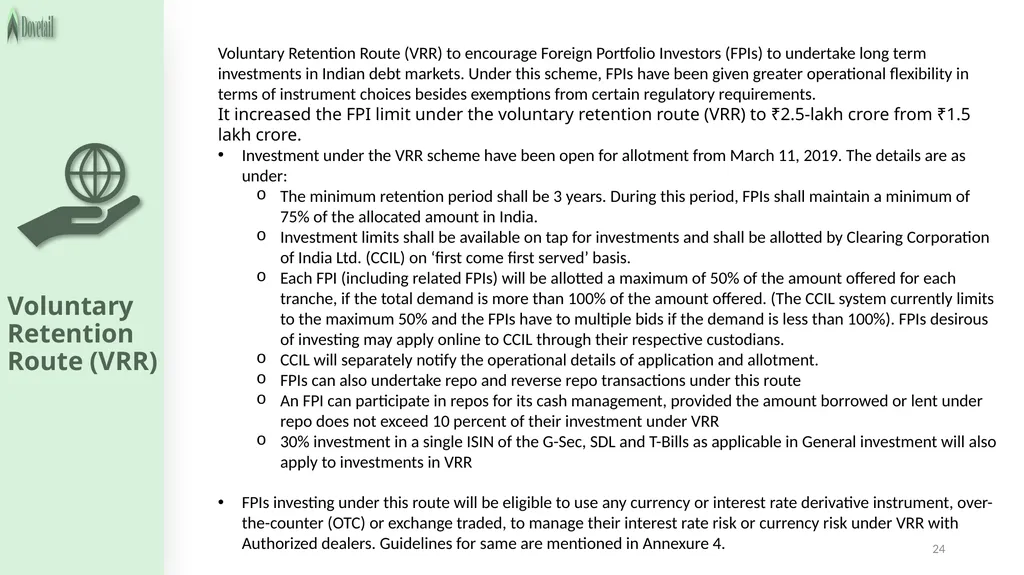
slide24. 24 Voluntary Retention Route (VRR) to encourage Foreign Portfolio Investors (FPIs) to undertake long term investments in Indian debt markets. Under this scheme, FPIs have been given greater operational flexibility in terms of instrument choices besides exemptions from certain regulatory requirements.
It increased the FPI limit under the voluntary retention route (VRR) to ₹2.5-lakh crore from ₹1.5 lakh crore.
Investment under the VRR scheme have been open for allotment from March 11, 2019. The details are as under:
The minimum retention period shall be 3 years. During this period, FPIs shall maintain a minimum of 75% of the allocated amount in India.
Investment limits shall be available on tap for investments and shall be allotted by Clearing Corporation of India Ltd. (CCIL) on ‘first come first served’ basis.
Each FPI (including related FPIs) will be allotted a maximum of 50% of the amount offered for each tranche, if the total demand is more than 100% of the amount offered. (The CCIL system currently limits to the maximum 50% and the FPIs have to multiple bids if the demand is less than 100%). FPIs desirous of investing may apply online to CCIL through their respective custodians.
CCIL will separately notify the operational details of application and allotment.
FPIs can also undertake repo and reverse repo transactions under this route
An FPI can participate in repos for its cash management, provided the amount borrowed or lent under repo does not exceed 10 percent of their investment under VRR
30% investment in a single ISIN of the G-Sec, SDL and T-Bills as applicable in General investment will also apply to investments in VRR
FPIs investing under this route will be eligible to use any currency or interest rate derivative instrument, over-the-counter (OTC) or exchange traded, to manage their interest rate risk or currency risk under VRR with Authorized dealers. Guidelines for same are mentioned in Annexure 4. Voluntary Retention Route (VRR)<br>
slide25. 25 TAX REGIME IN INDIA TAX REGIME IN INDIA<br>
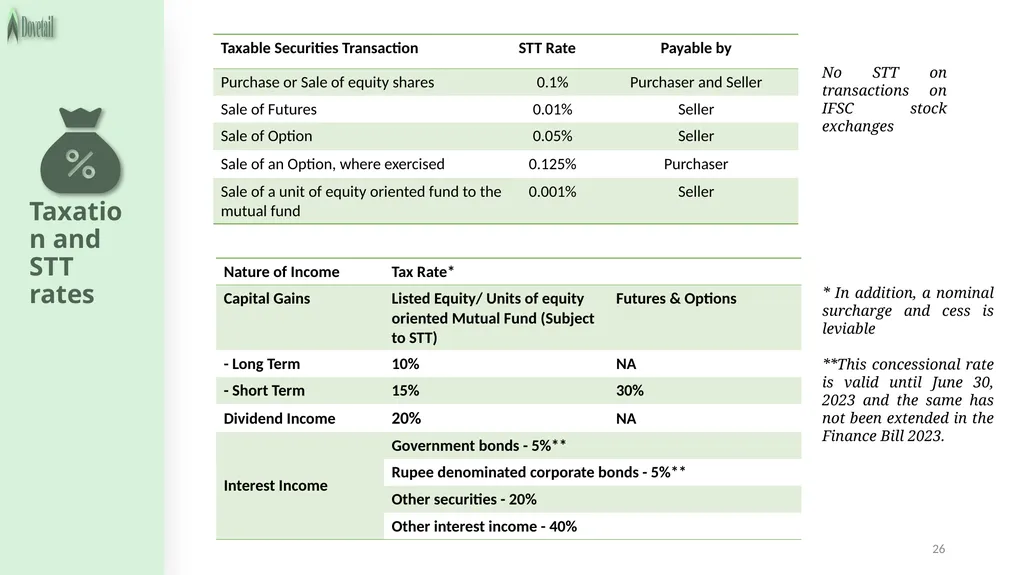
slide26. 26 Taxation and STT rates * In addition, a nominal surcharge and cess is leviable
**This concessional rate is valid until June 30, 2023 and the same has not been extended in the Finance Bill 2023. No STT on transactions on IFSC stock exchanges<br>
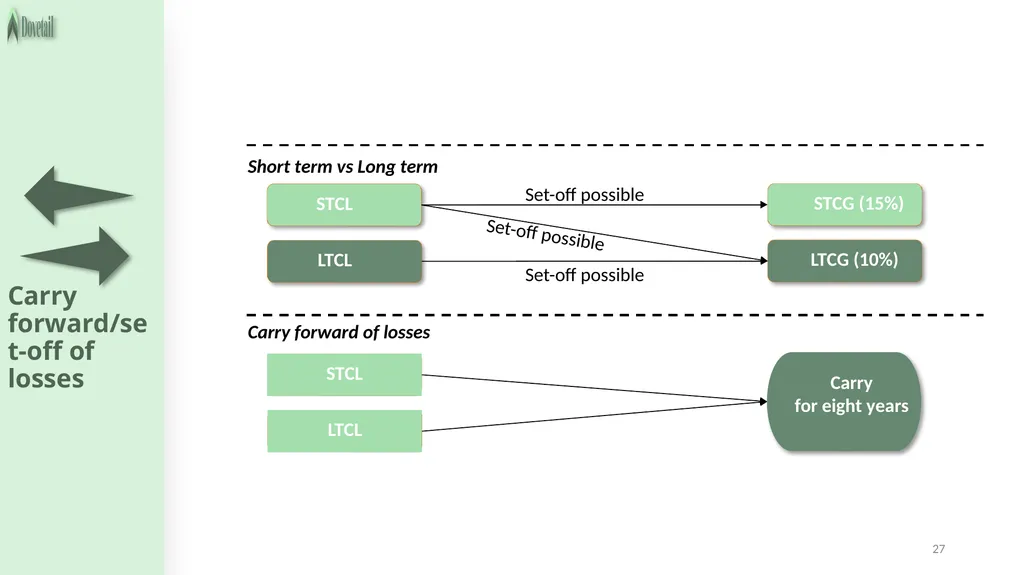
slide27. 27 Carry forward/set-off of losses Carry
for eight years<br>
slide28. 28 INDIRECT TRANSFER PROVISIONS<br>
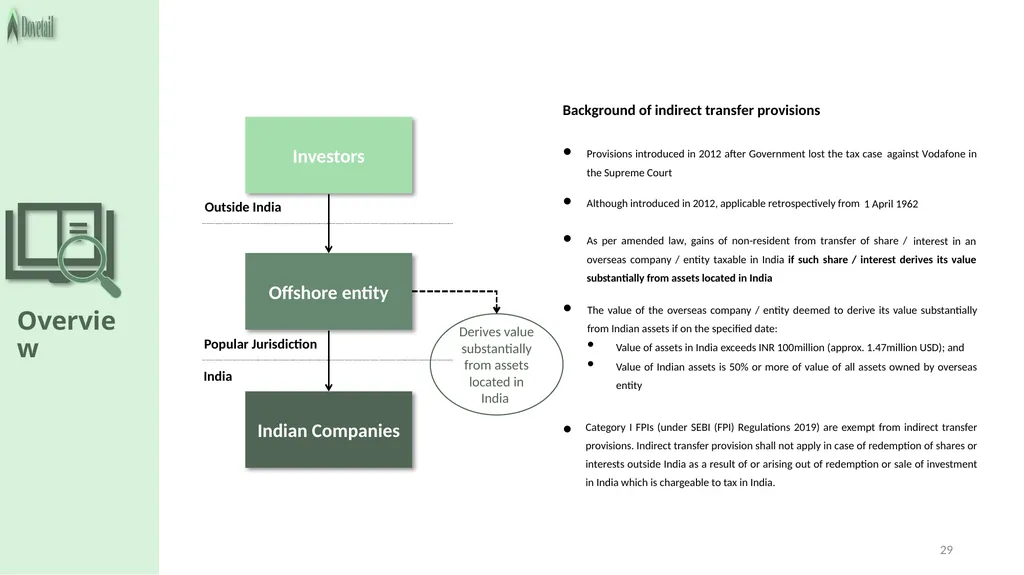
slide29. 29 Background of indirect transfer provisions • Provisions introduced in 2012 after Government lost the tax case against Vodafone in the Supreme Court • Although introduced in 2012, applicable retrospectively from 1 April 1962 • As per amended law, gains of non-resident from transfer of share / interest in an overseas company / entity taxable in India if such share / interest derives its value substantially from assets located in India • The value of the overseas company / entity deemed to derive its value substantially from Indian assets if on the specified date:
Value of assets in India exceeds INR 100million (approx. 1.47million USD); and
Value of Indian assets is 50% or more of value of all assets owned by overseas entity Investors Offshore entity Indian Companies Derives value substantially from assets located in India Outside India Popular Jurisdiction India • Category I FPIs (under SEBI (FPI) Regulations 2019) are exempt from indirect transfer provisions. Indirect transfer provision shall not apply in case of redemption of shares or interests outside India as a result of or arising out of redemption or sale of investment in India which is chargeable to tax in India. Overview<br>
slide30. 30 GENERAL ANT-AVOIDANCE RULES (GAAR)<br>
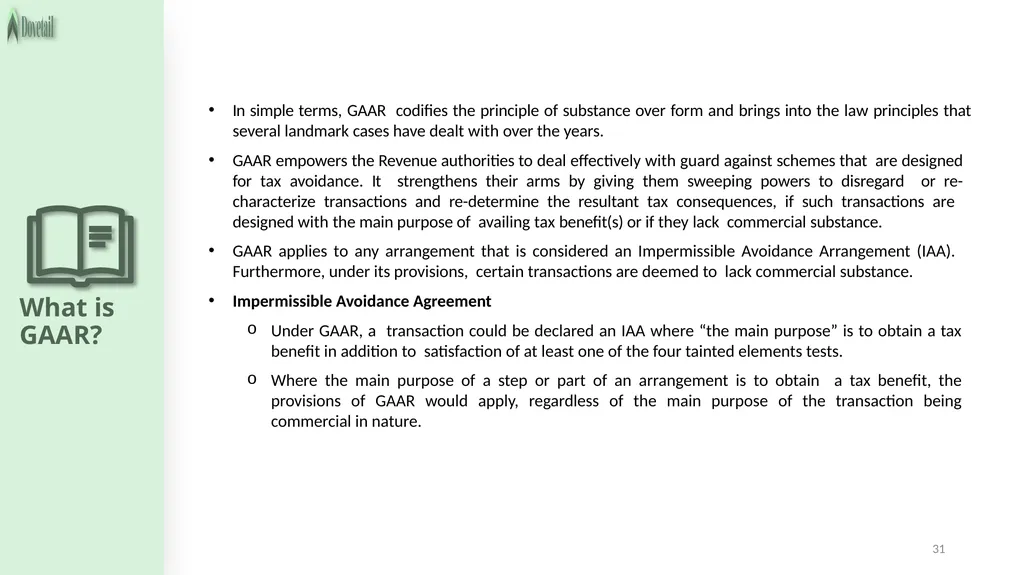
slide31. 31 What is GAAR? In simple terms, GAAR codifies the principle of substance over form and brings into the law principles that several landmark cases have dealt with over the years.
GAAR empowers the Revenue authorities to deal effectively with guard against schemes that are designed for tax avoidance. It strengthens their arms by giving them sweeping powers to disregard or re-characterize transactions and re-determine the resultant tax consequences, if such transactions are designed with the main purpose of availing tax benefit(s) or if they lack commercial substance.
GAAR applies to any arrangement that is considered an Impermissible Avoidance Arrangement (IAA). Furthermore, under its provisions, certain transactions are deemed to lack commercial substance.
Impermissible Avoidance Agreement
Under GAAR, a transaction could be declared an IAA where “the main purpose” is to obtain a tax benefit in addition to satisfaction of at least one of the four tainted elements tests.
Where the main purpose of a step or part of an arrangement is to obtain a tax benefit, the provisions of GAAR would apply, regardless of the main purpose of the transaction being commercial in nature.<br>
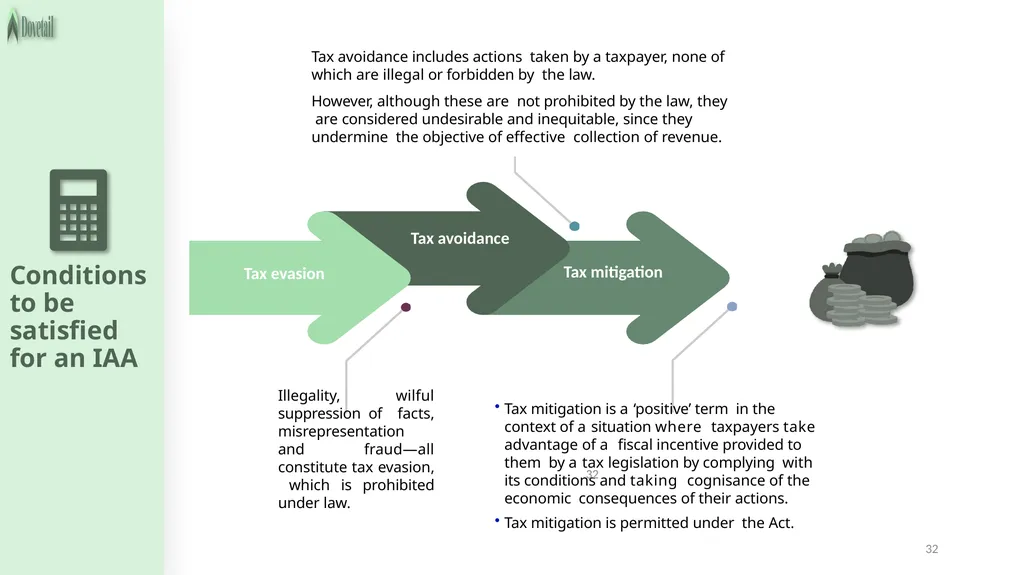
slide32. 32 Illegality, wilful suppression of facts, misrepresentation and fraud—all constitute tax evasion, which is prohibited under law. Tax evasion Tax avoidance Tax mitigation Tax mitigation is a ‘positive’ term in the context of a situation where taxpayers take advantage of a fiscal incentive provided to them by a tax legislation by complying with its conditions and taking cognisance of the economic consequences of their actions.
Tax mitigation is permitted under the Act. 32 Conditions to be satisfied for an IAA Tax avoidance includes actions taken by a taxpayer, none of which are illegal or forbidden by the law.
However, although these are not prohibited by the law, they are considered undesirable and inequitable, since they undermine the objective of effective collection of revenue.<br>
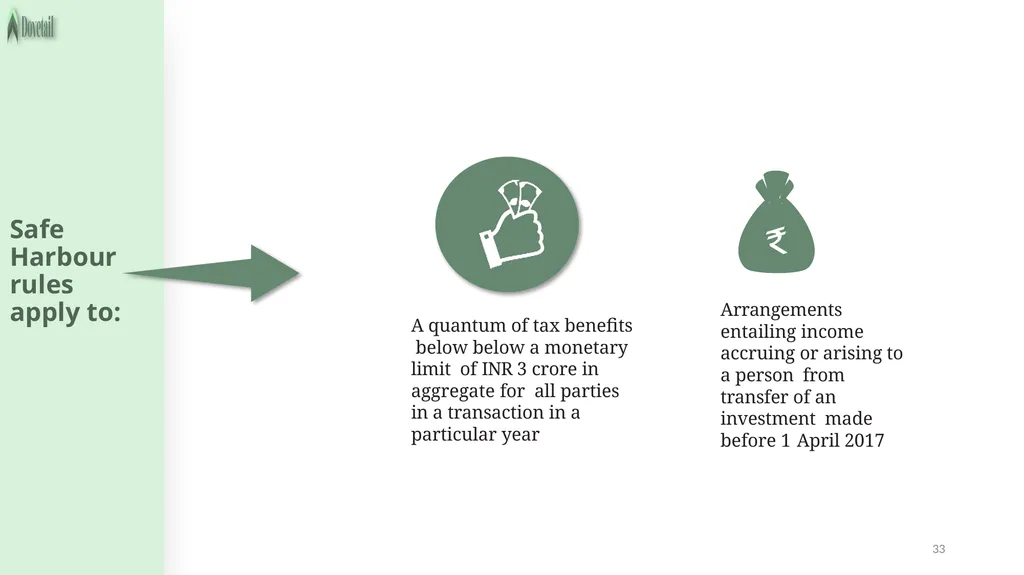
slide33. 33 A quantum of tax benefits below below a monetary limit of INR 3 crore in aggregate for all parties in a transaction in a particular year Arrangements entailing income accruing or arising to a person from transfer of an investment made before 1 April 2017 Safe Harbour rules apply to:<br>
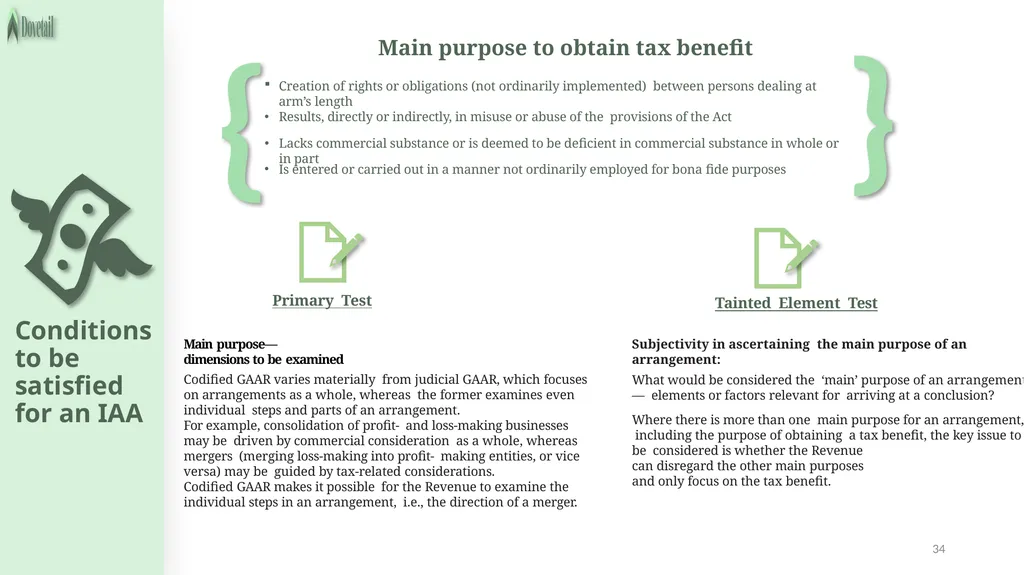
slide34. 34 Creation of rights or obligations (not ordinarily implemented) between persons dealing at arm’s length Results, directly or indirectly, in misuse or abuse of the provisions of the Act Lacks commercial substance or is deemed to be deficient in commercial substance in whole or in part Is entered or carried out in a manner not ordinarily employed for bona fide purposes { { Main purpose to obtain tax benefit Main purpose—
dimensions to be examined
Codified GAAR varies materially from judicial GAAR, which focuses on arrangements as a whole, whereas the former examines even individual steps and parts of an arrangement.
For example, consolidation of profit- and loss-making businesses may be driven by commercial consideration as a whole, whereas mergers (merging loss-making into profit- making entities, or vice versa) may be guided by tax-related considerations.
Codified GAAR makes it possible for the Revenue to examine the individual steps in an arrangement, i.e., the direction of a merger. Subjectivity in ascertaining the main purpose of an arrangement:
What would be considered the ‘main’ purpose of an arrangement— elements or factors relevant for arriving at a conclusion?
Where there is more than one main purpose for an arrangement, including the purpose of obtaining a tax benefit, the key issue to be considered is whether the Revenue
can disregard the other main purposes
and only focus on the tax benefit. Primary Test Tainted Element Test Conditions to be satisfied for an IAA<br>
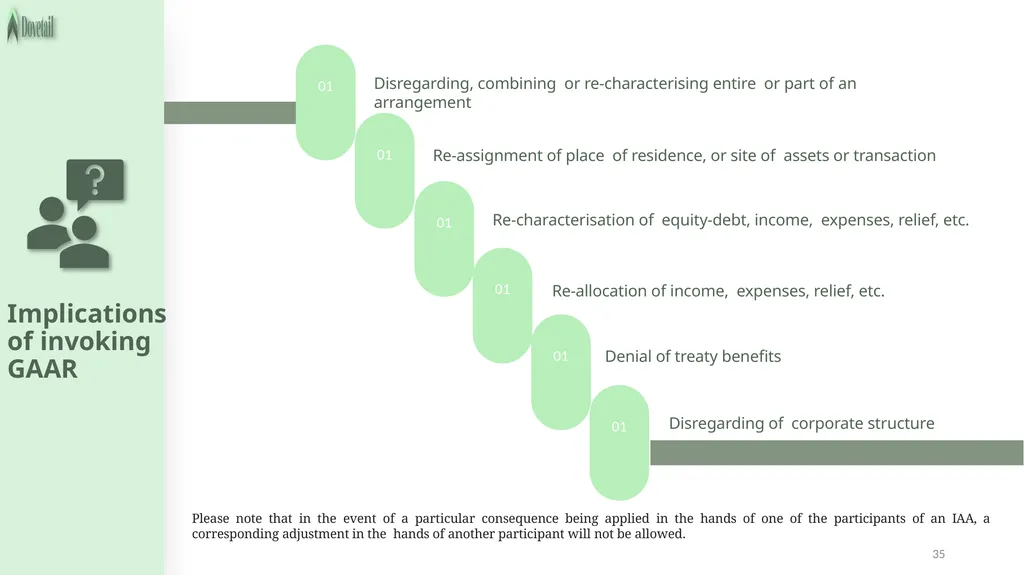
slide35. Disregarding, combining or re-characterising entire or part of an arrangement Re-assignment of place of residence, or site of assets or transaction Disregarding of corporate structure Re-allocation of income, expenses, relief, etc. Denial of treaty benefits Re-characterisation of equity-debt, income, expenses, relief, etc. Implications of invoking GAAR Please note that in the event of a particular consequence being applied in the hands of one of the participants of an IAA, a corresponding adjustment in the hands of another participant will not be allowed. 35<br>
slide36. ALTERNATE INVESTMENT FUND (AIF) 36<br>
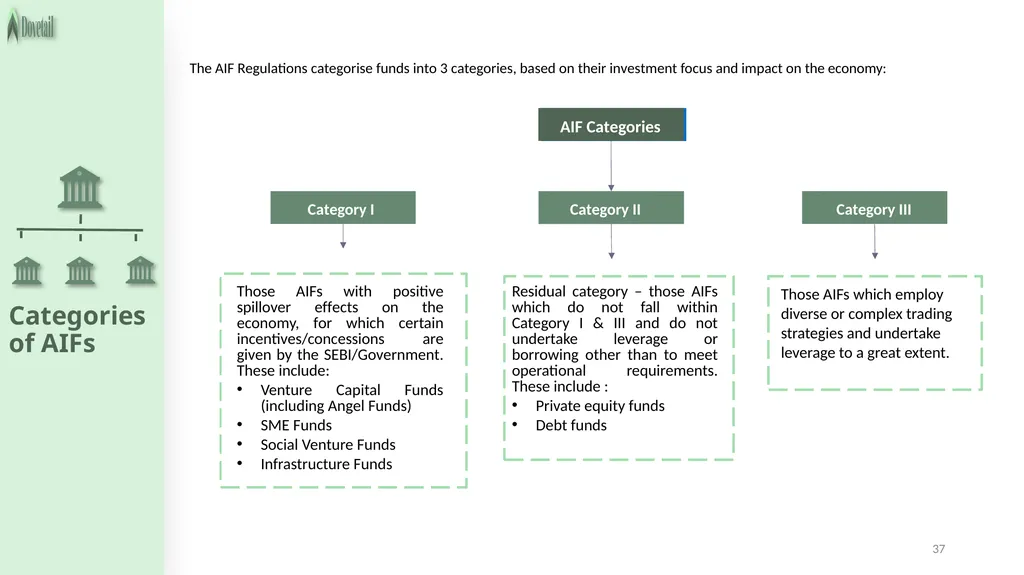
slide37. 37 Categories of AIFs The AIF Regulations categorise funds into 3 categories, based on their investment focus and impact on the economy: Those AIFs with positive spillover effects on the economy, for which certain incentives/concessions are given by the SEBI/Government. These include:
Venture Capital Funds (including Angel Funds)
SME Funds
Social Venture Funds
Infrastructure Funds AIF Categories Category I Category II Category III Those AIFs which employ
diverse or complex trading
strategies and undertake
leverage to a great extent. Residual category – those AIFs which do not fall within Category I & III and do not undertake leverage or borrowing other than to meet operational requirements. These include :
Private equity funds
Debt funds<br>
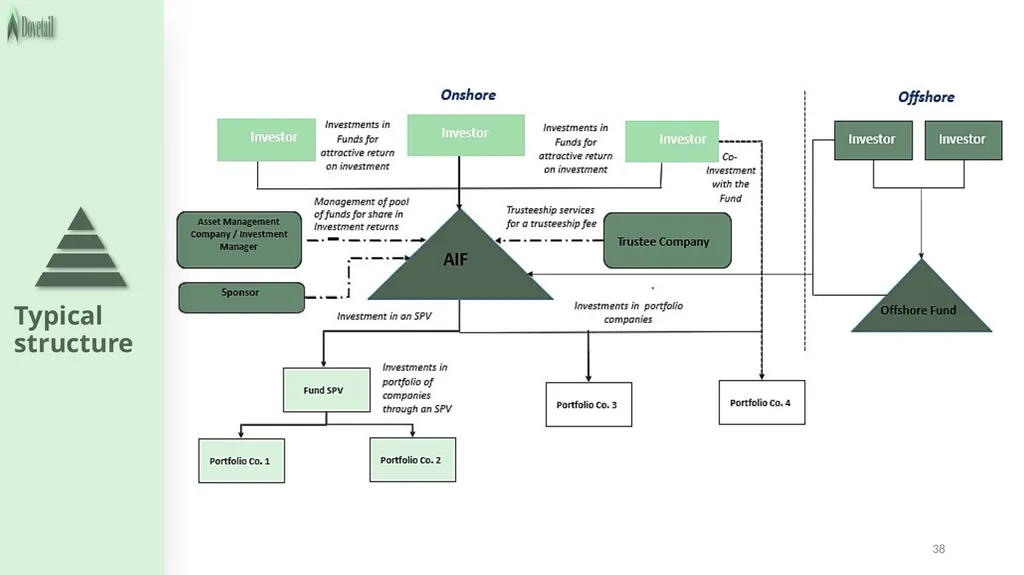
slide38. 38 Typical structure<br>
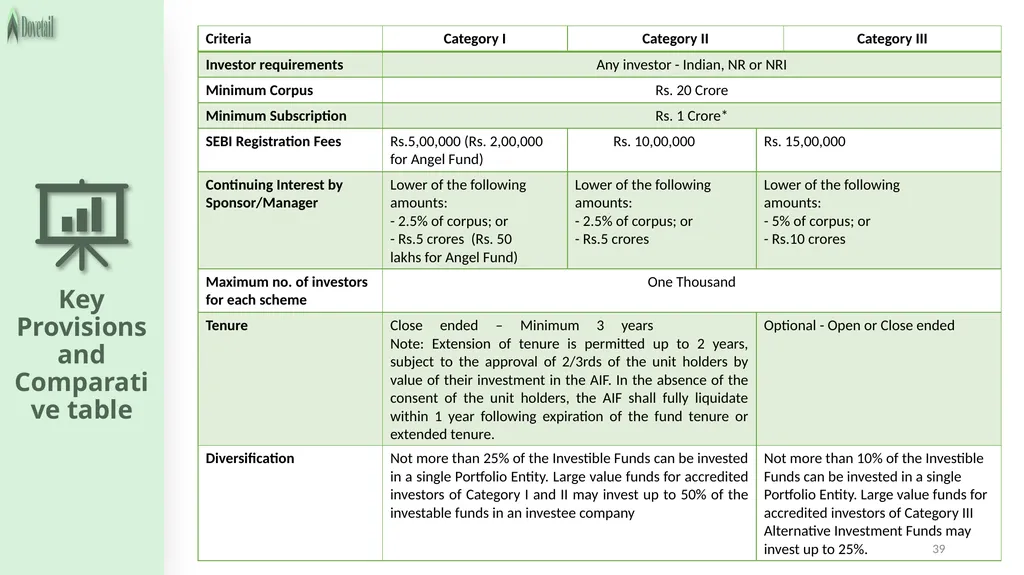
slide39. 39 Key Provisions and Comparative table<br>
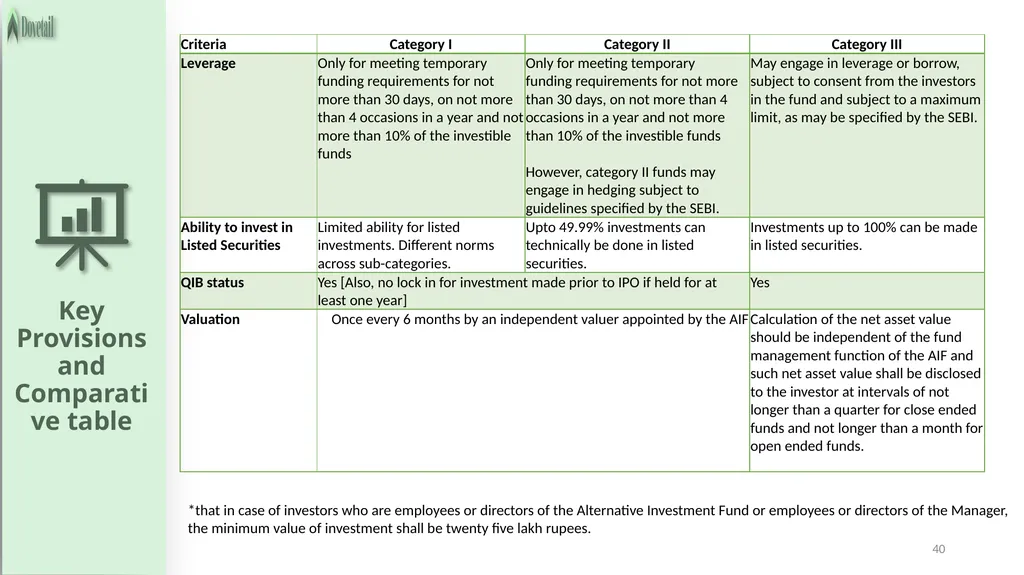
slide40. 40 Key Provisions and Comparative table *that in case of investors who are employees or directors of the Alternative Investment Fund or employees or directors of the Manager, the minimum value of investment shall be twenty five lakh rupees.<br>
slide41. 41 GIFT CITY<br>
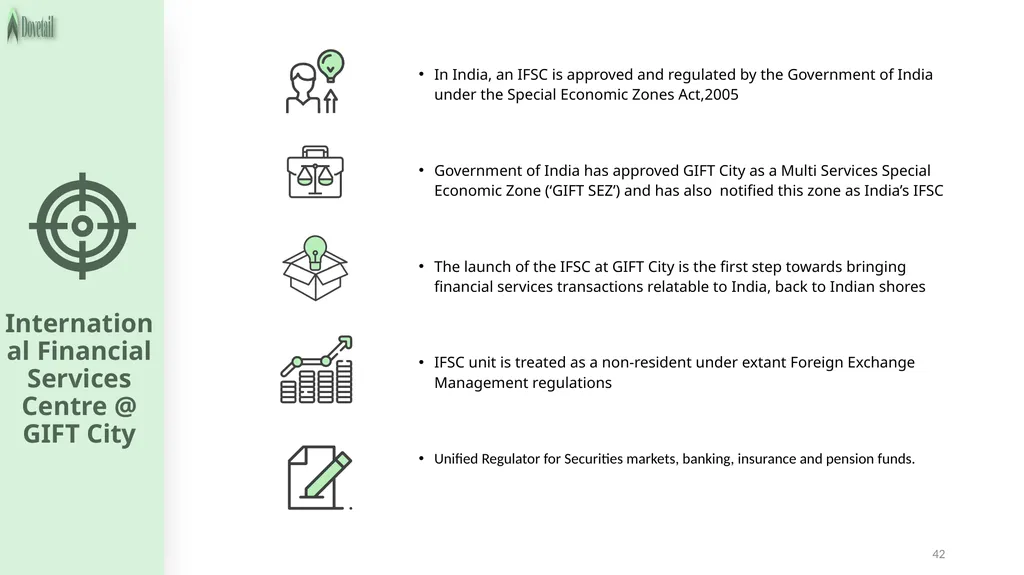
slide42. International Financial Services Centre @ GIFT City In India, an IFSC is approved and regulated by the Government of India under the Special Economic Zones Act,2005
Government of India has approved GIFT City as a Multi Services Special Economic Zone (‘GIFT SEZ’) and has also notified this zone as India’s IFSC
The launch of the IFSC at GIFT City is the first step towards bringing financial services transactions relatable to India, back to Indian shores
IFSC unit is treated as a non-resident under extant Foreign Exchange Management regulations
Unified Regulator for Securities markets, banking, insurance and pension funds. 42<br>
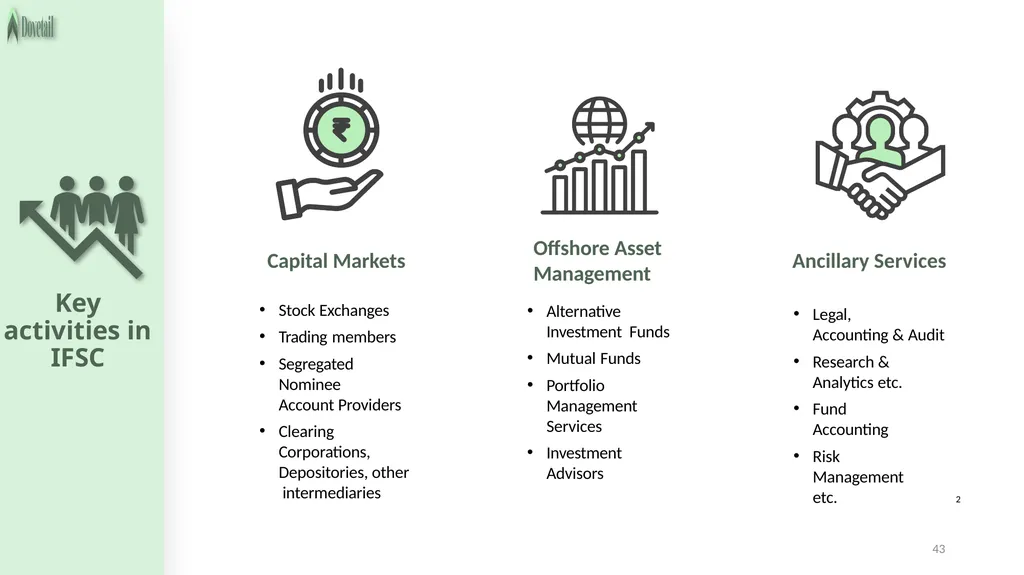
slide43. 43 2 Stock Exchanges
Trading members
Segregated Nominee Account Providers
Clearing Corporations, Depositories, other intermediaries Alternative Investment Funds
Mutual Funds
Portfolio Management Services
Investment Advisors Legal,
Accounting & Audit
Research & Analytics etc.
Fund Accounting
Risk Management etc. Ancillary Services Offshore Asset Management Capital Markets Key activities in IFSC<br>
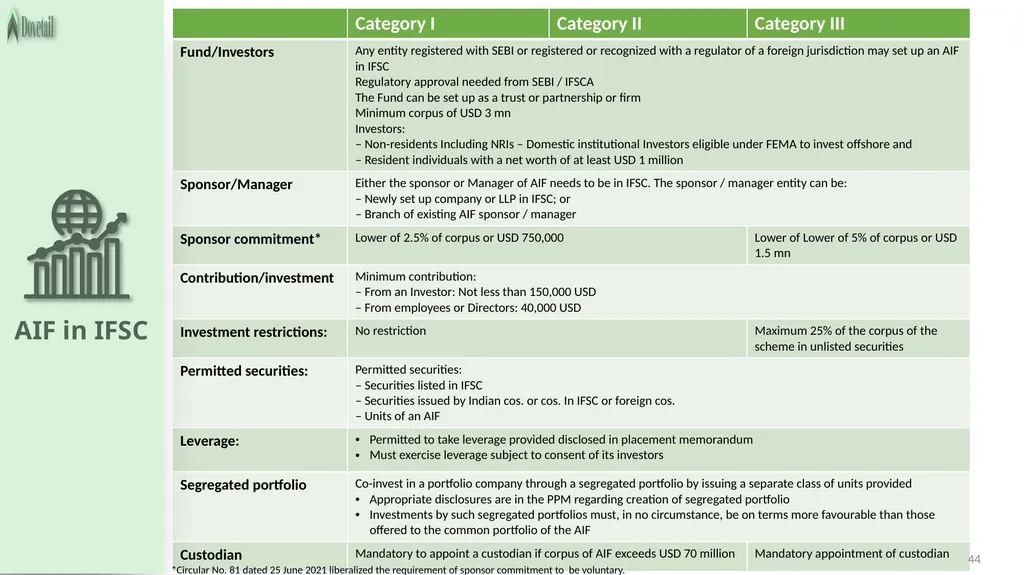
slide44. AIF in IFSC 44 *Circular No. 81 dated 25 June 2021 liberalized the requirement of sponsor commitment to be voluntary.<br>
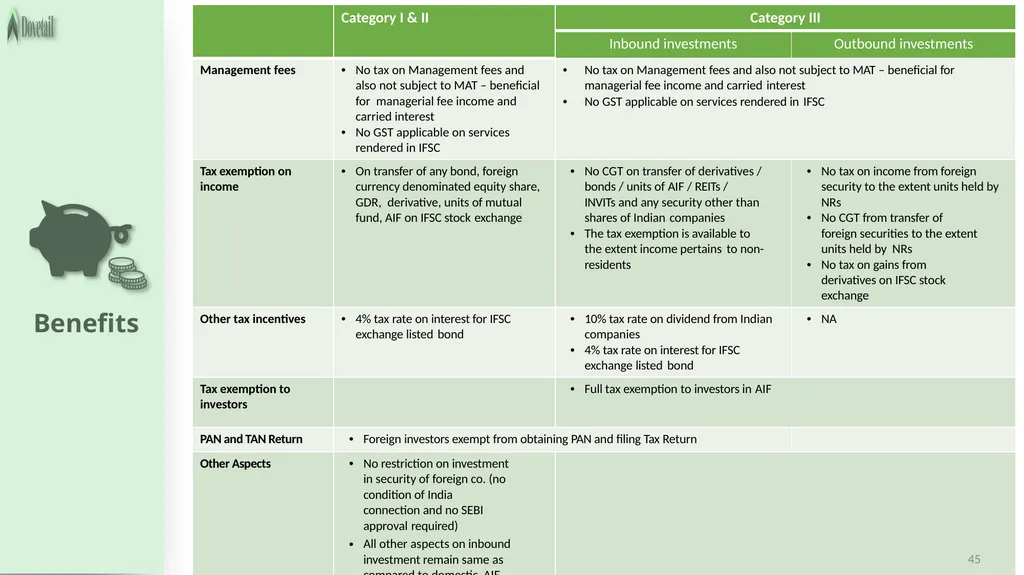
slide45. 45 Benefits<br>
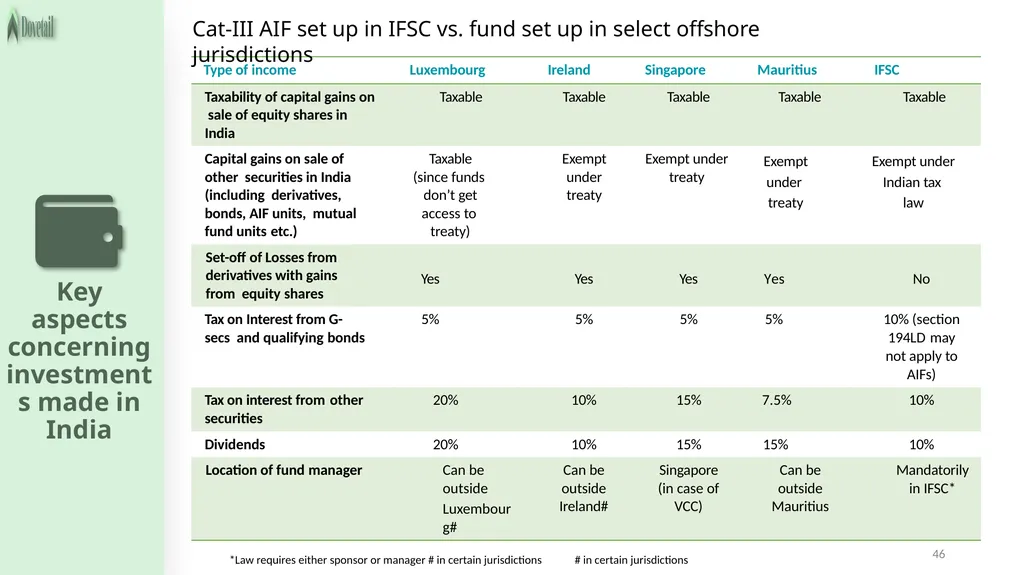
slide46. Cat-III AIF set up in IFSC vs. fund set up in select offshore jurisdictions Key aspects concerning investments made in India 46 *Law requires either sponsor or manager # in certain jurisdictions # in certain jurisdictions<br>
slide47. 47 ANNEXURES<br>
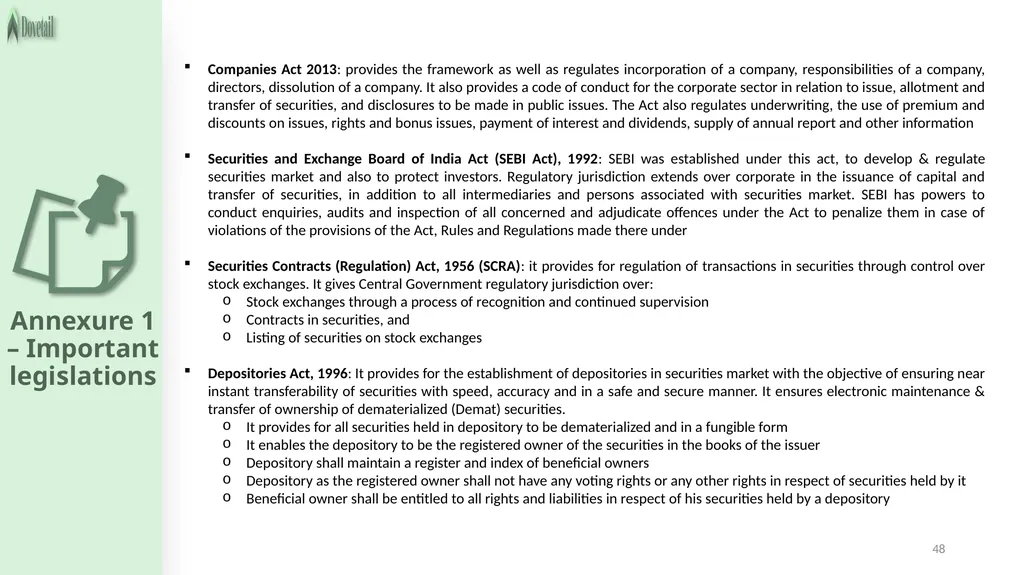
slide48. 48 Companies Act 2013: provides the framework as well as regulates incorporation of a company, responsibilities of a company, directors, dissolution of a company. It also provides a code of conduct for the corporate sector in relation to issue, allotment and transfer of securities, and disclosures to be made in public issues. The Act also regulates underwriting, the use of premium and discounts on issues, rights and bonus issues, payment of interest and dividends, supply of annual report and other information
Securities and Exchange Board of India Act (SEBI Act), 1992: SEBI was established under this act, to develop & regulate securities market and also to protect investors. Regulatory jurisdiction extends over corporate in the issuance of capital and transfer of securities, in addition to all intermediaries and persons associated with securities market. SEBI has powers to conduct enquiries, audits and inspection of all concerned and adjudicate offences under the Act to penalize them in case of violations of the provisions of the Act, Rules and Regulations made there under
Securities Contracts (Regulation) Act, 1956 (SCRA): it provides for regulation of transactions in securities through control over stock exchanges. It gives Central Government regulatory jurisdiction over:
Stock exchanges through a process of recognition and continued supervision
Contracts in securities, and
Listing of securities on stock exchanges
Depositories Act, 1996: It provides for the establishment of depositories in securities market with the objective of ensuring near instant transferability of securities with speed, accuracy and in a safe and secure manner. It ensures electronic maintenance & transfer of ownership of dematerialized (Demat) securities.
It provides for all securities held in depository to be dematerialized and in a fungible form
It enables the depository to be the registered owner of the securities in the books of the issuer
Depository shall maintain a register and index of beneficial owners
Depository as the registered owner shall not have any voting rights or any other rights in respect of securities held by it
Beneficial owner shall be entitled to all rights and liabilities in respect of his securities held by a depository Annexure 1 – Important legislations<br>
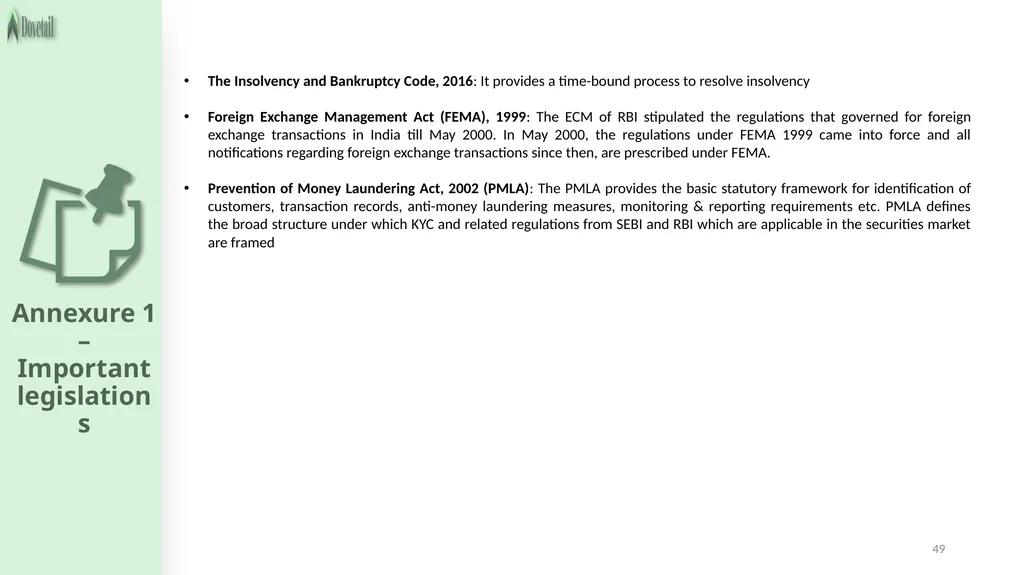
slide49. 49 The Insolvency and Bankruptcy Code, 2016: It provides a time-bound process to resolve insolvency
Foreign Exchange Management Act (FEMA), 1999: The ECM of RBI stipulated the regulations that governed for foreign exchange transactions in India till May 2000. In May 2000, the regulations under FEMA 1999 came into force and all notifications regarding foreign exchange transactions since then, are prescribed under FEMA.
Prevention of Money Laundering Act, 2002 (PMLA): The PMLA provides the basic statutory framework for identification of customers, transaction records, anti-money laundering measures, monitoring & reporting requirements etc. PMLA defines the broad structure under which KYC and related regulations from SEBI and RBI which are applicable in the securities market are framed Annexure 1 – Important legislations<br>
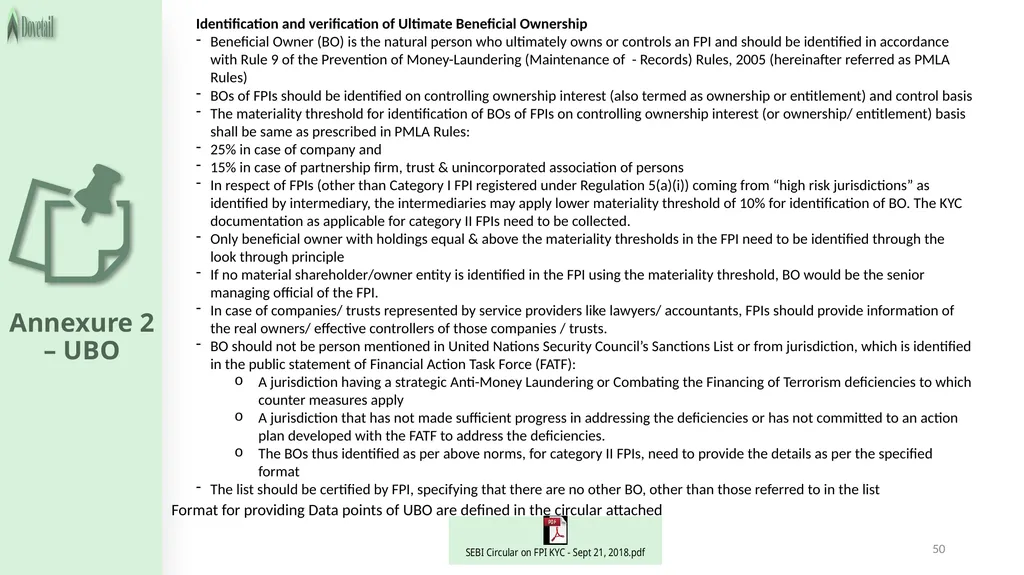
slide50. 50 Identification and verification of Ultimate Beneficial Ownership
Beneficial Owner (BO) is the natural person who ultimately owns or controls an FPI and should be identified in accordance with Rule 9 of the Prevention of Money-Laundering (Maintenance of - Records) Rules, 2005 (hereinafter referred as PMLA Rules)
BOs of FPIs should be identified on controlling ownership interest (also termed as ownership or entitlement) and control basis
The materiality threshold for identification of BOs of FPIs on controlling ownership interest (or ownership/ entitlement) basis shall be same as prescribed in PMLA Rules:
25% in case of company and
15% in case of partnership firm, trust & unincorporated association of persons
In respect of FPIs (other than Category I FPI registered under Regulation 5(a)(i)) coming from “high risk jurisdictions” as identified by intermediary, the intermediaries may apply lower materiality threshold of 10% for identification of BO. The KYC documentation as applicable for category II FPIs need to be collected.
Only beneficial owner with holdings equal & above the materiality thresholds in the FPI need to be identified through the look through principle
If no material shareholder/owner entity is identified in the FPI using the materiality threshold, BO would be the senior managing official of the FPI.
In case of companies/ trusts represented by service providers like lawyers/ accountants, FPIs should provide information of the real owners/ effective controllers of those companies / trusts.
BO should not be person mentioned in United Nations Security Council’s Sanctions List or from jurisdiction, which is identified in the public statement of Financial Action Task Force (FATF):
A jurisdiction having a strategic Anti-Money Laundering or Combating the Financing of Terrorism deficiencies to which counter measures apply
A jurisdiction that has not made sufficient progress in addressing the deficiencies or has not committed to an action plan developed with the FATF to address the deficiencies.
The BOs thus identified as per above norms, for category II FPIs, need to provide the details as per the specified format
The list should be certified by FPI, specifying that there are no other BO, other than those referred to in the list Format for providing Data points of UBO are defined in the circular attached Annexure 2 – UBO<br>
slide51. 51 Annexure 3 - Exposure norms for corporate bonds Investment by any FPI, including investments by related FPIs, shall not exceed 50% of any issue of a corporate bond.
In case an FPI, including related FPIs, has invested in more than 50% of any single issue, it shall not make further investments in that issue until this stipulation is met
Single issue is considered at an ISIN of the corporate bond
FPIs are not permitted to invest in partly paid debt instruments
New investment (made after April 27, 2018), other than investments mentioned above, would be exempted from this requirement till March 31, 2019. These investment will, however, have to comply with this requirement thereafter
Newly registered FPIs (registered after April 27, 2018) shall be required to adhere to this stipulation by March 31, 2019 or within 6 months from the date of registration, whichever is later
These provisions would not apply to
Investments by Multilateral Financial Institutions
FPI investments in Security Receipts
Pipeline investments
The above three restrictions do not apply to FPI investments in following securities:
─ Security Receipts
─ Investments in debt instruments issued by Asset Reconstruction Companies
─ Debt instruments issued by an entity under the Corporate Insolvency Resolution Process as per the resolution plan approved by the National Company Law Tribunal under the Insolvency and Bankruptcy Code, 2016
FPI investment in non-equity oriented mutual funds (i.e. debt)are subject to following conditions:
─ FPI investments in debt mutual funds included for the purpose of above limits
─ FPIs are not permitted to invest in overnight funds, liquid funds, money market funds, short term debt funds and ultra-short term debt funds<br>
slide52. 52 Authorized dealers may offer derivative contracts to eligible users under VRR or to its central treasury (of the group and being a group entity). Authorized dealers shall ensure that:
The FPI has an exposure to exchange rate risk on account of investments made under VRR.
The notional and tenor of the contract does not exceed the value and tenor of the exposure.
The same exposure has not been hedged with any other authorized dealer or on the exchange.
In cases where the value of the exposure falls below the notional of the derivative, the derivative should be suitably adjusted unless such divergence has occurred on account of change in market value of the exposure, in which case the FPI may, at its discretion, continue with the derivative contract till its original maturity.
Authorized dealers shall allow FPIs to freely cancel and rebook the derivative contracts.
Authorized Dealer shall ensure that all payables incidental to the hedge are met by the FPI out of repatriable funds and/or inward remittance through normal banking channels. Annexure 4 – Guidelines to hedge exchange rate risk under VRR<br>
slide53. The information contained herein has been prepared on the basis of information which is either publicly available or obtained from a source which Dovetail Capital Pvt. Ltd. believes to be reliable at the time of publication. Information provided herein may be a summary or translation. The content of the material contained herein is subject to change without notice, and such changes could affect its validity. Dovetail Capital Pvt. Ltd. is not obligated to update the material in light of future events. Furthermore, Dovetail Capital Pvt. Ltd. does not warrant, expressly or implicitly, its veracity, accuracy or completeness. Dovetail Capital Pvt. Ltd. accepts no liability whatsoever for any use of this communication or any action taken based on or arising from the material contained herein. Additional information may be available upon request. The material in this communication is for information purposes only. Therefore, this communication should not be interpreted as investment, tax or legal advice by Dovetail Capital Pvt. Ltd. or any of its officers, directors, employees or agents and customers should consult with appropriate professional advisers for these specific matters. Disclaimer 53<br>
slide54. THANK YOU<br>
slide3. 3 Important legislations governing securities market Key statutes applicable for foreign investors include:
FEMA, 1999
SEBI Foreign Portfolio Investors Regulations, 2019
SEBI Regulations applicable to key market intermediaries such as Custodians, Stockbrokers and regulations governing investor classes – Mutual Funds /collective investment schemes, Alternative Investment Funds, Portfolio Manager etc.
Legislations governing securities market in detail is included in Annexure 1:<br>
slide4. 4 INVESTMENT ROUTES IN INDIA<br>
slide5. 5 Foreign Investments in India Portfolio investments Direct investments FPI NRI FVCI FDI SEBI Approval Government of India Approval* Automatic Approval Route *The approval would be provided by the respective ministry or department on behalf of the Government of India. Certain sectors would also require inputs from the Ministry of Home Affairs. Foreign Investment Avenues<br>
slide6. 6 Foreign Portfolio Investors (FPIs): Entities established or incorporated outside India and permitted to invest in listed Indian securities and unlisted debt. Foreign Portfolio Investment is any investment made by a person resident outside India in capital instruments where such investment is
Less than 10 percent of the post issue paid-up equity capital on a fully diluted basis of a listed Indian company or
Less than 10 percent of the paid-up value of each series of capital instruments of a listed Indian company.
Reporting under (SAST) Regulations, 2011- On reaching the prescribed threshold of:
5% or more of the shares of the target company. Reporting to be done within 2 working days of the receipt of intimation of allotment of shares, or the acquisition of shares or voting rights to every stock exchange where the shares of the target company are listed and the target company at it registered office.
+/- 2% change in the holding position of the target company. Reporting to be done within 2 working days
Non-Resident Indian/ Overseas Citizen of India (NRIs/ OCIs): An Indian citizen who stays abroad for employment or carries on business or vocation outside India or a non-resident foreign citizen of Indian origin. Portfolio Investment route for entities classified as Non-Resident Indians (NRI) and Overseas Citizen of India (OCI)
Only entities eligible as NRI/ OCI as per Government guideline are eligible under this route. Appointment of a custodian is not compulsory
Investment in Listed securities and other securities permissible under FEMA
Individual Limit of 5% equity in any company, and an overall composite limit of 10%. This limit of 10% can be raised to 24%
NRIs have been permitted to access Exchange Traded Currency Derivatives (ETCD) market, subject to certain conditions Foreign Investment Avenues<br>
slide7. 7 Foreign Direct Investments (FDIs) (Strategic investments in Indian companies):
Investments through this route are considered strategic investments. Foreign Direct Investments (FDI) in India attract provisions of the Foreign Exchange Management Act,1999 (FEMA) and are subject to the regulations and directions issued by the Government of India (GoI) and Reserve Bank of India (RBI).
Entry routes for FDI –
Automatic Route - Investment by a person resident outside India does not require the prior approval from GoI or RBI.
Government Approved Route - Investment by a person resident outside India in certain specified sectors requires prior approval from Government of India. In addition, entities or beneficial owners of the entities (direct or indirect) based in or citizen of countries which share land border with India, should seek prior approval from Government of India
Eligibility Norms - Person resident outside India can invest in Indian companies, subject to the FDI Policy except in those sectors/ activities which are part of the prohibited list. An entity of a country, which shares land border with India or the beneficial owner of an entity (directly or indirectly) seeking to invest into India is situated in or is a citizen of any such country, shall invest only with prior Government approval. Eligible investors need to adhere to uniform KYC as specified by SEBI and RBI from time to time
Further, there are 8 sectors where investments are prohibited – Lottery business including government/private lottery, online lotteries etc., gambling and betting including casinos etc., chit funds, Nidhi company, trading in transferable development rights (TDRs), real estate business or construction of farm houses, manufacturing of cigars, cheroots, cigarillos and cigarettes, of tobacco or of tobacco substitutes and activities/sectors not open to private sector investment e.g.(I) Atomic Energy and (II) Railway operations.
A non-resident entity can invest in India, subject to the FDI Policy except in those sectors/activities which are prohibited. However, an entity of a country, which shares a land border with India or where the beneficial owner of investment into India is situated in or is a citizen of any such country, can invest only under the Government route. Foreign Investment Avenues<br>
slide8. 8 *Additional restrictions or conditions may be applicable specific to the asset class and investment route.
** Unlisted Corporate Bonds are subject to end use restriction
*** Units of short-term investment schemes of mutual funds – FPIs are not permitted to invest in Liquid and Money market mutual funds. Investments in debt mutual funds will be reckoned under the corporate bond limits. Investments in Mutual Funds not permitted under VRR route Permitted investments for foreign investors 8 * * ** ***<br>
slide9. 9 FOREIGN PORTFOLIO INVESTORS FOREIGN PORTFOLIO INVESTORS<br>
slide10. 10 In order to address the requirements of the evolving securities market, the Securities and Exchange Board of India ("SEBI") had constituted a working group under the chairmanship of Dr. Harun R. Khan to review the regulatory framework for foreign portfolio investors ("FPIs"). Based on the recommendations of the working group, SEBI has notified the SEBI (Foreign Portfolio Investors) Regulations, 2019 (the "Regulations") on September 23, 2019, in supersession of the SEBI (Foreign Portfolio Investors) Regulations, 2014.
The erstwhile three categories of FPIs have been merged into two categories FPI regime. This initiative, has also brought about important changes to market mechanisms, aimed at efficiency and global standards in key market processes.
Putting an end to regulatory uncertainty regarding non-resident Indians, overseas citizens of India and resident individuals holding stake in an FPI, the Regulations also expressly permit non-resident Indians or overseas citizens of India or resident Indian individuals to be constituents of the applicant provided they meet conditions specified by the SEBI. Market entry<br>
slide11. 11 Investor using Foreign Portfolio Investment Route Designated Depository Participant (DDP) - Custodian DDP Due Diligence process KYC Completion Grant of Registration as FPI NSDL Portal upload for generating FPI registration certificate Pre - Registration Post - Registration Set-up Custody arrangement. Open Securities & Cash Accounts in Custody books Open DEMAT Account with NSDL/CDSL Open CSGL Account for Government Securities (Central Bank RBI as a central depository) Open Bank account (Cash INR) Application for USS/CP Code – Investor’s unique ID for trading on the stock exchanges KYC Documents upload to KRA Central registry of KYC documents Tax Consultant Stock Broker Obtain Local Tax ID Permanent Account Number (PAN) Setups including repatriation related process Collect KYC Documents from KRA KYC Completion and open broking account Collect and set-up UCC / CP Code Readiness to Trade Market entry<br>
slide12. 12 Applicant should not be resident in India.
the applicant is not a non-resident Indian or an overseas citizen of India;
Non-resident Indians or overseas citizens of India or resident Indian individuals can be constituents of the applicant provided they meet conditions specified by the Board;
Where NRIs or OCI or RIs are constituents of the applicant – the contribution of a single NRI or OCI or RI shall be below twenty-five percent of the total contribution in the corpus of the applicant;
the aggregate contribution of NRIs, OCIs and RIs shall be below fifty percent of the total contribution in the corpus of the applicant.
the NRIs, OCIs and RIs shall not be in control of the applicant.
Applicant should be a resident of a country:
Whose securities market regulator is a signatory to IOSCO’s
Multilateral MOU or a signatory to a bilateral MOU with SEBI;
Whose central bank is a member of the Bank for International Settlements;
Against whom the FATF has not issued any warnings
Applicant must be a “fit and proper” person as prescribed Eligibility criteria<br>
slide13. 13 Accounts - Each FPI is allowed to open only one SNRR account, Derivative margin account, securities and depository account with a single custodian (Multiple accounts are not allowed) with an exception to VRR accounts
Investment - A foreign portfolio investor shall invest only in the following securities, namely-
shares, debentures and warrants issued by a body corporate; listed or to be listed on a recognized stock exchange in India;
Units of:
schemes launched by mutual funds
units of schemes floated by a Collective Investment Scheme
derivatives traded on a recognized stock exchange
units of real estate investment trusts, infrastructure investment trusts and units of Category III Alternative Investment Funds registered with the Board
Sectoral Limits - Up to 24% or to the respective sectoral foreign direct investment (FDI) limits of the paid-up capital on a fully diluted basis, will not require Government approval or compliance of sectoral conditions as the case may be, if such investment does not result in transfer of ownership and control of the resident Indian company from resident Indian citizens or transfer of ownership or control to persons resident outside India.
4. Naked short selling - FPIs are not allowed to engage in naked short selling. FPIs may short sell equity shares, provided they have borrowed securities under the SEBI securities borrowing and lending scheme and deliver the shares to the clearing corporation on settlement date. Further, FPIs are permitted to borrow securities only for delivery into short sale
5. 10% Limit - Each FPI (or FPIs belonging to the same investor group) holding in equity shares should always be below 10% of the post issue paid up capital on a fully diluted basis of a listed company. The 10% limits will be applicable across investments in the same listed company through
ADR/ GDR (post conversion to underlying equity shares)
FDI, FPI, FVCI
Participatory Notes/ODI Overview of Restrictions<br>
slide14. 14 Red Flag List - A red flag shall be activated whenever the foreign investment is 3% or less than 3% of the aggregate NRI/FPI limits or the sectoral cap which is updated on NSDL’s portal on a daily end-of-day basis.
Breach List - Once the aggregate NRI/FPI investment limits or the sectoral cap for a given company have been breached, the depositories shall inform the exchanges about the breach. The exchanges shall issue the necessary circulars/public notifications on their respective websites and shall halt all further purchases by :
FPIs, if the aggregate FPI limit is breached
NRIs, if the aggregate NRI limit is breached
All foreign investors, if the sectoral cap is breached
In the event of a breach of the sectoral cap/aggregate FPI limit/aggregate NRI limit, the foreign investors shall divest their excess holding within 5 trading days from the date of settlement of the trades, by selling shares only to domestic investors.
8. Banks - In the case of public sector banks, the limit is 20% of the paid-up capital . In case of Private sector banks, acquisition beyond 5% by any investor, foreign or domestic, would require prior approval from the Banking regulator (RBI).
9. Recognized stock exchange/Clearing corporation – FPIs can acquire/hold up to 5% of the paid-up equity share capital in a recognized stock exchange or clearing corporation. Any acquisition exceeding 2% of the paid-up equity share capital of a recognized stock exchange or clearing corporation needs to be approved by the SEBI Board within 15 days of such acquisition.
10. At all times (monitored on a day end basis), an FPI’s investment in corporate debt securities maturing within 1 year shall not exceed 30 percent of the FPI’s total portfolio of corporate debt securities as per “FAR” route. Overview of Restrictions<br>
slide15. **An applicant incorporated or established in an International Financial Services Centre shall be deemed to be appropriately regulated. 15 Categorisation<br>
slide16. Categorisation 16<br>
slide17. Categorisation 17<br>
slide18. Categorisation 18<br>
slide19. 19 FPIs are required to provide KYC related documents based on the category under which it is registered. FPIs are required to provide KYC related documents based on the category under which it is registered Prospectus and information memorandum are acceptable in lieu of an official constitutional document
CBDT has introduced Electronic Permanent Account Number (E-PAN) card. FPIs can share the E-PAN card with market intermediaries at the time of account opening thus ensuring compliance with the Know Your Client (KYC) norms
Alternate documents in lieu of Board Resolution for KYC purposes
Power of Attorney granted to Global custodian/ local custodian is accepted in lieu of Board Resolution (BR). BR and the authorized signatory list (ASL) is not required if SWIFT is used as a medium of instruction.
*Not required while opening the bank account. However, FPIs concerned to submit an undertaking that upon demand by Regulators/ Law Enforcement Agencies the relevant document/s would be submitted to the bank. Know Your Client (KYC)<br>
slide20. 20 *Not required while opening the bank account. However, FPIs concerned to submit an undertaking that upon demand by Regulators/ Law Enforcement Agencies the relevant document/s would be submitted to the bank.
Persons eligible for Aadhaar (Aadhaar is a Unique Identification Number (UID), issued by the Unique Identification Authority of India (UIDAI)), are required to submit Aadhaar as proof of identity. Person not eligible for Aadhaar, have to submit PAN. Such persons eligible for Aadhar also need to provide the consent declaration permitting the DDP/ Custodian to authenticate the Aadhar.
Refer to Annexure 2 regarding identification and verification of UBO Know Your Client (KYC) 20<br>
slide21. Avenues of Investments – Primary Market 21<br>
slide22. 22 FPIs are permitted to invest in Government Securities and State Developments under the specified conditions and the applicable limits. The conditions and the limits are detailed below:
Investment by any FPI (including investments by related FPIs) are subject to the Concentration limits as prescribed by RBI & SEBI from time to time
15% of prevailing investment limit for that category for Long Term FPIs
10% of prevailing investment limit for that category for Other FPIs
FPI investment in any Government Security is no longer subject to the requirement of minimum residual maturity and are permitted to invest in short term investments with below conditions:
Short term investments means investments in less than 1 year residual maturity securities
Aggregate foreign ownership limit in each central government debt security is 30% of the outstanding stock of that security
Coupon reinvestment by FPIs in G-secs, which was previously outside the investment limit, is now reckoned within the G-sec limits. At the time of periodic re-setting of limits, coupon investments would be added to the amount of utilisation
FPIs will not be permitted to invest in partly paid instruments
RBI has introduced a separate limit of INR 50 billion for undertaking long position in Interest Rate Futures. The limits prescribed for investment by FPIs in government securities would be exclusively available for acquiring government securities. Government Debt RBI has rolled out a new route ‘FAR’ to attract foreign investments in specified long dated Central Government securities.
Through certain specified categories of Central Government securities would be opened fully for non-resident investors without any restrictions.
Key features:
Any non-resident can make investments in specified Government securities under this route.
In addition to specified government securities all new issuances of Government securities of 5-year, 10-year and 30-year tenors from the financial year 2020-21, will be eligible for investment under FAR as ‘specified securities’.
Investments under FAR will be free from all investment limits. Further, restrictions applicable on FPI investments in Government securities under the General Investment route (e.g. Residual maturity condition, security-wise limit, concentration limit) will not apply to investments made under FAR.<br>
slide23. 23 FPIs are permitted to invest in corporate bonds under specified conditions and the applicable limits. FPI corporate debt investments are subject to Corporate Debt Investment Limits (CDIL) as announced by RBI from time to time. The conditions and the limits are detailed below:
The overall limit for FPI investment in corporate bonds, at 15% of outstanding stock of corporate bonds
All investments in INR denominated bonds/debentures issued onshore by Indian Corporates, Security Receipts, Credit Enhanced Bonds, Debt oriented Mutual Funds will be reckoned under the Corporate Debt Limit
FPIs are permitted to invest in Corporate Bonds freely until the overall limit utilization reaches 95%. Post this threshold, auction would be conducted for the Corporate Bond limit
FPIs are governed by the various exposure norms like subscription/purchase of a single issuance, single corporate including related entities (Refer Annexure 3)
FPIs are permitted to invest in Corporate Bonds with a residual maturity of above 1 year
FPI holding of short term investments in corporate bonds is governed by:
Short term investments means investments in less than 1 year residual maturity securities
Short-term investments can now be 30 per cent of their total investment in corporate bonds
These stipulations would not apply to investments in SRs by FPIs Corporate debt<br>
slide24. 24 Voluntary Retention Route (VRR) to encourage Foreign Portfolio Investors (FPIs) to undertake long term investments in Indian debt markets. Under this scheme, FPIs have been given greater operational flexibility in terms of instrument choices besides exemptions from certain regulatory requirements.
It increased the FPI limit under the voluntary retention route (VRR) to ₹2.5-lakh crore from ₹1.5 lakh crore.
Investment under the VRR scheme have been open for allotment from March 11, 2019. The details are as under:
The minimum retention period shall be 3 years. During this period, FPIs shall maintain a minimum of 75% of the allocated amount in India.
Investment limits shall be available on tap for investments and shall be allotted by Clearing Corporation of India Ltd. (CCIL) on ‘first come first served’ basis.
Each FPI (including related FPIs) will be allotted a maximum of 50% of the amount offered for each tranche, if the total demand is more than 100% of the amount offered. (The CCIL system currently limits to the maximum 50% and the FPIs have to multiple bids if the demand is less than 100%). FPIs desirous of investing may apply online to CCIL through their respective custodians.
CCIL will separately notify the operational details of application and allotment.
FPIs can also undertake repo and reverse repo transactions under this route
An FPI can participate in repos for its cash management, provided the amount borrowed or lent under repo does not exceed 10 percent of their investment under VRR
30% investment in a single ISIN of the G-Sec, SDL and T-Bills as applicable in General investment will also apply to investments in VRR
FPIs investing under this route will be eligible to use any currency or interest rate derivative instrument, over-the-counter (OTC) or exchange traded, to manage their interest rate risk or currency risk under VRR with Authorized dealers. Guidelines for same are mentioned in Annexure 4. Voluntary Retention Route (VRR)<br>
slide25. 25 TAX REGIME IN INDIA TAX REGIME IN INDIA<br>
slide26. 26 Taxation and STT rates * In addition, a nominal surcharge and cess is leviable
**This concessional rate is valid until June 30, 2023 and the same has not been extended in the Finance Bill 2023. No STT on transactions on IFSC stock exchanges<br>
slide27. 27 Carry forward/set-off of losses Carry
for eight years<br>
slide28. 28 INDIRECT TRANSFER PROVISIONS<br>
slide29. 29 Background of indirect transfer provisions • Provisions introduced in 2012 after Government lost the tax case against Vodafone in the Supreme Court • Although introduced in 2012, applicable retrospectively from 1 April 1962 • As per amended law, gains of non-resident from transfer of share / interest in an overseas company / entity taxable in India if such share / interest derives its value substantially from assets located in India • The value of the overseas company / entity deemed to derive its value substantially from Indian assets if on the specified date:
Value of assets in India exceeds INR 100million (approx. 1.47million USD); and
Value of Indian assets is 50% or more of value of all assets owned by overseas entity Investors Offshore entity Indian Companies Derives value substantially from assets located in India Outside India Popular Jurisdiction India • Category I FPIs (under SEBI (FPI) Regulations 2019) are exempt from indirect transfer provisions. Indirect transfer provision shall not apply in case of redemption of shares or interests outside India as a result of or arising out of redemption or sale of investment in India which is chargeable to tax in India. Overview<br>
slide30. 30 GENERAL ANT-AVOIDANCE RULES (GAAR)<br>
slide31. 31 What is GAAR? In simple terms, GAAR codifies the principle of substance over form and brings into the law principles that several landmark cases have dealt with over the years.
GAAR empowers the Revenue authorities to deal effectively with guard against schemes that are designed for tax avoidance. It strengthens their arms by giving them sweeping powers to disregard or re-characterize transactions and re-determine the resultant tax consequences, if such transactions are designed with the main purpose of availing tax benefit(s) or if they lack commercial substance.
GAAR applies to any arrangement that is considered an Impermissible Avoidance Arrangement (IAA). Furthermore, under its provisions, certain transactions are deemed to lack commercial substance.
Impermissible Avoidance Agreement
Under GAAR, a transaction could be declared an IAA where “the main purpose” is to obtain a tax benefit in addition to satisfaction of at least one of the four tainted elements tests.
Where the main purpose of a step or part of an arrangement is to obtain a tax benefit, the provisions of GAAR would apply, regardless of the main purpose of the transaction being commercial in nature.<br>
slide32. 32 Illegality, wilful suppression of facts, misrepresentation and fraud—all constitute tax evasion, which is prohibited under law. Tax evasion Tax avoidance Tax mitigation Tax mitigation is a ‘positive’ term in the context of a situation where taxpayers take advantage of a fiscal incentive provided to them by a tax legislation by complying with its conditions and taking cognisance of the economic consequences of their actions.
Tax mitigation is permitted under the Act. 32 Conditions to be satisfied for an IAA Tax avoidance includes actions taken by a taxpayer, none of which are illegal or forbidden by the law.
However, although these are not prohibited by the law, they are considered undesirable and inequitable, since they undermine the objective of effective collection of revenue.<br>
slide33. 33 A quantum of tax benefits below below a monetary limit of INR 3 crore in aggregate for all parties in a transaction in a particular year Arrangements entailing income accruing or arising to a person from transfer of an investment made before 1 April 2017 Safe Harbour rules apply to:<br>
slide34. 34 Creation of rights or obligations (not ordinarily implemented) between persons dealing at arm’s length Results, directly or indirectly, in misuse or abuse of the provisions of the Act Lacks commercial substance or is deemed to be deficient in commercial substance in whole or in part Is entered or carried out in a manner not ordinarily employed for bona fide purposes { { Main purpose to obtain tax benefit Main purpose—
dimensions to be examined
Codified GAAR varies materially from judicial GAAR, which focuses on arrangements as a whole, whereas the former examines even individual steps and parts of an arrangement.
For example, consolidation of profit- and loss-making businesses may be driven by commercial consideration as a whole, whereas mergers (merging loss-making into profit- making entities, or vice versa) may be guided by tax-related considerations.
Codified GAAR makes it possible for the Revenue to examine the individual steps in an arrangement, i.e., the direction of a merger. Subjectivity in ascertaining the main purpose of an arrangement:
What would be considered the ‘main’ purpose of an arrangement— elements or factors relevant for arriving at a conclusion?
Where there is more than one main purpose for an arrangement, including the purpose of obtaining a tax benefit, the key issue to be considered is whether the Revenue
can disregard the other main purposes
and only focus on the tax benefit. Primary Test Tainted Element Test Conditions to be satisfied for an IAA<br>
slide35. Disregarding, combining or re-characterising entire or part of an arrangement Re-assignment of place of residence, or site of assets or transaction Disregarding of corporate structure Re-allocation of income, expenses, relief, etc. Denial of treaty benefits Re-characterisation of equity-debt, income, expenses, relief, etc. Implications of invoking GAAR Please note that in the event of a particular consequence being applied in the hands of one of the participants of an IAA, a corresponding adjustment in the hands of another participant will not be allowed. 35<br>
slide36. ALTERNATE INVESTMENT FUND (AIF) 36<br>
slide37. 37 Categories of AIFs The AIF Regulations categorise funds into 3 categories, based on their investment focus and impact on the economy: Those AIFs with positive spillover effects on the economy, for which certain incentives/concessions are given by the SEBI/Government. These include:
Venture Capital Funds (including Angel Funds)
SME Funds
Social Venture Funds
Infrastructure Funds AIF Categories Category I Category II Category III Those AIFs which employ
diverse or complex trading
strategies and undertake
leverage to a great extent. Residual category – those AIFs which do not fall within Category I & III and do not undertake leverage or borrowing other than to meet operational requirements. These include :
Private equity funds
Debt funds<br>
slide38. 38 Typical structure<br>
slide39. 39 Key Provisions and Comparative table<br>
slide40. 40 Key Provisions and Comparative table *that in case of investors who are employees or directors of the Alternative Investment Fund or employees or directors of the Manager, the minimum value of investment shall be twenty five lakh rupees.<br>
slide41. 41 GIFT CITY<br>
slide42. International Financial Services Centre @ GIFT City In India, an IFSC is approved and regulated by the Government of India under the Special Economic Zones Act,2005
Government of India has approved GIFT City as a Multi Services Special Economic Zone (‘GIFT SEZ’) and has also notified this zone as India’s IFSC
The launch of the IFSC at GIFT City is the first step towards bringing financial services transactions relatable to India, back to Indian shores
IFSC unit is treated as a non-resident under extant Foreign Exchange Management regulations
Unified Regulator for Securities markets, banking, insurance and pension funds. 42<br>
slide43. 43 2 Stock Exchanges
Trading members
Segregated Nominee Account Providers
Clearing Corporations, Depositories, other intermediaries Alternative Investment Funds
Mutual Funds
Portfolio Management Services
Investment Advisors Legal,
Accounting & Audit
Research & Analytics etc.
Fund Accounting
Risk Management etc. Ancillary Services Offshore Asset Management Capital Markets Key activities in IFSC<br>
slide44. AIF in IFSC 44 *Circular No. 81 dated 25 June 2021 liberalized the requirement of sponsor commitment to be voluntary.<br>
slide45. 45 Benefits<br>
slide46. Cat-III AIF set up in IFSC vs. fund set up in select offshore jurisdictions Key aspects concerning investments made in India 46 *Law requires either sponsor or manager # in certain jurisdictions # in certain jurisdictions<br>
slide47. 47 ANNEXURES<br>
slide48. 48 Companies Act 2013: provides the framework as well as regulates incorporation of a company, responsibilities of a company, directors, dissolution of a company. It also provides a code of conduct for the corporate sector in relation to issue, allotment and transfer of securities, and disclosures to be made in public issues. The Act also regulates underwriting, the use of premium and discounts on issues, rights and bonus issues, payment of interest and dividends, supply of annual report and other information
Securities and Exchange Board of India Act (SEBI Act), 1992: SEBI was established under this act, to develop & regulate securities market and also to protect investors. Regulatory jurisdiction extends over corporate in the issuance of capital and transfer of securities, in addition to all intermediaries and persons associated with securities market. SEBI has powers to conduct enquiries, audits and inspection of all concerned and adjudicate offences under the Act to penalize them in case of violations of the provisions of the Act, Rules and Regulations made there under
Securities Contracts (Regulation) Act, 1956 (SCRA): it provides for regulation of transactions in securities through control over stock exchanges. It gives Central Government regulatory jurisdiction over:
Stock exchanges through a process of recognition and continued supervision
Contracts in securities, and
Listing of securities on stock exchanges
Depositories Act, 1996: It provides for the establishment of depositories in securities market with the objective of ensuring near instant transferability of securities with speed, accuracy and in a safe and secure manner. It ensures electronic maintenance & transfer of ownership of dematerialized (Demat) securities.
It provides for all securities held in depository to be dematerialized and in a fungible form
It enables the depository to be the registered owner of the securities in the books of the issuer
Depository shall maintain a register and index of beneficial owners
Depository as the registered owner shall not have any voting rights or any other rights in respect of securities held by it
Beneficial owner shall be entitled to all rights and liabilities in respect of his securities held by a depository Annexure 1 – Important legislations<br>
slide49. 49 The Insolvency and Bankruptcy Code, 2016: It provides a time-bound process to resolve insolvency
Foreign Exchange Management Act (FEMA), 1999: The ECM of RBI stipulated the regulations that governed for foreign exchange transactions in India till May 2000. In May 2000, the regulations under FEMA 1999 came into force and all notifications regarding foreign exchange transactions since then, are prescribed under FEMA.
Prevention of Money Laundering Act, 2002 (PMLA): The PMLA provides the basic statutory framework for identification of customers, transaction records, anti-money laundering measures, monitoring & reporting requirements etc. PMLA defines the broad structure under which KYC and related regulations from SEBI and RBI which are applicable in the securities market are framed Annexure 1 – Important legislations<br>
slide50. 50 Identification and verification of Ultimate Beneficial Ownership
Beneficial Owner (BO) is the natural person who ultimately owns or controls an FPI and should be identified in accordance with Rule 9 of the Prevention of Money-Laundering (Maintenance of - Records) Rules, 2005 (hereinafter referred as PMLA Rules)
BOs of FPIs should be identified on controlling ownership interest (also termed as ownership or entitlement) and control basis
The materiality threshold for identification of BOs of FPIs on controlling ownership interest (or ownership/ entitlement) basis shall be same as prescribed in PMLA Rules:
25% in case of company and
15% in case of partnership firm, trust & unincorporated association of persons
In respect of FPIs (other than Category I FPI registered under Regulation 5(a)(i)) coming from “high risk jurisdictions” as identified by intermediary, the intermediaries may apply lower materiality threshold of 10% for identification of BO. The KYC documentation as applicable for category II FPIs need to be collected.
Only beneficial owner with holdings equal & above the materiality thresholds in the FPI need to be identified through the look through principle
If no material shareholder/owner entity is identified in the FPI using the materiality threshold, BO would be the senior managing official of the FPI.
In case of companies/ trusts represented by service providers like lawyers/ accountants, FPIs should provide information of the real owners/ effective controllers of those companies / trusts.
BO should not be person mentioned in United Nations Security Council’s Sanctions List or from jurisdiction, which is identified in the public statement of Financial Action Task Force (FATF):
A jurisdiction having a strategic Anti-Money Laundering or Combating the Financing of Terrorism deficiencies to which counter measures apply
A jurisdiction that has not made sufficient progress in addressing the deficiencies or has not committed to an action plan developed with the FATF to address the deficiencies.
The BOs thus identified as per above norms, for category II FPIs, need to provide the details as per the specified format
The list should be certified by FPI, specifying that there are no other BO, other than those referred to in the list Format for providing Data points of UBO are defined in the circular attached Annexure 2 – UBO<br>
slide51. 51 Annexure 3 - Exposure norms for corporate bonds Investment by any FPI, including investments by related FPIs, shall not exceed 50% of any issue of a corporate bond.
In case an FPI, including related FPIs, has invested in more than 50% of any single issue, it shall not make further investments in that issue until this stipulation is met
Single issue is considered at an ISIN of the corporate bond
FPIs are not permitted to invest in partly paid debt instruments
New investment (made after April 27, 2018), other than investments mentioned above, would be exempted from this requirement till March 31, 2019. These investment will, however, have to comply with this requirement thereafter
Newly registered FPIs (registered after April 27, 2018) shall be required to adhere to this stipulation by March 31, 2019 or within 6 months from the date of registration, whichever is later
These provisions would not apply to
Investments by Multilateral Financial Institutions
FPI investments in Security Receipts
Pipeline investments
The above three restrictions do not apply to FPI investments in following securities:
─ Security Receipts
─ Investments in debt instruments issued by Asset Reconstruction Companies
─ Debt instruments issued by an entity under the Corporate Insolvency Resolution Process as per the resolution plan approved by the National Company Law Tribunal under the Insolvency and Bankruptcy Code, 2016
FPI investment in non-equity oriented mutual funds (i.e. debt)are subject to following conditions:
─ FPI investments in debt mutual funds included for the purpose of above limits
─ FPIs are not permitted to invest in overnight funds, liquid funds, money market funds, short term debt funds and ultra-short term debt funds<br>
slide52. 52 Authorized dealers may offer derivative contracts to eligible users under VRR or to its central treasury (of the group and being a group entity). Authorized dealers shall ensure that:
The FPI has an exposure to exchange rate risk on account of investments made under VRR.
The notional and tenor of the contract does not exceed the value and tenor of the exposure.
The same exposure has not been hedged with any other authorized dealer or on the exchange.
In cases where the value of the exposure falls below the notional of the derivative, the derivative should be suitably adjusted unless such divergence has occurred on account of change in market value of the exposure, in which case the FPI may, at its discretion, continue with the derivative contract till its original maturity.
Authorized dealers shall allow FPIs to freely cancel and rebook the derivative contracts.
Authorized Dealer shall ensure that all payables incidental to the hedge are met by the FPI out of repatriable funds and/or inward remittance through normal banking channels. Annexure 4 – Guidelines to hedge exchange rate risk under VRR<br>
slide53. The information contained herein has been prepared on the basis of information which is either publicly available or obtained from a source which Dovetail Capital Pvt. Ltd. believes to be reliable at the time of publication. Information provided herein may be a summary or translation. The content of the material contained herein is subject to change without notice, and such changes could affect its validity. Dovetail Capital Pvt. Ltd. is not obligated to update the material in light of future events. Furthermore, Dovetail Capital Pvt. Ltd. does not warrant, expressly or implicitly, its veracity, accuracy or completeness. Dovetail Capital Pvt. Ltd. accepts no liability whatsoever for any use of this communication or any action taken based on or arising from the material contained herein. Additional information may be available upon request. The material in this communication is for information purposes only. Therefore, this communication should not be interpreted as investment, tax or legal advice by Dovetail Capital Pvt. Ltd. or any of its officers, directors, employees or agents and customers should consult with appropriate professional advisers for these specific matters. Disclaimer 53<br>
slide54. THANK YOU<br>