Legislative Counsel Bureau Audit Division Auditing Boards and Commissions Training November 18, 2019 Government auditing is essential in providing accountability to legislators, oversight bodies, those charged with governance, and the
"Legislative Counsel Bureau Audit Division Auditing" is the property of its rightful owner. Permission is granted to
download and print the materials on this website for personal, non-commercial use only, and to display it
on your personal computer provided you do not modify the materials and that you retain all copyright
notices contained in the materials. By downloading content from our website, you accept the terms of this
agreement.
Presentation Transcript
01
Legislative Counsel Bureau Audit Division Auditing Boards and Commissions Training
November 18, 2019<br>
02
“Government auditing is essential in providing accountability to legislators, oversight bodies, those charged with governance, and the public.”
Government Auditing Standards - 1.03 Audit Division<br>
03
Executive Branch – Division of Internal Audits Conducts audits approved by the Executive Branch Audit Committee
Provides training and assists agency staff in developing internal controls
Reviews internal controls and expenditures for adherence to state requirements 3<br>
04
Legislative Branch- Legislative Counsel Bureau Audit Division Conducts audits:
Of State agencies based on schedule approved by the Legislative Commission
Based on specific request by the Legislative Commission
As mandated through legislation 4<br>
05
Sunset Subcommittee of the Legislative Commission – NRS 232B Conducts reviews of boards and similar entities
Selects entities to review each interim
Determines whether those entities should be continued, modified, consolidated, or terminated
Can request LCB Audit to audit boards 5<br>
06
Why is Fiscal Oversight Especially Important for Boards? Boards’ budgets are not included in Executive Budget
Budgetary oversight is reduced
Higher risk of weak internal controls
Increased risk of fraud 6<br>
07
Recent Board Frauds 2002 - $760k embezzled from Dental Examiners
2005 - $38k embezzled from Certified Court Reporters
2006 - $62k embezzled from Osteopathic Medicine
2008 - $11k embezzled from Osteopathic Medicine
2014 - $35k embezzled from Board of Podiatry
2016 - $unknown – Board of Physical Therapy
2017 - $9k embezzled from Board of Examiners for Marriage and Family Therapists and Clinical Professional Counselors
2018 - $20k diverted in unauthorized pay from Board of Massage Therapy 7<br>
08
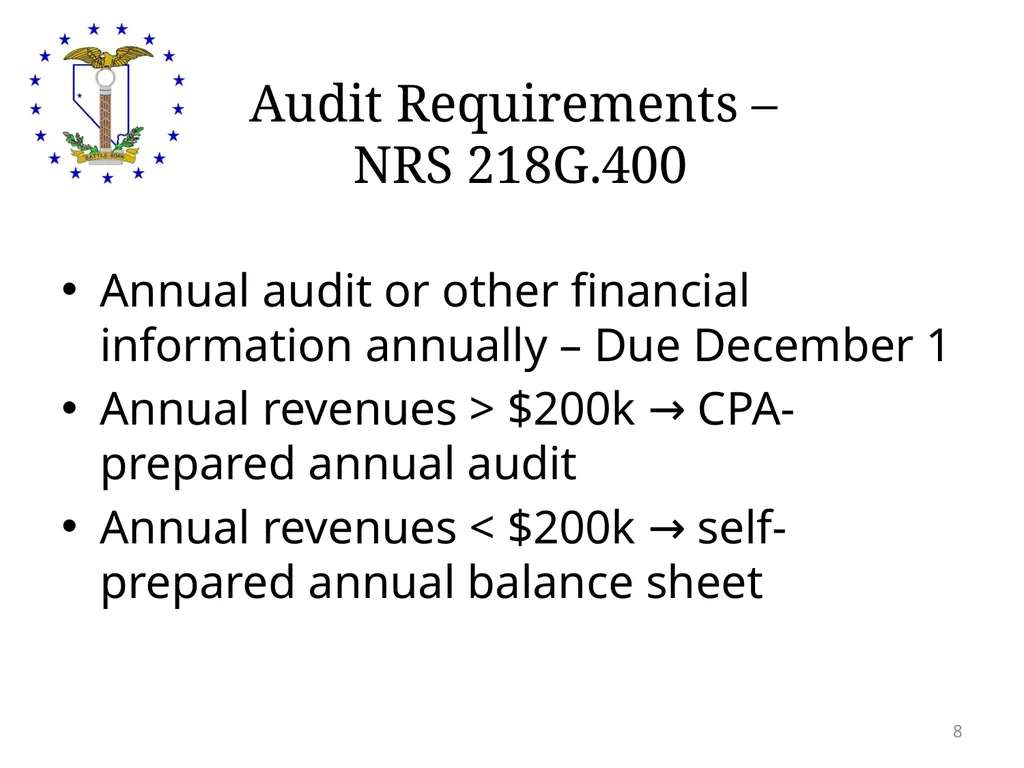
Audit Requirements – NRS 218G.400 Annual audit or other financial information annually – Due December 1
Annual revenues > $200k → CPA-prepared annual audit
Annual revenues < $200k → self-prepared annual balance sheet 8<br>
09
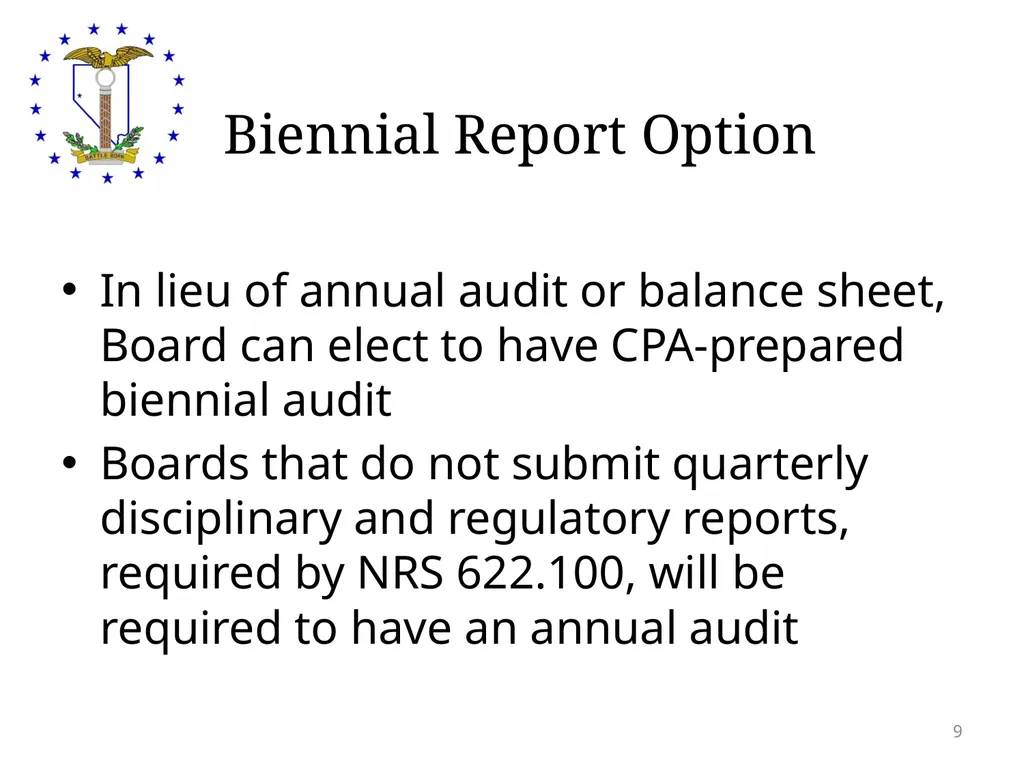
Biennial Report Option In lieu of annual audit or balance sheet, Board can elect to have CPA-prepared biennial audit
Boards that do not submit quarterly disciplinary and regulatory reports, required by NRS 622.100, will be required to have an annual audit 9<br>
10
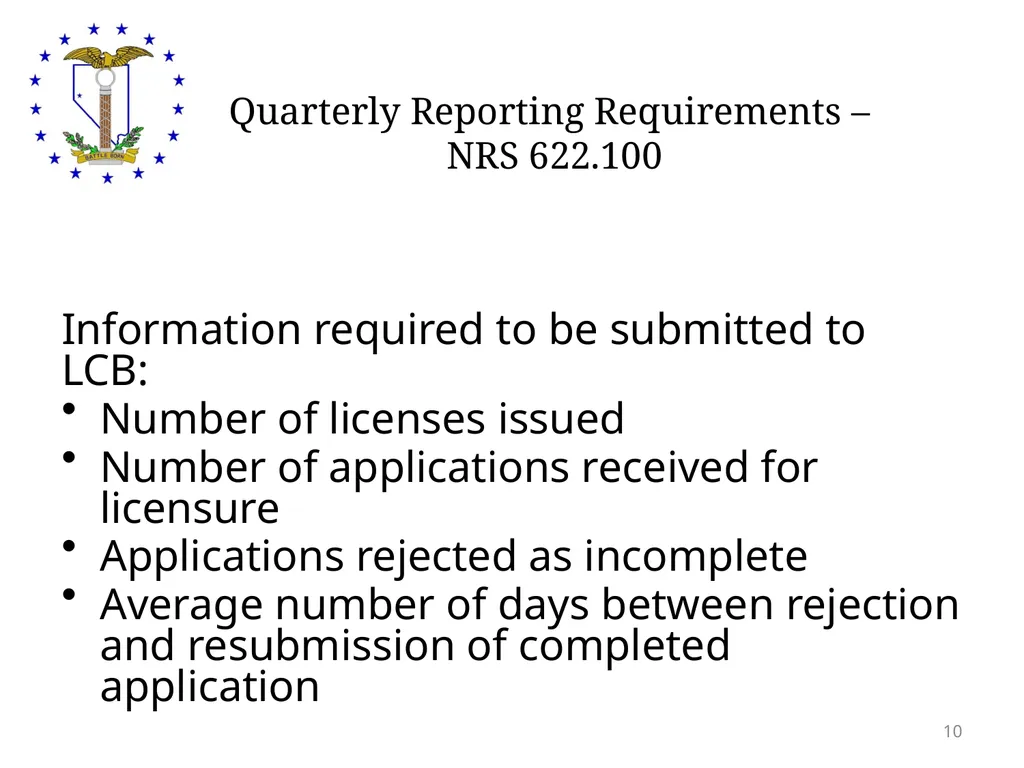
Quarterly Reporting Requirements – NRS 622.100 Information required to be submitted to LCB:
Number of licenses issued
Number of applications received for licensure
Applications rejected as incomplete
Average number of days between rejection and resubmission of completed application 10<br>
11
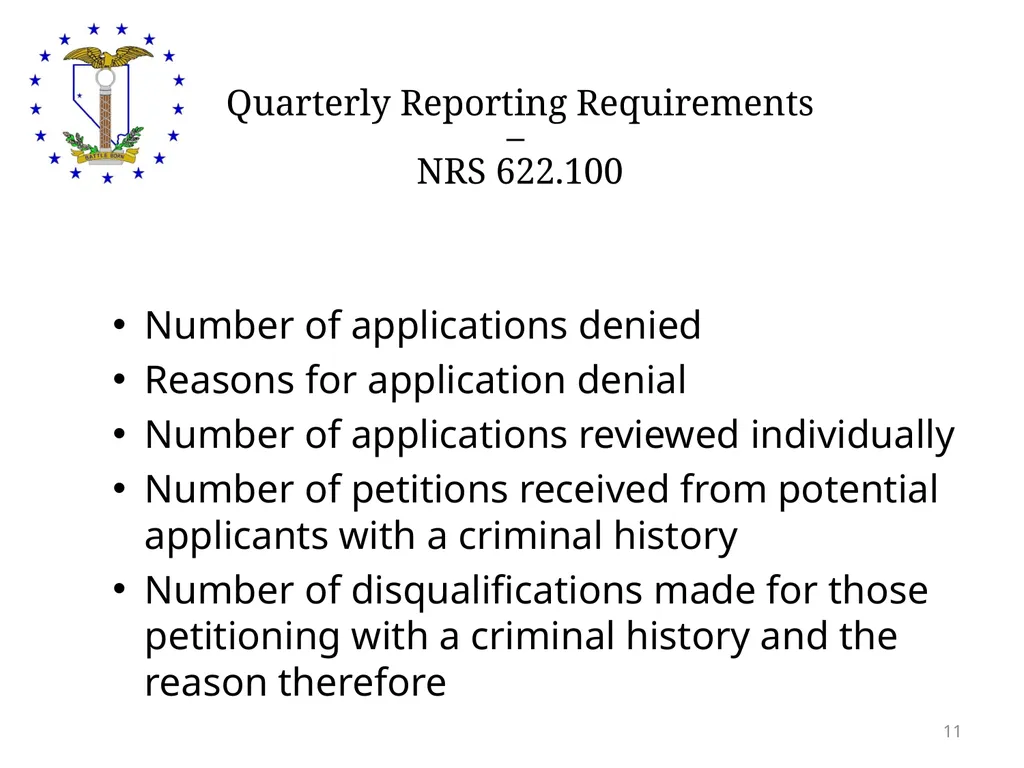
Number of applications denied
Reasons for application denial
Number of applications reviewed individually
Number of petitions received from potential applicants with a criminal history
Number of disqualifications made for those petitioning with a criminal history and the reason therefore 11 Quarterly Reporting Requirements – NRS 622.100<br>
12
Suggestions for Board Members Be an active participant in financial oversight
Follow up on findings in audit reports to ensure corrective action is taken
Request copies of balance sheets and financial statements…and ask questions 12<br>
13
Other Suggestions Be aware of delays in submitting financial and disciplinary information
Consider risks associated with biennial audits
Ask questions of Board management and members, and utilize available resources 13<br>
14
Questions? 14<br>
15
Where to Turn For Help? Sandra McGuirk, Deputy Legislative Auditor
smcguirk@lcb.state.nv.us