Leiter international performance scale-third edition By Maria Barta and Lori Holloway Leiter-3 The Leiter-3 is an individual-administered test designed to assess cognitive functions in children, adolescents, and adults ages 3 years, 0
"Leiter international performance scale-third" is the property of its rightful owner. Permission is granted to
download and print the materials on this website for personal, non-commercial use only, and to display it
on your personal computer provided you do not modify the materials and that you retain all copyright
notices contained in the materials. By downloading content from our website, you accept the terms of this
agreement.
Presentation Transcript
01
Leiter international performance scale-third edition By Maria Barta and Lori Holloway<br>
02
Leiter-3 The Leiter-3 is an individual-administered test designed to assess cognitive functions in children, adolescents, and adults ages 3 years, 0 months, to 75+ years. The test includes measures of nonverbal intelligence in fluid reasoning and visualization, as well as appraisals of nonverbal memory, attention, and cognitive interference.
The goal of revising this instrument was to:
Construct a reliable and valid nonverbal measure of intellectual ability, and memory and attention, that could be used to assess children, adolescents, and adults who could not be reliably and validly assessed with traditional intelligence tests<br>
03
Leiter-3-Who can administer? Graduate-level training in intellectual assessment
Psychologists
Occupational therapists
Educational Diagnosticians
Speech and Language Patholigists<br>
04
Leiter-3 Rationale for the Design of the Leiter-3
There were four primary issues which highlighted the need for the Leiter-3
Need to Early Identification of Cognitive Delays
Need for measurement of Small Increments of Improvement in Cognitive Ability
Need for a Reliable and Valid Scale of Intelligence Regardless of Language or Motor Ability
Need for Transition Planning for Entering World of Work<br>
05
Leiter-3 Some of the group of individual for whom the Leiter-3 was specially developed include those with:
Significant Communication Disorders
Autism
Cognitive Delay
Dominance in a Language other than English
Learning Disabilities
Hearing Impairments
Attention-Deficit Disorder
Motor Impairments
Traumatic Brain Injury
Various adults brain disorders including Alzheimer’s, Parkinson’s, and Dementia<br>
06
Leiter-3 Designed to be a completely non-verbal instrument
Primary method used for communication is pantomime. Instructions consist of a combination of hand and head movements, facial expressions, and demonstrations.
Each subtest includes a “teaching trial” as the first item for every age group to help the examiner nonverbally explain what is required.<br>
07
Leiter-3 The Leiter-3 includes two groups of subtests:
Cognitive Battery with five subtests of nonverbal intellectual ability related to visualization and reasoning. Only four subtests are needed for measuring Nonverbal IQ which can be administered in approximately 45 minutes (30 minutes for younger or lower functioning individuals)
Attention/Memory Battery with five subtests including two nonverbal attention subtests, one new interference (Stroop) subtest, and two memory subtests. The five subtests can be administered in 30 minutes. The Attetion/Memory (A/M) Battery can be added (or used separately) to provide nonverbal measures for various cognitive deficits to aid in clinical and neuropsychological assessment. Also included and Examiner Rating Scale, which provides multiple, scaled measures of test-session behavior.<br>
08
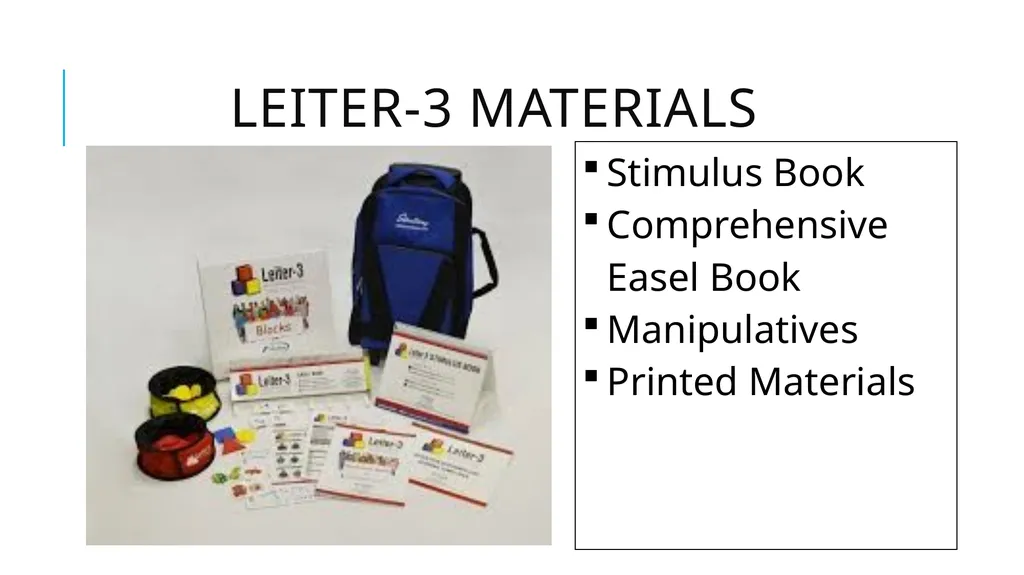
Leiter-3 Materials<br>
09
Leiter-3 The Cognitive battery 1. Figure Ground (FG): Identification of embedded figures, or designs, within a complex stimulus.
https://www.youtube.com/watch?v=-lj6Y6-Djo8
2. Form Completion (FC): Ability to recognize a “whole object” from a randomly-displayed array of its fragmented parts.
3. Classification/Analogies (CA): Combines two subtests from the Leiter-R-Classification and Design Analogies. The subtest begins with tasks that measure categorization of objects or geometric designs. This is followed (age 6 and above) by classical “matrix analogies” items using geometric shapes.<br>
10
Leiter-3 The Cognitive battery continue.. 4. Sequential Order (SO): Logical progressions of pictorial or figural objects; selection of related stimuli that progress in a corresponding order. This subtest includes several of the classic, original Leiter items
5. Visual Patterns (VP): Optional Combines two subtest from the Leiter-R- Matching and Repeated Patterns. For ages 3-5: Discrimination and matching of visual stimuli; selection of Response Blocks or manipulative shapes that match Easel stimuli. For ages 6-75+: Patterns of pictorial or figural objects which are repeated (e.g., apple, banana, apple, banana,…). The individual supplies “missing” portion of pattern by moving Response Blocks into alignment with Easel.<br>
11
Leiter-3 The attention/memory battery 6. Attention Sustained (AS): Measure consists of “boring” clerical tasks such as finding, and crossing-out, all squares found in an array of geometric shapes printed on a page. Three parallel forms, of increasing difficulty, are included: a preschool “smiling face” form, an animal pictures form and a more complex array of geometric shapes.
7. Forward Memory (FM): Ability to remember a sequence of pictured objects to which the examiner points in a given sequence.
https://www.youtube.com/watch?v=hm5MH56Jq3Q
8. Attention Divided (AD): This subtest measures the degree of perseverative attention when divided attention is demanded. The materials include red and yellow Bowls, red and yellow foam Manipulatives, and Sorting Cards. The individual is required to place colored foam circles in the corresponding (matching) colored Bowl, while also slapping only red triangles on the Sorting Cards, as they are flipped over by the examiner at one card per second.<br>
12
Leiter-3 The attention/memory battery 9. Reverse Memory (RM): Ability to remember a sequence of pictured objects in opposite order from that in which the examiner pointed. This subtest provides an important contrast to Forward Memory, just as forward and backward digits do.
10. Nonverbal Stroop (NS): Tests for cognitive process and neuropsychological deficits, as well as cognitive interference processes. Two sets of paper-and-pencil matching tasks look for a difference between the congruent trial (where each pair of colors is identical) and the, usually slower, incongruent trail (where each pair of colors is different, and the examinee matches the correct color with a small white mark on the targeted color-circle).<br>
13
Leiter-3 Scoring For most of the subtests, responses are scored “0” for fail or incorrect and “1” for pass or correct
Each subtest has a stop rule. Depending on the test, the stop rule can range from 5-7 cumulative errors. The stop rule is based on the cumulative responses failed, not consecutive.
Each response is scored, not just the complete sequence. Partial completion of a sequence will be credited for most subtests.
The raw score for each subtest is calculated by adding the correct responses “1” for the entire subtest.<br>
14
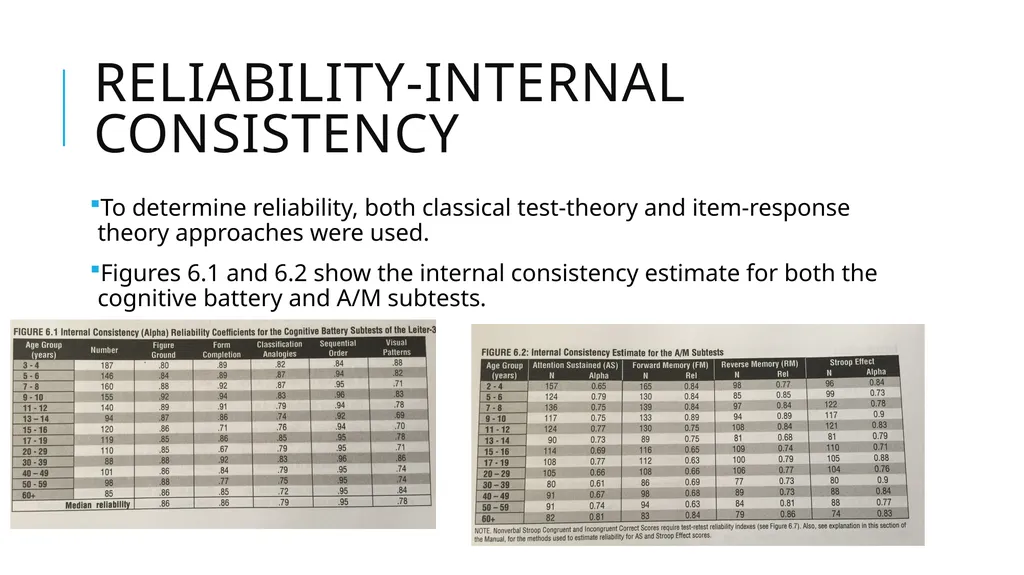
Reliability-Internal consistency To determine reliability, both classical test-theory and item-response theory approaches were used.
Figures 6.1 and 6.2 show the internal consistency estimate for both the cognitive battery and A/M subtests.<br>
15
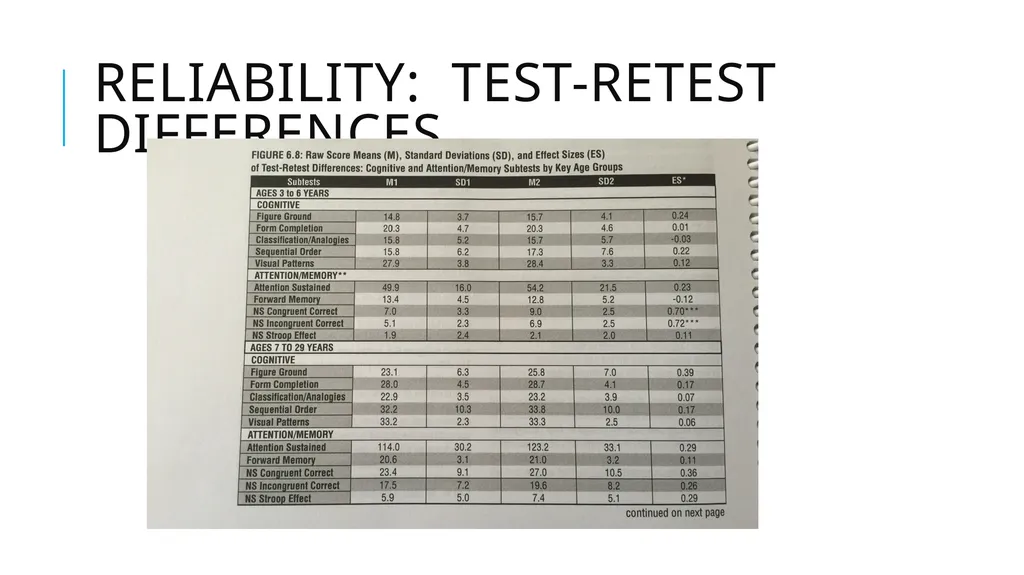
Reliability: Test-Retest Differences<br>
16
Reference: Leiter-3 Manual by Gale H. Roid, Ph, D., Lucy J. Miller, Ph. D., Mark Pomplun, Ph. D. and Chris Koch, Ph. D.
www.StoeltingCo.com<br>