
Lesson 1 UNITS We will study Unit: 1-2-3-5 Unit 1
Description: Lesson 1 UNITS We will study Unit: 1-2-3-5 Unit 1 The role and work of the Public Services Public Services 5 Broad Categories: Emergency Services Armed Services Central Government Local Authorities Voluntary Services Emergency Services
Related Topics
Download Presentation
"Lesson 1 UNITS We will study Unit: 1-2-3-5 Unit 1" is the property of its rightful owner. Permission is granted to download and print the materials on this website for personal, non-commercial use only, and to display it on your personal computer provided you do not modify the materials and that you retain all copyright notices contained in the materials. By downloading content from our website, you accept the terms of this agreement.
Presentation Transcript
slide1. Lesson 1<br>
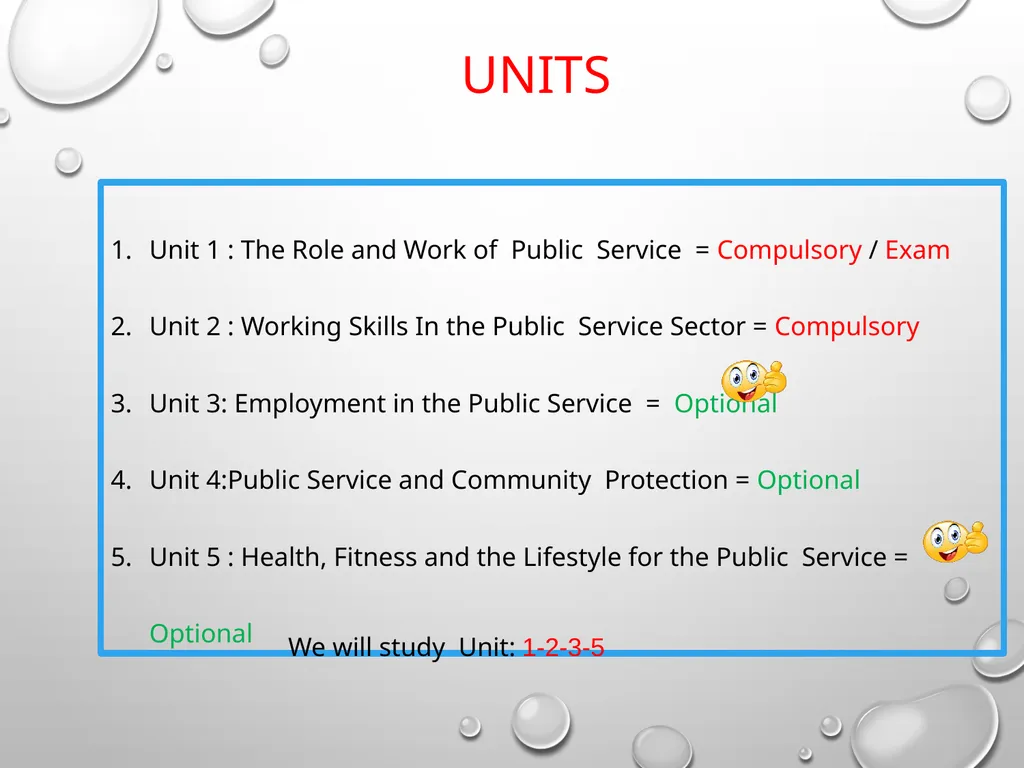
slide2. UNITS We will study Unit: 1-2-3-5<br>
slide3. Unit 1 The role and work of the Public Services<br>
slide4. Public Services 5 Broad Categories:
Emergency Services
Armed Services
Central Government
Local Authorities
Voluntary Services<br>
slide5. Emergency Services Police
A quick quiz?
When was the modern Police Service formed?
(lets see who’s closest)
Ans: 1829
Formed by the, then, Home Secretary; what was his name?
Robert Peel
Why did we need a police force in 1829?
http://vcp.e2bn.org/justice/page11377-the-development-of-a-police-force.html
And today?
https://www.gov.uk/government/uploads/system/uploads/attachment_data/file/630471/hosb1017-police-workforce.pdf<br>
slide6. What do the Police do? Obviously respond to emergency calls and investigate crime! But also….
Community Relations
Provide a visible presence
Giving Evidence
Educational visits
Licensing Firearms
Referring victims to support agencies
Underwater searches
Missing Persons
Providing Safety Advice
Escorting abnormal loads
Holding people in custody
Dealing with public protests<br>
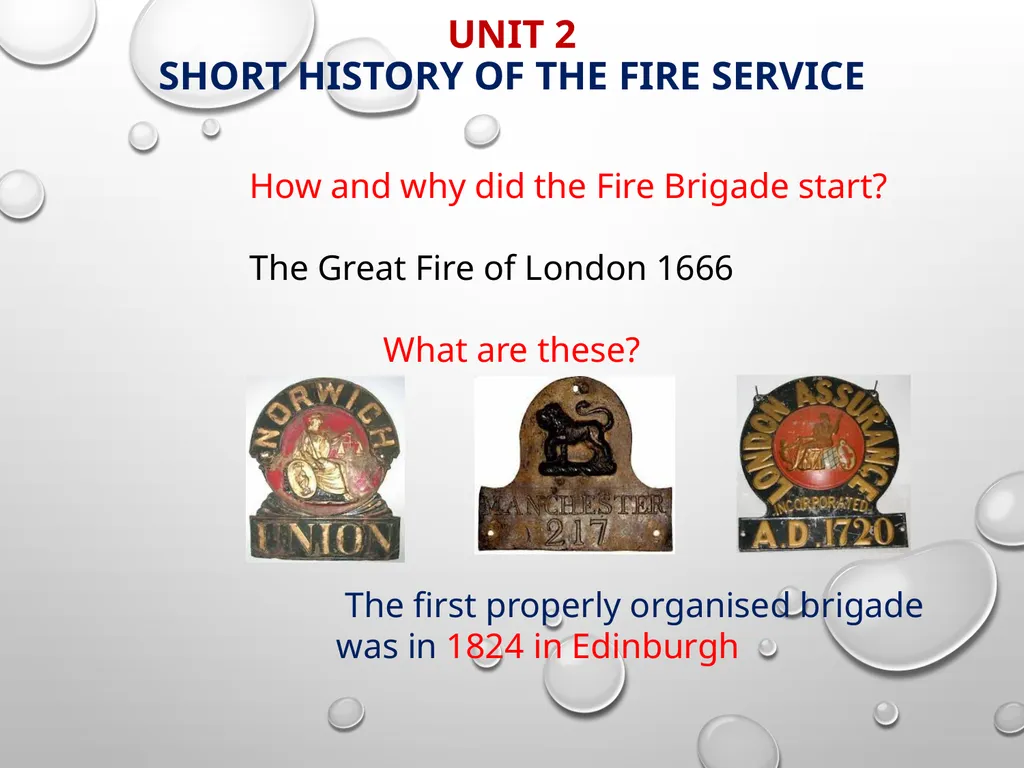
slide7. Unit 2 Short history of the Fire Service How and why did the Fire Brigade start?
The Great Fire of London 1666
What are these? The first properly organised brigade was in 1824 in Edinburgh<br>
slide8. Unit 2 Short history of the Fire Service In the mid 1850s the first reliable steam powered appliances were introduced
It wasn’t until 1938 that many of these brigades were amalgamated
Before 1938 there were between 1400 – 1500 fire brigades run by local councils!
In 1938 we had the AFS followed by the NFS ensuring uniformity of equipment
This was the busiest time for the UK Fire Service – WHY?
http://www.wartimememories.co.uk/afs.html<br>
slide9. Unit 2 Short history of the Fire Service The Fire Services Act (1947) became effective on the 1st of April 1948
This resulted in 148 County Council and County Borough run Fire Brigades
Further amalgamation In 1974 and 1986 following local government re-organisation
There are at present 63 brigades in England, Wales, Scotland and Northern Ireland
The Brigade will go through many more changes to enable it’s PURPOSE, which is to provide an effective means of fighting fire, saving lives and providing a humanitarian service<br>
slide10. The Fire Service? It is now termed the ‘Fire and Rescue Service’.
There are 46 separate fire authorities in England
27,000 Full-Time Firefighters
11,000 Retained. Do you understand this?
http://www.fireservice.co.uk/recruitment/retained-firefighters/<br>
slide11. What do the Fire Service Do? Attend emergency calls including
Fires, Flooding, terrorist incidents, RTC’s, Chemical incidents, Special Services, Lock-ins and outs, animal rescues, shut in lift calls, persons trapped, unsafe structures etc
Promote Fire Safety
Ensure Fire Prevention Give First Aid
Manage disasters
Deal with Hazardous materials
Give evidence in court
Preserve the scene
Offer Home Fire Safety Risk Assessments
General public education<br>
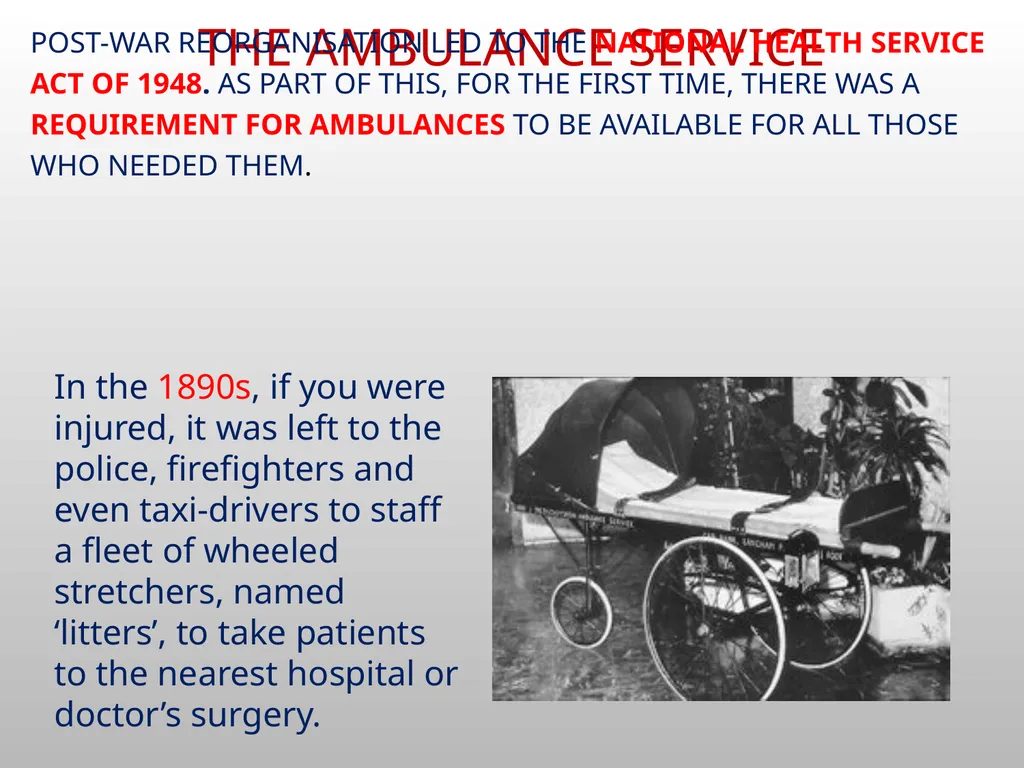
slide12. The Ambulance Service Post-war reorganisation led to the National Health Service Act of 1948. As part of this, for the first time, there was a requirement for ambulances to be available for all those who needed them. In the 1890s, if you were injured, it was left to the police, firefighters and even taxi-drivers to staff a fleet of wheeled stretchers, named ‘litters’, to take patients to the nearest hospital or doctor’s surgery.<br>
slide13. Work of the Ambulance Service Immediate response
Patient Transport
Emergency Care Assistants
Medical Dispatchers
Emergency Call Handlers
Other important aspects
Non-emergency patient transport
Transfers between hospitals
Delivery of First-Aid courses
Clinical staffing for air-ambulances
Decontamination of casualties<br>
slide14. The Armed Services OK – quick, name the big three
(Not you …!)
The British Army
The Royal Navy
The Royal Air Force (RAF
And the reserves – this is too easy!
The Army Reserve (formerly known as the territorial army)
The Royal Naval Reserve
The RAF Reserves<br>
slide15. The Armed Services Around 170,000 trained personnel with around 65,000 civilian support workers.
Three key priorities:
What are they?
Defending the UK
Supporting international peacekeeping duties
Supporting the civil authorities
Easy to remember<br>
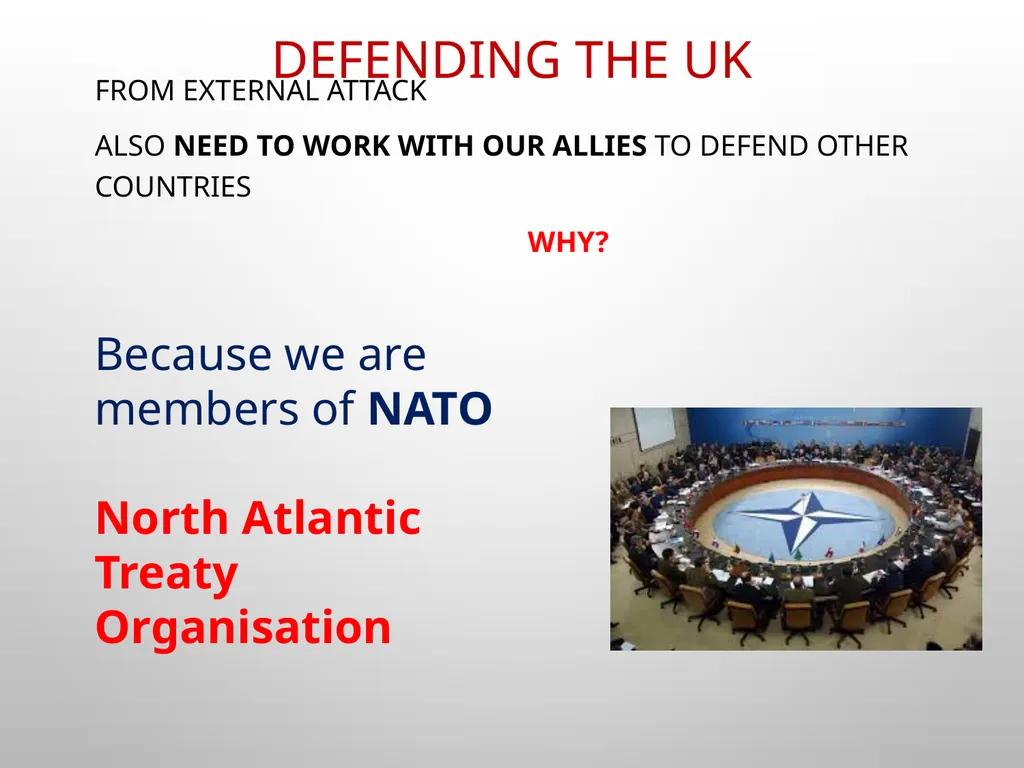
slide16. Defending the UK From external attack
Also need to work with our allies to defend other countries
Why? Because we are members of NATO
North Atlantic Treaty Organisation<br>
slide17. Defending the UK NATO Link
http://www.nato.int/
The Armed services also defend British oversees territories
The armed services also assist with the evacuation of British Nationals in countries experiencing conflict<br>
slide18. Supporting International Peacekeeping Duties Work with NATO and the United Nations (UN)
To protect civilians and aid workers in dangerous parts of the world
What is the UN?
http://www.un.org/en/about-un/
All these acronym's! Let’s have an explanation
https://www.youtube.com/watch?v=S6qWzFqs8iE<br>
slide19. Supporting the Civil Authorities What does this mean?
https://www.gov.uk/government/publications/2010-to-2015-government-policy-armed-forces-support-for-activities-in-the-uk/2010-to-2015-government-policy-armed-forces-support-for-activities-in-the-uk
The armed services are sometimes called upon to assist emergency services and Local authority counterparts in times of disaster, unrest or emergency.<br>
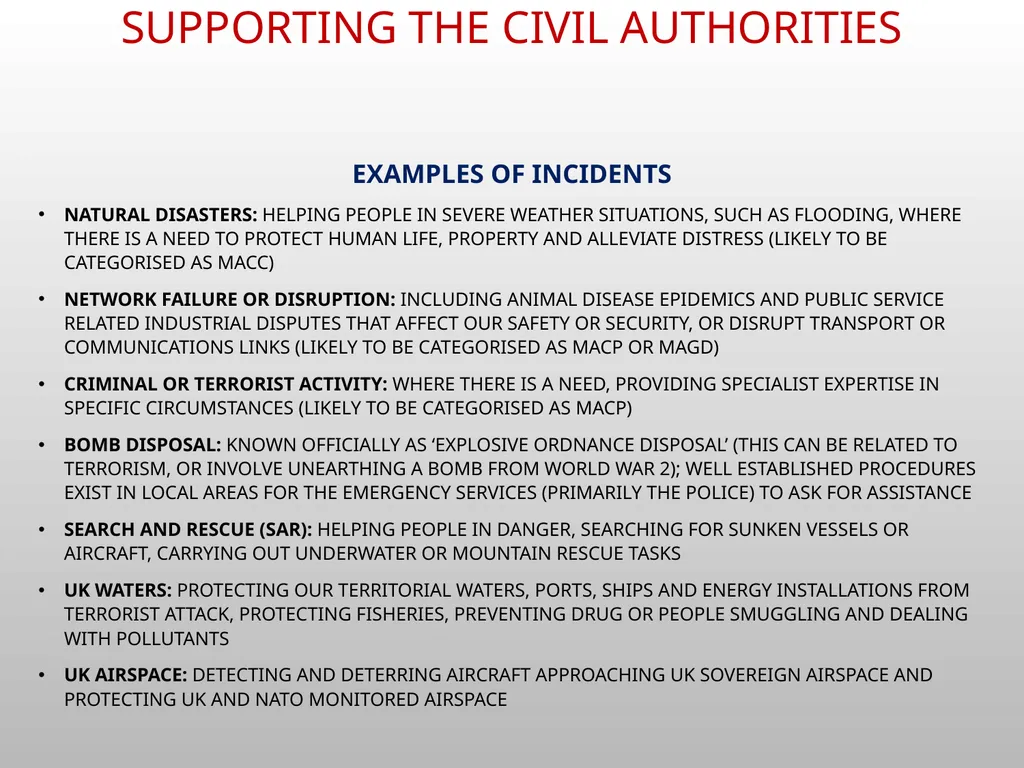
slide20. Supporting the Civil Authorities Examples of incidents
Natural disasters: helping people in severe weather situations, such as flooding, where there is a need to protect human life, property and alleviate distress (likely to be categorised as MACC)
Network failure or disruption: including animal disease epidemics and public service related industrial disputes that affect our safety or security, or disrupt transport or communications links (likely to be categorised as MACP or MAGD)
Criminal or terrorist activity: where there is a need, providing specialist expertise in specific circumstances (likely to be categorised as MACP)
Bomb disposal: known officially as ‘explosive ordnance disposal’ (this can be related to terrorism, or involve unearthing a bomb from World War 2); well established procedures exist in local areas for the emergency services (primarily the police) to ask for assistance
Search and rescue (SAR): helping people in danger, searching for sunken vessels or aircraft, carrying out underwater or mountain rescue tasks
UK waters: protecting our territorial waters, ports, ships and energy installations from terrorist attack, protecting fisheries, preventing drug or people smuggling and dealing with pollutants
UK airspace: detecting and deterring aircraft approaching UK sovereign airspace and protecting UK and NATO monitored airspace<br>
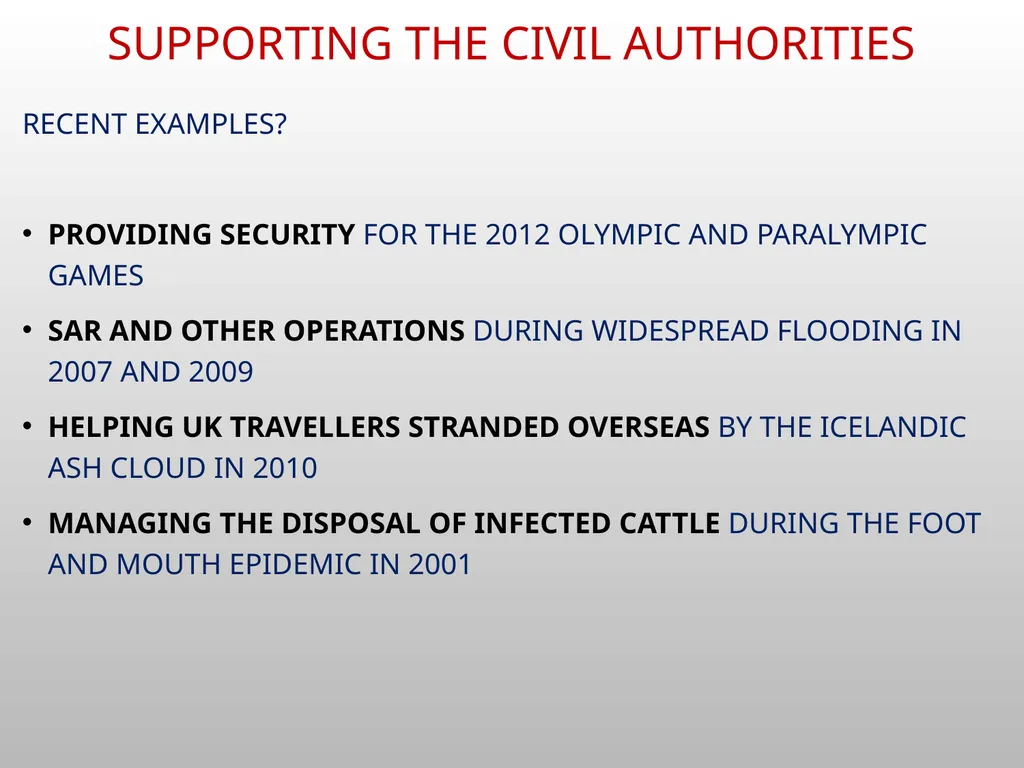
slide21. Supporting the Civil Authorities Recent Examples?
Providing security for the 2012 Olympic and Paralympic Games
SAR and other operations during widespread flooding in 2007 and 2009
helping UK travellers stranded overseas by the Icelandic ash cloud in 2010
Managing the disposal of infected cattle during the Foot and Mouth epidemic in 2001<br>
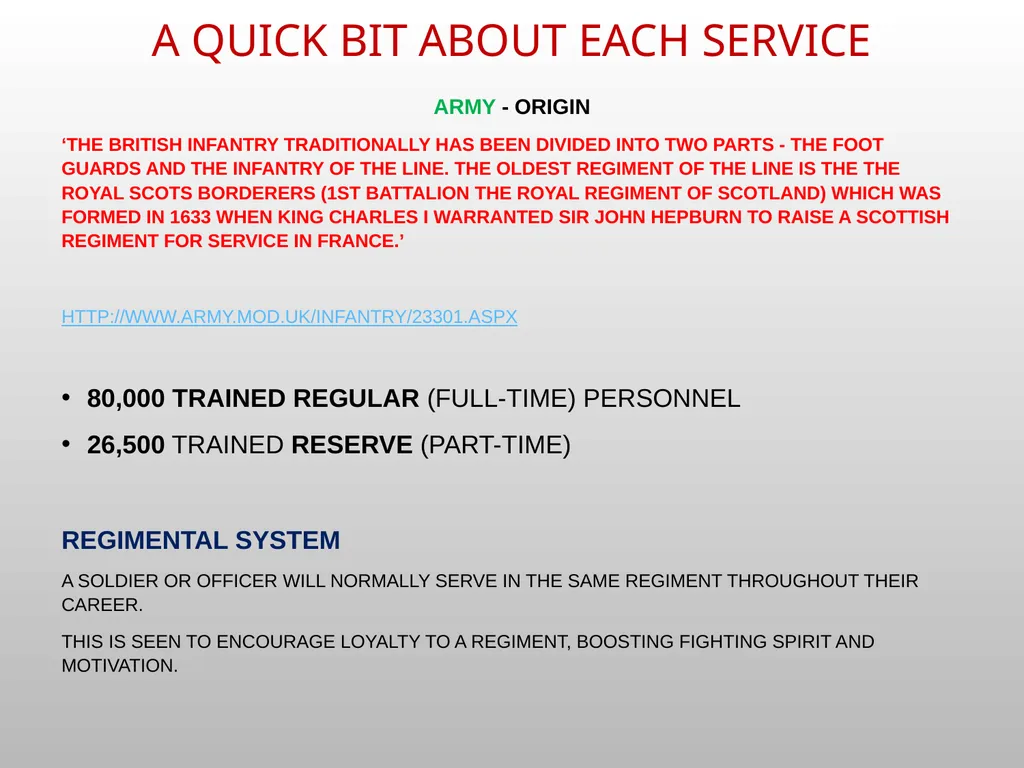
slide22. A quick bit about each service Army - Origin
‘The British Infantry traditionally has been divided into two parts - the Foot Guards and the Infantry of the Line. The oldest Regiment of the Line is the The Royal Scots Borderers (1st Battalion The Royal Regiment of Scotland) which was formed in 1633 when King Charles I warranted Sir John Hepburn to raise a Scottish Regiment for service in France.’
http://www.army.mod.uk/infantry/23301.aspx
80,000 trained regular (full-time) personnel
26,500 trained reserve (part-time)
Regimental system
A soldier or officer will normally serve in the same regiment throughout their career.
This is seen to encourage loyalty to a regiment, boosting fighting spirit and motivation.<br>
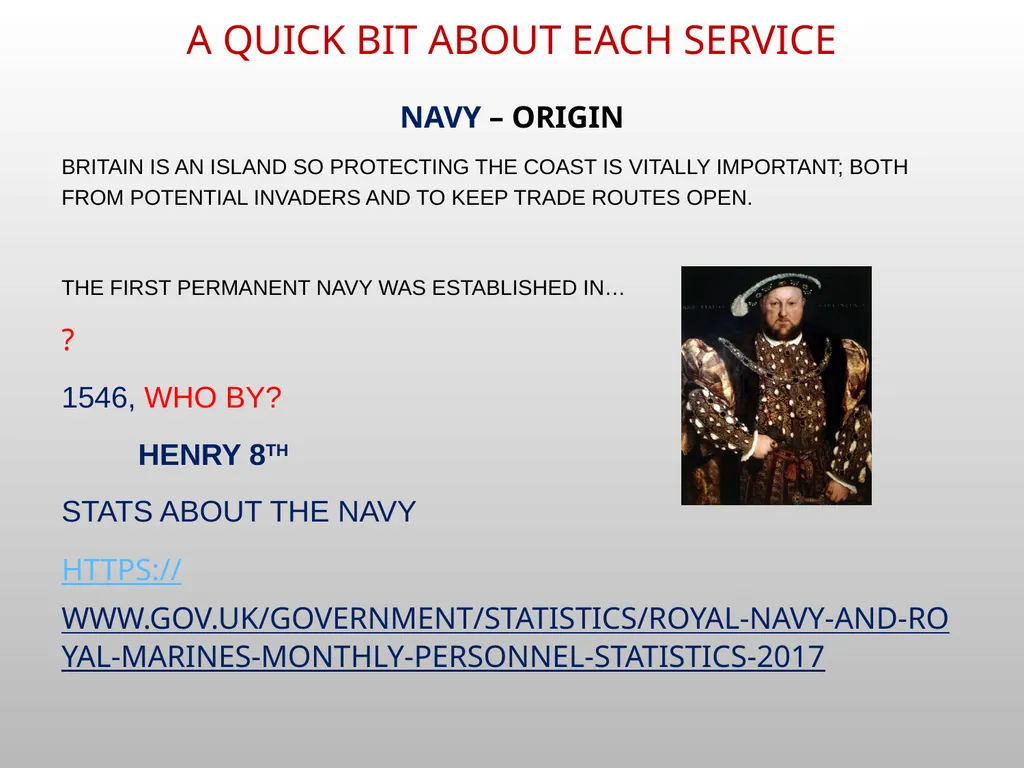
slide23. A quick bit about each service Navy – Origin
Britain is an island so protecting the coast is vitally important; both from potential invaders and to keep trade routes open.
The first permanent navy was established in…
?
1546, who by?
Henry 8th
Stats about the navy
https://www.gov.uk/government/statistics/royal-navy-and-royal-marines-monthly-personnel-statistics-2017<br>
slide24. The Royal Air Force When was it created?
On 29 November 1917 an Act of Parliament establishing an Air Force and an Air Council received the Royal Assent.
On April 1, 1918, the Royal Air Force (RAF) is formed with the amalgamation of the Royal Flying Corps (RFC) and the Royal Naval Air Service (RNAS). The RAF took its place beside the British navy and army as a separate military service with its own ministry.
The RAF employs around 37,000 servicemen and women.
Roles include: Pilot, ground support, mechanic and air-traffic controller.<br>
slide2. UNITS We will study Unit: 1-2-3-5<br>
slide3. Unit 1 The role and work of the Public Services<br>
slide4. Public Services 5 Broad Categories:
Emergency Services
Armed Services
Central Government
Local Authorities
Voluntary Services<br>
slide5. Emergency Services Police
A quick quiz?
When was the modern Police Service formed?
(lets see who’s closest)
Ans: 1829
Formed by the, then, Home Secretary; what was his name?
Robert Peel
Why did we need a police force in 1829?
http://vcp.e2bn.org/justice/page11377-the-development-of-a-police-force.html
And today?
https://www.gov.uk/government/uploads/system/uploads/attachment_data/file/630471/hosb1017-police-workforce.pdf<br>
slide6. What do the Police do? Obviously respond to emergency calls and investigate crime! But also….
Community Relations
Provide a visible presence
Giving Evidence
Educational visits
Licensing Firearms
Referring victims to support agencies
Underwater searches
Missing Persons
Providing Safety Advice
Escorting abnormal loads
Holding people in custody
Dealing with public protests<br>
slide7. Unit 2 Short history of the Fire Service How and why did the Fire Brigade start?
The Great Fire of London 1666
What are these? The first properly organised brigade was in 1824 in Edinburgh<br>
slide8. Unit 2 Short history of the Fire Service In the mid 1850s the first reliable steam powered appliances were introduced
It wasn’t until 1938 that many of these brigades were amalgamated
Before 1938 there were between 1400 – 1500 fire brigades run by local councils!
In 1938 we had the AFS followed by the NFS ensuring uniformity of equipment
This was the busiest time for the UK Fire Service – WHY?
http://www.wartimememories.co.uk/afs.html<br>
slide9. Unit 2 Short history of the Fire Service The Fire Services Act (1947) became effective on the 1st of April 1948
This resulted in 148 County Council and County Borough run Fire Brigades
Further amalgamation In 1974 and 1986 following local government re-organisation
There are at present 63 brigades in England, Wales, Scotland and Northern Ireland
The Brigade will go through many more changes to enable it’s PURPOSE, which is to provide an effective means of fighting fire, saving lives and providing a humanitarian service<br>
slide10. The Fire Service? It is now termed the ‘Fire and Rescue Service’.
There are 46 separate fire authorities in England
27,000 Full-Time Firefighters
11,000 Retained. Do you understand this?
http://www.fireservice.co.uk/recruitment/retained-firefighters/<br>
slide11. What do the Fire Service Do? Attend emergency calls including
Fires, Flooding, terrorist incidents, RTC’s, Chemical incidents, Special Services, Lock-ins and outs, animal rescues, shut in lift calls, persons trapped, unsafe structures etc
Promote Fire Safety
Ensure Fire Prevention Give First Aid
Manage disasters
Deal with Hazardous materials
Give evidence in court
Preserve the scene
Offer Home Fire Safety Risk Assessments
General public education<br>
slide12. The Ambulance Service Post-war reorganisation led to the National Health Service Act of 1948. As part of this, for the first time, there was a requirement for ambulances to be available for all those who needed them. In the 1890s, if you were injured, it was left to the police, firefighters and even taxi-drivers to staff a fleet of wheeled stretchers, named ‘litters’, to take patients to the nearest hospital or doctor’s surgery.<br>
slide13. Work of the Ambulance Service Immediate response
Patient Transport
Emergency Care Assistants
Medical Dispatchers
Emergency Call Handlers
Other important aspects
Non-emergency patient transport
Transfers between hospitals
Delivery of First-Aid courses
Clinical staffing for air-ambulances
Decontamination of casualties<br>
slide14. The Armed Services OK – quick, name the big three
(Not you …!)
The British Army
The Royal Navy
The Royal Air Force (RAF
And the reserves – this is too easy!
The Army Reserve (formerly known as the territorial army)
The Royal Naval Reserve
The RAF Reserves<br>
slide15. The Armed Services Around 170,000 trained personnel with around 65,000 civilian support workers.
Three key priorities:
What are they?
Defending the UK
Supporting international peacekeeping duties
Supporting the civil authorities
Easy to remember<br>
slide16. Defending the UK From external attack
Also need to work with our allies to defend other countries
Why? Because we are members of NATO
North Atlantic Treaty Organisation<br>
slide17. Defending the UK NATO Link
http://www.nato.int/
The Armed services also defend British oversees territories
The armed services also assist with the evacuation of British Nationals in countries experiencing conflict<br>
slide18. Supporting International Peacekeeping Duties Work with NATO and the United Nations (UN)
To protect civilians and aid workers in dangerous parts of the world
What is the UN?
http://www.un.org/en/about-un/
All these acronym's! Let’s have an explanation
https://www.youtube.com/watch?v=S6qWzFqs8iE<br>
slide19. Supporting the Civil Authorities What does this mean?
https://www.gov.uk/government/publications/2010-to-2015-government-policy-armed-forces-support-for-activities-in-the-uk/2010-to-2015-government-policy-armed-forces-support-for-activities-in-the-uk
The armed services are sometimes called upon to assist emergency services and Local authority counterparts in times of disaster, unrest or emergency.<br>
slide20. Supporting the Civil Authorities Examples of incidents
Natural disasters: helping people in severe weather situations, such as flooding, where there is a need to protect human life, property and alleviate distress (likely to be categorised as MACC)
Network failure or disruption: including animal disease epidemics and public service related industrial disputes that affect our safety or security, or disrupt transport or communications links (likely to be categorised as MACP or MAGD)
Criminal or terrorist activity: where there is a need, providing specialist expertise in specific circumstances (likely to be categorised as MACP)
Bomb disposal: known officially as ‘explosive ordnance disposal’ (this can be related to terrorism, or involve unearthing a bomb from World War 2); well established procedures exist in local areas for the emergency services (primarily the police) to ask for assistance
Search and rescue (SAR): helping people in danger, searching for sunken vessels or aircraft, carrying out underwater or mountain rescue tasks
UK waters: protecting our territorial waters, ports, ships and energy installations from terrorist attack, protecting fisheries, preventing drug or people smuggling and dealing with pollutants
UK airspace: detecting and deterring aircraft approaching UK sovereign airspace and protecting UK and NATO monitored airspace<br>
slide21. Supporting the Civil Authorities Recent Examples?
Providing security for the 2012 Olympic and Paralympic Games
SAR and other operations during widespread flooding in 2007 and 2009
helping UK travellers stranded overseas by the Icelandic ash cloud in 2010
Managing the disposal of infected cattle during the Foot and Mouth epidemic in 2001<br>
slide22. A quick bit about each service Army - Origin
‘The British Infantry traditionally has been divided into two parts - the Foot Guards and the Infantry of the Line. The oldest Regiment of the Line is the The Royal Scots Borderers (1st Battalion The Royal Regiment of Scotland) which was formed in 1633 when King Charles I warranted Sir John Hepburn to raise a Scottish Regiment for service in France.’
http://www.army.mod.uk/infantry/23301.aspx
80,000 trained regular (full-time) personnel
26,500 trained reserve (part-time)
Regimental system
A soldier or officer will normally serve in the same regiment throughout their career.
This is seen to encourage loyalty to a regiment, boosting fighting spirit and motivation.<br>
slide23. A quick bit about each service Navy – Origin
Britain is an island so protecting the coast is vitally important; both from potential invaders and to keep trade routes open.
The first permanent navy was established in…
?
1546, who by?
Henry 8th
Stats about the navy
https://www.gov.uk/government/statistics/royal-navy-and-royal-marines-monthly-personnel-statistics-2017<br>
slide24. The Royal Air Force When was it created?
On 29 November 1917 an Act of Parliament establishing an Air Force and an Air Council received the Royal Assent.
On April 1, 1918, the Royal Air Force (RAF) is formed with the amalgamation of the Royal Flying Corps (RFC) and the Royal Naval Air Service (RNAS). The RAF took its place beside the British navy and army as a separate military service with its own ministry.
The RAF employs around 37,000 servicemen and women.
Roles include: Pilot, ground support, mechanic and air-traffic controller.<br>