LEVELS OF STRATEGIC MANAGEMENT Associate Professor Head School of Management Gangadhar Meher University Definition of Strategic levels of Management Decision Strategic levels of management decision refers to the hierarchical structure of
"LEVELS OF STRATEGIC MANAGEMENT Associate Professor" is the property of its rightful owner. Permission is granted to
download and print the materials on this website for personal, non-commercial use only, and to display it
on your personal computer provided you do not modify the materials and that you retain all copyright
notices contained in the materials. By downloading content from our website, you accept the terms of this
agreement.
Presentation Transcript
01
LEVELS OF STRATEGIC MANAGEMENT Associate Professor & Head
School of Management
Gangadhar Meher University<br>
02
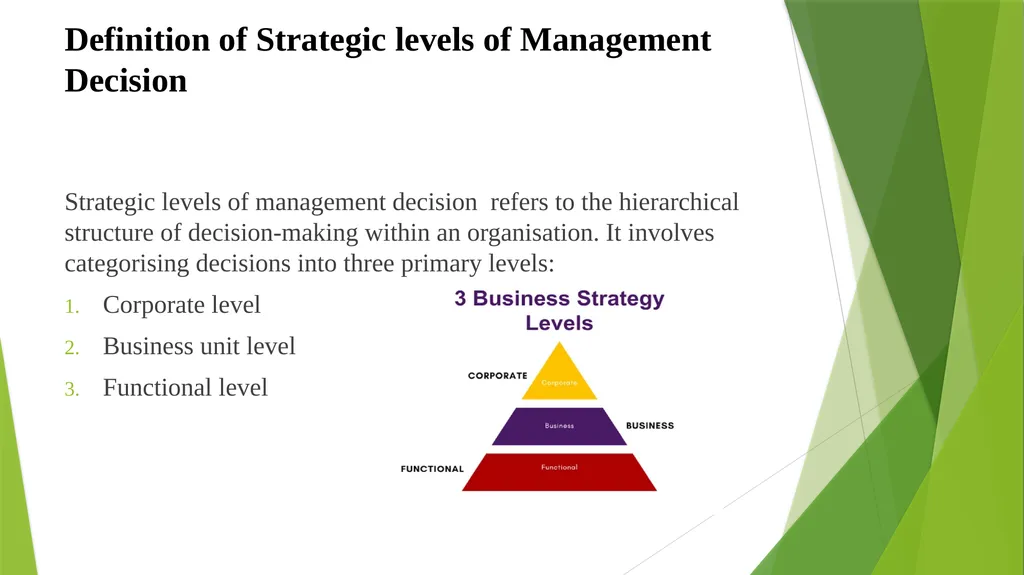
Definition of Strategic levels of Management Decision Strategic levels of management decision refers to the hierarchical structure of decision-making within an organisation. It involves categorising decisions into three primary levels:
Corporate level
Business unit level
Functional level<br>
03
CORPORATE LEVELS OF STRATEGIC MANAGEMENT Corporate level strategic management refers to the highest level of strategic decision-making within an organization. It involves developing and implementing strategies to achieve overall organizational goals and objectives.
Characteristics :-
1.Focus on the entire organisation
2.Concerned with long-term direction and scope
Benefits:-
1.Provides overall direction and purpose
2.Enhance organizational competitiveness
3.Allocates resources effectively<br>
04
BUSINESS LEVELS OF STRATEGIC MANAGEMENT Business levels strategic management focuses on developing and implementing strategies to achieve specific business unit goals and objectives. It involves analysing the competitive environment, identifying opportunities and threats, and allocating resources to gain a competitive advantage.
Characteristics:-
1.Focuses on a specific business unit or department
2.Concerned with competitive advantage and market positioning
3.Involves middle management and business unit leaders
Benefits:-
1.Enhances competitive advantage
2.Improves market positioning
3.Increases operational efficiency<br>
05
FUNCTIONAL LEVEL STRATEGIC MANAGEMENT Functional level strategic management focuses on developing and implementing strategies to achieve specific functional goals and objectives with an organization.
It involves analysing the internal environment, identifying opportunities and threats, and allocating resources to optimize functional performance.
Characteristics:-
1.Focus on a specific functional area( e.g. HR, Finance, operations)
2.Concerned with operational efficiency and effectiveness
Benefits:-
1.Enhance operational efficiency
2.Improves functional performance<br>
06
CASE STUDY Amazon, the e- commerce giant, has disrupted multiple industries through its innovative corporate- level strategies.
Main focus on: -
Diversification- Expanding into new industries.
Vertical Integration- Controlling its supply chain, logistics, and distribution networks.
Strategic acquisitions- Acquiring companies like whole foods market etc.
Objectives: -
Increase revenue through diversified business streams.
Enhance customer experience
Enhance innovation and efficiency<br>
07
CONT…. Implementation: -
Organizational Structure
Resource allocation
Performance management
Outcomes: -
Become the world’s largest online retailer
Expand into new industries.
Customer satisfaction.<br>