
Lexical Density Lesson Four Lexical density A text

Description: Lexical Density Lesson Four Lexical density A text contains x lexical items. Thees items include content lexical items and grammatical lexical items (articles, prepositions, conjunctions, auxiliary verbs, pronouns). Lexical density is
Related Topics
Download Presentation
"Lexical Density Lesson Four Lexical density A text" is the property of its rightful owner. Permission is granted to download and print the materials on this website for personal, non-commercial use only, and to display it on your personal computer provided you do not modify the materials and that you retain all copyright notices contained in the materials. By downloading content from our website, you accept the terms of this agreement.
Presentation Transcript
slide1. Lexical Density Lesson Four<br>
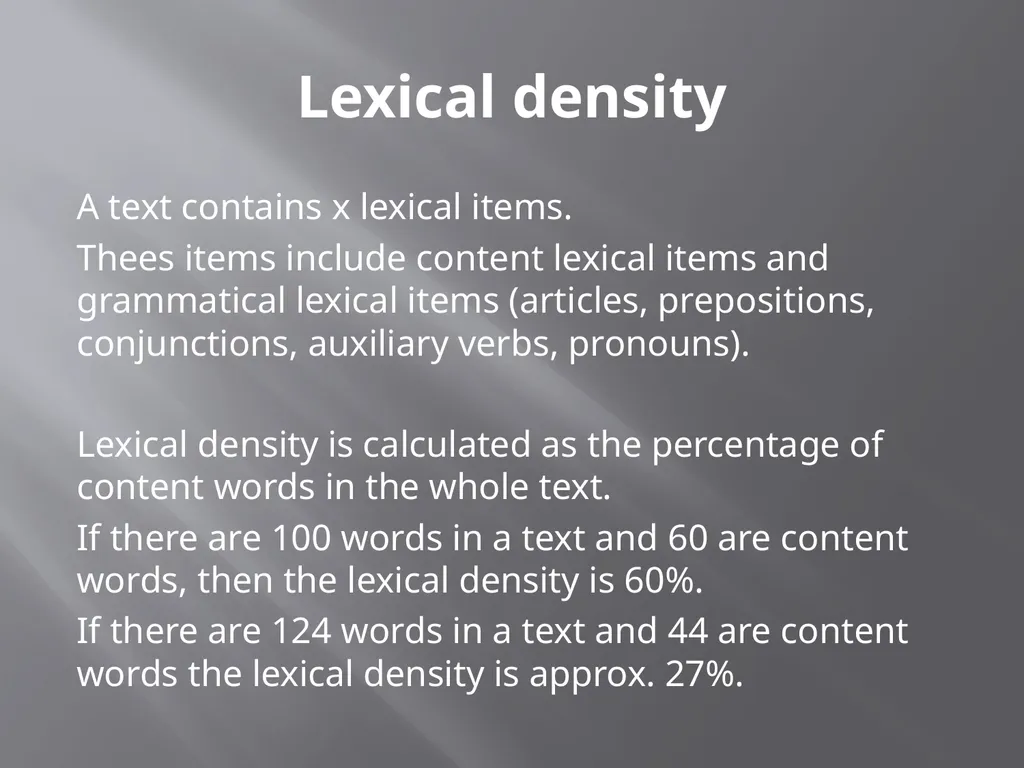
slide2. Lexical density A text contains x lexical items.
Thees items include content lexical items and grammatical lexical items (articles, prepositions, conjunctions, auxiliary verbs, pronouns).
Lexical density is calculated as the percentage of content words in the whole text.
If there are 100 words in a text and 60 are content words, then the lexical density is 60%.
If there are 124 words in a text and 44 are content words the lexical density is approx. 27%.<br>
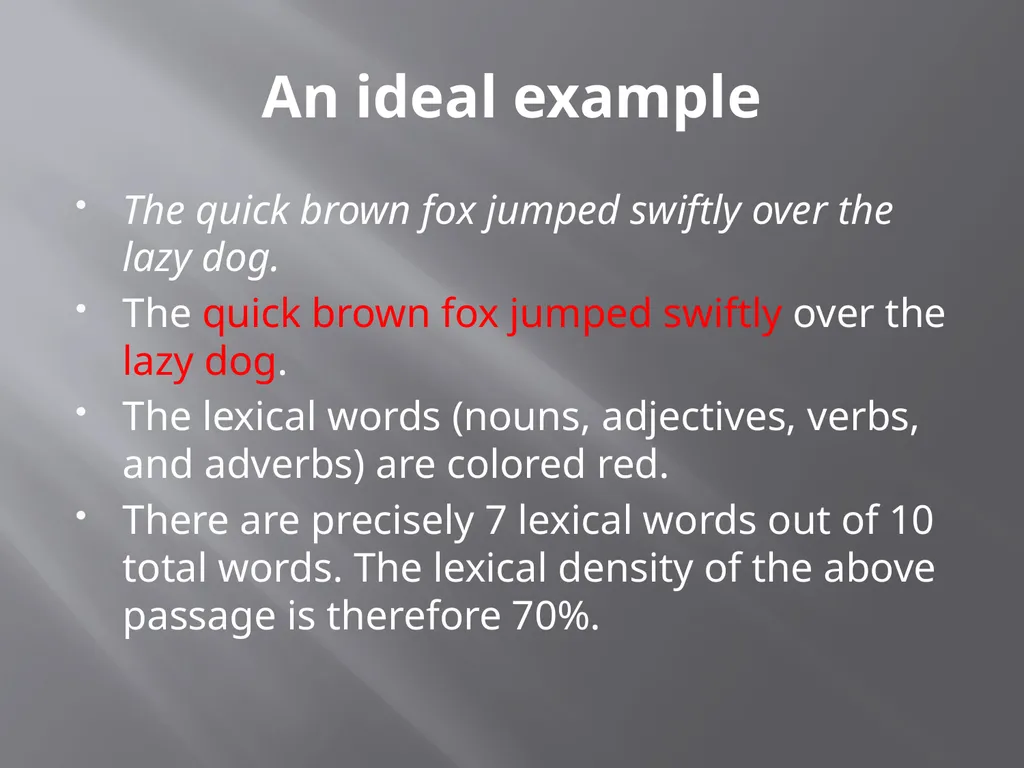
slide3. An ideal example The quick brown fox jumped swiftly over the lazy dog.
The quick brown fox jumped swiftly over the lazy dog.
The lexical words (nouns, adjectives, verbs, and adverbs) are colored red.
There are precisely 7 lexical words out of 10 total words. The lexical density of the above passage is therefore 70%.<br>
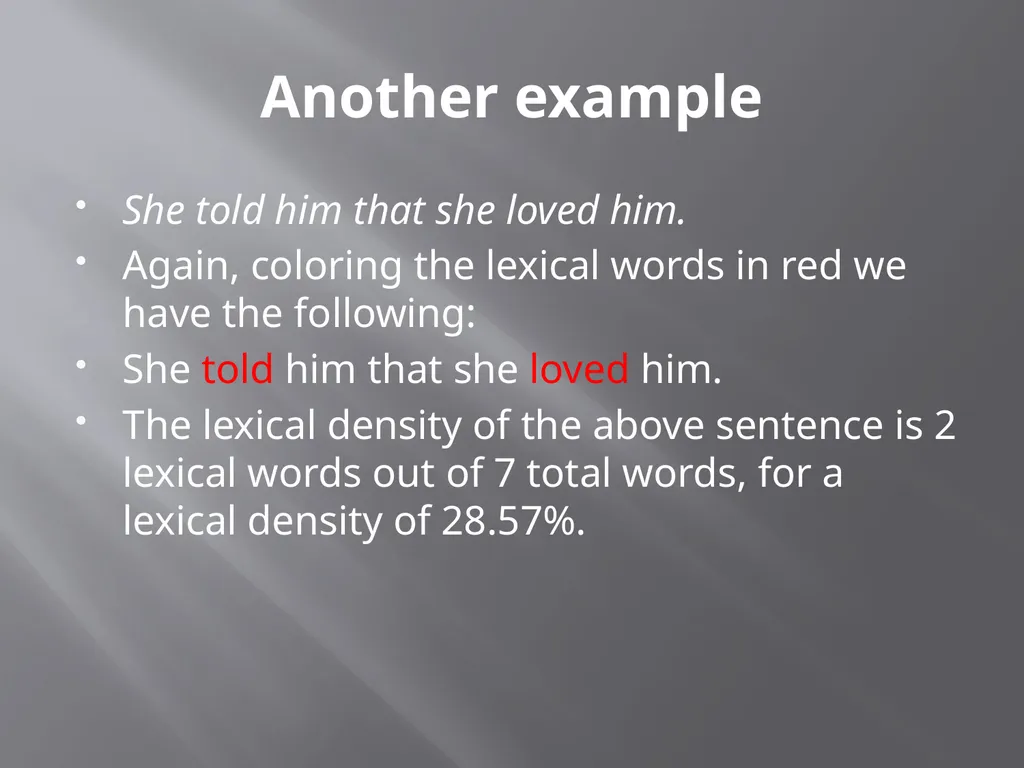
slide4. Another example She told him that she loved him.
Again, coloring the lexical words in red we have the following:
She told him that she loved him.
The lexical density of the above sentence is 2 lexical words out of 7 total words, for a lexical density of 28.57%.<br>
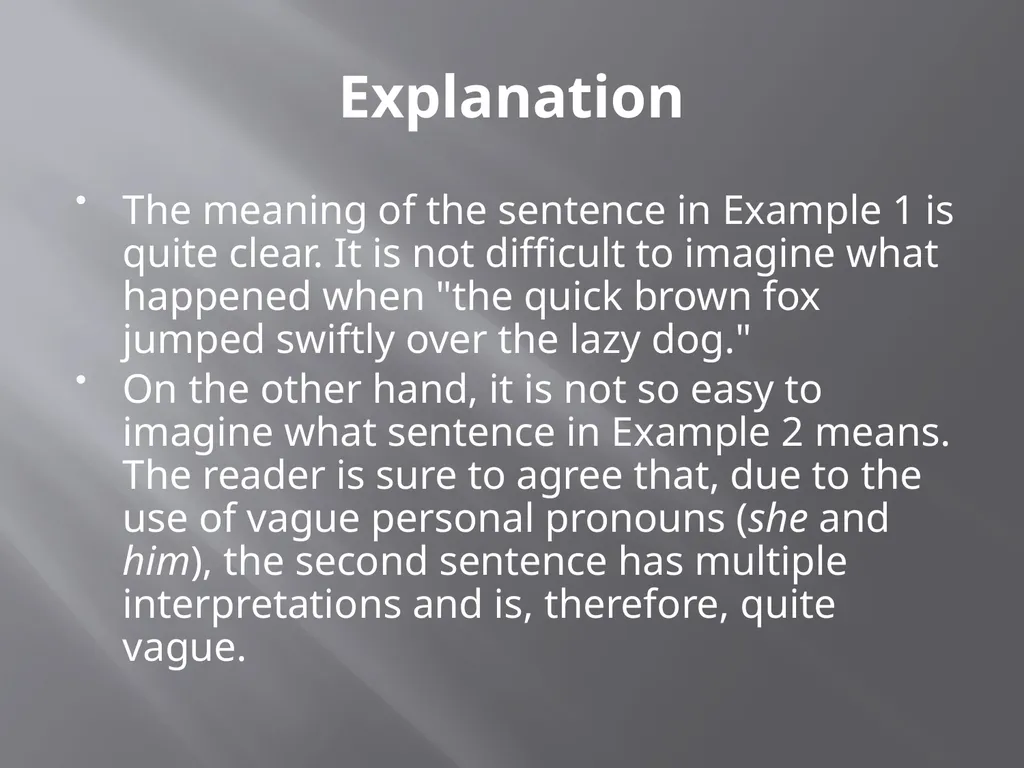
slide5. Explanation The meaning of the sentence in Example 1 is quite clear. It is not difficult to imagine what happened when "the quick brown fox jumped swiftly over the lazy dog."
On the other hand, it is not so easy to imagine what sentence in Example 2 means. The reader is sure to agree that, due to the use of vague personal pronouns (she and him), the second sentence has multiple interpretations and is, therefore, quite vague.<br>
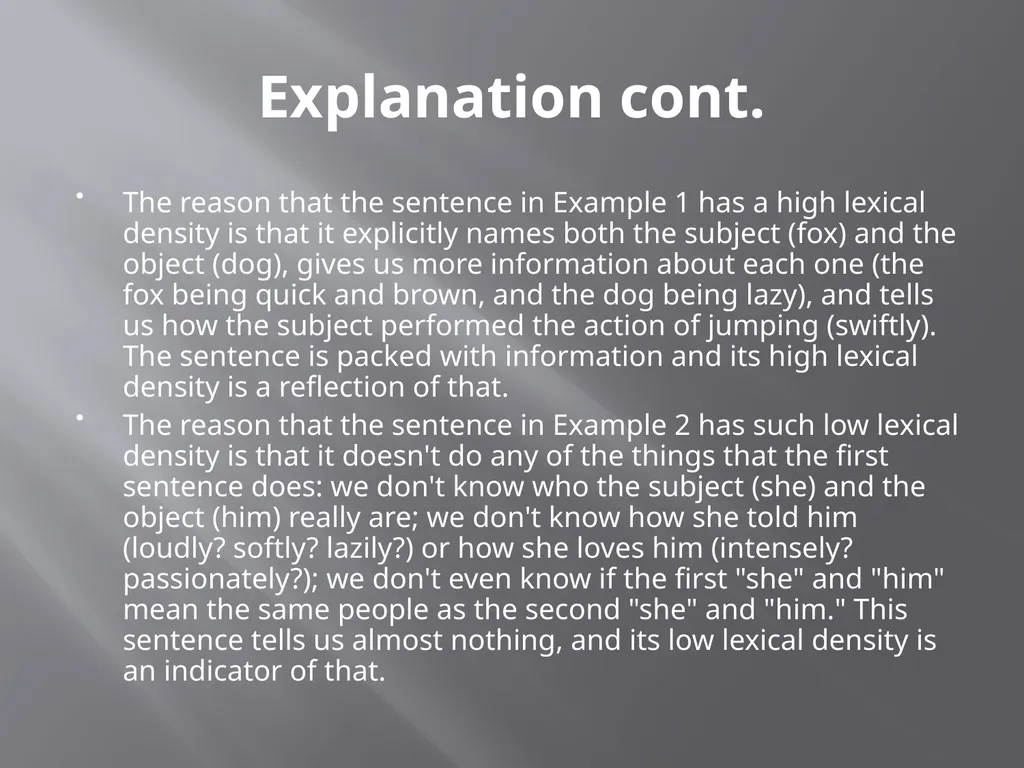
slide6. Explanation cont. The reason that the sentence in Example 1 has a high lexical density is that it explicitly names both the subject (fox) and the object (dog), gives us more information about each one (the fox being quick and brown, and the dog being lazy), and tells us how the subject performed the action of jumping (swiftly). The sentence is packed with information and its high lexical density is a reflection of that.
The reason that the sentence in Example 2 has such low lexical density is that it doesn't do any of the things that the first sentence does: we don't know who the subject (she) and the object (him) really are; we don't know how she told him (loudly? softly? lazily?) or how she loves him (intensely? passionately?); we don't even know if the first "she" and "him" mean the same people as the second "she" and "him." This sentence tells us almost nothing, and its low lexical density is an indicator of that.<br>
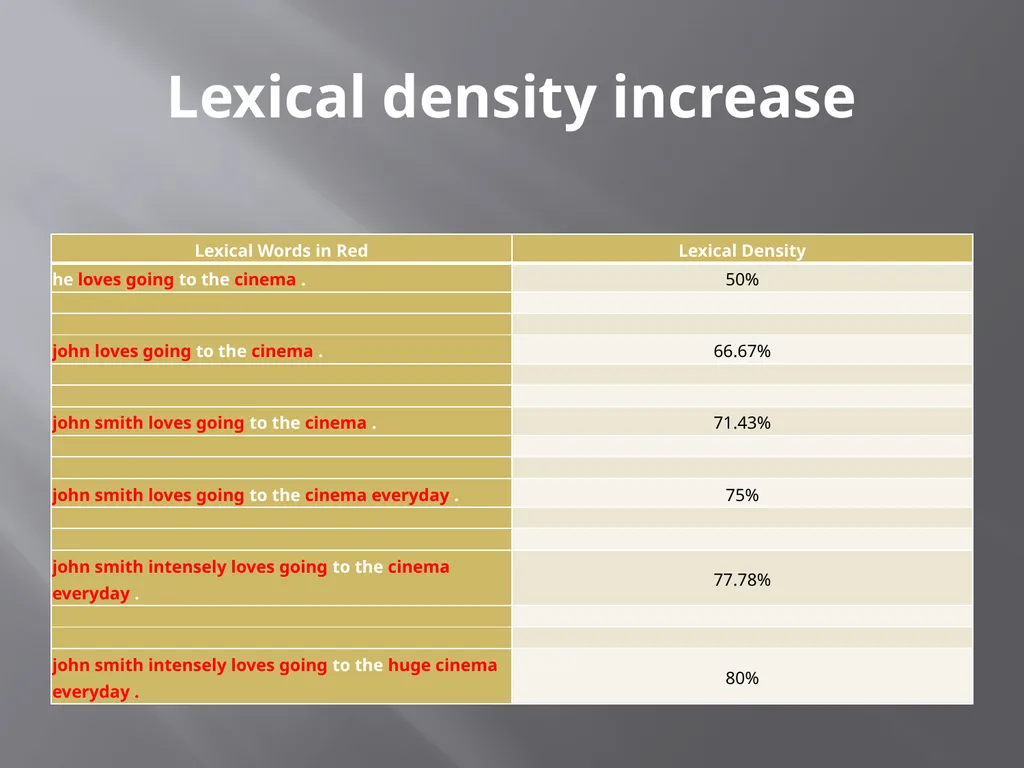
slide7. Lexical density increase<br>
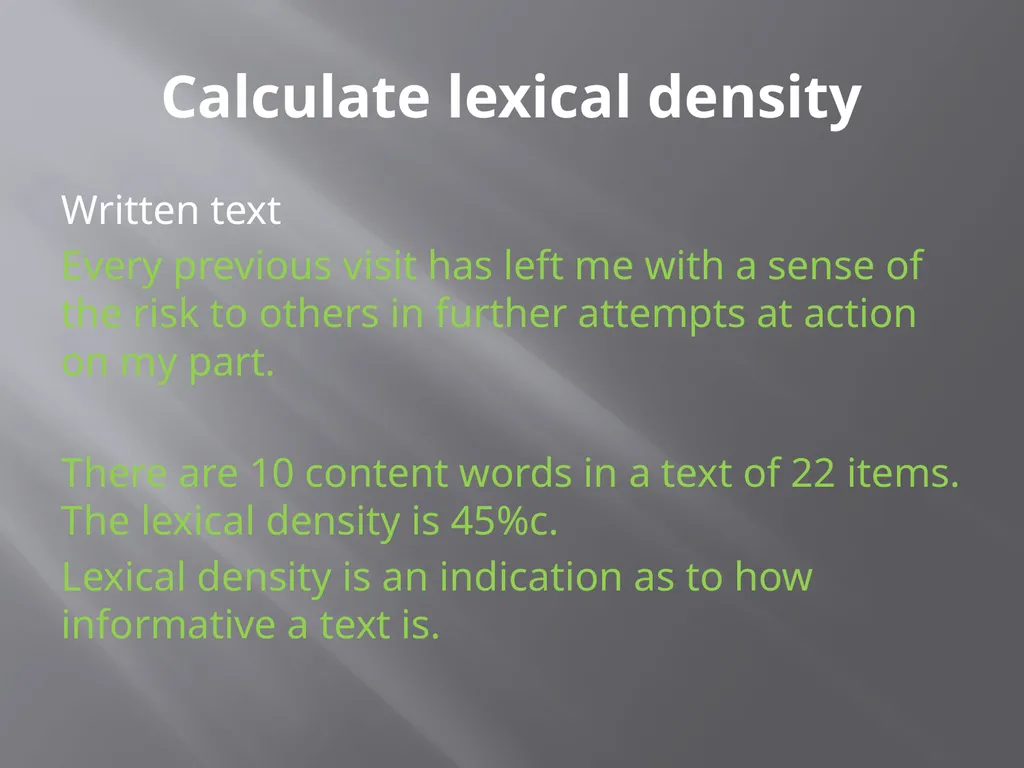
slide8. Calculate lexical density Written text
Every previous visit has left me with a sense of the risk to others in further attempts at action on my part.
There are 10 content words in a text of 22 items. The lexical density is 45%c.
Lexical density is an indication as to how informative a text is.<br>
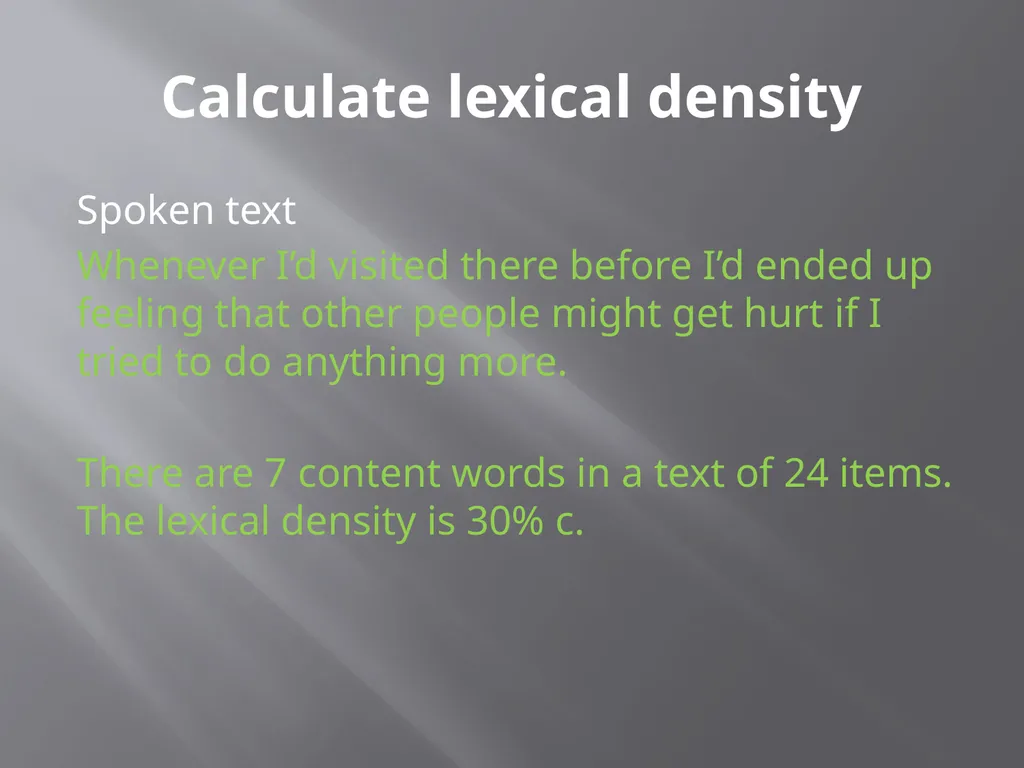
slide9. Calculate lexical density Spoken text
Whenever I’d visited there before I’d ended up feeling that other people might get hurt if I tried to do anything more.
There are 7 content words in a text of 24 items. The lexical density is 30% c.<br>
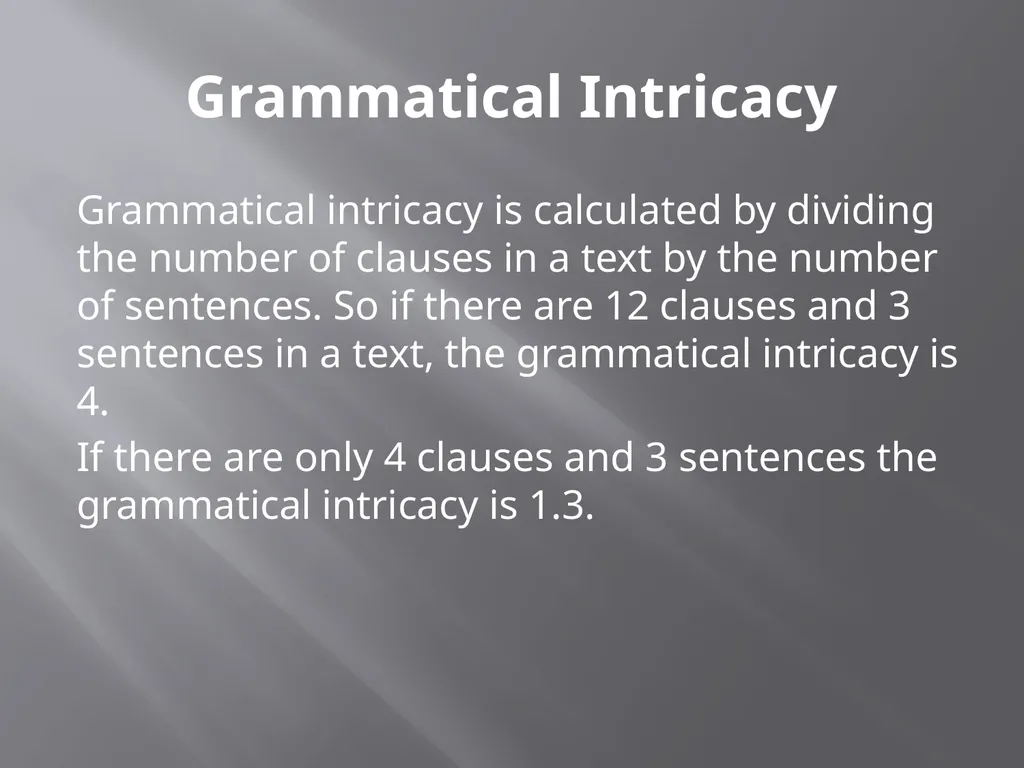
slide10. Grammatical Intricacy Grammatical intricacy is calculated by dividing the number of clauses in a text by the number of sentences. So if there are 12 clauses and 3 sentences in a text, the grammatical intricacy is 4.
If there are only 4 clauses and 3 sentences the grammatical intricacy is 1.3.<br>
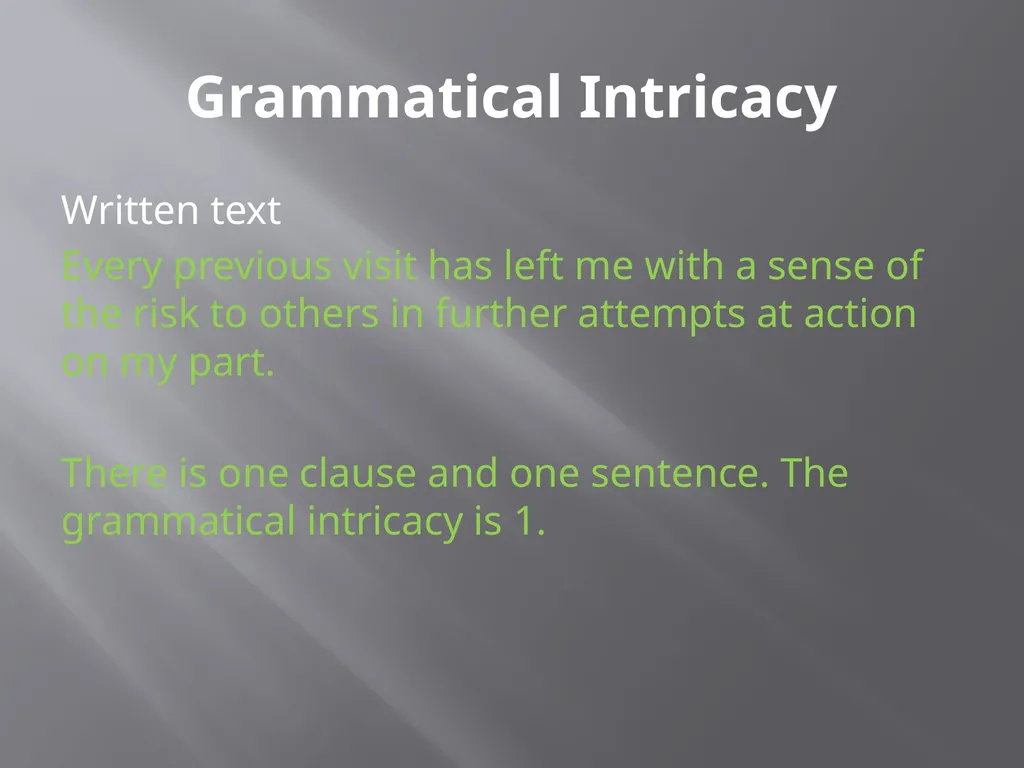
slide11. Grammatical Intricacy Written text
Every previous visit has left me with a sense of the risk to others in further attempts at action on my part.
There is one clause and one sentence. The grammatical intricacy is 1.<br>
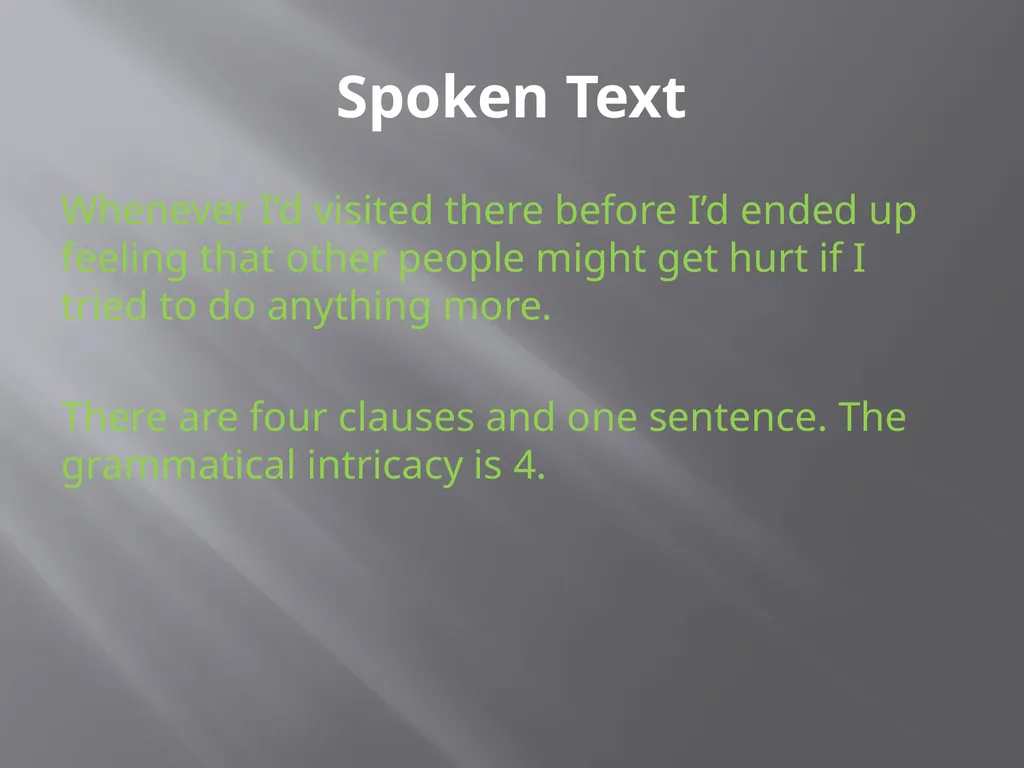
slide12. Spoken Text Whenever I’d visited there before I’d ended up feeling that other people might get hurt if I tried to do anything more.
There are four clauses and one sentence. The grammatical intricacy is 4.<br>
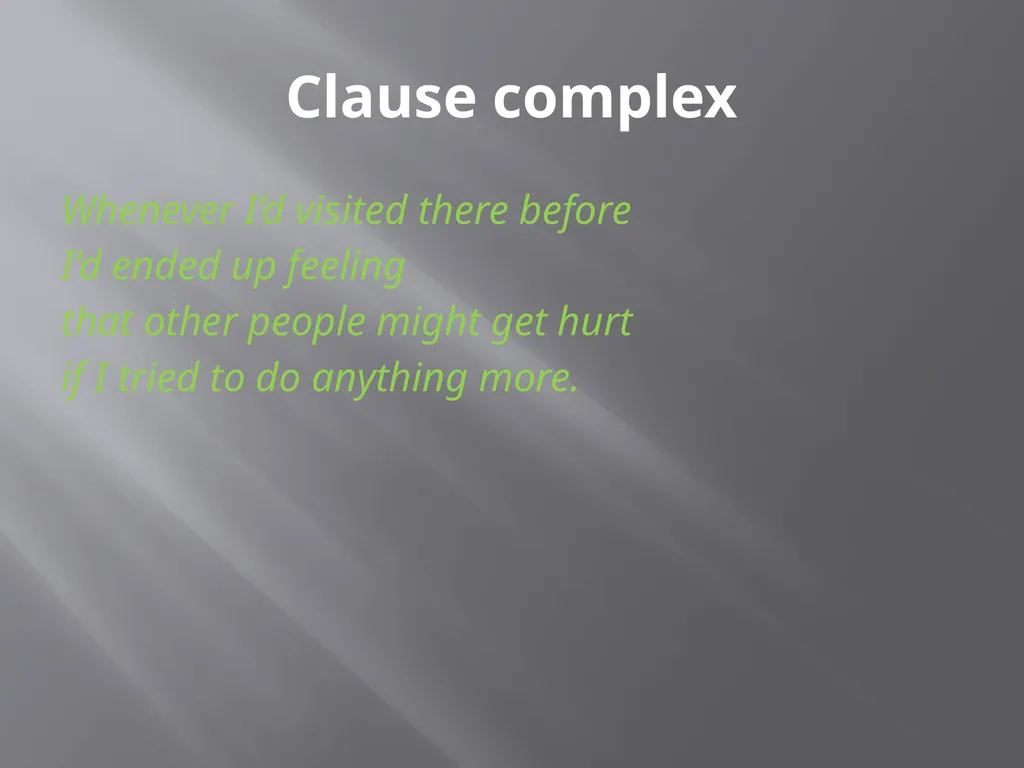
slide13. Clause complex Whenever I’d visited there before
I’d ended up feeling
that other people might get hurt
if I tried to do anything more.<br>
slide14. Spoken versus written The spoken text has a lower degree of lexical density, but a higher degree of grammatical intricacy.<br>
slide15. Conversation Analysis Why do texts happen?
Speech Acts
Locutionary act (what people try to do in a social context)
Illocutionary act
Perlocutionary effect<br>
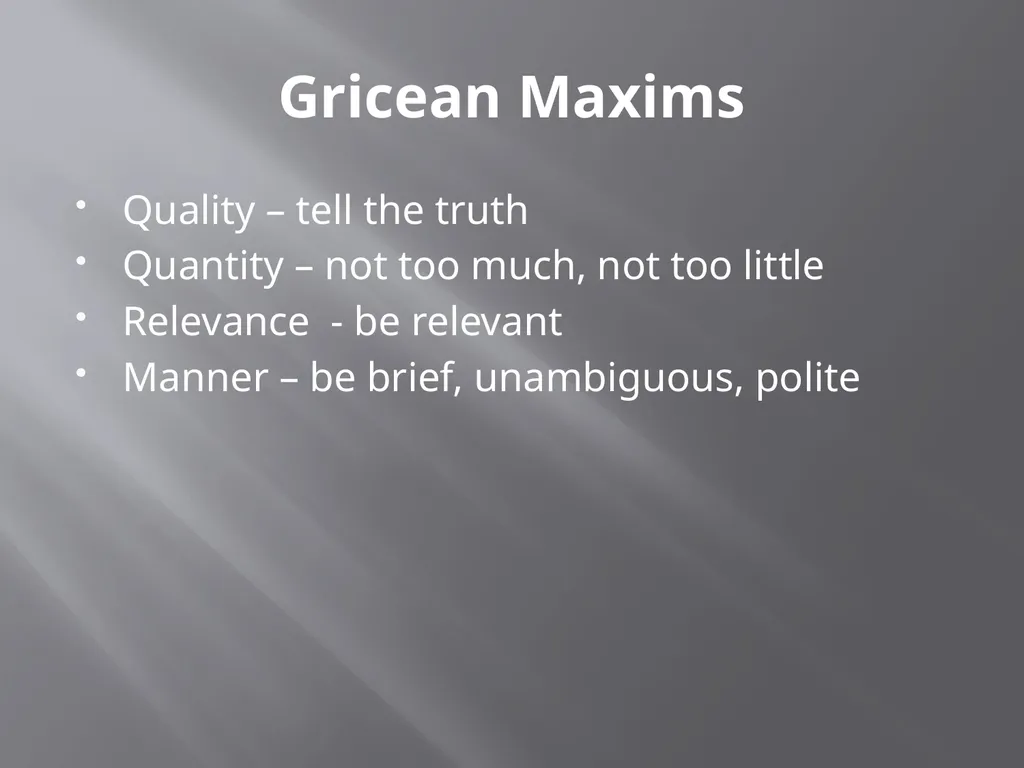
slide16. Gricean Maxims Quality – tell the truth
Quantity – not too much, not too little
Relevance - be relevant
Manner – be brief, unambiguous, polite<br>
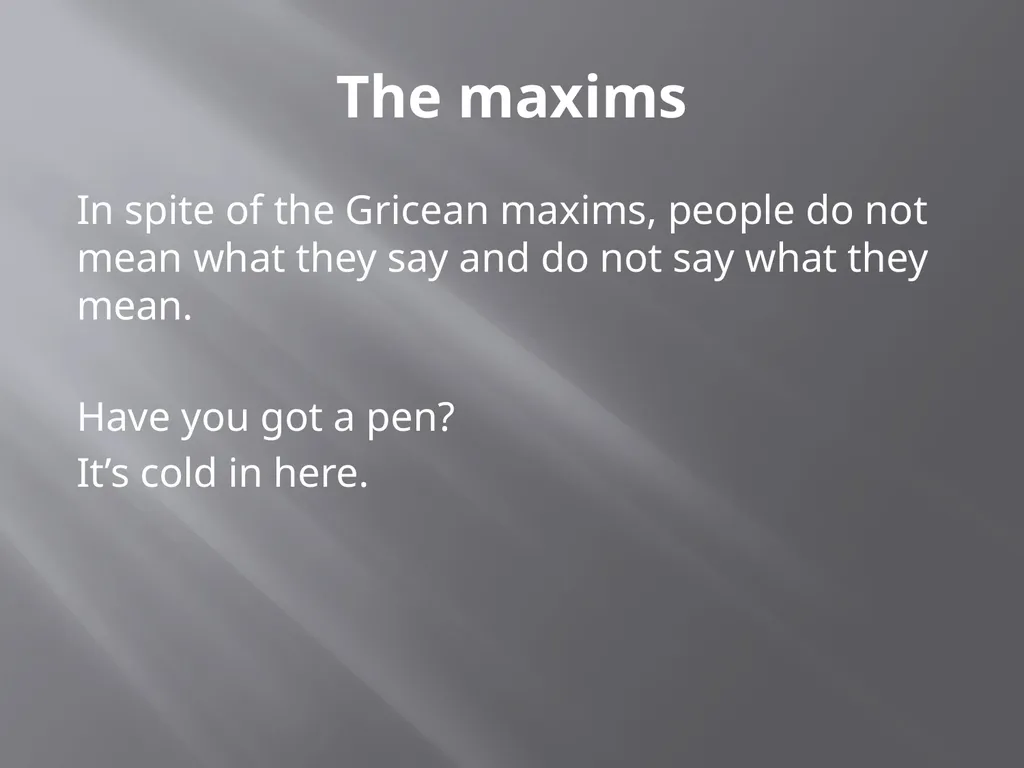
slide17. The maxims In spite of the Gricean maxims, people do not mean what they say and do not say what they mean.
Have you got a pen?
It’s cold in here.<br>
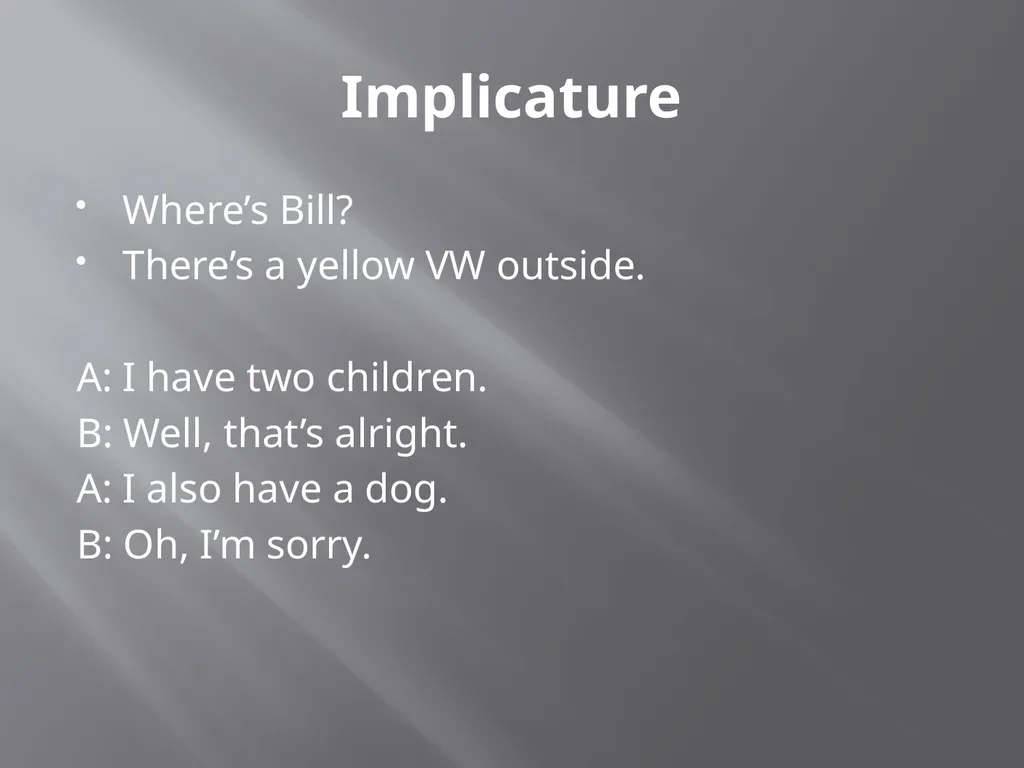
slide18. Implicature Where’s Bill?
There’s a yellow VW outside.
A: I have two children.
B: Well, that’s alright.
A: I also have a dog.
B: Oh, I’m sorry.<br>
slide19. Pragmatic/Casual talk Pragmatic – eg service encounter
bank
post office
shop
Casual – interpersonal
social role
affective
familiarity
affiliation in group<br>
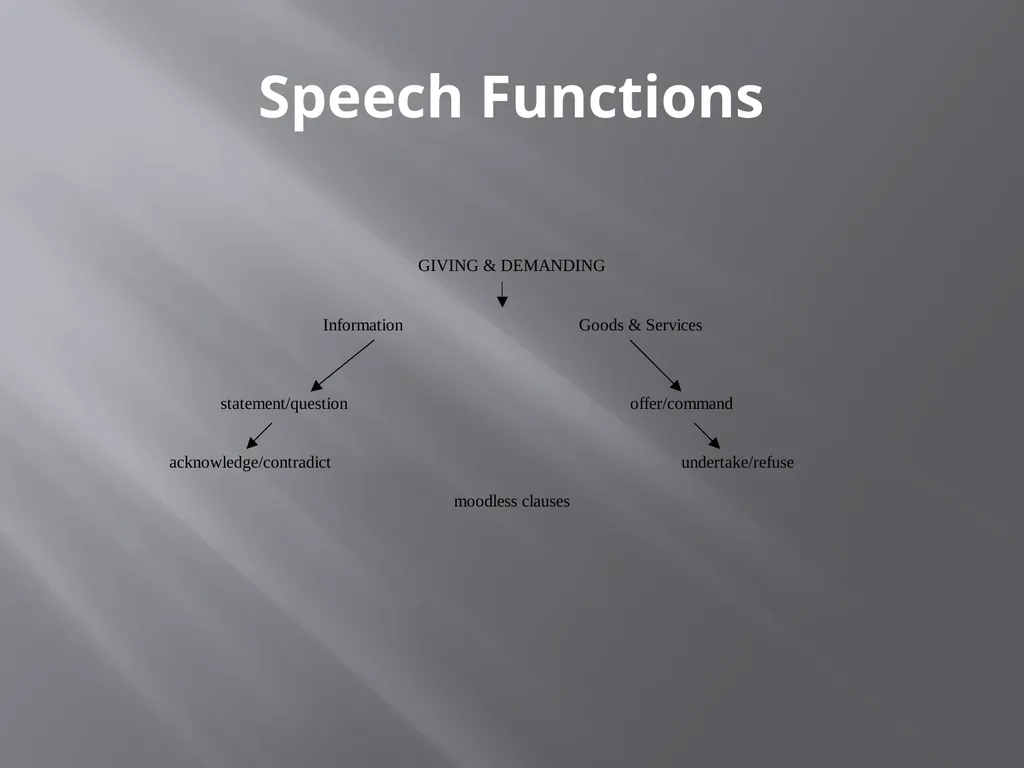
slide20. Speech Functions<br>
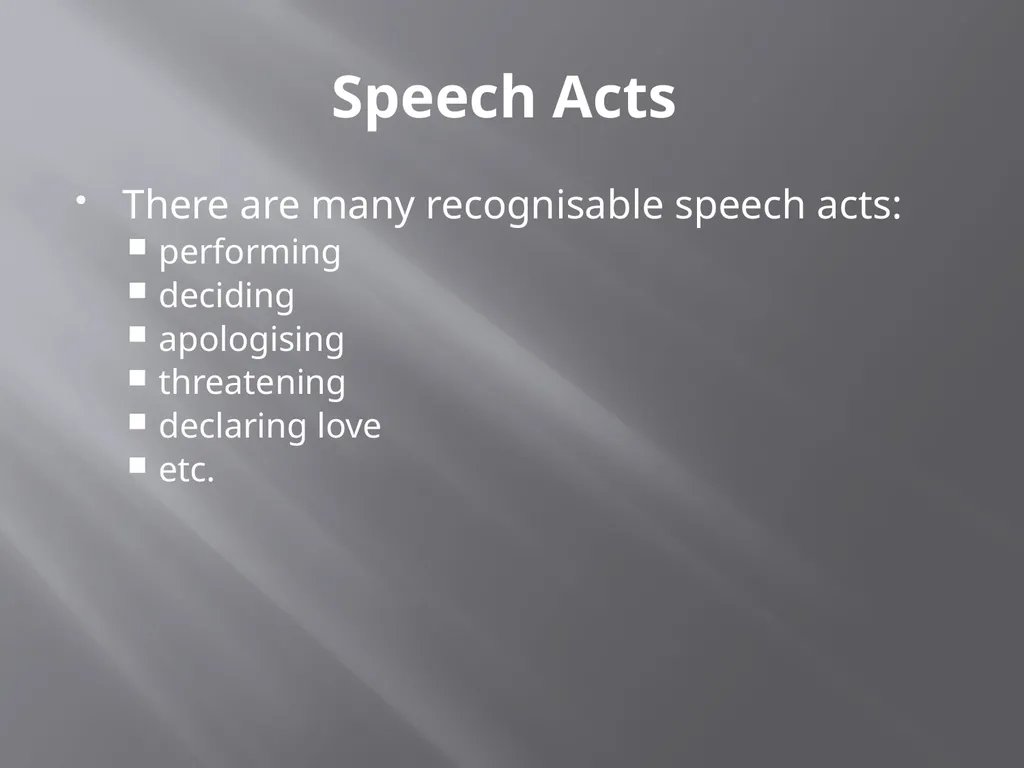
slide21. Speech Acts There are many recognisable speech acts:
performing
deciding
apologising
threatening
declaring love
etc.<br>
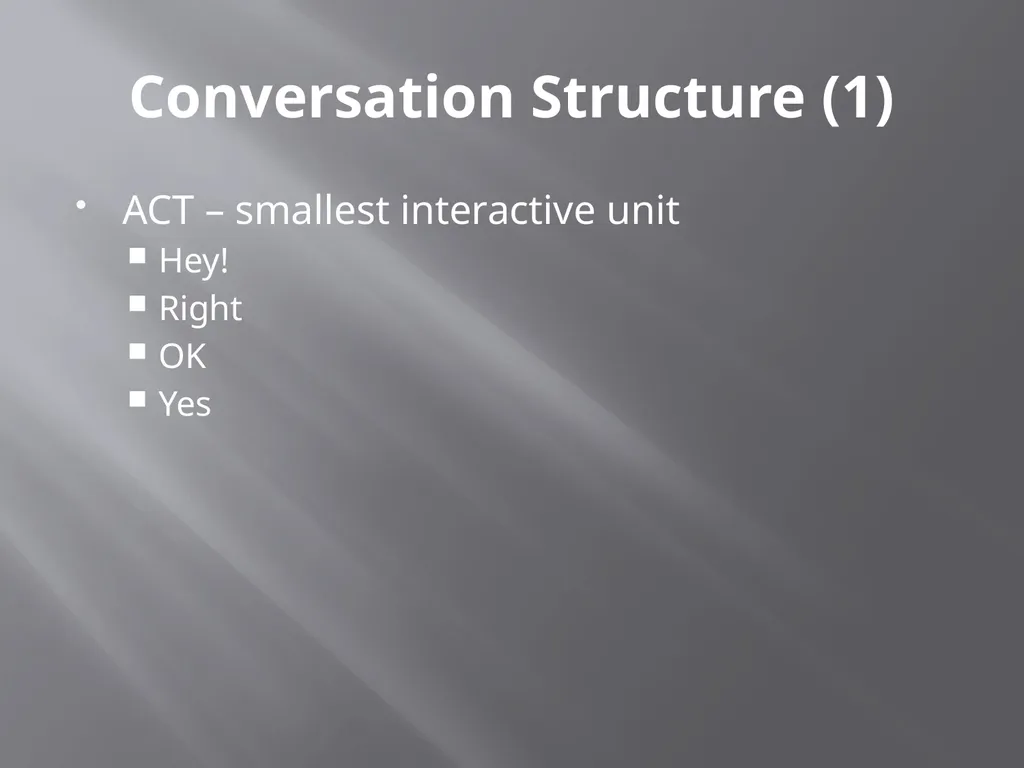
slide22. Conversation Structure (1) ACT – smallest interactive unit
Hey!
Right
OK
Yes<br>
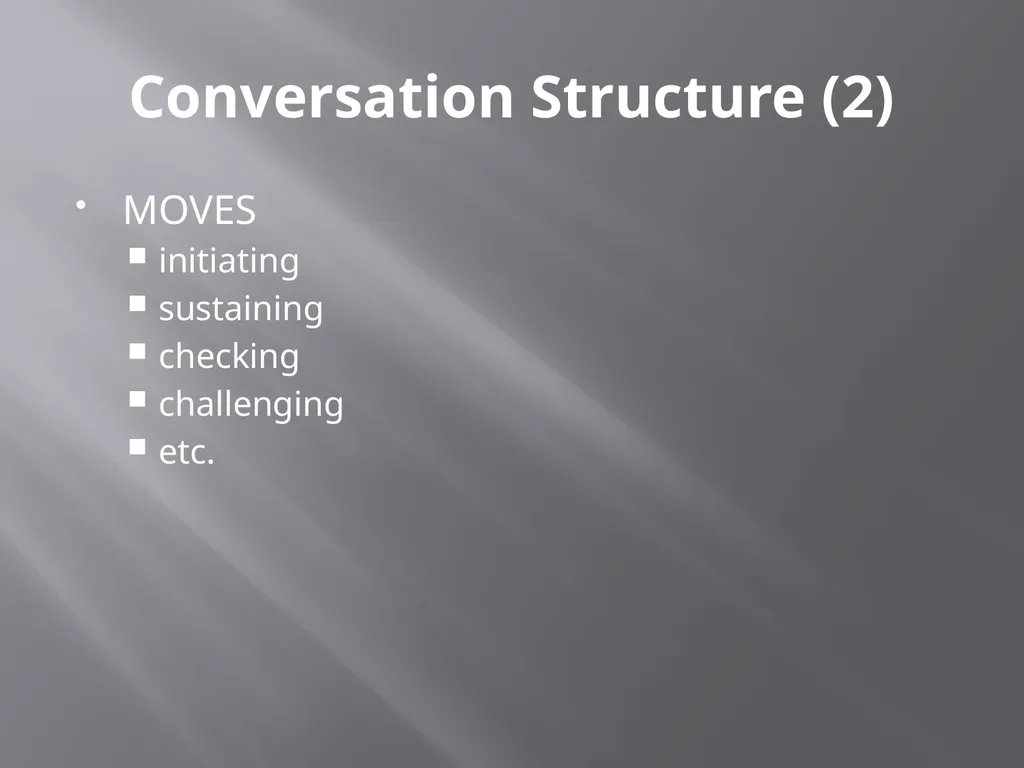
slide23. Conversation Structure (2) MOVES
initiating
sustaining
checking
challenging
etc.<br>
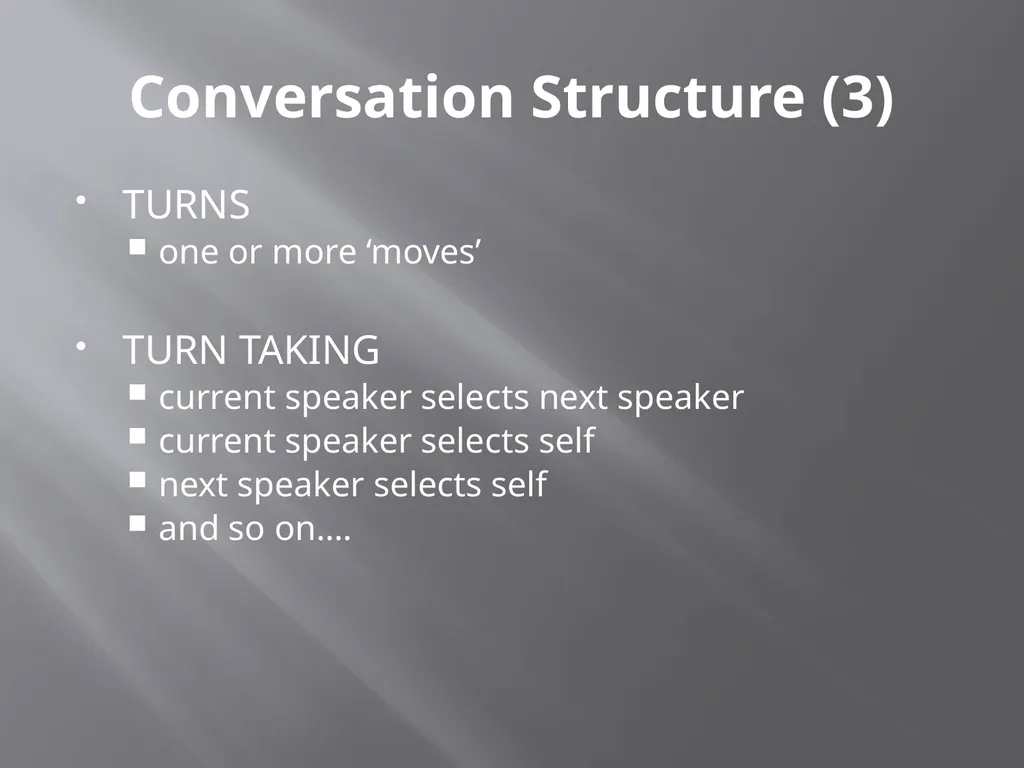
slide24. Conversation Structure (3) TURNS
one or more ‘moves’
TURN TAKING
current speaker selects next speaker
current speaker selects self
next speaker selects self
and so on….<br>
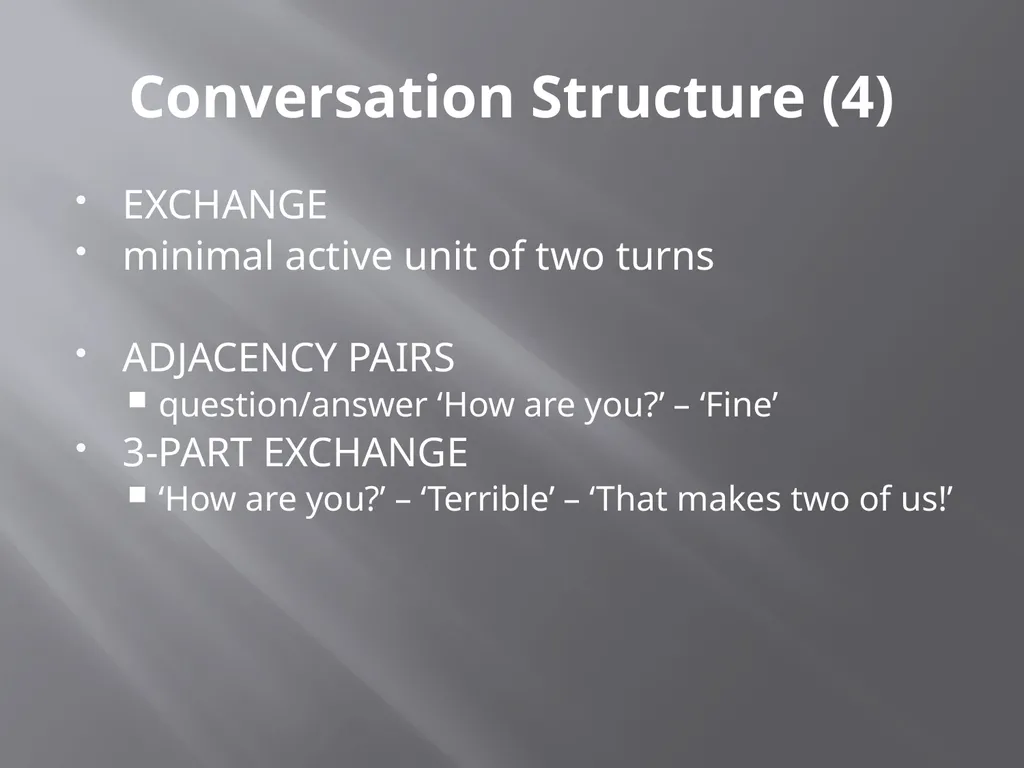
slide25. Conversation Structure (4) EXCHANGE
minimal active unit of two turns
ADJACENCY PAIRS
question/answer ‘How are you?’ – ‘Fine’
3-PART EXCHANGE
‘How are you?’ – ‘Terrible’ – ‘That makes two of us!’<br>
slide26. Conversation As we carry on conversations, we decide what to say based on what the previous speaker has said as well as what we expect the subsequent speaker to say. We alter what we say based on feedback. Listeners can indicate agreement, objection, etc. That is conversations a co-constructed.<br>
slide27. Conversation is transient. Once said, it is gone. You can never remember exactly what was said (cf. Chinese whispers)
Converation is spontaneous (cf. film language).
Planned versus unplanned language.<br>
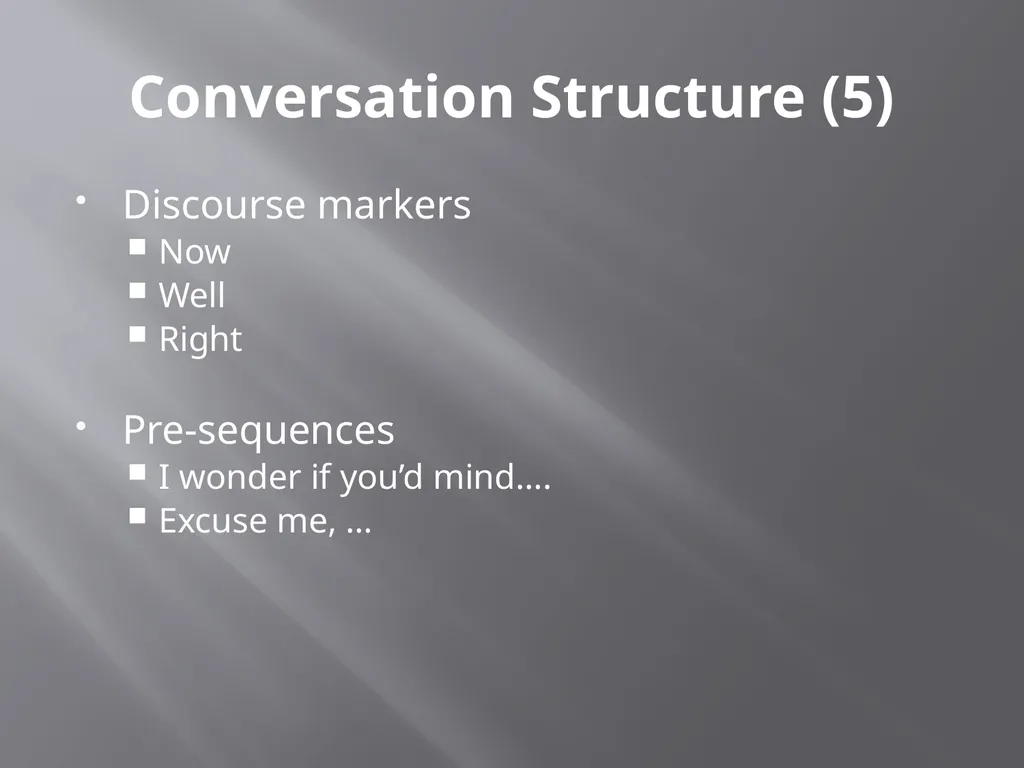
slide28. Conversation Structure (5) Discourse markers
Now
Well
Right
Pre-sequences
I wonder if you’d mind….
Excuse me, …<br>
slide29. Semiotic modalities We use other ‘semiotic modalities’ when we speak: gaze, gesture, facial expression, tone of voice, volume. Conversation takes place in a context. We can use deictic terms: this, that, here, there.<br>
slide30. Digitalisation Of course the present day digital age has altered this perspective: telephone, interactive mediated communication - Facetime, WhatsApp, Snapchat, Skype, but even these lack some elements of face-to-face conversation.<br>
slide31. STORIES (abstract)
orientation
complication
evaluation
resolution
(coda)<br>
slide32. Little Red Riding Hood (I’m going to tell you a story)
Once upon a time (fairy story)
Wolf!!
LRRH is suspicious, afraid
“What big ears you’ve got!”
All ends (un)happily
(the moral of the story…)<br>
slide33. Joke (Have you heard the one about the penguin?)
There’s a man walking down the street
Policeman!
Should take it to the Zoo
Penguin happy (punch line)
(Alright then, don’t laugh)<br>
slide34. Gossip Interaction – social relations in group
About a thrird person
Tacit approval
face-threatening/saving
Reaffirm social values<br>
slide2. Lexical density A text contains x lexical items.
Thees items include content lexical items and grammatical lexical items (articles, prepositions, conjunctions, auxiliary verbs, pronouns).
Lexical density is calculated as the percentage of content words in the whole text.
If there are 100 words in a text and 60 are content words, then the lexical density is 60%.
If there are 124 words in a text and 44 are content words the lexical density is approx. 27%.<br>
slide3. An ideal example The quick brown fox jumped swiftly over the lazy dog.
The quick brown fox jumped swiftly over the lazy dog.
The lexical words (nouns, adjectives, verbs, and adverbs) are colored red.
There are precisely 7 lexical words out of 10 total words. The lexical density of the above passage is therefore 70%.<br>
slide4. Another example She told him that she loved him.
Again, coloring the lexical words in red we have the following:
She told him that she loved him.
The lexical density of the above sentence is 2 lexical words out of 7 total words, for a lexical density of 28.57%.<br>
slide5. Explanation The meaning of the sentence in Example 1 is quite clear. It is not difficult to imagine what happened when "the quick brown fox jumped swiftly over the lazy dog."
On the other hand, it is not so easy to imagine what sentence in Example 2 means. The reader is sure to agree that, due to the use of vague personal pronouns (she and him), the second sentence has multiple interpretations and is, therefore, quite vague.<br>
slide6. Explanation cont. The reason that the sentence in Example 1 has a high lexical density is that it explicitly names both the subject (fox) and the object (dog), gives us more information about each one (the fox being quick and brown, and the dog being lazy), and tells us how the subject performed the action of jumping (swiftly). The sentence is packed with information and its high lexical density is a reflection of that.
The reason that the sentence in Example 2 has such low lexical density is that it doesn't do any of the things that the first sentence does: we don't know who the subject (she) and the object (him) really are; we don't know how she told him (loudly? softly? lazily?) or how she loves him (intensely? passionately?); we don't even know if the first "she" and "him" mean the same people as the second "she" and "him." This sentence tells us almost nothing, and its low lexical density is an indicator of that.<br>
slide7. Lexical density increase<br>
slide8. Calculate lexical density Written text
Every previous visit has left me with a sense of the risk to others in further attempts at action on my part.
There are 10 content words in a text of 22 items. The lexical density is 45%c.
Lexical density is an indication as to how informative a text is.<br>
slide9. Calculate lexical density Spoken text
Whenever I’d visited there before I’d ended up feeling that other people might get hurt if I tried to do anything more.
There are 7 content words in a text of 24 items. The lexical density is 30% c.<br>
slide10. Grammatical Intricacy Grammatical intricacy is calculated by dividing the number of clauses in a text by the number of sentences. So if there are 12 clauses and 3 sentences in a text, the grammatical intricacy is 4.
If there are only 4 clauses and 3 sentences the grammatical intricacy is 1.3.<br>
slide11. Grammatical Intricacy Written text
Every previous visit has left me with a sense of the risk to others in further attempts at action on my part.
There is one clause and one sentence. The grammatical intricacy is 1.<br>
slide12. Spoken Text Whenever I’d visited there before I’d ended up feeling that other people might get hurt if I tried to do anything more.
There are four clauses and one sentence. The grammatical intricacy is 4.<br>
slide13. Clause complex Whenever I’d visited there before
I’d ended up feeling
that other people might get hurt
if I tried to do anything more.<br>
slide14. Spoken versus written The spoken text has a lower degree of lexical density, but a higher degree of grammatical intricacy.<br>
slide15. Conversation Analysis Why do texts happen?
Speech Acts
Locutionary act (what people try to do in a social context)
Illocutionary act
Perlocutionary effect<br>
slide16. Gricean Maxims Quality – tell the truth
Quantity – not too much, not too little
Relevance - be relevant
Manner – be brief, unambiguous, polite<br>
slide17. The maxims In spite of the Gricean maxims, people do not mean what they say and do not say what they mean.
Have you got a pen?
It’s cold in here.<br>
slide18. Implicature Where’s Bill?
There’s a yellow VW outside.
A: I have two children.
B: Well, that’s alright.
A: I also have a dog.
B: Oh, I’m sorry.<br>
slide19. Pragmatic/Casual talk Pragmatic – eg service encounter
bank
post office
shop
Casual – interpersonal
social role
affective
familiarity
affiliation in group<br>
slide20. Speech Functions<br>
slide21. Speech Acts There are many recognisable speech acts:
performing
deciding
apologising
threatening
declaring love
etc.<br>
slide22. Conversation Structure (1) ACT – smallest interactive unit
Hey!
Right
OK
Yes<br>
slide23. Conversation Structure (2) MOVES
initiating
sustaining
checking
challenging
etc.<br>
slide24. Conversation Structure (3) TURNS
one or more ‘moves’
TURN TAKING
current speaker selects next speaker
current speaker selects self
next speaker selects self
and so on….<br>
slide25. Conversation Structure (4) EXCHANGE
minimal active unit of two turns
ADJACENCY PAIRS
question/answer ‘How are you?’ – ‘Fine’
3-PART EXCHANGE
‘How are you?’ – ‘Terrible’ – ‘That makes two of us!’<br>
slide26. Conversation As we carry on conversations, we decide what to say based on what the previous speaker has said as well as what we expect the subsequent speaker to say. We alter what we say based on feedback. Listeners can indicate agreement, objection, etc. That is conversations a co-constructed.<br>
slide27. Conversation is transient. Once said, it is gone. You can never remember exactly what was said (cf. Chinese whispers)
Converation is spontaneous (cf. film language).
Planned versus unplanned language.<br>
slide28. Conversation Structure (5) Discourse markers
Now
Well
Right
Pre-sequences
I wonder if you’d mind….
Excuse me, …<br>
slide29. Semiotic modalities We use other ‘semiotic modalities’ when we speak: gaze, gesture, facial expression, tone of voice, volume. Conversation takes place in a context. We can use deictic terms: this, that, here, there.<br>
slide30. Digitalisation Of course the present day digital age has altered this perspective: telephone, interactive mediated communication - Facetime, WhatsApp, Snapchat, Skype, but even these lack some elements of face-to-face conversation.<br>
slide31. STORIES (abstract)
orientation
complication
evaluation
resolution
(coda)<br>
slide32. Little Red Riding Hood (I’m going to tell you a story)
Once upon a time (fairy story)
Wolf!!
LRRH is suspicious, afraid
“What big ears you’ve got!”
All ends (un)happily
(the moral of the story…)<br>
slide33. Joke (Have you heard the one about the penguin?)
There’s a man walking down the street
Policeman!
Should take it to the Zoo
Penguin happy (punch line)
(Alright then, don’t laugh)<br>
slide34. Gossip Interaction – social relations in group
About a thrird person
Tacit approval
face-threatening/saving
Reaffirm social values<br>