
Liane Hambly lhambly@btinternet.com
EM
Published · 43 slides · 0 views
1 / 1




Description
Liane Hambly lhamblybtinternet.com Creativecareercoaching.org Guidance development Theory Level 6, unit 3 What youll need for this unit Videos 1 and 2 How did I end up here? Two videos on traditional and modern theory 3 change management
Related Topics
Share
Embed code
Download this presentation From Below
"Liane Hambly lhambly@btinternet.com" is the property of its rightful owner. Permission is granted to download and print the materials on this website for personal, non-commercial use only, and to display it on your personal computer provided you do not modify the materials and that you retain all copyright notices contained in the materials. By downloading content from our website, you accept the terms of this agreement.
Presentation Transcript
01
Liane Hambly lhambly@btinternet.com
Creativecareercoaching.org Guidance development
Theory
Level 6, unit 3<br>
Creativecareercoaching.org Guidance development
Theory
Level 6, unit 3<br>
02
What you’ll need for this unit Videos
1 and 2 How did I end up here? Two videos on traditional and modern theory
3 change management (motivation)
4 recalibrating career theory
Reading
Career Development Theory study guide
Handout – overview of the theories
Reading list- a few online articles and videos
Slides and notes
Assignment briefing ©Liane Hambly 2024<br>
1 and 2 How did I end up here? Two videos on traditional and modern theory
3 change management (motivation)
4 recalibrating career theory
Reading
Career Development Theory study guide
Handout – overview of the theories
Reading list- a few online articles and videos
Slides and notes
Assignment briefing ©Liane Hambly 2024<br>
03
Overview Underpinning concepts
career
career management (including planned happenstance and chaos theory)
The purpose of careers work (support, enable, empower? Social justice?)
Decision making (including the neuroscience!)
Historical overview of theories of career “choice” Liane Hambly 2024 3<br>
career
career management (including planned happenstance and chaos theory)
The purpose of careers work (support, enable, empower? Social justice?)
Decision making (including the neuroscience!)
Historical overview of theories of career “choice” Liane Hambly 2024 3<br>
04
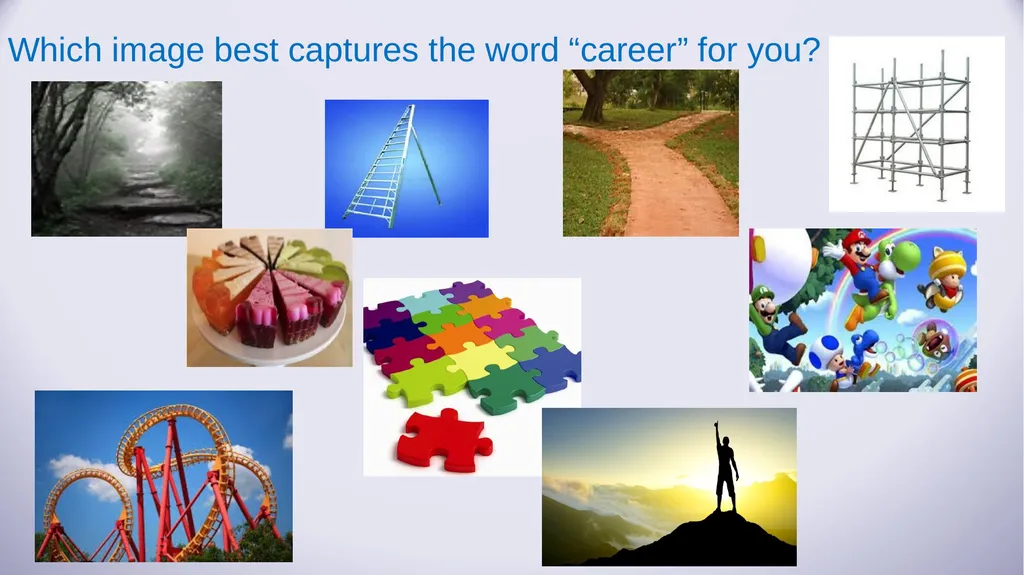
Which image best captures the word “career” for you?<br>
05
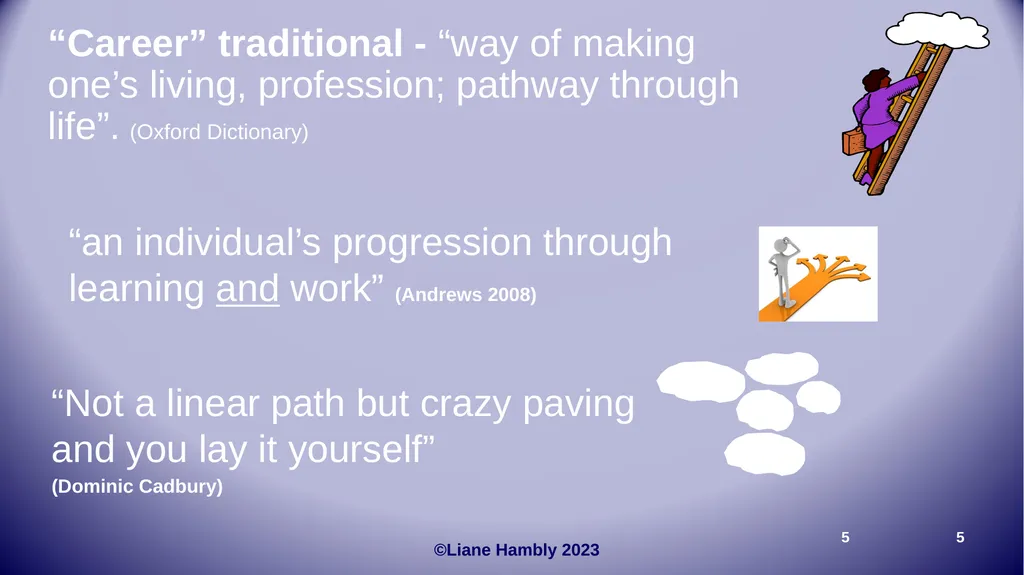
5 “Career” traditional - “way of making one’s living, profession; pathway through life”. (Oxford Dictionary) 5 “an individual’s progression through learning and work” (Andrews 2008) “Not a linear path but crazy paving and you lay it yourself”
(Dominic Cadbury) ©Liane Hambly 2023<br>
(Dominic Cadbury) ©Liane Hambly 2023<br>
06
6 1 modern definition - the boundaryless career ‘Career is more about improvisation than planning …. making fresh choices in response to changing circumstances, rather than implementing pre-determined plans’
Independence from traditional career paths … no job for life, downshifting …
Multiple employers
Use transferable skills to occupy a number of roles
(ARTHUR & ROUSSEAU, 1996, P. 6) THE BOUNDARYLESS CAREER: A NEW EMPLOYMENT PRINCIPLE FOR A NEW ORGANIZATIONAL ERA. NEW YORK: OXFORD UNIVERSITY PRESS. 6<br>
Independence from traditional career paths … no job for life, downshifting …
Multiple employers
Use transferable skills to occupy a number of roles
(ARTHUR & ROUSSEAU, 1996, P. 6) THE BOUNDARYLESS CAREER: A NEW EMPLOYMENT PRINCIPLE FOR A NEW ORGANIZATIONAL ERA. NEW YORK: OXFORD UNIVERSITY PRESS. 6<br>
07
Career is changing …
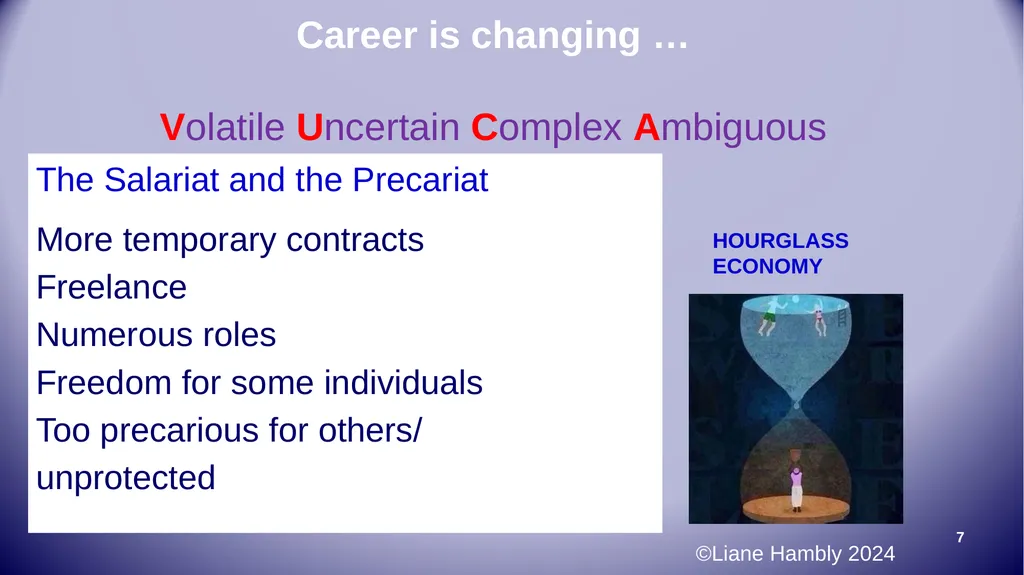
Volatile Uncertain Complex Ambiguous The Salariat and the Precariat
More temporary contracts
Freelance
Numerous roles
Freedom for some individuals
Too precarious for others/
unprotected 7 HOURGLASS ECONOMY ©Liane Hambly 2024<br>
More temporary contracts
Freelance
Numerous roles
Freedom for some individuals
Too precarious for others/
unprotected 7 HOURGLASS ECONOMY ©Liane Hambly 2024<br>
08
4th and 5th industrial revolutions
source – bbn times 1700’S Late 1800’s 1960+
Data processing Data analysis
Artificial intelligence
3D printing
Biological hacking ©Liane Hambly 2024<br>
Data processing Data analysis
Artificial intelligence
3D printing
Biological hacking ©Liane Hambly 2024<br>
09
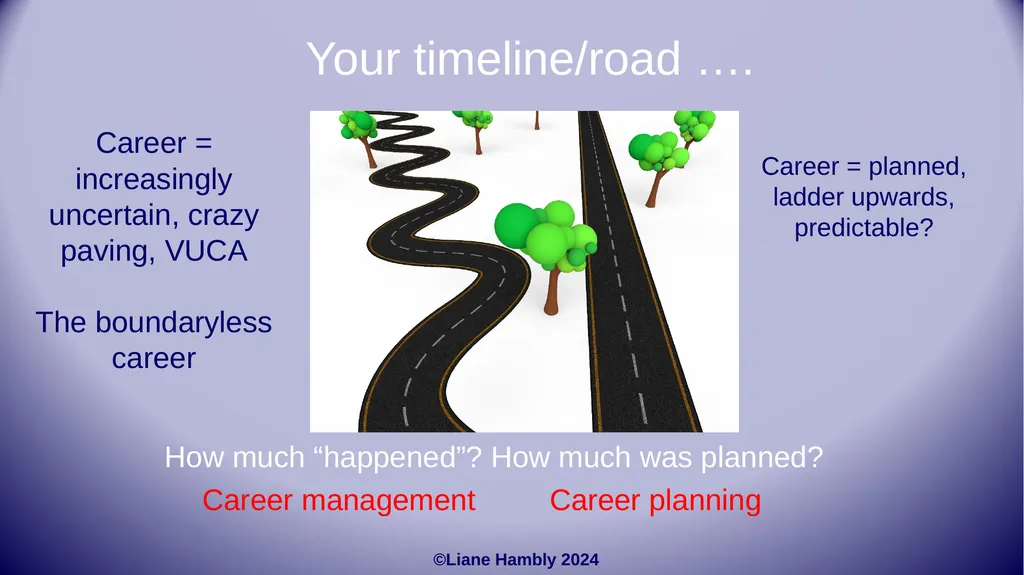
How much “happened”? How much was planned? Your timeline/road …. Career = increasingly uncertain, crazy paving, VUCA
The boundaryless career Career = planned, ladder upwards, predictable? Career management Career planning ©Liane Hambly 2024<br>
10
10 Career management “Career management is not about making the right occupational choice …
… its about equipping people with the competencies (KSA) to make the myriad choices with which adults are confronted continuously, lifelong’”
Jarvis, P. Talent - Canadian Blueprint for Life/ work Design
See also Australian Blueprint for Career Development
Skills Development Scotland Career Management Skills framework
English Career Development framework 10 ©Liane Hambly 2024<br>
… its about equipping people with the competencies (KSA) to make the myriad choices with which adults are confronted continuously, lifelong’”
Jarvis, P. Talent - Canadian Blueprint for Life/ work Design
See also Australian Blueprint for Career Development
Skills Development Scotland Career Management Skills framework
English Career Development framework 10 ©Liane Hambly 2024<br>
11
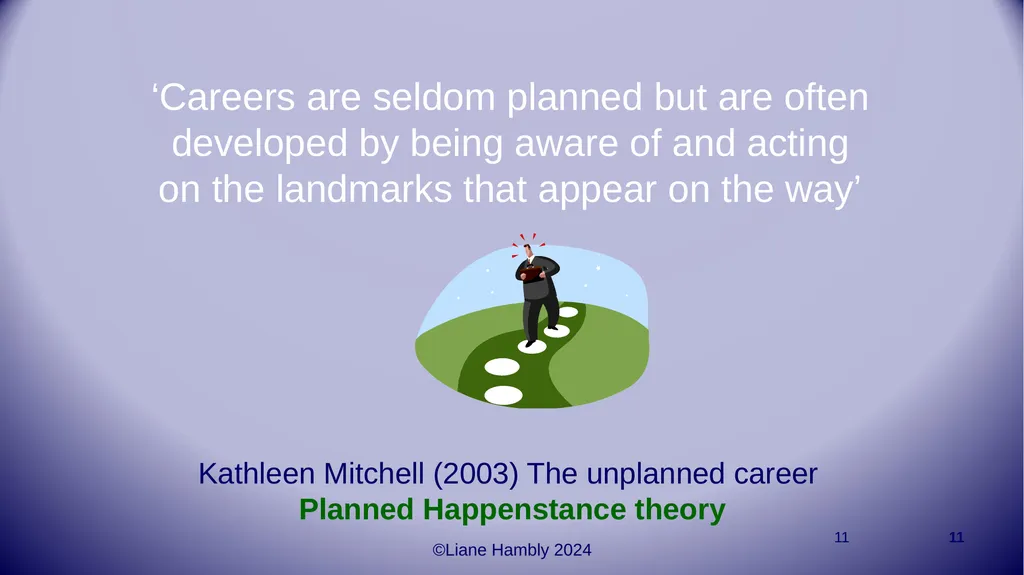
Kathleen Mitchell (2003) The unplanned career
Planned Happenstance theory ‘Careers are seldom planned but are often developed by being aware of and acting on the landmarks that appear on the way’ 11 11 ©Liane Hambly 2024<br>
12
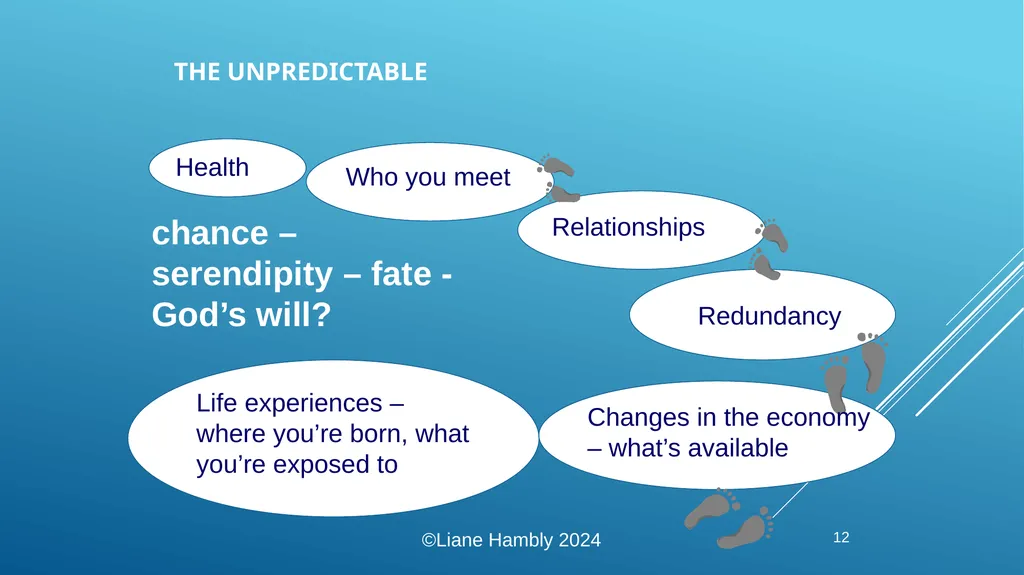
The unpredictable 12 chance – serendipity – fate - God’s will? ©Liane Hambly 2024 Life experiences – where you’re born, what you’re exposed to Changes in the economy – what’s available Redundancy Relationships Who you meet Health<br>
13
copyright Liane Hambly 2024<br>
14
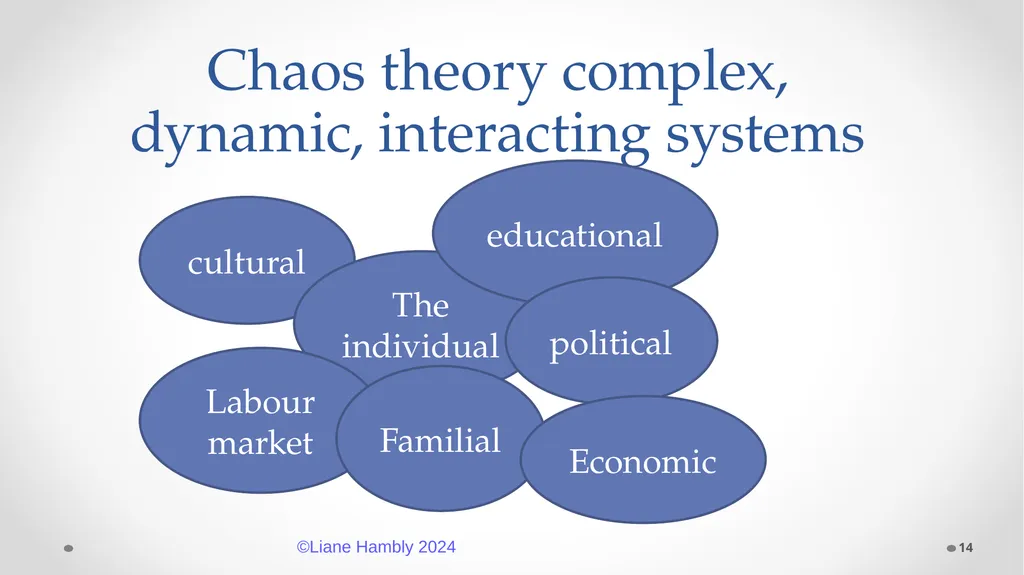
Chaos theory complex, dynamic, interacting systems 14 cultural The individual educational Labour market Familial political Economic ©Liane Hambly 2024<br>
15
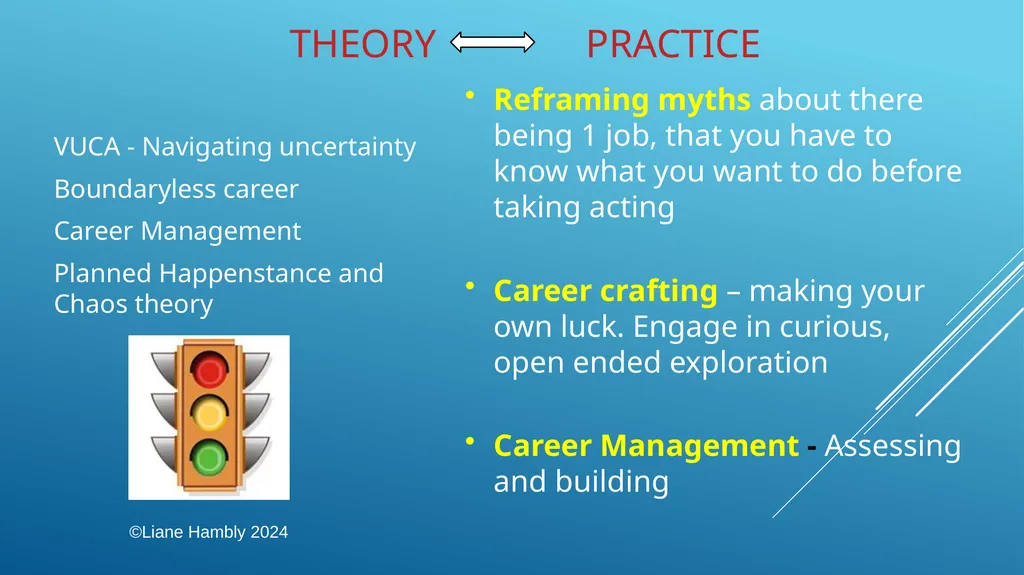
Theory Practice VUCA - Navigating uncertainty
Boundaryless career
Career Management
Planned Happenstance and Chaos theory ©Liane Hambly 2024 Reframing myths about there being 1 job, that you have to know what you want to do before taking acting
Career crafting – making your own luck. Engage in curious, open ended exploration
Career Management - Assessing and building<br>
Boundaryless career
Career Management
Planned Happenstance and Chaos theory ©Liane Hambly 2024 Reframing myths about there being 1 job, that you have to know what you want to do before taking acting
Career crafting – making your own luck. Engage in curious, open ended exploration
Career Management - Assessing and building<br>
16
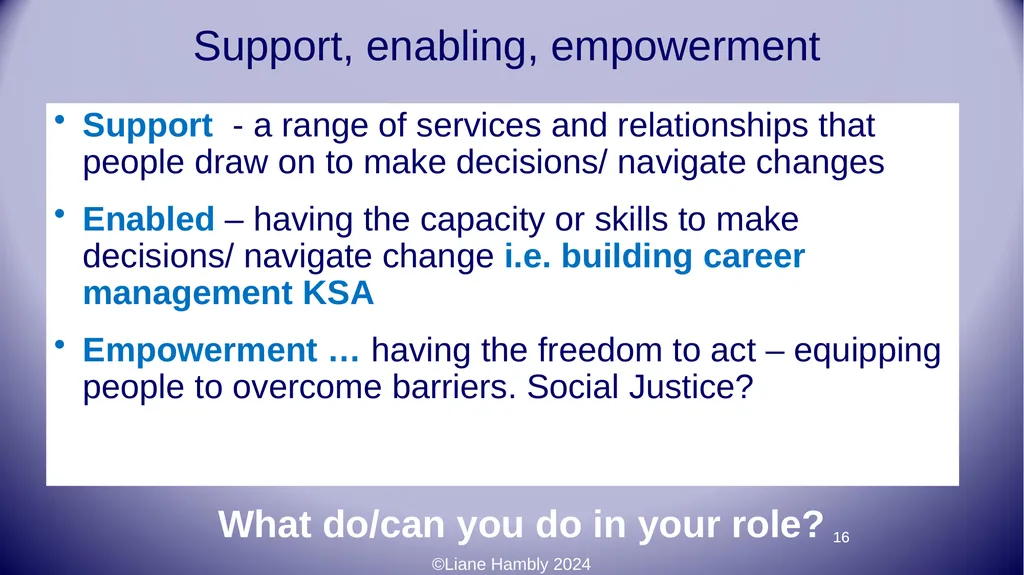
16 16 Support, enabling, empowerment Support - a range of services and relationships that people draw on to make decisions/ navigate changes
Enabled – having the capacity or skills to make decisions/ navigate change i.e. building career management KSA
Empowerment … having the freedom to act – equipping people to overcome barriers. Social Justice? ©Liane Hambly 2024 What do/can you do in your role?<br>
Enabled – having the capacity or skills to make decisions/ navigate change i.e. building career management KSA
Empowerment … having the freedom to act – equipping people to overcome barriers. Social Justice? ©Liane Hambly 2024 What do/can you do in your role?<br>
17
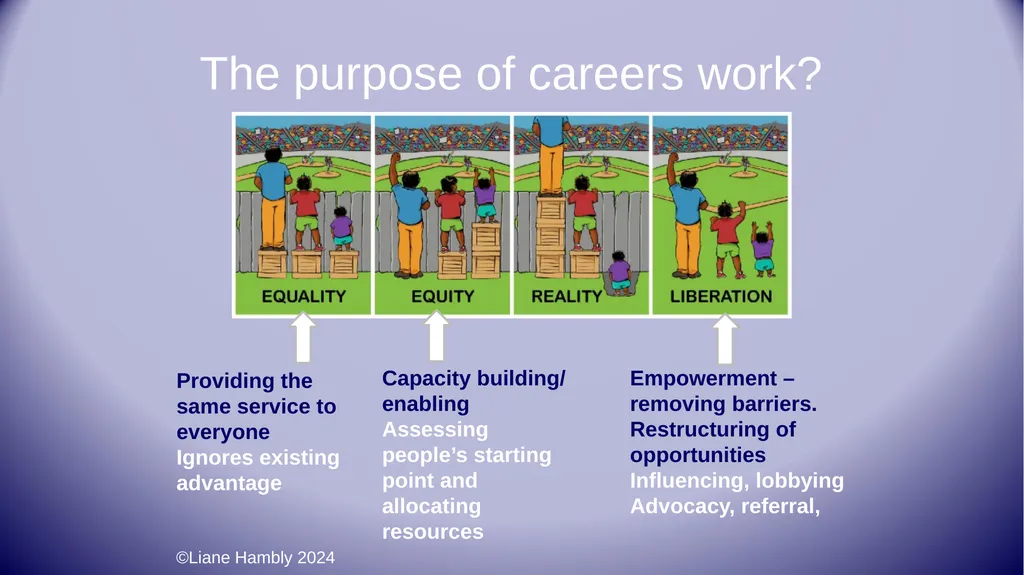
The purpose of careers work? Providing the same service to everyone
Ignores existing advantage Capacity building/ enabling
Assessing people’s starting point and allocating resources Empowerment – removing barriers.
Restructuring of opportunities
Influencing, lobbying
Advocacy, referral, ©Liane Hambly 2024<br>
Ignores existing advantage Capacity building/ enabling
Assessing people’s starting point and allocating resources Empowerment – removing barriers.
Restructuring of opportunities
Influencing, lobbying
Advocacy, referral, ©Liane Hambly 2024<br>
18
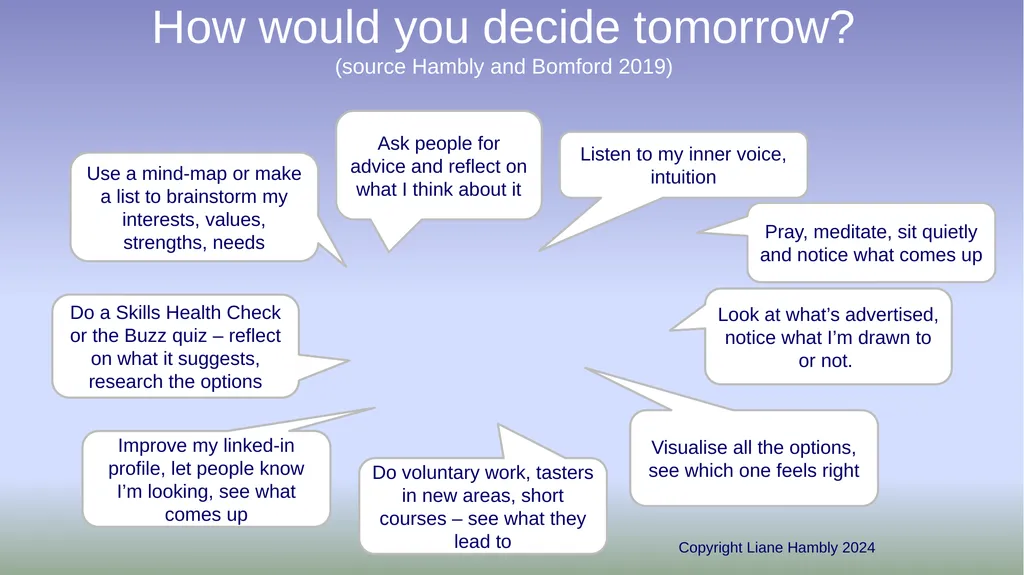
How would you decide tomorrow?
(source Hambly and Bomford 2019) Use a mind-map or make a list to brainstorm my interests, values, strengths, needs Ask people for advice and reflect on what I think about it Listen to my inner voice, intuition Pray, meditate, sit quietly and notice what comes up Do a Skills Health Check or the Buzz quiz – reflect on what it suggests, research the options Improve my linked-in profile, let people know I’m looking, see what comes up Look at what’s advertised, notice what I’m drawn to or not. Visualise all the options, see which one feels right Do voluntary work, tasters in new areas, short courses – see what they lead to Copyright Liane Hambly 2024<br>
19
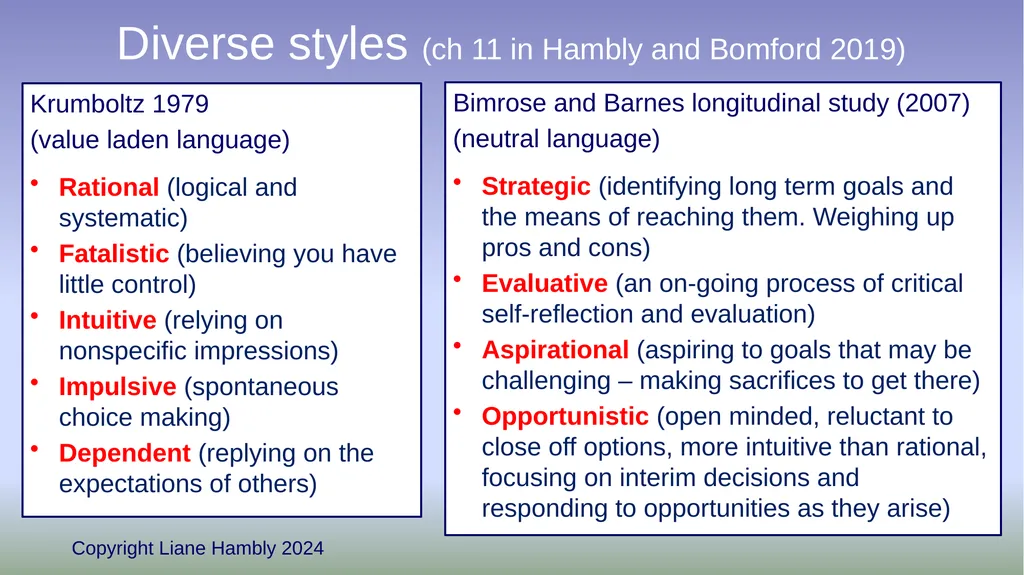
Diverse styles (ch 11 in Hambly and Bomford 2019) Krumboltz 1979
(value laden language)
Rational (logical and systematic)
Fatalistic (believing you have little control)
Intuitive (relying on nonspecific impressions)
Impulsive (spontaneous choice making)
Dependent (replying on the expectations of others) Bimrose and Barnes longitudinal study (2007)
(neutral language)
Strategic (identifying long term goals and the means of reaching them. Weighing up pros and cons)
Evaluative (an on-going process of critical self-reflection and evaluation)
Aspirational (aspiring to goals that may be challenging – making sacrifices to get there)
Opportunistic (open minded, reluctant to close off options, more intuitive than rational, focusing on interim decisions and responding to opportunities as they arise) Copyright Liane Hambly 2024<br>
(value laden language)
Rational (logical and systematic)
Fatalistic (believing you have little control)
Intuitive (relying on nonspecific impressions)
Impulsive (spontaneous choice making)
Dependent (replying on the expectations of others) Bimrose and Barnes longitudinal study (2007)
(neutral language)
Strategic (identifying long term goals and the means of reaching them. Weighing up pros and cons)
Evaluative (an on-going process of critical self-reflection and evaluation)
Aspirational (aspiring to goals that may be challenging – making sacrifices to get there)
Opportunistic (open minded, reluctant to close off options, more intuitive than rational, focusing on interim decisions and responding to opportunities as they arise) Copyright Liane Hambly 2024<br>
20
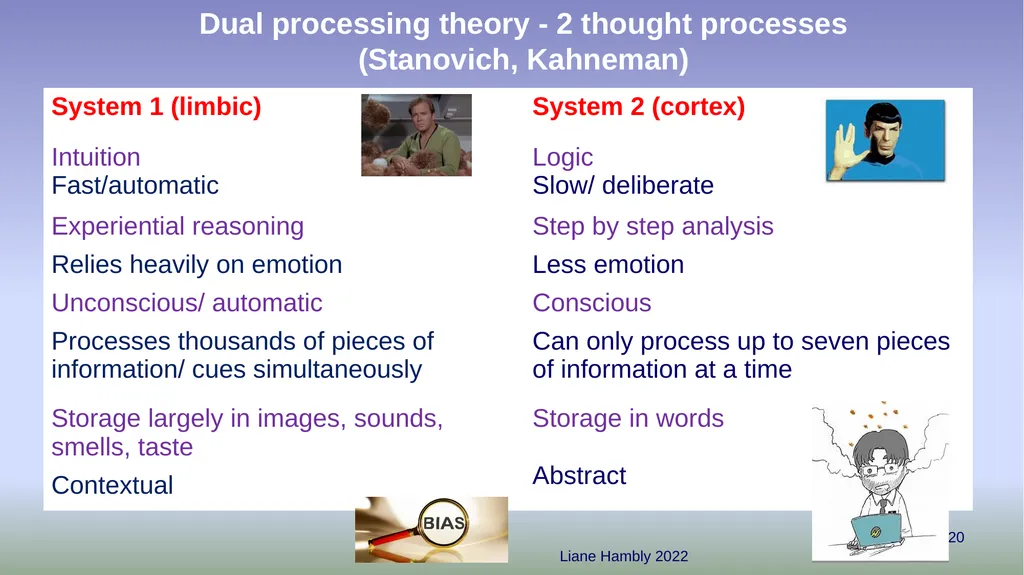
Dual processing theory - 2 thought processes
(Stanovich, Kahneman) 20 Liane Hambly 2022<br>
21
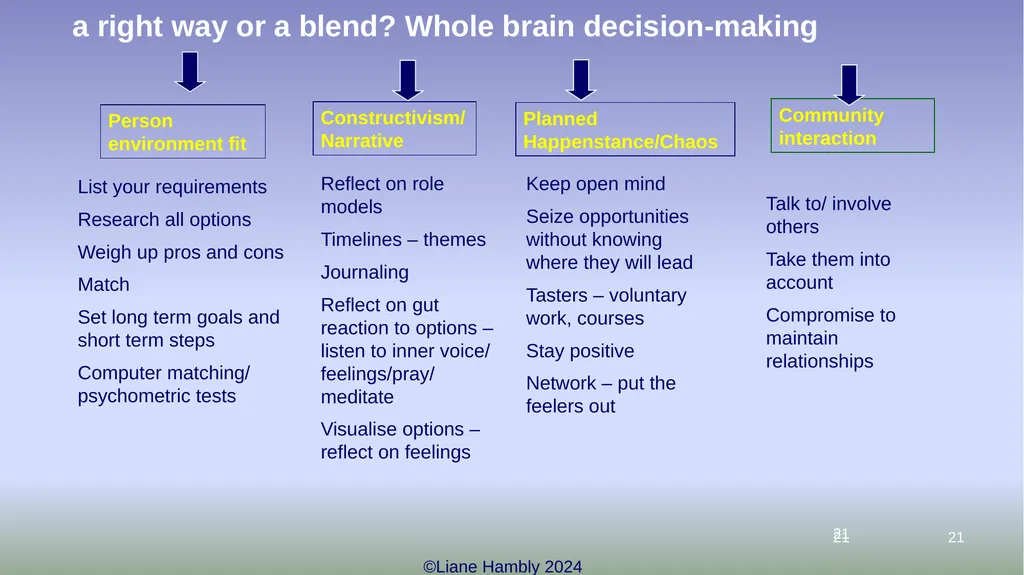
21 21 21 Person environment fit Constructivism/ Narrative Planned Happenstance/Chaos Keep open mind
Seize opportunities without knowing where they will lead
Tasters – voluntary work, courses
Stay positive
Network – put the feelers out a right way or a blend? Whole brain decision-making Reflect on role models
Timelines – themes
Journaling
Reflect on gut reaction to options – listen to inner voice/ feelings/pray/ meditate
Visualise options – reflect on feelings Talk to/ involve others
Take them into account
Compromise to maintain relationships Community interaction ©Liane Hambly 2024 List your requirements
Research all options
Weigh up pros and cons
Match
Set long term goals and short term steps
Computer matching/ psychometric tests<br>
Seize opportunities without knowing where they will lead
Tasters – voluntary work, courses
Stay positive
Network – put the feelers out a right way or a blend? Whole brain decision-making Reflect on role models
Timelines – themes
Journaling
Reflect on gut reaction to options – listen to inner voice/ feelings/pray/ meditate
Visualise options – reflect on feelings Talk to/ involve others
Take them into account
Compromise to maintain relationships Community interaction ©Liane Hambly 2024 List your requirements
Research all options
Weigh up pros and cons
Match
Set long term goals and short term steps
Computer matching/ psychometric tests<br>
22
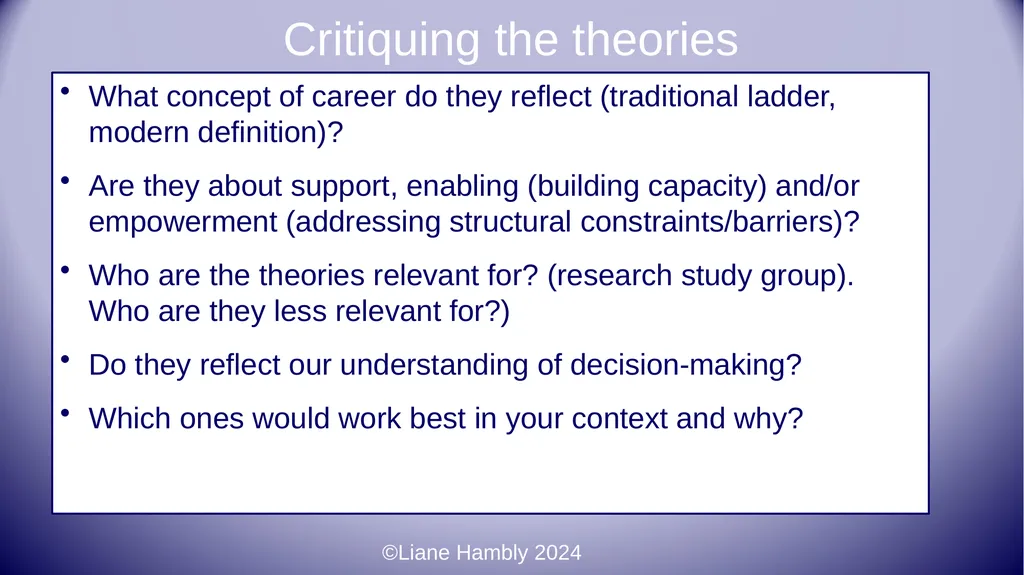
Critiquing the theories What concept of career do they reflect (traditional ladder, modern definition)?
Are they about support, enabling (building capacity) and/or empowerment (addressing structural constraints/barriers)?
Who are the theories relevant for? (research study group). Who are they less relevant for?)
Do they reflect our understanding of decision-making?
Which ones would work best in your context and why? ©Liane Hambly 2024<br>
Are they about support, enabling (building capacity) and/or empowerment (addressing structural constraints/barriers)?
Who are the theories relevant for? (research study group). Who are they less relevant for?)
Do they reflect our understanding of decision-making?
Which ones would work best in your context and why? ©Liane Hambly 2024<br>
23
Overview Underpinning concepts
career
career management (including planned happenstance and chaos theory)
The purpose of careers work (support, enable, empower? Social justice?)
Decision making
Historical overview of theories of career “choice” Liane Hambly 2024 23<br>
career
career management (including planned happenstance and chaos theory)
The purpose of careers work (support, enable, empower? Social justice?)
Decision making
Historical overview of theories of career “choice” Liane Hambly 2024 23<br>
24
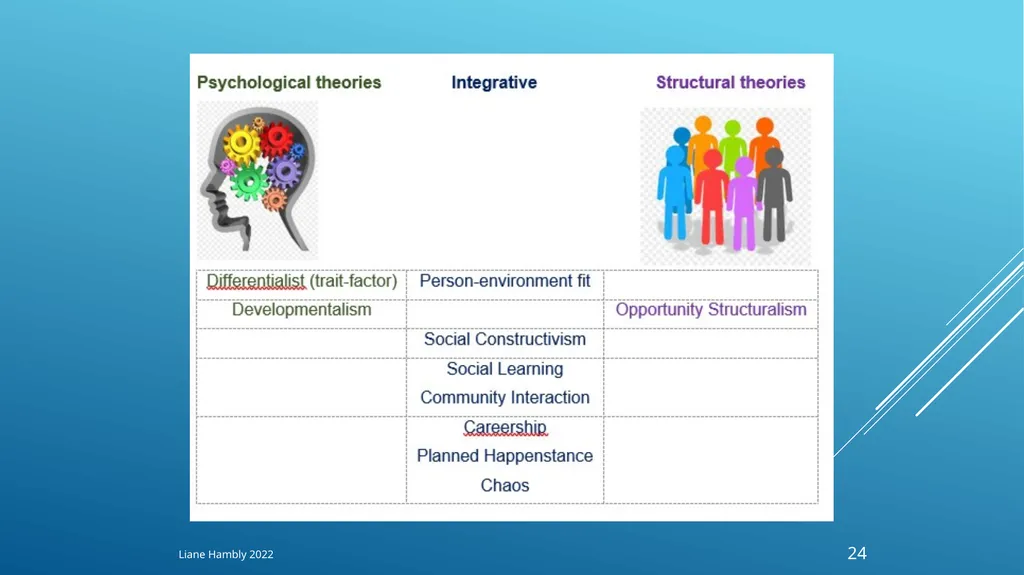
Liane Hambly 2022 24<br>
25
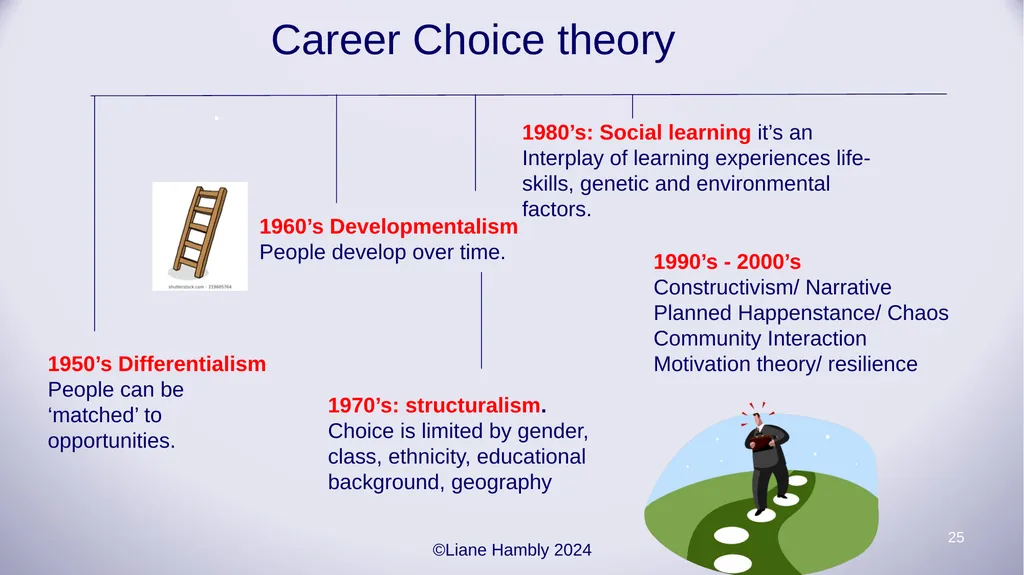
25 Career Choice theory . 25 25 1950’s Differentialism
People can be ‘matched’ to opportunities. 1960’s Developmentalism
People develop over time. 1970’s: structuralism.
Choice is limited by gender, class, ethnicity, educational background, geography 1980’s: Social learning it’s an Interplay of learning experiences life-skills, genetic and environmental factors. ©Liane Hambly 2024 1990’s - 2000’s
Constructivism/ Narrative
Planned Happenstance/ Chaos
Community Interaction
Motivation theory/ resilience<br>
People can be ‘matched’ to opportunities. 1960’s Developmentalism
People develop over time. 1970’s: structuralism.
Choice is limited by gender, class, ethnicity, educational background, geography 1980’s: Social learning it’s an Interplay of learning experiences life-skills, genetic and environmental factors. ©Liane Hambly 2024 1990’s - 2000’s
Constructivism/ Narrative
Planned Happenstance/ Chaos
Community Interaction
Motivation theory/ resilience<br>
26
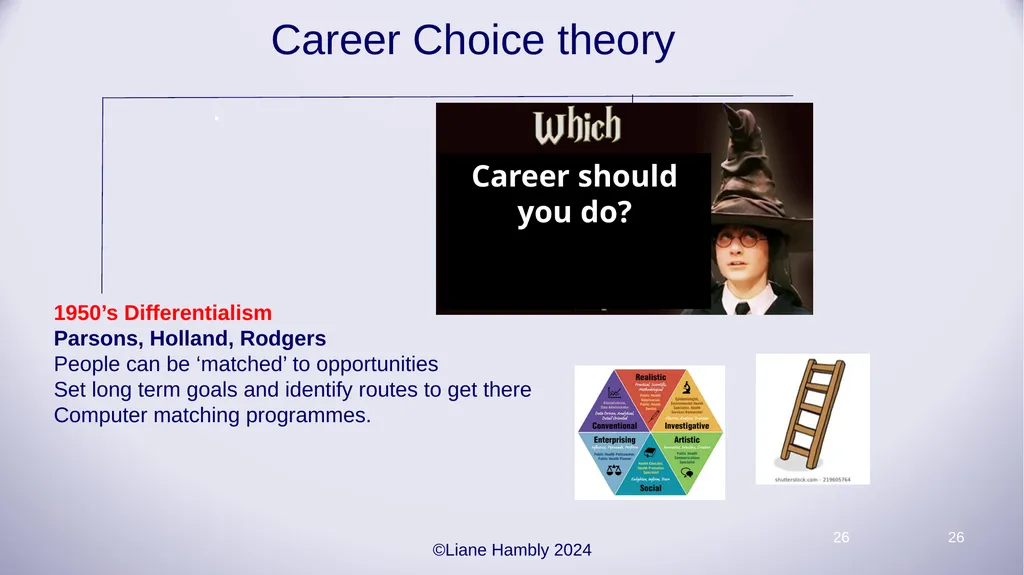
26 Career Choice theory . 26 26 1950’s Differentialism
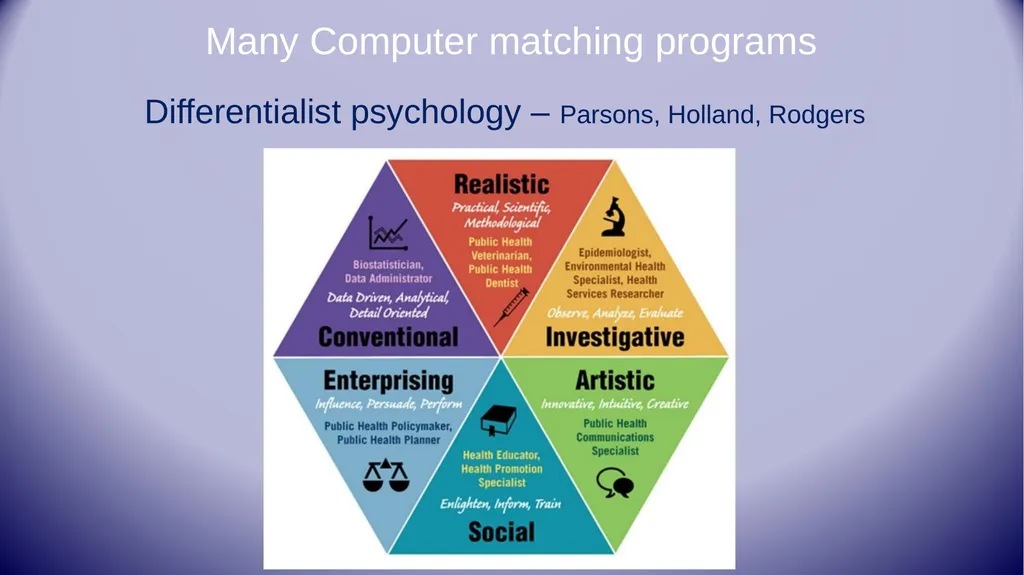
Parsons, Holland, Rodgers
People can be ‘matched’ to opportunities
Set long term goals and identify routes to get there
Computer matching programmes. ©Liane Hambly 2024 Career should you do?<br>
Parsons, Holland, Rodgers
People can be ‘matched’ to opportunities
Set long term goals and identify routes to get there
Computer matching programmes. ©Liane Hambly 2024 Career should you do?<br>
27
Many Computer matching programs Differentialist psychology – Parsons, Holland, Rodgers<br>
28
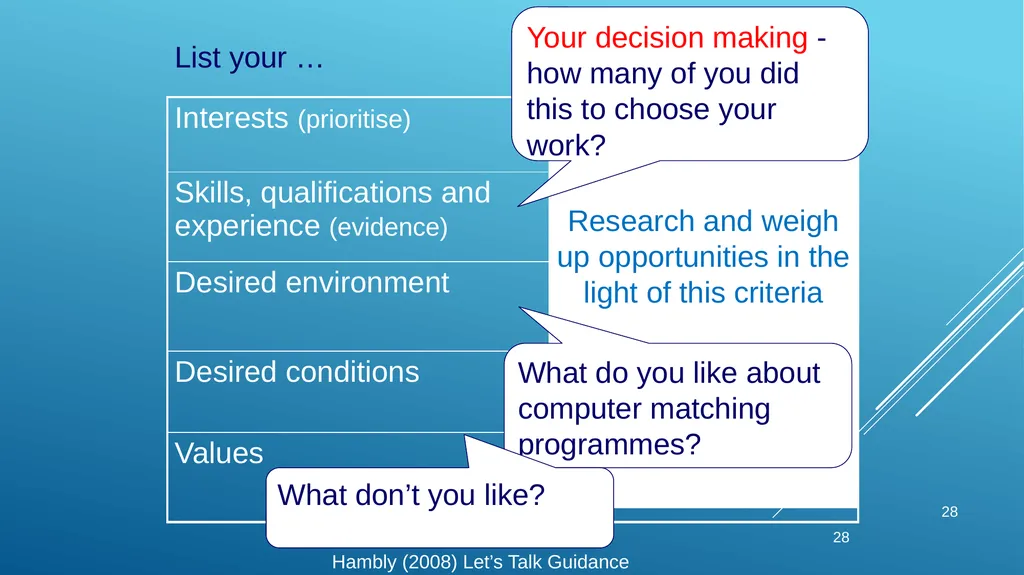
28 28 Research and weigh up opportunities in the light of this criteria List your … Hambly (2008) Let’s Talk Guidance Your decision making - how many of you did this to choose your work? What do you like about computer matching programmes? What don’t you like?<br>
29
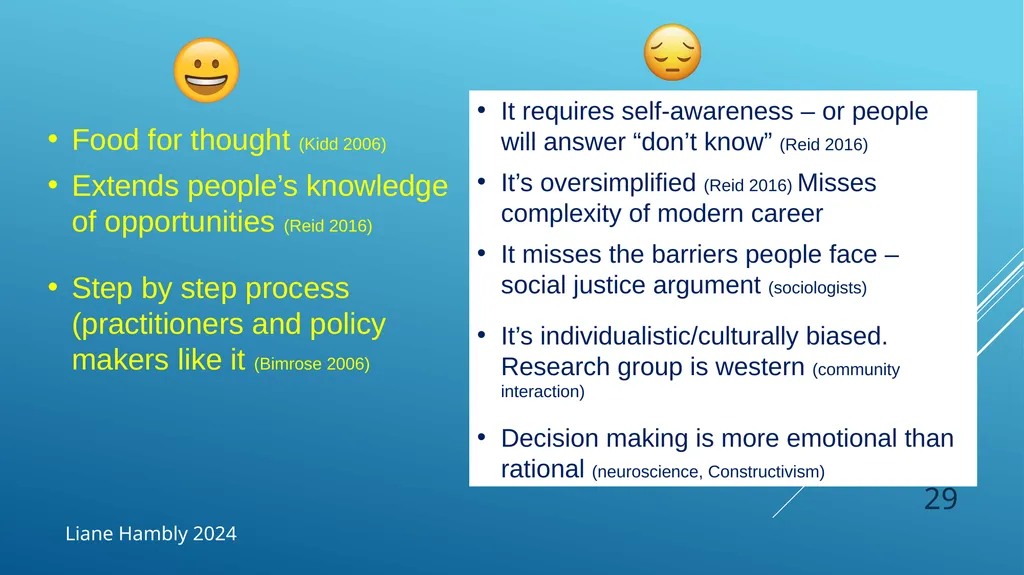
Liane Hambly 2024 29 Food for thought (Kidd 2006)
Extends people’s knowledge of opportunities (Reid 2016)
Step by step process (practitioners and policy makers like it (Bimrose 2006) It requires self-awareness – or people will answer “don’t know” (Reid 2016)
It’s oversimplified (Reid 2016) Misses complexity of modern career
It misses the barriers people face – social justice argument (sociologists)
It’s individualistic/culturally biased. Research group is western (community interaction)
Decision making is more emotional than rational (neuroscience, Constructivism)<br>
Extends people’s knowledge of opportunities (Reid 2016)
Step by step process (practitioners and policy makers like it (Bimrose 2006) It requires self-awareness – or people will answer “don’t know” (Reid 2016)
It’s oversimplified (Reid 2016) Misses complexity of modern career
It misses the barriers people face – social justice argument (sociologists)
It’s individualistic/culturally biased. Research group is western (community interaction)
Decision making is more emotional than rational (neuroscience, Constructivism)<br>
30
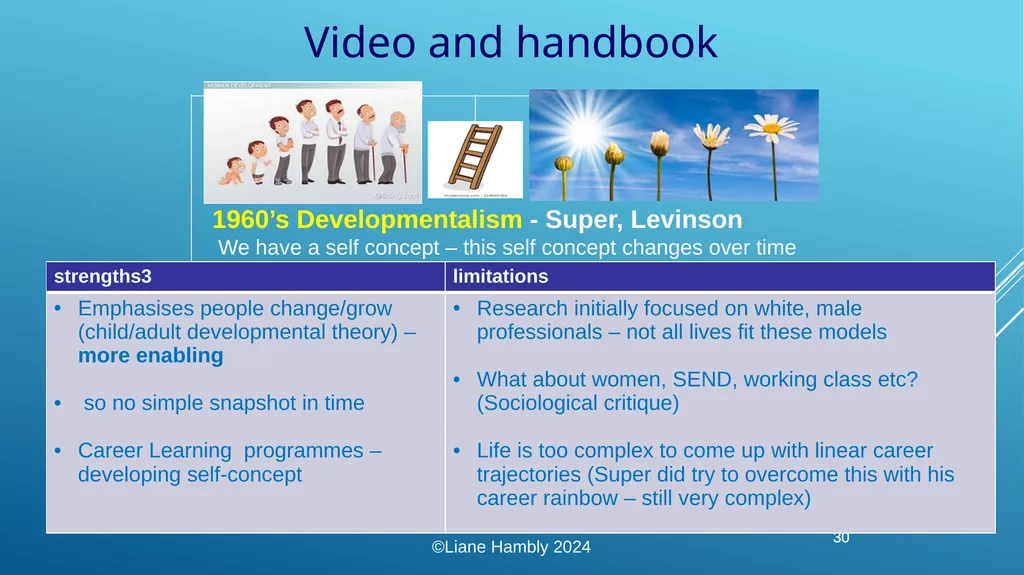
30 30 30 . 1960’s Developmentalism - Super, Levinson
We have a self concept – this self concept changes over time ©Liane Hambly 2024 Video and handbook<br>
We have a self concept – this self concept changes over time ©Liane Hambly 2024 Video and handbook<br>
31
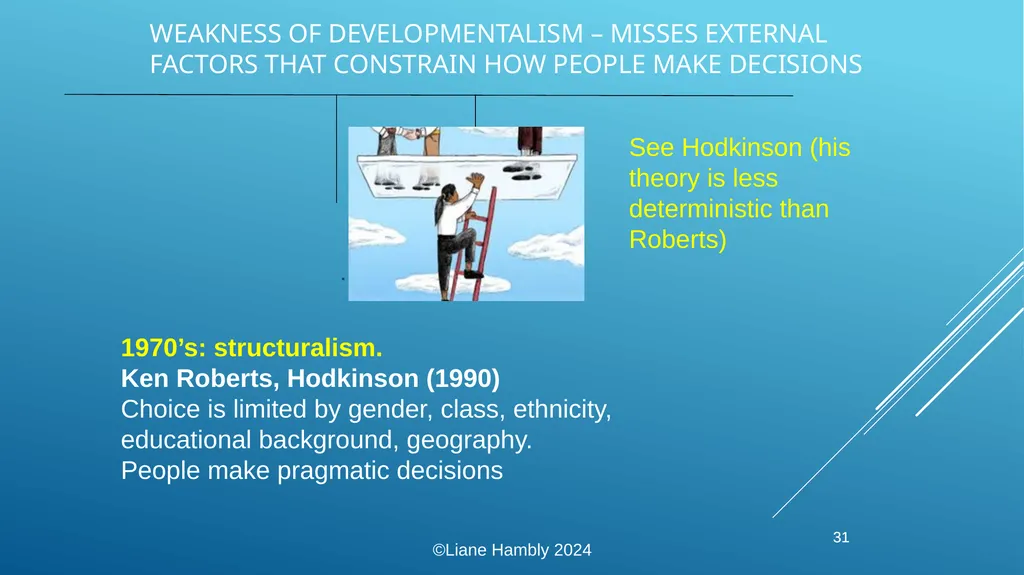
Weakness of developmentalism – misses external factors that constrain how people make decisions . 31 31 1970’s: structuralism.
Ken Roberts, Hodkinson (1990)
Choice is limited by gender, class, ethnicity, educational background, geography.
People make pragmatic decisions ©Liane Hambly 2024 See Hodkinson (his theory is less deterministic than Roberts)<br>
Ken Roberts, Hodkinson (1990)
Choice is limited by gender, class, ethnicity, educational background, geography.
People make pragmatic decisions ©Liane Hambly 2024 See Hodkinson (his theory is less deterministic than Roberts)<br>
32
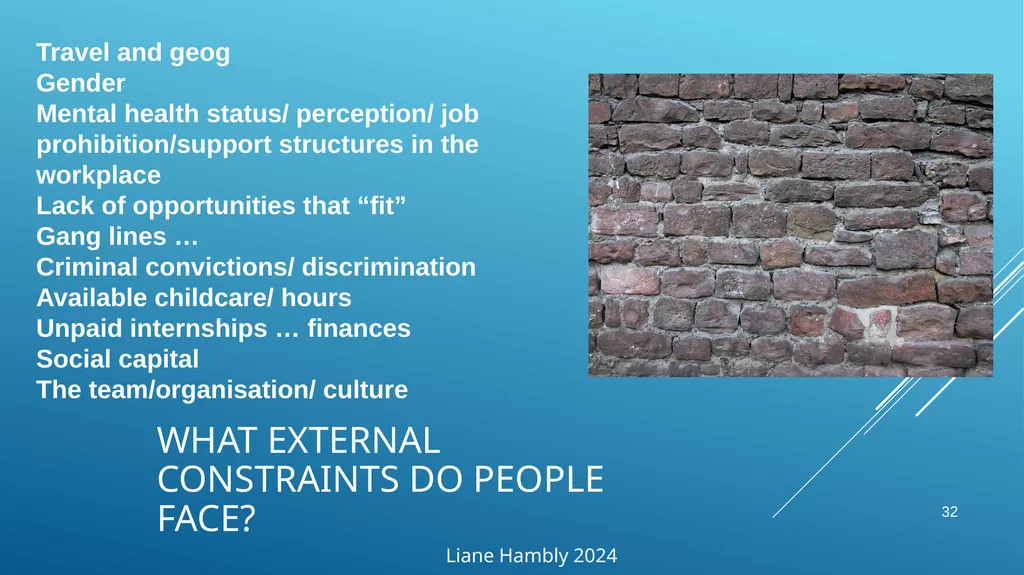
What external constraints do people face? Liane Hambly 2024 32 Travel and geog
Gender
Mental health status/ perception/ job prohibition/support structures in the workplace
Lack of opportunities that “fit”
Gang lines …
Criminal convictions/ discrimination
Available childcare/ hours
Unpaid internships … finances
Social capital
The team/organisation/ culture<br>
Gender
Mental health status/ perception/ job prohibition/support structures in the workplace
Lack of opportunities that “fit”
Gang lines …
Criminal convictions/ discrimination
Available childcare/ hours
Unpaid internships … finances
Social capital
The team/organisation/ culture<br>
33
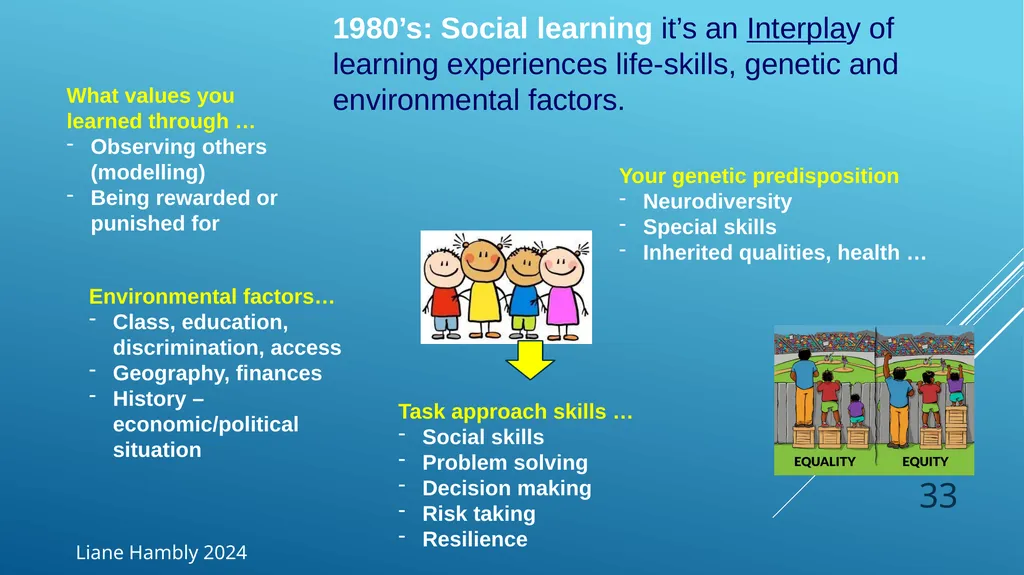
Liane Hambly 2024 33 Your genetic predisposition
Neurodiversity
Special skills
Inherited qualities, health … What values you learned through …
Observing others (modelling)
Being rewarded or punished for Environmental factors…
Class, education, discrimination, access
Geography, finances
History – economic/political situation Task approach skills …
Social skills
Problem solving
Decision making
Risk taking
Resilience 1980’s: Social learning it’s an Interplay of learning experiences life-skills, genetic and environmental factors.<br>
Neurodiversity
Special skills
Inherited qualities, health … What values you learned through …
Observing others (modelling)
Being rewarded or punished for Environmental factors…
Class, education, discrimination, access
Geography, finances
History – economic/political situation Task approach skills …
Social skills
Problem solving
Decision making
Risk taking
Resilience 1980’s: Social learning it’s an Interplay of learning experiences life-skills, genetic and environmental factors.<br>
34
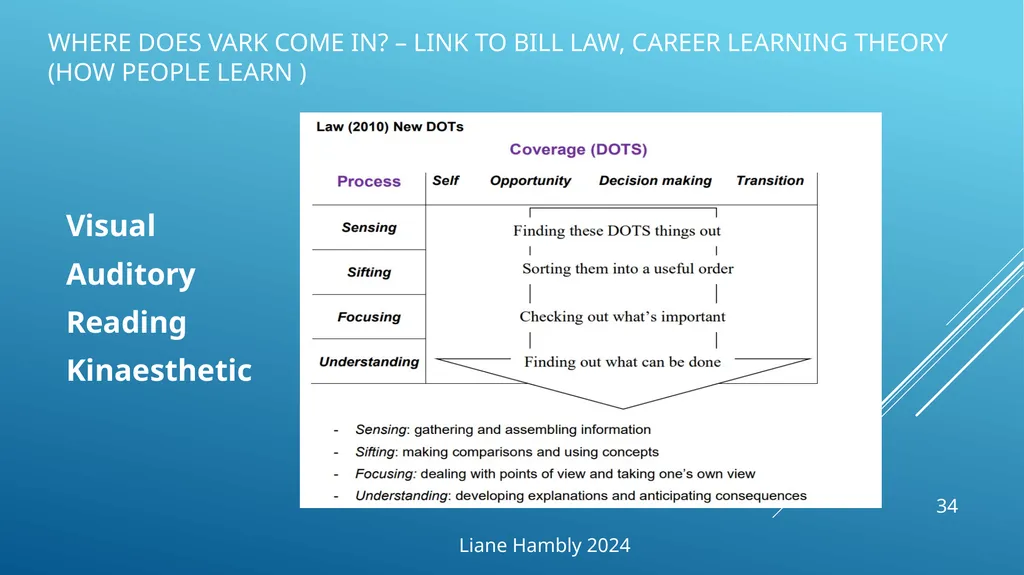
Where does VARK come in? – link to Bill Law, Career Learning Theory (how people learn ) Visual
Auditory
Reading
Kinaesthetic Liane Hambly 2024 34<br>
Auditory
Reading
Kinaesthetic Liane Hambly 2024 34<br>
35
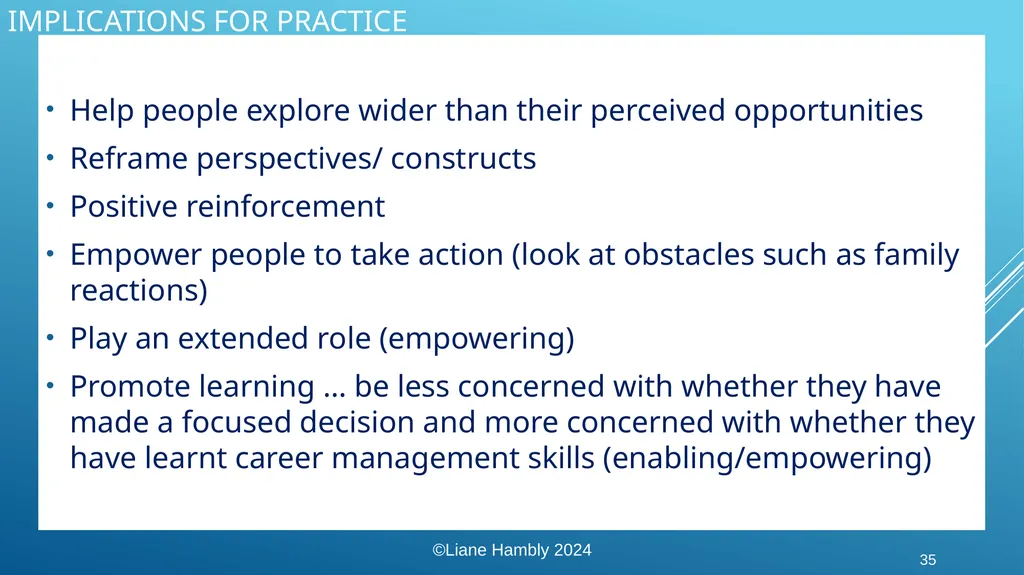
Implications for practice Help people explore wider than their perceived opportunities
Reframe perspectives/ constructs
Positive reinforcement
Empower people to take action (look at obstacles such as family reactions)
Play an extended role (empowering)
Promote learning … be less concerned with whether they have made a focused decision and more concerned with whether they have learnt career management skills (enabling/empowering) 35 ©Liane Hambly 2024<br>
Reframe perspectives/ constructs
Positive reinforcement
Empower people to take action (look at obstacles such as family reactions)
Play an extended role (empowering)
Promote learning … be less concerned with whether they have made a focused decision and more concerned with whether they have learnt career management skills (enabling/empowering) 35 ©Liane Hambly 2024<br>
36
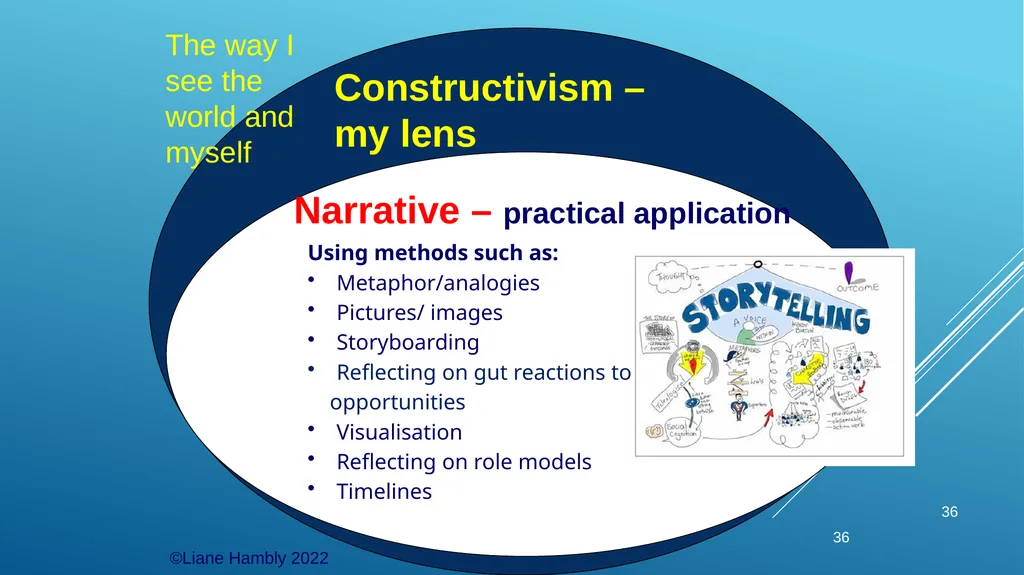
36 36 Constructivism – my lens Narrative – practical application ©Liane Hambly 2022 Using methods such as:
Metaphor/analogies
Pictures/ images
Storyboarding
Reflecting on gut reactions to
opportunities
Visualisation
Reflecting on role models
Timelines The way I see the world and myself<br>
Metaphor/analogies
Pictures/ images
Storyboarding
Reflecting on gut reactions to
opportunities
Visualisation
Reflecting on role models
Timelines The way I see the world and myself<br>
37
1. Glance at the images .. Notice your gut reaction (drawn to or put off) Liane Hambly 2020 37 2. Describe what you see
(this reveals your constructs)<br>
(this reveals your constructs)<br>
38
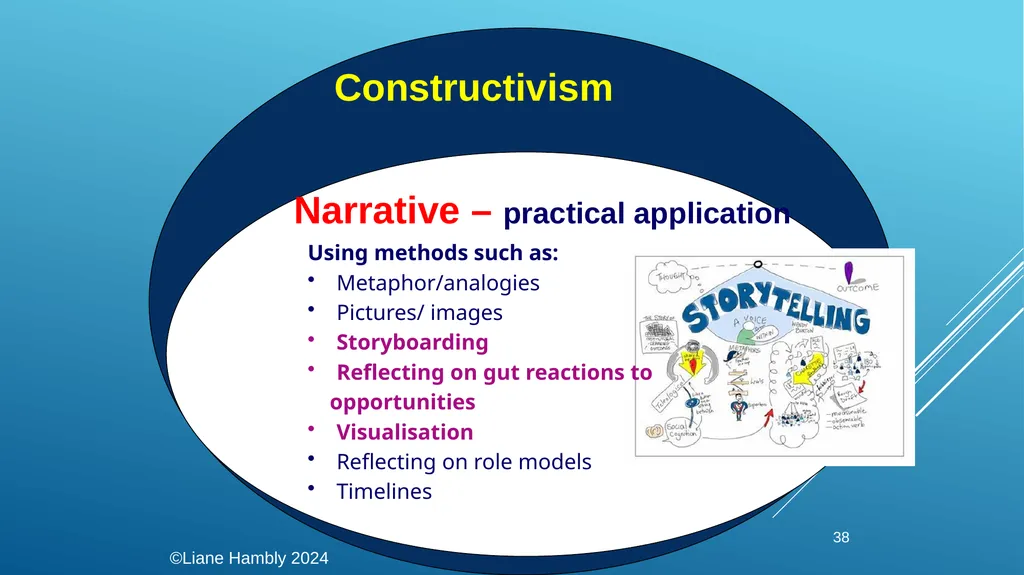
38 Constructivism Narrative – practical application ©Liane Hambly 2024 Using methods such as:
Metaphor/analogies
Pictures/ images
Storyboarding
Reflecting on gut reactions to
opportunities
Visualisation
Reflecting on role models
Timelines<br>
Metaphor/analogies
Pictures/ images
Storyboarding
Reflecting on gut reactions to
opportunities
Visualisation
Reflecting on role models
Timelines<br>
39
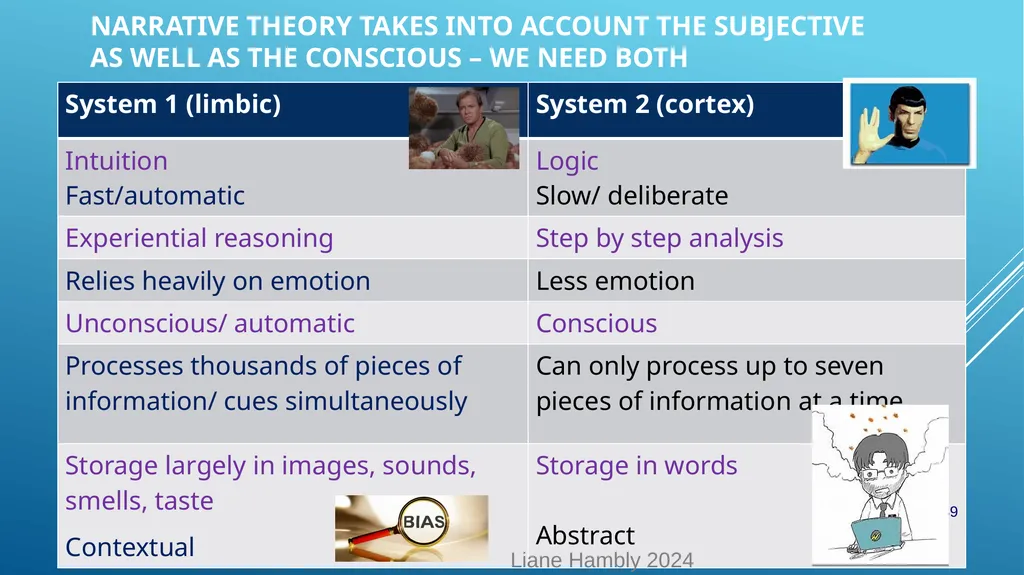
Narrative theory takes into account the subjective as well as the conscious – we need both Liane Hambly 2024 39<br>
40
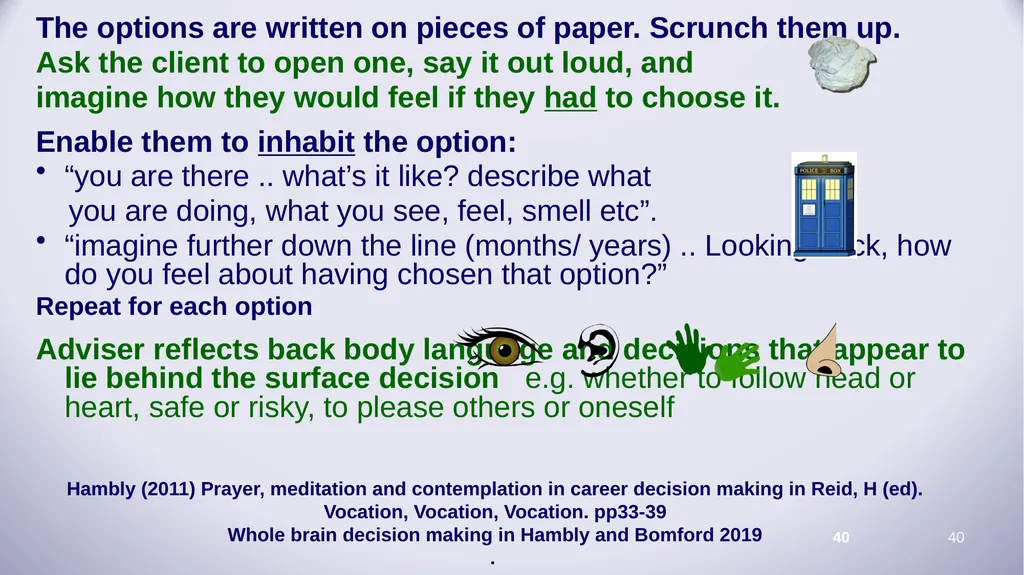
40 The options are written on pieces of paper. Scrunch them up.
Ask the client to open one, say it out loud, and
imagine how they would feel if they had to choose it.
Enable them to inhabit the option:
“you are there .. what’s it like? describe what
you are doing, what you see, feel, smell etc”.
“imagine further down the line (months/ years) .. Looking back, how do you feel about having chosen that option?”
Repeat for each option
Adviser reflects back body language and decisions that appear to lie behind the surface decision e.g. whether to follow head or heart, safe or risky, to please others or oneself 40 40 Hambly (2011) Prayer, meditation and contemplation in career decision making in Reid, H (ed). Vocation, Vocation, Vocation. pp33-39
Whole brain decision making in Hambly and Bomford 2019
. 40<br>
Ask the client to open one, say it out loud, and
imagine how they would feel if they had to choose it.
Enable them to inhabit the option:
“you are there .. what’s it like? describe what
you are doing, what you see, feel, smell etc”.
“imagine further down the line (months/ years) .. Looking back, how do you feel about having chosen that option?”
Repeat for each option
Adviser reflects back body language and decisions that appear to lie behind the surface decision e.g. whether to follow head or heart, safe or risky, to please others or oneself 40 40 Hambly (2011) Prayer, meditation and contemplation in career decision making in Reid, H (ed). Vocation, Vocation, Vocation. pp33-39
Whole brain decision making in Hambly and Bomford 2019
. 40<br>
41
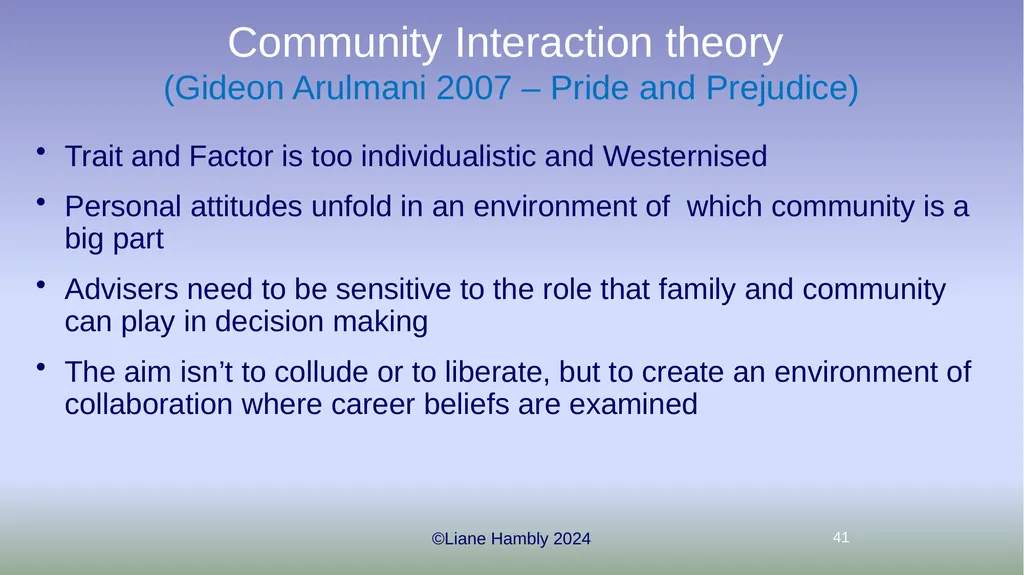
41 Community Interaction theory
(Gideon Arulmani 2007 – Pride and Prejudice) Trait and Factor is too individualistic and Westernised
Personal attitudes unfold in an environment of which community is a big part
Advisers need to be sensitive to the role that family and community can play in decision making
The aim isn’t to collude or to liberate, but to create an environment of collaboration where career beliefs are examined ©Liane Hambly 2024<br>
Personal attitudes unfold in an environment of which community is a big part
Advisers need to be sensitive to the role that family and community can play in decision making
The aim isn’t to collude or to liberate, but to create an environment of collaboration where career beliefs are examined ©Liane Hambly 2024<br>
42
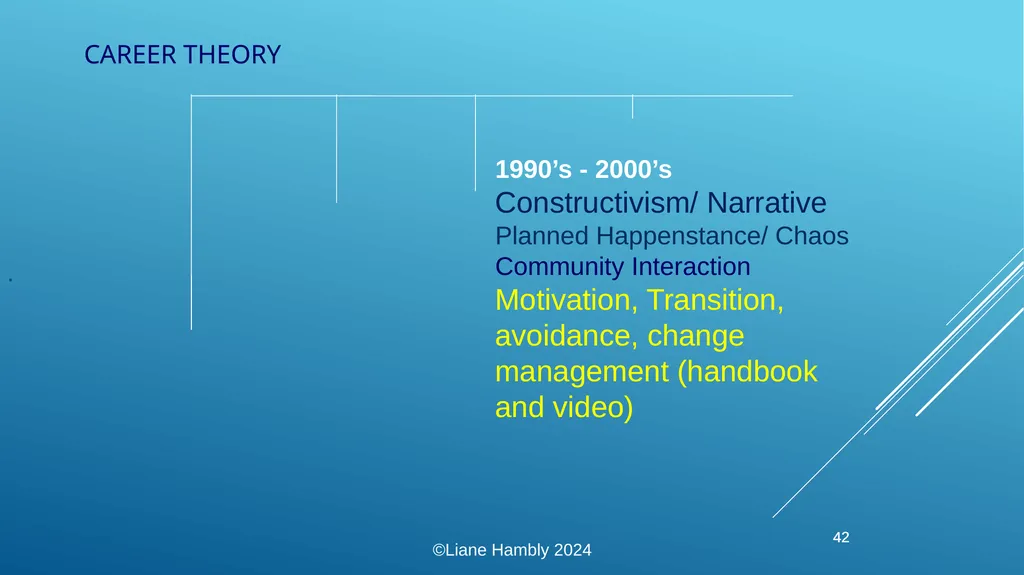
42 42 42 Career theory . ©Liane Hambly 2024 1990’s - 2000’s
Constructivism/ Narrative
Planned Happenstance/ Chaos
Community Interaction
Motivation, Transition, avoidance, change management (handbook and video)<br>
Constructivism/ Narrative
Planned Happenstance/ Chaos
Community Interaction
Motivation, Transition, avoidance, change management (handbook and video)<br>
43
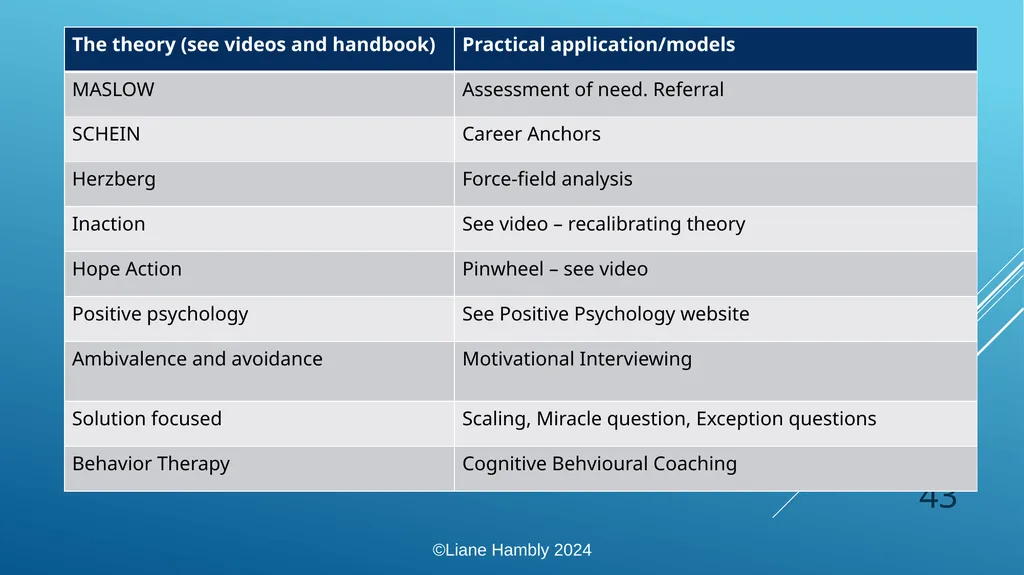
Liane Hambly 2024 43 ©Liane Hambly 2024<br>