
LIBTA State Update March 19, 2019 Agenda (see
LD
Published · 41 slides · 0 views

1 / 1
Description
LIBTA State Update March 19, 2019 Agenda (see Google Folder) Introduction Fun Facts (Where we were ten years ago vs. now) Program Approvals and Reapprovals Computer Science Curriculum Framework Perkins V Update Parking Lot Issuesother
Related Topics
Share
Embed code
Download this presentation From Below
"LIBTA State Update March 19, 2019 Agenda (see" is the property of its rightful owner. Permission is granted to download and print the materials on this website for personal, non-commercial use only, and to display it on your personal computer provided you do not modify the materials and that you retain all copyright notices contained in the materials. By downloading content from our website, you accept the terms of this agreement.
Presentation Transcript
01
LIBTA State Update March 19, 2019<br>
02
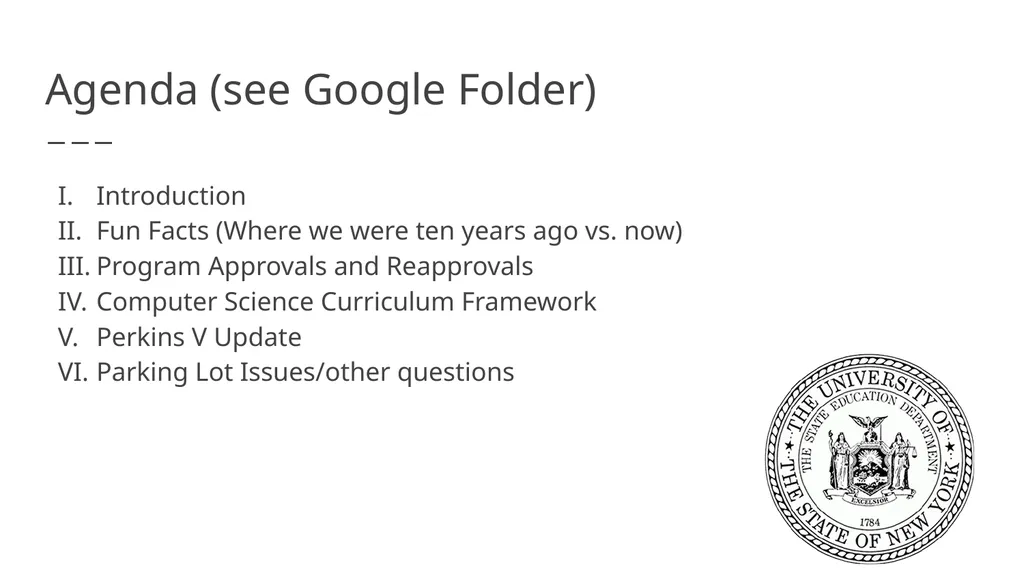
Agenda (see Google Folder) Introduction
Fun Facts (Where we were ten years ago vs. now)
Program Approvals and Reapprovals
Computer Science Curriculum Framework
Perkins V Update
Parking Lot Issues/other questions<br>
Fun Facts (Where we were ten years ago vs. now)
Program Approvals and Reapprovals
Computer Science Curriculum Framework
Perkins V Update
Parking Lot Issues/other questions<br>
03
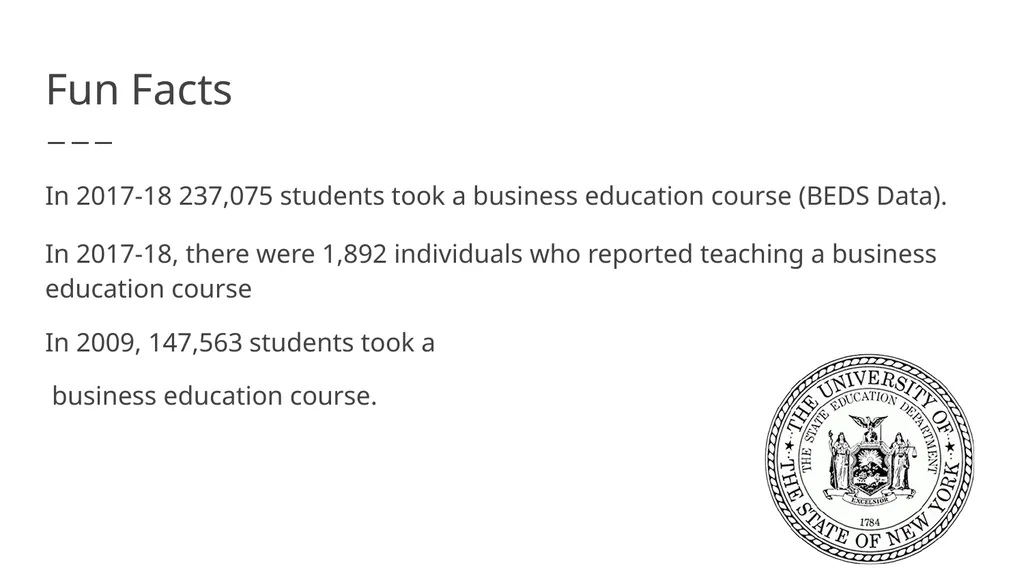
Fun Facts In 2017-18 237,075 students took a business education course (BEDS Data).
In 2017-18, there were 1,892 individuals who reported teaching a business education course
In 2009, 147,563 students took a
business education course.<br>
In 2017-18, there were 1,892 individuals who reported teaching a business education course
In 2009, 147,563 students took a
business education course.<br>
04
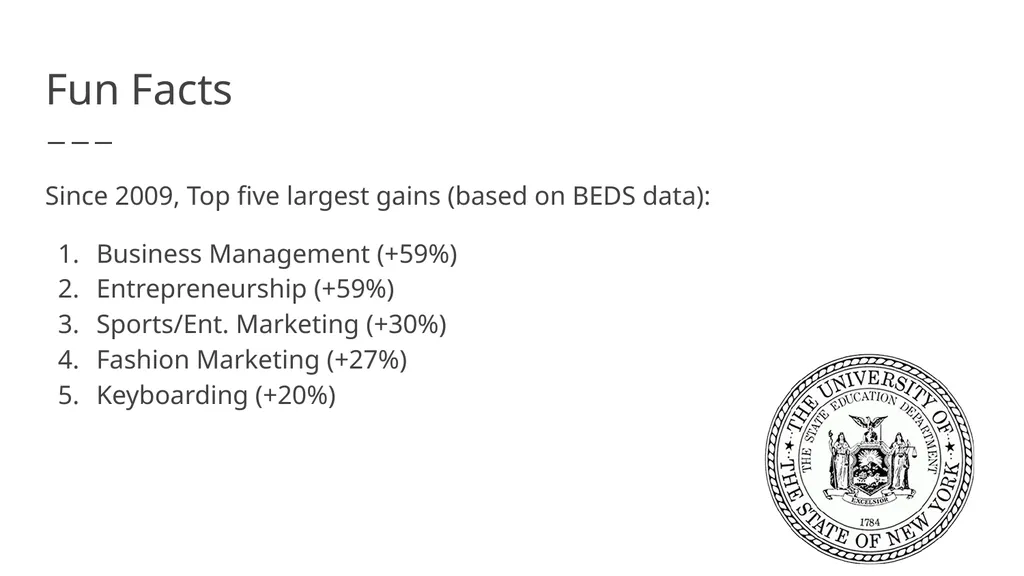
Fun Facts Since 2009, Top five largest gains (based on BEDS data):
Business Management (+59%)
Entrepreneurship (+59%)
Sports/Ent. Marketing (+30%)
Fashion Marketing (+27%)
Keyboarding (+20%)<br>
Business Management (+59%)
Entrepreneurship (+59%)
Sports/Ent. Marketing (+30%)
Fashion Marketing (+27%)
Keyboarding (+20%)<br>
05
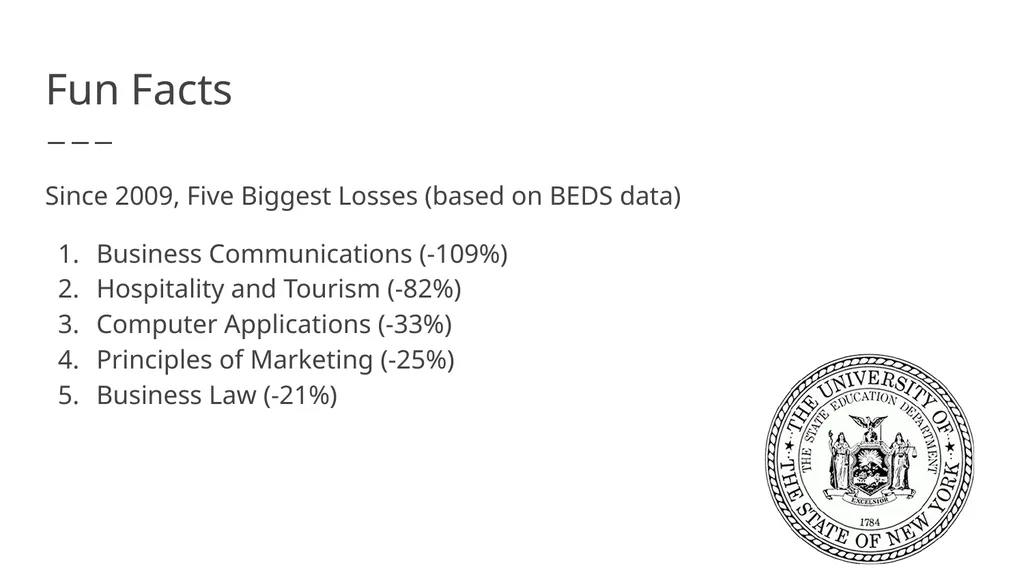
Fun Facts Since 2009, Five Biggest Losses (based on BEDS data)
Business Communications (-109%)
Hospitality and Tourism (-82%)
Computer Applications (-33%)
Principles of Marketing (-25%)
Business Law (-21%)<br>
Business Communications (-109%)
Hospitality and Tourism (-82%)
Computer Applications (-33%)
Principles of Marketing (-25%)
Business Law (-21%)<br>
06
Fun Facts 37 approved CTE business programs on Long Island and growing (New York State Ed CTE Web Site, 2019)
92% of school districts that serve 9-12 employ at least one business teacher (BEDS Data)
According to BEDS data, there are 353 business teachers on Long Island<br>
92% of school districts that serve 9-12 employ at least one business teacher (BEDS Data)
According to BEDS data, there are 353 business teachers on Long Island<br>
07
Things in Business Education’s Favor CTE Program Approval Process
CDOS Credential or pathway for graduation
Middle-level instruction
Computerized testing-students have to have good keyboarding skills, right?
Continued advocacy from NYSACTE and BTA bringing CTE and business to the table<br>
CDOS Credential or pathway for graduation
Middle-level instruction
Computerized testing-students have to have good keyboarding skills, right?
Continued advocacy from NYSACTE and BTA bringing CTE and business to the table<br>
08
Multiple Pathways to Graduation (4+1 option) For a Regents diploma, students must pass one regents exam in:
English Language Arts
Mathematics
Science
Social Studies
For the fifth required assessment, students have options<br>
English Language Arts
Mathematics
Science
Social Studies
For the fifth required assessment, students have options<br>
09
Pathway Options for Graduation Arts
Bi-literacy (LOTE)
Humanities
STEM
CDOS
CTE Approved Program<br>
Bi-literacy (LOTE)
Humanities
STEM
CDOS
CTE Approved Program<br>
10
CDOS Pathway Option -May be used for all students as a 4+1 pathway
-MUST be taught by a CTE teacher
-Option 1
Development of a career plan
Demonstrated achievement of New York State CDOS Standards 1,2, and 3a
Completion of 216 hours (2 units) of CTE content and work based learning. 54 hours must be work-based learning
-Option 2
Passing a NYS-approved work readiness examination<br>
-MUST be taught by a CTE teacher
-Option 1
Development of a career plan
Demonstrated achievement of New York State CDOS Standards 1,2, and 3a
Completion of 216 hours (2 units) of CTE content and work based learning. 54 hours must be work-based learning
-Option 2
Passing a NYS-approved work readiness examination<br>
11
Advanced Regents Diploma Options -Local sequence in business education
-CTE approved program
-Stackable credentials<br>
-CTE approved program
-Stackable credentials<br>
12
Local Business Education Sequence -Five units of business courses (taught by a certified CTE teacher) may be taken to replace the LOTE requirement for an advanced regents diploma
-There are no specific course requirements from NYSED, however we do recommend that CFM or it’s equivalent be included, if possible<br>
-There are no specific course requirements from NYSED, however we do recommend that CFM or it’s equivalent be included, if possible<br>
13
CTE Approved Programs -Refer to application in folder as a reference<br>
14
Program Theme and Title -Assessment, coursework, and title must be aligned
-Program may not be named on NYSED’s end after a vendor (Microsoft Office, Virtual Enterprises, NAF, etc.)
-Must be one contact person for all CTE programs to list on the NYSED web site<br>
-Program may not be named on NYSED’s end after a vendor (Microsoft Office, Virtual Enterprises, NAF, etc.)
-Must be one contact person for all CTE programs to list on the NYSED web site<br>
15
Common Program Titles and CIP Codes 52.0301/52.0304: Accounting/Finance
52.0204: Business Administrative Studies
52.0201: Business Administration/Management
52.0701: Entrepreneurship
52.1401: Marketing<br>
52.0204: Business Administrative Studies
52.0201: Business Administration/Management
52.0701: Entrepreneurship
52.1401: Marketing<br>
16
Part B: Program Data Should be based on program enrollment, not school enrollment
Numbers of students in the program with IEPs/504s are needed for data purposes
Be ready to justify low numbers on a reapproval application<br>
Numbers of students in the program with IEPs/504s are needed for data purposes
Be ready to justify low numbers on a reapproval application<br>
17
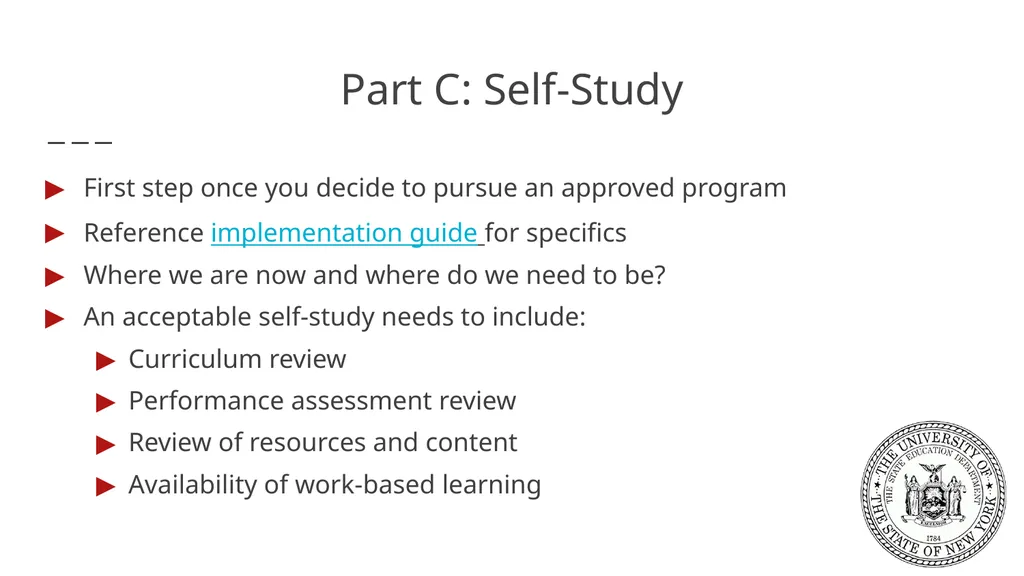
Part C: Self-Study First step once you decide to pursue an approved program
Reference implementation guide for specifics
Where we are now and where do we need to be?
An acceptable self-study needs to include:
Curriculum review
Performance assessment review
Review of resources and content
Availability of work-based learning<br>
Reference implementation guide for specifics
Where we are now and where do we need to be?
An acceptable self-study needs to include:
Curriculum review
Performance assessment review
Review of resources and content
Availability of work-based learning<br>
18
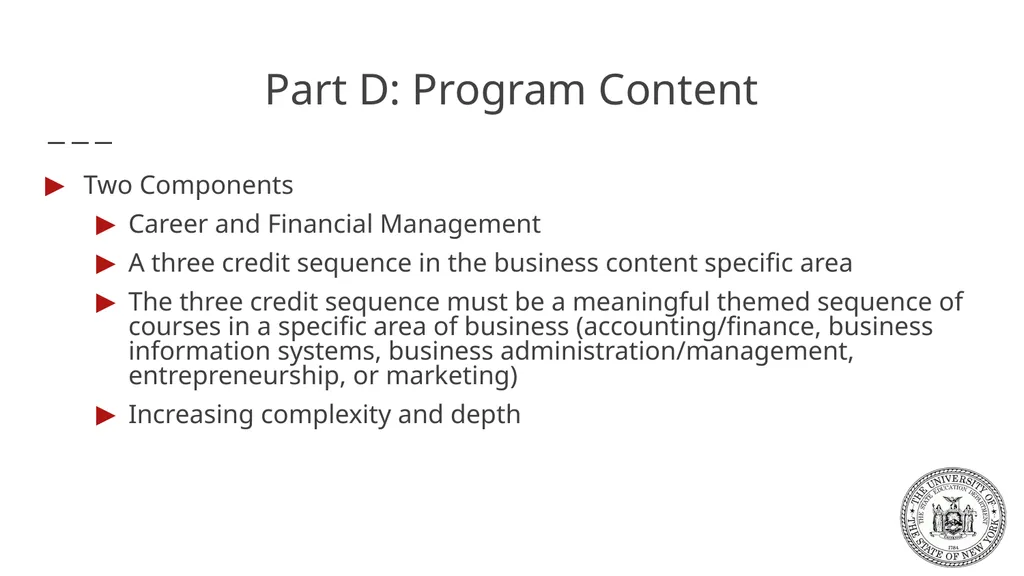
Part D: Program Content Two Components
Career and Financial Management
A three credit sequence in the business content specific area
The three credit sequence must be a meaningful themed sequence of courses in a specific area of business (accounting/finance, business information systems, business administration/management, entrepreneurship, or marketing)
Increasing complexity and depth<br>
Career and Financial Management
A three credit sequence in the business content specific area
The three credit sequence must be a meaningful themed sequence of courses in a specific area of business (accounting/finance, business information systems, business administration/management, entrepreneurship, or marketing)
Increasing complexity and depth<br>
19
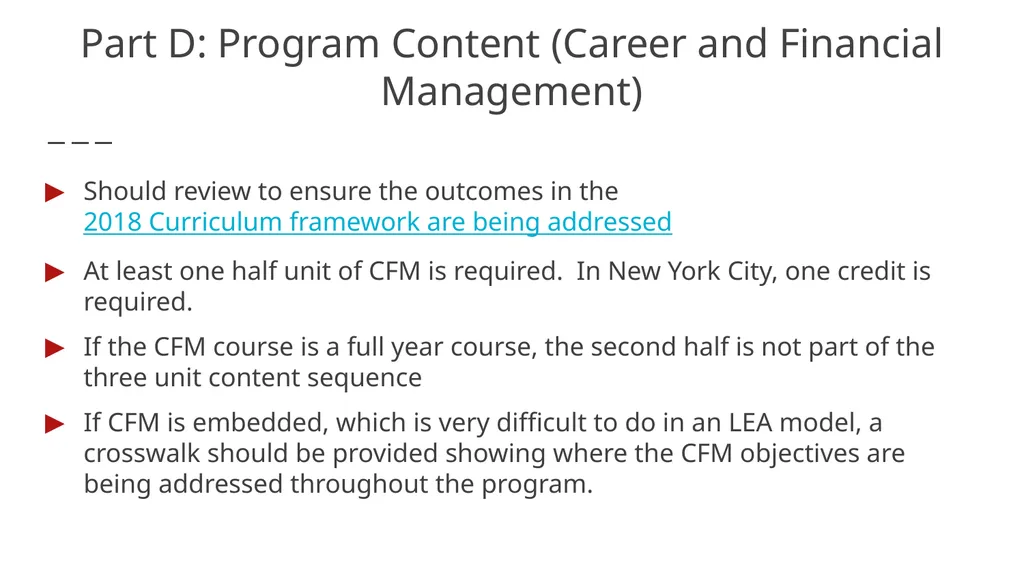
Part D: Program Content (Career and Financial Management) Should review to ensure the outcomes in the 2018 Curriculum framework are being addressed
At least one half unit of CFM is required. In New York City, one credit is required.
If the CFM course is a full year course, the second half is not part of the three unit content sequence
If CFM is embedded, which is very difficult to do in an LEA model, a crosswalk should be provided showing where the CFM objectives are being addressed throughout the program.<br>
At least one half unit of CFM is required. In New York City, one credit is required.
If the CFM course is a full year course, the second half is not part of the three unit content sequence
If CFM is embedded, which is very difficult to do in an LEA model, a crosswalk should be provided showing where the CFM objectives are being addressed throughout the program.<br>
20
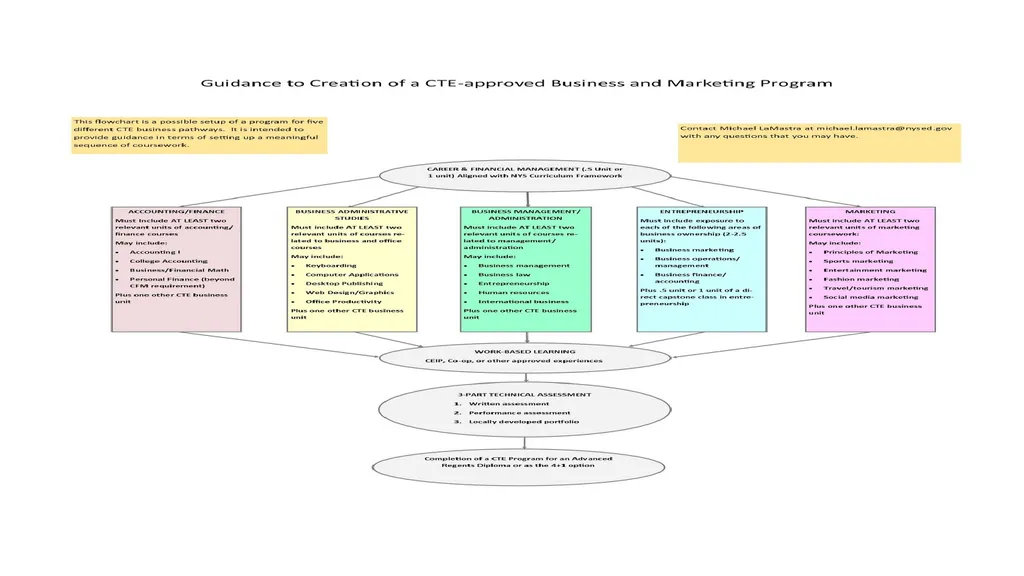
Program Theme and Content (Refer to Guide in Folder)<br>
21
Part E: Work-Based Learning Two Categories: Registered and Unregistered<br>
22
Registered Work-Based Learning Programs Co-op
CEIP
GEWEP
WECEP
All of these programs must be taught by a certified work-based learning coordinator. If the program is not registered, you will need to submit registration with your application.<br>
CEIP
GEWEP
WECEP
All of these programs must be taught by a certified work-based learning coordinator. If the program is not registered, you will need to submit registration with your application.<br>
23
Non-registered Work-Based Learning Programs School-based enterprise (EX: school store or credit union)
Job shadowing
On-site projects (done for an outside client and/or public display, not class assignments)<br>
Job shadowing
On-site projects (done for an outside client and/or public display, not class assignments)<br>
24
Part F Employability Profiles Should be no more than 1-2 pages
Should reflect end-of-program outcomes only (almost like a resume for what a student can do when entering college/a career)
Needs professional (21st century) and technical skills
Examples are on the CTE TAC Web Site
See folder for some free, formattable examples.<br>
Should reflect end-of-program outcomes only (almost like a resume for what a student can do when entering college/a career)
Needs professional (21st century) and technical skills
Examples are on the CTE TAC Web Site
See folder for some free, formattable examples.<br>
25
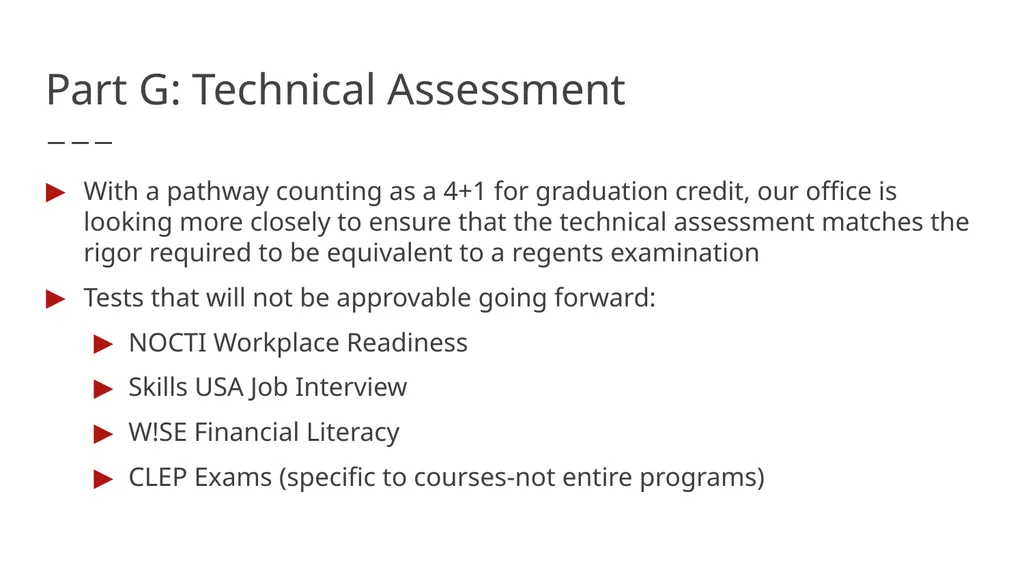
Part G: Technical Assessment With a pathway counting as a 4+1 for graduation credit, our office is looking more closely to ensure that the technical assessment matches the rigor required to be equivalent to a regents examination
Tests that will not be approvable going forward:
NOCTI Workplace Readiness
Skills USA Job Interview
W!SE Financial Literacy
CLEP Exams (specific to courses-not entire programs)<br>
Tests that will not be approvable going forward:
NOCTI Workplace Readiness
Skills USA Job Interview
W!SE Financial Literacy
CLEP Exams (specific to courses-not entire programs)<br>
26
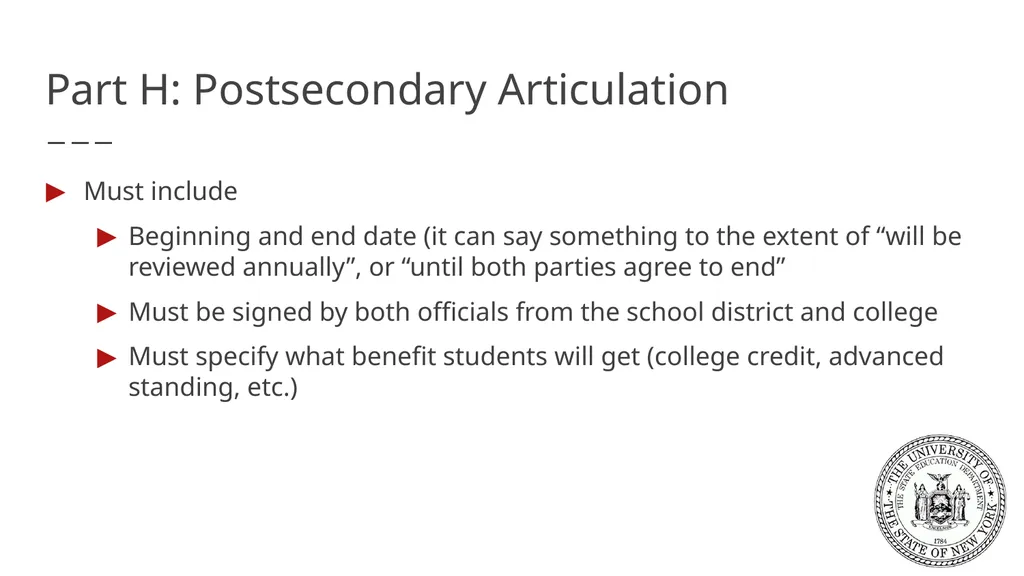
Part H: Postsecondary Articulation Must include
Beginning and end date (it can say something to the extent of “will be reviewed annually”, or “until both parties agree to end”
Must be signed by both officials from the school district and college
Must specify what benefit students will get (college credit, advanced standing, etc.)<br>
Beginning and end date (it can say something to the extent of “will be reviewed annually”, or “until both parties agree to end”
Must be signed by both officials from the school district and college
Must specify what benefit students will get (college credit, advanced standing, etc.)<br>
27
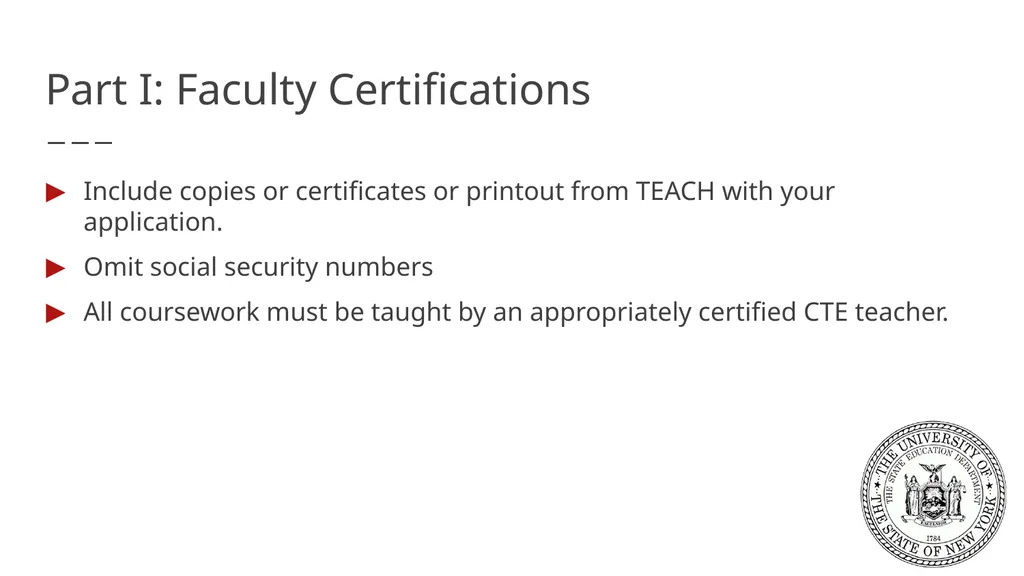
Part I: Faculty Certifications Include copies or certificates or printout from TEACH with your application.
Omit social security numbers
All coursework must be taught by an appropriately certified CTE teacher.<br>
Omit social security numbers
All coursework must be taught by an appropriately certified CTE teacher.<br>
28
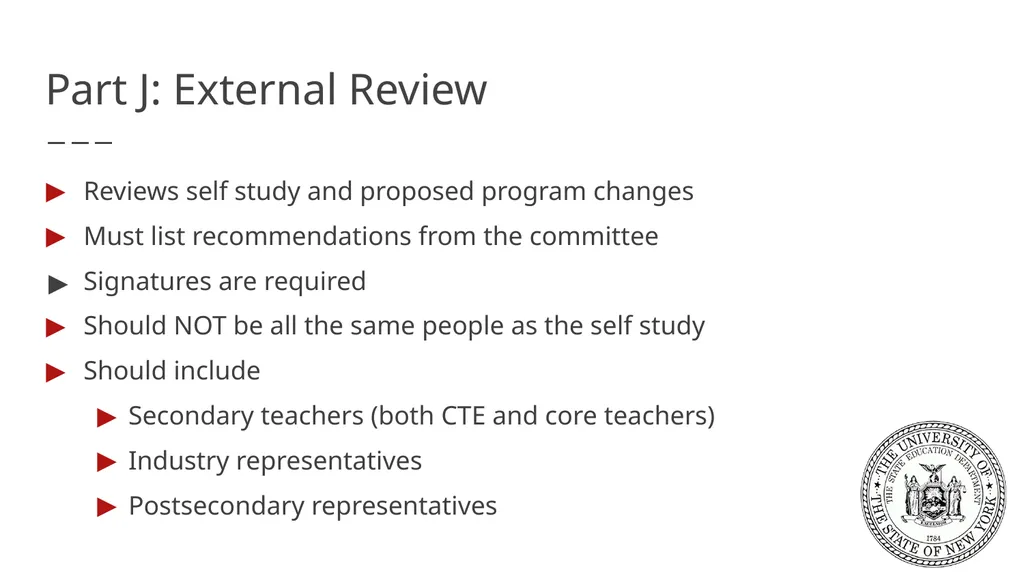
Part J: External Review Reviews self study and proposed program changes
Must list recommendations from the committee
Signatures are required
Should NOT be all the same people as the self study
Should include
Secondary teachers (both CTE and core teachers)
Industry representatives
Postsecondary representatives<br>
Must list recommendations from the committee
Signatures are required
Should NOT be all the same people as the self study
Should include
Secondary teachers (both CTE and core teachers)
Industry representatives
Postsecondary representatives<br>
29
Part K: Chief Administrator’s Signature Make sure that this is not forgotten
Send in both a paper copy and an e-mail of all application materials to emsccte@nysed.gov.
Application needs to be sent in Word. Supporting materials can be in PDF<br>
Send in both a paper copy and an e-mail of all application materials to emsccte@nysed.gov.
Application needs to be sent in Word. Supporting materials can be in PDF<br>
30
Questions on Program Approvals<br>
31
Computer Science Certification/Standards -Beginning in fiscal 2019, an effort commenced to write a framework for K-12 computer science standards across the State of New York
-A new certification was created in K-12 computer science
-Preliminary standards expected to be complete by May 2019 with an opportunity for public comment<br>
-A new certification was created in K-12 computer science
-Preliminary standards expected to be complete by May 2019 with an opportunity for public comment<br>
32
Computer Science Certification/Standards -Teachers who hold a certificate in any area can continue teaching computer science courses until September 1, 2022
-After this date, teachers may be issued a statement of continued eligibility<br>
-After this date, teachers may be issued a statement of continued eligibility<br>
33
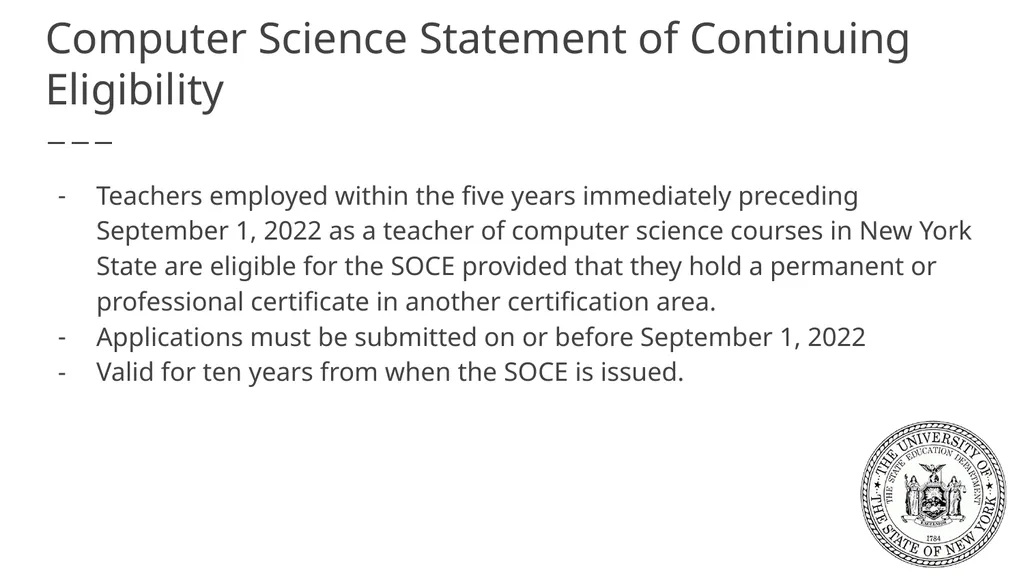
Computer Science Statement of Continuing Eligibility Teachers employed within the five years immediately preceding September 1, 2022 as a teacher of computer science courses in New York State are eligible for the SOCE provided that they hold a permanent or professional certificate in another certification area.
Applications must be submitted on or before September 1, 2022
Valid for ten years from when the SOCE is issued.<br>
Applications must be submitted on or before September 1, 2022
Valid for ten years from when the SOCE is issued.<br>
34
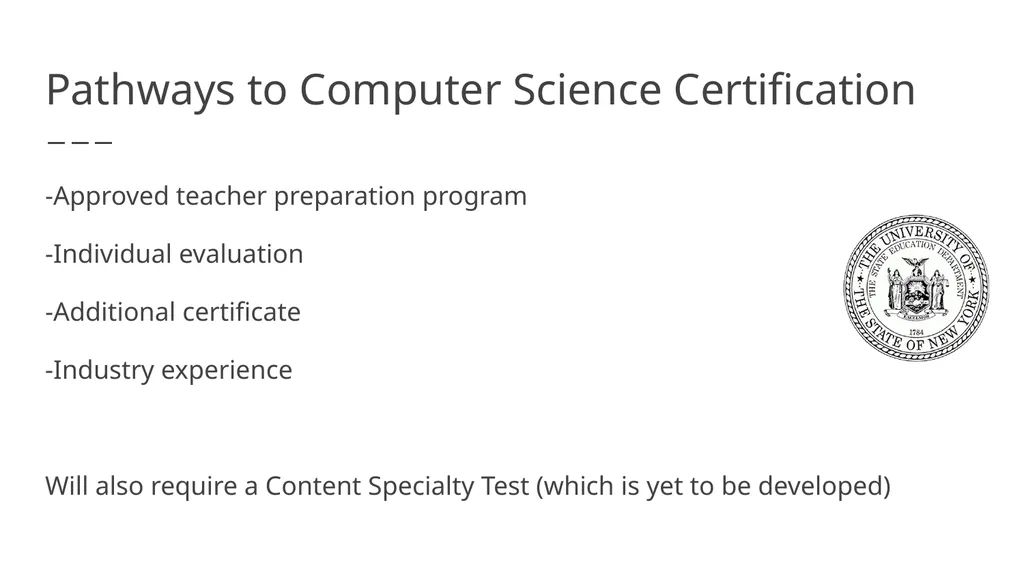
Pathways to Computer Science Certification -Approved teacher preparation program
-Individual evaluation
-Additional certificate
-Industry experience
Will also require a Content Specialty Test (which is yet to be developed)<br>
-Individual evaluation
-Additional certificate
-Industry experience
Will also require a Content Specialty Test (which is yet to be developed)<br>
35
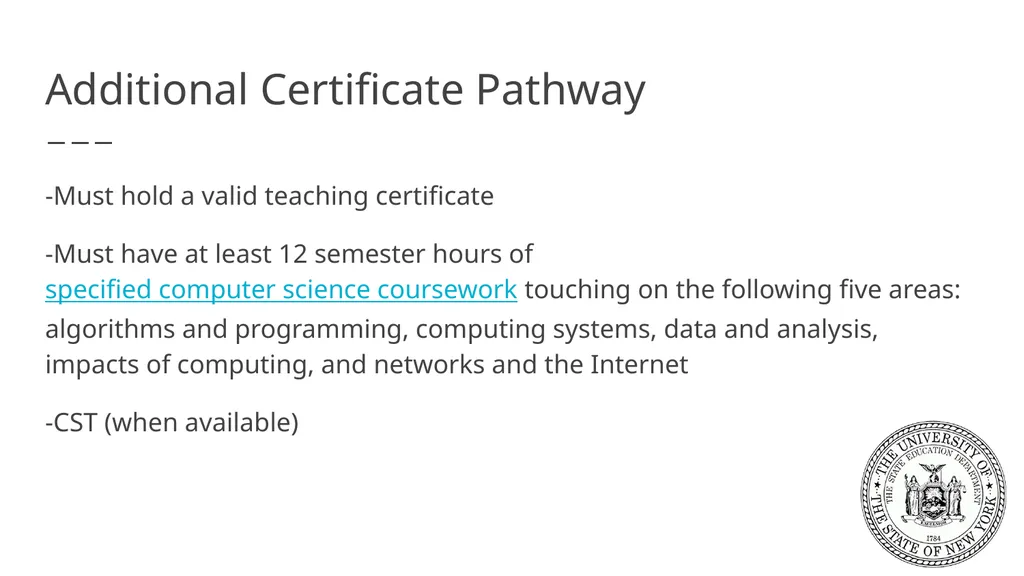
Additional Certificate Pathway -Must hold a valid teaching certificate
-Must have at least 12 semester hours of specified computer science coursework touching on the following five areas: algorithms and programming, computing systems, data and analysis, impacts of computing, and networks and the Internet
-CST (when available)<br>
-Must have at least 12 semester hours of specified computer science coursework touching on the following five areas: algorithms and programming, computing systems, data and analysis, impacts of computing, and networks and the Internet
-CST (when available)<br>
36
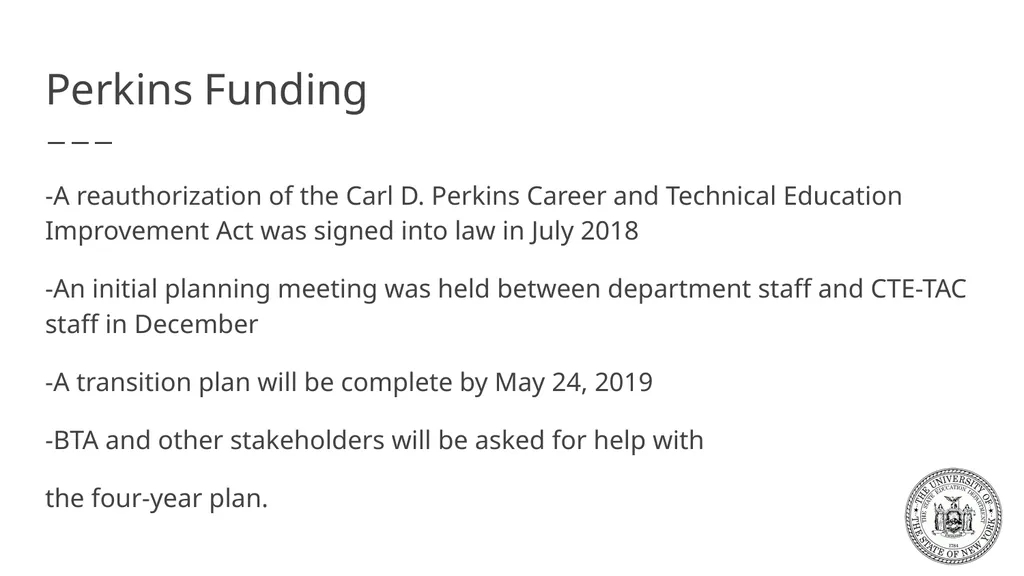
Perkins Funding -A reauthorization of the Carl D. Perkins Career and Technical Education Improvement Act was signed into law in July 2018
-An initial planning meeting was held between department staff and CTE-TAC staff in December
-A transition plan will be complete by May 24, 2019
-BTA and other stakeholders will be asked for help with
the four-year plan.<br>
-An initial planning meeting was held between department staff and CTE-TAC staff in December
-A transition plan will be complete by May 24, 2019
-BTA and other stakeholders will be asked for help with
the four-year plan.<br>
37
Points of thought with new Perkins -No decisions have been made yet
-Program quality indicator
-Definition of a “program of study”<br>
-Program quality indicator
-Definition of a “program of study”<br>
38
Program Quality Indicator New York must choose between:
Attainment of recognized postsecondary credentials
Attainment of postsecondary credit in the CTE program
Participation in work-based learning<br>
Attainment of recognized postsecondary credentials
Attainment of postsecondary credit in the CTE program
Participation in work-based learning<br>
39
Program of Study Definition New requirements:
“Progresses in specificity (beginning with all aspects of an industry or career cluster and leading to more occupation-specific instruction)
Has multiple entry and exit points that incorporate credentialing<br>
“Progresses in specificity (beginning with all aspects of an industry or career cluster and leading to more occupation-specific instruction)
Has multiple entry and exit points that incorporate credentialing<br>
40
Questions/Other Issues<br>
41
Contact Information Michael LaMastra
Associate in Business Education
New York State Education Department
E-mail: michael.lamastra@nysed.gov
Phone: 518-474-7551
Join the updated CTE Business Listserv for monthly updates<br>
Associate in Business Education
New York State Education Department
E-mail: michael.lamastra@nysed.gov
Phone: 518-474-7551
Join the updated CTE Business Listserv for monthly updates<br>