Linear modeling Usman Roshan Department of Data
Description: Linear modeling Usman Roshan Department of Data Science NJIT Linearly separable data Non linearly separable data Hyperplane separators Hyperplane separators w Hyperplane separators w Hyperplane separators x xp w r Hyperplane separators x xp
Related Topics
Download Presentation
"Linear modeling Usman Roshan Department of Data" is the property of its rightful owner. Permission is granted to download and print the materials on this website for personal, non-commercial use only, and to display it on your personal computer provided you do not modify the materials and that you retain all copyright notices contained in the materials. By downloading content from our website, you accept the terms of this agreement.
Presentation Transcript
slide1. Linear modeling Usman Roshan
Department of Data Science
NJIT<br>
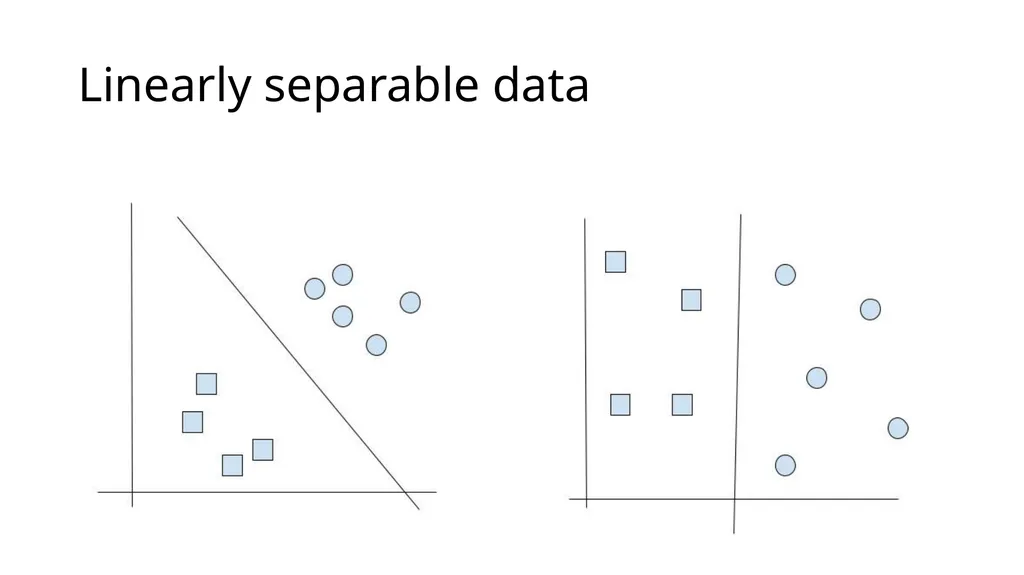
slide2. Linearly separable data<br>
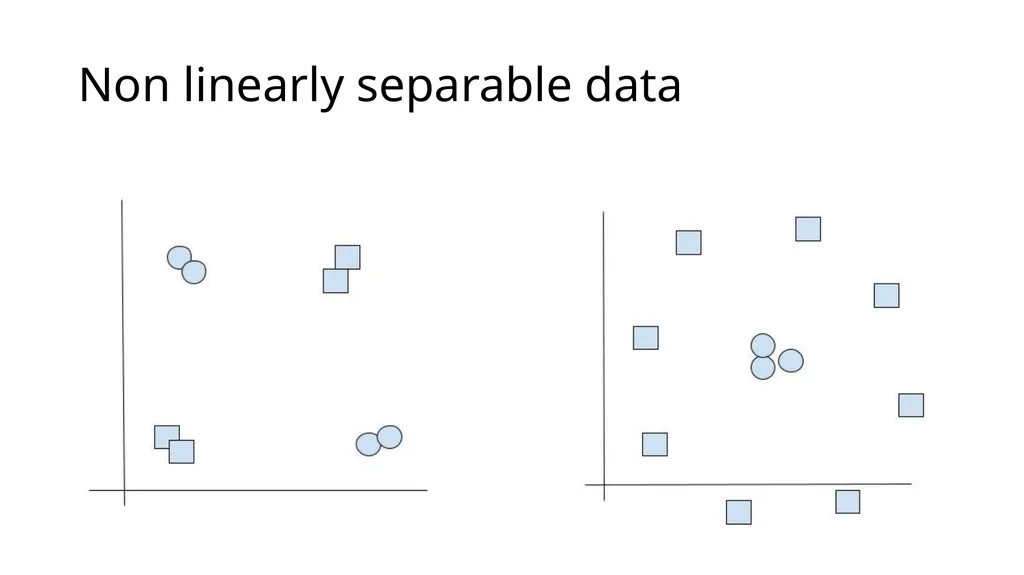
slide3. Non linearly separable data<br>
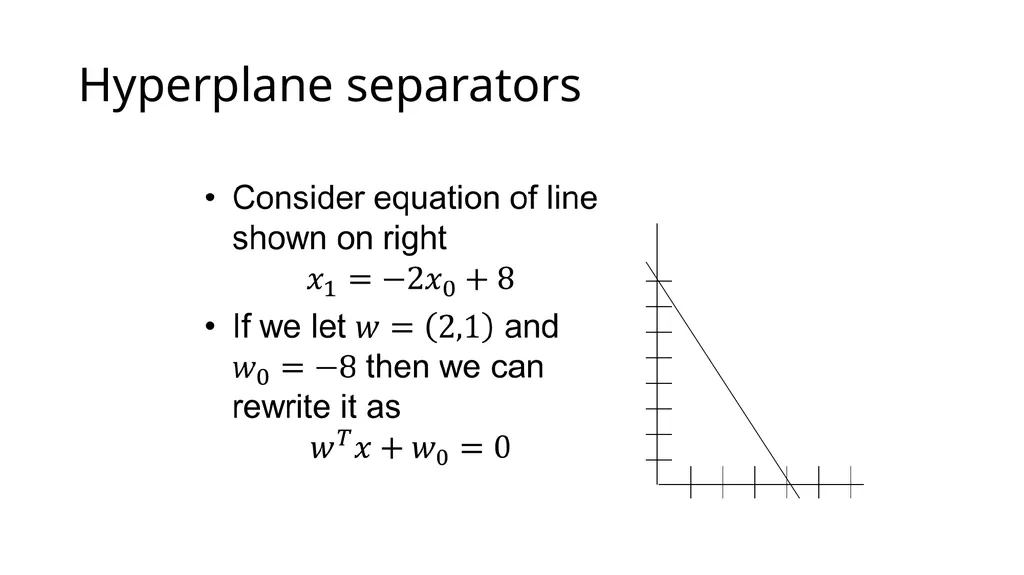
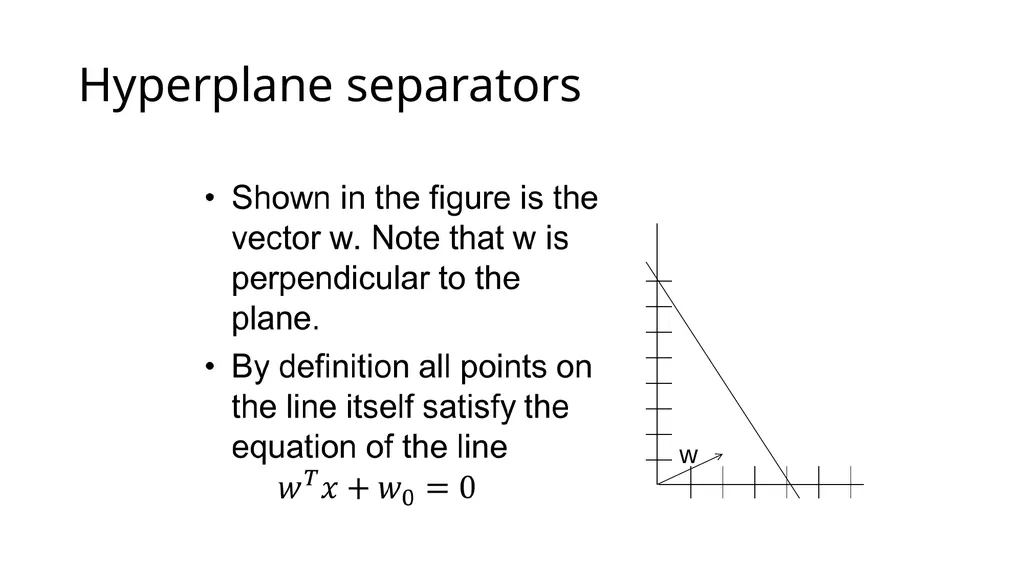
slide4. Hyperplane separators<br>
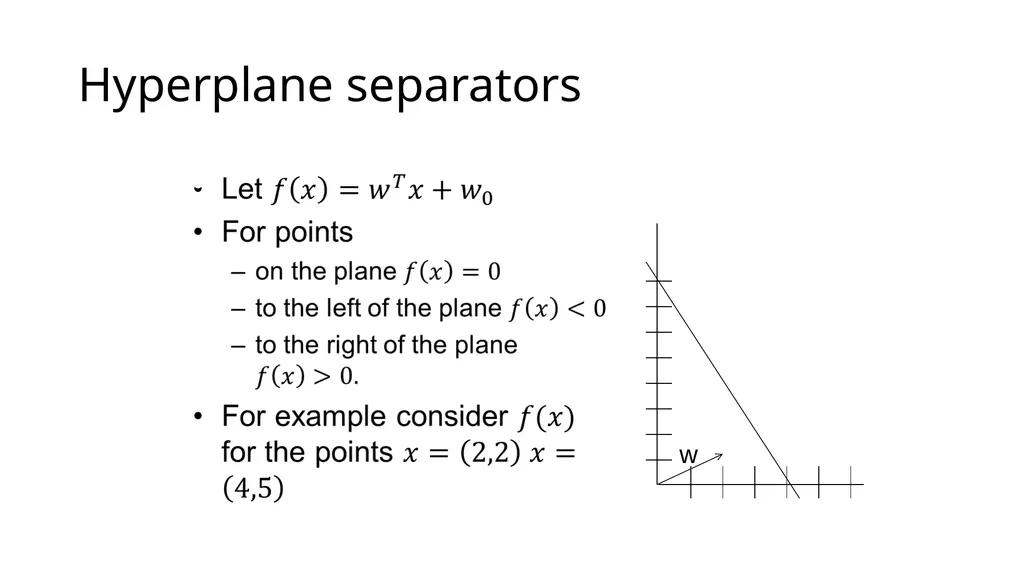
slide5. Hyperplane separators w<br>
slide6. Hyperplane separators w<br>
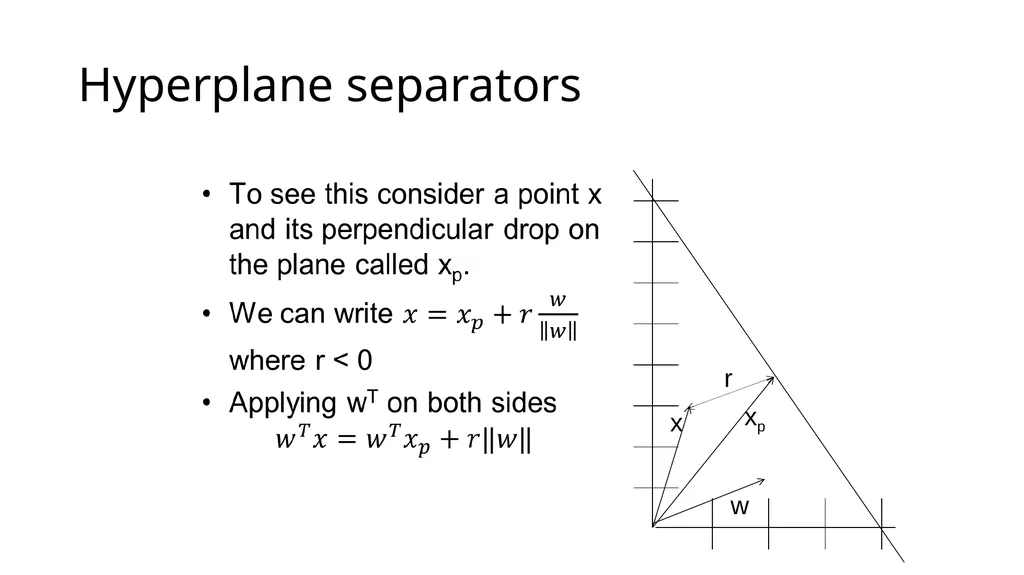
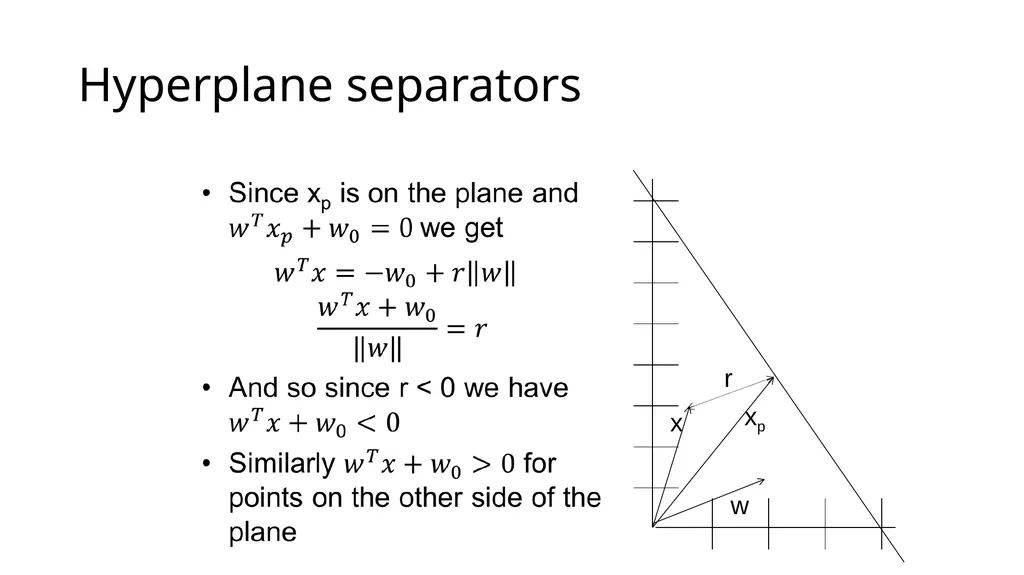
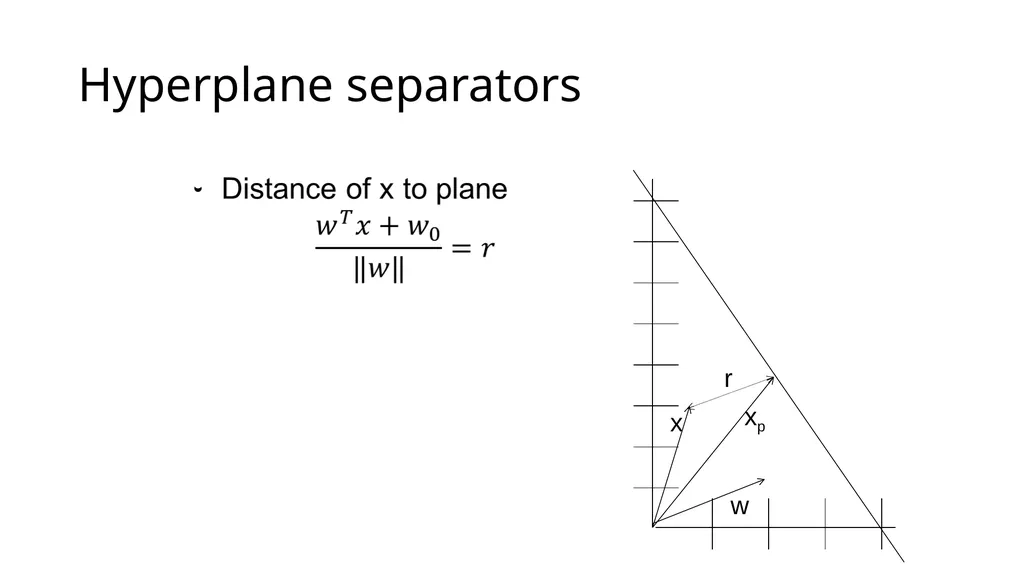
slide7. Hyperplane separators x xp w r<br>
slide8. Hyperplane separators x xp w r<br>
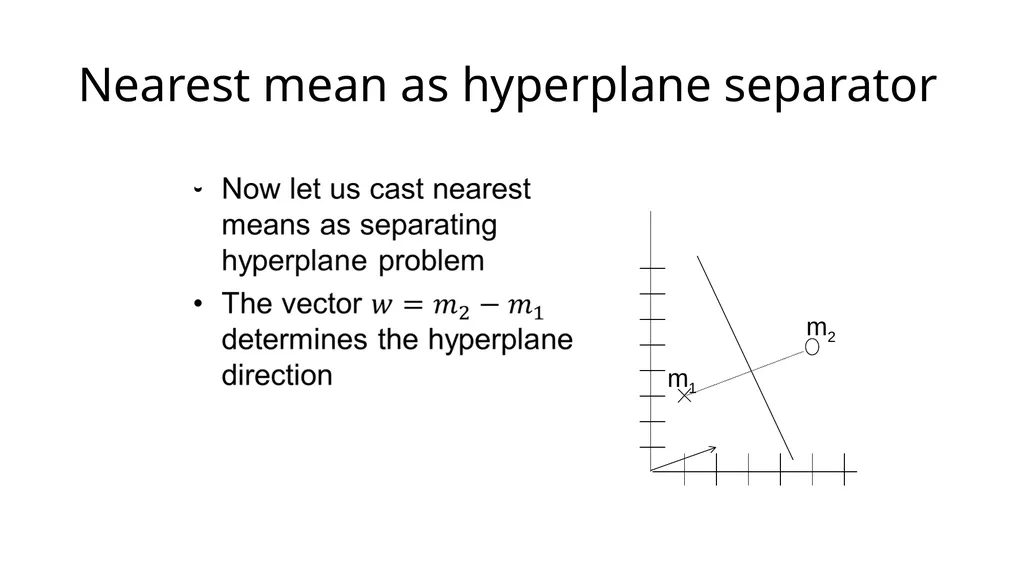
slide9. Nearest mean as hyperplane separator m1 m2<br>
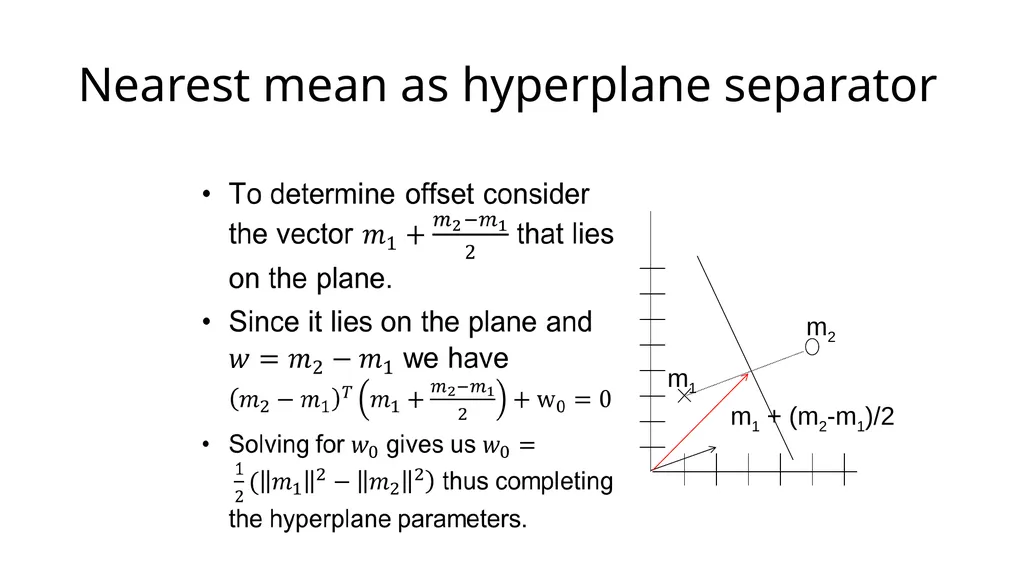
slide10. Nearest mean as hyperplane separator m1 m2 m1 + (m2-m1)/2<br>
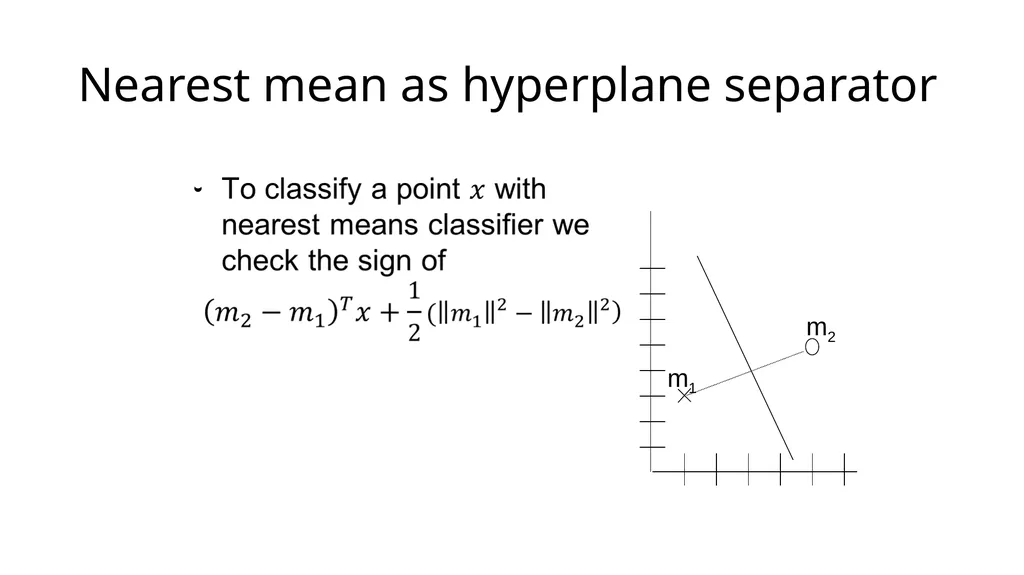
slide11. Nearest mean as hyperplane separator m1 m2<br>
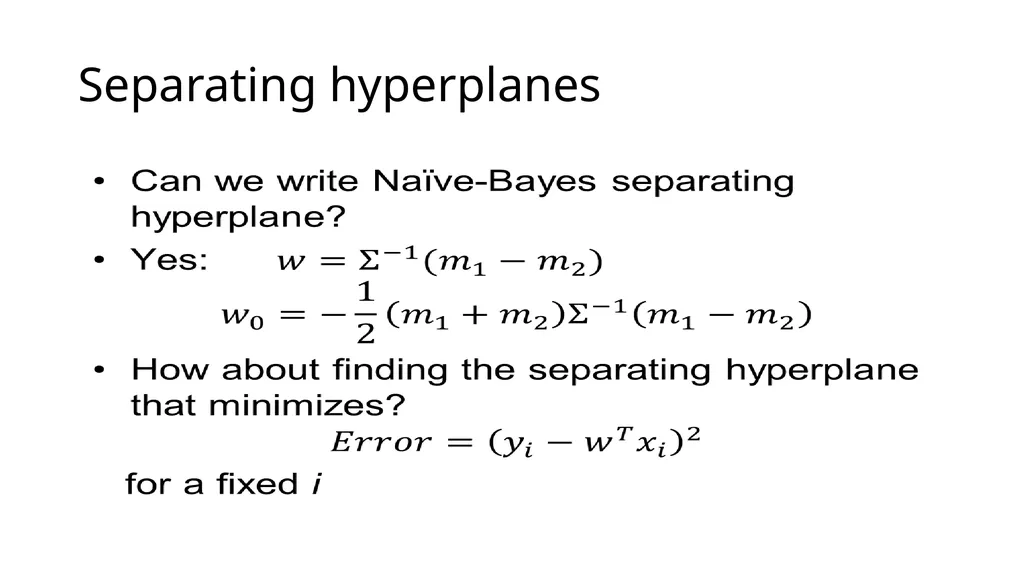
slide12. Separating hyperplanes<br>
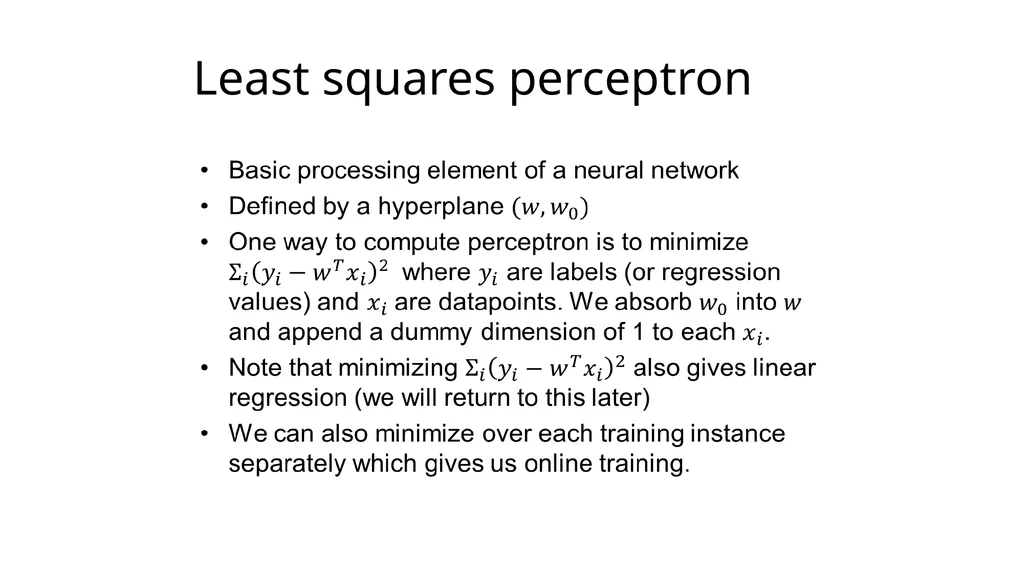
slide13. Least squares perceptron<br>
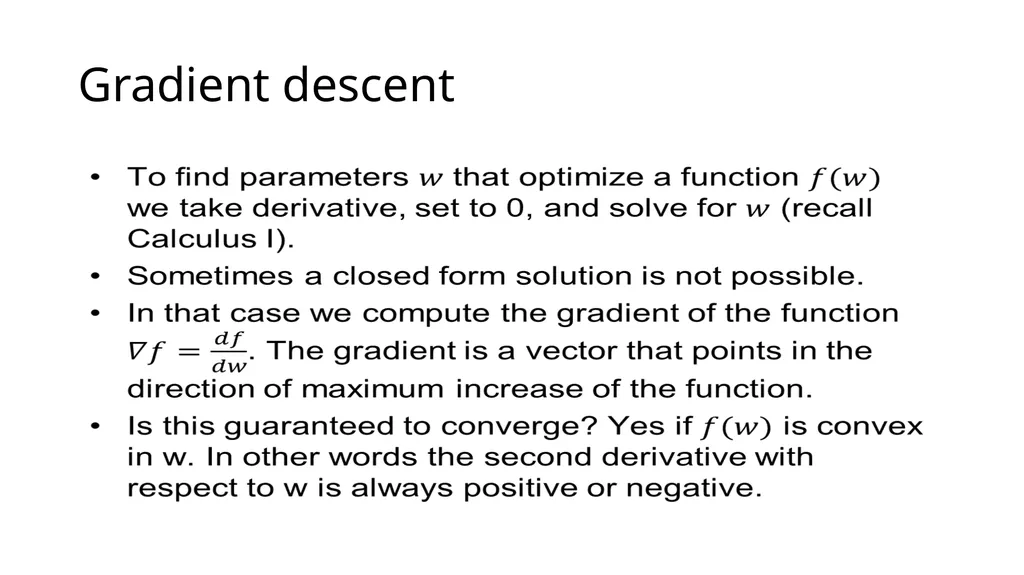
slide14. Gradient descent<br>
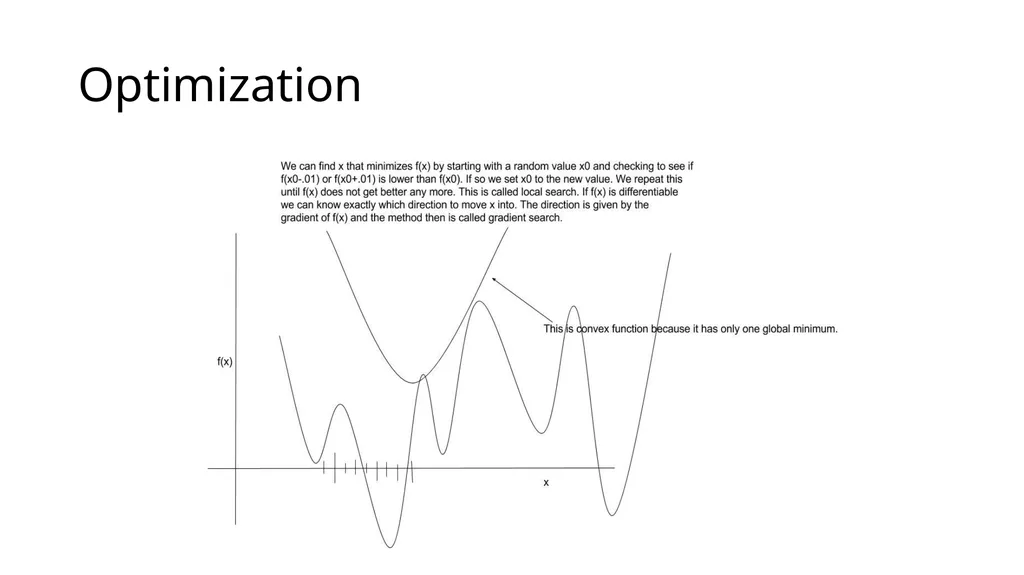
slide15. Optimization<br>
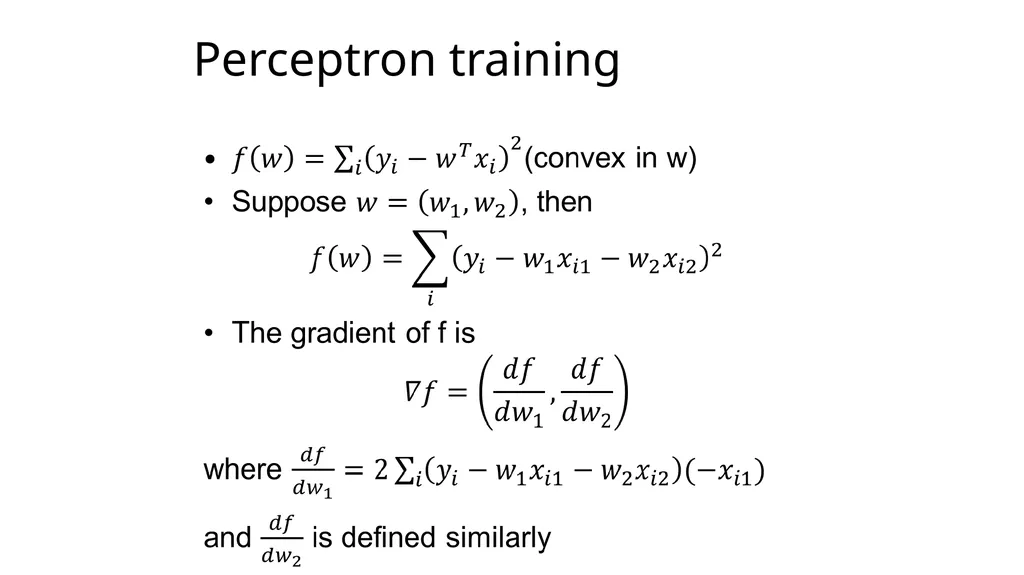
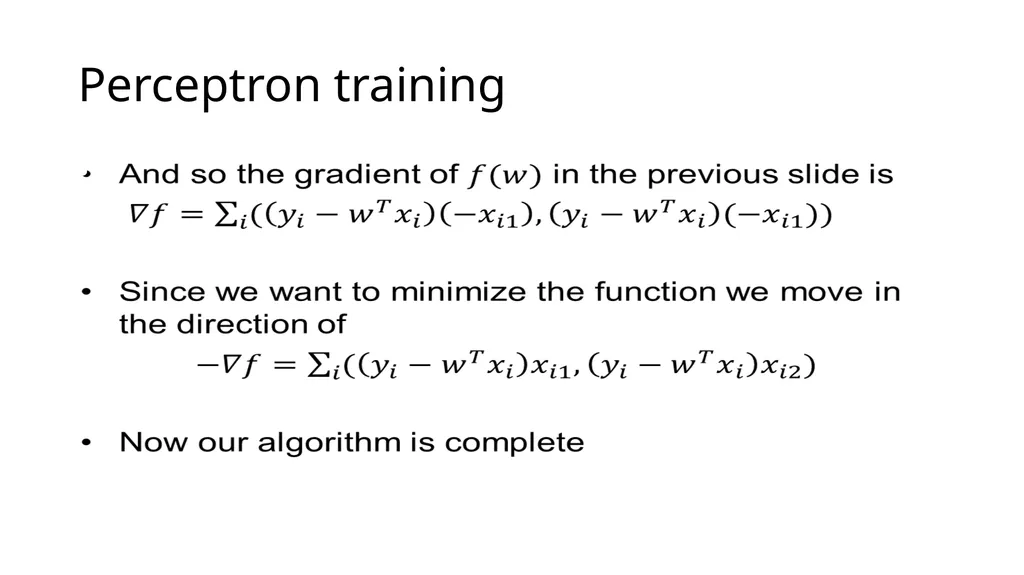
slide16. Perceptron training<br>
slide17. Perceptron training<br>
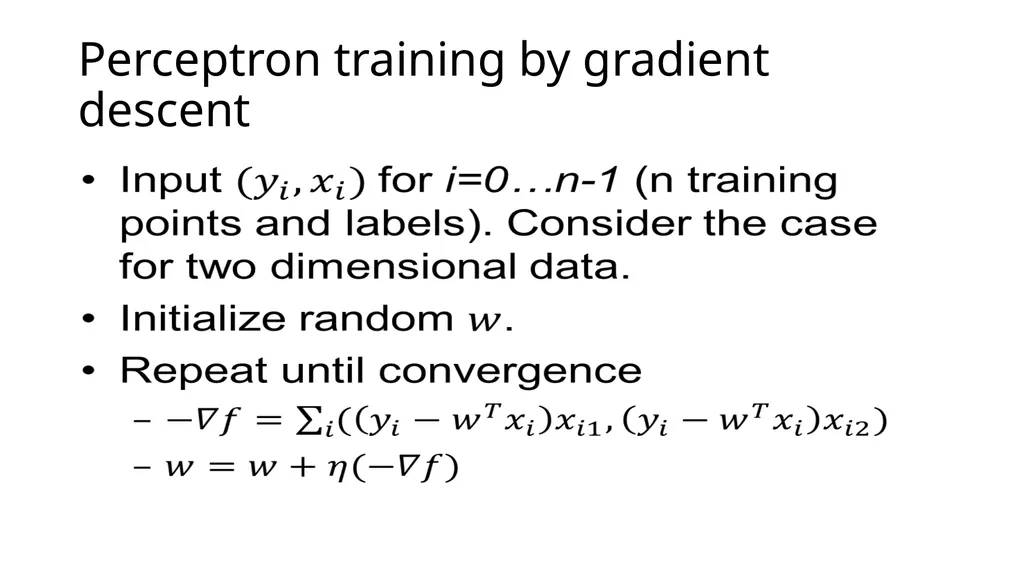
slide18. Perceptron training by gradient descent<br>
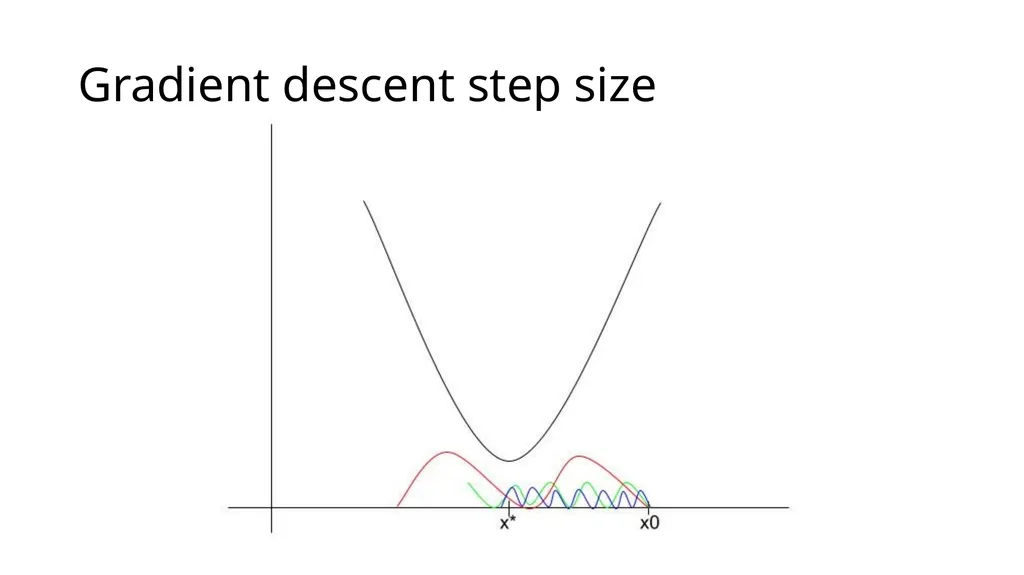
slide19. Gradient descent step size<br>
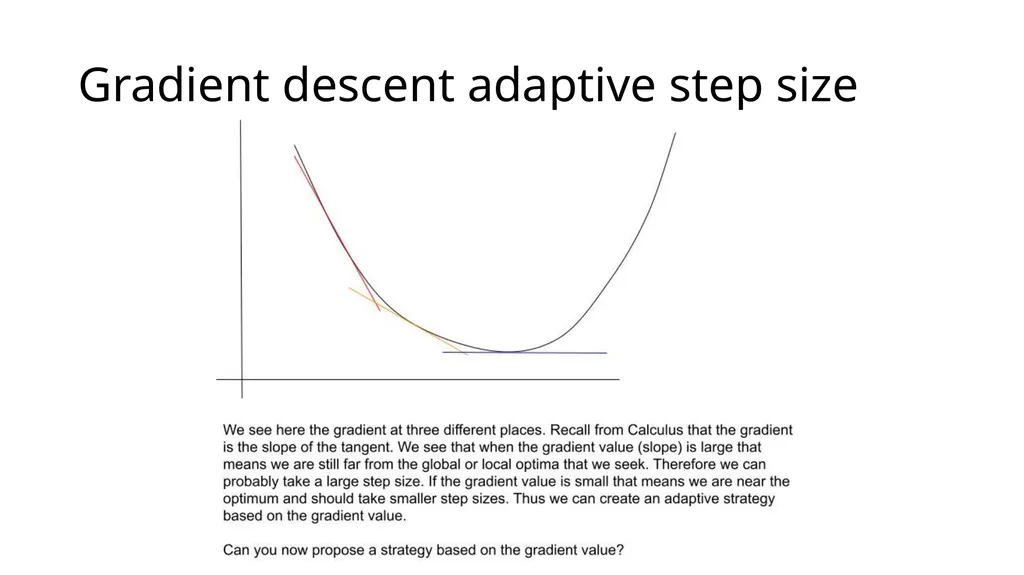
slide20. Gradient descent adaptive step size<br>
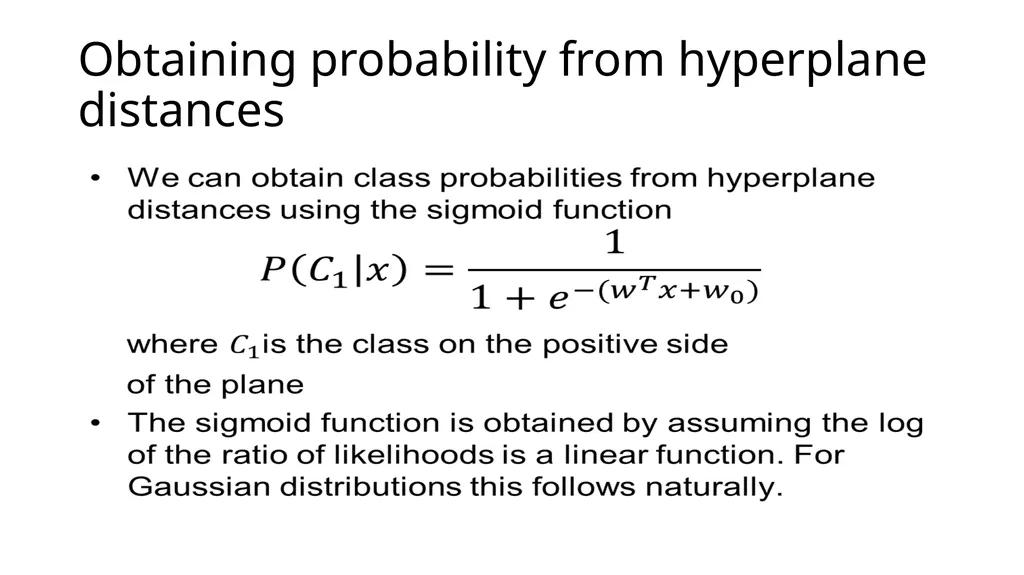
slide21. Obtaining probability from hyperplane distances<br>
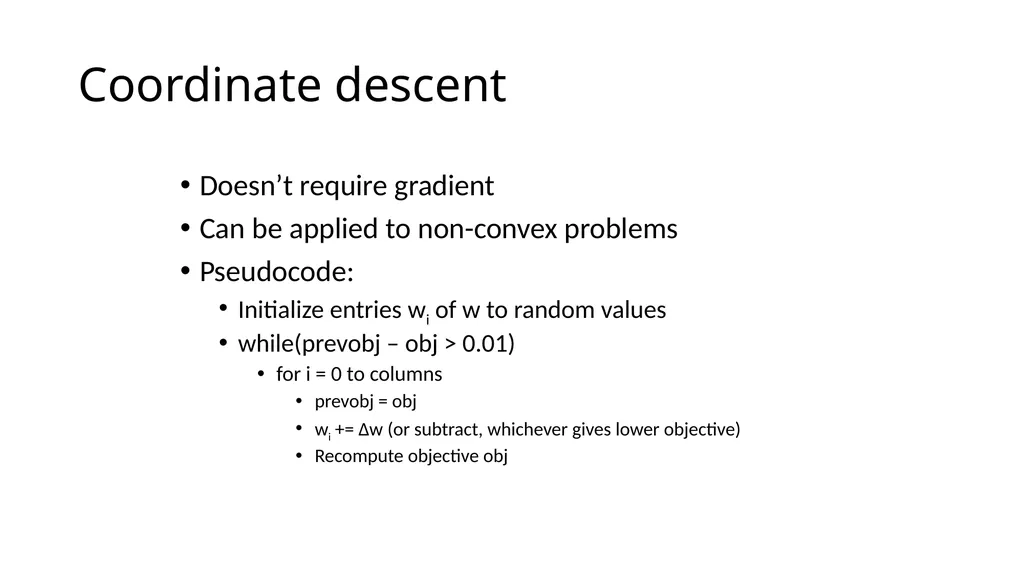
slide22. Coordinate descent Doesn’t require gradient
Can be applied to non-convex problems
Pseudocode:
Initialize entries wi of w to random values
while(prevobj – obj > 0.01)
for i = 0 to columns
prevobj = obj
wi += Δw (or subtract, whichever gives lower objective)
Recompute objective obj<br>
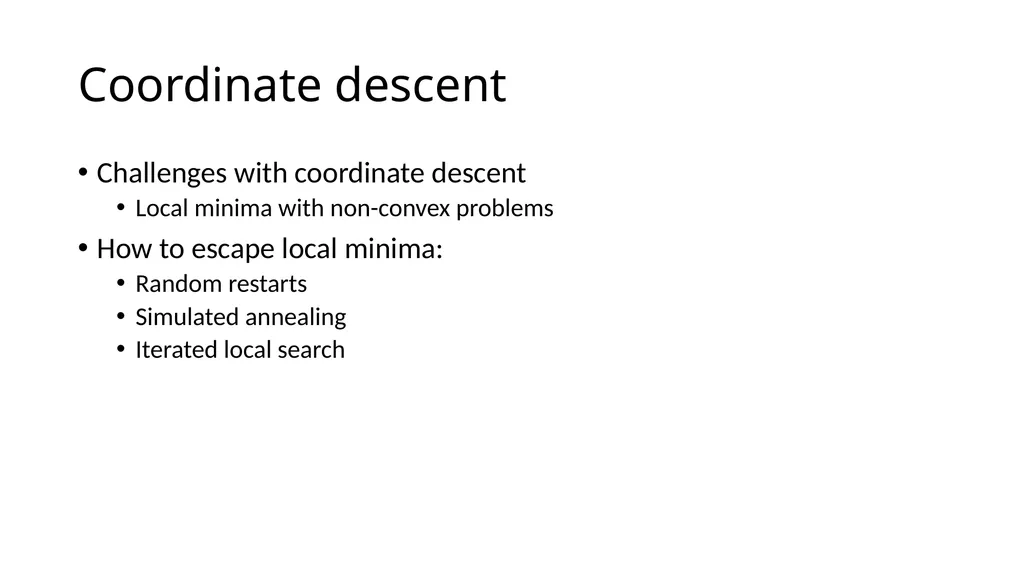
slide23. Coordinate descent Challenges with coordinate descent
Local minima with non-convex problems
How to escape local minima:
Random restarts
Simulated annealing
Iterated local search<br>
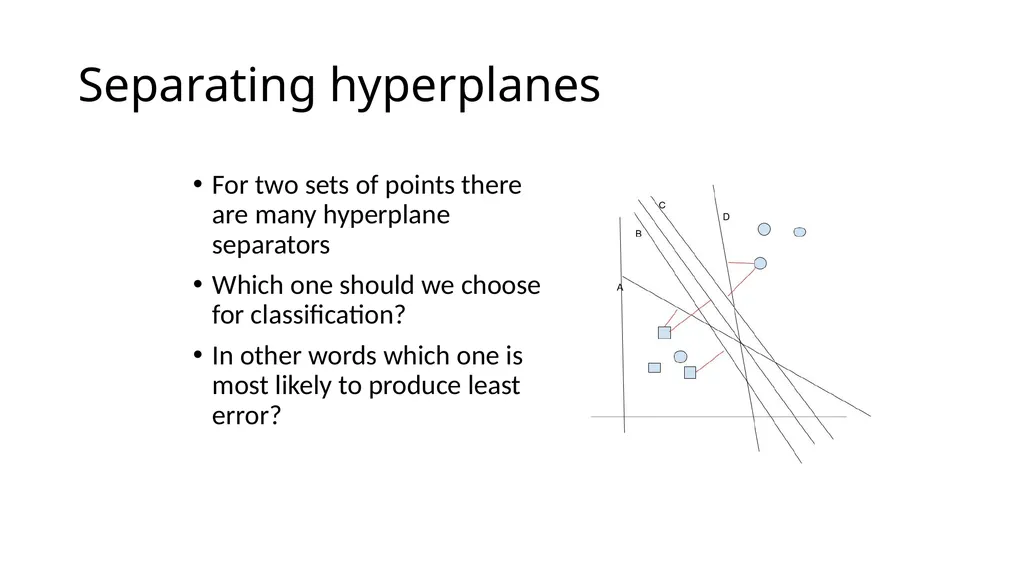
slide24. Separating hyperplanes For two sets of points there are many hyperplane separators
Which one should we choose for classification?
In other words which one is most likely to produce least error?<br>
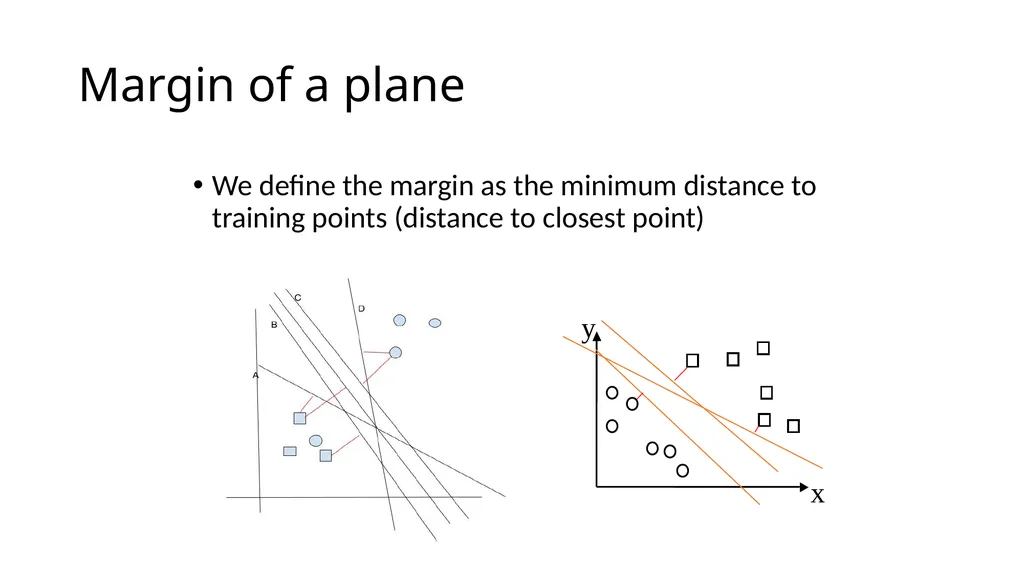
slide25. Margin of a plane We define the margin as the minimum distance to training points (distance to closest point)<br>
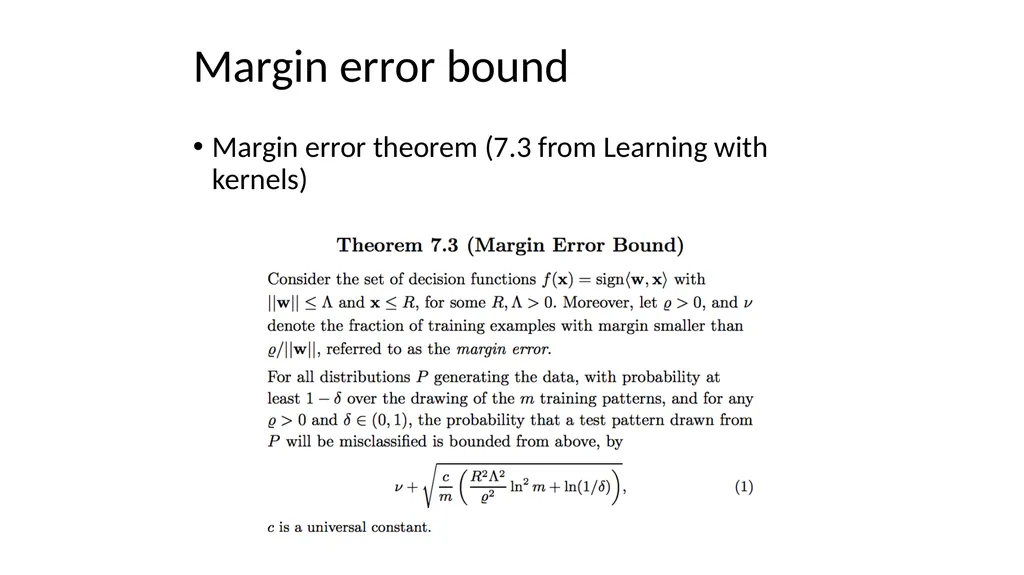
slide26. Margin error bound Margin error theorem (7.3 from Learning with kernels)<br>
slide27. Maximum margin hyperplane Previous theorem dictates that the best hyperplane is the one that maximizes the minimum distance of all training points to the plane (Learning with kernels, Scholkopf and Smola, 2002) also called the margin.
Its expected error is at most the fraction of misclassified points plus a complexity term (Learning with kernels, Scholkopf and Smola, 2002)<br>
slide28. Optimally separating hyperplane How do we find the optimally separating (maximum margin) hyperplane?
Recall distance of a point to the plane defined earlier<br>
slide29. Hyperplane separators x xp w r<br>
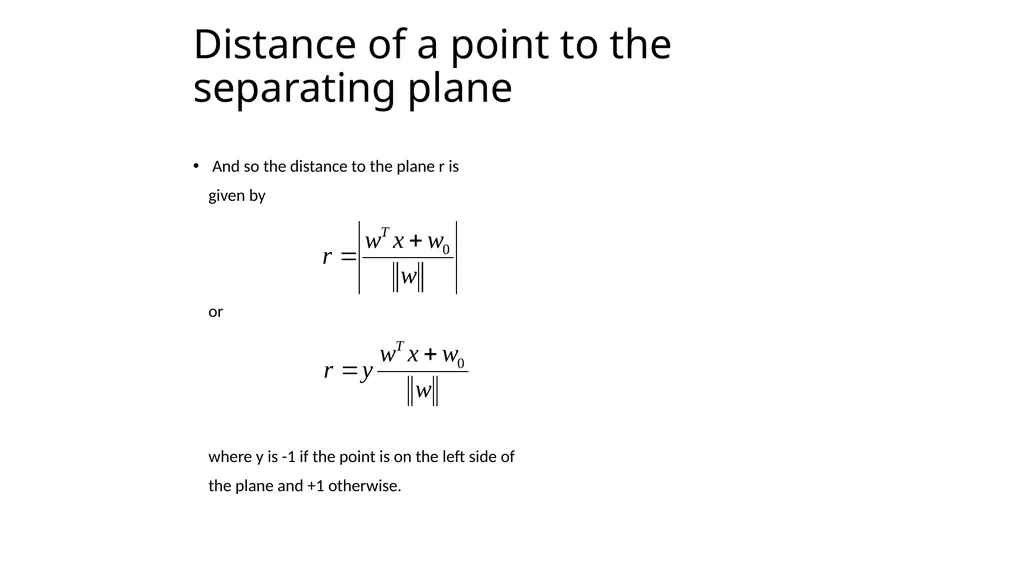
slide30. Distance of a point to the separating plane And so the distance to the plane r is
given by
or
where y is -1 if the point is on the left side of
the plane and +1 otherwise.<br>
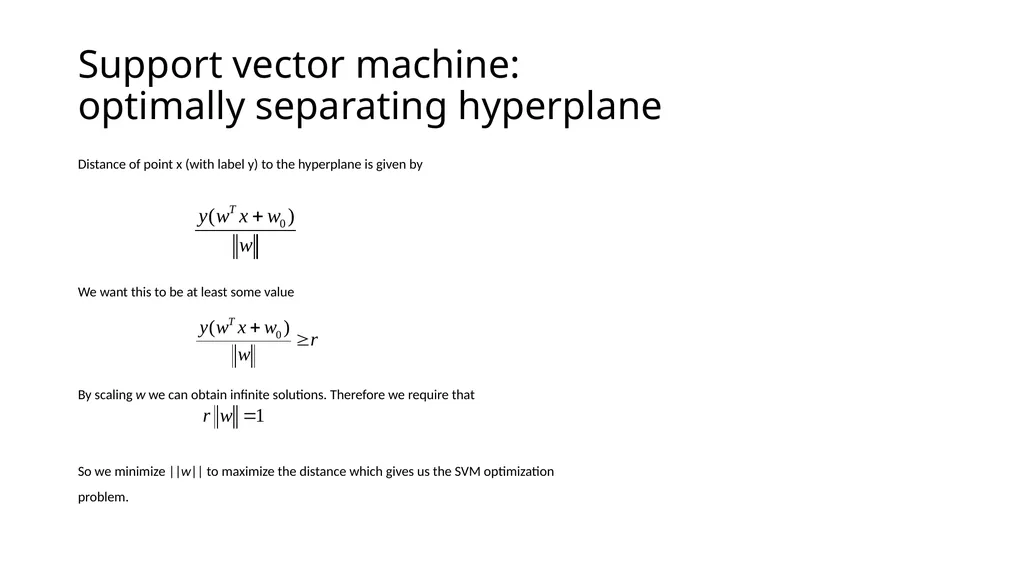
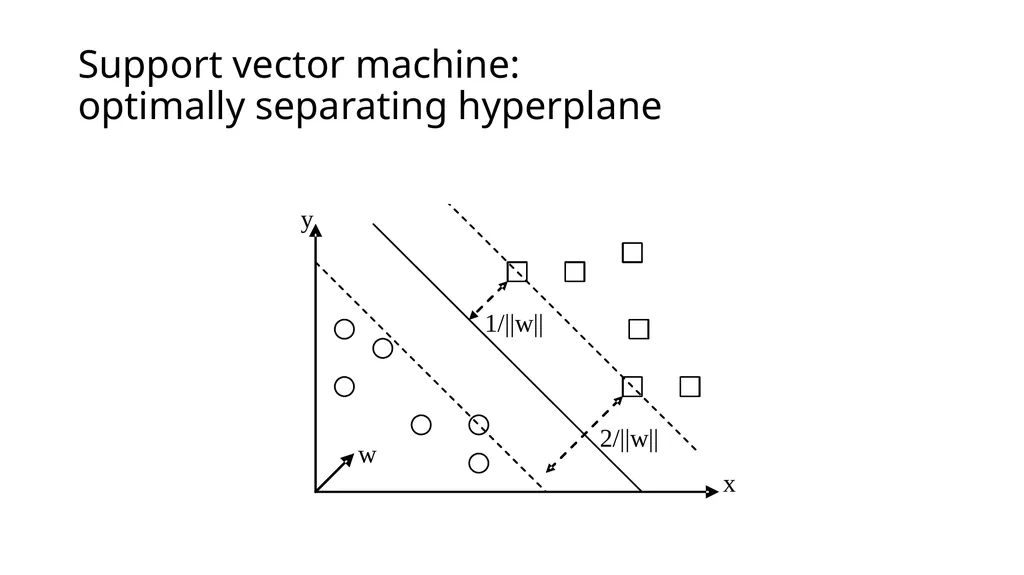
slide31. Support vector machine: optimally separating hyperplane Distance of point x (with label y) to the hyperplane is given by
We want this to be at least some value
By scaling w we can obtain infinite solutions. Therefore we require that
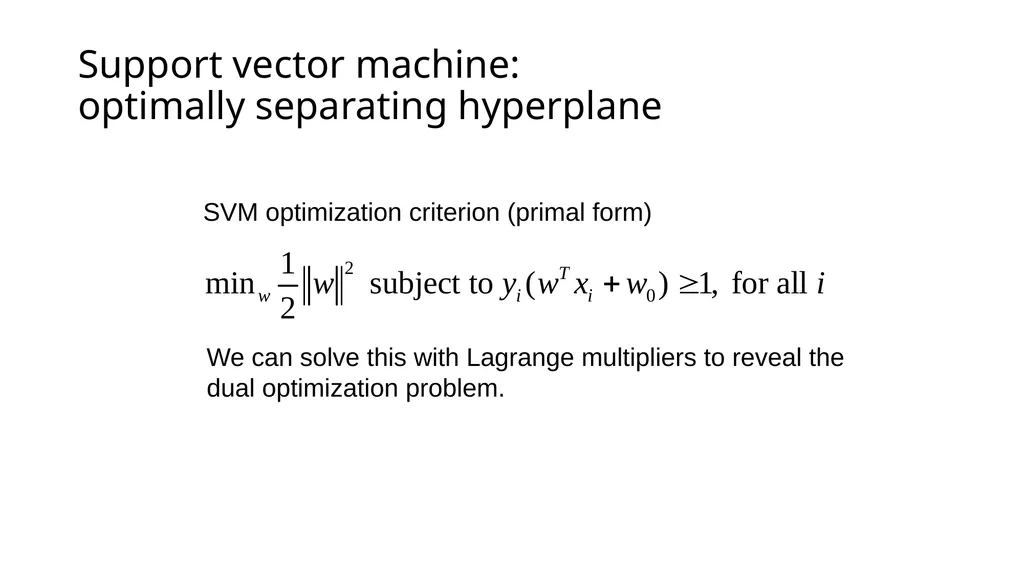
So we minimize ||w|| to maximize the distance which gives us the SVM optimization
problem.<br>
slide32. Support vector machine: optimally separating hyperplane SVM optimization criterion (primal form) We can solve this with Lagrange multipliers to reveal the
dual optimization problem.<br>
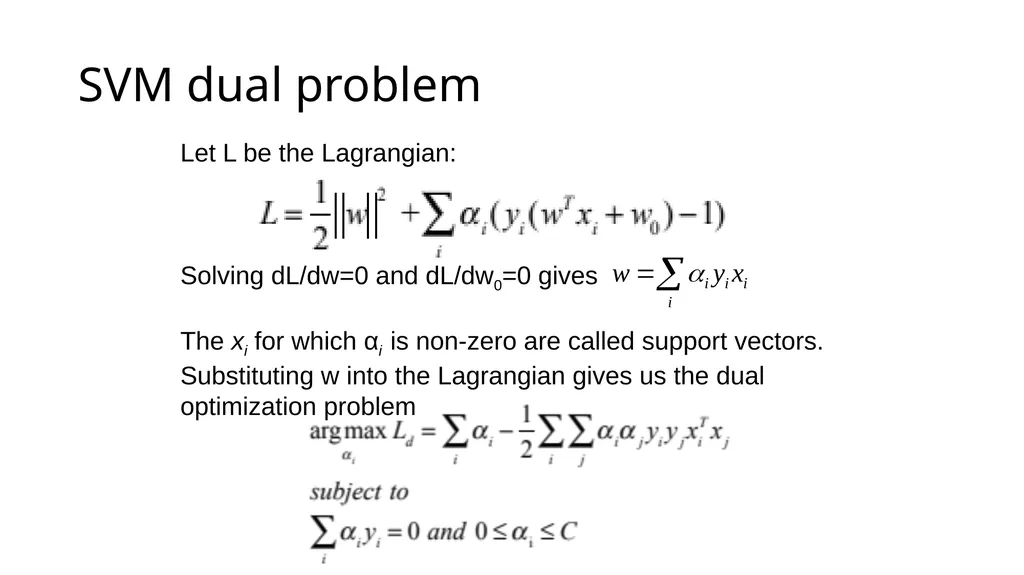
slide33. SVM dual problem Let L be the Lagrangian:
Solving dL/dw=0 and dL/dw0=0 gives
The xi for which αi is non-zero are called support vectors. Substituting w into the Lagrangian gives us the dual optimization problem<br>
slide34. Support vector machine: optimally separating hyperplane<br>
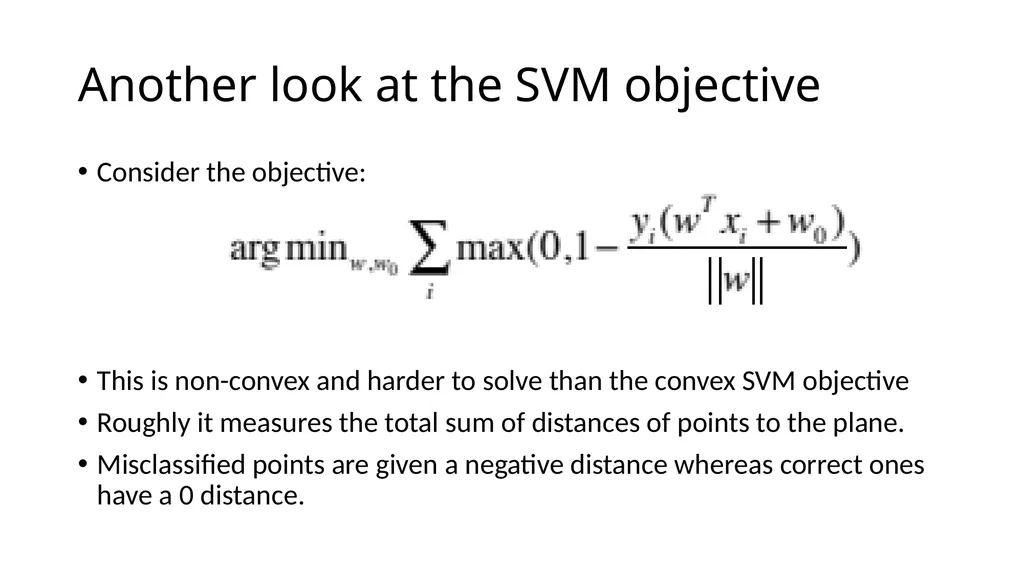
slide35. Another look at the SVM objective Consider the objective:
This is non-convex and harder to solve than the convex SVM objective
Roughly it measures the total sum of distances of points to the plane.
Misclassified points are given a negative distance whereas correct ones have a 0 distance.<br>
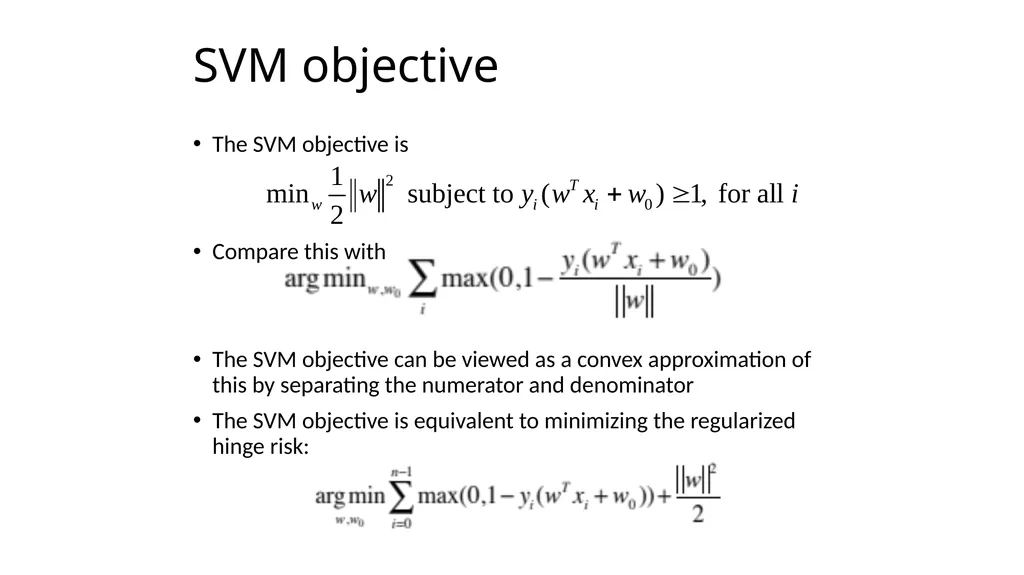
slide36. SVM objective The SVM objective is
Compare this with
The SVM objective can be viewed as a convex approximation of this by separating the numerator and denominator
The SVM objective is equivalent to minimizing the regularized hinge risk:<br>
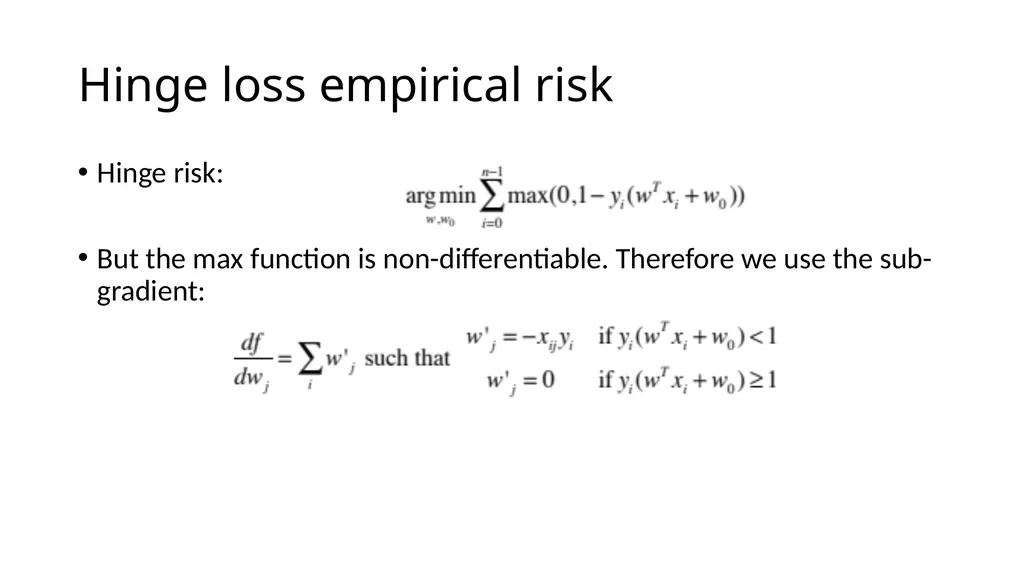
slide37. Hinge loss empirical risk Hinge risk:
But the max function is non-differentiable. Therefore we use the sub-gradient:<br>
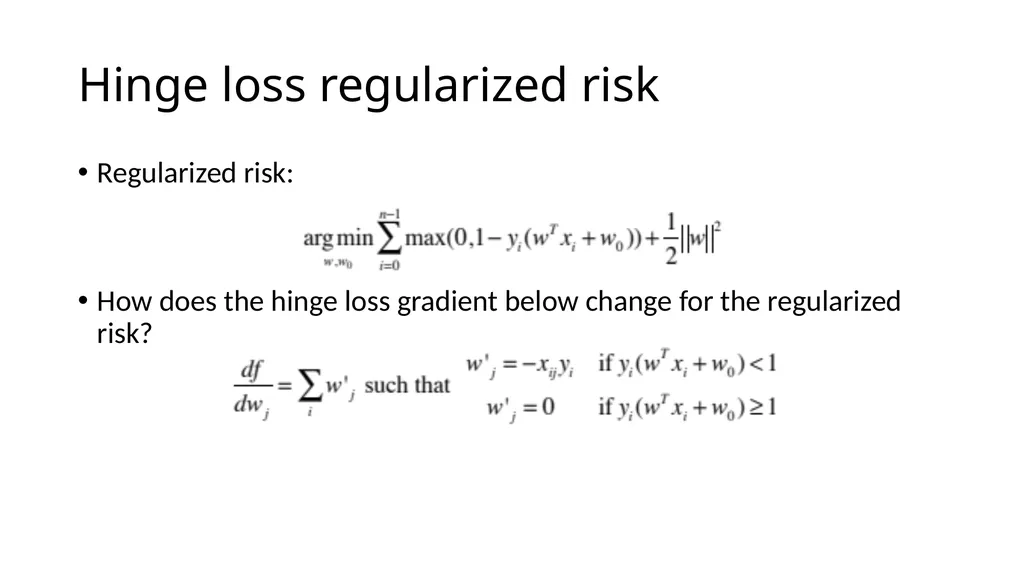
slide38. Hinge loss regularized risk Regularized risk:
How does the hinge loss gradient below change for the regularized risk?<br>
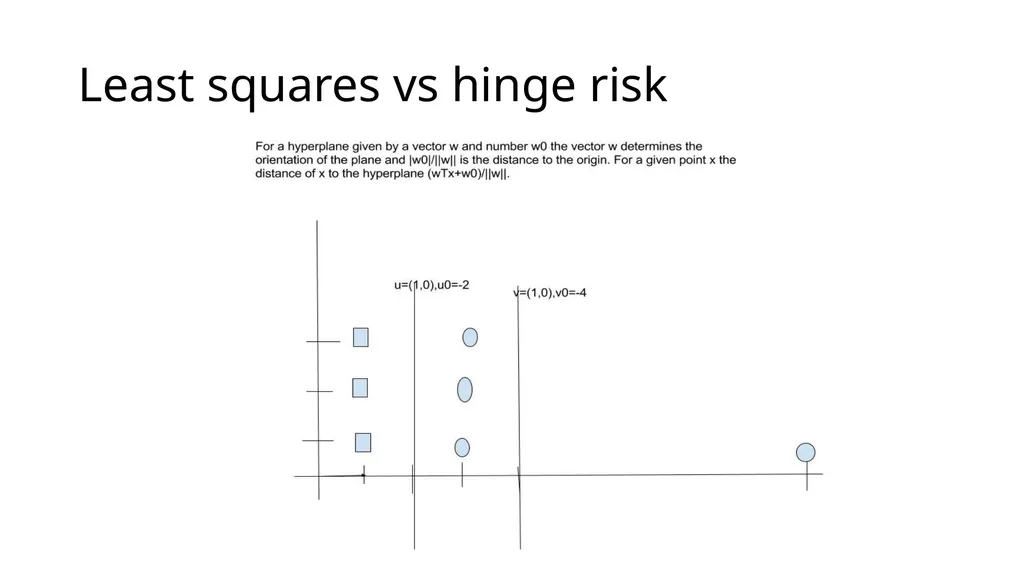
slide39. Least squares vs hinge risk<br>
slide40. Least squares vs SVM on outliers<br>
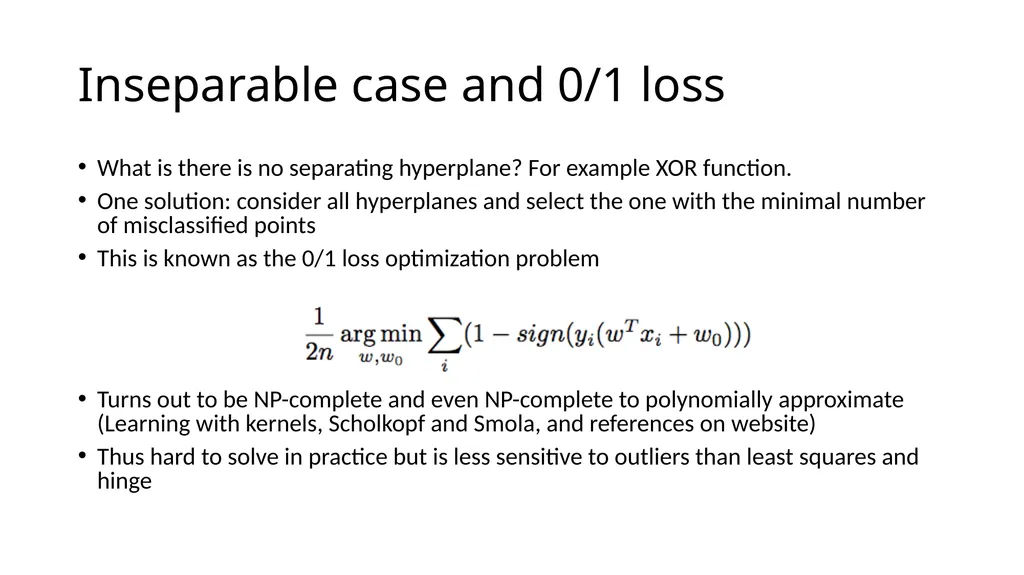
slide41. Inseparable case and 0/1 loss What is there is no separating hyperplane? For example XOR function.
One solution: consider all hyperplanes and select the one with the minimal number of misclassified points
This is known as the 0/1 loss optimization problem
Turns out to be NP-complete and even NP-complete to polynomially approximate (Learning with kernels, Scholkopf and Smola, and references on website)
Thus hard to solve in practice but is less sensitive to outliers than least squares and hinge<br>
slide42. SVM vs 01loss on outliers<br>
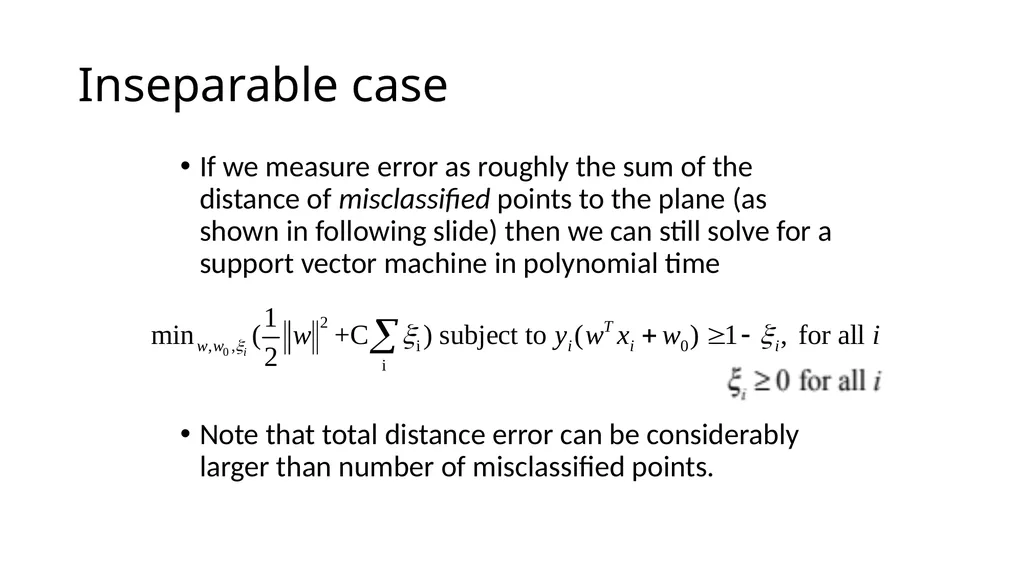
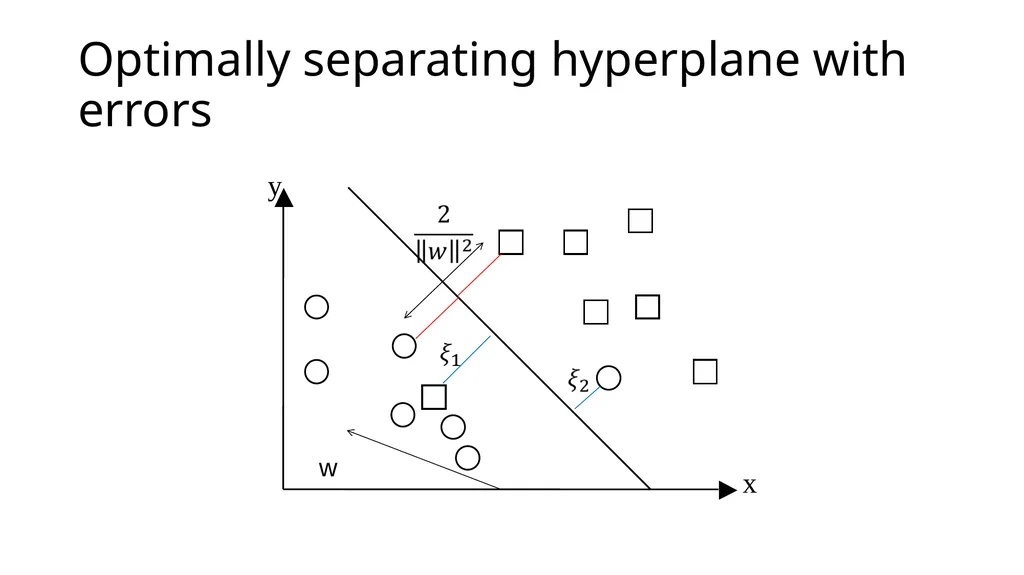
slide43. Inseparable case If we measure error as roughly the sum of the distance of misclassified points to the plane (as shown in following slide) then we can still solve for a support vector machine in polynomial time
Note that total distance error can be considerably larger than number of misclassified points.<br>
slide44. Optimally separating hyperplane with errors y x w<br>

Department of Data Science
NJIT<br>
slide2. Linearly separable data<br>
slide3. Non linearly separable data<br>
slide4. Hyperplane separators<br>
slide5. Hyperplane separators w<br>
slide6. Hyperplane separators w<br>
slide7. Hyperplane separators x xp w r<br>
slide8. Hyperplane separators x xp w r<br>
slide9. Nearest mean as hyperplane separator m1 m2<br>
slide10. Nearest mean as hyperplane separator m1 m2 m1 + (m2-m1)/2<br>
slide11. Nearest mean as hyperplane separator m1 m2<br>
slide12. Separating hyperplanes<br>
slide13. Least squares perceptron<br>
slide14. Gradient descent<br>
slide15. Optimization<br>
slide16. Perceptron training<br>
slide17. Perceptron training<br>
slide18. Perceptron training by gradient descent<br>
slide19. Gradient descent step size<br>
slide20. Gradient descent adaptive step size<br>
slide21. Obtaining probability from hyperplane distances<br>
slide22. Coordinate descent Doesn’t require gradient
Can be applied to non-convex problems
Pseudocode:
Initialize entries wi of w to random values
while(prevobj – obj > 0.01)
for i = 0 to columns
prevobj = obj
wi += Δw (or subtract, whichever gives lower objective)
Recompute objective obj<br>
slide23. Coordinate descent Challenges with coordinate descent
Local minima with non-convex problems
How to escape local minima:
Random restarts
Simulated annealing
Iterated local search<br>
slide24. Separating hyperplanes For two sets of points there are many hyperplane separators
Which one should we choose for classification?
In other words which one is most likely to produce least error?<br>
slide25. Margin of a plane We define the margin as the minimum distance to training points (distance to closest point)<br>
slide26. Margin error bound Margin error theorem (7.3 from Learning with kernels)<br>
slide27. Maximum margin hyperplane Previous theorem dictates that the best hyperplane is the one that maximizes the minimum distance of all training points to the plane (Learning with kernels, Scholkopf and Smola, 2002) also called the margin.
Its expected error is at most the fraction of misclassified points plus a complexity term (Learning with kernels, Scholkopf and Smola, 2002)<br>
slide28. Optimally separating hyperplane How do we find the optimally separating (maximum margin) hyperplane?
Recall distance of a point to the plane defined earlier<br>
slide29. Hyperplane separators x xp w r<br>
slide30. Distance of a point to the separating plane And so the distance to the plane r is
given by
or
where y is -1 if the point is on the left side of
the plane and +1 otherwise.<br>
slide31. Support vector machine: optimally separating hyperplane Distance of point x (with label y) to the hyperplane is given by
We want this to be at least some value
By scaling w we can obtain infinite solutions. Therefore we require that
So we minimize ||w|| to maximize the distance which gives us the SVM optimization
problem.<br>
slide32. Support vector machine: optimally separating hyperplane SVM optimization criterion (primal form) We can solve this with Lagrange multipliers to reveal the
dual optimization problem.<br>
slide33. SVM dual problem Let L be the Lagrangian:
Solving dL/dw=0 and dL/dw0=0 gives
The xi for which αi is non-zero are called support vectors. Substituting w into the Lagrangian gives us the dual optimization problem<br>
slide34. Support vector machine: optimally separating hyperplane<br>
slide35. Another look at the SVM objective Consider the objective:
This is non-convex and harder to solve than the convex SVM objective
Roughly it measures the total sum of distances of points to the plane.
Misclassified points are given a negative distance whereas correct ones have a 0 distance.<br>
slide36. SVM objective The SVM objective is
Compare this with
The SVM objective can be viewed as a convex approximation of this by separating the numerator and denominator
The SVM objective is equivalent to minimizing the regularized hinge risk:<br>
slide37. Hinge loss empirical risk Hinge risk:
But the max function is non-differentiable. Therefore we use the sub-gradient:<br>
slide38. Hinge loss regularized risk Regularized risk:
How does the hinge loss gradient below change for the regularized risk?<br>
slide39. Least squares vs hinge risk<br>
slide40. Least squares vs SVM on outliers<br>
slide41. Inseparable case and 0/1 loss What is there is no separating hyperplane? For example XOR function.
One solution: consider all hyperplanes and select the one with the minimal number of misclassified points
This is known as the 0/1 loss optimization problem
Turns out to be NP-complete and even NP-complete to polynomially approximate (Learning with kernels, Scholkopf and Smola, and references on website)
Thus hard to solve in practice but is less sensitive to outliers than least squares and hinge<br>
slide42. SVM vs 01loss on outliers<br>
slide43. Inseparable case If we measure error as roughly the sum of the distance of misclassified points to the plane (as shown in following slide) then we can still solve for a support vector machine in polynomial time
Note that total distance error can be considerably larger than number of misclassified points.<br>
slide44. Optimally separating hyperplane with errors y x w<br>