
Liquid Dosages forms UNIVERSITY EDUCATION AND
AM
Published · 24 slides · 0 views

1 / 1



Description
Liquid Dosages forms UNIVERSITY EDUCATION AND TECHNOLOGY CELL CENTRE OF DISTANCE AND ONLINE EDUCATION KVV By Mrs. Madhuri M Desai Assistant Professor, Krishna Institute of Pharmacy, Karad OBJECTIVES Objectives of this topics are: 1. To
Related Topics
Share
Embed code
Download this presentation From Below
"Liquid Dosages forms UNIVERSITY EDUCATION AND" is the property of its rightful owner. Permission is granted to download and print the materials on this website for personal, non-commercial use only, and to display it on your personal computer provided you do not modify the materials and that you retain all copyright notices contained in the materials. By downloading content from our website, you accept the terms of this agreement.
Presentation Transcript
01
Liquid Dosages forms UNIVERSITY EDUCATION AND TECHNOLOGY CELL &
CENTRE OF DISTANCE AND ONLINE EDUCATION KVV By
Mrs. Madhuri M Desai
Assistant Professor,
Krishna Institute of Pharmacy, Karad<br>
CENTRE OF DISTANCE AND ONLINE EDUCATION KVV By
Mrs. Madhuri M Desai
Assistant Professor,
Krishna Institute of Pharmacy, Karad<br>
02
OBJECTIVES Objectives of this topics are:
1. To understand the classification of liquid dosage forms.
2. To know the various excipients used in the preparation of liquid dosage form.<br>
1. To understand the classification of liquid dosage forms.
2. To know the various excipients used in the preparation of liquid dosage form.<br>
03
INTRODUCTION Liquid form a dose of a chemical compound used as a drug or medication intended for administration or consumption.
May be administered systematically by mouth or injected, by using different techniques, into the skin, muscles, or veins.<br>
May be administered systematically by mouth or injected, by using different techniques, into the skin, muscles, or veins.<br>
04
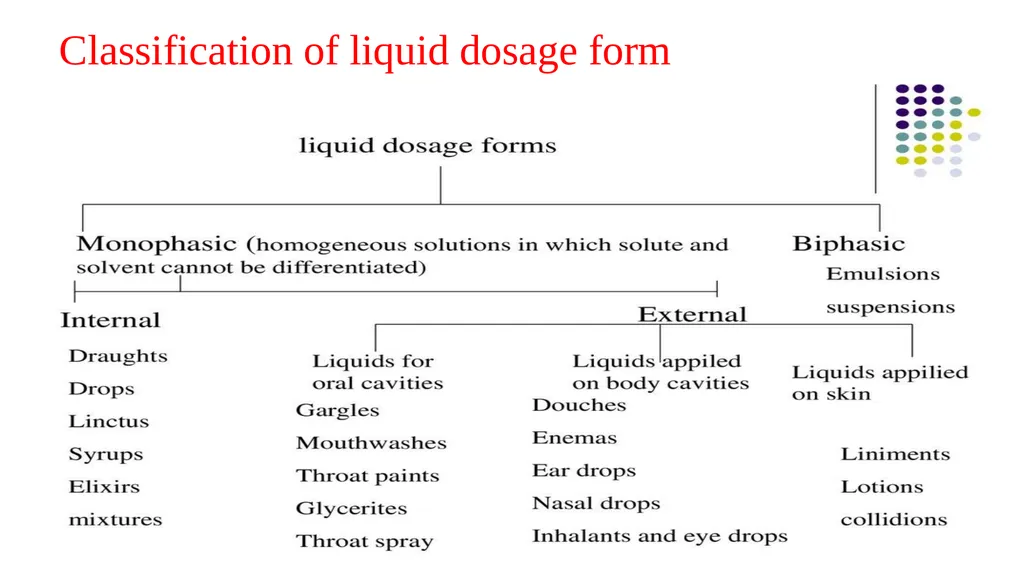
Classification of liquid dosage form<br>
05
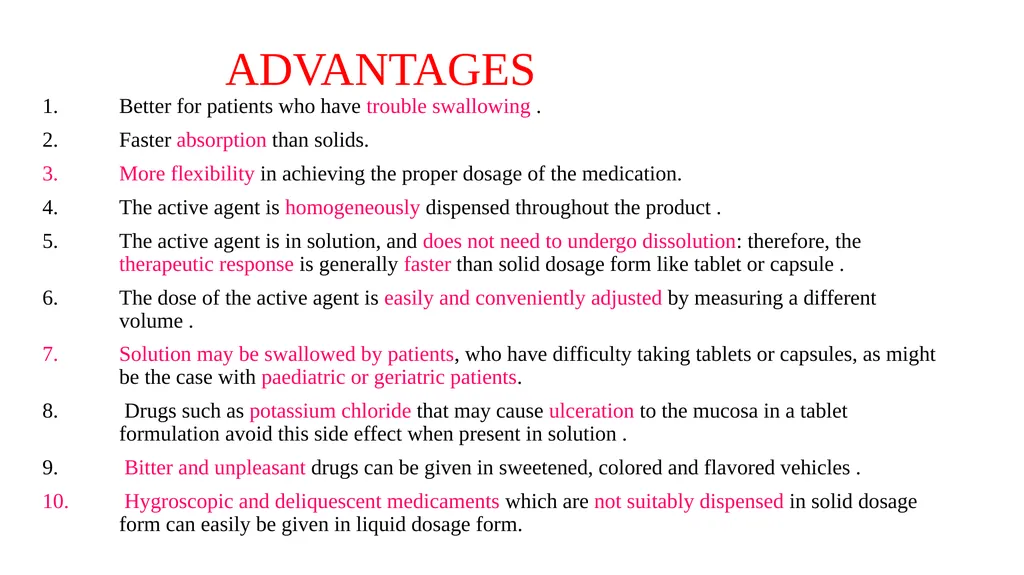
ADVANTAGES Better for patients who have trouble swallowing .
Faster absorption than solids.
More flexibility in achieving the proper dosage of the medication.
The active agent is homogeneously dispensed throughout the product .
The active agent is in solution, and does not need to undergo dissolution: therefore, the therapeutic response is generally faster than solid dosage form like tablet or capsule .
The dose of the active agent is easily and conveniently adjusted by measuring a different volume .
Solution may be swallowed by patients, who have difficulty taking tablets or capsules, as might be the case with paediatric or geriatric patients.
Drugs such as potassium chloride that may cause ulceration to the mucosa in a tablet formulation avoid this side effect when present in solution .
Bitter and unpleasant drugs can be given in sweetened, colored and flavored vehicles .
Hygroscopic and deliquescent medicaments which are not suitably dispensed in solid dosage form can easily be given in liquid dosage form.<br>
Faster absorption than solids.
More flexibility in achieving the proper dosage of the medication.
The active agent is homogeneously dispensed throughout the product .
The active agent is in solution, and does not need to undergo dissolution: therefore, the therapeutic response is generally faster than solid dosage form like tablet or capsule .
The dose of the active agent is easily and conveniently adjusted by measuring a different volume .
Solution may be swallowed by patients, who have difficulty taking tablets or capsules, as might be the case with paediatric or geriatric patients.
Drugs such as potassium chloride that may cause ulceration to the mucosa in a tablet formulation avoid this side effect when present in solution .
Bitter and unpleasant drugs can be given in sweetened, colored and flavored vehicles .
Hygroscopic and deliquescent medicaments which are not suitably dispensed in solid dosage form can easily be given in liquid dosage form.<br>
06
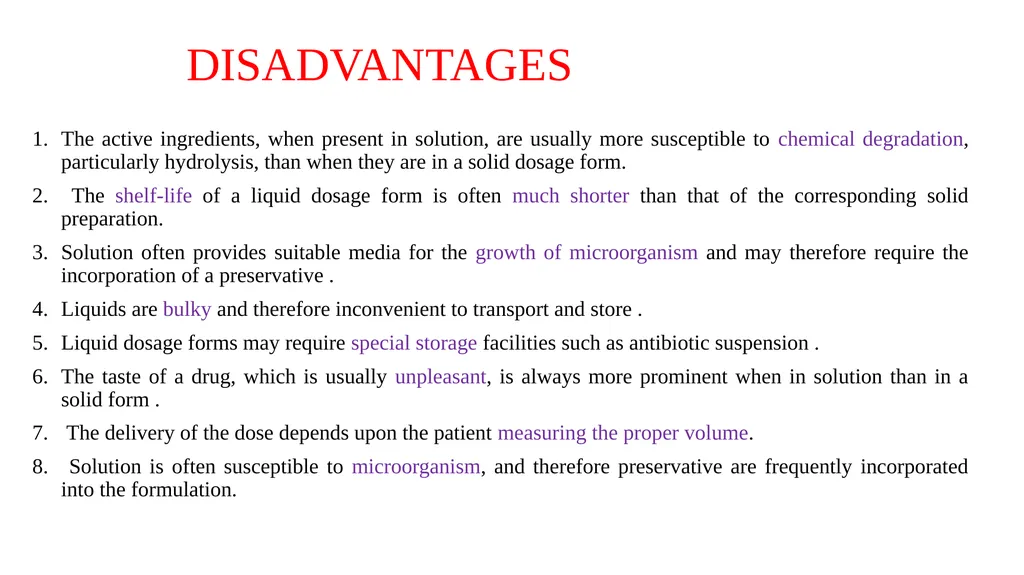
DISADVANTAGES The active ingredients, when present in solution, are usually more susceptible to chemical degradation, particularly hydrolysis, than when they are in a solid dosage form.
The shelf-life of a liquid dosage form is often much shorter than that of the corresponding solid preparation.
Solution often provides suitable media for the growth of microorganism and may therefore require the incorporation of a preservative .
Liquids are bulky and therefore inconvenient to transport and store .
Liquid dosage forms may require special storage facilities such as antibiotic suspension .
The taste of a drug, which is usually unpleasant, is always more prominent when in solution than in a solid form .
The delivery of the dose depends upon the patient measuring the proper volume.
Solution is often susceptible to microorganism, and therefore preservative are frequently incorporated into the formulation.<br>
The shelf-life of a liquid dosage form is often much shorter than that of the corresponding solid preparation.
Solution often provides suitable media for the growth of microorganism and may therefore require the incorporation of a preservative .
Liquids are bulky and therefore inconvenient to transport and store .
Liquid dosage forms may require special storage facilities such as antibiotic suspension .
The taste of a drug, which is usually unpleasant, is always more prominent when in solution than in a solid form .
The delivery of the dose depends upon the patient measuring the proper volume.
Solution is often susceptible to microorganism, and therefore preservative are frequently incorporated into the formulation.<br>
07
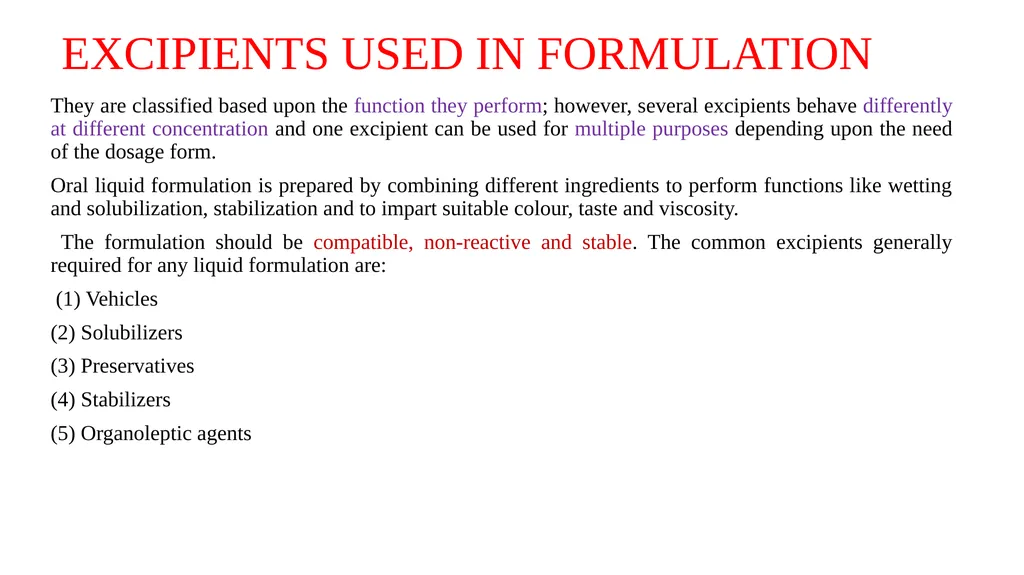
EXCIPIENTS USED IN FORMULATION They are classified based upon the function they perform; however, several excipients behave differently at different concentration and one excipient can be used for multiple purposes depending upon the need of the dosage form.
Oral liquid formulation is prepared by combining different ingredients to perform functions like wetting and solubilization, stabilization and to impart suitable colour, taste and viscosity.
The formulation should be compatible, non-reactive and stable. The common excipients generally required for any liquid formulation are:
(1) Vehicles
(2) Solubilizers
(3) Preservatives
(4) Stabilizers
(5) Organoleptic agents<br>
Oral liquid formulation is prepared by combining different ingredients to perform functions like wetting and solubilization, stabilization and to impart suitable colour, taste and viscosity.
The formulation should be compatible, non-reactive and stable. The common excipients generally required for any liquid formulation are:
(1) Vehicles
(2) Solubilizers
(3) Preservatives
(4) Stabilizers
(5) Organoleptic agents<br>
08
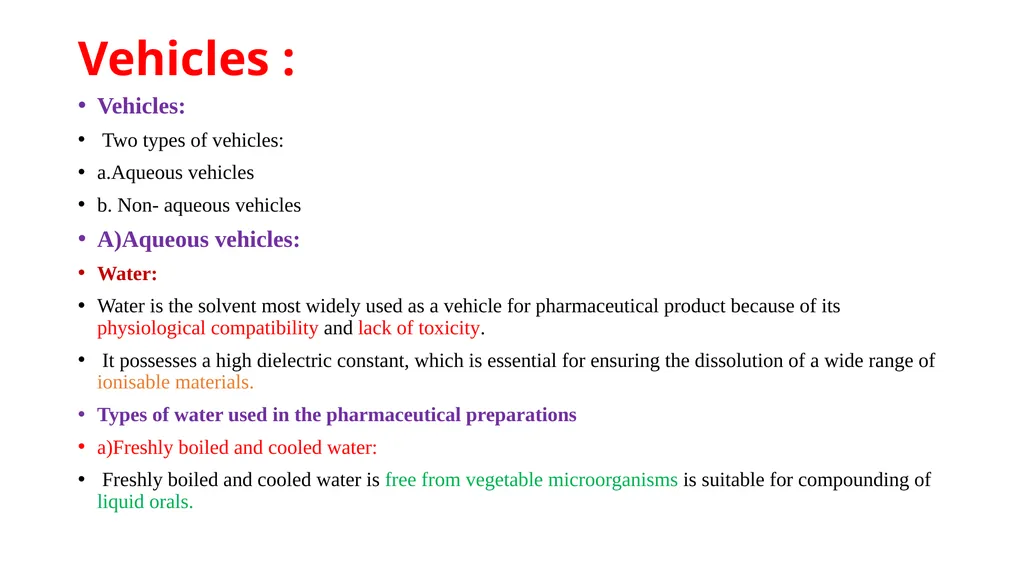
Vehicles : Vehicles:
Two types of vehicles:
a.Aqueous vehicles
b. Non- aqueous vehicles
A)Aqueous vehicles:
Water:
Water is the solvent most widely used as a vehicle for pharmaceutical product because of its physiological compatibility and lack of toxicity.
It possesses a high dielectric constant, which is essential for ensuring the dissolution of a wide range of ionisable materials.
Types of water used in the pharmaceutical preparations
a)Freshly boiled and cooled water:
Freshly boiled and cooled water is free from vegetable microorganisms is suitable for compounding of liquid orals.<br>
Two types of vehicles:
a.Aqueous vehicles
b. Non- aqueous vehicles
A)Aqueous vehicles:
Water:
Water is the solvent most widely used as a vehicle for pharmaceutical product because of its physiological compatibility and lack of toxicity.
It possesses a high dielectric constant, which is essential for ensuring the dissolution of a wide range of ionisable materials.
Types of water used in the pharmaceutical preparations
a)Freshly boiled and cooled water:
Freshly boiled and cooled water is free from vegetable microorganisms is suitable for compounding of liquid orals.<br>
09
b)Purified water:
Purified water is prepared by distillation and deionisation is 100 times free from dissolved solids than potable waters.
It is clear, colourless liquid, odourless, tasteless.
Intended for use in the preparation of non -Parenteral aqueous dosage only.
c)Aromatic water:
These are aqueous saturated solutions of volatile oils or other aromatic principles.
Use as vehicle and flavouring agent in the liquid oral preparations.
Aromatic water themselves acts as carminative and stomachic. E. g. Fennel, dill.
d) Water for Injection (WFI):
WFI is prepared by Distillation technique. WFI is intended for use in Parenteral preparations, it must pass through bacterial endotoxin test, limit not more than 0.25 IU of endotoxin per ml.
Used in manufacturing of injectable products to be sterilised after preparations.<br>
Purified water is prepared by distillation and deionisation is 100 times free from dissolved solids than potable waters.
It is clear, colourless liquid, odourless, tasteless.
Intended for use in the preparation of non -Parenteral aqueous dosage only.
c)Aromatic water:
These are aqueous saturated solutions of volatile oils or other aromatic principles.
Use as vehicle and flavouring agent in the liquid oral preparations.
Aromatic water themselves acts as carminative and stomachic. E. g. Fennel, dill.
d) Water for Injection (WFI):
WFI is prepared by Distillation technique. WFI is intended for use in Parenteral preparations, it must pass through bacterial endotoxin test, limit not more than 0.25 IU of endotoxin per ml.
Used in manufacturing of injectable products to be sterilised after preparations.<br>
10
e)Sterile water for injection (SWFI):
It is used as solvent , vehicle or diluents for already sterilised and packed injectable medication
Used for reconstitution of multiple antibiotics.
f)Bacteriostatic water for injection:
It is sterile water for injection which contains one or more suitable antimicrobial agents.
It is used in the Parenteral that are administered in small volumes.
B)Non aqueous vehicle:
alcohols, glycerol/glycerine, propylene glycol USP
1.Fixed oils of vegetable origin:
Fixed oils of vegetable origin: Fixed oils obtained from plant and mineral origin are used as solvent for oil soluble drugs. These are non-volatile oils that consist mainly of fatty acid esters of glycol.
Almond oil, consist of glycerides mainly of oleic acid is used as a solvent for oily phenol injections. Arachis oil is used as the solvent in dimercaprol injection.
Olive oil, sesame oil, maize oil, cottonseed oil, soya oil and castor oil suitable for Parenteral and eye, ear drop formulation.<br>
It is used as solvent , vehicle or diluents for already sterilised and packed injectable medication
Used for reconstitution of multiple antibiotics.
f)Bacteriostatic water for injection:
It is sterile water for injection which contains one or more suitable antimicrobial agents.
It is used in the Parenteral that are administered in small volumes.
B)Non aqueous vehicle:
alcohols, glycerol/glycerine, propylene glycol USP
1.Fixed oils of vegetable origin:
Fixed oils of vegetable origin: Fixed oils obtained from plant and mineral origin are used as solvent for oil soluble drugs. These are non-volatile oils that consist mainly of fatty acid esters of glycol.
Almond oil, consist of glycerides mainly of oleic acid is used as a solvent for oily phenol injections. Arachis oil is used as the solvent in dimercaprol injection.
Olive oil, sesame oil, maize oil, cottonseed oil, soya oil and castor oil suitable for Parenteral and eye, ear drop formulation.<br>
11
Ethyl oleate is useful solvent for both ergo-calciferol injection and testosterone propionate injection.
Vegetable oils are used for veterinary formulations.
2. Alcohol (Ethyl Alcohol):
Next to water, alcohol is the most useful solvent in pharmacy. It is invariably as hydroalcoholic mixture that dissolves both water soluble and alcohol drugs and excipients. Diluted alcohol NF, prepared by mixing equal volumes Alcohol USP & Purified water.
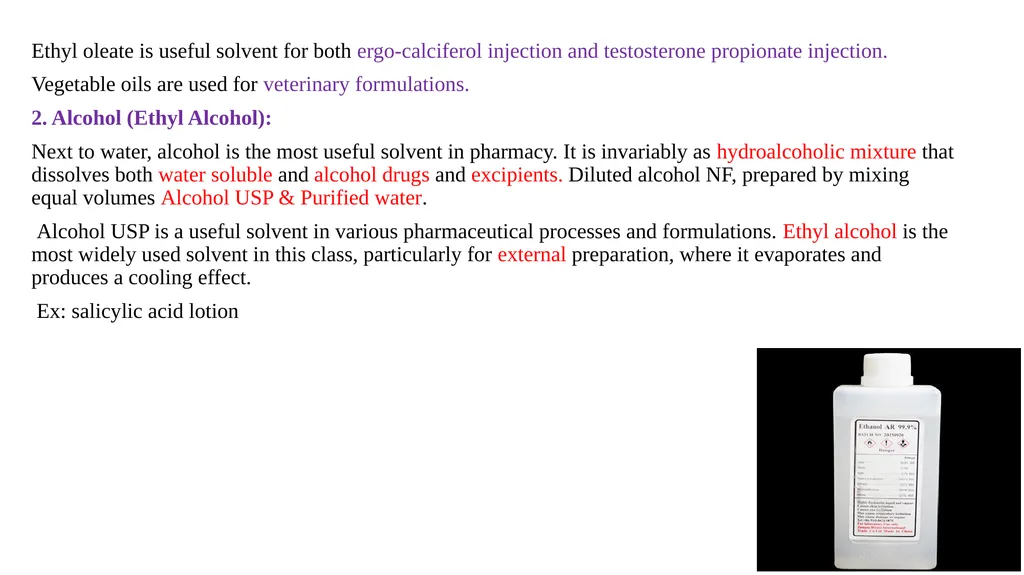
Alcohol USP is a useful solvent in various pharmaceutical processes and formulations. Ethyl alcohol is the most widely used solvent in this class, particularly for external preparation, where it evaporates and produces a cooling effect.
Ex: salicylic acid lotion<br>
Vegetable oils are used for veterinary formulations.
2. Alcohol (Ethyl Alcohol):
Next to water, alcohol is the most useful solvent in pharmacy. It is invariably as hydroalcoholic mixture that dissolves both water soluble and alcohol drugs and excipients. Diluted alcohol NF, prepared by mixing equal volumes Alcohol USP & Purified water.
Alcohol USP is a useful solvent in various pharmaceutical processes and formulations. Ethyl alcohol is the most widely used solvent in this class, particularly for external preparation, where it evaporates and produces a cooling effect.
Ex: salicylic acid lotion<br>
12
3.Glycerol (or Glycerine):
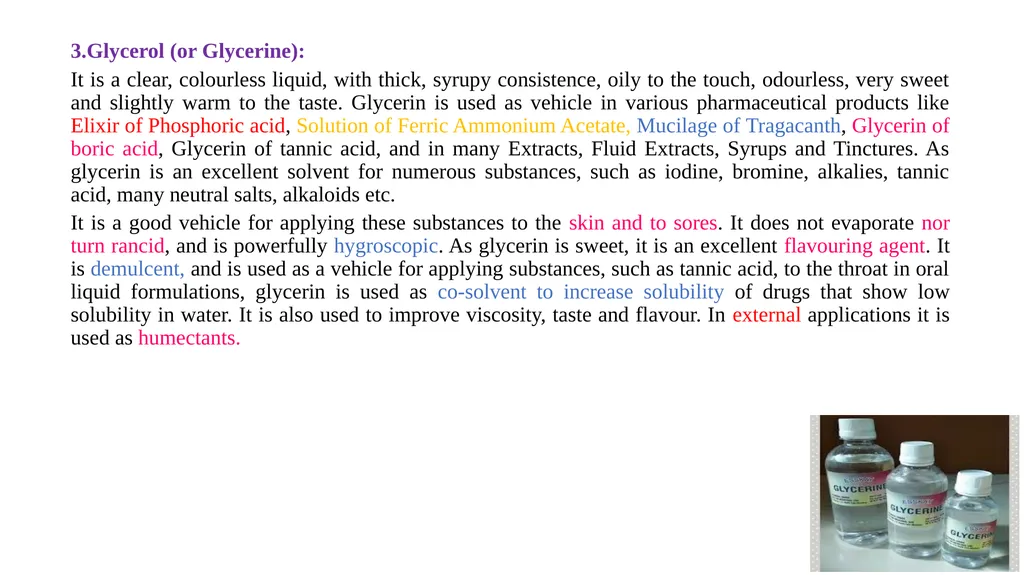
It is a clear, colourless liquid, with thick, syrupy consistence, oily to the touch, odourless, very sweet and slightly warm to the taste. Glycerin is used as vehicle in various pharmaceutical products like Elixir of Phosphoric acid, Solution of Ferric Ammonium Acetate, Mucilage of Tragacanth, Glycerin of boric acid, Glycerin of tannic acid, and in many Extracts, Fluid Extracts, Syrups and Tinctures. As glycerin is an excellent solvent for numerous substances, such as iodine, bromine, alkalies, tannic acid, many neutral salts, alkaloids etc.
It is a good vehicle for applying these substances to the skin and to sores. It does not evaporate nor turn rancid, and is powerfully hygroscopic. As glycerin is sweet, it is an excellent flavouring agent. It is demulcent, and is used as a vehicle for applying substances, such as tannic acid, to the throat in oral liquid formulations, glycerin is used as co-solvent to increase solubility of drugs that show low solubility in water. It is also used to improve viscosity, taste and flavour. In external applications it is used as humectants.<br>
It is a clear, colourless liquid, with thick, syrupy consistence, oily to the touch, odourless, very sweet and slightly warm to the taste. Glycerin is used as vehicle in various pharmaceutical products like Elixir of Phosphoric acid, Solution of Ferric Ammonium Acetate, Mucilage of Tragacanth, Glycerin of boric acid, Glycerin of tannic acid, and in many Extracts, Fluid Extracts, Syrups and Tinctures. As glycerin is an excellent solvent for numerous substances, such as iodine, bromine, alkalies, tannic acid, many neutral salts, alkaloids etc.
It is a good vehicle for applying these substances to the skin and to sores. It does not evaporate nor turn rancid, and is powerfully hygroscopic. As glycerin is sweet, it is an excellent flavouring agent. It is demulcent, and is used as a vehicle for applying substances, such as tannic acid, to the throat in oral liquid formulations, glycerin is used as co-solvent to increase solubility of drugs that show low solubility in water. It is also used to improve viscosity, taste and flavour. In external applications it is used as humectants.<br>
13
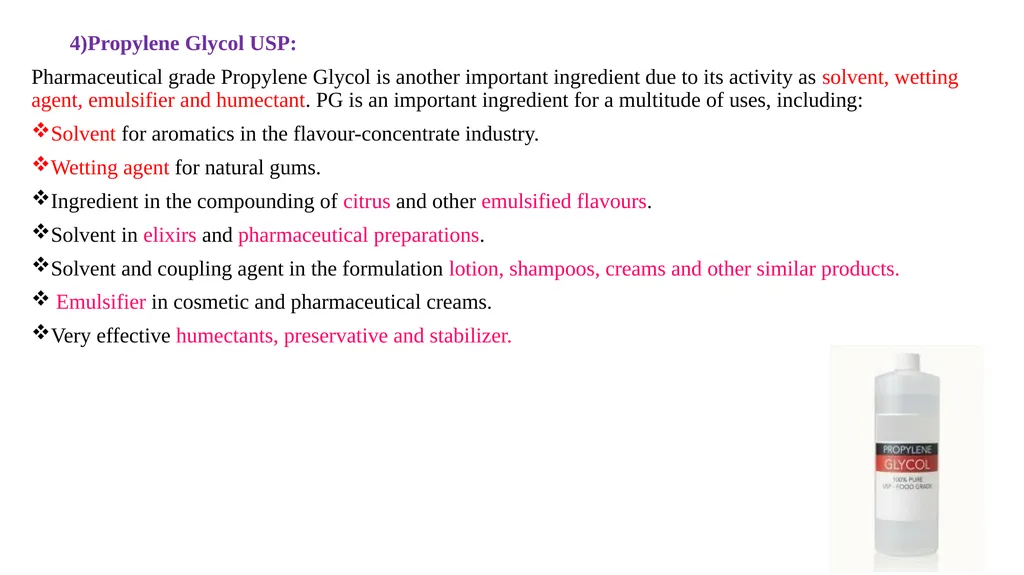
4)Propylene Glycol USP:
Pharmaceutical grade Propylene Glycol is another important ingredient due to its activity as solvent, wetting agent, emulsifier and humectant. PG is an important ingredient for a multitude of uses, including:
Solvent for aromatics in the flavour-concentrate industry.
Wetting agent for natural gums.
Ingredient in the compounding of citrus and other emulsified flavours.
Solvent in elixirs and pharmaceutical preparations.
Solvent and coupling agent in the formulation lotion, shampoos, creams and other similar products.
Emulsifier in cosmetic and pharmaceutical creams.
Very effective humectants, preservative and stabilizer.<br>
Pharmaceutical grade Propylene Glycol is another important ingredient due to its activity as solvent, wetting agent, emulsifier and humectant. PG is an important ingredient for a multitude of uses, including:
Solvent for aromatics in the flavour-concentrate industry.
Wetting agent for natural gums.
Ingredient in the compounding of citrus and other emulsified flavours.
Solvent in elixirs and pharmaceutical preparations.
Solvent and coupling agent in the formulation lotion, shampoos, creams and other similar products.
Emulsifier in cosmetic and pharmaceutical creams.
Very effective humectants, preservative and stabilizer.<br>
14
2) pH MODIFIERS AND BUFFERING AGENTS
These are the agents which used to control the formulation pH, could prevent large changes during storage. Buffer capacity: 0.01&0.1M and Buffer concentration:0.05 to 0.5M
Selection of buffer should be based on:
Whether the acid-base forms are listed for use in oral liquids.
The stability of the drug and access the buffer
The compatibility between the buffer and container
The combination of buffers can also be used to gain a wider range of pH compared individual buffer alone. Pharmaceutical buffers are carbonates, citrates , lactates, phosphates or nitrates. As the pH of body fluid is 7.4,products such as injections, eye drops and nasal drops should be buffered at this value to avoid irritation.<br>
These are the agents which used to control the formulation pH, could prevent large changes during storage. Buffer capacity: 0.01&0.1M and Buffer concentration:0.05 to 0.5M
Selection of buffer should be based on:
Whether the acid-base forms are listed for use in oral liquids.
The stability of the drug and access the buffer
The compatibility between the buffer and container
The combination of buffers can also be used to gain a wider range of pH compared individual buffer alone. Pharmaceutical buffers are carbonates, citrates , lactates, phosphates or nitrates. As the pH of body fluid is 7.4,products such as injections, eye drops and nasal drops should be buffered at this value to avoid irritation.<br>
15
3)SUSPENDING AGENTS AND VISCOSITY-MODIFYING AGENTS:
Suspending agents can be classified to cellulose derivatives, cays, natural gums, and synthetic gums. In many cases, these excipients are used in combination. For each agent concentration of use and the respective property such as ionic charge, water dispersibility, pH range, theological flow.
Ex. Sodium alginate, Methylcellulose,Hydroxyethylcellulose,Hydroxypropylcellulose,CMC,
Tragacanth, Guar gum.
4)WETTING AGENTS AND SURFACTANTS (SOLUBILIZERS):
Wetting agents are used in liquid dosage forms to create a homogenous dispersion of solid particles in a liquid vehicle. Wetting agents are Surfactants (HLB Value 7 to 9) that when dissolved in water, lower the contact angle and aid in spreadability of water on the particles surface to displace the air layer at the surface and help in wetting and solubilization.
Examples: Benzalkonium chloride, Cetylpyridinium chloride, Octoxynol Poloxamer Polyoxyl 40 hydrogenated ,castor oil, Polysorbate 20, Polysorbate 40, Polysorbate 60 Polysorbate 80, Sodium lauryl sulfate, Sorbitan monolaurate, Sorbitan monopalmitate, Sorbitan monostearate<br>
Suspending agents can be classified to cellulose derivatives, cays, natural gums, and synthetic gums. In many cases, these excipients are used in combination. For each agent concentration of use and the respective property such as ionic charge, water dispersibility, pH range, theological flow.
Ex. Sodium alginate, Methylcellulose,Hydroxyethylcellulose,Hydroxypropylcellulose,CMC,
Tragacanth, Guar gum.
4)WETTING AGENTS AND SURFACTANTS (SOLUBILIZERS):
Wetting agents are used in liquid dosage forms to create a homogenous dispersion of solid particles in a liquid vehicle. Wetting agents are Surfactants (HLB Value 7 to 9) that when dissolved in water, lower the contact angle and aid in spreadability of water on the particles surface to displace the air layer at the surface and help in wetting and solubilization.
Examples: Benzalkonium chloride, Cetylpyridinium chloride, Octoxynol Poloxamer Polyoxyl 40 hydrogenated ,castor oil, Polysorbate 20, Polysorbate 40, Polysorbate 60 Polysorbate 80, Sodium lauryl sulfate, Sorbitan monolaurate, Sorbitan monopalmitate, Sorbitan monostearate<br>
16
5)PRESERVATIVES:
Preservatives are substances added to various pharmaceutical dosage forms and cosmetic preparations to prevent or inhibit microbial growth. An ideal preservative would be effective at low concentrations against all possible micro organism, be non-toxic and compatible with other constituent of the preparation and be stable for the shelf-life of the preparation
The majorities of preservatives are bacteriostatic rather than bacteriocidal, and consists of both acid and non acid types.
Typical Preservatives Used in Oral Liquid Dosage Forms:
Among the acidic types are phenol, chloro-cresol, 9-phenyl phenol, alkyl esters of para-hydroxy benzoic acid, benzoic acid (0.1-2%) boric acid, and sorbic acid, and their respective salts.
Neutral preservatives include chlorobutanol, benzyl alcohol, and beta-phenylethyl alcohol.
Alcohol (15-20%), Glycerin (45%), Benzyl alcohol, Bronopol, Chlorbutol, Chlorocresol, Butylparaben, Methylparaben and Propylparaben(10:1), Phenol,Phenoxyethanol Sodium benzoate(0.1 to2%), Antimicrobial solvents like propylene Dycol, chloroform etc.
In addition, some formulation ingredients like nonionic surfactánts, quaternary ammonium compounds, gelatin, ferric salts, calcium salts and salts of heavy metals, including silver, lead, and mercury prevent microbial growth.<br>
Preservatives are substances added to various pharmaceutical dosage forms and cosmetic preparations to prevent or inhibit microbial growth. An ideal preservative would be effective at low concentrations against all possible micro organism, be non-toxic and compatible with other constituent of the preparation and be stable for the shelf-life of the preparation
The majorities of preservatives are bacteriostatic rather than bacteriocidal, and consists of both acid and non acid types.
Typical Preservatives Used in Oral Liquid Dosage Forms:
Among the acidic types are phenol, chloro-cresol, 9-phenyl phenol, alkyl esters of para-hydroxy benzoic acid, benzoic acid (0.1-2%) boric acid, and sorbic acid, and their respective salts.
Neutral preservatives include chlorobutanol, benzyl alcohol, and beta-phenylethyl alcohol.
Alcohol (15-20%), Glycerin (45%), Benzyl alcohol, Bronopol, Chlorbutol, Chlorocresol, Butylparaben, Methylparaben and Propylparaben(10:1), Phenol,Phenoxyethanol Sodium benzoate(0.1 to2%), Antimicrobial solvents like propylene Dycol, chloroform etc.
In addition, some formulation ingredients like nonionic surfactánts, quaternary ammonium compounds, gelatin, ferric salts, calcium salts and salts of heavy metals, including silver, lead, and mercury prevent microbial growth.<br>
17
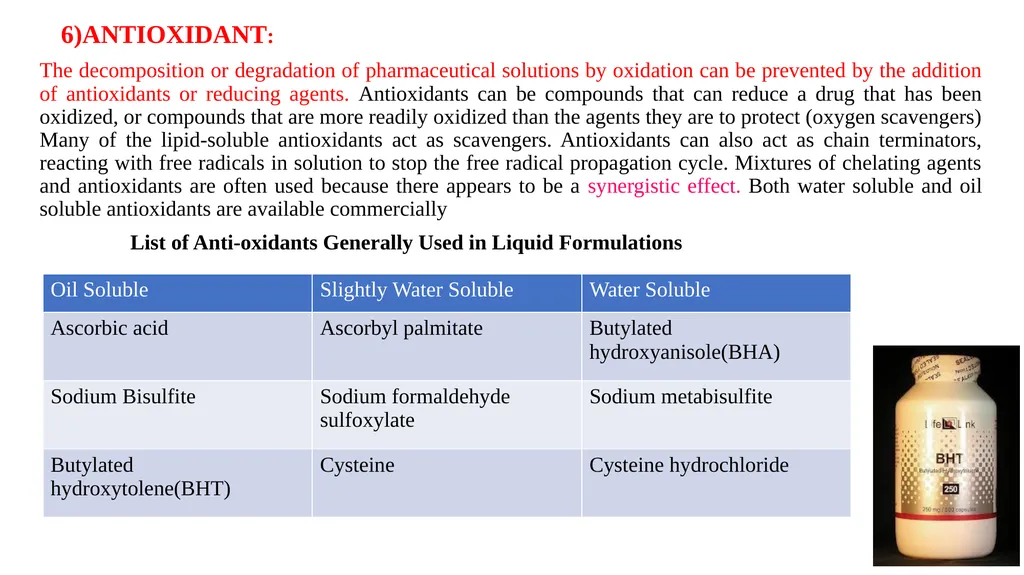
6)ANTIOXIDANT:
The decomposition or degradation of pharmaceutical solutions by oxidation can be prevented by the addition of antioxidants or reducing agents. Antioxidants can be compounds that can reduce a drug that has been oxidized, or compounds that are more readily oxidized than the agents they are to protect (oxygen scavengers) Many of the lipid-soluble antioxidants act as scavengers. Antioxidants can also act as chain terminators, reacting with free radicals in solution to stop the free radical propagation cycle. Mixtures of chelating agents and antioxidants are often used because there appears to be a synergistic effect. Both water soluble and oil soluble antioxidants are available commercially
List of Anti-oxidants Generally Used in Liquid Formulations<br>
The decomposition or degradation of pharmaceutical solutions by oxidation can be prevented by the addition of antioxidants or reducing agents. Antioxidants can be compounds that can reduce a drug that has been oxidized, or compounds that are more readily oxidized than the agents they are to protect (oxygen scavengers) Many of the lipid-soluble antioxidants act as scavengers. Antioxidants can also act as chain terminators, reacting with free radicals in solution to stop the free radical propagation cycle. Mixtures of chelating agents and antioxidants are often used because there appears to be a synergistic effect. Both water soluble and oil soluble antioxidants are available commercially
List of Anti-oxidants Generally Used in Liquid Formulations<br>
18
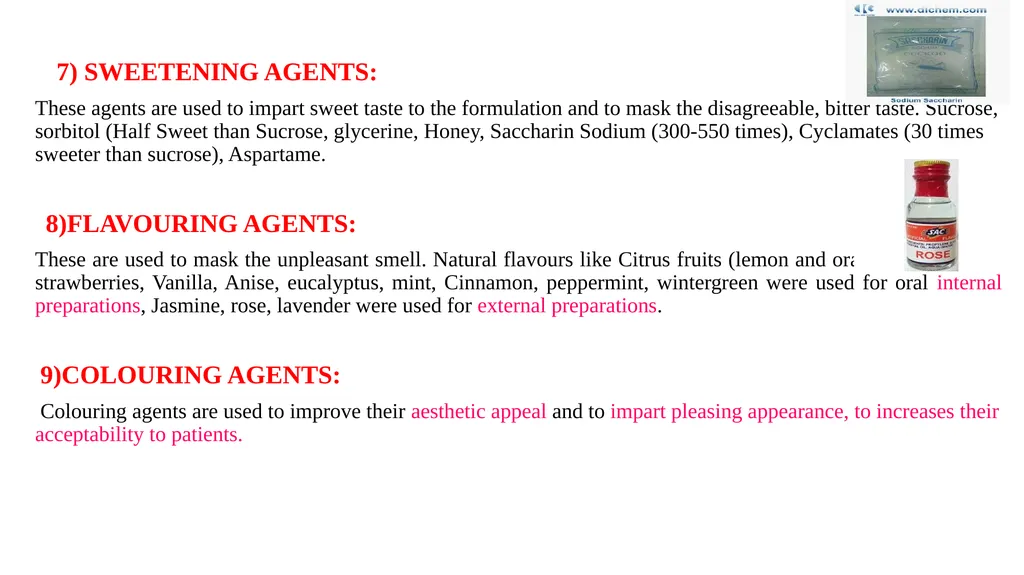
7) SWEETENING AGENTS:
These agents are used to impart sweet taste to the formulation and to mask the disagreeable, bitter taste. Sucrose, sorbitol (Half Sweet than Sucrose, glycerine, Honey, Saccharin Sodium (300-550 times), Cyclamates (30 times sweeter than sucrose), Aspartame.
8)FLAVOURING AGENTS:
These are used to mask the unpleasant smell. Natural flavours like Citrus fruits (lemon and orange), Raspberry, strawberries, Vanilla, Anise, eucalyptus, mint, Cinnamon, peppermint, wintergreen were used for oral internal preparations, Jasmine, rose, lavender were used for external preparations.
9)COLOURING AGENTS:
Colouring agents are used to improve their aesthetic appeal and to impart pleasing appearance, to increases their acceptability to patients.<br>
These agents are used to impart sweet taste to the formulation and to mask the disagreeable, bitter taste. Sucrose, sorbitol (Half Sweet than Sucrose, glycerine, Honey, Saccharin Sodium (300-550 times), Cyclamates (30 times sweeter than sucrose), Aspartame.
8)FLAVOURING AGENTS:
These are used to mask the unpleasant smell. Natural flavours like Citrus fruits (lemon and orange), Raspberry, strawberries, Vanilla, Anise, eucalyptus, mint, Cinnamon, peppermint, wintergreen were used for oral internal preparations, Jasmine, rose, lavender were used for external preparations.
9)COLOURING AGENTS:
Colouring agents are used to improve their aesthetic appeal and to impart pleasing appearance, to increases their acceptability to patients.<br>
19
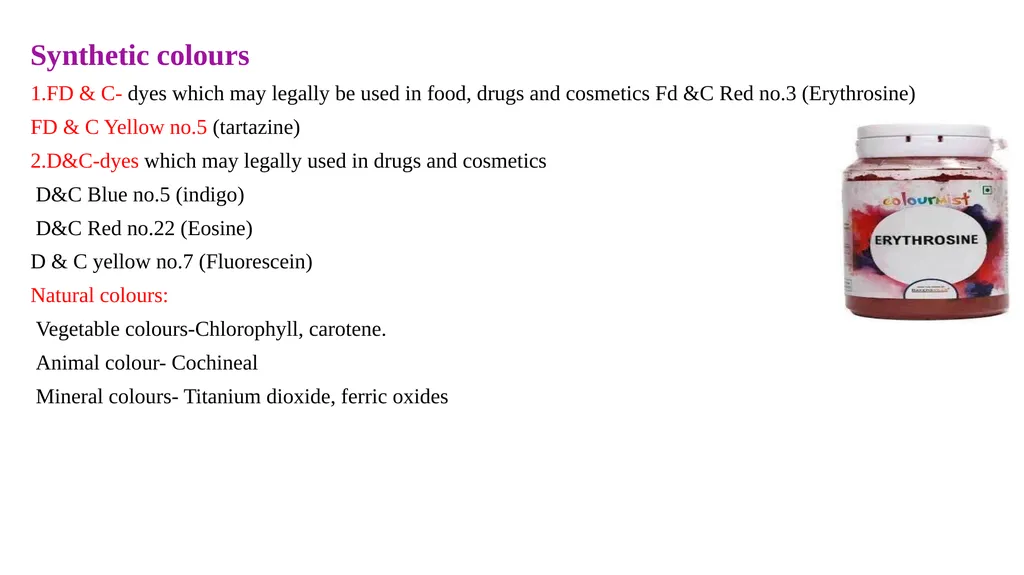
Synthetic colours
1.FD & C- dyes which may legally be used in food, drugs and cosmetics Fd &C Red no.3 (Erythrosine)
FD & C Yellow no.5 (tartazine)
2.D&C-dyes which may legally used in drugs and cosmetics
D&C Blue no.5 (indigo)
D&C Red no.22 (Eosine)
D & C yellow no.7 (Fluorescein)
Natural colours:
Vegetable colours-Chlorophyll, carotene.
Animal colour- Cochineal
Mineral colours- Titanium dioxide, ferric oxides<br>
1.FD & C- dyes which may legally be used in food, drugs and cosmetics Fd &C Red no.3 (Erythrosine)
FD & C Yellow no.5 (tartazine)
2.D&C-dyes which may legally used in drugs and cosmetics
D&C Blue no.5 (indigo)
D&C Red no.22 (Eosine)
D & C yellow no.7 (Fluorescein)
Natural colours:
Vegetable colours-Chlorophyll, carotene.
Animal colour- Cochineal
Mineral colours- Titanium dioxide, ferric oxides<br>
20
THANK
YOU<br>
YOU<br>
21
conclusion In todays class we all have completed with concept of the classification and excipients used in the preparation of liquid dosage forms.<br>
22
Thanks for support and guidance:
Prof. (Dr) Namdeo R. Jadhav
Dean, Krishna Institute of Pharmacy,
Krishna Vishwa Vidyapeeth, Karad
Dr. M. V. Ghorpade
Registrar,
Krishna Vishwa Vidyapeeth, Karad<br>
Prof. (Dr) Namdeo R. Jadhav
Dean, Krishna Institute of Pharmacy,
Krishna Vishwa Vidyapeeth, Karad
Dr. M. V. Ghorpade
Registrar,
Krishna Vishwa Vidyapeeth, Karad<br>
23
And above all
Hon. Dr. Sureshji Bhosale
Chancellor, KVV,
Chairman, Krishna Charitable Trust, Karad<br>
Hon. Dr. Sureshji Bhosale
Chancellor, KVV,
Chairman, Krishna Charitable Trust, Karad<br>
24
END CREDITS
Concept, script and cast:
Location:
Graphics:
Narration:
Editor:<br>
Concept, script and cast:
Location:
Graphics:
Narration:
Editor:<br>