
LIS618 lecture 0 Introduction to the course Thomas


Description: LIS618 lecture 0 Introduction to the course Thomas Krichel 2011-04-21 structure me the way I see it you the way you see it. me I am Thomas Krichel. My homepage is http:openlib.orghomekrichel. You can also use
Related Topics
Download Presentation
"LIS618 lecture 0 Introduction to the course Thomas" is the property of its rightful owner. Permission is granted to download and print the materials on this website for personal, non-commercial use only, and to display it on your personal computer provided you do not modify the materials and that you retain all copyright notices contained in the materials. By downloading content from our website, you accept the terms of this agreement.
Presentation Transcript
slide1. LIS618 lecture 0
Introduction to the course Thomas Krichel
2011-04-21<br>
slide2. structure me
the way I see it
you
the way you see it.<br>
slide3. me I am Thomas Krichel.
My homepage is http://openlib.org/home/krichel. You can also use http://wotan.liu.edu/home/krichel, it contains almost the same contents at all times.<br>
slide4. my courses page My courses are at http://wotan.liu.edu/home/krichel/courses.
These contain material for all current and previous editions of all courses that I ran at the Palmer School.
I am an open access supporter.<br>
slide5. me and LIS618 In 2003, the course was called “database searching”.
Since 2004, it has been called “online information retrieval techniques”.
Let me try to clarify both terms.<br>
slide6. term “database” A database is an organized collection of data for one or more purposes, usually in digital form. The data are typically organized to model relevant aspects of reality (for example, the availability of rooms in hotels), in a way that supports processes requiring this information (for example, finding a hotel with vacancies).<br>
slide7. this is not our database The previous definition is not what librarians mean when they talk about databases, with the use of the term “database searching”.
What they mean by “database” is any type of, usually remote access, resource that the library has purchased.
Searching Google is not “database searching”.<br>
slide8. searching When using the term searching with database searching we mean the following process
a user has an information need
the user formulates a query
the user is presented with a set of results
Librarians love searching. Users love finding.<br>
slide9. why study database searching? There are historical reasons.
There are pedagogical reasons.
There are reasons of transparency.<br>
slide10. historical reasons When libraries first licensed remote content, it was very expensive and difficult to use.
The telecommunications charges where high.
The cost of the system access was high. There often was a charge by minute.
The systems were difficult to use. They were not suitable for a non-trained user.
Database searching by a librarian is a way to save cost.<br>
slide11. historical reasons today The historical reasons don’t seem to apply.
There are still reasons why you have intermediated searching.
One important one is to save the searcher (a high-salary individual) time and have the search conducted by someone with a lower salary.
A lot of these job are outsourced.<br>
slide12. pedagogical reasons As librarians, we need to teach people how to use online information resources.
Unless they can do this themselves.
Many (most) think they can.
The pedagogical reasons seem to disappear over time.
There are however serious problems of transparency.<br>
slide13. transparency In days of old library databases where proprietary.
The engines provided documentation on how to search contents to a detailed level. The release of this information did not damage the business.
In the days of search engines (the new “database”) the algorithms to search are secret.<br>
slide14. secrecy in search There are some indications has the search engines give on how they do their work.
But overall the algorithms are secret.
The monopoly of Google makes for a serious threat to the information culture.
The solution would be to build and operate open-source engines. I have done some pioneering but small scale work in this area.<br>
slide15. information retrieval Deals with how to build systems that allow users, even untrained, obtain complicated information.
This is big business. Google, arguably the most successful business of the early 21st century, owes it all it information retrieval.
In particular, to web information retrieval.<br>
slide16. online information retrieval techniques This is different from database searching because we are talking about techniques.
Successful database requires techniques at the level of query formulation.
But it more requires an overall knowledge of the database, it’s contents, structure.
This is more the subject of a sources and services type course.<br>
slide17. http://openlib.org/home/krichel Please shutdown the computers when
you are done.
Thank you for your attention!<br>
slide19. Not CoveRED because of ILLNESS not cover<br>
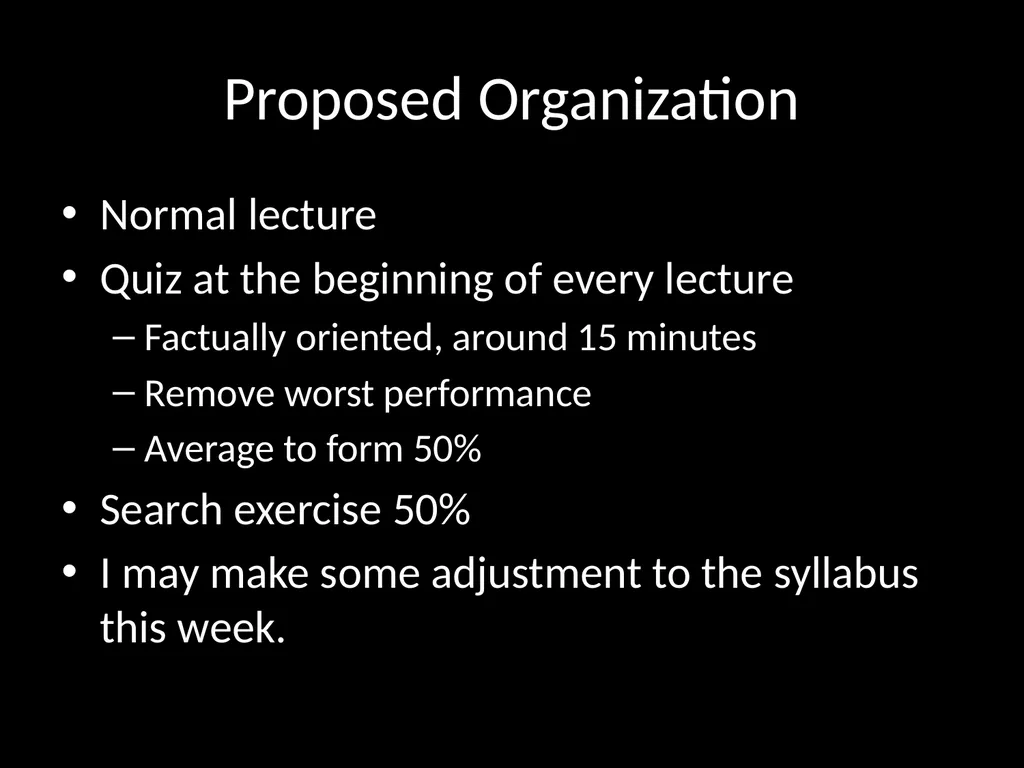
slide20. Proposed Organization Normal lecture
Quiz at the beginning of every lecture
Factually oriented, around 15 minutes
Remove worst performance
Average to form 50%
Search exercise 50%
I may make some adjustment to the syllabus this week.<br>
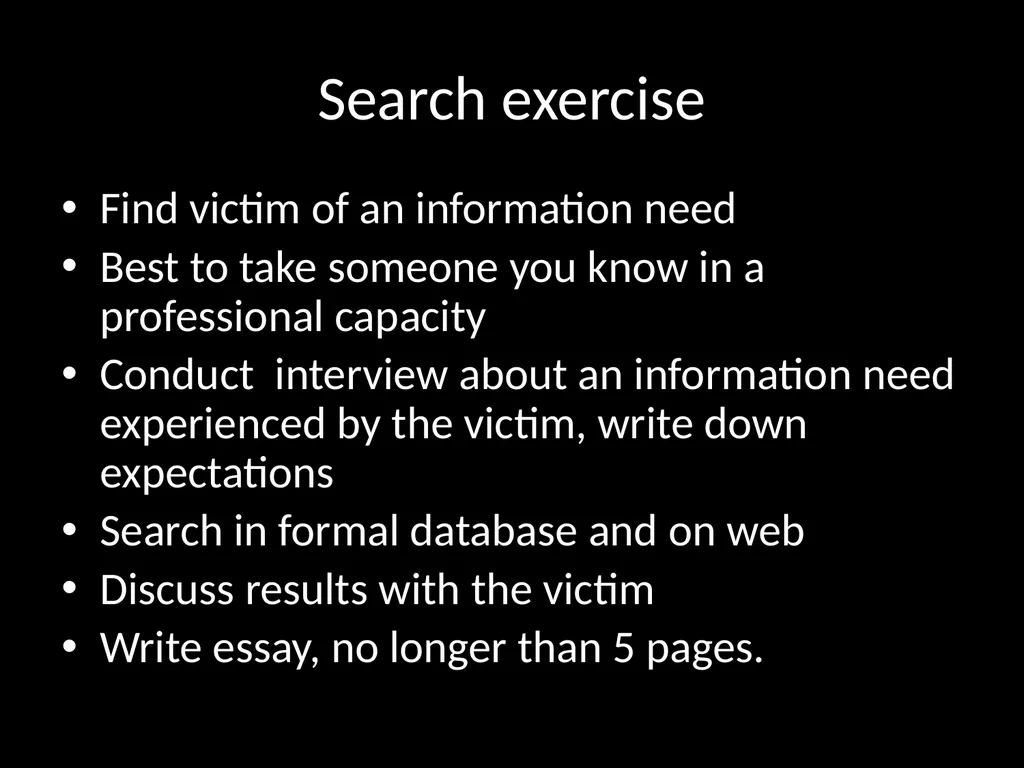
slide21. Search exercise Find victim of an information need
Best to take someone you know in a professional capacity
Conduct interview about an information need experienced by the victim, write down expectations
Search in formal database and on web
Discuss results with the victim
Write essay, no longer than 5 pages.<br>
slide22. about the course This course is new wine in an old bottle
Officially a merger of
lis566 information resources on the Internet
mailing lists
usenet news
web searching
lis618 database searching
access and use of commercial databases<br>
slide23. mix of theory and practice I am not a database search practitioner.
Each database is different, practical skills are not easily transferable.
Thus my emphasis in the course is more on theory.
In the past, I did theory first, then practice.
These day I mix. Some theory and some practice in every session.<br>
slide24. What online retrieval systems? Dialog has been the traditional database covered.
They were the market leaders in online databases in the past.
Nowadays the field is much more open.
They remain a very good teaching tool for command based database searching.
Nexis: a news database I have covered every year.
Google: a well-known search engine that I started to cover two years ago.<br>
slide25. other stuff Other online IR systems that I have covered in the past
OCLC FirstSearch
Factiva (briefly)
WestLaw (external speaker)
New developments
Peer-to-peer networks
an introduction to reference linking using OpenURL
Old developments with library potential
relational databases<br>
slide26. About me Born 1965, in Völklingen (Germany)
Studied economics and social sciences at the Universities of Toulouse, Paris, Exeter and Leiceister.
PhD in theoretical macroeconomics
Lecturer in Economics at the University of Surrey 1993 and 2001
Since 2001 assistant professor at the Palmer School<br>
slide27. Why? During research assistantship period, (1990 to 1993) I was constantly frustrated with difficult access to scientific literature.
At the same time, I discovered easy access to freely downloadable software over the Internet.
I decided to work towards downloadable scientific documents. This lead to my library career (eventually).<br>
slide28. Steps taken I 1993 founded the NetEc project at http://netec.mcc.ac.uk, later available at http://netec.ier.hit-u.ac.jp as well as at http://netec.wustl.edu.
These are networking projects targeted to the economics community. The bulk is
Information about working papers
Downloadable working papers
Journal articles were added later<br>
slide29. Steps taken II Set up RePEc, a digital library for economics research. Catalogs
Research documents
Collections of research documents
Researchers themselves
Organizations that are important to the research process
Decentralized collection, model for the open archives initiative<br>
slide30. Steps taken III Co-founder of Open Archives Initiative
Work on the Academic Metadata Format
Co-founded rclis, a RePEc clone for (Research in Computing, Library and Information Science)
Currently working on the Konz project. It uses a database of titles of journal published papers and tries to find them on the Internet.<br>
slide31. my interest in databases an important emphasis of course is still on commercial databases.
From my point of view I have two interests in database searching
As a provider, I must understand how people search in order to provide some data that they can use and will use.
As an economist, I have a strong interest in information as a commodity. The database market is an important market place.<br>
slide32. online information retrieval This subject can be though off as a subset of information retrieval (IR). Most IR is online or digital.
IR concentrates on textual data.
We can think of online IR to fall under two categories
database IR
web IR<br>
slide33. database / web IR Database IR look at systems that have
controlled set of record
low heterogeneity
use requires authentication
advanced search features
Web IR has opposite characteristics<br>
slide34. traditional social model User goes to a library
Describes problem to the librarian
Librarian does the search
without the user present
with the user present
Hands over the result to the user
User fetches full-text or asks a librarian to fetch the full text.<br>
slide35. economic rational for traditional model In olden days the cost of telecommunication was high.
Database use costs
cost of communication
cost of access time to the database
The traditional model controls an upper limit to the costs.<br>
slide36. disintermediation With access cost time gone, the traditional model is under threat
There is disintermediation where the librarian looses her role of doing the search.
But that may not be good news for information retrieval results
user knows subject matter best
librarian knows searching best<br>
slide37. Web searching IR has received a lot of impetus through the web, which poses unprecedented search challenges.
With more and more data appearing on the web DS may be a subject in decline
It is primarily concerned with non-web databases
There is more and more web-based methods of searching<br>
slide38. Public access vs quality Now the public at large is able to do online searching.
At the same time need for quality answers has grown.
Quality-filtered services will become more important.
In the current databases, there is as lot that would already be available for free mixed with quality-controlled stuff.
Publishers have direct offerings and intermediated vending is in decline.<br>
slide39. http://openlib.org/home/krichel Thank you for your attention!<br>
2011-04-21<br>
slide2. structure me
the way I see it
you
the way you see it.<br>
slide3. me I am Thomas Krichel.
My homepage is http://openlib.org/home/krichel. You can also use http://wotan.liu.edu/home/krichel, it contains almost the same contents at all times.<br>
slide4. my courses page My courses are at http://wotan.liu.edu/home/krichel/courses.
These contain material for all current and previous editions of all courses that I ran at the Palmer School.
I am an open access supporter.<br>
slide5. me and LIS618 In 2003, the course was called “database searching”.
Since 2004, it has been called “online information retrieval techniques”.
Let me try to clarify both terms.<br>
slide6. term “database” A database is an organized collection of data for one or more purposes, usually in digital form. The data are typically organized to model relevant aspects of reality (for example, the availability of rooms in hotels), in a way that supports processes requiring this information (for example, finding a hotel with vacancies).<br>
slide7. this is not our database The previous definition is not what librarians mean when they talk about databases, with the use of the term “database searching”.
What they mean by “database” is any type of, usually remote access, resource that the library has purchased.
Searching Google is not “database searching”.<br>
slide8. searching When using the term searching with database searching we mean the following process
a user has an information need
the user formulates a query
the user is presented with a set of results
Librarians love searching. Users love finding.<br>
slide9. why study database searching? There are historical reasons.
There are pedagogical reasons.
There are reasons of transparency.<br>
slide10. historical reasons When libraries first licensed remote content, it was very expensive and difficult to use.
The telecommunications charges where high.
The cost of the system access was high. There often was a charge by minute.
The systems were difficult to use. They were not suitable for a non-trained user.
Database searching by a librarian is a way to save cost.<br>
slide11. historical reasons today The historical reasons don’t seem to apply.
There are still reasons why you have intermediated searching.
One important one is to save the searcher (a high-salary individual) time and have the search conducted by someone with a lower salary.
A lot of these job are outsourced.<br>
slide12. pedagogical reasons As librarians, we need to teach people how to use online information resources.
Unless they can do this themselves.
Many (most) think they can.
The pedagogical reasons seem to disappear over time.
There are however serious problems of transparency.<br>
slide13. transparency In days of old library databases where proprietary.
The engines provided documentation on how to search contents to a detailed level. The release of this information did not damage the business.
In the days of search engines (the new “database”) the algorithms to search are secret.<br>
slide14. secrecy in search There are some indications has the search engines give on how they do their work.
But overall the algorithms are secret.
The monopoly of Google makes for a serious threat to the information culture.
The solution would be to build and operate open-source engines. I have done some pioneering but small scale work in this area.<br>
slide15. information retrieval Deals with how to build systems that allow users, even untrained, obtain complicated information.
This is big business. Google, arguably the most successful business of the early 21st century, owes it all it information retrieval.
In particular, to web information retrieval.<br>
slide16. online information retrieval techniques This is different from database searching because we are talking about techniques.
Successful database requires techniques at the level of query formulation.
But it more requires an overall knowledge of the database, it’s contents, structure.
This is more the subject of a sources and services type course.<br>
slide17. http://openlib.org/home/krichel Please shutdown the computers when
you are done.
Thank you for your attention!<br>
slide19. Not CoveRED because of ILLNESS not cover<br>
slide20. Proposed Organization Normal lecture
Quiz at the beginning of every lecture
Factually oriented, around 15 minutes
Remove worst performance
Average to form 50%
Search exercise 50%
I may make some adjustment to the syllabus this week.<br>
slide21. Search exercise Find victim of an information need
Best to take someone you know in a professional capacity
Conduct interview about an information need experienced by the victim, write down expectations
Search in formal database and on web
Discuss results with the victim
Write essay, no longer than 5 pages.<br>
slide22. about the course This course is new wine in an old bottle
Officially a merger of
lis566 information resources on the Internet
mailing lists
usenet news
web searching
lis618 database searching
access and use of commercial databases<br>
slide23. mix of theory and practice I am not a database search practitioner.
Each database is different, practical skills are not easily transferable.
Thus my emphasis in the course is more on theory.
In the past, I did theory first, then practice.
These day I mix. Some theory and some practice in every session.<br>
slide24. What online retrieval systems? Dialog has been the traditional database covered.
They were the market leaders in online databases in the past.
Nowadays the field is much more open.
They remain a very good teaching tool for command based database searching.
Nexis: a news database I have covered every year.
Google: a well-known search engine that I started to cover two years ago.<br>
slide25. other stuff Other online IR systems that I have covered in the past
OCLC FirstSearch
Factiva (briefly)
WestLaw (external speaker)
New developments
Peer-to-peer networks
an introduction to reference linking using OpenURL
Old developments with library potential
relational databases<br>
slide26. About me Born 1965, in Völklingen (Germany)
Studied economics and social sciences at the Universities of Toulouse, Paris, Exeter and Leiceister.
PhD in theoretical macroeconomics
Lecturer in Economics at the University of Surrey 1993 and 2001
Since 2001 assistant professor at the Palmer School<br>
slide27. Why? During research assistantship period, (1990 to 1993) I was constantly frustrated with difficult access to scientific literature.
At the same time, I discovered easy access to freely downloadable software over the Internet.
I decided to work towards downloadable scientific documents. This lead to my library career (eventually).<br>
slide28. Steps taken I 1993 founded the NetEc project at http://netec.mcc.ac.uk, later available at http://netec.ier.hit-u.ac.jp as well as at http://netec.wustl.edu.
These are networking projects targeted to the economics community. The bulk is
Information about working papers
Downloadable working papers
Journal articles were added later<br>
slide29. Steps taken II Set up RePEc, a digital library for economics research. Catalogs
Research documents
Collections of research documents
Researchers themselves
Organizations that are important to the research process
Decentralized collection, model for the open archives initiative<br>
slide30. Steps taken III Co-founder of Open Archives Initiative
Work on the Academic Metadata Format
Co-founded rclis, a RePEc clone for (Research in Computing, Library and Information Science)
Currently working on the Konz project. It uses a database of titles of journal published papers and tries to find them on the Internet.<br>
slide31. my interest in databases an important emphasis of course is still on commercial databases.
From my point of view I have two interests in database searching
As a provider, I must understand how people search in order to provide some data that they can use and will use.
As an economist, I have a strong interest in information as a commodity. The database market is an important market place.<br>
slide32. online information retrieval This subject can be though off as a subset of information retrieval (IR). Most IR is online or digital.
IR concentrates on textual data.
We can think of online IR to fall under two categories
database IR
web IR<br>
slide33. database / web IR Database IR look at systems that have
controlled set of record
low heterogeneity
use requires authentication
advanced search features
Web IR has opposite characteristics<br>
slide34. traditional social model User goes to a library
Describes problem to the librarian
Librarian does the search
without the user present
with the user present
Hands over the result to the user
User fetches full-text or asks a librarian to fetch the full text.<br>
slide35. economic rational for traditional model In olden days the cost of telecommunication was high.
Database use costs
cost of communication
cost of access time to the database
The traditional model controls an upper limit to the costs.<br>
slide36. disintermediation With access cost time gone, the traditional model is under threat
There is disintermediation where the librarian looses her role of doing the search.
But that may not be good news for information retrieval results
user knows subject matter best
librarian knows searching best<br>
slide37. Web searching IR has received a lot of impetus through the web, which poses unprecedented search challenges.
With more and more data appearing on the web DS may be a subject in decline
It is primarily concerned with non-web databases
There is more and more web-based methods of searching<br>
slide38. Public access vs quality Now the public at large is able to do online searching.
At the same time need for quality answers has grown.
Quality-filtered services will become more important.
In the current databases, there is as lot that would already be available for free mixed with quality-controlled stuff.
Publishers have direct offerings and intermediated vending is in decline.<br>
slide39. http://openlib.org/home/krichel Thank you for your attention!<br>