
Literature review to frame the development of
YM
Published · 30 slides · 0 views

1 / 1
Description
Literature review to frame the development of professional standards for community pharmacy Prepared by Sally Williams, inQuisit Ltd for the Royal Pharmaceutical Society, January 2019 Contents Introduction page 3 Approach to the literature
Related Topics
Share
Embed code
Download this presentation From Below
"Literature review to frame the development of" is the property of its rightful owner. Permission is granted to download and print the materials on this website for personal, non-commercial use only, and to display it on your personal computer provided you do not modify the materials and that you retain all copyright notices contained in the materials. By downloading content from our website, you accept the terms of this agreement.
Presentation Transcript
01
Literature review to frame the development of professional standards for community pharmacy Prepared by Sally Williams, inQuisit Ltd for the Royal Pharmaceutical Society, January 2019<br>
02
Contents Introduction page 3
Approach to the literature review page 4
The policy context page 5
Existing standards for community pharmacy page 6
Integrated models of care page 7
Delivering care beyond the high street page 8
Multiprofessional teamworking page 9
Patient-centred care page 10
Raising public awareness page 11
Privacy and confidentiality page 12
Professionalism and giving trusted advice page 13
Workload and wellbeing page 14
Skill-mix and delegation page 15
Essential services – medicines supply page 16
OTC medicines and other products page 17
Public health page 18
Breadth of services, registration and health records page 19
Quality improvement, risk management and learning page 20
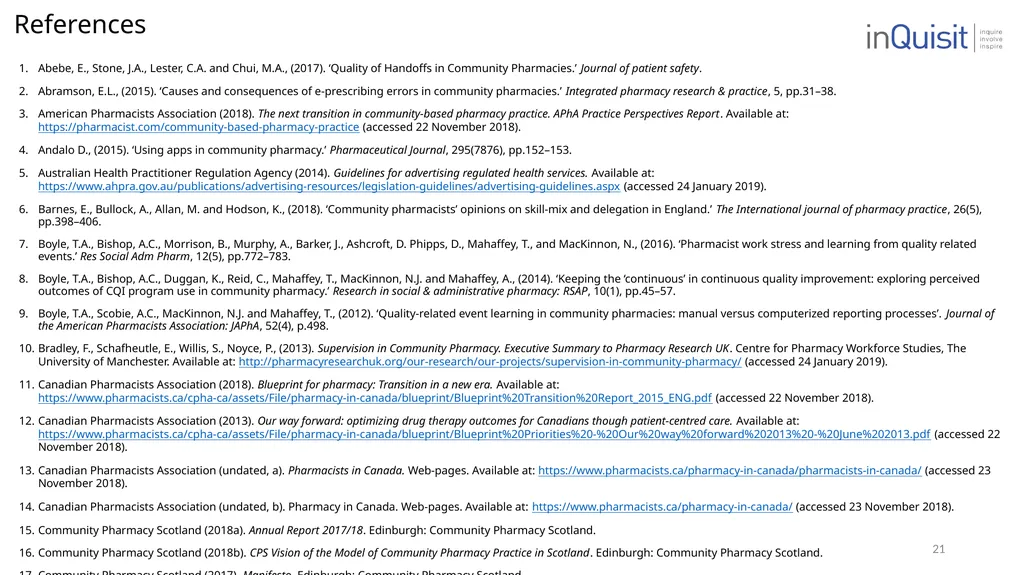
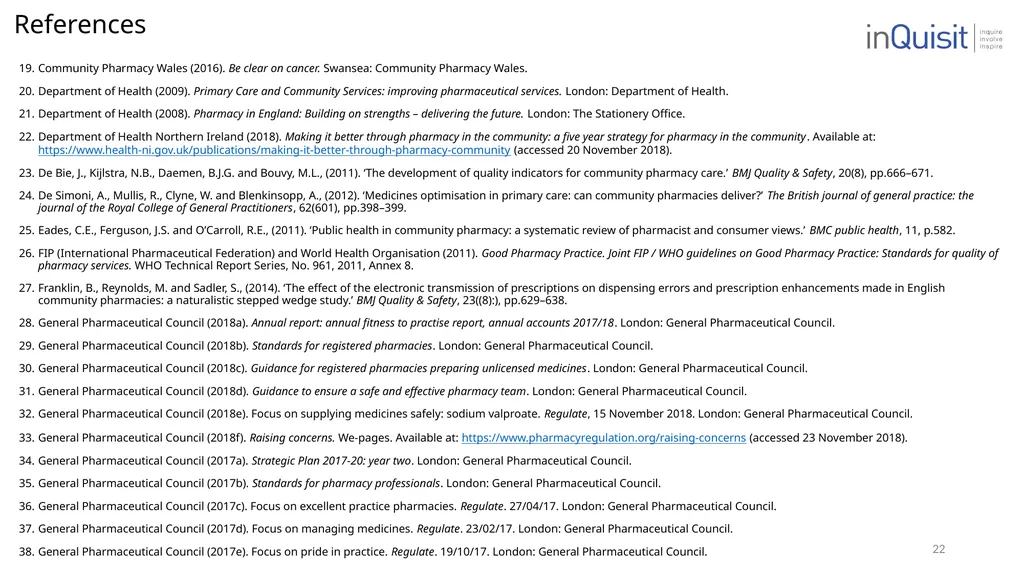
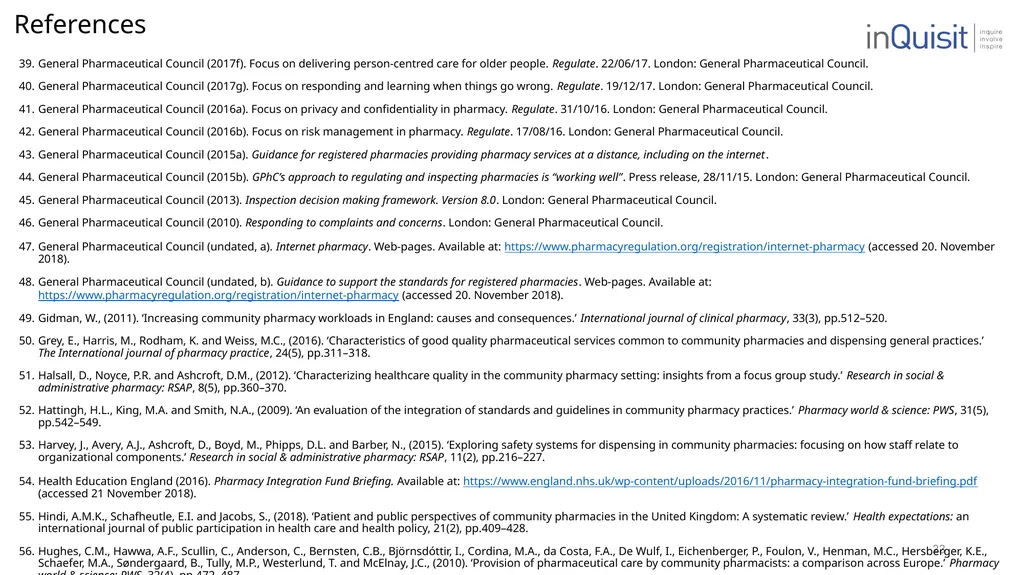
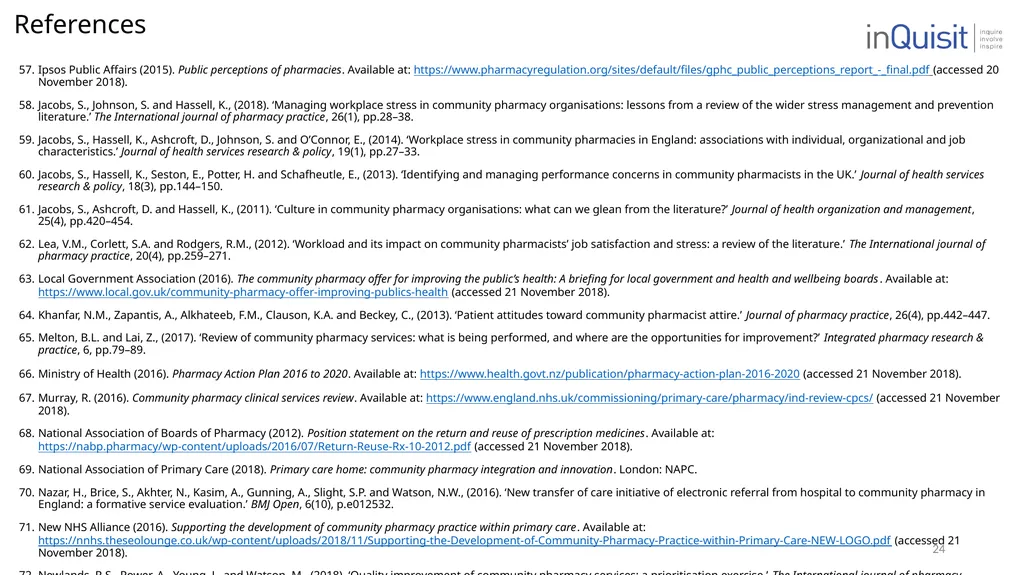
References page 21 – 30 2<br>
Approach to the literature review page 4
The policy context page 5
Existing standards for community pharmacy page 6
Integrated models of care page 7
Delivering care beyond the high street page 8
Multiprofessional teamworking page 9
Patient-centred care page 10
Raising public awareness page 11
Privacy and confidentiality page 12
Professionalism and giving trusted advice page 13
Workload and wellbeing page 14
Skill-mix and delegation page 15
Essential services – medicines supply page 16
OTC medicines and other products page 17
Public health page 18
Breadth of services, registration and health records page 19
Quality improvement, risk management and learning page 20
References page 21 – 30 2<br>
03
Introduction The Royal Pharmaceutical Society (RPS) is the dedicated professional body for pharmacists in England, Scotland and Wales. It has previously produced, and updated, professional standards for hospital pharmacy (RPS, 2017). It is now working to develop professional standards for community pharmacy. This literature review seeks to frame discussion amongst the key stakeholders who will come together to develop the new standards. The review explored the following questions:
What standards already exist for community pharmacy – what do they cover (pharmacy supply/services); what status do they have (e.g. regulatory/advisory)?
Are there gaps, or conflicts, in the standards that currently exist, and how might RPS professional standards address these?
What changes to the community pharmacy landscape are underway, or on the horizon, where standards may be helpful?
What can the RPS learn from other countries regarding community pharmacy?
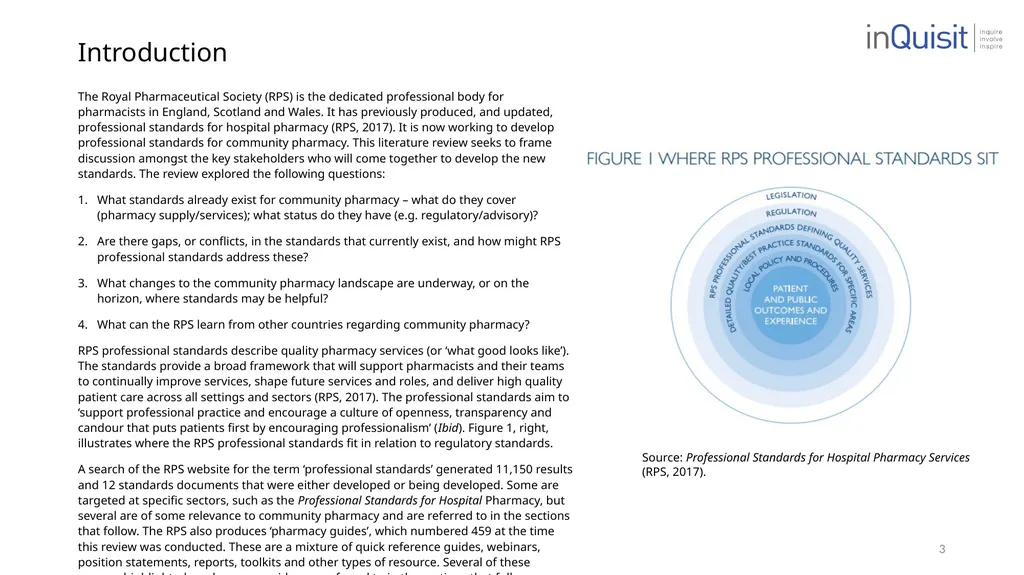
RPS professional standards describe quality pharmacy services (or ‘what good looks like’). The standards provide a broad framework that will support pharmacists and their teams to continually improve services, shape future services and roles, and deliver high quality patient care across all settings and sectors (RPS, 2017). The professional standards aim to ‘support professional practice and encourage a culture of openness, transparency and candour that puts patients first by encouraging professionalism’ (Ibid). Figure 1, right, illustrates where the RPS professional standards fit in relation to regulatory standards.
A search of the RPS website for the term ‘professional standards’ generated 11,150 results and 12 standards documents that were either developed or being developed. Some are targeted at specific sectors, such as the Professional Standards for Hospital Pharmacy, but several are of some relevance to community pharmacy and are referred to in the sections that follow. The RPS also produces ‘pharmacy guides’, which numbered 459 at the time this review was conducted. These are a mixture of quick reference guides, webinars, position statements, reports, toolkits and other types of resource. Several of these sources highlighted as pharmacy guides are referred to in the sections that follow, however some were ‘member only content’ and therefore unavailable for review. Source: Professional Standards for Hospital Pharmacy Services (RPS, 2017). 3<br>
What standards already exist for community pharmacy – what do they cover (pharmacy supply/services); what status do they have (e.g. regulatory/advisory)?
Are there gaps, or conflicts, in the standards that currently exist, and how might RPS professional standards address these?
What changes to the community pharmacy landscape are underway, or on the horizon, where standards may be helpful?
What can the RPS learn from other countries regarding community pharmacy?
RPS professional standards describe quality pharmacy services (or ‘what good looks like’). The standards provide a broad framework that will support pharmacists and their teams to continually improve services, shape future services and roles, and deliver high quality patient care across all settings and sectors (RPS, 2017). The professional standards aim to ‘support professional practice and encourage a culture of openness, transparency and candour that puts patients first by encouraging professionalism’ (Ibid). Figure 1, right, illustrates where the RPS professional standards fit in relation to regulatory standards.
A search of the RPS website for the term ‘professional standards’ generated 11,150 results and 12 standards documents that were either developed or being developed. Some are targeted at specific sectors, such as the Professional Standards for Hospital Pharmacy, but several are of some relevance to community pharmacy and are referred to in the sections that follow. The RPS also produces ‘pharmacy guides’, which numbered 459 at the time this review was conducted. These are a mixture of quick reference guides, webinars, position statements, reports, toolkits and other types of resource. Several of these sources highlighted as pharmacy guides are referred to in the sections that follow, however some were ‘member only content’ and therefore unavailable for review. Source: Professional Standards for Hospital Pharmacy Services (RPS, 2017). 3<br>
04
4<br>
05
Ever since the White Paper Pharmacy in England: Building on strengths - delivering the future (Department of Health 2008), highlighted the potential pharmacy has to offer, beyond the safe and effective dispensing of prescriptions, emphasis has been given to expanding the scope of community pharmacy services. In 2008, this included aspirations for community pharmacies to become 'healthy living' centres; promoting health and helping more people to take care of themselves; expanding the range of services on offer to include treatment for many minor ailments; support for people with long term conditions (such as high blood pressure or high cholesterol); and screening (e.g. for those at risk of vascular disease). Since then, successive reports have brought pharmacy more on to the agenda. The Five Year Forward View envisaged pharmacists being part of Multispecialty Community Providers and playing a far greater role in supporting urgent and emergency care (NHS England, 2014a). The General Practice Forward View promised investment in clinical pharmacists to support GP practice prescription processes, medicines optimisation, minor ailments and long term conditions management, in addition to supporting community pharmacy to better support GP practices, care homes and urgent care (NHS England, 2016).
That same year, the Community Pharmacy Forward View set out the sector's vision, focusing on three core domains: community pharmacy serving as the facilitator of personalised care for people with long-term conditions; being the trusted, convenient first port of call for episodic healthcare advice and treatment; and serving as the neighbourhood health and wellbeing hub (Pharmacy Voice, PSNC, RPS, 2016). Professional organisations have has said that delivering this vision relies upon: raising awareness of community pharmacy; supporting local leaders to build partnerships across the health and care system; harnessing technology and secure digital integration; empowering the workforce to develop their skills and manage change; establishing new ways of working and delivering integrated care; and proactively supporting and facilitating sector-development and change management (Pharmacy Voice, PSNC, RPS, 2017).
This is an ambitious and demanding agenda for the profession, and the RPS professional standards for community pharmacy will want to consider how best to assist pharmacists, pharmacy technicians and the wider pharmacy team to deliver these objectives at practice level. This is vital, as a recurrent theme from the literature is that community pharmacy remains 'a much underused resource’ and that progress has been slow since the 2008 White Paper (National Association of Primary Care, 2018; Murray, 2016; Smith et al, 2014). The New NHS Alliance (2016) has expressed disappointment that there is not a community pharmacy led new model of care and that the NHS has failed to fully utilise the expertise of the community pharmacist. It has called for GPs to support community pharmacy as the first call point for patients. Amongst the recommendations made by Smith et al (2014) to develop community pharmacy, and calls for more guidance and support from the RPS, employers and other national bodies about how to become part of the care models set out in the Five Year Forward View. They argue that ‘pharmacists must be relentless in making the case locally’ for their contribution in the future. The RPS professional standards for community pharmacy offer an opportunity to guide pharmacists on how to push ahead at local level, how to influence local commissioners, and how to become involved in the work of federations and new models of primary and community provision.
In terms of looking over the horizon and future-proofing professional standards for community pharmacy, the strategic plans of professional regulators and membership bodies for pharmacy highlight both societal challenges, such as the economic uncertainty associated with Brexit and the implications of leaving the EU for workforce planning and medicines regulation (GPhC, 2017; Pharmaceutical Society of Ireland, 2018), as well as public health and demographic challenges. New technologies, such as artificial intelligence and machine learning, will pose new opportunities, but also new risks, and community pharmacy is thought to be at risk of being ‘overtaken by the inexorable expansion of technology-driven dispensing and supply’ if the sector does not effectively position itself as part of national and local planning (Smith et al, 2014). Developments in medicine, such as stratified medicine using genetic analysis, and medicines that previously were only able to be administered in the hospital setting now provided to patients in their own homes, will also impact on community pharmacy (The Scottish Government, 2013). 5 The policy context<br>
That same year, the Community Pharmacy Forward View set out the sector's vision, focusing on three core domains: community pharmacy serving as the facilitator of personalised care for people with long-term conditions; being the trusted, convenient first port of call for episodic healthcare advice and treatment; and serving as the neighbourhood health and wellbeing hub (Pharmacy Voice, PSNC, RPS, 2016). Professional organisations have has said that delivering this vision relies upon: raising awareness of community pharmacy; supporting local leaders to build partnerships across the health and care system; harnessing technology and secure digital integration; empowering the workforce to develop their skills and manage change; establishing new ways of working and delivering integrated care; and proactively supporting and facilitating sector-development and change management (Pharmacy Voice, PSNC, RPS, 2017).
This is an ambitious and demanding agenda for the profession, and the RPS professional standards for community pharmacy will want to consider how best to assist pharmacists, pharmacy technicians and the wider pharmacy team to deliver these objectives at practice level. This is vital, as a recurrent theme from the literature is that community pharmacy remains 'a much underused resource’ and that progress has been slow since the 2008 White Paper (National Association of Primary Care, 2018; Murray, 2016; Smith et al, 2014). The New NHS Alliance (2016) has expressed disappointment that there is not a community pharmacy led new model of care and that the NHS has failed to fully utilise the expertise of the community pharmacist. It has called for GPs to support community pharmacy as the first call point for patients. Amongst the recommendations made by Smith et al (2014) to develop community pharmacy, and calls for more guidance and support from the RPS, employers and other national bodies about how to become part of the care models set out in the Five Year Forward View. They argue that ‘pharmacists must be relentless in making the case locally’ for their contribution in the future. The RPS professional standards for community pharmacy offer an opportunity to guide pharmacists on how to push ahead at local level, how to influence local commissioners, and how to become involved in the work of federations and new models of primary and community provision.
In terms of looking over the horizon and future-proofing professional standards for community pharmacy, the strategic plans of professional regulators and membership bodies for pharmacy highlight both societal challenges, such as the economic uncertainty associated with Brexit and the implications of leaving the EU for workforce planning and medicines regulation (GPhC, 2017; Pharmaceutical Society of Ireland, 2018), as well as public health and demographic challenges. New technologies, such as artificial intelligence and machine learning, will pose new opportunities, but also new risks, and community pharmacy is thought to be at risk of being ‘overtaken by the inexorable expansion of technology-driven dispensing and supply’ if the sector does not effectively position itself as part of national and local planning (Smith et al, 2014). Developments in medicine, such as stratified medicine using genetic analysis, and medicines that previously were only able to be administered in the hospital setting now provided to patients in their own homes, will also impact on community pharmacy (The Scottish Government, 2013). 5 The policy context<br>
06
Existing standards for community pharmacy The International Pharmaceutical Federation (FIP) and World Health Organisation (2011) provide a framework for ‘good pharmacy practice’ standards based on a review of existing national standards in ‘at least’ 37 countries. This framework states that the mission of pharmacy practice is to 'contribute to health improvement and to help patients with health problems to make the best use of their medicines’.
A plethora of standards and guidance documents already exist; one imagines a challenge for community pharmacy teams is keeping abreast of them all. Standards documents emphasise that pharmacy professionals must adhere to all that laws that apply to pharmacies (GPhC, 2017; PSNI, 2016; Pharmaceutical Society of Australia, 2017; Pharmacy Council of New Zealand, 2018a), including laws on supplying and advertising medicines, medicines regulation, health and safety, equalities legislation, and data protection, to name a few. Some standards documents cite relevant legislation, an approach seen in Northern Ireland, for example (PSNI, 2010 and 2016). The RPS standards for hospital pharmacy (RPS, 2017) are accompanied by a standards handbook providing links to, for example, legal and regulatory frameworks, international standards, and which signposts more detailed guidance.
Professional regulatory standards are relevant to the supply of medicines and devices, as well as to pharmacy services, defined by the GPhC as: 'all pharmacy-related services provided at or from a registered pharmacy including the management of medicines, provision of advice and referral, clinical services such as vaccination services, and services provided to care homes’ (GPhC, 2018). Such standards often place emphasis on self-audit (PSNI, 2010) and on being accessible to the public so that they can understand what to expect of pharmacy teams and premises. A common drive across pharmacy regulators is become more outcome-focused (GPhC, 2017; Pharmaceutical Society of Ireland, 2018a and 2018b). Professional regulatory standards tend to be organised around broad principles and provide high-level statements, such as ‘Pharmacy professionals must behave in a professional manner’ (GPhC, 2017), giving little detail on how the principle should be embedded in daily practice, or what is meant by, for example, 'all necessary records’ or 'enough staff’ (GPhC, 2018). Guidance documents tend to bridge the gap by producing more granular guidance on how to meet the principles, such as on preparing unlicensed medicines (GPhC, 2018) providing services at a distance, including on the internet (GPhC, 2015), how to ensure there is a safe and effective pharmacy team (GPhC, 2018), or on dispensing practice (Pharmaceutical Society of Australia, 2017), as well as on consent, maintaining clear sexual boundaries, patient confidentiality, raising concerns, and many other topics.
GPhC standards and RPS standards are relevant to pharmacists and pharmacy technicians and some cover non-pharmacy staff working in pharmacy settings (GPhC, 2018); other standards are aimed solely at pharmacists (Pharmaceutical Society of Australia, 2017) and pharmacy students (Pharmaceutical Society of Australia, 2017). Guidance is usually not mandatory; some documents distinguish between ‘essential’ and desirable’ standards (for example, PSNI, 2010), or use words such as ‘should’, ‘might’ or ‘may’ to distinguish good practice guidance from mandatory standards (PSNI, 2016). A lack of clarity and differentiation between the ratings used to regulate registered pharmacies (GPhC, 2015 and 2013), highlights the need for care in using terms such as ‘satisfactory’, ‘good’ and ‘excellent’ with respect to pharmaceutical practice. There are several examples of ‘excellent’ practice in the literature (GPhC, 2017) and other learning (GPhC, 2017; PSNI, undated) that may be useful in informing professional standards for community pharmacy. Point to consider in developing professional standards for community pharmacy:
Learning from the GPhC’s plans, set out in its Annual Report (2017/18), to publish learning from its inspections, including examples of ‘good’ and ‘excellent’ practice (GPhC, 2018a)
How best to support pharmacy teams to keep abreast of and meet the wide range of standards and legislative requirements 6<br>
A plethora of standards and guidance documents already exist; one imagines a challenge for community pharmacy teams is keeping abreast of them all. Standards documents emphasise that pharmacy professionals must adhere to all that laws that apply to pharmacies (GPhC, 2017; PSNI, 2016; Pharmaceutical Society of Australia, 2017; Pharmacy Council of New Zealand, 2018a), including laws on supplying and advertising medicines, medicines regulation, health and safety, equalities legislation, and data protection, to name a few. Some standards documents cite relevant legislation, an approach seen in Northern Ireland, for example (PSNI, 2010 and 2016). The RPS standards for hospital pharmacy (RPS, 2017) are accompanied by a standards handbook providing links to, for example, legal and regulatory frameworks, international standards, and which signposts more detailed guidance.
Professional regulatory standards are relevant to the supply of medicines and devices, as well as to pharmacy services, defined by the GPhC as: 'all pharmacy-related services provided at or from a registered pharmacy including the management of medicines, provision of advice and referral, clinical services such as vaccination services, and services provided to care homes’ (GPhC, 2018). Such standards often place emphasis on self-audit (PSNI, 2010) and on being accessible to the public so that they can understand what to expect of pharmacy teams and premises. A common drive across pharmacy regulators is become more outcome-focused (GPhC, 2017; Pharmaceutical Society of Ireland, 2018a and 2018b). Professional regulatory standards tend to be organised around broad principles and provide high-level statements, such as ‘Pharmacy professionals must behave in a professional manner’ (GPhC, 2017), giving little detail on how the principle should be embedded in daily practice, or what is meant by, for example, 'all necessary records’ or 'enough staff’ (GPhC, 2018). Guidance documents tend to bridge the gap by producing more granular guidance on how to meet the principles, such as on preparing unlicensed medicines (GPhC, 2018) providing services at a distance, including on the internet (GPhC, 2015), how to ensure there is a safe and effective pharmacy team (GPhC, 2018), or on dispensing practice (Pharmaceutical Society of Australia, 2017), as well as on consent, maintaining clear sexual boundaries, patient confidentiality, raising concerns, and many other topics.
GPhC standards and RPS standards are relevant to pharmacists and pharmacy technicians and some cover non-pharmacy staff working in pharmacy settings (GPhC, 2018); other standards are aimed solely at pharmacists (Pharmaceutical Society of Australia, 2017) and pharmacy students (Pharmaceutical Society of Australia, 2017). Guidance is usually not mandatory; some documents distinguish between ‘essential’ and desirable’ standards (for example, PSNI, 2010), or use words such as ‘should’, ‘might’ or ‘may’ to distinguish good practice guidance from mandatory standards (PSNI, 2016). A lack of clarity and differentiation between the ratings used to regulate registered pharmacies (GPhC, 2015 and 2013), highlights the need for care in using terms such as ‘satisfactory’, ‘good’ and ‘excellent’ with respect to pharmaceutical practice. There are several examples of ‘excellent’ practice in the literature (GPhC, 2017) and other learning (GPhC, 2017; PSNI, undated) that may be useful in informing professional standards for community pharmacy. Point to consider in developing professional standards for community pharmacy:
Learning from the GPhC’s plans, set out in its Annual Report (2017/18), to publish learning from its inspections, including examples of ‘good’ and ‘excellent’ practice (GPhC, 2018a)
How best to support pharmacy teams to keep abreast of and meet the wide range of standards and legislative requirements 6<br>
07
Integrated models of care When the RPS updated its Professional Standards for Hospital Pharmacy in 2017, one of the objectives was ‘to ensure that as new and more integrated models of care develop the professional standards will continue to be applicable’ (RPS, 2017), and standard three focuses upon ‘integrated transfer of care’. There is a strong emphasis in the literature on integrated models of care involving community pharmacy (NHS England, 2014; NHS England, 2016; NHS Confederation, 2013; PSI, 2018; Pharmaceutical Society of Ireland, 2016; Murray, 2016; The Scottish Government, 2013). The RPS has articulated its shared ambition with the National Association of Primary Care (NAPC) for closer working between GPs, community pharmacists and other community-based healthcare professions to improve medicine use and reduce waste, provide holistic, person-centred care, and to better support people with long-term conditions (RPS and NAPC, 2015). The Community Pharmacy Forward View emphasises a commitment to working as an integrated part of the NHS (Pharmacy Voice, PSNC, RPS, 2016), which relies upon establishing new ways of working and delivering integrated care (Pharmacy Voice, PSNC, RPS and 2017).
Integration is regarded as key to delivering ambitions for community pharmacy and public health, with community pharmacy seen ‘as an integral component of primary care as a service to improve the public's health’ (NHS Confederation, 2013). Strengthening relationships between community pharmacy and general practice is a recurring theme, including within the new care model ‘primary care home’. The National Association of Primary Care has said: 'The new environment requires community pharmacy to be an integrated partner, working seamlessly within pathways with other health and care partners. This requires a deeper understanding of the wider health system. Community pharmacists would no longer be competitors in the community but partners working to improve outcomes’ (NAPC, 2018).
The GP Forward View makes a commitment to pilot 470 clinical pharmacists in over 700 practices, leading to a further 1,500 pharmacists in general practice by 2020, and for a new Pharmacy Integration Fund to facilitate better support for GP practices, care homes and urgent care (NHS England, 2014). The literature highlights support for clinical pharmacists to be embedded within general practice, as well as other settings (New NHS Alliance, 2016) and the potential to promote health and wellbeing messages at the same time as optimising the use of medicines, especially for people with long term conditions (Local Government Association, 2016).
The direction of travel for community pharmacy in the UK is mirrored in New Zealand, where there has been an emphasis on vertical integration, spanning primary and secondary care (Ministry of Health, 2016), and Ireland, which wants to see pharmacists become part of an integrated solution to patient and healthcare demands (Pharmaceutical Society of Ireland, 2016). Researchers in the United States have also argued the merits of pharmacists belonging to integrated care teams, with opportunities provided by a proliferation of new models such as medical homes, accountable care organisations, and community-based care teams (Smith, Bates and Bodenheimer, 2013). Emerging new interprofessional collaborative models are reported in Canada, where several provinces have adopted a community practice model that integrates pharmacists into primary care teams (Canadian Pharmacists Association, 2013). Points to consider in developing professional standards for community pharmacy:
How to reflect the strong emphasis in the literature on integrated models of care
How to dovetail with the Professional Standards for Hospital Pharmacy with respect to transitions in care from hospital to the community
The specific needs for guidance of:
clinical pharmacists embedded in general practice and other community settings
community pharmacy teams that are part of integrated models of care 7<br>
Integration is regarded as key to delivering ambitions for community pharmacy and public health, with community pharmacy seen ‘as an integral component of primary care as a service to improve the public's health’ (NHS Confederation, 2013). Strengthening relationships between community pharmacy and general practice is a recurring theme, including within the new care model ‘primary care home’. The National Association of Primary Care has said: 'The new environment requires community pharmacy to be an integrated partner, working seamlessly within pathways with other health and care partners. This requires a deeper understanding of the wider health system. Community pharmacists would no longer be competitors in the community but partners working to improve outcomes’ (NAPC, 2018).
The GP Forward View makes a commitment to pilot 470 clinical pharmacists in over 700 practices, leading to a further 1,500 pharmacists in general practice by 2020, and for a new Pharmacy Integration Fund to facilitate better support for GP practices, care homes and urgent care (NHS England, 2014). The literature highlights support for clinical pharmacists to be embedded within general practice, as well as other settings (New NHS Alliance, 2016) and the potential to promote health and wellbeing messages at the same time as optimising the use of medicines, especially for people with long term conditions (Local Government Association, 2016).
The direction of travel for community pharmacy in the UK is mirrored in New Zealand, where there has been an emphasis on vertical integration, spanning primary and secondary care (Ministry of Health, 2016), and Ireland, which wants to see pharmacists become part of an integrated solution to patient and healthcare demands (Pharmaceutical Society of Ireland, 2016). Researchers in the United States have also argued the merits of pharmacists belonging to integrated care teams, with opportunities provided by a proliferation of new models such as medical homes, accountable care organisations, and community-based care teams (Smith, Bates and Bodenheimer, 2013). Emerging new interprofessional collaborative models are reported in Canada, where several provinces have adopted a community practice model that integrates pharmacists into primary care teams (Canadian Pharmacists Association, 2013). Points to consider in developing professional standards for community pharmacy:
How to reflect the strong emphasis in the literature on integrated models of care
How to dovetail with the Professional Standards for Hospital Pharmacy with respect to transitions in care from hospital to the community
The specific needs for guidance of:
clinical pharmacists embedded in general practice and other community settings
community pharmacy teams that are part of integrated models of care 7<br>
08
Delivering care beyond the high street Integrated working of the kind envisaged will mean significant shifts for community pharmacy staff, including working in a variety of settings, such as outreach teams, patients’ homes, care homes, hospices, and general practice (Smith et al, 2013), as well as specific clinical areas, such as drug misuse (Wilson and Barber, 2013), and via remote consultations using telehealth (The Scottish Government, 2013). It means shifting the focus away from registered pharmacy premises, and on to ‘the clinical capabilities of pharmacists working in a variety of environments to meet those care needs in partnership with other medical and social care professionals’ (Ibid).
This distributed model of care is associated with certain challenges, for example, the National Association of Primary Care has said: 'To operate outside their usual sphere of experience, pharmacists and support staff will have to build confidence, and increasing skills and clinical peer support will be critical’ (NAPC, 2018). It considers that clinical networks could be important in providing the support needed. The RPS Professional Standards for Homecare Services in England (RPS, 2013a) provides a standards framework for homecare medicine delivery services, including a dedicated standard on integrated care.
Pharmacists are not only working in a variety of settings, but different operational environments, from general practice and nursing homes, to urgent care settings such as NHS 111. This calls upon an extended skill-set. For example, the Scottish Government expects all pharmacists to be NHS accredited clinical pharmacist independent prescribers by 2023 in order to provide clinical care to patients in the community (The Scottish Government, 2013). It will also require the whole pharmacy team to work differently. Di Simoni et al (2012) observe that, if patient recruitment of MURs is done opportunistically, pharmacy staff will need to take time away from routine work without prior notice. One of the implications of greater external engagement and delivering care in different settings is that pharmacists will need to leave the pharmacy for periods of time, with implications for delegation to, and supervision of, pharmacy technicians and support staff. The academic literature highlights some concerns amongst community pharmacists over delegation and skill-mix (see page 15).
Current UK medicines legislation impedes a pharmacists' ability to attend meetings that take place within normal working hours. The Collaborative Working Scheme in Wales seeks to support pharmacists’ collaborative relationships with GPs and other health professionals by allowing pharmacies to recover the costs of using an additional pharmacist who would remain at the pharmacy and allow normal business to continue (Community Pharmacy Wales, 2017).
Much of the literature speaks to a disappointment that aspirations for integrated models of care for community pharmacy in the UK have not yet been realised on the scale envisaged, or needed to drive change (New NHS Alliance, 2016; Smith et al, 2014). Several challenges are highlighted, including the arrangements for commissioning community pharmacy and securing GP support (New NHS Alliance, 2016). NHS England has published a suite of policies and procedures to support the commissioning infrastructure for pharmacy (NHS England, undated(a); Department of Health, 2009). This includes the development of the Community Pharmacy Quality Payments Scheme, which will reward community pharmacies for delivering quality criteria in all three of the quality dimensions: Clinical Effectiveness, Patient Safety and Patient Experience (NHS England, 2017). The RPS may wish to consider how the development of professional standards might support integrated models of care for the benefit of patients and the wider health system, but also in enabling pharmacists to better utilise their skills and expertise. Points to consider in developing professional standards for community pharmacy:
How the standards can support pharmacy teams to deliver care in a variety of settings
How best to support pharmacy teams in overcoming challenges to integrate with other parts of the health system, particularly primary care 8<br>
This distributed model of care is associated with certain challenges, for example, the National Association of Primary Care has said: 'To operate outside their usual sphere of experience, pharmacists and support staff will have to build confidence, and increasing skills and clinical peer support will be critical’ (NAPC, 2018). It considers that clinical networks could be important in providing the support needed. The RPS Professional Standards for Homecare Services in England (RPS, 2013a) provides a standards framework for homecare medicine delivery services, including a dedicated standard on integrated care.
Pharmacists are not only working in a variety of settings, but different operational environments, from general practice and nursing homes, to urgent care settings such as NHS 111. This calls upon an extended skill-set. For example, the Scottish Government expects all pharmacists to be NHS accredited clinical pharmacist independent prescribers by 2023 in order to provide clinical care to patients in the community (The Scottish Government, 2013). It will also require the whole pharmacy team to work differently. Di Simoni et al (2012) observe that, if patient recruitment of MURs is done opportunistically, pharmacy staff will need to take time away from routine work without prior notice. One of the implications of greater external engagement and delivering care in different settings is that pharmacists will need to leave the pharmacy for periods of time, with implications for delegation to, and supervision of, pharmacy technicians and support staff. The academic literature highlights some concerns amongst community pharmacists over delegation and skill-mix (see page 15).
Current UK medicines legislation impedes a pharmacists' ability to attend meetings that take place within normal working hours. The Collaborative Working Scheme in Wales seeks to support pharmacists’ collaborative relationships with GPs and other health professionals by allowing pharmacies to recover the costs of using an additional pharmacist who would remain at the pharmacy and allow normal business to continue (Community Pharmacy Wales, 2017).
Much of the literature speaks to a disappointment that aspirations for integrated models of care for community pharmacy in the UK have not yet been realised on the scale envisaged, or needed to drive change (New NHS Alliance, 2016; Smith et al, 2014). Several challenges are highlighted, including the arrangements for commissioning community pharmacy and securing GP support (New NHS Alliance, 2016). NHS England has published a suite of policies and procedures to support the commissioning infrastructure for pharmacy (NHS England, undated(a); Department of Health, 2009). This includes the development of the Community Pharmacy Quality Payments Scheme, which will reward community pharmacies for delivering quality criteria in all three of the quality dimensions: Clinical Effectiveness, Patient Safety and Patient Experience (NHS England, 2017). The RPS may wish to consider how the development of professional standards might support integrated models of care for the benefit of patients and the wider health system, but also in enabling pharmacists to better utilise their skills and expertise. Points to consider in developing professional standards for community pharmacy:
How the standards can support pharmacy teams to deliver care in a variety of settings
How best to support pharmacy teams in overcoming challenges to integrate with other parts of the health system, particularly primary care 8<br>
09
Multiprofessional teamworking Integrated models of care necessitate working in new, multiprofessional teams. Reviewers of NHS pharmacy care for The Scottish Government observed that the pharmacist in the community will be a member of a number of teams, and said: '…to be most effective pharmaceutical care must be delivered within a framework of multidisciplinary co-operation, which means that the pharmacist works in partnership with the GP, the nurse, the social care workers and any other professional involved to arrive at optimal treatment of the patient' (Wilson and Barber, 2013). Smith et al (2013) have argued for the active engagement by pharmacists in local primary care federations, networks and super-partnerships. The RPS has called for a ‘sustained programme to reduce the isolation of individual pharmacists working in single handed pharmacies’ and for networks of community pharmacists and federated working to allow for specialisation, economies of scale, peer support and intraprofessional working (RPS, undated(a)).
Learning from the United States with respect to team-based care delivery models, includes the lack of payment mechanisms that explicitly provide for pharmacist services (Smith, Bates and Bodenheimer, 2013). In England, the Pharmacy Integration Fund aims to help pharmacy professionals, inter alia, embrace new ways of working as part of multidisciplinary teams in GP practices, care homes and urgent care settings; develop pharmacist professionals' clinical and leadership skills; and prepare pharmacists for independent prescribing (Health Education England, 2016).
In New Zealand, emphasis is on ‘smart systems’ to enable an integrated 'one team' approach (Ministry of Health, 2016). This includes making better use of the pharmacy technician workforce, and implementing the pharmacy accuracy checking technician (PACT) role (with a view to making pharmacists more accessible), and greater use of electronic-prescribing systems (to reduce waste and provide more integrated services). In the UK, securing digital integration and access to integrated patient records is regarded as essential to supporting integrated models of care (Pharmacy Voice, PSNC, RPS 2017; Smith et al, 2013) and the RPS has called for pharmacists to have ‘full read and write access’ to the patient health record (RPS, 2014a). In Canada, investment has been made into a pan-Canadian integrated clinical decision support software, to support the adoption of professional pharmacy (Canadian Pharmacists Association, 2013).
Being released from the pharmacy to attend meetings or provide care in other settings will necessitate more handovers between pharmacists, and as members of multidisciplinary teams, sharing information with other health and care staff. One study, in the United States, found that in almost half of the time, ‘handoffs’ were inaccurate or incomplete (Abebe et al, 2017), and more than 90% of community pharmacists reported that they had not had any formal training on ways of handing over information. Interruptions and distractions were a problem in nearly half of the handoffs.
Increased sharing of information brings with it issues of data governance, as well as information technology interoperability. The Pharmacy Information Flows project has been working to develop information models for specific information flows to and from pharmacy services and other NHS services (Professional Record Standards Body, 2018). It has begun with information models for the administration of vaccinations and any emergency supply of medicine given by community pharmacists with or without a prescription, and will progress to consider information models for medicine and appliance use reviews, new medicines service, digital minor illness referral scheme, and the information to be included in a discharge summary from secondary care to pharmaceutical services in the community. The NHS Commissioning Board already provides guidance on the standards community pharmacists must meet for information technology services (NHS Commissioning Board, 2012). Points to consider in developing professional standards for community pharmacy:
How the standards can support clinical networks and federated ways of working
How the standards should support multiprofessional teamworking, including good practice in handovers
Data governance issues associated with information sharing 9<br>
Learning from the United States with respect to team-based care delivery models, includes the lack of payment mechanisms that explicitly provide for pharmacist services (Smith, Bates and Bodenheimer, 2013). In England, the Pharmacy Integration Fund aims to help pharmacy professionals, inter alia, embrace new ways of working as part of multidisciplinary teams in GP practices, care homes and urgent care settings; develop pharmacist professionals' clinical and leadership skills; and prepare pharmacists for independent prescribing (Health Education England, 2016).
In New Zealand, emphasis is on ‘smart systems’ to enable an integrated 'one team' approach (Ministry of Health, 2016). This includes making better use of the pharmacy technician workforce, and implementing the pharmacy accuracy checking technician (PACT) role (with a view to making pharmacists more accessible), and greater use of electronic-prescribing systems (to reduce waste and provide more integrated services). In the UK, securing digital integration and access to integrated patient records is regarded as essential to supporting integrated models of care (Pharmacy Voice, PSNC, RPS 2017; Smith et al, 2013) and the RPS has called for pharmacists to have ‘full read and write access’ to the patient health record (RPS, 2014a). In Canada, investment has been made into a pan-Canadian integrated clinical decision support software, to support the adoption of professional pharmacy (Canadian Pharmacists Association, 2013).
Being released from the pharmacy to attend meetings or provide care in other settings will necessitate more handovers between pharmacists, and as members of multidisciplinary teams, sharing information with other health and care staff. One study, in the United States, found that in almost half of the time, ‘handoffs’ were inaccurate or incomplete (Abebe et al, 2017), and more than 90% of community pharmacists reported that they had not had any formal training on ways of handing over information. Interruptions and distractions were a problem in nearly half of the handoffs.
Increased sharing of information brings with it issues of data governance, as well as information technology interoperability. The Pharmacy Information Flows project has been working to develop information models for specific information flows to and from pharmacy services and other NHS services (Professional Record Standards Body, 2018). It has begun with information models for the administration of vaccinations and any emergency supply of medicine given by community pharmacists with or without a prescription, and will progress to consider information models for medicine and appliance use reviews, new medicines service, digital minor illness referral scheme, and the information to be included in a discharge summary from secondary care to pharmaceutical services in the community. The NHS Commissioning Board already provides guidance on the standards community pharmacists must meet for information technology services (NHS Commissioning Board, 2012). Points to consider in developing professional standards for community pharmacy:
How the standards can support clinical networks and federated ways of working
How the standards should support multiprofessional teamworking, including good practice in handovers
Data governance issues associated with information sharing 9<br>
10
Patient-centred care The first standard of the GPhC’s Standards for Pharmacy Professionals is that pharmacy professionals must provide patient-centred care (GPhC, 2017). Elsewhere, the GPhC has referred to ‘patient-centred professionalism’ (GPhC, 2017). Demonstrating a patient-centred ethos is considered to be an important aspect of community pharmaceutical provision (Grey et al, 2016). The literature associates patient-centred care with shared-decision making, making every contact count, personalisation and care focused on the particular needs of the patient. Some sources focus on delivering patient-centred pharmaceutical care to specific patient groups, such as older people (GPhC, 2017) or people with long-term conditions (Pharmacy Voice, PSNC, RPS, 2016).
The American Pharmacists Association (APhA) has said: 'The pharmacy profession has entered a new "patient-centered, medication experience" era in which new roles are being adopted and traditional roles are being filled by other works, procedures, or technology’ (APhA, 2018). Two of the seven principles of the code of ethics of the Pharmacy Council of New Zealand (2018a) focus on patient-centred care, practised and promoted by the individual pharmacy, and in collaboration with others to deliver patient-centred care. The Ministry of Health in New Zealand refers to a ‘people-powered focus’, which is one of its four areas for action (Ministry of Health, 2016). Canada’s vision is for ‘optimal drug therapy outcomes for Canadians through patient-centred care’ (Canadian Pharmacists Association, 2013 and 2018). Others similarly place patient-centred care at the heart of pharmacy practice (Pharmaceutical Society of Australia, 2017).
The literature also hints at some difficulties delivery patient-centred care in practice. The Canadian Pharmacists Association (2013) has said that the majority of community pharmacists and owners are struggling to transition their business to the provision of new patient-centred medication management services; it does not explain the reasons for the struggle. When Watson et al (2018) examined perceptions of the need for quality and quality improvement in UK community pharmacy services, the challenge of standardising practice whilst providing person-centred care emerged. Thomas et al (2016) explored how community pharmacy staff perceive and experience the role of procedures within pharmacies in England and Wales. They found that community pharmacy staff were required to follow a large amount of procedures as part of their work, which at times, was not possible, and that several factors influenced compliance with procedures, including work demands, ‘the social norm’ within the pharmacy, lack of staff, pressure to hit targets and poor communication. The researchers also highlighted tensions between the standardisation of practice and the professional autonomy of pharmacists, with pharmacists fearful of being unsupported by their employer for working outside of procedures, even when acting for patient benefit.
These challenges suggest that pharmacy teams may benefit from further guidance on delivering patient-centred and individualised care within the confines of the community pharmacy setting. Points to consider in developing professional standards for community pharmacy:
How to support delivery of ‘patient-centred care’
How to standardise practice for patient-centred care 10<br>
The American Pharmacists Association (APhA) has said: 'The pharmacy profession has entered a new "patient-centered, medication experience" era in which new roles are being adopted and traditional roles are being filled by other works, procedures, or technology’ (APhA, 2018). Two of the seven principles of the code of ethics of the Pharmacy Council of New Zealand (2018a) focus on patient-centred care, practised and promoted by the individual pharmacy, and in collaboration with others to deliver patient-centred care. The Ministry of Health in New Zealand refers to a ‘people-powered focus’, which is one of its four areas for action (Ministry of Health, 2016). Canada’s vision is for ‘optimal drug therapy outcomes for Canadians through patient-centred care’ (Canadian Pharmacists Association, 2013 and 2018). Others similarly place patient-centred care at the heart of pharmacy practice (Pharmaceutical Society of Australia, 2017).
The literature also hints at some difficulties delivery patient-centred care in practice. The Canadian Pharmacists Association (2013) has said that the majority of community pharmacists and owners are struggling to transition their business to the provision of new patient-centred medication management services; it does not explain the reasons for the struggle. When Watson et al (2018) examined perceptions of the need for quality and quality improvement in UK community pharmacy services, the challenge of standardising practice whilst providing person-centred care emerged. Thomas et al (2016) explored how community pharmacy staff perceive and experience the role of procedures within pharmacies in England and Wales. They found that community pharmacy staff were required to follow a large amount of procedures as part of their work, which at times, was not possible, and that several factors influenced compliance with procedures, including work demands, ‘the social norm’ within the pharmacy, lack of staff, pressure to hit targets and poor communication. The researchers also highlighted tensions between the standardisation of practice and the professional autonomy of pharmacists, with pharmacists fearful of being unsupported by their employer for working outside of procedures, even when acting for patient benefit.
These challenges suggest that pharmacy teams may benefit from further guidance on delivering patient-centred and individualised care within the confines of the community pharmacy setting. Points to consider in developing professional standards for community pharmacy:
How to support delivery of ‘patient-centred care’
How to standardise practice for patient-centred care 10<br>
11
Raising public awareness One of the main challenges to achieving the Community Pharmacy Forward View (Pharmacy Voice, PSNC, RPS, 2016) is generating widespread awareness of the pharmacy offering. Insufficient public awareness of the range of services pharmacy teams can offer has been identified as a problem (Hindi et al, 2018; Smith et al, 2013; Pharmacy Voice, PSNC, RPS, 2017; NHS Confederation, 2013). The RPS placed emphasis in its response to the Community Pharmacy Call to Action on patients being guided towards community pharmacy and pharmacists promoting new services. It said: ‘Pharmacists must be their own advocates for the profession and for what they can provide to patients’ (RPS, undated(a)).
Hindi et al (2018) reviewed the literature to understand patient and public perspectives of community pharmacies in the UK, and low public or patient awareness of extended pharmacy services was a common finding. The pharmacy setting appeared to be portrayed as a dispensary and place for medicines purchase as well as advice on minor ailments. There was an apparent resistance to acknowledge the pharmacist as an essential member of the healthcare team, whilst their expertise in medications was acknowledged. The majority of respondents preferred physicians to pharmacists regardless of the service provided. More frequent service users tended to favour extended pharmacy services and revealed more support for pharmacists performing numerous different roles.
Unless public awareness increases, take-up of enhanced pharmacy services is likely to remain low. Nazar et al (2016) evaluated uptake of electronic referral from hospital to community pharmacy in England. The study found that whilst more than 2,000 inpatients were referred over a 13-month period (2014-2015), only 31% of these patients participated in a follow-up consultation; 47% of referrals were rejected by community pharmacies with the most common reason being ‘patient was uncontactable’. Most referred patients were over 60 years of age and referred for a Medicines Use Review (MUR) or enrolment for the New Medicines Service (NMS). Those patients who received a community pharmacist follow-up consultation had statistically significant lower rates of readmissions and shorter hospital stays than those patients without a follow-up consultation. So, patients who did not receive a pharmacist follow-up missed out.
The review by Hindi et al (2018) identified a shortage of studies discussing strategies to effectively promote pharmacy services, pointing to a gap the RPS could consider addressing. The Department of Health has issued guidance to build awareness of how much community pharmacy has to offer for local commissioners (Department of Health, 2009). The RPS has produced a guide on advertising pharmacy services and medication (member only content), as well as a ‘Beginners guide to blogging’ and ‘Social media as a professional tool’, which may inform its standards development in this area. It may also wish to refer to existing professional standards on advertising medicines and professional services (PSNI, 2016; Australian Health Practitioner Regulation Agency, 2014). The PSNC offers a social media guide for community pharmacy teams and local pharmacy committees to help them to use social media as tools for keeping up to date or communicating with patients and other stakeholders (PSNC, 2017a). Points to consider in developing professional standards for community pharmacy:
How to support local pharmacy teams to raise awareness of the community pharmacy as a trusted source of advice and information
How to use social media and other communication tools to generate public awareness of pharmacy services 11<br>
Hindi et al (2018) reviewed the literature to understand patient and public perspectives of community pharmacies in the UK, and low public or patient awareness of extended pharmacy services was a common finding. The pharmacy setting appeared to be portrayed as a dispensary and place for medicines purchase as well as advice on minor ailments. There was an apparent resistance to acknowledge the pharmacist as an essential member of the healthcare team, whilst their expertise in medications was acknowledged. The majority of respondents preferred physicians to pharmacists regardless of the service provided. More frequent service users tended to favour extended pharmacy services and revealed more support for pharmacists performing numerous different roles.
Unless public awareness increases, take-up of enhanced pharmacy services is likely to remain low. Nazar et al (2016) evaluated uptake of electronic referral from hospital to community pharmacy in England. The study found that whilst more than 2,000 inpatients were referred over a 13-month period (2014-2015), only 31% of these patients participated in a follow-up consultation; 47% of referrals were rejected by community pharmacies with the most common reason being ‘patient was uncontactable’. Most referred patients were over 60 years of age and referred for a Medicines Use Review (MUR) or enrolment for the New Medicines Service (NMS). Those patients who received a community pharmacist follow-up consultation had statistically significant lower rates of readmissions and shorter hospital stays than those patients without a follow-up consultation. So, patients who did not receive a pharmacist follow-up missed out.
The review by Hindi et al (2018) identified a shortage of studies discussing strategies to effectively promote pharmacy services, pointing to a gap the RPS could consider addressing. The Department of Health has issued guidance to build awareness of how much community pharmacy has to offer for local commissioners (Department of Health, 2009). The RPS has produced a guide on advertising pharmacy services and medication (member only content), as well as a ‘Beginners guide to blogging’ and ‘Social media as a professional tool’, which may inform its standards development in this area. It may also wish to refer to existing professional standards on advertising medicines and professional services (PSNI, 2016; Australian Health Practitioner Regulation Agency, 2014). The PSNC offers a social media guide for community pharmacy teams and local pharmacy committees to help them to use social media as tools for keeping up to date or communicating with patients and other stakeholders (PSNC, 2017a). Points to consider in developing professional standards for community pharmacy:
How to support local pharmacy teams to raise awareness of the community pharmacy as a trusted source of advice and information
How to use social media and other communication tools to generate public awareness of pharmacy services 11<br>
12
Privacy and confidentiality, and public health In several studies, participants perceived the pharmacist's lack of access to medical records, inability to prescribe and communication difficulties with other healthcare providers as significant barriers to pharmacists' extended roles in the wider healthcare system (for example, Hindi et al, 2018).
One UK study found that pharmacists’ confidence in providing public health services was on the whole ‘average to low’ (Eades et al, 2011). Time was consistently identified by pharmacists as a barrier, together with the absence of an adequate counselling space, lack of demand, and expectation of a negative reaction from customers. Pharmacists also identified a need for further training in relation to a number of public health services. The study found that most pharmacy users had never been offered public health services by their pharmacist, did not expect this, and had mixed views on the pharmacists’ ability to do this. Nevertheless, satisfaction was found to be high in those who had experienced pharmaceutical public health services. The authors concluded that there has been little change in customer and pharmacist attitudes over the decade since the previous review, and that training is needed to increase pharmacists’ confidence in providing public health services.
Overcoming public perceptions of pharmacy as primarily concerned with medicines supply remains a challenge for the profession. A survey of more than a thousand members of the general public by Ipsos Mori (2015) for the GPhC found that pharmacists were seen as a key source of information for advice on medicines (40% would speak to a pharmacist about this) and for advice about stopping smoking (15%), but only a small proportion last visited the pharmacy for advice about a health problem (9%) or a health service (5%). Most said the pharmacy was clean and properly maintained, and perceptions of pharmacy staff were generally positive. Privacy was an issue for some (8%), mostly as they did not like talking aloud in front of others or there was no private room available for discussions. Other studies have identified a perceived lack of privacy and confidentiality as a barrier to using extended pharmacy services, with the pharmacy not considered an appropriate venue for private discussions (Hindi et al, 2018). A review of pharmaceutical care in Scotland called for pharmacy owners to actively consider how to achieve privacy and confidentiality in premises (Wilson and Barber, 2013).
The GPhC (2016a) has highlighted a need for the whole pharmacy team to consider how to respect a person's privacy, use resources and available facilities, design and layout of the pharmacy (such as a sound-proofed consultation room, frosted glass fins to create individual booths at the medicines counter, and dividing the medicines counter from queuing customers). The GPhC has issued guidance on patient confidentiality, and the RPS has run a webinar on the ‘principles of confidentiality and disclosure’. Pharmacy premises also need to meet national standards to ensure that MURs take place in a confidential environment (PSNC, undated(a)). Other sources of guidance include the Information Commissioner's Office and the NHS Information Governance Toolkit, as well as the Standards for Registered Pharmacies (GPhC, 2018). Points to consider in developing professional standards for community pharmacy:
How to increase pharmacists’ confidence in making unsolicited interventions, including public health services
How to respect patient privacy and confidentiality, including giving attention to pharmacy premises, equipment, facilities and taking a whole team approach 12<br>
One UK study found that pharmacists’ confidence in providing public health services was on the whole ‘average to low’ (Eades et al, 2011). Time was consistently identified by pharmacists as a barrier, together with the absence of an adequate counselling space, lack of demand, and expectation of a negative reaction from customers. Pharmacists also identified a need for further training in relation to a number of public health services. The study found that most pharmacy users had never been offered public health services by their pharmacist, did not expect this, and had mixed views on the pharmacists’ ability to do this. Nevertheless, satisfaction was found to be high in those who had experienced pharmaceutical public health services. The authors concluded that there has been little change in customer and pharmacist attitudes over the decade since the previous review, and that training is needed to increase pharmacists’ confidence in providing public health services.
Overcoming public perceptions of pharmacy as primarily concerned with medicines supply remains a challenge for the profession. A survey of more than a thousand members of the general public by Ipsos Mori (2015) for the GPhC found that pharmacists were seen as a key source of information for advice on medicines (40% would speak to a pharmacist about this) and for advice about stopping smoking (15%), but only a small proportion last visited the pharmacy for advice about a health problem (9%) or a health service (5%). Most said the pharmacy was clean and properly maintained, and perceptions of pharmacy staff were generally positive. Privacy was an issue for some (8%), mostly as they did not like talking aloud in front of others or there was no private room available for discussions. Other studies have identified a perceived lack of privacy and confidentiality as a barrier to using extended pharmacy services, with the pharmacy not considered an appropriate venue for private discussions (Hindi et al, 2018). A review of pharmaceutical care in Scotland called for pharmacy owners to actively consider how to achieve privacy and confidentiality in premises (Wilson and Barber, 2013).
The GPhC (2016a) has highlighted a need for the whole pharmacy team to consider how to respect a person's privacy, use resources and available facilities, design and layout of the pharmacy (such as a sound-proofed consultation room, frosted glass fins to create individual booths at the medicines counter, and dividing the medicines counter from queuing customers). The GPhC has issued guidance on patient confidentiality, and the RPS has run a webinar on the ‘principles of confidentiality and disclosure’. Pharmacy premises also need to meet national standards to ensure that MURs take place in a confidential environment (PSNC, undated(a)). Other sources of guidance include the Information Commissioner's Office and the NHS Information Governance Toolkit, as well as the Standards for Registered Pharmacies (GPhC, 2018). Points to consider in developing professional standards for community pharmacy:
How to increase pharmacists’ confidence in making unsolicited interventions, including public health services
How to respect patient privacy and confidentiality, including giving attention to pharmacy premises, equipment, facilities and taking a whole team approach 12<br>
13
Professionalism and giving trusted advice Pharmacist' professionalism has been found to be influential to patients' satisfaction and has been attributed to pharmacists being friendly, approachable, non-judgemental and possessing excellent communication skills (Hindi et al, 2018). One study in the United States found that members of the public prefer pharmacists to be dressed in a shirt and tie, dress shoes, white coat, and name tag, with over 86% reporting that a pharmacist with a white coat instilled feelings of comfort, confidence, trust, and professionalism. The authors concluded that wearing a white coat appears to be ‘the mainstay in displaying professionalism and inspiring trust’ (Khanfar et al, 2013).
Pharmacists are generally well trusted, with 87% telling Ipsos Mori (2015) that they trust health advice from a pharmacist either a great deal or a fair amount. However, this study found that the proportion who trust advice from pharmacists a great deal is significantly lower than the other professions (39%) and a further 12% say they do not trust their health advice. There have been calls to give greater focus to professionalism and professional identity to support the direction of travel (Wilson and Barber, 2013). In Australia, researchers identified a strong level of concern that the rhetoric of professionalism in community pharmacy is not always matched by the reality (White and Clark, 2010). Community pharmacists in one English study identified staff professionalism as an area for improvement, with some reporting that ‘staff still view it as a retail job rather than health care’, while others had staff who were uninterested in training to extend their role (Barnes et al, 2018).
In the United States, Melton and Lai (2017) found that patient satisfaction is generally high when patients are loyal to pharmacies, which reflects a good relationship with the staff and an appreciation for the overall atmosphere of the pharmacy. Patients also reported greater pharmacy loyalty when the pharmacist had more relational skills rather than just technical knowledge. They argued: 'Pharmacists can promote greater patient loyalty not only through professionalism but also through greater relational skills’. There is some evidence to show that the communication skills of pharmacists in England are highly rated, although some pharmacists were found to use jargon when explaining a medicine interaction (Weiss et al, 2010). The authors of this study concluded that formatively assessing communication skills can be incorporated into the routine assessment and feedback of pharmacy over-the-counter medicines advice.
Jacobs et al (2011) identified from a review of the literature five dimensions of organisational culture, of which one of the most prevalent was ‘the professional-business role dichotomy’. Other factors found to influence organisational culture included the influence of individual pharmacists’ characteristics and organisational setting, and the impact on pharmacists’ wellbeing and job satisfaction, and the services delivered. Another study by Jacobs et al (2013), involving interviews with senior managers from community pharmacies and locum agencies, concluded that being ‘for-profit’ organisations, community pharmacies may prioritise business performance over ensuring the professional performance of pharmacists, the responsibility for which would be left to the individual pharmacist. This might indicate a need for guidance on managing conflicts and specifically, any factors that interfere with expectations regarding professionalism. Points to consider in developing professional standards for community pharmacy:
How to support professionalism in the context of the changing landscape for community pharmacy
How to guide pharmacy teams to increase levels of trust in the advice they offer
How to incorporate routine assessment of communication and consultation skills into pharmacy practice
How the standards balance the dichotomy of providing professional-business services 13<br>
Pharmacists are generally well trusted, with 87% telling Ipsos Mori (2015) that they trust health advice from a pharmacist either a great deal or a fair amount. However, this study found that the proportion who trust advice from pharmacists a great deal is significantly lower than the other professions (39%) and a further 12% say they do not trust their health advice. There have been calls to give greater focus to professionalism and professional identity to support the direction of travel (Wilson and Barber, 2013). In Australia, researchers identified a strong level of concern that the rhetoric of professionalism in community pharmacy is not always matched by the reality (White and Clark, 2010). Community pharmacists in one English study identified staff professionalism as an area for improvement, with some reporting that ‘staff still view it as a retail job rather than health care’, while others had staff who were uninterested in training to extend their role (Barnes et al, 2018).
In the United States, Melton and Lai (2017) found that patient satisfaction is generally high when patients are loyal to pharmacies, which reflects a good relationship with the staff and an appreciation for the overall atmosphere of the pharmacy. Patients also reported greater pharmacy loyalty when the pharmacist had more relational skills rather than just technical knowledge. They argued: 'Pharmacists can promote greater patient loyalty not only through professionalism but also through greater relational skills’. There is some evidence to show that the communication skills of pharmacists in England are highly rated, although some pharmacists were found to use jargon when explaining a medicine interaction (Weiss et al, 2010). The authors of this study concluded that formatively assessing communication skills can be incorporated into the routine assessment and feedback of pharmacy over-the-counter medicines advice.
Jacobs et al (2011) identified from a review of the literature five dimensions of organisational culture, of which one of the most prevalent was ‘the professional-business role dichotomy’. Other factors found to influence organisational culture included the influence of individual pharmacists’ characteristics and organisational setting, and the impact on pharmacists’ wellbeing and job satisfaction, and the services delivered. Another study by Jacobs et al (2013), involving interviews with senior managers from community pharmacies and locum agencies, concluded that being ‘for-profit’ organisations, community pharmacies may prioritise business performance over ensuring the professional performance of pharmacists, the responsibility for which would be left to the individual pharmacist. This might indicate a need for guidance on managing conflicts and specifically, any factors that interfere with expectations regarding professionalism. Points to consider in developing professional standards for community pharmacy:
How to support professionalism in the context of the changing landscape for community pharmacy
How to guide pharmacy teams to increase levels of trust in the advice they offer
How to incorporate routine assessment of communication and consultation skills into pharmacy practice
How the standards balance the dichotomy of providing professional-business services 13<br>
14
Workload and wellbeing Standards for registered pharmacies seek to, inter alia, ensure that ‘staff are empowered and competent to safeguard the health, safety and wellbeing of patients and the public’ (GPhC, 2018), and other standards focus on how pharmacy professionals must behave and perform (GPhC, 2017). The GPhC provides guidance on how to ensure a safe and effective pharmacy team, including on setting staffing levels, leadership and management roles, and the knowledge, skills and training of pharmacy staff (GPhC, 2018). A theme from the literature indicates that greater attention may be needed to the wellbeing of the pharmacy workforce in the context of rising workloads.
Several sources highlight increases in community pharmacy workload and the implications of this in terms of workplace stress and decreased job satisfaction (Gidman, 2011; Lea et al, 2012; Jacobs et al, 2018), which in turn can impact on safety culture (Boyle et al, 2016). One survey of pharmacists found that those pharmacies that provide sufficient resources to deal with the workload (most notably, staffing and rest breaks) are perceived as having better levels of safety (Phipps, 2012). Some of the respondents to this survey said they needed more support from the regulator and professional association to negotiate safe working conditions with employers. Ziaei et al (2015) found that internationally trained pharmacists complained about heavy workloads, long working hours and a lack of support from their employers.
Commercial issues would seem to create particular pressures. The American Pharmacists Association (2018) conducted a national survey of pharmacists and found that most (of 342 respondents) had favourable perceptions of community-pharmacy practice. Yet, pharmacists also reported that the commercial characteristics of community pharmacy resulted in: ‘stressful and unsupportive working conditions, a focus on dispensing/profits over patient care/outcomes, and lack of recognition and opportunities for advancement’. Amongst the recommendations made by the American Pharmacists Association was to create ‘patient care business competencies for community practice’.
Jacobs et al (2014) found that community pharmacists in England reported significantly higher levels of stress than other health care workers for seven out of eight work-related stressors. Long working days, being a pharmacy manager and working for large multiples were associated with higher reported levels of stress.
The profile of the pharmacy workforce as ‘highly feminised’, with a trend towards part time, flexible, portfolio working is significant, against a backdrop of concern that, unless concerted action is taken, demand for pharmacists’ services is likely to outstrip supply (Turner, 2011). Gidman (2011) found striking differences in the work patterns described by the male and female community pharmacists, with male interviewees not only commonly working full time, but also occupying senior positions in community pharmacy, whilst female interviewees commonly worked as employees. Jacobs et al (2018) observe that pharmacists commonly operate on a ‘one pharmacist model’, with regulatory and operational restrictions on that pharmacists' time, making it difficult to release the pharmacist to participate in stress management initiatives.
There is a range of guidance already in existence for pharmacists, covering topics such as how to prepare for the first day of practice in community pharmacy (RPS, 2016a); supporting those working as a Responsible Pharmacist (RPS, undated(b)); for locums working in community pharmacy (RPS, undated(c)); and to support the standards for registered pharmacies (RPS, undated(d)). However, beyond a webinar recorded by the RPS on ‘assertiveness and time management’, this review found little guidance to help pharmacists to manage their workloads or deal effectively with stress. Points to consider in developing professional standards for community pharmacy:
How to help community pharmacists manage their workloads
How to ensure working conditions do not compromise patient safety
How to spot the signs of workplace stress and steps to help manage this
How to enhance wellbeing and nurture a positive organisational culture in community pharmacy 14<br>
Several sources highlight increases in community pharmacy workload and the implications of this in terms of workplace stress and decreased job satisfaction (Gidman, 2011; Lea et al, 2012; Jacobs et al, 2018), which in turn can impact on safety culture (Boyle et al, 2016). One survey of pharmacists found that those pharmacies that provide sufficient resources to deal with the workload (most notably, staffing and rest breaks) are perceived as having better levels of safety (Phipps, 2012). Some of the respondents to this survey said they needed more support from the regulator and professional association to negotiate safe working conditions with employers. Ziaei et al (2015) found that internationally trained pharmacists complained about heavy workloads, long working hours and a lack of support from their employers.
Commercial issues would seem to create particular pressures. The American Pharmacists Association (2018) conducted a national survey of pharmacists and found that most (of 342 respondents) had favourable perceptions of community-pharmacy practice. Yet, pharmacists also reported that the commercial characteristics of community pharmacy resulted in: ‘stressful and unsupportive working conditions, a focus on dispensing/profits over patient care/outcomes, and lack of recognition and opportunities for advancement’. Amongst the recommendations made by the American Pharmacists Association was to create ‘patient care business competencies for community practice’.
Jacobs et al (2014) found that community pharmacists in England reported significantly higher levels of stress than other health care workers for seven out of eight work-related stressors. Long working days, being a pharmacy manager and working for large multiples were associated with higher reported levels of stress.
The profile of the pharmacy workforce as ‘highly feminised’, with a trend towards part time, flexible, portfolio working is significant, against a backdrop of concern that, unless concerted action is taken, demand for pharmacists’ services is likely to outstrip supply (Turner, 2011). Gidman (2011) found striking differences in the work patterns described by the male and female community pharmacists, with male interviewees not only commonly working full time, but also occupying senior positions in community pharmacy, whilst female interviewees commonly worked as employees. Jacobs et al (2018) observe that pharmacists commonly operate on a ‘one pharmacist model’, with regulatory and operational restrictions on that pharmacists' time, making it difficult to release the pharmacist to participate in stress management initiatives.
There is a range of guidance already in existence for pharmacists, covering topics such as how to prepare for the first day of practice in community pharmacy (RPS, 2016a); supporting those working as a Responsible Pharmacist (RPS, undated(b)); for locums working in community pharmacy (RPS, undated(c)); and to support the standards for registered pharmacies (RPS, undated(d)). However, beyond a webinar recorded by the RPS on ‘assertiveness and time management’, this review found little guidance to help pharmacists to manage their workloads or deal effectively with stress. Points to consider in developing professional standards for community pharmacy:
How to help community pharmacists manage their workloads
How to ensure working conditions do not compromise patient safety
How to spot the signs of workplace stress and steps to help manage this
How to enhance wellbeing and nurture a positive organisational culture in community pharmacy 14<br>
15
Skill-mix and delegation The literature frequently points to delegation to the wider pharmacy team as a key factor in managing workload and yet, here too, there is evidence to suggest that pharmacists may benefit from additional guidance. Lea et al (2012) found that pharmacists perceive their own role to be dominated by the dispensing and checking of prescriptions. Enhancing dispensing pathways and advancing the role of pharmacy technician practice are therefore key to managing pharmacists’ workload. Gidman (2011) found that pharmacists in North West England perceived that skill mix initiatives were not helping them to deal with rising workload demands and barriers to technician prescription checking included lacking the right mix of staff to support appropriate use of accredited checking technicians and a reluctance by most pharmacists to take the responsibility for the technician’s work. Another English study found only half of community pharmacists strongly agreed that they worked well as a team in their pharmacy, and whilst two-thirds agreed with statements about good leadership, nevertheless 68% would welcome leadership training (Barnes et al, 2018). Most were confident in delegating workload to other team members, but 40% agreed or strongly agreed that team members worked beyond their qualifications and training. A high number of pharmacy support roles were part-time, which could lead to communication issues.
Guiding pharmacists on the activities they can delegate to technicians and the type of supervision to provide would seem to be needed. Bradley et al, 2013) sought to investigate arrangements for supervision, role delegation and skill mix in community pharmacy. Survey participants were asked to rank a list of 22 activities in terms of perceived risk and feasibility of performing them during a pharmacist’s absence. Community pharmacists felt that their presence was critical to safe pharmacy operation, and for providing the unsolicited opportunity for intervention, however respondents all felt that current supervision requirements were in some ways impeding pharmacists ability to offer more clinical patient-focused activities. This study also found that community pharmacists were most reserved when judging the activities they felt their support staff could safely perform during their absence; pharmacy technicians in the community and the hospital felt significantly more confident performing particular technical activities, with hospital pharmacists' views more aligned.
One Australian study (Hattingh et al, 2009) found that most of the community pharmacists surveyed did not clearly differentiate between pharmacists’ and dispensary assistants’ activities, and dispensing processes and the involvement of pharmacists in the provision of patient advice varied. The majority of participants did not have a well-defined system in place to monitor how well support staff used protocols; instead they said support staff referred patients on an ad hoc and unstructured basis. Professional standards for dispensing (by the equivalent of the RPS) were neither known by the majority of participants nor used to develop dispensing processes and procedures. Since that study, the Pharmacy Board of Australia has issued Guidelines for dispensing of medicines (2015a), which explicitly address, in several places, the role of dispensary assistants and technicians in assisting pharmacists with dispensing.
Since July 2011 it has been compulsory for pharmacy technicians in Great Britain to register with the GPhC. Across the countries included in this review, a drive to make better use of the pharmacy technician workforce, including by implementing the pharmacy accuracy checking technician role was in evidence (Ministry of Health, 2016; Canadian Pharmacists Association, 2013; Community Pharmacy Scotland, 2018a). Community Pharmacy Scotland’s vision includes for pharmacists to be decoupled from the technical aspect of procurement and assembly of medicines within the supply process, to allow their full clinical skill to be devoted to a ‘patient-facing informative role’. This means ‘the pharmacy support structure’ will have to perform the supply accuracy check (via technology alone, staff only, or a hybrid approach). Community Pharmacy Scotland (2018b) has said this calls for flexibility in supervision arrangements 'to allow professional judgement to be exercised in the safe supply of medicines from the pharmacy in the absence of a pharmacist’. Points to consider in developing professional standards for community pharmacy:
How to support the development of pharmacy teams with the appropriate skills
How to nurture professionalism within the wider pharmacy team
How to support pharmacists in delegating tasks, particularly relating to dispensing, including developing protocols to support this 15<br>
Guiding pharmacists on the activities they can delegate to technicians and the type of supervision to provide would seem to be needed. Bradley et al, 2013) sought to investigate arrangements for supervision, role delegation and skill mix in community pharmacy. Survey participants were asked to rank a list of 22 activities in terms of perceived risk and feasibility of performing them during a pharmacist’s absence. Community pharmacists felt that their presence was critical to safe pharmacy operation, and for providing the unsolicited opportunity for intervention, however respondents all felt that current supervision requirements were in some ways impeding pharmacists ability to offer more clinical patient-focused activities. This study also found that community pharmacists were most reserved when judging the activities they felt their support staff could safely perform during their absence; pharmacy technicians in the community and the hospital felt significantly more confident performing particular technical activities, with hospital pharmacists' views more aligned.
One Australian study (Hattingh et al, 2009) found that most of the community pharmacists surveyed did not clearly differentiate between pharmacists’ and dispensary assistants’ activities, and dispensing processes and the involvement of pharmacists in the provision of patient advice varied. The majority of participants did not have a well-defined system in place to monitor how well support staff used protocols; instead they said support staff referred patients on an ad hoc and unstructured basis. Professional standards for dispensing (by the equivalent of the RPS) were neither known by the majority of participants nor used to develop dispensing processes and procedures. Since that study, the Pharmacy Board of Australia has issued Guidelines for dispensing of medicines (2015a), which explicitly address, in several places, the role of dispensary assistants and technicians in assisting pharmacists with dispensing.
Since July 2011 it has been compulsory for pharmacy technicians in Great Britain to register with the GPhC. Across the countries included in this review, a drive to make better use of the pharmacy technician workforce, including by implementing the pharmacy accuracy checking technician role was in evidence (Ministry of Health, 2016; Canadian Pharmacists Association, 2013; Community Pharmacy Scotland, 2018a). Community Pharmacy Scotland’s vision includes for pharmacists to be decoupled from the technical aspect of procurement and assembly of medicines within the supply process, to allow their full clinical skill to be devoted to a ‘patient-facing informative role’. This means ‘the pharmacy support structure’ will have to perform the supply accuracy check (via technology alone, staff only, or a hybrid approach). Community Pharmacy Scotland (2018b) has said this calls for flexibility in supervision arrangements 'to allow professional judgement to be exercised in the safe supply of medicines from the pharmacy in the absence of a pharmacist’. Points to consider in developing professional standards for community pharmacy:
How to support the development of pharmacy teams with the appropriate skills
How to nurture professionalism within the wider pharmacy team
How to support pharmacists in delegating tasks, particularly relating to dispensing, including developing protocols to support this 15<br>
16
Essential services – medicines supply Essential services, as defined under the NHS Community Pharmacy Contractual Framework, comprise dispensing, repeat dispensing and the disposal of unwanted medicines, in addition to promotion of healthy lifestyles (public health), signposting to other healthcare providers, support for self-care, and clinical governance (PSNC, 2013). There are various sources of guidance and standards relating to these areas, particularly for medicines supply, in the UK (GPhC, 2018; GPhC, 2017; PSNI, 2016 and 2016; Specialist Pharmacy Service, undated) and abroad (Pharmacy Board of Australia, 2015a and 2017; Pharmacy Council of New Zealand, 2018; Pharmaceutical Society of Ireland, 2018), addressing everything from the dispensing process, incident reporting, and associated tasks, including brand substitution and the provision of consumer medicine information, to ensuring that medicines are obtained from a reputable source, stored securely and safeguarded from unauthorised access. The RPS has developed Professional guidance on the safe and secure handling of medicines (RPS, 2018). Several of the guidance documents focus upon the promotion and supply of medicines at a distance, including over the internet (GPhC, undated(a), 2018 and 2015; PSNI, 2016; Pharmacy Board of Australia, 2015a; Pharmacy Council of New Zealand, 2018; RPS, 2018). Some resources focus on the supply of specific medicines (for example, GPhC, 2018e) or groups of medicines (GPhC, 2018; NICE, 2016a) or on the way they are supplied (Pharmacy Board of Australia, 2015b).
Whilst being cognisant of the guidance already in existence, the RPS may wish to consider how professional standards for community pharmacy could address some of the issues highlighted by the literature. Five of six learning points identified by the Pharmaceutical Society of Northern Ireland from fitness to practise cases concerned the supply of medicines (PSNI, 2018) and may be useful in identifying areas where guidance is needed. For example, the first learning point related to the adulteration of NHS prescription forms by a registered pharmacist. Another learning point concerned procurement of medicines stocks through the retail supply chain and the wholesaling of medicines. The findings of inspections of registered pharmacies carried out by the GPhC (2018a) will also be a useful source of learning for standards for community pharmacy.
A rapid review of the peer-reviewed literature in 2016 reported there has been poor take-up of repeat dispensing in England (Wright, 2016). There have been calls for widespread electronic repeat prescribing (Pharmacy Voice, PSNC, RPS, 2017), even making it the default once patients are stabilised on their medication (Murray, 2016). Technological developments, such as greater use of dispensing robots and automation of supply processes, will have implications for pharmacy teams. The GPhC (2017d) has observed that such developments have the potential ‘to create new and different risks compared to ‘traditional’ pharmacy service’. Wilson and Barber (2013) highlight arrangements in The Netherlands where pharmacies work together to support a network of robotic central filling, dispensing and return of repeat prescriptions to local pharmacies. Such developments may inform the RPS standards.
The National Association of Boards of Pharmacy (2012) in the United States has previously issued a position statement on the return and reuse of prescription medicines, which endorses, for the community, the return and reuse of medicines that have been in a closed system (such as a healthcare facility). In the UK, pharmacies are obliged to accept back unwanted medicines from patients. This review did not identify any guidance regarding the potential reuse of any returned medicines. Points to consider in developing professional standards for community pharmacy:
Whether the promotion and supply of medicines at a distance, including over the internet, should be covered by the community standards
Learning from fitness to practise cases heard by the GPhC relating to medicines supply
How to support pharmacy teams with respect to technological developments and electronic services
Whether community pharmacies would benefit from guidance relating to the potential reuse of returned medicines 16<br>
Whilst being cognisant of the guidance already in existence, the RPS may wish to consider how professional standards for community pharmacy could address some of the issues highlighted by the literature. Five of six learning points identified by the Pharmaceutical Society of Northern Ireland from fitness to practise cases concerned the supply of medicines (PSNI, 2018) and may be useful in identifying areas where guidance is needed. For example, the first learning point related to the adulteration of NHS prescription forms by a registered pharmacist. Another learning point concerned procurement of medicines stocks through the retail supply chain and the wholesaling of medicines. The findings of inspections of registered pharmacies carried out by the GPhC (2018a) will also be a useful source of learning for standards for community pharmacy.
A rapid review of the peer-reviewed literature in 2016 reported there has been poor take-up of repeat dispensing in England (Wright, 2016). There have been calls for widespread electronic repeat prescribing (Pharmacy Voice, PSNC, RPS, 2017), even making it the default once patients are stabilised on their medication (Murray, 2016). Technological developments, such as greater use of dispensing robots and automation of supply processes, will have implications for pharmacy teams. The GPhC (2017d) has observed that such developments have the potential ‘to create new and different risks compared to ‘traditional’ pharmacy service’. Wilson and Barber (2013) highlight arrangements in The Netherlands where pharmacies work together to support a network of robotic central filling, dispensing and return of repeat prescriptions to local pharmacies. Such developments may inform the RPS standards.
The National Association of Boards of Pharmacy (2012) in the United States has previously issued a position statement on the return and reuse of prescription medicines, which endorses, for the community, the return and reuse of medicines that have been in a closed system (such as a healthcare facility). In the UK, pharmacies are obliged to accept back unwanted medicines from patients. This review did not identify any guidance regarding the potential reuse of any returned medicines. Points to consider in developing professional standards for community pharmacy:
Whether the promotion and supply of medicines at a distance, including over the internet, should be covered by the community standards
Learning from fitness to practise cases heard by the GPhC relating to medicines supply
How to support pharmacy teams with respect to technological developments and electronic services
Whether community pharmacies would benefit from guidance relating to the potential reuse of returned medicines 16<br>
17
OTC medicines and other products One theme arising from the literature is a concern regarding the supply of over the counter (OTC) medicines. Providing OTC medicines is a core function of community pharmacy, and there is a policy objective for pharmacy to provide NHS funded OTC medicines to low income groups to help them self-care and free up GP time (NHS England, 2014b). However, promoting the appropriate sale and supply of OTC medicines has been identified as the priority for community pharmacy practice improvement, ahead of patient counselling for prescribed medication; pharmaceutical care to promote medication adherence; promotion and delivery of a Minor Ailment Scheme; pharmaceutical care of vulnerable patients; and effective use of the community pharmacy workforce (Newlands et al, 2018). This follows several reports by the consumer organisation Which? that found sub-optimal practice across pharmacies in relation to the sale and supply of OTC requests (Which?, 2018, 2013, 2008).
One literature review exploring the role of the community pharmacist in relation to the supply of non-prescription medicines, found that non-pharmacist staff dealt with a large proportion of the consultations and pharmacists were usually involved in the consultation through their referral. Counselling was not consistently offered to everyone or of sufficient quality, and pharmacists were reported to conduct better consultations than non-pharmacist staff (van Eikenhorst et al, 2017). The authors concluded that effort is needed to enhance the community pharmacy environment to bring about a more positive experience for people using pharmacy.
The RPS has issued an interim statement on the supply of OTC medicines in response to requests for professional guidance in this area (RPS, 2013b). Its community pharmacy hub also provides access to resources on OTC medicines (RPS, undated(e)).
Another area for guidance relates to the sale of non-medicinal products for which the health benefit may be uncertain. Salman Popattia et al (2018) reviewed the literature to explore a pharmacist’s responsibilities when selling complementary medicines. This study highlighted the ethical conflict between a pharmacist’s business and health professional role. Whilst pharmacists ‘consistently identified ensuring safe use and providing advice to consumers as their primary responsibilities when selling complementary medicines’, there was a disconnect in practice and a concern regarding the lack of scientific evidence for complementary medicines did not appear to affect pharmacists selling these products. The authors called for a detailed practice-specific ethical framework to guide pharmacists regarding their responsibilities when selling complementary medicines. Others studies have highlighted a lack of definition of the responsibilities of pharmacists relating to complementary medicines, which have led to calls for clear guidelines that inform their duty of care in this area (Ung et al, 2017).
Similar issues apply to the sale of products such as electronic-cigarettes (‘e-cigarettes’) and some allergy testing products. The Standards Committee of the PSNI has reminded registrants of their obligations to make the safety and welfare of patients their prime concern when it comes to e-cigarettes and advises pharmacists to use their professional judgement when deciding whether to recommend e-cigarettes for sale via their community pharmacy (PSNI, 2013a). The Pharmaceutical Society of Ireland (2018c) has issued a regulatory notice advising superintendent pharmacists and pharmacy owners that offering food intolerance testing in pharmacies is not appropriate.
Technological developments are likely to increase the range of products that pharmacists may be asked to advise upon, from healthy lifestyle or self-care apps (Andalo, 2015) to home genetic testing or screening kits. There would seem to be a need for guidance to help pharmacists and the pharmacy team navigate decision-making on products where the evidence base may be equivocal. Points to consider in developing professional standards for community pharmacy:
Building on the RPS interim statement of professional standard on the supply of OTC medicines
How to support pharmacists to provide a positive experience for people using community pharmacy
How to support pharmacy teams when selling products where the health benefits may be uncertain
Whether to incorporate guidelines on the selling of complementary medicines 17<br>
One literature review exploring the role of the community pharmacist in relation to the supply of non-prescription medicines, found that non-pharmacist staff dealt with a large proportion of the consultations and pharmacists were usually involved in the consultation through their referral. Counselling was not consistently offered to everyone or of sufficient quality, and pharmacists were reported to conduct better consultations than non-pharmacist staff (van Eikenhorst et al, 2017). The authors concluded that effort is needed to enhance the community pharmacy environment to bring about a more positive experience for people using pharmacy.
The RPS has issued an interim statement on the supply of OTC medicines in response to requests for professional guidance in this area (RPS, 2013b). Its community pharmacy hub also provides access to resources on OTC medicines (RPS, undated(e)).
Another area for guidance relates to the sale of non-medicinal products for which the health benefit may be uncertain. Salman Popattia et al (2018) reviewed the literature to explore a pharmacist’s responsibilities when selling complementary medicines. This study highlighted the ethical conflict between a pharmacist’s business and health professional role. Whilst pharmacists ‘consistently identified ensuring safe use and providing advice to consumers as their primary responsibilities when selling complementary medicines’, there was a disconnect in practice and a concern regarding the lack of scientific evidence for complementary medicines did not appear to affect pharmacists selling these products. The authors called for a detailed practice-specific ethical framework to guide pharmacists regarding their responsibilities when selling complementary medicines. Others studies have highlighted a lack of definition of the responsibilities of pharmacists relating to complementary medicines, which have led to calls for clear guidelines that inform their duty of care in this area (Ung et al, 2017).
Similar issues apply to the sale of products such as electronic-cigarettes (‘e-cigarettes’) and some allergy testing products. The Standards Committee of the PSNI has reminded registrants of their obligations to make the safety and welfare of patients their prime concern when it comes to e-cigarettes and advises pharmacists to use their professional judgement when deciding whether to recommend e-cigarettes for sale via their community pharmacy (PSNI, 2013a). The Pharmaceutical Society of Ireland (2018c) has issued a regulatory notice advising superintendent pharmacists and pharmacy owners that offering food intolerance testing in pharmacies is not appropriate.
Technological developments are likely to increase the range of products that pharmacists may be asked to advise upon, from healthy lifestyle or self-care apps (Andalo, 2015) to home genetic testing or screening kits. There would seem to be a need for guidance to help pharmacists and the pharmacy team navigate decision-making on products where the evidence base may be equivocal. Points to consider in developing professional standards for community pharmacy:
Building on the RPS interim statement of professional standard on the supply of OTC medicines
How to support pharmacists to provide a positive experience for people using community pharmacy
How to support pharmacy teams when selling products where the health benefits may be uncertain
Whether to incorporate guidelines on the selling of complementary medicines 17<br>
18
Public health There is a great deal of literature pertaining to the potential of community pharmacy to support public health (for example, Public Health England/Royal Society of Public Health, 2016; Local Government Association, 2016; NHS Confederation, 2013; Community Pharmacy Scotland, 2017). In 2014, Public Health England reported that community pharmacies were increasingly delivering a wide range of public health services, from stopping smoking to sexual health (including for chlamydia and emergency contraception), healthy diet and weight, physical activity, alcohol interventions, needle and syringe exchange schemes, harm reduction, supervised administration for drug misusers, and flu immunisations (Public Health England, 2014). The Five Year Forward View (NHS England, 2014) reinforced a focus on preventing ill health and supporting healthy living. A year later, the Royal Society for Public Health (2015a) called for a further expansion of healthy living pharmacies; greater visibility of pharmacy teams in the community; inclusion of pharmacy representatives on health and wellbeing boards; and further research into the effectiveness of pharmacy-based public health programmes. It said that smoking cessation services are the service most frequently delivered by community pharmacies and that pharmacy-based initiatives have potential to reach groups often underrepresented in primary healthcare services.
Realising this potential relies upon having public health interventions delivered by pharmacists and their teams that are ‘of a high quality, in premises that are professional looking, which facilitate the delivery of health promoting interventions’ (Public Health England, 2017). Several guidance and standards documents seek to support these objectives (e.g. Public Health England, 2016; Royal Society for Public Health, undated; NICE/Public Health England, 2018; PSNC, 2017; NICE/Public Health England 2018). The RPS has produced Professional Standards for Public Health Practice for Pharmacy (RPS, 2014b) and offers a range of public health content on its community pharmacy hub. Examples of public health related pharmacy campaigns in recent years include a specific focus on cancer (Community Pharmacy Wales, 2016), and on high blood pressure (Pharmacy Voice, 2017).
The literature suggests there remains some way to go to embed an appreciation of the contribution of pharmacy to public health. A study to identify the characteristics of a good quality pharmaceutical service found that, out of 23 characteristics, those relating to patient safety were deemed by groups of stakeholders to be the most important, while those relating to public health were considered the least important. The majority of participants felt that it was important for all staff in a community pharmacy or a GP dispensary to be able to provide up-to-date public health information, but, overall, public health characteristics were seen as less important than those in the other categories (Grey et al, 2016). Another study, exploring the attitudes of pharmacists and consumers to public health, found that most pharmacists viewed public health services as important and part of their role but secondary to medicine related roles (Eades et al, 2011).
Professional standards for community pharmacy will need to consider how to strengthen confidence and awareness in pharmacy’s public health offering, including helping to firmly position community pharmacy as a health service. Pharmacies have been rated joint third place, with health clubs, in terms of their ‘healthiness’ on a Richter scale of health, behind leisure centres and health services (Royal Society for Public Health, 2018); a position that remains unchanged from the previous three years (Royal Society for Public Health, 2015b). Health services were defined as dentists, opticians and GPs; pharmacists were clearly seen to fall outside of this definition. Nevertheless, the Healthy Living Pharmacy was regarded as a positive development, as it means having a quality assured team of health champions trained in Making Every Contact Count and promoting behaviour change.
One way to strengthen awareness is to be able to demonstrate the public health impact. This can only happen by recording advice, interventions and referrals for public health. The Royal Society for Public Health (2017) has produced a toolkit to support healthcare professionals to better measure their public health contributions. Points to consider in developing professional standards for community pharmacy:
How to measure the impact of public health interventions
How to increase amongst pharmacy teams the value given to pharmacy public health
How to generate public awareness in pharmacy public health services 18<br>
Realising this potential relies upon having public health interventions delivered by pharmacists and their teams that are ‘of a high quality, in premises that are professional looking, which facilitate the delivery of health promoting interventions’ (Public Health England, 2017). Several guidance and standards documents seek to support these objectives (e.g. Public Health England, 2016; Royal Society for Public Health, undated; NICE/Public Health England, 2018; PSNC, 2017; NICE/Public Health England 2018). The RPS has produced Professional Standards for Public Health Practice for Pharmacy (RPS, 2014b) and offers a range of public health content on its community pharmacy hub. Examples of public health related pharmacy campaigns in recent years include a specific focus on cancer (Community Pharmacy Wales, 2016), and on high blood pressure (Pharmacy Voice, 2017).
The literature suggests there remains some way to go to embed an appreciation of the contribution of pharmacy to public health. A study to identify the characteristics of a good quality pharmaceutical service found that, out of 23 characteristics, those relating to patient safety were deemed by groups of stakeholders to be the most important, while those relating to public health were considered the least important. The majority of participants felt that it was important for all staff in a community pharmacy or a GP dispensary to be able to provide up-to-date public health information, but, overall, public health characteristics were seen as less important than those in the other categories (Grey et al, 2016). Another study, exploring the attitudes of pharmacists and consumers to public health, found that most pharmacists viewed public health services as important and part of their role but secondary to medicine related roles (Eades et al, 2011).
Professional standards for community pharmacy will need to consider how to strengthen confidence and awareness in pharmacy’s public health offering, including helping to firmly position community pharmacy as a health service. Pharmacies have been rated joint third place, with health clubs, in terms of their ‘healthiness’ on a Richter scale of health, behind leisure centres and health services (Royal Society for Public Health, 2018); a position that remains unchanged from the previous three years (Royal Society for Public Health, 2015b). Health services were defined as dentists, opticians and GPs; pharmacists were clearly seen to fall outside of this definition. Nevertheless, the Healthy Living Pharmacy was regarded as a positive development, as it means having a quality assured team of health champions trained in Making Every Contact Count and promoting behaviour change.
One way to strengthen awareness is to be able to demonstrate the public health impact. This can only happen by recording advice, interventions and referrals for public health. The Royal Society for Public Health (2017) has produced a toolkit to support healthcare professionals to better measure their public health contributions. Points to consider in developing professional standards for community pharmacy:
How to measure the impact of public health interventions
How to increase amongst pharmacy teams the value given to pharmacy public health
How to generate public awareness in pharmacy public health services 18<br>
19
Breadth of services, registration and health records The literature speaks to expanding the breadth of services offered by community pharmacy in the UK and abroad, including medicines optimisation, chronic disease management, smoking cessation, immunisations services, wellness programmes, and ordering and interpreting laboratory results (Pharmacy Voice, PSNC, RPS, 2017; Department of Health Northern Ireland, 2018; Canadian Pharmacists Association, undated(a), undated). Advanced services, as defined under the NHS Community Pharmacy Contractual Framework, comprise Medicines Use Review (MUR) and Prescription Intervention Services, New Medicine Service (NMS), Stoma Appliance Customisation Service, and Appliance Use Review Service (PSNC, 2013). There are various guidance documents relating to medicines optimisation (for example, NICE, 2015, 2016b and 2018b; Specialist Pharmacy Service, 2017; NHS England, 2018), as well as for the MUR and NMS services (PSNC, 2014, undated(a), 2018 and 2018).
In England, there has been a particular focus on extending the role of community pharmacy in urgent care, including: providing emergency supplies of prescription medicines; supporting self-care of minor illnesses and providing minor ailment services; and minimising adverse effects and admissions related to medicines (NHS England, 2015). Attention is given to the NHS Urgent Medicine Supply Advanced Service (NUMSAS), which manages a referral from NHS 111 or an integrated Urgent Care Clinical Assessment Service to a community pharmacy (NHS England, 2018a and 2018b).
Some activities rely on pharmacists extending their scope of practice, as independent prescribers, for example, for minor ailments and conditions, or to provide injections (Canadian Pharmacists Association, undated(b)). In Canada, the federal budget now recognises pharmacists as health care ‘practitioners’ (Canadian Pharmacists Association, 2013). Several guidance documents exist related to pharmacist independent and supplementary prescribing (PSNI, 2013b; Specialist Pharmacy Service, 2018; Pharmacy Council of New Zealand, 2013), including the RPS competency framework for prescribers (RPS, 2016).
There are aspirations to develop pharmacy services further, including extending the Minor Ailment Service to treat more common conditions, and viewing the community pharmacy 'as an integral part of primary care with improved referral pathways’ (Community Pharmacy Scotland, 2017). In Scotland, there is a move to require patients to register with a pharmacy (Community Pharmacy Scotland, 2018). Registration is advocated as a means of supporting both continuity and consistency of care, with a ‘named pharmacist’ and a stronger focus on the relationship between an individual pharmacist and the patient and their carers (Wilson and Barber, 2013). This will mean ‘redefining the relationship between the pharmacy owner and the individual pharmacist to ensure the latter has the freedom and is supported to exercise professional judgement for the benefit of patients’ (Ibid). Professional standards will be important in supporting this redefined relationship between pharmacy owner and pharmacist, but also between the pharmacist and patients and carers.
One Europe-wide study found that pharmacists in England and Ireland who were supported at their place of work by other pharmacists scored significantly higher on referral and consultation and had a higher overall provision of pharmaceutical care (Hughes et al, 2010).
As the range of services expands, the need for information sharing becomes greater. Wilson and Barber (2013) argue that the development of the Pharmacy Care Record, recording pharmaceutical needs and provision for patients, ‘should ensure that the information contained within it can be readily shared with other systems, and that other systems can feed information into it as appropriate’. Canada is building a network of electronic health records (Canadian Pharmacists Association, 2013) and has been seeking for pharmacists to access, and document, relevant patient care information in health records, including test results and ‘treatment indications’ (Canadian Pharmacists Association, 2013). Points to consider in developing professional standards for community pharmacy:
How the standards reflect the breadth of current and future services provided
How to support the development of continuing relationships between pharmacists and patients (and carers)
How to support pharmacists to work collaboratively across pharmacies, including developing networks
What standards are needed for information sharing and the interoperability of systems 19<br>
In England, there has been a particular focus on extending the role of community pharmacy in urgent care, including: providing emergency supplies of prescription medicines; supporting self-care of minor illnesses and providing minor ailment services; and minimising adverse effects and admissions related to medicines (NHS England, 2015). Attention is given to the NHS Urgent Medicine Supply Advanced Service (NUMSAS), which manages a referral from NHS 111 or an integrated Urgent Care Clinical Assessment Service to a community pharmacy (NHS England, 2018a and 2018b).
Some activities rely on pharmacists extending their scope of practice, as independent prescribers, for example, for minor ailments and conditions, or to provide injections (Canadian Pharmacists Association, undated(b)). In Canada, the federal budget now recognises pharmacists as health care ‘practitioners’ (Canadian Pharmacists Association, 2013). Several guidance documents exist related to pharmacist independent and supplementary prescribing (PSNI, 2013b; Specialist Pharmacy Service, 2018; Pharmacy Council of New Zealand, 2013), including the RPS competency framework for prescribers (RPS, 2016).
There are aspirations to develop pharmacy services further, including extending the Minor Ailment Service to treat more common conditions, and viewing the community pharmacy 'as an integral part of primary care with improved referral pathways’ (Community Pharmacy Scotland, 2017). In Scotland, there is a move to require patients to register with a pharmacy (Community Pharmacy Scotland, 2018). Registration is advocated as a means of supporting both continuity and consistency of care, with a ‘named pharmacist’ and a stronger focus on the relationship between an individual pharmacist and the patient and their carers (Wilson and Barber, 2013). This will mean ‘redefining the relationship between the pharmacy owner and the individual pharmacist to ensure the latter has the freedom and is supported to exercise professional judgement for the benefit of patients’ (Ibid). Professional standards will be important in supporting this redefined relationship between pharmacy owner and pharmacist, but also between the pharmacist and patients and carers.
One Europe-wide study found that pharmacists in England and Ireland who were supported at their place of work by other pharmacists scored significantly higher on referral and consultation and had a higher overall provision of pharmaceutical care (Hughes et al, 2010).
As the range of services expands, the need for information sharing becomes greater. Wilson and Barber (2013) argue that the development of the Pharmacy Care Record, recording pharmaceutical needs and provision for patients, ‘should ensure that the information contained within it can be readily shared with other systems, and that other systems can feed information into it as appropriate’. Canada is building a network of electronic health records (Canadian Pharmacists Association, 2013) and has been seeking for pharmacists to access, and document, relevant patient care information in health records, including test results and ‘treatment indications’ (Canadian Pharmacists Association, 2013). Points to consider in developing professional standards for community pharmacy:
How the standards reflect the breadth of current and future services provided
How to support the development of continuing relationships between pharmacists and patients (and carers)
How to support pharmacists to work collaboratively across pharmacies, including developing networks
What standards are needed for information sharing and the interoperability of systems 19<br>
20
Quality improvement, risk management, and learning A recurring theme from the literature is the incidence of errors relating to dispensing and electronic prescribing (e-prescribing). Examples of dispensing errors highlighted by the GPhC include being given out-of-date medication or medication that is incorrectly packaged or labelled, the wrong medication or prescription product or the wrong dosage (GPhC, 2018f). Approximately a third (32%) of cases considered by the GPhC’s investigating committee between 2009/10 concerned dispensing errors (GPhC, 2010). Elsewhere, a dispensing error rate of 24% in UK and US studies is reported (Simoens, 2010).
E-prescribing is attributed with having created many new types of errors in the United States and it is argued that increased attention is needed to system design and pharmacist training (Abramson, 2015). One study found most of the e-prescription errors in five US pharmacies were detected (by both pharmacists and technicians) during the entering of information into the pharmacy system (Odukoya et al, 2014). In order to correct e-prescription errors, participants ‘made educated guesses’ of the prescriber’s intent or contacted the prescriber via telephone or fax. The study highlighted the value that pharmacists and technicians play in preventing e-prescription errors. Organisational factors, such as communication, training, teamwork, and staffing levels, have been found to play an important role in recovering from e-prescription errors (Odukoya et al, 2015). Other factors that can affect recovery of e-prescription errors include level of experience, knowledge of the pharmacy personnel, availability or usability of tools and technology, interruptions, time pressure when performing tasks, and noise in the physical environment.
In the UK, Franklin et al (2014) found that electronically transmitted prescriptions had a higher prevalence of labelling errors than other prescriptions (there was no difference for content errors or enhancements), but this was predominantly accounted for by local practice in a single pharmacy. The researchers recommended that community pharmacists, prescribers, professional bodies and software providers should work together to agree how items should be dispensed and labelled to best reap the benefits of e-prescriptions, and that community pharmacists need to ensure their computer systems are promptly updated to help reduce errors.
Other studies raise concerns about a lack of consistency in documenting dispensing errors, with a preference for discussion of dispensing errors as the most ideal method for their management (Teinilä et al, 2009). A study in 15 English community pharmacies found that, commonly, up to four people handled a prescription during its dispensing journey and the attitudes and motivation of staff toward safety while dispensing appeared to vary. Some staff were 'less strict in their application' of protocols, procedure violations in relation to labelling were identified, and staff were observed listening to the radio and, in one pharmacy, watching television during dispensing (Harvey et al, 2015).
Several guidance documents focus upon incident reporting and learning, including the RPS Professional standards for the reporting, learning, sharing, taking action and review of incidents (RPS, 2016c) and give specific advice on reducing the likelihood of a dispensing error (GPhC, 2010), including relating to dispensing layout and process. The GPhC highlights that risk management in the context of registered pharmacies is about more than near misses and dispensing errors and places emphasis on having the necessary systems, processes and skilled staff in place to minimise the likelihood of providing poor quality care, learning where something has gone wrong, and minimising the potential for harm or adverse health outcomes (GPhC, 2016b). It gives examples of good practice from the inspection of registered pharmacies (such as reviewing near misses each week, giving staff members individual tailored feedback, and keeping details of how previous adverse incidents were handled). These examples might be useful in informing the development of professional standards for community pharmacy. Another GPhC document highlights ways to help avoid dispensing errors (such as using warning labels placed on shelf edges with identified stock completely segregated from other medicines, reviewing dispensing process and dispensary layout, and removing distractions), including how pharmacy owners can show they have identified and managed risks appropriately (GPhC, 2017g).
Demonstrating learning from errors relies on having sound systems for documenting incidents and any actions taken as a consequence. There is a good deal in the academic literature relevant to this area (see, for example, De Bie et al (2011); Halsall et al (2012); Boyle et al (2012) and (2014)), which speaks to a wider theme around measuring the impact of pharmacy interventions, advice and practice. Points to consider in developing professional standards for community pharmacy:
How to nurture the appropriate working conditions in community pharmacies that support recovery from errors
How to support safe dispensing practice, including minimising distractions and reinforcing the importance of complying with protocols
How to support effective dispensing teamworking
How to demonstrate learning and quality improvement 20<br>
E-prescribing is attributed with having created many new types of errors in the United States and it is argued that increased attention is needed to system design and pharmacist training (Abramson, 2015). One study found most of the e-prescription errors in five US pharmacies were detected (by both pharmacists and technicians) during the entering of information into the pharmacy system (Odukoya et al, 2014). In order to correct e-prescription errors, participants ‘made educated guesses’ of the prescriber’s intent or contacted the prescriber via telephone or fax. The study highlighted the value that pharmacists and technicians play in preventing e-prescription errors. Organisational factors, such as communication, training, teamwork, and staffing levels, have been found to play an important role in recovering from e-prescription errors (Odukoya et al, 2015). Other factors that can affect recovery of e-prescription errors include level of experience, knowledge of the pharmacy personnel, availability or usability of tools and technology, interruptions, time pressure when performing tasks, and noise in the physical environment.
In the UK, Franklin et al (2014) found that electronically transmitted prescriptions had a higher prevalence of labelling errors than other prescriptions (there was no difference for content errors or enhancements), but this was predominantly accounted for by local practice in a single pharmacy. The researchers recommended that community pharmacists, prescribers, professional bodies and software providers should work together to agree how items should be dispensed and labelled to best reap the benefits of e-prescriptions, and that community pharmacists need to ensure their computer systems are promptly updated to help reduce errors.
Other studies raise concerns about a lack of consistency in documenting dispensing errors, with a preference for discussion of dispensing errors as the most ideal method for their management (Teinilä et al, 2009). A study in 15 English community pharmacies found that, commonly, up to four people handled a prescription during its dispensing journey and the attitudes and motivation of staff toward safety while dispensing appeared to vary. Some staff were 'less strict in their application' of protocols, procedure violations in relation to labelling were identified, and staff were observed listening to the radio and, in one pharmacy, watching television during dispensing (Harvey et al, 2015).
Several guidance documents focus upon incident reporting and learning, including the RPS Professional standards for the reporting, learning, sharing, taking action and review of incidents (RPS, 2016c) and give specific advice on reducing the likelihood of a dispensing error (GPhC, 2010), including relating to dispensing layout and process. The GPhC highlights that risk management in the context of registered pharmacies is about more than near misses and dispensing errors and places emphasis on having the necessary systems, processes and skilled staff in place to minimise the likelihood of providing poor quality care, learning where something has gone wrong, and minimising the potential for harm or adverse health outcomes (GPhC, 2016b). It gives examples of good practice from the inspection of registered pharmacies (such as reviewing near misses each week, giving staff members individual tailored feedback, and keeping details of how previous adverse incidents were handled). These examples might be useful in informing the development of professional standards for community pharmacy. Another GPhC document highlights ways to help avoid dispensing errors (such as using warning labels placed on shelf edges with identified stock completely segregated from other medicines, reviewing dispensing process and dispensary layout, and removing distractions), including how pharmacy owners can show they have identified and managed risks appropriately (GPhC, 2017g).
Demonstrating learning from errors relies on having sound systems for documenting incidents and any actions taken as a consequence. There is a good deal in the academic literature relevant to this area (see, for example, De Bie et al (2011); Halsall et al (2012); Boyle et al (2012) and (2014)), which speaks to a wider theme around measuring the impact of pharmacy interventions, advice and practice. Points to consider in developing professional standards for community pharmacy:
How to nurture the appropriate working conditions in community pharmacies that support recovery from errors
How to support safe dispensing practice, including minimising distractions and reinforcing the importance of complying with protocols
How to support effective dispensing teamworking
How to demonstrate learning and quality improvement 20<br>
21
References Abebe, E., Stone, J.A., Lester, C.A. and Chui, M.A., (2017). ‘Quality of Handoffs in Community Pharmacies.’ Journal of patient safety.
Abramson, E.L., (2015). ‘Causes and consequences of e-prescribing errors in community pharmacies.’ Integrated pharmacy research & practice, 5, pp.31–38.
American Pharmacists Association (2018). The next transition in community-based pharmacy practice. APhA Practice Perspectives Report. Available at: https://pharmacist.com/community-based-pharmacy-practice (accessed 22 November 2018).
Andalo D., (2015). ‘Using apps in community pharmacy.’ Pharmaceutical Journal, 295(7876), pp.152–153.
Australian Health Practitioner Regulation Agency (2014). Guidelines for advertising regulated health services. Available at: https://www.ahpra.gov.au/publications/advertising-resources/legislation-guidelines/advertising-guidelines.aspx (accessed 24 January 2019).
Barnes, E., Bullock, A., Allan, M. and Hodson, K., (2018). ‘Community pharmacists’ opinions on skill-mix and delegation in England.’ The International journal of pharmacy practice, 26(5), pp.398–406.
Boyle, T.A., Bishop, A.C., Morrison, B., Murphy, A., Barker, J., Ashcroft, D. Phipps, D., Mahaffey, T., and MacKinnon, N., (2016). ‘Pharmacist work stress and learning from quality related events.’ Res Social Adm Pharm, 12(5), pp.772–783.
Boyle, T.A., Bishop, A.C., Duggan, K., Reid, C., Mahaffey, T., MacKinnon, N.J. and Mahaffey, A., (2014). ‘Keeping the ‘continuous’ in continuous quality improvement: exploring perceived outcomes of CQI program use in community pharmacy.’ Research in social & administrative pharmacy: RSAP, 10(1), pp.45–57.
Boyle, T.A., Scobie, A.C., MacKinnon, N.J. and Mahaffey, T., (2012). ‘Quality-related event learning in community pharmacies: manual versus computerized reporting processes’. Journal of the American Pharmacists Association: JAPhA, 52(4), p.498.
Bradley, F., Schafheutle, E., Willis, S., Noyce, P., (2013). Supervision in Community Pharmacy. Executive Summary to Pharmacy Research UK. Centre for Pharmacy Workforce Studies, The University of Manchester. Available at: http://pharmacyresearchuk.org/our-research/our-projects/supervision-in-community-pharmacy/ (accessed 24 January 2019).
Canadian Pharmacists Association (2018). Blueprint for pharmacy: Transition in a new era. Available at: https://www.pharmacists.ca/cpha-ca/assets/File/pharmacy-in-canada/blueprint/Blueprint%20Transition%20Report_2015_ENG.pdf (accessed 22 November 2018).
Canadian Pharmacists Association (2013). Our way forward: optimizing drug therapy outcomes for Canadians though patient-centred care. Available at: https://www.pharmacists.ca/cpha-ca/assets/File/pharmacy-in-canada/blueprint/Blueprint%20Priorities%20-%20Our%20way%20forward%202013%20-%20June%202013.pdf (accessed 22 November 2018).
Canadian Pharmacists Association (undated, a). Pharmacists in Canada. Web-pages. Available at: https://www.pharmacists.ca/pharmacy-in-canada/pharmacists-in-canada/ (accessed 23 November 2018).
Canadian Pharmacists Association (undated, b). Pharmacy in Canada. Web-pages. Available at: https://www.pharmacists.ca/pharmacy-in-canada/ (accessed 23 November 2018).
Community Pharmacy Scotland (2018a). Annual Report 2017/18. Edinburgh: Community Pharmacy Scotland.
Community Pharmacy Scotland (2018b). CPS Vision of the Model of Community Pharmacy Practice in Scotland. Edinburgh: Community Pharmacy Scotland.
Community Pharmacy Scotland (2017). Manifesto. Edinburgh: Community Pharmacy Scotland.
Community Pharmacy Wales (2017). Collaborative Working Scheme. Swansea: Community Pharmacy Wales. 21 Abebe, E., Stone, J.A., Lester, C.A. and Chui, M.A., (2017). ‘Quality of Handoffs in Community Pharmacies.’ Journal of patient safety.
Abramson, E.L., (2015). ‘Causes and consequences of e-prescribing errors in community pharmacies.’ Integrated pharmacy research & practice, 5, pp.31–38.
American Pharmacists Association (2018). The next transition in community-based pharmacy practice. APhA Practice Perspectives Report. Available at: https://pharmacist.com/community-based-pharmacy-practice (accessed 22 November 2018).
Andalo D., (2015). ‘Using apps in community pharmacy.’ Pharmaceutical Journal, 295(7876), pp.152–153.
Australian Health Practitioner Regulation Agency (2014). Guidelines for advertising regulated health services. Available at: https://www.ahpra.gov.au/publications/advertising-resources/legislation-guidelines/advertising-guidelines.aspx (accessed 24 January 2019).
Barnes, E., Bullock, A., Allan, M. and Hodson, K., (2018). ‘Community pharmacists’ opinions on skill-mix and delegation in England.’ The International journal of pharmacy practice, 26(5), pp.398–406.
Boyle, T.A., Bishop, A.C., Morrison, B., Murphy, A., Barker, J., Ashcroft, D. Phipps, D., Mahaffey, T., and MacKinnon, N., (2016). ‘Pharmacist work stress and learning from quality related events.’ Res Social Adm Pharm, 12(5), pp.772–783.
Boyle, T.A., Bishop, A.C., Duggan, K., Reid, C., Mahaffey, T., MacKinnon, N.J. and Mahaffey, A., (2014). ‘Keeping the ‘continuous’ in continuous quality improvement: exploring perceived outcomes of CQI program use in community pharmacy.’ Research in social & administrative pharmacy: RSAP, 10(1), pp.45–57.
Boyle, T.A., Scobie, A.C., MacKinnon, N.J. and Mahaffey, T., (2012). ‘Quality-related event learning in community pharmacies: manual versus computerized reporting processes’. Journal of the American Pharmacists Association: JAPhA, 52(4), p.498.
Bradley, F., Schafheutle, E., Willis, S., Noyce, P., (2013). Supervision in Community Pharmacy. Executive Summary to Pharmacy Research UK. Centre for Pharmacy Workforce Studies, The University of Manchester. Available at: http://pharmacyresearchuk.org/our-research/our-projects/supervision-in-community-pharmacy/ (accessed 24 January 2019).
Canadian Pharmacists Association (2018). Blueprint for pharmacy: Transition in a new era. Available at: https://www.pharmacists.ca/cpha-ca/assets/File/pharmacy-in-canada/blueprint/Blueprint%20Transition%20Report_2015_ENG.pdf (accessed 22 November 2018).
Canadian Pharmacists Association (2013). Our way forward: optimizing drug therapy outcomes for Canadians though patient-centred care. Available at: https://www.pharmacists.ca/cpha-ca/assets/File/pharmacy-in-canada/blueprint/Blueprint%20Priorities%20-%20Our%20way%20forward%202013%20-%20June%202013.pdf (accessed 22 November 2018).
Canadian Pharmacists Association (undated, a). Pharmacists in Canada. Web-pages. Available at: https://www.pharmacists.ca/pharmacy-in-canada/pharmacists-in-canada/ (accessed 23 November 2018).
Canadian Pharmacists Association (undated, b). Pharmacy in Canada. Web-pages. Available at: https://www.pharmacists.ca/pharmacy-in-canada/ (accessed 23 November 2018).
Community Pharmacy Scotland (2018a). Annual Report 2017/18. Edinburgh: Community Pharmacy Scotland.
Community Pharmacy Scotland (2018b). CPS Vision of the Model of Community Pharmacy Practice in Scotland. Edinburgh: Community Pharmacy Scotland.
Community Pharmacy Scotland (2017). Manifesto. Edinburgh: Community Pharmacy Scotland.
Community Pharmacy Wales (2017). Collaborative Working Scheme. Swansea: Community Pharmacy Wales.
Community Pharmacy Wales (2016). Be clear on cancer. Swansea: Community Pharmacy Wales.
Department of Health (2009). Primary Care and Community Services: improving pharmaceutical services. London: Department of Health.
Department of Health (2008). Pharmacy in England: Building on strengths – delivering the future. London: The Stationery Office.
Department of Health Northern Ireland (2018). Making it better through pharmacy in the community: a five year strategy for pharmacy in the community. Available at: https://www.health-ni.gov.uk/publications/making-it-better-through-pharmacy-community (accessed 20 November 2018).
De Bie, J., Kijlstra, N.B., Daemen, B.J.G. and Bouvy, M.L., (2011). ‘The development of quality indicators for community pharmacy care.’ BMJ Quality & Safety, 20(8), pp.666–671.
De Simoni, A., Mullis, R., Clyne, W. and Blenkinsopp, A., (2012). ‘Medicines optimisation in primary care: can community pharmacies deliver?’ The British journal of general practice: the journal of the Royal College of General Practitioners, 62(601), pp.398–399.
Eades, C.E., Ferguson, J.S. and O’Carroll, R.E., (2011). ‘Public health in community pharmacy: a systematic review of pharmacist and consumer views.’ BMC public health, 11, p.582.
FIP (International Pharmaceutical Federation) and World Health Organisation (2011). Good Pharmacy Practice. Joint FIP / WHO guidelines on Good Pharmacy Practice: Standards for quality of pharmacy services. WHO Technical Report Series, No. 961, 2011, Annex 8.
Franklin, B., Reynolds, M. and Sadler, S., (2014). ‘The effect of the electronic transmission of prescriptions on dispensing errors and prescription enhancements made in English community pharmacies: a naturalistic stepped wedge study.’ BMJ Quality & Safety, 23((8):), pp.629–638.
General Pharmaceutical Council (2018a). Annual report: annual fitness to practise report, annual accounts 2017/18. London: General Pharmaceutical Council.
General Pharmaceutical Council (2018b). Standards for registered pharmacies. London: General Pharmaceutical Council.
General Pharmaceutical Council (2018c). Guidance for registered pharmacies preparing unlicensed medicines. London: General Pharmaceutical Council.
General Pharmaceutical Council (2018d). Guidance to ensure a safe and effective pharmacy team. London: General Pharmaceutical Council.
General Pharmaceutical Council (2018e). Focus on supplying medicines safely: sodium valproate. Regulate, 15 November 2018. London: General Pharmaceutical Council.
General Pharmaceutical Council (2018f). Raising concerns. We-pages. Available at: https://www.pharmacyregulation.org/raising-concerns (accessed 23 November 2018).
General Pharmaceutical Council (2017a). Strategic Plan 2017-20: year two. London: General Pharmaceutical Council.
General Pharmaceutical Council (2017b). Standards for pharmacy professionals. London: General Pharmaceutical Council.
General Pharmaceutical Council (2017c). Focus on excellent practice pharmacies. Regulate. 27/04/17. London: General Pharmaceutical Council.
General Pharmaceutical Council (2017d). Focus on managing medicines. Regulate. 23/02/17. London: General Pharmaceutical Council.
General Pharmaceutical Council (2017e). Focus on pride in practice. Regulate. 19/10/17. London: General Pharmaceutical Council.
General Pharmaceutical Council (2017f). Focus on delivering person-centred care for older people. Regulate. 22/06/17. London: General Pharmaceutical Council.
General Pharmaceutical Council (2017g). Focus on responding and learning when things go wrong. Regulate. 19/12/17. London: General Pharmaceutical Council.
General Pharmaceutical Council (2016a). Focus on privacy and confidentiality in pharmacy. Regulate. 31/10/16. London: General Pharmaceutical Council.
General Pharmaceutical Council (2016b). Focus on risk management in pharmacy. Regulate. 17/08/16. London: General Pharmaceutical Council.
General Pharmaceutical Council (2015a). Guidance for registered pharmacies providing pharmacy services at a distance, including on the internet. #8
General Pharmaceutical Council (2015b). GPhC’s approach to regulating and inspecting pharmacies is “working well”. Press release, 28/11/15. London: General Pharmaceutical Council.
General Pharmaceutical Council (2013). Inspection decision making framework. Version 8.0. London: General Pharmaceutical Council.
General Pharmaceutical Council (2010). Responding to complaints and concerns. London: General Pharmaceutical Council.
General Pharmaceutical Council (undated, a). Internet pharmacy. Web-pages. Available at: https://www.pharmacyregulation.org/registration/internet-pharmacy (accessed 20. November 2018).
General Pharmaceutical Council (undated, b). Guidance to support the standards for registered pharmacies. Web-pages. Available at: https://www.pharmacyregulation.org/registration/internet-pharmacy (accessed 20. November 2018).
Gidman, W., (2011). ‘Increasing community pharmacy workloads in England: causes and consequences.’ International journal of clinical pharmacy, 33(3), pp.512–520.
Grey, E., Harris, M., Rodham, K. and Weiss, M.C., (2016). ‘Characteristics of good quality pharmaceutical services common to community pharmacies and dispensing general practices.’ The International journal of pharmacy practice, 24(5), pp.311–318.
Halsall, D., Noyce, P.R. and Ashcroft, D.M., (2012). ‘Characterizing healthcare quality in the community pharmacy setting: insights from a focus group study.’ Research in social & administrative pharmacy: RSAP, 8(5), pp.360–370.
Hattingh, H.L., King, M.A. and Smith, N.A., (2009). ‘An evaluation of the integration of standards and guidelines in community pharmacy practices.’ Pharmacy world & science: PWS, 31(5), pp.542–549.
Harvey, J., Avery, A.J., Ashcroft, D., Boyd, M., Phipps, D.L. and Barber, N., (2015). ‘Exploring safety systems for dispensing in community pharmacies: focusing on how staff relate to organizational components.’ Research in social & administrative pharmacy: RSAP, 11(2), pp.216–227.
Health Education England (2016). Pharmacy Integration Fund Briefing. Available at: https://www.england.nhs.uk/wp-content/uploads/2016/11/pharmacy-integration-fund-briefing.pdf (accessed 21 November 2018).
Hindi, A.M.K., Schafheutle, E.I. and Jacobs, S., (2018). ‘Patient and public perspectives of community pharmacies in the United Kingdom: A systematic review.’ Health expectations: an international journal of public participation in health care and health policy, 21(2), pp.409–428.
Hughes, C.M., Hawwa, A.F., Scullin, C., Anderson, C., Bernsten, C.B., Björnsdóttir, I., Cordina, M.A., da Costa, F.A., De Wulf, I., Eichenberger, P., Foulon, V., Henman, M.C., Hersberger, K.E., Schaefer, M.A., Søndergaard, B., Tully, M.P., Westerlund, T. and McElnay, J.C., (2010). ‘Provision of pharmaceutical care by community pharmacists: a comparison across Europe.’ Pharmacy world & science: PWS, 32(4), pp.472–487.
Ipsos Public Affairs (2015). Public perceptions of pharmacies. Available at: https://www.pharmacyregulation.org/sites/default/files/gphc_public_perceptions_report_-_final.pdf
Jacobs, S., Johnson, S. and Hassell, K., (2018). ‘Managing workplace stress in community pharmacy organisations: lessons from a review of the wider stress management and prevention literature.’ The International journal of pharmacy practice, 26(1), pp.28–38.
Jacobs, S., Hassell, K., Ashcroft, D., Johnson, S. and O’Connor, E., (2014). ‘Workplace stress in community pharmacies in England: associations with individual, organizational and job characteristics.’ Journal of health services research & policy, 19(1), pp.27–33.
Jacobs, S., Hassell, K., Seston, E., Potter, H. and Schafheutle, E., (2013). ‘Identifying and managing performance concerns in community pharmacists in the UK.’ Journal of health services research & policy, 18(3), pp.144–150.
Jacobs, S., Ashcroft, D. and Hassell, K., (2011). ‘Culture in community pharmacy organisations: what can we glean from the literature?’ Journal of health organization and management, 25(4), pp.420–454.<br>
Abramson, E.L., (2015). ‘Causes and consequences of e-prescribing errors in community pharmacies.’ Integrated pharmacy research & practice, 5, pp.31–38.
American Pharmacists Association (2018). The next transition in community-based pharmacy practice. APhA Practice Perspectives Report. Available at: https://pharmacist.com/community-based-pharmacy-practice (accessed 22 November 2018).
Andalo D., (2015). ‘Using apps in community pharmacy.’ Pharmaceutical Journal, 295(7876), pp.152–153.
Australian Health Practitioner Regulation Agency (2014). Guidelines for advertising regulated health services. Available at: https://www.ahpra.gov.au/publications/advertising-resources/legislation-guidelines/advertising-guidelines.aspx (accessed 24 January 2019).
Barnes, E., Bullock, A., Allan, M. and Hodson, K., (2018). ‘Community pharmacists’ opinions on skill-mix and delegation in England.’ The International journal of pharmacy practice, 26(5), pp.398–406.
Boyle, T.A., Bishop, A.C., Morrison, B., Murphy, A., Barker, J., Ashcroft, D. Phipps, D., Mahaffey, T., and MacKinnon, N., (2016). ‘Pharmacist work stress and learning from quality related events.’ Res Social Adm Pharm, 12(5), pp.772–783.
Boyle, T.A., Bishop, A.C., Duggan, K., Reid, C., Mahaffey, T., MacKinnon, N.J. and Mahaffey, A., (2014). ‘Keeping the ‘continuous’ in continuous quality improvement: exploring perceived outcomes of CQI program use in community pharmacy.’ Research in social & administrative pharmacy: RSAP, 10(1), pp.45–57.
Boyle, T.A., Scobie, A.C., MacKinnon, N.J. and Mahaffey, T., (2012). ‘Quality-related event learning in community pharmacies: manual versus computerized reporting processes’. Journal of the American Pharmacists Association: JAPhA, 52(4), p.498.
Bradley, F., Schafheutle, E., Willis, S., Noyce, P., (2013). Supervision in Community Pharmacy. Executive Summary to Pharmacy Research UK. Centre for Pharmacy Workforce Studies, The University of Manchester. Available at: http://pharmacyresearchuk.org/our-research/our-projects/supervision-in-community-pharmacy/ (accessed 24 January 2019).
Canadian Pharmacists Association (2018). Blueprint for pharmacy: Transition in a new era. Available at: https://www.pharmacists.ca/cpha-ca/assets/File/pharmacy-in-canada/blueprint/Blueprint%20Transition%20Report_2015_ENG.pdf (accessed 22 November 2018).
Canadian Pharmacists Association (2013). Our way forward: optimizing drug therapy outcomes for Canadians though patient-centred care. Available at: https://www.pharmacists.ca/cpha-ca/assets/File/pharmacy-in-canada/blueprint/Blueprint%20Priorities%20-%20Our%20way%20forward%202013%20-%20June%202013.pdf (accessed 22 November 2018).
Canadian Pharmacists Association (undated, a). Pharmacists in Canada. Web-pages. Available at: https://www.pharmacists.ca/pharmacy-in-canada/pharmacists-in-canada/ (accessed 23 November 2018).
Canadian Pharmacists Association (undated, b). Pharmacy in Canada. Web-pages. Available at: https://www.pharmacists.ca/pharmacy-in-canada/ (accessed 23 November 2018).
Community Pharmacy Scotland (2018a). Annual Report 2017/18. Edinburgh: Community Pharmacy Scotland.
Community Pharmacy Scotland (2018b). CPS Vision of the Model of Community Pharmacy Practice in Scotland. Edinburgh: Community Pharmacy Scotland.
Community Pharmacy Scotland (2017). Manifesto. Edinburgh: Community Pharmacy Scotland.
Community Pharmacy Wales (2017). Collaborative Working Scheme. Swansea: Community Pharmacy Wales. 21 Abebe, E., Stone, J.A., Lester, C.A. and Chui, M.A., (2017). ‘Quality of Handoffs in Community Pharmacies.’ Journal of patient safety.
Abramson, E.L., (2015). ‘Causes and consequences of e-prescribing errors in community pharmacies.’ Integrated pharmacy research & practice, 5, pp.31–38.
American Pharmacists Association (2018). The next transition in community-based pharmacy practice. APhA Practice Perspectives Report. Available at: https://pharmacist.com/community-based-pharmacy-practice (accessed 22 November 2018).
Andalo D., (2015). ‘Using apps in community pharmacy.’ Pharmaceutical Journal, 295(7876), pp.152–153.
Australian Health Practitioner Regulation Agency (2014). Guidelines for advertising regulated health services. Available at: https://www.ahpra.gov.au/publications/advertising-resources/legislation-guidelines/advertising-guidelines.aspx (accessed 24 January 2019).
Barnes, E., Bullock, A., Allan, M. and Hodson, K., (2018). ‘Community pharmacists’ opinions on skill-mix and delegation in England.’ The International journal of pharmacy practice, 26(5), pp.398–406.
Boyle, T.A., Bishop, A.C., Morrison, B., Murphy, A., Barker, J., Ashcroft, D. Phipps, D., Mahaffey, T., and MacKinnon, N., (2016). ‘Pharmacist work stress and learning from quality related events.’ Res Social Adm Pharm, 12(5), pp.772–783.
Boyle, T.A., Bishop, A.C., Duggan, K., Reid, C., Mahaffey, T., MacKinnon, N.J. and Mahaffey, A., (2014). ‘Keeping the ‘continuous’ in continuous quality improvement: exploring perceived outcomes of CQI program use in community pharmacy.’ Research in social & administrative pharmacy: RSAP, 10(1), pp.45–57.
Boyle, T.A., Scobie, A.C., MacKinnon, N.J. and Mahaffey, T., (2012). ‘Quality-related event learning in community pharmacies: manual versus computerized reporting processes’. Journal of the American Pharmacists Association: JAPhA, 52(4), p.498.
Bradley, F., Schafheutle, E., Willis, S., Noyce, P., (2013). Supervision in Community Pharmacy. Executive Summary to Pharmacy Research UK. Centre for Pharmacy Workforce Studies, The University of Manchester. Available at: http://pharmacyresearchuk.org/our-research/our-projects/supervision-in-community-pharmacy/ (accessed 24 January 2019).
Canadian Pharmacists Association (2018). Blueprint for pharmacy: Transition in a new era. Available at: https://www.pharmacists.ca/cpha-ca/assets/File/pharmacy-in-canada/blueprint/Blueprint%20Transition%20Report_2015_ENG.pdf (accessed 22 November 2018).
Canadian Pharmacists Association (2013). Our way forward: optimizing drug therapy outcomes for Canadians though patient-centred care. Available at: https://www.pharmacists.ca/cpha-ca/assets/File/pharmacy-in-canada/blueprint/Blueprint%20Priorities%20-%20Our%20way%20forward%202013%20-%20June%202013.pdf (accessed 22 November 2018).
Canadian Pharmacists Association (undated, a). Pharmacists in Canada. Web-pages. Available at: https://www.pharmacists.ca/pharmacy-in-canada/pharmacists-in-canada/ (accessed 23 November 2018).
Canadian Pharmacists Association (undated, b). Pharmacy in Canada. Web-pages. Available at: https://www.pharmacists.ca/pharmacy-in-canada/ (accessed 23 November 2018).
Community Pharmacy Scotland (2018a). Annual Report 2017/18. Edinburgh: Community Pharmacy Scotland.
Community Pharmacy Scotland (2018b). CPS Vision of the Model of Community Pharmacy Practice in Scotland. Edinburgh: Community Pharmacy Scotland.
Community Pharmacy Scotland (2017). Manifesto. Edinburgh: Community Pharmacy Scotland.
Community Pharmacy Wales (2017). Collaborative Working Scheme. Swansea: Community Pharmacy Wales.
Community Pharmacy Wales (2016). Be clear on cancer. Swansea: Community Pharmacy Wales.
Department of Health (2009). Primary Care and Community Services: improving pharmaceutical services. London: Department of Health.
Department of Health (2008). Pharmacy in England: Building on strengths – delivering the future. London: The Stationery Office.
Department of Health Northern Ireland (2018). Making it better through pharmacy in the community: a five year strategy for pharmacy in the community. Available at: https://www.health-ni.gov.uk/publications/making-it-better-through-pharmacy-community (accessed 20 November 2018).
De Bie, J., Kijlstra, N.B., Daemen, B.J.G. and Bouvy, M.L., (2011). ‘The development of quality indicators for community pharmacy care.’ BMJ Quality & Safety, 20(8), pp.666–671.
De Simoni, A., Mullis, R., Clyne, W. and Blenkinsopp, A., (2012). ‘Medicines optimisation in primary care: can community pharmacies deliver?’ The British journal of general practice: the journal of the Royal College of General Practitioners, 62(601), pp.398–399.
Eades, C.E., Ferguson, J.S. and O’Carroll, R.E., (2011). ‘Public health in community pharmacy: a systematic review of pharmacist and consumer views.’ BMC public health, 11, p.582.
FIP (International Pharmaceutical Federation) and World Health Organisation (2011). Good Pharmacy Practice. Joint FIP / WHO guidelines on Good Pharmacy Practice: Standards for quality of pharmacy services. WHO Technical Report Series, No. 961, 2011, Annex 8.
Franklin, B., Reynolds, M. and Sadler, S., (2014). ‘The effect of the electronic transmission of prescriptions on dispensing errors and prescription enhancements made in English community pharmacies: a naturalistic stepped wedge study.’ BMJ Quality & Safety, 23((8):), pp.629–638.
General Pharmaceutical Council (2018a). Annual report: annual fitness to practise report, annual accounts 2017/18. London: General Pharmaceutical Council.
General Pharmaceutical Council (2018b). Standards for registered pharmacies. London: General Pharmaceutical Council.
General Pharmaceutical Council (2018c). Guidance for registered pharmacies preparing unlicensed medicines. London: General Pharmaceutical Council.
General Pharmaceutical Council (2018d). Guidance to ensure a safe and effective pharmacy team. London: General Pharmaceutical Council.
General Pharmaceutical Council (2018e). Focus on supplying medicines safely: sodium valproate. Regulate, 15 November 2018. London: General Pharmaceutical Council.
General Pharmaceutical Council (2018f). Raising concerns. We-pages. Available at: https://www.pharmacyregulation.org/raising-concerns (accessed 23 November 2018).
General Pharmaceutical Council (2017a). Strategic Plan 2017-20: year two. London: General Pharmaceutical Council.
General Pharmaceutical Council (2017b). Standards for pharmacy professionals. London: General Pharmaceutical Council.
General Pharmaceutical Council (2017c). Focus on excellent practice pharmacies. Regulate. 27/04/17. London: General Pharmaceutical Council.
General Pharmaceutical Council (2017d). Focus on managing medicines. Regulate. 23/02/17. London: General Pharmaceutical Council.
General Pharmaceutical Council (2017e). Focus on pride in practice. Regulate. 19/10/17. London: General Pharmaceutical Council.
General Pharmaceutical Council (2017f). Focus on delivering person-centred care for older people. Regulate. 22/06/17. London: General Pharmaceutical Council.
General Pharmaceutical Council (2017g). Focus on responding and learning when things go wrong. Regulate. 19/12/17. London: General Pharmaceutical Council.
General Pharmaceutical Council (2016a). Focus on privacy and confidentiality in pharmacy. Regulate. 31/10/16. London: General Pharmaceutical Council.
General Pharmaceutical Council (2016b). Focus on risk management in pharmacy. Regulate. 17/08/16. London: General Pharmaceutical Council.
General Pharmaceutical Council (2015a). Guidance for registered pharmacies providing pharmacy services at a distance, including on the internet. #8
General Pharmaceutical Council (2015b). GPhC’s approach to regulating and inspecting pharmacies is “working well”. Press release, 28/11/15. London: General Pharmaceutical Council.
General Pharmaceutical Council (2013). Inspection decision making framework. Version 8.0. London: General Pharmaceutical Council.
General Pharmaceutical Council (2010). Responding to complaints and concerns. London: General Pharmaceutical Council.
General Pharmaceutical Council (undated, a). Internet pharmacy. Web-pages. Available at: https://www.pharmacyregulation.org/registration/internet-pharmacy (accessed 20. November 2018).
General Pharmaceutical Council (undated, b). Guidance to support the standards for registered pharmacies. Web-pages. Available at: https://www.pharmacyregulation.org/registration/internet-pharmacy (accessed 20. November 2018).
Gidman, W., (2011). ‘Increasing community pharmacy workloads in England: causes and consequences.’ International journal of clinical pharmacy, 33(3), pp.512–520.
Grey, E., Harris, M., Rodham, K. and Weiss, M.C., (2016). ‘Characteristics of good quality pharmaceutical services common to community pharmacies and dispensing general practices.’ The International journal of pharmacy practice, 24(5), pp.311–318.
Halsall, D., Noyce, P.R. and Ashcroft, D.M., (2012). ‘Characterizing healthcare quality in the community pharmacy setting: insights from a focus group study.’ Research in social & administrative pharmacy: RSAP, 8(5), pp.360–370.
Hattingh, H.L., King, M.A. and Smith, N.A., (2009). ‘An evaluation of the integration of standards and guidelines in community pharmacy practices.’ Pharmacy world & science: PWS, 31(5), pp.542–549.
Harvey, J., Avery, A.J., Ashcroft, D., Boyd, M., Phipps, D.L. and Barber, N., (2015). ‘Exploring safety systems for dispensing in community pharmacies: focusing on how staff relate to organizational components.’ Research in social & administrative pharmacy: RSAP, 11(2), pp.216–227.
Health Education England (2016). Pharmacy Integration Fund Briefing. Available at: https://www.england.nhs.uk/wp-content/uploads/2016/11/pharmacy-integration-fund-briefing.pdf (accessed 21 November 2018).
Hindi, A.M.K., Schafheutle, E.I. and Jacobs, S., (2018). ‘Patient and public perspectives of community pharmacies in the United Kingdom: A systematic review.’ Health expectations: an international journal of public participation in health care and health policy, 21(2), pp.409–428.
Hughes, C.M., Hawwa, A.F., Scullin, C., Anderson, C., Bernsten, C.B., Björnsdóttir, I., Cordina, M.A., da Costa, F.A., De Wulf, I., Eichenberger, P., Foulon, V., Henman, M.C., Hersberger, K.E., Schaefer, M.A., Søndergaard, B., Tully, M.P., Westerlund, T. and McElnay, J.C., (2010). ‘Provision of pharmaceutical care by community pharmacists: a comparison across Europe.’ Pharmacy world & science: PWS, 32(4), pp.472–487.
Ipsos Public Affairs (2015). Public perceptions of pharmacies. Available at: https://www.pharmacyregulation.org/sites/default/files/gphc_public_perceptions_report_-_final.pdf
Jacobs, S., Johnson, S. and Hassell, K., (2018). ‘Managing workplace stress in community pharmacy organisations: lessons from a review of the wider stress management and prevention literature.’ The International journal of pharmacy practice, 26(1), pp.28–38.
Jacobs, S., Hassell, K., Ashcroft, D., Johnson, S. and O’Connor, E., (2014). ‘Workplace stress in community pharmacies in England: associations with individual, organizational and job characteristics.’ Journal of health services research & policy, 19(1), pp.27–33.
Jacobs, S., Hassell, K., Seston, E., Potter, H. and Schafheutle, E., (2013). ‘Identifying and managing performance concerns in community pharmacists in the UK.’ Journal of health services research & policy, 18(3), pp.144–150.
Jacobs, S., Ashcroft, D. and Hassell, K., (2011). ‘Culture in community pharmacy organisations: what can we glean from the literature?’ Journal of health organization and management, 25(4), pp.420–454.<br>
22
References Community Pharmacy Wales (2016). Be clear on cancer. Swansea: Community Pharmacy Wales.
Department of Health (2009). Primary Care and Community Services: improving pharmaceutical services. London: Department of Health.
Department of Health (2008). Pharmacy in England: Building on strengths – delivering the future. London: The Stationery Office.
Department of Health Northern Ireland (2018). Making it better through pharmacy in the community: a five year strategy for pharmacy in the community. Available at: https://www.health-ni.gov.uk/publications/making-it-better-through-pharmacy-community (accessed 20 November 2018).
De Bie, J., Kijlstra, N.B., Daemen, B.J.G. and Bouvy, M.L., (2011). ‘The development of quality indicators for community pharmacy care.’ BMJ Quality & Safety, 20(8), pp.666–671.
De Simoni, A., Mullis, R., Clyne, W. and Blenkinsopp, A., (2012). ‘Medicines optimisation in primary care: can community pharmacies deliver?’ The British journal of general practice: the journal of the Royal College of General Practitioners, 62(601), pp.398–399.
Eades, C.E., Ferguson, J.S. and O’Carroll, R.E., (2011). ‘Public health in community pharmacy: a systematic review of pharmacist and consumer views.’ BMC public health, 11, p.582.
FIP (International Pharmaceutical Federation) and World Health Organisation (2011). Good Pharmacy Practice. Joint FIP / WHO guidelines on Good Pharmacy Practice: Standards for quality of pharmacy services. WHO Technical Report Series, No. 961, 2011, Annex 8.
Franklin, B., Reynolds, M. and Sadler, S., (2014). ‘The effect of the electronic transmission of prescriptions on dispensing errors and prescription enhancements made in English community pharmacies: a naturalistic stepped wedge study.’ BMJ Quality & Safety, 23((8):), pp.629–638.
General Pharmaceutical Council (2018a). Annual report: annual fitness to practise report, annual accounts 2017/18. London: General Pharmaceutical Council.
General Pharmaceutical Council (2018b). Standards for registered pharmacies. London: General Pharmaceutical Council.
General Pharmaceutical Council (2018c). Guidance for registered pharmacies preparing unlicensed medicines. London: General Pharmaceutical Council.
General Pharmaceutical Council (2018d). Guidance to ensure a safe and effective pharmacy team. London: General Pharmaceutical Council.
General Pharmaceutical Council (2018e). Focus on supplying medicines safely: sodium valproate. Regulate, 15 November 2018. London: General Pharmaceutical Council.
General Pharmaceutical Council (2018f). Raising concerns. We-pages. Available at: https://www.pharmacyregulation.org/raising-concerns (accessed 23 November 2018).
General Pharmaceutical Council (2017a). Strategic Plan 2017-20: year two. London: General Pharmaceutical Council.
General Pharmaceutical Council (2017b). Standards for pharmacy professionals. London: General Pharmaceutical Council.
General Pharmaceutical Council (2017c). Focus on excellent practice pharmacies. Regulate. 27/04/17. London: General Pharmaceutical Council.
General Pharmaceutical Council (2017d). Focus on managing medicines. Regulate. 23/02/17. London: General Pharmaceutical Council.
General Pharmaceutical Council (2017e). Focus on pride in practice. Regulate. 19/10/17. London: General Pharmaceutical Council. 22<br>
Department of Health (2009). Primary Care and Community Services: improving pharmaceutical services. London: Department of Health.
Department of Health (2008). Pharmacy in England: Building on strengths – delivering the future. London: The Stationery Office.
Department of Health Northern Ireland (2018). Making it better through pharmacy in the community: a five year strategy for pharmacy in the community. Available at: https://www.health-ni.gov.uk/publications/making-it-better-through-pharmacy-community (accessed 20 November 2018).
De Bie, J., Kijlstra, N.B., Daemen, B.J.G. and Bouvy, M.L., (2011). ‘The development of quality indicators for community pharmacy care.’ BMJ Quality & Safety, 20(8), pp.666–671.
De Simoni, A., Mullis, R., Clyne, W. and Blenkinsopp, A., (2012). ‘Medicines optimisation in primary care: can community pharmacies deliver?’ The British journal of general practice: the journal of the Royal College of General Practitioners, 62(601), pp.398–399.
Eades, C.E., Ferguson, J.S. and O’Carroll, R.E., (2011). ‘Public health in community pharmacy: a systematic review of pharmacist and consumer views.’ BMC public health, 11, p.582.
FIP (International Pharmaceutical Federation) and World Health Organisation (2011). Good Pharmacy Practice. Joint FIP / WHO guidelines on Good Pharmacy Practice: Standards for quality of pharmacy services. WHO Technical Report Series, No. 961, 2011, Annex 8.
Franklin, B., Reynolds, M. and Sadler, S., (2014). ‘The effect of the electronic transmission of prescriptions on dispensing errors and prescription enhancements made in English community pharmacies: a naturalistic stepped wedge study.’ BMJ Quality & Safety, 23((8):), pp.629–638.
General Pharmaceutical Council (2018a). Annual report: annual fitness to practise report, annual accounts 2017/18. London: General Pharmaceutical Council.
General Pharmaceutical Council (2018b). Standards for registered pharmacies. London: General Pharmaceutical Council.
General Pharmaceutical Council (2018c). Guidance for registered pharmacies preparing unlicensed medicines. London: General Pharmaceutical Council.
General Pharmaceutical Council (2018d). Guidance to ensure a safe and effective pharmacy team. London: General Pharmaceutical Council.
General Pharmaceutical Council (2018e). Focus on supplying medicines safely: sodium valproate. Regulate, 15 November 2018. London: General Pharmaceutical Council.
General Pharmaceutical Council (2018f). Raising concerns. We-pages. Available at: https://www.pharmacyregulation.org/raising-concerns (accessed 23 November 2018).
General Pharmaceutical Council (2017a). Strategic Plan 2017-20: year two. London: General Pharmaceutical Council.
General Pharmaceutical Council (2017b). Standards for pharmacy professionals. London: General Pharmaceutical Council.
General Pharmaceutical Council (2017c). Focus on excellent practice pharmacies. Regulate. 27/04/17. London: General Pharmaceutical Council.
General Pharmaceutical Council (2017d). Focus on managing medicines. Regulate. 23/02/17. London: General Pharmaceutical Council.
General Pharmaceutical Council (2017e). Focus on pride in practice. Regulate. 19/10/17. London: General Pharmaceutical Council. 22<br>
23
References General Pharmaceutical Council (2017f). Focus on delivering person-centred care for older people. Regulate. 22/06/17. London: General Pharmaceutical Council.
General Pharmaceutical Council (2017g). Focus on responding and learning when things go wrong. Regulate. 19/12/17. London: General Pharmaceutical Council.
General Pharmaceutical Council (2016a). Focus on privacy and confidentiality in pharmacy. Regulate. 31/10/16. London: General Pharmaceutical Council.
General Pharmaceutical Council (2016b). Focus on risk management in pharmacy. Regulate. 17/08/16. London: General Pharmaceutical Council.
General Pharmaceutical Council (2015a). Guidance for registered pharmacies providing pharmacy services at a distance, including on the internet.
General Pharmaceutical Council (2015b). GPhC’s approach to regulating and inspecting pharmacies is “working well”. Press release, 28/11/15. London: General Pharmaceutical Council.
General Pharmaceutical Council (2013). Inspection decision making framework. Version 8.0. London: General Pharmaceutical Council.
General Pharmaceutical Council (2010). Responding to complaints and concerns. London: General Pharmaceutical Council.
General Pharmaceutical Council (undated, a). Internet pharmacy. Web-pages. Available at: https://www.pharmacyregulation.org/registration/internet-pharmacy (accessed 20. November 2018).
General Pharmaceutical Council (undated, b). Guidance to support the standards for registered pharmacies. Web-pages. Available at: https://www.pharmacyregulation.org/registration/internet-pharmacy (accessed 20. November 2018).
Gidman, W., (2011). ‘Increasing community pharmacy workloads in England: causes and consequences.’ International journal of clinical pharmacy, 33(3), pp.512–520.
Grey, E., Harris, M., Rodham, K. and Weiss, M.C., (2016). ‘Characteristics of good quality pharmaceutical services common to community pharmacies and dispensing general practices.’ The International journal of pharmacy practice, 24(5), pp.311–318.
Halsall, D., Noyce, P.R. and Ashcroft, D.M., (2012). ‘Characterizing healthcare quality in the community pharmacy setting: insights from a focus group study.’ Research in social & administrative pharmacy: RSAP, 8(5), pp.360–370.
Hattingh, H.L., King, M.A. and Smith, N.A., (2009). ‘An evaluation of the integration of standards and guidelines in community pharmacy practices.’ Pharmacy world & science: PWS, 31(5), pp.542–549.
Harvey, J., Avery, A.J., Ashcroft, D., Boyd, M., Phipps, D.L. and Barber, N., (2015). ‘Exploring safety systems for dispensing in community pharmacies: focusing on how staff relate to organizational components.’ Research in social & administrative pharmacy: RSAP, 11(2), pp.216–227.
Health Education England (2016). Pharmacy Integration Fund Briefing. Available at: https://www.england.nhs.uk/wp-content/uploads/2016/11/pharmacy-integration-fund-briefing.pdf (accessed 21 November 2018).
Hindi, A.M.K., Schafheutle, E.I. and Jacobs, S., (2018). ‘Patient and public perspectives of community pharmacies in the United Kingdom: A systematic review.’ Health expectations: an international journal of public participation in health care and health policy, 21(2), pp.409–428.
Hughes, C.M., Hawwa, A.F., Scullin, C., Anderson, C., Bernsten, C.B., Björnsdóttir, I., Cordina, M.A., da Costa, F.A., De Wulf, I., Eichenberger, P., Foulon, V., Henman, M.C., Hersberger, K.E., Schaefer, M.A., Søndergaard, B., Tully, M.P., Westerlund, T. and McElnay, J.C., (2010). ‘Provision of pharmaceutical care by community pharmacists: a comparison across Europe.’ Pharmacy world & science: PWS, 32(4), pp.472–487. 23<br>
General Pharmaceutical Council (2017g). Focus on responding and learning when things go wrong. Regulate. 19/12/17. London: General Pharmaceutical Council.
General Pharmaceutical Council (2016a). Focus on privacy and confidentiality in pharmacy. Regulate. 31/10/16. London: General Pharmaceutical Council.
General Pharmaceutical Council (2016b). Focus on risk management in pharmacy. Regulate. 17/08/16. London: General Pharmaceutical Council.
General Pharmaceutical Council (2015a). Guidance for registered pharmacies providing pharmacy services at a distance, including on the internet.
General Pharmaceutical Council (2015b). GPhC’s approach to regulating and inspecting pharmacies is “working well”. Press release, 28/11/15. London: General Pharmaceutical Council.
General Pharmaceutical Council (2013). Inspection decision making framework. Version 8.0. London: General Pharmaceutical Council.
General Pharmaceutical Council (2010). Responding to complaints and concerns. London: General Pharmaceutical Council.
General Pharmaceutical Council (undated, a). Internet pharmacy. Web-pages. Available at: https://www.pharmacyregulation.org/registration/internet-pharmacy (accessed 20. November 2018).
General Pharmaceutical Council (undated, b). Guidance to support the standards for registered pharmacies. Web-pages. Available at: https://www.pharmacyregulation.org/registration/internet-pharmacy (accessed 20. November 2018).
Gidman, W., (2011). ‘Increasing community pharmacy workloads in England: causes and consequences.’ International journal of clinical pharmacy, 33(3), pp.512–520.
Grey, E., Harris, M., Rodham, K. and Weiss, M.C., (2016). ‘Characteristics of good quality pharmaceutical services common to community pharmacies and dispensing general practices.’ The International journal of pharmacy practice, 24(5), pp.311–318.
Halsall, D., Noyce, P.R. and Ashcroft, D.M., (2012). ‘Characterizing healthcare quality in the community pharmacy setting: insights from a focus group study.’ Research in social & administrative pharmacy: RSAP, 8(5), pp.360–370.
Hattingh, H.L., King, M.A. and Smith, N.A., (2009). ‘An evaluation of the integration of standards and guidelines in community pharmacy practices.’ Pharmacy world & science: PWS, 31(5), pp.542–549.
Harvey, J., Avery, A.J., Ashcroft, D., Boyd, M., Phipps, D.L. and Barber, N., (2015). ‘Exploring safety systems for dispensing in community pharmacies: focusing on how staff relate to organizational components.’ Research in social & administrative pharmacy: RSAP, 11(2), pp.216–227.
Health Education England (2016). Pharmacy Integration Fund Briefing. Available at: https://www.england.nhs.uk/wp-content/uploads/2016/11/pharmacy-integration-fund-briefing.pdf (accessed 21 November 2018).
Hindi, A.M.K., Schafheutle, E.I. and Jacobs, S., (2018). ‘Patient and public perspectives of community pharmacies in the United Kingdom: A systematic review.’ Health expectations: an international journal of public participation in health care and health policy, 21(2), pp.409–428.
Hughes, C.M., Hawwa, A.F., Scullin, C., Anderson, C., Bernsten, C.B., Björnsdóttir, I., Cordina, M.A., da Costa, F.A., De Wulf, I., Eichenberger, P., Foulon, V., Henman, M.C., Hersberger, K.E., Schaefer, M.A., Søndergaard, B., Tully, M.P., Westerlund, T. and McElnay, J.C., (2010). ‘Provision of pharmaceutical care by community pharmacists: a comparison across Europe.’ Pharmacy world & science: PWS, 32(4), pp.472–487. 23<br>
24
References Ipsos Public Affairs (2015). Public perceptions of pharmacies. Available at: https://www.pharmacyregulation.org/sites/default/files/gphc_public_perceptions_report_-_final.pdf (accessed 20 November 2018).
Jacobs, S., Johnson, S. and Hassell, K., (2018). ‘Managing workplace stress in community pharmacy organisations: lessons from a review of the wider stress management and prevention literature.’ The International journal of pharmacy practice, 26(1), pp.28–38.
Jacobs, S., Hassell, K., Ashcroft, D., Johnson, S. and O’Connor, E., (2014). ‘Workplace stress in community pharmacies in England: associations with individual, organizational and job characteristics.’ Journal of health services research & policy, 19(1), pp.27–33.
Jacobs, S., Hassell, K., Seston, E., Potter, H. and Schafheutle, E., (2013). ‘Identifying and managing performance concerns in community pharmacists in the UK.’ Journal of health services research & policy, 18(3), pp.144–150.
Jacobs, S., Ashcroft, D. and Hassell, K., (2011). ‘Culture in community pharmacy organisations: what can we glean from the literature?’ Journal of health organization and management, 25(4), pp.420–454.
Lea, V.M., Corlett, S.A. and Rodgers, R.M., (2012). ‘Workload and its impact on community pharmacists’ job satisfaction and stress: a review of the literature.’ The International journal of pharmacy practice, 20(4), pp.259–271.
Local Government Association (2016). The community pharmacy offer for improving the public’s health: A briefing for local government and health and wellbeing boards. Available at: https://www.local.gov.uk/community-pharmacy-offer-improving-publics-health (accessed 21 November 2018).
Khanfar, N.M., Zapantis, A., Alkhateeb, F.M., Clauson, K.A. and Beckey, C., (2013). ‘Patient attitudes toward community pharmacist attire.’ Journal of pharmacy practice, 26(4), pp.442–447.
Melton, B.L. and Lai, Z., (2017). ‘Review of community pharmacy services: what is being performed, and where are the opportunities for improvement?’ Integrated pharmacy research & practice, 6, pp.79–89.
Ministry of Health (2016). Pharmacy Action Plan 2016 to 2020. Available at: https://www.health.govt.nz/publication/pharmacy-action-plan-2016-2020 (accessed 21 November 2018).
Murray, R. (2016). Community pharmacy clinical services review. Available at: https://www.england.nhs.uk/commissioning/primary-care/pharmacy/ind-review-cpcs/ (accessed 21 November 2018).
National Association of Boards of Pharmacy (2012). Position statement on the return and reuse of prescription medicines. Available at: https://nabp.pharmacy/wp-content/uploads/2016/07/Return-Reuse-Rx-10-2012.pdf (accessed 21 November 2018).
National Association of Primary Care (2018). Primary care home: community pharmacy integration and innovation. London: NAPC.
Nazar, H., Brice, S., Akhter, N., Kasim, A., Gunning, A., Slight, S.P. and Watson, N.W., (2016). ‘New transfer of care initiative of electronic referral from hospital to community pharmacy in England: a formative service evaluation.’ BMJ Open, 6(10), p.e012532.
New NHS Alliance (2016). Supporting the development of community pharmacy practice within primary care. Available at: https://nnhs.theseolounge.co.uk/wp-content/uploads/2018/11/Supporting-the-Development-of-Community-Pharmacy-Practice-within-Primary-Care-NEW-LOGO.pdf (accessed 21 November 2018).
Newlands, R.S., Power, A., Young, L. and Watson, M., (2018). ‘Quality improvement of community pharmacy services: a prioritisation exercise.’ The International journal of pharmacy practice, 26(1), pp.39–48. 24 Abebe, E., Stone, J.A., Lester, C.A. and Chui, M.A., (2017). ‘Quality of Handoffs in Community Pharmacies.’ Journal of patient safety.
Abramson, E.L., (2015). ‘Causes and consequences of e-prescribing errors in community pharmacies.’ Integrated pharmacy research & practice, 5, pp.31–38.
American Pharmacists Association (2018). The next transition in community-based pharmacy practice. APhA Practice Perspectives Report. Available at: https://pharmacist.com/community-based-pharmacy-practice (accessed 22 November 2018).
Andalo D., (2015). ‘Using apps in community pharmacy.’ Pharmaceutical Journal, 295(7876), pp.152–153.
Australian Health Practitioner Regulation Agency (2014). Guidelines for advertising regulated health services. Available at: https://www.ahpra.gov.au/publications/advertising-resources/legislation-guidelines/advertising-guidelines.aspx (accessed 24 January 2019).
Barnes, E., Bullock, A., Allan, M. and Hodson, K., (2018). ‘Community pharmacists’ opinions on skill-mix and delegation in England.’ The International journal of pharmacy practice, 26(5), pp.398–406.
Boyle, T.A., Bishop, A.C., Morrison, B., Murphy, A., Barker, J., Ashcroft, D. Phipps, D., Mahaffey, T., and MacKinnon, N., (2016). ‘Pharmacist work stress and learning from quality related events.’ Res Social Adm Pharm, 12(5), pp.772–783.
Boyle, T.A., Bishop, A.C., Duggan, K., Reid, C., Mahaffey, T., MacKinnon, N.J. and Mahaffey, A., (2014). ‘Keeping the ‘continuous’ in continuous quality improvement: exploring perceived outcomes of CQI program use in community pharmacy.’ Research in social & administrative pharmacy: RSAP, 10(1), pp.45–57.
Boyle, T.A., Scobie, A.C., MacKinnon, N.J. and Mahaffey, T., (2012). ‘Quality-related event learning in community pharmacies: manual versus computerized reporting processes’. Journal of the American Pharmacists Association: JAPhA, 52(4), p.498.
Bradley, F., Schafheutle, E., Willis, S., Noyce, P., (2013). Supervision in Community Pharmacy. Executive Summary to Pharmacy Research UK. Centre for Pharmacy Workforce Studies, The University of Manchester. Available at: http://pharmacyresearchuk.org/our-research/our-projects/supervision-in-community-pharmacy/ (accessed 24 January 2019).
Canadian Pharmacists Association (2018). Blueprint for pharmacy: Transition in a new era. Available at: https://www.pharmacists.ca/cpha-ca/assets/File/pharmacy-in-canada/blueprint/Blueprint%20Transition%20Report_2015_ENG.pdf (accessed 22 November 2018).
Canadian Pharmacists Association (2013). Our way forward: optimizing drug therapy outcomes for Canadians though patient-centred care. Available at: https://www.pharmacists.ca/cpha-ca/assets/File/pharmacy-in-canada/blueprint/Blueprint%20Priorities%20-%20Our%20way%20forward%202013%20-%20June%202013.pdf (accessed 22 November 2018).
Canadian Pharmacists Association (undated, a). Pharmacists in Canada. Web-pages. Available at: https://www.pharmacists.ca/pharmacy-in-canada/pharmacists-in-canada/ (accessed 23 November 2018).
Canadian Pharmacists Association (undated, b). Pharmacy in Canada. Web-pages. Available at: https://www.pharmacists.ca/pharmacy-in-canada/ (accessed 23 November 2018).
Community Pharmacy Scotland (2018a). Annual Report 2017/18. Edinburgh: Community Pharmacy Scotland.
Community Pharmacy Scotland (2018b). CPS Vision of the Model of Community Pharmacy Practice in Scotland. Edinburgh: Community Pharmacy Scotland.
Community Pharmacy Scotland (2017). Manifesto. Edinburgh: Community Pharmacy Scotland.
Community Pharmacy Wales (2017). Collaborative Working Scheme. Swansea: Community Pharmacy Wales.
Community Pharmacy Wales (2016). Be clear on cancer. Swansea: Community Pharmacy Wales.
Department of Health (2009). Primary Care and Community Services: improving pharmaceutical services. London: Department of Health.
Department of Health (2008). Pharmacy in England: Building on strengths – delivering the future. London: The Stationery Office.
Department of Health Northern Ireland (2018). Making it better through pharmacy in the community: a five year strategy for pharmacy in the community. Available at: https://www.health-ni.gov.uk/publications/making-it-better-through-pharmacy-community (accessed 20 November 2018).
De Bie, J., Kijlstra, N.B., Daemen, B.J.G. and Bouvy, M.L., (2011). ‘The development of quality indicators for community pharmacy care.’ BMJ Quality & Safety, 20(8), pp.666–671.
De Simoni, A., Mullis, R., Clyne, W. and Blenkinsopp, A., (2012). ‘Medicines optimisation in primary care: can community pharmacies deliver?’ The British journal of general practice: the journal of the Royal College of General Practitioners, 62(601), pp.398–399.
Eades, C.E., Ferguson, J.S. and O’Carroll, R.E., (2011). ‘Public health in community pharmacy: a systematic review of pharmacist and consumer views.’ BMC public health, 11, p.582.
FIP (International Pharmaceutical Federation) and World Health Organisation (2011). Good Pharmacy Practice. Joint FIP / WHO guidelines on Good Pharmacy Practice: Standards for quality of pharmacy services. WHO Technical Report Series, No. 961, 2011, Annex 8.
Franklin, B., Reynolds, M. and Sadler, S., (2014). ‘The effect of the electronic transmission of prescriptions on dispensing errors and prescription enhancements made in English community pharmacies: a naturalistic stepped wedge study.’ BMJ Quality & Safety, 23((8):), pp.629–638.
General Pharmaceutical Council (2018a). Annual report: annual fitness to practise report, annual accounts 2017/18. London: General Pharmaceutical Council.
General Pharmaceutical Council (2018b). Standards for registered pharmacies. London: General Pharmaceutical Council.
General Pharmaceutical Council (2018c). Guidance for registered pharmacies preparing unlicensed medicines. London: General Pharmaceutical Council.
General Pharmaceutical Council (2018d). Guidance to ensure a safe and effective pharmacy team. London: General Pharmaceutical Council.
General Pharmaceutical Council (2018e). Focus on supplying medicines safely: sodium valproate. Regulate, 15 November 2018. London: General Pharmaceutical Council.
General Pharmaceutical Council (2018f). Raising concerns. We-pages. Available at: https://www.pharmacyregulation.org/raising-concerns (accessed 23 November 2018).
General Pharmaceutical Council (2017a). Strategic Plan 2017-20: year two. London: General Pharmaceutical Council.
General Pharmaceutical Council (2017b). Standards for pharmacy professionals. London: General Pharmaceutical Council.
General Pharmaceutical Council (2017c). Focus on excellent practice pharmacies. Regulate. 27/04/17. London: General Pharmaceutical Council.
General Pharmaceutical Council (2017d). Focus on managing medicines. Regulate. 23/02/17. London: General Pharmaceutical Council.
General Pharmaceutical Council (2017e). Focus on pride in practice. Regulate. 19/10/17. London: General Pharmaceutical Council.
General Pharmaceutical Council (2017f). Focus on delivering person-centred care for older people. Regulate. 22/06/17. London: General Pharmaceutical Council.
General Pharmaceutical Council (2017g). Focus on responding and learning when things go wrong. Regulate. 19/12/17. London: General Pharmaceutical Council.
General Pharmaceutical Council (2016a). Focus on privacy and confidentiality in pharmacy. Regulate. 31/10/16. London: General Pharmaceutical Council.
General Pharmaceutical Council (2016b). Focus on risk management in pharmacy. Regulate. 17/08/16. London: General Pharmaceutical Council.
General Pharmaceutical Council (2015a). Guidance for registered pharmacies providing pharmacy services at a distance, including on the internet. #8
General Pharmaceutical Council (2015b). GPhC’s approach to regulating and inspecting pharmacies is “working well”. Press release, 28/11/15. London: General Pharmaceutical Council.
General Pharmaceutical Council (2013). Inspection decision making framework. Version 8.0. London: General Pharmaceutical Council.
General Pharmaceutical Council (2010). Responding to complaints and concerns. London: General Pharmaceutical Council.
General Pharmaceutical Council (undated, a). Internet pharmacy. Web-pages. Available at: https://www.pharmacyregulation.org/registration/internet-pharmacy (accessed 20. November 2018).
General Pharmaceutical Council (undated, b). Guidance to support the standards for registered pharmacies. Web-pages. Available at: https://www.pharmacyregulation.org/registration/internet-pharmacy (accessed 20. November 2018).
Gidman, W., (2011). ‘Increasing community pharmacy workloads in England: causes and consequences.’ International journal of clinical pharmacy, 33(3), pp.512–520.
Grey, E., Harris, M., Rodham, K. and Weiss, M.C., (2016). ‘Characteristics of good quality pharmaceutical services common to community pharmacies and dispensing general practices.’ The International journal of pharmacy practice, 24(5), pp.311–318.
Halsall, D., Noyce, P.R. and Ashcroft, D.M., (2012). ‘Characterizing healthcare quality in the community pharmacy setting: insights from a focus group study.’ Research in social & administrative pharmacy: RSAP, 8(5), pp.360–370.
Hattingh, H.L., King, M.A. and Smith, N.A., (2009). ‘An evaluation of the integration of standards and guidelines in community pharmacy practices.’ Pharmacy world & science: PWS, 31(5), pp.542–549.
Harvey, J., Avery, A.J., Ashcroft, D., Boyd, M., Phipps, D.L. and Barber, N., (2015). ‘Exploring safety systems for dispensing in community pharmacies: focusing on how staff relate to organizational components.’ Research in social & administrative pharmacy: RSAP, 11(2), pp.216–227.
Health Education England (2016). Pharmacy Integration Fund Briefing. Available at: https://www.england.nhs.uk/wp-content/uploads/2016/11/pharmacy-integration-fund-briefing.pdf (accessed 21 November 2018).
Hindi, A.M.K., Schafheutle, E.I. and Jacobs, S., (2018). ‘Patient and public perspectives of community pharmacies in the United Kingdom: A systematic review.’ Health expectations: an international journal of public participation in health care and health policy, 21(2), pp.409–428.
Hughes, C.M., Hawwa, A.F., Scullin, C., Anderson, C., Bernsten, C.B., Björnsdóttir, I., Cordina, M.A., da Costa, F.A., De Wulf, I., Eichenberger, P., Foulon, V., Henman, M.C., Hersberger, K.E., Schaefer, M.A., Søndergaard, B., Tully, M.P., Westerlund, T. and McElnay, J.C., (2010). ‘Provision of pharmaceutical care by community pharmacists: a comparison across Europe.’ Pharmacy world & science: PWS, 32(4), pp.472–487.
Ipsos Public Affairs (2015). Public perceptions of pharmacies. Available at: https://www.pharmacyregulation.org/sites/default/files/gphc_public_perceptions_report_-_final.pdf
Jacobs, S., Johnson, S. and Hassell, K., (2018). ‘Managing workplace stress in community pharmacy organisations: lessons from a review of the wider stress management and prevention literature.’ The International journal of pharmacy practice, 26(1), pp.28–38.
Jacobs, S., Hassell, K., Ashcroft, D., Johnson, S. and O’Connor, E., (2014). ‘Workplace stress in community pharmacies in England: associations with individual, organizational and job characteristics.’ Journal of health services research & policy, 19(1), pp.27–33.
Jacobs, S., Hassell, K., Seston, E., Potter, H. and Schafheutle, E., (2013). ‘Identifying and managing performance concerns in community pharmacists in the UK.’ Journal of health services research & policy, 18(3), pp.144–150.
Jacobs, S., Ashcroft, D. and Hassell, K., (2011). ‘Culture in community pharmacy organisations: what can we glean from the literature?’ Journal of health organization and management, 25(4), pp.420–454.<br>
Jacobs, S., Johnson, S. and Hassell, K., (2018). ‘Managing workplace stress in community pharmacy organisations: lessons from a review of the wider stress management and prevention literature.’ The International journal of pharmacy practice, 26(1), pp.28–38.
Jacobs, S., Hassell, K., Ashcroft, D., Johnson, S. and O’Connor, E., (2014). ‘Workplace stress in community pharmacies in England: associations with individual, organizational and job characteristics.’ Journal of health services research & policy, 19(1), pp.27–33.
Jacobs, S., Hassell, K., Seston, E., Potter, H. and Schafheutle, E., (2013). ‘Identifying and managing performance concerns in community pharmacists in the UK.’ Journal of health services research & policy, 18(3), pp.144–150.
Jacobs, S., Ashcroft, D. and Hassell, K., (2011). ‘Culture in community pharmacy organisations: what can we glean from the literature?’ Journal of health organization and management, 25(4), pp.420–454.
Lea, V.M., Corlett, S.A. and Rodgers, R.M., (2012). ‘Workload and its impact on community pharmacists’ job satisfaction and stress: a review of the literature.’ The International journal of pharmacy practice, 20(4), pp.259–271.
Local Government Association (2016). The community pharmacy offer for improving the public’s health: A briefing for local government and health and wellbeing boards. Available at: https://www.local.gov.uk/community-pharmacy-offer-improving-publics-health (accessed 21 November 2018).
Khanfar, N.M., Zapantis, A., Alkhateeb, F.M., Clauson, K.A. and Beckey, C., (2013). ‘Patient attitudes toward community pharmacist attire.’ Journal of pharmacy practice, 26(4), pp.442–447.
Melton, B.L. and Lai, Z., (2017). ‘Review of community pharmacy services: what is being performed, and where are the opportunities for improvement?’ Integrated pharmacy research & practice, 6, pp.79–89.
Ministry of Health (2016). Pharmacy Action Plan 2016 to 2020. Available at: https://www.health.govt.nz/publication/pharmacy-action-plan-2016-2020 (accessed 21 November 2018).
Murray, R. (2016). Community pharmacy clinical services review. Available at: https://www.england.nhs.uk/commissioning/primary-care/pharmacy/ind-review-cpcs/ (accessed 21 November 2018).
National Association of Boards of Pharmacy (2012). Position statement on the return and reuse of prescription medicines. Available at: https://nabp.pharmacy/wp-content/uploads/2016/07/Return-Reuse-Rx-10-2012.pdf (accessed 21 November 2018).
National Association of Primary Care (2018). Primary care home: community pharmacy integration and innovation. London: NAPC.
Nazar, H., Brice, S., Akhter, N., Kasim, A., Gunning, A., Slight, S.P. and Watson, N.W., (2016). ‘New transfer of care initiative of electronic referral from hospital to community pharmacy in England: a formative service evaluation.’ BMJ Open, 6(10), p.e012532.
New NHS Alliance (2016). Supporting the development of community pharmacy practice within primary care. Available at: https://nnhs.theseolounge.co.uk/wp-content/uploads/2018/11/Supporting-the-Development-of-Community-Pharmacy-Practice-within-Primary-Care-NEW-LOGO.pdf (accessed 21 November 2018).
Newlands, R.S., Power, A., Young, L. and Watson, M., (2018). ‘Quality improvement of community pharmacy services: a prioritisation exercise.’ The International journal of pharmacy practice, 26(1), pp.39–48. 24 Abebe, E., Stone, J.A., Lester, C.A. and Chui, M.A., (2017). ‘Quality of Handoffs in Community Pharmacies.’ Journal of patient safety.
Abramson, E.L., (2015). ‘Causes and consequences of e-prescribing errors in community pharmacies.’ Integrated pharmacy research & practice, 5, pp.31–38.
American Pharmacists Association (2018). The next transition in community-based pharmacy practice. APhA Practice Perspectives Report. Available at: https://pharmacist.com/community-based-pharmacy-practice (accessed 22 November 2018).
Andalo D., (2015). ‘Using apps in community pharmacy.’ Pharmaceutical Journal, 295(7876), pp.152–153.
Australian Health Practitioner Regulation Agency (2014). Guidelines for advertising regulated health services. Available at: https://www.ahpra.gov.au/publications/advertising-resources/legislation-guidelines/advertising-guidelines.aspx (accessed 24 January 2019).
Barnes, E., Bullock, A., Allan, M. and Hodson, K., (2018). ‘Community pharmacists’ opinions on skill-mix and delegation in England.’ The International journal of pharmacy practice, 26(5), pp.398–406.
Boyle, T.A., Bishop, A.C., Morrison, B., Murphy, A., Barker, J., Ashcroft, D. Phipps, D., Mahaffey, T., and MacKinnon, N., (2016). ‘Pharmacist work stress and learning from quality related events.’ Res Social Adm Pharm, 12(5), pp.772–783.
Boyle, T.A., Bishop, A.C., Duggan, K., Reid, C., Mahaffey, T., MacKinnon, N.J. and Mahaffey, A., (2014). ‘Keeping the ‘continuous’ in continuous quality improvement: exploring perceived outcomes of CQI program use in community pharmacy.’ Research in social & administrative pharmacy: RSAP, 10(1), pp.45–57.
Boyle, T.A., Scobie, A.C., MacKinnon, N.J. and Mahaffey, T., (2012). ‘Quality-related event learning in community pharmacies: manual versus computerized reporting processes’. Journal of the American Pharmacists Association: JAPhA, 52(4), p.498.
Bradley, F., Schafheutle, E., Willis, S., Noyce, P., (2013). Supervision in Community Pharmacy. Executive Summary to Pharmacy Research UK. Centre for Pharmacy Workforce Studies, The University of Manchester. Available at: http://pharmacyresearchuk.org/our-research/our-projects/supervision-in-community-pharmacy/ (accessed 24 January 2019).
Canadian Pharmacists Association (2018). Blueprint for pharmacy: Transition in a new era. Available at: https://www.pharmacists.ca/cpha-ca/assets/File/pharmacy-in-canada/blueprint/Blueprint%20Transition%20Report_2015_ENG.pdf (accessed 22 November 2018).
Canadian Pharmacists Association (2013). Our way forward: optimizing drug therapy outcomes for Canadians though patient-centred care. Available at: https://www.pharmacists.ca/cpha-ca/assets/File/pharmacy-in-canada/blueprint/Blueprint%20Priorities%20-%20Our%20way%20forward%202013%20-%20June%202013.pdf (accessed 22 November 2018).
Canadian Pharmacists Association (undated, a). Pharmacists in Canada. Web-pages. Available at: https://www.pharmacists.ca/pharmacy-in-canada/pharmacists-in-canada/ (accessed 23 November 2018).
Canadian Pharmacists Association (undated, b). Pharmacy in Canada. Web-pages. Available at: https://www.pharmacists.ca/pharmacy-in-canada/ (accessed 23 November 2018).
Community Pharmacy Scotland (2018a). Annual Report 2017/18. Edinburgh: Community Pharmacy Scotland.
Community Pharmacy Scotland (2018b). CPS Vision of the Model of Community Pharmacy Practice in Scotland. Edinburgh: Community Pharmacy Scotland.
Community Pharmacy Scotland (2017). Manifesto. Edinburgh: Community Pharmacy Scotland.
Community Pharmacy Wales (2017). Collaborative Working Scheme. Swansea: Community Pharmacy Wales.
Community Pharmacy Wales (2016). Be clear on cancer. Swansea: Community Pharmacy Wales.
Department of Health (2009). Primary Care and Community Services: improving pharmaceutical services. London: Department of Health.
Department of Health (2008). Pharmacy in England: Building on strengths – delivering the future. London: The Stationery Office.
Department of Health Northern Ireland (2018). Making it better through pharmacy in the community: a five year strategy for pharmacy in the community. Available at: https://www.health-ni.gov.uk/publications/making-it-better-through-pharmacy-community (accessed 20 November 2018).
De Bie, J., Kijlstra, N.B., Daemen, B.J.G. and Bouvy, M.L., (2011). ‘The development of quality indicators for community pharmacy care.’ BMJ Quality & Safety, 20(8), pp.666–671.
De Simoni, A., Mullis, R., Clyne, W. and Blenkinsopp, A., (2012). ‘Medicines optimisation in primary care: can community pharmacies deliver?’ The British journal of general practice: the journal of the Royal College of General Practitioners, 62(601), pp.398–399.
Eades, C.E., Ferguson, J.S. and O’Carroll, R.E., (2011). ‘Public health in community pharmacy: a systematic review of pharmacist and consumer views.’ BMC public health, 11, p.582.
FIP (International Pharmaceutical Federation) and World Health Organisation (2011). Good Pharmacy Practice. Joint FIP / WHO guidelines on Good Pharmacy Practice: Standards for quality of pharmacy services. WHO Technical Report Series, No. 961, 2011, Annex 8.
Franklin, B., Reynolds, M. and Sadler, S., (2014). ‘The effect of the electronic transmission of prescriptions on dispensing errors and prescription enhancements made in English community pharmacies: a naturalistic stepped wedge study.’ BMJ Quality & Safety, 23((8):), pp.629–638.
General Pharmaceutical Council (2018a). Annual report: annual fitness to practise report, annual accounts 2017/18. London: General Pharmaceutical Council.
General Pharmaceutical Council (2018b). Standards for registered pharmacies. London: General Pharmaceutical Council.
General Pharmaceutical Council (2018c). Guidance for registered pharmacies preparing unlicensed medicines. London: General Pharmaceutical Council.
General Pharmaceutical Council (2018d). Guidance to ensure a safe and effective pharmacy team. London: General Pharmaceutical Council.
General Pharmaceutical Council (2018e). Focus on supplying medicines safely: sodium valproate. Regulate, 15 November 2018. London: General Pharmaceutical Council.
General Pharmaceutical Council (2018f). Raising concerns. We-pages. Available at: https://www.pharmacyregulation.org/raising-concerns (accessed 23 November 2018).
General Pharmaceutical Council (2017a). Strategic Plan 2017-20: year two. London: General Pharmaceutical Council.
General Pharmaceutical Council (2017b). Standards for pharmacy professionals. London: General Pharmaceutical Council.
General Pharmaceutical Council (2017c). Focus on excellent practice pharmacies. Regulate. 27/04/17. London: General Pharmaceutical Council.
General Pharmaceutical Council (2017d). Focus on managing medicines. Regulate. 23/02/17. London: General Pharmaceutical Council.
General Pharmaceutical Council (2017e). Focus on pride in practice. Regulate. 19/10/17. London: General Pharmaceutical Council.
General Pharmaceutical Council (2017f). Focus on delivering person-centred care for older people. Regulate. 22/06/17. London: General Pharmaceutical Council.
General Pharmaceutical Council (2017g). Focus on responding and learning when things go wrong. Regulate. 19/12/17. London: General Pharmaceutical Council.
General Pharmaceutical Council (2016a). Focus on privacy and confidentiality in pharmacy. Regulate. 31/10/16. London: General Pharmaceutical Council.
General Pharmaceutical Council (2016b). Focus on risk management in pharmacy. Regulate. 17/08/16. London: General Pharmaceutical Council.
General Pharmaceutical Council (2015a). Guidance for registered pharmacies providing pharmacy services at a distance, including on the internet. #8
General Pharmaceutical Council (2015b). GPhC’s approach to regulating and inspecting pharmacies is “working well”. Press release, 28/11/15. London: General Pharmaceutical Council.
General Pharmaceutical Council (2013). Inspection decision making framework. Version 8.0. London: General Pharmaceutical Council.
General Pharmaceutical Council (2010). Responding to complaints and concerns. London: General Pharmaceutical Council.
General Pharmaceutical Council (undated, a). Internet pharmacy. Web-pages. Available at: https://www.pharmacyregulation.org/registration/internet-pharmacy (accessed 20. November 2018).
General Pharmaceutical Council (undated, b). Guidance to support the standards for registered pharmacies. Web-pages. Available at: https://www.pharmacyregulation.org/registration/internet-pharmacy (accessed 20. November 2018).
Gidman, W., (2011). ‘Increasing community pharmacy workloads in England: causes and consequences.’ International journal of clinical pharmacy, 33(3), pp.512–520.
Grey, E., Harris, M., Rodham, K. and Weiss, M.C., (2016). ‘Characteristics of good quality pharmaceutical services common to community pharmacies and dispensing general practices.’ The International journal of pharmacy practice, 24(5), pp.311–318.
Halsall, D., Noyce, P.R. and Ashcroft, D.M., (2012). ‘Characterizing healthcare quality in the community pharmacy setting: insights from a focus group study.’ Research in social & administrative pharmacy: RSAP, 8(5), pp.360–370.
Hattingh, H.L., King, M.A. and Smith, N.A., (2009). ‘An evaluation of the integration of standards and guidelines in community pharmacy practices.’ Pharmacy world & science: PWS, 31(5), pp.542–549.
Harvey, J., Avery, A.J., Ashcroft, D., Boyd, M., Phipps, D.L. and Barber, N., (2015). ‘Exploring safety systems for dispensing in community pharmacies: focusing on how staff relate to organizational components.’ Research in social & administrative pharmacy: RSAP, 11(2), pp.216–227.
Health Education England (2016). Pharmacy Integration Fund Briefing. Available at: https://www.england.nhs.uk/wp-content/uploads/2016/11/pharmacy-integration-fund-briefing.pdf (accessed 21 November 2018).
Hindi, A.M.K., Schafheutle, E.I. and Jacobs, S., (2018). ‘Patient and public perspectives of community pharmacies in the United Kingdom: A systematic review.’ Health expectations: an international journal of public participation in health care and health policy, 21(2), pp.409–428.
Hughes, C.M., Hawwa, A.F., Scullin, C., Anderson, C., Bernsten, C.B., Björnsdóttir, I., Cordina, M.A., da Costa, F.A., De Wulf, I., Eichenberger, P., Foulon, V., Henman, M.C., Hersberger, K.E., Schaefer, M.A., Søndergaard, B., Tully, M.P., Westerlund, T. and McElnay, J.C., (2010). ‘Provision of pharmaceutical care by community pharmacists: a comparison across Europe.’ Pharmacy world & science: PWS, 32(4), pp.472–487.
Ipsos Public Affairs (2015). Public perceptions of pharmacies. Available at: https://www.pharmacyregulation.org/sites/default/files/gphc_public_perceptions_report_-_final.pdf
Jacobs, S., Johnson, S. and Hassell, K., (2018). ‘Managing workplace stress in community pharmacy organisations: lessons from a review of the wider stress management and prevention literature.’ The International journal of pharmacy practice, 26(1), pp.28–38.
Jacobs, S., Hassell, K., Ashcroft, D., Johnson, S. and O’Connor, E., (2014). ‘Workplace stress in community pharmacies in England: associations with individual, organizational and job characteristics.’ Journal of health services research & policy, 19(1), pp.27–33.
Jacobs, S., Hassell, K., Seston, E., Potter, H. and Schafheutle, E., (2013). ‘Identifying and managing performance concerns in community pharmacists in the UK.’ Journal of health services research & policy, 18(3), pp.144–150.
Jacobs, S., Ashcroft, D. and Hassell, K., (2011). ‘Culture in community pharmacy organisations: what can we glean from the literature?’ Journal of health organization and management, 25(4), pp.420–454.<br>
25
References NHS England (2018a). NHS Urgent Medicine Supply Advanced Service Pilot: Toolkit for pharmacy staff. Available at: https://www.england.nhs.uk/publication/nhs-urgent-medicine-supply-advanced-service-pilot-toolkit-for-pharmacy-staff/ (accessed 21 November 2018).
NHS England (2018b). NHS Urgent Medicine Supply Advanced Service – Community Pharmacy Service Specification. Available at: https://www.england.nhs.uk/publication/nhs-urgent-medicine-supply-advanced-service-pilot-community-pharmacy-service-specification-november-2016/ (accessed 21 November 2018).
NHS England (2017). Pharmacy quality payments: quality criteria guidance. Available at: https://www.england.nhs.uk/publication/pharmacy-quality-payments-quality-criteria-guidance/ (accessed 21 November 2018).
NHS England (2016). General Practice Forward View. Available at: https://www.england.nhs.uk/publication/general-practice-forward-view-gpfv/ (accessed 21 November 2018).
NHS England (2015). Quick Guide: Extending the role of community pharmacy in urgent care. Available at: https://www.england.nhs.uk/commissioning/wp-content/uploads/sites/12/2015/11/quick-guid-comm-pharm-urgent-care.pdf (accessed 21 November 2018).
NHS England (2014a). Five Year Forward View. Available at: https://www.england.nhs.uk/five-year-forward-view/ (accessed 21 November 2018).
NHS England (2014b). Community pharmacy – helping provide better quality and resilient urgent care. Available at: https://www.england.nhs.uk/wp-content/uploads/2014/11/comm-pharm-better-quality-resilient-urgent-care.pdf (accessed 21 November 2018).
NHS England (undated, a). Web-pages on: Community Pharmacy Contractual Framework / Pharmacy Quality Payments Scheme Guidance / Pharmacy Access Scheme / Pharmacy Manual. Available at: https://www.england.nhs.uk/commissioning/primary-care/pharmacy/framework/ (accessed 21 November 2018).
NHS England (undated, b). NHS Commissioning – pharmacy. Web-pages. Available at: https://www.england.nhs.uk/commissioning/primary-care/pharmacy/ (Accessed 21 November 2018). #139
NHS Commissioning Board (2012). Securing excellence in IT services. Operating model for community pharmacies, appliance contractors, dental practices and community optometry. Available at: https://www.england.nhs.uk/wp-content/uploads/2012/12/pc-it-facts.pdf (accessed 21 November 2018).
NHS Confederation (2013). Health on the high street: rethinking the role of community pharmacy. London: The NHS Confederation.
National Institute for Health and Care Excellence / Public Health England. (2018a). Community pharmacies: promoting health and wellbeing (ng102). Available at: https://www.nice.org.uk/guidance/ng102 (accessed 21 November 2018).
National Institute for Health and Care Excellence. (2018b). Medicines management for people receiving social care in the community (qs171). Available at: https://www.nice.org.uk/guidance/qs171 (accessed 21 November 2018).
National Institute for Health and Care Excellence. (2016a). Controlled drugs: safe use and management (ng46). Available at: https://www.nice.org.uk/guidance/ng46 (accessed 21 November 2018).
National Institute for Health and Care Excellence. (2016b). Medicines optimisation quality standard (qs120). Available at: https://www.nice.org.uk/guidance/qs120 (accessed 21 November 2018).
National Institute for Health and Care Excellence. (2015). Medicines optimisation: the safe and effective use of medicines to enable the best possible outcomes (NG5). Available at: https://www.nice.org.uk/guidance/ng5 (accessed 21 November 2018). 25<br>
NHS England (2018b). NHS Urgent Medicine Supply Advanced Service – Community Pharmacy Service Specification. Available at: https://www.england.nhs.uk/publication/nhs-urgent-medicine-supply-advanced-service-pilot-community-pharmacy-service-specification-november-2016/ (accessed 21 November 2018).
NHS England (2017). Pharmacy quality payments: quality criteria guidance. Available at: https://www.england.nhs.uk/publication/pharmacy-quality-payments-quality-criteria-guidance/ (accessed 21 November 2018).
NHS England (2016). General Practice Forward View. Available at: https://www.england.nhs.uk/publication/general-practice-forward-view-gpfv/ (accessed 21 November 2018).
NHS England (2015). Quick Guide: Extending the role of community pharmacy in urgent care. Available at: https://www.england.nhs.uk/commissioning/wp-content/uploads/sites/12/2015/11/quick-guid-comm-pharm-urgent-care.pdf (accessed 21 November 2018).
NHS England (2014a). Five Year Forward View. Available at: https://www.england.nhs.uk/five-year-forward-view/ (accessed 21 November 2018).
NHS England (2014b). Community pharmacy – helping provide better quality and resilient urgent care. Available at: https://www.england.nhs.uk/wp-content/uploads/2014/11/comm-pharm-better-quality-resilient-urgent-care.pdf (accessed 21 November 2018).
NHS England (undated, a). Web-pages on: Community Pharmacy Contractual Framework / Pharmacy Quality Payments Scheme Guidance / Pharmacy Access Scheme / Pharmacy Manual. Available at: https://www.england.nhs.uk/commissioning/primary-care/pharmacy/framework/ (accessed 21 November 2018).
NHS England (undated, b). NHS Commissioning – pharmacy. Web-pages. Available at: https://www.england.nhs.uk/commissioning/primary-care/pharmacy/ (Accessed 21 November 2018). #139
NHS Commissioning Board (2012). Securing excellence in IT services. Operating model for community pharmacies, appliance contractors, dental practices and community optometry. Available at: https://www.england.nhs.uk/wp-content/uploads/2012/12/pc-it-facts.pdf (accessed 21 November 2018).
NHS Confederation (2013). Health on the high street: rethinking the role of community pharmacy. London: The NHS Confederation.
National Institute for Health and Care Excellence / Public Health England. (2018a). Community pharmacies: promoting health and wellbeing (ng102). Available at: https://www.nice.org.uk/guidance/ng102 (accessed 21 November 2018).
National Institute for Health and Care Excellence. (2018b). Medicines management for people receiving social care in the community (qs171). Available at: https://www.nice.org.uk/guidance/qs171 (accessed 21 November 2018).
National Institute for Health and Care Excellence. (2016a). Controlled drugs: safe use and management (ng46). Available at: https://www.nice.org.uk/guidance/ng46 (accessed 21 November 2018).
National Institute for Health and Care Excellence. (2016b). Medicines optimisation quality standard (qs120). Available at: https://www.nice.org.uk/guidance/qs120 (accessed 21 November 2018).
National Institute for Health and Care Excellence. (2015). Medicines optimisation: the safe and effective use of medicines to enable the best possible outcomes (NG5). Available at: https://www.nice.org.uk/guidance/ng5 (accessed 21 November 2018). 25<br>
26
References Odukoya, O.K., Stone, J.A. and Chui, M.A., (2014). ‘How do community pharmacies recover from e-prescription errors?’ Research in social & administrative pharmacy: RSAP, 10(6), pp.837–852.
Odukoya, O.K., Stone, J.A. and Chui, M.A., (2015). ‘Barriers and facilitators to recovering from e-prescribing errors in community pharmacies.’ Journal of the American Pharmacists Association: JAPhA, 55(1), pp.52–58.
Pharmacy Board of Australia (2015a). Guidelines for dispensing of medicines. Available at: www.pharmacyboard.gov.au
Pharmacy Board of Australia (2015b). Guidelines on dose administration aids and staged supply of dispensed medicines. Available at: www.pharmacyboard.gov.au
Pharmaceutical Council of New Zealand (2018a). Code of ethics. Available at: http://www.pharmacycouncil.org.nz/New-Zealand-Registered-Pharmacists/Standards-and-Guidelines/Standards-and-guidelines (accessed 21 November 2018).
Pharmaceutical Council of New Zealand (2018b). Protocol for the sale and supply of pharmacist only medicines. Available at: http://www.pharmacycouncil.org.nz/New-Zealand-Registered-Pharmacists/Standards-and-Guidelines/Standards-and-guidelines (accessed 21 November 2018).
Pharmaceutical Council of New Zealand (2018c). Promotion and supply of medicines over the internet. Available at: http://www.pharmacycouncil.org.nz/New-Zealand-Registered-Pharmacists/Standards-and-Guidelines/Standards-and-guidelines (accessed 21 November 2018).
Pharmaceutical Council of New Zealand (2014). Pharmacy Council statement on pharmacists’ prescribers and medicines management services. Available at: http://www.pharmacycouncil.org.nz/Portals/12/Documents/prescribers/Pharmacist_Prescriber_Standards_July2013.pdf?ver=2017-02-20-130511-963 (accessed 23 January 2019).
Pharmaceutical Services Negotiating Committee (2017a). PSNC Briefing 001/17: Social media guide for community pharmacy teams and LPCs. Available at: https://psnc.org.uk/contract-it/psnc-briefings-pharmacy-contract-and-it/psnc-briefing-00117-social-media-guide-for-community-pharmacy-teams-and-lpcs-january-2017/ (accessed 20 November 2018).
Pharmaceutical Services Negotiating Committee (2017b). PSNC Briefing 003/17: Quality payments – how to become a healthy living pharmacy Level 1. Available at: https://psnc.org.uk/services-commissioning/psnc-briefings-services-and-commissioning/psnc-briefing-00317-quality-payments-how-to-become-a-healthy-living-pharmacy-level-1-january-2017/ (accessed 20 November 2018).
Pharmaceutical Services Negotiating Committee (2014). PSNC Briefing 016/14: Advanced Services (MURs and the NMS). Available at: https://psnc.org.uk/services-commissioning/psnc-briefings-services-and-commissioning/psnc-briefing-01614-advanced-services-murs-and-the-nms/ (accessed 20 November 2018).
Pharmaceutical Services Negotiating Committee (2013). NHS Community Pharmacy services – a summary. Available at: https://psnc.org.uk/psncs-work/communications-and-lobbying/cpcf-summary-july-2013/ (accessed 20 November 2018).
Pharmaceutical Services Negotiating Committee (undated, a). Web-pages on MUR record keeping and data requirements. Available at: https://psnc.org.uk/services-commissioning/advanced-services/murs/mur-record-keeping-and-data-requirements/ (accessed 20 November 2018).
Pharmaceutical Services Negotiating Committee (undated, b). Competency framework for the assessment of pharmacists providing the Medicines Use Review (MUR) and prescription intervention service. Available at: https://psnc.org.uk/services-commissioning/advanced-services/murs/pharmacist-mur-accreditation/ (accessed 20 November 2018).
Pharmaceutical Services Negotiating Committee (undated, c). MUR patient consent. Web-pages. Available at: https://psnc.org.uk/services-commissioning/advanced-services/murs/mur-patient-consent/ (accessed 20 November 2018). 26 Abebe, E., Stone, J.A., Lester, C.A. and Chui, M.A., (2017). ‘Quality of Handoffs in Community Pharmacies.’ Journal of patient safety.
Abramson, E.L., (2015). ‘Causes and consequences of e-prescribing errors in community pharmacies.’ Integrated pharmacy research & practice, 5, pp.31–38.
American Pharmacists Association (2018). The next transition in community-based pharmacy practice. APhA Practice Perspectives Report. Available at: https://pharmacist.com/community-based-pharmacy-practice (accessed 22 November 2018).
Andalo D., (2015). ‘Using apps in community pharmacy.’ Pharmaceutical Journal, 295(7876), pp.152–153.
Australian Health Practitioner Regulation Agency (2014). Guidelines for advertising regulated health services. Available at: https://www.ahpra.gov.au/publications/advertising-resources/legislation-guidelines/advertising-guidelines.aspx (accessed 24 January 2019).
Barnes, E., Bullock, A., Allan, M. and Hodson, K., (2018). ‘Community pharmacists’ opinions on skill-mix and delegation in England.’ The International journal of pharmacy practice, 26(5), pp.398–406.
Boyle, T.A., Bishop, A.C., Morrison, B., Murphy, A., Barker, J., Ashcroft, D. Phipps, D., Mahaffey, T., and MacKinnon, N., (2016). ‘Pharmacist work stress and learning from quality related events.’ Res Social Adm Pharm, 12(5), pp.772–783.
Boyle, T.A., Bishop, A.C., Duggan, K., Reid, C., Mahaffey, T., MacKinnon, N.J. and Mahaffey, A., (2014). ‘Keeping the ‘continuous’ in continuous quality improvement: exploring perceived outcomes of CQI program use in community pharmacy.’ Research in social & administrative pharmacy: RSAP, 10(1), pp.45–57.
Boyle, T.A., Scobie, A.C., MacKinnon, N.J. and Mahaffey, T., (2012). ‘Quality-related event learning in community pharmacies: manual versus computerized reporting processes’. Journal of the American Pharmacists Association: JAPhA, 52(4), p.498.
Bradley, F., Schafheutle, E., Willis, S., Noyce, P., (2013). Supervision in Community Pharmacy. Executive Summary to Pharmacy Research UK. Centre for Pharmacy Workforce Studies, The University of Manchester. Available at: http://pharmacyresearchuk.org/our-research/our-projects/supervision-in-community-pharmacy/ (accessed 24 January 2019).
Canadian Pharmacists Association (2018). Blueprint for pharmacy: Transition in a new era. Available at: https://www.pharmacists.ca/cpha-ca/assets/File/pharmacy-in-canada/blueprint/Blueprint%20Transition%20Report_2015_ENG.pdf (accessed 22 November 2018).
Canadian Pharmacists Association (2013). Our way forward: optimizing drug therapy outcomes for Canadians though patient-centred care. Available at: https://www.pharmacists.ca/cpha-ca/assets/File/pharmacy-in-canada/blueprint/Blueprint%20Priorities%20-%20Our%20way%20forward%202013%20-%20June%202013.pdf (accessed 22 November 2018).
Canadian Pharmacists Association (undated, a). Pharmacists in Canada. Web-pages. Available at: https://www.pharmacists.ca/pharmacy-in-canada/pharmacists-in-canada/ (accessed 23 November 2018).
Canadian Pharmacists Association (undated, b). Pharmacy in Canada. Web-pages. Available at: https://www.pharmacists.ca/pharmacy-in-canada/ (accessed 23 November 2018).
Community Pharmacy Scotland (2018a). Annual Report 2017/18. Edinburgh: Community Pharmacy Scotland.
Community Pharmacy Scotland (2018b). CPS Vision of the Model of Community Pharmacy Practice in Scotland. Edinburgh: Community Pharmacy Scotland.
Community Pharmacy Scotland (2017). Manifesto. Edinburgh: Community Pharmacy Scotland.
Community Pharmacy Wales (2017). Collaborative Working Scheme. Swansea: Community Pharmacy Wales.
Community Pharmacy Wales (2016). Be clear on cancer. Swansea: Community Pharmacy Wales.
Department of Health (2009). Primary Care and Community Services: improving pharmaceutical services. London: Department of Health.
Department of Health (2008). Pharmacy in England: Building on strengths – delivering the future. London: The Stationery Office.
Department of Health Northern Ireland (2018). Making it better through pharmacy in the community: a five year strategy for pharmacy in the community. Available at: https://www.health-ni.gov.uk/publications/making-it-better-through-pharmacy-community (accessed 20 November 2018).
De Bie, J., Kijlstra, N.B., Daemen, B.J.G. and Bouvy, M.L., (2011). ‘The development of quality indicators for community pharmacy care.’ BMJ Quality & Safety, 20(8), pp.666–671.
De Simoni, A., Mullis, R., Clyne, W. and Blenkinsopp, A., (2012). ‘Medicines optimisation in primary care: can community pharmacies deliver?’ The British journal of general practice: the journal of the Royal College of General Practitioners, 62(601), pp.398–399.
Eades, C.E., Ferguson, J.S. and O’Carroll, R.E., (2011). ‘Public health in community pharmacy: a systematic review of pharmacist and consumer views.’ BMC public health, 11, p.582.
FIP (International Pharmaceutical Federation) and World Health Organisation (2011). Good Pharmacy Practice. Joint FIP / WHO guidelines on Good Pharmacy Practice: Standards for quality of pharmacy services. WHO Technical Report Series, No. 961, 2011, Annex 8.
Franklin, B., Reynolds, M. and Sadler, S., (2014). ‘The effect of the electronic transmission of prescriptions on dispensing errors and prescription enhancements made in English community pharmacies: a naturalistic stepped wedge study.’ BMJ Quality & Safety, 23((8):), pp.629–638.
General Pharmaceutical Council (2018a). Annual report: annual fitness to practise report, annual accounts 2017/18. London: General Pharmaceutical Council.
General Pharmaceutical Council (2018b). Standards for registered pharmacies. London: General Pharmaceutical Council.
General Pharmaceutical Council (2018c). Guidance for registered pharmacies preparing unlicensed medicines. London: General Pharmaceutical Council.
General Pharmaceutical Council (2018d). Guidance to ensure a safe and effective pharmacy team. London: General Pharmaceutical Council.
General Pharmaceutical Council (2018e). Focus on supplying medicines safely: sodium valproate. Regulate, 15 November 2018. London: General Pharmaceutical Council.
General Pharmaceutical Council (2018f). Raising concerns. We-pages. Available at: https://www.pharmacyregulation.org/raising-concerns (accessed 23 November 2018).
General Pharmaceutical Council (2017a). Strategic Plan 2017-20: year two. London: General Pharmaceutical Council.
General Pharmaceutical Council (2017b). Standards for pharmacy professionals. London: General Pharmaceutical Council.
General Pharmaceutical Council (2017c). Focus on excellent practice pharmacies. Regulate. 27/04/17. London: General Pharmaceutical Council.
General Pharmaceutical Council (2017d). Focus on managing medicines. Regulate. 23/02/17. London: General Pharmaceutical Council.
General Pharmaceutical Council (2017e). Focus on pride in practice. Regulate. 19/10/17. London: General Pharmaceutical Council.
General Pharmaceutical Council (2017f). Focus on delivering person-centred care for older people. Regulate. 22/06/17. London: General Pharmaceutical Council.
General Pharmaceutical Council (2017g). Focus on responding and learning when things go wrong. Regulate. 19/12/17. London: General Pharmaceutical Council.
General Pharmaceutical Council (2016a). Focus on privacy and confidentiality in pharmacy. Regulate. 31/10/16. London: General Pharmaceutical Council.
General Pharmaceutical Council (2016b). Focus on risk management in pharmacy. Regulate. 17/08/16. London: General Pharmaceutical Council.
General Pharmaceutical Council (2015a). Guidance for registered pharmacies providing pharmacy services at a distance, including on the internet. #8
General Pharmaceutical Council (2015b). GPhC’s approach to regulating and inspecting pharmacies is “working well”. Press release, 28/11/15. London: General Pharmaceutical Council.
General Pharmaceutical Council (2013). Inspection decision making framework. Version 8.0. London: General Pharmaceutical Council.
General Pharmaceutical Council (2010). Responding to complaints and concerns. London: General Pharmaceutical Council.
General Pharmaceutical Council (undated, a). Internet pharmacy. Web-pages. Available at: https://www.pharmacyregulation.org/registration/internet-pharmacy (accessed 20. November 2018).
General Pharmaceutical Council (undated, b). Guidance to support the standards for registered pharmacies. Web-pages. Available at: https://www.pharmacyregulation.org/registration/internet-pharmacy (accessed 20. November 2018).
Gidman, W., (2011). ‘Increasing community pharmacy workloads in England: causes and consequences.’ International journal of clinical pharmacy, 33(3), pp.512–520.
Grey, E., Harris, M., Rodham, K. and Weiss, M.C., (2016). ‘Characteristics of good quality pharmaceutical services common to community pharmacies and dispensing general practices.’ The International journal of pharmacy practice, 24(5), pp.311–318.
Halsall, D., Noyce, P.R. and Ashcroft, D.M., (2012). ‘Characterizing healthcare quality in the community pharmacy setting: insights from a focus group study.’ Research in social & administrative pharmacy: RSAP, 8(5), pp.360–370.
Hattingh, H.L., King, M.A. and Smith, N.A., (2009). ‘An evaluation of the integration of standards and guidelines in community pharmacy practices.’ Pharmacy world & science: PWS, 31(5), pp.542–549.
Harvey, J., Avery, A.J., Ashcroft, D., Boyd, M., Phipps, D.L. and Barber, N., (2015). ‘Exploring safety systems for dispensing in community pharmacies: focusing on how staff relate to organizational components.’ Research in social & administrative pharmacy: RSAP, 11(2), pp.216–227.
Health Education England (2016). Pharmacy Integration Fund Briefing. Available at: https://www.england.nhs.uk/wp-content/uploads/2016/11/pharmacy-integration-fund-briefing.pdf (accessed 21 November 2018).
Hindi, A.M.K., Schafheutle, E.I. and Jacobs, S., (2018). ‘Patient and public perspectives of community pharmacies in the United Kingdom: A systematic review.’ Health expectations: an international journal of public participation in health care and health policy, 21(2), pp.409–428.
Hughes, C.M., Hawwa, A.F., Scullin, C., Anderson, C., Bernsten, C.B., Björnsdóttir, I., Cordina, M.A., da Costa, F.A., De Wulf, I., Eichenberger, P., Foulon, V., Henman, M.C., Hersberger, K.E., Schaefer, M.A., Søndergaard, B., Tully, M.P., Westerlund, T. and McElnay, J.C., (2010). ‘Provision of pharmaceutical care by community pharmacists: a comparison across Europe.’ Pharmacy world & science: PWS, 32(4), pp.472–487.
Ipsos Public Affairs (2015). Public perceptions of pharmacies. Available at: https://www.pharmacyregulation.org/sites/default/files/gphc_public_perceptions_report_-_final.pdf
Jacobs, S., Johnson, S. and Hassell, K., (2018). ‘Managing workplace stress in community pharmacy organisations: lessons from a review of the wider stress management and prevention literature.’ The International journal of pharmacy practice, 26(1), pp.28–38.
Jacobs, S., Hassell, K., Ashcroft, D., Johnson, S. and O’Connor, E., (2014). ‘Workplace stress in community pharmacies in England: associations with individual, organizational and job characteristics.’ Journal of health services research & policy, 19(1), pp.27–33.
Jacobs, S., Hassell, K., Seston, E., Potter, H. and Schafheutle, E., (2013). ‘Identifying and managing performance concerns in community pharmacists in the UK.’ Journal of health services research & policy, 18(3), pp.144–150.
Jacobs, S., Ashcroft, D. and Hassell, K., (2011). ‘Culture in community pharmacy organisations: what can we glean from the literature?’ Journal of health organization and management, 25(4), pp.420–454.<br>
Odukoya, O.K., Stone, J.A. and Chui, M.A., (2015). ‘Barriers and facilitators to recovering from e-prescribing errors in community pharmacies.’ Journal of the American Pharmacists Association: JAPhA, 55(1), pp.52–58.
Pharmacy Board of Australia (2015a). Guidelines for dispensing of medicines. Available at: www.pharmacyboard.gov.au
Pharmacy Board of Australia (2015b). Guidelines on dose administration aids and staged supply of dispensed medicines. Available at: www.pharmacyboard.gov.au
Pharmaceutical Council of New Zealand (2018a). Code of ethics. Available at: http://www.pharmacycouncil.org.nz/New-Zealand-Registered-Pharmacists/Standards-and-Guidelines/Standards-and-guidelines (accessed 21 November 2018).
Pharmaceutical Council of New Zealand (2018b). Protocol for the sale and supply of pharmacist only medicines. Available at: http://www.pharmacycouncil.org.nz/New-Zealand-Registered-Pharmacists/Standards-and-Guidelines/Standards-and-guidelines (accessed 21 November 2018).
Pharmaceutical Council of New Zealand (2018c). Promotion and supply of medicines over the internet. Available at: http://www.pharmacycouncil.org.nz/New-Zealand-Registered-Pharmacists/Standards-and-Guidelines/Standards-and-guidelines (accessed 21 November 2018).
Pharmaceutical Council of New Zealand (2014). Pharmacy Council statement on pharmacists’ prescribers and medicines management services. Available at: http://www.pharmacycouncil.org.nz/Portals/12/Documents/prescribers/Pharmacist_Prescriber_Standards_July2013.pdf?ver=2017-02-20-130511-963 (accessed 23 January 2019).
Pharmaceutical Services Negotiating Committee (2017a). PSNC Briefing 001/17: Social media guide for community pharmacy teams and LPCs. Available at: https://psnc.org.uk/contract-it/psnc-briefings-pharmacy-contract-and-it/psnc-briefing-00117-social-media-guide-for-community-pharmacy-teams-and-lpcs-january-2017/ (accessed 20 November 2018).
Pharmaceutical Services Negotiating Committee (2017b). PSNC Briefing 003/17: Quality payments – how to become a healthy living pharmacy Level 1. Available at: https://psnc.org.uk/services-commissioning/psnc-briefings-services-and-commissioning/psnc-briefing-00317-quality-payments-how-to-become-a-healthy-living-pharmacy-level-1-january-2017/ (accessed 20 November 2018).
Pharmaceutical Services Negotiating Committee (2014). PSNC Briefing 016/14: Advanced Services (MURs and the NMS). Available at: https://psnc.org.uk/services-commissioning/psnc-briefings-services-and-commissioning/psnc-briefing-01614-advanced-services-murs-and-the-nms/ (accessed 20 November 2018).
Pharmaceutical Services Negotiating Committee (2013). NHS Community Pharmacy services – a summary. Available at: https://psnc.org.uk/psncs-work/communications-and-lobbying/cpcf-summary-july-2013/ (accessed 20 November 2018).
Pharmaceutical Services Negotiating Committee (undated, a). Web-pages on MUR record keeping and data requirements. Available at: https://psnc.org.uk/services-commissioning/advanced-services/murs/mur-record-keeping-and-data-requirements/ (accessed 20 November 2018).
Pharmaceutical Services Negotiating Committee (undated, b). Competency framework for the assessment of pharmacists providing the Medicines Use Review (MUR) and prescription intervention service. Available at: https://psnc.org.uk/services-commissioning/advanced-services/murs/pharmacist-mur-accreditation/ (accessed 20 November 2018).
Pharmaceutical Services Negotiating Committee (undated, c). MUR patient consent. Web-pages. Available at: https://psnc.org.uk/services-commissioning/advanced-services/murs/mur-patient-consent/ (accessed 20 November 2018). 26 Abebe, E., Stone, J.A., Lester, C.A. and Chui, M.A., (2017). ‘Quality of Handoffs in Community Pharmacies.’ Journal of patient safety.
Abramson, E.L., (2015). ‘Causes and consequences of e-prescribing errors in community pharmacies.’ Integrated pharmacy research & practice, 5, pp.31–38.
American Pharmacists Association (2018). The next transition in community-based pharmacy practice. APhA Practice Perspectives Report. Available at: https://pharmacist.com/community-based-pharmacy-practice (accessed 22 November 2018).
Andalo D., (2015). ‘Using apps in community pharmacy.’ Pharmaceutical Journal, 295(7876), pp.152–153.
Australian Health Practitioner Regulation Agency (2014). Guidelines for advertising regulated health services. Available at: https://www.ahpra.gov.au/publications/advertising-resources/legislation-guidelines/advertising-guidelines.aspx (accessed 24 January 2019).
Barnes, E., Bullock, A., Allan, M. and Hodson, K., (2018). ‘Community pharmacists’ opinions on skill-mix and delegation in England.’ The International journal of pharmacy practice, 26(5), pp.398–406.
Boyle, T.A., Bishop, A.C., Morrison, B., Murphy, A., Barker, J., Ashcroft, D. Phipps, D., Mahaffey, T., and MacKinnon, N., (2016). ‘Pharmacist work stress and learning from quality related events.’ Res Social Adm Pharm, 12(5), pp.772–783.
Boyle, T.A., Bishop, A.C., Duggan, K., Reid, C., Mahaffey, T., MacKinnon, N.J. and Mahaffey, A., (2014). ‘Keeping the ‘continuous’ in continuous quality improvement: exploring perceived outcomes of CQI program use in community pharmacy.’ Research in social & administrative pharmacy: RSAP, 10(1), pp.45–57.
Boyle, T.A., Scobie, A.C., MacKinnon, N.J. and Mahaffey, T., (2012). ‘Quality-related event learning in community pharmacies: manual versus computerized reporting processes’. Journal of the American Pharmacists Association: JAPhA, 52(4), p.498.
Bradley, F., Schafheutle, E., Willis, S., Noyce, P., (2013). Supervision in Community Pharmacy. Executive Summary to Pharmacy Research UK. Centre for Pharmacy Workforce Studies, The University of Manchester. Available at: http://pharmacyresearchuk.org/our-research/our-projects/supervision-in-community-pharmacy/ (accessed 24 January 2019).
Canadian Pharmacists Association (2018). Blueprint for pharmacy: Transition in a new era. Available at: https://www.pharmacists.ca/cpha-ca/assets/File/pharmacy-in-canada/blueprint/Blueprint%20Transition%20Report_2015_ENG.pdf (accessed 22 November 2018).
Canadian Pharmacists Association (2013). Our way forward: optimizing drug therapy outcomes for Canadians though patient-centred care. Available at: https://www.pharmacists.ca/cpha-ca/assets/File/pharmacy-in-canada/blueprint/Blueprint%20Priorities%20-%20Our%20way%20forward%202013%20-%20June%202013.pdf (accessed 22 November 2018).
Canadian Pharmacists Association (undated, a). Pharmacists in Canada. Web-pages. Available at: https://www.pharmacists.ca/pharmacy-in-canada/pharmacists-in-canada/ (accessed 23 November 2018).
Canadian Pharmacists Association (undated, b). Pharmacy in Canada. Web-pages. Available at: https://www.pharmacists.ca/pharmacy-in-canada/ (accessed 23 November 2018).
Community Pharmacy Scotland (2018a). Annual Report 2017/18. Edinburgh: Community Pharmacy Scotland.
Community Pharmacy Scotland (2018b). CPS Vision of the Model of Community Pharmacy Practice in Scotland. Edinburgh: Community Pharmacy Scotland.
Community Pharmacy Scotland (2017). Manifesto. Edinburgh: Community Pharmacy Scotland.
Community Pharmacy Wales (2017). Collaborative Working Scheme. Swansea: Community Pharmacy Wales.
Community Pharmacy Wales (2016). Be clear on cancer. Swansea: Community Pharmacy Wales.
Department of Health (2009). Primary Care and Community Services: improving pharmaceutical services. London: Department of Health.
Department of Health (2008). Pharmacy in England: Building on strengths – delivering the future. London: The Stationery Office.
Department of Health Northern Ireland (2018). Making it better through pharmacy in the community: a five year strategy for pharmacy in the community. Available at: https://www.health-ni.gov.uk/publications/making-it-better-through-pharmacy-community (accessed 20 November 2018).
De Bie, J., Kijlstra, N.B., Daemen, B.J.G. and Bouvy, M.L., (2011). ‘The development of quality indicators for community pharmacy care.’ BMJ Quality & Safety, 20(8), pp.666–671.
De Simoni, A., Mullis, R., Clyne, W. and Blenkinsopp, A., (2012). ‘Medicines optimisation in primary care: can community pharmacies deliver?’ The British journal of general practice: the journal of the Royal College of General Practitioners, 62(601), pp.398–399.
Eades, C.E., Ferguson, J.S. and O’Carroll, R.E., (2011). ‘Public health in community pharmacy: a systematic review of pharmacist and consumer views.’ BMC public health, 11, p.582.
FIP (International Pharmaceutical Federation) and World Health Organisation (2011). Good Pharmacy Practice. Joint FIP / WHO guidelines on Good Pharmacy Practice: Standards for quality of pharmacy services. WHO Technical Report Series, No. 961, 2011, Annex 8.
Franklin, B., Reynolds, M. and Sadler, S., (2014). ‘The effect of the electronic transmission of prescriptions on dispensing errors and prescription enhancements made in English community pharmacies: a naturalistic stepped wedge study.’ BMJ Quality & Safety, 23((8):), pp.629–638.
General Pharmaceutical Council (2018a). Annual report: annual fitness to practise report, annual accounts 2017/18. London: General Pharmaceutical Council.
General Pharmaceutical Council (2018b). Standards for registered pharmacies. London: General Pharmaceutical Council.
General Pharmaceutical Council (2018c). Guidance for registered pharmacies preparing unlicensed medicines. London: General Pharmaceutical Council.
General Pharmaceutical Council (2018d). Guidance to ensure a safe and effective pharmacy team. London: General Pharmaceutical Council.
General Pharmaceutical Council (2018e). Focus on supplying medicines safely: sodium valproate. Regulate, 15 November 2018. London: General Pharmaceutical Council.
General Pharmaceutical Council (2018f). Raising concerns. We-pages. Available at: https://www.pharmacyregulation.org/raising-concerns (accessed 23 November 2018).
General Pharmaceutical Council (2017a). Strategic Plan 2017-20: year two. London: General Pharmaceutical Council.
General Pharmaceutical Council (2017b). Standards for pharmacy professionals. London: General Pharmaceutical Council.
General Pharmaceutical Council (2017c). Focus on excellent practice pharmacies. Regulate. 27/04/17. London: General Pharmaceutical Council.
General Pharmaceutical Council (2017d). Focus on managing medicines. Regulate. 23/02/17. London: General Pharmaceutical Council.
General Pharmaceutical Council (2017e). Focus on pride in practice. Regulate. 19/10/17. London: General Pharmaceutical Council.
General Pharmaceutical Council (2017f). Focus on delivering person-centred care for older people. Regulate. 22/06/17. London: General Pharmaceutical Council.
General Pharmaceutical Council (2017g). Focus on responding and learning when things go wrong. Regulate. 19/12/17. London: General Pharmaceutical Council.
General Pharmaceutical Council (2016a). Focus on privacy and confidentiality in pharmacy. Regulate. 31/10/16. London: General Pharmaceutical Council.
General Pharmaceutical Council (2016b). Focus on risk management in pharmacy. Regulate. 17/08/16. London: General Pharmaceutical Council.
General Pharmaceutical Council (2015a). Guidance for registered pharmacies providing pharmacy services at a distance, including on the internet. #8
General Pharmaceutical Council (2015b). GPhC’s approach to regulating and inspecting pharmacies is “working well”. Press release, 28/11/15. London: General Pharmaceutical Council.
General Pharmaceutical Council (2013). Inspection decision making framework. Version 8.0. London: General Pharmaceutical Council.
General Pharmaceutical Council (2010). Responding to complaints and concerns. London: General Pharmaceutical Council.
General Pharmaceutical Council (undated, a). Internet pharmacy. Web-pages. Available at: https://www.pharmacyregulation.org/registration/internet-pharmacy (accessed 20. November 2018).
General Pharmaceutical Council (undated, b). Guidance to support the standards for registered pharmacies. Web-pages. Available at: https://www.pharmacyregulation.org/registration/internet-pharmacy (accessed 20. November 2018).
Gidman, W., (2011). ‘Increasing community pharmacy workloads in England: causes and consequences.’ International journal of clinical pharmacy, 33(3), pp.512–520.
Grey, E., Harris, M., Rodham, K. and Weiss, M.C., (2016). ‘Characteristics of good quality pharmaceutical services common to community pharmacies and dispensing general practices.’ The International journal of pharmacy practice, 24(5), pp.311–318.
Halsall, D., Noyce, P.R. and Ashcroft, D.M., (2012). ‘Characterizing healthcare quality in the community pharmacy setting: insights from a focus group study.’ Research in social & administrative pharmacy: RSAP, 8(5), pp.360–370.
Hattingh, H.L., King, M.A. and Smith, N.A., (2009). ‘An evaluation of the integration of standards and guidelines in community pharmacy practices.’ Pharmacy world & science: PWS, 31(5), pp.542–549.
Harvey, J., Avery, A.J., Ashcroft, D., Boyd, M., Phipps, D.L. and Barber, N., (2015). ‘Exploring safety systems for dispensing in community pharmacies: focusing on how staff relate to organizational components.’ Research in social & administrative pharmacy: RSAP, 11(2), pp.216–227.
Health Education England (2016). Pharmacy Integration Fund Briefing. Available at: https://www.england.nhs.uk/wp-content/uploads/2016/11/pharmacy-integration-fund-briefing.pdf (accessed 21 November 2018).
Hindi, A.M.K., Schafheutle, E.I. and Jacobs, S., (2018). ‘Patient and public perspectives of community pharmacies in the United Kingdom: A systematic review.’ Health expectations: an international journal of public participation in health care and health policy, 21(2), pp.409–428.
Hughes, C.M., Hawwa, A.F., Scullin, C., Anderson, C., Bernsten, C.B., Björnsdóttir, I., Cordina, M.A., da Costa, F.A., De Wulf, I., Eichenberger, P., Foulon, V., Henman, M.C., Hersberger, K.E., Schaefer, M.A., Søndergaard, B., Tully, M.P., Westerlund, T. and McElnay, J.C., (2010). ‘Provision of pharmaceutical care by community pharmacists: a comparison across Europe.’ Pharmacy world & science: PWS, 32(4), pp.472–487.
Ipsos Public Affairs (2015). Public perceptions of pharmacies. Available at: https://www.pharmacyregulation.org/sites/default/files/gphc_public_perceptions_report_-_final.pdf
Jacobs, S., Johnson, S. and Hassell, K., (2018). ‘Managing workplace stress in community pharmacy organisations: lessons from a review of the wider stress management and prevention literature.’ The International journal of pharmacy practice, 26(1), pp.28–38.
Jacobs, S., Hassell, K., Ashcroft, D., Johnson, S. and O’Connor, E., (2014). ‘Workplace stress in community pharmacies in England: associations with individual, organizational and job characteristics.’ Journal of health services research & policy, 19(1), pp.27–33.
Jacobs, S., Hassell, K., Seston, E., Potter, H. and Schafheutle, E., (2013). ‘Identifying and managing performance concerns in community pharmacists in the UK.’ Journal of health services research & policy, 18(3), pp.144–150.
Jacobs, S., Ashcroft, D. and Hassell, K., (2011). ‘Culture in community pharmacy organisations: what can we glean from the literature?’ Journal of health organization and management, 25(4), pp.420–454.<br>
27
References Pharmaceutical Society of Australia (2017a). Professional Practice Standards. Available at: https://www.psa.org.au/practice-support-industry/professional-practice-standards/ (accessed 21 November 2018).
Pharmaceutical Society of Australia (2017b). Dispensing Practise Guidelines. Available at: https://www.psa.org.au/wp-content/uploads/2018/09/Dispensing-Practice-Guidelines-2017-pdf-8.3MB.pdf (accessed 20 November 2018).
Pharmaceutical Society of Ireland (2018a). Assuring public trust in pharmacy through effective regulation. Corporate strategy 2018-2020. Available at: https://www.thepsi.ie/Libraries/Publications/PSI_Corporate_Strategy_2018-2020.sflb.ashx (accessed 20 November 2018).
Pharmaceutical Society of Ireland (2018b). Standards for retail pharmacy businesses. Available at: http://www.psni.org.uk/wp-content/uploads/2018/06/Council-Premises-Standards-04-June-2018-Formatted.pdf (accessed 20 November 2018).
Pharmaceutical Society of Ireland (2018c). Food intolerance testing. Regulatory Notice. Available at: https://www.thepsi.ie/gns/inspection-enforcement/Regulatory_Notices/Food_intolerance_tests.aspx (accessed 20 November 2018).
Pharmaceutical Society of Ireland (2016). Future pharmacy practice in Ireland: meeting patients’ needs. Available at: https://www.thepsi.ie/gns/Pharmacy_Practice/pharmacy_practice_reports/Future_Pharmacy_Practice_Report.aspx (accessed 20 November 2018).
Pharmaceutical Society of Ireland (undated). Pharmacy Practice Guidance. Web-pages. Available at: https://www.thepsi.ie/gns/Pharmacy_Practice/practice-guidance.aspx (accessed 20 November 2018).
Pharmaceutical Society of Northern Ireland (2016a). Ensuring that pharmacy services are delivered in a competent, professional and ethical manner – The Code: Professional standards of conduct, ethics and performance for pharmacists in Northern Ireland. Available at: http://www.psni.org.uk/psni/about/code-of-ethics-and-standards/ (accessed 20 November 2018).
Pharmaceutical Society of Northern Ireland (2016b). Standards and guidance on the responsible pharmacist regulations. http://www.psni.org.uk/psni/about/code-of-ethics-and-standards/ (accessed 20 November 2018).
Pharmaceutical Society of Northern Ireland (2016c). Professional standards and guidance for advertising medicines and professional services. http://www.psni.org.uk/psni/about/code-of-ethics-and-standards/ (accessed 20 November 2018).
Pharmaceutical Society of Northern Ireland (2016d). Professional standards and guidance for the sale and supply of medicines. http://www.psni.org.uk/psni/about/code-of-ethics-and-standards/ (accessed 20 November 2018).
Pharmaceutical Society of Northern Ireland (2016e). Supplementary guidance for pharmacists in Northern Ireland on the provision of prescription collection and/or delivery services. http://www.psni.org.uk/psni/about/code-of-ethics-and-standards/ (accessed 20 November 2018).
Pharmaceutical Society of Northern Ireland (2013a). Open letter to registrants re e-cigarettes. Available at: http://www.psni.org.uk/wp-content/uploads/2013/02/e-cigarettes-statements1.pdf (accessed 21 November 2018).
Pharmaceutical Society of Northern Ireland (2013b). Standards and guidelines for pharmacist prescribers. http://www.psni.org.uk/psni/about/code-of-ethics-and-standards/ (accessed 20 November 2018).
Pharmaceutical Society of Northern Ireland (2010). The Pharmaceutical Society of Northern Ireland’s Standards for Registered Pharmacy Premises (Community). http://www.psni.org.uk/psni/about/code-of-ethics-and-standards/ (accessed 20 November 2018). 27<br>
Pharmaceutical Society of Australia (2017b). Dispensing Practise Guidelines. Available at: https://www.psa.org.au/wp-content/uploads/2018/09/Dispensing-Practice-Guidelines-2017-pdf-8.3MB.pdf (accessed 20 November 2018).
Pharmaceutical Society of Ireland (2018a). Assuring public trust in pharmacy through effective regulation. Corporate strategy 2018-2020. Available at: https://www.thepsi.ie/Libraries/Publications/PSI_Corporate_Strategy_2018-2020.sflb.ashx (accessed 20 November 2018).
Pharmaceutical Society of Ireland (2018b). Standards for retail pharmacy businesses. Available at: http://www.psni.org.uk/wp-content/uploads/2018/06/Council-Premises-Standards-04-June-2018-Formatted.pdf (accessed 20 November 2018).
Pharmaceutical Society of Ireland (2018c). Food intolerance testing. Regulatory Notice. Available at: https://www.thepsi.ie/gns/inspection-enforcement/Regulatory_Notices/Food_intolerance_tests.aspx (accessed 20 November 2018).
Pharmaceutical Society of Ireland (2016). Future pharmacy practice in Ireland: meeting patients’ needs. Available at: https://www.thepsi.ie/gns/Pharmacy_Practice/pharmacy_practice_reports/Future_Pharmacy_Practice_Report.aspx (accessed 20 November 2018).
Pharmaceutical Society of Ireland (undated). Pharmacy Practice Guidance. Web-pages. Available at: https://www.thepsi.ie/gns/Pharmacy_Practice/practice-guidance.aspx (accessed 20 November 2018).
Pharmaceutical Society of Northern Ireland (2016a). Ensuring that pharmacy services are delivered in a competent, professional and ethical manner – The Code: Professional standards of conduct, ethics and performance for pharmacists in Northern Ireland. Available at: http://www.psni.org.uk/psni/about/code-of-ethics-and-standards/ (accessed 20 November 2018).
Pharmaceutical Society of Northern Ireland (2016b). Standards and guidance on the responsible pharmacist regulations. http://www.psni.org.uk/psni/about/code-of-ethics-and-standards/ (accessed 20 November 2018).
Pharmaceutical Society of Northern Ireland (2016c). Professional standards and guidance for advertising medicines and professional services. http://www.psni.org.uk/psni/about/code-of-ethics-and-standards/ (accessed 20 November 2018).
Pharmaceutical Society of Northern Ireland (2016d). Professional standards and guidance for the sale and supply of medicines. http://www.psni.org.uk/psni/about/code-of-ethics-and-standards/ (accessed 20 November 2018).
Pharmaceutical Society of Northern Ireland (2016e). Supplementary guidance for pharmacists in Northern Ireland on the provision of prescription collection and/or delivery services. http://www.psni.org.uk/psni/about/code-of-ethics-and-standards/ (accessed 20 November 2018).
Pharmaceutical Society of Northern Ireland (2013a). Open letter to registrants re e-cigarettes. Available at: http://www.psni.org.uk/wp-content/uploads/2013/02/e-cigarettes-statements1.pdf (accessed 21 November 2018).
Pharmaceutical Society of Northern Ireland (2013b). Standards and guidelines for pharmacist prescribers. http://www.psni.org.uk/psni/about/code-of-ethics-and-standards/ (accessed 20 November 2018).
Pharmaceutical Society of Northern Ireland (2010). The Pharmaceutical Society of Northern Ireland’s Standards for Registered Pharmacy Premises (Community). http://www.psni.org.uk/psni/about/code-of-ethics-and-standards/ (accessed 20 November 2018). 27<br>
28
References Pharmaceutical Society of Northern Ireland (undated). Learnings from fitness to practise cases. http://www.psni.org.uk/psni/fitness-to-practise/learnings-from-fitness-to-practise-cases/ (accessed 20 November 2018).
Pharmacy Voice (2017). Tackling high blood pressure through community pharmacy. Available at: https://www.gov.uk/government/publications/community-pharmacy-role-in-reducing-high-blood-pressure (accessed 20 November 2018).
Pharmacy Voice, PSNC, RPS (2017). Community Pharmacy Forward View. Part II – Making it happen. Available at: https://www.npa.co.uk/news-and-events/news-item/community-pharmacy-forward-view-making-happen/ (accessed 21 November 2018).
Pharmacy Voice, PSNC, RPS (2016). Community Pharmacy Forward View. Available at: https://psnc.org.uk/services-commissioning/community-pharmacy-forward-view/ (accessed 21 November 2018).
Phipps, D., (2012). ‘Pharmacy work demands and safety.’ Pharmaceutical Journal, vol 288, 2/9 June 2012; 687.
Professional Record Standards Authority (2018). Pharmacy information flows: vaccination administration and emergency supply of medicine. Available at: https://theprsb.org/standards/pharmacyinformationflows/ (accessed 22 November 2018).
Public Health England (2017). Pharmacy: A way forward for public health. Opportunities for action through pharmacy for public health. Available at: https://www.gov.uk/government/publications/community-pharmacy-public-health-interventions (accessed 22 November 2018).
Public Health England (2016). Healthy Living Pharmacy Level 1 Quality Criteria: Assessment of compliance Healthy Living Pharmacy Level 1. Available at: https://www.gov.uk/government/publications/healthy-living-pharmacy-level-1-quality-criteria (accessed 22 November 2018).
Public Health England (2014). Developing Pharmacy’s contribution to Public Health: A progress report from the Pharmacy and Public Health Forum. Available at: https://www.gov.uk/government/collections/pharmacy-and-public-health-forum-publications (accessed 22 November 2018).
Public Health England / Royal Society of Public Health (2016). Building capacity: realising the potential of community pharmacy assets for improving the public’s health. Available at: https://www.rsph.org.uk/our-work/policy/wider-public-health-workforce/pharmacies-in-the-community.html (accessed 22 November 2018).
Royal Pharmaceutical Society (2018). Professional guidance on the safe and secure handling of medicines. Available at: https://www.rpharms.com/ (accessed 14 November 2018).
Royal Pharmaceutical Society (2017a). Professional Standards for Hospital Pharmacy Services. Available at: https://www.rpharms.com/ (accessed 14 November 2018).
Royal Pharmaceutical Society (2016a). Essential Guide to Community Pharmacy Practice: Preparing for day one. Available at: https://www.rpharms.com/ (accessed 14 November 2018).
Royal Pharmaceutical Society (2016b). A competency framework for all prescribers. Available at: https://www.rpharms.com/ (accessed 14 November 2018).
Royal Pharmaceutical Society (2016c). Professional standards for the reporting, learning, sharing, taking action and review of incidents. Available at: https://www.rpharms.com/ (accessed 14 November 2018).
Royal Pharmaceutical Society (2014a). Pharmacist access to the Patient Health Record. Available at: https://www.rpharms.com/ (accessed 14 November 2018).
Royal Pharmaceutical Society (2014b). Professional Standards for Public Health Practice for Pharmacy: For pharmacists and pharmacy teams working in England and Wales. Available at: https://www.rpharms.com/ (accessed 14 November 2018). 28<br>
Pharmacy Voice (2017). Tackling high blood pressure through community pharmacy. Available at: https://www.gov.uk/government/publications/community-pharmacy-role-in-reducing-high-blood-pressure (accessed 20 November 2018).
Pharmacy Voice, PSNC, RPS (2017). Community Pharmacy Forward View. Part II – Making it happen. Available at: https://www.npa.co.uk/news-and-events/news-item/community-pharmacy-forward-view-making-happen/ (accessed 21 November 2018).
Pharmacy Voice, PSNC, RPS (2016). Community Pharmacy Forward View. Available at: https://psnc.org.uk/services-commissioning/community-pharmacy-forward-view/ (accessed 21 November 2018).
Phipps, D., (2012). ‘Pharmacy work demands and safety.’ Pharmaceutical Journal, vol 288, 2/9 June 2012; 687.
Professional Record Standards Authority (2018). Pharmacy information flows: vaccination administration and emergency supply of medicine. Available at: https://theprsb.org/standards/pharmacyinformationflows/ (accessed 22 November 2018).
Public Health England (2017). Pharmacy: A way forward for public health. Opportunities for action through pharmacy for public health. Available at: https://www.gov.uk/government/publications/community-pharmacy-public-health-interventions (accessed 22 November 2018).
Public Health England (2016). Healthy Living Pharmacy Level 1 Quality Criteria: Assessment of compliance Healthy Living Pharmacy Level 1. Available at: https://www.gov.uk/government/publications/healthy-living-pharmacy-level-1-quality-criteria (accessed 22 November 2018).
Public Health England (2014). Developing Pharmacy’s contribution to Public Health: A progress report from the Pharmacy and Public Health Forum. Available at: https://www.gov.uk/government/collections/pharmacy-and-public-health-forum-publications (accessed 22 November 2018).
Public Health England / Royal Society of Public Health (2016). Building capacity: realising the potential of community pharmacy assets for improving the public’s health. Available at: https://www.rsph.org.uk/our-work/policy/wider-public-health-workforce/pharmacies-in-the-community.html (accessed 22 November 2018).
Royal Pharmaceutical Society (2018). Professional guidance on the safe and secure handling of medicines. Available at: https://www.rpharms.com/ (accessed 14 November 2018).
Royal Pharmaceutical Society (2017a). Professional Standards for Hospital Pharmacy Services. Available at: https://www.rpharms.com/ (accessed 14 November 2018).
Royal Pharmaceutical Society (2016a). Essential Guide to Community Pharmacy Practice: Preparing for day one. Available at: https://www.rpharms.com/ (accessed 14 November 2018).
Royal Pharmaceutical Society (2016b). A competency framework for all prescribers. Available at: https://www.rpharms.com/ (accessed 14 November 2018).
Royal Pharmaceutical Society (2016c). Professional standards for the reporting, learning, sharing, taking action and review of incidents. Available at: https://www.rpharms.com/ (accessed 14 November 2018).
Royal Pharmaceutical Society (2014a). Pharmacist access to the Patient Health Record. Available at: https://www.rpharms.com/ (accessed 14 November 2018).
Royal Pharmaceutical Society (2014b). Professional Standards for Public Health Practice for Pharmacy: For pharmacists and pharmacy teams working in England and Wales. Available at: https://www.rpharms.com/ (accessed 14 November 2018). 28<br>
29
References Royal Pharmaceutical Society (2013a). Professional Standards for Homecare Services in England. Available at: https://www.rpharms.com/ (accessed 14 November 2018).
Royal Pharmaceutical Society (2013b). Interim statement on professional standard: supply of over the counter (OTC) medicines. Available at: https://www.rpharms.com/ (accessed 14 November 2018).
Royal Pharmaceutical Society (undated, a). Improving Health and Patient Care through Community Pharmacy – A Call to Action. Royal Pharmaceutical Society response. Available at: https://www.rpharms.com/ (accessed 14 November 2018).
Royal Pharmaceutical Society (undated, b). Responsible Pharmacist Toolkit. Available at: https://www.rpharms.com/resources/toolkits/responsible-pharmacist-rp (accessed 22 November 20218).
Royal Pharmaceutical Society (undated, c). Working as a locum in community pharmacy. Available at: https://www.rpharms.com/resources/quick-reference-guides/working-as-a-locum-pharmacist-in-community (accessed 22 November 2018).
Royal Pharmaceutical Society (undated, d). Guidance to support the standards for registered pharmacies. Web-pages. Available at: https://www.pharmacyregulation.org/standards/guidance/guidance-support-standards-registered-pharmacies (Accessed 23 November 2018).
Royal Pharmaceutical Society (undated, e). Community pharmacy hub. Web-pages. Available at: https://www.rpharms.com/resources/ultimate-guides-and-hubs/community-pharmacy-hub (Accessed 23 November 2018).
Royal Pharmaceutical Society and National Association of Primary Care (2015). Improving patient care through better general practice and community pharmacy integration. Available at: https://napc.co.uk/wp-content/uploads/2017/09/Response-document.pdf (accessed 14 November 2018).
Royal Society for Public Health. (2018). Health on the high street: running on empty. Available at: https://www.rsph.org.uk/our-work/campaigns/health-on-the-high-street/2018.html (accessed 14 November 2018).
Royal Society for Public Health. (2015a). Reducing premature mortality: the role of community pharmacies. Available at: https://www.rsph.org.uk/uploads/assets/uploaded/51a2cd60-35c4-40de-959f96dd1bd6980f.pdf (accessed 14 November 2018).
Royal Society for Public Health. (2015b). Health on the high street. Available at: https://www.rsph.org.uk/our-work/campaigns/health-on-the-high-street.html (accessed 14 November 2018).
Royal Society for Public Health. (undated). Healthy Living Pharmacies Level 1. Web-pages. Available at: https://www.rsph.org.uk/our-services/registration-healthy-living-pharmacies-level1.html (accessed 21 November 2018).
Royal Society for Public Health / Public Health England. (2017). Everyday interactions: measuring the public health impact of healthcare professionals. Available at: https://www.rsph.org.uk/our-work/policy/wider-public-health-workforce/measuring-public-health-impact.html (accessed 14 November 2018).
Salman Popattia, A., Winch, S. and La Caze, A., (2018). ‘Ethical responsibilities of pharmacists when selling complementary medicines: a systematic review.’ International Journal of Pharmacy Practice, 26(2), pp.93–119.
Simoens, S., (2010). ‘Making patient safety a priority: community pharmacy and tools to assure drug supply.’ The International journal of pharmacy practice, 18(3), pp.129–130.
Smith, M., Bates, D.W. and Bodenheimer, T.S., (2013). ‘Pharmacists belong in accountable care organizations and integrated care teams.’ Health affairs (Project Hope), 32(11), pp.1963–1970.
Smith, J., Picton, C., Dayan M., (2014). Now more than ever: why pharmacy needs to act. London: Royal Pharmaceutical Society. 29<br>
Royal Pharmaceutical Society (2013b). Interim statement on professional standard: supply of over the counter (OTC) medicines. Available at: https://www.rpharms.com/ (accessed 14 November 2018).
Royal Pharmaceutical Society (undated, a). Improving Health and Patient Care through Community Pharmacy – A Call to Action. Royal Pharmaceutical Society response. Available at: https://www.rpharms.com/ (accessed 14 November 2018).
Royal Pharmaceutical Society (undated, b). Responsible Pharmacist Toolkit. Available at: https://www.rpharms.com/resources/toolkits/responsible-pharmacist-rp (accessed 22 November 20218).
Royal Pharmaceutical Society (undated, c). Working as a locum in community pharmacy. Available at: https://www.rpharms.com/resources/quick-reference-guides/working-as-a-locum-pharmacist-in-community (accessed 22 November 2018).
Royal Pharmaceutical Society (undated, d). Guidance to support the standards for registered pharmacies. Web-pages. Available at: https://www.pharmacyregulation.org/standards/guidance/guidance-support-standards-registered-pharmacies (Accessed 23 November 2018).
Royal Pharmaceutical Society (undated, e). Community pharmacy hub. Web-pages. Available at: https://www.rpharms.com/resources/ultimate-guides-and-hubs/community-pharmacy-hub (Accessed 23 November 2018).
Royal Pharmaceutical Society and National Association of Primary Care (2015). Improving patient care through better general practice and community pharmacy integration. Available at: https://napc.co.uk/wp-content/uploads/2017/09/Response-document.pdf (accessed 14 November 2018).
Royal Society for Public Health. (2018). Health on the high street: running on empty. Available at: https://www.rsph.org.uk/our-work/campaigns/health-on-the-high-street/2018.html (accessed 14 November 2018).
Royal Society for Public Health. (2015a). Reducing premature mortality: the role of community pharmacies. Available at: https://www.rsph.org.uk/uploads/assets/uploaded/51a2cd60-35c4-40de-959f96dd1bd6980f.pdf (accessed 14 November 2018).
Royal Society for Public Health. (2015b). Health on the high street. Available at: https://www.rsph.org.uk/our-work/campaigns/health-on-the-high-street.html (accessed 14 November 2018).
Royal Society for Public Health. (undated). Healthy Living Pharmacies Level 1. Web-pages. Available at: https://www.rsph.org.uk/our-services/registration-healthy-living-pharmacies-level1.html (accessed 21 November 2018).
Royal Society for Public Health / Public Health England. (2017). Everyday interactions: measuring the public health impact of healthcare professionals. Available at: https://www.rsph.org.uk/our-work/policy/wider-public-health-workforce/measuring-public-health-impact.html (accessed 14 November 2018).
Salman Popattia, A., Winch, S. and La Caze, A., (2018). ‘Ethical responsibilities of pharmacists when selling complementary medicines: a systematic review.’ International Journal of Pharmacy Practice, 26(2), pp.93–119.
Simoens, S., (2010). ‘Making patient safety a priority: community pharmacy and tools to assure drug supply.’ The International journal of pharmacy practice, 18(3), pp.129–130.
Smith, M., Bates, D.W. and Bodenheimer, T.S., (2013). ‘Pharmacists belong in accountable care organizations and integrated care teams.’ Health affairs (Project Hope), 32(11), pp.1963–1970.
Smith, J., Picton, C., Dayan M., (2014). Now more than ever: why pharmacy needs to act. London: Royal Pharmaceutical Society. 29<br>
30
References Smith, J., Picton, C., Dayan M., (2013). Now or Never: shaping pharmacy for the future. The report of the Commission on future models of care delivered through pharmacy. London: Royal Pharmaceutical Society.
Specialist Pharmacy Service (2018). Medicines Matters: A guide to mechanisms for the prescribing, supply and administration of medicines (in England). Available at: https://www.sps.nhs.uk/articles/medicines-mattersa-guide-to-mechanisms-for-the-prescribing-supply-and-administration-of-medicines-in-england/ (accessed 20 November 2018).
Specialist Pharmacy Service (2017). The “Rough Guide” to Community Health Services (CHS). How to navigate your way through Medicines Optimisation in CHS. Version 4. Available at: https://www.sps.nhs.uk/articles/the-rough-guide-to-community-health-services/ (accessed 20 November 2018).
Teinilä, T., Grönroos, V. and Airaksinen, M., (2009). ‘Survey of dispensing error practices in community pharmacies in Finland: a nationwide study.’ Journal of the American Pharmacists Association: JAPhA, 49(5), pp.604–610.
The Scottish Government (2013). Prescription for Excellence: A vision and action plan for the right pharmaceutical care through integrated partnerships and innovation. Edinburgh: The Scottish Government.
Thomas, C.E.L., Phipps, D.L. and Ashcroft, D.M., (2016). ‘When procedures meet practice in community pharmacies: qualitative insights from pharmacists and pharmacy support staff.’ BMJ Open, 6(6), p.e010851.
Turner, J., (2011). Pharmacy: workforce risks and opportunities: a report to review the key workforce risks and opportunities within the pharmacy workforce. London: Centre for Workforce Intelligence.
Ung, C.O.L., Harnett, J. and Hu, H., (2017). ‘Community pharmacist’s responsibilities with regards to traditional medicine/complementary medicine products: A systematic literature review.’ Research in social & administrative pharmacy: RSAP, 13(4), pp.686–716.
van Eikenhorst, L., Salema, N.-E. and Anderson, C., (2017). ‘A systematic review in select countries of the role of the pharmacist in consultations and sales of non-prescription medicines in community pharmacy.’ Research in social & administrative pharmacy: RSAP, 13(1), pp.17–38.
Watson, M.C. and Skea, Z.C., (2018). ‘Jugglers and tightrope walkers: The challenge of delivering quality community pharmacy services.’ PloS one, 13(7), p.e0200610.
Weiss, M.C., Booth, A., Jones, B., Ramjeet, S. and Wong, E., (2010). ‘Use of simulated patients to assess the clinical and communication skills of community pharmacists.’ Pharmacy world & science: PWS, 32(3), pp.353–361.
Wilson, H., Barber, N. (2013). Review of NHS Pharmaceutical Care of Patients in the Community in Scotland. Edinburgh: The Scottish Government.
Which? (2018). Three in 10 pharmacies not following safety guidelines, finds Which? investigation. Available at: https://www.which.co.uk/news/2018/02/three-in-10-pharmacies-not-following-safety-guidelines-finds-which-investigation/ (accessed 22 November 2018).
Which? (2013). Can you trust your local pharmacy’s advice? Available at: https://www.which.co.uk/news/2013/05/can-you-trust-your-local-pharmacys-advice-319886/ (accessed 22 November 2018).
Which? (2008). Pharmacies get test of own medicine. Available at: https://www.which.co.uk/news/2008/09/pharmacies-get-test-of-own-medicine-157330/ (accessed 22 November 2018).
White, L. and Clark, C., (2010). Stakeholders’ views of service quality in community pharmacy: a qualitative study. Health marketing quarterly, 27(1), pp.48–65.
Wright, D. (2016). A rapid review of evidence regarding clinical services commissioned from community pharmacies. Commissioned by the Chief Pharmaceutical Officer for England to inform the Murray Review of clinical services in community pharmacy. Available at: https://www.england.nhs.uk/commissioning/wp-content/uploads/sites/12/2016/12/rapid-evdnc-rev-dec-16.pdf (accessed 20 November 2018).
Ziaei, Z., Hassell, K. and Schafheutle, E.I., (2015). ‘Work experiences of internationally trained pharmacists in Great Britain.’ The International Journal of Pharmacy Practice, 23(2), pp.131–140. 30<br>
Specialist Pharmacy Service (2018). Medicines Matters: A guide to mechanisms for the prescribing, supply and administration of medicines (in England). Available at: https://www.sps.nhs.uk/articles/medicines-mattersa-guide-to-mechanisms-for-the-prescribing-supply-and-administration-of-medicines-in-england/ (accessed 20 November 2018).
Specialist Pharmacy Service (2017). The “Rough Guide” to Community Health Services (CHS). How to navigate your way through Medicines Optimisation in CHS. Version 4. Available at: https://www.sps.nhs.uk/articles/the-rough-guide-to-community-health-services/ (accessed 20 November 2018).
Teinilä, T., Grönroos, V. and Airaksinen, M., (2009). ‘Survey of dispensing error practices in community pharmacies in Finland: a nationwide study.’ Journal of the American Pharmacists Association: JAPhA, 49(5), pp.604–610.
The Scottish Government (2013). Prescription for Excellence: A vision and action plan for the right pharmaceutical care through integrated partnerships and innovation. Edinburgh: The Scottish Government.
Thomas, C.E.L., Phipps, D.L. and Ashcroft, D.M., (2016). ‘When procedures meet practice in community pharmacies: qualitative insights from pharmacists and pharmacy support staff.’ BMJ Open, 6(6), p.e010851.
Turner, J., (2011). Pharmacy: workforce risks and opportunities: a report to review the key workforce risks and opportunities within the pharmacy workforce. London: Centre for Workforce Intelligence.
Ung, C.O.L., Harnett, J. and Hu, H., (2017). ‘Community pharmacist’s responsibilities with regards to traditional medicine/complementary medicine products: A systematic literature review.’ Research in social & administrative pharmacy: RSAP, 13(4), pp.686–716.
van Eikenhorst, L., Salema, N.-E. and Anderson, C., (2017). ‘A systematic review in select countries of the role of the pharmacist in consultations and sales of non-prescription medicines in community pharmacy.’ Research in social & administrative pharmacy: RSAP, 13(1), pp.17–38.
Watson, M.C. and Skea, Z.C., (2018). ‘Jugglers and tightrope walkers: The challenge of delivering quality community pharmacy services.’ PloS one, 13(7), p.e0200610.
Weiss, M.C., Booth, A., Jones, B., Ramjeet, S. and Wong, E., (2010). ‘Use of simulated patients to assess the clinical and communication skills of community pharmacists.’ Pharmacy world & science: PWS, 32(3), pp.353–361.
Wilson, H., Barber, N. (2013). Review of NHS Pharmaceutical Care of Patients in the Community in Scotland. Edinburgh: The Scottish Government.
Which? (2018). Three in 10 pharmacies not following safety guidelines, finds Which? investigation. Available at: https://www.which.co.uk/news/2018/02/three-in-10-pharmacies-not-following-safety-guidelines-finds-which-investigation/ (accessed 22 November 2018).
Which? (2013). Can you trust your local pharmacy’s advice? Available at: https://www.which.co.uk/news/2013/05/can-you-trust-your-local-pharmacys-advice-319886/ (accessed 22 November 2018).
Which? (2008). Pharmacies get test of own medicine. Available at: https://www.which.co.uk/news/2008/09/pharmacies-get-test-of-own-medicine-157330/ (accessed 22 November 2018).
White, L. and Clark, C., (2010). Stakeholders’ views of service quality in community pharmacy: a qualitative study. Health marketing quarterly, 27(1), pp.48–65.
Wright, D. (2016). A rapid review of evidence regarding clinical services commissioned from community pharmacies. Commissioned by the Chief Pharmaceutical Officer for England to inform the Murray Review of clinical services in community pharmacy. Available at: https://www.england.nhs.uk/commissioning/wp-content/uploads/sites/12/2016/12/rapid-evdnc-rev-dec-16.pdf (accessed 20 November 2018).
Ziaei, Z., Hassell, K. and Schafheutle, E.I., (2015). ‘Work experiences of internationally trained pharmacists in Great Britain.’ The International Journal of Pharmacy Practice, 23(2), pp.131–140. 30<br>