
LIVING GUIDELINE FOR DIAGNOSING AND MANAGING
Description: LIVING GUIDELINE FOR DIAGNOSING AND MANAGING PEDIATRIC CONCUSSION The Fundamentals Disclaimer The recommendations and resources found within the Living Guideline for Diagnosing and Managing Pediatric Concussion are intended to inform and
Related Topics
Download Presentation
"LIVING GUIDELINE FOR DIAGNOSING AND MANAGING" is the property of its rightful owner. Permission is granted to download and print the materials on this website for personal, non-commercial use only, and to display it on your personal computer provided you do not modify the materials and that you retain all copyright notices contained in the materials. By downloading content from our website, you accept the terms of this agreement.
Presentation Transcript
slide1. LIVING GUIDELINE
FOR DIAGNOSING
AND MANAGING
PEDIATRIC CONCUSSION The Fundamentals<br>
slide2. Disclaimer The recommendations and resources found within the Living Guideline for Diagnosing and Managing Pediatric Concussion are intended to inform and instruct care providers and other stakeholders who deliver services to children and youth who have sustained or are suspected of having sustained a concussion. This Guideline is not intended for use with patients or clients over the age of 18 years. It is not for self-diagnosis or treatment. Patient, parents, and/or caregivers may wish to bring their healthcare and other providers’ attention to this Guideline.
The best available evidence has informed the recommendations, and relevant evidence published after this Guideline could influence the recommendations made within. Healthcare professionals should also consider their own judgment, the preferences of their patients, and factors such as the availability of resources in their decisions.
The Ontario Neurotrauma Foundation, the project team, and any developers, contributors, and supporting partners shall not be liable for any damages, claims, liabilities, costs, or obligations arising from the use or misuse of this guideline including loss or damage arising from any claims made by a third party.
The Ontario Neurotrauma Foundation assumes no responsibility or liability whatsoever for changes made to the Guideline without its consent. Any changes must be accompanied by the statement: “Adapted from Guideline for Diagnosing and Managing Pediatric Concussion with/ without permission,” according to whether or not permission was sought and/or given.<br>
slide3. Disclaimer All content contained in this slide deck is the property of the Ontario Neurotrauma Foundation (ONF). The guideline (print and electronic) and its derivatives may not be sold by any third party. Although these products will carry a notice of the ONF’s copyright, users are encouraged to download them at no charge for their personal use.
The slide deck is made available by ONF for lawful, personal, non-commercial and not-for-profit use only .
The unauthorized reproduction, distribution of this copyrighted work is not permitted.
For permission to use this slide deck for commercial or any use other than personal, please contact Judy Gargaro at judy.gargaro@onf.org<br>
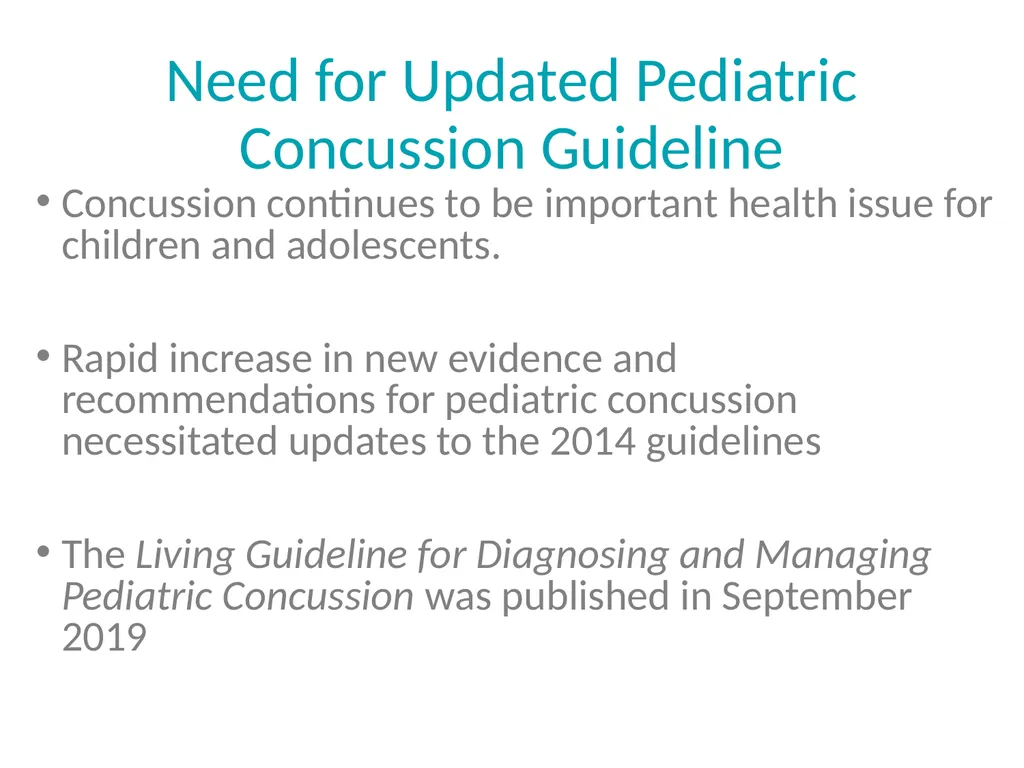
slide4. Need for Updated Pediatric Concussion Guideline Concussion continues to be important health issue for children and adolescents.
Rapid increase in new evidence and recommendations for pediatric concussion necessitated updates to the 2014 guidelines
The Living Guideline for Diagnosing and Managing Pediatric Concussion was published in September 2019<br>
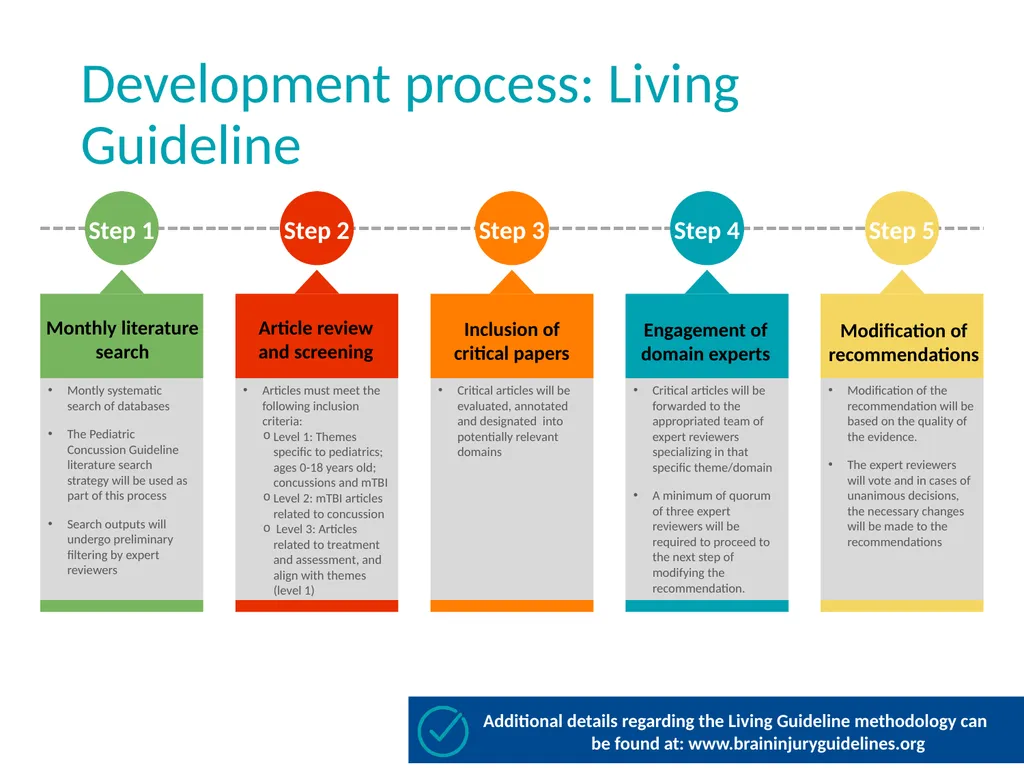
slide5. Development process: Living Guideline Step 1 Step 2 Step 3 Step 4 Step 5 Monthly literature search Article review and screening Inclusion of critical papers Engagement of domain experts Modification of recommendations Additional details regarding the Living Guideline methodology can be found at: www.braininjuryguidelines.org<br>
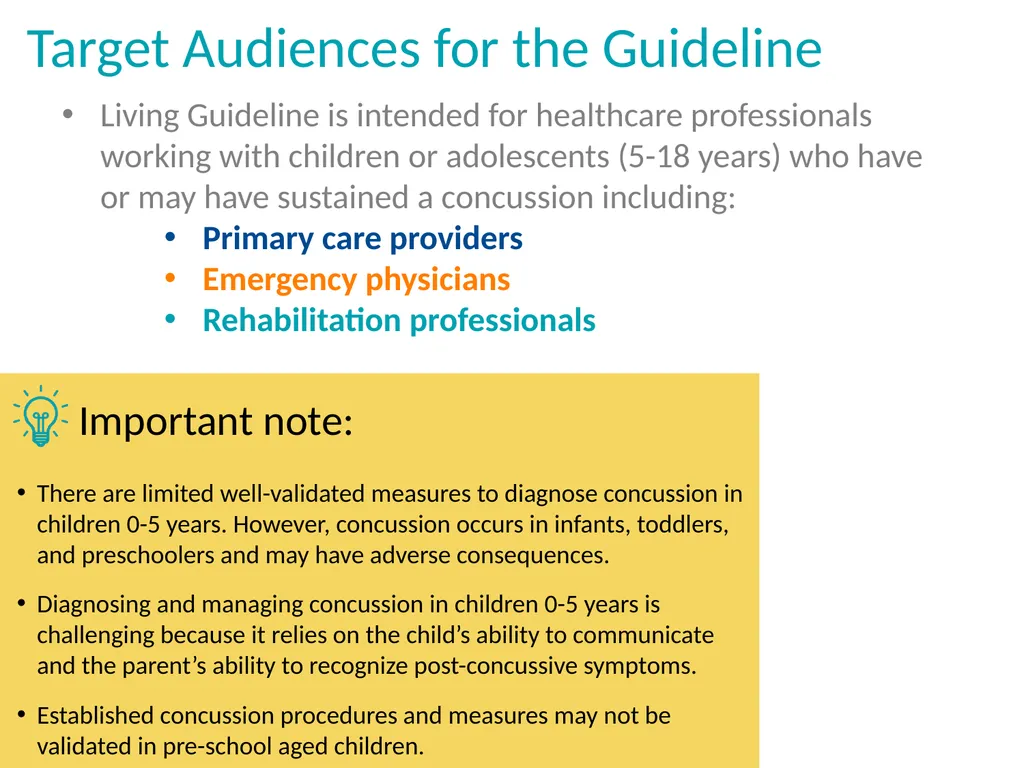
slide6. Target Audiences for the Guideline Living Guideline is intended for healthcare professionals working with children or adolescents (5-18 years) who have or may have sustained a concussion including:
Primary care providers
Emergency physicians
Rehabilitation professionals Important note: There are limited well-validated measures to diagnose concussion in children 0-5 years. However, concussion occurs in infants, toddlers, and preschoolers and may have adverse consequences.
Diagnosing and managing concussion in children 0-5 years is challenging because it relies on the child’s ability to communicate and the parent’s ability to recognize post-concussive symptoms.
Established concussion procedures and measures may not be validated in pre-school aged children.<br>
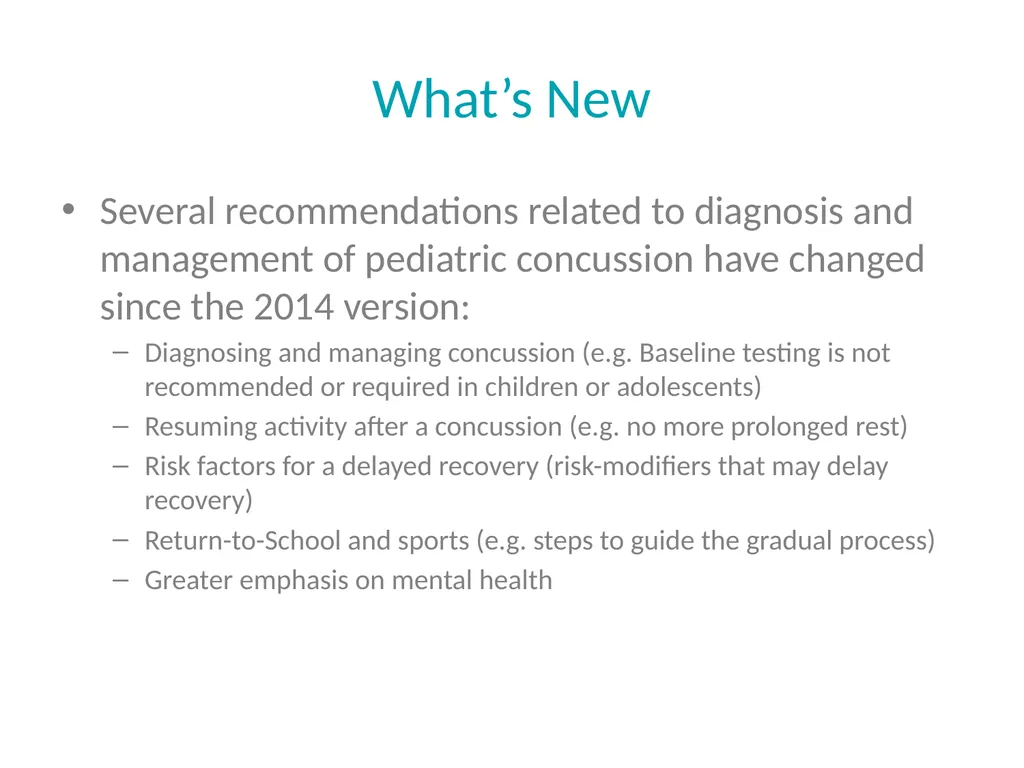
slide7. What’s New Several recommendations related to diagnosis and management of pediatric concussion have changed since the 2014 version:
Diagnosing and managing concussion (e.g. Baseline testing is not recommended or required in children or adolescents)
Resuming activity after a concussion (e.g. no more prolonged rest)
Risk factors for a delayed recovery (risk-modifiers that may delay recovery)
Return-to-School and sports (e.g. steps to guide the gradual process)
Greater emphasis on mental health<br>
slide8. Health clinical questions The Living Guideline addresses the following clinical questions:
How should children and adolescents return to physical activity following concussion?
Which children are at risk for prolonged symptoms post-concussion?
When should primary care providers consult an interdisciplinary concussion team?
How can providers better recognize and manage vestibular and visual impairments post-concussion?<br>
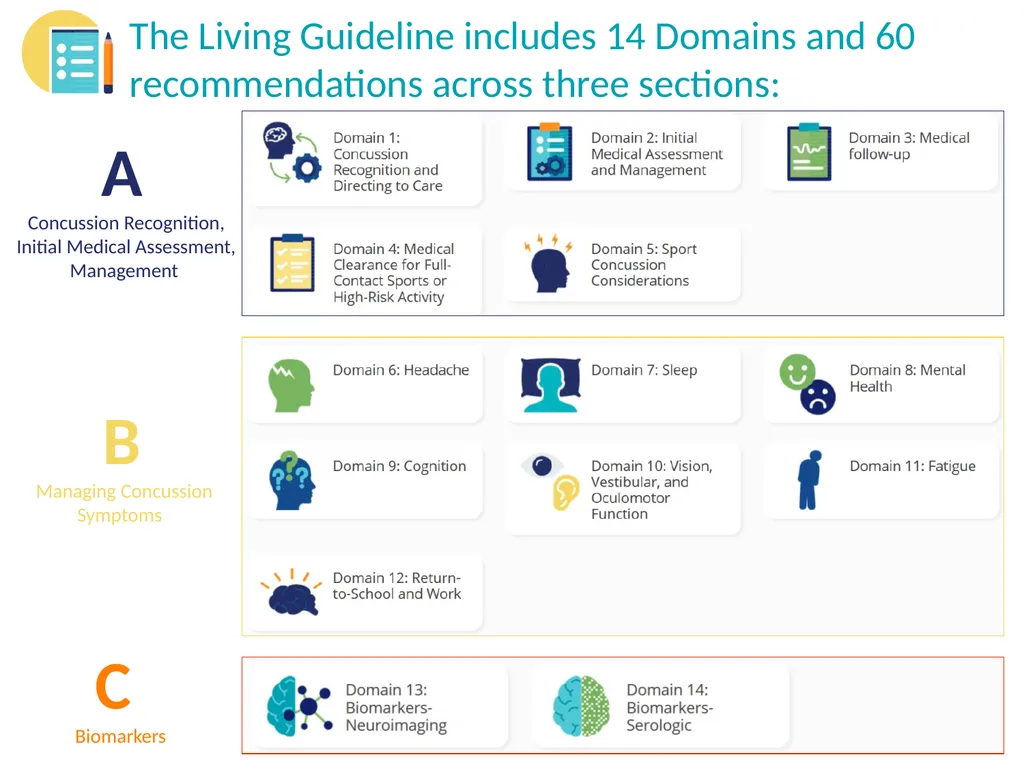
slide9. The Living Guideline includes 14 Domains and 60 recommendations across three sections: C
Biomarkers A
Concussion Recognition, Initial Medical Assessment, Management B
Managing Concussion Symptoms<br>
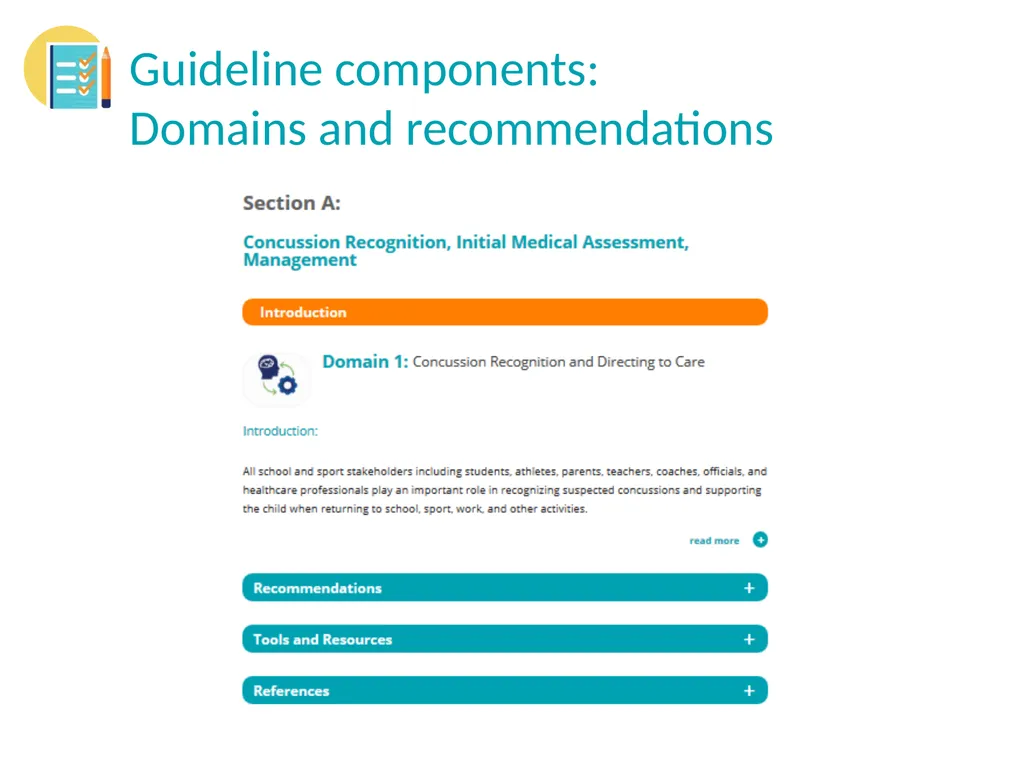
slide10. Guideline components: Domains and recommendations<br>
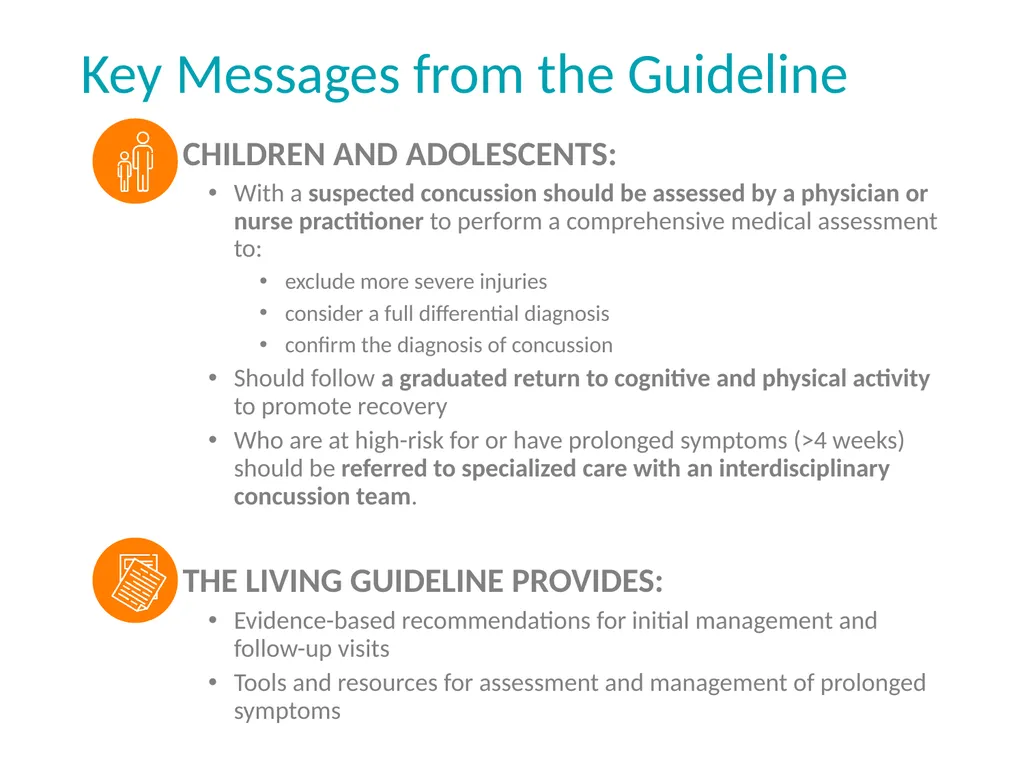
slide11. Key Messages from the Guideline CHILDREN AND ADOLESCENTS:
With a suspected concussion should be assessed by a physician or nurse practitioner to perform a comprehensive medical assessment to:
exclude more severe injuries
consider a full differential diagnosis
confirm the diagnosis of concussion
Should follow a graduated return to cognitive and physical activity to promote recovery
Who are at high-risk for or have prolonged symptoms (>4 weeks) should be referred to specialized care with an interdisciplinary concussion team.
THE LIVING GUIDELINE PROVIDES:
Evidence-based recommendations for initial management and follow-up visits
Tools and resources for assessment and management of prolonged symptoms<br>
slide12. Access the Living Guideline To access the Living Guideline for Diagnosing and Managing Pediatric Concussion, visit:
www.braininjuryguidelines.org Download tools and resources to help you use the Guideline. Try the ‘Sharing and Using the Living Guideline’ tool to help you disseminate and put the Guideline into practice. Share community resources with parents, teachers and coaches to help them understand what information they should know from the Guideline.<br>
slide2. Disclaimer The recommendations and resources found within the Living Guideline for Diagnosing and Managing Pediatric Concussion are intended to inform and instruct care providers and other stakeholders who deliver services to children and youth who have sustained or are suspected of having sustained a concussion. This Guideline is not intended for use with patients or clients over the age of 18 years. It is not for self-diagnosis or treatment. Patient, parents, and/or caregivers may wish to bring their healthcare and other providers’ attention to this Guideline.
The best available evidence has informed the recommendations, and relevant evidence published after this Guideline could influence the recommendations made within. Healthcare professionals should also consider their own judgment, the preferences of their patients, and factors such as the availability of resources in their decisions.
The Ontario Neurotrauma Foundation, the project team, and any developers, contributors, and supporting partners shall not be liable for any damages, claims, liabilities, costs, or obligations arising from the use or misuse of this guideline including loss or damage arising from any claims made by a third party.
The Ontario Neurotrauma Foundation assumes no responsibility or liability whatsoever for changes made to the Guideline without its consent. Any changes must be accompanied by the statement: “Adapted from Guideline for Diagnosing and Managing Pediatric Concussion with/ without permission,” according to whether or not permission was sought and/or given.<br>
slide3. Disclaimer All content contained in this slide deck is the property of the Ontario Neurotrauma Foundation (ONF). The guideline (print and electronic) and its derivatives may not be sold by any third party. Although these products will carry a notice of the ONF’s copyright, users are encouraged to download them at no charge for their personal use.
The slide deck is made available by ONF for lawful, personal, non-commercial and not-for-profit use only .
The unauthorized reproduction, distribution of this copyrighted work is not permitted.
For permission to use this slide deck for commercial or any use other than personal, please contact Judy Gargaro at judy.gargaro@onf.org<br>
slide4. Need for Updated Pediatric Concussion Guideline Concussion continues to be important health issue for children and adolescents.
Rapid increase in new evidence and recommendations for pediatric concussion necessitated updates to the 2014 guidelines
The Living Guideline for Diagnosing and Managing Pediatric Concussion was published in September 2019<br>
slide5. Development process: Living Guideline Step 1 Step 2 Step 3 Step 4 Step 5 Monthly literature search Article review and screening Inclusion of critical papers Engagement of domain experts Modification of recommendations Additional details regarding the Living Guideline methodology can be found at: www.braininjuryguidelines.org<br>
slide6. Target Audiences for the Guideline Living Guideline is intended for healthcare professionals working with children or adolescents (5-18 years) who have or may have sustained a concussion including:
Primary care providers
Emergency physicians
Rehabilitation professionals Important note: There are limited well-validated measures to diagnose concussion in children 0-5 years. However, concussion occurs in infants, toddlers, and preschoolers and may have adverse consequences.
Diagnosing and managing concussion in children 0-5 years is challenging because it relies on the child’s ability to communicate and the parent’s ability to recognize post-concussive symptoms.
Established concussion procedures and measures may not be validated in pre-school aged children.<br>
slide7. What’s New Several recommendations related to diagnosis and management of pediatric concussion have changed since the 2014 version:
Diagnosing and managing concussion (e.g. Baseline testing is not recommended or required in children or adolescents)
Resuming activity after a concussion (e.g. no more prolonged rest)
Risk factors for a delayed recovery (risk-modifiers that may delay recovery)
Return-to-School and sports (e.g. steps to guide the gradual process)
Greater emphasis on mental health<br>
slide8. Health clinical questions The Living Guideline addresses the following clinical questions:
How should children and adolescents return to physical activity following concussion?
Which children are at risk for prolonged symptoms post-concussion?
When should primary care providers consult an interdisciplinary concussion team?
How can providers better recognize and manage vestibular and visual impairments post-concussion?<br>
slide9. The Living Guideline includes 14 Domains and 60 recommendations across three sections: C
Biomarkers A
Concussion Recognition, Initial Medical Assessment, Management B
Managing Concussion Symptoms<br>
slide10. Guideline components: Domains and recommendations<br>
slide11. Key Messages from the Guideline CHILDREN AND ADOLESCENTS:
With a suspected concussion should be assessed by a physician or nurse practitioner to perform a comprehensive medical assessment to:
exclude more severe injuries
consider a full differential diagnosis
confirm the diagnosis of concussion
Should follow a graduated return to cognitive and physical activity to promote recovery
Who are at high-risk for or have prolonged symptoms (>4 weeks) should be referred to specialized care with an interdisciplinary concussion team.
THE LIVING GUIDELINE PROVIDES:
Evidence-based recommendations for initial management and follow-up visits
Tools and resources for assessment and management of prolonged symptoms<br>
slide12. Access the Living Guideline To access the Living Guideline for Diagnosing and Managing Pediatric Concussion, visit:
www.braininjuryguidelines.org Download tools and resources to help you use the Guideline. Try the ‘Sharing and Using the Living Guideline’ tool to help you disseminate and put the Guideline into practice. Share community resources with parents, teachers and coaches to help them understand what information they should know from the Guideline.<br>