
Local Self-Government and Fiscal Decentralisation
LO
Published · 105 slides · 0 views

1 / 1





Description
Local Self-Government and Fiscal Decentralisation in EU assist. prof. dr. Boštjan Brezovnik as far as our knowledge reaches back in time about man, we always find that human beings have lived in a society in the company of their peers, as
Related Topics
Share
Embed code
Download this presentation From Below
"Local Self-Government and Fiscal Decentralisation" is the property of its rightful owner. Permission is granted to download and print the materials on this website for personal, non-commercial use only, and to display it on your personal computer provided you do not modify the materials and that you retain all copyright notices contained in the materials. By downloading content from our website, you accept the terms of this agreement.
Presentation Transcript
01
Local Self-Government and
Fiscal Decentralisation in EU
assist. prof. dr. Boštjan Brezovnik<br>
Fiscal Decentralisation in EU
assist. prof. dr. Boštjan Brezovnik<br>
02
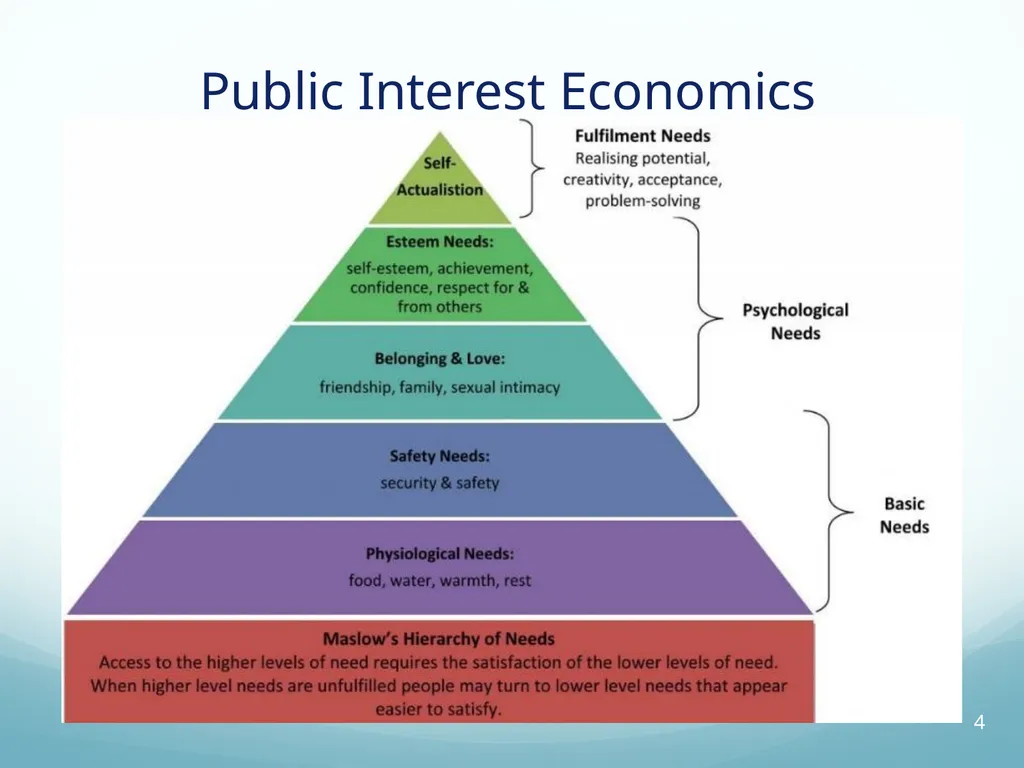
as far as our knowledge reaches back in time about man, we always find that human beings have lived in a society in the company of their peers, as this was the only way for them to go through life, ensure their own survival, provide for the continuation of their lineage and meet their own needs.
A man being a social being or ‘zoon politikon’, as stated by the ancient Greek philosopher Aristotle, it was easier to meet their needs in social harmony (social community) than by themselves alone. And to ensure the existence of the community, a man living in a social community had to contribute to meeting its (general social) needs. 2 Public Interest Economics<br>
A man being a social being or ‘zoon politikon’, as stated by the ancient Greek philosopher Aristotle, it was easier to meet their needs in social harmony (social community) than by themselves alone. And to ensure the existence of the community, a man living in a social community had to contribute to meeting its (general social) needs. 2 Public Interest Economics<br>
03
we can find some forms of social co-existence also in the life of some other animal species, which enable the existence of a community (for example, ants or bees), however, ever since we’ve known them, these forms of community haven’t changed.
while the social forms of co-existence of humans are constantly developing and transforming; the reason for this being that in meeting their own needs and the needs of the social community man rose to a level of a ‘living being who produces,’ that is, to the level of a being who with its own work consciously influences nature in order to receive goods, necessary to its survival.
there is no doubt that the production of life-saving material goods was, is and certainly will be the foundation for social communities of people, in other words, a society. Public Interest Economics 3<br>
04
4 Public Interest Economics<br>
05
Public Interest Economics general interest can only be defined in relation to individual interest, the holder of which can only be a person or individual. From his or her point of view is a mental sensation oriented in a specific material or spiritual asset or a particular personal position. This sensation can pertain to a wish to acquire certain goods or position or just keep the status quo.
general interest emerges as a direct consequence of the coexistence of human beings and their interrelationships.
in terms of joint creation, public interest is also related to (individual) interest of an individual. Individuals must through mutual interactions from their individual interest and through the process of their adjustment and change form a general interest which gives the framework for their actions or creations.
general interest cannot be identical to the interest of individuals who formed this interest through interrelationships. 5<br>
06
Public Interest Economics awareness of direct context of general interest is of no significance to the individual, it is only important whether the individual is able to realize his or her individual interest in terms of public interest realization or whether the realization of general interest is a prerequisite for realization of individual's interests.
without having a foundation in individual interests, the general interest notionally cannot even exist since its realization is in the final stage always aimed at realizing the direct interest of the individual.
members of a specific society are similarly as is the case with general interest agents of social interest, whereby the social interest is in this case also an emanation of the interests of individuals. The social and public interest basically mark the same phenomenon, but the difference is that when defining social interest we specifically emphasize the institutional part of social interest, i.e. its connection with the social system. 6<br>
07
Public Interest Economics the public interest is directly related to the state as an institution for carrying out political rule and is in terms of this somewhat more narrow than the general or social interest.
the public interest is notionally related to the state and law as its instrument of social regulation since only the latter with its normative instruments can determine which of the multitude of potential interests is the public interest.
according to Appleby, ,the public interest is never merely the sum of all private interests nor the sum remaining after cancelling out their various pluses and minuses. It is not wholly separate from private interests but it is something distinctive that arises within, among, apart from and above private interests. Contrary to the general interest which is a social phenomenon, the public interest is a normative phenomenon. 7<br>
08
the concept of society is understood as a community of people who produce and consume material goods, who ensure the preservation of the human race, who develop material and spiritual culture in a way to enable and encourages various socially beneficial and important activities.
all these activities consist of actions of individuals, which have to be harmonious and coordinated if they are to achieve the desired social effect and success.
the concept of society involves elements of order, i.e. a system of certain behaviours and conducts of individuals who are part of it.
order is supported by relevant rules of social behaviour and conduct and the actual efficiency of such rules, namely, by the fact that the members of society submit themselves to such rules. 8 Public Interest Economics<br>
09
the mentioned rules are therefore used to regulate socially important conduct and the behaviour of individuals and social organisations into an orderly whole. The latter reflects itself in human society, understood as a universal and holistic organisation of social life, as a specific, narrow functional organisation, which is today known under the term state organisation.
according to Plato cosmos, as he says, ‘is not a simple world, but an arranged, decorated, in measure and order brought community of all that exists’, and, further on, ‘polis is not a simple state, but an internal structure in which a community of people is harmoniously united, either with each other or in relation to the entirety of everything else. The essence of an internal structure of cosmos and polis is first and foremost revealed in the nature of the soul. 9 Public Interest Economics<br>
according to Plato cosmos, as he says, ‘is not a simple world, but an arranged, decorated, in measure and order brought community of all that exists’, and, further on, ‘polis is not a simple state, but an internal structure in which a community of people is harmoniously united, either with each other or in relation to the entirety of everything else. The essence of an internal structure of cosmos and polis is first and foremost revealed in the nature of the soul. 9 Public Interest Economics<br>
10
The Concept of the State according to Plato cosmos, as he says, ‘is not a simple world, but an arranged, decorated, in measure and order brought community of all that exists’, and, further on, ‘polis is not a simple state, but an internal structure in which a community of people is harmoniously united, either with each other or in relation to the entirety of everything else. The essence of an internal structure of cosmos and polis is first and foremost revealed in the nature of the soul.
To achieve, as Plato says, ‘the internal structure, which harmoniously unites the community of people with each other as well as in relation to the entirety of everything else,’ we strive for the perfection of order, which we implement in the state (rule of law). 10<br>
To achieve, as Plato says, ‘the internal structure, which harmoniously unites the community of people with each other as well as in relation to the entirety of everything else,’ we strive for the perfection of order, which we implement in the state (rule of law). 10<br>
11
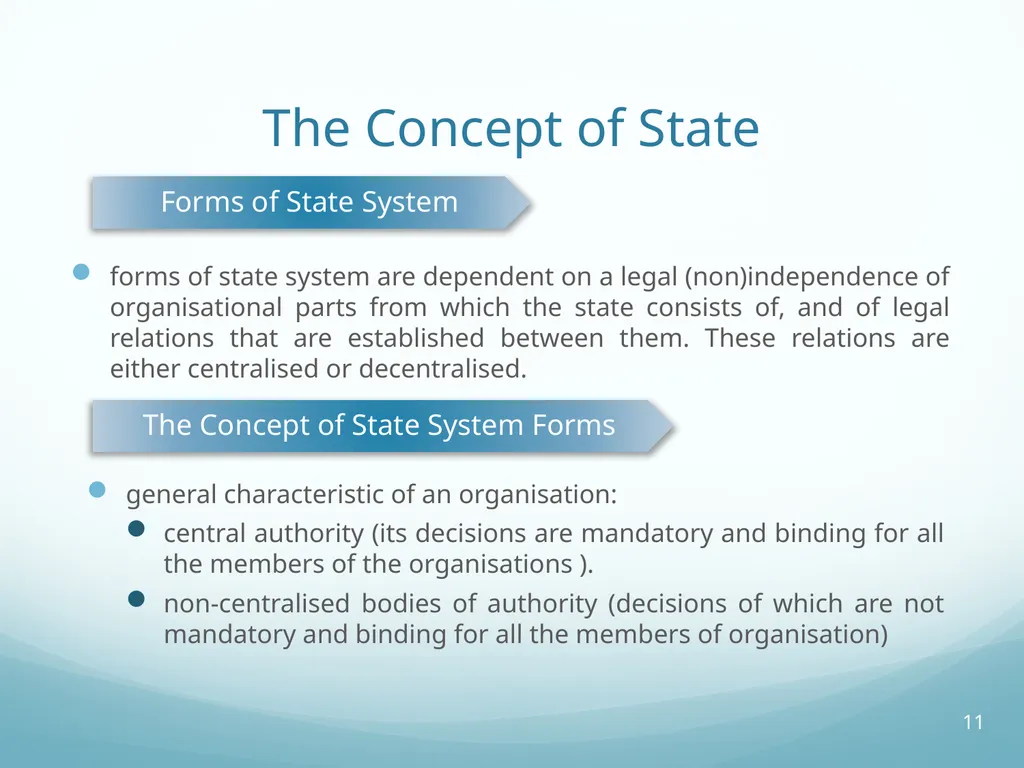
The Concept of State forms of state system are dependent on a legal (non)independence of organisational parts from which the state consists of, and of legal relations that are established between them. These relations are either centralised or decentralised. 11 general characteristic of an organisation:
central authority (its decisions are mandatory and binding for all the members of the organisations ).
non-centralised bodies of authority (decisions of which are not mandatory and binding for all the members of organisation)<br>
central authority (its decisions are mandatory and binding for all the members of the organisations ).
non-centralised bodies of authority (decisions of which are not mandatory and binding for all the members of organisation)<br>
12
The Concept of State state organisation is most often divided along territorial lines.
the power of central authorities extends to the whole state territory, while the authority of non-central authorities extends to certain parts of the territory.
'actual decentralisation' (the system, according to which central and non-central bodies of authority exist in a state)
'legal decentralisation' (If non-central bodies execute authority as subordinate bodies of authority in the name of central bodies of authority and have at that no independent authority, then the legal centralisation is in place and non-central bodies of authority are centralised) 12<br>
13
The Concept of State states are classified into various forms of state systems according to the criterion of the legal decentralisation. If decentralised units have the same level of authority as states do, then we are talking about a so-called composite state, and when the level of decentralisation is lower, then we are talking about a unified or a unitary state. 13 relations between the state bodies of authority are centralised and form a unified organisational system.
unitary state can actually be decentralised and divided into administrative territorial units, which have local self-government or have some type of recognised autonomy.<br>
unitary state can actually be decentralised and divided into administrative territorial units, which have local self-government or have some type of recognised autonomy.<br>
14
The Concept of State composed out of several states.
'confederation' is created by an international treaty with which the union of states is established, along with some shared bodies of authority with various jurisdictions and in various forms. In this case it is a union of states, as states in confederation remain sovereign and unlimited in their authority. Authority of the union is completely dependent on the member states, and not vice versa.
federation, contrary to confederation, the body of authority of the member states is a holder of the stately, i.e. sovereign authority in the true sense. Thus, the central body of authority has the right to make decisions that are mandatory for the state bodies of authority. 14<br>
15
The Concept of State The EU has 28 Member States with a diversified institutional arrangement:
three countries are federal States (Germany, Austria and Belgium),
two are 'regionalised' States which are quasi-federal (Spain and Italy)
the 'one and indivisible' makeup of the other 23 so-called 'unitary States masks an asymmetric organisation with 'autonomous' regions with legislative responsibilities on only part of the national territory, as in the case in the UK and Portugal.
in line with this diversity at State level, the sub-national organisation in EU Member States is correspondingly varied, supported by around 91.000 sub-national public authorities with very heterogeneous responsibilities and resources, all the outcome of differences in geography, history as well as social and political situations. 15<br>
16
The Concept of State throughout history there has been a regularly occurring tendency to regulate state and society, which would lead to provide personal freedom and limitation of state authority.
first serious attempts to limit the authority appeared in the Middle Ages (in the year 1215 English barons, gathered in the field Runnymede near London, made King John Lackland declare and sign The Great Charter of Liberties (Magna Carta Libertatum)).
English bloodless revolution in 1688, which led to a compromise between the feudal aristocracy headed by the monarch, and emerging middle class (theory of the separation of powers – John Locke). 16<br>
17
The Concept of State freedom (of an individual) is only possible, where power is not abused, but distributed in a deliberate proportion in accordance with the constitutional order (Montesquieu).
the authoritative power is divided into three state authorities, namely the representative, executive and judiciary authority, while each of them is assigned the relevant state function (legislative, executive and jurisdiction) (horizontal level of limitation of power)
'For authority not to be abused it is necessary to arrange things in such a way that one authority hinders or checks the other authority' (Montesquieu). 17<br>
18
The Concept of State through development, especially in the USA and Germany, the so called vertical separation of power has been established.
vertical separation of power is of great importance in the states that are not federatively regulated, since the significant share of the vertical separation of power belongs to the local self-government.
the constitutional systems, where local self-government is explicitly defined as a constitutional category, have a specific form of vertical separation of powers; the autonomy of local self-government and minimal requirements for autonomy (legal entity, right to property, jurisdiction and justification for the execution of public duties at the local level). 18<br>
19
The Concept of State subsidiarity is a modern idea, whose historical origins date back to Aristotle. In recent times this concept has explicitly appeared as a legal principle in the Maastricht agreement of the EU.
the principle of subsidiarity is the foundation or, better yet, a criterion for the vertical separation of power or public affairs, respectively, to the state, regional and local authorities.
the basic idea on which this principle is based on is that political authority can interfere only to the extent when society and its constitutive parts, from an individual to a family, and from local communities to various major classifications, are not capable of meeting various needs. 19<br>
20
The Concept of State as a principle of social organisation means that the higher authority, especially the state authority, can interfere only to the extent where the lower authority showed or proved their inability.
is primarily the principle of limitation of authority, however, it has no normative nature (indicates a trend).
the second meaning evokes the idea of help to the lower levels of authority. In this context, the issue is the evaluation of not whether the authority has a right to interfere, but whether it is its duty to do so. It is about help which strengthens and gives the right to autonomy. 20<br>
21
The Concept of State 21 a system of relations between central and local state bodies of authority, where the local bodies have a certain degree of independence, determined by the constitution and law.
‘one-tier’ decentralisation is the one where the same body of authority is decentralised regarding certain matters, and centralised regarding other matters. In the matters where it is centralised, duties are performed on the principle of subordination, while in performing other duties they enjoy a certain degree of independence.
in the case of a ‘two-tier’ decentralisation, however, along with the local bodies of authority, there are also state bodies of authority. The latter means that the matters which are centralised are in the same unit dealt with by one type of bodies of authority, while decentralised matters are dealt with the other type of bodies of authority<br>
22
The Concept of State ‘bureaucratic decentralisation’ - higher bodies of authority are appointing and deposing decentralised bodies.
‘democratic decentralisation’ - the bodies of authority are elected by the people living in local communities and they are under the authority of a local community. Such decentralisation is widely known as a self-governing decentralisation. The characteristic of this concept is that the population of the immediate social community manages it through elected bodies. 22<br>
‘democratic decentralisation’ - the bodies of authority are elected by the people living in local communities and they are under the authority of a local community. Such decentralisation is widely known as a self-governing decentralisation. The characteristic of this concept is that the population of the immediate social community manages it through elected bodies. 22<br>
23
The Concept of State the characteristic of decentralisation as a general concept is transferring duties from the state to other organisations, which are not an integral part of the state, but are relatively independent.
self-government is based on the idea that every individual and every social group should have a say and influence on matters that relate to their interests and benefits, that matters, therefore, should be decided on by those who are affected by them.
conceptual and legal foundation for decentralisation is based on the unity of the entire sphere of authority, represented by the central state bodies. Part of this authority or part of public duties, respectively, namely duties of local importance (in practice we refer to them as local matters) the state hands over to local communities, which should in principle perform these duties autonomously with their own bodies of authority, but under a certain supervision from the central state authorities. 23<br>
24
The Concept of State Local self-government denotes the right and the ability of local authorities, within the limits of the law, to regulate and manage a substantial share of public affairs under their own responsibility and in the interests of the local population.
This right shall be exercised by councils or assemblies composed of members freely elected by secret ballot on the basis of direct, equal, universal suffrage, and which may possess executive organs responsible to them. This provision shall in no way affect recourse to assemblies of citizens, referendums or any other form of direct citizen participation where it is permitted by statute (Article 3, European Charter of Local Self-Government). 24<br>
This right shall be exercised by councils or assemblies composed of members freely elected by secret ballot on the basis of direct, equal, universal suffrage, and which may possess executive organs responsible to them. This provision shall in no way affect recourse to assemblies of citizens, referendums or any other form of direct citizen participation where it is permitted by statute (Article 3, European Charter of Local Self-Government). 24<br>
25
The Concept of State European Charter of Local Self-government (ECLS) agreed by the Member States of the Council of Europe on the 15th of October 1985 at the 20th plenary session of the CLRAE. The Charter was entered into force on the 1st of September 1988, when it was ratified by four states.
the objective of the ECLS is to ensure The European standards for defining and protecting the rights of local authorities, which represent the closest level of administration to citizens and enable effective participation in forming decisions that concern their environment.
the ECLS delegates to its signatories to meet the fundamental rules which ensure political, administrative and financial independence of local communities
the fundamental objective of ECLS is the harmonisation of systems of local self-government across Europe. 25<br>
26
The Concept of State the concept of territorial decentralisation is closely linked to the concept of local community and local self-government, since throughout history decentralisation in general started to develop as territorial decentralisation.
the territory is one of the fundamental elements for the existence of a state and is as such the vital element for defining the concept of local community.
throughout history, states as well as local communities were as a rule frequently transformed in the process of territorial reorganisations, while there have always been attempts to bring in certain criteria of rationality. 26<br>
27
The Concept of State local communities, i.e. municipalities and wider self-governing local communities, just like the state itself, do not form themselves on the basis of certain criteria of rationality, upon which it would be estimated in advance if they are capable of performing duties they need to perform.
modern territorially decentralised local communities are mostly a result of historical developments, traditions, political compromises, geographical and other factors, which have very little to do with the criteria of rationality in relation to the duties and needs that they must perform or meet, respectively. 27<br>
modern territorially decentralised local communities are mostly a result of historical developments, traditions, political compromises, geographical and other factors, which have very little to do with the criteria of rationality in relation to the duties and needs that they must perform or meet, respectively. 27<br>
28
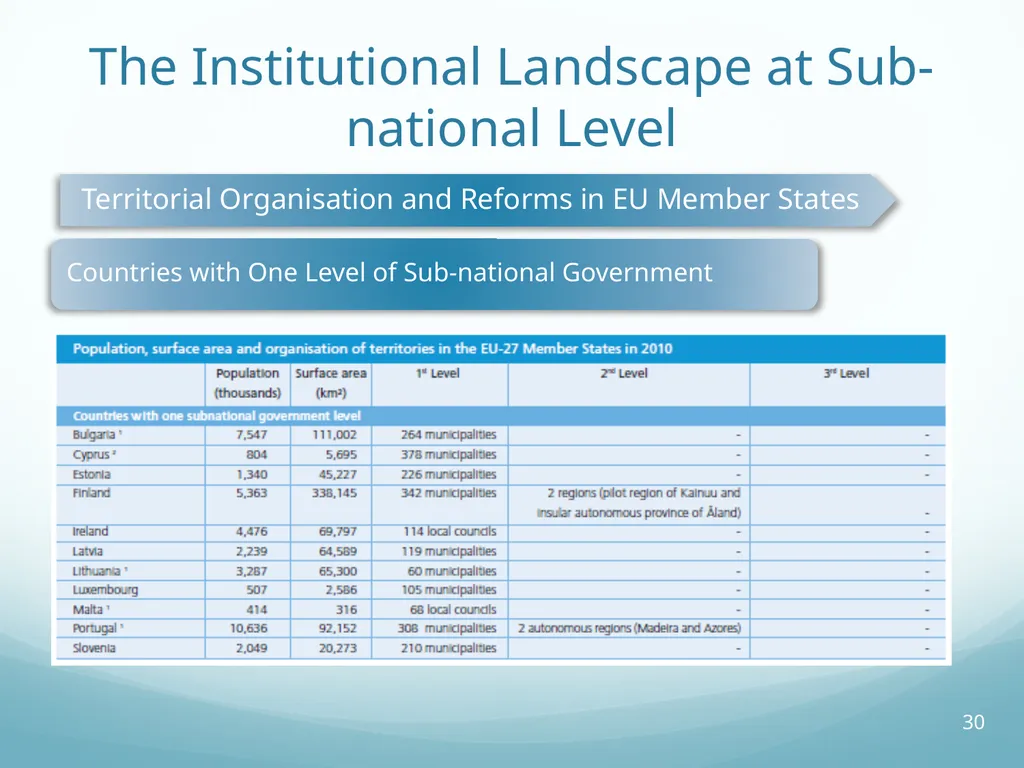
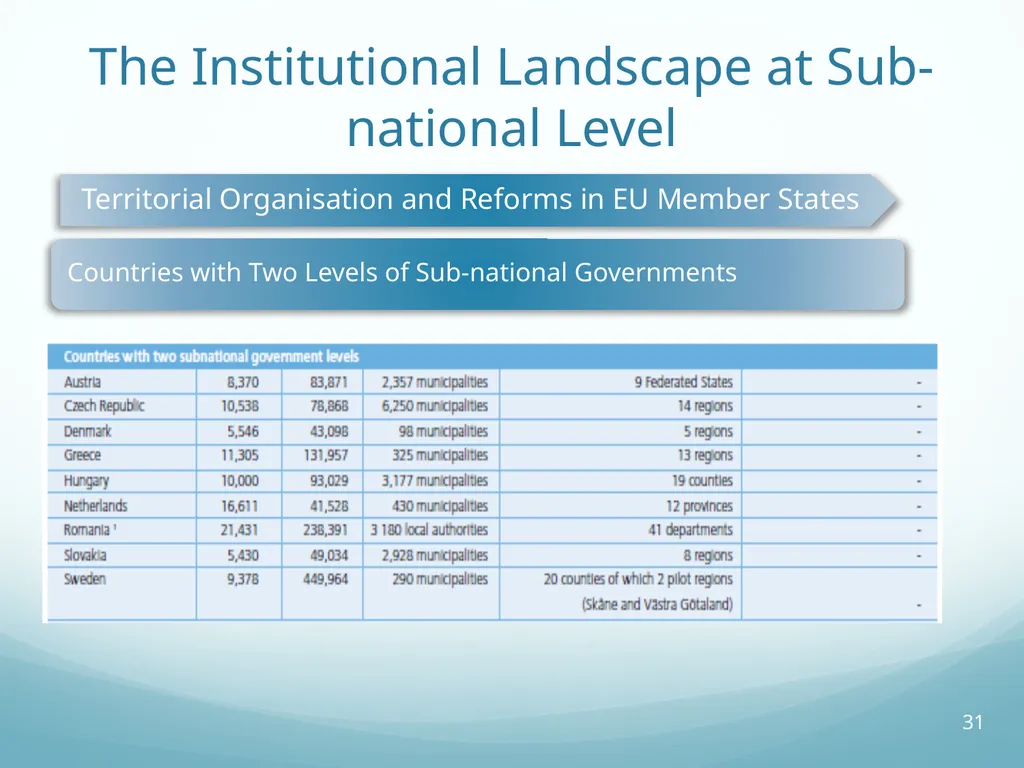
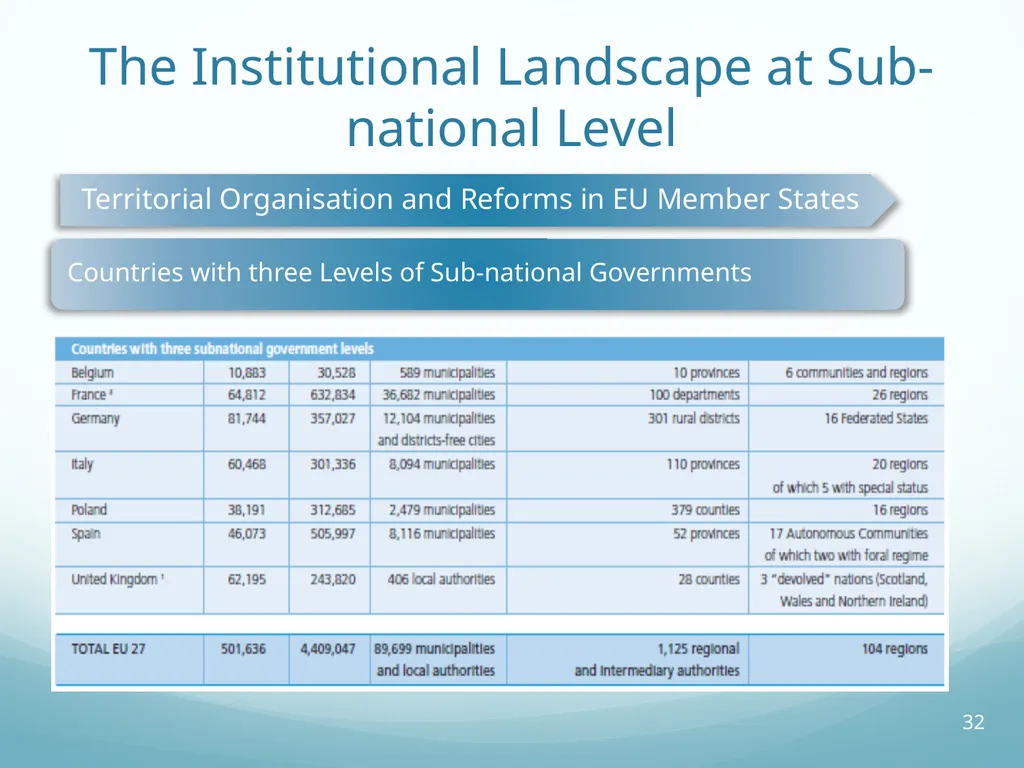
The Institutional Landscape at Sub-national Level 28 the EU is comprised of 28 Member States, including three with a federal structure (Germany, Austria, Belgium), two regionalised States (Spain & Italy) and 23 unitary States, some of which have a heterogeneous territorial organisation e.g. Portugal, UK and Finland (regions exist only on part of the of the national territory).
eleven countries have just one level of local authority, i.e. municipalities; nine others have two (municipalities and regions) while the remaining seven, which are some of the biggest countries in the EU, have three levels: municipalities, regions and intermediary entities (i.e. departments, provinces, counties, etc.<br>
eleven countries have just one level of local authority, i.e. municipalities; nine others have two (municipalities and regions) while the remaining seven, which are some of the biggest countries in the EU, have three levels: municipalities, regions and intermediary entities (i.e. departments, provinces, counties, etc.<br>
29
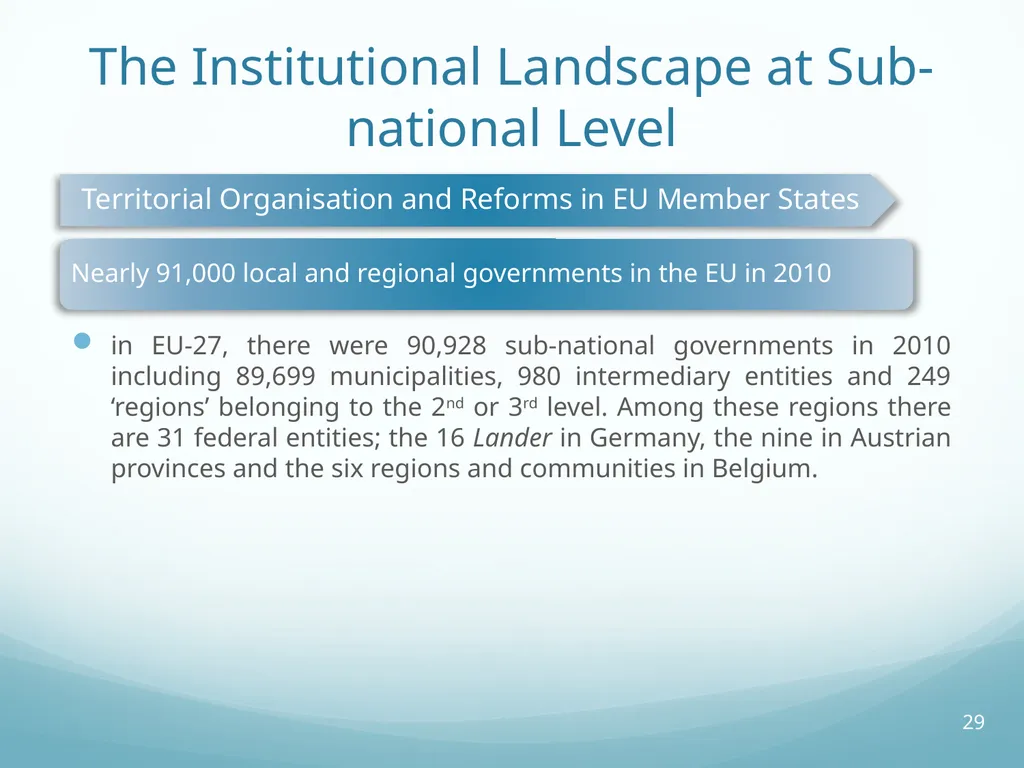
The Institutional Landscape at Sub-national Level in EU-27, there were 90,928 sub-national governments in 2010 including 89,699 municipalities, 980 intermediary entities and 249 ‘regions’ belonging to the 2nd or 3rd level. Among these regions there are 31 federal entities; the 16 Lander in Germany, the nine in Austrian provinces and the six regions and communities in Belgium. 29<br>
30
The Institutional Landscape at Sub-national Level 30<br>
31
The Institutional Landscape at Sub-national Level 31<br>
32
The Institutional Landscape at Sub-national Level 32<br>
33
The Institutional Landscape at Sub-national Level in 2010, the average European municipality had 5,580 inhabitants over a surface area of 49 km2. this average hides significant disparities; in six countries, including in France, the Czech Republic and Hungary, the average municipality has fewer than 4,000 inhabitants on average; in eight others the average municipality has greater than 30,000 inhabitants. The UK is an extreme case with 152,000 inhabitants per municipality.
in the countries with ‘large municipalities’, there is often a structured sub-national level comprised of ‘localities’ (i.e. parishes, freguesisas, etc.) which sometimes are given a legal status. 33<br>
in the countries with ‘large municipalities’, there is often a structured sub-national level comprised of ‘localities’ (i.e. parishes, freguesisas, etc.) which sometimes are given a legal status. 33<br>
34
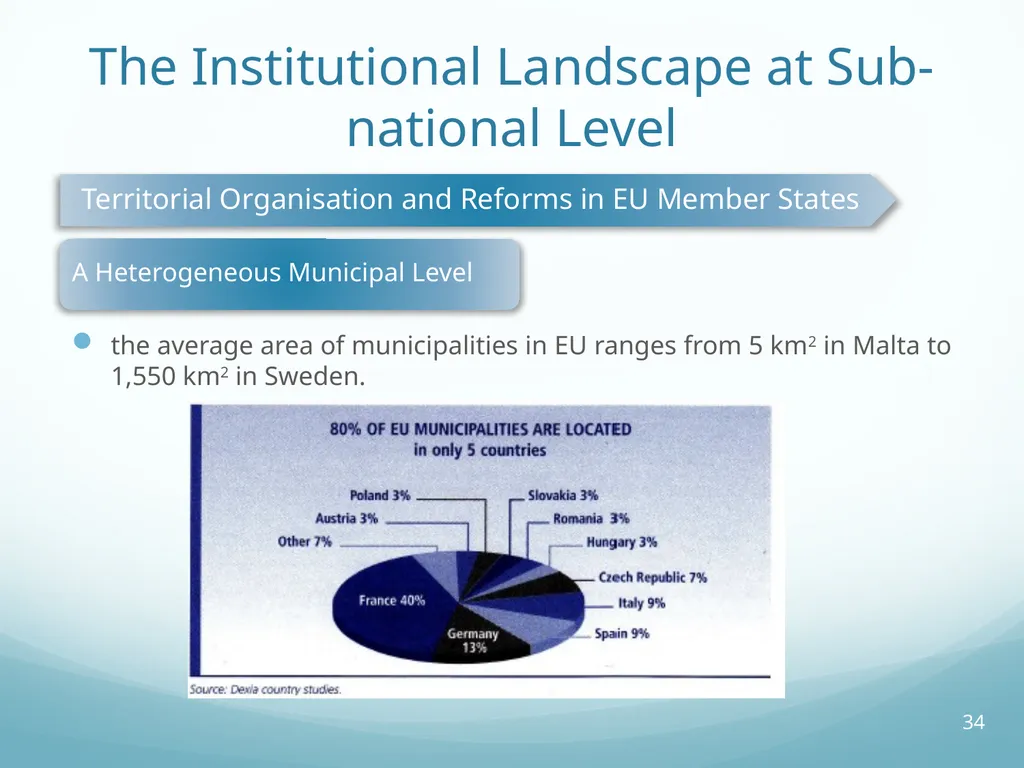
The Institutional Landscape at Sub-national Level the average area of municipalities in EU ranges from 5 km2 in Malta to 1,550 km2 in Sweden. 34<br>
35
The Institutional Landscape at Sub-national Level throughout the EU (excluding the UK), 82% of municipalities have fewer than 5,000 inhabitants. this figure rises to 95% in the four countries where the average number of inhabitants per municipality is fewer than 2,000 inhabitants (Czech Republic, Cyprus, France & Slovakia). Inversely, is is very low (between 2% and 11%) in countries with densely populated municipalities such as Lithuania, the Netherlands, Sweden, Denmark and Bulgaria. This is generally a result of dynamic merger policies. 35<br>
36
The Institutional Landscape at Sub-national Level the municipal statues is far from homogeneous, even within same country. Municipalities in 16 EU Member States have different statutes based on their demographic, administrative, economic or cultural specificities. 36 the distinction between rural and urban municipalities is the most commonly found. Depending on the country, this distinction can be based on demographic (Latvia, Greece), historical (Hungary) and/or socio-economic (Slovakia, Slovenia) criteria.<br>
37
The Institutional Landscape at Sub-national Level around ten countries have opted to grant a dual political and administrative status to some of their municipalities, either because of their history or to reflect their demographic and socio-economic weight. they therefore operate at two different sub-national government levels, namely the municipal and the higher levels.
For some countries, only the capital city has dual status. Prague and Dublin have a double status as municipality and regional authority; Paris and Bucharest are both municipalities and departments/counties, while Vienna is both a statutory city and a federal State. 37<br>
For some countries, only the capital city has dual status. Prague and Dublin have a double status as municipality and regional authority; Paris and Bucharest are both municipalities and departments/counties, while Vienna is both a statutory city and a federal State. 37<br>
38
The Institutional Landscape at Sub-national Level for other countries, dual status is not reserved for capital city but can be used for other cities, generally largest. This is the case in Hungary, where 23 cities (county seats and cities with more than 50,000 inhabitants designed by Parliament) also have county status; in Latvia, seven Republican cities (designed by Parliament and combining a high level of development with a population of at least 50,000 inhabitants) have the dual status of municipality and district. the 65 Polish cities with more than 100,000 inhabitants or former regional capitals also have county status. Germany has 116 ‘district-free cities’ and three ‘city-States’ (Berlin, Bremen and Hamburg). 38<br>
39
The Institutional Landscape at Sub-national Level in more than half the countries, the largest cities are granted special status that allows them to not only have a different institutional organisation from other municipalities but to also sometimes take additional responsibilities and resources.
this special status usually includes a division into city districts, which in turn ensures that local public service management in closer to users and better adapted to the needs of population.
capital cities, which symbolise national unity, are generally where public authorities are headquartered, and are also the most significant city in both demographic and economic terms. In addition to being sub-divided into districts, the capitals in several countries have their own specific legislation as the capital city (Pragues, Madrid, Sofia, Warshaw, Budapest, Bratislava and Ljubljana). 39<br>
40
The Institutional Landscape at Sub-national Level the European municipal spread is constantly changing.
the current organisation is the outcome of both the history and geography of each country, but also the result of various policies implemented by central States in terms of decentralisation and territorial division.
municipal merger policies have been implemented in many countries, with one of the objectives being compensate for the disadvantages linked to small size of many the municipalities concerned (insufficient financial resources, to carry out their responsibilities correctly, limited tax base, etc.) 40<br>
41
The Institutional Landscape at Sub-national Level merger policies started in the 1950s in Austria (halving the number of municipalities) and in Sweden (divided by more than 8), before being adopted by more than half of EU15 countries.
in the following years municipal merger movements drastically reduced the number of municipalities in Denmark in 1970 (divided by 5), West Germany in the 1960s and 1970s (divided by 3), Belgium in 1975 (divided by 4) and more progressively, the Netherlands (divided by almost 2 over the period of more than 50 years) along with Finland. 41<br>
in the following years municipal merger movements drastically reduced the number of municipalities in Denmark in 1970 (divided by 5), West Germany in the 1960s and 1970s (divided by 3), Belgium in 1975 (divided by 4) and more progressively, the Netherlands (divided by almost 2 over the period of more than 50 years) along with Finland. 41<br>
42
The Institutional Landscape at Sub-national Level in 1997, the Capodistrias reform in Greece reduced the number of municipalities by almost 6. Denmark totally re-organised its territory in January 2007, reducing the number of municipalities from 271 to 98. As a result, the average demographic size of a Danish municipality has risen from 20,000 to 55,000 inhabitants.
following the set by Denmark Latvia in 2009 reduces the number of municipalities from 524 to 119. Greece has been the latest, and most aggressive to reform its municipalities. In July 2010, the Kallikratis programme went into effect and divided the number of municipalities by more than three (from 1,034 to 325).
municipal reforms are also underway in England, in Northern Ireland, in Finland, in the Netherlands, in Germany, in Luxembourg, where the municipal reconstructing project will cut the number of municipalities from 116 to 71 in 2017. 42<br>
43
The Institutional Landscape at Sub-national Level the communist era in central and Eastern European countries saw a decrease in the number of municipalities during the 1960s and 1970s, as they were absorbed into larger units as part of the central State’s rationalisation, planning and territorial control.
the democratic transition that began in 1990s did not have the same impact in every country. In some, such as Slovenia, the Czech Republic and Romania, it led to splintering of municipal regroupings and, in many cases, to the re-establishment of historical municipalities, seen as both the vectors of local democracy and the territorial entities best suited to manage community cervices (in Slovenia for example, the number of municipalities went from 54 in 1976 to 147 in 1994 and 212 in 2014).
elsewhere, the number of municipalities has remain relatively stable since the beginning of the 1990s (in Poland and Slovakia) and in some cases even decreased, especially in the Baltic States, committed to finding the ‘perfect municipal size’. 43<br>
44
The Institutional Landscape at Sub-national Level the quest for the perfect size has also brought other options into play, notably the promotion of inter-municipal cooperation.
France is the trailblazer in Europe in this area, opting to develop the role of inter-municipal groupings that are strongly integrated in fiscal terms of democracy rather then eliminate municipalities: in 2007, 91% of French municipalities belonged to 2,588 inter-municipal cooperation structures with own-source tax revenue, representing 87% of the population
cooperation between municipalities continued to progress in many different European countries (Hungary, Finland, Austria, Estonia, Bulgaria, Portugal, etc.) 44<br>
45
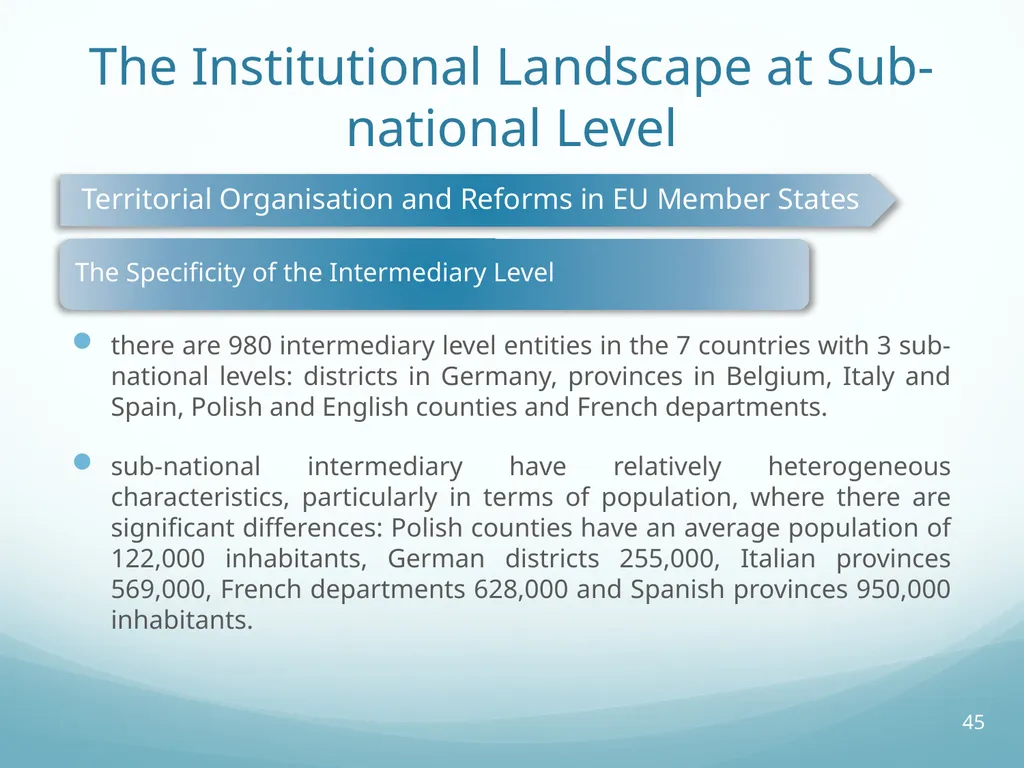
The Institutional Landscape at Sub-national Level there are 980 intermediary level entities in the 7 countries with 3 sub-national levels: districts in Germany, provinces in Belgium, Italy and Spain, Polish and English counties and French departments.
sub-national intermediary have relatively heterogeneous characteristics, particularly in terms of population, where there are significant differences: Polish counties have an average population of 122,000 inhabitants, German districts 255,000, Italian provinces 569,000, French departments 628,000 and Spanish provinces 950,000 inhabitants. 45<br>
sub-national intermediary have relatively heterogeneous characteristics, particularly in terms of population, where there are significant differences: Polish counties have an average population of 122,000 inhabitants, German districts 255,000, Italian provinces 569,000, French departments 628,000 and Spanish provinces 950,000 inhabitants. 45<br>
46
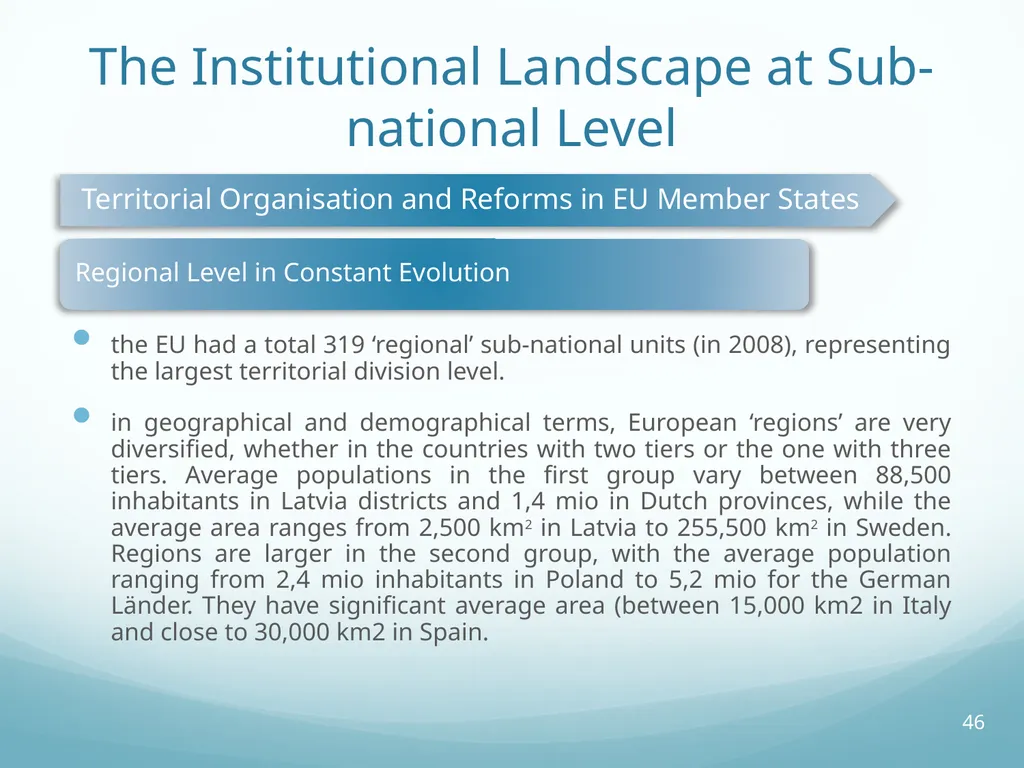
The Institutional Landscape at Sub-national Level the EU had a total 319 ‘regional’ sub-national units (in 2008), representing the largest territorial division level.
in geographical and demographical terms, European ‘regions’ are very diversified, whether in the countries with two tiers or the one with three tiers. Average populations in the first group vary between 88,500 inhabitants in Latvia districts and 1,4 mio in Dutch provinces, while the average area ranges from 2,500 km2 in Latvia to 255,500 km2 in Sweden. Regions are larger in the second group, with the average population ranging from 2,4 mio inhabitants in Poland to 5,2 mio for the German Länder. They have significant average area (between 15,000 km2 in Italy and close to 30,000 km2 in Spain. 46<br>
in geographical and demographical terms, European ‘regions’ are very diversified, whether in the countries with two tiers or the one with three tiers. Average populations in the first group vary between 88,500 inhabitants in Latvia districts and 1,4 mio in Dutch provinces, while the average area ranges from 2,500 km2 in Latvia to 255,500 km2 in Sweden. Regions are larger in the second group, with the average population ranging from 2,4 mio inhabitants in Poland to 5,2 mio for the German Länder. They have significant average area (between 15,000 km2 in Italy and close to 30,000 km2 in Spain. 46<br>
47
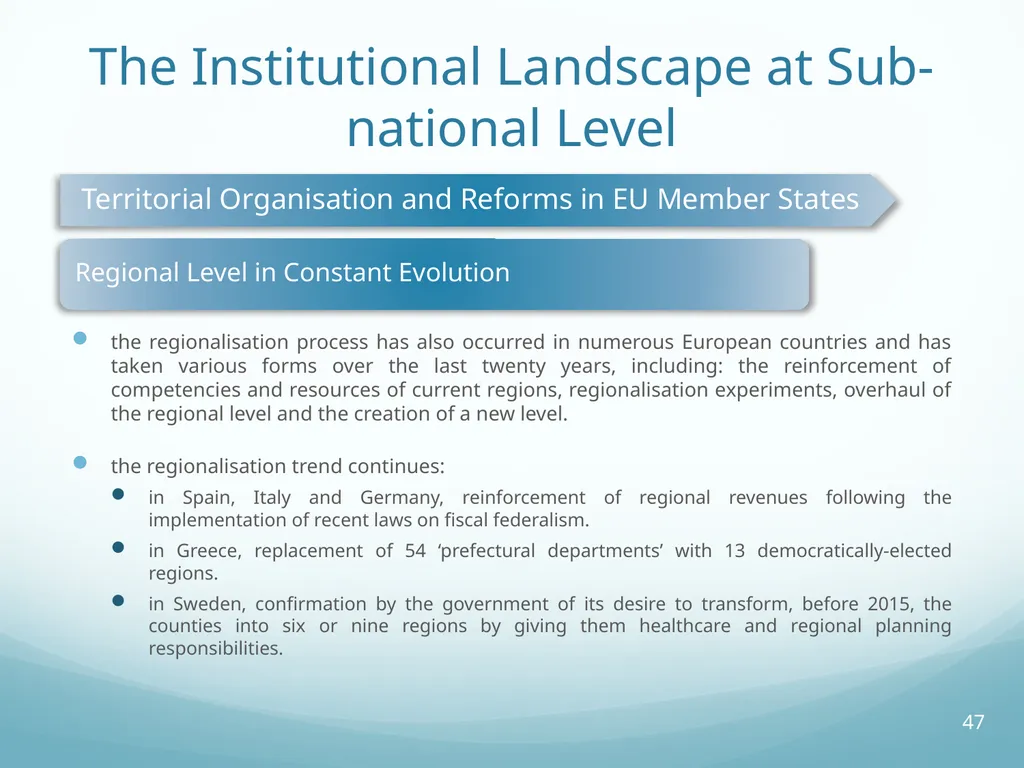
The Institutional Landscape at Sub-national Level the regionalisation process has also occurred in numerous European countries and has taken various forms over the last twenty years, including: the reinforcement of competencies and resources of current regions, regionalisation experiments, overhaul of the regional level and the creation of a new level.
the regionalisation trend continues:
in Spain, Italy and Germany, reinforcement of regional revenues following the implementation of recent laws on fiscal federalism.
in Greece, replacement of 54 ‘prefectural departments’ with 13 democratically-elected regions.
in Sweden, confirmation by the government of its desire to transform, before 2015, the counties into six or nine regions by giving them healthcare and regional planning responsibilities. 47<br>
48
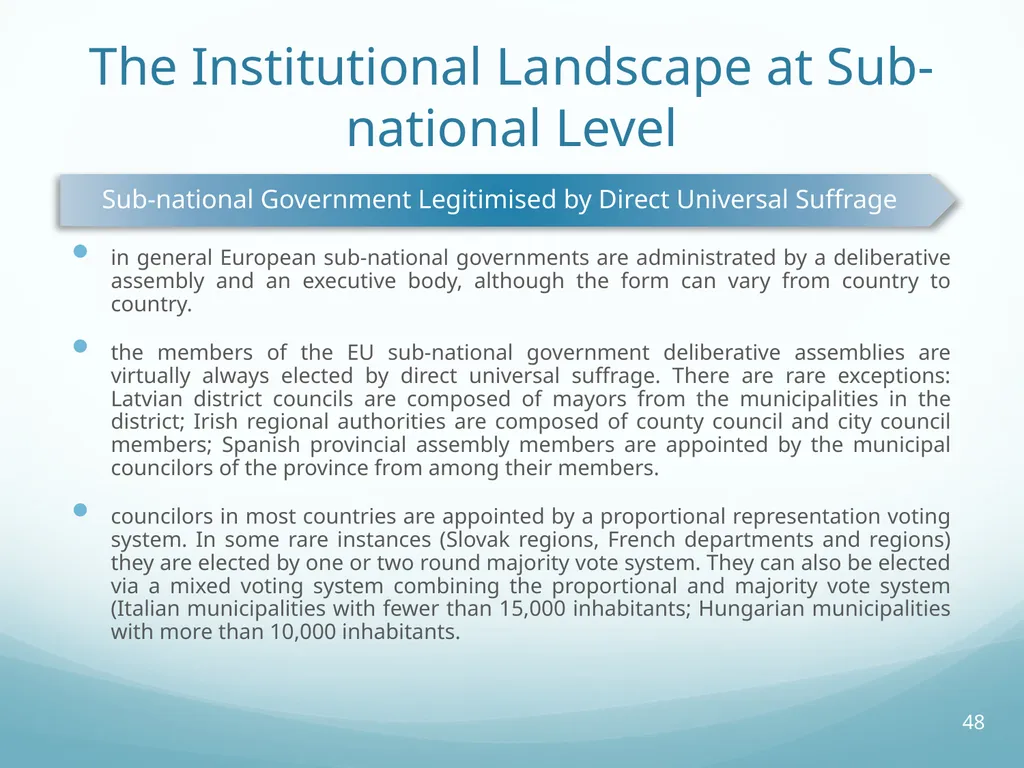
The Institutional Landscape at Sub-national Level in general European sub-national governments are administrated by a deliberative assembly and an executive body, although the form can vary from country to country.
the members of the EU sub-national government deliberative assemblies are virtually always elected by direct universal suffrage. There are rare exceptions: Latvian district councils are composed of mayors from the municipalities in the district; Irish regional authorities are composed of county council and city council members; Spanish provincial assembly members are appointed by the municipal councilors of the province from among their members.
councilors in most countries are appointed by a proportional representation voting system. In some rare instances (Slovak regions, French departments and regions) they are elected by one or two round majority vote system. They can also be elected via a mixed voting system combining the proportional and majority vote system (Italian municipalities with fewer than 15,000 inhabitants; Hungarian municipalities with more than 10,000 inhabitants. 48<br>
49
The Institutional Landscape at Sub-national Level the voting system used can also vary dependent on the size of the municipality, which is the case in the Luxembourg, Italy, Hungary, Slovenia and Poland. In the latter, local assemblies are elected under the majority vote system in municipalities with fewer than 20,000 inhabitants and under proportional system in municipalities with more than 30,000 inhabitants.
the duration of a councilor's mandate in deliberative assemblies varies from one country to another, ranging from three (Malta) to six years (France, Luxembourg, Belgian municipalities and provinces, municipalities in some Austrian Länder). Four years is the most frequently found duration. 49<br>
the duration of a councilor's mandate in deliberative assemblies varies from one country to another, ranging from three (Malta) to six years (France, Luxembourg, Belgian municipalities and provinces, municipalities in some Austrian Länder). Four years is the most frequently found duration. 49<br>
50
The Institutional Landscape at Sub-national Level the executive bodies of sub-national governments take one of the following forms:
an executive body composed of a single person, generally given the title mayor (or burgomaster) or president: this form is found at local level in around ten countries (Bulgaria, Cyprus, Hungary, Latvia, Lithuania, Malta, Romania) as well as in intermediary or regional entity executive bodies in Greece, Hungary, Latvia, Slovakia, France and Germany.
a college or executive committee composed of several people, including a ‘leader’ and several deputies, which is the most frequently found form.
the executive body (mayor/president or committee) is generally elected by members of the deliberative assembly from among their members. Mayors are elected by direct universal suffrage in around ten countries (Hungary, Bulgaria, Cyprus, Poland, Romania, Slovakia, Slovenia). In Greece and Portugal, the person who heads the majority list becomes the head of the executive. 50<br>
51
The Institutional Landscape at Sub-national Level Luxembourg, Belgium and the Netherlands apply an unusual system to appoint local executive bodies:
in Luxembourg, the members of the executive body are appointed by the Ministry of the Inferior while the head of the executive is appointed by the Grand Duke.
in the Netherlands, members are elected by the deliberative assembly from among its own members, while the head of the executive is appointed by the King.
in Belgium – the college of burgomaster and aldermen is elected by the municipal council, the burgomaster is appointed by the region under different conditions in the three regions.
the length of the mandates for executive bodies is not always identical to those of deliberative bodies. 51<br>
52
The Institutional Landscape at Sub-national Level the right of citizens to participate in the conduct of public affairs is one of the democratic principles that are shared by all member States of the EU (and Council of Europe).
the most common form of citizen participation in local political life is the referendum.
in several Member States (Bulgaria, Estonia, Hungary, Romania, Slovakia, Slovenia), a referendum must be held for any modifications in local government territorial boundaries. Inversely, referenda cannot be held for any modifications in local government territorial boundaries.
a referendum can generally be organised when requested by the deliberative assembly or a sufficient number of voters. The outcome is usually purely consultative, although it can be binding in several countries when a predetermined voting participation rate is reached (Czech Republic, France, Greece, Hungary, Poland, Portugal, Slovakia). 52<br>
53
Sub-national Government Areas of Activity the basic powers and responsibilities of local authorities shall be prescribed by the constitution or by statute. However, this provision shall not prevent the attribution to local authorities of powers and responsibilities for specific purposes in accordance with the law.
Local authorities shall, within the limits of the law, have full discretion to exercise their initiative with regard to any matter which is not excluded from their competence nor assigned to any other authority.
public responsibilities shall generally be exercised, in preference, by those authorities which are closest to the citizen. Allocation of responsibility to another authority should weigh up the extent and nature of the task and requirements of efficiency and economy. (Article 4, ECLS) 53<br>
54
Sub-national Government Areas of Activity sub-national public authority responsibilities are generally detailed in law and more rarely in the Constitution.
legislative texts on sub-national government responsibilities in a number of countries also often refer to a 'general competence clause' (or subsidiarity principle), which states that 'sub-national governments are required to take decisions for all responsibilities best carried out at their level', whenever that responsibility does not devolve by law to another public entity. 54<br>
legislative texts on sub-national government responsibilities in a number of countries also often refer to a 'general competence clause' (or subsidiarity principle), which states that 'sub-national governments are required to take decisions for all responsibilities best carried out at their level', whenever that responsibility does not devolve by law to another public entity. 54<br>
55
Sub-national Government Areas of Activity the law can set out the conditions for exercising a competence based on the nature and specify whether they are:
own responsibilities, which generally concern issues in the local interest: local governments enjoy considerable leeway in how they carry out these responsibilities.
delegated responsibilities on behalf of the central State or of another sub-national government: in every country, local governments carry out administrative tasks on behalf of the State. The implementation of these responsibilities is generally accompanied by precise instructions and strictly controlled, which curtails local government leeway and their autonomy.
shared responsibilities with other institutional levels in the same areas. Sharing of tasks can be with other local governments, federal States or the central State. 55<br>
56
Sub-national Government Areas of Activity distinctions, particularly between delegated and own responsibilities are important to determinate the sources of financing.
in many countries, delegated responsibilities are usually financed by State transfers while own responsibilities are funded fro the budgets of local governments themselves (tax revenue or fees charged for service).
the scope of responsibilities can vary depending on specific characteristics such as demographic size, which is the case in Spain.
capital cities with a specific legislation exercise more extensive responsibilities than common law municipalities. 56<br>
57
Sub-national Government Areas of Activity sub-national governments have a variety of powers to carry out their responsibilities:
regulatory powers (and legislative for some regional entities) that fall within the scope of their responsibilities and in compliance with the hierarchy or norms.
power to levy taxes, except in Malta and for some categories of local governments (Hungarian counties or Latvian districts).
administrative powers over the organisation of sub-national administration.
management powers over the conditions under which public services are provided to the general public and over the allocation of resources. 57<br>
58
Sub-national Government Areas of Activity municipalities are responsible for community services to the population, while higher-level sub-national government tiers take on responsibilities that cover larger geographic areas.
the scope of municipal responsibilities is very extensive, as they are responsible for managing local public services, which include:
living environment: usually covers urbanism and urban planning, protection of the environment, upkeep of public parks, etc.
management of distribution networks: this heading regroups basic services and infrastructure that absorb significant local resources, such as water (provision of drinking water, sewerage) , waste (collection and treatment of household waste), public transport (construction and upkeep of the road network, local public transport services), public lighting, etc. 58<br>
59
Sub-national Government Areas of Activity schools: in every European country except Malta, Ireland, Cyprus and Spain, municipalities are responsible for the construction and upkeep of primary school buildings. their responsibility can also extend to the secondary school level (in the Baltic States, Bulgaria, Finland, Sweden, Poland, Romania and the Netherlands), to vocational teaching (Austria, Italy, Netherlands, Lithuania and Sweden) and to adult vocational teaching (Denmark, Lithuania).
social services: a common municipal responsibility in Europe. It can cover a wide variety of services depending on the country: support services for children, families, the disabled and elderly and social services (social benefits, inclusion, poverty).
leisure and culture: includes a number of important areas such as municipal libraries, cultural activities, sport activities and amenities.
public health care: municipalities are responsible for primary care and prevention actions in half the countries in Europe. 59<br>
60
Sub-national Government Areas of Activity public order and safety: municipalities can set up municipal police forces and/or be responsible for emergency and fire-fighting service, as is the case in the UK, Belgium and Spain.
social housing: less frequent, this responsibility covers the construction and management of the housing stock as well as the granting of housing subsidies.
at regional level, responsibilities are very varied and generally include:
education: the construction and upkeep of secondary schools, and sometimes higher education buildings.
territorial planning and economic development.
public health care: management of secondary care and public hospitals.
social services: responsibilities as employment services, social and professional inclusion, youth, elderly, etc. 60<br>
61
The Institutional Landscape at Sub-national Level Without prejudice to more general statutory provisions, local authorities shall be able to determine their own internal administrative structures in order to adapt them to local needs and ensure effective management.
The conditions of service of local government employees shall be such as to permit the recruitment of high-quality staff on the basis of merit and competence; to this end adequate training opportunities, remuneration and career prospects shall be provided. (Article 6, ECLS) 61<br>
The conditions of service of local government employees shall be such as to permit the recruitment of high-quality staff on the basis of merit and competence; to this end adequate training opportunities, remuneration and career prospects shall be provided. (Article 6, ECLS) 61<br>
62
The Institutional Landscape at Sub-national Level administrative and human resources differ widely from country to country.
the smallest rural municipalities generally have extremely limited human and administrative means.
sub-national government entities employed a total of more than 18 million people (in 2005) representing 56% of all public employment and around 16% of total EU workforce. 62<br>
the smallest rural municipalities generally have extremely limited human and administrative means.
sub-national government entities employed a total of more than 18 million people (in 2005) representing 56% of all public employment and around 16% of total EU workforce. 62<br>
63
The Institutional Landscape at Sub-national Level Local authorities shall be entitled, in exercising their powers, to co-operate and, within the framework of the law, to form consortia with other local authorities in order to carry out tasks of common interest.
The entitlement of local authorities to belong to an association for the protection and promotion of their common interests and to belong to an international association of local authorities shall be recognised in each State.
Local authorities shall be entitled, under such conditions as may be provided for by the law, to co-operate with their counterparts in other States. (Article 10, ECLS) 63<br>
64
The Institutional Landscape at Sub-national Level inter-municipal cooperation is very well-established in Europe, representing an efficient way of compendation for the modest demographic size of municipalities by allowing them to pool resources and improve the management od local public services.
inter-municipal cooperation is voluntary in the vast majority of countries, although occasionally encouraged by direct (specific grants, tax schemes) or indirect (ease of access to State funding or to structural funds) financial incentives, as is the case in Hungary (micro-regions), Portugal and France.
inter-municipal cooperation is highly developed in Austria (1.413 inter-municipal organisations), Germany (municipal syndicates and municipal associations), southern Europe, Spain, Italy, Portugal, Greece), the Benelux countries, Finland and Sweden. 64<br>
65
The Institutional Landscape at Sub-national Level generally, there has been a clear trend in Europe over past decade to outsource the management of local public services the management of local public services.
recourse to some form of delegated management mode, whether it be via a sub-contracting agreement, a concession to a private entity (association or company) or the creation of a public-private partnership (PPP) is increasingly frequent along with the privatisation of some public services.
several European countries regularly use PPPs, particularly in the UK (one of the first to use this type of management), along with the Germany, Spain, Portugal, Ireland and Italy.
the number of PPPs is on the increase in other European countries, particularly in France and Greece, Poland, Lithuania, Romania, Czech Republic, Latvia and Slovenia. 65<br>
66
The Institutional Landscape at Sub-national Level Any administrative supervision of local authorities may only be exercised according to such procedures and in such cases as are provided for by the constitution or by statute.
Any administrative supervision of the activities of the local authorities shall normally aim only at ensuring compliance with the law and with constitutional principles. Administrative supervision may however be exercised with regard to expediency by higher-level authorities in respect of tasks the execution of which is delegated to local authorities.
Administrative supervision of local authorities shall be exercised in such a way as to ensure that the intervention of the controlling authority is kept in proportion to the importance of the interests which it is intended to protect. (Article 8, ECLS) 66<br>
67
The Institutional Landscape at Sub-national Level the principle of self-government does not exempt sub-national governments from controls by their supervisory authority. these controls concern the administrative, budgetary and financial acts carried out by sub-national governments themselves and those of their groupings and satellites.
Legal control:
legal control of decisions taken by sub-national governments are generally carried out posteriori. However, some countries (Belgium, Germany, Luxembourg, Spain) also have an a priori control that can be applied in exceptional circumstances and for certain major decisions such as modifications to territorial boundaries, zoning changes, disposal of public property, the introduction of new local taxes, the setting of rates for public services etc. 67<br>
68
The Institutional Landscape at Sub-national Level in federal States and autonomous regions, the control of regional laws and administrative acts (mainly to ensure compliance with the Constitution or with national/federal laws) is generally carried out by a constitutional tribunal.
for the local governments, legal control is exercised for the most part by the supervisory authority, which can either be the central government or a higher sub-national government level. whenever an act is clearly illegal, it can be contested before the administrative judge.
Central state controls can be carried out by the Ministry in charge of sub-national governments, by the central State representative at territorial level or by another State representative. The state representatives responsible for controls are: prefects in France, Poland and Romania, commissioners or district governors in Cyprus, Luxembourg and Bulgaria, county governors in Estonia, Lithuania and Sweden, State appointed Secretary generals in Greece, Hungary and Denmark. 68<br>
69
The Institutional Landscape at Sub-national Level a prior budgets audits by financial supervisory bodies are rare, although examples can still be found in Luxembourg (district commissioners), Ireland (audit control services by the Ministry) or in the federal countries, where some federated States can have extensive control powers over sub-regional levels.
most commonly found form of budgetary and financial control in Europe is a posteriori audits, which can cover both the accounts of a local government and those of its satellite entities. 69<br>
most commonly found form of budgetary and financial control in Europe is a posteriori audits, which can cover both the accounts of a local government and those of its satellite entities. 69<br>
70
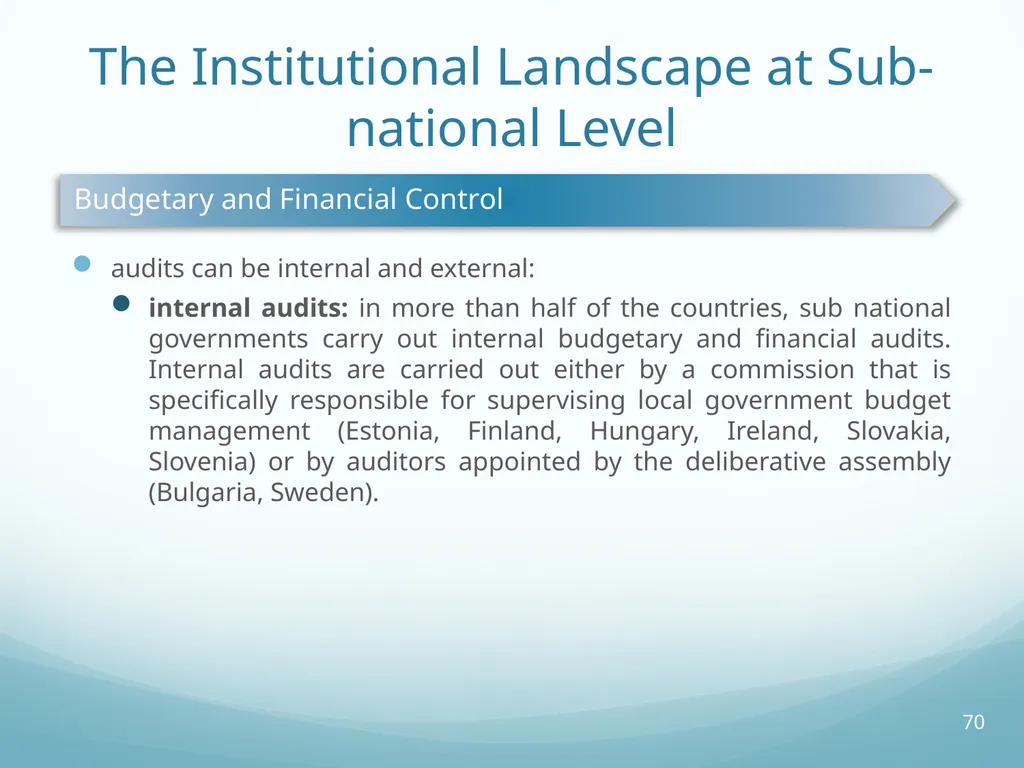
The Institutional Landscape at Sub-national Level audits can be internal and external:
internal audits: in more than half of the countries, sub national governments carry out internal budgetary and financial audits. Internal audits are carried out either by a commission that is specifically responsible for supervising local government budget management (Estonia, Finland, Hungary, Ireland, Slovakia, Slovenia) or by auditors appointed by the deliberative assembly (Bulgaria, Sweden). 70<br>
internal audits: in more than half of the countries, sub national governments carry out internal budgetary and financial audits. Internal audits are carried out either by a commission that is specifically responsible for supervising local government budget management (Estonia, Finland, Hungary, Ireland, Slovakia, Slovenia) or by auditors appointed by the deliberative assembly (Bulgaria, Sweden). 70<br>
71
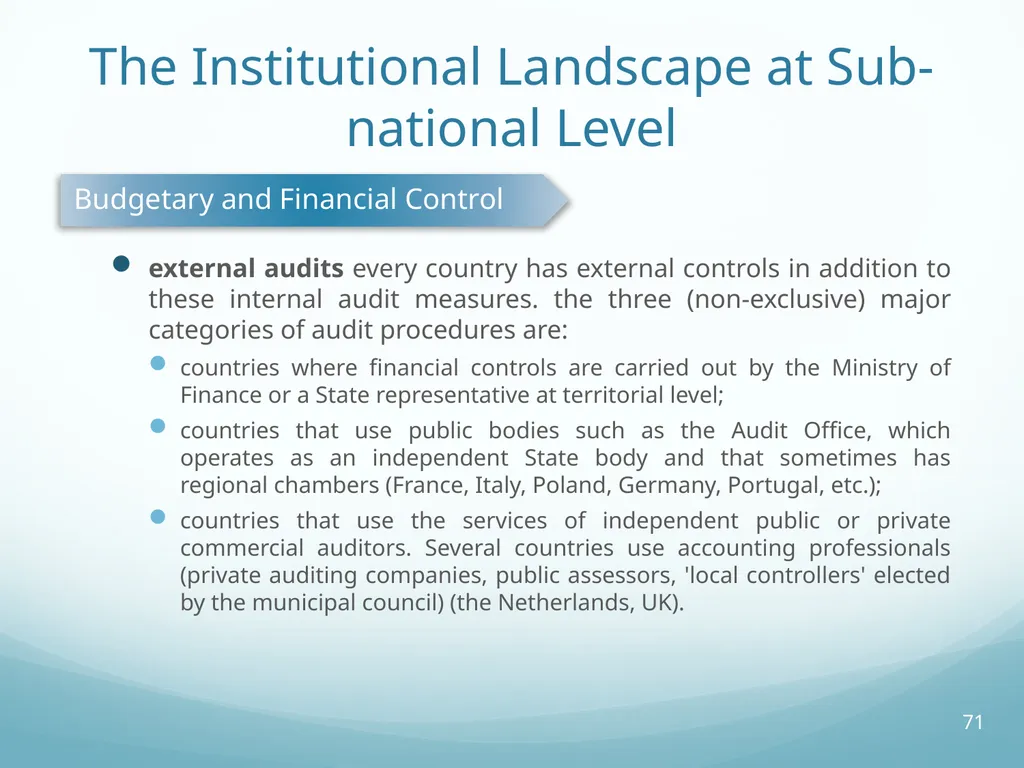
The Institutional Landscape at Sub-national Level external audits every country has external controls in addition to these internal audit measures. the three (non-exclusive) major categories of audit procedures are:
countries where financial controls are carried out by the Ministry of Finance or a State representative at territorial level;
countries that use public bodies such as the Audit Office, which operates as an independent State body and that sometimes has regional chambers (France, Italy, Poland, Germany, Portugal, etc.);
countries that use the services of independent public or private commercial auditors. Several countries use accounting professionals (private auditing companies, public assessors, 'local controllers' elected by the municipal council) (the Netherlands, UK). 71<br>
72
The Institutional Landscape at Sub-national Level the decentralisation and regionalisation process implemented in most European countries in recent decades have given rise of the number of responsibility transfers to the sub national government level.
the extended scope of sub-national responsibilities has generated a corresponding increase in expenditure.
In EU28 terms, the weight of sub-national public sector has grown steadily since the first waves of decentralization at the end of 1970s. 72<br>
the extended scope of sub-national responsibilities has generated a corresponding increase in expenditure.
In EU28 terms, the weight of sub-national public sector has grown steadily since the first waves of decentralization at the end of 1970s. 72<br>
73
The Institutional Landscape at Sub-national Level according to Eurostat forecasts, the EU will lose 10 million inhabitants by 2050. Almost half of the European regions will be less populated than today, particularly regions such as Eastern Germany, Central and Eastern Europe, the Baltic States and Northern Scandinavia.
the European population will be greyer. As of 2030, a third of the population will be over 65 years of age. Ageing populations will be concentrated in the north of Spain, Italy, in the Länder of former East Germany, and to a lesser degree in Finland and the north of Sweden. The dependency ratio should be 51% in 2050 in the EU, representing 1 retiree for every 2 active people, replacing the current EU average of 1 to 4. 73<br>
the European population will be greyer. As of 2030, a third of the population will be over 65 years of age. Ageing populations will be concentrated in the north of Spain, Italy, in the Länder of former East Germany, and to a lesser degree in Finland and the north of Sweden. The dependency ratio should be 51% in 2050 in the EU, representing 1 retiree for every 2 active people, replacing the current EU average of 1 to 4. 73<br>
74
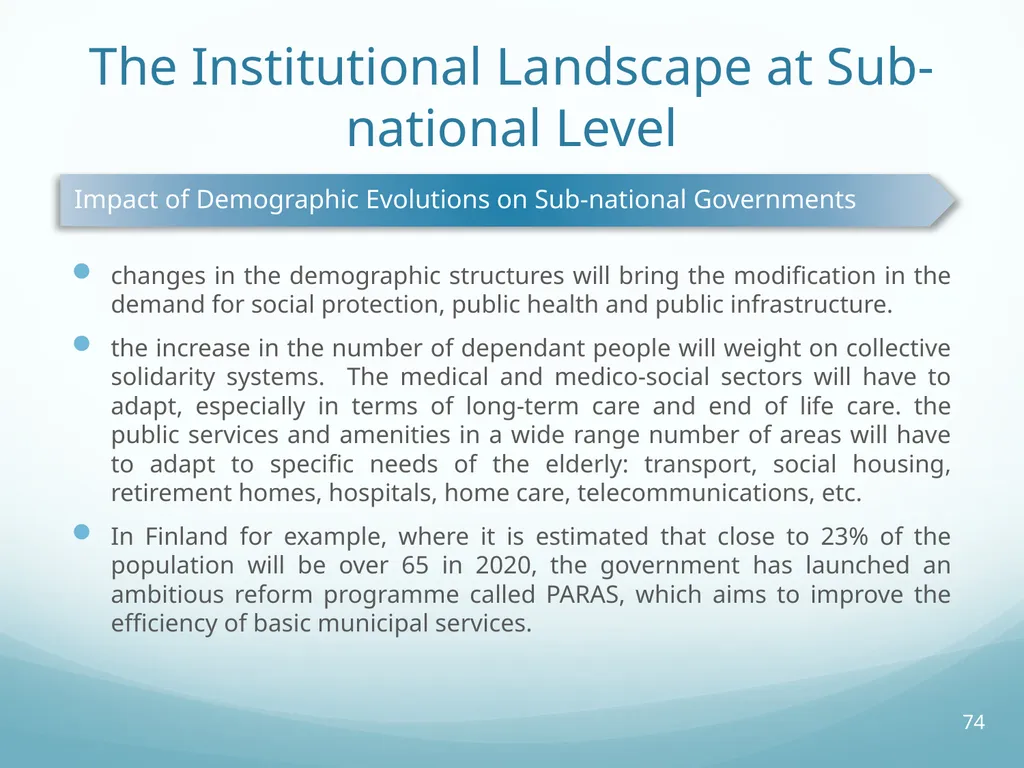
The Institutional Landscape at Sub-national Level changes in the demographic structures will bring the modification in the demand for social protection, public health and public infrastructure.
the increase in the number of dependant people will weight on collective solidarity systems. The medical and medico-social sectors will have to adapt, especially in terms of long-term care and end of life care. the public services and amenities in a wide range number of areas will have to adapt to specific needs of the elderly: transport, social housing, retirement homes, hospitals, home care, telecommunications, etc.
In Finland for example, where it is estimated that close to 23% of the population will be over 65 in 2020, the government has launched an ambitious reform programme called PARAS, which aims to improve the efficiency of basic municipal services. 74<br>
75
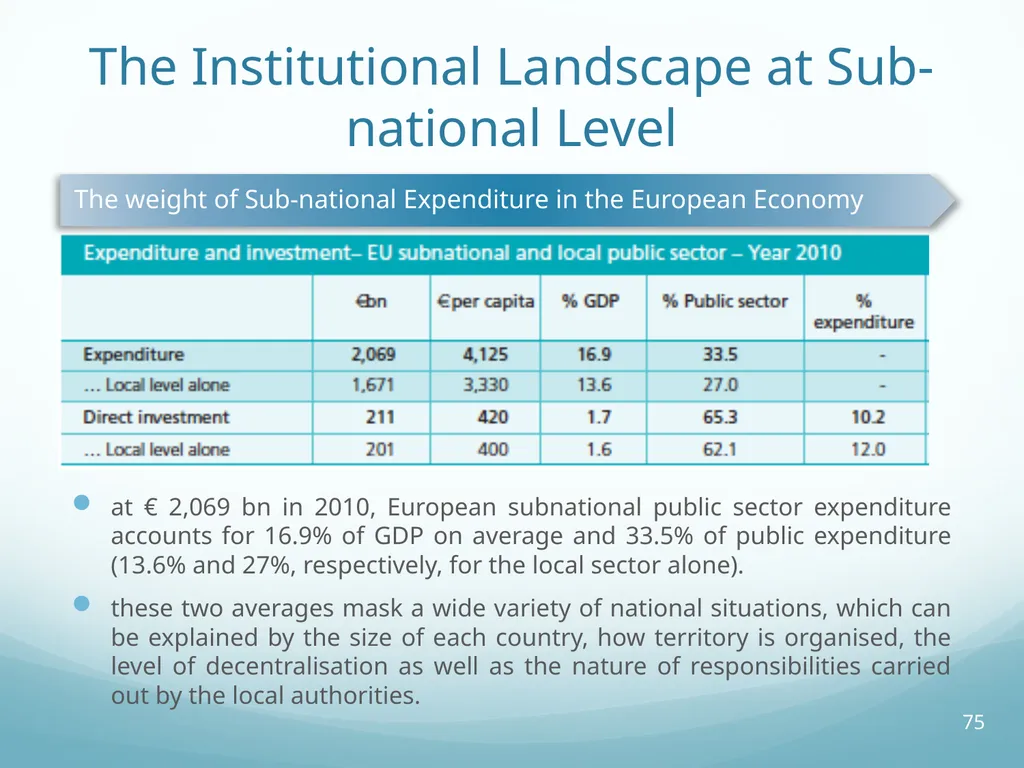
The Institutional Landscape at Sub-national Level 75 at € 2,069 bn in 2010, European subnational public sector expenditure accounts for 16.9% of GDP on average and 33.5% of public expenditure (13.6% and 27%, respectively, for the local sector alone).
these two averages mask a wide variety of national situations, which can be explained by the size of each country, how territory is organised, the level of decentralisation as well as the nature of responsibilities carried out by the local authorities.<br>
these two averages mask a wide variety of national situations, which can be explained by the size of each country, how territory is organised, the level of decentralisation as well as the nature of responsibilities carried out by the local authorities.<br>
76
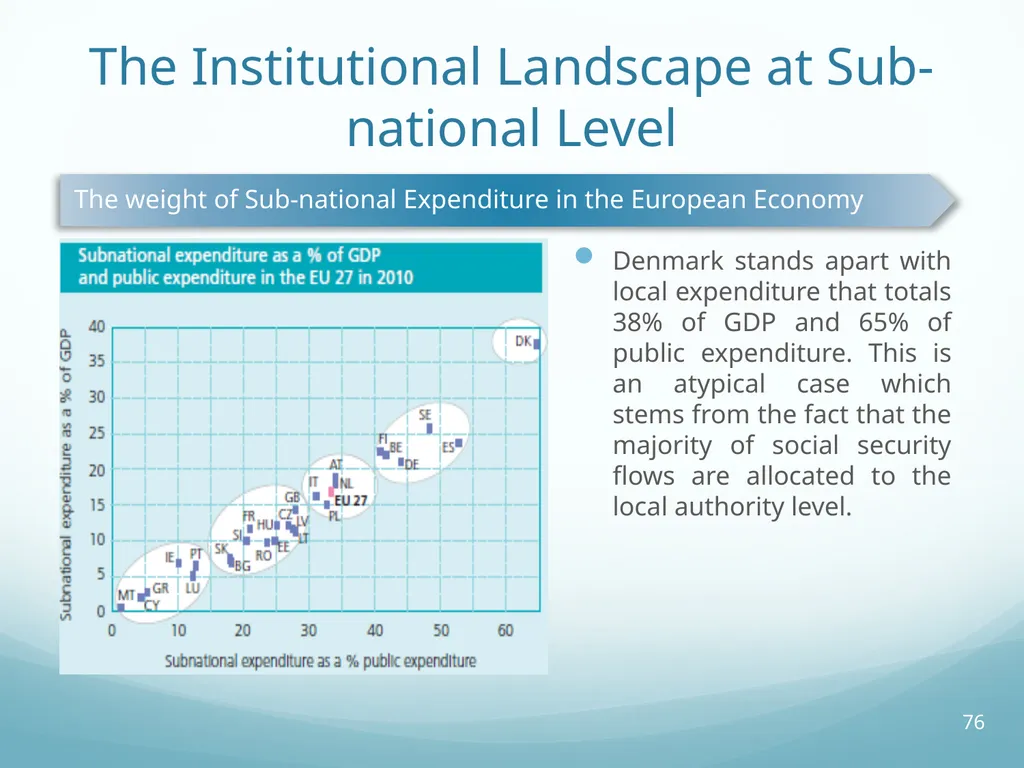
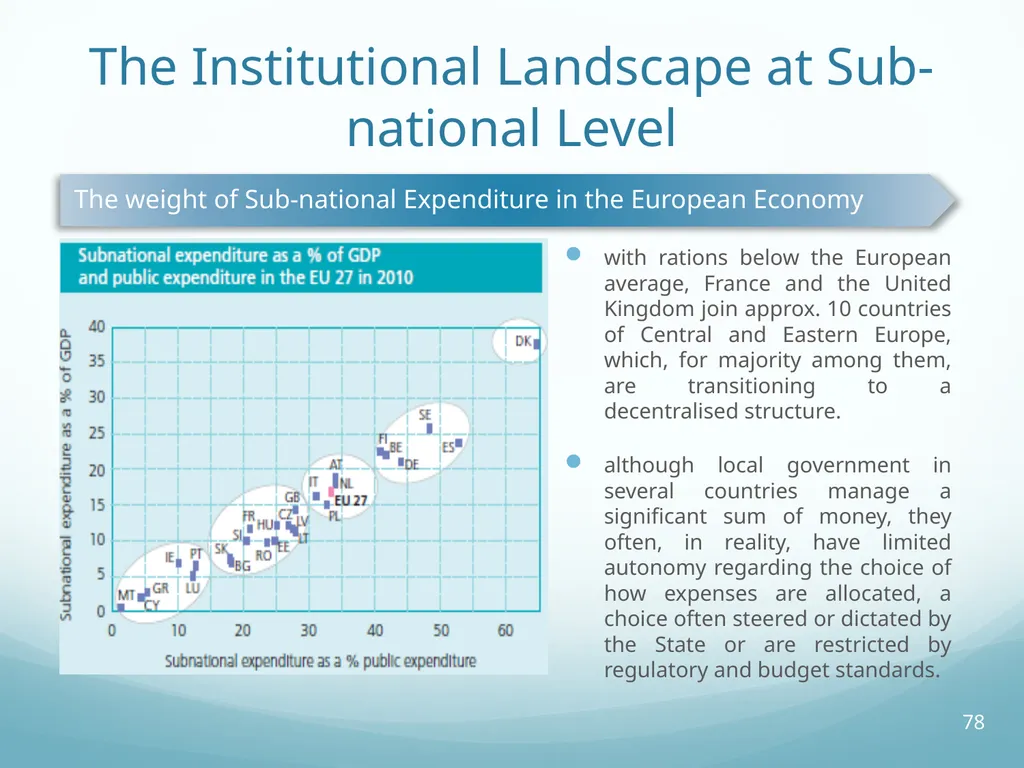
The Institutional Landscape at Sub-national Level Denmark stands apart with local expenditure that totals 38% of GDP and 65% of public expenditure. This is an atypical case which stems from the fact that the majority of social security flows are allocated to the local authority level. 76<br>
77
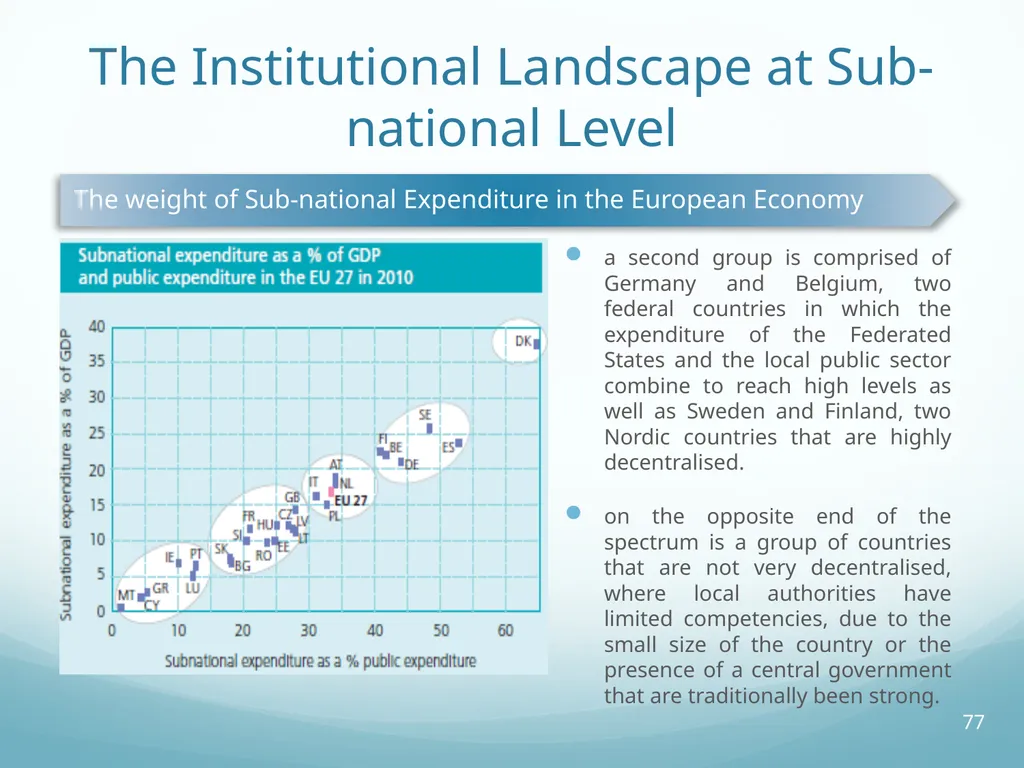
The Institutional Landscape at Sub-national Level a second group is comprised of Germany and Belgium, two federal countries in which the expenditure of the Federated States and the local public sector combine to reach high levels as well as Sweden and Finland, two Nordic countries that are highly decentralised.
on the opposite end of the spectrum is a group of countries that are not very decentralised, where local authorities have limited competencies, due to the small size of the country or the presence of a central government that are traditionally been strong. 77<br>
on the opposite end of the spectrum is a group of countries that are not very decentralised, where local authorities have limited competencies, due to the small size of the country or the presence of a central government that are traditionally been strong. 77<br>
78
The Institutional Landscape at Sub-national Level with rations below the European average, France and the United Kingdom join approx. 10 countries of Central and Eastern Europe, which, for majority among them, are transitioning to a decentralised structure.
although local government in several countries manage a significant sum of money, they often, in reality, have limited autonomy regarding the choice of how expenses are allocated, a choice often steered or dictated by the State or are restricted by regulatory and budget standards. 78<br>
although local government in several countries manage a significant sum of money, they often, in reality, have limited autonomy regarding the choice of how expenses are allocated, a choice often steered or dictated by the State or are restricted by regulatory and budget standards. 78<br>
79
The Institutional Landscape at Sub-national Level in 2010, growth in sub-national public sector expenditure in Europe was -0.04% by volume and -0.1% for the local level alone.
this stabilisation followed ten years of strong growth (+2.4% on average by volume), which resulted from the decentralisation process that has been underway in European countries as well as greater demand for local public services. Certain budget spending items increased significantly, such as social spending and healthcare.
this pause came on the back of two years (2008 and 2009) of strong expenditure increase, driven by the economic and social crisis and the implementation of the national stimulus plans. 79<br>
80
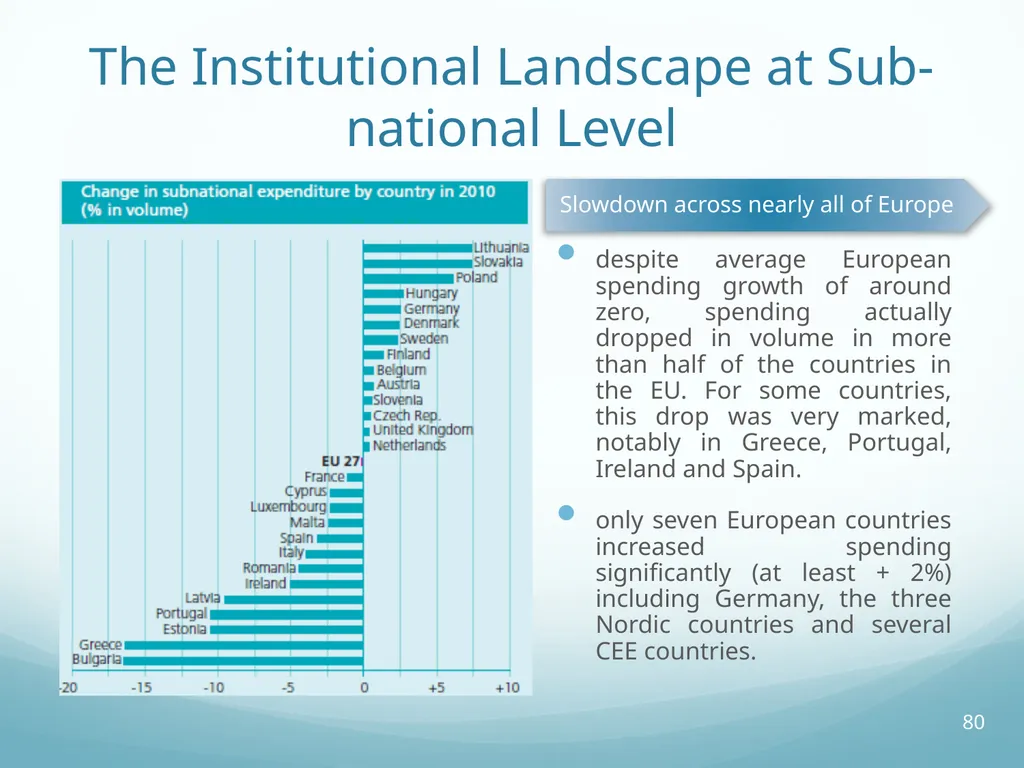
The Institutional Landscape at Sub-national Level despite average European spending growth of around zero, spending actually dropped in volume in more than half of the countries in the EU. For some countries, this drop was very marked, notably in Greece, Portugal, Ireland and Spain.
only seven European countries increased spending significantly (at least + 2%) including Germany, the three Nordic countries and several CEE countries. 80<br>
only seven European countries increased spending significantly (at least + 2%) including Germany, the three Nordic countries and several CEE countries. 80<br>
81
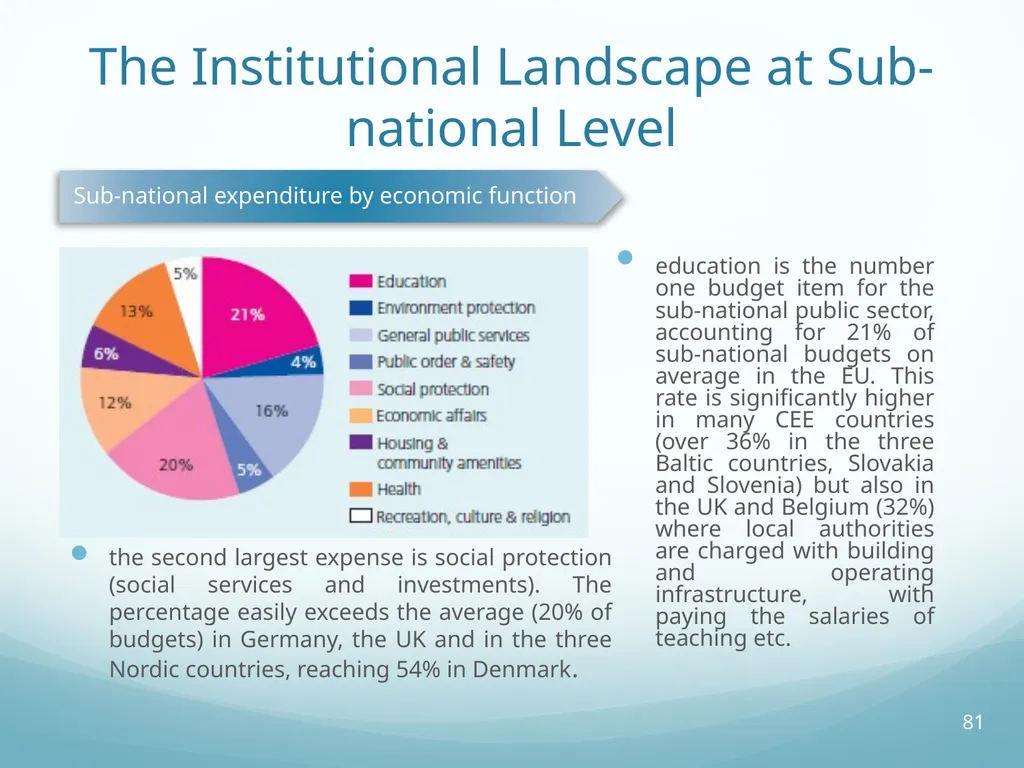
The Institutional Landscape at Sub-national Level education is the number one budget item for the sub-national public sector, accounting for 21% of sub-national budgets on average in the EU. This rate is significantly higher in many CEE countries (over 36% in the three Baltic countries, Slovakia and Slovenia) but also in the UK and Belgium (32%) where local authorities are charged with building and operating infrastructure, with paying the salaries of teaching etc. 81 the second largest expense is social protection (social services and investments). The percentage easily exceeds the average (20% of budgets) in Germany, the UK and in the three Nordic countries, reaching 54% in Denmark.<br>
82
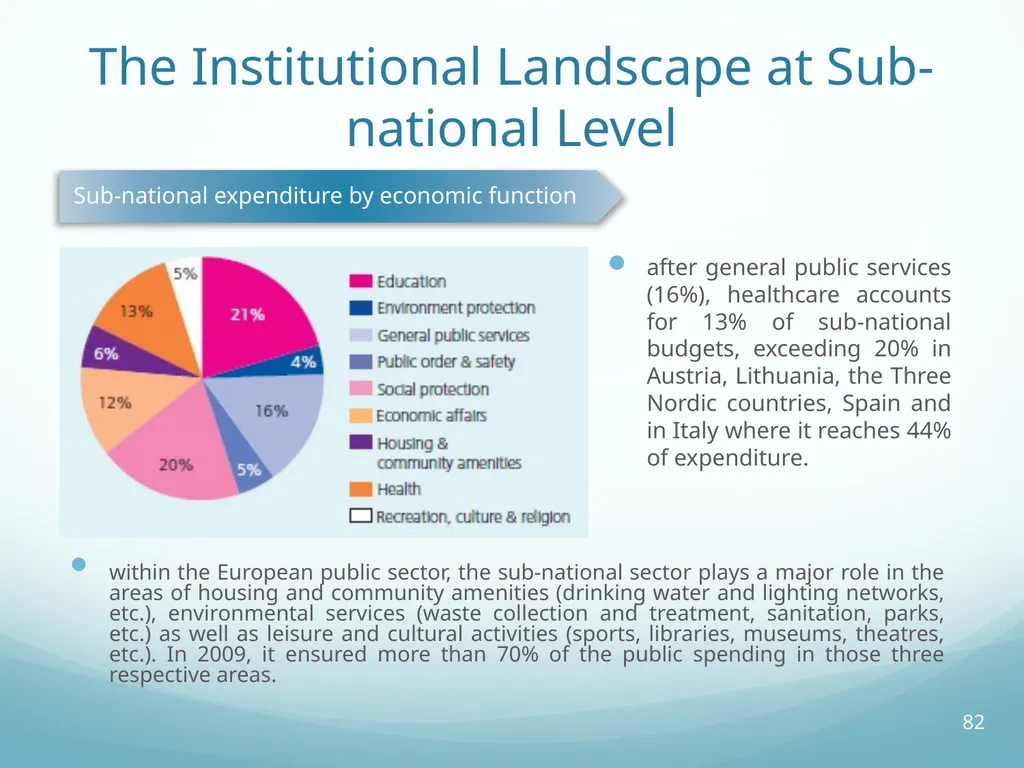
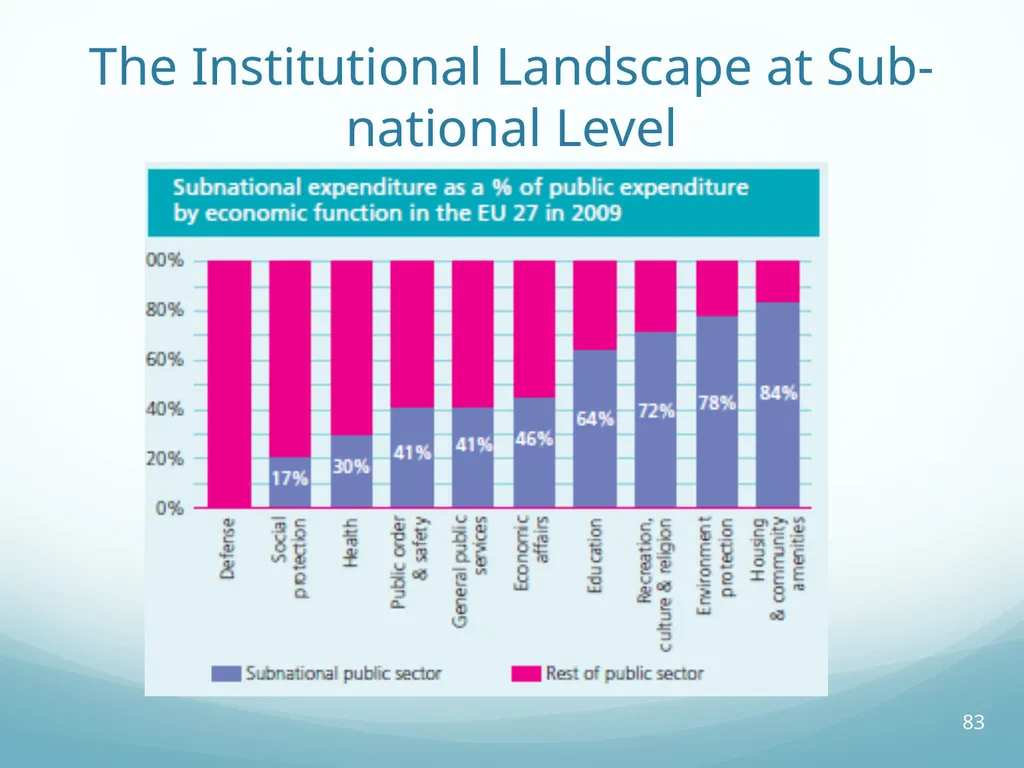
The Institutional Landscape at Sub-national Level after general public services (16%), healthcare accounts for 13% of sub-national budgets, exceeding 20% in Austria, Lithuania, the Three Nordic countries, Spain and in Italy where it reaches 44% of expenditure. 82 within the European public sector, the sub-national sector plays a major role in the areas of housing and community amenities (drinking water and lighting networks, etc.), environmental services (waste collection and treatment, sanitation, parks, etc.) as well as leisure and cultural activities (sports, libraries, museums, theatres, etc.). In 2009, it ensured more than 70% of the public spending in those three respective areas.<br>
83
The Institutional Landscape at Sub-national Level 83<br>
84
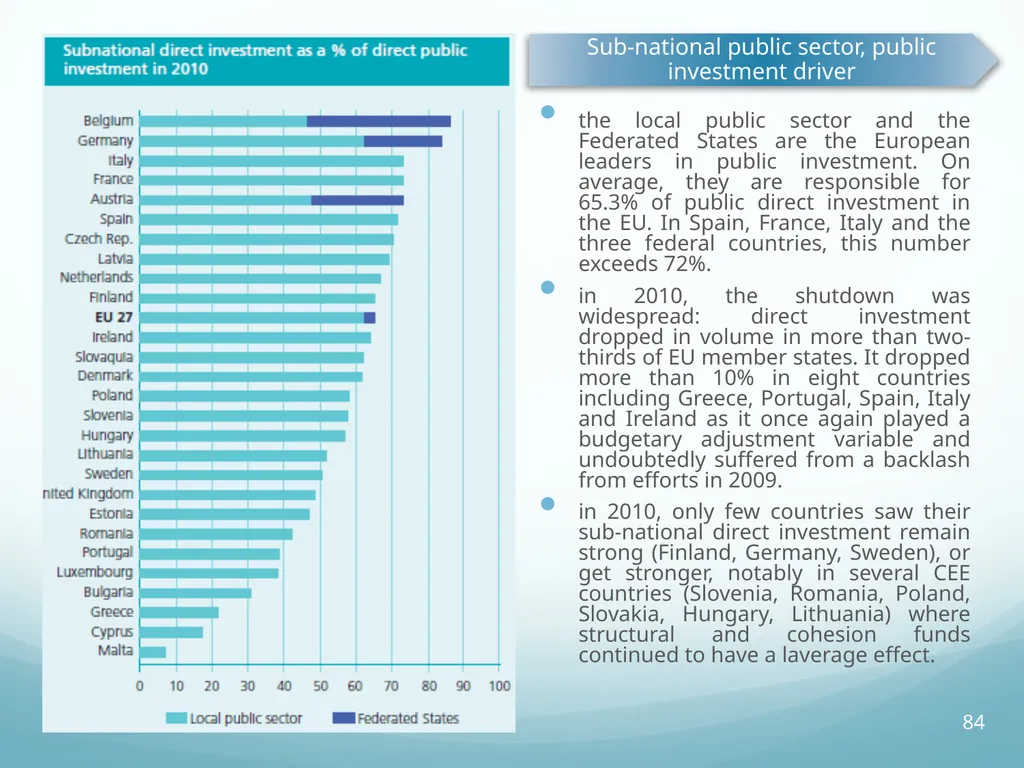
the local public sector and the Federated States are the European leaders in public investment. On average, they are responsible for 65.3% of public direct investment in the EU. In Spain, France, Italy and the three federal countries, this number exceeds 72%.
in 2010, the shutdown was widespread: direct investment dropped in volume in more than two-thirds of EU member states. It dropped more than 10% in eight countries including Greece, Portugal, Spain, Italy and Ireland as it once again played a budgetary adjustment variable and undoubtedly suffered from a backlash from efforts in 2009.
in 2010, only few countries saw their sub-national direct investment remain strong (Finland, Germany, Sweden), or get stronger, notably in several CEE countries (Slovenia, Romania, Poland, Slovakia, Hungary, Lithuania) where structural and cohesion funds continued to have a laverage effect. 84<br>
85
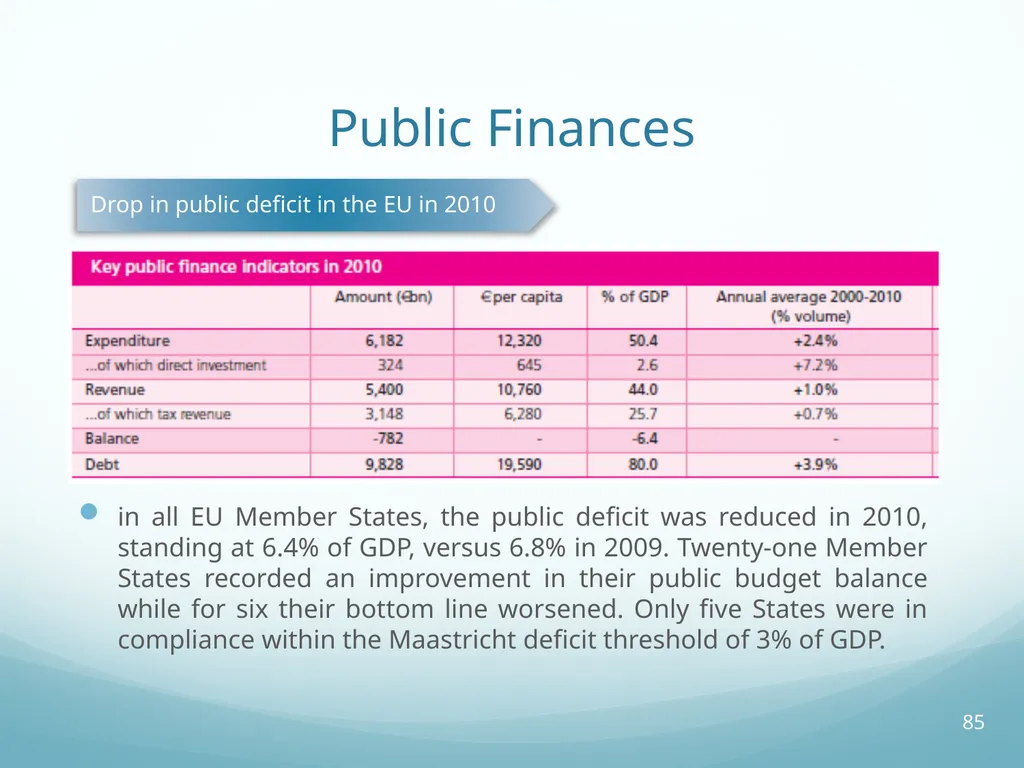
Public Finances 85 in all EU Member States, the public deficit was reduced in 2010, standing at 6.4% of GDP, versus 6.8% in 2009. Twenty-one Member States recorded an improvement in their public budget balance while for six their bottom line worsened. Only five States were in compliance within the Maastricht deficit threshold of 3% of GDP.<br>
86
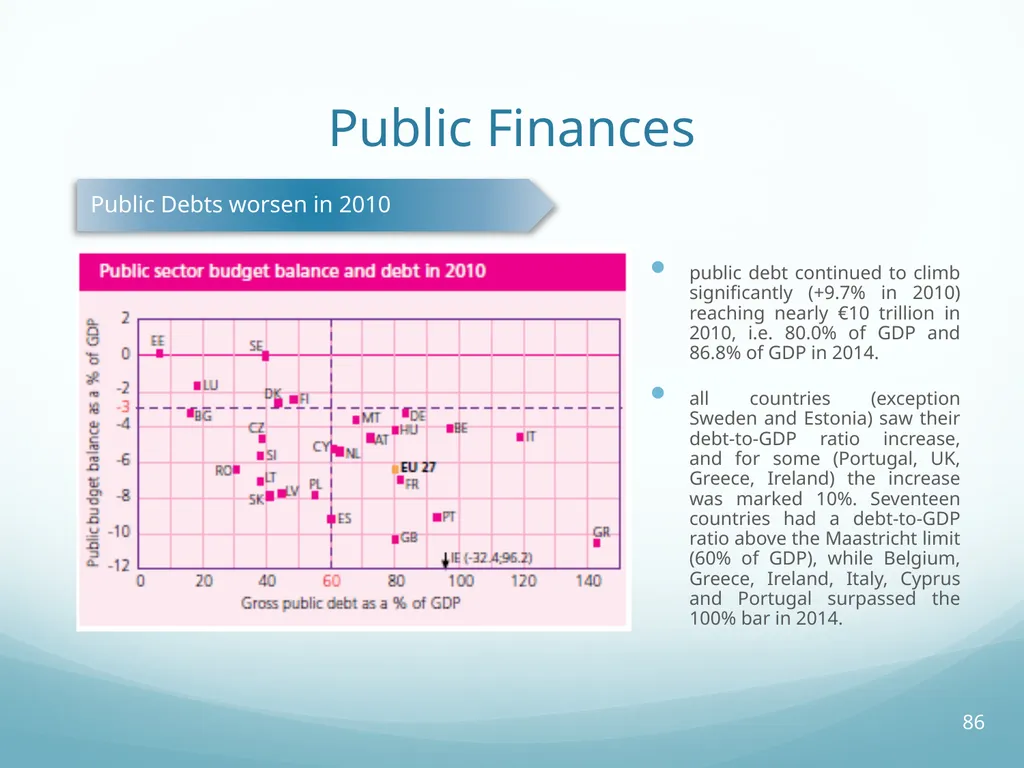
Public Finances public debt continued to climb significantly (+9.7% in 2010) reaching nearly €10 trillion in 2010, i.e. 80.0% of GDP and 86.8% of GDP in 2014.
all countries (exception Sweden and Estonia) saw their debt-to-GDP ratio increase, and for some (Portugal, UK, Greece, Ireland) the increase was marked 10%. Seventeen countries had a debt-to-GDP ratio above the Maastricht limit (60% of GDP), while Belgium, Greece, Ireland, Italy, Cyprus and Portugal surpassed the 100% bar in 2014. 86<br>
all countries (exception Sweden and Estonia) saw their debt-to-GDP ratio increase, and for some (Portugal, UK, Greece, Ireland) the increase was marked 10%. Seventeen countries had a debt-to-GDP ratio above the Maastricht limit (60% of GDP), while Belgium, Greece, Ireland, Italy, Cyprus and Portugal surpassed the 100% bar in 2014. 86<br>
87
Sub-national Government Revenue Local authorities shall be entitled, within national economic policy, to adequate financial resources of their own, of which they may dispose freely within the framework of their powers.
local authorities' financial resources shall be commensurate with the responsibilities provided for by the constitution and the law.
Part at least of the financial resources of local authorities shall derive from local taxes and charges of which, within the limits of statute, they have the power to determine the rate.
The financial systems on which resources available to local authorities are based shall be of a sufficiently diversified and buoyant nature to enable them to keep pace as far as practically possible with the real evolution of the cost of carrying out their tasks. 87<br>
88
Sub-national Government Revenue The protection of financially weaker local authorities calls for the institution of financial equalisation procedures or equivalent measures which are designed to correct the effects of the unequal distribution of potential sources of finance and of the financial burden they must support. Such procedures or measures shall not diminish the discretion local authorities may exercise within their own sphere of responsibility.
Local authorities shall be consulted, in an appropriate manner, on the way in which redistributed resources are to be allocated to them.
As far as possible, grants to local authorities shall not be earmarked for the financing of specific projects. The provision of grants shall not remove the basic freedom of local authorities to exercise policy discretion within their own jurisdiction.
For the purpose of borrowing for capital investment, local authorities shall have access to the national capital market within the limits of the law. (Article 9, ECLS) 88<br>
89
Sub-national Government Revenue methods of financing sub-national government can be determined by general local administrative laws, local finance or by annual or multiannual finance laws.
in three federal countries of the EU, detailed provisions appear in Constitution on how federal States and local governments are to be financed (Germany, Belgium, Austria).
the Constitutions of several unitary States also contain provisions of this kind:
in Italy, article 19 of the Constitution addresses the financial autonomy of local governments.
in Spain, chapters on local governments and autonomous communities include provisions on finances, in particular article 142 which states that ‘local entities must have sufficient resources with which to meet the obligations conferred on each of them by law’ and ‘be financed primarily by means of own-source taxes and their parts of State and autonomous community taxes’. 89<br>
90
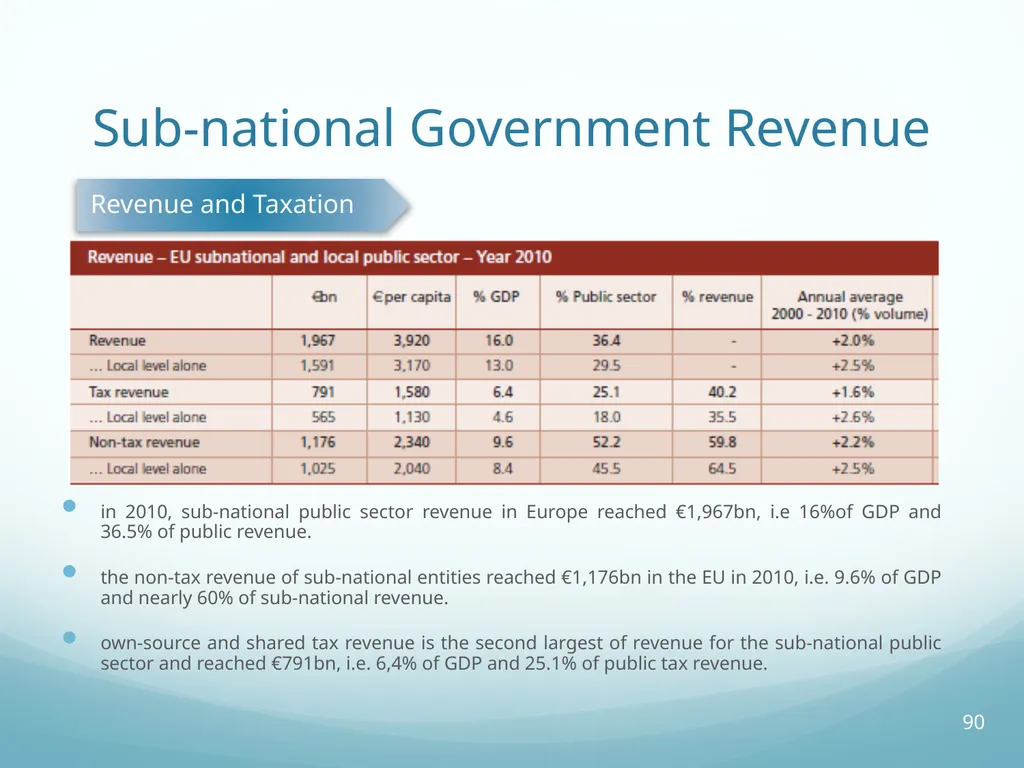
Sub-national Government Revenue in 2010, sub-national public sector revenue in Europe reached €1,967bn, i.e 16%of GDP and 36.5% of public revenue.
the non-tax revenue of sub-national entities reached €1,176bn in the EU in 2010, i.e. 9.6% of GDP and nearly 60% of sub-national revenue.
own-source and shared tax revenue is the second largest of revenue for the sub-national public sector and reached €791bn, i.e. 6,4% of GDP and 25.1% of public tax revenue. 90<br>
91
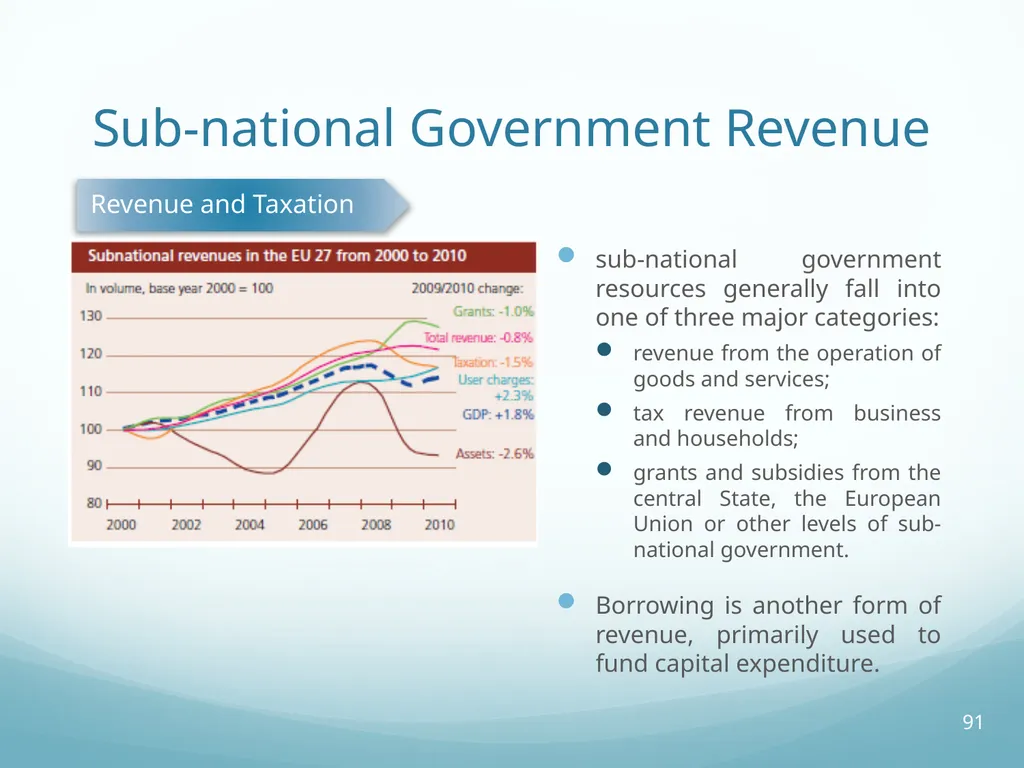
Sub-national Government Revenue 91 sub-national government resources generally fall into one of three major categories:
revenue from the operation of goods and services;
tax revenue from business and households;
grants and subsidies from the central State, the European Union or other levels of sub-national government.
Borrowing is another form of revenue, primarily used to fund capital expenditure.<br>
revenue from the operation of goods and services;
tax revenue from business and households;
grants and subsidies from the central State, the European Union or other levels of sub-national government.
Borrowing is another form of revenue, primarily used to fund capital expenditure.<br>
92
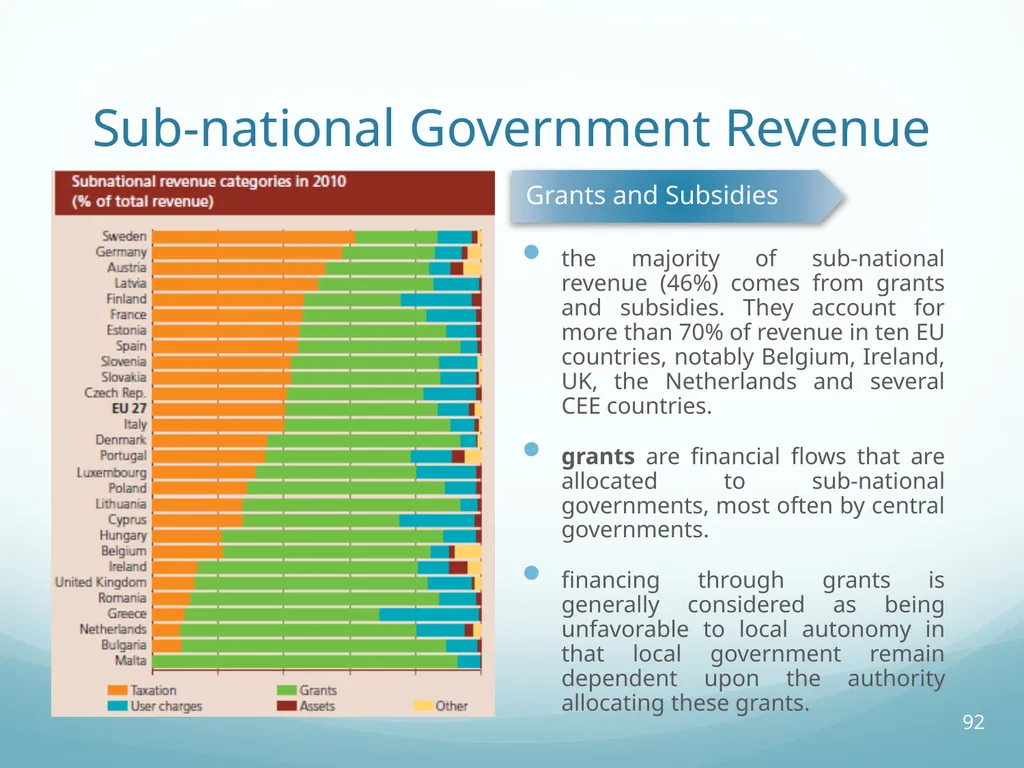
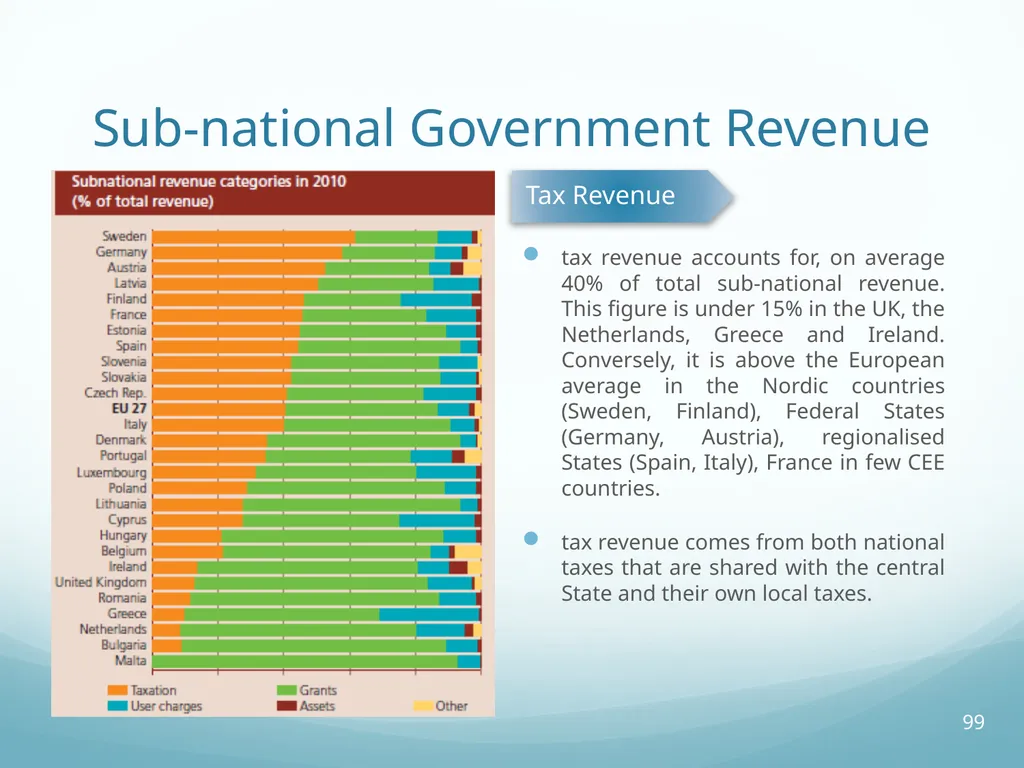
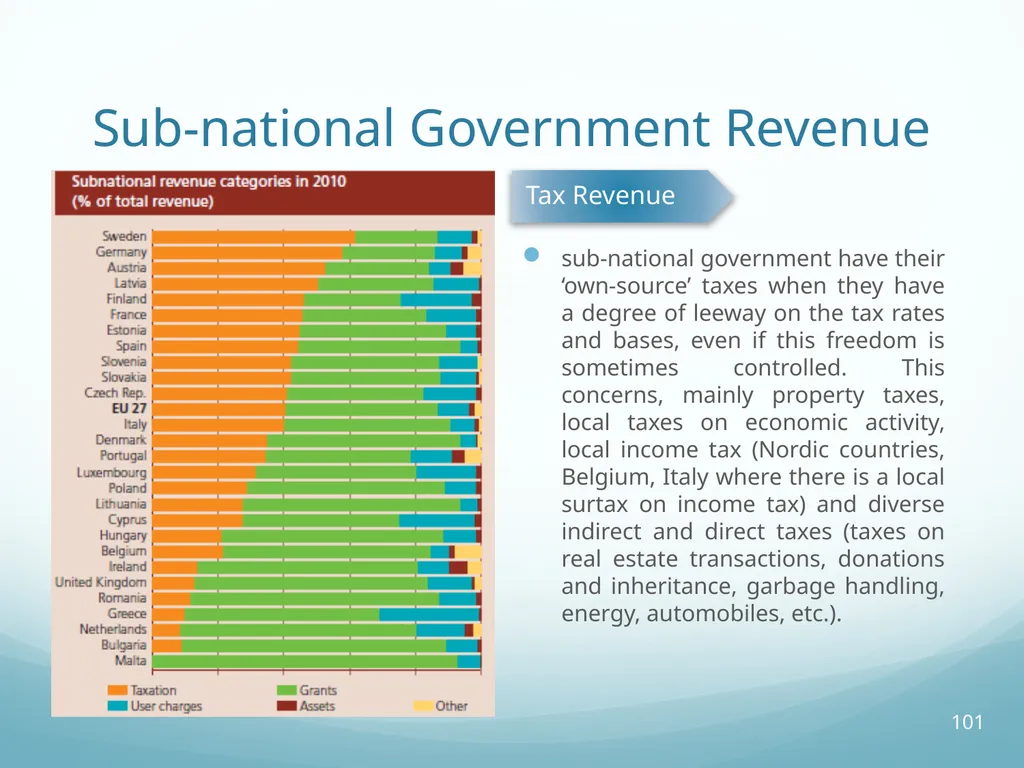
Sub-national Government Revenue the majority of sub-national revenue (46%) comes from grants and subsidies. They account for more than 70% of revenue in ten EU countries, notably Belgium, Ireland, UK, the Netherlands and several CEE countries.
grants are financial flows that are allocated to sub-national governments, most often by central governments.
financing through grants is generally considered as being unfavorable to local autonomy in that local government remain dependent upon the authority allocating these grants. 92<br>
grants are financial flows that are allocated to sub-national governments, most often by central governments.
financing through grants is generally considered as being unfavorable to local autonomy in that local government remain dependent upon the authority allocating these grants. 92<br>
93
Sub-national Government Revenue different categories of grants:
operating or investment grants form the lion’s share of grants to sub-national governments in most countries. Investment grants are less frequently the most important part of grant revenue.
general grants (also called municipal funds, general funds, primary autonomous revenue, etc.) can be used freely by the sub-national governments who benefit from them.
earmarked grants finance specific types of spending (teachers’ salaries, healthcare spending (Spain, Italy, Sweden, etc.), social spending (Nordic countries, Poland), infrastructure spending, spending on environment (Poland), social housing (Ireland) or policing (UK).
other types of grants: incentive grants (merger incentive grants – Estonia, Slovenia, Finland); conditional grants (allocated in exchange of co-financing – capital spending projects (Portugal, Hungary); special grants, etc. 93<br>
94
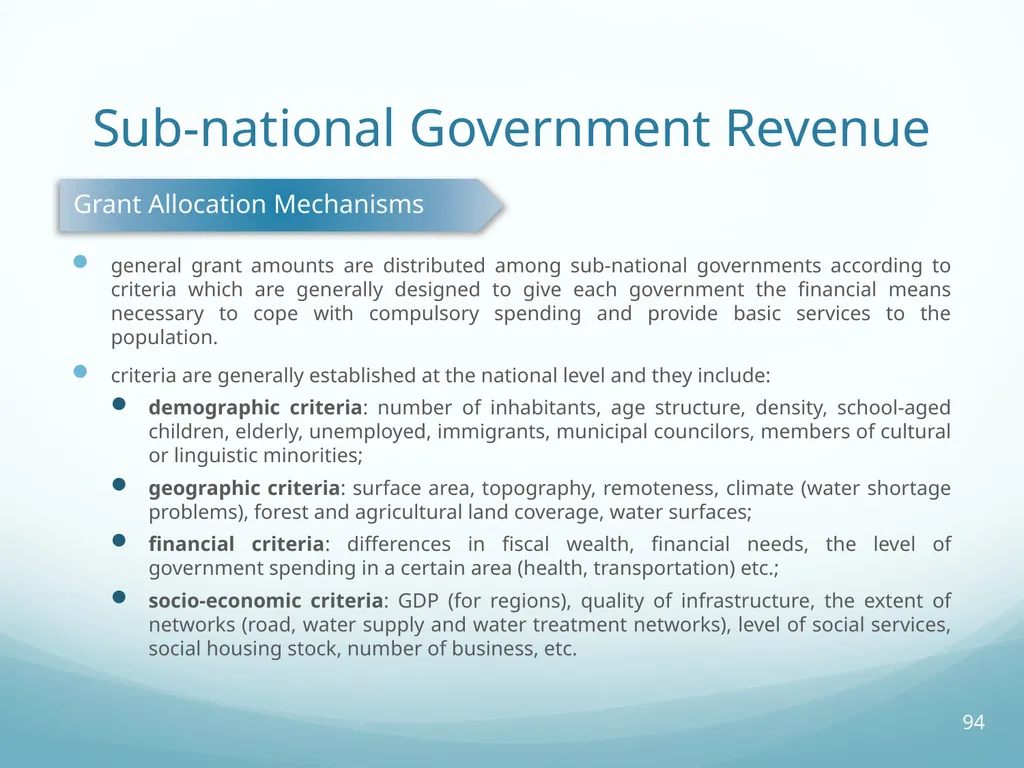
Sub-national Government Revenue general grant amounts are distributed among sub-national governments according to criteria which are generally designed to give each government the financial means necessary to cope with compulsory spending and provide basic services to the population.
criteria are generally established at the national level and they include:
demographic criteria: number of inhabitants, age structure, density, school-aged children, elderly, unemployed, immigrants, municipal councilors, members of cultural or linguistic minorities;
geographic criteria: surface area, topography, remoteness, climate (water shortage problems), forest and agricultural land coverage, water surfaces;
financial criteria: differences in fiscal wealth, financial needs, the level of government spending in a certain area (health, transportation) etc.;
socio-economic criteria: GDP (for regions), quality of infrastructure, the extent of networks (road, water supply and water treatment networks), level of social services, social housing stock, number of business, etc. 94<br>
95
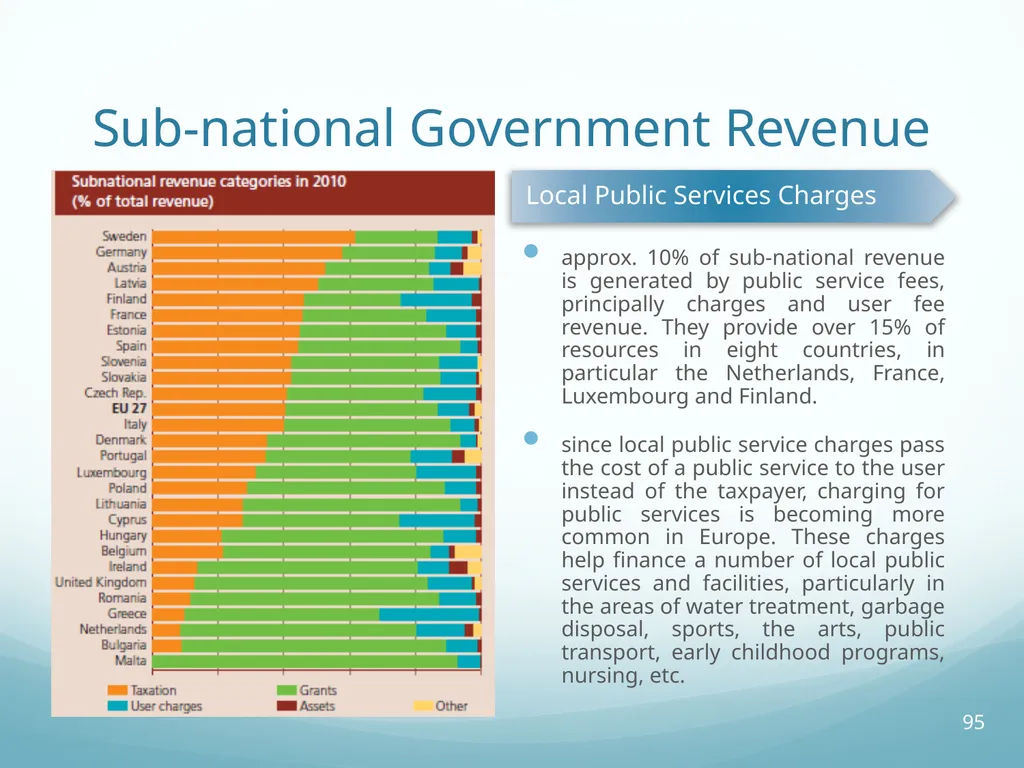
Sub-national Government Revenue approx. 10% of sub-national revenue is generated by public service fees, principally charges and user fee revenue. They provide over 15% of resources in eight countries, in particular the Netherlands, France, Luxembourg and Finland.
since local public service charges pass the cost of a public service to the user instead of the taxpayer, charging for public services is becoming more common in Europe. These charges help finance a number of local public services and facilities, particularly in the areas of water treatment, garbage disposal, sports, the arts, public transport, early childhood programs, nursing, etc. 95<br>
since local public service charges pass the cost of a public service to the user instead of the taxpayer, charging for public services is becoming more common in Europe. These charges help finance a number of local public services and facilities, particularly in the areas of water treatment, garbage disposal, sports, the arts, public transport, early childhood programs, nursing, etc. 95<br>
96
Sub-national Government Revenue fee revenues are generally more substantial for municipalities than for other local levels as they are the entities that are most often responsible for community services.
public service charges are playing increasingly important role in local budgets. This is notably the case in countries moving towards liberalisation or privatisation, as well in those limited own-source leverage.
for example: in Ireland, charges for goods and services represent 26% of municipal income whereas tax revenue, which comes from just one local tax, only accounts for 9% of local revenue.
the freedom to set charges and fees and taxes varies from country to country and from sector to sector. European local governments are free to set fees either by themselves or together with national regulating authorities through regulated prices and/or ceilings. 96<br>
97
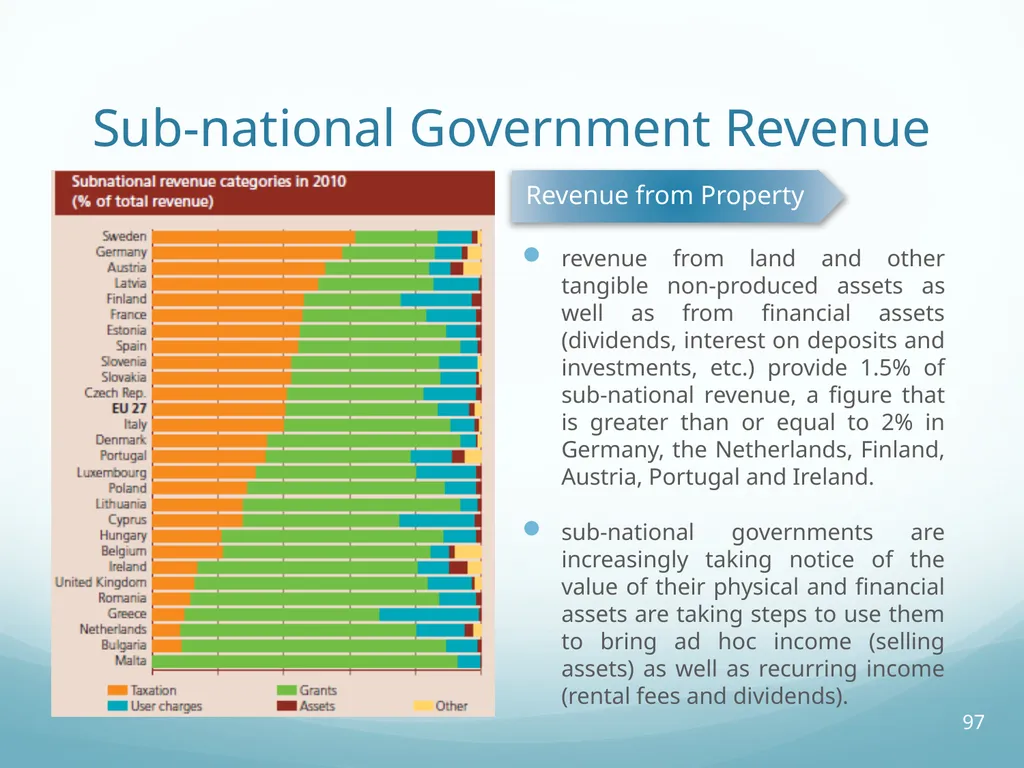
Sub-national Government Revenue revenue from land and other tangible non-produced assets as well as from financial assets (dividends, interest on deposits and investments, etc.) provide 1.5% of sub-national revenue, a figure that is greater than or equal to 2% in Germany, the Netherlands, Finland, Austria, Portugal and Ireland.
sub-national governments are increasingly taking notice of the value of their physical and financial assets are taking steps to use them to bring ad hoc income (selling assets) as well as recurring income (rental fees and dividends). 97<br>
sub-national governments are increasingly taking notice of the value of their physical and financial assets are taking steps to use them to bring ad hoc income (selling assets) as well as recurring income (rental fees and dividends). 97<br>
98
Sub-national Government Revenue in many European countries following the fall of communism, the decentralisation process forced local local authorities to look for new financial resources. In Czech Republic, Estonia, Hungary and Latvia, for example, local governments sold the bulk of their property holdings. Another source of income was the privatisation of local public companies.
beyond these one-off revenue sources, income from real estate assets mainly comes from the management of rental properties and dividends. In Ireland, where municipalities play a leading role in housing policy, 7% of their income stems from property revenue, particularly rentals (compared with the 2% average in the EU). 98<br>
beyond these one-off revenue sources, income from real estate assets mainly comes from the management of rental properties and dividends. In Ireland, where municipalities play a leading role in housing policy, 7% of their income stems from property revenue, particularly rentals (compared with the 2% average in the EU). 98<br>
99
Sub-national Government Revenue tax revenue accounts for, on average 40% of total sub-national revenue. This figure is under 15% in the UK, the Netherlands, Greece and Ireland. Conversely, it is above the European average in the Nordic countries (Sweden, Finland), Federal States (Germany, Austria), regionalised States (Spain, Italy), France in few CEE countries.
tax revenue comes from both national taxes that are shared with the central State and their own local taxes. 99<br>
tax revenue comes from both national taxes that are shared with the central State and their own local taxes. 99<br>
100
Sub-national Government Revenue the main taxes that are shared with the local authorities are personal income tax (approx. 15 countries), company income tax (around ten countries) and to lesser extent, VAT (Federal States, Spain, etc.). This type of taxation is predominant in CEE countries and the Federal States where sub-national governments receive a proportion of national tax revenue which is redistributed to them depending on specific sharing mechanisms.
when sub-national governments receive a share of national tax, there are generally two different configurations:
they have the possibility of applying an additional local rate to a central State tax (local surtax);
they can receive a part of State tax through specific redistribution mechanisms, which can but must not be based on localisation of the proceeds of the tax (the principle of ‘fair return’). 100<br>
101
Sub-national Government Revenue sub-national government have their ‘own-source’ taxes when they have a degree of leeway on the tax rates and bases, even if this freedom is sometimes controlled. This concerns, mainly property taxes, local taxes on economic activity, local income tax (Nordic countries, Belgium, Italy where there is a local surtax on income tax) and diverse indirect and direct taxes (taxes on real estate transactions, donations and inheritance, garbage handling, energy, automobiles, etc.). 101<br>
102
Sub-national Government Revenue due to their demographic, geographic and economic features, sub-national governments are not all capable of providing the same level of services. These result in three main types of inequalities:
greater needs on the part of certain governments,
higher costs for given service,
limited resources due to weaker per capita tax bases and difficulties in imposing high fees.
reducing these inequalities and also avoiding sterile competition between territories seemingly requires the creation of equalisation systems, re-destribution mechanisms that promote a certain level of equality and solidarity. 102<br>
103
Sub-national Government Revenue subparagraph 5 of article 9 of the ECLS encourages European countries to set up equalisation corrective system. Most countries have done so to varying degrees; certain countries like Germany, Italy, Spain and France have even inscribed the principle of equalisation into their Constitutions.
the subject of equalisation can be examined from three perspectives:
Who finances? This question provides a basis for distinguishing between vertical or horizontal equalisation;
What? Here interest focuses more on object of equalisation, making distinction possible between inflowing equalisation (revenue) and outflowing equalisation (charges or spending needs);
How? Emphasis is placed on equalisation means, which may be tax-based and/or sourced from grants. 103<br>
104
Sub-national Government Revenue vertical equalisation as redistribution from the State to sub-national governments (but also from federated States or regions to lower-level authorities): this involves selectively allocating resources, via grants or tax shifts, to most disadvantaged sub-national governments, considered as such because their contributive capacity is below the national avarage, they have greater needs and/or more severe spending obligations;
Horizontal equalisation as re-distribution among same level sub national governments (between regions, municipalities, etc.): this envolves levying resources from sub-national governments considered ‘the wealthiest’ and allocating them to these that are more disadvantaged. In this system, wealthy sub-national governments contribute to an equalisation fund that is re-distributed to beneficiary sub-national governments (Robin Hood system). 104<br>
Horizontal equalisation as re-distribution among same level sub national governments (between regions, municipalities, etc.): this envolves levying resources from sub-national governments considered ‘the wealthiest’ and allocating them to these that are more disadvantaged. In this system, wealthy sub-national governments contribute to an equalisation fund that is re-distributed to beneficiary sub-national governments (Robin Hood system). 104<br>
105
References: Brezovnik, B., Trpin, G. & Pličanič, S. (2019) Public Administration System (Maribor: Institute for Local-Self Government Maribor).
Brezovnik, B., Finžgar, M. & Oplotnik, Ž. J. (2016) Fiscal Decentralisation in Slovenia (Maribor: Institute for Local Self-Government and Public Procurement).
Dexia (2011) Subnational Public Finance in the European Union (Paris: Dexia).
Dexia (2008) Subnational Governments in the European Union (Paris: Dexia). 105<br>