
Local SEO Tips for Chapter Sites with Meta Data
Description: Local SEO Tips for Chapter Sites with Meta Data Templates FY18 Update Search Engine Optimization (SEO) By following SEO best practices, chapters can achieve significant search presence at no cost. Top page organic search results Expansive
Related Topics
Download Presentation
"Local SEO Tips for Chapter Sites with Meta Data" is the property of its rightful owner. Permission is granted to download and print the materials on this website for personal, non-commercial use only, and to display it on your personal computer provided you do not modify the materials and that you retain all copyright notices contained in the materials. By downloading content from our website, you accept the terms of this agreement.
Presentation Transcript
slide1. Local SEO Tips
for Chapter Sites
with Meta Data Templates FY18 Update<br>
slide2. Search Engine Optimization (SEO) By following SEO best practices, chapters can achieve significant search presence at no cost.
Top page organic search results
Expansive Google+ results in right “knowledge panel”, including photos, videos and maps
Consumer reviews featured
Social profiles highlighted SEO Local Learning Center<br>
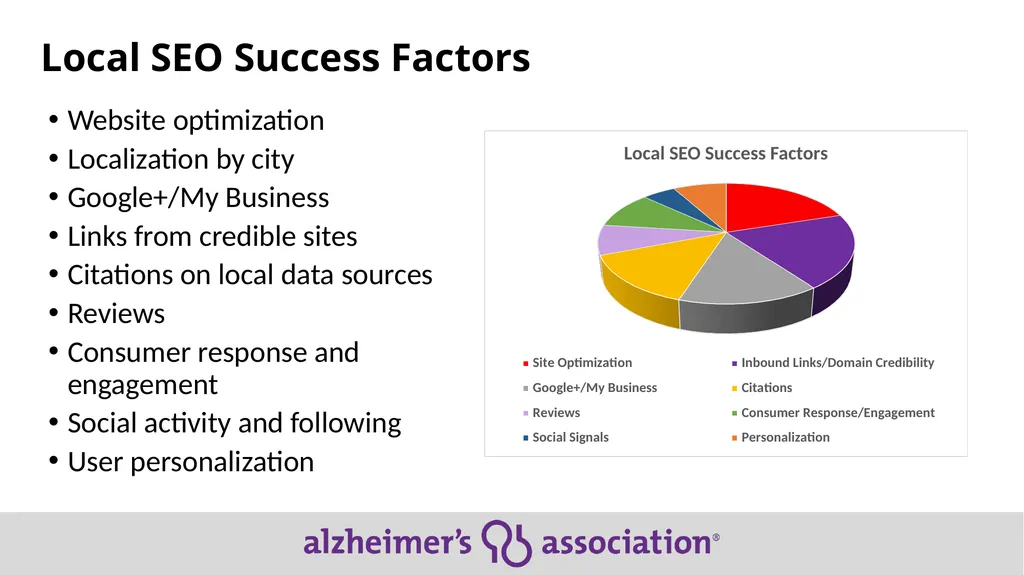
slide3. Local SEO Success Factors Website optimization
Localization by city
Google+/My Business
Links from credible sites
Citations on local data sources
Reviews
Consumer response and engagement
Social activity and following
User personalization 3<br>
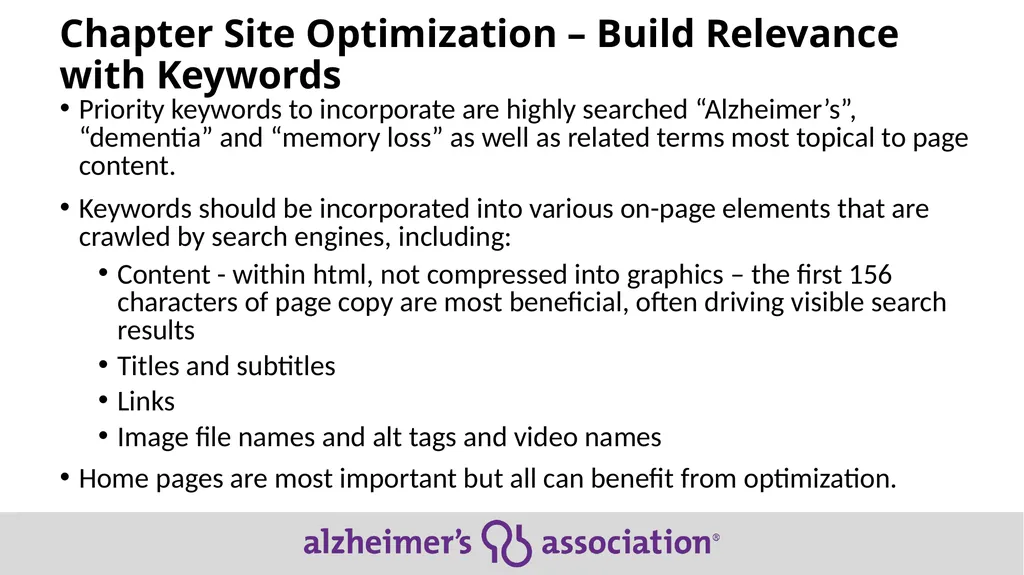
slide4. Chapter Site Optimization – Build Relevance with Keywords Priority keywords to incorporate are highly searched “Alzheimer’s”, “dementia” and “memory loss” as well as related terms most topical to page content.
Keywords should be incorporated into various on-page elements that are crawled by search engines, including:
Content - within html, not compressed into graphics – the first 156 characters of page copy are most beneficial, often driving visible search results
Titles and subtitles
Links
Image file names and alt tags and video names
Home pages are most important but all can benefit from optimization.<br>
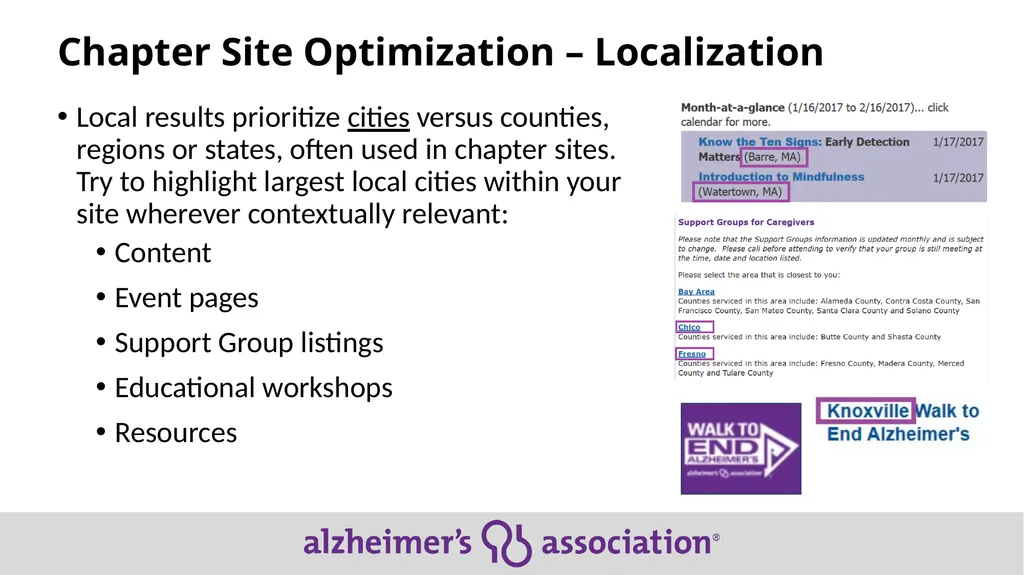
slide5. Chapter Site Optimization – Localization Local results prioritize cities versus counties, regions or states, often used in chapter sites. Try to highlight largest local cities within your site wherever contextually relevant:
Content
Event pages
Support Group listings
Educational workshops
Resources<br>
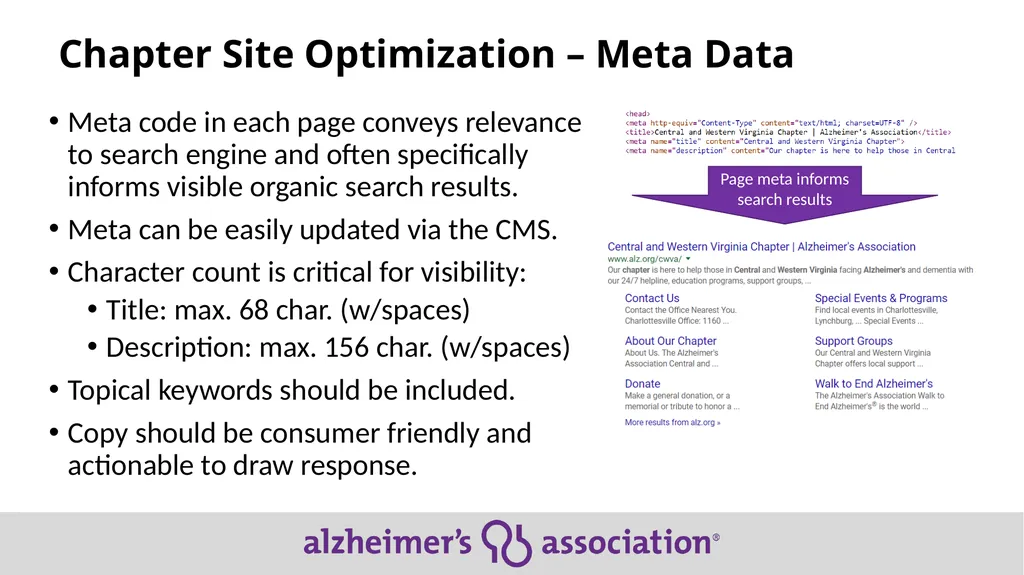
slide6. Chapter Site Optimization – Meta Data Meta code in each page conveys relevance to search engine and often specifically informs visible organic search results.
Meta can be easily updated via the CMS.
Character count is critical for visibility:
Title: max. 68 char. (w/spaces)
Description: max. 156 char. (w/spaces)
Topical keywords should be included.
Copy should be consumer friendly and actionable to draw response. Page meta informs search results<br>
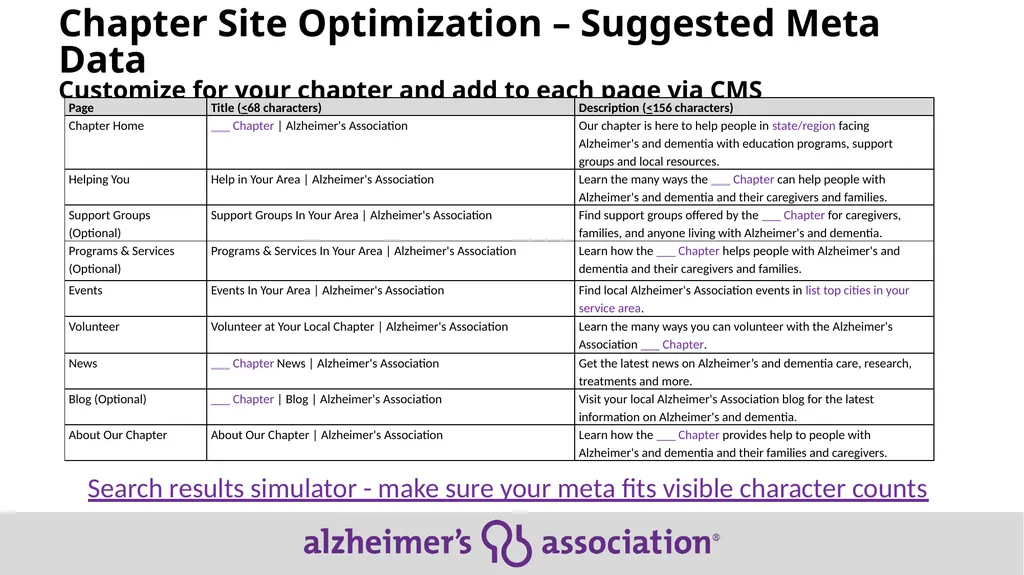
slide7. Chapter Site Optimization – Suggested Meta Data Customize for your chapter and add to each page via CMS Search results simulator - make sure your meta fits visible character counts<br>
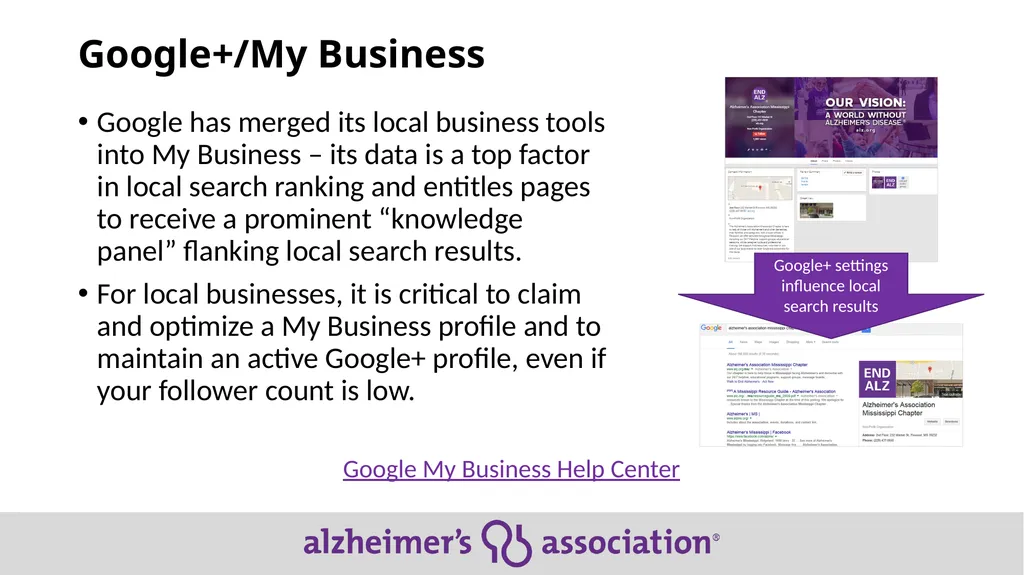
slide8. Google+/My Business Google has merged its local business tools into My Business – its data is a top factor in local search ranking and entitles pages to receive a prominent “knowledge panel” flanking local search results.
For local businesses, it is critical to claim and optimize a My Business profile and to maintain an active Google+ profile, even if your follower count is low. Google My Business Help Center Google+ settings influence local search results<br>
slide9. Google+/My Business – Optimizing Find your chapter on Google My Business and claim it for edit permission. If it doesn’t have a listing, follow steps to create one. If your chapter has multiple offices you can have a profile for each.
Make sure Business Name is the full chapter name. Add: logo/photos for Profile and Cover, Business Hours and a keyword rich Description. that includes key cities, “Alzheimer's”, “dementia” and “memory loss”.
Select business category: “Non Profit Organization”.
Populate Photos and add videos if content is available; your chapter’s YouTube channel can be connected. Detailed Instructions for Setting Up Google+/My Business Pages<br>
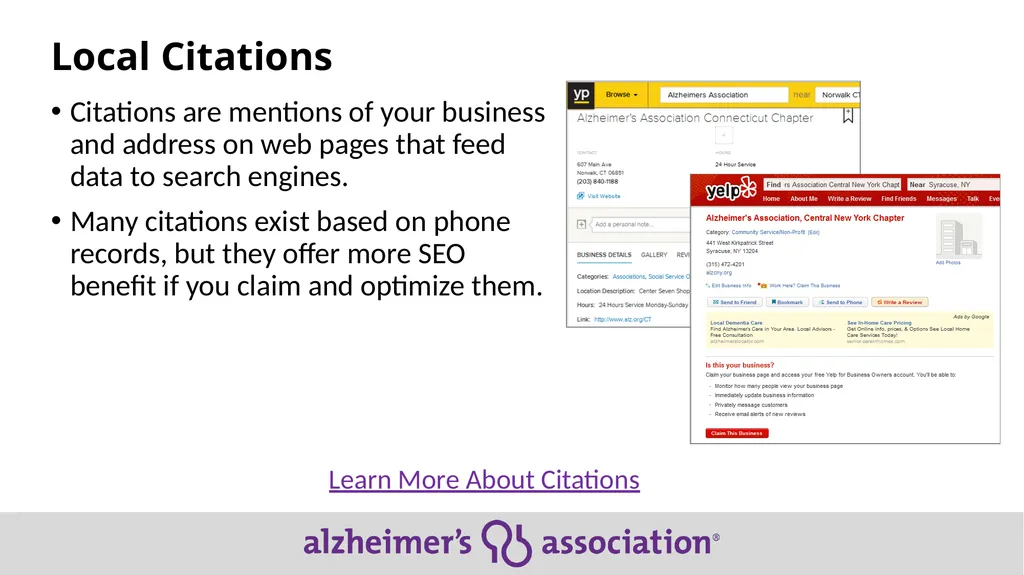
slide10. Local Citations Citations are mentions of your business and address on web pages that feed data to search engines.
Many citations exist based on phone records, but they offer more SEO benefit if you claim and optimize them. Learn More About Citations<br>
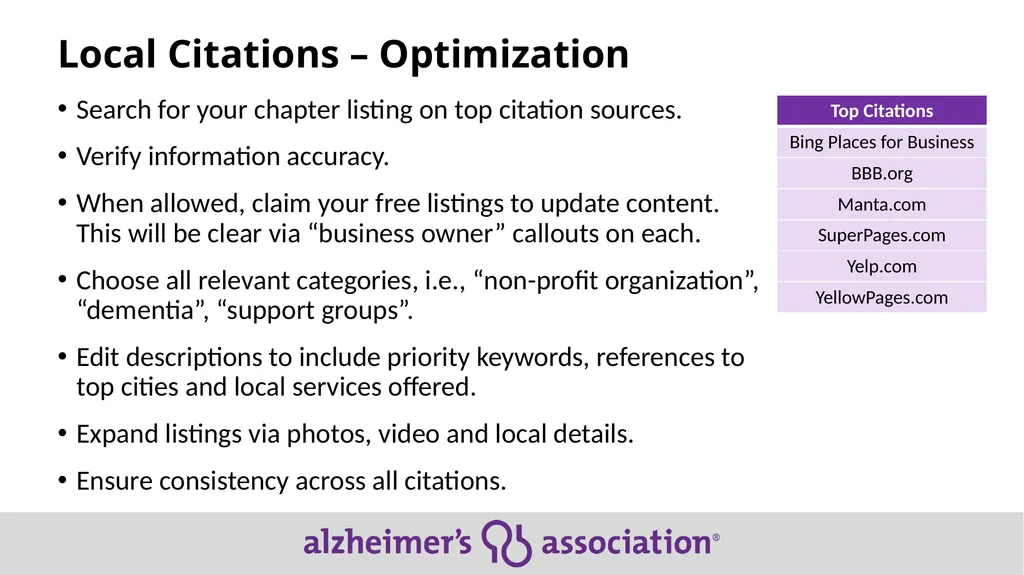
slide11. Local Citations – Optimization Search for your chapter listing on top citation sources.
Verify information accuracy.
When allowed, claim your free listings to update content. This will be clear via “business owner” callouts on each.
Choose all relevant categories, i.e., “non-profit organization”, “dementia”, “support groups”.
Edit descriptions to include priority keywords, references to top cities and local services offered.
Expand listings via photos, video and local details.
Ensure consistency across all citations.<br>
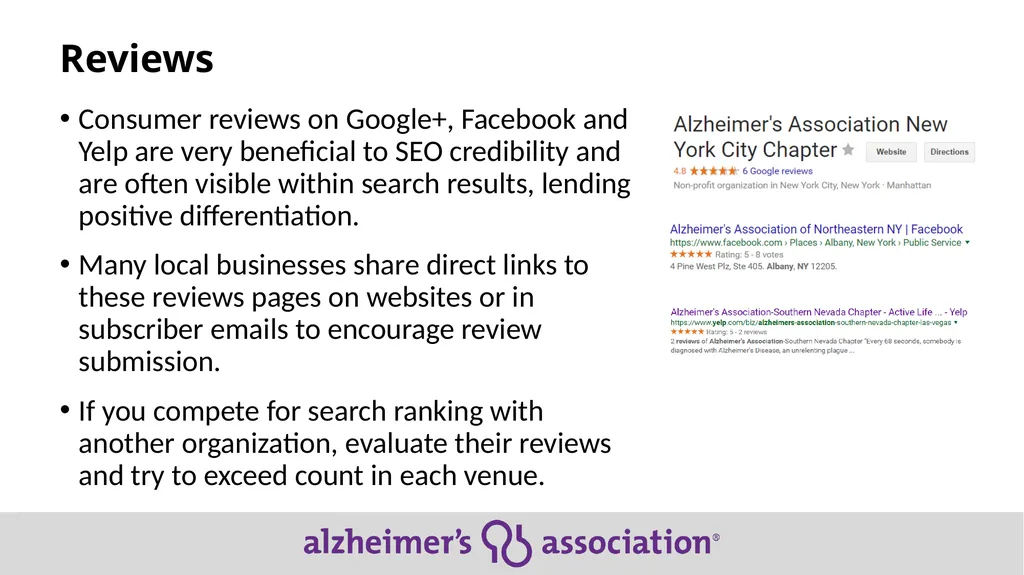
slide12. Reviews Consumer reviews on Google+, Facebook and Yelp are very beneficial to SEO credibility and are often visible within search results, lending positive differentiation.
Many local businesses share direct links to these reviews pages on websites or in subscriber emails to encourage review submission.
If you compete for search ranking with another organization, evaluate their reviews and try to exceed count in each venue.<br>
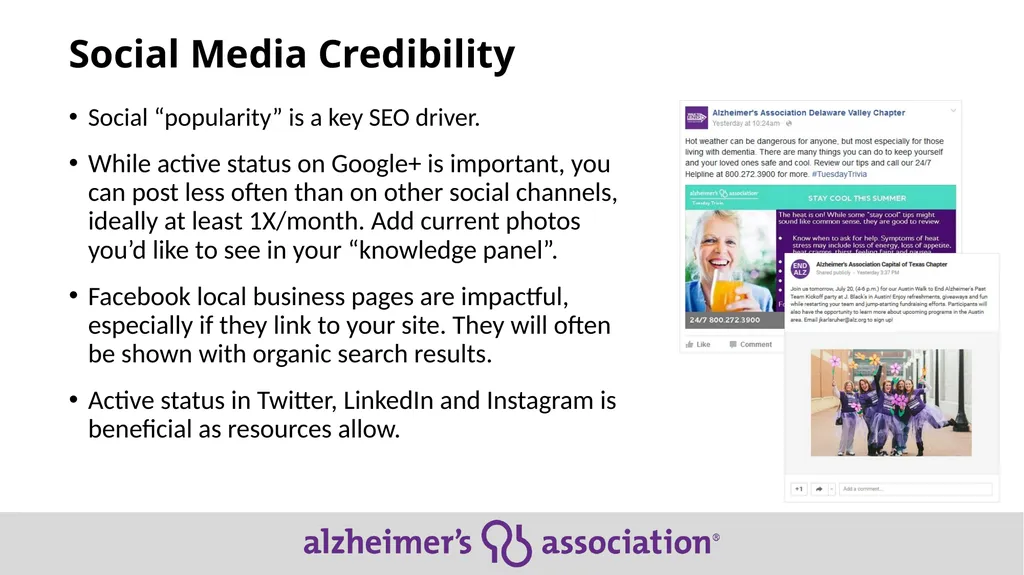
slide13. Social Media Credibility Social “popularity” is a key SEO driver.
While active status on Google+ is important, you can post less often than on other social channels, ideally at least 1X/month. Add current photos you’d like to see in your “knowledge panel”.
Facebook local business pages are impactful, especially if they link to your site. They will often be shown with organic search results.
Active status in Twitter, LinkedIn and Instagram is beneficial as resources allow.<br>
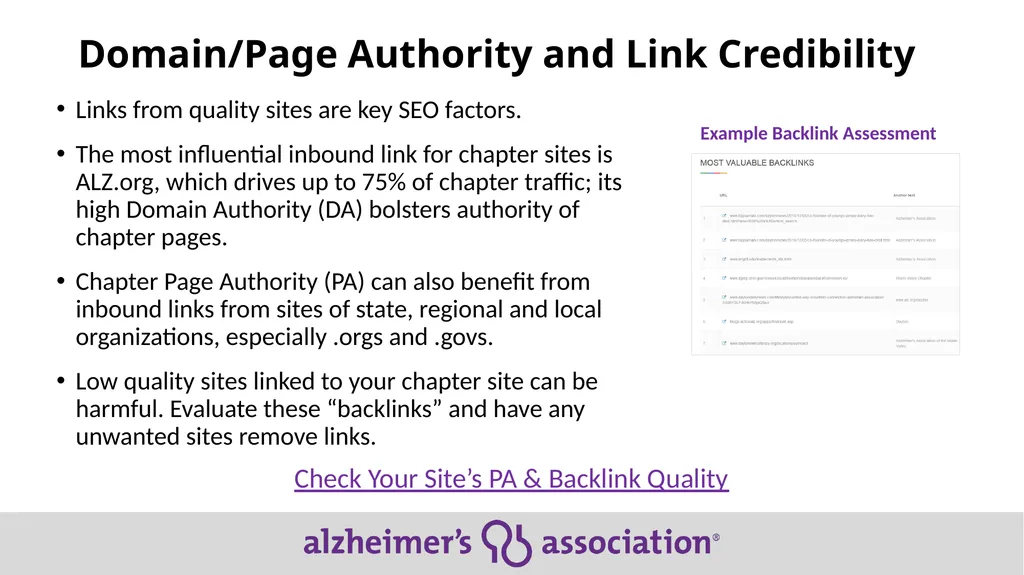
slide14. Domain/Page Authority and Link Credibility Links from quality sites are key SEO factors.
The most influential inbound link for chapter sites is ALZ.org, which drives up to 75% of chapter traffic; its high Domain Authority (DA) bolsters authority of chapter pages.
Chapter Page Authority (PA) can also benefit from inbound links from sites of state, regional and local organizations, especially .orgs and .govs.
Low quality sites linked to your chapter site can be harmful. Evaluate these “backlinks” and have any unwanted sites remove links. Check Your Site’s PA & Backlink Quality Example Backlink Assessment<br>
slide15. National Support We are here to help.
For consultation on these local marketing tactics, contact:
Lisa Blaney-Koen: lblaney@alz.org
Daniela Petrovska: dpetrovska@alz.org<br>
slide2. Search Engine Optimization (SEO) By following SEO best practices, chapters can achieve significant search presence at no cost.
Top page organic search results
Expansive Google+ results in right “knowledge panel”, including photos, videos and maps
Consumer reviews featured
Social profiles highlighted SEO Local Learning Center<br>
slide3. Local SEO Success Factors Website optimization
Localization by city
Google+/My Business
Links from credible sites
Citations on local data sources
Reviews
Consumer response and engagement
Social activity and following
User personalization 3<br>
slide4. Chapter Site Optimization – Build Relevance with Keywords Priority keywords to incorporate are highly searched “Alzheimer’s”, “dementia” and “memory loss” as well as related terms most topical to page content.
Keywords should be incorporated into various on-page elements that are crawled by search engines, including:
Content - within html, not compressed into graphics – the first 156 characters of page copy are most beneficial, often driving visible search results
Titles and subtitles
Links
Image file names and alt tags and video names
Home pages are most important but all can benefit from optimization.<br>
slide5. Chapter Site Optimization – Localization Local results prioritize cities versus counties, regions or states, often used in chapter sites. Try to highlight largest local cities within your site wherever contextually relevant:
Content
Event pages
Support Group listings
Educational workshops
Resources<br>
slide6. Chapter Site Optimization – Meta Data Meta code in each page conveys relevance to search engine and often specifically informs visible organic search results.
Meta can be easily updated via the CMS.
Character count is critical for visibility:
Title: max. 68 char. (w/spaces)
Description: max. 156 char. (w/spaces)
Topical keywords should be included.
Copy should be consumer friendly and actionable to draw response. Page meta informs search results<br>
slide7. Chapter Site Optimization – Suggested Meta Data Customize for your chapter and add to each page via CMS Search results simulator - make sure your meta fits visible character counts<br>
slide8. Google+/My Business Google has merged its local business tools into My Business – its data is a top factor in local search ranking and entitles pages to receive a prominent “knowledge panel” flanking local search results.
For local businesses, it is critical to claim and optimize a My Business profile and to maintain an active Google+ profile, even if your follower count is low. Google My Business Help Center Google+ settings influence local search results<br>
slide9. Google+/My Business – Optimizing Find your chapter on Google My Business and claim it for edit permission. If it doesn’t have a listing, follow steps to create one. If your chapter has multiple offices you can have a profile for each.
Make sure Business Name is the full chapter name. Add: logo/photos for Profile and Cover, Business Hours and a keyword rich Description. that includes key cities, “Alzheimer's”, “dementia” and “memory loss”.
Select business category: “Non Profit Organization”.
Populate Photos and add videos if content is available; your chapter’s YouTube channel can be connected. Detailed Instructions for Setting Up Google+/My Business Pages<br>
slide10. Local Citations Citations are mentions of your business and address on web pages that feed data to search engines.
Many citations exist based on phone records, but they offer more SEO benefit if you claim and optimize them. Learn More About Citations<br>
slide11. Local Citations – Optimization Search for your chapter listing on top citation sources.
Verify information accuracy.
When allowed, claim your free listings to update content. This will be clear via “business owner” callouts on each.
Choose all relevant categories, i.e., “non-profit organization”, “dementia”, “support groups”.
Edit descriptions to include priority keywords, references to top cities and local services offered.
Expand listings via photos, video and local details.
Ensure consistency across all citations.<br>
slide12. Reviews Consumer reviews on Google+, Facebook and Yelp are very beneficial to SEO credibility and are often visible within search results, lending positive differentiation.
Many local businesses share direct links to these reviews pages on websites or in subscriber emails to encourage review submission.
If you compete for search ranking with another organization, evaluate their reviews and try to exceed count in each venue.<br>
slide13. Social Media Credibility Social “popularity” is a key SEO driver.
While active status on Google+ is important, you can post less often than on other social channels, ideally at least 1X/month. Add current photos you’d like to see in your “knowledge panel”.
Facebook local business pages are impactful, especially if they link to your site. They will often be shown with organic search results.
Active status in Twitter, LinkedIn and Instagram is beneficial as resources allow.<br>
slide14. Domain/Page Authority and Link Credibility Links from quality sites are key SEO factors.
The most influential inbound link for chapter sites is ALZ.org, which drives up to 75% of chapter traffic; its high Domain Authority (DA) bolsters authority of chapter pages.
Chapter Page Authority (PA) can also benefit from inbound links from sites of state, regional and local organizations, especially .orgs and .govs.
Low quality sites linked to your chapter site can be harmful. Evaluate these “backlinks” and have any unwanted sites remove links. Check Your Site’s PA & Backlink Quality Example Backlink Assessment<br>
slide15. National Support We are here to help.
For consultation on these local marketing tactics, contact:
Lisa Blaney-Koen: lblaney@alz.org
Daniela Petrovska: dpetrovska@alz.org<br>