LYRASIS Leadership Forum 2016 Welcome wifi code: Your hosts: Robert Miller, Michele Kimpton, David Singleton, Wanda Brown, John Herbert, Celeste Feather, Laurie Arp, Russell Palmer, Stephanie Moreland and Jenn Bielewski eResources
"LYRASIS Leadership Forum 2016 Welcome wifi code:" is the property of its rightful owner. Permission is granted to
download and print the materials on this website for personal, non-commercial use only, and to display it
on your personal computer provided you do not modify the materials and that you retain all copyright
notices contained in the materials. By downloading content from our website, you accept the terms of this
agreement.
Presentation Transcript
01
LYRASIS Leadership Forum 2016 Welcome wifi code: Your hosts: Robert Miller, Michele Kimpton, David Singleton, Wanda Brown, John Herbert, Celeste Feather, Laurie Arp, Russell Palmer, Stephanie Moreland and Jenn Bielewski<br>
02
eResources & Licensing Celeste Feather Licensing and Strategic Partnerships<br>
03
LYRASIS Licensing and Strategic Partnerships Staffed by a team of 4 librarians
Rooted in work of legacy networks
Includes collaborative programs at national level<br>
04
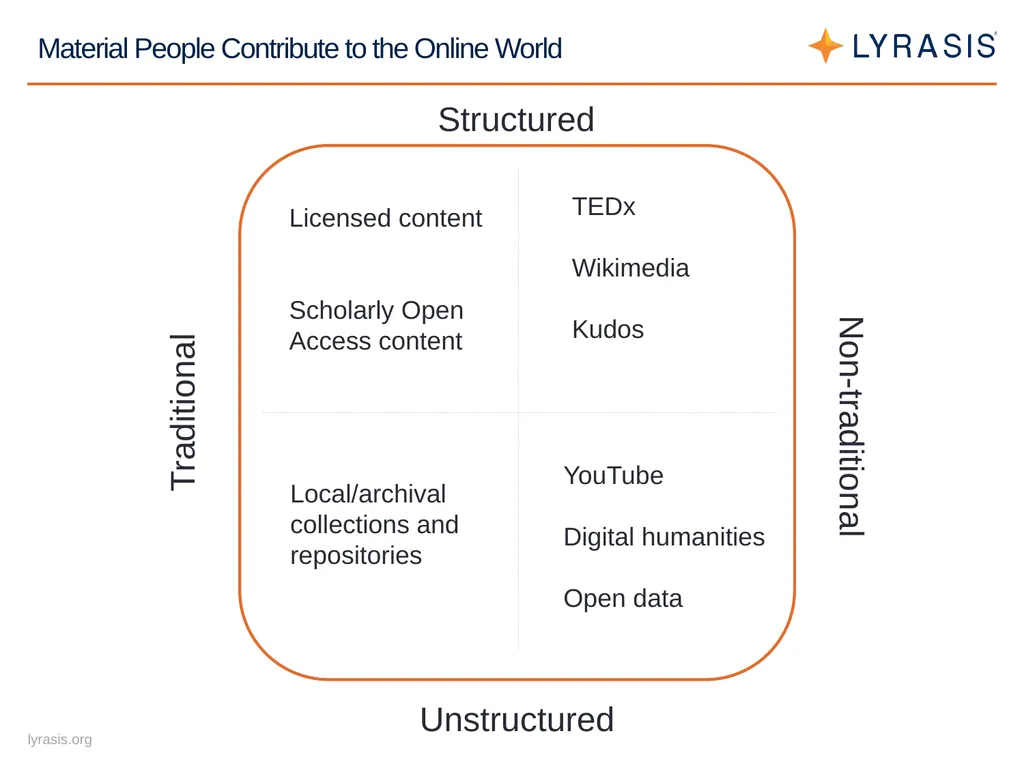
Material People Contribute to the Online World Traditional Structured Unstructured Non-traditional Licensed content
Scholarly Open Access content Local/archival
collections and
repositories TEDx
Wikimedia
Kudos YouTube
Digital humanities
Open data<br>
05
Questions Do you see the emphasis changing from content acquisition to content creation within your organization? Given stagnant budgets, what activities are no longer being performed so that efforts may be directed elsewhere?
What level of priority does your organization give to the creation and support of openly accessible content? And for what types of content and for whom?
What role should or does your library play in bringing together multiple departments to review new services that impact the entire organization? What role should LYRASIS play in expanding awareness of these services, and how can we assist members in this area?
What new models for hosting and accessing commercial content are being explored within your organization? What is the leading motivator, a desire for control or dissatisfaction with what commercial providers have developed so far?<br>
06
Technology A Bigger Picture John Herbert Director of Technology Services<br>
07
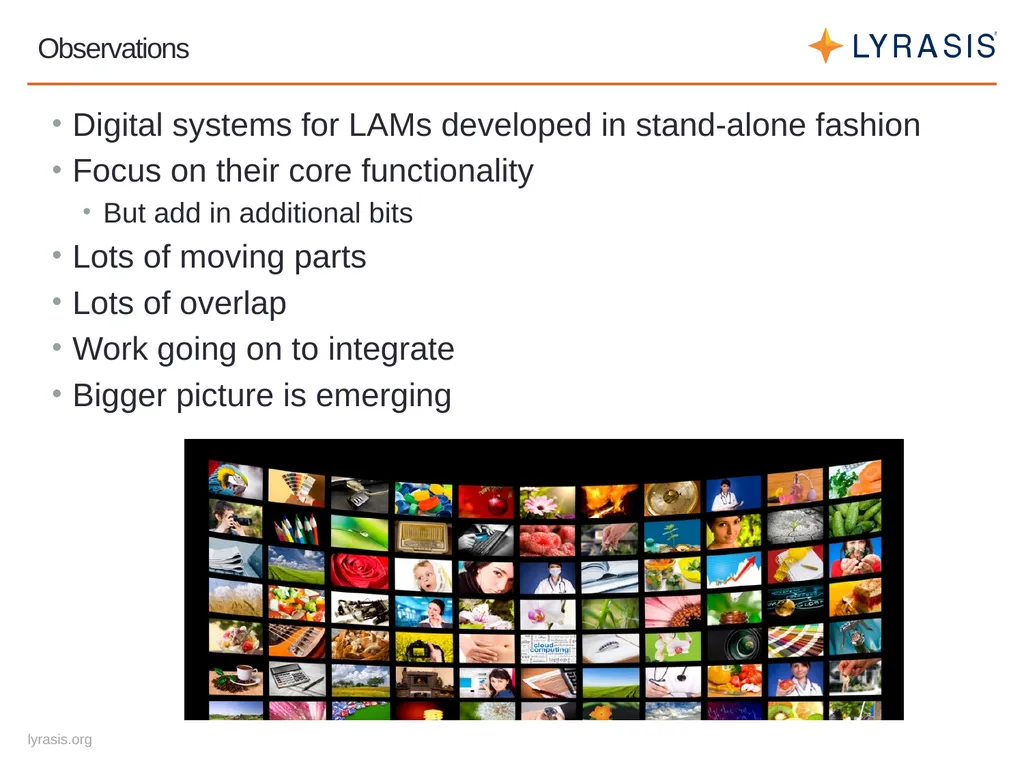
Observations Digital systems for LAMs developed in stand-alone fashion
Focus on their core functionality
But add in additional bits
Lots of moving parts
Lots of overlap
Work going on to integrate
Bigger picture is emerging<br>
08
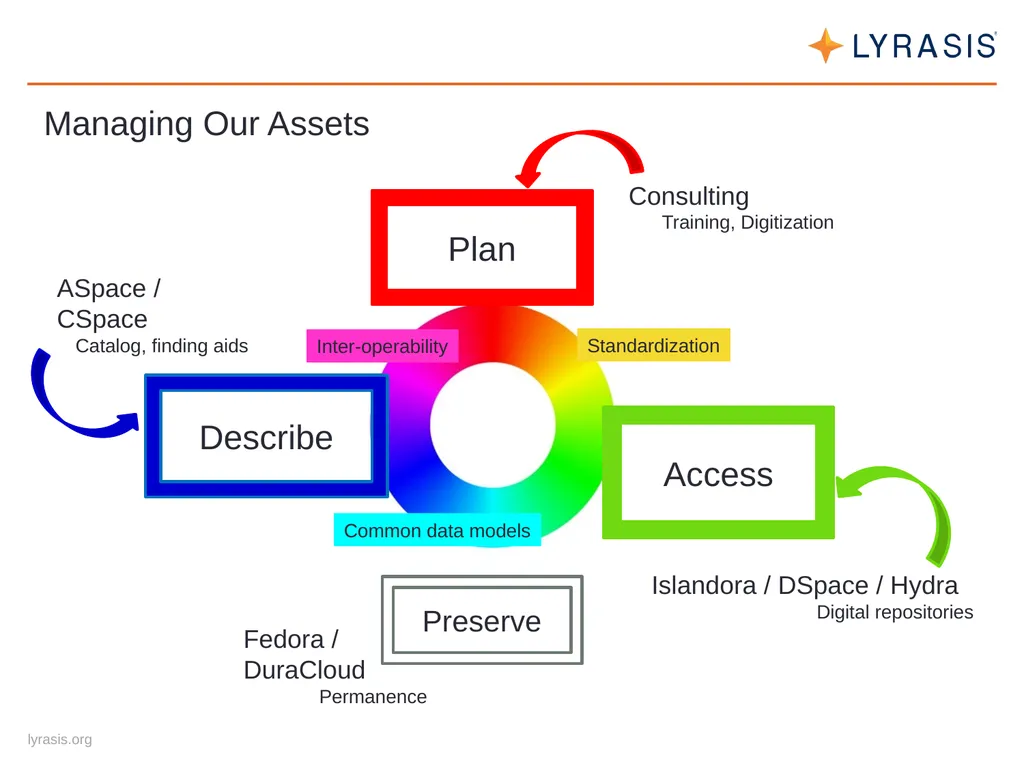
Preserve Fedora / DuraCloud
Permanence Managing Our Assets Plan Consulting
Training, Digitization Access Islandora / DSpace / Hydra
Digital repositories Describe ASpace / CSpace
Catalog, finding aids Common data models Inter-operability Standardization<br>
09
Questions How does this resonate?
What’s missing?
Where are the entry points?
How are things connected (or not) at your institution?<br>
10
Open Source Community Supported Software Michele Kimpton, former CEO DuraSpace
Laurie Gemmill Arp
Director of Collections Services & Community Supported Software<br>
11
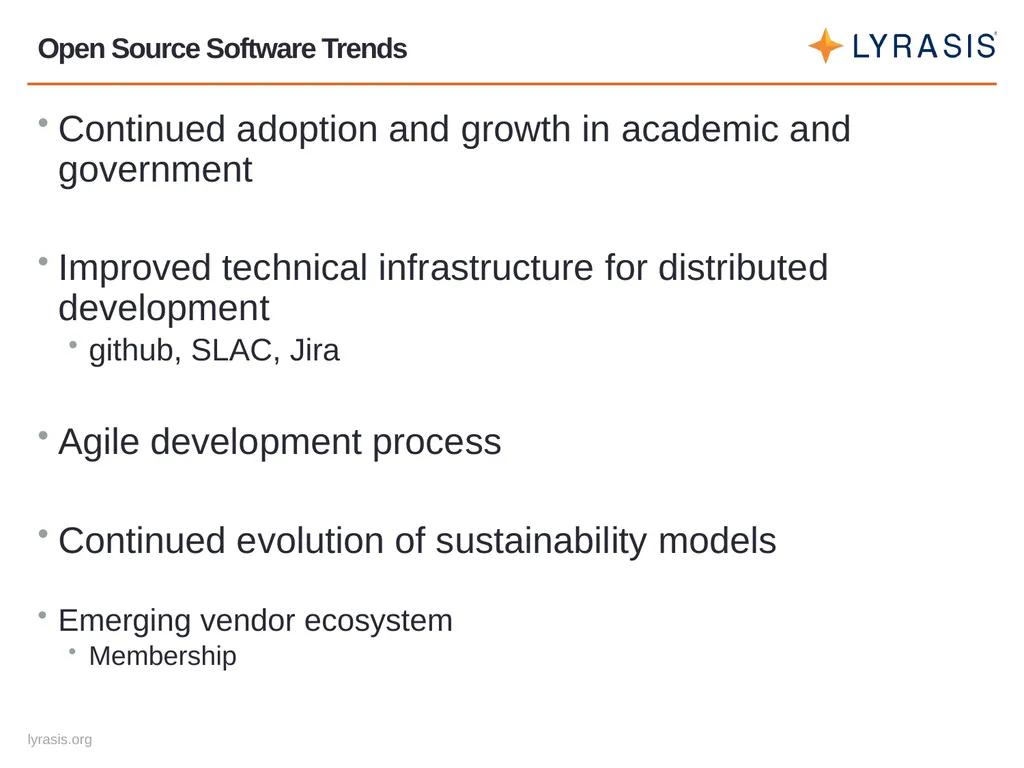
Open Source Software Trends Continued adoption and growth in academic and government
Improved technical infrastructure for distributed development
github, SLAC, Jira
Agile development process
Continued evolution of sustainability models
Emerging vendor ecosystem
Membership<br>
12
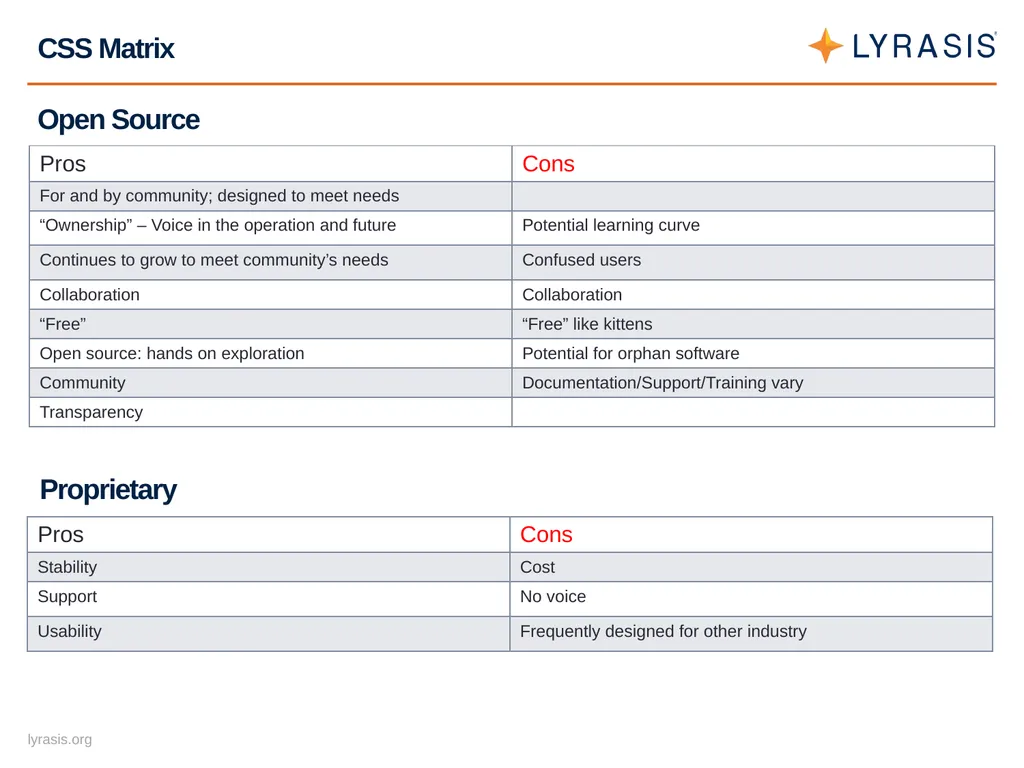
CSS Matrix Open Source Proprietary<br>
13
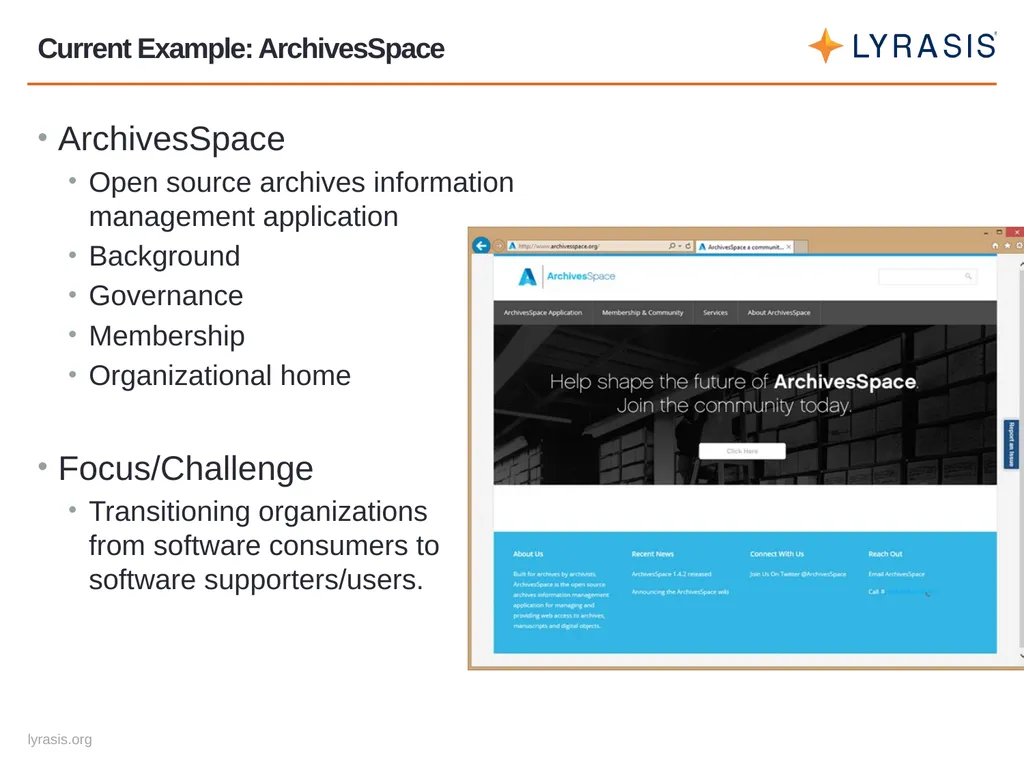
Current Example: ArchivesSpace ArchivesSpace
Open source archives information management application
Background
Governance
Membership
Organizational home
Focus/Challenge
Transitioning organizations from software consumers to software supporters/users.<br>
14
Questions Are you using OSS?
What has been successful, and what has been challenging?
What projects/platforms are you evaluating now?
What services and support could LYRASIS put in place to remove barriers and/or improve success?
What are the costs/benefits of open source vs proprietary
Internal, external fte cost, annual service fees, training and support<br>