
M403-GRAPH THEORY INTRODUCTION - 2 K. C. TAMMI


Description: M403-GRAPH THEORY INTRODUCTION - 2 K. C. TAMMI RAJU, M. Sc; HOD, Dept. of mathematics; PG COURSES CONTENTS BASIC DEFINITIONS: Finite and Infinite graphs Incidence and Degree The sum of the degrees of all vertices in a graph G is twice the
Related Topics
Download Presentation
"M403-GRAPH THEORY INTRODUCTION - 2 K. C. TAMMI" is the property of its rightful owner. Permission is granted to download and print the materials on this website for personal, non-commercial use only, and to display it on your personal computer provided you do not modify the materials and that you retain all copyright notices contained in the materials. By downloading content from our website, you accept the terms of this agreement.
Presentation Transcript
slide1. M403-GRAPH THEORY
INTRODUCTION - 2 K. C. TAMMI RAJU, M. Sc;
HOD, Dept. of mathematics;
PG COURSES<br>
slide2. CONTENTS BASIC DEFINITIONS: Finite and Infinite graphs Incidence and Degree The sum of the degrees of all vertices in a graph G is twice the number of edges in G. The number of vertices of odd degree in a graph is always even. Regular graph Isolated vertex pendant vertex a brief history of graph theory<br>
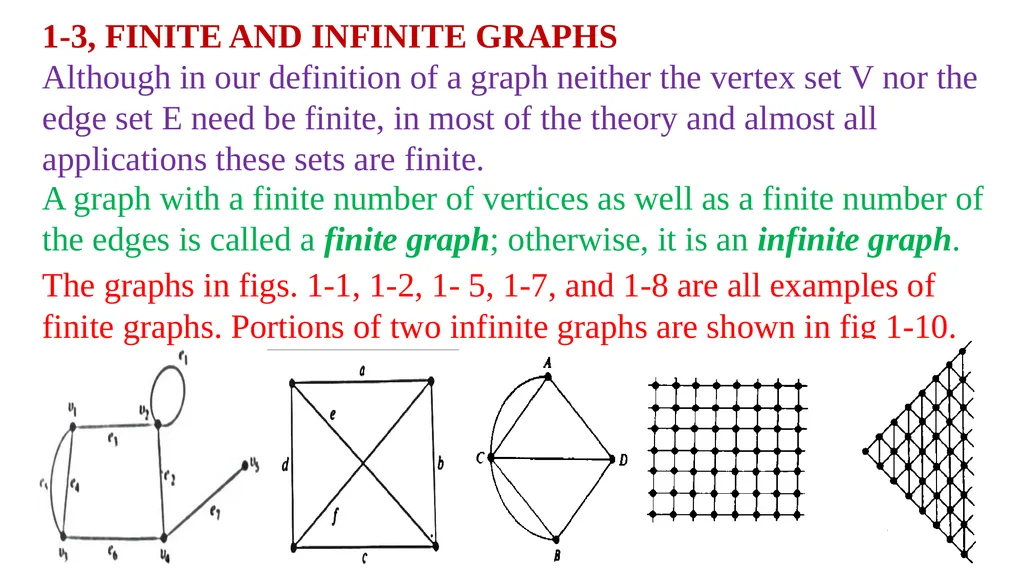
slide3. A graph with a finite number of vertices as well as a finite number of the edges is called a finite graph; otherwise, it is an infinite graph. 1-3, FINITE AND INFINITE GRAPHS Although in our definition of a graph neither the vertex set V nor the edge set E need be finite, in most of the theory and almost all applications these sets are finite. The graphs in figs. 1-1, 1-2, 1- 5, 1-7, and 1-8 are all examples of finite graphs. Portions of two infinite graphs are shown in fig 1-10.<br>
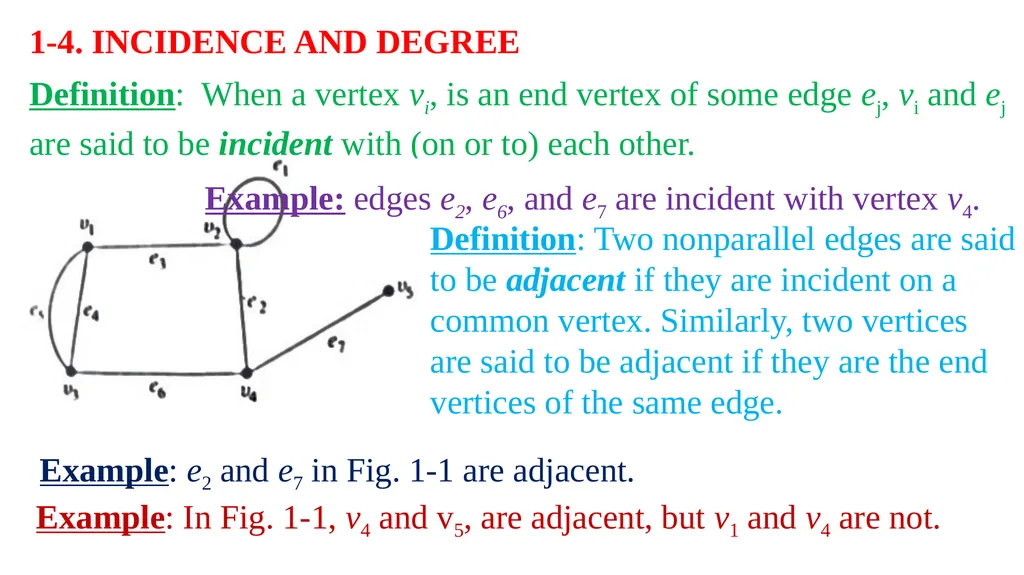
slide4. Definition: When a vertex vi, is an end vertex of some edge ej, vi and ej are said to be incident with (on or to) each other. 1-4. INCIDENCE AND DEGREE Example: edges e2, e6, and e7 are incident with vertex v4. Example: e2 and e7 in Fig. 1-1 are adjacent. Definition: Two nonparallel edges are said to be adjacent if they are incident on a common vertex. Similarly, two vertices are said to be adjacent if they are the end vertices of the same edge. Example: In Fig. 1-1, v4 and v5, are adjacent, but v1 and v4 are not.<br>
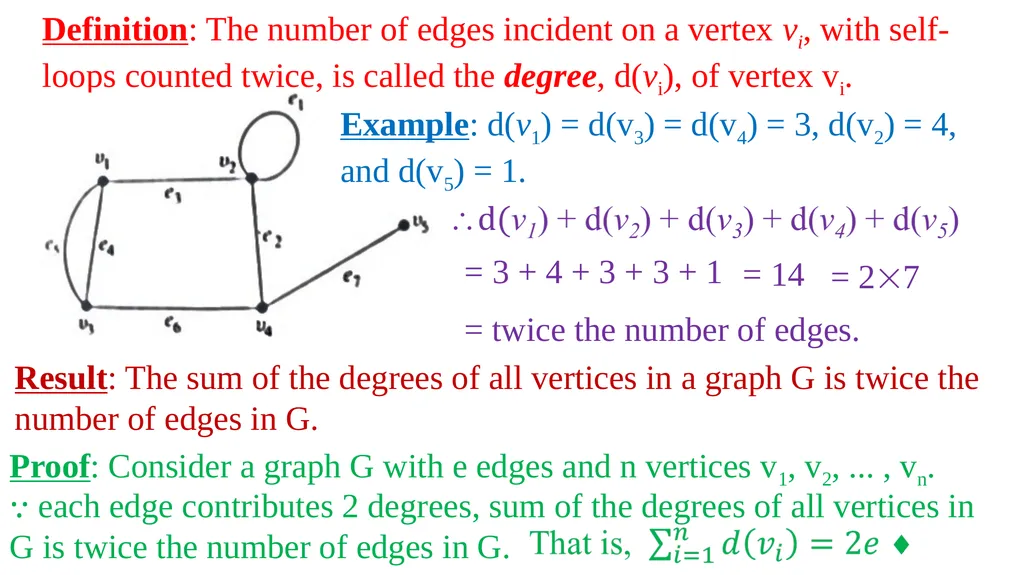
slide5. Definition: The number of edges incident on a vertex vi, with self-loops counted twice, is called the degree, d(vi), of vertex vi. Example: d(v1) = d(v3) = d(v4) = 3, d(v2) = 4, and d(v5) = 1. Result: The sum of the degrees of all vertices in a graph G is twice the number of edges in G. Proof: Consider a graph G with e edges and n vertices v1, v2, ... , vn. = 3 + 4 + 3 + 3 + 1 = twice the number of edges. = 14 = 27 ⸪ each edge contributes 2 degrees, sum of the degrees of all vertices in G is twice the number of edges in G.<br>
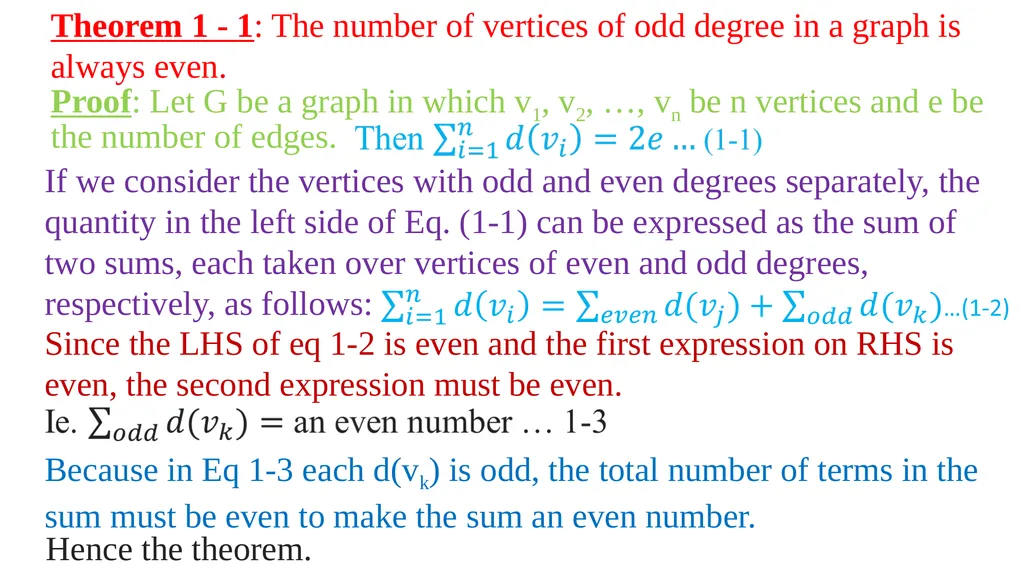
slide6. Theorem 1 - 1: The number of vertices of odd degree in a graph is always even. Proof: Let G be a graph in which v1, v2, …, vn be n vertices and e be If we consider the vertices with odd and even degrees separately, the quantity in the left side of Eq. (1-1) can be expressed as the sum of two sums, each taken over vertices of even and odd degrees, respectively, as follows: Since the LHS of eq 1-2 is even and the first expression on RHS is even, the second expression must be even. Because in Eq 1-3 each d(vk) is odd, the total number of terms in the sum must be even to make the sum an even number. Hence the theorem. the number of edges.<br>
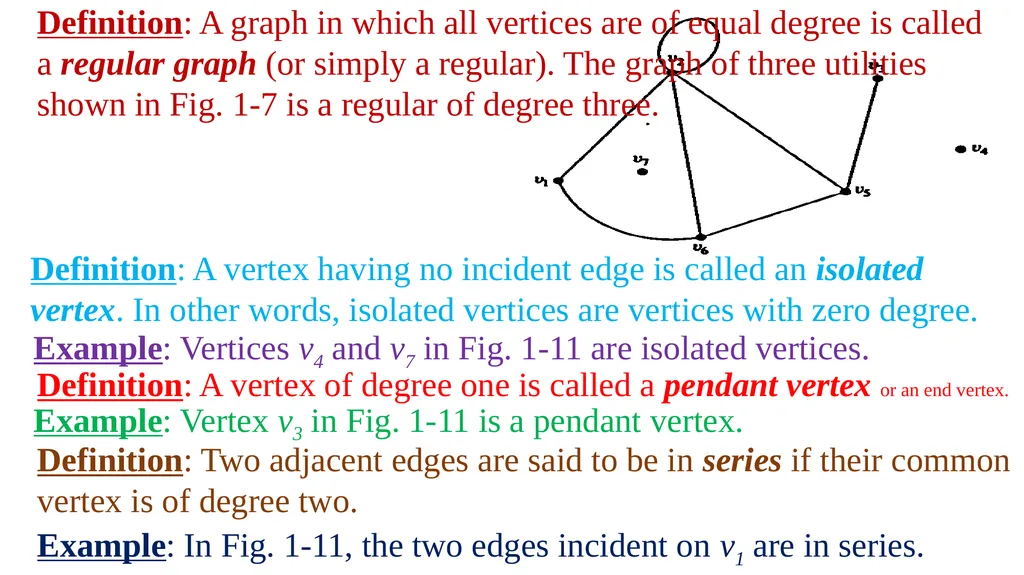
slide7. Definition: A graph in which all vertices are of equal degree is called a regular graph (or simply a regular). The graph of three utilities shown in Fig. 1-7 is a regular of degree three. Definition: A vertex having no incident edge is called an isolated vertex. In other words, isolated vertices are vertices with zero degree. Example: Vertices v4 and v7 in Fig. 1-11 are isolated vertices. Definition: A vertex of degree one is called a pendant vertex or an end vertex. Example: Vertex v3 in Fig. 1-11 is a pendant vertex. Definition: Two adjacent edges are said to be in series if their common vertex is of degree two. Example: In Fig. 1-11, the two edges incident on v1 are in series.<br>
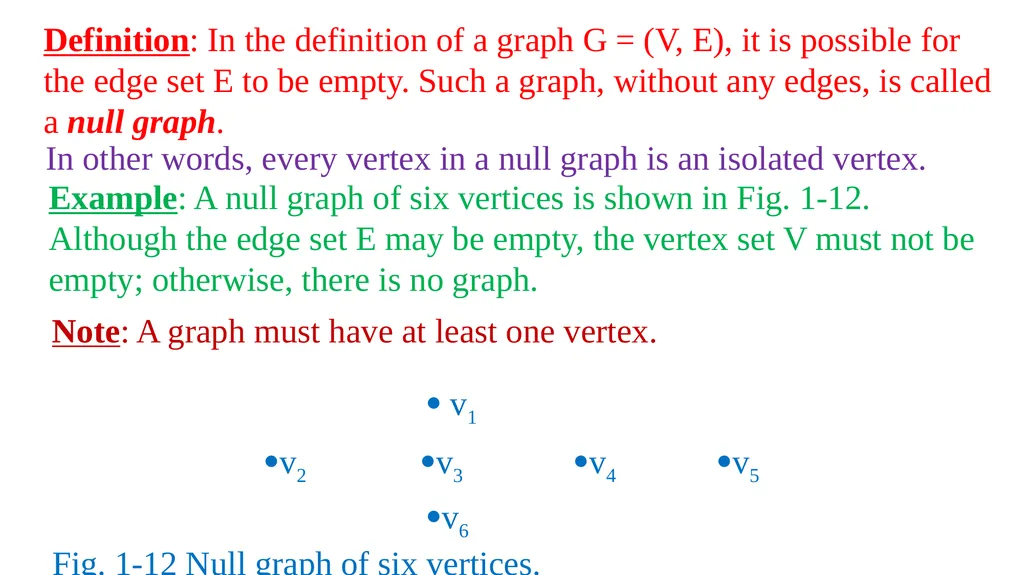
slide8. v1
v2 v3 v4 v5
v6 Fig. 1-12 Null graph of six vertices. Definition: In the definition of a graph G = (V, E), it is possible for the edge set E to be empty. Such a graph, without any edges, is called a null graph. In other words, every vertex in a null graph is an isolated vertex. Example: A null graph of six vertices is shown in Fig. 1-12. Although the edge set E may be empty, the vertex set V must not be empty; otherwise, there is no graph. Note: A graph must have at least one vertex.<br>
slide9. [1-6. A BRIEF HISTORY OF GRAPH THEORY As mentioned before, graph theory was born in 1736 with Euler's paper in which he solved the Konigsberg bridge problem [1-4]. For the next 100 years nothing more was done in the field. In 1847, G. R. Kirchhoff (1824-1887) developed the theory of trees for their applications in electrical networks [1-6]. Ten years later, A. Cayley (1821-1895) discovered trees while he was trying to enumerate the isomers of saturated hydrocarbons CnH2n+2 [1-3]. About the time of Kirchhoff and Cayley, two other milestones in graph theory were laid.<br>
slide10. One was the four-color conjecture, which states that four colors are sufficient for coloring any atlas (a map on a plane) such that the countries with common boundaries have different colors. It is believed that A. F. Mobius (1790-1868) first presented the four-color problem in one of his lectures in 1840. About 10 years later, A. De Morgan (1806-1871) discussed this problem with his fellow mathematicians in London. De Morgan’s letter is the first authenticated reference to the four-color problem.<br>
slide11. To this day, the four-color conjecture is by far the most famous unsolved problem in graph theory; it has stimulated an enormous amount of research in the field (1-11). The problem became well known after Cayley published it in 1879 in the first volume of the Proceedings of the Royal Geographic Society. The other milestone is due to Sir W. R. Hamilton (1805-1865). In the year 1859 he invented a puzzle and sold it for 25 guineas to a game manufacturer in Dublin.<br>
slide12. The object in the puzzle was to find a route along the edges of the dodecahedron, passing through each of the 20 cities exactly once [1-12]. The corners were marked with the names of 20 important cities: London, New York, Delhi, Paris, and so on. The puzzle consisted of a wooden, regular dodecahedron (a polyhedron with 12 faces and 20 corners, each face being a regular pentagon and three edges meeting at each corner; see Fig. 2-21).<br>
slide13. This fertile period was followed by half a century of relative inactivity. He organized the work of other mathematicians and his own and wrote the first book on the subject, which was published in 1936 [1-7]. One of the pioneers in this period was D. K6nig. Then a resurgence of interest in graphs started during the 1920s. Although the solution of this specific problem is easy to obtain (as we shall see in Chapter 2), to date no one has found a necessary and sufficient condition for the existence of such a route (called Hamiltonian circuit) in an arbitrary graph.<br>
slide14. The past 30 years has been a period of intense activity in graph theory both pure and applied. A great deal of research has been done and is being done in this area. Thousands of papers have been published and more than a dozen books written during the past decade. Among the current leaders in the field are Claude Berge, Oystein Ore (recently deceased), Paul Erdés, William Tutte, and Frank Harary.]<br>
slide15. IMPORTANT QUESTIONS COVERED Prove that the sum of the degrees of all vertices in a graph G is twice the number of edges in G. Prove that the number of vertices of odd degree in a graph is always even. Write A brief history of graph theory<br>
HOD, Dept. of mathematics;
PG COURSES<br>
slide2. CONTENTS BASIC DEFINITIONS: Finite and Infinite graphs Incidence and Degree The sum of the degrees of all vertices in a graph G is twice the number of edges in G. The number of vertices of odd degree in a graph is always even. Regular graph Isolated vertex pendant vertex a brief history of graph theory<br>
slide3. A graph with a finite number of vertices as well as a finite number of the edges is called a finite graph; otherwise, it is an infinite graph. 1-3, FINITE AND INFINITE GRAPHS Although in our definition of a graph neither the vertex set V nor the edge set E need be finite, in most of the theory and almost all applications these sets are finite. The graphs in figs. 1-1, 1-2, 1- 5, 1-7, and 1-8 are all examples of finite graphs. Portions of two infinite graphs are shown in fig 1-10.<br>
slide4. Definition: When a vertex vi, is an end vertex of some edge ej, vi and ej are said to be incident with (on or to) each other. 1-4. INCIDENCE AND DEGREE Example: edges e2, e6, and e7 are incident with vertex v4. Example: e2 and e7 in Fig. 1-1 are adjacent. Definition: Two nonparallel edges are said to be adjacent if they are incident on a common vertex. Similarly, two vertices are said to be adjacent if they are the end vertices of the same edge. Example: In Fig. 1-1, v4 and v5, are adjacent, but v1 and v4 are not.<br>
slide5. Definition: The number of edges incident on a vertex vi, with self-loops counted twice, is called the degree, d(vi), of vertex vi. Example: d(v1) = d(v3) = d(v4) = 3, d(v2) = 4, and d(v5) = 1. Result: The sum of the degrees of all vertices in a graph G is twice the number of edges in G. Proof: Consider a graph G with e edges and n vertices v1, v2, ... , vn. = 3 + 4 + 3 + 3 + 1 = twice the number of edges. = 14 = 27 ⸪ each edge contributes 2 degrees, sum of the degrees of all vertices in G is twice the number of edges in G.<br>
slide6. Theorem 1 - 1: The number of vertices of odd degree in a graph is always even. Proof: Let G be a graph in which v1, v2, …, vn be n vertices and e be If we consider the vertices with odd and even degrees separately, the quantity in the left side of Eq. (1-1) can be expressed as the sum of two sums, each taken over vertices of even and odd degrees, respectively, as follows: Since the LHS of eq 1-2 is even and the first expression on RHS is even, the second expression must be even. Because in Eq 1-3 each d(vk) is odd, the total number of terms in the sum must be even to make the sum an even number. Hence the theorem. the number of edges.<br>
slide7. Definition: A graph in which all vertices are of equal degree is called a regular graph (or simply a regular). The graph of three utilities shown in Fig. 1-7 is a regular of degree three. Definition: A vertex having no incident edge is called an isolated vertex. In other words, isolated vertices are vertices with zero degree. Example: Vertices v4 and v7 in Fig. 1-11 are isolated vertices. Definition: A vertex of degree one is called a pendant vertex or an end vertex. Example: Vertex v3 in Fig. 1-11 is a pendant vertex. Definition: Two adjacent edges are said to be in series if their common vertex is of degree two. Example: In Fig. 1-11, the two edges incident on v1 are in series.<br>
slide8. v1
v2 v3 v4 v5
v6 Fig. 1-12 Null graph of six vertices. Definition: In the definition of a graph G = (V, E), it is possible for the edge set E to be empty. Such a graph, without any edges, is called a null graph. In other words, every vertex in a null graph is an isolated vertex. Example: A null graph of six vertices is shown in Fig. 1-12. Although the edge set E may be empty, the vertex set V must not be empty; otherwise, there is no graph. Note: A graph must have at least one vertex.<br>
slide9. [1-6. A BRIEF HISTORY OF GRAPH THEORY As mentioned before, graph theory was born in 1736 with Euler's paper in which he solved the Konigsberg bridge problem [1-4]. For the next 100 years nothing more was done in the field. In 1847, G. R. Kirchhoff (1824-1887) developed the theory of trees for their applications in electrical networks [1-6]. Ten years later, A. Cayley (1821-1895) discovered trees while he was trying to enumerate the isomers of saturated hydrocarbons CnH2n+2 [1-3]. About the time of Kirchhoff and Cayley, two other milestones in graph theory were laid.<br>
slide10. One was the four-color conjecture, which states that four colors are sufficient for coloring any atlas (a map on a plane) such that the countries with common boundaries have different colors. It is believed that A. F. Mobius (1790-1868) first presented the four-color problem in one of his lectures in 1840. About 10 years later, A. De Morgan (1806-1871) discussed this problem with his fellow mathematicians in London. De Morgan’s letter is the first authenticated reference to the four-color problem.<br>
slide11. To this day, the four-color conjecture is by far the most famous unsolved problem in graph theory; it has stimulated an enormous amount of research in the field (1-11). The problem became well known after Cayley published it in 1879 in the first volume of the Proceedings of the Royal Geographic Society. The other milestone is due to Sir W. R. Hamilton (1805-1865). In the year 1859 he invented a puzzle and sold it for 25 guineas to a game manufacturer in Dublin.<br>
slide12. The object in the puzzle was to find a route along the edges of the dodecahedron, passing through each of the 20 cities exactly once [1-12]. The corners were marked with the names of 20 important cities: London, New York, Delhi, Paris, and so on. The puzzle consisted of a wooden, regular dodecahedron (a polyhedron with 12 faces and 20 corners, each face being a regular pentagon and three edges meeting at each corner; see Fig. 2-21).<br>
slide13. This fertile period was followed by half a century of relative inactivity. He organized the work of other mathematicians and his own and wrote the first book on the subject, which was published in 1936 [1-7]. One of the pioneers in this period was D. K6nig. Then a resurgence of interest in graphs started during the 1920s. Although the solution of this specific problem is easy to obtain (as we shall see in Chapter 2), to date no one has found a necessary and sufficient condition for the existence of such a route (called Hamiltonian circuit) in an arbitrary graph.<br>
slide14. The past 30 years has been a period of intense activity in graph theory both pure and applied. A great deal of research has been done and is being done in this area. Thousands of papers have been published and more than a dozen books written during the past decade. Among the current leaders in the field are Claude Berge, Oystein Ore (recently deceased), Paul Erdés, William Tutte, and Frank Harary.]<br>
slide15. IMPORTANT QUESTIONS COVERED Prove that the sum of the degrees of all vertices in a graph G is twice the number of edges in G. Prove that the number of vertices of odd degree in a graph is always even. Write A brief history of graph theory<br>