MACSSE 473 Day 25 Student questions String search Horspool Boyer Moore intro String Search Brute Force, Horspool, Boyer-Moore Brute Force String Search Example The problem: Search for the first occurrence of a pattern of length m in a text
"MA/CSSE 473 Day 25 Student questions String search" is the property of its rightful owner. Permission is granted to
download and print the materials on this website for personal, non-commercial use only, and to display it
on your personal computer provided you do not modify the materials and that you retain all copyright
notices contained in the materials. By downloading content from our website, you accept the terms of this
agreement.
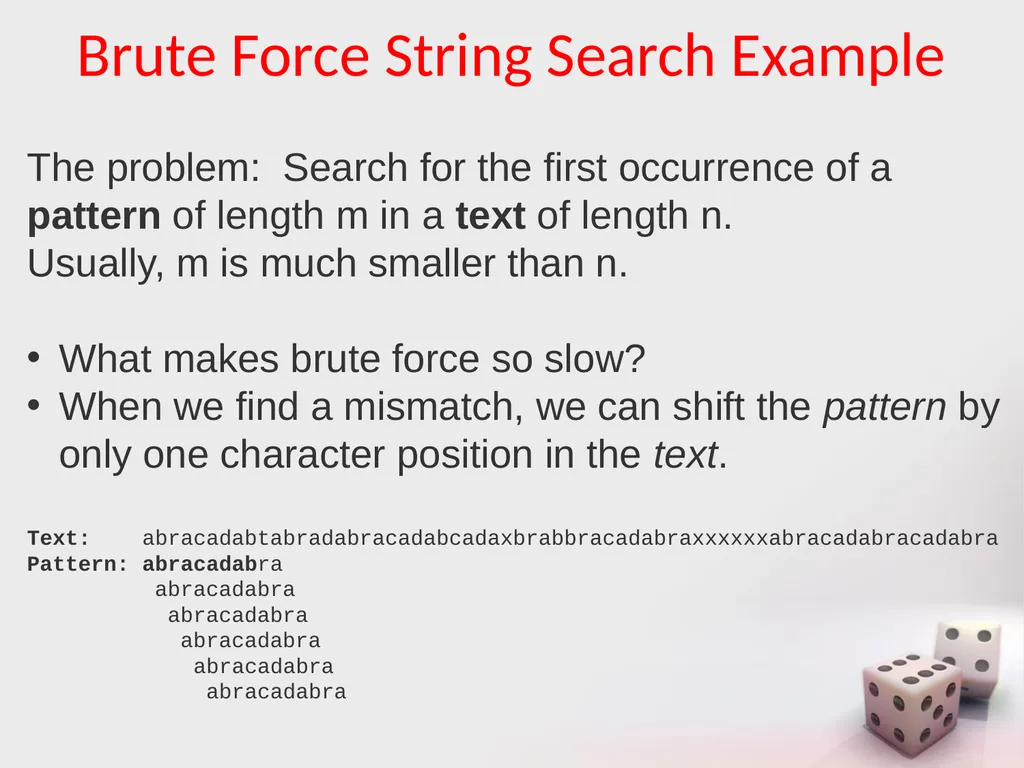
Brute Force String Search Example The problem: Search for the first occurrence of a pattern of length m in a text of length n.
Usually, m is much smaller than n.
What makes brute force so slow?
When we find a mismatch, we can shift the pattern by only one character position in the text.
Text: abracadabtabradabracadabcadaxbrabbracadabraxxxxxxabracadabracadabra Pattern: abracadabra abracadabra abracadabra abracadabra
abracadabra
abracadabra<br>
04
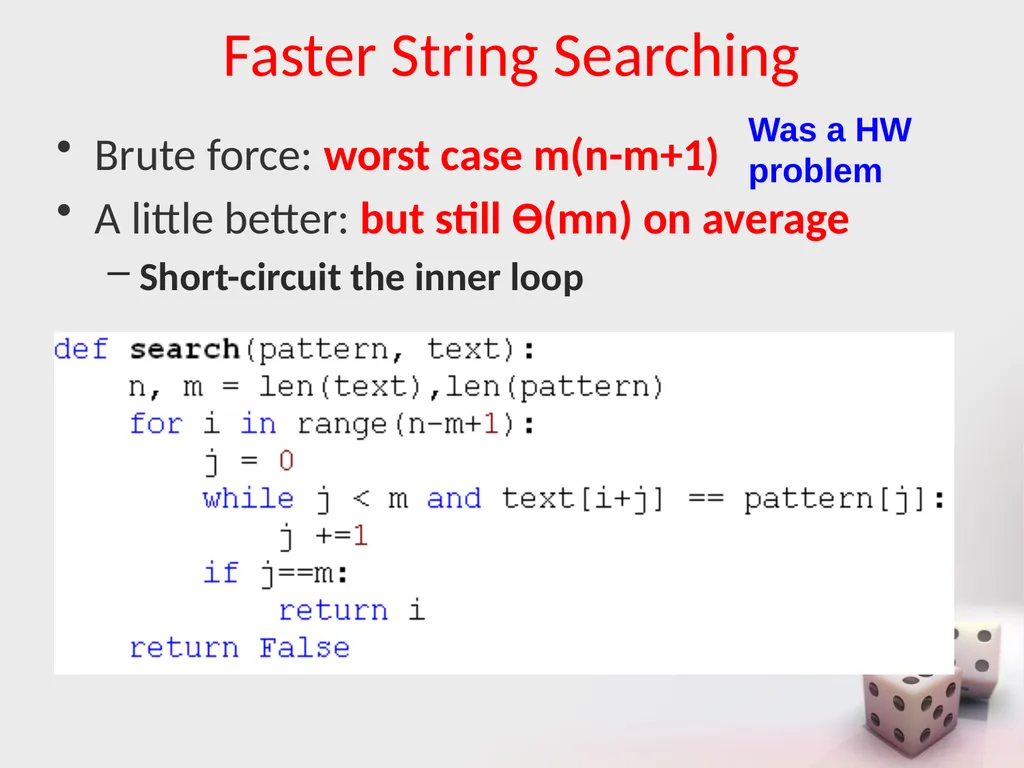
Faster String Searching Brute force: worst case m(n-m+1)
A little better: but still Ѳ(mn) on average
Short-circuit the inner loop Was a HW problem<br>
05
What we want to do When we find a character mismatch
Shift the pattern as far right as we can
With no possibility of skipping over a match.<br>
06
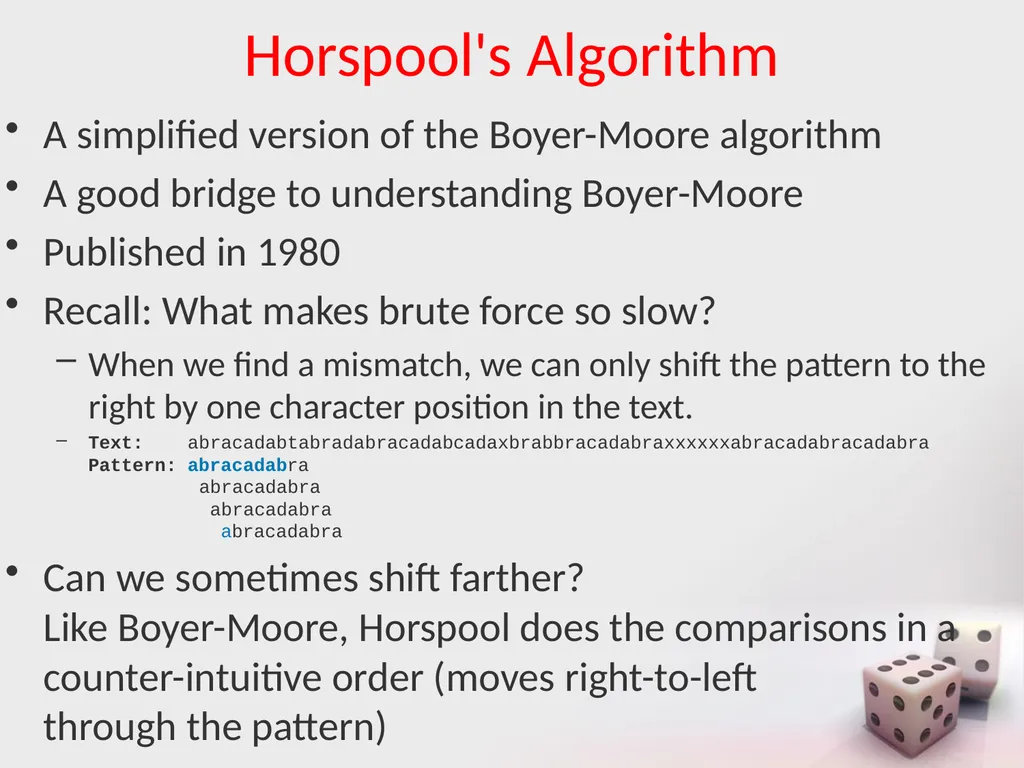
Horspool's Algorithm A simplified version of the Boyer-Moore algorithm
A good bridge to understanding Boyer-Moore
Published in 1980
Recall: What makes brute force so slow?
When we find a mismatch, we can only shift the pattern to the right by one character position in the text.
Text: abracadabtabradabracadabcadaxbrabbracadabraxxxxxxabracadabracadabra Pattern: abracadabra abracadabra abracadabra abracadabra
Can we sometimes shift farther? Like Boyer-Moore, Horspool does the comparisons in a counter-intuitive order (moves right-to-left through the pattern)<br>
07
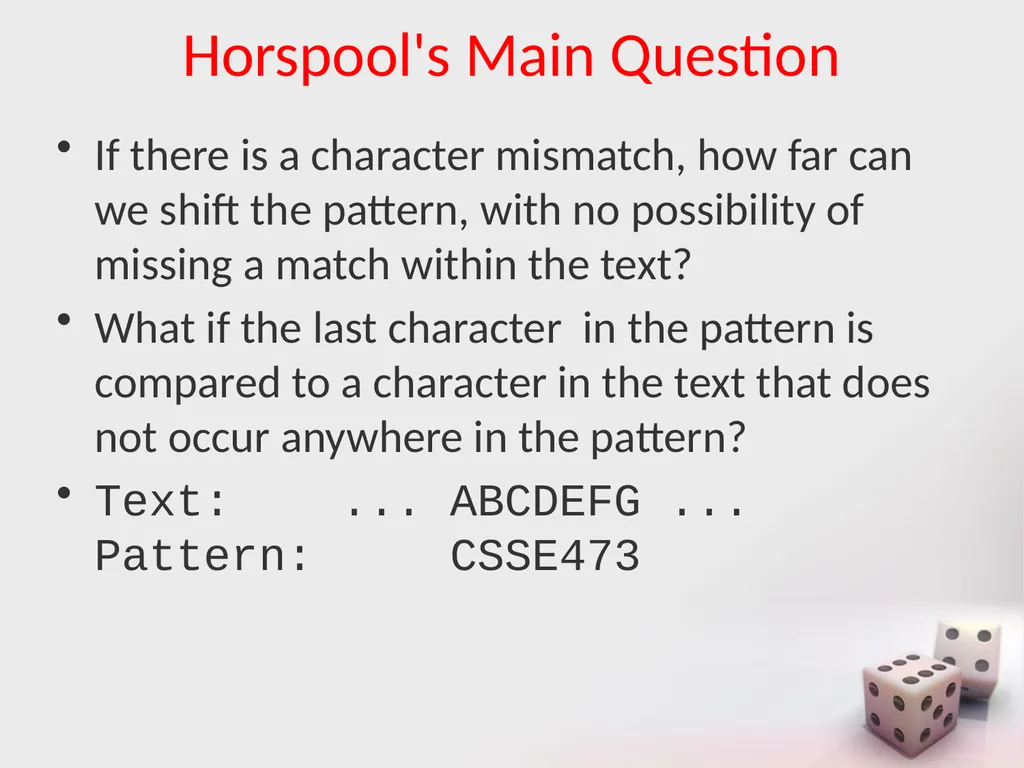
Horspool's Main Question If there is a character mismatch, how far can we shift the pattern, with no possibility of missing a match within the text?
What if the last character in the pattern is compared to a character in the text that does not occur anywhere in the pattern?
Text: ... ABCDEFG ... Pattern: CSSE473<br>
08
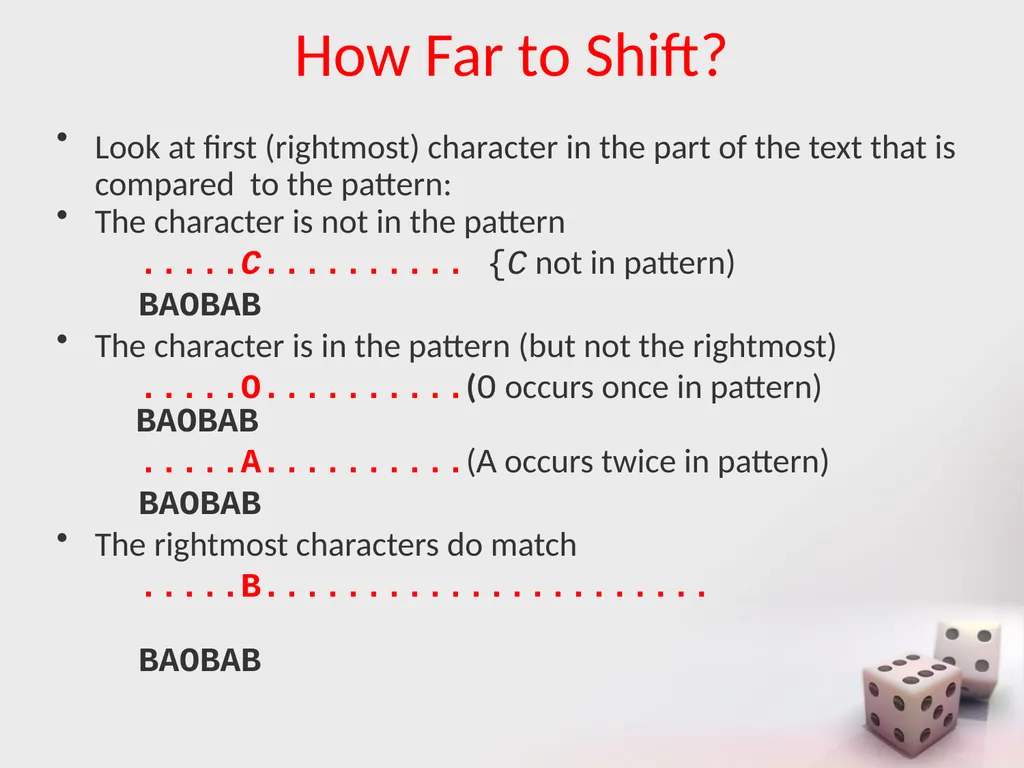
How Far to Shift? Look at first (rightmost) character in the part of the text that is compared to the pattern:
The character is not in the pattern
.....C.......... {C not in pattern)
BAOBAB
The character is in the pattern (but not the rightmost)
.....O..........(O occurs once in pattern) BAOBAB
.....A..........(A occurs twice in pattern)
BAOBAB
The rightmost characters do match
.....B......................
BAOBAB<br>
09
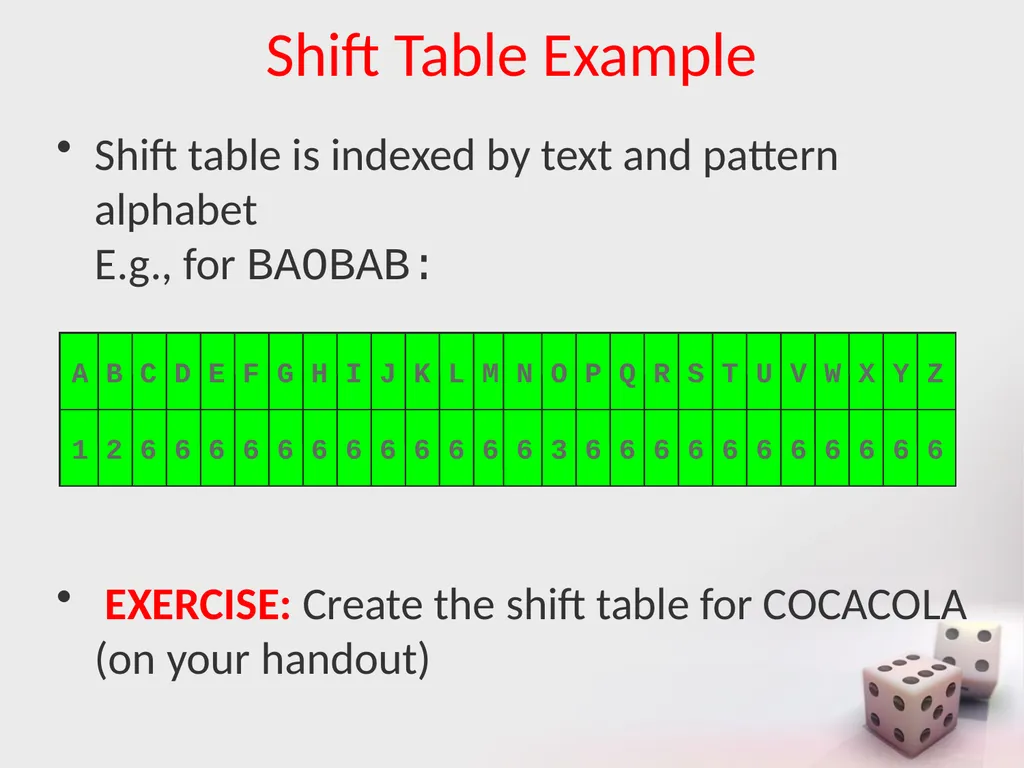
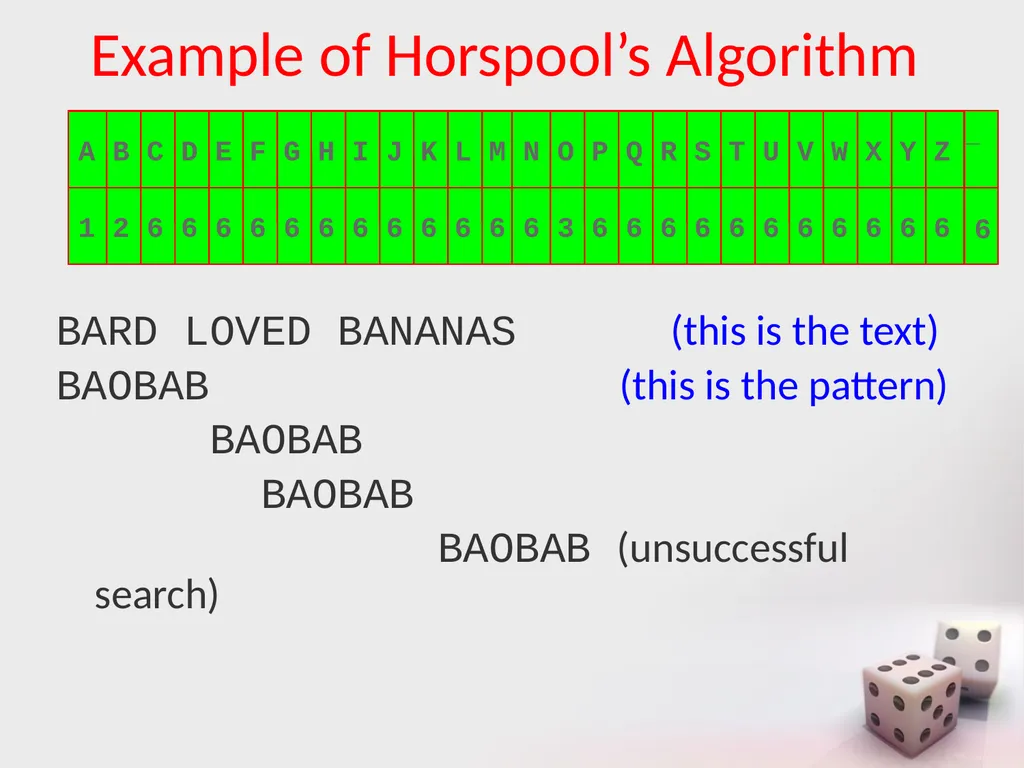
Shift Table Example Shift table is indexed by text and pattern alphabet E.g., for BAOBAB:
EXERCISE: Create the shift table for COCACOLA (on your handout)<br>
10
Example of Horspool’s Algorithm BARD LOVED BANANAS (this is the text)
BAOBAB (this is the pattern)
BAOBAB
BAOBAB
BAOBAB (unsuccessful search)<br>
11
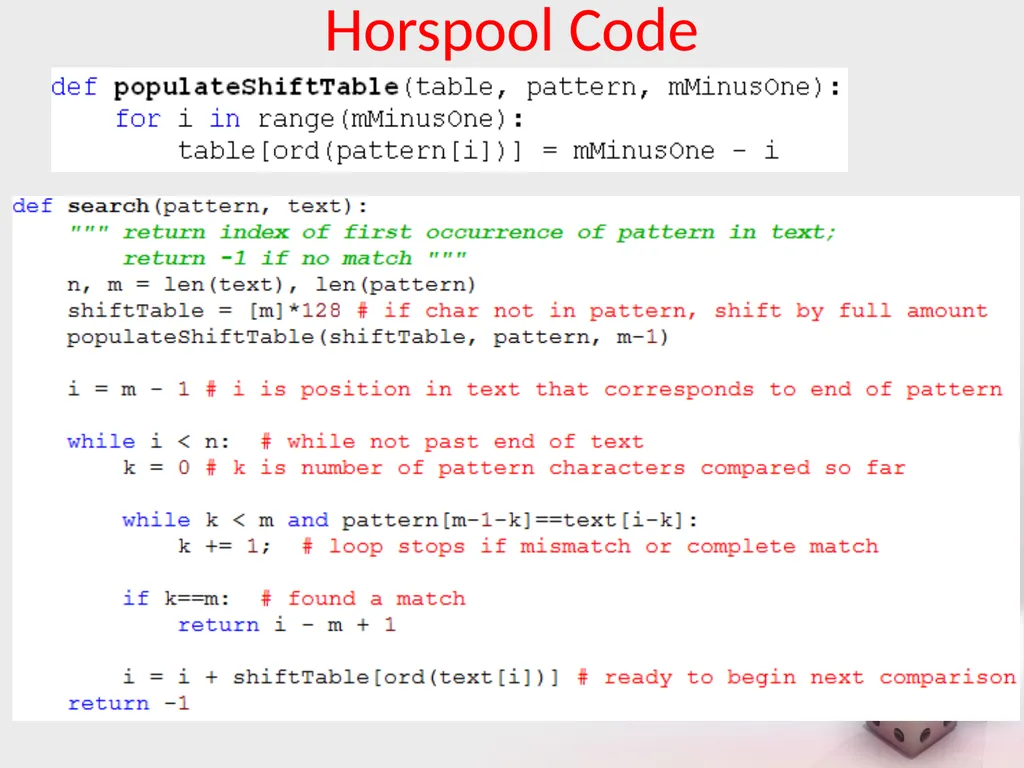
Horspool Code<br>
12
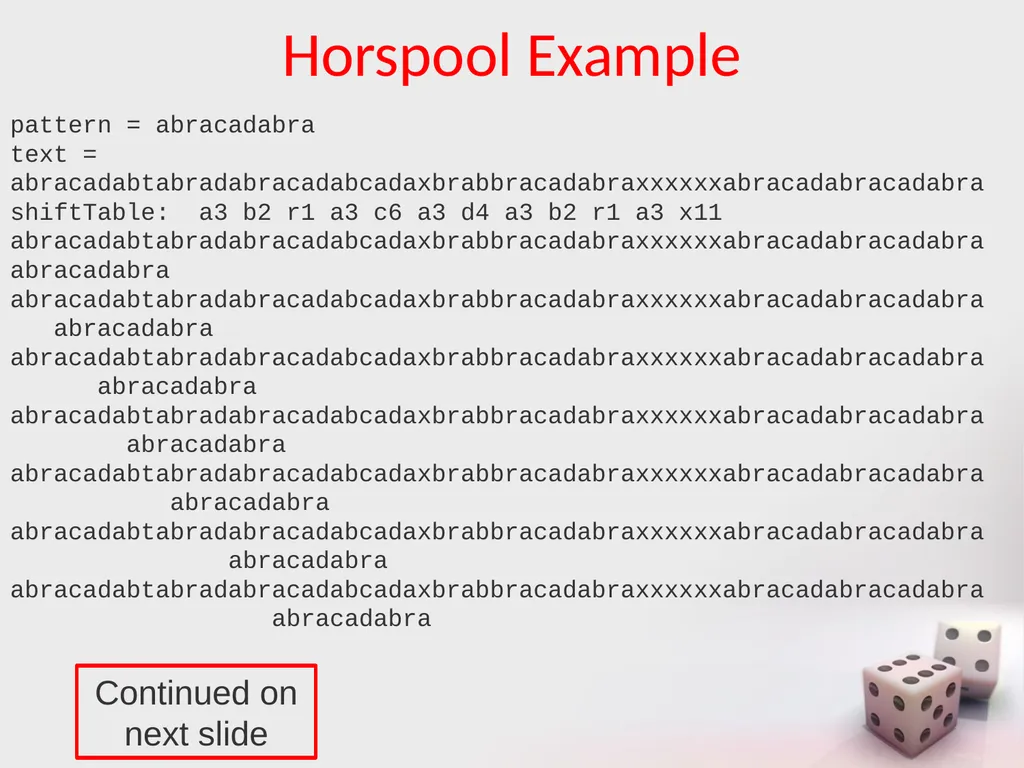
Horspool Example pattern = abracadabra
text = abracadabtabradabracadabcadaxbrabbracadabraxxxxxxabracadabracadabra
shiftTable: a3 b2 r1 a3 c6 a3 d4 a3 b2 r1 a3 x11
abracadabtabradabracadabcadaxbrabbracadabraxxxxxxabracadabracadabra
abracadabra
abracadabtabradabracadabcadaxbrabbracadabraxxxxxxabracadabracadabra
abracadabra
abracadabtabradabracadabcadaxbrabbracadabraxxxxxxabracadabracadabra
abracadabra
abracadabtabradabracadabcadaxbrabbracadabraxxxxxxabracadabracadabra
abracadabra
abracadabtabradabracadabcadaxbrabbracadabraxxxxxxabracadabracadabra
abracadabra
abracadabtabradabracadabcadaxbrabbracadabraxxxxxxabracadabracadabra
abracadabra
abracadabtabradabracadabcadaxbrabbracadabraxxxxxxabracadabracadabra
abracadabra Continued on next slide<br>
13
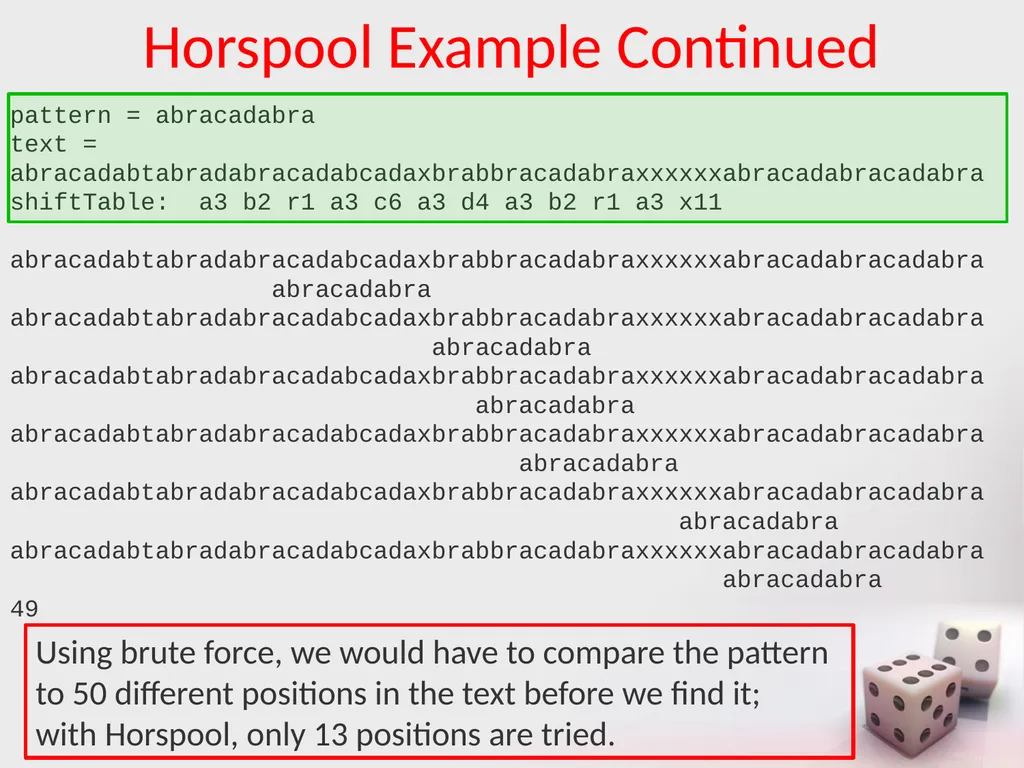
Horspool Example Continued pattern = abracadabra
text = abracadabtabradabracadabcadaxbrabbracadabraxxxxxxabracadabracadabra
shiftTable: a3 b2 r1 a3 c6 a3 d4 a3 b2 r1 a3 x11
abracadabtabradabracadabcadaxbrabbracadabraxxxxxxabracadabracadabra
abracadabra
abracadabtabradabracadabcadaxbrabbracadabraxxxxxxabracadabracadabra
abracadabra
abracadabtabradabracadabcadaxbrabbracadabraxxxxxxabracadabracadabra
abracadabra
abracadabtabradabracadabcadaxbrabbracadabraxxxxxxabracadabracadabra
abracadabra
abracadabtabradabracadabcadaxbrabbracadabraxxxxxxabracadabracadabra
abracadabra
abracadabtabradabracadabcadaxbrabbracadabraxxxxxxabracadabracadabra
abracadabra
49 Using brute force, we would have to compare the pattern to 50 different positions in the text before we find it; with Horspool, only 13 positions are tried.<br>
14
Boyer Moore Intro When determining how far to shift after a mismatch
Horspool only uses the text character corresponding to the rightmost pattern character
Can we do better?
Often there is a partial match (on the right end of the pattern) before a mismatch occurs
Boyer-Moore takes into account k, the number of matched characters before a mismatch occurs.
If k=0, same shift as Horspool.<br>
15
Boyer-Moore Algorithm Based on two main ideas:
compare pattern characters to text characters from right to left
precompute the shift amounts in two tables
bad-symbol table indicates how much to shift based on the text’s character that causes a mismatch
good-suffix table indicates how much to shift based on matched part (suffix) of the pattern<br>
16
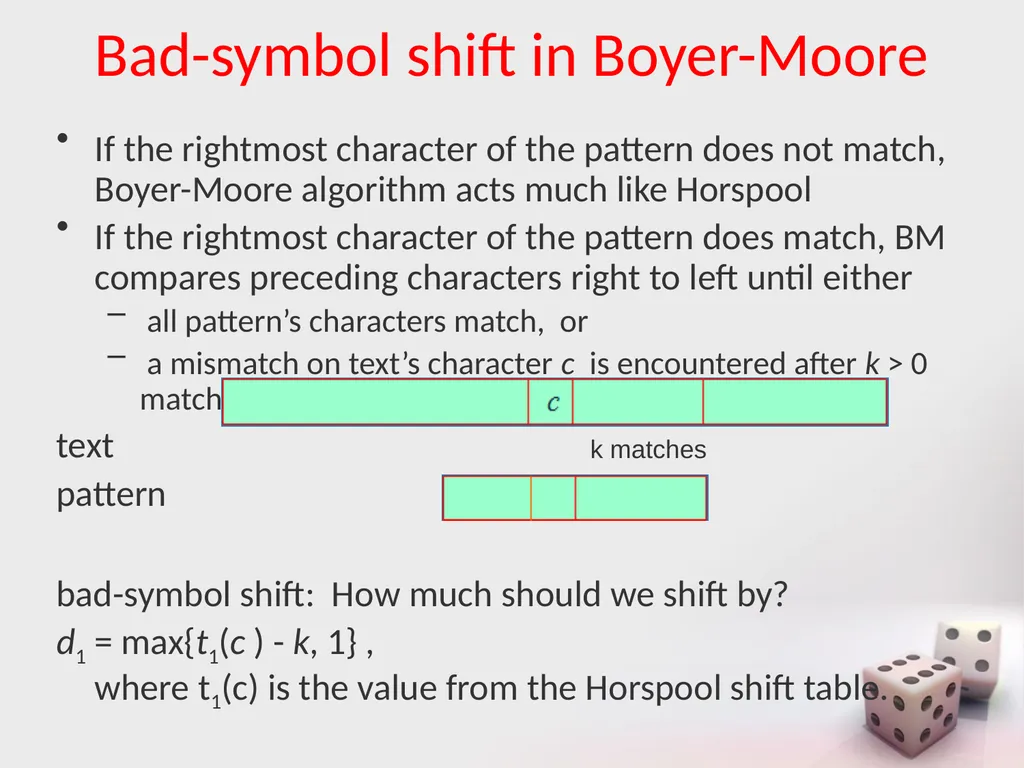
Bad-symbol shift in Boyer-Moore If the rightmost character of the pattern does not match, Boyer-Moore algorithm acts much like Horspool
If the rightmost character of the pattern does match, BM compares preceding characters right to left until either
all pattern’s characters match, or
a mismatch on text’s character c is encountered after k > 0 matches
text
pattern
bad-symbol shift: How much should we shift by?
d1 = max{t1(c ) - k, 1} , where t1(c) is the value from the Horspool shift table. k matches <br>
17
Boyer-Moore Algorithm After successfully matching 0 < k < m characters, the algorithm shifts the pattern right by
d = max {d1, d2}
where d1 = max{t1(c) - k, 1} is the bad-symbol shift
d2(k) is the good-suffix shift
Remaining question: How to compute good-suffix shift table?
d2[k] = ???<br>
18
Good-suffix Shift in Boyer-Moore Good-suffix shift d2 is applied after the k last characters of the pattern are successfully matched
0 < k < m
How can we take advantage of this?
As in the bad suffix table, we want to pre-compute some information based on the characters in the suffix.
We create a good suffix table whose indices are k = 1...m-1, and whose values are how far we can shift after matching a k-character suffix (from the right).
Spend some time talking with one or two other students. Try to come up with criteria for how far we can shift.
Example patterns: CABABA AWOWWOW WOWWOW ABRACADABRA<br>
19
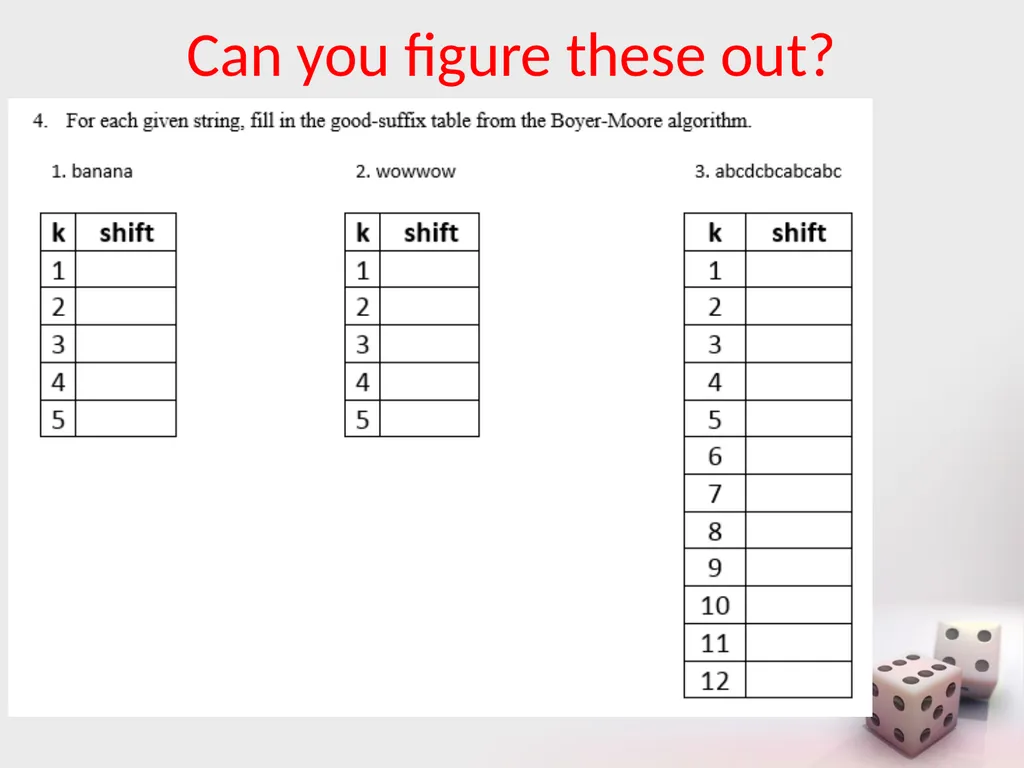
Can you figure these out?<br>
20
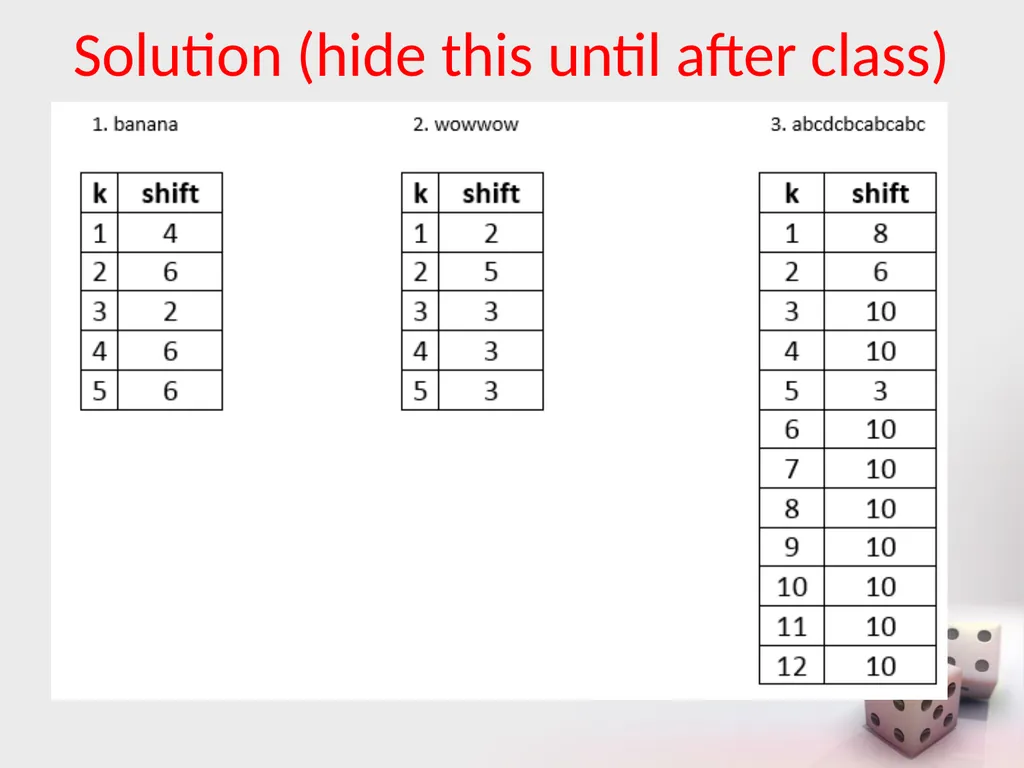
Solution (hide this until after class)<br>
21
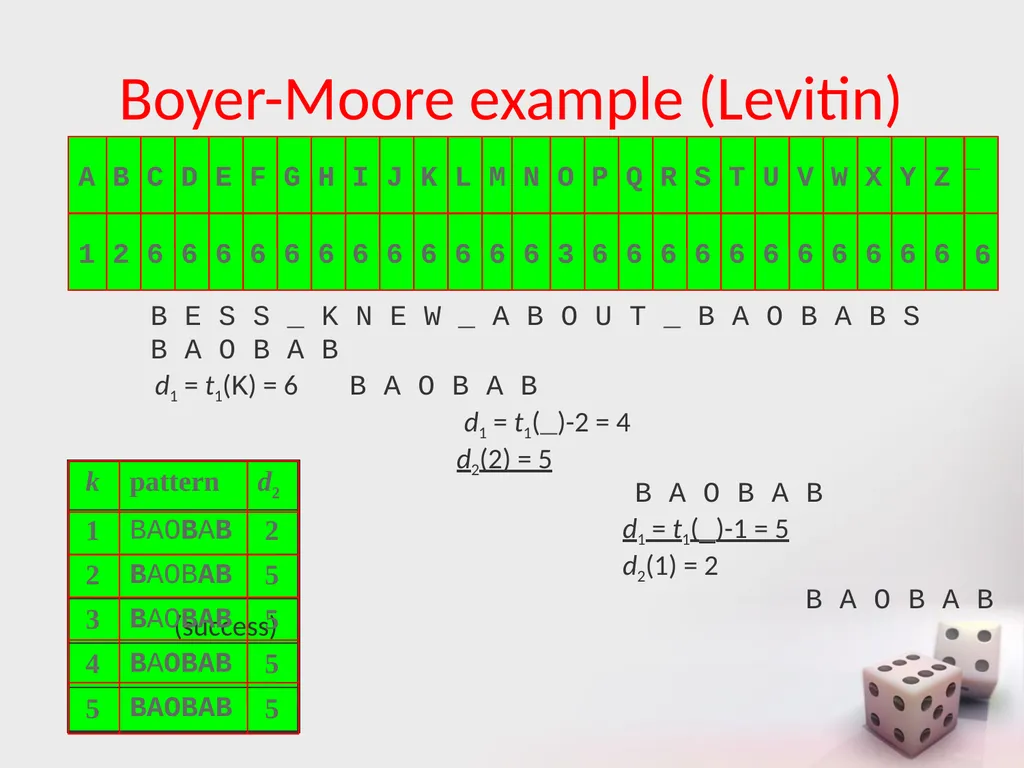
Boyer-Moore example (Levitin) B E S S _ K N E W _ A B O U T _ B A O B A B S
B A O B A B
d1 = t1(K) = 6 B A O B A B
d1 = t1(_)-2 = 4
d2(2) = 5
B A O B A B
d1 = t1(_)-1 = 5
d2(1) = 2
B A O B A B (success)<br>
22
Boyer-Moore Example On Moore's home page
http://www.cs.utexas.edu/users/moore/best-ideas/string-searching/fstrpos-example.html<br>