
Machine Learning Model overview Types of ML models
Description: Machine Learning Model overview Types of ML models New developments (if you are interested in research) We can design supervised training tasks for unlabeled data Self-supervised learning: generate labels from data, e.g., word2vec, BERT
Related Topics
Download Presentation
"Machine Learning Model overview Types of ML models" is the property of its rightful owner. Permission is granted to download and print the materials on this website for personal, non-commercial use only, and to display it on your personal computer provided you do not modify the materials and that you retain all copyright notices contained in the materials. By downloading content from our website, you accept the terms of this agreement.
Presentation Transcript
slide1. Machine Learning Model overview<br>
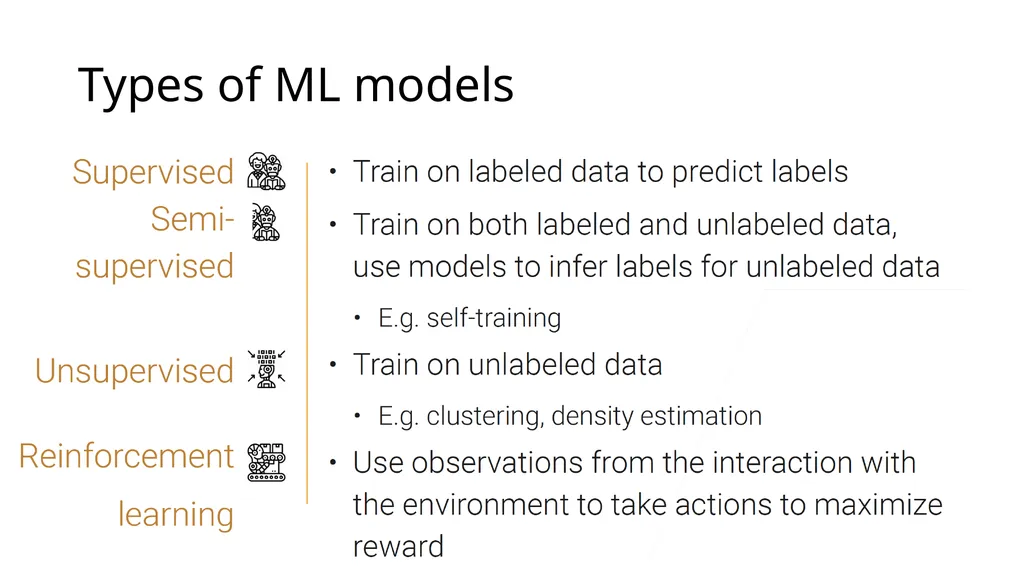
slide2. Types of ML models<br>
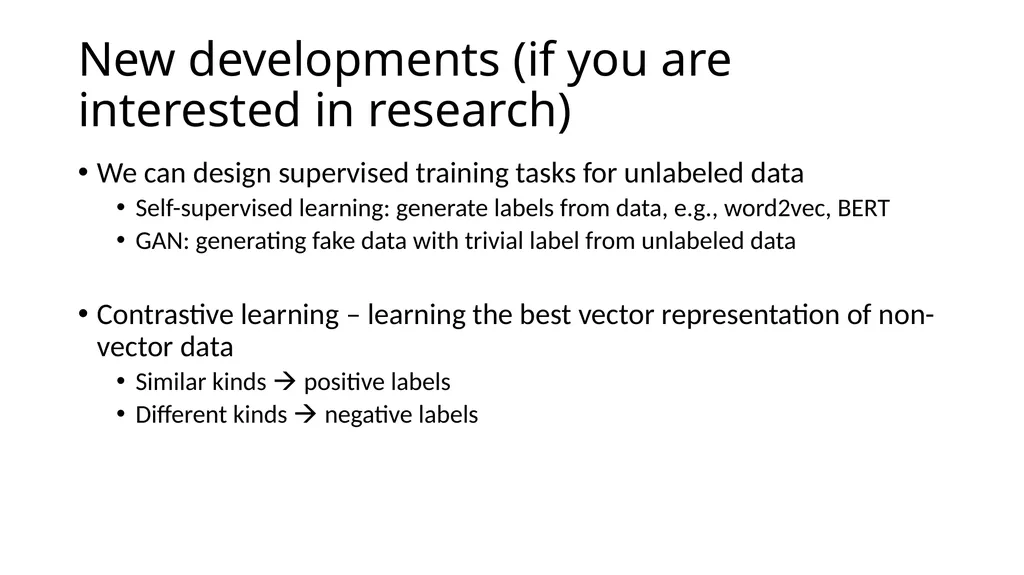
slide3. New developments (if you are interested in research) We can design supervised training tasks for unlabeled data
Self-supervised learning: generate labels from data, e.g., word2vec, BERT
GAN: generating fake data with trivial label from unlabeled data
Contrastive learning – learning the best vector representation of non-vector data
Similar kinds positive labels
Different kinds negative labels<br>
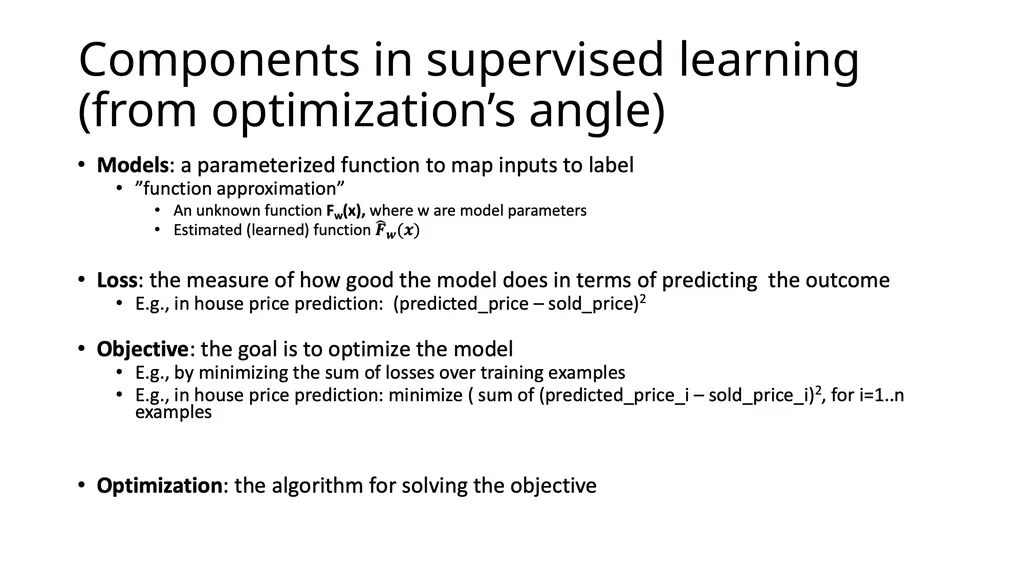
slide4. Components in supervised learning (from optimization’s angle)<br>
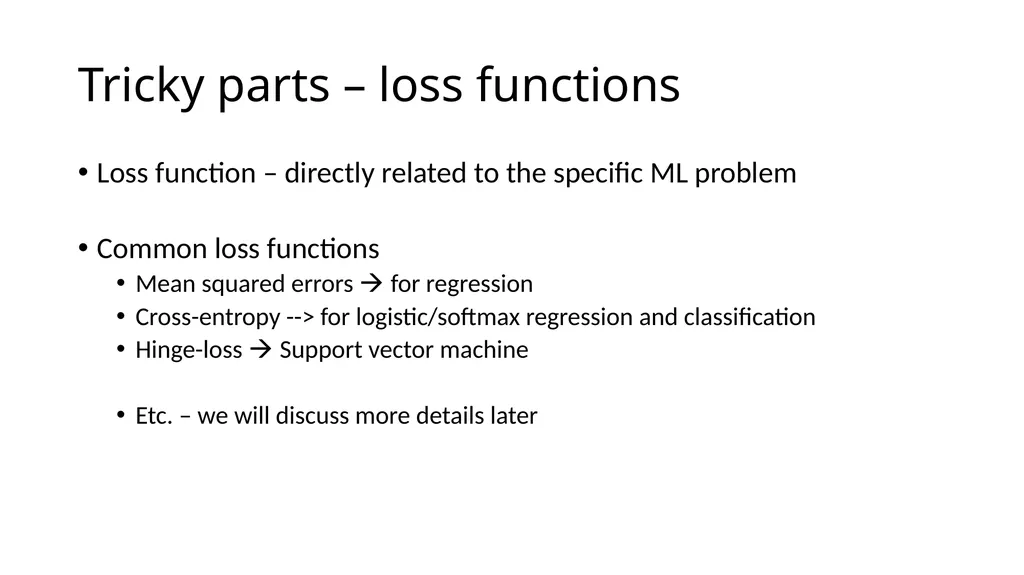
slide5. Tricky parts – loss functions Loss function – directly related to the specific ML problem
Common loss functions
Mean squared errors for regression
Cross-entropy --> for logistic/softmax regression and classification
Hinge-loss Support vector machine
Etc. – we will discuss more details later<br>
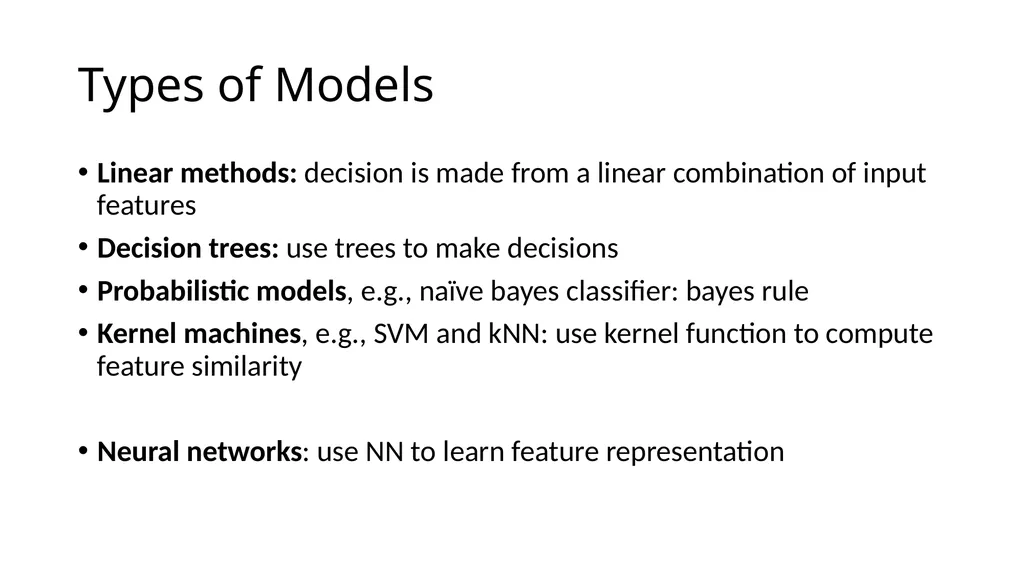
slide6. Types of Models Linear methods: decision is made from a linear combination of input features
Decision trees: use trees to make decisions
Probabilistic models, e.g., naïve bayes classifier: bayes rule
Kernel machines, e.g., SVM and kNN: use kernel function to compute feature similarity
Neural networks: use NN to learn feature representation<br>
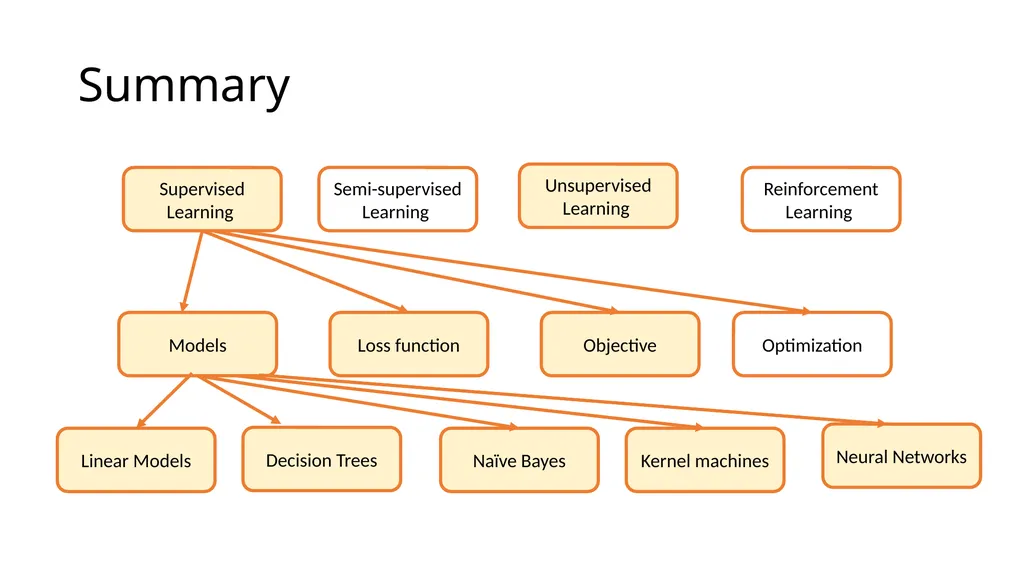
slide7. Summary Supervised
Learning Semi-supervised
Learning Unsupervised
Learning Reinforcement
Learning Objective Loss function Models Optimization Linear Models Decision Trees Naïve Bayes Neural Networks Kernel machines<br>
slide8. Question How does the idea of ”function approximation” link the major concepts in supervised learning (loss, objective, and optimization)?<br>
slide2. Types of ML models<br>
slide3. New developments (if you are interested in research) We can design supervised training tasks for unlabeled data
Self-supervised learning: generate labels from data, e.g., word2vec, BERT
GAN: generating fake data with trivial label from unlabeled data
Contrastive learning – learning the best vector representation of non-vector data
Similar kinds positive labels
Different kinds negative labels<br>
slide4. Components in supervised learning (from optimization’s angle)<br>
slide5. Tricky parts – loss functions Loss function – directly related to the specific ML problem
Common loss functions
Mean squared errors for regression
Cross-entropy --> for logistic/softmax regression and classification
Hinge-loss Support vector machine
Etc. – we will discuss more details later<br>
slide6. Types of Models Linear methods: decision is made from a linear combination of input features
Decision trees: use trees to make decisions
Probabilistic models, e.g., naïve bayes classifier: bayes rule
Kernel machines, e.g., SVM and kNN: use kernel function to compute feature similarity
Neural networks: use NN to learn feature representation<br>
slide7. Summary Supervised
Learning Semi-supervised
Learning Unsupervised
Learning Reinforcement
Learning Objective Loss function Models Optimization Linear Models Decision Trees Naïve Bayes Neural Networks Kernel machines<br>
slide8. Question How does the idea of ”function approximation” link the major concepts in supervised learning (loss, objective, and optimization)?<br>