
Malaria mosquito-borne infectious disease caused
AS
Published · 36 slides · 0 views

1 / 1

















Description
Malaria mosquito-borne infectious disease caused by genus plasmodium. The disease results from the multiplication of Plasmodium parasites within RBCs, causing symptoms that typically include fever and headache in severe cases progressing to
Related Topics
Share
Embed code
Download this presentation From Below
"Malaria mosquito-borne infectious disease caused" is the property of its rightful owner. Permission is granted to download and print the materials on this website for personal, non-commercial use only, and to display it on your personal computer provided you do not modify the materials and that you retain all copyright notices contained in the materials. By downloading content from our website, you accept the terms of this agreement.
Presentation Transcript
01
Malaria mosquito-borne infectious disease caused by genus plasmodium.
The disease results from the multiplication of Plasmodium parasites within RBCs, causing symptoms that typically include fever and headache in severe cases progressing to coma or death.
It is widespread in tropical and subtropical regions, including much of Sub-Saharan Africa, Asia and the America. Alternative names:
· Quartan malaria
· Falciparum malaria
· Biduoterian fever
· Blackwater fever
· Tertian malaria<br>
The disease results from the multiplication of Plasmodium parasites within RBCs, causing symptoms that typically include fever and headache in severe cases progressing to coma or death.
It is widespread in tropical and subtropical regions, including much of Sub-Saharan Africa, Asia and the America. Alternative names:
· Quartan malaria
· Falciparum malaria
· Biduoterian fever
· Blackwater fever
· Tertian malaria<br>
02
At risk for malaria:
40% of the world’s population
Commonly associated with poverty
more than 500 million are ill of malaria yearly
Eliminated from US, Canada, Europe and Russia but has resurged in tropics
India has 1.5 million cases/year of malaria(40-50% are due to P.Falciparum)<br>
40% of the world’s population
Commonly associated with poverty
more than 500 million are ill of malaria yearly
Eliminated from US, Canada, Europe and Russia but has resurged in tropics
India has 1.5 million cases/year of malaria(40-50% are due to P.Falciparum)<br>
03
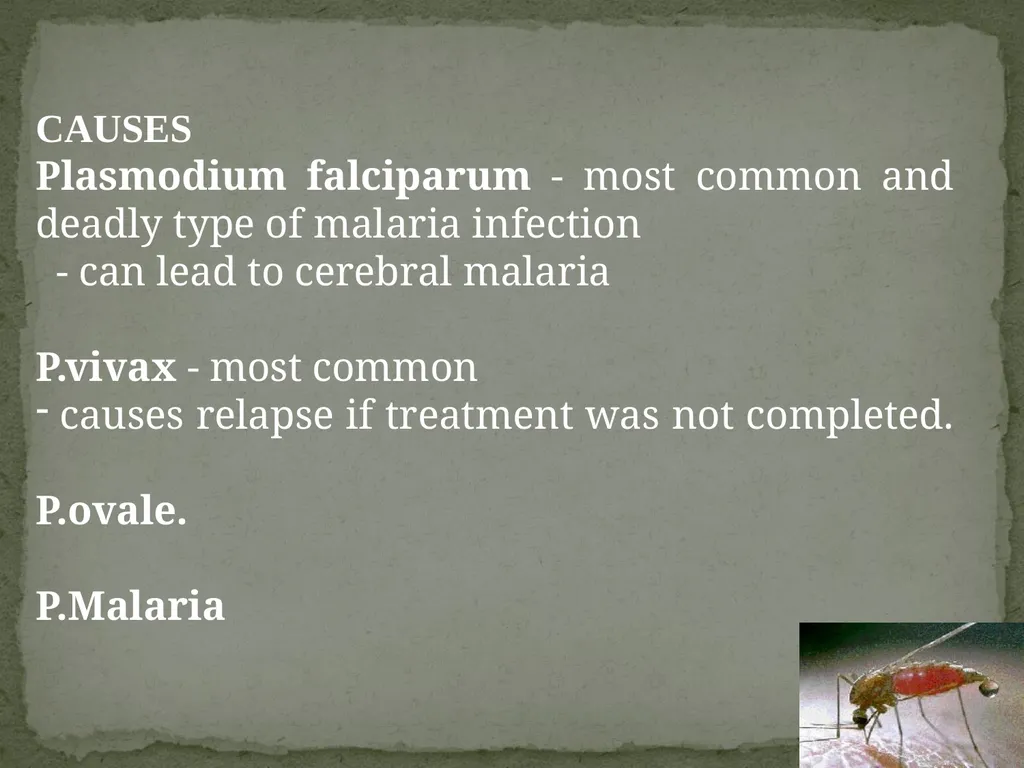
CAUSES
Plasmodium falciparum - most common and deadly type of malaria infection
- can lead to cerebral malaria
P.vivax - most common
causes relapse if treatment was not completed.
P.ovale.
P.Malaria<br>
Plasmodium falciparum - most common and deadly type of malaria infection
- can lead to cerebral malaria
P.vivax - most common
causes relapse if treatment was not completed.
P.ovale.
P.Malaria<br>
04
fever Hypnozoite
P.V, M, O Merozoites PATHOPHYSIOLOGY:<br>
P.V, M, O Merozoites PATHOPHYSIOLOGY:<br>
05
Falciparum invading RBC<br>
06
Signs & symptoms: Sometimes the incubation periods can be prolonged for several months in P. vivax, P. ovale, and P. malariae.
All four species can exhibit non-specific prodromal symptoms a few days before the first febrile attack.
These prodromal symptoms are generally described as 'flu-like‘
- headache, slight fever, muscle pain, anorexia, nausea and lassitude. The symptoms tend to correlate with increasing numbers of parasites.<br>
All four species can exhibit non-specific prodromal symptoms a few days before the first febrile attack.
These prodromal symptoms are generally described as 'flu-like‘
- headache, slight fever, muscle pain, anorexia, nausea and lassitude. The symptoms tend to correlate with increasing numbers of parasites.<br>
07
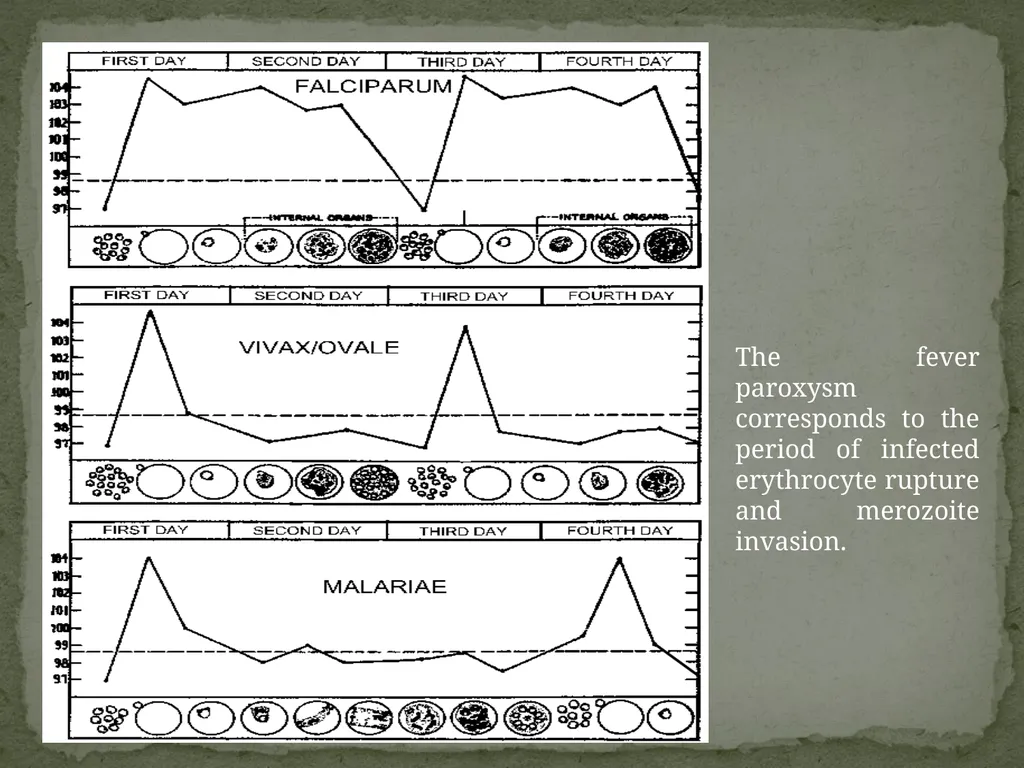
These prodromal symptoms will be followed by febrile attacks (malarial paroxysms) The Malarial Paroxysm The malarial paroxysm will usually last 4-8 hours<br>
08
The fever paroxysm corresponds to the period of infected erythrocyte rupture and merozoite invasion.<br>
09
Uncomplicated Malaria Symptoms: fever, chills, headache, body pains, diarrhea, vomiting, cough
Signs: anemia, thrombocytopenia Features of severe malaria Decrease in conscious level, neurological signs or fits
Severe anemia – Hematocrit < 15%
Hyperpyrexia
Hyperparasitemia > 5%
Hypoglycemia (glucose < 2.2 mmol/L)
Renal impairment or oliguria
Pulmonary edema, hypoxia, acidosis
Circulatory collapse or shock
Hemostasis abnormalities – hemolysis
Hepatomegaly, Splenomegaly, Dehydration.<br>
Signs: anemia, thrombocytopenia Features of severe malaria Decrease in conscious level, neurological signs or fits
Severe anemia – Hematocrit < 15%
Hyperpyrexia
Hyperparasitemia > 5%
Hypoglycemia (glucose < 2.2 mmol/L)
Renal impairment or oliguria
Pulmonary edema, hypoxia, acidosis
Circulatory collapse or shock
Hemostasis abnormalities – hemolysis
Hepatomegaly, Splenomegaly, Dehydration.<br>
10
Examine blood under microscope (geimsa stain) CT scan: to evaluate evidence of cerebral edema or hemorrhage Diagnosis: Polymerase chain reaction (PCR)
-determine the species of plasmodium Dipstick test (Immunochromatographic tests/ Antigen-Capture Assay)
- not as effective when parasite levels are below 100 parasites/mL of blood Thick and thin blood smears are gold standard
Identify species and quantify density
If can not identify species, treat for P.f.
Re-examine smears or use alternative diagnostic tool
Suspect P.f.
If critically ill
If returned from Sub-Saharan Africa, > 95 % chance of P.f. pure or mixed infection
Parasitemia > 1%<br>
-determine the species of plasmodium Dipstick test (Immunochromatographic tests/ Antigen-Capture Assay)
- not as effective when parasite levels are below 100 parasites/mL of blood Thick and thin blood smears are gold standard
Identify species and quantify density
If can not identify species, treat for P.f.
Re-examine smears or use alternative diagnostic tool
Suspect P.f.
If critically ill
If returned from Sub-Saharan Africa, > 95 % chance of P.f. pure or mixed infection
Parasitemia > 1%<br>
11
Principles of management of malaria Prompt and accurate diagnosis
Assess for signs of complicated/severe malaria
Prompt use of appropriate antimalarial drugs
Monitor clinical and parasitological improvement
Cure – parasitic and/or clinical
Ancillary treatment
Instructions for future prevention of malaria<br>
Assess for signs of complicated/severe malaria
Prompt use of appropriate antimalarial drugs
Monitor clinical and parasitological improvement
Cure – parasitic and/or clinical
Ancillary treatment
Instructions for future prevention of malaria<br>
12
The Anti-malarial Drugs Artesunate, Artether, Artemether
Mefloquine, Amodiaquine
Quinine, Chloroquine
Lumefantrine, Halofantrine,
Proguanilchlor (chlorguanide)
Sulfadoxin+Pyrimethmine, Dapsone
Tetracyclines, Doxycyclin, Clindamycin<br>
Mefloquine, Amodiaquine
Quinine, Chloroquine
Lumefantrine, Halofantrine,
Proguanilchlor (chlorguanide)
Sulfadoxin+Pyrimethmine, Dapsone
Tetracyclines, Doxycyclin, Clindamycin<br>
13
Malaria Treatment
non-falciparum infections Chloroquine (CQ) is the drug of choice
Pruritis is major side effect of CQ
More common in dark-skinned people
Can offer antihistamines, continue use
Some CQ-resistant P. vivax has been reported from Oceania and South America
Mefloquine or quinine for proven resistant cases<br>
Pruritis is major side effect of CQ
More common in dark-skinned people
Can offer antihistamines, continue use
Some CQ-resistant P. vivax has been reported from Oceania and South America
Mefloquine or quinine for proven resistant cases<br>
14
Complications of falciparum malaria Each cycle releases 20 times more merozoites than vivax
Coma - cerebral malaria, convulsions
Renal failure – black water fever
Hyperpyrexia, acute pulmonary edema
Hemolytic Jaundice, severe bleeding
Hypovolemic shock, Hypoglycemia
Metabolic acidosis, Coagulopathy,
Severe anaemia, hyperparasitemia
Usually resistant to Chloroquine<br>
Coma - cerebral malaria, convulsions
Renal failure – black water fever
Hyperpyrexia, acute pulmonary edema
Hemolytic Jaundice, severe bleeding
Hypovolemic shock, Hypoglycemia
Metabolic acidosis, Coagulopathy,
Severe anaemia, hyperparasitemia
Usually resistant to Chloroquine<br>
15
Drug Rx. of falciparum Chloroquine is not the drug of choice
Should not be treated with single drug
Combination therapy is a must
Artemisinin based CT – ACT is the Rx. of choice<br>
Should not be treated with single drug
Combination therapy is a must
Artemisinin based CT – ACT is the Rx. of choice<br>
16
Combination Therapy (CT) Anti-malarial combination therapy (CT) is the simultaneous use of two or more blood schizonticidal drugs with different biochemical targets in the parasites and independent modes of action.
Artemisinin based Combination Therapy (ACT)
Artemisinin-based combination therapy (ACT) is an antimalarial combination therapy with an artemisinin derivative as one component of the combination given for at least 3 days.<br>
Artemisinin based Combination Therapy (ACT)
Artemisinin-based combination therapy (ACT) is an antimalarial combination therapy with an artemisinin derivative as one component of the combination given for at least 3 days.<br>
17
Rationale for ACT Resistance to Chloroquine and SP
Protect individual drug from resistance
To decrease rate of decline in efficacy
To interrupt spread of resistant strains
To decrease transmission in a region
The combination is often more effective
In the rare event of resistance to one of the drugs during the course of the infection, the parasite will be killed by the other drug<br>
Protect individual drug from resistance
To decrease rate of decline in efficacy
To interrupt spread of resistant strains
To decrease transmission in a region
The combination is often more effective
In the rare event of resistance to one of the drugs during the course of the infection, the parasite will be killed by the other drug<br>
18
Why Artemisinins ? Short half-life; hence good for combination
Rapid substantial reduction of the parasite biomass
Rapid resolution of clinical symptoms
Effective action against multi-drug resistant P. falciparum
Reduction of gametocyte carriage
No documented parasite resistance yet
Few reported adverse effects.<br>
Rapid substantial reduction of the parasite biomass
Rapid resolution of clinical symptoms
Effective action against multi-drug resistant P. falciparum
Reduction of gametocyte carriage
No documented parasite resistance yet
Few reported adverse effects.<br>
19
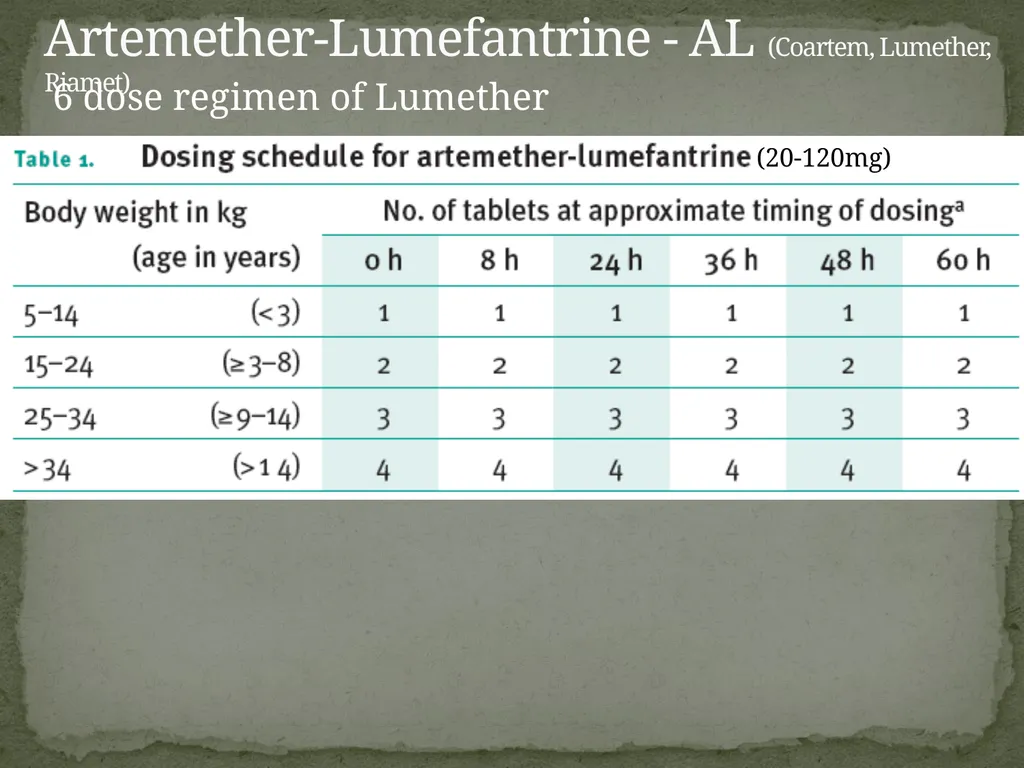
Artemether-Lumefantrine - AL (Coartem, Lumether, Riamet) 6 dose regimen of Lumether (20-120mg)<br>
20
AL Dosage Schedule<br>
21
Low Resistance areas<br>
22
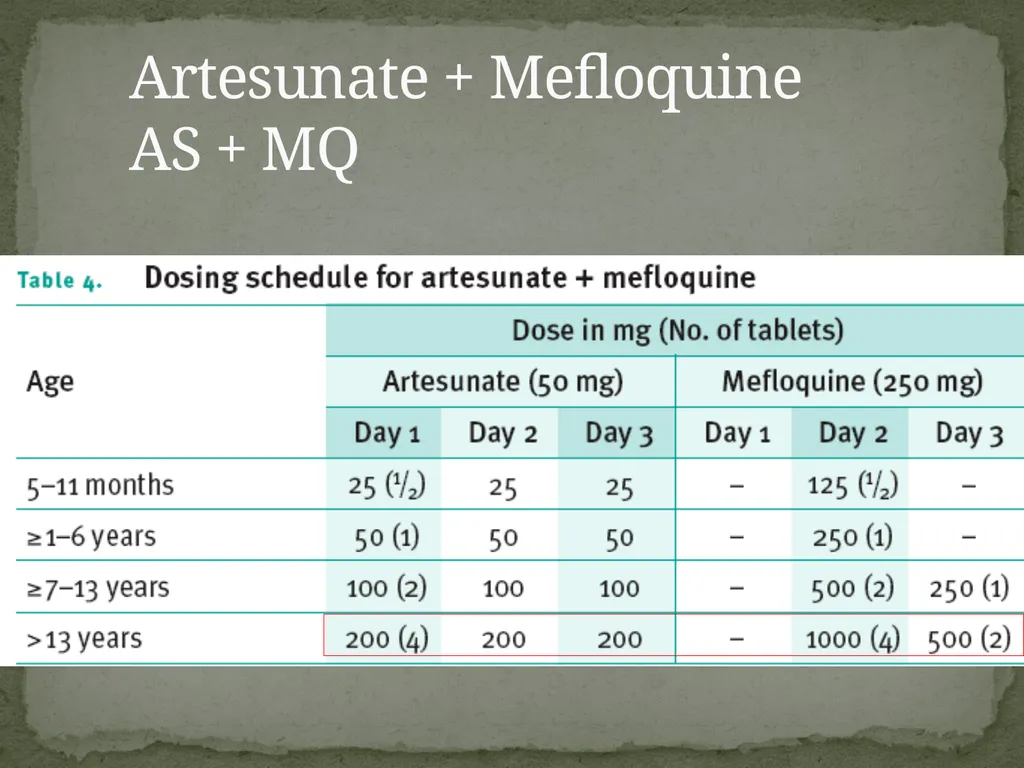
Artesunate + Mefloquine
AS + MQ<br>
23
Artesunate + Amodiaquine
AS + AQ<br>
24
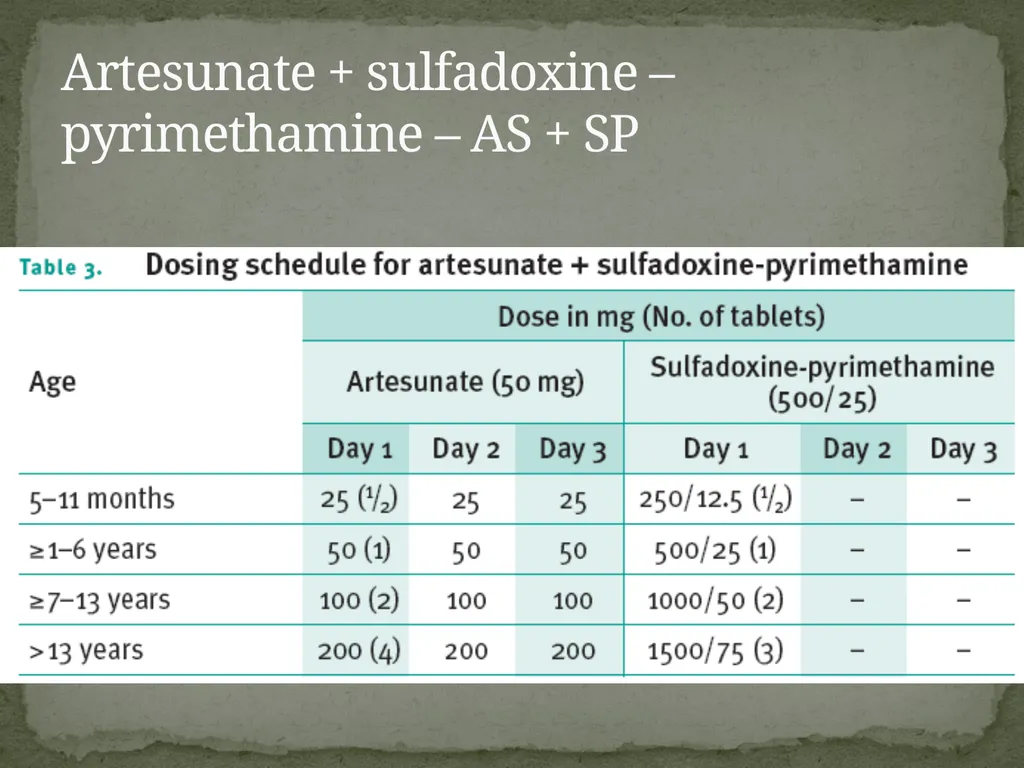
Artesunate + sulfadoxine –pyrimethamine – AS + SP<br>
25
Second line Combinations Artesunate (7 days) + Tetracycline(100mg) (7)
Artesunate (7 days) + Doxycycline(100mg) (7)
Artesunate (7 days) + Clindamycin(900mg) (7)
or
4. Quinine in place of AS + any of the above antibiotics for 7 days<br>
Artesunate (7 days) + Doxycycline(100mg) (7)
Artesunate (7 days) + Clindamycin(900mg) (7)
or
4. Quinine in place of AS + any of the above antibiotics for 7 days<br>
26
Artemisinins parenteral αβ Arteether – 150 mg (2ml) i.m od x 3 days or 3 mg/kg od i.m. x 3 days
Artesunate: 2.4 mg/kg (loading dose) IV, followed by 1.2 mg/kg at 12 and 24 hours, then 1.2 mg/kg daily for 6 days. If the patient is able to swallow, the daily dose can be given orally.
Artemether 3.2 mg/kg i.m. given on admission then 1.6 mg/kg per day is an acceptable alternative to quinine i.v infusions
Rectal artemisinins are not as effective severe falciparum malaria Chloroquine-resistant malaria or sensitivity not known<br>
Artesunate: 2.4 mg/kg (loading dose) IV, followed by 1.2 mg/kg at 12 and 24 hours, then 1.2 mg/kg daily for 6 days. If the patient is able to swallow, the daily dose can be given orally.
Artemether 3.2 mg/kg i.m. given on admission then 1.6 mg/kg per day is an acceptable alternative to quinine i.v infusions
Rectal artemisinins are not as effective severe falciparum malaria Chloroquine-resistant malaria or sensitivity not known<br>
27
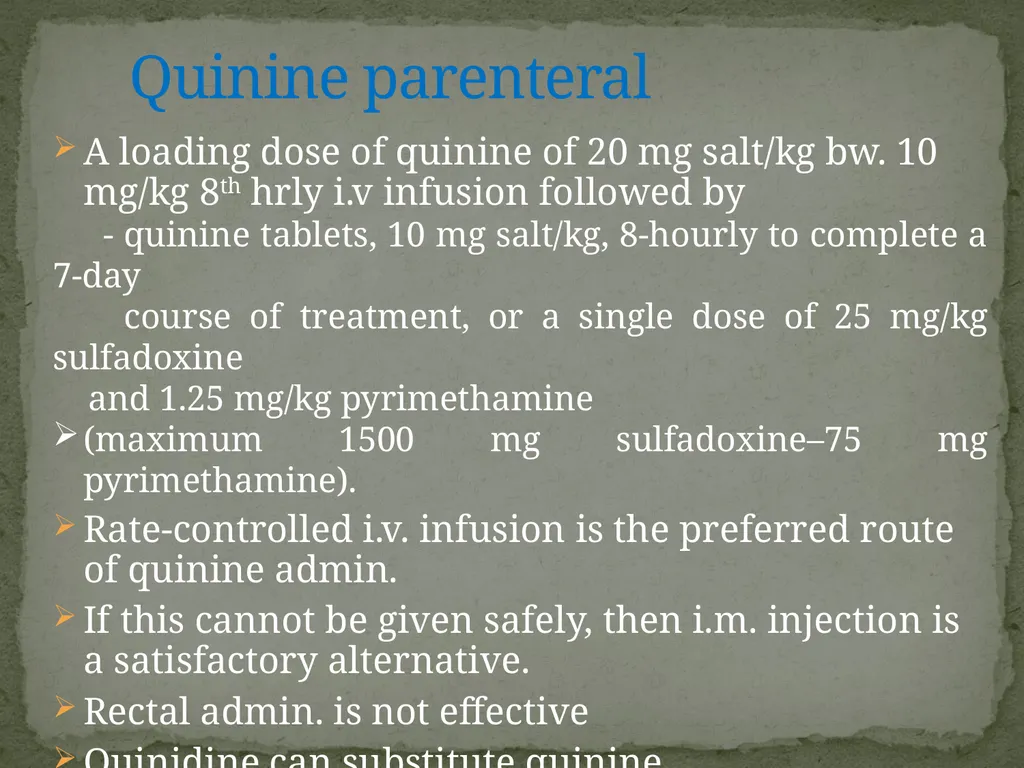
Quinine parenteral A loading dose of quinine of 20 mg salt/kg bw. 10 mg/kg 8th hrly i.v infusion followed by
- quinine tablets, 10 mg salt/kg, 8-hourly to complete a 7-day
course of treatment, or a single dose of 25 mg/kg sulfadoxine
and 1.25 mg/kg pyrimethamine
(maximum 1500 mg sulfadoxine–75 mg pyrimethamine).
Rate-controlled i.v. infusion is the preferred route of quinine admin.
If this cannot be given safely, then i.m. injection is a satisfactory alternative.
Rectal admin. is not effective
Quinidine can substitute quinine<br>
- quinine tablets, 10 mg salt/kg, 8-hourly to complete a 7-day
course of treatment, or a single dose of 25 mg/kg sulfadoxine
and 1.25 mg/kg pyrimethamine
(maximum 1500 mg sulfadoxine–75 mg pyrimethamine).
Rate-controlled i.v. infusion is the preferred route of quinine admin.
If this cannot be given safely, then i.m. injection is a satisfactory alternative.
Rectal admin. is not effective
Quinidine can substitute quinine<br>
28
severe falciparum malaria Chloroquine-sensitive malaria Chloroquine: 10 mg base/kg over 8 hours, followed by 15 mg/kg given over the next 24 hours.
or
Chloroquine: 5 mg base/kg over 6 hours, every 6 hours, for a total of 5 doses
or
(If IV infusion is not possible) chloroquine, 3.5 mg base/kg, every 6 hours IM or SC<br>
or
Chloroquine: 5 mg base/kg over 6 hours, every 6 hours, for a total of 5 doses
or
(If IV infusion is not possible) chloroquine, 3.5 mg base/kg, every 6 hours IM or SC<br>
29
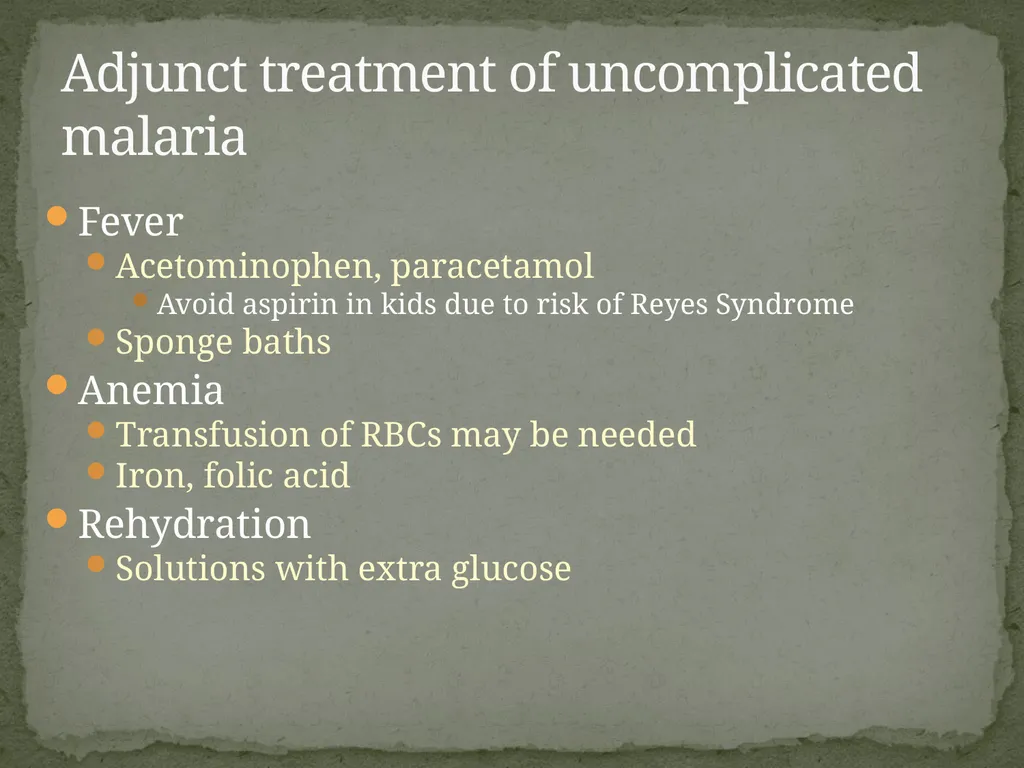
Adjunct treatment of uncomplicated malaria Fever
Acetominophen, paracetamol
Avoid aspirin in kids due to risk of Reyes Syndrome
Sponge baths
Anemia
Transfusion of RBCs may be needed
Iron, folic acid
Rehydration
Solutions with extra glucose<br>
Acetominophen, paracetamol
Avoid aspirin in kids due to risk of Reyes Syndrome
Sponge baths
Anemia
Transfusion of RBCs may be needed
Iron, folic acid
Rehydration
Solutions with extra glucose<br>
30
What to give in pregnancy ? In 1st trimester
Quinine + Clindamycin 7 days
In 2nd and 3rd trimesters
Any ACT combination as per rec. or
Artesunate + Clindamycin 7 days or
Quinine + Clindamycin 7 days
Lactating women same ACT<br>
Quinine + Clindamycin 7 days
In 2nd and 3rd trimesters
Any ACT combination as per rec. or
Artesunate + Clindamycin 7 days or
Quinine + Clindamycin 7 days
Lactating women same ACT<br>
31
Warning Artemisinins should never be used as monotherapy
Artesunate combinations always given for 3 days; never single dose of AS.
For AL six doses must be over 3 days
AQ or MQ or SP should never be used alone - lest drug resistance occurs<br>
Artesunate combinations always given for 3 days; never single dose of AS.
For AL six doses must be over 3 days
AQ or MQ or SP should never be used alone - lest drug resistance occurs<br>
32
Combinations not recommended Chloroquine based combinations (e.g CQ + SP; CQ + Artesunate)
Artesunate (single dose) + SP
Chloproguanil-Dapsone (LapDap)<br>
Artesunate (single dose) + SP
Chloproguanil-Dapsone (LapDap)<br>
33
Antimalarial Chemoprophylaxis Prevents disease, not infection
Appropriate for non-immune travelers
Consider:
immune status
intensity/duration of exposure
parasite drug resistance<br>
Appropriate for non-immune travelers
Consider:
immune status
intensity/duration of exposure
parasite drug resistance<br>
34
Suppressive prophylaxis
Chloroquine, proguanil, mefloquine and doxycycline
only effective at killing the malaria parasite once it has entered the erythrocytic stage (blood stage) and therefore have no effect until the liver stage is complete.
So these prophylactics must continue to be taken for four weeks after leaving the area of risk.
Causal prophylaxis
Malarone and primaquine
Causal prophylactics target not only the blood stages of malaria, but the initial liver stage as well.
So user can stop taking the drug 7 days after leaving the area of risk.
Regimens
recommended by the WHO for prevention of P. falciparum infection.
Doxycycline 100 mg once daily (started one day before travel, and continued for four weeks after returning);
Mefloquine 250 mg once weekly (started two-and-a-half weeks before travel, and continued for four weeks after returning);
Atovaquone/Proguanil(malarone) 1 tablet daily (started one day before travel, and continued for 1 week after returning).
In areas where chloroquine remains effective:
Chloroquine 300 mg once weekly, and Proguanil 200 mg once daily (started one week before travel, and continued for four weeks after returning);<br>
Chloroquine, proguanil, mefloquine and doxycycline
only effective at killing the malaria parasite once it has entered the erythrocytic stage (blood stage) and therefore have no effect until the liver stage is complete.
So these prophylactics must continue to be taken for four weeks after leaving the area of risk.
Causal prophylaxis
Malarone and primaquine
Causal prophylactics target not only the blood stages of malaria, but the initial liver stage as well.
So user can stop taking the drug 7 days after leaving the area of risk.
Regimens
recommended by the WHO for prevention of P. falciparum infection.
Doxycycline 100 mg once daily (started one day before travel, and continued for four weeks after returning);
Mefloquine 250 mg once weekly (started two-and-a-half weeks before travel, and continued for four weeks after returning);
Atovaquone/Proguanil(malarone) 1 tablet daily (started one day before travel, and continued for 1 week after returning).
In areas where chloroquine remains effective:
Chloroquine 300 mg once weekly, and Proguanil 200 mg once daily (started one week before travel, and continued for four weeks after returning);<br>
35
Personal Protection Protective clothing
Insect repellants
Household insecticide products
Window and door screens
Bed nets
Consult physician for proper prophylaxis before traveling to endemic areas
- usually anti-malarial drugs starting a day or two, usually chloroquine or mefloquine
Treatment - continued through at least four weeks after leaving the endemic area Seek medical help : if having flu-like symptoms<br>
Insect repellants
Household insecticide products
Window and door screens
Bed nets
Consult physician for proper prophylaxis before traveling to endemic areas
- usually anti-malarial drugs starting a day or two, usually chloroquine or mefloquine
Treatment - continued through at least four weeks after leaving the endemic area Seek medical help : if having flu-like symptoms<br>