
Malware CS230: COMPUTER SYSTEMS SECURITY (Summer
Description: Malware CS230: COMPUTER SYSTEMS SECURITY (Summer 2020) Marco Canini Lecture slides adapted from UC Berkeley CS161 by Vern Paxson Reproduced with permission Outline Malware definition, taxonomy and propagation Malware detection and the virus
Related Topics
Download Presentation
"Malware CS230: COMPUTER SYSTEMS SECURITY (Summer" is the property of its rightful owner. Permission is granted to download and print the materials on this website for personal, non-commercial use only, and to display it on your personal computer provided you do not modify the materials and that you retain all copyright notices contained in the materials. By downloading content from our website, you accept the terms of this agreement.
Presentation Transcript
slide1. Malware CS230: COMPUTER SYSTEMS SECURITY (Summer 2020)
Marco Canini Lecture slides adapted from UC Berkeley CS161 by Vern Paxson Reproduced with permission<br>
slide2. Outline Malware definition, taxonomy and propagation
Malware detection and the virus write / antivirus arms race
Malware infection cleanup
Worms: large-scale malware
Modeling worm spread 10 Jun 2020 Marco Canini, © 2020 2<br>
slide3. Malware definition, taxonomy and propagation 10 Jun 2020 Marco Canini, © 2020 3<br>
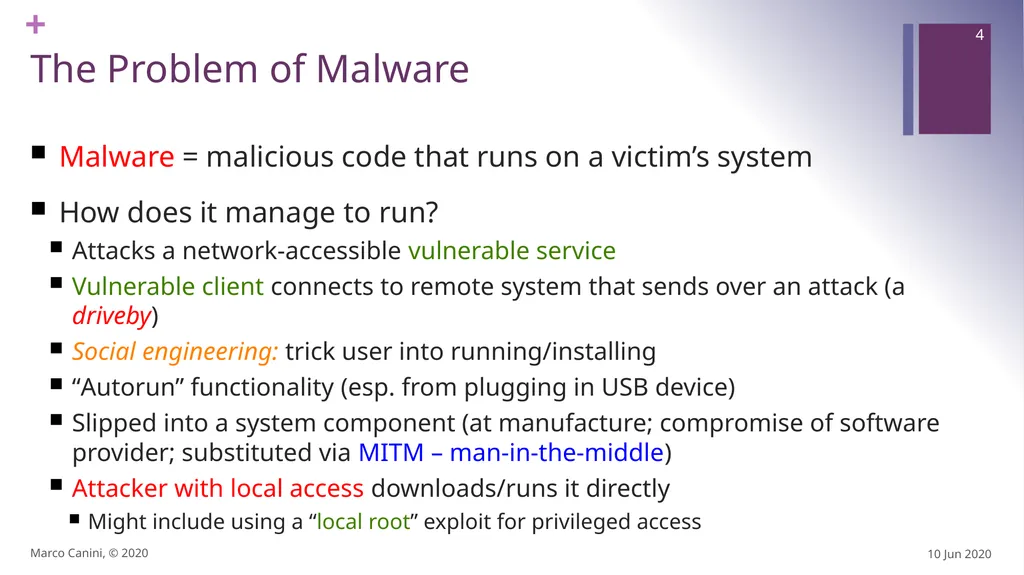
slide4. The Problem of Malware Malware = malicious code that runs on a victim’s system
How does it manage to run?
Attacks a network-accessible vulnerable service
Vulnerable client connects to remote system that sends over an attack (a driveby)
Social engineering: trick user into running/installing
“Autorun” functionality (esp. from plugging in USB device)
Slipped into a system component (at manufacture; compromise of software provider; substituted via MITM – man-in-the-middle)
Attacker with local access downloads/runs it directly
Might include using a “local root” exploit for privileged access 10 Jun 2020 Marco Canini, © 2020 4<br>
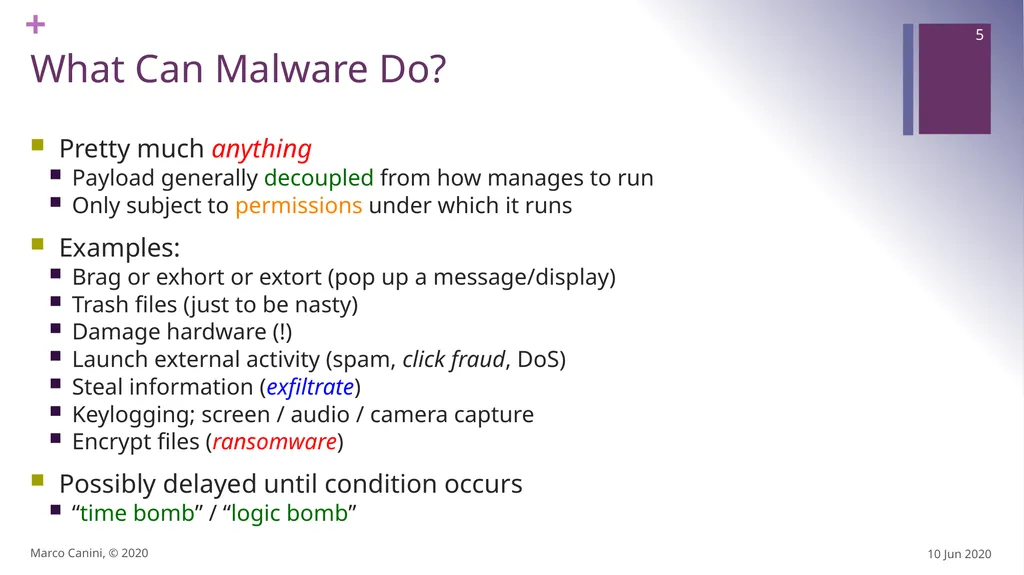
slide5. What Can Malware Do? Pretty much anything
Payload generally decoupled from how manages to run
Only subject to permissions under which it runs
Examples:
Brag or exhort or extort (pop up a message/display)
Trash files (just to be nasty)
Damage hardware (!)
Launch external activity (spam, click fraud, DoS)
Steal information (exfiltrate)
Keylogging; screen / audio / camera capture
Encrypt files (ransomware)
Possibly delayed until condition occurs
“time bomb” / “logic bomb” 10 Jun 2020 Marco Canini, © 2020 5<br>
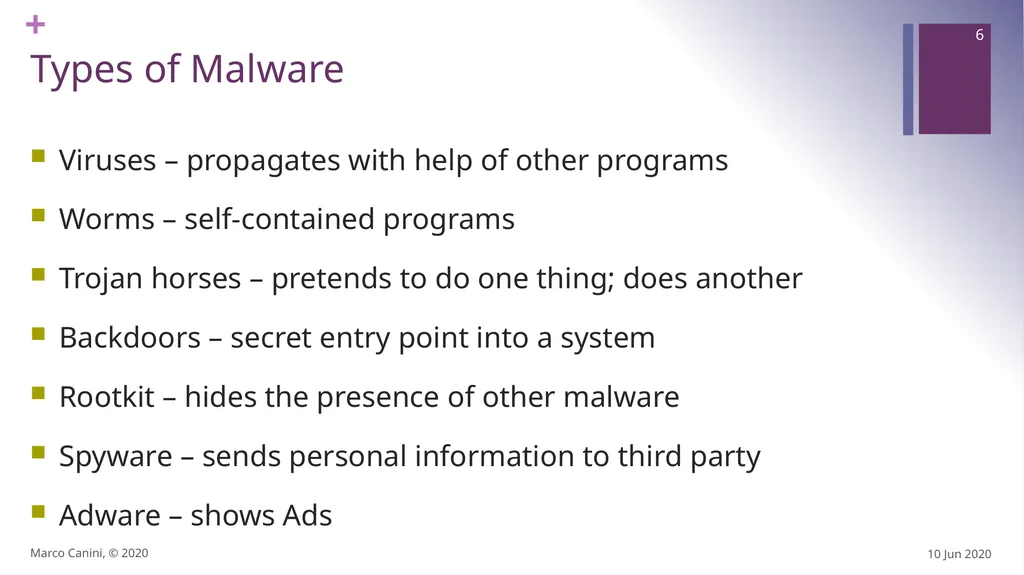
slide6. Types of Malware Viruses – propagates with help of other programs
Worms – self-contained programs
Trojan horses – pretends to do one thing; does another
Backdoors – secret entry point into a system
Rootkit – hides the presence of other malware
Spyware – sends personal information to third party
Adware – shows Ads 10 Jun 2020 Marco Canini, © 2020 6<br>
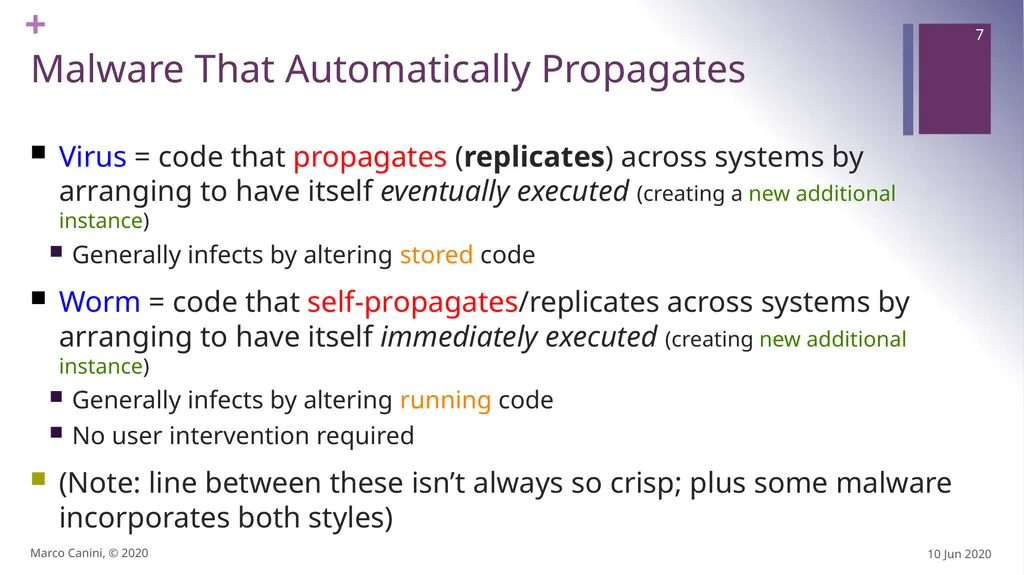
slide7. Malware That Automatically Propagates Virus = code that propagates (replicates) across systems by arranging to have itself eventually executed (creating a new additional instance)
Generally infects by altering stored code
Worm = code that self-propagates/replicates across systems by arranging to have itself immediately executed (creating new additional instance)
Generally infects by altering running code
No user intervention required
(Note: line between these isn’t always so crisp; plus some malware incorporates both styles) 10 Jun 2020 Marco Canini, © 2020 7<br>
slide8. Virus/Worm Writer’s Goals Hard to detect
Hard to destroy or deactivate
Spreads infection widely/quickly
Can reinfect a host
Easy to create
Machine/OS independent 10 Jun 2020 Marco Canini, © 2020 8<br>
slide9. The Problem of Viruses Opportunistic = code will eventually execute
Generally due to user action
Running an app, booting their system, opening an attachment
Separate notions: how it propagates vs. what else it does when executed (payload)
General infection strategy: find some code lying around, alter it to include the virus
Have been around for decades …
… resulting arms race has heavily influenced evolution of modern malware 10 Jun 2020 Marco Canini, © 2020 9<br>
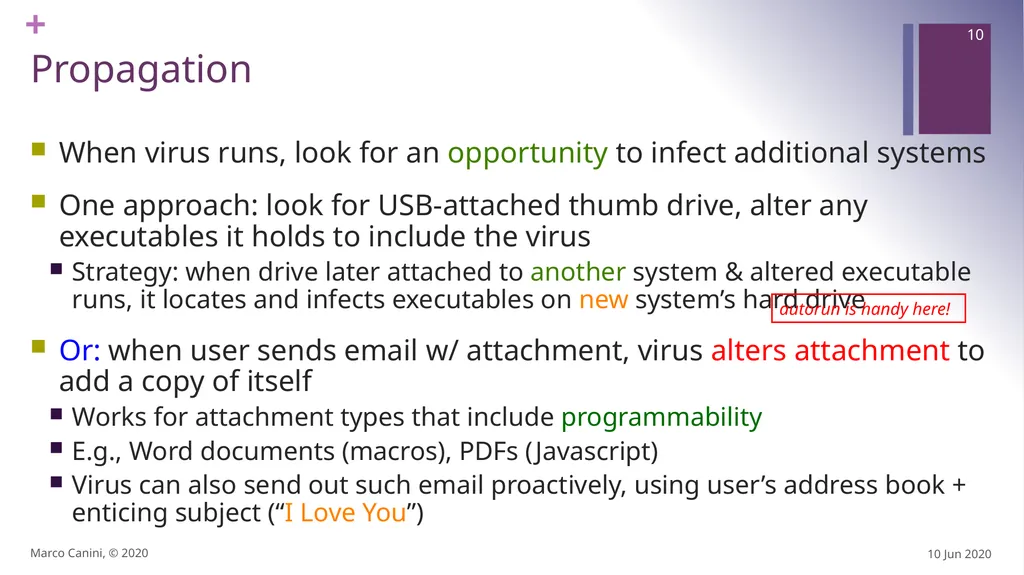
slide10. Propagation When virus runs, look for an opportunity to infect additional systems
One approach: look for USB-attached thumb drive, alter any executables it holds to include the virus
Strategy: when drive later attached to another system & altered executable runs, it locates and infects executables on new system’s hard drive
Or: when user sends email w/ attachment, virus alters attachment to add a copy of itself
Works for attachment types that include programmability
E.g., Word documents (macros), PDFs (Javascript)
Virus can also send out such email proactively, using user’s address book + enticing subject (“I Love You”) autorun is handy here! 10 Jun 2020 Marco Canini, © 2020 10<br>
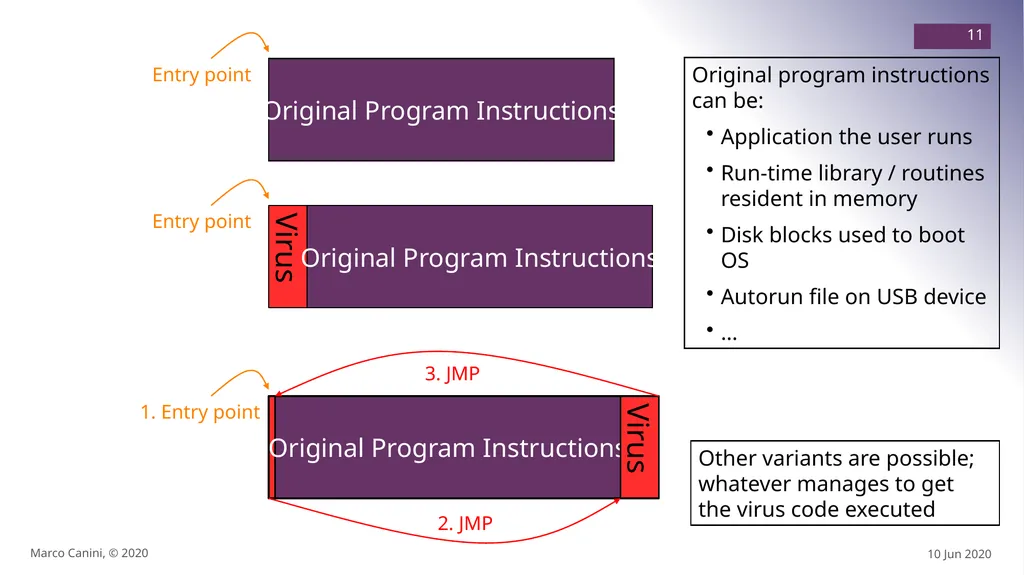
slide11. Original program instructions can be:
Application the user runs
Run-time library / routines resident in memory
Disk blocks used to boot OS
Autorun file on USB device
… Other variants are possible; whatever manages to get the virus code executed 10 Jun 2020 Marco Canini, © 2020 11<br>
slide12. Malware detection and the virus write / antivirus arms race 10 Jun 2020 Marco Canini, © 2020 12<br>
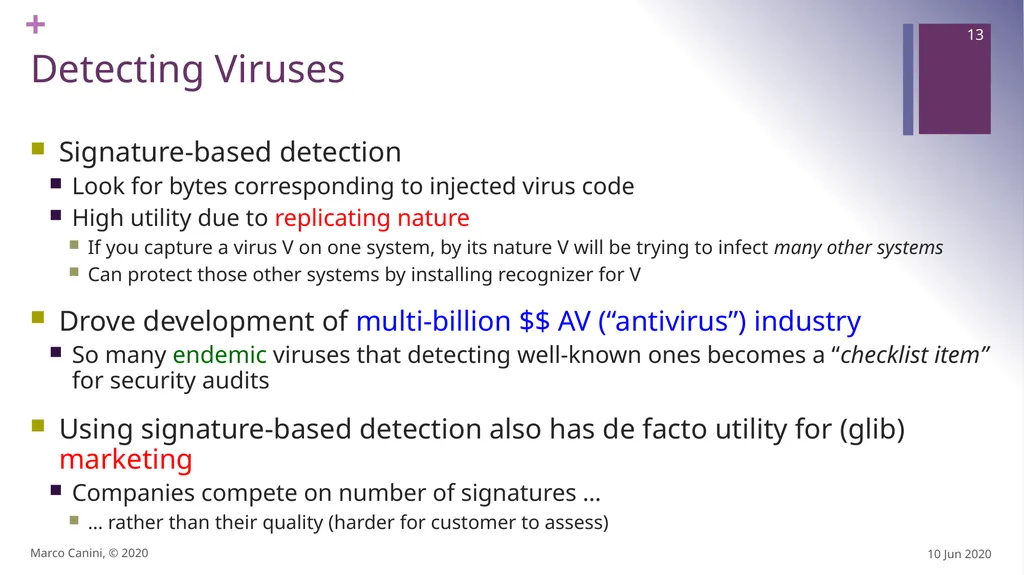
slide13. Detecting Viruses Signature-based detection
Look for bytes corresponding to injected virus code
High utility due to replicating nature
If you capture a virus V on one system, by its nature V will be trying to infect many other systems
Can protect those other systems by installing recognizer for V
Drove development of multi-billion $$ AV (“antivirus”) industry
So many endemic viruses that detecting well-known ones becomes a “checklist item” for security audits
Using signature-based detection also has de facto utility for (glib) marketing
Companies compete on number of signatures …
… rather than their quality (harder for customer to assess) 10 Jun 2020 Marco Canini, © 2020 13<br>
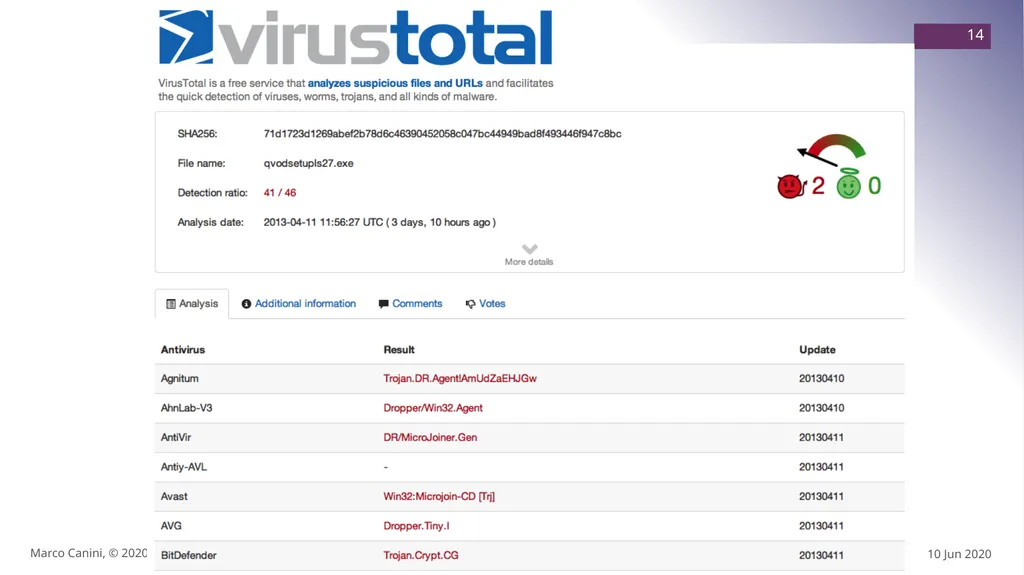
slide14. 10 Jun 2020 Marco Canini, © 2020 14<br>
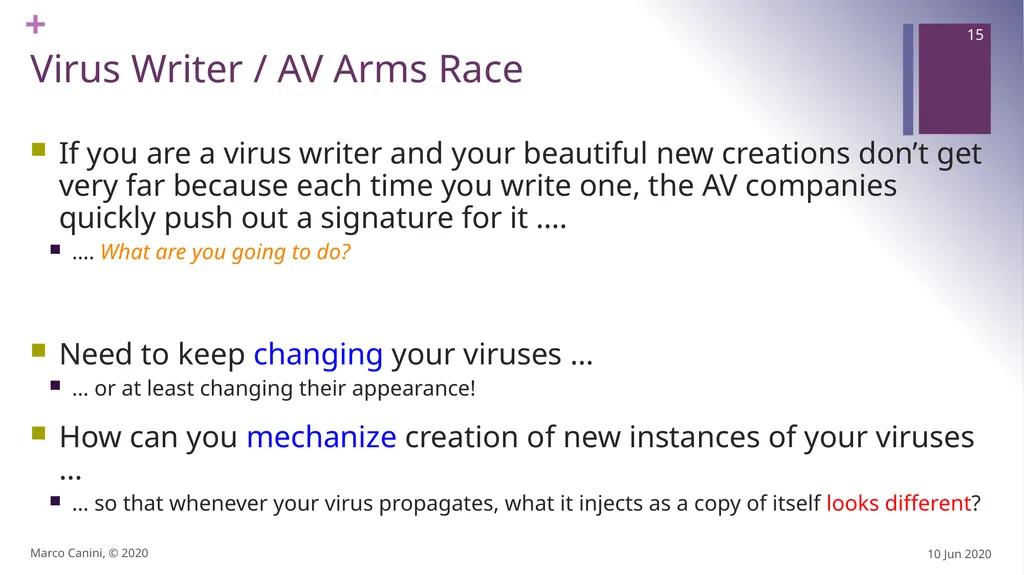
slide15. Virus Writer / AV Arms Race If you are a virus writer and your beautiful new creations don’t get very far because each time you write one, the AV companies quickly push out a signature for it ….
…. What are you going to do?
Need to keep changing your viruses …
… or at least changing their appearance!
How can you mechanize creation of new instances of your viruses …
… so that whenever your virus propagates, what it injects as a copy of itself looks different? 10 Jun 2020 Marco Canini, © 2020 15<br>
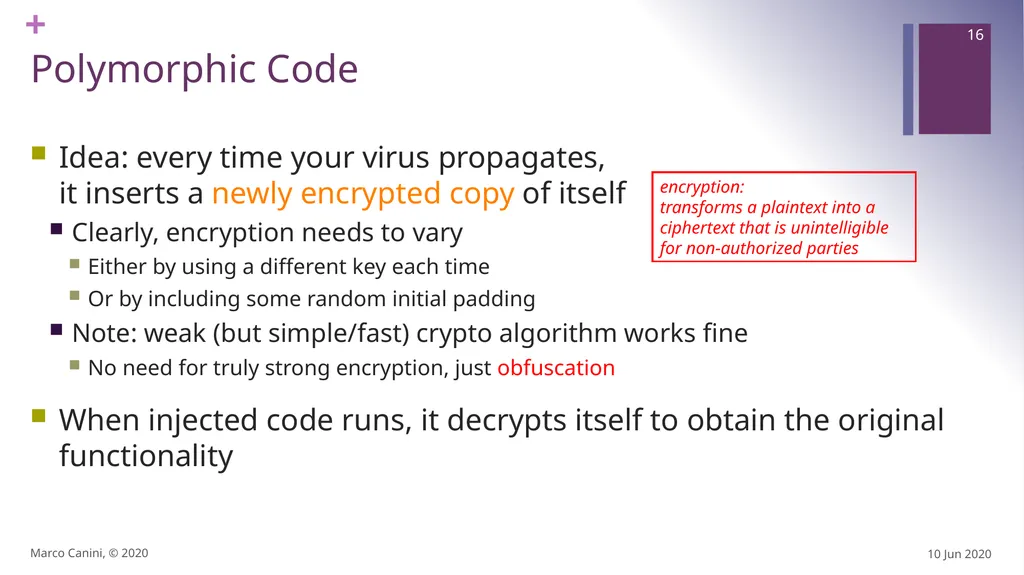
slide16. Polymorphic Code Idea: every time your virus propagates, it inserts a newly encrypted copy of itself
Clearly, encryption needs to vary
Either by using a different key each time
Or by including some random initial padding
Note: weak (but simple/fast) crypto algorithm works fine
No need for truly strong encryption, just obfuscation
When injected code runs, it decrypts itself to obtain the original functionality 10 Jun 2020 Marco Canini, © 2020 16 encryption: transforms a plaintext into a ciphertext that is unintelligible for non-authorized parties<br>
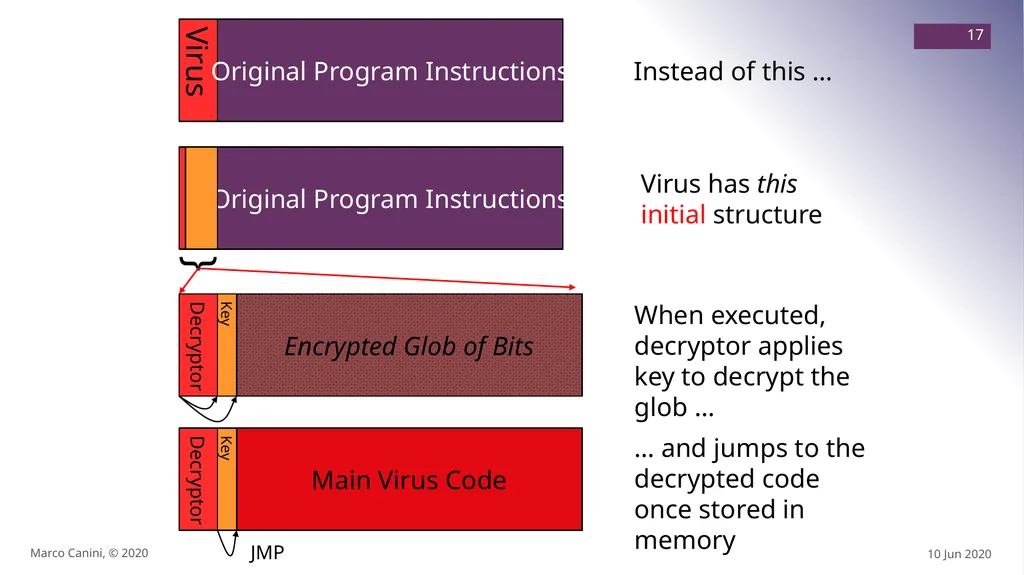
slide17. Instead of this … Virus has this initial structure When executed, decryptor applies key to decrypt the glob … … and jumps to the decrypted code once stored in memory 10 Jun 2020 Marco Canini, © 2020 17<br>
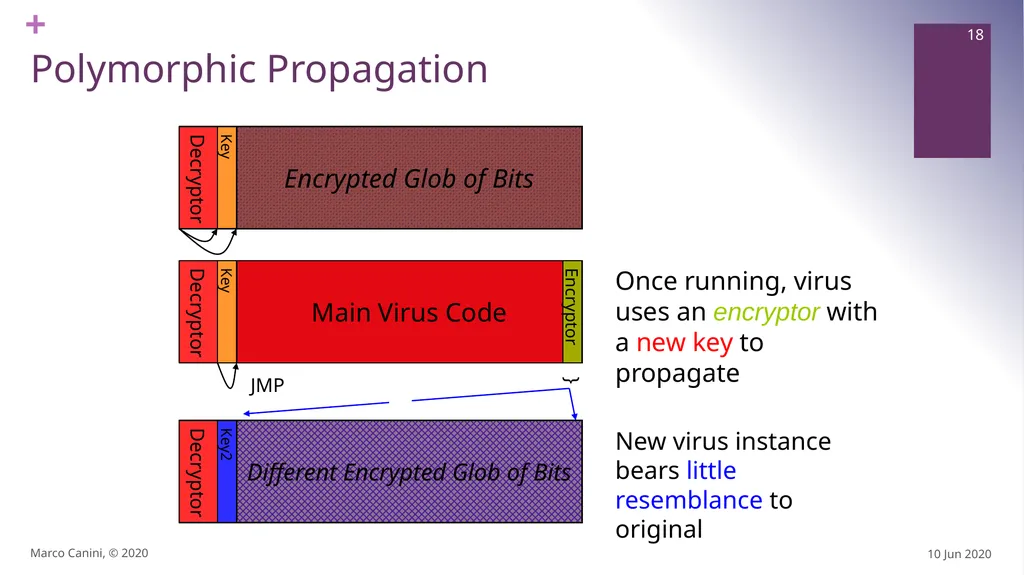
slide18. Decryptor Main Virus Code Key Once running, virus uses an encryptor with a new key to propagate Encryptor Polymorphic Propagation New virus instance bears little resemblance to original 10 Jun 2020 Marco Canini, © 2020 18<br>
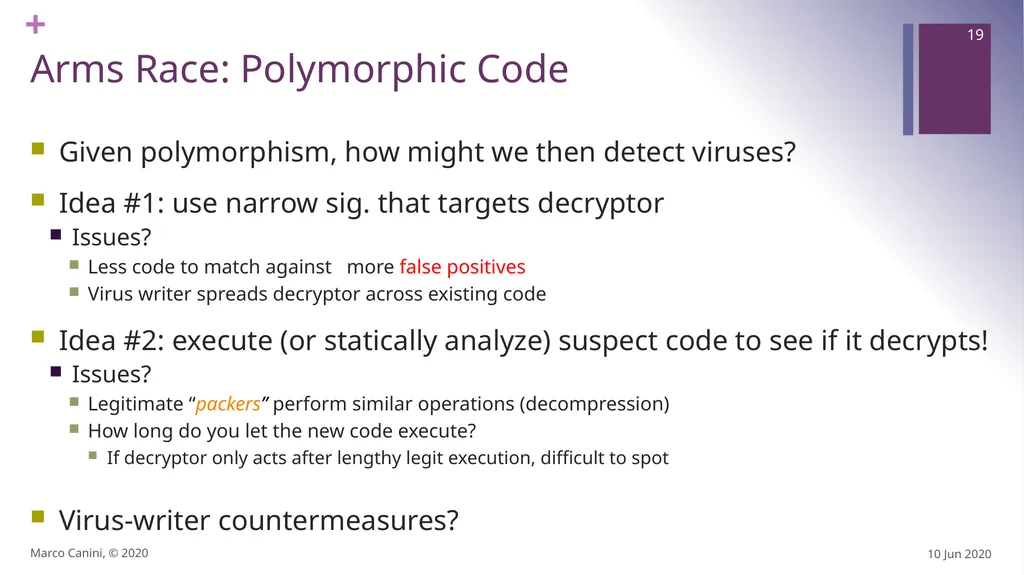
slide19. Arms Race: Polymorphic Code Given polymorphism, how might we then detect viruses?
Idea #1: use narrow sig. that targets decryptor
Issues?
Less code to match against more false positives
Virus writer spreads decryptor across existing code
Idea #2: execute (or statically analyze) suspect code to see if it decrypts!
Issues?
Legitimate “packers” perform similar operations (decompression)
How long do you let the new code execute?
If decryptor only acts after lengthy legit execution, difficult to spot
Virus-writer countermeasures? 10 Jun 2020 Marco Canini, © 2020 19<br>
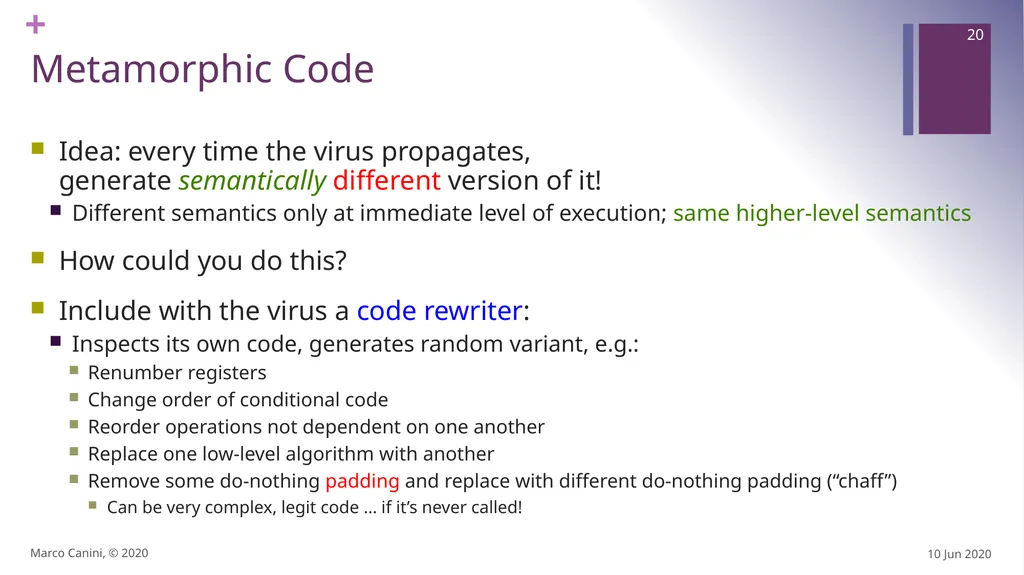
slide20. Metamorphic Code Idea: every time the virus propagates, generate semantically different version of it!
Different semantics only at immediate level of execution; same higher-level semantics
How could you do this?
Include with the virus a code rewriter:
Inspects its own code, generates random variant, e.g.:
Renumber registers
Change order of conditional code
Reorder operations not dependent on one another
Replace one low-level algorithm with another
Remove some do-nothing padding and replace with different do-nothing padding (“chaff”)
Can be very complex, legit code … if it’s never called! 10 Jun 2020 Marco Canini, © 2020 20<br>
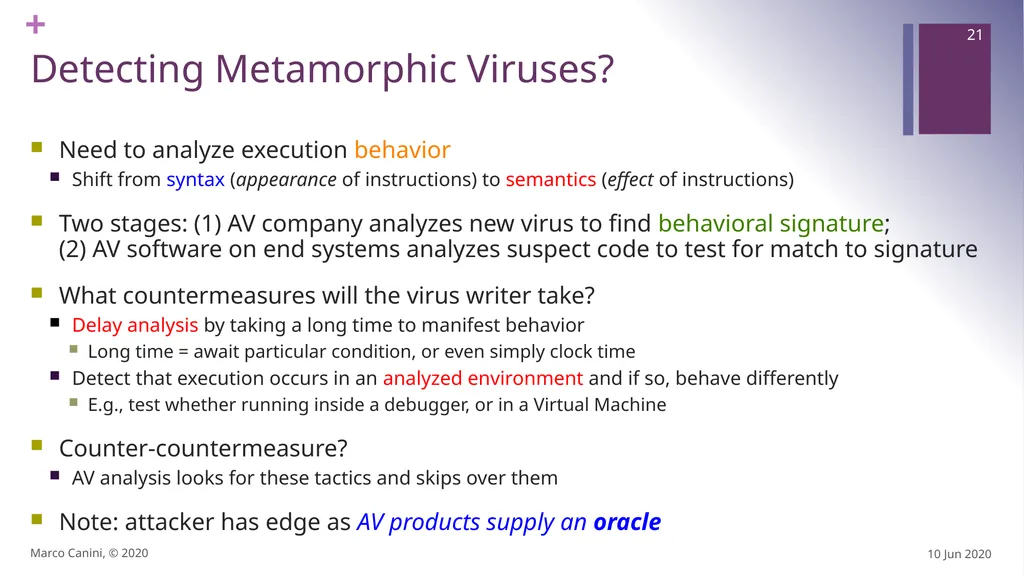
slide21. Detecting Metamorphic Viruses? Need to analyze execution behavior
Shift from syntax (appearance of instructions) to semantics (effect of instructions)
Two stages: (1) AV company analyzes new virus to find behavioral signature; (2) AV software on end systems analyzes suspect code to test for match to signature
What countermeasures will the virus writer take?
Delay analysis by taking a long time to manifest behavior
Long time = await particular condition, or even simply clock time
Detect that execution occurs in an analyzed environment and if so, behave differently
E.g., test whether running inside a debugger, or in a Virtual Machine
Counter-countermeasure?
AV analysis looks for these tactics and skips over them
Note: attacker has edge as AV products supply an oracle 10 Jun 2020 Marco Canini, © 2020 21<br>
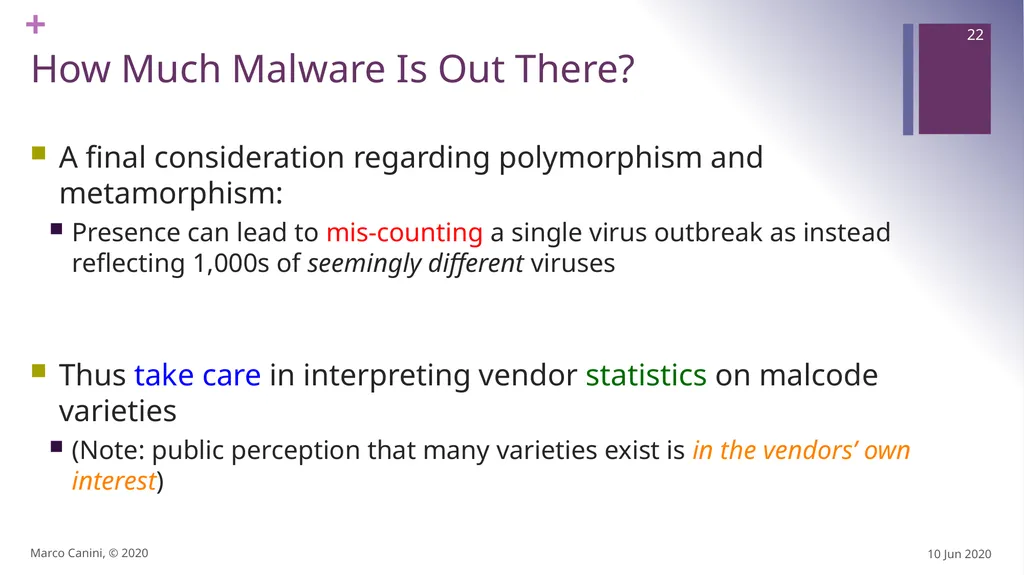
slide22. How Much Malware Is Out There? A final consideration regarding polymorphism and metamorphism:
Presence can lead to mis-counting a single virus outbreak as instead reflecting 1,000s of seemingly different viruses
Thus take care in interpreting vendor statistics on malcode varieties
(Note: public perception that many varieties exist is in the vendors’ own interest) 10 Jun 2020 Marco Canini, © 2020 22<br>
slide23. Malware infection cleanup 10 Jun 2020 Marco Canini, © 2020 23<br>
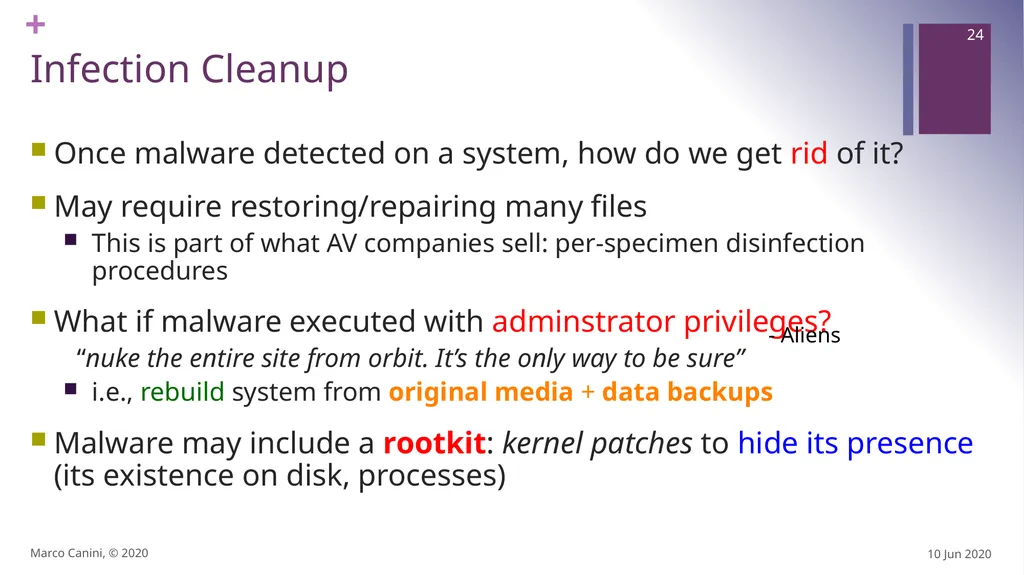
slide24. Infection Cleanup Once malware detected on a system, how do we get rid of it?
May require restoring/repairing many files
This is part of what AV companies sell: per-specimen disinfection procedures
What if malware executed with adminstrator privileges?
“nuke the entire site from orbit. It’s the only way to be sure”
i.e., rebuild system from original media + data backups
Malware may include a rootkit: kernel patches to hide its presence (its existence on disk, processes) - Aliens 10 Jun 2020 Marco Canini, © 2020 24<br>
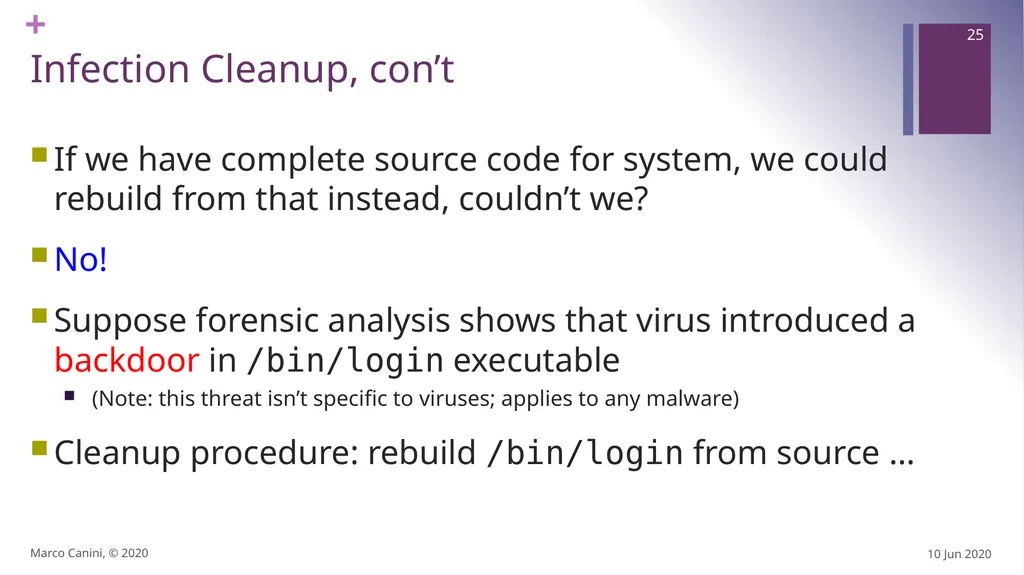
slide25. Infection Cleanup, con’t If we have complete source code for system, we could rebuild from that instead, couldn’t we?
No!
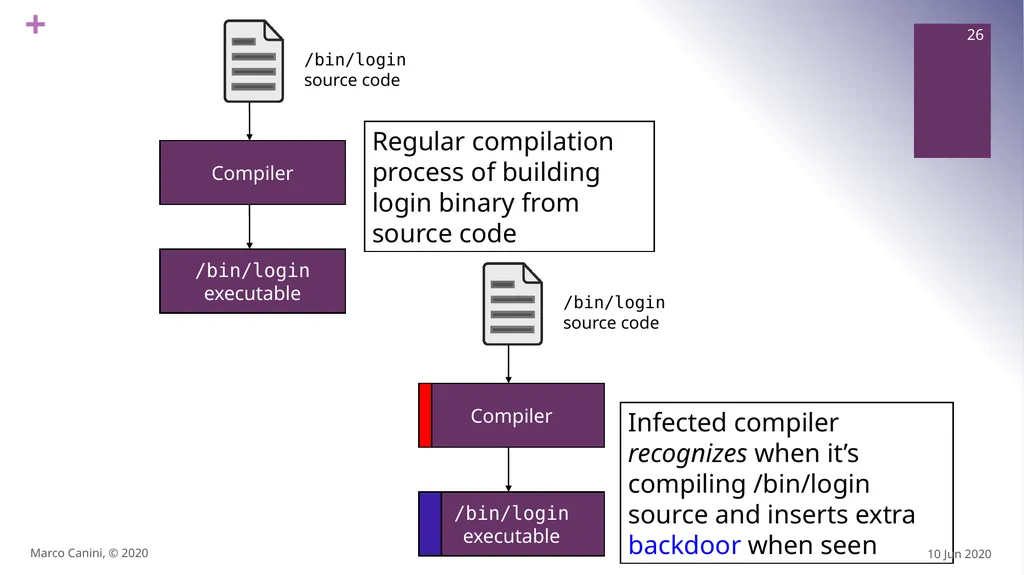
Suppose forensic analysis shows that virus introduced a backdoor in /bin/login executable
(Note: this threat isn’t specific to viruses; applies to any malware)
Cleanup procedure: rebuild /bin/login from source … 10 Jun 2020 Marco Canini, © 2020 25<br>
slide26. /bin/login source code Compiler /bin/login executable Regular compilation process of building login binary from source code 10 Jun 2020 Marco Canini, © 2020 26<br>
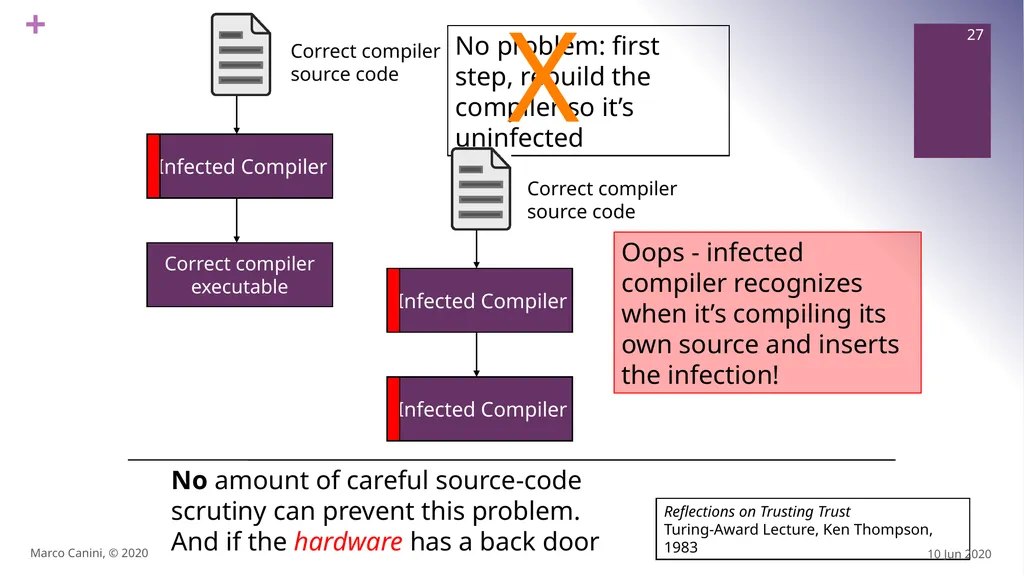
slide27. No problem: first step, rebuild the compiler so it’s uninfected Correct compiler source code Infected Compiler Correct compiler executable 10 Jun 2020 Marco Canini, © 2020 27<br>
slide28. Worms: large-scale malware 10 Jun 2020 Marco Canini, © 2020 28<br>
slide29. Large-Scale Malware Worm = code that self-propagates/replicates across systems by arranging to have itself immediately executed
Generally infects by altering running code
No user intervention required 10 Jun 2020 Marco Canini, © 2020 29<br>
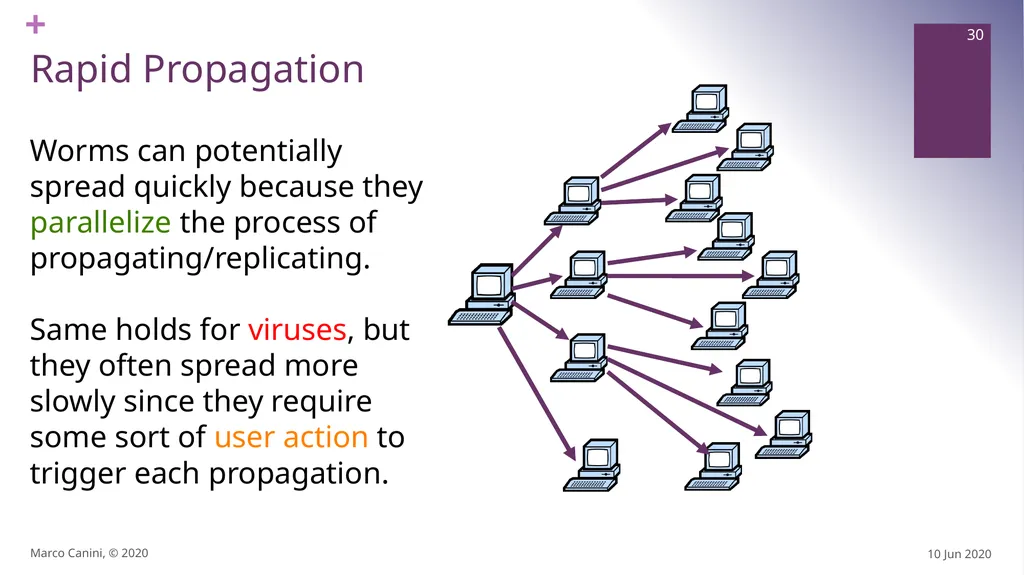
slide30. Worms can potentially spread quickly because they parallelize the process of propagating/replicating.
Same holds for viruses, but they often spread more slowly since they require some sort of user action to trigger each propagation. Rapid Propagation 10 Jun 2020 Marco Canini, © 2020 30<br>
slide31. Large-Scale Malware Worm = code that self-propagates/replicates across systems by arranging to have itself immediately executed
Generally infects by altering running code
No user intervention required
Propagation includes notions of targeting & exploit
How does the worm find new prospective victims?
How does worm get code to automatically run?
Botnet = set of compromised machines (“bots”) under a common command-and-control (C&C)
Attacker might use a worm to get the bots, or other techniques; orthogonal to bot’s use in botnet 10 Jun 2020 Marco Canini, © 2020 31<br>
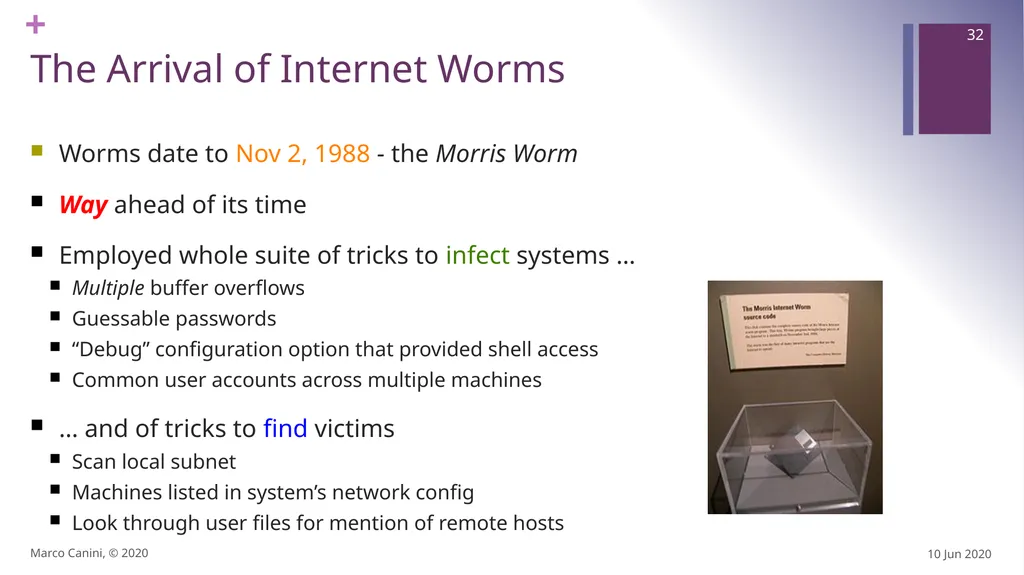
slide32. The Arrival of Internet Worms Worms date to Nov 2, 1988 - the Morris Worm
Way ahead of its time
Employed whole suite of tricks to infect systems …
Multiple buffer overflows
Guessable passwords
“Debug” configuration option that provided shell access
Common user accounts across multiple machines
… and of tricks to find victims
Scan local subnet
Machines listed in system’s network config
Look through user files for mention of remote hosts 10 Jun 2020 Marco Canini, © 2020 32<br>
slide33. Love Letter Worm, aka «ILOVEYOU» On 5th May 2000, arrived as email with a Visual Basic Script attachment
Exploited Window’s extension hiding to display a fake “txt” extension for the original file iloveyou.txt.vbs
Propagates by email to all addresses in the address book
Also propagates through IRC
Modifies IE’s home page
Replaces several different kinds of files with copies of itself 10 Jun 2020 Marco Canini, © 2020 33<br>
slide34. ILOVEYOU, con’t American parliament science committee:
“In one day’s time, roughly 47 million people received the e-mail worldwide and the virus looked for love in all the wrong places in over 10 million computers. [...] Insurance giant Lloyd’s of London has estimated the virus will cost over $15 billion in damages and lost productivity” 10 Jun 2020 Marco Canini, © 2020 34<br>
slide35. Modern Era of Internet Worms Began Jul 13, 2001 with release of initial version of Code Red
Exploited known buffer overflow in Microsoft IIS Web servers
On by default in many systems
Vulnerability & fix announced previous month
Payload part 1: web site defacement
HELLO! Welcome to http://www.worm.com! Hacked By Chinese!
Only done if language setting = English 10 Jun 2020 Marco Canini, © 2020 35<br>
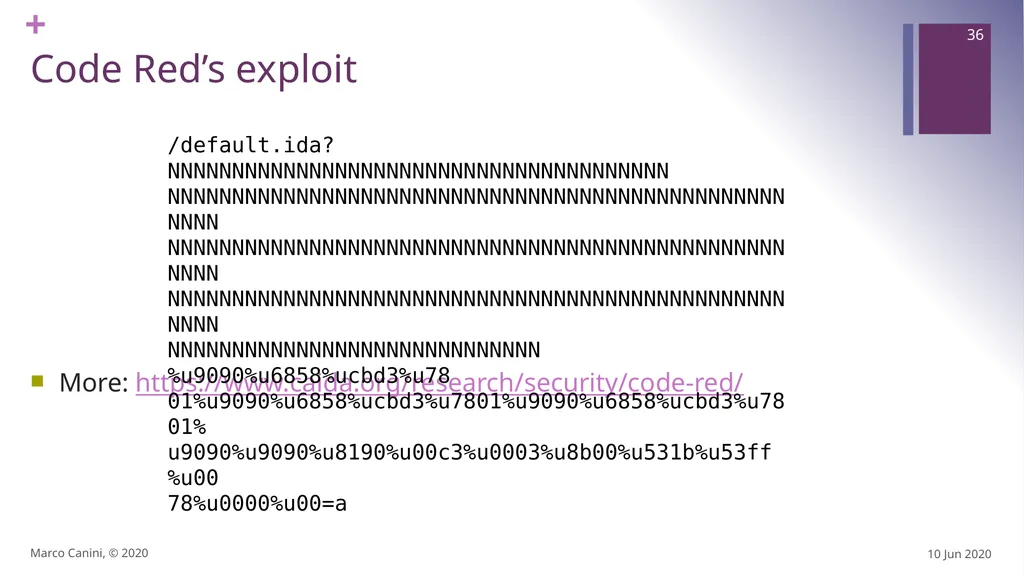
slide36. Code Red’s exploit More: https://www.caida.org/research/security/code-red/ 10 Jun 2020 Marco Canini, © 2020 36 /default.ida?NNNNNNNNNNNNNNNNNNNNNNNNNNNNNNNNNNNNNNN NNNNNNNNNNNNNNNNNNNNNNNNNNNNNNNNNNNNNNNNNNNNNNNNNNNN NNNNNNNNNNNNNNNNNNNNNNNNNNNNNNNNNNNNNNNNNNNNNNNNNNNN NNNNNNNNNNNNNNNNNNNNNNNNNNNNNNNNNNNNNNNNNNNNNNNNNNNN NNNNNNNNNNNNNNNNNNNNNNNNNNNNN%u9090%u6858%ucbd3%u78 01%u9090%u6858%ucbd3%u7801%u9090%u6858%ucbd3%u7801% u9090%u9090%u8190%u00c3%u0003%u8b00%u531b%u53ff%u00 78%u0000%u00=a<br>
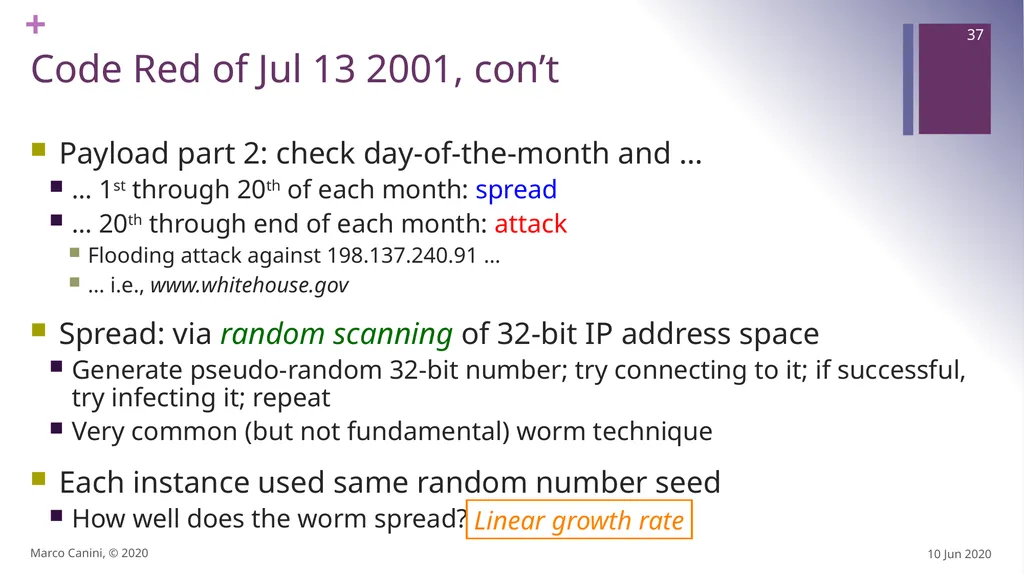
slide37. Code Red of Jul 13 2001, con’t Payload part 2: check day-of-the-month and …
… 1st through 20th of each month: spread
… 20th through end of each month: attack
Flooding attack against 198.137.240.91 …
… i.e., www.whitehouse.gov
Spread: via random scanning of 32-bit IP address space
Generate pseudo-random 32-bit number; try connecting to it; if successful, try infecting it; repeat
Very common (but not fundamental) worm technique
Each instance used same random number seed
How well does the worm spread? Linear growth rate 10 Jun 2020 Marco Canini, © 2020 37<br>
slide38. Code Red, con’t Revision released July 19, 2001.
White House responds to threat of flooding attack by changing the address of www.whitehouse.gov
Causes Code Red to die for date ≥ 20th of the month due to failure of TCP connection to establish.
Author didn’t carefully test their code - buggy!
But: this time random number generator correctly seeded. Bingo! 10 Jun 2020 Marco Canini, © 2020 38<br>
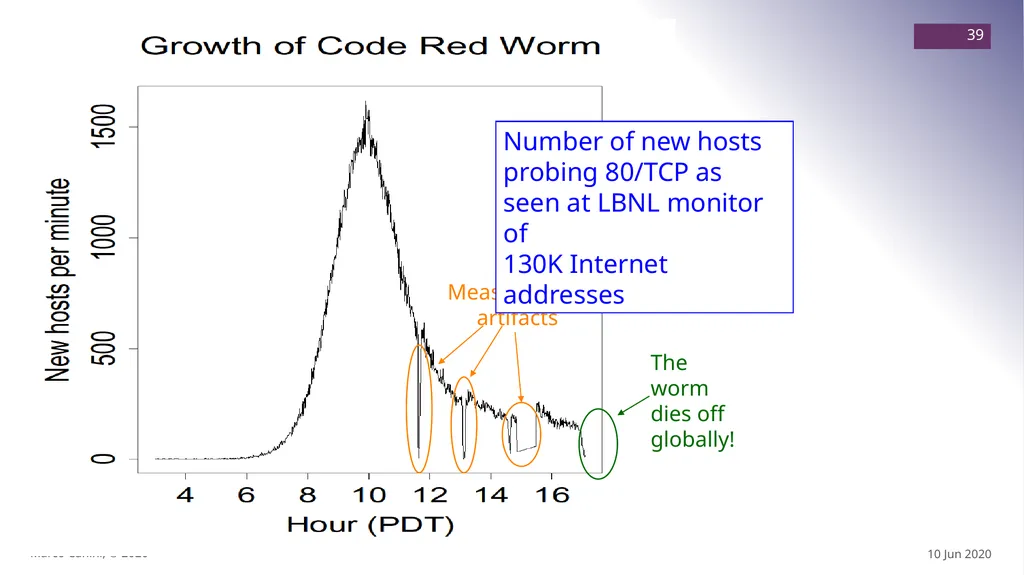
slide39. 10 Jun 2020 Marco Canini, © 2020 39 Number of new hosts probing 80/TCP as seen at LBNL monitor of 130K Internet addresses<br>
slide40. Modeling worm spread 10 Jun 2020 Marco Canini, © 2020 40<br>
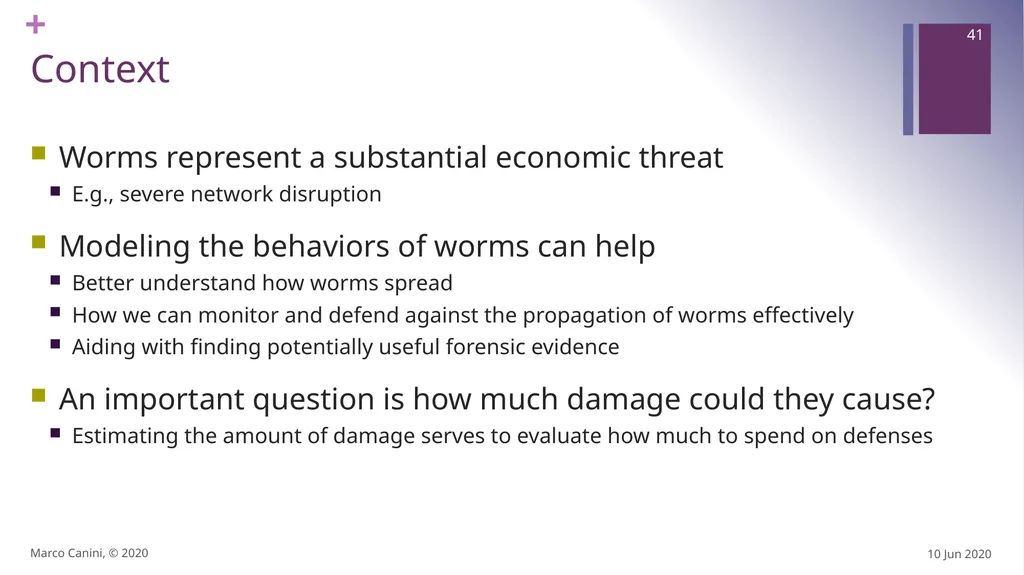
slide41. Context Worms represent a substantial economic threat
E.g., severe network disruption
Modeling the behaviors of worms can help
Better understand how worms spread
How we can monitor and defend against the propagation of worms effectively
Aiding with finding potentially useful forensic evidence
An important question is how much damage could they cause?
Estimating the amount of damage serves to evaluate how much to spend on defenses 10 Jun 2020 Marco Canini, © 2020 41<br>
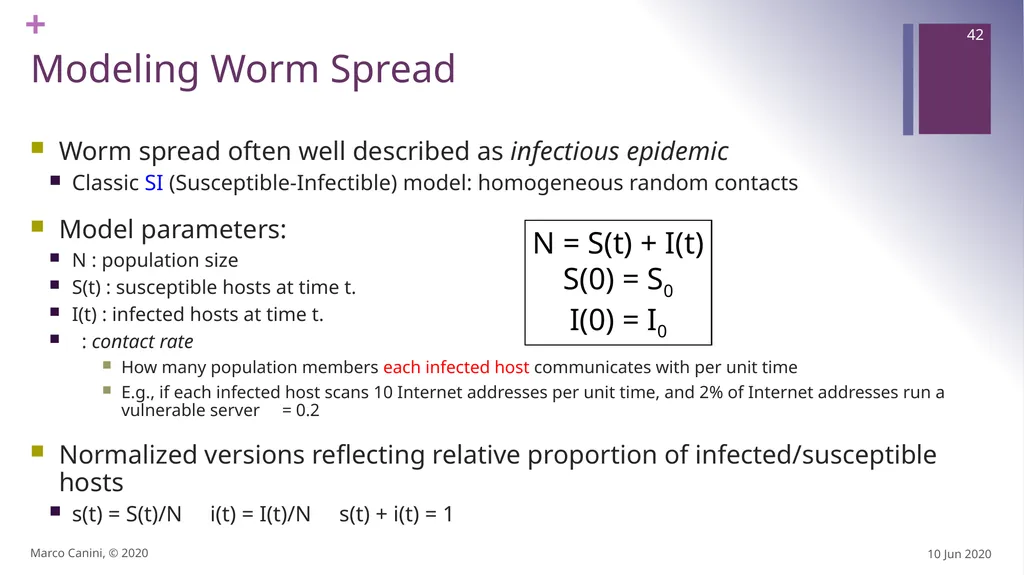
slide42. Modeling Worm Spread Worm spread often well described as infectious epidemic
Classic SI (Susceptible-Infectible) model: homogeneous random contacts
Model parameters:
N : population size
S(t) : susceptible hosts at time t.
I(t) : infected hosts at time t.
: contact rate
How many population members each infected host communicates with per unit time
E.g., if each infected host scans 10 Internet addresses per unit time, and 2% of Internet addresses run a vulnerable server = 0.2
Normalized versions reflecting relative proportion of infected/susceptible hosts
s(t) = S(t)/N i(t) = I(t)/N s(t) + i(t) = 1 N = S(t) + I(t) S(0) = S0
I(0) = I0 10 Jun 2020 Marco Canini, © 2020 42<br>
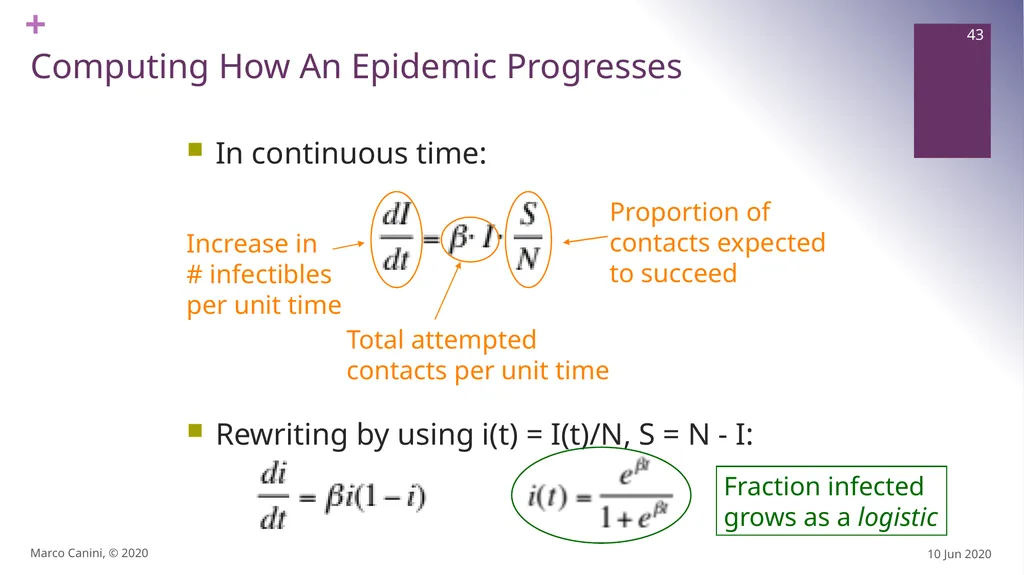
slide43. Computing How An Epidemic Progresses 10 Jun 2020 Marco Canini, © 2020 43 In continuous time: Rewriting by using i(t) = I(t)/N, S = N - I: <br>
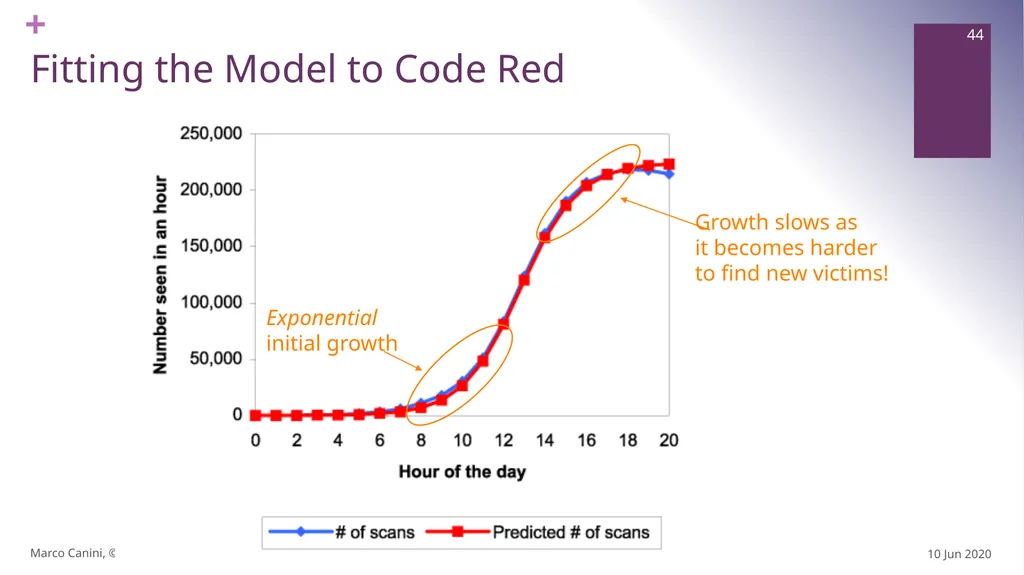
slide44. Fitting the Model to Code Red 10 Jun 2020 Marco Canini, © 2020 44<br>
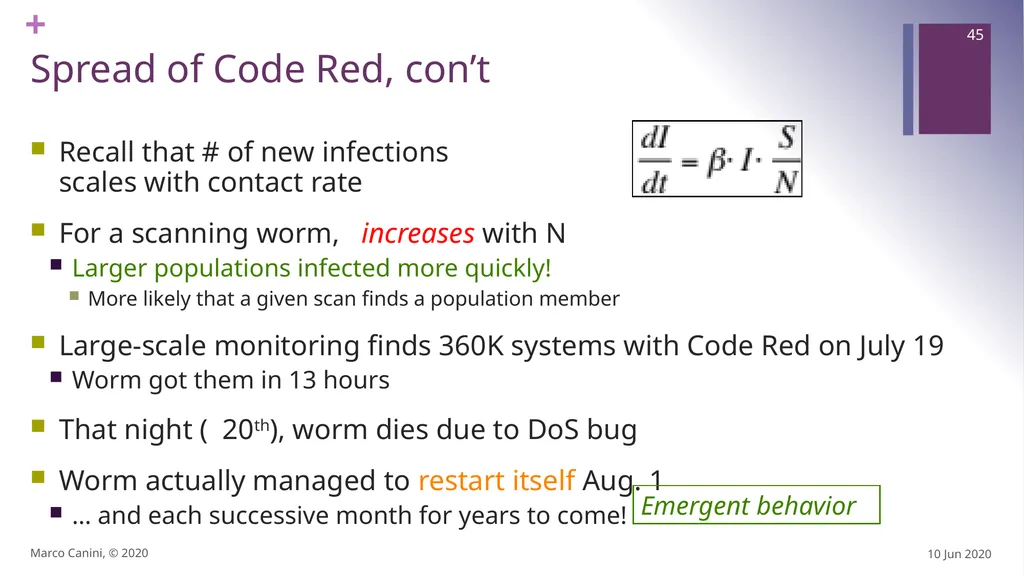
slide45. Spread of Code Red, con’t Recall that # of new infections scales with contact rate
For a scanning worm, increases with N
Larger populations infected more quickly!
More likely that a given scan finds a population member
Large-scale monitoring finds 360K systems with Code Red on July 19
Worm got them in 13 hours
That night ( 20th), worm dies due to DoS bug
Worm actually managed to restart itself Aug. 1
… and each successive month for years to come! 10 Jun 2020 Marco Canini, © 2020 45 Emergent behavior<br>
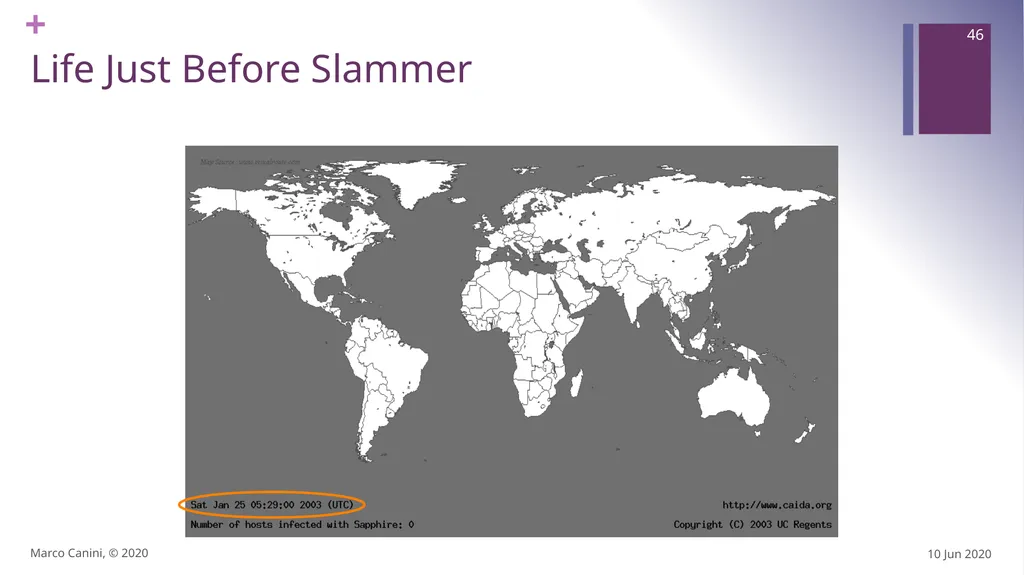
slide46. Life Just Before Slammer 10 Jun 2020 Marco Canini, © 2020 46<br>
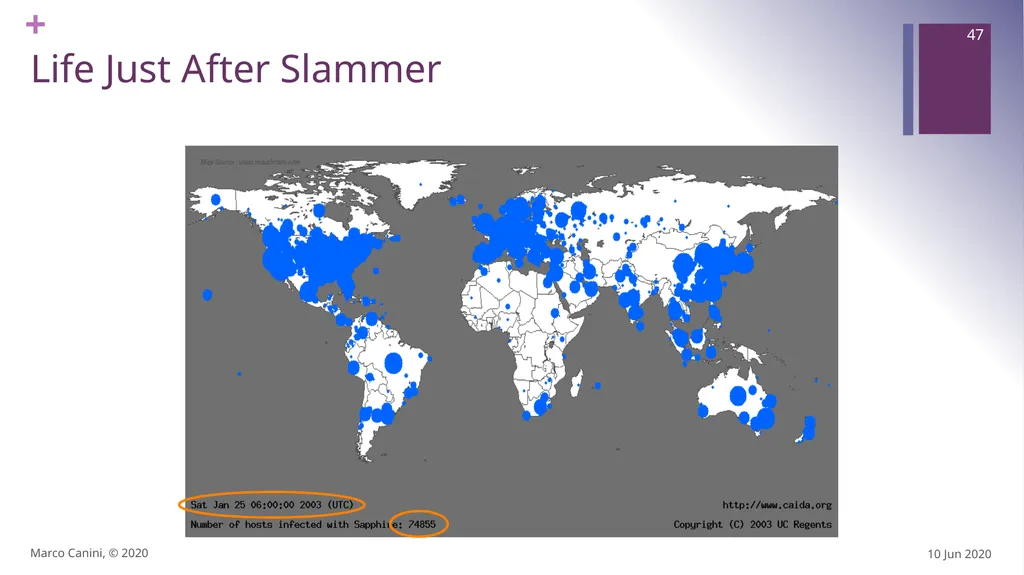
slide47. Life Just After Slammer 10 Jun 2020 Marco Canini, © 2020 47<br>
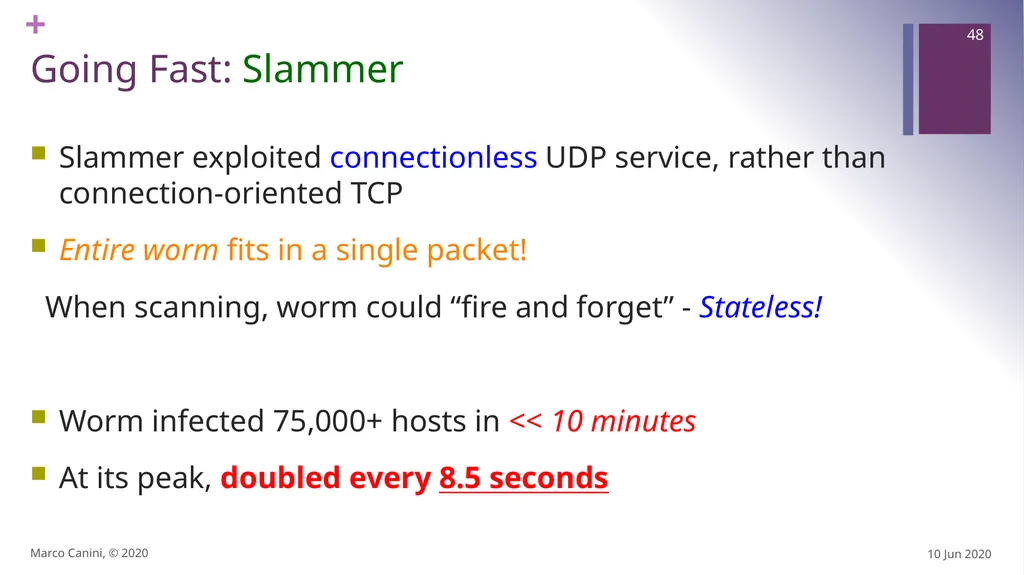
slide48. Going Fast: Slammer Slammer exploited connectionless UDP service, rather than connection-oriented TCP
Entire worm fits in a single packet!
When scanning, worm could “fire and forget” - Stateless!
Worm infected 75,000+ hosts in << 10 minutes
At its peak, doubled every 8.5 seconds 10 Jun 2020 Marco Canini, © 2020 48<br>
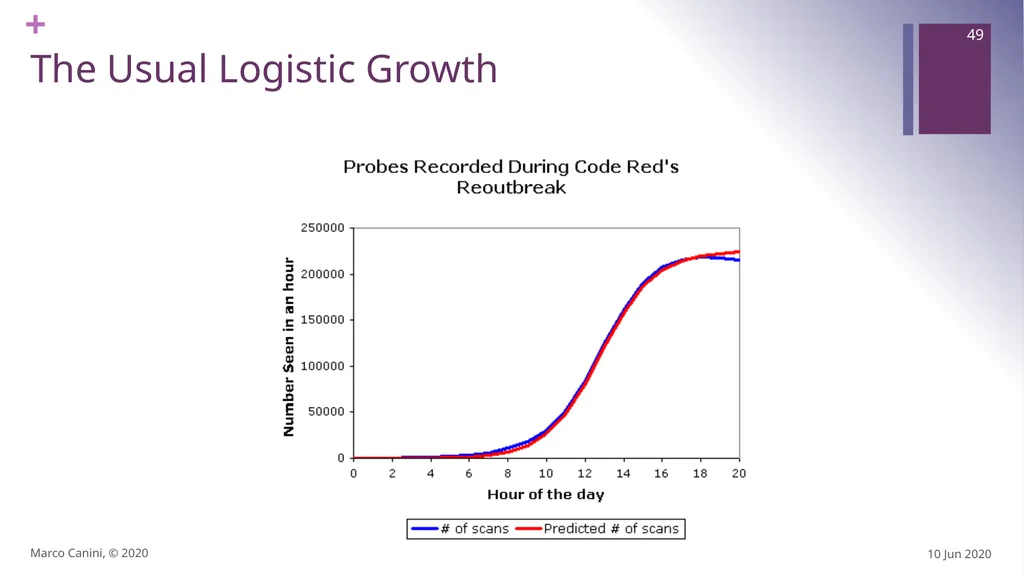
slide49. The Usual Logistic Growth 10 Jun 2020 Marco Canini, © 2020 49<br>
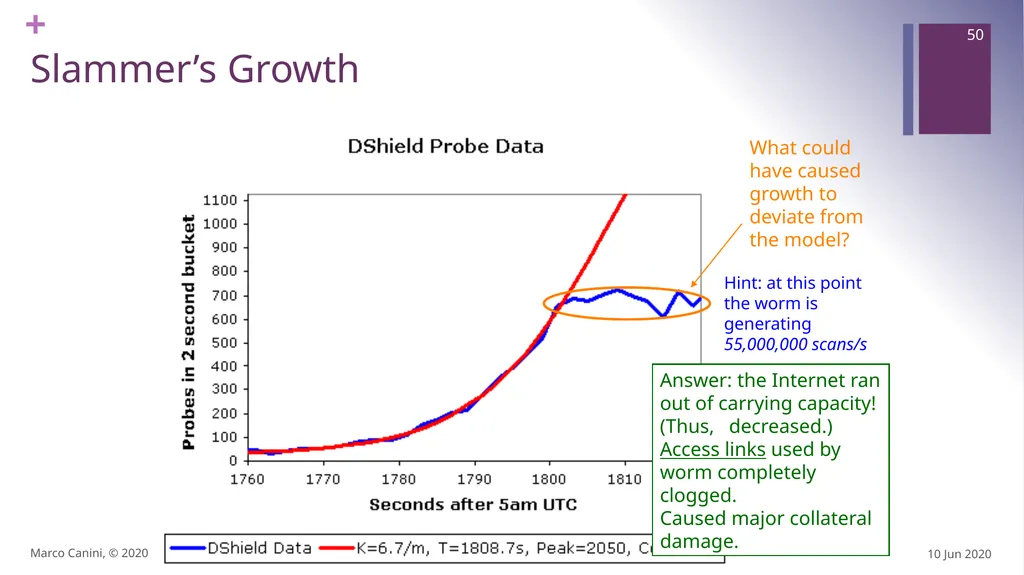
slide50. Hint: at this point the worm is generating 55,000,000 scans/s Answer: the Internet ran out of carrying capacity! (Thus, decreased.)
Access links used by worm completely clogged.
Caused major collateral damage. Slammer’s Growth 10 Jun 2020 Marco Canini, © 2020 50<br>
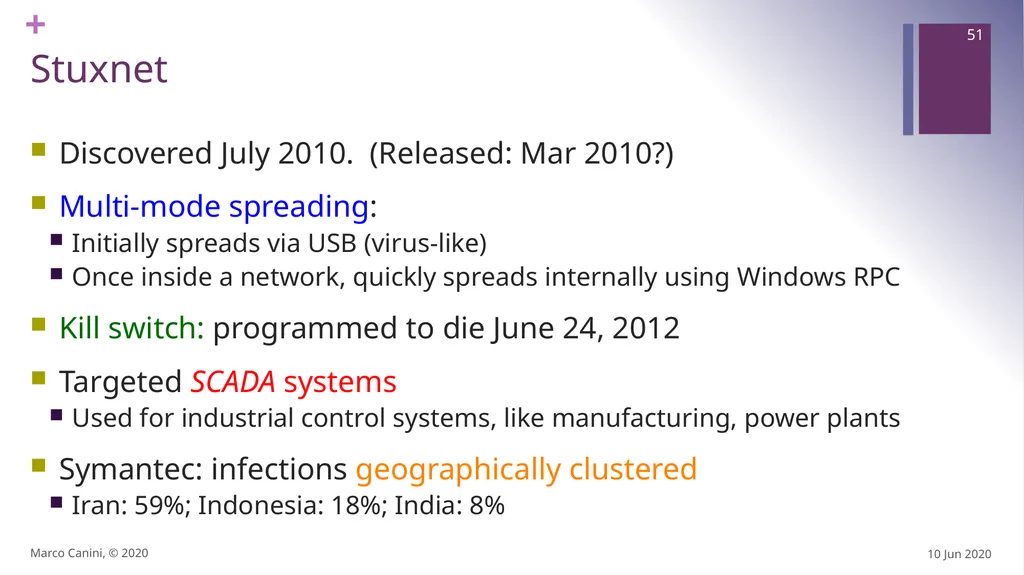
slide51. Stuxnet Discovered July 2010. (Released: Mar 2010?)
Multi-mode spreading:
Initially spreads via USB (virus-like)
Once inside a network, quickly spreads internally using Windows RPC
Kill switch: programmed to die June 24, 2012
Targeted SCADA systems
Used for industrial control systems, like manufacturing, power plants
Symantec: infections geographically clustered
Iran: 59%; Indonesia: 18%; India: 8% 10 Jun 2020 Marco Canini, © 2020 51<br>
slide52. Stuxnet, con’t Used four Zero Days
Unprecedented expense on the part of the author
“Rootkit” for hiding infection based on installing Windows drivers with valid digital signatures
Attacker stole private keys for certificates from two companies in Taiwan
Payload: do nothing …
… unless attached to particular models of frequency converter drives operating at 807-1210Hz
… like those made in Iran (and Finland) …
… and used to operate centrifuges for producing enriched uranium 10 Jun 2020 Marco Canini, © 2020 52<br>
slide53. Stuxnet, con’t Payload: do nothing …
… unless attached to particular models of frequency converter drives operating at 807-1210Hz
… like those made in Iran (and Finland) …
… and used to operate centrifuges for producing enriched uranium
For these, worm would slowly increase drive frequency to 1410Hz …
… enough to cause centrifuge to fly apart …
… while sending out fake readings from control system indicating everything was okay …
… and then drop it back to normal range 10 Jun 2020 Marco Canini, © 2020 53<br>
slide54. Worm Take-Aways Potentially enormous reach/damage
Weapon
Hard to get right
Emergent behavior / surprising dynamics
Remanence: worms stick around
E.g. Slammer still seen in 2013!
Propagation faster than human response 10 Jun 2020 Marco Canini, © 2020 54<br>
Marco Canini Lecture slides adapted from UC Berkeley CS161 by Vern Paxson Reproduced with permission<br>
slide2. Outline Malware definition, taxonomy and propagation
Malware detection and the virus write / antivirus arms race
Malware infection cleanup
Worms: large-scale malware
Modeling worm spread 10 Jun 2020 Marco Canini, © 2020 2<br>
slide3. Malware definition, taxonomy and propagation 10 Jun 2020 Marco Canini, © 2020 3<br>
slide4. The Problem of Malware Malware = malicious code that runs on a victim’s system
How does it manage to run?
Attacks a network-accessible vulnerable service
Vulnerable client connects to remote system that sends over an attack (a driveby)
Social engineering: trick user into running/installing
“Autorun” functionality (esp. from plugging in USB device)
Slipped into a system component (at manufacture; compromise of software provider; substituted via MITM – man-in-the-middle)
Attacker with local access downloads/runs it directly
Might include using a “local root” exploit for privileged access 10 Jun 2020 Marco Canini, © 2020 4<br>
slide5. What Can Malware Do? Pretty much anything
Payload generally decoupled from how manages to run
Only subject to permissions under which it runs
Examples:
Brag or exhort or extort (pop up a message/display)
Trash files (just to be nasty)
Damage hardware (!)
Launch external activity (spam, click fraud, DoS)
Steal information (exfiltrate)
Keylogging; screen / audio / camera capture
Encrypt files (ransomware)
Possibly delayed until condition occurs
“time bomb” / “logic bomb” 10 Jun 2020 Marco Canini, © 2020 5<br>
slide6. Types of Malware Viruses – propagates with help of other programs
Worms – self-contained programs
Trojan horses – pretends to do one thing; does another
Backdoors – secret entry point into a system
Rootkit – hides the presence of other malware
Spyware – sends personal information to third party
Adware – shows Ads 10 Jun 2020 Marco Canini, © 2020 6<br>
slide7. Malware That Automatically Propagates Virus = code that propagates (replicates) across systems by arranging to have itself eventually executed (creating a new additional instance)
Generally infects by altering stored code
Worm = code that self-propagates/replicates across systems by arranging to have itself immediately executed (creating new additional instance)
Generally infects by altering running code
No user intervention required
(Note: line between these isn’t always so crisp; plus some malware incorporates both styles) 10 Jun 2020 Marco Canini, © 2020 7<br>
slide8. Virus/Worm Writer’s Goals Hard to detect
Hard to destroy or deactivate
Spreads infection widely/quickly
Can reinfect a host
Easy to create
Machine/OS independent 10 Jun 2020 Marco Canini, © 2020 8<br>
slide9. The Problem of Viruses Opportunistic = code will eventually execute
Generally due to user action
Running an app, booting their system, opening an attachment
Separate notions: how it propagates vs. what else it does when executed (payload)
General infection strategy: find some code lying around, alter it to include the virus
Have been around for decades …
… resulting arms race has heavily influenced evolution of modern malware 10 Jun 2020 Marco Canini, © 2020 9<br>
slide10. Propagation When virus runs, look for an opportunity to infect additional systems
One approach: look for USB-attached thumb drive, alter any executables it holds to include the virus
Strategy: when drive later attached to another system & altered executable runs, it locates and infects executables on new system’s hard drive
Or: when user sends email w/ attachment, virus alters attachment to add a copy of itself
Works for attachment types that include programmability
E.g., Word documents (macros), PDFs (Javascript)
Virus can also send out such email proactively, using user’s address book + enticing subject (“I Love You”) autorun is handy here! 10 Jun 2020 Marco Canini, © 2020 10<br>
slide11. Original program instructions can be:
Application the user runs
Run-time library / routines resident in memory
Disk blocks used to boot OS
Autorun file on USB device
… Other variants are possible; whatever manages to get the virus code executed 10 Jun 2020 Marco Canini, © 2020 11<br>
slide12. Malware detection and the virus write / antivirus arms race 10 Jun 2020 Marco Canini, © 2020 12<br>
slide13. Detecting Viruses Signature-based detection
Look for bytes corresponding to injected virus code
High utility due to replicating nature
If you capture a virus V on one system, by its nature V will be trying to infect many other systems
Can protect those other systems by installing recognizer for V
Drove development of multi-billion $$ AV (“antivirus”) industry
So many endemic viruses that detecting well-known ones becomes a “checklist item” for security audits
Using signature-based detection also has de facto utility for (glib) marketing
Companies compete on number of signatures …
… rather than their quality (harder for customer to assess) 10 Jun 2020 Marco Canini, © 2020 13<br>
slide14. 10 Jun 2020 Marco Canini, © 2020 14<br>
slide15. Virus Writer / AV Arms Race If you are a virus writer and your beautiful new creations don’t get very far because each time you write one, the AV companies quickly push out a signature for it ….
…. What are you going to do?
Need to keep changing your viruses …
… or at least changing their appearance!
How can you mechanize creation of new instances of your viruses …
… so that whenever your virus propagates, what it injects as a copy of itself looks different? 10 Jun 2020 Marco Canini, © 2020 15<br>
slide16. Polymorphic Code Idea: every time your virus propagates, it inserts a newly encrypted copy of itself
Clearly, encryption needs to vary
Either by using a different key each time
Or by including some random initial padding
Note: weak (but simple/fast) crypto algorithm works fine
No need for truly strong encryption, just obfuscation
When injected code runs, it decrypts itself to obtain the original functionality 10 Jun 2020 Marco Canini, © 2020 16 encryption: transforms a plaintext into a ciphertext that is unintelligible for non-authorized parties<br>
slide17. Instead of this … Virus has this initial structure When executed, decryptor applies key to decrypt the glob … … and jumps to the decrypted code once stored in memory 10 Jun 2020 Marco Canini, © 2020 17<br>
slide18. Decryptor Main Virus Code Key Once running, virus uses an encryptor with a new key to propagate Encryptor Polymorphic Propagation New virus instance bears little resemblance to original 10 Jun 2020 Marco Canini, © 2020 18<br>
slide19. Arms Race: Polymorphic Code Given polymorphism, how might we then detect viruses?
Idea #1: use narrow sig. that targets decryptor
Issues?
Less code to match against more false positives
Virus writer spreads decryptor across existing code
Idea #2: execute (or statically analyze) suspect code to see if it decrypts!
Issues?
Legitimate “packers” perform similar operations (decompression)
How long do you let the new code execute?
If decryptor only acts after lengthy legit execution, difficult to spot
Virus-writer countermeasures? 10 Jun 2020 Marco Canini, © 2020 19<br>
slide20. Metamorphic Code Idea: every time the virus propagates, generate semantically different version of it!
Different semantics only at immediate level of execution; same higher-level semantics
How could you do this?
Include with the virus a code rewriter:
Inspects its own code, generates random variant, e.g.:
Renumber registers
Change order of conditional code
Reorder operations not dependent on one another
Replace one low-level algorithm with another
Remove some do-nothing padding and replace with different do-nothing padding (“chaff”)
Can be very complex, legit code … if it’s never called! 10 Jun 2020 Marco Canini, © 2020 20<br>
slide21. Detecting Metamorphic Viruses? Need to analyze execution behavior
Shift from syntax (appearance of instructions) to semantics (effect of instructions)
Two stages: (1) AV company analyzes new virus to find behavioral signature; (2) AV software on end systems analyzes suspect code to test for match to signature
What countermeasures will the virus writer take?
Delay analysis by taking a long time to manifest behavior
Long time = await particular condition, or even simply clock time
Detect that execution occurs in an analyzed environment and if so, behave differently
E.g., test whether running inside a debugger, or in a Virtual Machine
Counter-countermeasure?
AV analysis looks for these tactics and skips over them
Note: attacker has edge as AV products supply an oracle 10 Jun 2020 Marco Canini, © 2020 21<br>
slide22. How Much Malware Is Out There? A final consideration regarding polymorphism and metamorphism:
Presence can lead to mis-counting a single virus outbreak as instead reflecting 1,000s of seemingly different viruses
Thus take care in interpreting vendor statistics on malcode varieties
(Note: public perception that many varieties exist is in the vendors’ own interest) 10 Jun 2020 Marco Canini, © 2020 22<br>
slide23. Malware infection cleanup 10 Jun 2020 Marco Canini, © 2020 23<br>
slide24. Infection Cleanup Once malware detected on a system, how do we get rid of it?
May require restoring/repairing many files
This is part of what AV companies sell: per-specimen disinfection procedures
What if malware executed with adminstrator privileges?
“nuke the entire site from orbit. It’s the only way to be sure”
i.e., rebuild system from original media + data backups
Malware may include a rootkit: kernel patches to hide its presence (its existence on disk, processes) - Aliens 10 Jun 2020 Marco Canini, © 2020 24<br>
slide25. Infection Cleanup, con’t If we have complete source code for system, we could rebuild from that instead, couldn’t we?
No!
Suppose forensic analysis shows that virus introduced a backdoor in /bin/login executable
(Note: this threat isn’t specific to viruses; applies to any malware)
Cleanup procedure: rebuild /bin/login from source … 10 Jun 2020 Marco Canini, © 2020 25<br>
slide26. /bin/login source code Compiler /bin/login executable Regular compilation process of building login binary from source code 10 Jun 2020 Marco Canini, © 2020 26<br>
slide27. No problem: first step, rebuild the compiler so it’s uninfected Correct compiler source code Infected Compiler Correct compiler executable 10 Jun 2020 Marco Canini, © 2020 27<br>
slide28. Worms: large-scale malware 10 Jun 2020 Marco Canini, © 2020 28<br>
slide29. Large-Scale Malware Worm = code that self-propagates/replicates across systems by arranging to have itself immediately executed
Generally infects by altering running code
No user intervention required 10 Jun 2020 Marco Canini, © 2020 29<br>
slide30. Worms can potentially spread quickly because they parallelize the process of propagating/replicating.
Same holds for viruses, but they often spread more slowly since they require some sort of user action to trigger each propagation. Rapid Propagation 10 Jun 2020 Marco Canini, © 2020 30<br>
slide31. Large-Scale Malware Worm = code that self-propagates/replicates across systems by arranging to have itself immediately executed
Generally infects by altering running code
No user intervention required
Propagation includes notions of targeting & exploit
How does the worm find new prospective victims?
How does worm get code to automatically run?
Botnet = set of compromised machines (“bots”) under a common command-and-control (C&C)
Attacker might use a worm to get the bots, or other techniques; orthogonal to bot’s use in botnet 10 Jun 2020 Marco Canini, © 2020 31<br>
slide32. The Arrival of Internet Worms Worms date to Nov 2, 1988 - the Morris Worm
Way ahead of its time
Employed whole suite of tricks to infect systems …
Multiple buffer overflows
Guessable passwords
“Debug” configuration option that provided shell access
Common user accounts across multiple machines
… and of tricks to find victims
Scan local subnet
Machines listed in system’s network config
Look through user files for mention of remote hosts 10 Jun 2020 Marco Canini, © 2020 32<br>
slide33. Love Letter Worm, aka «ILOVEYOU» On 5th May 2000, arrived as email with a Visual Basic Script attachment
Exploited Window’s extension hiding to display a fake “txt” extension for the original file iloveyou.txt.vbs
Propagates by email to all addresses in the address book
Also propagates through IRC
Modifies IE’s home page
Replaces several different kinds of files with copies of itself 10 Jun 2020 Marco Canini, © 2020 33<br>
slide34. ILOVEYOU, con’t American parliament science committee:
“In one day’s time, roughly 47 million people received the e-mail worldwide and the virus looked for love in all the wrong places in over 10 million computers. [...] Insurance giant Lloyd’s of London has estimated the virus will cost over $15 billion in damages and lost productivity” 10 Jun 2020 Marco Canini, © 2020 34<br>
slide35. Modern Era of Internet Worms Began Jul 13, 2001 with release of initial version of Code Red
Exploited known buffer overflow in Microsoft IIS Web servers
On by default in many systems
Vulnerability & fix announced previous month
Payload part 1: web site defacement
HELLO! Welcome to http://www.worm.com! Hacked By Chinese!
Only done if language setting = English 10 Jun 2020 Marco Canini, © 2020 35<br>
slide36. Code Red’s exploit More: https://www.caida.org/research/security/code-red/ 10 Jun 2020 Marco Canini, © 2020 36 /default.ida?NNNNNNNNNNNNNNNNNNNNNNNNNNNNNNNNNNNNNNN NNNNNNNNNNNNNNNNNNNNNNNNNNNNNNNNNNNNNNNNNNNNNNNNNNNN NNNNNNNNNNNNNNNNNNNNNNNNNNNNNNNNNNNNNNNNNNNNNNNNNNNN NNNNNNNNNNNNNNNNNNNNNNNNNNNNNNNNNNNNNNNNNNNNNNNNNNNN NNNNNNNNNNNNNNNNNNNNNNNNNNNNN%u9090%u6858%ucbd3%u78 01%u9090%u6858%ucbd3%u7801%u9090%u6858%ucbd3%u7801% u9090%u9090%u8190%u00c3%u0003%u8b00%u531b%u53ff%u00 78%u0000%u00=a<br>
slide37. Code Red of Jul 13 2001, con’t Payload part 2: check day-of-the-month and …
… 1st through 20th of each month: spread
… 20th through end of each month: attack
Flooding attack against 198.137.240.91 …
… i.e., www.whitehouse.gov
Spread: via random scanning of 32-bit IP address space
Generate pseudo-random 32-bit number; try connecting to it; if successful, try infecting it; repeat
Very common (but not fundamental) worm technique
Each instance used same random number seed
How well does the worm spread? Linear growth rate 10 Jun 2020 Marco Canini, © 2020 37<br>
slide38. Code Red, con’t Revision released July 19, 2001.
White House responds to threat of flooding attack by changing the address of www.whitehouse.gov
Causes Code Red to die for date ≥ 20th of the month due to failure of TCP connection to establish.
Author didn’t carefully test their code - buggy!
But: this time random number generator correctly seeded. Bingo! 10 Jun 2020 Marco Canini, © 2020 38<br>
slide39. 10 Jun 2020 Marco Canini, © 2020 39 Number of new hosts probing 80/TCP as seen at LBNL monitor of 130K Internet addresses<br>
slide40. Modeling worm spread 10 Jun 2020 Marco Canini, © 2020 40<br>
slide41. Context Worms represent a substantial economic threat
E.g., severe network disruption
Modeling the behaviors of worms can help
Better understand how worms spread
How we can monitor and defend against the propagation of worms effectively
Aiding with finding potentially useful forensic evidence
An important question is how much damage could they cause?
Estimating the amount of damage serves to evaluate how much to spend on defenses 10 Jun 2020 Marco Canini, © 2020 41<br>
slide42. Modeling Worm Spread Worm spread often well described as infectious epidemic
Classic SI (Susceptible-Infectible) model: homogeneous random contacts
Model parameters:
N : population size
S(t) : susceptible hosts at time t.
I(t) : infected hosts at time t.
: contact rate
How many population members each infected host communicates with per unit time
E.g., if each infected host scans 10 Internet addresses per unit time, and 2% of Internet addresses run a vulnerable server = 0.2
Normalized versions reflecting relative proportion of infected/susceptible hosts
s(t) = S(t)/N i(t) = I(t)/N s(t) + i(t) = 1 N = S(t) + I(t) S(0) = S0
I(0) = I0 10 Jun 2020 Marco Canini, © 2020 42<br>
slide43. Computing How An Epidemic Progresses 10 Jun 2020 Marco Canini, © 2020 43 In continuous time: Rewriting by using i(t) = I(t)/N, S = N - I: <br>
slide44. Fitting the Model to Code Red 10 Jun 2020 Marco Canini, © 2020 44<br>
slide45. Spread of Code Red, con’t Recall that # of new infections scales with contact rate
For a scanning worm, increases with N
Larger populations infected more quickly!
More likely that a given scan finds a population member
Large-scale monitoring finds 360K systems with Code Red on July 19
Worm got them in 13 hours
That night ( 20th), worm dies due to DoS bug
Worm actually managed to restart itself Aug. 1
… and each successive month for years to come! 10 Jun 2020 Marco Canini, © 2020 45 Emergent behavior<br>
slide46. Life Just Before Slammer 10 Jun 2020 Marco Canini, © 2020 46<br>
slide47. Life Just After Slammer 10 Jun 2020 Marco Canini, © 2020 47<br>
slide48. Going Fast: Slammer Slammer exploited connectionless UDP service, rather than connection-oriented TCP
Entire worm fits in a single packet!
When scanning, worm could “fire and forget” - Stateless!
Worm infected 75,000+ hosts in << 10 minutes
At its peak, doubled every 8.5 seconds 10 Jun 2020 Marco Canini, © 2020 48<br>
slide49. The Usual Logistic Growth 10 Jun 2020 Marco Canini, © 2020 49<br>
slide50. Hint: at this point the worm is generating 55,000,000 scans/s Answer: the Internet ran out of carrying capacity! (Thus, decreased.)
Access links used by worm completely clogged.
Caused major collateral damage. Slammer’s Growth 10 Jun 2020 Marco Canini, © 2020 50<br>
slide51. Stuxnet Discovered July 2010. (Released: Mar 2010?)
Multi-mode spreading:
Initially spreads via USB (virus-like)
Once inside a network, quickly spreads internally using Windows RPC
Kill switch: programmed to die June 24, 2012
Targeted SCADA systems
Used for industrial control systems, like manufacturing, power plants
Symantec: infections geographically clustered
Iran: 59%; Indonesia: 18%; India: 8% 10 Jun 2020 Marco Canini, © 2020 51<br>
slide52. Stuxnet, con’t Used four Zero Days
Unprecedented expense on the part of the author
“Rootkit” for hiding infection based on installing Windows drivers with valid digital signatures
Attacker stole private keys for certificates from two companies in Taiwan
Payload: do nothing …
… unless attached to particular models of frequency converter drives operating at 807-1210Hz
… like those made in Iran (and Finland) …
… and used to operate centrifuges for producing enriched uranium 10 Jun 2020 Marco Canini, © 2020 52<br>
slide53. Stuxnet, con’t Payload: do nothing …
… unless attached to particular models of frequency converter drives operating at 807-1210Hz
… like those made in Iran (and Finland) …
… and used to operate centrifuges for producing enriched uranium
For these, worm would slowly increase drive frequency to 1410Hz …
… enough to cause centrifuge to fly apart …
… while sending out fake readings from control system indicating everything was okay …
… and then drop it back to normal range 10 Jun 2020 Marco Canini, © 2020 53<br>
slide54. Worm Take-Aways Potentially enormous reach/damage
Weapon
Hard to get right
Emergent behavior / surprising dynamics
Remanence: worms stick around
E.g. Slammer still seen in 2013!
Propagation faster than human response 10 Jun 2020 Marco Canini, © 2020 54<br>