
Malwares What is a Malware? Software that is
Description: Malwares What is a Malware? Software that is specifically designed to disturb, damage, or gain unauthorized access to a computer system. These software are generally made for : Stealing, encrypting, or deleting data Altering or hijacking
Related Topics
Download Presentation
"Malwares What is a Malware? Software that is" is the property of its rightful owner. Permission is granted to download and print the materials on this website for personal, non-commercial use only, and to display it on your personal computer provided you do not modify the materials and that you retain all copyright notices contained in the materials. By downloading content from our website, you accept the terms of this agreement.
Presentation Transcript
slide1. Malwares<br>
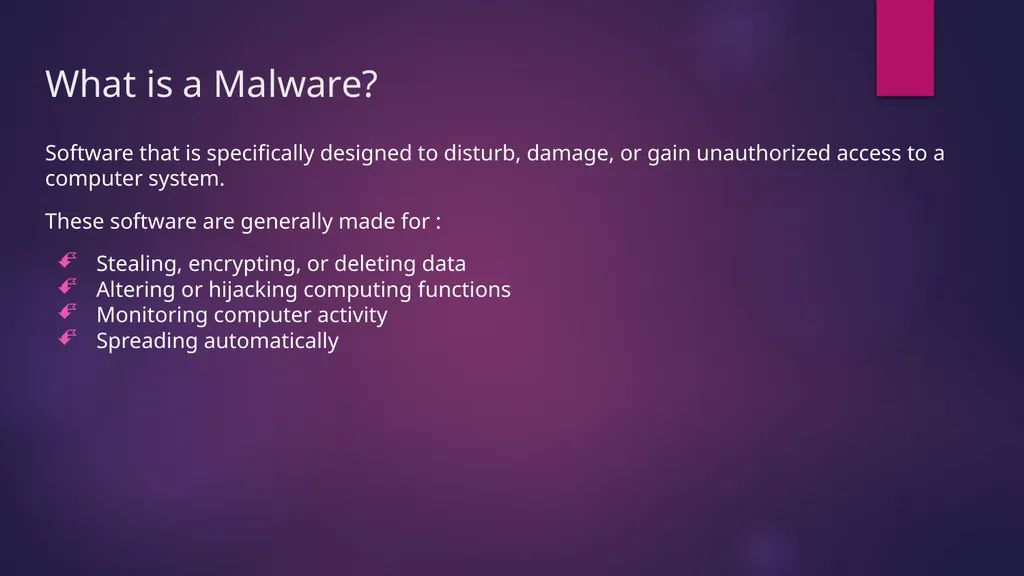
slide2. What is a Malware? Software that is specifically designed to disturb, damage, or gain unauthorized access to a computer system.
These software are generally made for :
Stealing, encrypting, or deleting data
Altering or hijacking computing functions
Monitoring computer activity
Spreading automatically<br>
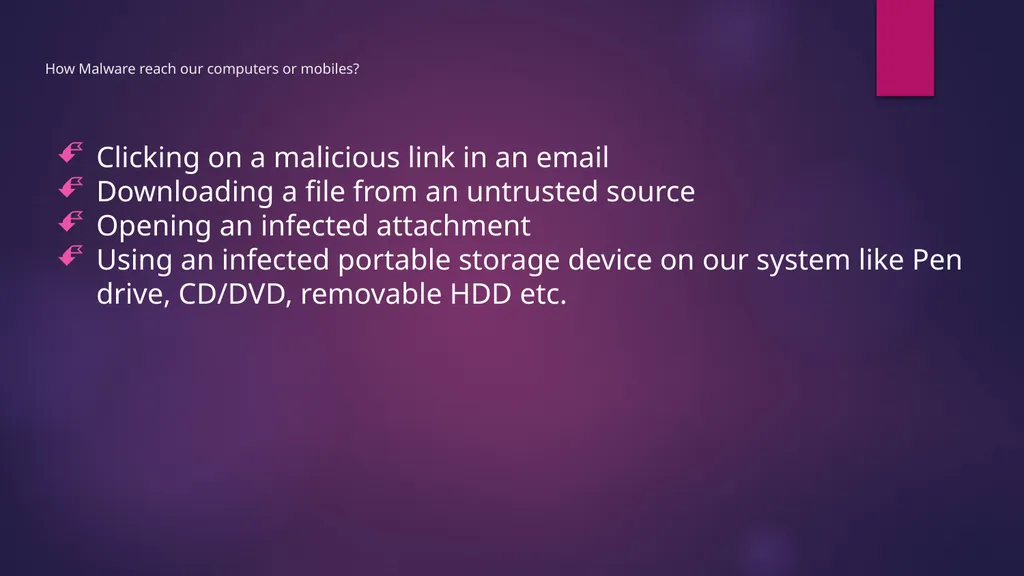
slide3. How Malware reach our computers or mobiles? Clicking on a malicious link in an email
Downloading a file from an untrusted source
Opening an infected attachment
Using an infected portable storage device on our system like Pen drive, CD/DVD, removable HDD etc.<br>
slide4. Types of Malware Viruses
Worms
Trojans
Ransomware
Adware
Spyware
Rootkits
Keyloggers
Fileless Malware
Cryptojacking
Hybrid Malware<br>
slide5. Are all Malware Virus? No, not all malware is a virus, but every virus is a type of malware. Malware is a general term for any malicious software that can harm your device, including computer viruses.<br>
slide6. Virus, Worms and Trojan Virus is a computer program or software that connect itself to another software or computer program to harm computer system. When the computer program runs attached with virus it perform some action such as deleting a file from the computer system. Virus can’t be controlled by remote.
Worms is also a computer program like virus but it does not modify the program. It replicate itself more and more to cause slow down the computer system. Worms can be controlled by remote.
Trojan is a hidden piece of code which steal the important information of user. For example, Trojan horse software observe the e-mail ID and password while entering in web browser for logging.<br>
slide7. What is an Adware? Adware is a type of malware that displays unwanted advertisements on a device. It can appear in many forms, including banner ads, videos, pop-ups, and full-screen ads. Adware is often bundled with other software and installed without the user's knowledge or consent. Its purpose is to generate revenue for the creator by serving ads to internet users.<br>
slide8. What is Rootkit? A rootkit is a type of malicious software that gives an attacker privileged access to a computer while hiding its presence.
The term "rootkit" is a combination of the words "root" and "kit", with "root" referring to the administrator account on Unix and Linux systems, and "kit" referring to the software components that implement the tool.<br>
slide9. What is a Spyware? Spyware is a type of malicious software that secretly enters a user's device, gathers data, and sends it to third parties without their consent. It can harm the user by violating their privacy, endangering their device's security, or other means
How to check if your PC/phone has a spyware :
Unusual slowness, crashes, or instability
Overheating, unusual battery drain, strange noises during calls, or the camera or mic turning on randomly<br>
slide10. What is a Keylogger? A keylogger is a type of spyware that can be both hardware or software based. It secretly records everything you type on your computer or mobile device. This can include sensitive information like passwords, credit card numbers, and messages.
Records Keystrokes
This recorded data can be stored on the device itself or sent to a remote server.
Attackers can then use this stolen information for various malicious purposes, such as identity theft, financial fraud, or hijacking your online accounts.<br>
slide11. What is a Ransomware? Ransomware is a type of malware that prevents a user from accessing their device or data until they pay a ransom.
It can infect a device through malicious links, attachments, or other means, such as phishing or removable USB drives.
Once a device is infected, the ransomware can lock the computer, encrypt the data, or steal or delete it.
The attackers may also threaten to leak the stolen data.<br>
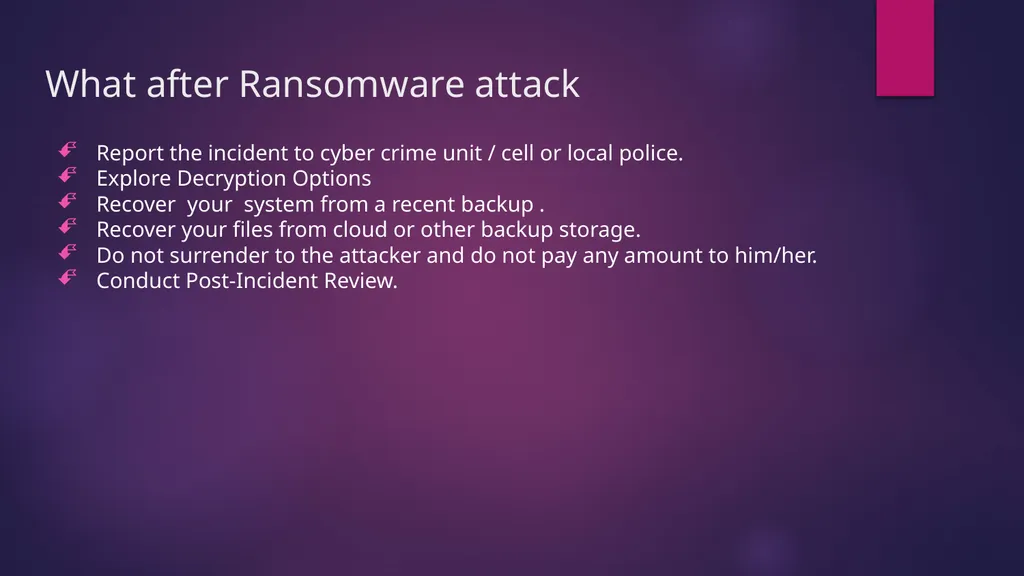
slide12. What after Ransomware attack Report the incident to cyber crime unit / cell or local police.
Explore Decryption Options
Recover your system from a recent backup .
Recover your files from cloud or other backup storage.
Do not surrender to the attacker and do not pay any amount to him/her.
Conduct Post-Incident Review.<br>
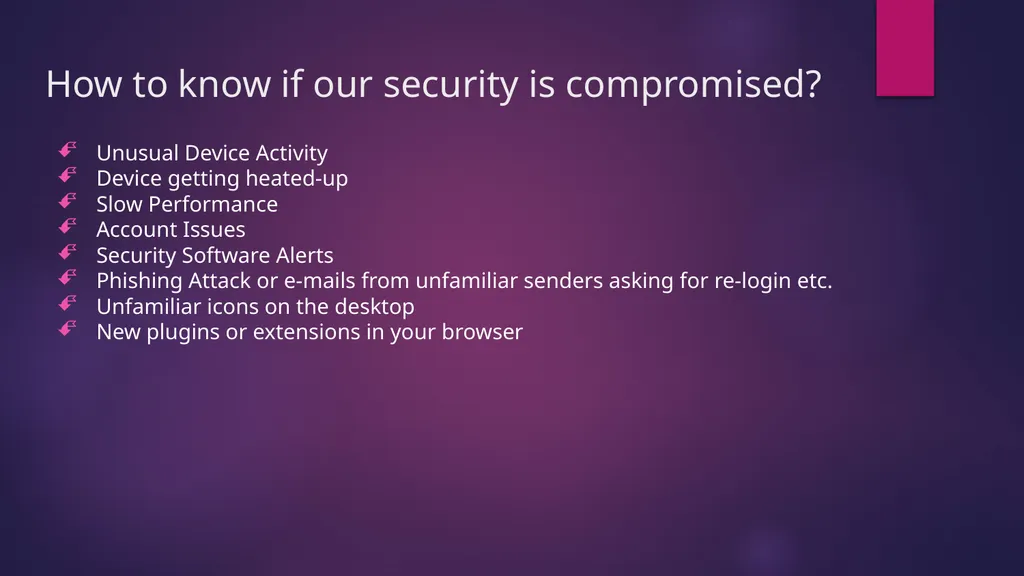
slide13. How to know if our security is compromised? Unusual Device Activity
Device getting heated-up
Slow Performance
Account Issues
Security Software Alerts
Phishing Attack or e-mails from unfamiliar senders asking for re-login etc.
Unfamiliar icons on the desktop
New plugins or extensions in your browser<br>
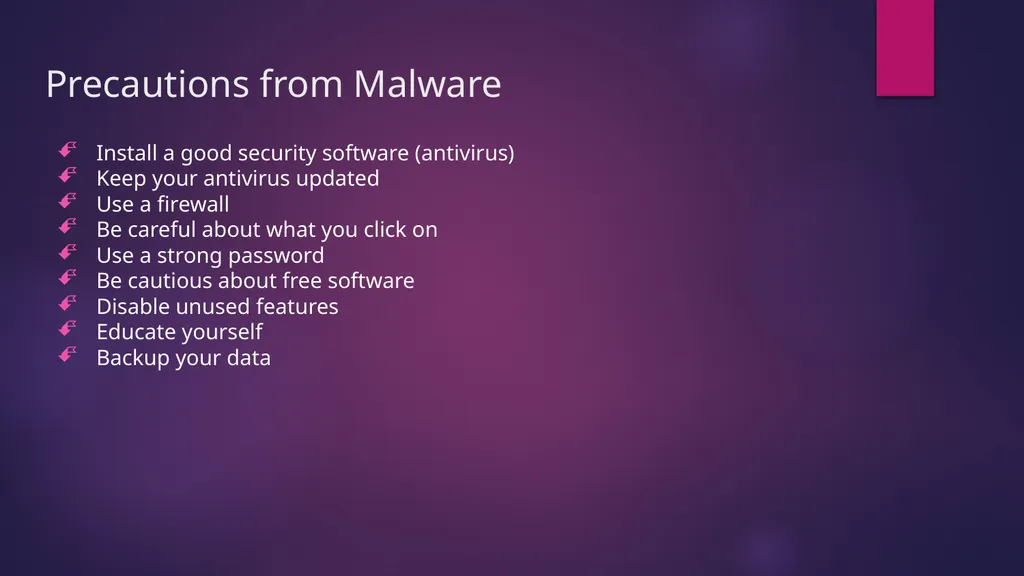
slide14. Precautions from Malware Install a good security software (antivirus)
Keep your antivirus updated
Use a firewall
Be careful about what you click on
Use a strong password
Be cautious about free software
Disable unused features
Educate yourself
Backup your data<br>
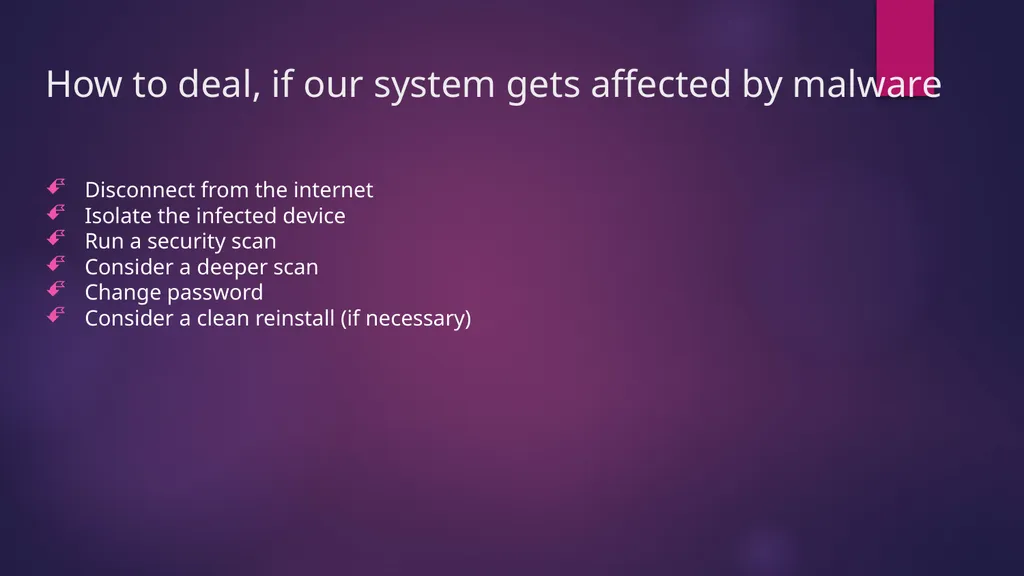
slide15. How to deal, if our system gets affected by malware Disconnect from the internet
Isolate the infected device
Run a security scan
Consider a deeper scan
Change password
Consider a clean reinstall (if necessary)<br>
slide2. What is a Malware? Software that is specifically designed to disturb, damage, or gain unauthorized access to a computer system.
These software are generally made for :
Stealing, encrypting, or deleting data
Altering or hijacking computing functions
Monitoring computer activity
Spreading automatically<br>
slide3. How Malware reach our computers or mobiles? Clicking on a malicious link in an email
Downloading a file from an untrusted source
Opening an infected attachment
Using an infected portable storage device on our system like Pen drive, CD/DVD, removable HDD etc.<br>
slide4. Types of Malware Viruses
Worms
Trojans
Ransomware
Adware
Spyware
Rootkits
Keyloggers
Fileless Malware
Cryptojacking
Hybrid Malware<br>
slide5. Are all Malware Virus? No, not all malware is a virus, but every virus is a type of malware. Malware is a general term for any malicious software that can harm your device, including computer viruses.<br>
slide6. Virus, Worms and Trojan Virus is a computer program or software that connect itself to another software or computer program to harm computer system. When the computer program runs attached with virus it perform some action such as deleting a file from the computer system. Virus can’t be controlled by remote.
Worms is also a computer program like virus but it does not modify the program. It replicate itself more and more to cause slow down the computer system. Worms can be controlled by remote.
Trojan is a hidden piece of code which steal the important information of user. For example, Trojan horse software observe the e-mail ID and password while entering in web browser for logging.<br>
slide7. What is an Adware? Adware is a type of malware that displays unwanted advertisements on a device. It can appear in many forms, including banner ads, videos, pop-ups, and full-screen ads. Adware is often bundled with other software and installed without the user's knowledge or consent. Its purpose is to generate revenue for the creator by serving ads to internet users.<br>
slide8. What is Rootkit? A rootkit is a type of malicious software that gives an attacker privileged access to a computer while hiding its presence.
The term "rootkit" is a combination of the words "root" and "kit", with "root" referring to the administrator account on Unix and Linux systems, and "kit" referring to the software components that implement the tool.<br>
slide9. What is a Spyware? Spyware is a type of malicious software that secretly enters a user's device, gathers data, and sends it to third parties without their consent. It can harm the user by violating their privacy, endangering their device's security, or other means
How to check if your PC/phone has a spyware :
Unusual slowness, crashes, or instability
Overheating, unusual battery drain, strange noises during calls, or the camera or mic turning on randomly<br>
slide10. What is a Keylogger? A keylogger is a type of spyware that can be both hardware or software based. It secretly records everything you type on your computer or mobile device. This can include sensitive information like passwords, credit card numbers, and messages.
Records Keystrokes
This recorded data can be stored on the device itself or sent to a remote server.
Attackers can then use this stolen information for various malicious purposes, such as identity theft, financial fraud, or hijacking your online accounts.<br>
slide11. What is a Ransomware? Ransomware is a type of malware that prevents a user from accessing their device or data until they pay a ransom.
It can infect a device through malicious links, attachments, or other means, such as phishing or removable USB drives.
Once a device is infected, the ransomware can lock the computer, encrypt the data, or steal or delete it.
The attackers may also threaten to leak the stolen data.<br>
slide12. What after Ransomware attack Report the incident to cyber crime unit / cell or local police.
Explore Decryption Options
Recover your system from a recent backup .
Recover your files from cloud or other backup storage.
Do not surrender to the attacker and do not pay any amount to him/her.
Conduct Post-Incident Review.<br>
slide13. How to know if our security is compromised? Unusual Device Activity
Device getting heated-up
Slow Performance
Account Issues
Security Software Alerts
Phishing Attack or e-mails from unfamiliar senders asking for re-login etc.
Unfamiliar icons on the desktop
New plugins or extensions in your browser<br>
slide14. Precautions from Malware Install a good security software (antivirus)
Keep your antivirus updated
Use a firewall
Be careful about what you click on
Use a strong password
Be cautious about free software
Disable unused features
Educate yourself
Backup your data<br>
slide15. How to deal, if our system gets affected by malware Disconnect from the internet
Isolate the infected device
Run a security scan
Consider a deeper scan
Change password
Consider a clean reinstall (if necessary)<br>