
MANAGEMENT ACCOUNTING -An Introduction


Description: MANAGEMENT ACCOUNTING -An Introduction Dr.S.BELLARMIN DIANA ASSISTANT PROFESSOR PG RESEARCH DEPARTMENT OF MANAGEMENT STUDIES BON SECOURS COLLEGE FOR WOMEN, THANJAVUR. INRODUCTION Accounting serves the purpose of providing financial
Related Topics
Download Presentation
"MANAGEMENT ACCOUNTING -An Introduction" is the property of its rightful owner. Permission is granted to download and print the materials on this website for personal, non-commercial use only, and to display it on your personal computer provided you do not modify the materials and that you retain all copyright notices contained in the materials. By downloading content from our website, you accept the terms of this agreement.
Presentation Transcript
slide1. MANAGEMENT ACCOUNTING
-An Introduction Dr.S.BELLARMIN DIANA
ASSISTANT PROFESSOR
PG & RESEARCH DEPARTMENT OF MANAGEMENT STUDIES
BON SECOURS COLLEGE FOR WOMEN, THANJAVUR.<br>
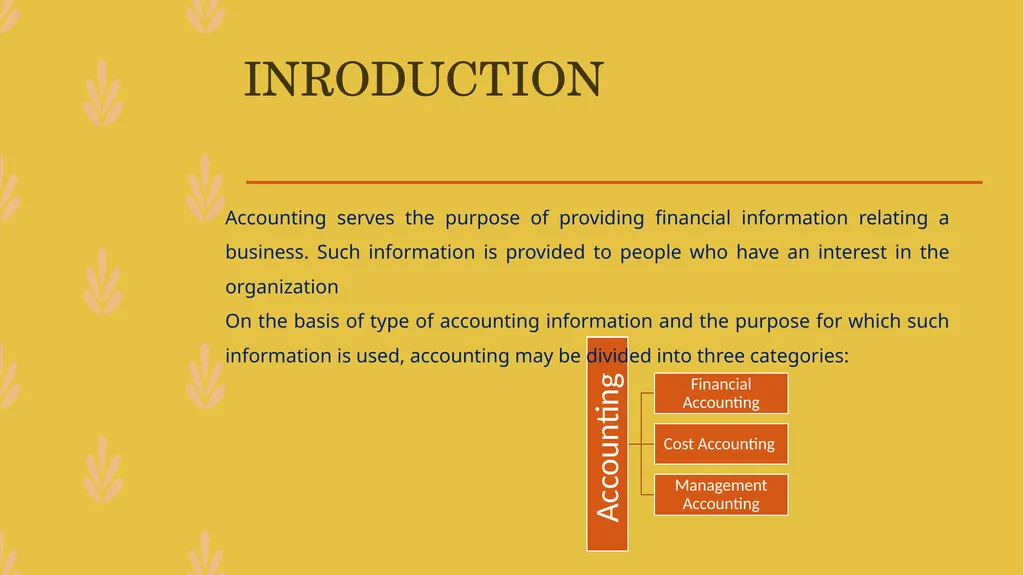
slide2. INRODUCTION Accounting serves the purpose of providing financial information relating a business. Such information is provided to people who have an interest in the organization
On the basis of type of accounting information and the purpose for which such information is used, accounting may be divided into three categories:<br>
slide3. Financial Accounting Financial accounting is mainly concerned with recording business transactions in the books of accounts for the purpose of presenting final accounts, i.e.,
Profit & Loss account - showing the net profit or loss during the period
Balance Sheet - showing the financial position of the firm at a point of time.
The objective of financial accounting is to provide information to external parties such as shareholders, creditors, employees, potential investors, government agencies, etc.<br>
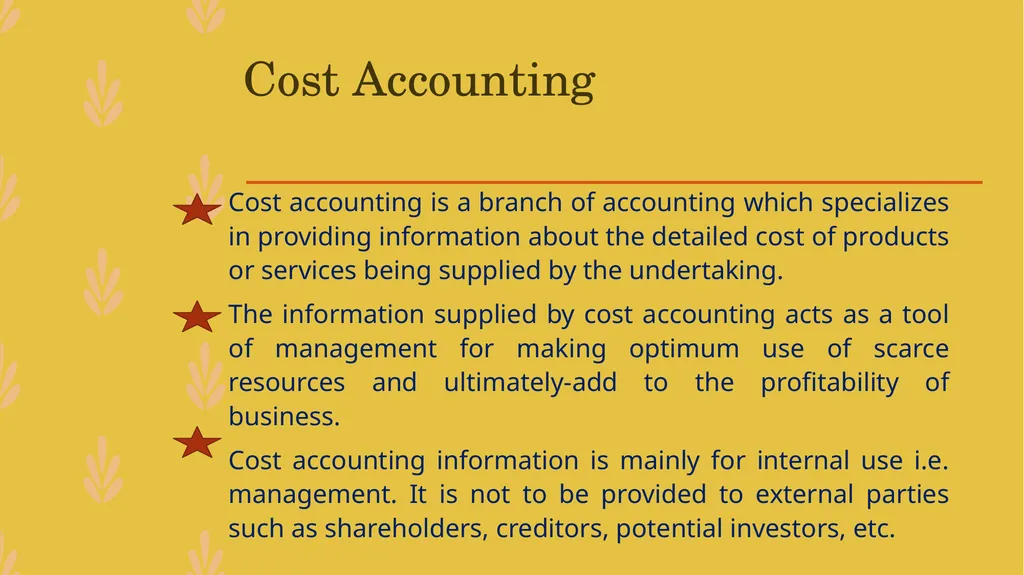
slide4. Cost Accounting Cost accounting is a branch of accounting which specializes in providing information about the detailed cost of products or services being supplied by the undertaking.
The information supplied by cost accounting acts as a tool of management for making optimum use of scarce resources and ultimately-add to the profitability of business.
Cost accounting information is mainly for internal use i.e. management. It is not to be provided to external parties such as shareholders, creditors, potential investors, etc.<br>
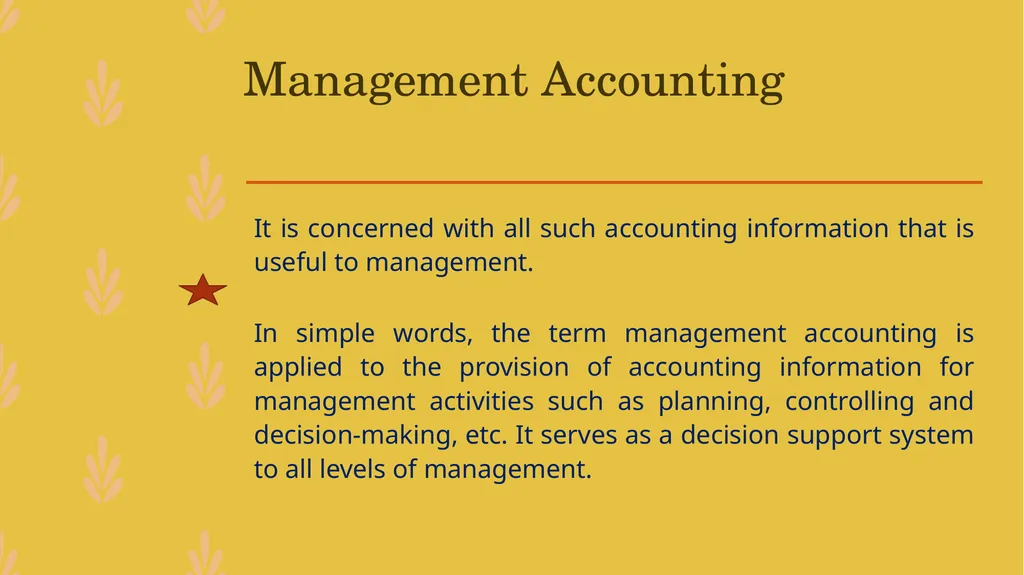
slide5. Management Accounting It is concerned with all such accounting information that is useful to management.
In simple words, the term management accounting is applied to the provision of accounting information for management activities such as planning, controlling and decision-making, etc. It serves as a decision support system to all levels of management.<br>
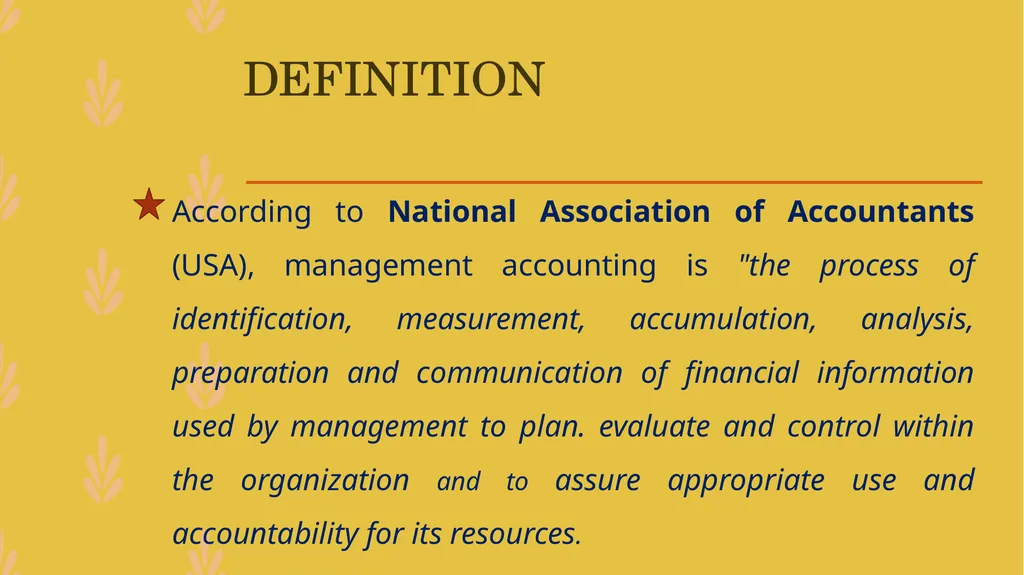
slide6. DEFINITION According to National Association of Accountants (USA), management accounting is "the process of identification, measurement, accumulation, analysis, preparation and communication of financial information used by management to plan. evaluate and control within the organization and to assure appropriate use and accountability for its resources.<br>
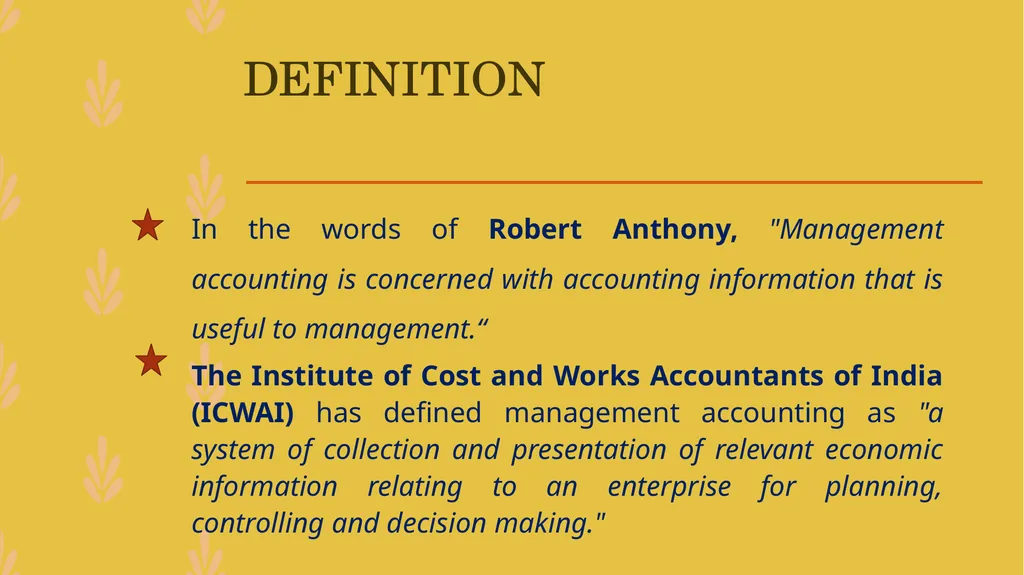
slide7. DEFINITION In the words of Robert Anthony, "Management accounting is concerned with accounting information that is useful to management.“
The Institute of Cost and Works Accountants of India (ICWAI) has defined management accounting as "a system of collection and presentation of relevant economic information relating to an enterprise for planning, controlling and decision making."<br>
slide8. OBJECTIVES To assist the management in promoting efficiency
To prepare budgets covering all functions of a business
To analyze monetary and non-monetary transactions
To compare the actual performance with plan for identifying deviations and their causes<br>
slide9. OBJECTIVES To interpret financial statements to enable the management to formulate future policies
To submit to the management at frequent intervals operating statements and short-term financial statements.
To arrange for the systematic allocation of responsibilities
To help the management in making decisions and implementing them efficiently<br>
slide10. CHARACTERISTICS The aim of management accounting is to assist management in decision making
Management accounting derives basic accounting information from financial and cost accounting
The information provided by management accounting is used by management for internal use and its is not given to external parties
Its adoption by any firm is depends on its utility and desirability and there is no statutory obligation
As it is concerned with decision making it is related with future course of action
There is no prescribed formats for presentation of information to management.
The study of cause and effect relationship is possible in management accounting<br>
slide11. SCOPE OF MANAGEMENT ACCOUNTING For an effective and successful management accounting, there should be a proper and well designed financial accounting system
The techniques of cost control and techniques of profit planning and decision-making are used by the management accounting
Forecasting helps in the preparation of budgets and budgeting helps management accountant in exercising budgetary control
Management accountant depends upon tax accounting and planning to minimize its tax liabilities and save more funds for the business<br>
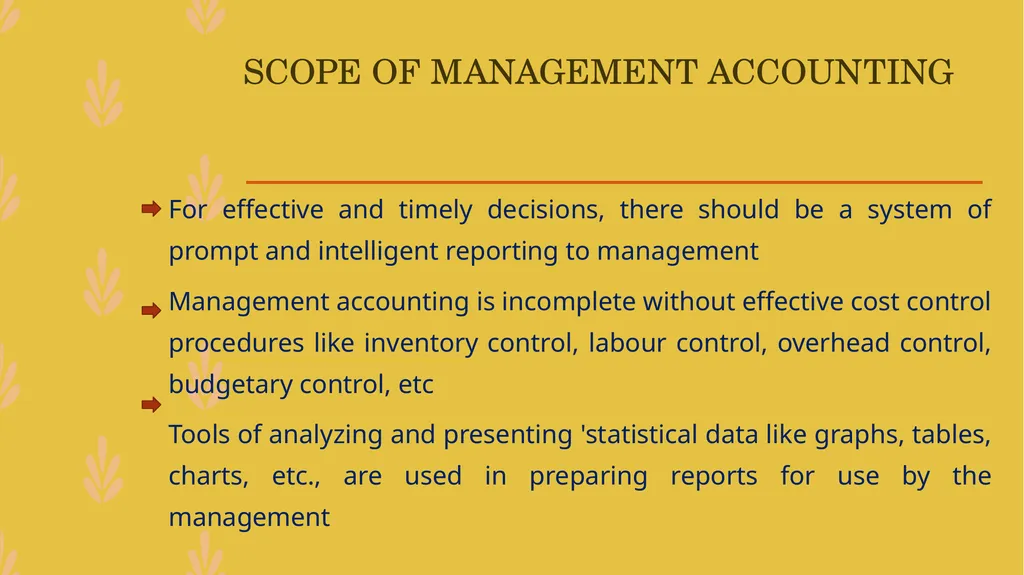
slide12. SCOPE OF MANAGEMENT ACCOUNTING For effective and timely decisions, there should be a system of prompt and intelligent reporting to management
Management accounting is incomplete without effective cost control procedures like inventory control, labour control, overhead control, budgetary control, etc
Tools of analyzing and presenting 'statistical data like graphs, tables, charts, etc., are used in preparing reports for use by the management<br>
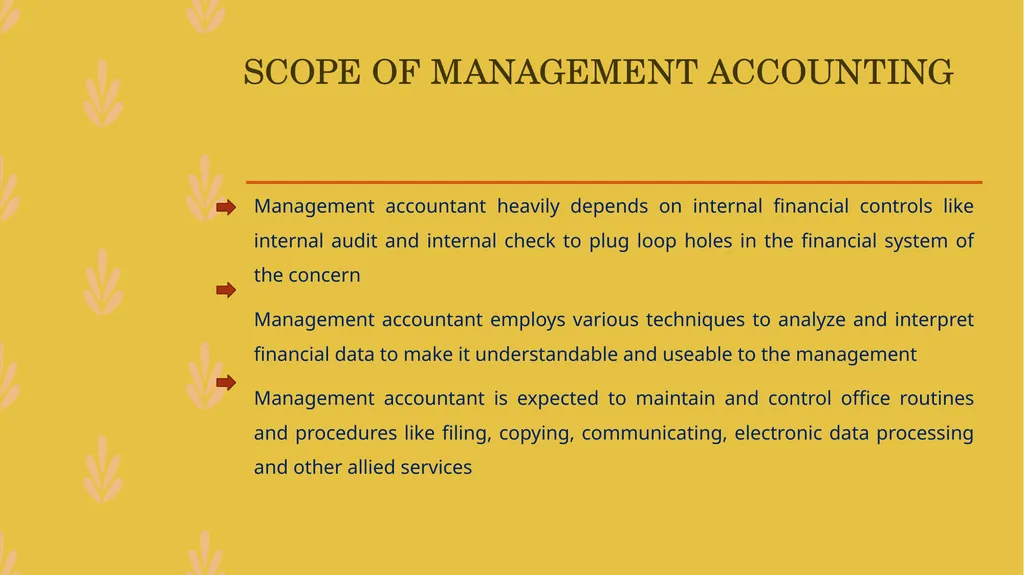
slide13. SCOPE OF MANAGEMENT ACCOUNTING Management accountant heavily depends on internal financial controls like internal audit and internal check to plug loop holes in the financial system of the concern
Management accountant employs various techniques to analyze and interpret financial data to make it understandable and useable to the management
Management accountant is expected to maintain and control office routines and procedures like filing, copying, communicating, electronic data processing and other allied services<br>
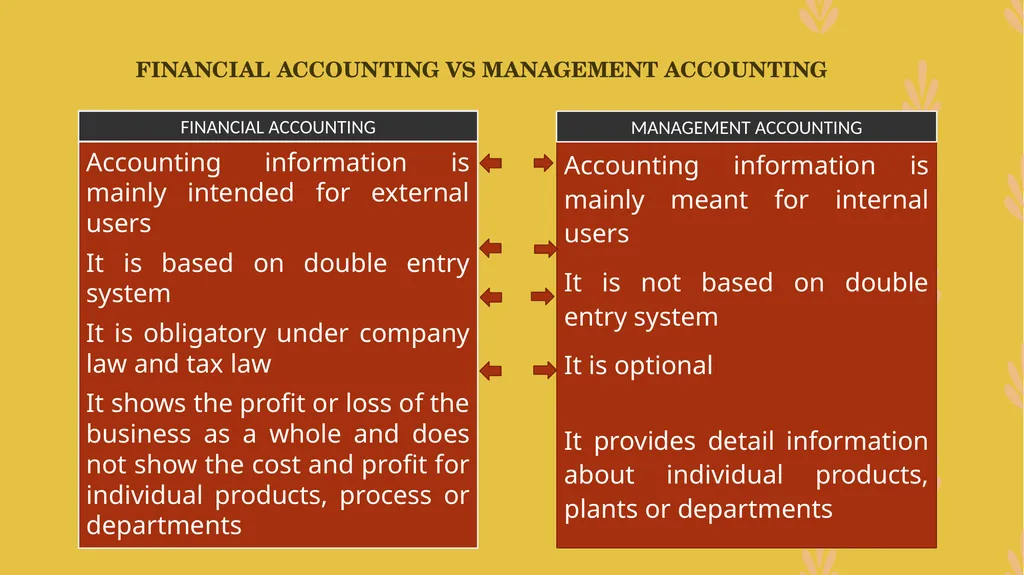
slide14. FINANCIAL ACCOUNTING VS MANAGEMENT ACCOUNTING Accounting information is mainly intended for external users
It is based on double entry system
It is obligatory under company law and tax law
It shows the profit or loss of the business as a whole and does not show the cost and profit for individual products, process or departments Accounting information is mainly meant for internal users
It is not based on double entry system
It is optional
It provides detail information about individual products, plants or departments FINANCIAL ACCOUNTING MANAGEMENT ACCOUNTING<br>
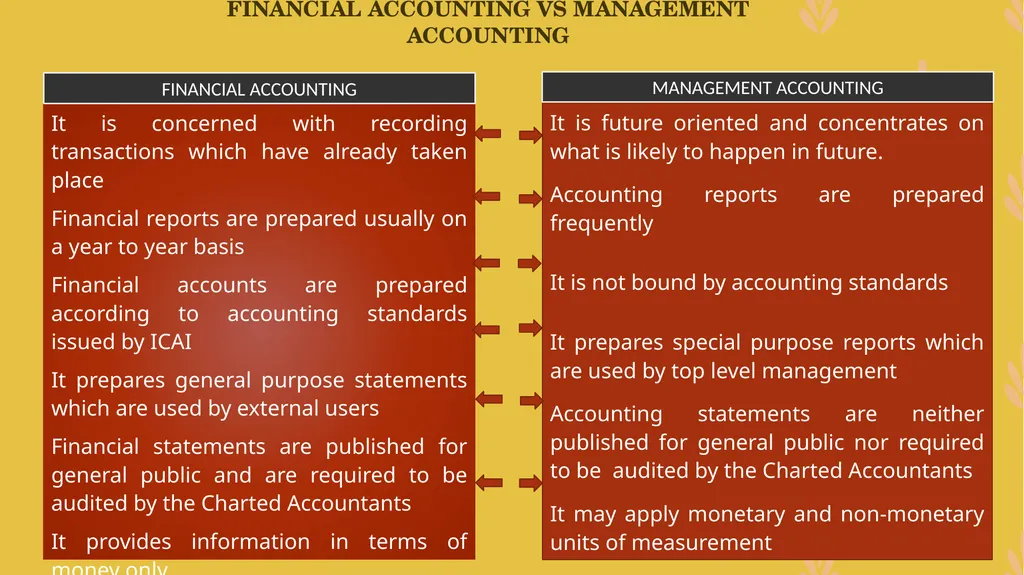
slide15. FINANCIAL ACCOUNTING VS MANAGEMENT ACCOUNTING It is concerned with recording transactions which have already taken place
Financial reports are prepared usually on a year to year basis
Financial accounts are prepared according to accounting standards issued by ICAI
It prepares general purpose statements which are used by external users
Financial statements are published for general public and are required to be audited by the Charted Accountants
It provides information in terms of money only It is future oriented and concentrates on what is likely to happen in future.
Accounting reports are prepared frequently
It is not bound by accounting standards
It prepares special purpose reports which are used by top level management
Accounting statements are neither published for general public nor required to be audited by the Charted Accountants
It may apply monetary and non-monetary units of measurement FINANCIAL ACCOUNTING MANAGEMENT ACCOUNTING<br>
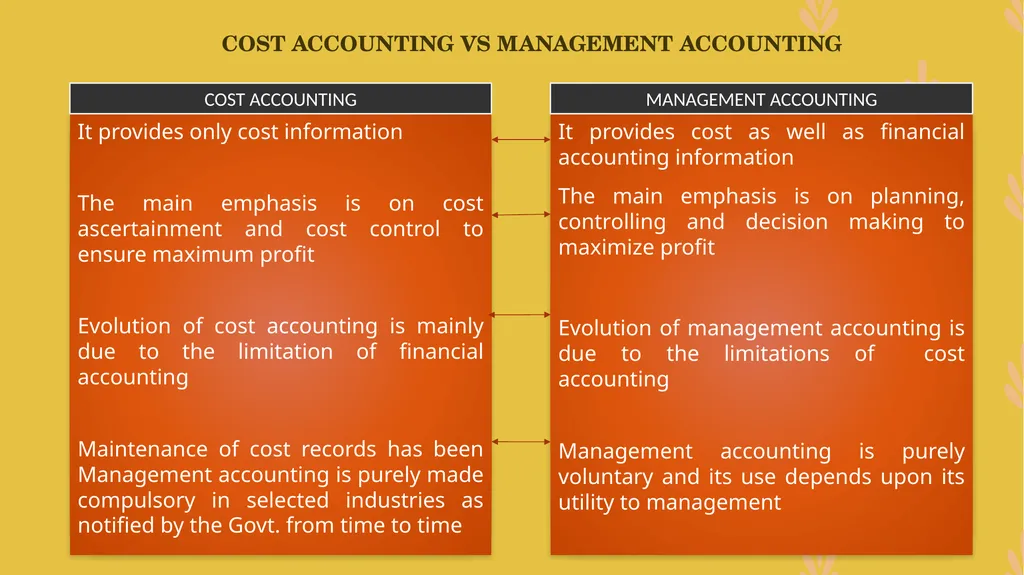
slide16. COST ACCOUNTING VS MANAGEMENT ACCOUNTING It provides only cost information
The main emphasis is on cost ascertainment and cost control to ensure maximum profit
Evolution of cost accounting is mainly due to the limitation of financial accounting
Maintenance of cost records has been Management accounting is purely made compulsory in selected industries as notified by the Govt. from time to time It provides cost as well as financial accounting information
The main emphasis is on planning, controlling and decision making to maximize profit
Evolution of management accounting is due to the limitations of cost accounting
Management accounting is purely voluntary and its use depends upon its utility to management COST ACCOUNTING MANAGEMENT ACCOUNTING<br>
slide17. COST ACCOUNTING VS MANAGEMENT ACCOUNTING It is based on data derived from financial accounts
In the organizational setup, cost accounting is placed at lower level in hierarchy than the management accountant
Cost accounting system can be installed without management accounting
Various techniques used by cost accounting include standard costing and variance analysis, marginal costing andcost volume profit analysis, budgetary control, uniform costing and inter-firm comparison, etc. It is based on data derived from cost accounting and financial accounting and other sources
Management accountant is generally placed at a higher level of hierarchy than the cost accountant
Management accounting can not be installed without a proper system of cost accounting
Management accounting also uses all these techniques used in cost accounting but in addition it also uses techniques like ratio analyses funds flow statement, statistical analysis and certain techniques from various branches of knowledge COST ACCOUNTING MANAGEMENT ACCOUNTING<br>
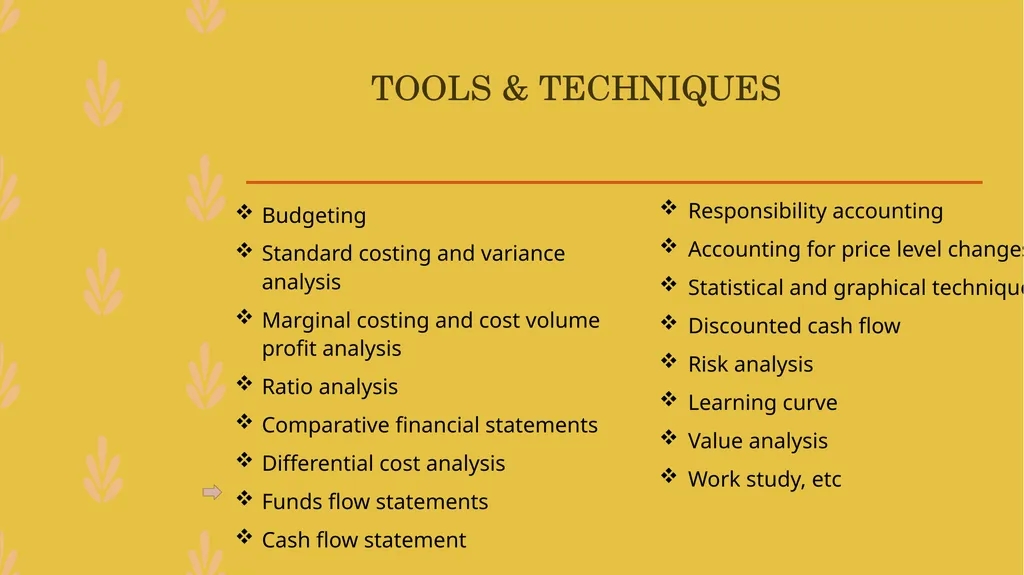
slide18. TOOLS & TECHNIQUES Budgeting
Standard costing and variance analysis
Marginal costing and cost volume profit analysis
Ratio analysis
Comparative financial statements
Differential cost analysis
Funds flow statements
Cash flow statement Responsibility accounting
Accounting for price level changes
Statistical and graphical techniques
Discounted cash flow
Risk analysis
Learning curve
Value analysis
Work study, etc<br>
slide19. THANK YOU<br>
ASSISTANT PROFESSOR
PG & RESEARCH DEPARTMENT OF MANAGEMENT STUDIES
BON SECOURS COLLEGE FOR WOMEN, THANJAVUR.<br>
slide2. INRODUCTION Accounting serves the purpose of providing financial information relating a business. Such information is provided to people who have an interest in the organization
On the basis of type of accounting information and the purpose for which such information is used, accounting may be divided into three categories:<br>
slide3. Financial Accounting Financial accounting is mainly concerned with recording business transactions in the books of accounts for the purpose of presenting final accounts, i.e.,
Profit & Loss account - showing the net profit or loss during the period
Balance Sheet - showing the financial position of the firm at a point of time.
The objective of financial accounting is to provide information to external parties such as shareholders, creditors, employees, potential investors, government agencies, etc.<br>
slide4. Cost Accounting Cost accounting is a branch of accounting which specializes in providing information about the detailed cost of products or services being supplied by the undertaking.
The information supplied by cost accounting acts as a tool of management for making optimum use of scarce resources and ultimately-add to the profitability of business.
Cost accounting information is mainly for internal use i.e. management. It is not to be provided to external parties such as shareholders, creditors, potential investors, etc.<br>
slide5. Management Accounting It is concerned with all such accounting information that is useful to management.
In simple words, the term management accounting is applied to the provision of accounting information for management activities such as planning, controlling and decision-making, etc. It serves as a decision support system to all levels of management.<br>
slide6. DEFINITION According to National Association of Accountants (USA), management accounting is "the process of identification, measurement, accumulation, analysis, preparation and communication of financial information used by management to plan. evaluate and control within the organization and to assure appropriate use and accountability for its resources.<br>
slide7. DEFINITION In the words of Robert Anthony, "Management accounting is concerned with accounting information that is useful to management.“
The Institute of Cost and Works Accountants of India (ICWAI) has defined management accounting as "a system of collection and presentation of relevant economic information relating to an enterprise for planning, controlling and decision making."<br>
slide8. OBJECTIVES To assist the management in promoting efficiency
To prepare budgets covering all functions of a business
To analyze monetary and non-monetary transactions
To compare the actual performance with plan for identifying deviations and their causes<br>
slide9. OBJECTIVES To interpret financial statements to enable the management to formulate future policies
To submit to the management at frequent intervals operating statements and short-term financial statements.
To arrange for the systematic allocation of responsibilities
To help the management in making decisions and implementing them efficiently<br>
slide10. CHARACTERISTICS The aim of management accounting is to assist management in decision making
Management accounting derives basic accounting information from financial and cost accounting
The information provided by management accounting is used by management for internal use and its is not given to external parties
Its adoption by any firm is depends on its utility and desirability and there is no statutory obligation
As it is concerned with decision making it is related with future course of action
There is no prescribed formats for presentation of information to management.
The study of cause and effect relationship is possible in management accounting<br>
slide11. SCOPE OF MANAGEMENT ACCOUNTING For an effective and successful management accounting, there should be a proper and well designed financial accounting system
The techniques of cost control and techniques of profit planning and decision-making are used by the management accounting
Forecasting helps in the preparation of budgets and budgeting helps management accountant in exercising budgetary control
Management accountant depends upon tax accounting and planning to minimize its tax liabilities and save more funds for the business<br>
slide12. SCOPE OF MANAGEMENT ACCOUNTING For effective and timely decisions, there should be a system of prompt and intelligent reporting to management
Management accounting is incomplete without effective cost control procedures like inventory control, labour control, overhead control, budgetary control, etc
Tools of analyzing and presenting 'statistical data like graphs, tables, charts, etc., are used in preparing reports for use by the management<br>
slide13. SCOPE OF MANAGEMENT ACCOUNTING Management accountant heavily depends on internal financial controls like internal audit and internal check to plug loop holes in the financial system of the concern
Management accountant employs various techniques to analyze and interpret financial data to make it understandable and useable to the management
Management accountant is expected to maintain and control office routines and procedures like filing, copying, communicating, electronic data processing and other allied services<br>
slide14. FINANCIAL ACCOUNTING VS MANAGEMENT ACCOUNTING Accounting information is mainly intended for external users
It is based on double entry system
It is obligatory under company law and tax law
It shows the profit or loss of the business as a whole and does not show the cost and profit for individual products, process or departments Accounting information is mainly meant for internal users
It is not based on double entry system
It is optional
It provides detail information about individual products, plants or departments FINANCIAL ACCOUNTING MANAGEMENT ACCOUNTING<br>
slide15. FINANCIAL ACCOUNTING VS MANAGEMENT ACCOUNTING It is concerned with recording transactions which have already taken place
Financial reports are prepared usually on a year to year basis
Financial accounts are prepared according to accounting standards issued by ICAI
It prepares general purpose statements which are used by external users
Financial statements are published for general public and are required to be audited by the Charted Accountants
It provides information in terms of money only It is future oriented and concentrates on what is likely to happen in future.
Accounting reports are prepared frequently
It is not bound by accounting standards
It prepares special purpose reports which are used by top level management
Accounting statements are neither published for general public nor required to be audited by the Charted Accountants
It may apply monetary and non-monetary units of measurement FINANCIAL ACCOUNTING MANAGEMENT ACCOUNTING<br>
slide16. COST ACCOUNTING VS MANAGEMENT ACCOUNTING It provides only cost information
The main emphasis is on cost ascertainment and cost control to ensure maximum profit
Evolution of cost accounting is mainly due to the limitation of financial accounting
Maintenance of cost records has been Management accounting is purely made compulsory in selected industries as notified by the Govt. from time to time It provides cost as well as financial accounting information
The main emphasis is on planning, controlling and decision making to maximize profit
Evolution of management accounting is due to the limitations of cost accounting
Management accounting is purely voluntary and its use depends upon its utility to management COST ACCOUNTING MANAGEMENT ACCOUNTING<br>
slide17. COST ACCOUNTING VS MANAGEMENT ACCOUNTING It is based on data derived from financial accounts
In the organizational setup, cost accounting is placed at lower level in hierarchy than the management accountant
Cost accounting system can be installed without management accounting
Various techniques used by cost accounting include standard costing and variance analysis, marginal costing andcost volume profit analysis, budgetary control, uniform costing and inter-firm comparison, etc. It is based on data derived from cost accounting and financial accounting and other sources
Management accountant is generally placed at a higher level of hierarchy than the cost accountant
Management accounting can not be installed without a proper system of cost accounting
Management accounting also uses all these techniques used in cost accounting but in addition it also uses techniques like ratio analyses funds flow statement, statistical analysis and certain techniques from various branches of knowledge COST ACCOUNTING MANAGEMENT ACCOUNTING<br>
slide18. TOOLS & TECHNIQUES Budgeting
Standard costing and variance analysis
Marginal costing and cost volume profit analysis
Ratio analysis
Comparative financial statements
Differential cost analysis
Funds flow statements
Cash flow statement Responsibility accounting
Accounting for price level changes
Statistical and graphical techniques
Discounted cash flow
Risk analysis
Learning curve
Value analysis
Work study, etc<br>
slide19. THANK YOU<br>