Managing a Difficult Conversation (To a Successful Conclusion) ETBI Conference January 2023 What is a Difficult Conversation? A difficult conversation involves anything we find it difficult to talk about. In these conversations, we usually
"Managing a Difficult Conversation (To a Successful" is the property of its rightful owner. Permission is granted to
download and print the materials on this website for personal, non-commercial use only, and to display it
on your personal computer provided you do not modify the materials and that you retain all copyright
notices contained in the materials. By downloading content from our website, you accept the terms of this
agreement.
Share
Embed code
Presentation Transcript
01
Managing a Difficult Conversation (To a Successful Conclusion) ETBI Conference January 2023<br>
02
What is a Difficult Conversation? A difficult conversation involves anything we find it difficult to talk about.
In these conversations, we usually fear consequences, whether we bring up the issue or avoid it.
If we avoid the subject, we risk our feelings festering or the situation worsening.
If we bring up the issue, we risk upsetting the other person or not getting what we want. ETBI Middle Leaders Summer School 2022<br>
03
The Difficult Conversation – 3 Conversations in 1 Difficult conversations all share the same basic structure comprised of three conversations going on within the difficult conversation:
1. The What Happened Conversation
In a good difficult conversation, this is calm, logical fact-finding
In a bad difficult conversation, the What Happened Conversation is about who’s “right” and who’s “wrong.” In these conversations, we usually confuse intention with impact and belief, because we’re upset about something, that the other person intended to hurt us
We blame the other person for the issue, and view ourselves as victims. We essentially turn what could be a productive difficult conversation into an argument about who was in the right ETBI Middle Leaders Summer School 2022<br>
04
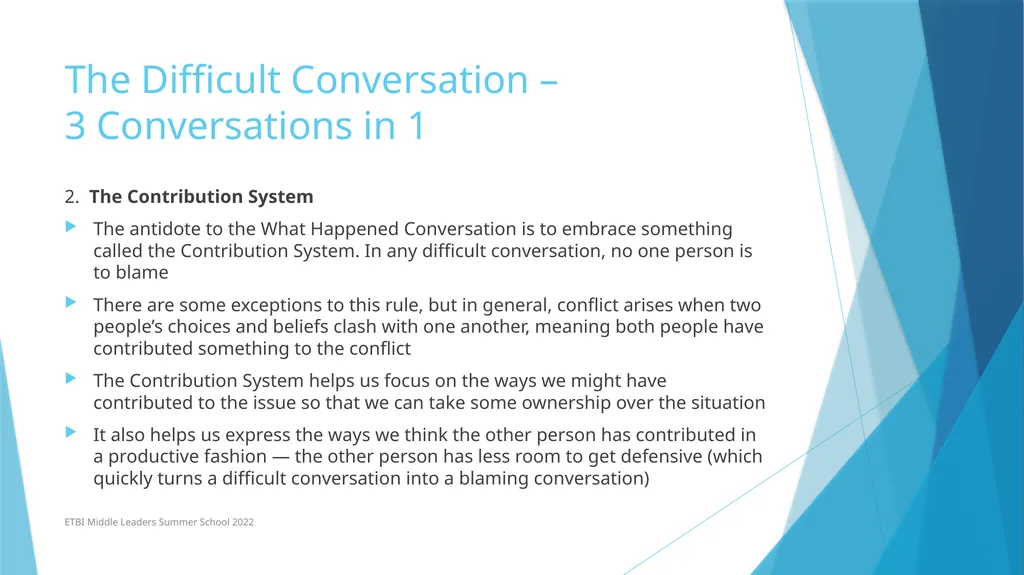
The Difficult Conversation – 3 Conversations in 1 2. The Contribution System
The antidote to the What Happened Conversation is to embrace something called the Contribution System. In any difficult conversation, no one person is to blame
There are some exceptions to this rule, but in general, conflict arises when two people’s choices and beliefs clash with one another, meaning both people have contributed something to the conflict
The Contribution System helps us focus on the ways we might have contributed to the issue so that we can take some ownership over the situation
It also helps us express the ways we think the other person has contributed in a productive fashion — the other person has less room to get defensive (which quickly turns a difficult conversation into a blaming conversation) ETBI Middle Leaders Summer School 2022<br>
05
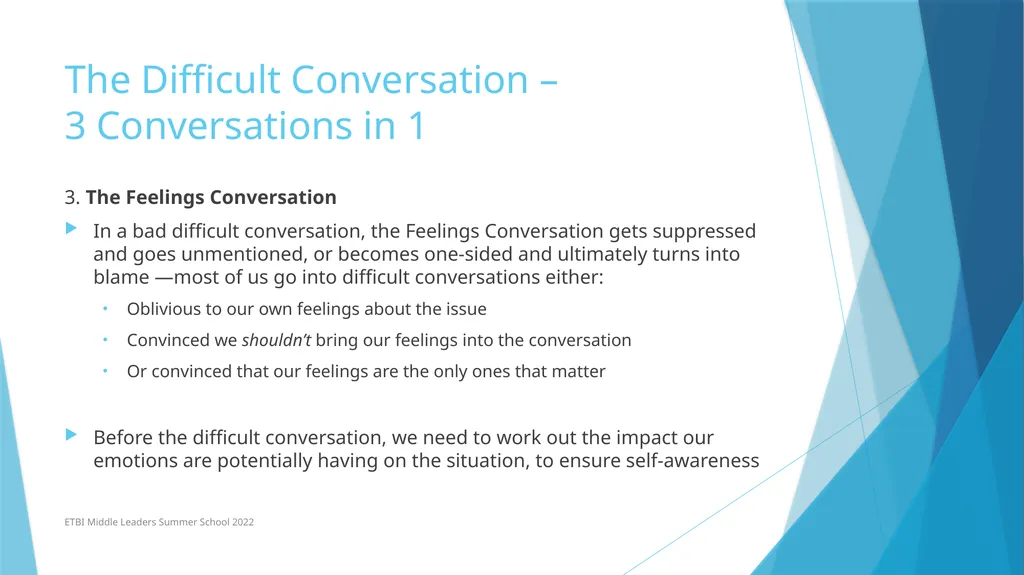
The Difficult Conversation – 3 Conversations in 1 3. The Feelings Conversation
In a bad difficult conversation, the Feelings Conversation gets suppressed and goes unmentioned, or becomes one-sided and ultimately turns into blame —most of us go into difficult conversations either:
Oblivious to our own feelings about the issue
Convinced we shouldn’t bring our feelings into the conversation
Or convinced that our feelings are the only ones that matter
Before the difficult conversation, we need to work out the impact our emotions are potentially having on the situation, to ensure self-awareness ETBI Middle Leaders Summer School 2022<br>
06
The Reality Difficult conversations are a part of life
They are definitely a part of leadership
Having difficult conversations are something that (most of us) do not like doing and perhaps even avoid ETBI Conference January 2023<br>
07
1. Face up to it Perhaps the most crucial part of managing the challenging conversation is facing up to it
The first step is to recognise that it is something that has to happen, if real progress is to be made. Don’t convince ourselves it will resolve itself
However, it is always good to have some reflection before the conversation takes place
Facing up to it does not mean there is always a need to do it immediately ETBI Conference January 2023<br>
08
2. Prepare for it As a famous Irish sportsperson once said, “Fail to prepare; prepare to fail”
This is true for the difficult conversation also
Start with some subtle information gathering on the context and what has been happening / should have been happening
Ensure that you have all facts or information that will be needed
Ensure that you are in touch with your emotions around the situation ETBI Middle Leaders Summer School 2022<br>
09
2. Prepare for it (contd.) Choose the right time for the meeting. For example, if it is with a colleague, don’t try to do it during a ‘snatched’ 10 minutes. Also, don’t do it on the day they have a full timetable
Consider the location carefully – should it be in your office?; should it be behind your desk or at a table?; should it be in a neutral space?; or over a coffee (for a colleague…. It all depends on your relationship and the nature of the conversation)?
All of the above preparation is presuming that it is not a difficult conversation that is time sensitive (e.g. a Child Protection issue) ETBI Middle Leaders Summer School 2022<br>
10
3. Reframe it Before the difficult conversation happens, your thinking does not have to be linear
Try to imagine the situation from all sides, whether it be the perspective of the colleague, the senior manager, the learner or the parent
Trying to reframe our thoughts can often lead us to a conversation that is empathetic, collegial and solution-focused, rather than blame-focused. ETBI Middle Leaders Summer School 2022<br>
11
4. Envision it Before you hold the conversation, try to envision what it is that you want to achieve
Envision how the conversation may go and what challenges may be presented
Focus on a successful outcome, rather than ‘winning the argument’ (which we all can be guilty of!)
What does success look like in this situation? ETBI Middle Leaders Summer School 2022<br>
12
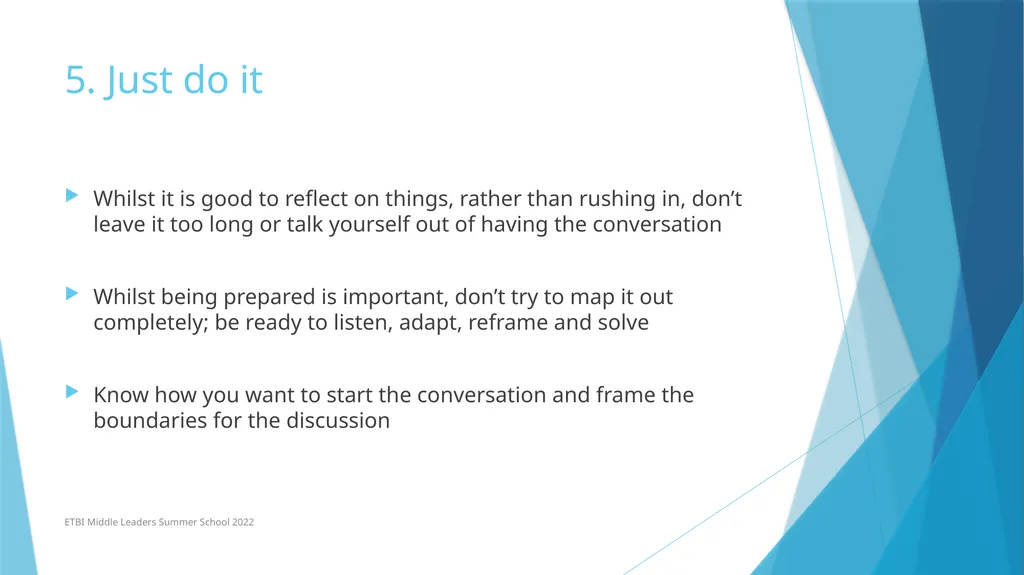
5. Just do it Whilst it is good to reflect on things, rather than rushing in, don’t leave it too long or talk yourself out of having the conversation
Whilst being prepared is important, don’t try to map it out completely; be ready to listen, adapt, reframe and solve
Know how you want to start the conversation and frame the boundaries for the discussion ETBI Middle Leaders Summer School 2022<br>
13
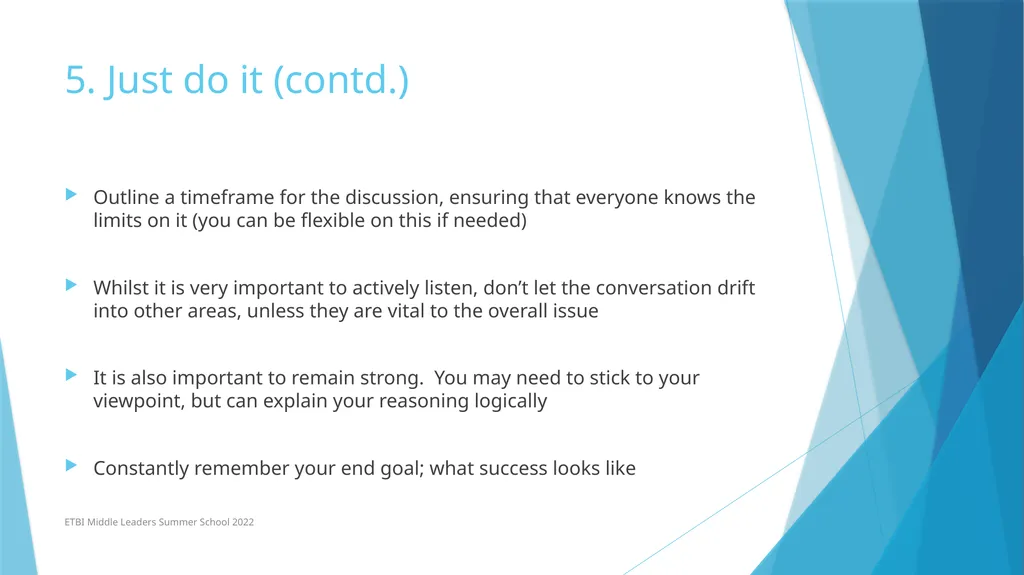
5. Just do it (contd.) Outline a timeframe for the discussion, ensuring that everyone knows the limits on it (you can be flexible on this if needed)
Whilst it is very important to actively listen, don’t let the conversation drift into other areas, unless they are vital to the overall issue
It is also important to remain strong. You may need to stick to your viewpoint, but can explain your reasoning logically
Constantly remember your end goal; what success looks like ETBI Middle Leaders Summer School 2022<br>
14
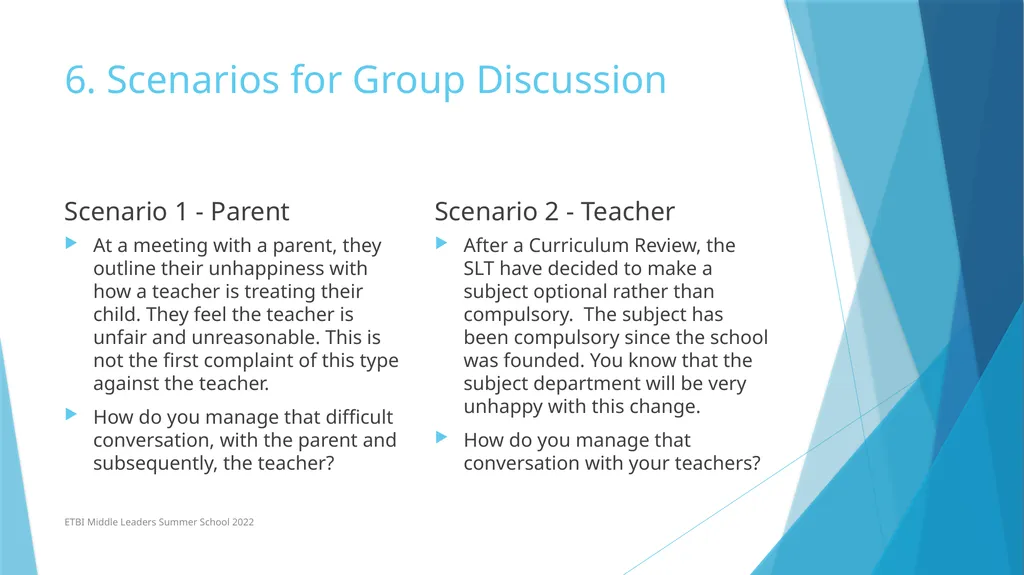
6. Scenarios for Group Discussion Scenario 1 - Parent At a meeting with a parent, they outline their unhappiness with how a teacher is treating their child. They feel the teacher is unfair and unreasonable. This is not the first complaint of this type against the teacher.
How do you manage that difficult conversation, with the parent and subsequently, the teacher? Scenario 2 - Teacher After a Curriculum Review, the SLT have decided to make a subject optional rather than compulsory. The subject has been compulsory since the school was founded. You know that the subject department will be very unhappy with this change.
How do you manage that conversation with your teachers? ETBI Middle Leaders Summer School 2022<br>
15
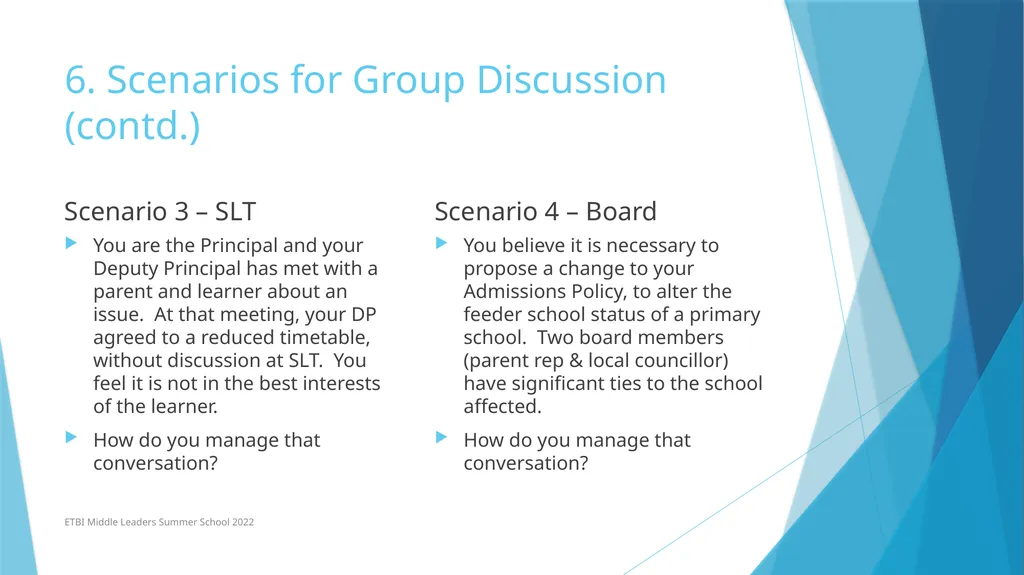
6. Scenarios for Group Discussion (contd.) Scenario 3 – SLT You are the Principal and your Deputy Principal has met with a parent and learner about an issue. At that meeting, your DP agreed to a reduced timetable, without discussion at SLT. You feel it is not in the best interests of the learner.
How do you manage that conversation? Scenario 4 – Board You believe it is necessary to propose a change to your Admissions Policy, to alter the feeder school status of a primary school. Two board members (parent rep & local councillor) have significant ties to the school affected.
How do you manage that conversation? ETBI Middle Leaders Summer School 2022<br>
16
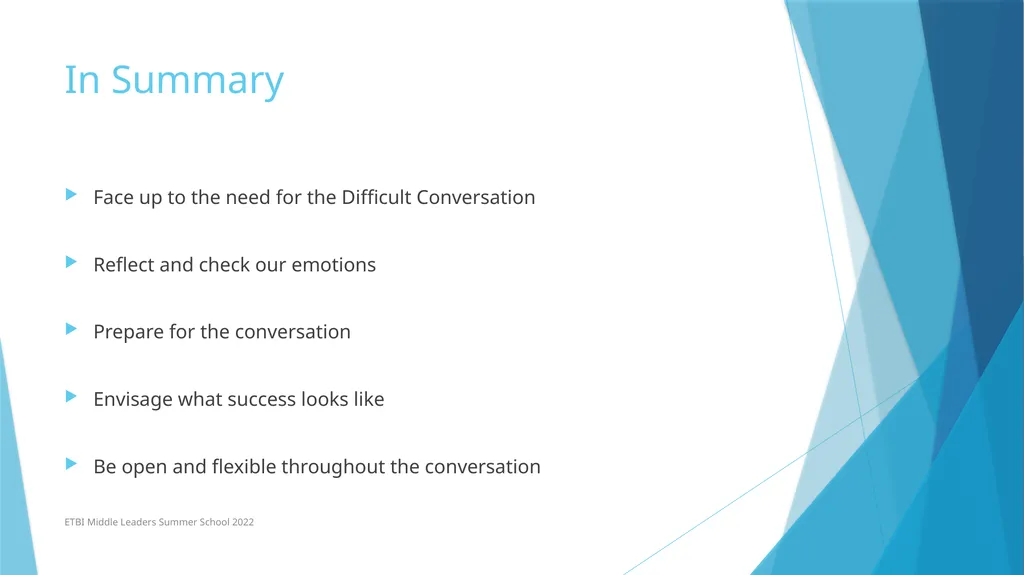
In Summary Face up to the need for the Difficult Conversation
Reflect and check our emotions
Prepare for the conversation
Envisage what success looks like
Be open and flexible throughout the conversation ETBI Middle Leaders Summer School 2022<br>