
MANAGING HEAD LICE IN THE SCHOOL SETTING A
TF
Published · 22 slides · 0 views
1 / 1

Description
MANAGING HEAD LICE IN THE SCHOOL SETTING A presentation for teachers and parents Carolyn Genatossio, RN, MPH This PowerPoint presentation has voice over Objectives The objective of this presentation is to provide current research based
Related Topics
Share
Embed code
Download this presentation From Below
"MANAGING HEAD LICE IN THE SCHOOL SETTING A" is the property of its rightful owner. Permission is granted to download and print the materials on this website for personal, non-commercial use only, and to display it on your personal computer provided you do not modify the materials and that you retain all copyright notices contained in the materials. By downloading content from our website, you accept the terms of this agreement.
Presentation Transcript
01
MANAGING HEAD LICE IN THE SCHOOL SETTING A presentation for teachers and parents
Carolyn Genatossio, RN, MPH
This PowerPoint presentation has voice over<br>
Carolyn Genatossio, RN, MPH
This PowerPoint presentation has voice over<br>
02
Objectives The objective of this presentation is to provide current research based information about head lice and how to manage children with lice in the school setting.
At the conclusion of this presentation the learner will:
Understand what head lice are and how they are transmitted
Understand the rationale for the recommendations to not exclude children with lice from school
Understand the general principles of prevention and treatment<br>
At the conclusion of this presentation the learner will:
Understand what head lice are and how they are transmitted
Understand the rationale for the recommendations to not exclude children with lice from school
Understand the general principles of prevention and treatment<br>
03
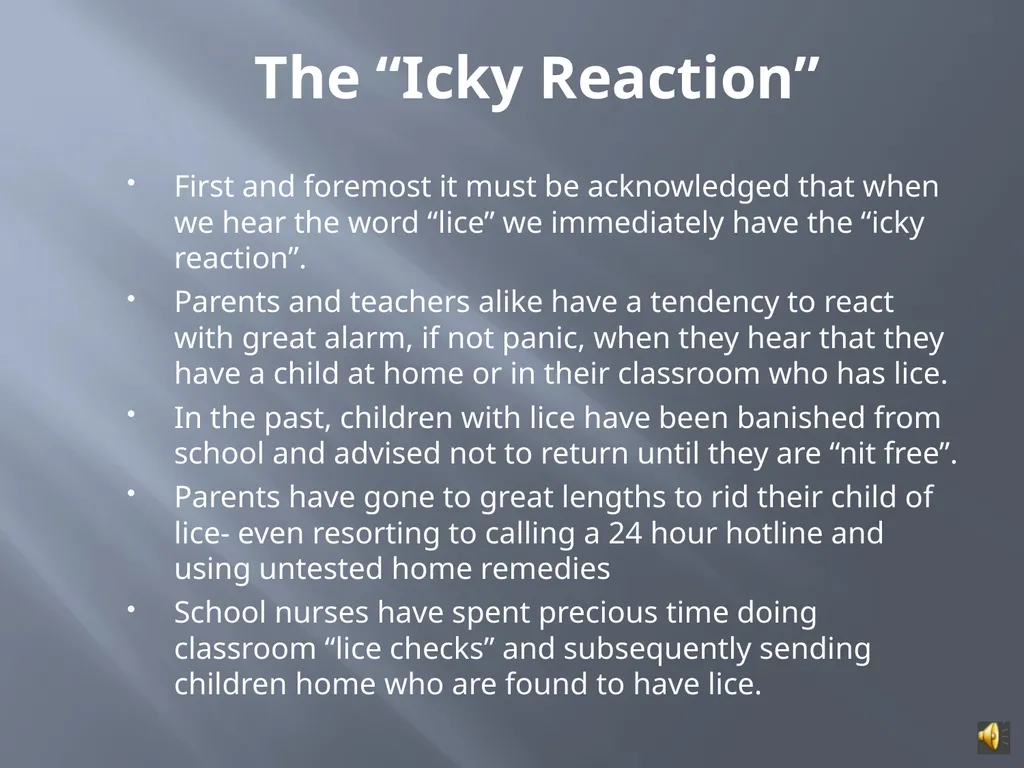
The “Icky Reaction” First and foremost it must be acknowledged that when we hear the word “lice” we immediately have the “icky reaction”.
Parents and teachers alike have a tendency to react with great alarm, if not panic, when they hear that they have a child at home or in their classroom who has lice.
In the past, children with lice have been banished from school and advised not to return until they are “nit free”.
Parents have gone to great lengths to rid their child of lice- even resorting to calling a 24 hour hotline and using untested home remedies
School nurses have spent precious time doing classroom “lice checks” and subsequently sending children home who are found to have lice.<br>
Parents and teachers alike have a tendency to react with great alarm, if not panic, when they hear that they have a child at home or in their classroom who has lice.
In the past, children with lice have been banished from school and advised not to return until they are “nit free”.
Parents have gone to great lengths to rid their child of lice- even resorting to calling a 24 hour hotline and using untested home remedies
School nurses have spent precious time doing classroom “lice checks” and subsequently sending children home who are found to have lice.<br>
04
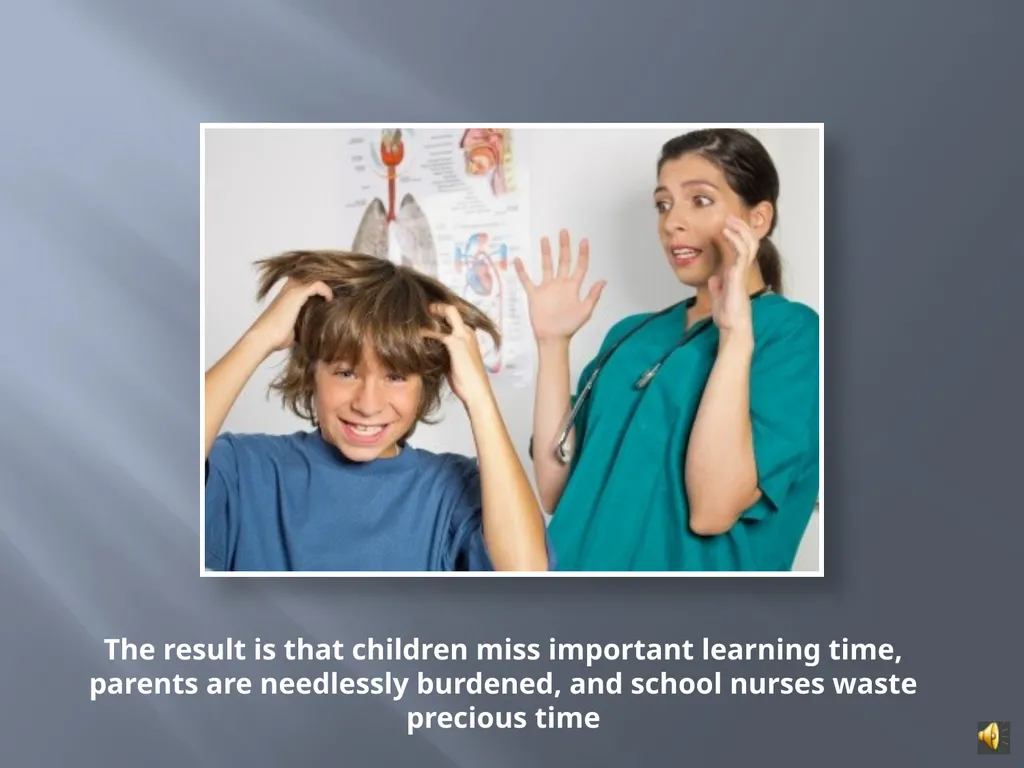
The result is that children miss important learning time, parents are needlessly burdened, and school nurses waste precious time<br>
05
What are head lice? The head louse, or Pediculus humanus capitis, is a parasitic insect that can be found on the head, eyebrows, and eyelashes of people
Head lice are small, wingless insects which feed on human blood and live close to the scalp
They need human blood in order to survive
Head lice that are off of their human hosts will starve
It is generally believed that a head louse will not survive for more than 24 hours when off of its human host
Head lice are not known to spread disease
Head lice do not thrive on pets
http://www.cdc.gov/parasites/lice/head/schools.html<br>
Head lice are small, wingless insects which feed on human blood and live close to the scalp
They need human blood in order to survive
Head lice that are off of their human hosts will starve
It is generally believed that a head louse will not survive for more than 24 hours when off of its human host
Head lice are not known to spread disease
Head lice do not thrive on pets
http://www.cdc.gov/parasites/lice/head/schools.html<br>
06
Learning the lice cycle Live lice lay eggs, these are called nits- you can not catch nits- they need to be laid by live lice
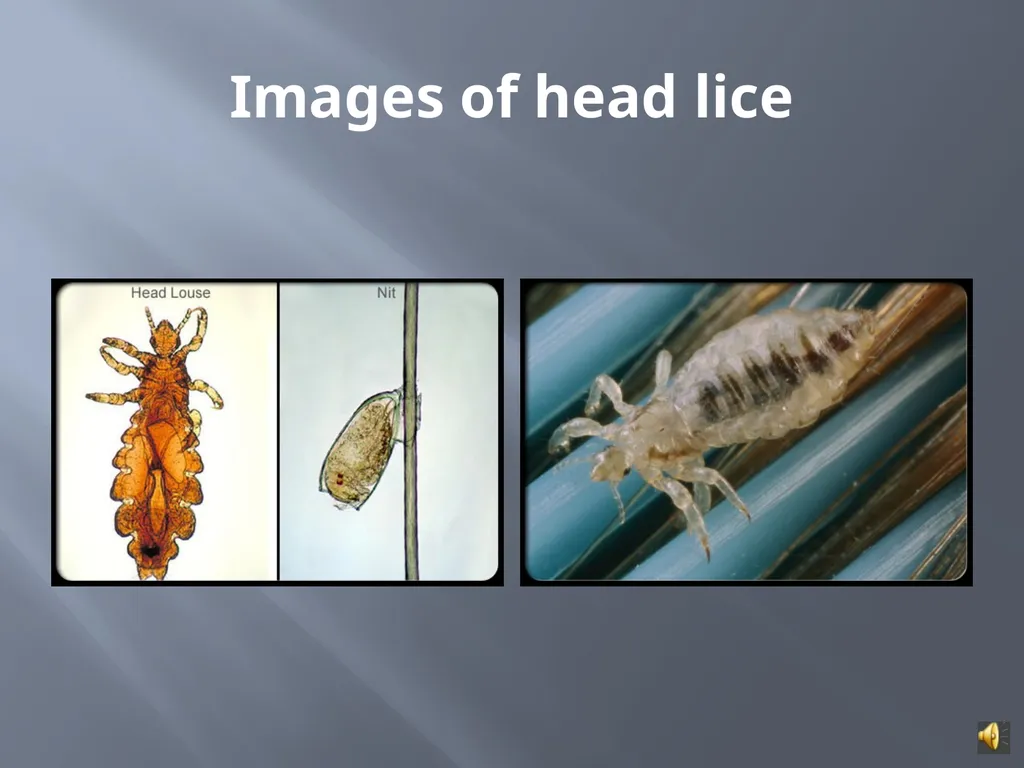
Nits are small yellowish-white (pearly) and oval shaped and are glued to the hair shaft at an angle
Once laid, it takes 7-10 days for a nit to hatch, and another 7-10 days for the female to mature and begin laying her own eggs
Head lice are clear in color when hatched, then quickly develop a reddish-brown color after feeding
Head lice are about the size of sesame seeds
Head lice have six legs equipped with claws to grasp the hair
Head lice live for approximately 30 days on a host and a female louse may lay up to 100 nits (eggs).
http://www.cdc.gov/parasites/lice/head/biology.html<br>
Nits are small yellowish-white (pearly) and oval shaped and are glued to the hair shaft at an angle
Once laid, it takes 7-10 days for a nit to hatch, and another 7-10 days for the female to mature and begin laying her own eggs
Head lice are clear in color when hatched, then quickly develop a reddish-brown color after feeding
Head lice are about the size of sesame seeds
Head lice have six legs equipped with claws to grasp the hair
Head lice live for approximately 30 days on a host and a female louse may lay up to 100 nits (eggs).
http://www.cdc.gov/parasites/lice/head/biology.html<br>
07
What are the signs of a lice infestation The presence of lice is usually detected by the presence of adult live lice, or nits (eggs) attached to the hair shaft
Nits are often at the nape of the neck and behind the ears
Complications of infestations are rare and involve bacterial skin infections caused by scratching and subsequent introduction of bacteria normally found on a person’s skin
Itching is the most common symptom of a lice infestation, along with the following additional symptoms:
a tickling feeling or a sensation of something moving in the hair
irritability and sleeplessness
sores on the head caused by scratching<br>
Nits are often at the nape of the neck and behind the ears
Complications of infestations are rare and involve bacterial skin infections caused by scratching and subsequent introduction of bacteria normally found on a person’s skin
Itching is the most common symptom of a lice infestation, along with the following additional symptoms:
a tickling feeling or a sensation of something moving in the hair
irritability and sleeplessness
sores on the head caused by scratching<br>
08
Images of head lice<br>
09
An age old problem Head lice have been around for thousands of years, evidence of infestations have been found in ancient Egyptian tombs
All children are at risk for head lice
Having lice has nothing to do with hygiene, income, or any other factors except that children are social beings and are therefore at higher risk for getting head lice<br>
All children are at risk for head lice
Having lice has nothing to do with hygiene, income, or any other factors except that children are social beings and are therefore at higher risk for getting head lice<br>
10
How are lice spread? Lice spread through direct contact
They cannot jump or fly – they crawl
The most common cause of infestation is direct head-head contact with an already infected person
Lice can survive for short periods on clothing, hats, hairbrushes, scarves, coats, sports uniforms, bedding, couches, carpeting, pillows, stuffed animals etc. so these can be involved in the spread
Dogs, cats, and other pets do not play a role in the spread of head lice<br>
They cannot jump or fly – they crawl
The most common cause of infestation is direct head-head contact with an already infected person
Lice can survive for short periods on clothing, hats, hairbrushes, scarves, coats, sports uniforms, bedding, couches, carpeting, pillows, stuffed animals etc. so these can be involved in the spread
Dogs, cats, and other pets do not play a role in the spread of head lice<br>
11
According to the American Academy of Pediatrics (AAP) Screening for lice has not been proven to have a significant effect on the spread of head lice in a school community
In addition such screening has not been shown to be cost-effective
Children who are found to have lice eggs (nits) or live lice have most likely been infected for days if not weeks
The AAP recommends that healthy child should not be excluded from or miss school because of head lice, and no-nit policies for return to school should be abandoned.
See more at: http://www.aap.org/en-us/about-the-aap/aap-press-room/pages/AAP-Offers-Updated-Guidance-on-Treating-Head-Lice.aspx#sthash.6LqMzoIP.dpuf<br>
In addition such screening has not been shown to be cost-effective
Children who are found to have lice eggs (nits) or live lice have most likely been infected for days if not weeks
The AAP recommends that healthy child should not be excluded from or miss school because of head lice, and no-nit policies for return to school should be abandoned.
See more at: http://www.aap.org/en-us/about-the-aap/aap-press-room/pages/AAP-Offers-Updated-Guidance-on-Treating-Head-Lice.aspx#sthash.6LqMzoIP.dpuf<br>
12
National Association of School Nurses It is the position of the National Association of School Nurses
that the management of head lice should not disrupt the
educational process.
No disease is associated with head lice, and in‐school
transmission is considered rare
When transmission occurs, it is generally found among younger aged children with increased head‐to‐head contact
Children found with live head lice should remain in class, but be discouraged from close direct head contact with others
http://www.nasn.org/Portals/0/positions/2011pspediculosis.pdf<br>
that the management of head lice should not disrupt the
educational process.
No disease is associated with head lice, and in‐school
transmission is considered rare
When transmission occurs, it is generally found among younger aged children with increased head‐to‐head contact
Children found with live head lice should remain in class, but be discouraged from close direct head contact with others
http://www.nasn.org/Portals/0/positions/2011pspediculosis.pdf<br>
13
From a parent who has been there “Lice are not particularly contagious, they hurt basically no one, and they’re not a public health risk. Lice don’t actually matter”.
Dan Kois, senior editor at Slate and a contributing writer to the New York Times Magazine.
http://www.slate.com/articles/life/family/2014/03/lice_in_school_let_em_stay.html?wpisrc=burger_bar<br>
Dan Kois, senior editor at Slate and a contributing writer to the New York Times Magazine.
http://www.slate.com/articles/life/family/2014/03/lice_in_school_let_em_stay.html?wpisrc=burger_bar<br>
14
Treatment- general guidelines It is recommended that you consult a health care provider about treatment
Treatment for head lice is recommended for persons with an active infestation
All household members and other close contacts should be checked; those persons with evidence of an active infestation should be treated
Some experts believe prophylactic treatment is prudent for persons who share the same bed with actively-infested individuals.
All infested persons (household members and close contacts) and their bedmates should be treated at the same time
http://www.cdc.gov/parasites/lice/head/treatment.html<br>
Treatment for head lice is recommended for persons with an active infestation
All household members and other close contacts should be checked; those persons with evidence of an active infestation should be treated
Some experts believe prophylactic treatment is prudent for persons who share the same bed with actively-infested individuals.
All infested persons (household members and close contacts) and their bedmates should be treated at the same time
http://www.cdc.gov/parasites/lice/head/treatment.html<br>
15
Treatment Treatment for head lice usually consists of shampooing the hair with a medicated shampoo containing one of the following ingredients: permethrin, pyrethrin, malathion, benzyl alcohol, spinosad, or ivermectin.
Shampoos containing lindane are no longer recommended.
Hair should be checked daily for the 10 days following treatment for newly hatched head lice. If these are present, an additional treatment may be necessary. Many of these agents require a reapplication of the treatment 7-10 days later to kill immature lice that may have hatched from eggs that were not inactivated during the initial treatment<br>
Shampoos containing lindane are no longer recommended.
Hair should be checked daily for the 10 days following treatment for newly hatched head lice. If these are present, an additional treatment may be necessary. Many of these agents require a reapplication of the treatment 7-10 days later to kill immature lice that may have hatched from eggs that were not inactivated during the initial treatment<br>
16
Treatment Before shampooing remove clothing that can become wet or stained during treatment
Apply lice shampoo, also called pediculicide, according to the instructions contained in the box or printed on the label.
If the infested person has very long hair (longer than shoulder length), it may be necessary to use a second bottle. Pay special attention to instructions on the label or in the box regarding how long the medication should be left on the hair and how it should be washed out.<br>
Apply lice shampoo, also called pediculicide, according to the instructions contained in the box or printed on the label.
If the infested person has very long hair (longer than shoulder length), it may be necessary to use a second bottle. Pay special attention to instructions on the label or in the box regarding how long the medication should be left on the hair and how it should be washed out.<br>
17
Treating the environment Machine wash and dry clothing, bed linens, and other items that an infested person wore or used during the 2 days before treatment using the hot water (130°F) laundry cycle and the high heat drying cycle.
Clothing and items that are not washable can be dry-cleaned or sealed in a plastic bag and stored for 2 weeks
Vacuum the floor and furniture, particularly where the infested person sat or lay
Do not use fumigant sprays or fogs; they are not necessary to control head lice and can be toxic if inhaled or absorbed through the skin<br>
Clothing and items that are not washable can be dry-cleaned or sealed in a plastic bag and stored for 2 weeks
Vacuum the floor and furniture, particularly where the infested person sat or lay
Do not use fumigant sprays or fogs; they are not necessary to control head lice and can be toxic if inhaled or absorbed through the skin<br>
18
Take these steps to help prevent and control the spread of head lice Avoid head-to-head (hair-to-hair) contact during play and other activities at home, school, and elsewhere (sports activities, playground, slumber parties, camp)
Do not share clothing such as hats, scarves, coats, sports uniforms, hair ribbons, or barrettes
Do not share combs, brushes, or towels. Disinfest combs and brushes used by an infested person by soaking them in hot water (at least 130°F) for 5–10 minutes
Do not lie on beds, couches, pillows, carpets, or stuffed animals that have recently been in contact with an infested person
http://www.cdc.gov/parasites/lice/head/prevent.html<br>
Do not share clothing such as hats, scarves, coats, sports uniforms, hair ribbons, or barrettes
Do not share combs, brushes, or towels. Disinfest combs and brushes used by an infested person by soaking them in hot water (at least 130°F) for 5–10 minutes
Do not lie on beds, couches, pillows, carpets, or stuffed animals that have recently been in contact with an infested person
http://www.cdc.gov/parasites/lice/head/prevent.html<br>
19
The experts agree Routine screening is not cost effective and has not proven to have a significant effect on the spread of head lice in a school community over time
No child should unnecessarily miss time from learning
No healthy child should be excluded from or allowed to miss school time because of head lice
A No-nit policy for return to school should be abandoned<br>
No child should unnecessarily miss time from learning
No healthy child should be excluded from or allowed to miss school time because of head lice
A No-nit policy for return to school should be abandoned<br>
20
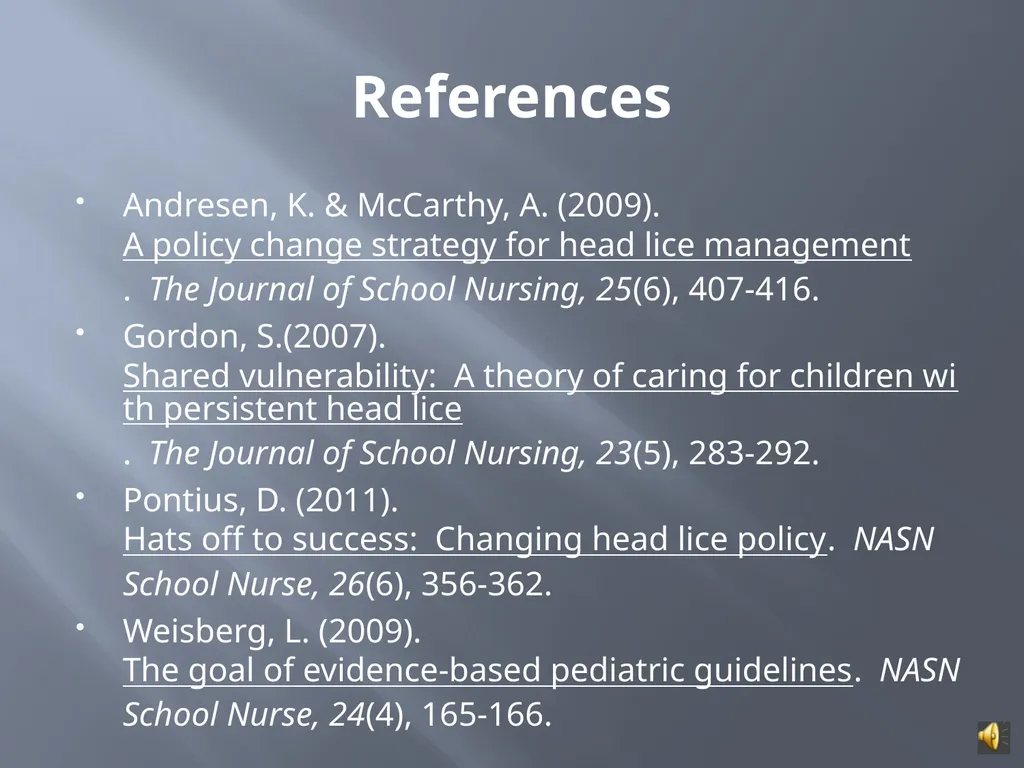
References Andresen, K. & McCarthy, A. (2009). A policy change strategy for head lice management. The Journal of School Nursing, 25(6), 407-416.
Gordon, S.(2007). Shared vulnerability: A theory of caring for children with persistent head lice. The Journal of School Nursing, 23(5), 283-292.
Pontius, D. (2011). Hats off to success: Changing head lice policy. NASN School Nurse, 26(6), 356-362.
Weisberg, L. (2009). The goal of evidence-based pediatric guidelines. NASN School Nurse, 24(4), 165-166.<br>
Gordon, S.(2007). Shared vulnerability: A theory of caring for children with persistent head lice. The Journal of School Nursing, 23(5), 283-292.
Pontius, D. (2011). Hats off to success: Changing head lice policy. NASN School Nurse, 26(6), 356-362.
Weisberg, L. (2009). The goal of evidence-based pediatric guidelines. NASN School Nurse, 24(4), 165-166.<br>
21
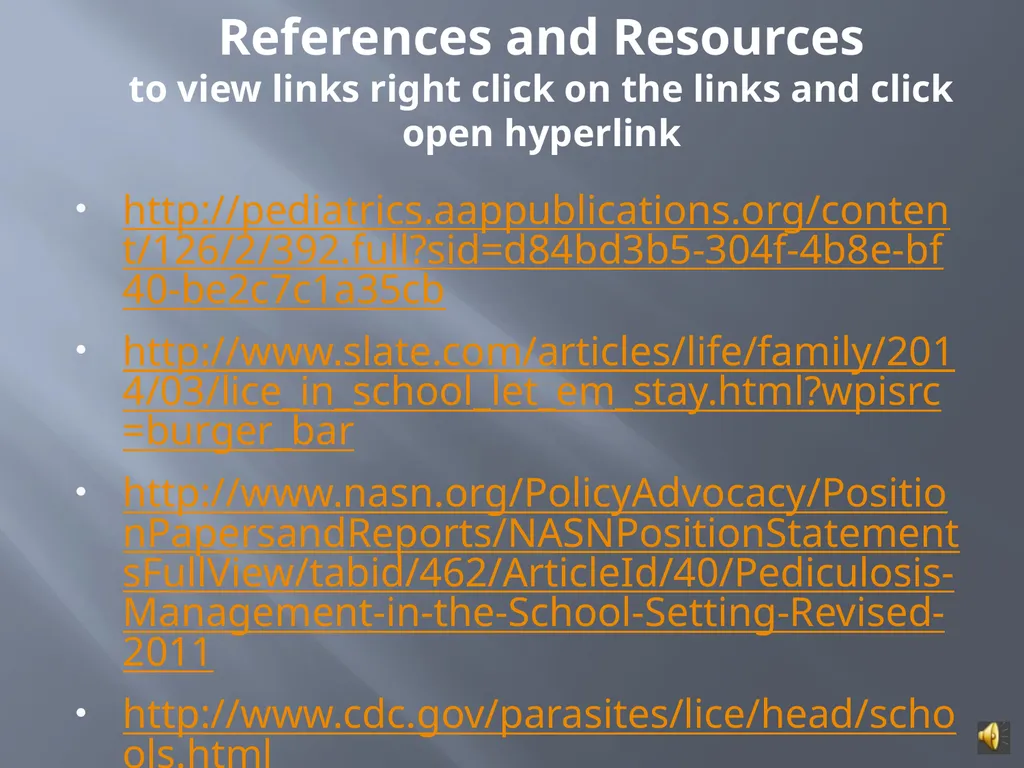
References and Resources
to view links right click on the links and click open hyperlink http://pediatrics.aappublications.org/content/126/2/392.full?sid=d84bd3b5-304f-4b8e-bf40-be2c7c1a35cb
http://www.slate.com/articles/life/family/2014/03/lice_in_school_let_em_stay.html?wpisrc=burger_bar
http://www.nasn.org/PolicyAdvocacy/PositionPapersandReports/NASNPositionStatementsFullView/tabid/462/ArticleId/40/Pediculosis-Management-in-the-School-Setting-Revised-2011
http://www.cdc.gov/parasites/lice/head/schools.html<br>
http://www.slate.com/articles/life/family/2014/03/lice_in_school_let_em_stay.html?wpisrc=burger_bar
http://www.nasn.org/PolicyAdvocacy/PositionPapersandReports/NASNPositionStatementsFullView/tabid/462/ArticleId/40/Pediculosis-Management-in-the-School-Setting-Revised-2011
http://www.cdc.gov/parasites/lice/head/schools.html<br>
22
Resources http://www.bostonglobe.com/lifestyle/health-wellness/2013/11/18/school-head-lice-policies-need-update/WeTYItmzgaPwNB2W4a6bmK/story.html
The National Association of School Nurses has many resources including handouts for teachers and parents
http://www.nasn.org/toolsresources/headlicepediculosiscapitis/licelessons<br>
The National Association of School Nurses has many resources including handouts for teachers and parents
http://www.nasn.org/toolsresources/headlicepediculosiscapitis/licelessons<br>