
Managing personal finance A4 Managing personal

Description: Managing personal finance A4 Managing personal finance If you wanted to buy a car but didnt have the money what other options are available to you? Managing personal finance In this topic you will learn about The suitability of different
Related Topics
Download Presentation
"Managing personal finance A4 Managing personal" is the property of its rightful owner. Permission is granted to download and print the materials on this website for personal, non-commercial use only, and to display it on your personal computer provided you do not modify the materials and that you retain all copyright notices contained in the materials. By downloading content from our website, you accept the terms of this agreement.
Presentation Transcript
slide1. Managing personal finance A4
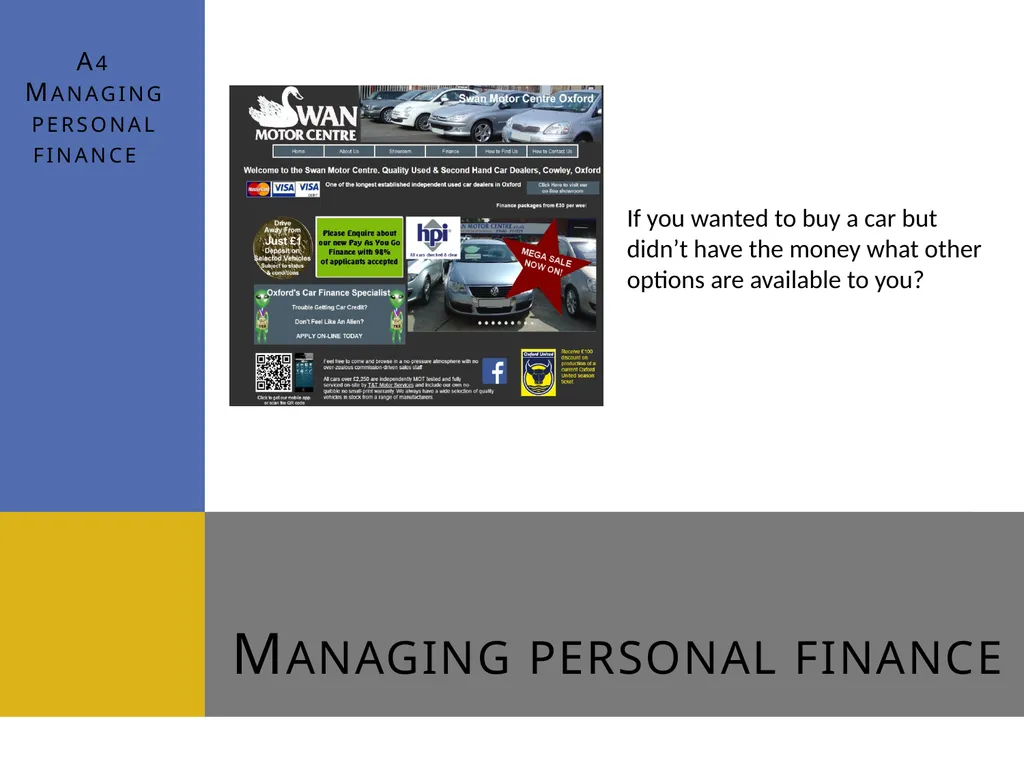
Managing personal finance If you wanted to buy a car but didn’t have the money what other options are available to you?<br>
slide2. Managing personal finance In this topic you will learn about
The suitability of different financial products and services against individual needs
Different types of borrowing, features, advantages and disadvantages:
Overdraft
Personal loans
Hire purchase
Mortgages
Credit cards
Payday loans
Different types of saving and investment features, advantages and disadvantages:
Individual savings accounts (ISAs)
Deposit and savings accounts
Premium bonds
Bonds and gilts
Shares
Pensions
Risks and rewards of saving versus investment
Different types of insurance products, features, advantages and disadvantages:
Car
Home and contents
Life assurance and insurance
Travel
Pet
Health<br>
slide3. Managing personal finance Suitability of different financial products and services will depend on a number of factors. Some of these include:
Personal circumstances e.g. fixed or varying monthly take home pay
Monthly amount that could be paid back
Nature of the good or service to be funded
Availability of an asset or guarantor to secure a loan against
Credit rating
Personal preferences<br>
slide4. Types of borrowing Overdraft
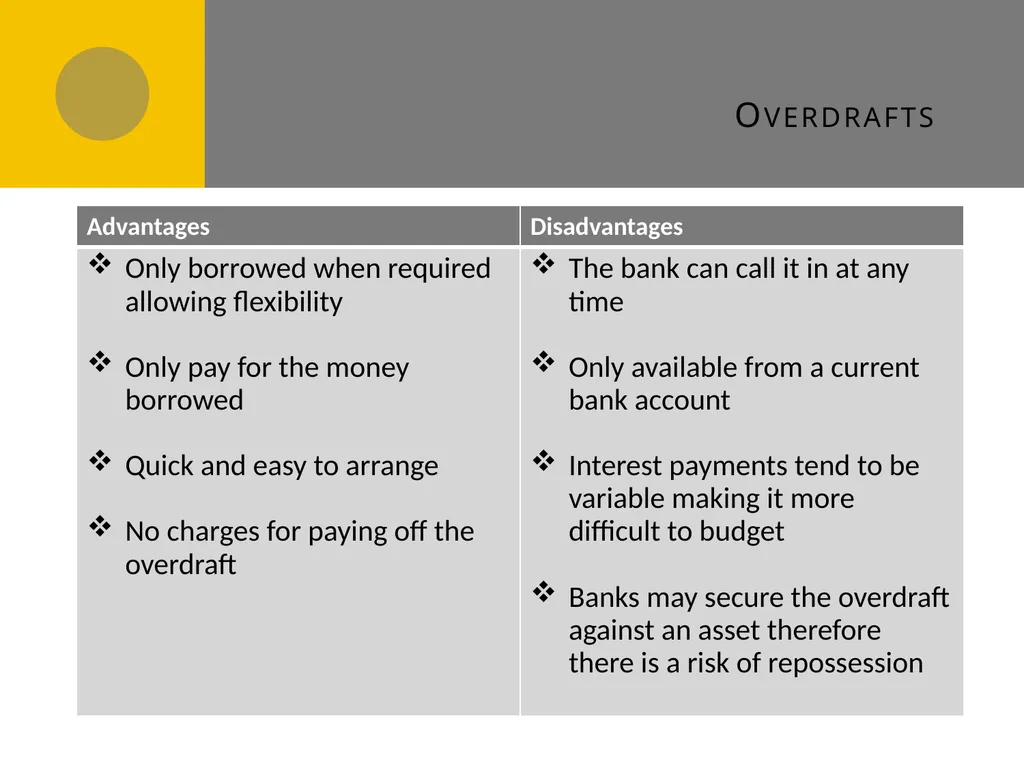
An overdraft is the facility to overspend on a current account up to an agreed sum
The individual in effect can withdraw money from the account that is not there meaning they go overdrawn or in the red
Interest is charged on the overdrawn amount
This is a good way to fund short-term cash shortages Borrowing is a way of funding a purchase now but paying for it over a period of time. Overdrafts can help with personal short-term financial shortages. But at what cost?<br>
slide5. Overdrafts<br>
slide6. Types of borrowing Personal loans
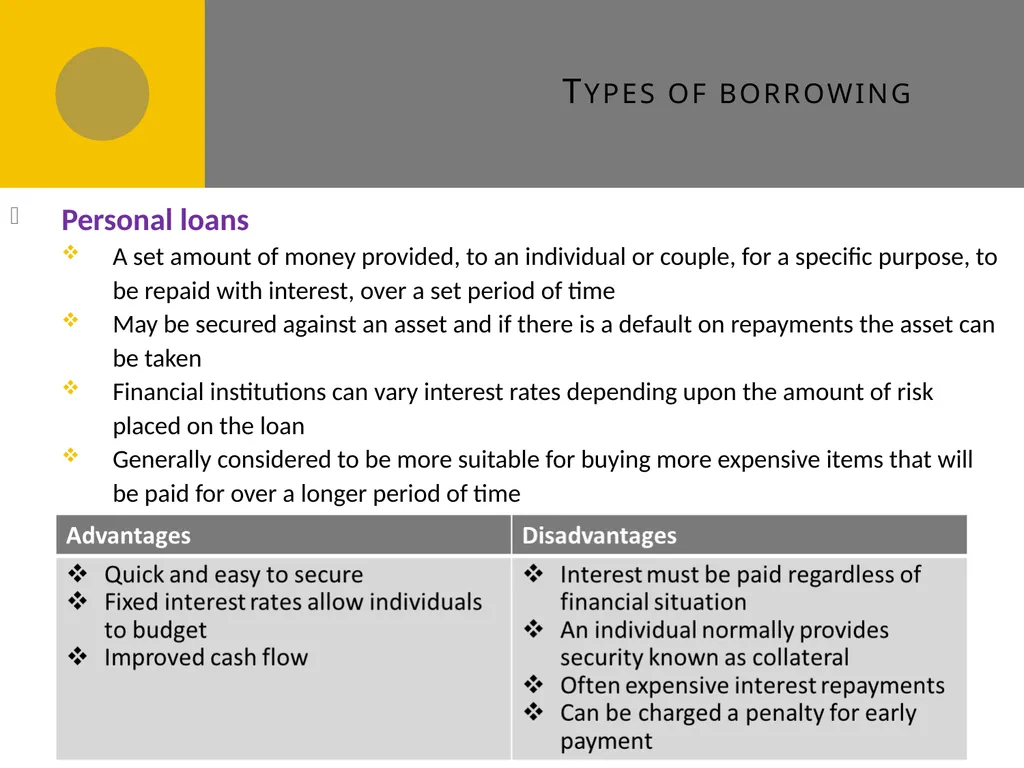
A set amount of money provided, to an individual or couple, for a specific purpose, to be repaid with interest, over a set period of time
May be secured against an asset and if there is a default on repayments the asset can be taken
Financial institutions can vary interest rates depending upon the amount of risk placed on the loan
Generally considered to be more suitable for buying more expensive items that will be paid for over a longer period of time<br>
slide7. Types of borrowing Hire purchase
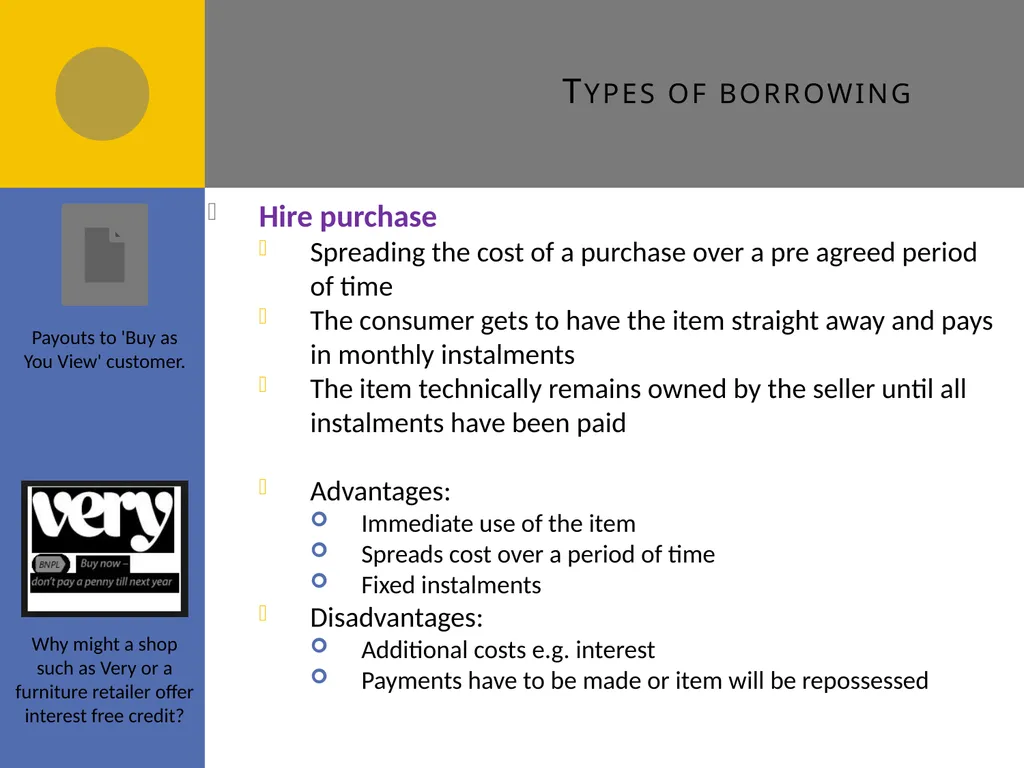
Spreading the cost of a purchase over a pre agreed period of time
The consumer gets to have the item straight away and pays in monthly instalments
The item technically remains owned by the seller until all instalments have been paid
Advantages:
Immediate use of the item
Spreads cost over a period of time
Fixed instalments
Disadvantages:
Additional costs e.g. interest
Payments have to be made or item will be repossessed Payouts to 'Buy as You View' customer. Why might a shop such as Very or a furniture retailer offer interest free credit?<br>
slide8. Types of borrowing Mortgage
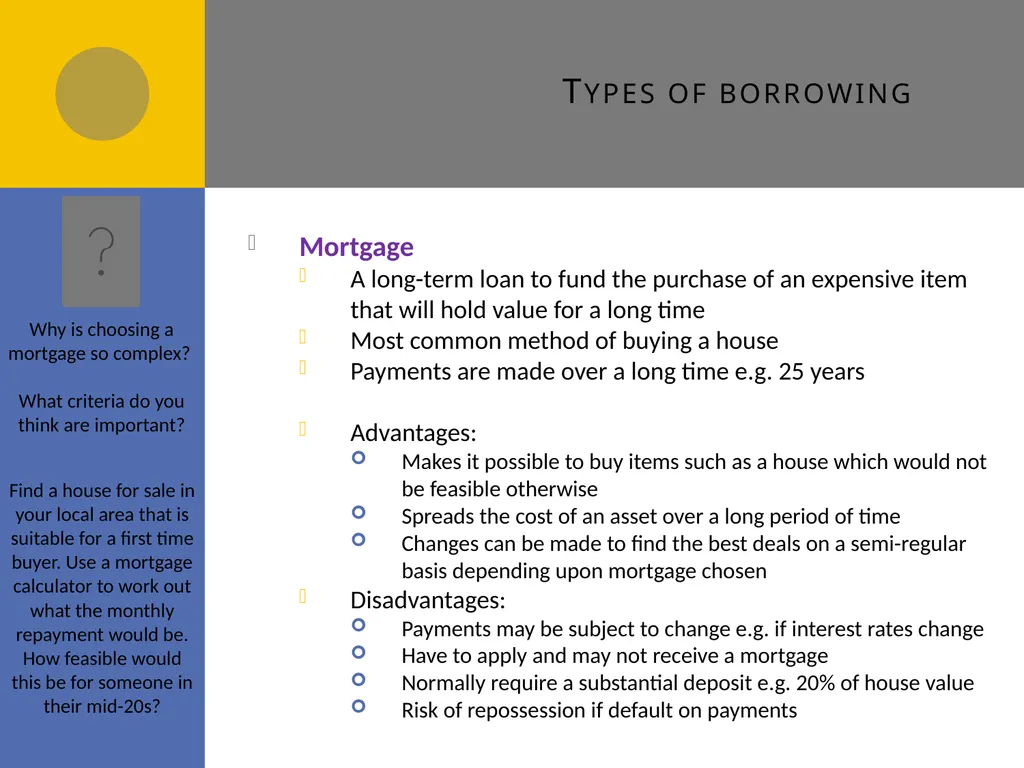
A long-term loan to fund the purchase of an expensive item that will hold value for a long time
Most common method of buying a house
Payments are made over a long time e.g. 25 years
Advantages:
Makes it possible to buy items such as a house which would not be feasible otherwise
Spreads the cost of an asset over a long period of time
Changes can be made to find the best deals on a semi-regular basis depending upon mortgage chosen
Disadvantages:
Payments may be subject to change e.g. if interest rates change
Have to apply and may not receive a mortgage
Normally require a substantial deposit e.g. 20% of house value
Risk of repossession if default on payments Why is choosing a mortgage so complex?
What criteria do you think are important? Find a house for sale in your local area that is suitable for a first time buyer. Use a mortgage calculator to work out what the monthly repayment would be. How feasible would this be for someone in their mid-20s?<br>
slide9. Types of borrowing Use your knowledge of credit cards and additional research to complete this slide for credit cards
Credit cards
Advantages:
Disadvantages: Recap A2 Ways to pay – credit cards.<br>
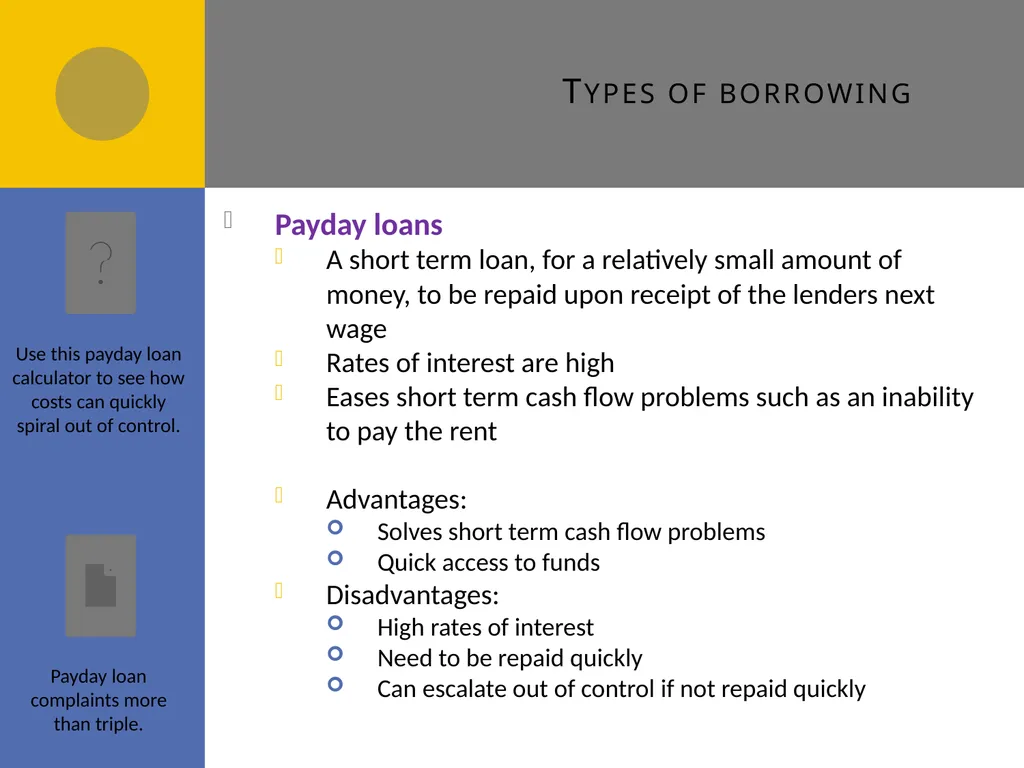
slide10. Types of borrowing Payday loans
A short term loan, for a relatively small amount of money, to be repaid upon receipt of the lenders next wage
Rates of interest are high
Eases short term cash flow problems such as an inability to pay the rent
Advantages:
Solves short term cash flow problems
Quick access to funds
Disadvantages:
High rates of interest
Need to be repaid quickly
Can escalate out of control if not repaid quickly Use this payday loan calculator to see how costs can quickly spiral out of control. Payday loan complaints more than triple.<br>
slide11. Types of saving and investment Discussion
What is the difference between savings and investments?
Which one do you think is the highest risk?
Write a definition of:
Saving
Investment<br>
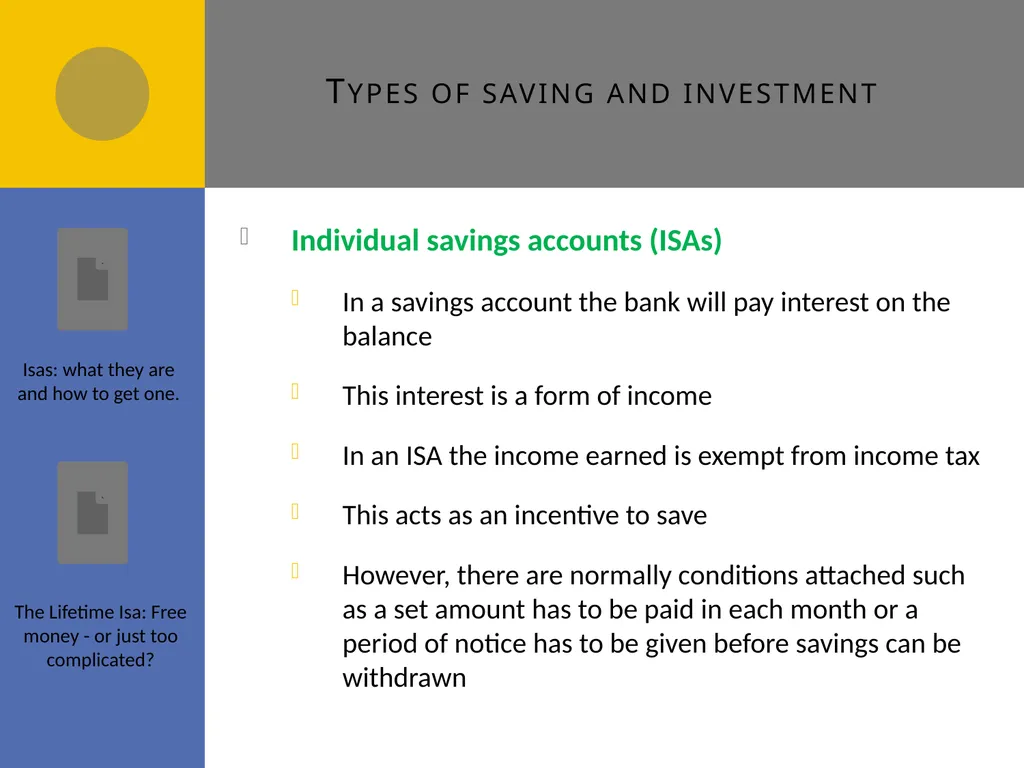
slide12. Types of saving and investment Individual savings accounts (ISAs)
In a savings account the bank will pay interest on the balance
This interest is a form of income
In an ISA the income earned is exempt from income tax
This acts as an incentive to save
However, there are normally conditions attached such as a set amount has to be paid in each month or a period of notice has to be given before savings can be withdrawn Isas: what they are and how to get one. The Lifetime Isa: Free money - or just too complicated?<br>
slide13. Types of saving and investment Deposit and savings accounts
Accounts held with banks or building societies where interest is paid on positive balances
Funds cannot be withdrawn immediately e.g. from an ATM as notice has to be given
Interest paid is subject to income tax, but only if above a certain level e.g. an individual who pays the basic rate of 20% income tax can earn up to £1000 a year in interest tax free
The value of savings will increase, assuming withdrawals are not made, as a result of interest received In pairs select 4 banks.
Research the deposit and savings accounts to produce a chart comparing the banks.
If you were to open an account which one would you choose and why?
If you were to recommend one to someone in their 50s which one would you recommend and why?<br>
slide14. Types of saving and investment* Premium bonds
A government incentive for individuals to save
Bonds are sold by the National Savings and Investment Bank
Each month bonds are entered into a prize draw with the opportunity to win up to £1 million
Each person is limited to holding up to £50 000 (2016) in bonds. This figure is revised periodically
The prize fund can be changed to reflect changes in interest rates
Interest is not paid on the savings The machine that picks the winning bond numbers is often affectionately referred to as ERNIE. Can you work out what this stands for? Would you prefer to put your money in a savings account or premium bonds? Justify your answer. November 2016 Happy 60th Birthday to Premium Bonds.<br>
slide15. Types of saving and investment Bonds and gilts
Individuals or companies lend money to the government in return for an IOU
A fixed rate of interest is paid on the loan and the initial sum repaid in full at a set point in the future
Shares
Investments made when individuals or organisations become part owners of a business i.e. they invest finance in return for equity
Shareholders’ objectives are to receive income in the form of dividends paid from the companies profits as well as to gain wealth as share prices increase
Unfortunately, share prices can move in both directions and dividends are not guaranteed What are government bonds?<br>
slide16. Types of saving and investment Pensions
Saving plans whereby the individual makes regular contributions to a pension policy
The objective is to plan for the future so that an income is available upon retirement
Pensions can give a lump sum payment, regular payments or a combination of the two
Pensions can be private where only the individual contributes or company pensions where the employer also makes a contribution
Individuals pay national insurance as a contribution towards a state pension Why are a lot of pensioners confused? How have state pension ages changed?
At what age will you be eligible?<br>
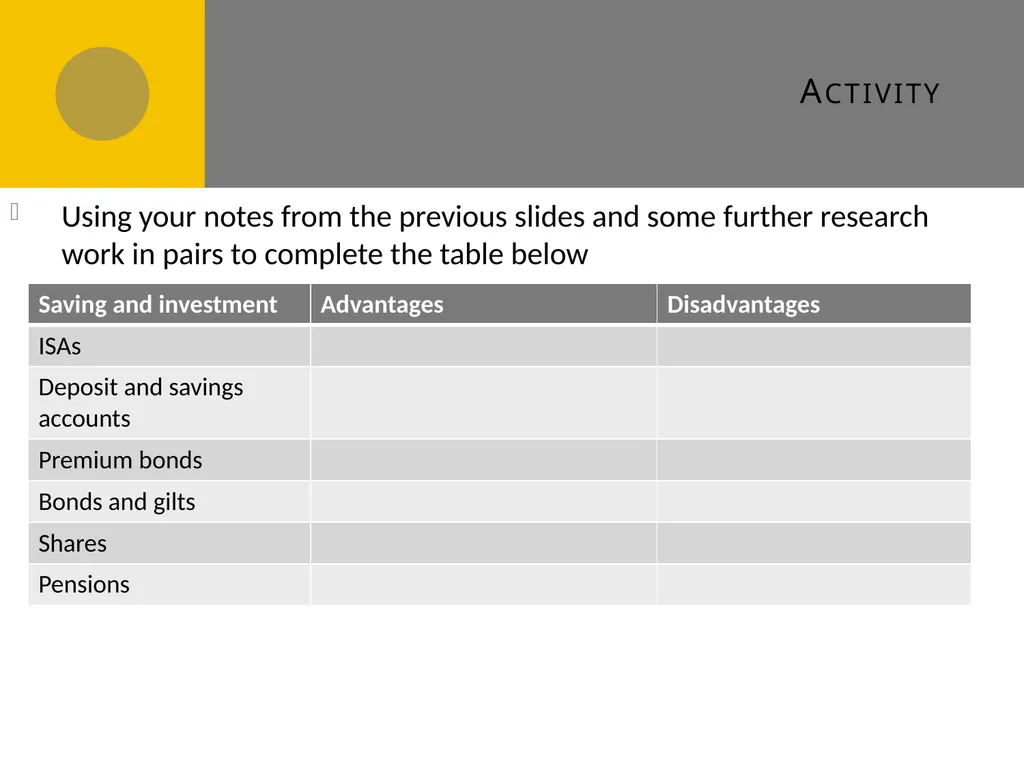
slide17. Activity Using your notes from the previous slides and some further research work in pairs to complete the table below<br>
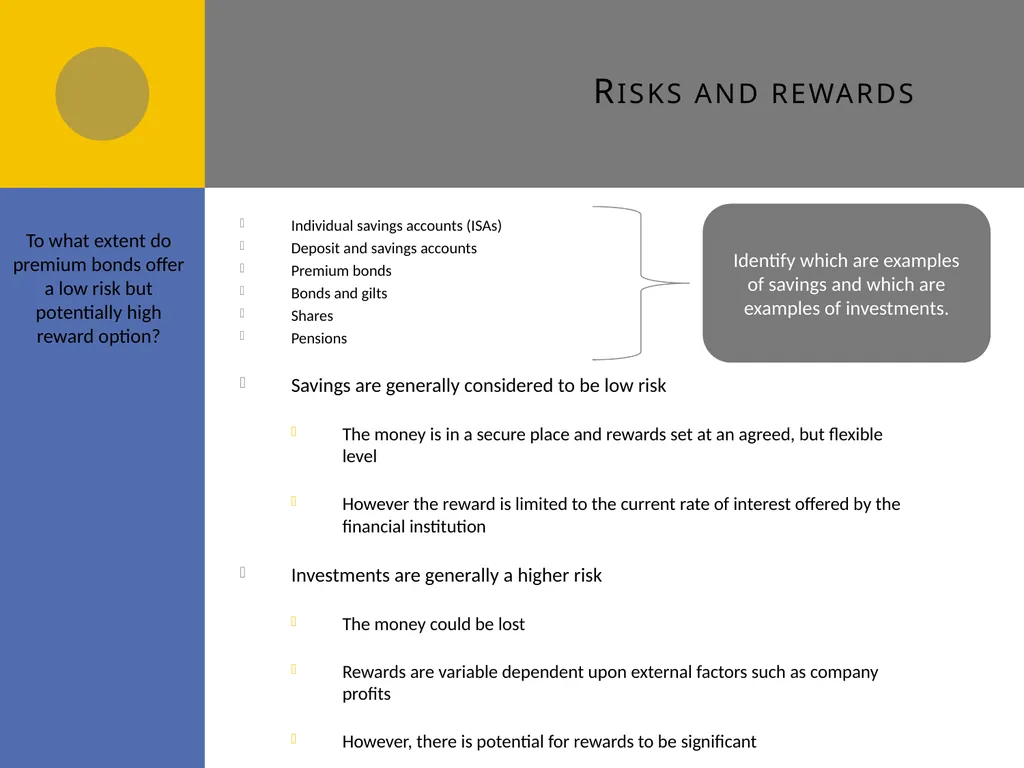
slide18. Risks and rewards Individual savings accounts (ISAs)
Deposit and savings accounts
Premium bonds
Bonds and gilts
Shares
Pensions
Savings are generally considered to be low risk
The money is in a secure place and rewards set at an agreed, but flexible level
However the reward is limited to the current rate of interest offered by the financial institution
Investments are generally a higher risk
The money could be lost
Rewards are variable dependent upon external factors such as company profits
However, there is potential for rewards to be significant Identify which are examples of savings and which are examples of investments. To what extent do premium bonds offer a low risk but potentially high reward option?<br>
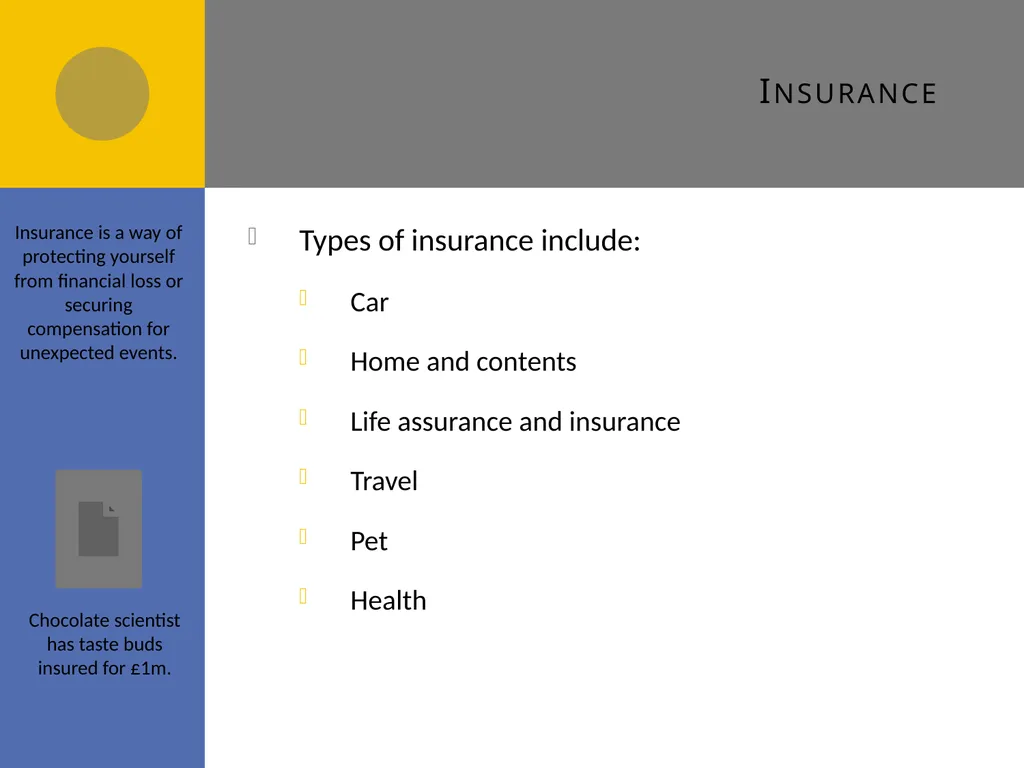
slide19. Insurance Types of insurance include:
Car
Home and contents
Life assurance and insurance
Travel
Pet
Health Insurance is a way of protecting yourself from financial loss or securing compensation for unexpected events. Chocolate scientist has taste buds insured for £1m.<br>
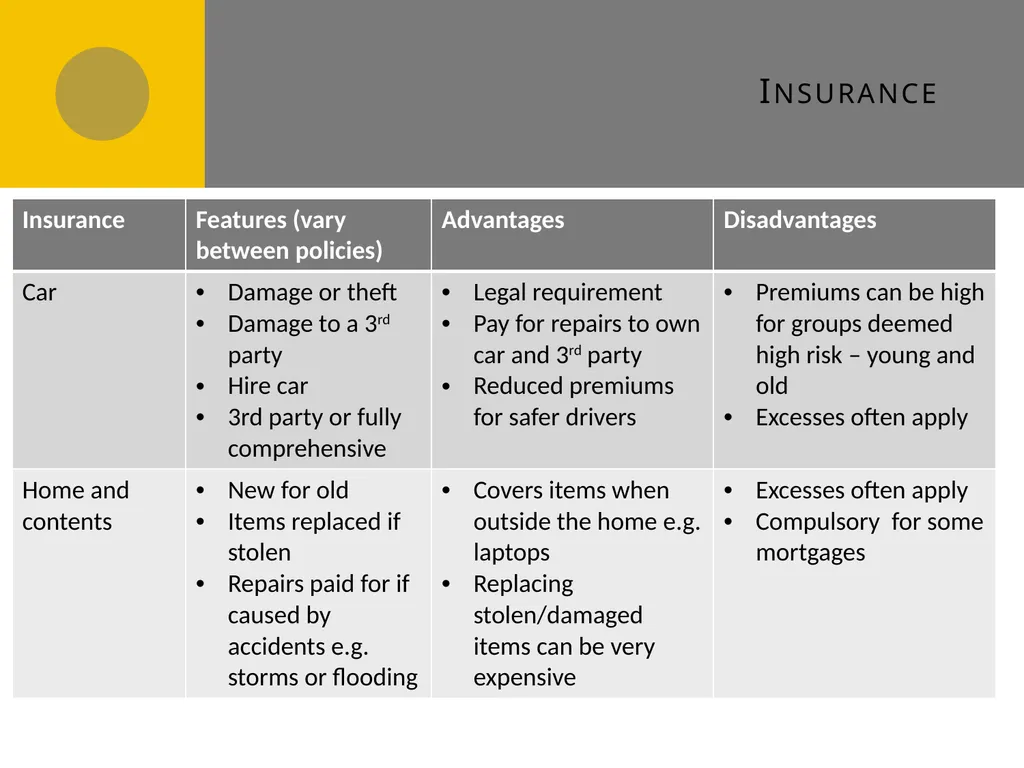
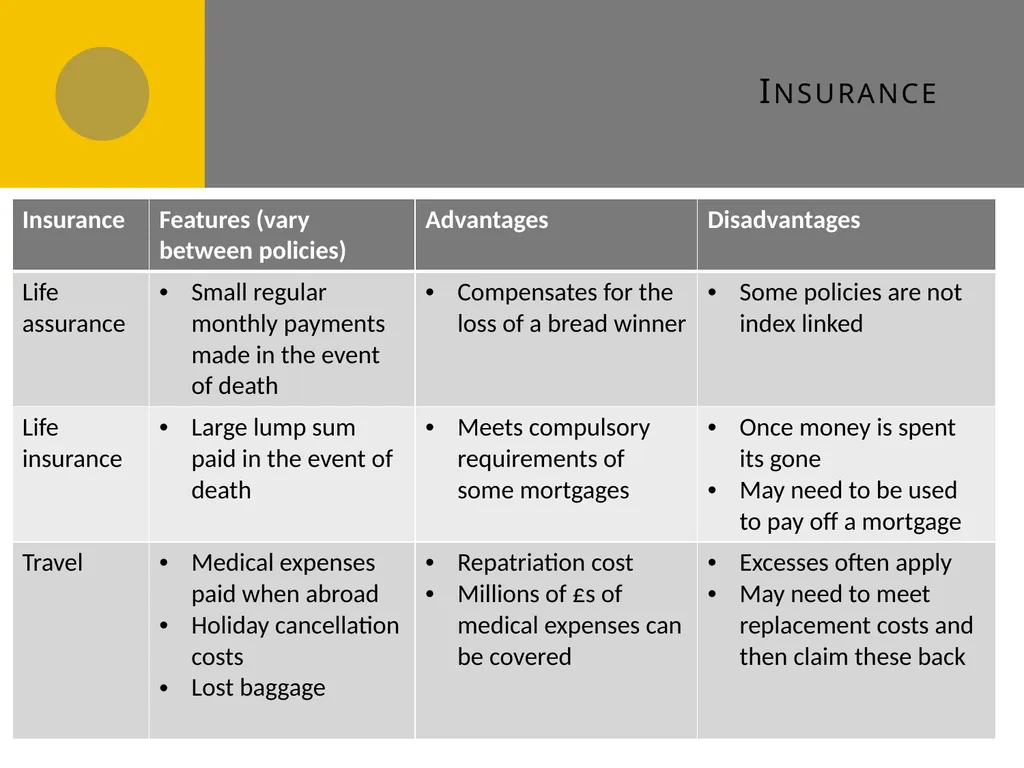
slide20. Insurance<br>
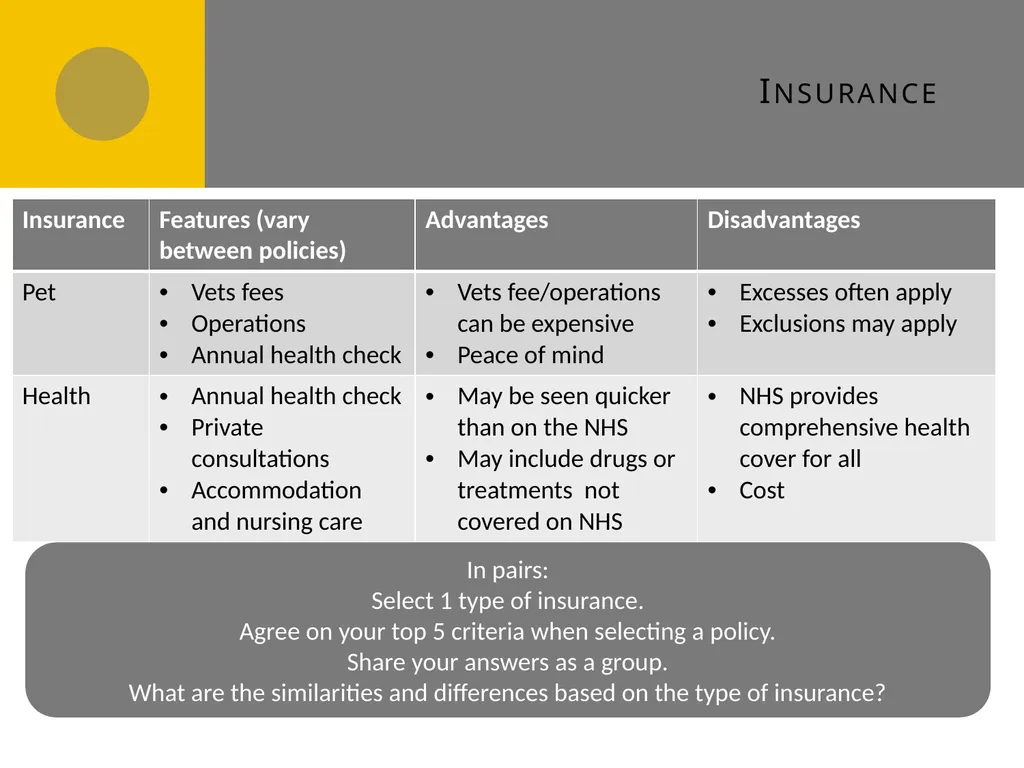
slide21. Insurance<br>
slide22. Insurance In pairs:
Select 1 type of insurance.
Agree on your top 5 criteria when selecting a policy.
Share your answers as a group.
What are the similarities and differences based on the type of insurance?<br>
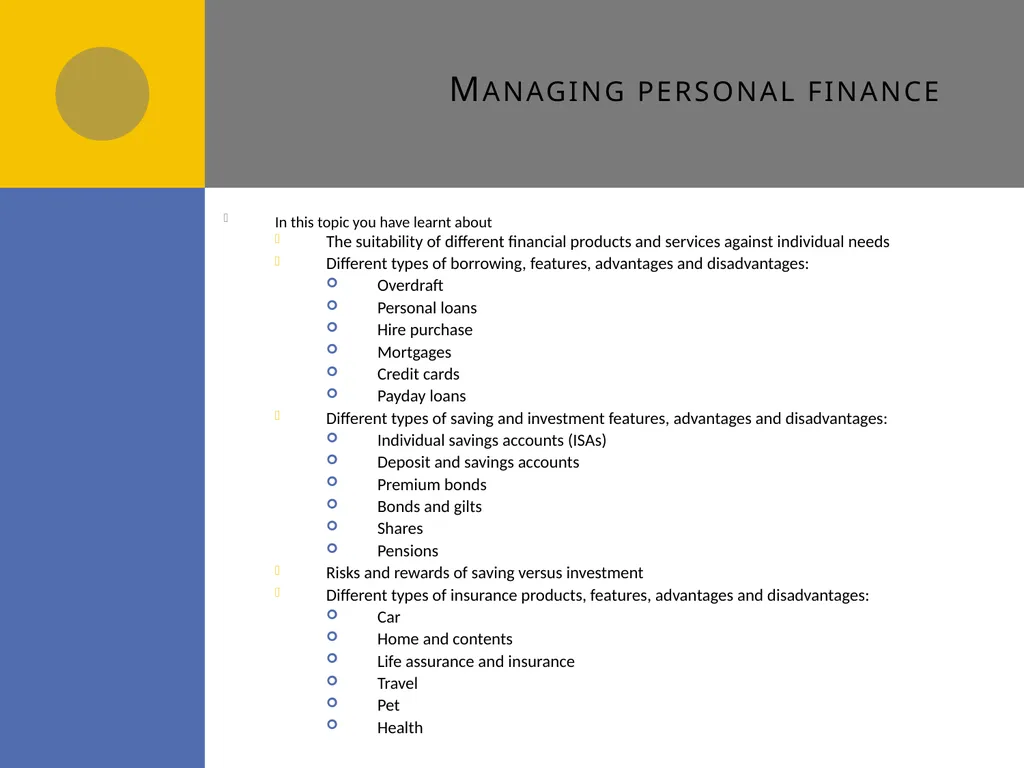
slide23. Managing personal finance In this topic you have learnt about
The suitability of different financial products and services against individual needs
Different types of borrowing, features, advantages and disadvantages:
Overdraft
Personal loans
Hire purchase
Mortgages
Credit cards
Payday loans
Different types of saving and investment features, advantages and disadvantages:
Individual savings accounts (ISAs)
Deposit and savings accounts
Premium bonds
Bonds and gilts
Shares
Pensions
Risks and rewards of saving versus investment
Different types of insurance products, features, advantages and disadvantages:
Car
Home and contents
Life assurance and insurance
Travel
Pet
Health<br>
Managing personal finance If you wanted to buy a car but didn’t have the money what other options are available to you?<br>
slide2. Managing personal finance In this topic you will learn about
The suitability of different financial products and services against individual needs
Different types of borrowing, features, advantages and disadvantages:
Overdraft
Personal loans
Hire purchase
Mortgages
Credit cards
Payday loans
Different types of saving and investment features, advantages and disadvantages:
Individual savings accounts (ISAs)
Deposit and savings accounts
Premium bonds
Bonds and gilts
Shares
Pensions
Risks and rewards of saving versus investment
Different types of insurance products, features, advantages and disadvantages:
Car
Home and contents
Life assurance and insurance
Travel
Pet
Health<br>
slide3. Managing personal finance Suitability of different financial products and services will depend on a number of factors. Some of these include:
Personal circumstances e.g. fixed or varying monthly take home pay
Monthly amount that could be paid back
Nature of the good or service to be funded
Availability of an asset or guarantor to secure a loan against
Credit rating
Personal preferences<br>
slide4. Types of borrowing Overdraft
An overdraft is the facility to overspend on a current account up to an agreed sum
The individual in effect can withdraw money from the account that is not there meaning they go overdrawn or in the red
Interest is charged on the overdrawn amount
This is a good way to fund short-term cash shortages Borrowing is a way of funding a purchase now but paying for it over a period of time. Overdrafts can help with personal short-term financial shortages. But at what cost?<br>
slide5. Overdrafts<br>
slide6. Types of borrowing Personal loans
A set amount of money provided, to an individual or couple, for a specific purpose, to be repaid with interest, over a set period of time
May be secured against an asset and if there is a default on repayments the asset can be taken
Financial institutions can vary interest rates depending upon the amount of risk placed on the loan
Generally considered to be more suitable for buying more expensive items that will be paid for over a longer period of time<br>
slide7. Types of borrowing Hire purchase
Spreading the cost of a purchase over a pre agreed period of time
The consumer gets to have the item straight away and pays in monthly instalments
The item technically remains owned by the seller until all instalments have been paid
Advantages:
Immediate use of the item
Spreads cost over a period of time
Fixed instalments
Disadvantages:
Additional costs e.g. interest
Payments have to be made or item will be repossessed Payouts to 'Buy as You View' customer. Why might a shop such as Very or a furniture retailer offer interest free credit?<br>
slide8. Types of borrowing Mortgage
A long-term loan to fund the purchase of an expensive item that will hold value for a long time
Most common method of buying a house
Payments are made over a long time e.g. 25 years
Advantages:
Makes it possible to buy items such as a house which would not be feasible otherwise
Spreads the cost of an asset over a long period of time
Changes can be made to find the best deals on a semi-regular basis depending upon mortgage chosen
Disadvantages:
Payments may be subject to change e.g. if interest rates change
Have to apply and may not receive a mortgage
Normally require a substantial deposit e.g. 20% of house value
Risk of repossession if default on payments Why is choosing a mortgage so complex?
What criteria do you think are important? Find a house for sale in your local area that is suitable for a first time buyer. Use a mortgage calculator to work out what the monthly repayment would be. How feasible would this be for someone in their mid-20s?<br>
slide9. Types of borrowing Use your knowledge of credit cards and additional research to complete this slide for credit cards
Credit cards
Advantages:
Disadvantages: Recap A2 Ways to pay – credit cards.<br>
slide10. Types of borrowing Payday loans
A short term loan, for a relatively small amount of money, to be repaid upon receipt of the lenders next wage
Rates of interest are high
Eases short term cash flow problems such as an inability to pay the rent
Advantages:
Solves short term cash flow problems
Quick access to funds
Disadvantages:
High rates of interest
Need to be repaid quickly
Can escalate out of control if not repaid quickly Use this payday loan calculator to see how costs can quickly spiral out of control. Payday loan complaints more than triple.<br>
slide11. Types of saving and investment Discussion
What is the difference between savings and investments?
Which one do you think is the highest risk?
Write a definition of:
Saving
Investment<br>
slide12. Types of saving and investment Individual savings accounts (ISAs)
In a savings account the bank will pay interest on the balance
This interest is a form of income
In an ISA the income earned is exempt from income tax
This acts as an incentive to save
However, there are normally conditions attached such as a set amount has to be paid in each month or a period of notice has to be given before savings can be withdrawn Isas: what they are and how to get one. The Lifetime Isa: Free money - or just too complicated?<br>
slide13. Types of saving and investment Deposit and savings accounts
Accounts held with banks or building societies where interest is paid on positive balances
Funds cannot be withdrawn immediately e.g. from an ATM as notice has to be given
Interest paid is subject to income tax, but only if above a certain level e.g. an individual who pays the basic rate of 20% income tax can earn up to £1000 a year in interest tax free
The value of savings will increase, assuming withdrawals are not made, as a result of interest received In pairs select 4 banks.
Research the deposit and savings accounts to produce a chart comparing the banks.
If you were to open an account which one would you choose and why?
If you were to recommend one to someone in their 50s which one would you recommend and why?<br>
slide14. Types of saving and investment* Premium bonds
A government incentive for individuals to save
Bonds are sold by the National Savings and Investment Bank
Each month bonds are entered into a prize draw with the opportunity to win up to £1 million
Each person is limited to holding up to £50 000 (2016) in bonds. This figure is revised periodically
The prize fund can be changed to reflect changes in interest rates
Interest is not paid on the savings The machine that picks the winning bond numbers is often affectionately referred to as ERNIE. Can you work out what this stands for? Would you prefer to put your money in a savings account or premium bonds? Justify your answer. November 2016 Happy 60th Birthday to Premium Bonds.<br>
slide15. Types of saving and investment Bonds and gilts
Individuals or companies lend money to the government in return for an IOU
A fixed rate of interest is paid on the loan and the initial sum repaid in full at a set point in the future
Shares
Investments made when individuals or organisations become part owners of a business i.e. they invest finance in return for equity
Shareholders’ objectives are to receive income in the form of dividends paid from the companies profits as well as to gain wealth as share prices increase
Unfortunately, share prices can move in both directions and dividends are not guaranteed What are government bonds?<br>
slide16. Types of saving and investment Pensions
Saving plans whereby the individual makes regular contributions to a pension policy
The objective is to plan for the future so that an income is available upon retirement
Pensions can give a lump sum payment, regular payments or a combination of the two
Pensions can be private where only the individual contributes or company pensions where the employer also makes a contribution
Individuals pay national insurance as a contribution towards a state pension Why are a lot of pensioners confused? How have state pension ages changed?
At what age will you be eligible?<br>
slide17. Activity Using your notes from the previous slides and some further research work in pairs to complete the table below<br>
slide18. Risks and rewards Individual savings accounts (ISAs)
Deposit and savings accounts
Premium bonds
Bonds and gilts
Shares
Pensions
Savings are generally considered to be low risk
The money is in a secure place and rewards set at an agreed, but flexible level
However the reward is limited to the current rate of interest offered by the financial institution
Investments are generally a higher risk
The money could be lost
Rewards are variable dependent upon external factors such as company profits
However, there is potential for rewards to be significant Identify which are examples of savings and which are examples of investments. To what extent do premium bonds offer a low risk but potentially high reward option?<br>
slide19. Insurance Types of insurance include:
Car
Home and contents
Life assurance and insurance
Travel
Pet
Health Insurance is a way of protecting yourself from financial loss or securing compensation for unexpected events. Chocolate scientist has taste buds insured for £1m.<br>
slide20. Insurance<br>
slide21. Insurance<br>
slide22. Insurance In pairs:
Select 1 type of insurance.
Agree on your top 5 criteria when selecting a policy.
Share your answers as a group.
What are the similarities and differences based on the type of insurance?<br>
slide23. Managing personal finance In this topic you have learnt about
The suitability of different financial products and services against individual needs
Different types of borrowing, features, advantages and disadvantages:
Overdraft
Personal loans
Hire purchase
Mortgages
Credit cards
Payday loans
Different types of saving and investment features, advantages and disadvantages:
Individual savings accounts (ISAs)
Deposit and savings accounts
Premium bonds
Bonds and gilts
Shares
Pensions
Risks and rewards of saving versus investment
Different types of insurance products, features, advantages and disadvantages:
Car
Home and contents
Life assurance and insurance
Travel
Pet
Health<br>